Breast
2026-09-23
BIG 3-07/TROG 07.01 NCT00470236
ForNon-low-risk DCIS after BCS, ≥1 mm clear radial margins
TL;DRTumour bed boost after WBI in resected non-low-risk DCIS: 5-yr freedom from LR 97.1% vs 92.7%, HR 0.47 (0.31-0.72), p<0.001.
The boost gain held on a 42.5 Gy/16 fx WBI backbone as well as 50 Gy/25 fx, so boost is not tied to conventional fractionation. The cost is G2+ induration 14% vs 6%, which is the number to weigh when deciding boost vs omission after ≥1 mm margins in non-low-risk DCIS.
In a woman with resected non-low-risk DCIS and ≥1 mm margins planned for WBI, this supports offering a 16 Gy/8 fx boost against a higher G2+ induration and pain rate; it does not address low-risk DCIS or pts with <1 mm margins. The longer read
Boost 16 Gy/8 fx cut LR hazard (HR 0.47) on both 50 Gy/25 fx and 42.5 Gy/16 fx WBI backbones, so it transfers to hypofractionated practice. The trade is G2+ induration 14% vs 6%, which frames the boost-or-omit conversation in non-low-risk DCIS with ≥1 mm margins.
7 details 4 trials watching
International randomised, unmasked, factorial phase 3, 136 centres across six trial groups in 11 countries. N=1608 accrued 2007-2014; median f/u 6.6 yr.
Women ≥18y with unilateral, histologically proven non-low-risk DCIS after breast-conserving surgery with ≥1 mm clear radial margins.
WBI either 50 Gy/25 fx (n=831) or 42.5 Gy/16 fx (n=777), randomised in a 4-arm factorial or chosen per centre. Boost 16 Gy/8 fx to tumour bed after WBI.
Primary: time to local recurrence. Toxicity reported as G2+ breast pain and induration.
Boost raised G2+ breast pain (14% vs 10%, p=0.003) and G2+ induration (14% vs 6%, p<0.001).
Older DCIS trials (NSABP B-17, EORTC 10853) established WBI after lumpectomy but did not test boost; the EORTC boost trial tested it only in invasive disease. This is the first randomised boost evidence in DCIS.
The fractionation-sensitivity result is not reported in the source abstract, so hypofractionation non-inferiority in DCIS cannot be read from it. Toxicity is assessor-unmasked, and no survival endpoint is reported.
A boost roughly halves local recurrence hazard in non-low-risk DCIS at a real cost in G2+ breast morbidity. It does not settle which non-low-risk subsets carry enough baseline risk to justify that trade.
CONSORT flow
Adequately powered phase 3 RCT, primary endpoint hit with 6.6-yr median f/u; first randomised boost data in DCIS. Qualified by unmasked design and added G2+ toxicity.
- Which non-low-risk DCIS subsets derive most boost benefit
- Local recurrence with hypofractionated vs conventional WBI in DCIS n=301 · primary completion 2020-11 · randomised hypo vs standard WBI, DCIS eligiblen=72 · primary completion 2026-12 · 1-wk vs 3.1-wk WBI, DCIS eligible, local control EP
- Boost role with ultra-hypofractionated or partial-breast RT recruiting Ultra Hypo-fractionated Adjuvant Whole Breast Radiation Therapy With Simultaneous Integrated Boost for Early-Stage Breast Cancer (H-ASSIST) Phase 2n=90 · primary completion 2028-02 · 5-fx WBI + SIB tumour bed boost, DCIS includedrecruiting 5 vs. 9-day Course of Whole Breast Radiotherapy With Boost for Early-stage Breast Cancer Phase 2n=144 · primary completion 2030-05 · randomised 5 vs 9 day WBI with boost, DCIS eligible
📚 Sources · 📄 1 paper
Abstract
2026-08-13
Moderately hypofractionated partial breast reirradiation
ForIsolated IBTR after BCS + WBI, T1-2, unifocal, ≥48mo interval, age ≥50
TL;DR40Gy/15fx PBI re-RT after second lumpectomy: 3yr LR-FS, DR-FS and OS all 86%, no grade 3+ late events (N=11).
The transferable read is the fractionation, not the outcome: 40 Gy / 2.67 Gy daily PBI met every OAR objective with heart Dmean 1.44 Gy and ipsilateral lung V16Gy 7.74%, so a once-daily 15-fraction re-RT can be planned inside standard constraints. That removes the BID-visit burden that limits RTOG 1014 uptake, though no plan sum with the first WBI course was possible.
For the woman with an isolated T1-2 IBTR ≥4 years after BCS plus WBI who wants to keep her breast, this supports offering once-daily hypofractionated PBI re-RT rather than only BID schedules; it says nothing about multifocal, T4, or short-interval recurrence, where mastectomy remains the comparator. The longer read
The transferable detail is the plan, not the outcome: 40 Gy / 2.67 Gy daily PBI with direct-planning IMRT achieved heart Dmean 1.44 Gy and ipsilateral lung V16Gy 7.74%, well inside objectives, in previously whole-breast-irradiated tissue. That makes a once-daily 15-fraction re-RT schedule planable without the BID burden, though no plan sum with the first course was possible.
Repeat lumpectomy rather than salvage mastectomy held in 9 of 11 at 3 years, with recurrences at 11 and 15 months. Selection was tight: unifocal T1-2 on triple imaging, ≥48 months from primary treatment. SLNB was attempted in 8 and failed to identify a node in 2, which is worth flagging when planning axillary staging at second conservation.
16 details 2 trials watching
Retrospective review of a departmental re-RT database, single institution (Porto), treated 2017-2021. Thirteen identified, two excluded (different fractionation; T4 treated with WBI), leaving N = 11. Median follow-up 41 months (27-62), Kaplan-Meier estimates with two-sided log-rank comparisons.
Isolated ipsilateral breast tumor recurrence after BCS plus whole-breast irradiation, all T1-2, clinically node negative, no metastatic disease before second BCS. Inclusion required age ≥ 50, unifocal disease on ultrasound, mammography and MRI, size < 2-3 cm, and an interval of ≥ 48 months from primary treatment. Median age at recurrence 63 (41-81), ECOG 0-1 in all.
Initial course was whole-breast irradiation at 2 Gy/fraction in all 11, with a 10 Gy / 5 fraction boost in 2. Re-RT was partial breast, 40 Gy at 2.67 Gy daily, direct-planning IMRT, supine, without DIBH. Median interval between courses 107 months (27-239).
No registered primary. LR-FS, DR-FS and OS by Kaplan-Meier from the day of re-RT completion, with adverse events graded by CTCAE v5.0 (acute < 90 days, late > 90 days) and cosmesis by the Harris scale.
At 3 years, 9/11 free from local recurrence, 10/11 from distant recurrence, 9/11 alive, each 86%. Two local recurrences, at 11 and 15 months. TAM-stratified LR-FS was 100% low risk, 80% intermediate, 100% in the single high-risk patient; the OS difference between low and intermediate risk was not significant (p = 0.75).
| Parameter | Objective | Achieved mean (range) |
|---|---|---|
| PTV V95% | > 98% | 98.36 (98-99.45) |
| PTV V107% | < 2% | 0 (0) |
| Ipsi lung V16Gy | < 15% | 7.74 (1.41-14.98) |
| Ipsi lung V8Gy | < 35% | 13.22 (2.78-34.58) |
| Heart Dmean | < 3.2 Gy | 1.44 (0.48-3.09) |
| Heart V16Gy | < 5% | 1.53 (0-4.89) |
| Contra lung V4Gy | < 10% | 1.09 (0-8.74) |
No grade 3 or higher late reactions. Acute events were skin-limited, most commonly grade 1-2 dermatitis (8 grade 1 erythema, 2 grade 1 pigmentation, 1 pruritus). At 1 year, grade 1 fibrosis in 9 and grade 1-2 oedema in 5, breast pain grade 1 in 2. No cardiopulmonary events, no rib fractures. Cosmesis good in 6, fair in 2, poor in 3.
RTOG 1014 (45 Gy / 1.5 Gy BID, 3D-CRT, n = 66) reported 7% late grade 3 and no grade 4-5 at 5.5 years; Janssen 2018 (n = 83, 45 Gy / 1.8 Gy daily) reported a 15% LR rate at 35 months. Brachytherapy series sit at 94-100% third-IBTR-free survival with 8-11% grade 3-4 complications. This cohort's toxicity is at or below all of them, on a fraction of the patient numbers and follow-up.
The first course's dose distribution was unavailable, so no composite plan sum could be produced and cumulative OAR dose stays uncharacterized, which is the number that actually gates re-RT safety. Cosmesis was scored unblinded by the treating radiation oncologist, and the reported confidence intervals (46-62%, 52-65%, 47-63%) do not contain their own 86% point estimates as printed.
The contribution is schedule feasibility, not efficacy: a once-daily 15-fraction re-RT plan met every published constraint with wide margin, which is what a department needs before abandoning BID. Whether 40 Gy in 15 fractions matches 45 Gy BID for in-breast control remains untested; two events in 11 patients cannot answer it.
Retrospective single-arm series, N=11, 2 events, median f/u 41 months. No comparator vs mastectomy or vs the established BID re-RT schedules.
- Does 40 Gy/15fx match 45 Gy BID for in-breast control? n=30 · primary completion 2025-08 · same 40Gy/15fx re-RT schedule, skin toxicityn=171 · primary completion 2027-06 · rPBI 5fx after prior WBI, in-breast recurrence
- Late fibrosis beyond 4 years in the overlap volume
- Cumulative OAR dose without a first-course plan sum
📚 Sources · 📄 1 paper
2026-08-12
NSABP B-35 margin-width analysis
ForPostmenopausal HR+ DCIS after lumpectomy, WBI and 5yr endocrine therapy
5.6% vs 4.0%
1mm cutoff, absolute difference 1.6%; 2mm cutoff 5.3% vs 3.8%
TL;DR10yr IBTR 5.6% vs 4.0% at 1mm cutoff (abs diff 1.6%), 5.3% vs 3.8% at 2mm (abs diff 1.5%).
Reported via The ASCO Post →
The RT-relevant read is that every patient here got whole-breast irradiation plus 5 years of endocrine therapy, so the 1.5% to 1.6% margin penalty is the residual after full adjuvant treatment. That gates transfer: it says nothing about a close margin when RT is omitted or refused, which is where the margin question actually bites.
In a postmenopausal woman with HR+ DCIS whose lumpectomy margin is under 2mm and who will complete whole-breast RT plus 5yr endocrine therapy, this argues re-excision buys little; it does not extend to premenopausal, HR-negative, or RT-omitted pts. The longer read
Every patient here received whole-breast irradiation with an optional boost plus 5yr endocrine therapy, so 1.5% to 1.6% is the residual margin effect after full adjuvant treatment. Boost use by margin group is not reported in source, which matters: it determines whether a close margin was tolerated or quietly compensated.
A margin under 2mm carried a 10yr IBTR of 5.3% vs 3.8% for ≥2mm, an absolute 1.5% penalty, in the largest randomised-trial population yet examined. That directly gates the return-to-theatre decision, though margin width was not randomised and the narrow group is enriched for disease that could not be cleared.
9 details 1 trial watching
Secondary margin-width analysis of NRG Oncology/NSABP B-35, a double-blind randomised trial of tamoxifen vs anastrozole that enrolled 3,104 postmenopausal women 2003-2006. Because local recurrence did not differ between the two endocrine arms, the arms were pooled and margin width analysed across the whole population. Margin data were collected prospectively by participating pathologists.
Postmenopausal women with hormone receptor-positive DCIS treated with lumpectomy. Two overlapping analysis cohorts: n=2,707 with margins classifiable as <1mm (close/indefinite) vs ≥1mm, and n=2,546 with the closest margin measured, permitting a <2mm vs ≥2mm cutoff.
All patients received whole-breast irradiation with an optional boost. Dose, fractionation and boost uptake are not reported in the source, so the RT exposure behind these recurrence rates cannot be characterised beyond "whole breast, boost optional".
Primary endpoint of interest: cumulative incidence of ipsilateral breast tumor recurrence at 10 years, analysed at both the 1mm and 2mm cutoffs. A secondary analysis of all breast cancer events, including contralateral disease, was also performed.
The prevailing 2mm threshold rests largely on the SSO/ASTRO/ASCO DCIS consensus, whose meta-analytic base drew heavily on series with variable and often absent adjuvant therapy. This analysis puts the same question to a uniformly irradiated, uniformly endocrine-treated randomised trial population, which is why the residual margin effect looks so much smaller.
Margin width was not randomised, and patients re-excised on trial carry their final margin, so the narrow-margin group is enriched for disease that could not be cleared. Source reports no hazard ratios, confidence intervals or event counts, and no multivariable adjustment for grade, size, age or boost use.
The claim is that a 1.5% to 1.6% absolute 10-year difference does not justify routine reoperation, which is a value judgment about the trade against anxiety, cosmesis and cost rather than a statistical one. The difference was statistically significant at the 1mm cutoff, so the argument turns on clinical meaningfulness, and a patient who weighs local recurrence heavily could reasonably read the same number differently.
| Cutoff | Narrow margin | Wider margin | Absolute difference |
|---|---|---|---|
| 1 mm | 5.6% (n=502) | 4.0% (n=2,205) | 1.6% |
| 2 mm | 5.3% (n=879) | 3.8% (n=1,667) | 1.5% |
Prospectively collected margin data from a large RCT population directly contests the 2mm re-excision threshold, but the margin comparison itself is non-randomised and abstract-only.
- Does the finding hold when whole-breast RT is omitted? not yet Assessment of Biosignature Classification of DCIS for RadioTherapy Benefit Post Lumpectomy (ABCD RT) Phase 3n=5270 · primary completion 2039-07 · randomises RT omission in biosignature-low DCIS
- Boost use and dose by margin group
- Applicability to premenopausal or HR-negative DCIS
📚 Sources · 📄 1 paper
Abstract
Cardiac Risk After Heart-Sparing Breast Radiotherapy
ForLeft-sided breast cancer, 3D-CRT or IMRT, 2008-2018
TL;DRMax LAD ≥12 Gy EQD2: sHR 1.81 (1.04-3.16) for cardiac events; mean heart dose ≥2 Gy null (P=.99), 2223 left-sided pts.
The number that reaches the planning system is the physical-dose translation: 12 Gy EQD2 max LAD is about 10.5 Gy at 42.5 Gy/16 fx and 7 Gy at 26 Gy/5 fx. Discrimination was weak for both metrics (C index 0.58 vs 0.53), so this argues for adding an LAD max objective and motion management, not for retiring mean heart dose.
In left-sided breast cancer planned with 3D-CRT or IMRT, this supports carrying an LAD max objective alongside the usual heart constraint; it does not extend to right-sided disease, which sat outside the primary analysis. The longer read
The actionable number is the physical-dose translation: 12 Gy EQD2 max LAD is about 10.5 Gy at 42.5 Gy/16 fx and 7 Gy at 26 Gy/5 fx, both checkable at the workstation. Discrimination was weak for both metrics (C index 0.58 vs 0.53), so this adds an LAD max objective and breath-hold rather than retiring the heart constraint.
9 details 4 trials watching
Cross-sectional cohort of 4908 breast cancer pts treated with 3D-CRT or IMRT from 2008 to 2018 at one Canadian tertiary center, 2223 left-sided in the primary analysis. Median follow-up 10.8 years (IQR 8.4-13.1). Dosimetry auto-segmented from planning CT, converted to EQD2; competing-risks (Fine and Gray) regression adjusted for cardiovascular risk factors.
Breast cancer treated with 3-dimensional conformal or intensity-modulated RT, 2008 to 2018, with the primary analysis restricted to left-sided disease. Systemic cardiotoxic exposure (anthracycline, trastuzumab) is not reported in source.
3D-CRT or IMRT across the heart-sparing era; LAD and heart automatically segmented and dose converted to EQD2. The threshold is a max point dose to the LAD, not a mean, and the reference schedules are moderate hypofractionation (42.5 Gy in 16 fx) and ultrahypofractionation (26 Gy in 5 fx).
Adverse cardiac events: MI, or admission / ED visit for unstable angina, arrhythmia, heart failure, pericarditis, myocarditis. Coronary angiography and revascularization captured separately as CAD. Discrimination compared by ROC C index, adjusted association by competing-risks regression.
10-year cumulative incidence of cardiac event or CAD was 5.0% (95% CI 4.1-6.0). Metric-by-metric comparison is in the table above.
| Metric | Max LAD dose | Mean heart dose |
|---|---|---|
| Discrimination (C index) | 0.58 (95% CI 0.52-0.64) | 0.53 (95% CI 0.47-0.60) |
| Adjusted association | ≥12 Gy EQD2: sHR 1.81 (1.04-3.16), P=.04 | ≥2 Gy: not associated, P=.99 |
| Schedule | Physical max LAD dose |
|---|---|
| 42.5 Gy / 16 fx | approx 10.5 Gy |
| 26 Gy / 5 fx | approx 7 Gy |
Current whole-heart constraints descend from population dose-response work on cohorts irradiated when incidental cardiac exposure was far higher (Darby, NEJM 2013), the era in which mean heart dose had usable spread. This is the modern counterpart of those series, and the reversal it reports is what you would expect if heart-sparing planning compressed mean heart dose below its discriminating range. The referenced schedules, 42.5 Gy in 16 fractions and 26 Gy in 5 fractions (FAST-Forward), are current practice, so the dosimetric translation transfers.
The mean heart dose null is hard to separate from restricted range: a 2 Gy dichotomy inside a heart-sparing cohort may not span enough exposure for a gradient to show. The endpoint counts coronary angiography and revascularization, which track ascertainment and access as well as biology. Systemic cardiotoxic exposure is not reported in source, leaving an obvious confounder unaddressed.
The asymmetry that matters is cost: an LAD max objective plus breath-hold usually costs optimization time, not target coverage, so a weak association is enough to justify it, while it would not justify trading away chest wall or nodal coverage. The measurement problem cuts the other way, since a max point dose to a small mobile auto-segmented vessel is among the least reproducible quantities to write into a protocol. Motion management carries the least methodological baggage of the two recommendations: it lowers LAD dose and heart dose together.
Cross-sectional single-center cohort with a cut point derived in the same data; C index 0.58 barely above chance and its interval overlaps mean heart dose's.
- External validation of the 12 Gy EQD2 LAD cut point
- Whether LAD-directed planning prospectively lowers cardiac events n=400 · primary completion 2026-04 · DIBH vs free-breathing cardiac dose, paired plansn=750 · primary completion 2027-12 · IMPT vs IMRT/VMAT, cardiac toxicity endpoint
- Generalizability to regional nodal irradiation and 5-fraction schedules active Postmastecomy Internal Mammary Nodal Irradiation for High-risk Breast Cancer Patients Phase 3n=2400 · primary completion 2025-11 · phase 3 IMN irradiation vs none, n=2400recruiting Ultra-Hypofractionated vs. Hypofractionated Radiation for Node-Positive Breast Cancer Phase 2n=220 · primary completion 2034-04 · randomised ultra-hypofx vs hypofx with nodal RT
📚 Sources · 📄 1 paper
Abstract
2026-07-29
DBCG Skagen Trial 1
ForHigh-risk breast cancer with an indication for locoregional (nodal) radiotherapy
8.0% vs 9.4%
OR 0.84 (95% CI 0.62-1.14), P=.27; within +5pp NI margin
TL;DR3yr lymphedema 8.0% (40Gy/15fx) vs 9.4% (50Gy/25fx), OR 0.84 (0.62-1.14), noninferior; no recurrence or mortality differences at 8yr.
The lymphedema signal that kept 50Gy/25fx alive for nodal volumes does not appear: 8.0% vs 9.4% at 3yr, OR 0.84 (0.62-1.14). Locoregional recurrence HR 0.96 (0.62-1.51) says the shorter course does not trade control for convenience, so 15 fractions becomes defensible when the nodes are in the field.
In high-risk breast cancer needing nodal irradiation, this supports 40Gy/15fx over 50Gy/25fx on both arm morbidity and locoregional control; it does not speak to pts needing a boost regimen or reconstruction subgroups the abstract does not break out. The longer read
The morbidity objection to nodal hypofractionation does not hold: lymphedema 8.0% vs 9.4% at 3yr, OR 0.84 (0.62-1.14), with locoregional recurrence HR 0.96 (0.62-1.51). 40Gy/15fx to the full locoregional volume becomes the defensible default, with SIB and reconstruction still untested here.
Lymphedema is the shared surgical and radiation morbidity after axillary management, and fraction size is now off the list of drivers: 8.0% with 40Gy/15fx vs 9.4% with 50Gy/25fx at 3yr. Counseling about arm morbidity after nodal surgery plus RT should not attribute risk to the shorter course.
8 details 5 trials watching
Phase III noninferiority RCT, 17 centers, accrual 2015-2021. ITT cohort n=2,908 (1,444 at 50Gy, 1,464 at 40Gy). Accrual continued until 3-year lymphedema estimates were reported in 1,012 patients.
High-risk breast cancer with an indication for locoregional radiotherapy, the population where nodal coverage has kept 25 fractions standard in Denmark. Median age 57 (range 23-86).
Standard arm 50Gy/25fx, experimental arm 40Gy/15fx, both delivered to the locoregional volume rather than breast or chest wall alone. That target volume is the whole point: it is where the morbidity concern lives.
Primary: arm lymphedema at 3 years, with an assumed 10% incidence under 50Gy/25fx and noninferiority predefined as maximum 5 percentage points excess. Cancer endpoints (locoregional recurrence, distant recurrence, breast cancer mortality, all-cause mortality) were assessed within 8 years.
Lymphedema 8.0% vs 9.4%, OR 0.84 (0.62-1.14), P=.27, comfortably inside the margin. Cancer-outcome HRs are tabulated above and show no difference by random assignment.
| Endpoint | HR | 95% CI |
|---|---|---|
| Locoregional recurrence | 0.96 | 0.62 to 1.51 |
| Distant recurrence | 1.10 | 0.89 to 1.37 |
| BC mortality | 1.25 | 0.93 to 1.66 |
| All-cause mortality | 1.08 | 0.85 to 1.36 |
The UK hypofractionation programme (START A/B, then FAST-Forward) established 40Gy/15fx and shorter for breast and chest wall, but node-positive patients receiving comprehensive regional coverage were a small fraction, which left the nodal question open. Skagen 1 tests exactly that gap prospectively with morbidity as the primary endpoint.
Median lymphedema follow-up of 4.1 years captures the 3-year endpoint but not the later plateau, and the abstract reports no brachial plexopathy, shoulder, cardiac, or pulmonary late toxicity. The BC mortality HR 1.25 (0.93-1.66) runs the wrong way with a CI that does not exclude harm; the trial was sized for lymphedema, not survival.
The trial removes the specific objection that blocked hypofractionated nodal RT rather than merely adding another positive fractionation result. It does not settle very-long-term arm and shoulder function, nor whether the same holds with a simultaneous integrated boost or in reconstructed chest walls.
CONSORT flow
Phase III, prespecified noninferiority margin met on the morbidity endpoint that blocked nodal hypofractionation, with 8yr recurrence and mortality HRs showing no difference.
- Does 40Gy/15fx hold with a simultaneous integrated boost? active Hypofractionation With Simultaneous Integrated Boost vs. Standard Fractionation in Early Breast Cancer Phase NAn=2324 · primary completion 2019-01 · phase 3 hypofx SIB vs standard fx, n=2324n=132 · primary completion 2026-03 · 40.05Gy/15fx + SIB, 4y fibrosis endpointrecruiting 5 fr Ultrahypofractionated WBI and SIB for Breast Cancer With Unfavorable Characteristics Phase NAn=458 · primary completion 2029-06 · randomised vs 40.05Gy/15fx + 48Gy SIB control arm
- Lymphedema and shoulder function beyond 5 years
- Safety in immediate breast reconstruction n=20 · primary completion 2025-12 · post-surgical complications after RT then immediate reconactive Hypofractionated Regional Nodal Irradiation Clinical Trial for Women With Breast Cancer Phase NAn=137 · primary completion 2026-04 · hypofx RNI cohort stratified by post-mastectomy recon
📚 Sources · 📄 1 paper
Abstract
2026-07-09 ASTRO Annual Meeting 2024
SUPREMO
ForPost-mastectomy breast, node-negative high-risk or 1-3 positive nodes
TL;DREditorial critique: chest-wall-only RT cut 10yr CW recurrence 1.1% vs 2.5% (HR 0.45) but RNI was prohibited.
The RT-relevant number is buried in SUPREMO's supplement: node-positive LRR 3.3% vs 4.8%, HR 0.51 (0.27-0.96), significant even with chest-wall-only fields and RNI prohibited. With supraclavicular coverage in 12% and IMN in under 2%, this trial never tested comprehensive PMRT, so it cannot settle the elective nodal decision.
In a post-mastectomy patient with 1-3 positive nodes staged by SLNB alone, this argues SUPREMO does not license PMRT omission; it says nothing about node-negative pts without adverse features, where EBCTCG also found no benefit. The longer read
The supplement carries the number the headline drops: node-positive LRR 3.3% vs 4.8%, HR 0.51 (0.27-0.96), achieved even with RNI prohibited, supraclavicular coverage in 12% and IMN in under 2%. SUPREMO therefore constrains chest-wall-only treatment, not the elective nodal volume decision.
Axillary staging gates how far SUPREMO travels: only 14% had SLNB alone, and roughly 30% of SLNB pts with 1-3 positive nodes harbour further nodes at completion ALND. Choosing ALND to justify skipping PMRT trades a 8% five-year lymphedema risk with SLNB alone for 25% with ALND alone.
Also covered Jul 7
9 details
ASO Perspectives editorial in Annals of Surgical Oncology, not new trial data. Two radiation oncologists re-read SUPREMO against the PMRT and RNI evidence base. PMRT after neoadjuvant therapy is explicitly out of scope.
The central claim is that SUPREMO tested chest wall alone, not PMRT: RNI was prohibited, supraclavicular nodes were covered in 12% of PMRT-arm pts (n=97), and internal mammary irradiation occurred in fewer than 2% across both arms. Non-UK centres could give RNI in the observation arm, and 12 control pts received supraclavicular RNI.
Only 25% were truly node-negative and would not be offered PMRT under current guidelines; the majority had N1 disease (1-3 nodes). 65% were hormone-receptor positive, TNBC was 10%, and only 14% had SLNB alone with the majority undergoing ALND.
SUPREMO's 10-year chest-wall recurrence fell from 2.5% to 1.1% (HR 0.45) with no gain in overall LRR, DFS or OS. The supplement carries the signal the headline drops: LRR 4.8% to 3.3%, HR 0.51 (95% CI 0.27-0.96) in node-positive pts, not in node-negative.
| Approach | 5yr lymphedema risk |
|---|---|
| SLNB alone | 8% |
| SLNB + RNI | 11% |
| ALND alone | 25% |
| ALND + RNI | 30% |
EBCTCG 2014 found PMRT cut 10-year LRR by 17.9% and 20-year breast cancer mortality by 8% in 1-3 node-positive women, persisting with a single positive node, with no node-negative benefit. MA-20 and EORTC 22922 both showed RNI benefit in 1-3 node-positive disease despite near-universal ALND, and a later EBCTCG RNI meta-analysis showed gains at 15 years including in contemporary systemic-therapy trials.
This is a single-perspective editorial from two radiation oncologists, so the framing selects evidence favouring comprehensive RNI, and the reader gets no independent re-analysis of SUPREMO's data. Its strongest number, the node-positive LRR HR 0.51, comes from a supplementary subgroup the trial did not power for.
The authors leave the genuinely open questions to trials in progress: MA.39 (Tailor-RT) for RNI omission at low recurrence score, T-Rex for RNI omission in hormone-sensitive disease with one to two macrometastatic SLNs. They also note the surgical corollary, that ALND should not be chosen to earn a PMRT omission, since ALND is the dominant lymphedema driver.
Editorial, no new data; contests the omission reading of SUPREMO on field design and population grounds, aligning with ASTRO 2025 and NCCN rather than the trial's public messaging.
- RNI omission in 1-3 node-positive pts staged by SLNB alone
- Whether low Oncotype score permits comprehensive RNI omission
- PMRT effect in triple-negative disease after mastectomy
📚 Sources · 📄 1 paper
2026-07-07
SUPREMO
ForPost-mastectomy pT1-2N1, pT3N0, or pT2N0 grade 3/LVI+ breast cancer
81.4% vs 81.9%
HR 1.04, 95% CI 0.82-1.30, P=0.80; primary endpoint not met
TL;DR10yr OS 81.4% vs 81.9% (HR 1.04, 0.82-1.30, p=0.80): PMRT omission safe in intermediate-risk pN0-pN1 post-mastectomy.
The RT read is the local-control trade: 1.1% vs 2.5% chest-wall recurrence, 29 events total, bought with 40-50 Gy to the chest wall in a population where OS was flat at 10 years. Nodal volumes were not routinely treated (SCF 97/808), so this speaks to chest wall alone, not to regional nodal irradiation.
In a pT2N1 or pT3N0 mastectomy patient who has completed modern adjuvant systemic therapy, this supports discussing PMRT omission with an absolute chest-wall recurrence trade under 2 points; it does not address regional nodal irradiation or pN2-N3 disease. The longer read
The trade is 1.1% vs 2.5% chest-wall recurrence from 40-50 Gy, with 10yr OS flat (HR 1.04). Nodal volumes were not routinely treated (SCF 97/808, IMC 12/808), so this licenses chest-wall omission specifically, not regional nodal omission, and moves PMRT here into a morbidity-versus-local-control discussion.
The systemic backbone (85% chemo, 79% endocrine, 19% trastuzumab) is what makes the null interpretable: with modern adjuvant therapy the residual chest-wall event rate is 2.5% untreated, leaving no room for RT to alter survival. Referral for PMRT in this band becomes optional rather than expected.
After mastectomy plus an axillary procedure in pT1-2N1, pT3N0, or pT2N0 grade 3/LVI disease, expected PMRT no longer carries a survival argument (HR 1.04), which changes the reconstruction conversation at the time of surgery since a planned reconstruction need not be sequenced around anticipated chest-wall irradiation.
Also covered Jul 9
9 details
International phase 3 randomized trial (BIG 2-04 MRC/EORTC SUPREMO), 125 UK sites plus 27 European and 21 international sites. N=1607 ITT (808 CWI, 799 no CWI), randomized August 2006 to April 2013, database lock June 2024. Median follow-up 9.6 years.
"Intermediate-risk" post-mastectomy disease: pT1N1, pT2N1, pT3N0, or pT2N0 with grade 3 and/or LVI. All had mastectomy, an axillary procedure, and systemic therapy. Baseline systemic exposure: 85% chemotherapy, 79% endocrine, 19% trastuzumab.
Chest wall 40 to 50 Gy in the irradiation arm. Nodal volumes were not part of the randomized question: supraclavicular fossa treated in only 97/808 irradiated patients, internal mammary chain in 12/808. Twelve patients in the no-irradiation arm received SCF treatment.
Primary: overall survival at 10 years. Secondary: chest-wall recurrence, regional recurrence, disease-free survival, distant metastasis-free survival, cause of death, radiation-related adverse events.
The historic case for postmastectomy RT in node-positive disease rests on the EBCTCG overview, where the locoregional-control gain translated into a mortality benefit. SUPREMO tests that inheritance in the 1-3 node and high-risk node-negative band under contemporary systemic therapy and finds the recurrence signal preserved (HR 0.45) but the survival signal absent (HR 1.04).
The chest-wall recurrence benefit rests on 29 events total with a CI upper bound of 0.99, so the point estimate is unstable. Accrual ran 2006-2013, predating routine dual HER2 blockade, extended adjuvant CDK4/6 inhibition, and current genomic risk stratification, all of which lower the baseline recurrence rate this trial was powered against.
A flat OS with a halved chest-wall recurrence is the signature of a locoregional intervention operating below the threshold where local control converts into survival. At 1.1% vs 2.5%, the absolute chest-wall event rate in both arms is low enough that no plausible salvage-to-mortality pathway could move a 10-year OS curve. The result reframes PMRT in this band as a local-control decision to be weighed against RT morbidity, not as a survival decision.
| Endpoint | CWI | No CWI | HR (95% CI) |
|---|---|---|---|
| Overall survival (1°) | 81.4% | 81.9% | 1.04 (0.82-1.30), p=0.80 |
| Disease-free survival | 76.2% | 75.5% | 0.97 (0.79-1.18) |
| Distant MFS | 78.2% | 79.2% | 1.06 (0.86-1.31) |
| Chest-wall recurrence | 9 (1.1%) | 20 (2.5%) | 0.45 (0.20-0.99) |
CONSORT flow
Adequately powered phase 3, prespecified OS primary, 9.6yr median follow-up, modern systemic backbone. Supports omitting PMRT in a population where guidelines still often recommend it.
- Does regional nodal irradiation carry the same null in pN1 disease
- Which biomarker or genomic subgroup still benefits from chest-wall RT
- Late cardiac and second-malignancy burden of the irradiated arm
📚 Sources · 📄 1 paper
Abstract
2026-06-14
GEC-ESTRO Breast Cancer Working Group APBI patient selection recommendations
TL;DRUpdated APBI selection criteria collapse to two groups (low-risk eligible, high-risk contraindicated), widening eligibility to pT1-2 ≤30mm, pN1mi, any histology.
The eligibility boundary moved, not the technique: pN1mi and multifocal disease within 2 cm are now inside the low-risk group, and the ceiling is 30 mm across all histologies. The 2010 intermediate tier is gone, so the contralateral question at consent is binary. BRCA 1-2 carriers are contraindicated regardless of age.
In a woman over 40 post-lumpectomy with a 25 mm pT2 pN1mi tumor and clear margins, this supports offering APBI where the 2010 criteria would not have; it does not extend to triple negative, BRCA carriers, or an unstaged axilla. The longer read
The eligibility boundary moved, not the technique: pN1mi and multifocal disease within 2 cm are now inside the low-risk group, with a 30 mm ceiling across all histologies. The intermediate tier is gone, so the APBI-vs-whole-breast conversation is binary. No dose, fractionation or target volume is specified in source.
Margin status is the surgical lever: a negative invasive margin qualifies, but DCIS requires ≥ 2 mm, so a close DCIS margin decides re-excision vs losing APBI eligibility. Unknown axillary status (pNx) is a contraindication, so skipping staging forecloses the option; pN1mi does not.
9 details
Evidence-based recommendation update from the GEC-ESTRO Breast Cancer Working Group. Systematic search 2010 to 2024 across PubMed, Medline, Scopus and Cochrane returned 618 articles, supplemented by reference lists, conference abstracts and book chapters. Ten prospective randomized trials and seven retrospective comparative studies with ≥ 5 yr median follow-up formed the evidence base.
Applies to pts after breast-conserving surgery being considered for partial breast irradiation. The low-risk group is age > 40 yr, unifocal or multifocal within 2 cm, pTis or T1-2 (≤ 30 mm), pN0 or pN1mi, all histology types, no EIC, no extensive LVI, negative invasive margins (≥ 2 mm for DCIS).
The document addresses who gets APBI, not how. No dose, fractionation, technique (brachytherapy vs external beam) or target-volume recommendation is given in the source text.
Two categories replace the prior scheme: low-risk good candidates and high-risk contraindicated. Contraindications are BRCA 1-2 mutation, age < 40 yr, positive invasive margins (< 2 mm for DCIS), multicentric or > 30 mm disease, triple negative, EIC positive, extensive LVI, and ≥ pN1a or pNx.
| Criterion | Low risk (APBI suitable) | High risk (APBI contraindicated) |
|---|---|---|
| Age | > 40 years | < 40 years |
| Germline | not specified | BRCA 1-2 mutation |
| T stage / size | pTis, T1-2 (≤ 30 mm) | > 30 mm |
| Focality | unifocal or multifocal within 2 cm | multicentric |
| Nodal status | pN0 or pN1mi | ≥ pN1a, or unknown axilla (pNx) |
| Histology | all histology types | triple negative |
| EIC | absent | EIC positive |
| LVI | no extensive LVI | extensive LVI |
| Margins | negative for invasive (≥ 2 mm for DCIS) | positive for invasive (< 2 mm for DCIS) |
Recommendation strength per criterion is not reported in the source text, so a reader cannot tell which thresholds rest on randomized data and which on panel opinion. The evidence base mixes ten randomized trials with seven retrospective comparative series without stated weighting.
The direction of travel is eligibility expansion: the authors state the 2010 criteria can be significantly expanded so more pts may receive APBI in routine practice. What the document does not settle is whether the widened boundary holds at the margins it moved most, node-micrometastatic and multifocal disease, where the randomized APBI trials enrolled few pts.
- IBTR outcomes for APBI in pN1mi disease
- Whether multifocal disease within 2 cm carries equivalent in-field control
- Whether triple negative warrants blanket APBI exclusion
📚 Sources · 📄 1 paper
Abstract
2026-06-09
RAPCHEM (BOOG 2010-03) NCT01872975
ForcT1-2 (<5cm) cN1 breast cancer, post-neoadjuvant chemo and surgery
2.9% (24/838)
Low 2.4%, intermediate 3.2%, high 2.8%
TL;DR10yr locoregional recurrence 2.9% (24/838) with response-adapted RT after neoadjuvant chemo; 2.4% in the RT-omission-eligible low-risk group.
Reported via The ASCO Post →
The allocation rule, not the recurrence rate, is the transferable part: ypN0 after mastectomy received no RT at all and still ran 2.4% at 10yr, and ypN1 pts had regional nodes omitted entirely. Dose, fractionation and target-volume detail are not reported in source, which limits direct transfer.
In cT1-2 cN1 pts who convert to ypN0 after neoadjuvant chemotherapy, this supports the safety of a de-escalated RT volume over 10 years; it does not extend to cN2-3 disease, and the randomised comparison remains open. The longer read
The transferable content is the allocation rule: ypN0 after mastectomy got no RT and ran 2.4% at 10yr, ypN1 had regional nodes omitted at 3.2%. Dose, fractionation and target volumes are not reported in source, so the volume decision transfers but the technique does not.
The de-escalation is entirely downstream of chemotherapy response: nodal clearance after neoadjuvant treatment is what unlocks the smaller RT volume, which raises the stakes on regimen choice and on documenting response. It does not change drug selection or sequencing itself.
8 details 3 trials watching
Prospective multicentre cohort, N=848 across 17 Dutch centres, accrued 2011-2015, presented at EBCC15 with 10-year follow-up; 838 completed follow-up. Not randomised: every patient received the RT volume their risk group assigned.
Breast tumour under 5 cm with 1 to 3 involved lymph nodes at presentation, treated with neoadjuvant chemotherapy then surgery (BCS or mastectomy). Most underwent axillary lymph node dissection.
Volume was set by post-chemotherapy nodal status. ypN0: breast RT after BCS, none after mastectomy. ypN1: breast or chest wall only, regional nodes omitted. ypN2+: breast or chest wall plus regional nodal irradiation. Dose and fractionation are not reported in source.
24 of 838 (2.9%) had a locoregional recurrence without distant spread at 10 years. Per-group counts appear in the detail table; the rates do not separate across strata.
The randomised test of this exact question is NSABP B-51/RTOG 1304 (NCT01872975), which the investigators expect in about 3 years; until then no trial has randomised ypN0 pts to nodal RT versus omission. Prior nodal-RT evidence (MA.20, EORTC 22922) was built in upfront-surgery populations, so it cannot arbitrate a post-chemotherapy response-adapted rule.
The 2.9% rate is uninterpretable without a comparator: a low event count in a de-escalated cohort is equally consistent with the omitted RT having been unnecessary and with the cohort being low-risk to begin with. ALND staging also means the ypN0 label carries more information than a modern sentinel-node ypN0 does.
The finding that recurrence is flat at 2.4% / 3.2% / 2.8% across escalating risk is the intended signal: the added RT in the higher strata may be doing the work that keeps them level with the low-risk group. It does not settle whether the low-risk group needed any RT, only that the allocation rule did not produce a visible failure.
Single-arm prospective cohort with no randomised comparator; allocation used ALND-era nodal staging. Confirmatory randomised answer (NSABP B-51) still pending.
- Does response-adapted RT omission hold under sentinel-node-only staging?
- Late toxicity avoided by omitting regional nodal irradiation n=827 · primary completion 2029-12 · randomised WBI alone vs WB+RNI in pN1 post-BCSnot yet A Study of Postoperative Regional Nodal Radiotherapy in Intermediate-risk Breast Cancer Phase 3n=3142 · primary completion 2032-12 · phase 3 RNI vs no RNI, toxicity evaluated
- Distant recurrence and survival in the de-escalated groups not yet A Study of Postoperative Regional Nodal Radiotherapy in Intermediate-risk Breast Cancer Phase 3n=3142 · primary completion 2032-12 · tumor-free survival non-inferiority without RNI
📚 Sources · 📄 1 paper
Abstract
2026-06-02 ASCO Annual Meeting 2026
RT + Systemic Therapy: What to Continue vs Hold (Speers)
TL;DRASCO 2026 education session slides triaging concurrent systemic agents with breast/CW + RNI into continue, caution, and hold/sequence.
HERANCCTG N9831APHINITYKATHERINEATEMPTDESTINY-Breast05COMBARTKEYNOTE-522
The operational content is the PK column: talazoparib 5t½ 19 days and pembrolizumab 5t½ ~110 days mean a brief hold buys nothing, so the mitigation is field size, lung dose and monitoring rather than a washout. Field size, not agent class, gates the CDK4/6i and olaparib calls.
In a pt starting breast/CW + RNI while on T-DXd, this supports concurrent treatment with lung-dose scrutiny rather than a hold; it does not extend to baseline ILD or active pulmonary disease, where sequencing is advised. The longer read
Plan geometry, not the drug name, does the deciding: large lung volumes, IMN coverage, bolus and reconstruction move T-DM1 into caution, high lung-dose plans move T-DXd, and field size gates CDK4/6i and olaparib. Where 5t½ is long (pembrolizumab ~110 days, T-DXd 30 days) a hold is unavailable, so the lever is dose constraints and surveillance.
The washout column tells you what a hold actually costs: capecitabine 4 hrs and veliparib 1 day are free to interrupt, talazoparib 19 days and T-DXd 30 days are not. Olaparib is asked to start 2-12 wks after RT completes on the OlympiA paradigm, which is a sequencing constraint on adjuvant planning, not a toxicity call.

+3 more figures


14 details 4 trials watching
ASCO 2026 education session slide set from Corey W. Speers, adapted from Wong, Speers, Schaverien, ASCO Educational Book 2026, Table 5. It is an allocation framework, not a trial: agents are sorted into continue, caution, and hold/sequence for concurrent use with breast/chest wall + RNI.
The RT context throughout is breast/CW + regional nodal irradiation. The modifiers that move an agent between buckets are plan-level, not drug-level: large lung volumes, IMN coverage, bolus, reconstruction, CNS SRS for T-DM1, high lung-dose plans and thoracic/lung RT for T-DXd, and field size for CDK4/6 inhibitors and olaparib.
Each agent is anchored to its half-life and five-half-life washout: olaparib 15 hr / 3 days, veliparib 5.5 hr / 1 day, talazoparib 90 hr / 19 days, capecitabine ~45 min / 4 hrs, palbociclib 28.8 hr / 6 days, abemaciclib-ribociclib 24-55 hr / 5-11 days, T-DM1 4 days / 20 days, T-DXd 6 days / 30 days, pembrolizumab 22 days / ~110 days. The stated default outside protocol is PK-based washout → RT → resume.
T-DXd's dominant toxicity is ILD: ~12% at 5.4 mg/kg with ~0.9% fatal, and 9.6% vs 1.6% for T-DM1 in DESTINY-Breast05; RT timing within the T-DXd arm showed 10.7% sequential vs 9.6% concurrent. Veliparib carries dose-limiting moist desquamation and fibrosis with concurrent RT (TBCRC 024). T-DM1 signals are dermatitis (possibly underreported), a small pneumonitis signal, and CNS radionecrosis with SRS.
The HER2 mAb call rests on trial precedent rather than new data: HERA started trastuzumab after chemotherapy and XRT, NCCTG N9831 gave XRT concurrently with trastuzumab, and APHINITY gave trastuzumab plus pertuzumab concurrently with RT. The immunotherapy call rests on KEYNOTE-522, whose V1 protocol required restarting pembrolizumab ≥2 wks post-RT and whose V2 amendment permitted concurrency; the post-hoc of 1,174 pts (715 irradiated) found numerically fewer G3-5 and immune AEs in the concurrent group.
The evidence tiers behind the buckets are uneven and the slide says so: the KEYNOTE-522 concurrency read is post-hoc with no adjustment for why pts were irradiated concurrently versus sequentially, and the CDK4/6i call rests on limited prospective data, most evidence retrospective, with a single trial cited (NCT05996107). P-RAD's endpoint is a biomarker (T-cell infiltration, tertiary lymphoid structures), not a clinical outcome.
The organizing logic is that PK sets whether a hold is even available, and plan geometry sets whether it is needed. Where 5t½ is short (capecitabine 4 hrs, veliparib 1 day, olaparib 3 days) the framework holds because it costs almost nothing; where 5t½ is long (talazoparib 19 days, T-DXd 30 days, pembrolizumab ~110 days) it concedes that a hold is theatre and shifts to lung dose, field size and surveillance. The unresolved item it flags rather than settles is T-DM1 vs T-DXd, where the mAbs are described as settled and the ADCs are not.
| Agent | Call | Basis given |
|---|---|---|
| Endocrine therapy | Continue | Minimal radiosensitization |
| Trastuzumab ± pertuzumab | Continue | Generally safe; modern heart-sparing |
| T-DM1 | Continue | Dermatitis + pneumonitis vigilance; caution with CNS SRS |
| Pembrolizumab | Continue | Pneumonitis vigilance + immune-toxicity workflows |
| T-DXd | Caution | Sequence/hold for high lung-dose or active pulmonary disease |
| CDK4/6 inhibitors | Caution | Usually hold for large fields; concurrent only in protocol |
| Olaparib | Caution | Reasonable with limited fields; protocol settings only |
| Cytotoxic chemo (anthracycline/taxane/platinum) | Hold / sequence | Sequence, do not give concurrently |
| Capecitabine | Hold / sequence | Adjuvant paradigm non-concurrent |
| Veliparib / talazoparib | Hold / sequence | Veliparib + RT severe acute/late tox |
| mTOR / PI3K agents | Hold / sequence | Mucosal, skin, metabolic, inflammatory risk; ESMO-ESTRO advises caution |
- T-DM1 vs T-DXd concurrency with locoregional RT
- Prospective CDK4/6i concurrent RT safety data recruiting Safety Assessment of Concurrent Radiotherapy and Novel Systemic Therapy for Breast Cancer Phase NAn=148 · primary completion 2026-01 · CDK4/6i during breast/CW ± nodal RT, n=148 safetyn=15 · primary completion 2026-09 · phase 1b abemaciclib + letrozole concurrent preop RT
- Whether short-course preop RT priming translates to outcomes n=120 · primary completion 2025-12 · randomised no/low/high dose preop RT boost + pembrorecruiting Preoperative Immunotherapy Combined With Stereotactic Radiation Therapy Boost in the Treatment of HER2-negative Breast Cancer Phase 2n=78 · primary completion 2028-02 · preop RT boost + randomised pembro vs placebo, HER2-neg
📚 Sources · 🐦 1 tweet
#ASCO26
— Yakup Ergün (@dr_yakupergun) June 1, 2026
Which treatments should continue with RT, and which should be held?
From the Great presentation by Dr. Corey W. Speers pic.twitter.com/9B7e0HePDZ
2026-05-30 ASCO Annual Meeting 2026
PREPEC
ForSkin- or nipple-sparing mastectomy, therapeutic or risk-reducing, implant reconstruction
79.2 vs 74.3
Difference 4.8 (95% CI 1.0-8.7), p=0.01
TL;DRPre-pectoral implant improved 24-mo BREAST-Q physical well-being (chest) by 4.8 points, but implant loss 21.1% vs 14.5%.
The 4.8-point BREAST-Q gain (1.0 to 8.7) sits against a 5.7-point higher implant loss rate (-2.4 to 13.8), so this is a trade-off, not a win. Source reports no post-mastectomy RT stratification or irradiated subgroup, so whether pre-pectoral holds up under PMRT is untested here.
In women planned for skin- or nipple-sparing mastectomy with implant reconstruction, this supports pre-pectoral placement for patient-reported chest well-being while flagging higher device loss; it does not address women who will need post-mastectomy radiotherapy. The longer read
Nothing in the source stratifies by post-mastectomy RT or reports capsular contracture, so the irradiated implant patient is not addressed. A 21.1% unplanned device loss rate at 24 months without radiation is the baseline to hold in mind when timing chest wall RT around a pre-pectoral reconstruction.
The primary endpoint is met (4.8 points, 1.0 to 8.7, p=0.01) but the prespecified non-inferiority safety hypothesis is not: unplanned device loss or replacement was 21.1% versus 14.5%. This makes plane selection a documented consent conversation about reoperation risk, not a default technique choice.

| IBBR assignment | N | 24-mo LS mean (95% CI) |
|---|---|---|
| Pre-pectoral IBBR | 191 | 79.2 (75.5 - 82.8) |
| Sub-pectoral IBBR | 189 | 74.3 (70.7 - 78.0) |
| Difference | 4.8 (1.0 - 8.7), p=0.01 |
+2 more figures

| Actual IBBR positioning | Unplanned loss/replacement at 24 mo, crude % (n/N) |
|---|---|
| Pre-pectoral IBBR | 21.1% (41 / 194) |
| Sub-pectoral IBBR | 14.5% (27 / 186) |
| Adjusted difference (95% CI) | 5.7 (-2.4 to 13.8) |

9 details
International randomized trial (PREPEC / OPBC-02) of pre-pectoral versus sub-pectoral implant-based breast reconstruction after skin-sparing or nipple-sparing mastectomy. Follow-up to 24 months, with 6 post-randomization patient-reported timepoints.
Women undergoing nipple-sparing or skin-sparing mastectomy in either the therapeutic or risk-reduction setting. Primary analysis included 191 pre-pectoral and 189 sub-pectoral; safety was analysed by actual positioning (194 versus 186).
Primary: long-term patient-reported physical well-being (chest) on BREAST-Q, scored 0 to 100 with higher better. Main secondary safety endpoint: unplanned loss or replacement of expander or implant.
Primary endpoint met; the safety endpoint moved against pre-pectoral placement. See the endpoint tables above.
Unplanned implant or expander loss or replacement at 24 months was 21.1% (41/194) pre-pectoral versus 14.5% (27/186) sub-pectoral, adjusted difference 5.7% (-2.4 to 13.8), which the investigators call inconsistent with the non-inferiority hypothesis.
Longitudinal completion ranged 83-95% and the primary estimate rests on multiple imputation with imputed baseline values, so the 4.8-point difference carries missing-data assumptions on top of its confidence interval. Surgeon and patient blinding is not feasible for a positioning trial, which cuts directly at a patient-reported primary endpoint.
The trial answers the PRO question it asked and simultaneously undercuts the assumption that pre-pectoral placement is device-safe. Whether a 4.8-point BREAST-Q gain is worth a 5.7-point absolute rise in unplanned reoperation is a preference-sensitive decision, not one the trial resolves.
Randomised, prespecified PRO primary endpoint met, but the safety co-read failed its non-inferiority hypothesis, so the trade-off, not the win, is the finding.
- Does pre-pectoral placement hold up under post-mastectomy radiotherapy
- Capsular contracture rates by implant plane
- Durability of the well-being advantage beyond 24 months
📚 Sources · 🐦 1 tweet
📌 Surgical de-escalation of implant-based breast reconstruction after mastectomy for breast cancer treatment or prevention: The international randomized phase I|I
— Elisabetta Bonzano MD, PhD (@to_be_elizabeth) May 30, 2026
PREPEC trial (ОРBC-02).
Presented by Walter Weber ✨#ASCO26 @OncoAlert #OncoAlertAF #BreastCancer pic.twitter.com/WE20JcBQG0
2026-05-27
SENOMAC NCT02240472
ForcN0 T1-T3 breast, 1-2 sentinel-node macromets, planned nodal RT
HR 0.89
95% CI 0.66-1.19, P<0.001 for noninferiority (margin 1.44)
TL;DR5yr RFS 89.7% vs 88.7% omitting completion ALND, HR 0.89 (0.66-1.19), noninferior in 1-2 SLN macromets.
The axilla here was irradiated, not left alone: 89.9% vs 88.4% received nodal target volumes, so this validates SLNB plus regional nodal RT, not surgical de-escalation without RT. Untreated non-SLN disease was present in 34.5%, meaning the RT field is carrying real burden. Nodal level doses and volumes are not yet reported.
In cN0 T1-T3 disease with one or two sentinel macrometastases, including mastectomy, T3 and extracapsular extension, this supports omitting completion dissection when regional nodal irradiation is planned; it does not speak to pts in whom nodal RT is being omitted. The longer read
Nodal target volumes were treated in 89.9% vs 88.4%, so the axilla was managed, not observed, and the RT field is covering the 34.5% non-sentinel-node burden the surgery would have removed. Doses and nodal levels are not yet reported, so the trial supports covering the regional nodes without specifying how.
Systemic therapy shares the load: approximately 65% received chemotherapy and 93% endocrine therapy, and 9.9% of dissected pts were upstaged to pN2 with 3.0% pN3, meaning omission removes nodal counts that currently inform adjuvant intensity. Decisions will rest on tumour biology and genomic tools rather than final node count.
Completion dissection can be omitted in the subgroups the earlier trials could not answer: mastectomy (36.7%), T3 (5.5%) and extracapsular extension, with 5yr RFS 89.7% vs 88.7%. The trade is accepting known residual disease, since 34.5% of dissected pts had additional non-sentinel-node metastases and 9.9% were pN2.
13 details 5 trials watching
Prospective randomized phase 3 noninferiority trial, 1:1, 67 hospitals in Sweden, Denmark, Germany, Greece and Italy. 2766 enrolled Jan 2015 to Dec 2021; per-protocol population 2540 (1335 sentinel-node biopsy only, 1205 completion dissection). Median follow-up 46.8 months (range 1.5 to 94.5).
cN0, T1 to T3 breast cancer with one or two sentinel-node macrometastases (>2mm). Preoperative axillary ultrasound was mandatory; suspicious nonpalpable nodes were still eligible even with FNA-confirmed metastasis. Additional micrometastases and extracapsular extension were allowed, and both breast-conserving surgery (63.3% / 64.3%) and mastectomy (36.7% / 35.7%) were eligible. Mean age 61.
RT including nodal target volumes was given to 89.9% (1192/1326) of the sentinel-node-only group and 88.4% (1058/1197) of the dissection group. Whole-breast RT was mandatory after breast-conserving surgery, but the protocol stipulated no specific target volumes or doses, deferring to national guidelines. QA on 1154 plans showed eCRF-to-plan concordance of 99.3% for breast or chest wall and 96.6% for nodal volumes.
Primary: overall survival (switched from breast cancer-specific survival in 2020 on DSMB advice). Prespecified secondary endpoints were recurrence-free survival, breast cancer-specific survival and patient-reported outcomes. Noninferiority required the upper CI bound for recurrence or death below 1.44.
No clinical lymphedema measurements were performed; arm morbidity relies on the LYMPH-ICF, QLQ-C30, QLQ-BR23 and EQ-5D questionnaires at 1, 3, 5 and 10 years. Only 1-year data from a Swedish-Danish subpopulation are published; 3-year data for the whole trial are not yet available.
Consistent with ACOSOG Z0011 and AMAROS, but the authors place SENOMAC alongside AMAROS and OTOASOR rather than Z0011, SINODAR-ONE or POSNOC, because nodal irradiation was routine here. Where the earlier trials enrolled nearly 40% micrometastasis-only pts, one T3 patient between them, and only 248 mastectomies (17.4%) in AMAROS, SENOMAC filled each of those gaps.
Detailed nodal level doses and volumes are not yet reported, so the RT dose actually treating the residual axilla is unquantified. Withdrawal was higher in the dissection arm, reflecting pts' wish to avoid the operation. The ER+/HER2+ subgroup HR of 0.26 (0.07-0.96) rests on 3 versus 10 events among 13 subgroups and should not be read as a real interaction.
The completion dissection arm shows what is being left behind: 34.5% (403/1167) had additional non-sentinel-node metastases, rising to 51.3% with two macrometastases, and 9.9% were upstaged to pN2 with 3.0% pN3. Noninferior recurrence-free survival despite that residual burden is a statement about what systemic therapy plus nodal RT can control, not about the axilla being clean.
| Event | SLNB only (N=1335) | cALND (N=1205) |
|---|---|---|
| Local recurrence | 12 (0.9) | 10 (0.8) |
| Regional recurrence | 6 (0.4) | 6 (0.5) |
| Distant recurrence | 44 (3.3) | 53 (4.4) |
| Death | 62 (4.6) | 69 (5.7) |
| Recurrence or death as first event | 95 (7.1) | 96 (8.0) |
CONSORT flow
Prespecified noninferiority met with wide margin to boundary; enrolls the mastectomy, T3 and ECE subgroups Z0011 and AMAROS excluded, resolving the residual uncertainty.
- Nodal RT target volumes and doses needed for this result n=1900 · primary completion 2026-07 · axillary treatment vs none, 1-2 SLN macrometsrecruiting The T-REX Trial: Tailored Regional External Beam Radiotherapy in Clinically Node-negative Breast Cancer Patients With 1-2 Sentinel Node Macrometastases. Phase NAn=1350 · primary completion 2028-12 · omits regional RT in ER+ 1-2 SLN macrometsrecruiting Level I-II Axillary Irradiation in Breast Cancer With Sentinel-Node Macro-metastases Phase NAn=1608 · primary completion 2032-12 · level I-II axilla vs whole regional RT, SLN macromets
- Late recurrence in luminal disease beyond 5 years
- Arm morbidity: 3yr and 5yr lymphedema outcomes recruiting Axillary Management in Breast Cancer Patients With Needle Biopsy Proven Nodal Metastases After Neoadjuvant Chemotherapy Phase NAn=1900 · primary completion 2030-02 · 5y lymphedema endpoint after omitting ALND + ARTnot yet Omission of Axillary Lymph Node Dissection in Case of Tumor Spread to Lymph Nodes in the Armpit in Breast Cancer Phase NAn=1380 · primary completion 2030-12 · TAD vs ALND, arm lymphedema + shoulder function
📚 Sources · 📄 1 paper
2026-05-22
DBCG IMN2 NCT06549920
ForNode-positive early breast, upfront surgery + ALND, no neoadjuvant therapy
HR 0.85
95% CI 0.76-0.94, p=0.0016; 15y OS 65.0% vs 60.8%
TL;DRAdjusted OS HR 0.85 (0.76-0.94) with IMNI in node-positive breast cancer; 15y OS 65.0% vs 60.8% despite taxanes, trastuzumab, AIs and 3D RT.
The benefit held in the 1-3 node group, HR 0.85 (0.73-0.97), the population where guidelines still hedge on IMNI. It was delivered with free-breathing 3D wide tangents at 50 Gy/25 Fx, and dilution (20.4% incidental coverage left-sided) biases toward the null, so modern gated or VMAT coverage likely does no worse.
In node-positive breast cancer after upfront surgery and ALND, including 1-3 positive nodes, this supports covering the IMN in the regional field; it does not extend to pts treated after neoadjuvant therapy. The longer read
The 1-3 node HR 0.85 (0.73-0.97) addresses the group where IMN coverage is most contested, using 50 Gy/25 Fx free-breathing 3D tangents to ICS 1-4. Because incidental left-sided coverage (V90% 20.4%) dilutes the contrast, the benefit is likely understated with gated or VMAT coverage.
11 details 3 trials watching
Prospective nationwide population-based cohort across 6 Danish RT centres, N=4541, 2007-2014. Not randomized: IMNI allocated by tumour laterality per national guideline; ITT right vs left. Median follow-up 13.7y.
Macrometastatic node-positive breast cancer, all with ALND, mastectomy or BCS. Excluded neoadjuvant systemic therapy, bilateral BC, prior malignancy, recurrence before RT. Median age 59; 68.3% had 1-3 positive nodes.
EC x3 then docetaxel x3 when chemo indicated; AI postmenopausal, tamoxifen premenopausal; trastuzumab concurrent for HER2+. 96.2% of chemo pts received taxanes.
48 Gy/24 Fx before Jan 2009, 50 Gy/25 Fx after. IMN target ICS 1-4 with 3D conformal wide tangents, free breathing, plus level II-III, interpectoral and level IV in all pts.
Primary: OS. Secondary: breast cancer mortality and distant metastasis, with non-breast-cancer death as competing event.
15y death from ischemic or valvular heart disease 0.2% right vs 0.7% left. 15y secondary lung cancer death 1.8% vs 2.2%. No smoking or baseline cardiac data.
OS HR 0.85 sits with the EBCTCG regional RT RR 0.90 (0.84-0.96) and underpowered KROG 08-06 HR 0.87 (0.57-1.31). Magnitude matches DBCG IMN1, which treated pts before taxanes and 3D planning.
Left-sided controls got incidental IMN dose (median CTV V90% 20.4%) and 10.1% received IMNI, compressing separation. 1-3 node analysis was post hoc; no correction for multiple testing across subgroups.
Newer systemic therapy did not erase the IMNI gain. The medial/central ≥4 node HR 0.98 and ER-/HER2+ HR 1.49 are exploratory signals, not omission criteria; authors found no subgroup for safe omission.
| Endpoint | IMNI (n=2194) | No IMNI (n=2347) | Adjusted HR (95% CI), p |
|---|---|---|---|
| OS at 15y | 65.0% | 60.8% | 0.85 (0.76-0.94), p=0.0016 |
| Breast cancer mortality, 15y CI | 21.4% | 23.6% | 0.84 (0.74-0.95), p=0.0077 |
| Distant metastasis, 15y CI | 25.1% | 26.9% | 0.87 (0.78-0.98), p=0.026 |
| Subgroup | HR (95% CI) | 15y OS IMNI vs no IMNI |
|---|---|---|
| 1-3 LN (n=3100, post hoc) | 0.85 (0.73-0.97) | 72.3% vs 68.0% |
| 4-9 LN | 0.92 (0.75-1.12) | 55.3% vs 51.6% |
| ≥10 LN | 0.75 (0.59-0.96) | 39.2% vs 31.1% |
| Lateral ≥4 LN | 0.77 (0.64-0.93) | 53.8% vs 41.7% |
| Medial/central ≥4 LN | 0.98 (0.79-1.21) | 43.6% vs 50.4% |
| ER-/HER2+ | 1.49 (0.98-2.25) | 57.7% vs 68.2% |
Large prospective multicentre cohort, primary endpoint met with 13.7y f/u, but laterality allocation is not randomization. Aligns with EBCTCG and DBCG IMN1.
- Does IMNI benefit persist with adjuvant immunotherapy or ADCs?
- Is regional RT omission safe after neoadjuvant therapy with pCR? active Standard or Comprehensive Radiation Therapy in Treating Patients With Early-Stage Breast Cancer Previously Treated With Chemotherapy and Surgery Phase NAn=1636 · primary completion 2023-09 · regional nodal XRT vs breast/chestwall only post chemon=100 · primary completion 2028-06 · RNI de-escalation in cN1 → ypN0 after neoadjuvant therapyrecruiting Axillary Management in Breast Cancer Patients With Needle Biopsy Proven Nodal Metastases After Neoadjuvant Chemotherapy Phase NAn=1900 · primary completion 2030-02 · omits axillary RT if SLNB node-neg after NACT; DFS
- Is ER-/HER2+ subtype a true predictor of IMNI harm?
📚 Sources · 📄 1 paper
2026-05-21
SWOG S1007
ForHR+/ERBB2- breast, 1-3 positive nodes, Oncotype RS ≤25
TL;DR5yr LRR 0.85% with RNI vs 0.55% without after BCS+RT in RS≤25 N1 disease; IDFS unchanged by RNI.
The number that moves the RNI decision is 0.55% 5yr LRR after BCS+RT without RNI, and equally low LRR in the endocrine-alone arm. Chemotherapy omission on a low RS does not by itself justify adding supraclavicular coverage. Target-volume detail beyond supraclavicular is not reported in source.
In HR+/ERBB2- N1 disease with RS ≤25 treated with BCS and whole-breast RT, this argues low RS alone does not compel nodal irradiation; it does not speak to RS >25, higher nodal burden, or ERBB2+ disease. The longer read
The actionable number is 0.55% 5yr LRR after BCS+RT without RNI in RS ≤25 N1 disease, against 0.85% with RNI. That floor leaves little absolute room for regional coverage, and IDFS did not move (premenopausal HR 1.03, postmenopausal HR 0.85). This informs the elective supraclavicular decision.
LRR stayed similarly low in the endocrine-therapy-alone group, so omitting chemotherapy on a low Recurrence Score did not raise locoregional risk. The conclusion is explicit: chemo omission is not an independent indication for RNI, which removes a reason to hedge a de-escalation decision.
9 details
Secondary analysis of the randomized SWOG S1007 trial (endocrine therapy alone vs chemotherapy then endocrine therapy). Radiotherapy data were prospectively collected across diverse practice settings, but RNI receipt itself was not randomized. Data analyzed June 2022 to April 2023.
Hormone receptor-positive, ERBB2-negative breast cancer with 1 to 3 involved nodes and Oncotype DX 21-gene Recurrence Score ≤25. 4871 female patients had radiotherapy forms; median age 57 (range 18-87).
RNI defined as targeting at least the supraclavicular region. 3947 (81.0%) reported radiotherapy receipt; of 3852 with complete target information, 2274 (59.0%) received RNI. Dose, fractionation, and internal mammary coverage are not reported in source.
Cumulative incidence of locoregional recurrence by locoregional treatment received, plus association between invasive disease-free survival and locoregional therapy, adjusted for menopausal status, treatment group, recurrence score, tumor size, nodes involved, and axillary surgery.
Median follow-up 6.1 years. See the LRR and IDFS tables above; IDFS did not differ by RNI receipt in either menopausal stratum.
| Locoregional treatment | 5yr LRR |
|---|---|
| BCS + RT with RNI | 0.85% |
| BCS + RT without RNI | 0.55% |
| Mastectomy + PMRT | 0.11% |
| Mastectomy, no RT | 1.7% |
| Group | HR (95% CI) | P |
|---|---|---|
| Premenopausal | 1.03 (0.74-1.43) | .87 |
| Postmenopausal | 0.85 (0.68-1.07) | .16 |
MA.20 and EORTC 22922 established the regional irradiation question in node-positive disease, both without an overall survival gain, in cohorts assembled before genomic risk stratification. This analysis reads that question in the population those trials could not define, biologically favorable N1, and finds an LRR floor low enough that a relative benefit has little absolute room to operate.
Radiotherapy information was recorded only in the first year after randomization, forcing a 1-year landmark that excludes the earliest events. Target detail stops at supraclavicular coverage, so internal mammary treatment cannot be separated, and the low absolute event count leaves the IDFS confidence intervals wide enough to accommodate a small effect in either direction.
The finding that matters is the floor, not the comparison: with 5yr LRR at or below 1.7% in every locoregional strategy examined, the population has too few events for regional irradiation to demonstrate meaningful absolute benefit. The explicit conclusion is that omission of chemotherapy is not an independent indication for RNI, which addresses a specific compensatory reflex rather than the general RNI question.
Prospectively collected RT data in a large trial cohort, but RNI receipt was not randomized; observational comparison, so an unmeasured-confounding read is unavoidable.
- Does any favorable N1 subgroup (3 nodes, RS near 25) still warrant RNI?
- Internal mammary coverage contribution, unseparable in this dataset
- Longer follow-up for late locoregional events in HR+ disease
📚 Sources · 📄 1 paper
Abstract
EORTC 22922/10925
ForStage I-III breast, central/medial tumor or involved axilla, post-ALND
61.0% vs 61.8% at 20yr
HR 1.00, p=.967; primary endpoint not met
TL;DR20yr OS 61.0% vs 61.8% (HR 1.00, p=.967): IM-MS nodal RT cut breast cancer mortality but added non-cancer deaths.
The breast cancer mortality gain (22.4% vs 18.6%, HR 0.82) is real and was fully offset by non-breast-cancer deaths (15.8% vs 20.4%, HR 1.26) that only emerged after 15 years. Cardiac disease ran 15.2% vs 11.7%. In a 1996-2004 planning era, that trade gates IM-MS coverage on achievable heart dose, not on nodal risk alone.
In a woman with a medial or central stage I-III tumor being considered for IM chain coverage, this supports treating the cardiac dose constraint as co-equal with nodal risk; it does not speak to modern DIBH or proton delivery, where the competing-mortality arm may not hold. The longer read
Breast cancer mortality fell (HR 0.82) and non-cancer death rose (HR 1.26), netting OS HR 1.00, with cardiac disease 15.2% vs 11.7% and lung fibrosis 6.3% vs 3.2%. Planning ran in the 2D era, so the decision this moves is achievable heart dose, not whether to cover the IM chain.
Systemic therapy was per institutional preference across 1996-2004 accrual, so the disease-specific gain (HR 0.82) sits on a backbone that predates current regimens. For a med onc the read is competing mortality: the excess non-cancer deaths after 15 years reframes how long-term cardiac surveillance should run in irradiated survivors.
9 details
Prospective multicenter randomized phase 3 trial, accrual 1996-2004, 4004 pts, with an RT quality-assurance program built in. The last analysis was planned at 20 years on the assumption that any survival effect of IM-MS-RT would be delayed. Median follow-up 22.2 years.
Women ≤75 yrs, unilateral histologically confirmed breast adenocarcinoma, stage I-III. Gate was tumor location or nodal status: centrally or medially located primary irrespective of axillary involvement, or any quadrant with axillary involvement. Median age 54.
Randomization was to internal mammary and medial supraclavicular (levels 3-4) nodal irradiation or not, layered on standard breast or chest wall treatment. Dose and fractionation are not given in the source excerpt. Planning ran in the two-dimensional and early-conformal era, when IM coverage at least doubled heart dose.
Primary: overall survival. Secondary: disease-free survival, distant metastases-free survival, breast cancer mortality, any breast recurrence.
Lung fibrosis 6.3% vs 3.2%, cardiac fibrosis 2.7% vs 1.7%, cardiac disease 15.2% vs 11.7% with IM-MS-RT. Severe (grade 3-4) events were uncommon and near-equal: cardiac 1.9% vs 1.7%, lung 0.3% vs 0.0%, so the excess sits in lower-grade, chronic morbidity rather than catastrophic events.
MA.20 and DBCG-IMN both read regional nodal RT positively at roughly ten-year horizons, and DBCG-IMN reported an OS gain. This trial covers the same anatomic question at twice that follow-up and shows the disease-specific gain surviving while the survival gain does not, which is the read those trials were too short to produce.
Systemic therapy was left to physician and institutional preference across an eight-year accrual, so the systemic backbone is heterogeneous and predates current regimens. The competing-mortality signal is a cause-of-death attribution over two decades in a population whose baseline cardiovascular risk rises independently, and the source does not report a cardiac-specific mortality breakdown separating RT-attributable from age-attributable death.
The two effects are both real and point opposite ways: HR 0.82 on breast cancer mortality, HR 1.26 on other deaths, netting HR 1.00 on OS. That arithmetic is the finding, and it argues the relevant question is not whether IM-MS coverage works but whether its cost can be engineered down.
| Endpoint | Control | IM-MS-RT | Effect size |
|---|---|---|---|
| Overall survival | 61.8% | 61.0% | HR 1.00, p=.967 |
| Disease-free survival | 49.0% | 48.2% | HR 0.97 (0.89-1.06), p=.5148 |
| Distant metastasis-free survival | 59.8% | 58.9% | HR 0.97 (0.88-1.08), p=.578 |
| Breast cancer mortality | 22.4% | 18.6% | HR 0.82 (0.72-0.95), p=.006 |
| Death not from breast cancer/unknown | 15.8% | 20.4% | HR 1.26, p=.002 |
Randomised, prespecified 20yr primary analysis, adequate power, endpoint reported honestly. Divergence from the 10yr-era read of nodal RT is internally valid, not a design artifact.
- Does modern heart-sparing delivery erase the excess non-cancer mortality?
- Which subgroups have enough breast cancer risk to justify the trade?
- Cardiac surveillance interval for irradiated long-term survivors
📚 Sources · 📄 1 paper
Abstract
2026-05-20
Pencil beam scanning proton vs IMRT photon PMRT: capsular contracture risk
ForSubpectoral implant reconstruction (TE/I or DTI) receiving PMRT
TL;DRProton vs photon PMRT CC HR 1.76 (0.93-3.32, P=.083) on MVA; 2-yr CC 50% with protons plus DTI.
The proton excess persists within both reconstruction types (2-yr CC 23% vs 12% after TE/I, 50% vs 35% after DTI) even though the adjusted HR crossed 1. Dose, fractionation and superficial constraints are not reported in source, so the PBS planning lever behind it is unknown. It bears on proton selection for implant pts.
In a pt planned for subpectoral DTI reconstruction who is being considered for PBS proton PMRT, this questions that pairing (2-yr CC 50%); it does not address autologous or prepectoral reconstruction. The longer read
The proton excess lost significance on MVA (HR 1.76, 0.93-3.32), but 2-yr CC stayed higher with protons after both TE/I (23% vs 12%) and DTI (50% vs 35%). Dose, fractionation and superficial constraints are not reported, so the planning lever is unknown. It bears on proton selection for implant pts.
Reconstruction type carried the strongest association: DTI vs TE/I HR 3.0 (1.7-5.5), P<.001, with the TE irradiated in all TE/I pts. For a pt expected to need PMRT, this bears on DTI vs 2-stage planning, especially when proton PMRT is anticipated.
12 details
Retrospective, IRB-approved cohort from 2 centers within a single institution, Jan 2017 to Dec 2023. Hypothesis stated a priori: proton cohort would have higher CC. Median follow-up 42 mo proton, 47 mo photon.
Subpectoral 2-stage TE/I or DTI reconstruction with PMRT; N=175 (89 proton, 86 photon). Median age 49 (range 24-78), 63% Hispanic. Groups balanced except laterality and reconstruction type (both P<.001).
Pencil beam scanning proton vs IMRT photon PMRT; the TE was irradiated in all TE/I pts. Dose, fractionation, bolus and superficial dose constraints are not reported in source.
Capsular contracture by Kaplan-Meier; associated factors by Cox proportional hazards, verified with binary logistic regression.
Reconstruction type was the only factor that stayed associated on multivariable analysis; the proton effect did not reach significance after adjustment (see tables).
| Comparison | Model | HR (95% CI) | P |
|---|---|---|---|
| Proton vs photon | Univariate | 2.3 (1.26-4.30) | .007 |
| Proton vs photon | Multivariable | 1.76 (0.93-3.32) | .083 |
| DTI vs TE/I | Multivariable | 3.0 (1.7-5.5) | <.001 |
| Reconstruction | Proton | Photon |
|---|---|---|
| DTI | 50% (n=36) | 35% (n=15) |
| TE/I | 23% (n=53) | 12% (n=71) |
The source frames proton vs photon CC data as scarce and reports this as the largest PBS PMRT reconstruction cohort to date. RADCOMP compares proton vs photon breast RT on cardiac outcomes, not reconstruction complications, so it will not settle this question.
Photon DTI stratum is only n=15, so the within-DTI modality contrast is underpowered. CC grading scale and RT planning parameters are absent from the abstract, which blocks translation to a specific planning change.
Adjusted proton HR 1.76 with an interval of 0.93-3.32 excludes neither no effect nor a large one; P=.083 is not reassurance. The consistent direction within both reconstruction types is the stronger signal, and PBS plus DTI is where the risk concentrates.
Retrospective cohort with reconstruction type imbalanced between modalities (P<.001); proton effect lost significance on multivariable analysis, so the modality signal stays confounded.
- Does proton CC excess persist after matching on reconstruction type?
- Which PBS superficial dose parameters drive capsular contracture?
- Does prepectoral or autologous reconstruction change proton vs photon risk?
📚 Sources · 📄 2 papers
Abstract
NRG/RTOG 9804 + E5194 combined analysis (tamoxifen after lumpectomy, DCIS)
ForGood-risk DCIS, lumpectomy without RT, low/int grade, ≤2.5 cm, margins ≥3 mm
TL;DR15-yr IBR 11.4% vs 19.0% with vs without tamoxifen in good-risk DCIS treated by lumpectomy without RT; invasive IBR HR 0.43.
The association was confined to invasive events (DCIS-IBR p=0.089), which made up 65 of 117 IBRs. For the RT-omission discussion, the 11.4% 15-yr IBR on tamoxifen has no RT arm in this analysis to benchmark against, and which good-risk subgroups drive it sits in Fig 3, with subgroup HRs not in source text.
In low/intermediate-grade DCIS ≤2.5 cm with margins ≥3 mm managed without RT after lumpectomy, this supports tamoxifen as an invasive-IBR risk-reduction option in the omission discussion; it does not extend to high-grade DCIS or pts receiving RT. The longer read
For RT omission in good-risk DCIS, tamoxifen alone still left 15-yr IBR at 11.4%, and this analysis has no RT arm to benchmark it against. The reduction tracked invasive IBR (HR 0.43), while DCIS-IBR did not separate (p=0.089).
In good-risk DCIS managed without RT, tamoxifen associated with lower invasive IBR (HR 0.43, 0.24-0.77) but not DCIS-IBR (p=0.089). Dose, duration and adherence are not reported, and contralateral breast event results, the other half of the endocrine rationale, are not in source text.
9 details 1 trial watching
Ancillary exploratory analysis combining the non-RT arm of NRG/RTOG 9804, which randomized good-risk DCIS to RT or no RT, with the good-risk E5194 cohort observed without RT. Tamoxifen was optional and not randomized in either trial. Univariate and multivariable Fine-Gray models; median follow-up 14.85 yr.
N=878 (317 RTOG 9804, 561 E5194); median age 59 (28-88). Good-risk: low- or intermediate-grade, ≤2.5 cm, excision margins ≥3 mm, lumpectomy without RT.
Tamoxifen, optional per trial; used by 43.1% overall (65.6% RTOG 9804 vs 30.3% E5194). Dose, duration and adherence not reported in source.
No RT in the analyzed population. The RTOG 9804 RT arm is not part of this analysis, so tamoxifen alone is not compared against RT here.
IBR (any), invasive IBR, DCIS-IBR, contralateral breast event and overall survival. CBE and OS results are not reported in the source text.
117 IBRs (65 invasive, 52 DCIS). The reduction tracked invasive IBR, not DCIS-IBR.
| Endpoint | Tamoxifen | No tamoxifen | Effect |
|---|---|---|---|
| Any IBR, 15-yr estimate | 11.4% (7.9-15.5) | 19.0% (15.3-22.9) | p=0.001 |
| Any IBR, multivariable | n/a | n/a | HR 0.54 (0.35-0.83), p=0.0045 |
| Invasive IBR | not reported | not reported | p=0.0048; MVA HR 0.43 (0.24-0.77), p=0.0042 |
| DCIS-IBR | not reported | not reported | p=0.089 |
| Characteristic | Tamoxifen | No tamoxifen | p |
|---|---|---|---|
| Enrolled on NRG/RTOG 9804 | 55.0% | 21.8% | <0.0001 |
| Non-white | 13.8% | 9.2% | 0.034 |
| Negative re-excision | 27.2% | 10.6% | <0.0001 |
| Pathologic size ≤5 mm | 57.0% | 41.3% | <0.0001 |
NSABP B-24 randomized tamoxifen after lumpectomy plus RT, and the UK/ANZ DCIS trial randomized tamoxifen and RT in a factorial design. Here tamoxifen is examined only in good-risk pts managed without RT, and without randomization.
Multivariable covariates are not listed in source, and trial membership also differs in follow-up (13.87 vs 16.15 yr). The DCIS-IBR result (p=0.089) rests on 52 events and does not exclude an effect.
Tamoxifen use tracked lower invasive recurrence in good-risk DCIS managed without RT, consistent in direction with randomized tamoxifen data. It does not settle whether tamoxifen alone approaches RT, or how much of the gap reflects the lower-risk profile of users.
Exploratory ancillary analysis; tamoxifen optional, not randomized, and imbalanced by trial, re-excision and size. Parent RCT tested RT, not tamoxifen, so residual confounding limits causal read.
- Does tamoxifen alone approximate RT for IBR control in good-risk DCIS? recruiting Omission of Adjuvant Radiotherapy in Low- and Intermediate-Risk Ductal Carcinoma In Situ After Breast-Conserving Surgery Phase 3n=636 · primary completion 2031-06 · ph3 NI RT omission in ER+ low/int-grade DCIS, tamoxifen
- Which good-risk DCIS subgroups gain enough to justify tamoxifen?
- Is the lack of DCIS-IBR reduction real or underpowered?
📚 Sources · 📄 1 paper
Abstract
2026-05-18 ESTRO Congress 2026
NRG/RTOG 1005 NCT01349322
ForHigh-risk early breast cancer post-lumpectomy + axillary surgery, boost indicated
HR 1.31
90% CI 0.84-2.04, P=.037 (noninferiority met)
TL;DR7yr IBR 2.6% concurrent vs 2.2% sequential, HR 1.31 (90% CI 0.84-2.04), noninferior, one shorter course.
The concurrent arm is 15 fractions total, 40 Gy/15F whole breast with an 8 Gy SIB at 0.53 Gy/day, versus 21-32 fractions sequentially. Cosmesis was noninferior on patient BCTOS, physician rating, and blinded photo review, so the usual objection to a simultaneous integrated boost in a high-risk, 16.7% close-margin population does not hold at 3 years.
In a post-lumpectomy patient with grade 3, ER-negative, close-margin, or node-positive disease where you would add a boost, this supports a 15-fraction SIB course instead of sequential; it does not address partial-breast, regional nodal irradiation, or ultrahypofractionated 5-fraction boost. The longer read
The concurrent arm is 15 fractions total, 40 Gy/15F whole breast with an 8 Gy SIB at 0.53 Gy/day, against 21-32 fractions sequentially. Cosmesis was noninferior on patient BCTOS, physician rating, and blinded photo review, so the usual SIB objection does not hold at 3 years in a cohort with 16.7% close margins.
10 details 5 trials watching
Randomized, unblinded phase 3 noninferiority trial run by NRG Oncology, 278 sites across North America and 6 other countries, accrual May 2011 to June 2014. 2,354 randomly assigned, 2,255 eligible (sequential 1,118, concurrent 1,137). Median follow-up 7.3 years.
Post-lumpectomy and axillary surgery, selected for higher risk of ipsilateral breast recurrence. Median age 55 (IQR 47-64), 35.6% under 50; 96.8% invasive, 52.7% grade 3, 29.6% ER-negative, 16.7% LVI, 16.7% close (<2 mm) or focally positive margins, 16.3% node-positive, 61.8% received chemotherapy.
Sequential arm: WBI 50 Gy/25F or 42.7 Gy/16F, then boost 12 Gy/6F (84.9%) or 14 Gy/7F. Concurrent arm: WBI 40 Gy/15F with an 8 Gy/15F integrated boost at 0.53 Gy per day. 3DCRT in 1,290 (59%), photons in 1,614 (73.8%). QART scored contours and plans per protocol or acceptable variation in 92.8% and 91.9%.
Primary: IBR as first recurrence, noninferiority margin an HR upper 90% CI limit of 2.12, powered at 80% off an assumed 1.59% 5-year sequential-arm IBR. Secondary: DFS, OS, adverse events, and cosmesis (patient BCTOS, physician global cosmetic score, blinded central digital photo review).
56 IBR events, 24 sequential and 32 concurrent. Cause-specific hazards and Fine-Gray gave the same HR 1.31, and noninferiority held against each sequential WBI fractionation separately. The protocol-specified superiority test was not significant, and post-hoc analyses by stratification variable showed no treatment interactions.
| Arm | WBI | Boost |
|---|---|---|
| Sequential | 50 Gy/25F (575, 52.4%) or 42.7 Gy/16F (523, 47.6%) | 12 Gy/6F (932, 84.9%) or 14 Gy/7F, after WBI |
| Concurrent | 40 Gy/15F | 8 Gy/15F at 0.53 Gy/day, during WBI |
Grade >2 treatment-related toxicity was uncommon with no difference in grade 3-4 events (p=0.81); radiation dermatitis, fatigue, and breast pain were the most prevalent events. Physician-rated excellent/good cosmesis at 3 years was 85.9% sequential vs 82.4% concurrent (p=0.34), photo review 64.2% vs 72.0% (p=0.11).
The boost itself was established by EORTC 22881-10882, where 16 Gy sequential cut IBR but added treatment time and worsened fibrosis. IMPORT HIGH tested integrated boosts on a 40 Gy/15F backbone and found 48 Gy acceptable while its 53 Gy arm carried more induration. NRG 1005 answers the delivery question at scale rather than the dose question.
Cosmetic assessment thinned badly over time: blinded photo review response fell from 79.7% at baseline to 47.1% at 3 years, and physician rating from 90.3% to 50.5%, so the cosmesis conclusions rest on roughly half the cohort with unblinded delivery. The QoL substudy also had imbalances, more stage II sequentially (39.7% vs 32.5%) and more IMRT concurrently (27.1% vs 18.5%).
The point estimate favors sequential (HR 1.31) even as the confidence bound clears the margin, so this is a noninferiority conclusion in the honest sense, not equivalence. With 7-year IBR at 2.2% and 2.6%, the absolute difference is under a percentage point in a deliberately high-risk cohort, which is the frame in which trading 6 to 7 fractions is reasonable.
CONSORT flow
Adequately powered phase III, prespecified noninferiority margin met at 7.3yr median f/u, with cosmesis and toxicity co-endpoints also noninferior. Removes 6-7 fractions.
- Late cosmesis and fibrosis beyond 3 years with an integrated boost n=132 · primary completion 2026-03 · 1° EP RT fibrosis at 4y with hypofx tumor bed boostn=50 · primary completion 2028-09 · cosmesis + PROMs to 60mo after ultra-short WBI/SIB
- Does noninferiority hold at 10-year IBR follow-up
- Integrated boost on ultrahypofractionated 5-fraction whole-breast RT recruiting Ultra Hypo-fractionated Adjuvant Whole Breast Radiation Therapy With Simultaneous Integrated Boost for Early-Stage Breast Cancer (H-ASSIST) Phase 2n=90 · primary completion 2028-02 · 5fx WBI + SIB, toxicity and QoL endpointsrecruiting 5 fr Ultrahypofractionated WBI and SIB for Breast Cancer With Unfavorable Characteristics Phase NAn=458 · primary completion 2029-06 · randomised 26Gy/5fx + SIB 30Gy vs 40.05Gy/15fx + SIBn=400 · primary completion 2030-12 · phase 3 FAST-Forward 1wk vs 2wk concomitant boost
📚 Sources · 📄 1 paper
Abstract
2026-05-17 ESTRO Congress 2026
OLIGOMA NCT04495309
ForMetastatic breast cancer, ≤5 lesions, any treatment line; mostly ER+/HER2- first-line
35.8 vs 20.4 mo
HR 0.48 (95%-CI 0.25-0.91), p=0.021
TL;DRmPFS 35.8 vs 20.4mo, HR 0.48 (0.25-0.91) p=0.021 with ablative RT to all lesions in oligometastatic breast.
The RT question here is whether ALL lesions must be treated: eligibility required ablative RT to every metastasis, and pts needing palliative RT to all sites were excluded, so this is comprehensive ablation, not selective consolidation. With 2/3 bone lesions and >80% carrying 1-3 mets, the transferable case is the low-burden bone-dominant pt. No dose or fractionation reported in source.
In ER+/HER2- metastatic breast with 1-3 mostly bone lesions starting first-line systemic therapy, this supports discussing ablative RT to all sites; it does not extend to pts with >5 lesions or those needing palliative RT to every site. The longer read
The transferable detail is the eligibility rule, not the HR: RT went to ALL metastatic lesions, and pts needing palliative RT to every site were excluded. With >80% carrying 1-3 mets and 2/3 bone, this is comprehensive ablation of low-burden disease. Dose and fractionation not reported in source.
The systemic regimen was fixed by tumor board BEFORE randomisation, so the PFS separation is attributable to RT rather than to differential drug management. Nearly three-quarters were on first-line endocrine or chemotherapy, so the question this moves is whether to pause and refer for ablation at diagnosis of oligometastatic disease, not which regimen to pick.

+3 more figures

| Arm | QLQ-C30 summary, mean (95%-CI) | Between-group change (ANCOVA) |
|---|---|---|
| Experimental | 72.2 (67.2-77.2) | -2.1 (-9.2-5.1) |
| Control | 74.3 (69.3-79.3) | n/a |


9 details 5 trials watching
Randomised trial (ARO-2021-09), systemic therapy alone vs systemic therapy plus local ablative radiotherapy to all metastatic lesions. Stratified by type of systemic therapy and treatment line. Systemic regimen was set by multidisciplinary tumor board before randomisation, so the only variable is RT.
Metastatic breast cancer, any treatment line, maximum 5 lesions. Median age 58 (experimental) vs 59 (control); ER positive 76.7% vs 81.8%, HER2 positive 7.5% vs 15.0%. Nearly three-quarters were on first-line endocrine or chemotherapy. >80% had 1-3 metastases and 2/3 of lesions were bone.
Local ablative RT was delivered to all metastatic lesions, not a selected subset. Palliative RT to symptomatic metastases was permitted, but pts requiring palliative RT to all metastases were not eligible. Dose, fractionation and technique not reported in source.
Co-primary: PFS and quality of life (EORTC QLQ-C30) at 12 weeks post-randomisation. Secondary: overall survival, toxicity, compliance, QLQ-C30 and QLQ-BR23, and patient satisfaction with cancer care (EORTC PATSAT C33).
Both co-primary endpoints read out in the trial's favour: PFS separated, and the 12-week QoL difference stayed inside the prespecified non-inferiority margin of -10 points with baseline adjustment. OS not reported in source.
Beyond the accrual shortfall, the QoL co-primary rested on n=64 of 87 randomised, and 12 weeks is too early to capture late RT toxicity in a population with a 35.8-month median PFS. Toxicity and compliance were secondary and are not reported in source.
This is the first RCT to show a PFS benefit from MDT in oligometastatic breast cancer specifically, a histology under-represented in the earlier mixed-tumour MDT randomised experience. Eight trials in the same question (TAORMINA, STEREO-SEIN, LARA, CLEAR, COSMO, ARCHER, ISTMET, OLIGAMI) are still recruiting, so the field will not settle on 87 pts.
The result establishes direction, not magnitude: an HR of 0.48 from an early-terminated trial is the estimate most likely to regress. What it does settle is the tolerability question, since short-term QoL was not degraded by treating every lesion. Which pts benefit most, by lesion count, site and systemic line, remains open.
CONSORT flow
Recruitment stopped at <20% of initial target; 87 pts, PFS CI 0.25-0.91. Positive and randomised, but underpowered against eight ongoing confirmatory trials.
- Which oligometastatic breast subgroups benefit most from MDT n=340 · primary completion 2026-11 · phase 3 MDT with subtype-specific systemic therapynot yet Adding Surgery and Radiation to the Usual Treatment for HER2-Positive Breast Cancer That Had Already Spread at Diagnosis Phase 3n=562 · primary completion 2032-05 · HER2+ de novo, 1-5 mets, SBRT added to SOC
- Does the PFS benefit translate to overall survival n=150 · primary completion 2025-08 · randomised SABR vs SOC in de novo oligomet BCn=345 · primary completion 2025-12 · TAORMINA: randomised SABR + systemic, 1-5 mets
- Optimal dose and fractionation for bone-dominant ablation recruiting OligoCare TwiCs (Trials Within Cohorts) Trial Comparing Acute Toxicity in Single-fraction vs Multiple-fraction SBRT for Metastasis-directed Treatment (SPRINT) Phase NAn=302 · primary completion 2029-02 · SPRINT: single- vs multi-fraction SBRT randomised
📚 Sources · 🐦 3 tweets
📌 Metastases-directed treatment in Patients with Oligometastatic Breast Cancer: Results from the OLIGOMA-trial (ARO-2021-09, NCT04495309) @DavidKrugMD 👏🏻 #ESTRO26 @ESTRO_RT @OncoAlert #OncoAlertAF pic.twitter.com/YDMef0fXRm
— Elisabetta Bonzano MD, PhD (@to_be_elizabeth) May 17, 2026
❗️ The OLIGOMA trial results just dropped at #ESTRO26 and they are massive. A 15-month improvement in median PFS for OMD breast cancer (HR = 0.48). This adds to the growing mountain of evidence that MDT (Metastasis-Directed Therapy) works. Lets’s go 🧵 1/n pic.twitter.com/5uiEVSYtdH
— NonsparseOncologist (@5_utr) May 17, 2026
Here are some details!
— Jeff Ryckman (@jryckman3) May 17, 2026
On OLIGOMA, nearly 3/4 were first line endocrine or chemotherapy. #ESTRO26 #OncTwitter@CJTsaiMDPhD pic.twitter.com/r3kJzNNsyK
APBI-IMRT Florence NCT02104895
ForEarly breast cancer post-BCS, pT <25 mm, margins ≥5 mm, age >40
7.7% vs 4.2%
HR 1.57 (95% CI 0.82-3.04), p=0.17
TL;DR15-yr IBTR 7.7% APBI vs 4.2% WBI, HR 1.57 (0.82-3.04) p=0.17; excess driven by new ipsilateral primaries, not true local relapse.
The 5-fraction 30Gy IMRT schedule is what transfers: this is the longest follow-up for that specific PBI regimen, and the 15-yr excess sits in new ipsilateral primaries (5.9% vs 2.7%, p=0.09) rather than local relapse (2.1% vs 1.6%, p=0.75). That distinction is the whole case for keeping PBI in Florence-eligible pts, and it rests on adjudication, not on a powered endpoint.
In a woman over 40 after breast-conserving surgery with a tumour under 25 mm and margins of at least 5 mm, this supports offering 5-fraction PBI as a durable option; it does not extend to node-positive disease, close margins, or younger patients. The longer read
The transferable parameter is 30Gy in 5 fractions by IMRT, now with 15-yr follow-up. The excess ipsilateral events are new primaries (5.9% vs 2.7%, p=0.09), not local relapse (2.1% vs 1.6%, p=0.75), which is the distinction that justifies continuing PBI in Florence-eligible pts.
Nothing here moves systemic therapy: distant metastasis 2.7% vs 4.6% and breast-cancer deaths 2.3% vs 3.1% are indistinguishable at 15 years. What matters downstream is the new-primary rate of 5.9% with PBI, which shapes how much ipsilateral surveillance a de-escalated local approach earns.

+2 more figures


10 details
Phase III equivalence trial, 1:1 randomisation, n=520, accrued 2005-2013, median follow-up 15 years. Powered at 80% against a 5-year estimated IBTR of 3% with a 5% equivalence margin. Survival outcomes analysed ITT; toxicity and cosmesis per protocol after 14 withdrawals.
Post-breast-conserving-surgery early breast cancer: pT <25 mm, final surgical margins ≥5 mm, age >40 years. A selected, low-risk population by design.
PBI arm: 30Gy in 5 fractions delivered by IMRT (n=260). WBI arm: 50Gy in 25 fractions plus a 10Gy in 5-fraction tumour-bed boost (n=260).
No endpoint separated the arms at 15 years. The IBTR point estimate favours WBI (HR 1.57, 95% CI 0.82-3.04, p=0.17) but the confidence interval spans unity.
Florence remains the only randomised test of a 5-fraction IMRT PBI schedule with follow-up this long; other external-beam PBI randomisations used different dose and fractionation, so their recurrence rates are not directly interchangeable with this one. The direction here, a numerically higher IBTR concentrated in new primaries, is the pattern PBI trials have consistently reported when they separate the two.
The trial was sized for 5-year equivalence, so the 15-year IBTR comparison is a long-term description rather than a powered test, and the upper CI bound of 3.04 leaves room for a real excess. The relapse-versus-new-primary split is an adjudicated distinction, not a molecularly confirmed one, and it carries the entire reassurance.
The result supports continuing PBI in Florence-eligible pts rather than expanding the indication. It does not settle whether the new-primary excess is a genuine consequence of leaving untreated breast tissue unirradiated, which is biologically the expected cost of the approach and would not be captured by any local-control endpoint.
CONSORT flow
Randomised phase III with mature 15-yr follow-up; no significant difference on any oncological endpoint. Supports an already guideline-listed de-escalation rather than establishing a new one.
- Whether the new-primary excess reflects untreated ipsilateral breast tissue
- Ipsilateral surveillance intensity after partial-breast irradiation
- Applicability of 5-fraction PBI below age 40
📚 Sources · 🐦 1 tweet
📌 Fifteen-year outcomes of the randomised APBI-IMRT Florence phase Ill trial of partial versus whole-breast irradiation in early breast cancer ✨
— Elisabetta Bonzano MD, PhD (@to_be_elizabeth) May 17, 2026
Excellent presentation led by @CarlottaB 👏🏻#ESTRO26 @Icro_Meattini @ESTRO_RT @OncoAlert #OncoAlertAF pic.twitter.com/1j4bIA2nyC
EORTC IM-MS (22922/10925)
ForStage I-III breast cancer considering internal mammary / medial supraclavicular nodal RT
61.0% vs 61.8%
HR=1.00, 95% CI 0.90-1.10, P=0.967 (1° EP not met)
TL;DR20yr OS 61.0% vs 61.8%, HR 1.00 (0.90-1.10), P=0.967: the 15yr breast-cancer mortality benefit is erased by non-BCM.
The 20yr null OS is a competing-risk cancellation, not absent efficacy: BCM 18.6% vs 22.4% (HR 0.82) offset by non-BCM 20.4% vs 15.8% (HR 1.26), with cardiac disease 15.2% vs 11.7% and lung fibrosis 6.3% vs 3.2%. Whether IM coverage survives depends entirely on your heart dose, and DBCG IMN2 ran 4-9x lower.
In stage I-III breast cancer where IM-MS coverage is on the table, this supports the anti-cancer effect of IM irradiation while showing the 20yr survival gain is forfeited at 1990s-era heart doses; it does not describe outcomes at modern DIBH/IMRT cardiac exposures. The longer read
This is a planning-constraint result, not a target-volume result. IM coverage delivered BCM 18.6% vs 22.4% (HR 0.82) and gave it all back as non-BCM (HR 1.26), with cardiac disease 15.2% vs 11.7%. The benefit survives only if your mean heart dose looks like DBCG IMN2's 1.2-2.3 Gy, not this trial's.
The 20yr OS null (61.0% vs 61.8%) should not be read as breast-cancer control being unimproved: BCM fell to 18.6% from 22.4%. The excess deaths are cardiopulmonary, which is a comorbidity and cardiac-surveillance consideration in long survivors treated in older RT eras rather than a systemic-therapy signal.

| Endpoint | IM-MS RT | No IM-MS RT | HR | P |
|---|---|---|---|---|
| BCM rate | 18.6% | 22.4% | 0.82 (0.72-0.95) | 0.006 |
| non-BCM rate | 20.4% | 15.8% | 1.26 (1.09-1.46) | 0.002 |
+3 more figures

| Endpoint | IM-MS RT | No IM-MS RT | HR (95% CI) | P |
|---|---|---|---|---|
| Overall survival (ITT), 20yr | 61.0% | 61.8% | 1.00 (0.90-1.10) | 0.967 |

| RT-related side effect | IM-MS RT | No IM-MS RT |
|---|---|---|
| Lung fibrosis | 6.3% | 3.2% |
| Cardiac fibrosis | 2.7% | 1.7% |
| Cardiac diseases | 15.2% | 11.7% |

| Endpoint (pN0) | IM-MS RT | No IM-MS RT | HR | P |
|---|---|---|---|---|
| DFS rate | 53.9% | 53.6% | 0.93 (0.81-1.07) | 0.318 |
| DMFS rate | 67.2% | 67.4% | 0.93 (0.78-1.10) | 0.397 |
9 details
Randomised EORTC trial 22922/10925, stage I-III breast cancer, internal mammary + medial supraclavicular irradiation versus no IM-MS irradiation. This is the 20-year readout, presented as a plenary at ESTRO 2026, including a dedicated pN0 analysis.
The intervention is the IM-MS target volume itself, added to otherwise standard locoregional treatment. Per-arm dose and fractionation are not reported in source; what the presenters did quantify is the dosimetric era gap, with DBCG IMN2 mean heart doses 4-9 times lower (MHD 1.2 Gy right-sided, 2.3 Gy left-sided, treated 2007-2014).
Primary: overall survival (ITT). Secondary readouts presented at 20 years include DFS and DMFS under DATECAN definitions (DFS counts all deaths and all breast events including DCIS and contralateral; DMFS counts all deaths and distant metastases), breast-cancer mortality, non-breast-cancer mortality, second cancers, and RT-related late effects.
OS 61.0% vs 61.8%, HR=1.00 (0.90-1.10), P=0.967. DFS and DMFS are likewise flat (HR 0.97 each), and the pN0 subgroup shows no separation. The signal lives entirely in the cause-specific split.
No statistical difference in secondary cancers or second breast cancers between arms. Absolute RT-related late effects favour the control arm: cardiac disease 15.2% vs 11.7%, lung fibrosis 6.3% vs 3.2%, cardiac fibrosis 2.7% vs 1.7%.
The Danish DBCG IMN2 cohort (Nielsen, Lancet Reg Health Eur 2024) reported that IM-MS irradiation reduced distant metastasis and BCM and improved OS in node-positive pts at 15 years. The presenters attribute the divergence to technique, since IMN2 heart doses were 4-9x lower.
The pN0 result is a subgroup read on endpoints that were flat overall, so it cannot exclude a small benefit in that group. The competing-risk interpretation also rests on comparing this trial's toxicity against a non-randomised cohort treated a decade later, which is a dosimetric argument, not a trial result.
This is the cleanest available demonstration that an oncologically real nodal-RT benefit can be spent entirely on late cardiopulmonary mortality. It settles that IM-MS irradiation reduces breast cancer death; it does not settle whether the survival benefit is recoverable, which is now a planning question rather than a target-volume question.
Randomised, prespecified 1° OS, 20yr follow-up, null. Divergence from DBCG IMN2 is confounded by an old-technique heart dose (4-9x higher), not by design flaw.
- Does IM-MS survival benefit re-emerge at modern cardiac-sparing doses?
- Which nodal subgroups justify IM coverage given competing cardiac mortality?
📚 Sources · 🐦 2 tweets
📌 Internal Mammary and Medial Supraclavicular irradiation in stage I-III breast cancer: 20 years results of the randomised EORTC trial 22922/10925, including in pNo patients
— Elisabetta Bonzano MD, PhD (@to_be_elizabeth) May 17, 2026
Special Joint Presentation Led by Prof. Philip Poortmans and Orit Kaidar-Person ✨ at #ESTRO26 @ESTRO_RT… pic.twitter.com/KIoJtdhEzp
20-year outcomes of @EORTC internal mammary #radiotherapy trial.
— Shankar Siva (@_ShankarSiva) May 17, 2026
➡️internal mammary improved control
➡️ survival counterbalanced by late adverse events #radiotherapy #bcsm
Great to see the long term data at #ESTRO26, and discussing Charlotte Cole suggests with modern RT, long… pic.twitter.com/yPtlfrLcri
DBCG RT Natural
For≥60y, pT1N0, grade 1-2, ER≥10%, HER2 normal, margin ≥2mm, post-BCS
1.5% vs 9.8%
+RT 2/236, 1.5% (0.3-5.1); -RT 19/272, 9.8% (5.9-14.9)
TL;DR5yr invasive LR 1.5% with PBI vs 9.8% randomised no-PBI vs 8.2% self-selected no-PBI at 4yr median f/u.
The 2x2 by treatment received is the actionable read, not the arm comparison: -RT +ET reached 3.7% (7/213) while -RT -ET hit 12.2% (32/352), so ET adherence is what holds the omission strategy together, and it was suboptimal. PBI was 40Gy/15fr, not a 5-fraction schedule.
In a woman ≥60 with pT1N0 grade 1-2 ER-positive HER2-normal disease post-lumpectomy, this argues against dropping both PBI and endocrine therapy, and it does not address node-positive, lobular, grade 3, or ER-low disease, which were excluded. The longer read
PBI 40Gy/15fr drove LR to 1.5% (2/236) vs 9.8% randomised omission, and the -RT arm crossed the prespecified 4% ceiling. The +RT -ET cell at 3.0% (2/132) means RT alone holds local control without endocrine therapy, which moves the omission conversation for a patient who will not take or tolerate ET.
The -RT +ET cell reached 3.7% (7/213) versus 12.2% (32/352) with neither, so endocrine therapy alone is close to RT alone for local control here. But the ET grouping is by treatment received (≥4.5y vs <4.5y or low-risk), so that 3.7% describes completers and adherence is the load-bearing assumption in an ET-only strategy.

+3 more figures

| Study arm | Events/Total | CIF % (95% CI) |
|---|---|---|
| +RT | 2/236 | 1.5 (0.3-5.1%) |
| -RT | 19/272 | 9.8 (5.9-14.9%) |
| S-RT | 18/278 | 8.2 (4.5-13.3%) |

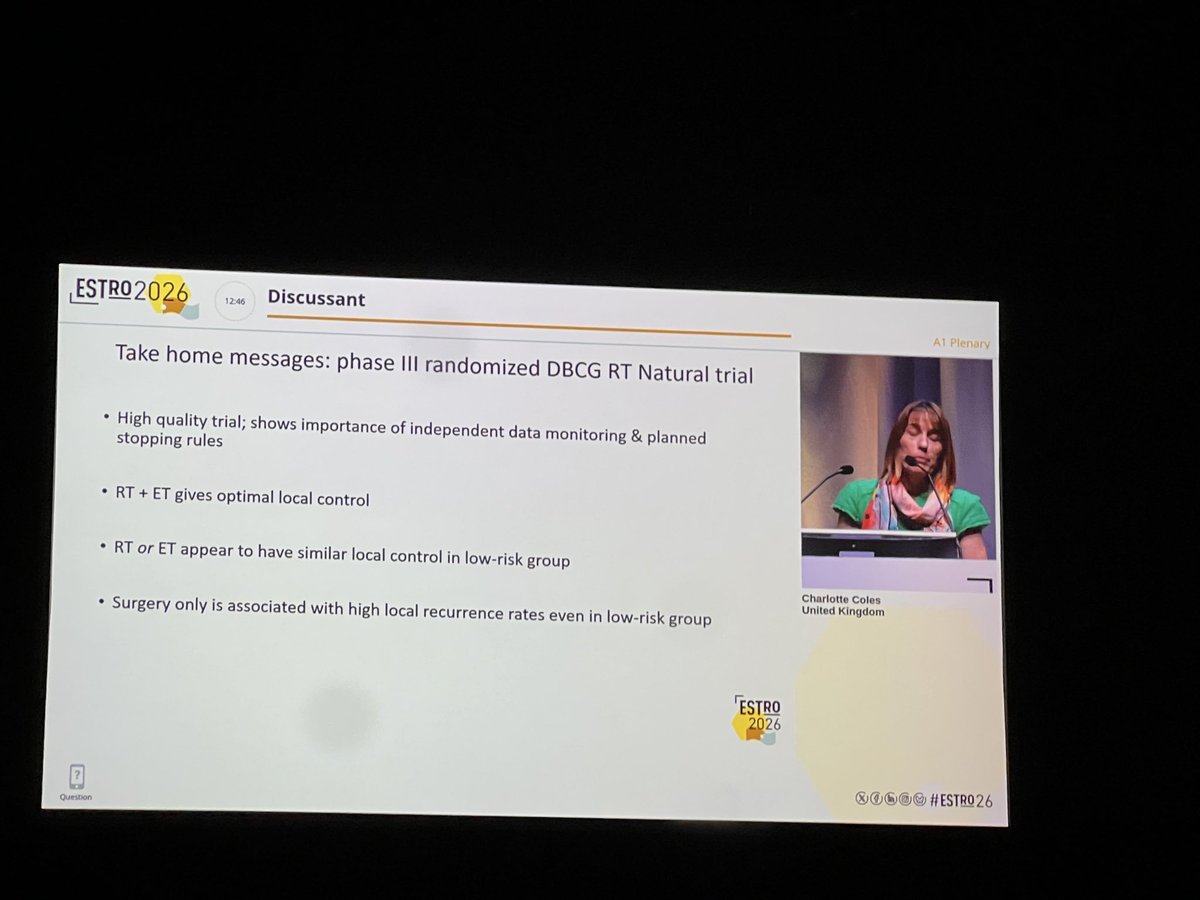
9 details 3 trials watching
Phase III randomized trial, PBI 40Gy/15fr vs no PBI, stratified by institution and endocrine therapy yes/no, with a third non-randomised self-selecting no-PBI cohort. Planned accrual 926 randomised with an interim analysis at 200 patients with 2 year follow-up. Median follow-up 4 years at this reading.
≥60 years, breast cancer treated with breast conservation, pT1N0, unilateral, unifocal, non-lobular, ER ≥10%, HER2 normal, grade 1-2, limited DCIS, margin ≥2mm. Endocrine therapy given per DBCG guideline, which recommends ET for pT1c and/or grade 2.
Partial breast irradiation, 40Gy in 15 fractions. This is a moderately hypofractionated PBI schedule, not the 5-fraction regimens now in wide use, which matters for how the toxicity and convenience side of the omission trade transfers.
Primary: 5 year invasive local recurrence, with a design assumption of 2% and a prespecified maximum acceptable 4%. Secondary: loco-regional side effects and quality of life. Follow-up yearly mammography plus loco-regional side effect assessment to 10 years.
All 41 recurrences were invasive and 39 of 41 arose in patients who received no PBI. Distant failure was rare across the whole trial at 4 events, 2 in each of the +RT and no-PBI groups.
Loco-regional side effects and QoL were prespecified secondary endpoints but no toxicity or QoL figures were reported in the source. The omission-versus-PBI toxicity trade that drives this decision is therefore unquantified here.
PRIME II and CALGB 9343 established that RT omission in older low-risk women is tolerable because absolute local recurrence stays low. Here the randomised no-RT arm reached 9.8% and crossed the trial's own 4% ceiling, which is the opposite result, and the discussant framed surgery alone as carrying high local recurrence even in low risk.
Median follow-up is 4 years against a 5 year primary endpoint, so the reported cumulative incidences are read before the timepoint the trial was designed around. The third arm is self-selected, not randomised, so its 8.2% carries confounding by whatever drove refusal, and the endocrine therapy split is by treatment received rather than assignment.
The trial's contribution is that it isolates the floor: a group with no adjuvant treatment at all, which the modern omission trials do not have because endocrine therapy is universal in their omission arms. 12.2% at that floor reframes the published omission literature as measuring RT omission on an endocrine backbone, not omission of local therapy. It does not settle whether PBI or ET is the better single agent, since 3.0% and 3.7% overlap widely.
CONSORT flow
Randomised, prespecified LR endpoint, stopped early by independent monitoring for exceeding the 4% threshold. Cuts against the de-escalation direction PRIME II and CALGB 9343 set.
- Does 5-fraction PBI match 40Gy/15fr local control in this population n=910 · primary completion 2029-11 · phase 3 PBI vs WBI, 1 week each, LR endpoint
- Toxicity and QoL trade between PBI and endocrine monotherapy n=30 · primary completion 2023-11 · SBRT added to endocrine tx, unoperated pts 75+n=168 · primary completion 2030-07 · randomised 30Gy vs 26Gy/5fr PBI, PRO endpoint
- Whether 4yr separation holds at the 5yr primary timepoint
📚 Sources · 🐦 2 tweets
Another trial showing even for lR optimal local control with RT and ET and suboptimal adherence to ET. In era of 5 fraction decision making is easier # Estro2026 pic.twitter.com/nkvYl3iuTn
— Sushil (@Sushilberiwal) May 17, 2026
Danish #breastcancer partial breast #radiotherapy “natural” trial.
— Shankar Siva (@_ShankarSiva) May 17, 2026
➡️ No postoperative treatment had highest risk of recurrence
➡️either tamoxifen or #radonc reduced recurrence
➡️combined tamoxifen + RT had no recurrences
In context of EUROPA trial, RT has best QoL vs endocrine… pic.twitter.com/bDVmbDKRNb
IMPORT HIGH
ForInvasive early breast, pT1-3 pN0-pN3a M0, post-BCS, requiring tumour bed boost
3.7% vs 3.5% 10yr IBTR (48Gy SIB vs 40+16Gy)
95% CI 2.6-5.3 vs 2.4-5.0; 53Gy/15F 5.5% (4.1, 7.3)
TL;DR10yr IBTR 3.7% with 48Gy/15F SIB vs 3.5% with 40Gy/15F + 16Gy/8F sequential; 53Gy/15F higher at 5.5%.
The decision this hardens is delivery, not dose: 48Gy/15F SIB holds at 3.7% (2.6, 5.3) IBTR at 10 years against 3.5% (2.4, 5.0) for a sequential 16Gy/8F phase, in a higher risk group. 53Gy/15F sits at 5.5% (4.1, 7.3), so escalation buys nothing.
For a woman after breast conserving surgery for pT1-3 pN0-pN3a invasive disease who needs a tumour bed boost, the 10-year data support the integrated 48Gy/15F arm over a separate sequential boost; they do not speak to boost omission or to 5-fraction whole-breast schedules. The longer read
Three weeks, one plan: the boost is integrated into 15 fractions with a modest dose reduction to whole breast distant from tumour, and IBTR at 10 years matches the sequential 16Gy/8F phase. Escalating the integrated boost to 53Gy/15F does not improve local control.

| Dose group | 10yr IBTR (95% CI) | 10yr OS abs. diff vs 40Gy/15F |
|---|---|---|
| 40Gy/15F + 16Gy/8F | 3.5% (2.4, 5.0) | reference |
| 48Gy/15F (3.2Gy/F) | 3.7% (2.6, 5.3) | -0.5 (-3.0, 2.8) |
| 53Gy/15F (3.5Gy/F) | 5.5% (4.1, 7.3) | 1.5 (-1.4, 5.1) |
+1 more figure

8 details 4 trials watching
Three-arm randomised multicentre trial, 1:1:1, N=2617 across 76 UK hospitals, recruited 2009-2015. Annual clinical follow-up to 10 years; PRO and photographic assessment collected only to 5 years.
Women ≥18 after breast conserving surgery for invasive early breast cancer, pT1-3, pN0-pN3a, M0, all requiring a tumour bed boost. Described as a higher-than-average risk group.
40Gy/15F + 16Gy/8F sequential boost (N=871), 48Gy/15F SIB at 3.2Gy/F (N=874), 53Gy/15F SIB at 3.5Gy/F (N=872). The SIB arms escalate to the regions at highest risk with a modest dose reduction to whole breast distant from tumour, all delivered in 3 weeks.
Endpoint reported here: ipsilateral breast tumour relapse at 10 years. The original sample size calculation assumed a 5% control rate at 5 years. Absolute OS difference and clinician-assessed normal tissue effects also reported.
The 5-year ordering holds at 10 years: the two lower-dose groups sit close together and 53Gy/15F stays highest. Both absolute OS differences vs 40Gy/15F have intervals containing zero.
Moderate/marked effects at 10 years were given as bounds across all randomised groups: <18% breast distortion or shrinkage, <10% induration, <2% telangiectasia, <2% breast oedema. No per-arm split reported in source.
EORTC 22881-10882 established the tumour bed boost itself; IMPORT HIGH asks how to deliver it and whether more dose helps. At 10 years, integration works and escalation does not, the same ranking the 5-year publication (Coles et al. Lancet 2023;401:2124-37) reported.
PRO and photographic assessment stopped at 5 years, so the 10-year toxicity comparison rests on clinician scoring reported as all-group bounds, not per-arm rates. Observed IBTR also ran below the 5% control rate the sample size calculation assumed.
The practical read is fraction count, not dose: a boost folded into 15 fractions removes the separate 16Gy/8F phase with no 10-year IBTR cost, while 53Gy/15F returns nothing. What the trial does not settle is whether the same integration transfers to 5-fraction whole-breast schedules.
CONSORT flow
Mature 10yr follow-up of a 2617-pt randomised trial; extends the 5-year Lancet 2023 read rather than changing it. No formal 10yr non-inferiority margin stated in source.
- Simultaneous integrated boost within 5-fraction whole-breast schedules recruiting Ultra-hypofractioNated Adjuvant Radiotherapy ± sImultaneous Integrated Boost for Low-risk Breast Cancer Patients Phase 2n=65 · primary completion 2025-10 · ultra-hypofx WBI +/- SIB, low-risk, phase 2recruiting Ultra Hypo-fractionated Adjuvant Whole Breast Radiation Therapy With Simultaneous Integrated Boost for Early-Stage Breast Cancer (H-ASSIST) Phase 2n=90 · primary completion 2028-02 · 5-fraction WBI with SIB tumor bed boost, phase 2
- Patient-reported cosmesis beyond 5 years, unmeasured after photographic follow-up ended n=139 · primary completion 2025-12 · 10y registry with cosmesis + QoL assessmentsn=50 · primary completion 2028-09 · cosmesis + PROMs to 60mo after ultra-short WBI/SIB
📚 Sources · 🐦 1 tweet
Day THREE of #ESTRO26 Coverage by OncoAlert 🚨
— OncoAlert (@OncoAlert) May 17, 2026
Ten-year results of the IMPORT HIGH trial (ISRCTN47437448): Dose escalated simultaneous integrated boost radiotherapy in early breast cancer Presented by Charlotte Coles 🇬🇧 #RadOnc ☢️
Ten-year IMPORT HIGH trial data show that a… pic.twitter.com/7RqVy2SrQm
DBCG HYPO
ForNode-negative early breast cancer or DCIS, post-BCS whole-breast RT
24.7% vs 19.5% at 10 yr
HR 0.76 (95% CI 0.62-0.92), p=0.005, favouring 40 Gy/15 fr
TL;DR10yr grade 2-3 breast induration 24.7% (50Gy) vs 19.5% (40Gy), HR 0.76 (0.62-0.92), p=0.005, no recurrence penalty.
The fibrosis separation persists at a decade, 24.7% vs 19.5%, HR 0.76 (0.62-0.92): 40 Gy/15 fr is not merely non-inferior on late morbidity, it is better, with OS numerically higher (93.0% vs 92.1%, p=0.10). For a node-negative or DCIS patient, the residual argument for 25 fractions is gone.
For node-negative invasive breast cancer or DCIS after breast conservation, this supports 40 Gy/15 fr over 50 Gy/25 fr on late induration with no recurrence cost; node-positive and regional nodal irradiation populations were not enrolled and are not addressed. The longer read
The fibrosis separation persists at a decade, 24.7% vs 19.5%, HR 0.76 (0.62-0.92), so 40 Gy/15 fr is superior on late induration rather than merely non-inferior. In node-negative disease or DCIS, whole-breast only, the late-tissue argument for 25 fractions has no support here.

| Endpoint (10-yr) | 50 Gy/25 fr | 40 Gy/15 fr | HR (95% CI), p |
|---|---|---|---|
| Grade 2-3 breast induration | 24.7% | 19.5% | 0.76 (0.62-0.92), p=0.005 |
| Overall survival | 92.1% | 93.0% | 0.81 (0.63-1.04), p=0.10 |
+1 more figure

8 details 5 trials watching
Phase III randomised non-inferiority trial, 1:1, run across Denmark, Norway and Germany from 2009-2014. These are the prespecified 10-year analyses of toxicity, recurrence and survival, at a median follow-up of 12.8 years.
1,882 women with node-negative breast cancer or DCIS. After exclusions (13 and 16), 933 and 936 women were analysed in the two arms, with 917 carried into the morbidity analysis of one arm.
Whole-breast irradiation only: 50 Gy in 25 fractions versus 40 Gy in 15 fractions. No regional nodal irradiation question is posed, and boost details are not reported in the source slides.
Primary: grade ≥2 breast induration at 3 years, requiring two consecutive visits or the final follow-up. Morbidity was scored at years 0, 1, 2, 3, 4, 5 and 10; recurrence and survival are the co-reported 10-year outcomes.
The toxicity endpoint is the positive result here: 10-year grade 2-3 induration 24.7% with 50 Gy vs 19.5% with 40 Gy, HR 0.76 (0.62-0.92), p=0.005. The fibrosis advantage of hypofractionation is durable, not an early-follow-up artefact.
START-B and the UK 10-year hypofractionation data established 40 Gy/15 fr as at least equivalent for control with less normal-tissue effect; DBCG HYPO reproduces that direction in a contemporary node-negative and DCIS population treated 2009-2014, in an era of CT planning and modern systemic therapy rather than the 1990s cohorts.
Breast induration is a clinician-scored endpoint and the source does not state whether assessment was blinded, which matters when the two arms are trivially distinguishable by treatment duration. Locoregional recurrence, distant failure and breast cancer mortality are reported only as 'no significant difference' with no event counts or confidence intervals in the source, so the precision of the non-inferiority claim cannot be judged from these slides.
A 5.2-percentage-point absolute reduction in decade-level grade 2-3 induration is a real cosmetic and symptomatic difference in a population most of whom will never recur. The OS HR of 0.81 (0.63-1.04) is directionally in favour of the shorter schedule but is not significant and should not be read as a survival benefit of hypofractionation.
Randomised phase III, prespecified 10-yr analysis, 12.8-yr median follow-up, primary toxicity endpoint favours 40 Gy/15 fr. Reinforces already-standard moderate hypofractionation rather than changing it.
- How does 40 Gy/15 fr compare with five-fraction schedules on 10-yr fibrosis? n=2100 · primary completion 2029-03 · randomised 1 wk vs 3 wk adjuvant WBI, non-inferiorityrecruiting 5 fr Ultrahypofractionated WBI and SIB for Breast Cancer With Unfavorable Characteristics Phase NAn=458 · primary completion 2029-06 · 26 Gy/5 fr + SIB vs 40.05 Gy/15 fr + SIB, randomisedrecruiting Ultra-Hypofractionated vs Moderate Hypofractionated Radiotherapy for Regional Lymph Nodes in High Risk Breast Cancer Phase NAn=1950 · primary completion 2034-03 · 26 Gy/5 fr vs 40-42.5 Gy/15-16 fr nodal RT
- Does the induration benefit hold with regional nodal irradiation? recruiting Hypofractionated Irradiation At Regional Nodal Area for Breast Cancer Vs Existed Standard Treatment Phase 3n=801 · primary completion 2022-12 · phase 3 hypofx vs conventional RNI, safety endpointactive Hypofractionated vs. Conventional Regional Nodal Radiation Therapy for Patients With Invasive Breast Cancer Phase 2n=805 · primary completion 2030-02 · 3 wk vs 5 wk nodal RT, arm edema and recurrence
- Locoregional recurrence event counts and confidence intervals
📚 Sources · 🐦 1 tweet
Day TWO of #ESTRO26 Coverage by OncoAlert 🚨
— OncoAlert (@OncoAlert) May 17, 2026
10-year Follow-Up of the DBCG HYPO Trial: Breast Induration, Recurrence and Survival After Hypofractionated Whole Breast Irradiation Presented by Hanna Forsberg 🇩🇰 @BOffersen #RadOnc ☢️ #BreastCancer
The DBCG HYPO trial reports… pic.twitter.com/4qf9R3HZwT
HypoG-01
ForBreast cancer receiving adjuvant RT incl. nodal volumes, ESTRO-contoured
118 events / 1260 pts
Median f/u 4.8 yrs; LRR 20/118, iLRR sites in-volume 20/30 (67%)
TL;DR118 first events over 4.8yr median f/u; 67% of LRR sites in-volume, patterns comparable across 40Gy/15fx and 50Gy/25fx.
The actionable number is 20/30 iLRR sites in-volume, with 19/30 nodal and concentrated in levels 1 and 2: failures are happening inside correctly contoured CTVs, not at their edges, so this argues against widening nodal volumes and supports ESTRO contouring as drawn. Per-arm event counts not reported in source.
In node-involved breast cancer planned for adjuvant regional nodal RT, this supports keeping ESTRO-guideline CTVs rather than expanding level 1 to 2 coverage for geographic-miss concern; it does not address volume choice in pts contoured outside those guidelines. The longer read
20/30 iLRR sites were in-volume and 19/30 nodal, mainly levels 1 and 2. Recurrences are inside correctly drawn CTVs, so the fix is not a wider nodal volume, and ESTRO contouring holds under 40 Gy/15 fx. Per-arm counts not reported in source.
19/30 recurrence sites were nodal, concentrated in levels 1 and 2, the levels most affected when axillary dissection is replaced by sentinel-node-only management. Relevant to how much residual nodal risk surgical de-escalation leaves for RT to absorb; the analysis does not stratify by axillary surgery type.

| Event / site | n |
|---|---|
| Isolated distant recurrence | 61 |
| Second malignancy | 37 |
| Isolated locoregional recurrence | 19 |
| Concomitant locoregional recurrence | 1 |
| LRR as first event | 20 / 118 |
| iLRR sites in-volume | 20 / 30 (67%) |
| iLRR sites nodal | 19 / 30 |
+1 more figure

9 details 5 trials watching
Pre-planned secondary analysis of the HypoG-01 phase III trial, analysed ITT. N=1,260, median follow-up 4.8 years. Reported as a patterns-of-failure and dosimetric mapping study, not a re-test of the parent efficacy endpoint.
Randomisation was 40 Gy/15 fractions over 3 weeks vs 50 Gy/25 fractions over 5 weeks, each with a tumour-bed boost. Contouring followed ESTRO guidelines, which is what makes the in-volume/marginal classification interpretable rather than institution-specific.
Primary event was the first oncological event: locoregional recurrence, distant recurrence, or second malignancy. LRR was classified against the CTV as in-volume (within CTV), marginal (outside CTV but ≥50% prescribed dose), or out-of-volume (<50%). Planned dose at each recurrence site was re-estimated on the original planning CT.
118 first events. Distant recurrence and second malignancy dominated (61 and 37); LRR was the least common first event at 20/118. Among 30 iLRR sites, 20 (67%) were in-volume and 19/30 were nodal, mainly levels 1 and 2.
The dosimetric read is retrospective by construction: dose at the recurrence site is estimated on the initial plan CT, so anatomic change and registration error over a median 4.8 years both push sites toward an in-volume label. The event count also caps what can be concluded, since 30 sites split across two arms leaves the "not obviously different" claim underpowered rather than negative.
START-B and FAST-Forward established that moderate and ultra-hypofractionation do not cost local control, but neither mapped recurrence sites against the CTV. The contribution here is geographic rather than actuarial: it tests whether the *volume*, not the *dose per fraction*, is where hypofractionated regional treatment could fail.
A 67% in-volume rate reframes residual LRR as a biology problem, not a coverage problem: pts recurred where dose was delivered. The nodal concentration in levels 1 and 2 is the one signal worth watching, since those are the levels most variably treated when surgical axillary management is de-escalated.
Pre-planned secondary analysis, descriptive only. No per-arm effect size or statistical comparison in source; 30 iLRR sites cannot exclude an arm difference.
- Per-arm LRR site distribution, 40 Gy/15 fx vs 50 Gy/25 fx recruiting Hypofractionated Irradiation At Regional Nodal Area for Breast Cancer Vs Existed Standard Treatment Phase 3n=801 · primary completion 2022-12 · phase 3 hypofx vs conventional RNI, node-positiverecruiting Conventionally Fractionated vs. Hypofractionated Comprehensive Nodal Irradiation for Breast Cancer Using Pencil Beam Scanning Proton Therapy Phase 3n=276 · primary completion 2038-02 · phase 3 3wk vs 5wk comprehensive nodal RT, protons
- Does ultra-hypofractionation shift nodal failure geography? n=768 · primary completion 2029-01 · randomised ultrahypo vs moderate hypo RNI, 4 cohortsrecruiting Ultra-Hypofractionated vs Moderate Hypofractionated Radiotherapy for Regional Lymph Nodes in High Risk Breast Cancer Phase NAn=1950 · primary completion 2034-03 · 26Gy/5fx vs 40Gy/15fx RNI, n=1950, recurrence f/u
- Level 1-2 coverage after sentinel-node-only axillary management n=205 · primary completion 2027-12 · RNI volume tailored to SLND-alone vs SLND+ALND
📚 Sources · 🐦 1 tweet
Day TWO of #ESTRO26 Coverage by OncoAlert 🚨
— OncoAlert (@OncoAlert) May 16, 2026
Patterns of locoregional and distant recurrence and dosimetric analysis in the HypoG-01 phase III trial Presented by Louis Munschi 🇫🇷 #RadOnc ☢️
In the HypoG-01 phase III trial (1260 patients, median follow-up 4.8 years), 118… pic.twitter.com/ogARInu0fB
Tumour bed boost after BCS+WBRT (Dutch cohort)
ForPost-BCS invasive breast cancer receiving WBRT, boost decision pending
TL;DR10yr IBTR 1.2% with 0-2 risk factors regardless of boost, supporting boost omission in the modern systemic era.
The decision this moves is boost omission, and the number that moves it is 10yr IBTR 1.2% in the 0-2 risk-factor group whether or not a boost was given, on 15,085 vs 13,845 pts. Note the ≥3 group ran higher WITH boost (3.3% vs 2.7%), which is allocation bias, not boost harm. Boost dose and fractionation are not in the source.
In a post-BCS patient over 40 with grade 1-2, hormone-receptor-positive disease receiving guideline-concordant systemic therapy, this supports omitting the tumour bed boost; it does not resolve the boost question for pts carrying three or more risk factors. The longer read
The omission decision rests on 10yr IBTR of 1.2% in the 0-2 risk-factor group with and without boost (15,085 vs 13,845 pts). The ≥3 stratum ran higher WITH boost (3.3% vs 2.7%), a signature of risk-based allocation rather than boost harm. Boost dose and fractionation are absent from the source.

| Risk factors | N no boost | N boost | 5yr no boost | 5yr boost | 10yr no boost | 10yr boost |
|---|---|---|---|---|---|---|
| 0-2 | 15,085 | 13,845 | 0.6% | 0.7% | 1.2% | 1.2% |
| ≥ 3 | 149 | 733 | 1.3% | 2.9% | 2.7% | 3.3% |
| Uncertain | 592 | 944 | 0.8% | 3.3% | 1.4% | 3.6% |
+2 more figures


9 details
Population-based Dutch cohort from the Netherlands Cancer Registry linked to pathology, on behalf of the DBRT group. Treatment years 2012-2016, follow-up to 10 years. Observational, no randomisation and no adjusted comparison reported in source.
Breast-conserving treatment with or without an RT boost, N=31,348 across the three risk strata. Stratification is by a count of five risk factors: age ≤40, grade 3, triple-negative, guideline-indicated systemic therapy not adequately given, and no pCR after neoadjuvant chemo in TNBC or HER2+.
Whole-breast RT with or without a tumour bed boost. Boost dose, fractionation, technique (photon vs electron vs SIB) and the WBRT schedule are not reported in the source slides, which limits transfer to a specific departmental protocol.
Primary: ipsilateral breast tumour recurrence (IBTR), histologically confirmed, identified by an algorithm over pathology report codes and free text. Reported as cumulative incidence at 5 and 10 years by risk-factor count. Benchmarked against the Assisi thresholds: omission acceptable at <3% 10yr IBTR with boost, <6% without.
IBTR was low in every stratum. The only cell crossing an Assisi threshold was ≥3 risk factors treated with a boost at 10 years, and even there the no-boost value in the same stratum was lower.
EORTC 22881-10882 established that a boost roughly halves IBTR, and that trial's control-arm event rates were an order of magnitude above these. IMPORT HIGH and the 2024 Assisi think tank both moved the field toward de-escalating or restricting the boost; this cohort supplies the contemporary absolute rates those recommendations assumed but could not show.
Boost was allocated by guideline-based risk, so the boost groups are adversely selected and the raw contrast understates any boost effect; the higher rate in the ≥3 boost group is the visible signature of that confounding. The ≥3 no-boost cell holds only 149 pts, and the 'uncertain' stratum (592 / 944) shows a boost-no-boost gap wide enough to suggest unmeasured risk is driving allocation there too.
The finding is about absolute rather than relative benefit: a preserved 50% relative reduction applied to a 1.2% 10-year event rate is not worth five extra fractions and a fibrosis penalty. What the cohort cannot say is whether the boost is the reason those low-risk rates are low, since roughly half the low-risk group received one.
Registry cohort, no randomisation and no adjusted effect estimate; boost allocation confounded by risk. Supports the direction already set by IMPORT HIGH and Assisi thresholds.
- Which ≥3 risk-factor subgroups actually benefit from a boost
- Whether boost omission holds under randomised testing in low-risk pts
- Boost dose and technique used across this cohort
📚 Sources · 🐦 1 tweet
Day TWO of #ESTRO26 Coverage by OncoAlert 🚨
— OncoAlert (@OncoAlert) May 16, 2026
Is a boost to the tumour bed still indicated after breast-conserving surgery and whole-breast radiotherapy in the era of modern systemic therapy? Presented by Femke Froklage 🇳🇱 #RadOnc ☢️
We aimed to identify a subgroup of breast… pic.twitter.com/RqK5r9XPqW