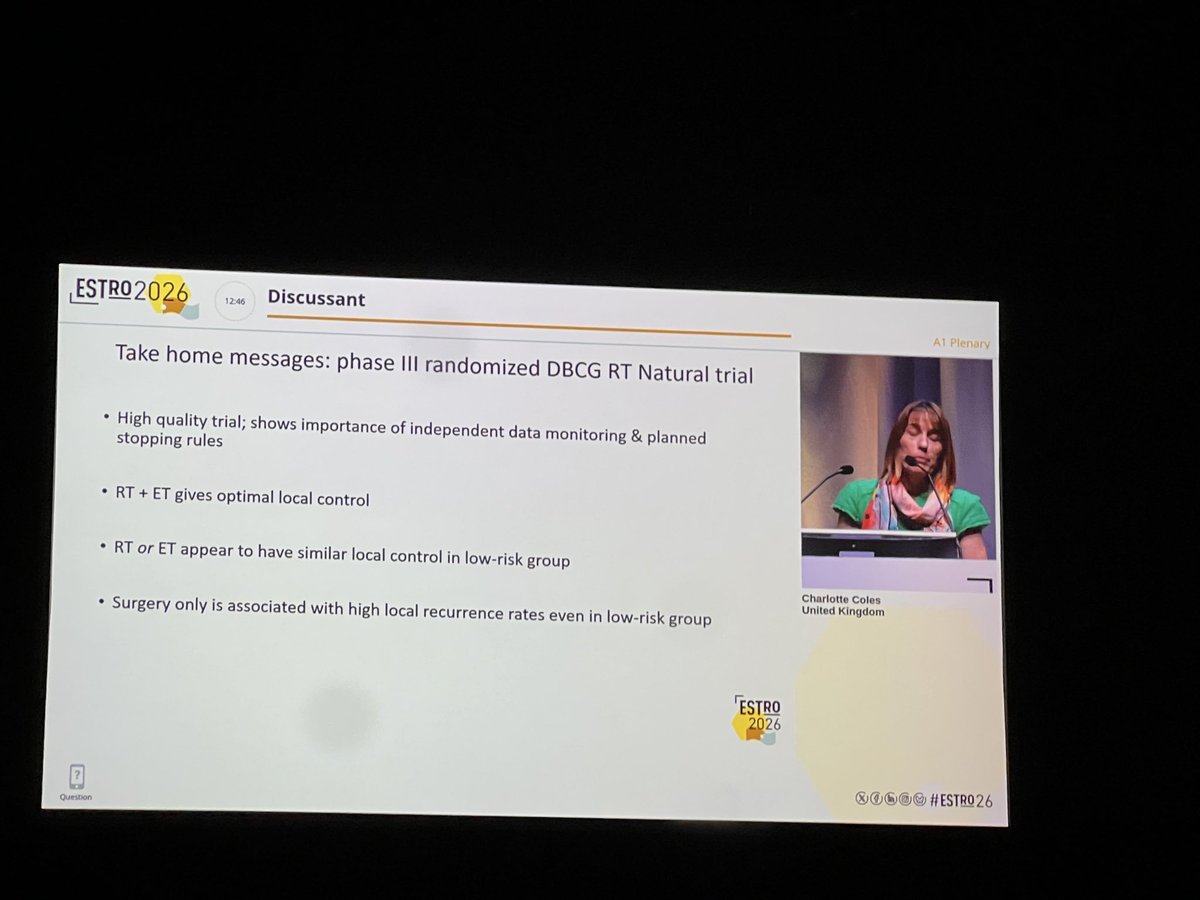
Prostate
Elective pelvic nodal RT is the meeting's contested question: PEACE-2 null on cPFS against POP-RT's HR 0.50, with PACE-NODES and PIVOTALboost reporting only acute bowel cost and neither efficacy endpoint mature.
POP-RT vs PEACE-2
TL;DRWPRT bFFS HR 0.50 (POP-RT) vs bPFS HR 0.97 (PEACE-2); pelvic RT benefit vanishes with 3yr ADT, PSMA staging.
POP-RTPEACE-2
The reversal tracks four coupled changes, and the one an RT reader controls is target volume: with 36 months ADT, 78 Gy EQD2 and PSMA staging, WPRT bought nothing biochemically (HR 0.97, p=0.73) where it halved biochemical failure at 24 months ADT and 74-76 Gy (HR 0.50). This moves elective nodal coverage toward optional in PSMA-staged very-high-risk N0M0 on 3 years of ADT, not in conventionally staged pts.
In very-high-risk N0M0 prostate staged by PSMA PET and planned for 36 months ADT with dose-escalated RT, this questions routine whole-pelvis coverage; it does not extend to conventionally staged pts or shorter ADT, where POP-RT still supports it. The longer read
Target volume is the variable you own here. WPRT halved biochemical failure at 24 months ADT and 74-76 Gy EQD2 (HR 0.50) but returned HR 0.97 (p=0.73) at 36 months ADT, 78 Gy and PSMA staging, with no toxicity penalty either way. Elective nodal coverage becomes conditional on staging and ADT length, not automatic.
ADT duration is the confounder doing the heavy lifting: 24 vs 36 months separates the two trials as much as the RT volume does. If 3 years of ADT is what erases the nodal-RT signal, then shortening ADT for tolerability reopens the case for pelvic coverage, so the systemic and RT decisions cannot be made independently in very-high-risk N0M0.

| Endpoint | POP-RT HR (95% CI), p | PEACE-2 HR (95% CI), p |
|---|---|---|
| bFFS / bPFS | 0.50 (0.42-0.61), p<0.001 | 0.97 (0.81-1.16), p=0.73 |
| cFFS / cPFS | 0.74 (0.61-0.90), p=0.002 | 0.81 (0.63-1.03), p=0.09 |
| MFS | 0.72 (0.58-0.89), p=0.002 | 0.93 (0.74-1.17), p=0.54 |
8 details 4 trials watching
Two independent phase III, open-label, randomized trials of whole-pelvis RT vs prostate-only RT, set side by side in a curator comparison graphic. POP-RT accrued 2011-2016 (median f/u 6.3-7.2 yr, updated); PEACE-2 accrued 2018-2023 and reads out at ~5.5 yr median f/u as an interim analysis (ESTRO 2026).
POP-RT enrolled high / very-high-risk localized N0M0 disease staged by conventional CT and bone scan. PEACE-2 restricted to very-high-risk N0M0 with PSMA PET/CT widely used, so its N0 is a cleaner, node-negative-by-molecular-imaging population.
Both delivered IMRT to whole pelvis plus prostate boost against prostate-only IMRT. Prostate dose was 74-76 Gy EQD2 in POP-RT and 78 Gy EQD2 in PEACE-2, so the control arm in the newer trial is the better-treated prostate.
ADT was a GnRH analog plus antiandrogen in both, but 24 months in POP-RT vs 36 months in PEACE-2. The extra year of systemic control is the single most plausible eraser of a nodal-RT effect.
Primary: bFFS in POP-RT, biochemical PFS in PEACE-2. Secondaries overlap (clinical failure/progression, MFS, OS, toxicity), with PEACE-2 adding CSS. The endpoints are close analogues but not identically defined, which limits how tightly the HRs can be compared.
Both trials reported comparable Grade ≥2 late GU toxicity between arms, with no significant increase in toxicity from WPRT in either. Toxicity is therefore not the lever in this decision; efficacy is.
POP-RT remains the only randomized trial to show a clear elective pelvic RT benefit (bFFS HR 0.50, MFS HR 0.72). PEACE-2's null biochemical result (HR 0.97) at interim is the first randomized read to contradict it, and it does so with a systemic and staging backbone POP-RT never had.
The two trials differ simultaneously in ADT duration, prostate dose, staging modality, risk band and accrual era, so no single factor can be assigned the loss of effect. PEACE-2's read is also interim with shorter follow-up than POP-RT's, and biochemical endpoints mature earliest, so the later endpoints are the least settled.
The graphic's own reading is that longer ADT, modern staging and intensified local therapy may reduce the incremental benefit of elective pelvic RT in very-high-risk disease. That is a hypothesis this comparison cannot test: it settles nothing about which of the four changes did the work, and a reader who shortens ADT while omitting pelvic RT is borrowing from both trials at once.
| Endpoint | POP-RT | PEACE-2 |
|---|---|---|
| Biochemical (bFFS / bPFS) | HR 0.50 (0.42-0.61), p<0.001 | HR 0.97 (0.81-1.16), p=0.73 |
| Clinical (cFFS / cPFS) | HR 0.74 (0.61-0.90), p=0.002 | HR 0.81 (0.63-1.03), p=0.09 |
| MFS | HR 0.72 (0.58-0.89), p=0.002 | HR 0.93 (0.74-1.17), p=0.54 |
- Does PEACE-2's cPFS signal mature into benefit at final analysis?
- Is longer ADT or PSMA staging the reason pelvic RT stopped working? n=250 · primary completion 2031-05 · PSMA-N0M0 randomised to PORT vs prostate+WPRTrecruiting Abi/Pred + ADT vs ADT in PSMA-Positive, Conventionally Node-Negative Prostate Cancer Phase 2n=140 · primary completion 2033-04 · PSMA+ cN0 nodes: ADT vs abi/pred intensification
- Does elective pelvic RT still help pts on shorter ADT? recruiting Phase II Trial of PSA Response-based Androgen Deprivation Therapy and Nodal Coverage for Prostate Cancer Early Salvage Radiotherapy (RANGER) Phase 2n=68 · primary completion 2030-11 · adds pelvic nodal RT + 4mo ADT in PSA nonrespondersn=250 · primary completion 2031-05 · prostate-only vs whole-pelvis RT, high-risk N0
📚 Sources · 🐦 1 tweet
POP RT Vs PEACE II
— Rohit Malde (@roxboxfix) May 18, 2026
2 years ADT + WPRT
Vs 3 years ADT + Prostate Only RT
Tough to choose or you already have a choice ?? pic.twitter.com/42kdSKQYKW
PRIME NCT03561961
ForHigh-risk, very high-risk or node-positive non-metastatic prostate; ECOG 0-2
TL;DRInterim: acute grade ≥2 GU ~5.4% vs ~4.0% (p=0.59) for 5-fx SBRT vs 25-fx, both with whole-pelvis RT; BFFS immature.
The transferable parameter is the nodal dose: 25 Gy in 5 fractions to elective pelvis in both arms, with SIB to involved nodes permitted only in the SBRT arm. Late grade ≥2 GU ran ~10-12% vs ~9-11% at 1-2 yr, so the 5-fraction schedule carried no toxicity penalty over 25 fractions in a node-covered field.
In high-risk or node-positive non-metastatic prostate cancer where whole-pelvis RT and ~2 years of ADT are already planned, this supports 5-fraction delivery on toxicity grounds; it does not yet inform biochemical control, and does not extend to pts treated to prostate alone. The longer read
The gate is the elective nodal dose: 25 Gy in 5 fractions to whole pelvis in both arms, SIB to involved nodes only in the SBRT arm. Grade 3+ GU/GI stayed <1% either way, so the decision this moves is whether pelvic coverage can be compressed to 5 fractions, not whether it controls nodes.

+1 more figure

| Feature | HYPO-RT-PC | PRIME |
|---|---|---|
| Fractionation | 42.7 Gy/7 fx vs 78 Gy/39 fx | 36.25 Gy/5 fx vs 68 Gy/25 fx |
| Pelvic RT | None (prostate + SV) | Whole pelvis, 25 Gy/5 fx, both arms |
| ADT | Not permitted | Long course (~2 years), both arms |
| Nodal status | Node-negative only | Includes node-positive |
| Primary result | 10-yr FFS 72% vs 65%, adj HR 0.84 (95% CI 0.69-1.03) | BFFS not yet mature |
9 details 3 trials watching
Phase III, open-label, randomized non-inferiority trial from Tata Memorial Centre and collaborating Indian centres. Accrual 2018 to 2023, completed at ~434 pts, 1:1, stratified by risk group and nodal status. Interim analysis with follow-up of 1 to 2 years.
High-risk, very high-risk and/or node-positive non-metastatic prostate cancer, ECOG 0-2, life expectancy 10 years. PSMA PET/CT staging was permitted, so nodal staging is not uniform across the cohort.
Arm A 36.25 Gy in 5 fractions (7.25 Gy/fx), every other day. Arm B ~68 Gy in 25 fractions (2.7 Gy/fx) over ~5 weeks. Both arms received whole-pelvis elective nodal RT at 25 Gy in 5 fractions or equivalent, with SIB to positive nodes allowed in the SBRT arm; delivery was modern IMRT/VMAT with daily IGRT.
Long-course ADT (~2 years) in both arms, so the randomised variable is fractionation alone, not systemic intensity.
Primary: biochemical failure-free survival (Phoenix, nadir + 2 ng/mL). Secondary: acute and late toxicity (RTOG/CTCAE v4.0/5.0), OS, MFS, cFFS, QoL (EORTC QLQ-C30, QLQ-PR25, IPSS) and cost-effectiveness.
No BFFS, MFS or OS estimate is reported in the source. The interim efficacy statement is only no signal of inferiority for the SBRT arm, with mature 4 to 5 year data awaited.
| Toxicity | SBRT 5 fx | Mod hypo 25 fx | p |
|---|---|---|---|
| Acute GU (≤90 days) | ~5.4% | ~4.0% | 0.59 |
| Acute GI (≤90 days) | ~2.2% | ~3.7% | 0.20 |
| Late GU (1-2 yr) | ~10-12% | ~9-11% | NS |
| Late GI (1-2 yr) | ~5-7% | ~4-6% | NS |
| Grade 3+ GU/GI | <1% | <1% | not reported |
QoL by EORTC QLQ-C30, QLQ-PR25 and IPSS showed urinary and bowel domains stable and comparable between arms, with transient declines during and soon after treatment then recovery. ADT-related sexual and hormonal effects were similar, as expected with a fixed 2-year backbone in both arms.
HYPO-RT-PC gave level-1 support for ultra-hypofractionation (10-yr FFS 72% vs 65%, adjusted HR 0.84, 95% CI 0.69-1.03), but in node-negative pts with no pelvic RT and no ADT, mostly on 3D-CRT. PRIME asks the fractionation question where the target includes the pelvis and the backbone is 2 years of ADT, so its toxicity read is not inherited from that trial.
Toxicity reaches the reader as approximate values on a third-party summary graphic rather than a published table, and late follow-up of 1 to 2 years is short for the GU and GI events that separate fractionation schedules. Open-label design also leaves the QoL and IPSS readouts unblinded.
If BFFS holds at 4 to 5 years, the practical claim is that elective pelvic coverage can be delivered in 5 fractions instead of 25, compressing a 5-week course to 1 to 2 weeks where linac time rations access. Toxicity is the necessary first gate and it clears; non-inferiority is an efficacy claim and nothing here tests it yet.
Interim toxicity and QoL readout at 1-2 yr; primary BFFS not reported and 4-5 yr efficacy pending. Safety comparability cannot establish non-inferiority of 5-fraction SBRT.
- Adequacy of 25 Gy/5 fx elective nodal dose for microscopic disease recruiting A Trial of 5 Fraction Prostate SBRT Versus 5 Fraction Prostate and Pelvic Nodal SBRT Phase 3n=1128 · primary completion 2028-06 · phase 3, 5-fx prostate vs prostate+pelvic nodal SBRTrecruiting PRO-BOOST-N: Prostate-First Versus Combined Prostate and Nodal Dose Escalation in PSMA PET-Staged Node-Positive Prostate Cancer Phase 2/3n=600 · primary completion 2033-12 · randomises nodal dose escalation over UHF whole-pelvis
- Late GU/GI toxicity beyond 2 years with 5-fraction whole-pelvis RT
- Mature BFFS non-inferiority at 4-5 years recruiting Comparing Moderately Ultra Hypofractionated Radiation Treatments for Prostate Cancer Phase 2n=204 · primary completion 2030-11 · non-inferiority: 25 Gy/5 fx vs 44 Gy/20 fx pelvic nodes
📚 Sources · 🐦 1 tweet
PRIME trial
— Rohit Malde (@roxboxfix) May 18, 2026
Can we safely deliver ultra-short SBRT including pelvic nodal irradiation in biologically aggressive disease treated with ADT?
With Pelvic RT
Moderate hypofractionation:
~68 Gy/25#/5w
Vs
Extreme hypofractionation/SBRT:
36.25 Gy / 5 # /1-2w
Compare HYPO RT PC pic.twitter.com/7NABknLsD5
PIVOTALboost
ForHigh-risk localised prostate, 20-fraction IMRT candidates
TL;DRAdding pelvic nodal IMRT to a focal prostate boost in 20fx raised early bowel toxicity only; 2yr G2+ rates similar across arms.
The 2-year cumulative G2+ rates run in the wrong direction for a toxicity argument against nodal RT: bowel 6.5% (4.5-9.5) and bladder 16.5% (13.1-20.6) in the nodes+boost arm, below both prostate-only arms. Whatever excess bowel toxicity nodal RT causes lives inside 18 weeks. That removes late toxicity as the reason to omit pelvic nodes in 20fx, and leaves the decision resting entirely on the unreported efficacy endpoint.
In high-risk localised prostate planned for 20-fraction IMRT, this supports that adding a focal boost with or without pelvic nodal coverage does not raise 2-year G2+ bowel or bladder toxicity; it says nothing about whether either improves biochemical control. The longer read
At 2 years, the nodes-plus-boost arm sat at 6.5% G2+ bowel (4.5-9.5) and 16.5% bladder (13.1-20.6), below both prostate-only arms, so the excess bowel toxicity from pelvic coverage is confined to the first 18 weeks. In a 20-fraction schedule, late morbidity is no longer the argument for omitting elective nodal RT or a focal boost.

| Arm | Bowel G2+ (95% CI) | Bladder G2+ (95% CI) |
|---|---|---|
| Prostate (n=281) | 8.2% (5.7-11.7) | 19.5% (15.5-24.4) |
| Prostate+Boost (n=345) | 8.7% (6.3-12.1) | 24.1% (20.2-28.7) |
| Prostate+Nodes+Boost (n=347) | 6.5% (4.5-9.5) | 16.5% (13.1-20.6) |
+1 more figure
8 details 5 trials watching
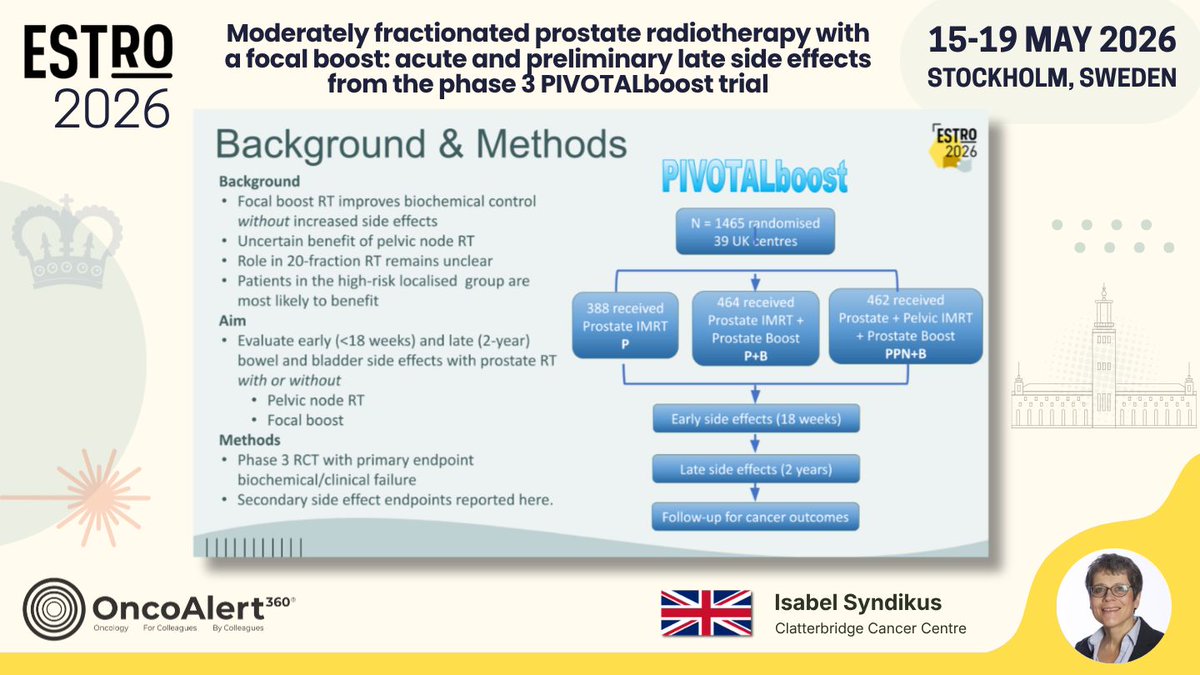
Phase 3 RCT, N=1465 randomised at 39 UK centres. Primary endpoint is biochemical/clinical failure; the side-effect endpoints presented here are secondary. Early toxicity assessed to 18 weeks, late toxicity at 2 years.
Localised prostate cancer, with the slides naming the high-risk localised group as most likely to benefit from the interventions under test. Full eligibility criteria not stated in the source.
20-fraction moderately hypofractionated IMRT in all arms. Randomisation is to prostate alone (388), prostate + focal boost (464), or prostate + pelvic nodes + focal boost (462), so the trial separates the boost question from the nodal question. Prescription dose and boost dose level not stated in the source slides.
Primary: biochemical/clinical failure, not reported at this presentation. Secondary (reported here): early bowel and bladder side effects to 18 weeks and late G2+ events at 2 years.
Nodal RT increased early bowel side effects, resolving by 18 weeks. Late cumulative rates were reported for the 973 (74%) patients with at least 2 years' follow-up.
The nodal question in prostate RT is currently split: POP-RT favoured whole-pelvis RT on biochemical failure-free survival while PEACE-2 was null on its nodal comparison, and both used conventional or near-conventional fractionation. PIVOTALboost is the first randomised test of pelvic nodal coverage in a 20-fraction schedule, so its eventual efficacy readout is the one that transfers to how most UK and increasingly non-UK practice actually delivers prostate RT.
The late analysis rests on the 74% with 2 years of follow-up, so a differential drop-out by arm would bias the comparison, and cumulative-incidence estimates at 2 years cannot address the fibrotic and stricture toxicity that appears at 5 to 10 years. The source does not state the grading instrument, and a clinician-graded versus patient-reported difference materially changes the size of a G2+ bowel signal.
A safety readout without its efficacy partner cannot move the nodal decision on its own, but it does close off one of the two arguments against nodal coverage in the hypofractionated era. The remaining argument is whether pelvic nodal RT does anything for disease control, which this trial is powered to answer and has not yet reported.
CONSORT flow
Randomised phase 3, but this is the secondary toxicity readout only; the biochemical/clinical failure primary endpoint is unreported, so it settles safety, not benefit.
- Does pelvic nodal RT improve biochemical/clinical failure at 20 fractions? n=18 · primary completion 2026-08 · 20fx pelvic nodal RT with prostate SIBrecruiting Phase III Adaptive Adaptive Stereostactic Body Radiotherapy (SBRT) With Dose Escalation for High-Risk Prostate Cancer Phase NAn=390 · primary completion 2033-04 · WPRT + DIL boost vs standard RT, high risk
- Does the focal intraprostatic boost add control over prostate IMRT alone? recruiting Image-guided Focal Dose Escalation- Primary pc Treated With Primary External Beam Hypofract.Stereotactic rt Phase NAn=374 · primary completion 2025-08 · arm A focal dose escalation vs arm B IMRTactive Standard Moderately Hypofractionated RT vs. Ultra-hypofractionated Focal Lesion Ablative Microboost in Prostate Cancer Phase NAn=484 · primary completion 2032-01 · Hypo-FLAME microboost vs standard 20fx RTrecruiting Addition of Focal Boost to Primary Radiotherapy for Prostate Cancer in 12 or 20 Fractions Phase NAn=1016 · primary completion 2040-10 · randomises focal boost vs none at 20fx
- Do G2+ rates diverge beyond 2 years as late fibrotic toxicity matures?
📚 Sources · 🐦 1 tweet
Day THREE of #ESTRO26 Coverage by OncoAlert 🚨
— OncoAlert (@OncoAlert) May 17, 2026
Moderately fractionated prostate radiotherapy with a focal boost: acute and preliminary late side effects from the phase 3 PIVOTALboost trial Presented by Isabel Syndikus 🇬🇧 #RadOnc ☢️
In the PIVOTALboost trial, we treated 1314… pic.twitter.com/cGuR1j2Qos
PACE-NODES
ForHigh-risk localised prostate (T3a-T4, Gleason 8-10, or PSA>20), on 12-36mo ADT
28% vs 21%
PPN-SBRT vs P-SBRT; no effect size or p-value reported in source
TL;DRCTCAE G2+ GI toxicity 28% vs 21% with added pelvic nodal SBRT; no GU difference, symptoms resolved by 12wk.
Nodal SBRT at 25Gy/5f costs 7 points of acute G2+ GI (28% vs 21%) and nothing in GU, with the EPIC-26 bowel signal at 4 weeks resolving by 12. That makes acute tolerability a weak argument against 5f elective nodal coverage; the decision now waits on late effects and the immature failure endpoint.
In high-risk localised prostate already planned for 5f prostate SBRT plus 12-36mo ADT, this supports the feasibility of extending to pelvic nodes without a GU penalty; it says nothing yet about whether nodal coverage improves control. The longer read
The cost of adding 25Gy/5f to the pelvis is 7 points of acute G2+ GI (28% vs 21%), transient by 12 weeks, with no GU penalty. The gating practical fact is deliverability: 11% of PPN-SBRT patients never received allocation on unmet constraints.

| Endpoint | PPN-SBRT | P-SBRT |
|---|---|---|
| CTCAE G2+ GI, 12wk | 28% | 21% |
| Did not receive allocation | 11% | 4% |
+1 more figure
10 details 3 trials watching
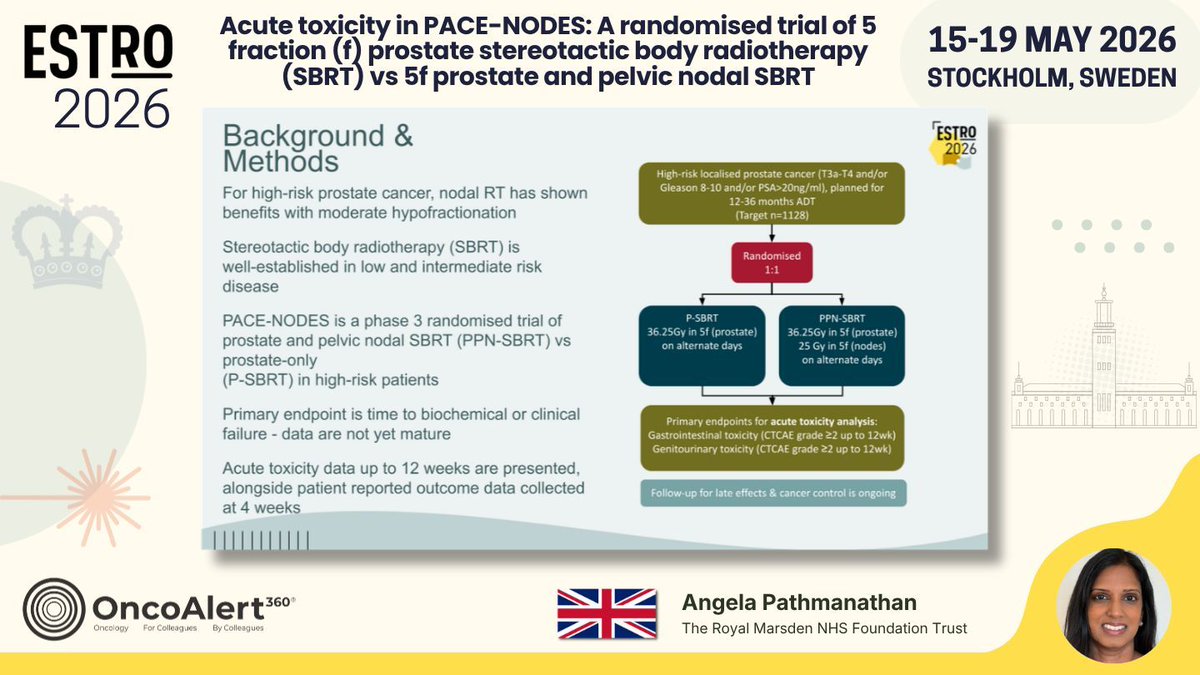
Phase 3 randomised 1:1 multicentre trial, target n=1128, 1166 randomised. This presentation reports the acute toxicity analysis only; the efficacy primary is time to biochemical or clinical failure and is not yet mature.
High-risk localised prostate cancer: T3a-T4 and/or Gleason 8-10 and/or PSA>20ng/ml, all planned for 12-36 months ADT.
Both arms 36.25Gy in 5 fractions to the prostate on alternate days. PPN-SBRT adds 25Gy in 5 fractions to the pelvic nodes; P-SBRT is prostate-only.
Primary for this analysis: CTCAE grade ≥2 GI and grade ≥2 GU toxicity up to 12 weeks. Patient-reported EPIC-26 domain scores collected at 4 weeks.
GI was the only separating domain; GU did not differ by clinician or patient report, and the GI gap had closed by 12 weeks.
11% of PPN-SBRT and 4% of P-SBRT patients did not receive their allocated treatment, mostly because planning constraints were not met, which is itself a deliverability signal for 5f nodal treatment.
Patient-reported outcomes were captured at 4 weeks only, so the 12-week convergence rests on clinician CTCAE grading. No effect size, confidence interval or p-value for the GI difference appears in the source, and late GI toxicity is the endpoint that historically decides elective nodal coverage.
The trial's answer so far is about deliverability rather than benefit: 5f nodal SBRT can be given across multiple centres at an acute cost confined to transient bowel symptoms. Whether that cost is worth paying depends entirely on the failure endpoint still to read out.
Acute-toxicity readout only; the efficacy primary (time to biochemical or clinical failure) is immature, so the nodal-coverage question stays open.
- Late GI toxicity beyond the 12-week acute window n=100 · primary completion 2027-10 · 1-2mm PTV margins to cut late rectal toxicityn=500 · primary completion 2027-12 · late GI toxicity as primary endpoint after prostate SBRT
- Whether 5f nodal SBRT improves biochemical or clinical failure recruiting PRO-BOOST-N: Prostate-First Versus Combined Prostate and Nodal Dose Escalation in PSMA PET-Staged Node-Positive Prostate Cancer Phase 2/3n=600 · primary completion 2033-12 · randomises nodal dose in cN1 ultrahypofx pelvic RT
- Which anatomy or constraints drove the 11% non-delivery rate
📚 Sources · 🐦 1 tweet
Day THREE of #ESTRO26 Coverage by OncoAlert 🚨
— OncoAlert (@OncoAlert) May 17, 2026
Acute toxicity in PACE-NODES: A randomised trial of 5 fraction (f) prostate stereotactic body radiotherapy (SBRT) vs 5f prostate and pelvic nodal SBRT
Presented by Angela Pathmanathan 🇬🇧 #RadOnc ☢️ #ProstateCancer
PACE-NODES is a… pic.twitter.com/z9bAOiKSIy
PEACE-2
ForVery-high-risk localized prostate, N0M0, ≥2 of Gleason ≥8 / T3-T4 / PSA ≥20
HR 0.81
95% CI 0.63-1.03, p=0.088, primary endpoint not met
TL;DRcPFS HR 0.81 (0.63-1.03), p=0.088: pelvic RT over prostate-only missed its primary endpoint in very-high-risk N0M0.
The target-volume decision is the whole trial: ADT × 3 years and the systemic backbone were fixed, so the 4.2-point 7yr cPFS gap (67.1% vs 62.9%, p=0.088) is what elective pelvic coverage buys in conventionally-staged N0M0 disease. No dose or fractionation appears in the source slides, and staging used conventional imaging or choline PET, not PSMA.
In very-high-risk localized prostate cancer staged N0M0 on conventional imaging or choline PET, this questions routine elective pelvic nodal coverage added to 3 years of ADT; it does not address PSMA-staged or node-positive disease. The longer read
Target volume is the randomized variable with the systemic backbone fixed, so the 7yr cPFS gap of 67.1% vs 62.9% (HR 0.81, p=0.088) is the entire return on elective pelvic coverage in conventionally-staged N0M0. Dose and fractionation are absent from source, blocking a technique-level transfer.
ADT × 3 years ran in every arm and cabazitaxel × 4 cycles was the second randomization, so nothing here moves systemic choice. The relevant read is prognostic: fewer than 1 in 10 men died of prostate cancer in a decade, which questions intensification in this clinicopathologically-defined very-high-risk group.

| Arm | 7yr cPFS | HR (95% CI) | p |
|---|---|---|---|
| Pelvic RT | 67.1% [61.6; 72.2] | 0.81 [0.63; 1.03] | 0.088 |
| Prostate only RT | 62.9% [57.4; 68.1] | n/a | n/a |
+2 more figures


9 details 5 trials watching
International multicenter randomized trial with four arms crossing two questions: RT target volume (prostate only vs pelvis) and cabazitaxel × 4 cycles vs none. Primary: cPFS. The target-volume comparison reads out at 7 years.
Very-high-risk localized prostate cancer defined as ≥2 risk factors among Gleason ≥8, T3-T4, and PSA ≥20 ng/mL. N0M0 by conventional imaging or choline PET/CT.
Androgen deprivation therapy × 3 years in every arm, with cabazitaxel × 4 cycles as the second randomization. The systemic backbone is held constant across the target-volume comparison.
The randomized variable is target volume alone: prostate-only RT versus pelvic RT. Dose, fractionation, and nodal CTV definition are not reported in the source slides.
Primary: cPFS. Secondary: PSA response at 3 months, bPFS, metastasis-free survival, prostate-cancer-specific survival, OS, acute and long-term tolerance, QoL, and biopsy biomarkers.
cPFS HR 0.81 (0.63-1.03), p=0.088 on multivariable analysis, so the primary endpoint was not met. 7yr cPFS 67.1% pelvic versus 62.9% prostate-only. Toxicity and secondary endpoints are not reported in these slides.
POP-RT, a single-center randomized trial of roughly 224 men, reported a whole-pelvis benefit that made elective nodal coverage common practice in high-risk disease. PEACE-2 is larger and multicenter and does not reproduce a comparable signal on its own primary endpoint.
Staging predates routine PSMA PET, so occult nodal disease sits in both arms and dilutes a target-volume comparison. The RT dose, fractionation, and pelvic CTV definition are absent from the source, which blocks a transfer judgment to any specific technique.
The plenary's own conclusion turned on prognosis rather than the RT question: with fewer than 1 in 10 men dying of prostate cancer in the first decade, the "very high-risk" definition itself is what the investigators challenged. A cohort with that little cancer-specific mortality has little room for a target-volume difference to show up in cPFS.
CONSORT flow
Randomized, prespecified cPFS primary, adequate accrual (380 vs 381) and 7yr readout. Negative result contests routine elective pelvic coverage in N0M0 very-high-risk disease.
- Does PSMA PET staging identify a subgroup where pelvic RT helps n=250 · primary completion 2031-05 · PSMA-N0M0 high-risk randomised to PORT vs whole-pelvis RTrecruiting PRO-BOOST-N: Prostate-First Versus Combined Prostate and Nodal Dose Escalation in PSMA PET-Staged Node-Positive Prostate Cancer Phase 2/3n=600 · primary completion 2033-12 · PSMA PET-staged cN1M0: nodal dose escalation vs…
- Biomarkers to guide intensification vs de-intensification in very-high-risk disease
- Pelvic RT toxicity and QoL tradeoff not reported in source n=700 · primary completion 2021-12 · longitudinal GI/heme/GU toxicity + HRQoL after WPRTactive Hypofractionated Whole-Pelvis Radiotherapy (WPRT) vs Conventionally-Fractionated WPRT in Prostate Cancer Phase 2n=58 · primary completion 2026-09 · QoL of 5-fraction vs 25-fraction WPRTn=400 · primary completion 2027-03 · late GI toxicity, protons vs photons, whole-pelvis RT
📚 Sources · 🐦 1 tweet
📣@PBlanchardMD shows #ESTRO26 that pelvic #radiotherapy in high risk #prostatecancer does not have a large improve in outcomes.
— Shankar Siva (@_ShankarSiva) May 17, 2026
- With only 1 in 10 dying of prostate cancer in 10 years, are these patients truly “high risk”? #pcsm #radonc pic.twitter.com/D0XrGD6iNX