Hepatobiliary
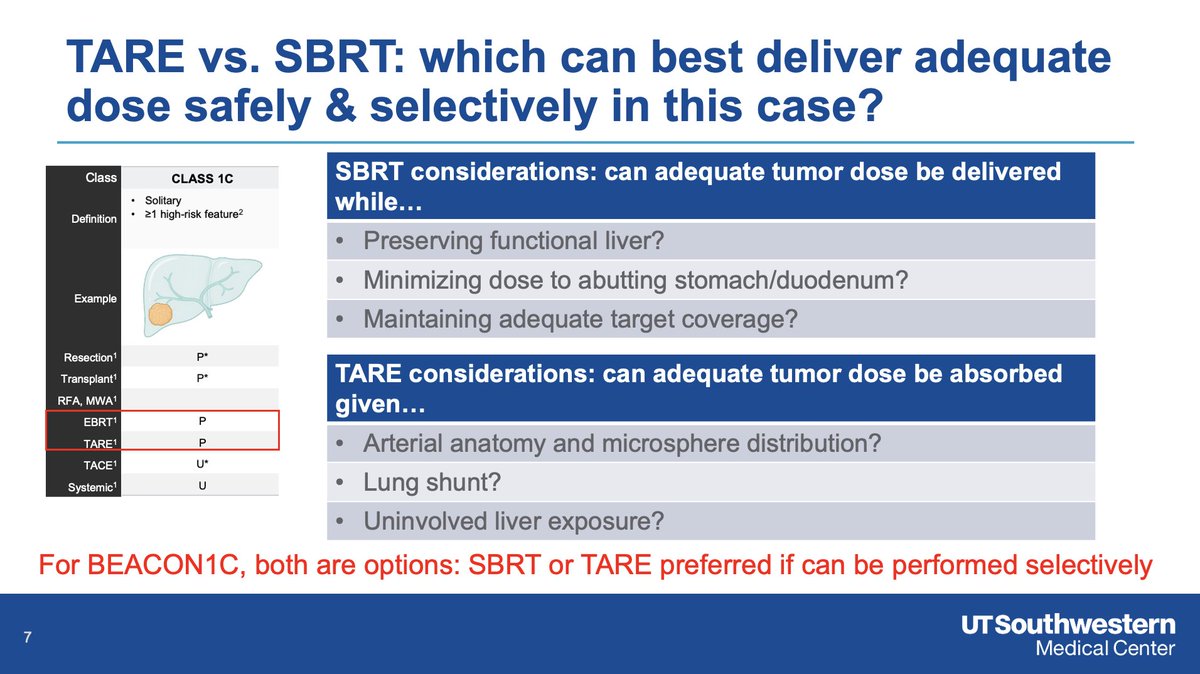
Modality selection between SBRT and TARE, framed on which can deliver adequate dose safely and selectively for a given pt/tumor.
TARE vs SBRT for HCC: decision-making talk
TL;DRBoth TARE and SBRT can deliver ablative RT in HCC; phenotype should pick the modality, SBRT attractive with MVI, arterial constraints, or non-invasive preference.
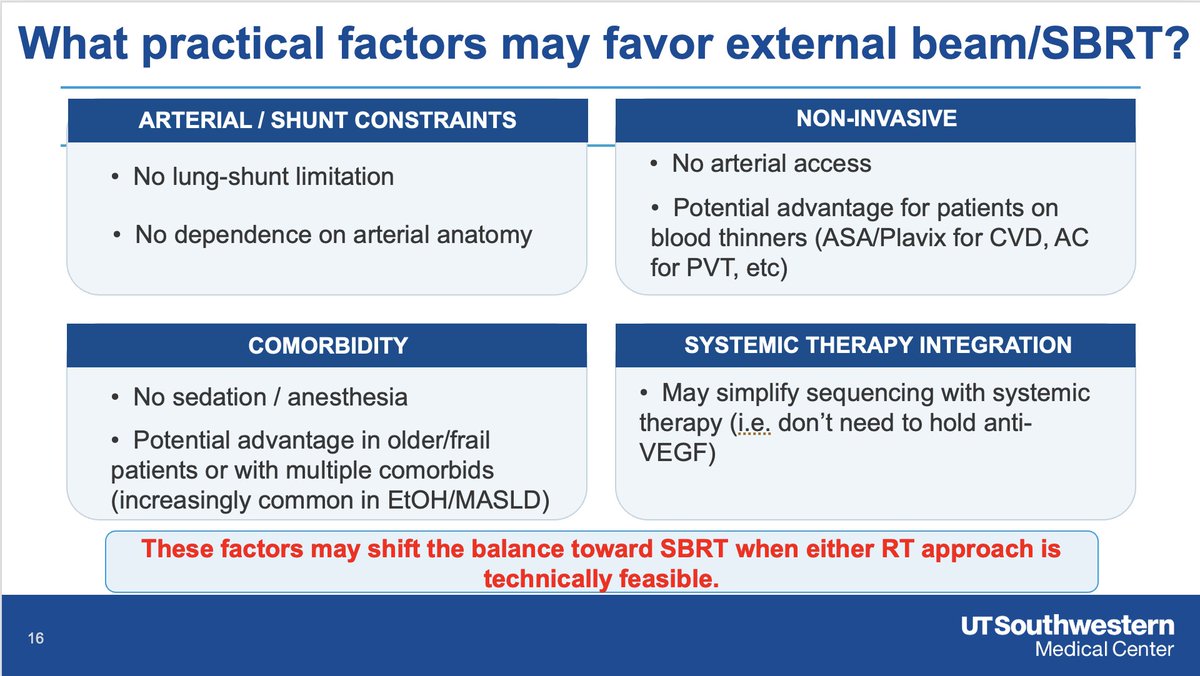
The speaker argued that TARE and SBRT are both ablative RT options in HCC and that the choice should follow tumor and pt phenotype, not a default modality. The proposed framework asks which approach can deliver adequate dose safely and selectively: for SBRT, liver sparing, luminal GI abutment and target coverage; for TARE, arterial anatomy, lung shunt and uninvolved liver exposure. Practical factors (anticoagulation, frailty, no anesthesia, anti-VEGF sequencing) are presented as tilting toward SBRT when either is feasible. The framework rests on the BEACON-HCC consensus allocation and on feasibility reasoning.
- The shared slides carry no comparative outcome data, so the framework rests on feasibility and convenience reasoning, not on head-to-head efficacy or toxicity evidence for SBRT vs TARE.
- The practical-factors slide lists only what favors SBRT; the mirror case for TARE (luminal GI abutment, dose absorbed by tumor) gets far less development in the slides shared.
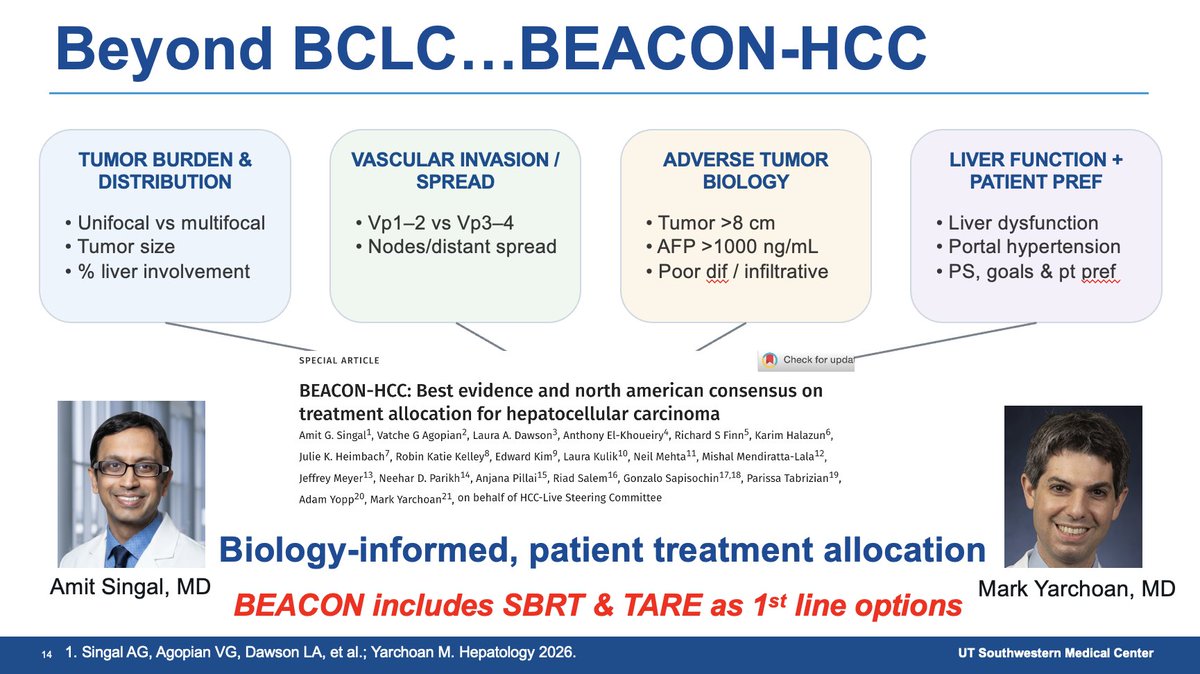
- Anchoring the recommendation to a consensus allocation document means the listing of SBRT and TARE as options reflects panel opinion, not a measured outcome.
- "Phenotype should determine modality" assumes the modalities are equivalently ablative once feasible; liver function limits and tumor size limits for each are not on the shared slides.
BEACON-HCC
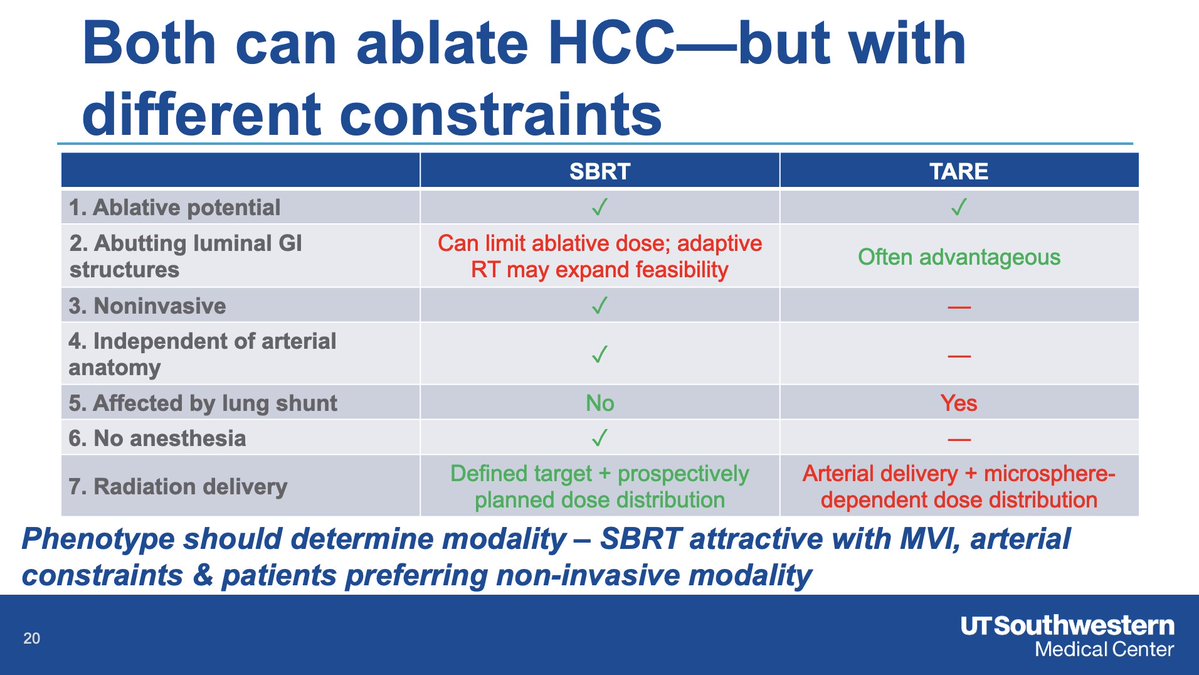
The decision is modality selection for ablative RT in HCC when both SBRT and TARE are feasible. The slides give no outcome comparison; the tie-breakers offered are operational: lung shunt, arterial anatomy, anticoagulation, anesthesia risk, and not having to hold anti-VEGF. Abutting stomach/duodenum is the stated scenario where SBRT dose can be limited and TARE is often advantageous.
In HCC where either ablative RT approach is technically feasible, this supports weighing MVI, arterial constraints, anticoagulation, frailty and anti-VEGF timing toward SBRT; it does not extend to tumors abutting luminal GI structures, where SBRT ablative dose can be limited.
The decision is SBRT vs TARE for ablative intent in HCC. The slides frame SBRT feasibility around functional liver sparing, dose to abutting stomach/duodenum and target coverage, with adaptive RT named as a way to expand feasibility. No dose or fractionation is given, and no outcome comparison.
The systemic-therapy angle is sequencing: the slides state SBRT may simplify integration because anti-VEGF does not need to be held, and that no arterial access may help pts on anticoagulation for PVT. No data on combined SBRT plus systemic therapy outcomes are shown.
+3 more figures
8 details 4 trials watching
SBRT delivers a defined target with a prospectively planned dose distribution; TARE dose distribution is arterial and microsphere-dependent. No dose, fractionation or dosimetry thresholds appear on the shared slides.
The talk positions itself against BCLC ("Beyond BCLC") and leans on BEACON-HCC (Hepatology 2026), a North American consensus on treatment allocation that the slide says includes SBRT & TARE as 1st line options. No trial results are cited on the shared slides.
Only some slides were shared, and they contain no outcome or toxicity numbers. The BEACON class 1C grid is partly illegible in OCR, so per-modality recommendation strengths cannot be reproduced.
The argument reframes TARE vs SBRT as a feasibility and selectivity question per pt, then adds practical tie-breakers that mostly favor SBRT. It does not settle which modality gives better control or survival when both are feasible.
| Criterion | SBRT | TARE |
|---|---|---|
| Ablative potential | Yes | Yes |
| Abutting luminal GI structures | Can limit ablative dose; adaptive RT may expand feasibility | Often advantageous |
| Affected by lung shunt | No | Yes |
| Arterial anatomy | Independent | Dependent (arterial delivery) |
| Radiation delivery | Defined target + prospectively planned dose distribution | Arterial delivery + microsphere-dependent dose distribution |
- Head-to-head SBRT vs TARE outcomes in HCC when both are feasible n=146 · primary completion 2028-12 · randomized phase 2 TARE vs 3-5 fx SBRT, ≤3 HCC lesionsrecruiting Comparison of SBRT and SIRT With Combination IO for Locally-advanced, Unresectable HCCs (BIIRTH) Phase 2/3n=106 · primary completion 2034-03 · TACE-SBRT vs Y90 SIRT then atezo/bev, PFS, large HCC
- Does adaptive RT expand SBRT feasibility for HCC abutting luminal GI structures? n=10 · primary completion 2025-12 · online CBCT-adaptive liver SBRT where OARs limit coverage
- SBRT timing with anti-VEGF systemic therapy in HCC n=18 · primary completion 2026-12 · phase 1 SBRT concurrent with atezo/bev, dose escalation
📚 Sources · 🐦 1 tweet
Enjoyed this session & learned a lot!
— Dr. Nina Niu Sanford (@NiuSanford) October 3, 2026
Both TARE & SBRT can deliver ablative RT in HCC. Key q is which approach is best suited for a given pt/tumor.
Sharing some of my slides below re: decision-making b/w the 2 modalities.
TY to @GIcancerDoc & @EileenMOReilly for the invite. https://t.co/9RPGdvzwOX pic.twitter.com/PW1Sri7CTf