Hepatobiliary
2026-10-03
TARE vs SBRT for HCC: decision-making talk
TL;DRBoth TARE and SBRT can deliver ablative RT in HCC; phenotype should pick the modality, SBRT attractive with MVI, arterial constraints, or non-invasive preference.
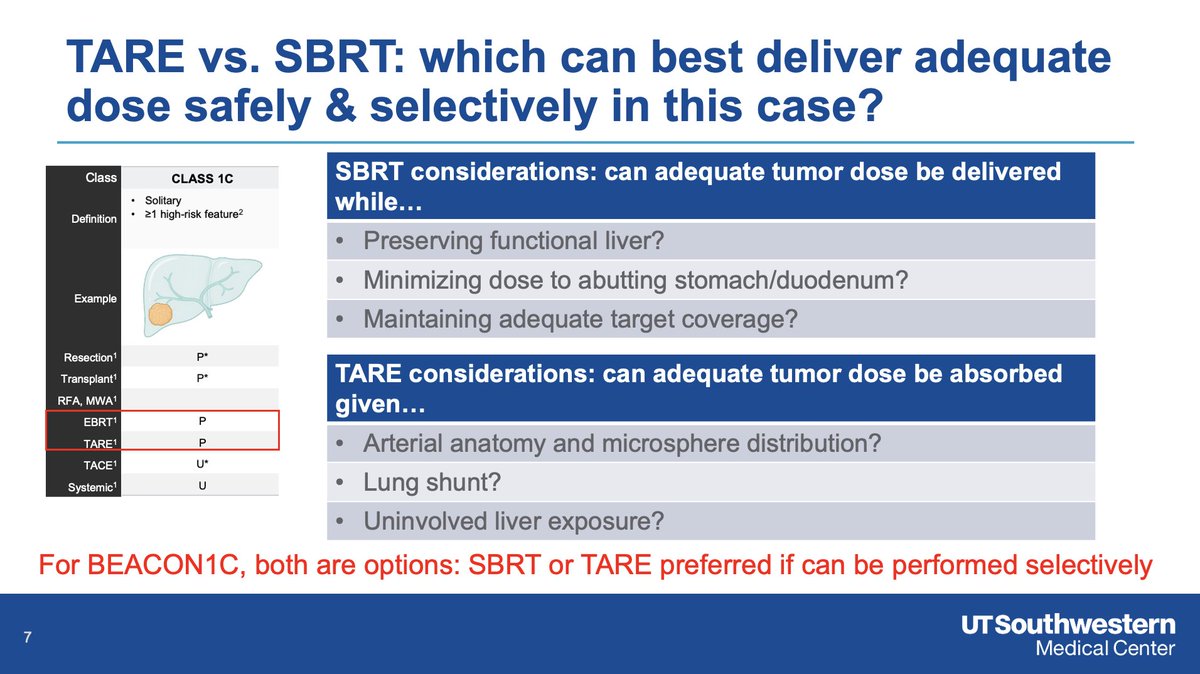
The speaker argued that TARE and SBRT are both ablative RT options in HCC and that the choice should follow tumor and pt phenotype, not a default modality. The proposed framework asks which approach can deliver adequate dose safely and selectively: for SBRT, liver sparing, luminal GI abutment and target coverage; for TARE, arterial anatomy, lung shunt and uninvolved liver exposure. Practical factors (anticoagulation, frailty, no anesthesia, anti-VEGF sequencing) are presented as tilting toward SBRT when either is feasible. The framework rests on the BEACON-HCC consensus allocation and on feasibility reasoning.
- The shared slides carry no comparative outcome data, so the framework rests on feasibility and convenience reasoning, not on head-to-head efficacy or toxicity evidence for SBRT vs TARE.
- The practical-factors slide lists only what favors SBRT; the mirror case for TARE (luminal GI abutment, dose absorbed by tumor) gets far less development in the slides shared.
- Anchoring the recommendation to a consensus allocation document means the listing of SBRT and TARE as options reflects panel opinion, not a measured outcome.
- "Phenotype should determine modality" assumes the modalities are equivalently ablative once feasible; liver function limits and tumor size limits for each are not on the shared slides.
BEACON-HCC
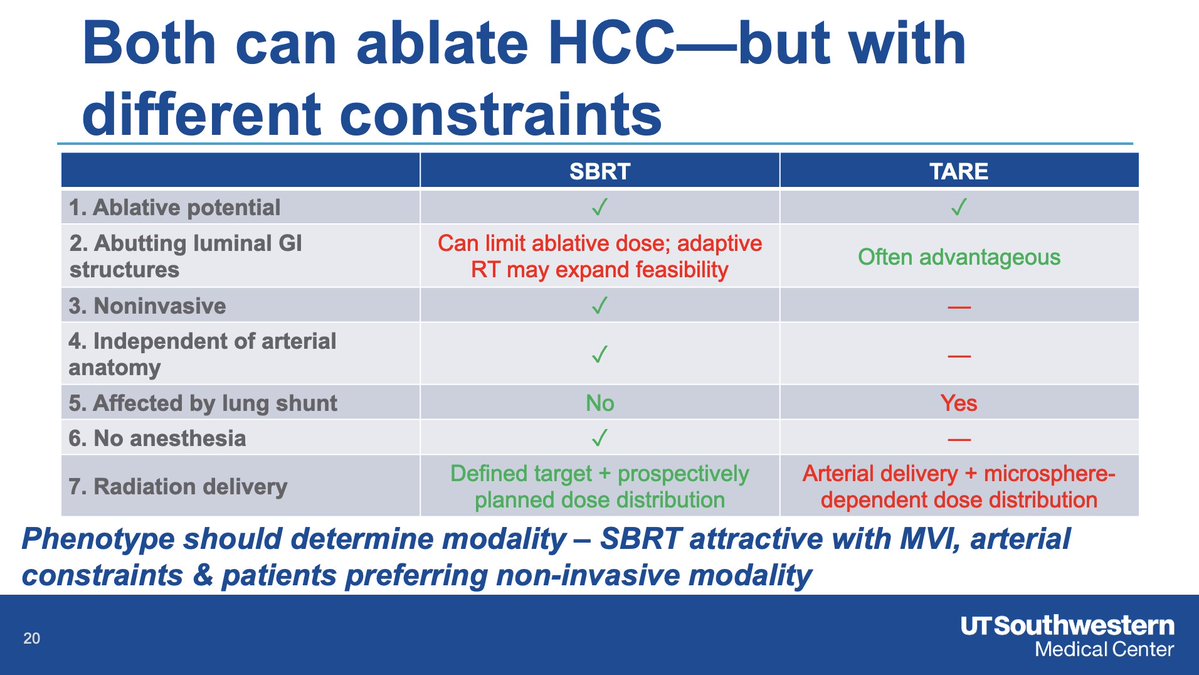
The decision is modality selection for ablative RT in HCC when both SBRT and TARE are feasible. The slides give no outcome comparison; the tie-breakers offered are operational: lung shunt, arterial anatomy, anticoagulation, anesthesia risk, and not having to hold anti-VEGF. Abutting stomach/duodenum is the stated scenario where SBRT dose can be limited and TARE is often advantageous.
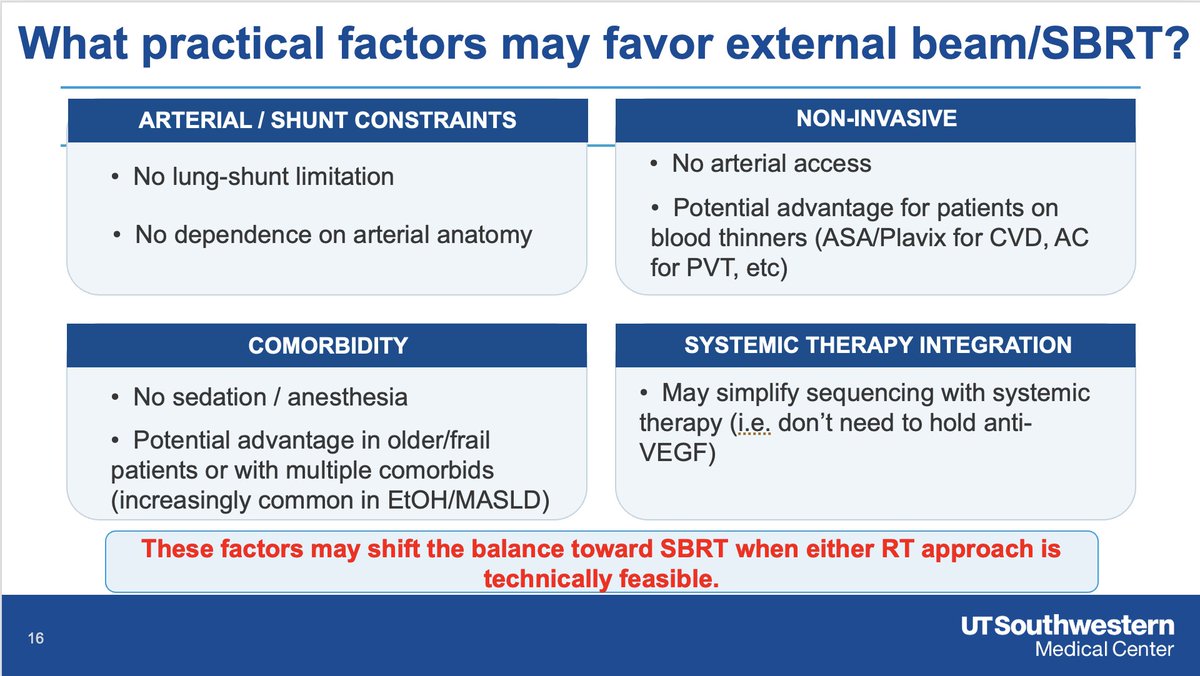
In HCC where either ablative RT approach is technically feasible, this supports weighing MVI, arterial constraints, anticoagulation, frailty and anti-VEGF timing toward SBRT; it does not extend to tumors abutting luminal GI structures, where SBRT ablative dose can be limited.
The decision is SBRT vs TARE for ablative intent in HCC. The slides frame SBRT feasibility around functional liver sparing, dose to abutting stomach/duodenum and target coverage, with adaptive RT named as a way to expand feasibility. No dose or fractionation is given, and no outcome comparison.
The systemic-therapy angle is sequencing: the slides state SBRT may simplify integration because anti-VEGF does not need to be held, and that no arterial access may help pts on anticoagulation for PVT. No data on combined SBRT plus systemic therapy outcomes are shown.
+3 more figures
8 details 4 trials watching
SBRT delivers a defined target with a prospectively planned dose distribution; TARE dose distribution is arterial and microsphere-dependent. No dose, fractionation or dosimetry thresholds appear on the shared slides.
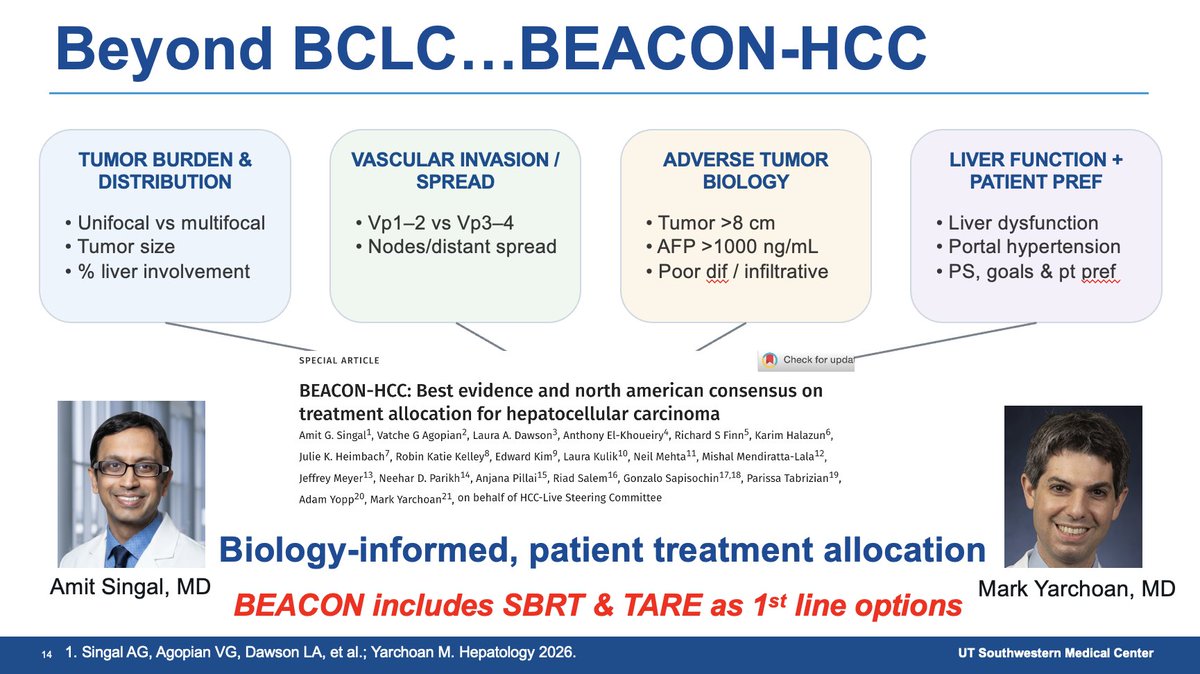
The talk positions itself against BCLC ("Beyond BCLC") and leans on BEACON-HCC (Hepatology 2026), a North American consensus on treatment allocation that the slide says includes SBRT & TARE as 1st line options. No trial results are cited on the shared slides.
Only some slides were shared, and they contain no outcome or toxicity numbers. The BEACON class 1C grid is partly illegible in OCR, so per-modality recommendation strengths cannot be reproduced.
The argument reframes TARE vs SBRT as a feasibility and selectivity question per pt, then adds practical tie-breakers that mostly favor SBRT. It does not settle which modality gives better control or survival when both are feasible.
| Criterion | SBRT | TARE |
|---|---|---|
| Ablative potential | Yes | Yes |
| Abutting luminal GI structures | Can limit ablative dose; adaptive RT may expand feasibility | Often advantageous |
| Affected by lung shunt | No | Yes |
| Arterial anatomy | Independent | Dependent (arterial delivery) |
| Radiation delivery | Defined target + prospectively planned dose distribution | Arterial delivery + microsphere-dependent dose distribution |
- Head-to-head SBRT vs TARE outcomes in HCC when both are feasible n=146 · primary completion 2028-12 · randomized phase 2 TARE vs 3-5 fx SBRT, ≤3 HCC lesionsrecruiting Comparison of SBRT and SIRT With Combination IO for Locally-advanced, Unresectable HCCs (BIIRTH) Phase 2/3n=106 · primary completion 2034-03 · TACE-SBRT vs Y90 SIRT then atezo/bev, PFS, large HCC
- Does adaptive RT expand SBRT feasibility for HCC abutting luminal GI structures? n=10 · primary completion 2025-12 · online CBCT-adaptive liver SBRT where OARs limit coverage
- SBRT timing with anti-VEGF systemic therapy in HCC n=18 · primary completion 2026-12 · phase 1 SBRT concurrent with atezo/bev, dose escalation
📚 Sources · 🐦 1 tweet
Enjoyed this session & learned a lot!
— Dr. Nina Niu Sanford (@NiuSanford) October 3, 2026
Both TARE & SBRT can deliver ablative RT in HCC. Key q is which approach is best suited for a given pt/tumor.
Sharing some of my slides below re: decision-making b/w the 2 modalities.
TY to @GIcancerDoc & @EileenMOReilly for the invite. https://t.co/9RPGdvzwOX pic.twitter.com/PW1Sri7CTf
2026-08-08
BEACON-HCC
ForHCC across all stages, North American practice context
TL;DRNew North American HCC allocation framework; expert decisions 96.6% concordant with BEACON vs 72.4% with BCLC 2025 across 29 cases.
First major allocation framework to place EBRT/SBRT alongside TARE as a first-line locoregional option rather than a BCLC afterthought, extending to Class 1D (Vp1-2) and Class 3B (Vp3/4). The panel's own citation base for Class 3B is RTOG1112, which showed only a trend (p=0.06) for SBRT vs sorafenib, so the elevation runs ahead of randomised evidence.
For a cirrhotic patient with unifocal HCC not eligible for resection or transplant, this framework treats SBRT as a legitimate first-line ablative option rather than a fallback; it does not apply to Class 4A, where the panel explicitly withholds EBRT outside symptom palliation. The longer read
SBRT enters the allocation boxes as a first-line locoregional option across Classes 1A through 3A, not a salvage line, which changes referral expectations at tumor board. No dose or fractionation is specified anywhere in the framework, and the Class 3B citation is RTOG1112 at p=0.06, so the elevation runs ahead of randomised evidence.
The framework pushes back on reflexive systemic therapy for macrovascular invasion: Class 1D (Vp1-2) is routed to local or surgical options, and adjuvant therapy after complete response is explicitly not recommended. Systemic therapy stays the cornerstone only for Class 3B, 4A, and 4B.
Resection is preferred without CSPH, transplant with it, and both extend beyond early stage after downstaging response. Class 3B carries a cited RCT showing resection after neoadjuvant radiation beat up-front resection, and Vp1-2 patients with deep durable responses become transplant candidates rather than automatic exclusions.
9 details 4 trials watching
Modified Delphi consensus, 20 North American multidisciplinary experts, iterative discussion and voting over two rounds. Followed by a 29-case pilot concordance exercise against external experts.
Framework spans the full HCC spectrum, from unifocal ≤3 cm (Class 1A) to distant metastases (Class 4B). Class assignment keys on tumor burden, Vp level of portal invasion, and poor prognostic features (>8 cm, AFP >1000 ng/mL, poor differentiation).
EBRT including SBRT is named a first-line locoregional option in Classes 1A through 3A, on par with TARE, RFA/MWA, and TACE. No dose or fractionation is specified anywhere in the framework: the stated rationale is ablative dose delivered selectively to limit radiation-induced liver injury. In Class 4A, EBRT is not routinely indicated outside palliation of symptomatic disease.
Expert decisions matched BEACON in 28 of 29 cases (96.6%) vs 72.4% for BCLC 2025. The single discordant case was combination systemic plus locoregional therapy for vascular invasion reaching the right atrium.
| BEACON class | BCLC 2025 | AJCC v8 | Adaptation from BCLC |
|---|---|---|---|
| Class 1A | Very early (0) or early (A) | Stage 1A or 1B | Aligned; framework elevates SBRT and TARE |
| Class 1B | Early (A) | Stage 1B | Aligned |
| Class 1C | Early (A) | Stage 2 | Aligned |
| Class 1D | Advanced (C) | Stage 2 | Macrovascular invasion may suit local or surgical therapy: TARE, SBRT, resection |
| Class 2 | Early (A) | Stage 1A or 1B | Aligned; framework elevates SBRT and TARE |
| Class 3A | Intermediate (B) or advanced (C) | Stage 3A | Aligned; framework elevates SBRT and TARE |
| Class 3B | Advanced (C) | Stage 3B or 4A | Macrovascular invasion may be amenable to local therapy in selected cases |
| Class 4A | Intermediate (B) | Stage 3A | Extensive intrahepatic spread treated as systemic process |
| Class 4B | Advanced (C) | Stage 4B | Stage and treatment framework aligned |
BCLC keeps radiation outside its core allocation algorithm; BEACON moves it in. The supporting evidence the panel cites is uneven: DOSISPHERE (ORR 71 vs 36%, OS 26.6 vs 10.7 mo) for personalized-dosimetry TARE is randomised, while the SBRT case in Class 3B rests on RTOG1112, which reached only p=0.06 for OS vs sorafenib.
The 72.4% BCLC comparator was scored by BEACON's own authors against cases the same group selected, and 29 cases cannot exercise nine classes evenly. Round-1 per-class agreement is unreadable from the source table because vote counts and class labels arrived unpaired.
The framework's real claim is that intrahepatic burden and Vp level, not BCLC's stage buckets, should drive allocation, and that radiation-based modalities are burden-appropriate rather than stage-restricted. Whether that improves outcomes is untested: validation against empiric clinical data is deferred to the HCC-Live Consortium.
Delphi consensus framework, not an efficacy study. Concordance figures measure opinion against opinion. Elevates EBRT/TARE to first-line locoregional status in a formal allocation system.
- Head-to-head SBRT vs TARE for liver-confined HCC n=146 · primary completion 2028-12 · randomised phase 2 TARE vs SBRT, =3 HCC lesionsrecruiting Comparison of SBRT and SIRT With Combination IO for Locally-advanced, Unresectable HCCs (BIIRTH) Phase 2/3n=106 · primary completion 2034-03 · TACE-SBRT vs Y90 SIRT, PFS primary
- Does BEACON allocation improve survival vs BCLC allocation
- Optimal sequencing of ICI with locoregional therapy active Durvalumab/Tremelimumab in Neoadjuvant and Adjuvant Setting in Patients With HCC Treated by by Percutaneous Ablation Procedure Phase 2n=30 · primary completion 2027-09 · durva/treme before and after percutaneous ablationrecruiting Using Radiotherapy and Immunotherapy to Treat Advanced Liver Cancer Before Transplant Phase 1/2n=48 · primary completion 2031-06 · Y90/SBRT plus atezo-bev, transplant conversion
📚 Sources · 📄 1 paper
Abstract
2026-07-01
NRG Oncology/RTOG 1112 NCT01730937
ForLocally advanced HCC, 74.0% MVI, local-regional tx unsuitable/refractory
HR 0.77
90% CI 0.59-1.01, 1-sided P=.06, not statistically significant
TL;DRmOS 15.8 vs 12.3 mo with SBRT + sorafenib vs sorafenib, HR 0.77 (90% CI 0.59-1.01), not significant; mPFS HR 0.55 in locally advanced HCC.
PFS carries the RT signal: HR 0.55 (95% CI 0.40-0.75) with personalized 27.5-50 Gy in 5 fractions, in a cohort with 74.0% macrovascular invasion and no rise in G3+ TRAE (47% vs 42%). In-liver control and failure patterns are not reported in source text, so the case for liver SBRT rests on PFS plus an adjusted OS HR.
In locally advanced HCC with macrovascular invasion, unsuitable for or refractory to local-regional therapy, this supports weighing liver SBRT with first-line systemic therapy for progression control; it does not extend to pts on the newer systemic standard that ended accrual. The longer read
Personalized 27.5-50 Gy in 5 fractions was deliverable in a cohort with 74.0% macrovascular invasion without more G3+ TRAE (47% vs 42%, P=.52). PFS HR 0.55 is the RT-attributable read; local control and in-liver failure patterns are not reported in source text, and the dose range blocks any dose-response read.
SBRT followed by sorafenib extended median PFS from 5.5 to 9.2 mo with G3+ TRAE 47% vs 42% (P=.52), so it did not compromise systemic tolerability. The trial closed after the first-line systemic standard changed, leaving the increment over newer backbones untested and the sequencing with systemic therapy an open planning question.
8 details 2 trials watching
Phase 3 randomized, multicenter, 1:1, stratified by performance status, liver function, degree of metastases and macrovascular invasion. 193 randomized, 177 eligible; data collected April 2013 to March 2021. Accrual stopped early after a change in standard-of-care systemic therapy.
HCC unsuitable for or refractory to standard local-regional therapies, candidates for first-line systemic therapy. Median age 66 (IQR 60-72), 84.7% male, macrovascular invasion 74.0%.
Sorafenib in both arms; the experimental arm received SBRT followed by sorafenib.
Personalized SBRT, 27.5 to 50 Gy in 5 fractions. Dose-selection rules, target volumes and OAR constraints not reported in source text.
Primary: overall survival. Secondary: PFS, adverse events, quality of life.
Primary OS not statistically significant on the unadjusted test; significant after stratification-factor adjustment. PFS clearly improved with SBRT; values in the table above.
| Endpoint | SBRT + sorafenib | Sorafenib | Effect size |
|---|---|---|---|
| Median OS (1° EP) | 15.8 mo (90% CI 11.4-19.2) | 12.3 mo (90% CI 10.6-14.3) | HR 0.77 (90% CI 0.59-1.01), 1-sided P=.06 |
| OS, adjusted for stratification factors | n/a | n/a | HR 0.72 (95% CI 0.52-0.99), 2-sided P=.04 |
| Median PFS | 9.2 mo (95% CI 7.5-11.9) | 5.5 mo (95% CI 3.4-6.3) | HR 0.55 (95% CI 0.40-0.75), P<.001 |
| G3+ treatment-related AEs | 39/83 (47%) | 37/88 (42%) | P=.52 |
| Improved QoL at 6 mo | 6/17 (35%) | 2/20 (10%) | not reported |
G3+ treatment-related AEs not increased with SBRT. Treatment-related deaths: 2 with sorafenib (death NOS, liver failure), 1 with SBRT plus sorafenib (lung infection).
Radioembolization trials against or combined with sorafenib (SARAH, SIRveNIB, SORAMIC) did not show an OS gain. START, which tested TACE plus RT against sorafenib in macrovascular invasion, favored the radiation-containing arm, and RTOG 1112 points the same direction with stereotactic delivery.
Analysis restricted to 177 eligible of 193 randomized. Local control and in-liver failure patterns not reported in source text, and personalized 27.5-50 Gy dosing confounds any dose-response read. QoL rests on 17 and 20 evaluable pts.
The authors call the OS gain clinically important but not statistically significant; adjusted OS and PFS point the same way, so underpowering after early closure is a more plausible reason for the miss than absence of effect. It does not settle whether SBRT adds to the systemic standard that replaced sorafenib.
Primary OS missed after accrual stopped early; positive OS read depends on stratification-adjusted analysis, with PFS the only unadjusted win.
- Does SBRT add OS benefit over current first-line systemic therapy? recruiting Testing Immunotherapy With or Without Stereotactic Body Radiation Therapy in Patients With Advanced Liver Cancer, HELIO-RT Trial Phase 3n=226 · primary completion 2029-03 · phase 3 IO-based 1L ± SBRT, advanced HCCnot yet SBRT Combined with Camrelizumab and Apatinib for Conversion Therapy in Patients with Unresectable Hepatocellular Carcinoma. Phase 2/3n=398 · primary completion 2030-12 · randomised 1L camrelizumab/apatinib ± SBRT
- Local control and in-liver failure patterns after SBRT
- Optimal dose within the personalized 27.5-50 Gy range
📚 Sources · 📄 1 paper
Abstract
2026-05-18 ESTRO Congress 2026
Multinational HCC EBRT IPD Cohort
ForVery early / early-stage HCC (BCLC-0 or A), incl. treatment-naive
TL;DRMedian OS 6.8y BCLC-0 and 4.6y BCLC-A across 4,913 EBRT-treated HCC pts, comparable to resection and ablation.
The modifiable RT variable in the Cox model is ablative dose, which was associated with reduced mortality, so the transferable read is that dose, not simply delivering EBRT, tracks with the outcome. Fractionation and dose thresholds are not given in the abstract. This is the citation for putting EBRT on the BCLC-0/A allocation discussion.
In BCLC-0 or A HCC where resection, transplant, or ablation is not feasible or is declined, this supports discussing ablative-dose EBRT as a locoregional option; it does not establish EBRT over resection or ablation in a pt eligible for either. The longer read
Ablative dose was the modifiable variable associated with reduced mortality, so the transferable read is dose, not simply offering EBRT. Dose thresholds, fractionation, and modality mix are not given in the source abstract. This is the citation for putting EBRT into the BCLC-0/A allocation discussion at tumor board.
Child-Pugh B or C, performance status, and tumor burden drove mortality in the multivariable model, which is the gating frame for who gets locoregional therapy at all. For the med onc coordinating a BCLC-0/A pt, EBRT enters the locoregional menu alongside ablation rather than as a last resort.
Median OS of 6.8 y (BCLC-0) and 4.6 y (BCLC-A) in EBRT-treated pts is a cross-literature benchmark against resection and ablation, not a head-to-head. It bears on referral for the medically inoperable or anatomically difficult pt, and does not establish EBRT over resection in a fully resectable candidate.
9 details 2 trials watching
Systematic review of EBRT publications meeting prespecified HCC technical standards (search date December 15, 2022), with corresponding authors invited to contribute individual patient data. Kaplan-Meier OS and RMST stratified by BCLC stage and treatment status; random-effects Cox for covariates. No comparator arm.
4,913 pts treated with EBRT, median follow-up 5.0 years, multinational. Analyses split by BCLC stage and by treatment-naive vs treatment-experienced; the headline read sits in BCLC-0 and BCLC-A.
EBRT delivered per each contributing series, gated by the prespecified technical standards rather than one protocol. Ablative dose was associated with a reduced risk of death; specific dose levels, fractionation, and modality mix are not given in the source abstract.
Overall survival by Kaplan-Meier and restricted mean survival time, stratified by BCLC stage and treatment status. Covariate associations from multivariable random-effects Cox modeling.
Median OS 6.8 y (95% CI 5.7-8.7) for BCLC-0 and 4.6 y (95% CI 4.1-5.1) for BCLC-A. Treatment-naive: not reached (95% CI 8.6-NR) for BCLC-0, 5.4 y (95% CI 4.5-6.7) for BCLC-A.
| Cohort | BCLC-0 | BCLC-A |
|---|---|---|
| All pts | 6.8 y (95% CI 5.7-8.7) | 4.6 y (95% CI 4.1-5.1) |
| Treatment-naive | NR (95% CI 8.6-NR) | 5.4 y (95% CI 4.5-6.7) |
The authors frame these medians as comparable with resection, thermal ablation, and other ablative locoregional therapies, a cross-study benchmark rather than a randomised comparison. EBRT's exclusion from BCLC has rested on the absence of OS evidence, which is the gap this cohort is built to fill.
IPD came only from authors who published and agreed to share, so contributing centers are self-selected and unmeasured selection at the patient level (who was routed to EBRT rather than resection) is unrecoverable. More recent year of treatment predicting survival mixes technique gains with stage migration and modern systemic salvage over a multi-decade accrual window.
The claim is an allocation claim, not an efficacy claim: EBRT belongs in the BCLC decision tree as an option to be weighed. It does not settle sequencing against ablation in a pt eligible for both, and the ablative-dose signal makes the quality of the RT, not its mere availability, the operative variable.
Largest EBRT IPD cohort argues for a BCLC allocation change, but it is pooled non-randomised data with no head-to-head comparator against resection or ablation.
- Ablative dose threshold and fractionation driving the survival association
- EBRT vs thermal ablation head-to-head in early HCC recruiting Stereotactic Radiosurgery Versus Radiofrequency Ablation for Primary Liver Cancer Phase 2n=130 · primary completion 2025-01 · phase 2 SBRT vs RFA, inoperable primary liver caactive Stereotactic Body Radiotherapy Versus Radiofrequency Ablation for Unresectable, Small (≤ 3 cm) HCC Phase NAn=178 · primary completion 2026-12 · randomised SBRT vs RFA, unresectable HCC <=3cm
- Selection differences between EBRT-treated and resected early-stage pts