Thoracic / Lung
2026-09-28 ASTRO Annual Meeting 2026
SWOG S1827/MAVERICK
ForLS- or ES-SCLC, no brain mets on MRI after 1st-line therapy
HR 0.60
90% CI 0.46-0.78, one-sided p=0.0005, favoring MRI alone
TL;DRMRI surveillance alone beat MRI + PCI for cognitive failure-free survival, HR 0.60 (90% CI 0.46-0.78), in LS- and ES-SCLC without brain mets after first-line therapy.
The benefit held with HA-PCI in 77% of the PCI arm and in the HA-PCI-only subgroup, so hippocampal sparing does not rescue PCI. Stage did not modify the effect (LS HR 0.59, ES HR 0.65, interaction p=0.79), which moves the LS-SCLC PCI default toward omission with MRI surveillance, pending final OS.
In LS- or ES-SCLC with a clean brain MRI after first-line therapy, this supports MRI surveillance over PCI, including HA-PCI. It does not address pts who cannot reliably get serial MRI, and it does not settle OS until the 190-event analysis. The longer read
HA-PCI made up 77% of the PCI arm and the HA-PCI-only subgroup still favored MRI alone, so the technique fix does not rescue PCI. The benefit was similar in LS (HR 0.59) and ES (HR 0.65), which moves the LS-SCLC PCI referral toward omission, with WBRT or SRS held for detected mets.
Immunotherapy was a stratification factor, and 41% of pts received it upfront. For the post-induction SCLC visit, this supports serial brain MRI (3, 6, 9, 12, 18, 24 mo) over a PCI referral. Final OS at 190 events is still the gate, especially in the post-ADRIATIC durvalumab era.
Also covered Sep 14
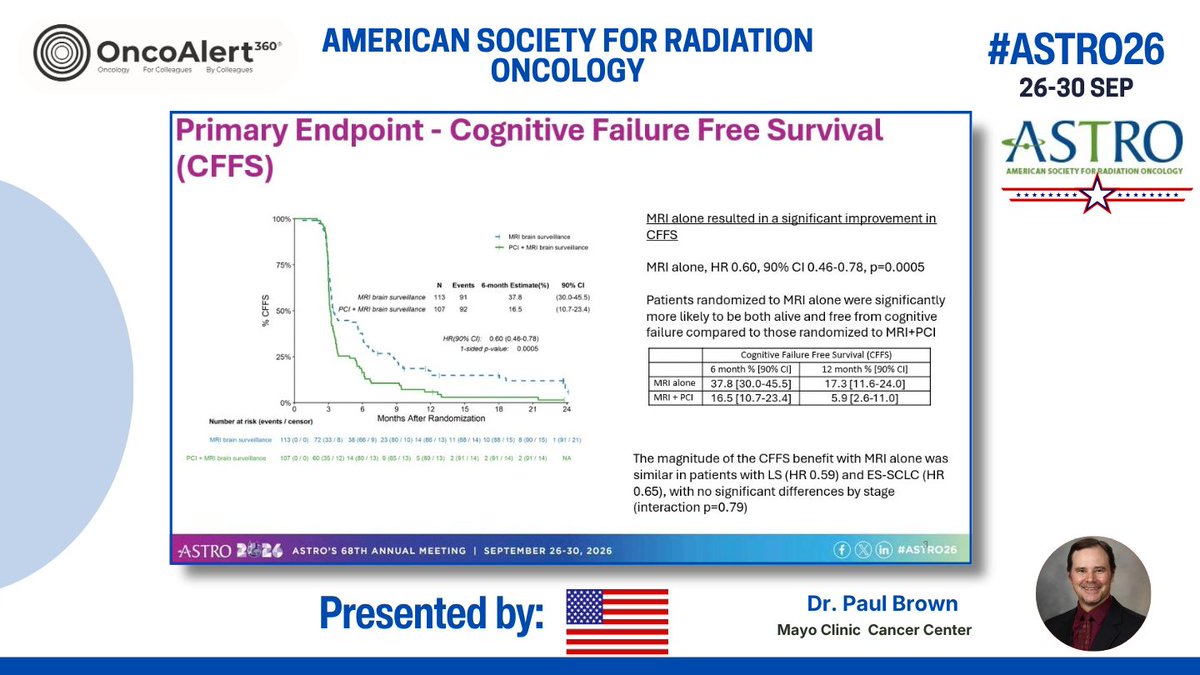
| Arm | 6-mo CFFS % (90% CI) | 12-mo CFFS % |
|---|---|---|
| MRI alone | 37.8 (30.0-45.5) | 17.3 |
| MRI + PCI | 16.5 (10.7-23.4) | 5.9 |
+2 more figures

13 details 3 trials watching
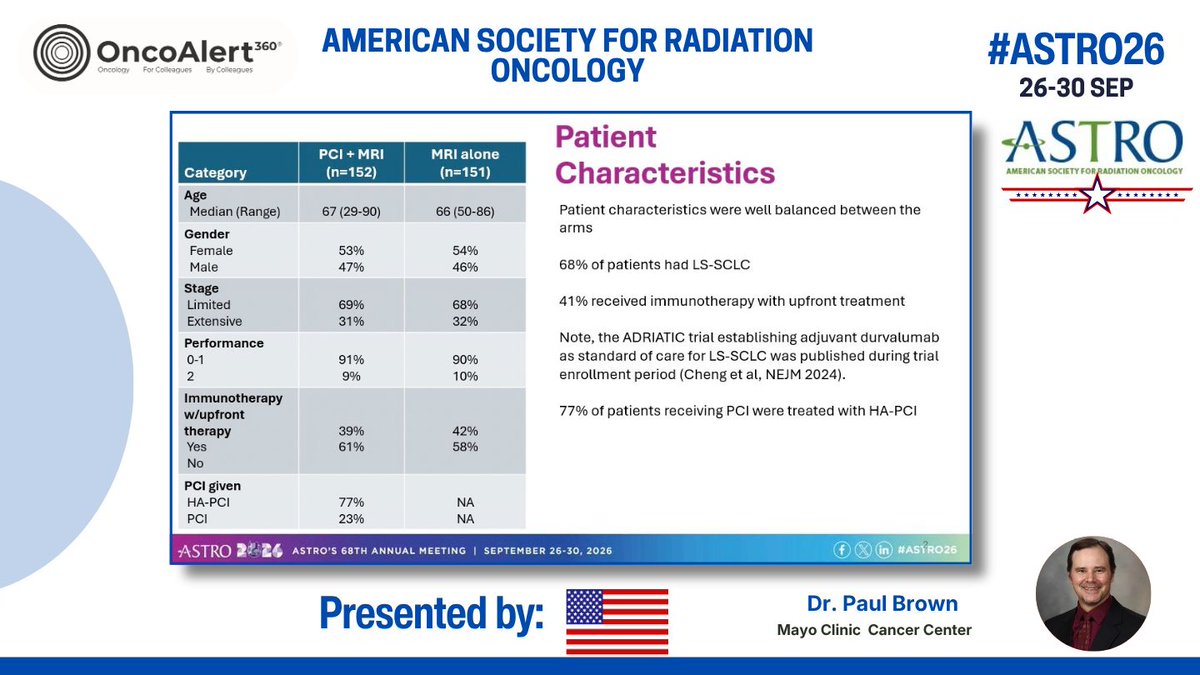
Randomized phase III (SWOG S1827), total accrual 304. Stratified by LS vs ES stage, immunotherapy (y/n), and PS 0-1 vs 2.
SCLC, limited or extensive stage, no prior brain mets and no brain mets on MRI after first-line therapy. 68% LS-SCLC; 41% received immunotherapy with upfront treatment.
PCI 25 Gy / 10 fx, with HA-PCI allowed at physician discretion; 77% of PCI pts received HA-PCI. At brain mets, RT was recommended in both arms (WBRT or SRS allowed).
Primary: cognitive failure-free survival (CFFS), with MRI and cognitive testing at 3, 6, 9, 12, 18 and 24 mo. Key secondary: OS.
CFFS favored MRI alone, HR 0.60 (90% CI 0.46-0.78), one-sided p=0.0005. The effect was similar by stage (LS HR 0.59, ES HR 0.65, interaction p=0.79) and in the HA-PCI-only subgroup. Preliminary OS after 128 events showed no significant difference. PCI decreased brain mets with no PFS difference.
| Subgroup | CFFS HR |
|---|---|
| LS-SCLC | HR 0.59 |
| ES-SCLC | HR 0.65 |
| Interaction | p=0.79 |
The Takahashi Japanese phase III had already moved ES-SCLC toward MRI surveillance, while LS-SCLC PCI still rests on pre-MRI-era randomized data and meta-analysis. MAVERICK is the first randomized test of surveillance vs PCI to include LS-SCLC with modern MRI staging.
The endpoint uses a 90% CI and a one-sided test. The brain mets reduction with PCI is unquantified in source, as is symptomatic morbidity from salvage RT. ADRIATIC changed the LS-SCLC backbone mid-enrollment.
When OS does not differ, a composite of death + cognitive failure mainly measures cognitive toxicity, and on that axis PCI loses even with hippocampal sparing. The open question is whether final OS confirms the preliminary read.
Randomized phase III, prespecified primary met, diverges from PCI as standard in LS-SCLC. Held below practice-changing: OS immature (128/190 events), composite cognitive endpoint, abstract-only.
- Does OS remain equivalent at the final 190-event analysis? n=534 · primary completion 2026-04 · LS-SCLC phase 3 PCI vs MRI surveillance post-CRTrecruiting PRophylactic Cerebral Irradiation or Active MAgnetic Resonance Imaging Surveillance in Small-cell Lung Cancer Patients (PRIMALung Study) Phase NAn=600 · primary completion 2028-04 · phase 3 OS non-inferiority, MRI alone vs PCI+MRI
- Salvage RT burden and neurologic morbidity in the surveillance arm n=534 · primary completion 2026-04 · PCI vs MRI surveillance, efficacy + safety, LS-SCLC
- Does the result hold after consolidation durvalumab in LS-SCLC?
📚 Sources · 🐦 1 tweet
In Collaboration with our partners at ASTRO we continue our coverage of #ASTRO26 🚨
— OncoAlert (@OncoAlert) September 28, 2026
LBA 03 - SWOG S1827/MAVERICK: A RANDOMIZED PHASE III TRIAL OF BRAIN MRI SURVEILLANCE WITH AND WITHOUT PROPHYLACTIC CRANIAL IRRADIATION (PCI) FOR SMALL-CELL LUNG CANCER (SCLC)
Presented by Dr.… pic.twitter.com/XwdqCUV9fN
2026-09-14
SWOG S1827/MAVERICK
ForLS or ES SCLC, responding after platinum ± IO, no brain mets on MRI, PS 0-2
TL;DRRandomized phase III, LS or ES SCLC: PCI 25 Gy/10 fx + MRI vs MRI surveillance alone; no CFFS or OS results in source tweets.
The RT question is PCI omission, not RT omission: the surveillance arm still gets RT at brain mets (SRS, WBRT or HA-WBRT at discretion), so CFFS pits upfront 25 Gy/10 fx PCI against deferred salvage. HA-PCI was also discretionary, diluting any hippocampal-sparing read. No CFFS or OS result in source tweets.
CFFS compares upfront PCI 25 Gy/10 fx against salvage RT at detection, with SRS, WBRT or HA-WBRT left to discretion. Discretionary HA-PCI means the PCI arm mixes techniques, so a cognitive result will not isolate hippocampal sparing. No results in source tweets.
Immunotherapy was allowed (concurrent and/or adjuvant) and stratified, so the trial tests PCI in the chemo-IO era for both LS and ES. Entry required response to platinum without progression and enrollment within 16 weeks of the last cycle, which defines the surveillance pathway being tested. No results in source tweets.
Also covered Sep 28
9 details 4 trials watching
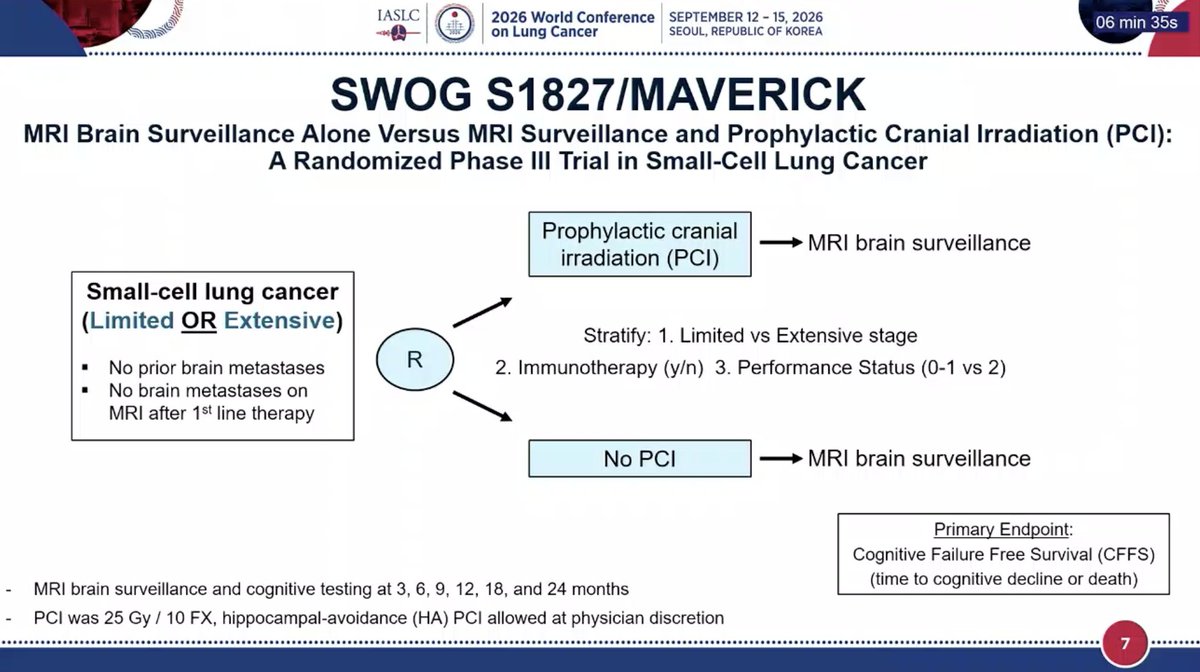
Randomized phase III, PCI + MRI brain surveillance vs MRI surveillance alone. Stratified by LS vs ES stage, immunotherapy (y/n) and PS 0-1 vs 2. N and follow-up not reported in source tweets.
LS or ES SCLC, ≥18y, PS 0-2. LS pts completed platinum chemo plus definitive thoracic RT or resection; ES pts completed platinum chemo; immunotherapy allowed. Required response to upfront therapy, no brain mets on MRI within 28 days, enrollment within 16 weeks of last chemo cycle.
PCI 25 Gy/10 fx, with HA-PCI allowed at physician discretion. RT recommended at detection of brain mets, with SRS, WBRT or HA-WBRT at physician discretion.
Primary: cognitive failure free survival (time to cognitive decline or death). Hypothesis: MRI surveillance alone gives superior CFFS without a decline in OS. MRI and cognitive testing at 3, 6, 9, 12, 18 and 24 mo.
No CFFS, OS or brain-met incidence results reported in source tweets.
Per the presenting tweet, pre-MRI-surveillance studies showed fewer brain mets and improved OS with PCI, the basis for PCI as standard. MAVERICK tests that against a modern MRI surveillance plus salvage RT pathway, the question also addressed by the Japanese ES-SCLC phase III (Takahashi) and EORTC PRIMALung.
Discretionary HA-PCI blends techniques in the PCI arm, and discretionary salvage modality (SRS vs WBRT vs HA-WBRT) makes the surveillance arm's cognitive cost practice-dependent. Source does not state how OS non-decline is formally tested.
The trial reframes PCI as a cognitive trade-off rather than a brain-met prevention question, with CFFS as the primary. Whatever the result, it will not separate standard PCI from HA-PCI or define the best salvage modality.
Source tweets carry design, eligibility and hypothesis slides only; no CFFS or OS result, so the PCI omission question cannot be classified yet.
- Does hippocampal-avoidance PCI change the cognitive trade-off vs surveillance?
- Is PCI omission equally safe in limited-stage and extensive-stage SCLC? n=534 · primary completion 2026-04 · phase 3 PCI vs MRI surveillance, LS-SCLC post-CRTrecruiting PRophylactic Cerebral Irradiation or Active MAgnetic Resonance Imaging Surveillance in Small-cell Lung Cancer Patients (PRIMALung Study) Phase NAn=600 · primary completion 2028-04 · phase 3 MRI alone vs PCI+MRI, LS and ES, OS NI
- SRS vs HA-WBRT for surveillance-detected brain metastases in SCLC n=152 · primary completion 2026-06 · phase 3 SRS vs HA-WBRT+memantine, cognition endpointn=340 · primary completion 2027-08 · phase 3 SRS/SRT vs HA-WBRT, ≤10 SCLC brain mets
📚 Sources · 🐦 1 tweet
Dr. Chad Rusthoven at #WCLC26 presents results from SWOG S1827, the phase III MAVERICK study exploring the benefit of PCI in pts with SCLC. Historic studies before the era of MRI surveillance showed a decrease in brain metastases with PCI and an improvement in OS but recent… pic.twitter.com/CZCbx0NSLN
— Stephen V Liu, MD (@StephenVLiu) September 12, 2026
2026-07-31
Proactive immune cell sparing SBRT (NCT04273893) NCT04273893
PREPRINTnot peer-reviewed
ForEarly-stage NSCLC, inoperable or declining surgery, SBRT without systemic therapy
13.4% (5.3%)
95% CI 2.8 to 24.0; p = 0.01
TL;DRImmune-sparing lung SBRT planning cut ALC loss: overall improvement 13.4% (95% CI 2.8-24.0), G3 lymphopenia 0% vs 15.4%; survival trend unpowered.
The dosimetric lever is low-dose spill, not the target: V5 to thoracic spine fell 87% and LN stations 58% with lung V5 down only 8%, all within RTOG 0813/0915 criteria. Benefit concentrated in central tumors (29.5% ALC gain) and was absent for peripheral PTV <20cc, so arc and beam-angle choices for central SBRT are where this plan change applies.
In a central early-stage NSCLC going to 5-fx SBRT without systemic therapy, this supports treating heart, great vessels, thoracic spine and LN stations as low-dose avoidance structures; it does not change planning for small peripheral PTVs under 20cc or establish a survival gain. The longer read
The lever is low-dose spill, not target coverage: thoracic spine V5 fell 87% and LN-station V5 58% with lung V5 down only 8%, inside RTOG 0813/0915 criteria. Gains concentrated in central tumors (29.5% ALC improvement) and vanished for peripheral PTV <20cc, so beam and arc choices for central SBRT are where this applies.
16 details
Randomized phase II, 1:1, stratified by tumor location, permuted blocks, not masked. Enrolled Feb 2020 to Apr 2023; 55 randomized, 51 analyzed (25 vs 26). Survival and subgroup analyses were unplanned and exploratory.
Early-stage NSCLC (AJCC v8), ECOG 0-2, unable or unwilling to undergo surgery; recurrent NSCLC eligible. Excluded RT within 2 yr and systemic therapy within 1 yr prior or 6 mo after. Median age 74 both arms.
45-60 Gy in 5 fx (majority 60 Gy/5), IMRT or VMAT, 4DCT ITV plus 5mm radial / 8mm sup-inf PTV margin. Optimized plans met standard RTOG 0813/0915 criteria while minimizing dose to heart, great vessels, thoracic spine and lymph-node-stations, contoured to a 40 cGy/fx low-dose envelope.
Primary: in vivo lymphocyte depletion at end of treatment, 4 wk and 6 mo; safety/toxicity (co-primary). Algorithm performance reported separately. OS and EFS descriptive only.
Central tumors drove the effect (29.5% overall ALC improvement, p=0.004); peripheral PTV <20cc showed no difference. G3 lymphopenia 0% vs 15.4% (p=0.04).
| Timepoint | Optimized | Standard | Between-group diff |
|---|---|---|---|
| End of SBRT | -16% | -31% | 15.1% (3.7-26.5), p=0.01 |
| 4 weeks | -22% | -34% | 12.3% (0.2-24.5), p=0.05 |
| 6 months | -16% | -26% | 10.4% (-4.7-25.5), p=0.17 |
| Population · endpoint | Optimized | Standard | p |
|---|---|---|---|
| All pts · OS | 82.1% | 65.1% | 0.23 |
| All pts · EFS | 62.3% | 56.7% | 0.27 |
| Tx-naive · OS | 93.4% | 69.4% | 0.14 |
| Tx-naive · EFS | 75.0% | 59.8% | 0.10 |
G3 AEs 2 (lung infection) optimized vs 4 standard (dyspnea, hypoxia, lung infection); all recovered. No G2+ pneumonitis or G4+ events in either arm.
Both arms sat inside RTOG 0813/0915 planning criteria, so the comparison isolates immune-OAR avoidance on top of current SBRT constraints. Prior lymphopenia-outcome links in thoracic RT are largely associative; this is a randomized test that planning alone moves ALC.
Arm imbalance in central (36.0% vs 23.1%) and treatment-naive (64.0% vs 88.5%) pts biases the survival comparison. Tx-naive OS reported as 93.4% and 94.1% in different sections. LN V5 OS split is a non-randomized dosimetric stratification.
Establishes feasibility and an ALC effect, not a clinical one. Whether sparing lymphocytes during SBRT translates to EFS/OS, or to better IO response when combined, needs the multi-institutional powered trial the authors call for.
Preprint, small randomized phase II with unmasked lymphocyte surrogate primary; survival analyses unplanned and unpowered. Arm imbalance in central and treatment-naive pts.
- Does lymphocyte-sparing SBRT improve EFS or OS in a powered trial?
- Does immune-sparing planning enhance SBRT plus immunotherapy outcomes?
- Optimal dose limits for thoracic spine and lymph-node-stations
📚 Sources · 📄 1 paper
Abstract
2026-07-14
Consolidative TRT + Atezolizumab Maintenance in ES-SCLC NCT04462276
ForES-SCLC with ≥SD after carbo-etoposide-atezolizumab induction, unselected
6.7 vs 13.4 mo
HR 1.55 (95% CI 0.90-2.69), P = .34; primary end point not met
TL;DRPrimary EP missed: mOS 6.7 vs 13.4mo (HR 1.55, P=.34) with consolidative 30Gy/10fx; trial halted for fatal SAEs.
The failure is toxicity, not tumor control: PFS was identical (2.4 vs 2.6 mo) while fatal AEs hit 19.4% vs 3.0%, and TRT carried an AE HR of 2.47 (1.15-5.32). Dose was modest (30 Gy/10 fx, postinduction volumes, below OAR thresholds), so de-escalating the plan is not the obvious fix; baseline DLCO SB and radiation-induced lymphopenia are the selection levers.
In unselected ES-SCLC responding to chemoimmunotherapy, this argues against offering consolidative thoracic RT during atezolizumab maintenance off-trial, particularly with low baseline DLCO; it says nothing about limited-stage disease or thoracic RT given without concurrent IO maintenance. The longer read
The dose was already conservative (30 Gy/10 fx, postinduction volumes, below OAR thresholds) and no dosimetric parameter tracked with serious events, so de-escalating the plan is not an obvious mitigation. Concurrent vs sequential timing did not change AE risk either. Selection (baseline DLCO SB 45.3 vs 56.7 in fatal-AE pts) and lymphocyte-sparing planning are the live levers.
Arm B's mOS of 13.4 mo and 56.6% 1-yr OS beat the IMpower133 atezolizumab benchmark, so maintenance alone was performing normally and the detriment is attributable to the added modality. TRT carried an AE HR of 2.47 (1.15-5.32) while longer atezolizumab exposure did not, which supports continuing maintenance unmodified rather than adding thoracic RT off-trial.
12 details 5 trials watching
Multicenter open-label phase 2 randomized trial (TREASURE, AIO-TRK-0320) at 20 sites in Germany and Austria, accrual September 2020 to August 2022, follow-up to September 2024, database lock April 2025, post hoc OS update April 2026. Planned 104 randomized for 80% power on a 20% absolute 12-month OS improvement; halted at 68 on SMC recommendation.
ES-SCLC with at least stable disease after induction carboplatin-etoposide-atezolizumab. 34 per arm, mean age 63.3 vs 65.6 y, 63.2% male, ECOG 0-1, thoracic PR in 82.4% overall. Randomization stratified by brain metastases, induction response, and prophylactic cranial irradiation.
30 Gy in 10 fractions to the postinduction thoracic primary and involved lymph node volume. Doses and volumes sat within or below typical clinical ranges and below established organ-at-risk thresholds, and concurrent versus sequential delivery relative to atezolizumab made no difference to AE occurrence.
Primary: overall survival from randomization, by stratified log-rank and multivariable Cox in the ITT population. Secondary: PFS and frequency plus severity of AEs and SAEs. Sensitivity analyses in per-protocol and an adjusted ITT excluding fatal AEs.
SAEs 61.3% vs 18.2% (P < .001) and fatal AEs 19.4% vs 3.0% (P = .04), dominated by infection and respiratory events. Grade 3 or greater trAE rate in arm A (26%) exceeded published benchmarks for atezolizumab monotherapy and for consolidative TRT without immunotherapy, which is the argument for an interaction between the two modalities rather than either alone.
Arm B tracked or beat the IMpower133 atezolizumab benchmark (13.4 mo and 56.6% 1-yr vs 12.3 mo and 51.7%), so the control arm was not underperforming; arm A fell well below it. Prior prospective single-arm series of TRT added to chemoimmunotherapy reported no toxicity increase, while randomized PACIFIC-2 and CheckMate-73L in NSCLC both showed more fatal infections in the concurrent thoracic RT plus IO arms.
Early termination at 68 of 104 makes every efficacy estimate exploratory, and the OS confidence interval (0.90-2.69) crosses 1. Causal attribution of the deaths was contested: investigators called 4 of the arm A fatalities unrelated, the SMC reclassified 3 of those as possibly or probably related. Risk-factor analyses (DLCO SB, GTV, dosimetry) are small-N and post hoc.
The PFS/OS dissociation is the load-bearing observation. Identical PFS argues the RT did nothing systemically, so the OS gap most plausibly reflects treatment-related deaths rather than faster progression, a reading the adjusted-ITT sensitivity analysis complicates by remaining consistent after excluding fatal AEs.
| Endpoint | Arm A (+TRT) | Arm B | P |
|---|---|---|---|
| Any toxic effects | 30 (96.8%) | 25 (75.8%) | .02 |
| SAEs | 19 (61.3%) | 6 (18.2%) | <.001 |
| trAEs | 71.0% | 30.3% | .001 |
| trSAEs | 29.0% | 6.1% | .01 |
| Fatal AEs | 6 (19.4%) | 1 (3.0%) | .04 |
CONSORT flow
Randomized, prespecified OS primary, halted early for fatal SAEs; result contests the single-arm safety data that encouraged consolidative TRT in the IO era.
- Can DLCO or lymphocyte kinetics select pts who tolerate consolidative TRT active Thymus Dosimetric and Morphologic Predictors of Radiation-Induced Lymphopenia in Stage III NSCLCn=450 · primary completion 2027-12 · thymus dose + morphology as RT lymphopenia predictors
- Does lymphocyte-sparing planning mitigate the infection signal n=55 · primary completion 2023-05 · SBRT planning optimized to cut lymphocyte depletionn=212 · primary completion 2026-11 · randomises lymphocyte-sparing vs conventional thoracic RT
- Is the late 2-year OS crossover real or small-numbers noise recruiting Phase II Trial of Consolidative Thoracic Radiotherapy for ES-SCLC After Standard Care of Chemo-immunotherapy Phase NAn=104 · primary completion 2025-09 · consolidative TRT after chemo-IO, PD-L1 maintenancerecruiting Association of Thoraco-mediastinal Radiotherapy With Maintenance Immunotherapy Treatment With Atezolizumab Phase 2n=37 · primary completion 2026-12 · consolidative TRT + atezolizumab maintenance in ES-SCLC
📚 Sources · 📄 1 paper
Abstract
2026-06-02 ASCO Annual Meeting 2026
LBA8005: Concurrent Thoracic RT + Chemoimmunotherapy in ES-SCLC
ForTreatment-naive ES-SCLC on durvalumab/platinum/etoposide, ECOG 0-1, thoracic lesion
10.0 vs 11.8 mo
HR 1.14, 95% CI 0.84-1.56, p=0.40 (primary endpoint not met)
TL;DRmOS 10.0 vs 11.8 mo, HR 1.14 (0.84-1.56), p=0.40: adding 30Gy/10fx consolidative TRT to chemo-IO did not improve survival.
The consolidative-TRT habit carried over from CREST does not survive an IO backbone: OS HR 1.14, and both landmark subgroups (completers HR 1.02, no brain/liver mets HR 1.10) sit on or above 1.0, so there is no population here in which 30Gy/10fx earned its place. Source gives no local control or toxicity numbers, so the mechanism stays open.
In treatment-naive ES-SCLC starting durvalumab plus platinum/etoposide, this argues against routinely adding 30Gy/10fx thoracic RT during cycles 2-4; it does not address consolidative TRT after IO completion, nor PCI, which was permitted in both arms. The longer read
The 30Gy/10fx schedule that CREST validated does not hold up on an IO backbone (HR 1.14), and enriching for the fitter patient did not help: completers HR 1.02, no brain/liver mets HR 1.10. Note this tested CONCURRENT RT at day 21-28, not post-induction consolidation, so that decision is still open.
The systemic regimen was identical in both arms, so this is a clean read that thoracic RT adds nothing to durvalumab plus carboplatin/etoposide, not a comment on the backbone itself. PFS was flat (5.1 vs 5.0 mo), and referral for concurrent thoracic RT during cycles 2-4 is not supported.

| Arm | Median OS | 95% CI | HR (95% CI), p |
|---|---|---|---|
| Chemoimmunotherapy plus TRT | 10.0 months | 8.3 - 11.7 | 1.14 (0.84 - 1.56), p=0.40 |
| Chemoimmunotherapy | 11.8 months | 10.0 - 13.6 | reference |
+2 more figures

| Arm | Median PFS | 95% CI | HR (95% CI), p |
|---|---|---|---|
| Chemoimmunotherapy plus TRT | 5.1 months | 4.7 - 5.4 | 1.10 (0.84 - 1.45), p=0.49 |
| Chemoimmunotherapy | 5.0 months | 4.6 - 5.4 | reference |

9 details 5 trials watching
Randomized phase III, 1:1, N=228 (115 TRT vs 113 control). Stratified by liver metastases and brain metastases. Primary: overall survival; key secondary ORR, PFS, toxicity.
Treatment-naive confirmed SCLC, stage IV or stage III ineligible for curative chemoradiation, ECOG PS 0-1, at least one measurable thoracic lesion. Asymptomatic or stable brain metastases allowed.
Both arms: 4 cycles durvalumab 1500 mg + carboplatin AUC=5 + etoposide 100 mg/m2 IV d1 with d2-3 IV or 200 mg/m2 PO d2-4, Q3W, then durvalumab 1500 mg Q4W until progression, toxicity, or patient choice.
30 Gy in 10 fractions starting day 21-28, so delivered concurrently with the later chemoimmunotherapy cycles rather than as post-chemo consolidation. PCI 25-30 Gy to responders and WBRT 20-30 Gy for brain metastases were optional per local routine in both arms. Target volume, technique, and dose constraints not reported in source.
Primary endpoint not met. PFS was likewise flat (5.1 vs 5.0 mo, HR 1.10, p=0.49), and neither landmark subgroup shifted the estimate below 1.0.
| Population | TRT median OS | Control median OS | HR (95% CI), p |
|---|---|---|---|
| Completed all 4 chemo-IO courses | 11.9 mo (9.7-14.1) | 12.1 mo (9.4-14.8) | 1.02 (0.72-1.44), p=0.92 |
| No brain or liver mets | 11.9 mo (6.2-17.7) | 13.2 mo (10.4-16.1) | 1.10 (0.65-1.87), p=0.72 |
CREST (Slotman, Lancet 2015) established the same 30 Gy/10 fx schedule as consolidative TRT after chemotherapy alone and showed a 2-year OS gain. This trial asks the schedule against a durvalumab-containing backbone and finds nothing, which is the relevant question now that chemo-IO is standard first line.
Toxicity was a key secondary but no AE data appear in the source slides, so a harm-versus-local-benefit tradeoff cannot be assessed. No local control or pattern-of-failure endpoint is shown, and permitted PCI plus WBRT in both arms further blurs the RT contrast between arms.
The timing choice matters for how far the null generalizes: day 21-28 puts RT alongside active chemo-IO, not after it, so this tests concurrent thoracic RT rather than the CREST consolidation paradigm. What it does not settle is whether the null reflects absent local benefit or a benefit cancelled by added toxicity.
CONSORT flow
Randomised phase III, primary OS endpoint, prespecified stratification; result diverges from CREST-era practice of consolidative TRT. Design internally valid for the null claim.
- Does consolidative TRT after completing chemo-IO still help? n=150 · primary completion 2025-03 · RT to all residual lesions post chemo-IO in ES-SCLCrecruiting Phase II Trial of Consolidative Thoracic Radiotherapy for ES-SCLC After Standard Care of Chemo-immunotherapy Phase NAn=104 · primary completion 2025-09 · ph2 TRT after chemo-IO then PD-1/L1 maintenancenot yet Addition of Thoracic Consolidation Radiotherapy to the Maintenance Immunotherapy for ES-SCLC (STONE-001) Phase 3n=182 · primary completion 2028-12 · randomised TRT added to IO maintenance after inductionn=165 · primary completion 2028-12 · consolidative RT to residual disease during IO
- Did concurrent TRT add toxicity that offset local benefit? active Chemotherapy and Immunotherapy in Extensive-Stage Small-Cell Lung Cancer With Thoracic Radiotherapy Phase 2n=35 · primary completion 2027-09 · safety/feasibility of concurrent TRT with chemo-durva
- Local control and pattern-of-failure outcomes unreported
📚 Sources · 🐦 1 tweet
🚨 #ASCO26 | #️⃣LBA8005⁰☢️ Concurrent thoracic radiotherapy + chemoimmunotherapy in ES-SCLC
— Masahiro TORASAWA, MD. PhD. (@M_Torasawa) June 2, 2026
👥 ES-SCLC⁰Durvalumab + platinum/etoposide⁰± concurrent thoracic radiotherapy⁰TRT: 30 Gy / 10 fractions, starting day 21–28
📊 Randomized phase III⁰ChemoIO + TRT: n=115⁰ChemoIO… pic.twitter.com/TDA5amz59e
2026-06-01 ASCO Annual Meeting 2026
DeLLphi-304
For2L SCLC after platinum, with or without baseline brain metastases
TL;DRPost hoc CNS analysis: median CNS PFS NE vs 7.2mo, HR 0.54 (0.39-0.75) favoring 2L tarlatamab in SCLC.
For an RT reader the actionable number is the brain-met subset: CNS PFS 6.5 vs 4.2mo, HR 0.40 (0.24, 0.66) by mRANO-BM BICR, with CNS CR 14.9% vs 5.4%. But >70% had prior CNS-directed treatment and no RT exposure or intracranial-failure pattern is reported, so this informs surveillance interval rather than deferring SRS.
In relapsed SCLC with treated, asymptomatic brain metastases entering 2L, this supports tarlatamab as systemic therapy with meaningful intracranial activity; it does not address untreated or symptomatic CNS disease, where local therapy remains the studied path. The longer read
The brain-met subset read by mRANO-BM BICR gives CNS PFS 6.5 vs 4.2mo, HR 0.40 (0.24, 0.66), which is the number to hold against a systemic-only strategy. But >70% had prior CNS-directed therapy and neither RT exposure nor in-field versus out-of-field failure is reported, so it moves the surveillance interval, not the decision to offer SRS.
Intracranial activity is now a differentiator for tarlatamab in 2L SCLC rather than an unknown: CNS CR 14.9% vs 5.4% and CNS disease control 77.6% vs 71.4%, with median duration of CNS disease control 8.2 vs 5.2mo. That supports keeping a pt with treated, stable brain metastases on the bispecific rather than defaulting to chemotherapy for CNS coverage.

| Arm | n | Median CNS PFS (95% CI) | HR (95% CI) |
|---|---|---|---|
| Tarlatamab | 67 | 6.5 (4.3, 13.7) | 0.40 (0.24, 0.66) |
| Chemotherapy | 56 | 4.2 (2.9, 5.5) | n/a |
+2 more figures

| Arm | n | Median CNS PFS (95% CI) | HR (95% CI) |
|---|---|---|---|
| Tarlatamab | 254 | NE (13.7, NE) | 0.54 (0.39, 0.75) |
| Chemotherapy | 255 | 7.2 (5.6, NE) | n/a |
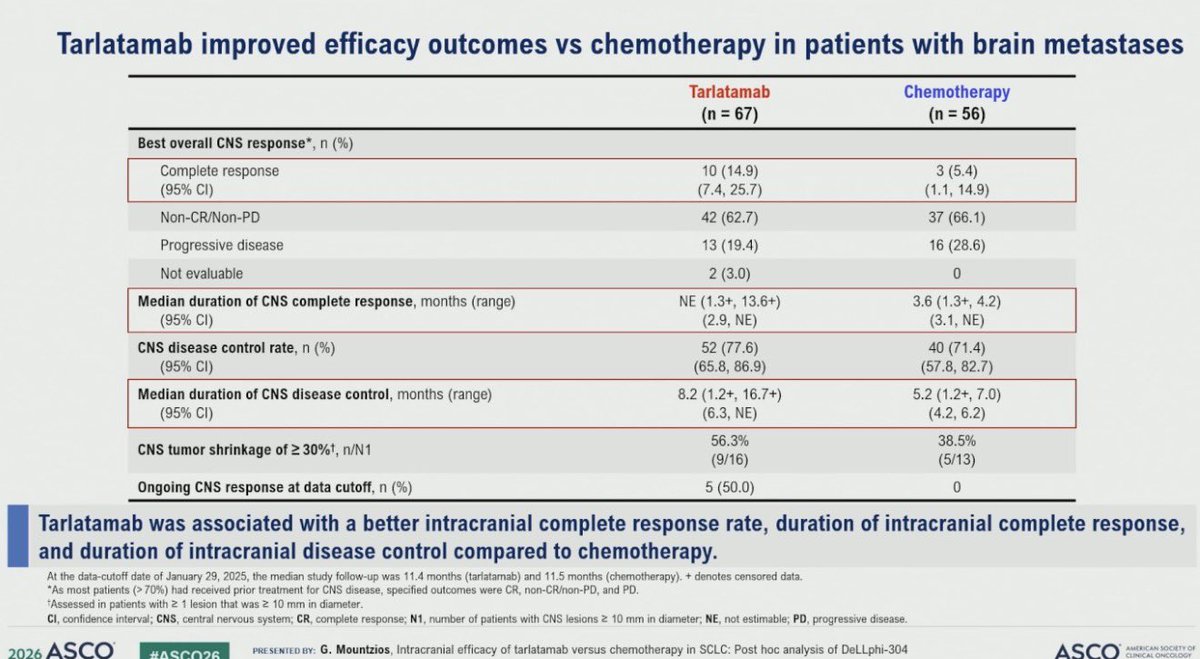
| CNS outcome | Tarlatamab (n=67) | Chemotherapy (n=56) |
|---|---|---|
| Complete response, n (%) | 10 (14.9) | 3 (5.4) |
| Non-CR/non-PD, n (%) | 42 (62.7) | 37 (66.1) |
| Progressive disease, n (%) | 13 (19.4) | 16 (28.6) |
| CNS disease control rate, n (%) | 52 (77.6) | 40 (71.4) |
| Median duration of CNS disease control, mo | 8.2 (1.2+, 16.7+) | 5.2 (1.2+, 7.0) |
10 details 1 trial watching
Post hoc intracranial analysis of the randomised DeLLphi-304 trial of second-line tarlatamab versus chemotherapy in SCLC. Two assessment frameworks: investigator RECIST in the ITT population and mRANO-BM by BICR in pts with baseline brain metastases. Data cutoff January 29, 2025; median follow-up 11.4 mo (tarlatamab) and 11.5 mo (chemotherapy).
ITT n=254 tarlatamab versus n=255 chemotherapy. The brain-metastasis cohort was n=67 versus n=56, defined as ≥1 brain metastasis at baseline per mRANO-BM by BICR plus ≥1 post-baseline scan. More than 70% had already received CNS-directed treatment, which is why the response categories were CR, non-CR/non-PD and PD rather than a conventional ORR.
This analysis reports time to CNS progression or death (CNS PFS) in the ITT population and in the brain-metastasis subset, plus best overall CNS response, CNS disease control rate, duration of CNS complete response and duration of CNS disease control. None of these was the trial's registered primary endpoint.
Both CNS PFS comparisons favor tarlatamab, and the effect is larger in the brain-metastasis subset (HR 0.40) than in the ITT population (HR 0.54). Intracranial complete response was 14.9% versus 5.4%, and CNS tumor shrinkage ≥30% occurred in 9/16 versus 5/13 pts with measurable lesions ≥10mm.
Brain metastases develop in the majority of SCLC pts, and second-line systemic options have historically been judged on extracranial disease with CNS control assumed to be the province of SRS, WBRT or prophylactic cranial irradiation. A bispecific T-cell engager showing an intracranial complete response rate of 14.9% is the notable part, because the working assumption for large-molecule agents has been limited intracranial penetration.
The ITT median CNS PFS was not estimable at 11.4 months of follow-up, so the ITT curve rests on the early portion of the data and the point estimate can still move. The two populations were also read with different tools and different models (stratified Cox for ITT, unstratified for the subset), so the ITT and subset HRs are not strictly comparable to each other.
The result establishes that intracranial disease does not progress faster under tarlatamab than under chemotherapy, and probably progresses more slowly. What it does not establish is whether that activity is sufficient to defer local therapy in a patient who would otherwise be referred for SRS, since the source reports no radiotherapy exposure data and no in-field versus out-of-field failure pattern.
Post hoc intracranial analysis of a randomised trial; CNS endpoints were not the registered primary, and the brain-met subset HR comes from an unstratified model.
- Does intracranial activity permit deferral of SRS in untreated brain mets
- Activity in CNS-treatment-naive or symptomatic brain metastases n=35 · primary completion 2029-02 · phase 2 tarlatamab, active asymptomatic brain mets
- Durability of CNS control beyond 12 months follow-up
📚 Sources · 🐦 1 tweet
Dr. @g_mountzios #ASCO26 presents CNS outcomes with 2L tarlatamab in DeLLphi-304. Improved time to CNS progression overall (HR 0.54). In pts with brain nets, tarlatamab vs chemo CNS CR rate 15% vs 5% with DCR 78% vs 71% and time to CBS progression 6.5m vs 4.2m, HR 0.40 pic.twitter.com/5i8jL1zlKW
— Stephen V Liu, MD (@StephenVLiu) June 1, 2026
2026-05-31
OCEANUS
ForAdvanced NSCLC receiving RT with ICI, newly diagnosed or ICI-refractory
TL;DRSequential RT+ICI mOS 20.3 vs 16.0 mo for concurrent, aHR 0.68 (0.47-0.99), in newly diagnosed advanced NSCLC; retrospective registry.
The RT-relevant gap is the exposure itself: the source text neither defines the sequential window nor reports dose, fractionation or target, so the timing signal cannot yet guide SBRT versus palliative-course scheduling around ICI. In refractory disease, continuing ICI after RT gave 11.2 vs 6.7 mo rwOS (P=.20), limited to 90-day survivors.
In newly diagnosed advanced NSCLC starting ICI with an RT indication, this adds observational support for sequencing RT rather than overlapping it; it does not extend to unresectable locally advanced disease, and in ICI-refractory disease the maintenance signal is non-significant. The longer read
Timing is the RT variable: sequencing RT around ICI rather than overlapping it tracked with longer rwOS in newly diagnosed advanced disease. Dose, fractionation, target and the sequential window are not reported in source text, so the signal cannot yet separate SBRT from palliative-course scheduling.
In ICI-refractory NSCLC, ICI maintenance after RT gave 11.2 vs 6.7 mo rwOS (P=.20), non-significant and limited to 90-day survivors. Chemotherapy tracked with longer rwOS only in newly diagnosed disease, magnitude not reported in source, so the systemic partner question stays open.
9 details 2 trials watching
Territory-wide retrospective cohort from the Hong Kong Hospital Authority CDARS database (more than 90% population coverage), NSCLC diagnosed 2010 to 2021. Overlap weighting was the primary propensity method, IPTW the sensitivity analysis; RMST was specified where proportional hazards failed.
Of 3522 ICI-treated pts, 335 received RT: 155 newly diagnosed advanced and 180 refractory NSCLC. 247 (73.7%) male, median age 64 (range 34-90).
RT dose, fractionation, modality, target site and the interval separating sequential from concurrent delivery are not reported in source text.
Primary: real-world OS after landmark, via weighted Kaplan-Meier and Cox models. Exposures: sequential vs concurrent RT+ICI (newly diagnosed), RT with vs without ICI maintenance (refractory), and receipt of chemotherapy.
Chemotherapy tracked with longer rwOS in newly diagnosed disease but not in refractory disease; no chemotherapy effect size in source text. IPTW estimates were similar to the primary analysis.
| Cohort | Exposure arm | Reference arm | Effect |
|---|---|---|---|
| Newly diagnosed advanced (n=155) | Sequential RT+ICI: 20.3 mo (13.3-NR) | Concurrent RT+ICI: 16.0 mo (8.3-30.0) | aHR 0.68 (0.47-0.99), P=.045 |
| Refractory (n=180) | RT + ICI maintenance: 11.2 mo (7.9-20.6) | RT without ICI maintenance: 6.7 mo (4.4-17.4) | P=.20 |
The source notes randomized data on RT+ICI sequencing are limited. PEMBRO-RT tested SBRT before pembrolizumab in advanced NSCLC, and PACIFIC placed ICI after concurrent chemoRT in unresectable locally advanced disease; neither randomized timing as this cohort compares it.
Undefined timing window and unreported RT parameters make the exposure heterogeneous, possibly mixing consolidative and palliative courses. The 2010 to 2021 window spans shifting first-line ICI practice, and any RMST estimates are not reported in source text.
A sequential advantage cuts against the common assumption that overlap maximises RT-ICI interaction, but urgent symptomatic RT given during ICI could explain it equally well. Whether continuing ICI after RT helps refractory disease remains open.
Retrospective propensity-weighted registry cohort; residual confounding by indication likely, upper CI bound 0.99 in n=155, and authors frame it as hypothesis generating.
- Does sequential vs concurrent RT+ICI timing change OS when randomized?
- Does continuing ICI after RT benefit refractory NSCLC? recruiting A Study Evaluating The Combination of Immunotherapy With Radiotherapy in Non-Small Cell Lung Cancer Phase 2n=39 · primary completion 2030-06 · post-IO progression, ICI + ablative hypofractionated RT
- Which RT dose and target drive any timing effect? n=366 · primary completion 2027-06 · abscopal control across RT fractionation arms + ICI
📚 Sources · 📄 1 paper
Abstract
2026-05-30 ASCO Annual Meeting 2026
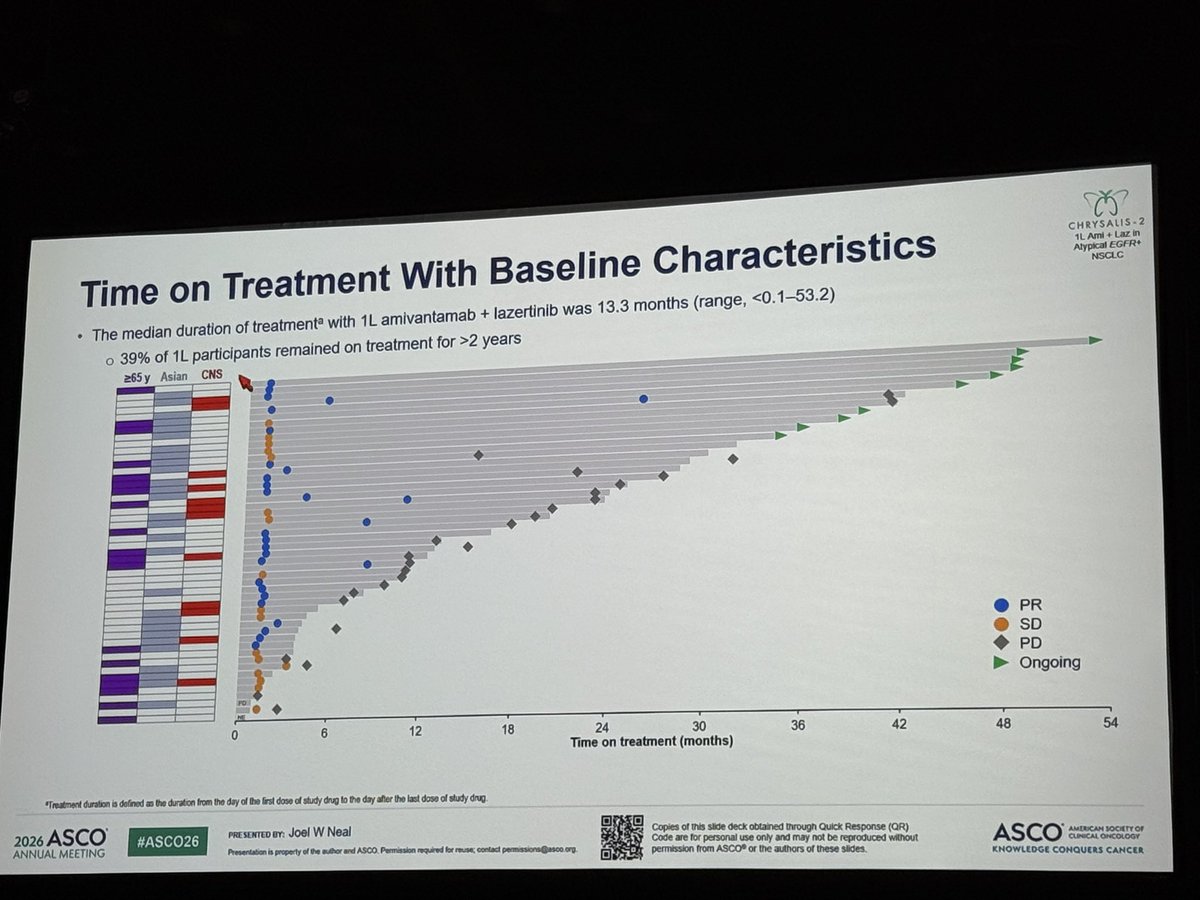
CHRYSALIS-2
ForTreatment-naive advanced NSCLC with atypical (uncommon) EGFR mutation
TL;DRMedian OS 41.0 mo (95% CI 27.7-NE) with 1L amivantamab + lazertinib in atypical EGFR-mutant NSCLC, single-arm n=49.
In treatment-naive advanced NSCLC with an atypical EGFR mutation, this supports amivantamab plus lazertinib as a prospectively benchmarked option where none is established; it does not extend to classical exon 19del/L858R disease or exon 20 insertions. The longer read

+1 more figure
8 details 3 trials watching
Single-arm expansion cohort of the CHRYSALIS-2 program, n=49, 1L atypical EGFR-mutated advanced NSCLC. Median follow-up 31.3 mo. No randomised comparator arm.
Treatment-naive advanced NSCLC harbouring an atypical (uncommon) EGFR mutation. Baseline strata shown on the swimmer plot include age ≥65y, Asian ancestry and CNS involvement; per-stratum counts are not reported in source.
IV amivantamab (EGFR/MET bispecific) plus lazertinib (third-generation EGFR TKI). No chemotherapy backbone. Median duration of treatment 13.3 months (range <0.1-53.2), with 39% of 1L participants still on treatment beyond 2 years.
Median OS 41.0 mo (95% CI 27.7-NE), described by the presenters as roughly 3.5 years. The upper CI bound is not estimable, so the point estimate is anchored on the lower bound of 27.7 mo.
Reported only as consistent with prior reports, no new safety signals with longer follow-up. No grade 3+ rates, infusion-reaction rates or dermatologic AE rates appear in the source.
The atypical EGFR label pools biologically distinct alterations (G719X, S768I, L861Q and compound variants) whose single-agent TKI sensitivity differs; n=49 cannot resolve per-variant benefit, and the curator's read of no variant-outcome association is an absence of signal in a small cohort, not evidence of uniformity. No comparator, so the 41.0 mo median cannot be positioned against afatinib or osimertinib series in the same population.
Atypical EGFR is the part of the EGFR-mutant space where no regimen is settled, so a 41.0 mo median in 49 pts is meaningful as a benchmark even without randomisation. The practical question this leaves open is whether the bispecific's added toxicity and IV schedule are justified over an oral TKI alone, which this design cannot answer.
Single-arm n=49 expansion cohort, no randomised comparator against afatinib or osimertinib in atypical EGFR. Maturity gate: single-arm never reaches confirmatory.
- Doublet vs single-agent osimertinib or afatinib in atypical EGFR n=480 · primary completion 2029-02 · phase 3 firmonertinib vs osimertinib/afatinib, PACC 1L
- Which atypical EGFR variants drive the durable-response tail
- Whether subcutaneous amivantamab preserves efficacy with less infusion burden n=418 · primary completion 2024-01 · phase 3 SC vs IV ami + lazertinib, randomisedrecruiting A Study of Amivantamab in Participants With Advanced or Metastatic Solid Tumors Including Epidermal Growth Factor Receptor (EGFR)-Mutated Non-Small Cell Lung Cancer Phase 2n=520 · primary completion 2027-08 · SC co-formulation activity + safety cohorts
📚 Sources · 🐦 1 tweet
Amivantamab + lazertinib achieved a median OS of 41.0 months in treatment-naïve atypical EGFR-mutant NSCLC, with no clear association between EGFR variant subtype and outcome. A compelling option. Meanwhile, amivantamab continues evaluation across multiple tumor types. #ASCO26 pic.twitter.com/aWn3Ja60Ji
— Chul Kim (@chulkimMD) May 29, 2026
ESAONA
For1L EGFR-mutant NSCLC with brain metastases
95.5% vs 79.6%
p = 0.0004
TL;DRiORR 95.5% vs 79.6% (p=0.0004) and intracranial PFS HR 0.46 favoring asandeutertinib in 1L EGFR-mutant NSCLC with brain mets.
The RT-relevant number is intracranial PFS: median not reached vs 17.5 mo, HR 0.46. If a first-line TKI holds CNS disease that long, the deferral-of-brain-RT window widens, but the source reports no prior-RT stratification, no CNS-RT use by arm, and no lesion size or symptom criteria, so this cannot yet gate an SRS-versus-defer decision.
In treatment-naive EGFR-mutant NSCLC with asymptomatic brain metastases, this supports the case for TKI-first CNS control as a hypothesis, not a change in practice; it says nothing about symptomatic or large lesions where local therapy is already indicated.
Intracranial PFS median not reached vs 17.5 mo, HR 0.46, is the number that touches the SRS-timing decision in asymptomatic brain mets. The source gives no prior-RT stratification and no salvage-RT rates by arm, so the deferral question stays open rather than answered.
The intracranial effect (HR 0.46) is roughly double the systemic one (HR 0.64), so the case for asandeutertinib rests on CNS penetration rather than broad potency. Serious TRAEs run 10.8% vs 7.1%, a real but modest trade against a phase II endpoint with no OS.

| Endpoint | Asandeutertinib (n=111) | Osimertinib (n=113) | Effect |
|---|---|---|---|
| Intracranial ORR (BICR) | 95.5% (89.8-98.5) | 79.6% (71.0-86.6) | p = 0.0004 |
| Intracranial PFS (BICR) | Median not reached | 17.5 mo (15.18-NA) | HR 0.46, p = 0.0020 |
| Overall PFS (BICR) | Median not reached | 17.2 mo (15.18-19.55) | HR 0.64, p = 0.0473 |
| Any TRAE | 99.1% | 95.6% | n/a |
| Serious TRAE | 10.8% | 7.1% | n/a |
7 details 4 trials watching
Randomised phase II, N=224, asandeutertinib (n=111) vs osimertinib (n=113). Endpoints read by BICR. Follow-up duration, stratification factors and alpha allocation are not reported in the source slide.
First-line EGFR-mutated NSCLC with brain metastases. The source does not state lesion number, size, symptom status, or whether prior CNS radiotherapy was permitted, which is the eligibility gate an RT reader needs.
Intracranial ORR by BICR is the headline, with intracranial PFS and overall PFS reported alongside. No overall survival data in source.
Any TRAE 99.1% vs 95.6%; serious TRAE 10.8% vs 7.1%. The excess serious-event rate is small in absolute terms but sits on a phase II denominator, and no organ-level breakdown is given in source.
The intracranial separation (HR 0.46) is larger than the systemic one (HR 0.64), which points at CNS penetration rather than a general potency gain as the mechanism. For radiation oncology the question is whether that CNS margin is durable enough to defer SRS in asymptomatic pts; a phase II with unreached medians and no OS cannot answer it.
CONSORT flow
Phase II, conference-slide source only; no OS, borderline overall-PFS p, and no reported CNS-RT or prior-RT stratification. Needs phase III before displacing osimertinib.
- Does intracranial PFS benefit translate to overall survival
- Salvage brain RT and SRS rates by arm recruiting Observation or Upfront Cranial RT in Oncogene Mutated NSCLC With Asymptomatic BM: A Phase III RCT Phase 3n=190 · primary completion 2025-12 · randomises upfront SRS/WBRT vs TKI alone, asx BMrecruiting A Study of Stereotactic Radiosurgery (SRS) and Standard Treatment in People With Lung Cancer That Has Spread to the Brain Phase 2n=56 · primary completion 2027-12 · SRS after 3mo osimertinib vs osimertinib alonerecruiting Early or Delayed Intervention of Brain Radiotherapy Combined With Almonertinib in EGFR Mutated NSCLC With Brain Metastases Phase 3n=232 · primary completion 2028-12 · early vs delayed SRS timing on 3G TKI, phase 3
- Activity in symptomatic or leptomeningeal CNS disease recruiting A Clinical Trial of Furmonertinib Combined With Anlotinib as First-line Treatment for Advanced NSCLC With EGFR-sensitive Mutations and Brain Metastasis Phase 2n=146 · primary completion 2027-09 · 1L 3G TKI + anlotinib, brain/LM mets at dx
📚 Sources · 🐦 1 tweet
#ASCO26 🧠🌍
— Dr Rishabh Jain (@DrRishabhOnco) May 30, 2026
Could a next-generation EGFR TKI outperform osimertinib in patients with brain metastases?
The phase II ESAONA trial suggests the answer may be yes.
🧪 LBA2007 | ESAONA
1L EGFR-mutated NSCLC with brain metastases
👥 n=224
⚔️ Asandeutertinib vs Osimertinib
Key… https://t.co/mEOKGNKgf7 pic.twitter.com/pUQuH6i2cV
OptiTROP-Lung05 NCT06448312
For1L stage IIIB-IV NSCLC, PD-L1 TPS ≥1%, EGFR/ALK wild-type, ECOG 0-1
HR 0.35
95% CI 0.26-0.47, p<0.0001; NR vs 5.7 mo
TL;DRmPFS NR vs 5.7mo, HR 0.35 (0.26-0.47) for sac-TMT + pembro in 1L PD-L1+ NSCLC.
In treatment-naive PD-L1 TPS ≥1% advanced NSCLC without EGFR/ALK alteration, this supports a TROP2 ADC plus pembro as a chemo-free option worth watching; it does not address pts already committed to pembro plus platinum chemo, nor PD-L1-negative disease. The longer read

| Arm | PFS events, n (%) | Median PFS, mo (95% CI) | HR (95% CI) |
|---|---|---|---|
| Sac-TMT + Pembro (n=208) | 66 (31.7) | NR (13.6, NE) | 0.35 (0.26, 0.47), p<0.0001 |
| Pembro (n=205) | 128 (62.4) | 5.7 (4.3, 7.0) | n/a |
+3 more figures

| PD-L1 stratum | Sac-TMT + Pembro median, mo | Pembro median, mo | HR (95% CI) |
|---|---|---|---|
| TPS ≥50% | NR (NE, NE) | 9.5 (6.9, 13.8) | 0.47 (0.29, 0.77) |
| TPS 1-49% | NR (11.1, NE) | 4.3 (2.9, 5.5) | 0.28 (0.19, 0.41) |

| Arm | OS events, n (%) | Median OS, mo (95% CI) | HR (95% CI) |
|---|---|---|---|
| Sac-TMT + Pembro (n=208) | 33 (15.9) | NR (NE, NE) | 0.55 (0.36, 0.85) |
| Pembro (n=205) | 54 (26.3) | NR (NE, NE) | n/a |

13 details 3 trials watching
Randomized, multicenter, open-label phase 3 (NCT06448312), 1:1, N=413. Stratified by histology (squamous vs non-squamous), PD-L1 TPS (1-49% vs ≥50%), and ECOG (0 vs 1). Median follow-up 10.5 months at this analysis.
Locally advanced stage IIIB/IIIC or metastatic stage IV NSCLC with no prior systemic antitumor therapy. Required PD-L1 TPS ≥1% by IHC 22C3 central lab, no sensitizing EGFR or ALK alteration, ECOG 0 or 1.
Sac-TMT 4 mg/kg Q2W plus pembrolizumab 400 mg versus pembrolizumab 400 mg Q6W alone, until progression or unacceptable toxicity. Pembro was capped at a maximum of 18 cycles in both arms. One pt in the pembro group never received assigned treatment.
Primary: PFS by BICR. Key secondary: OS. Other secondary: investigator-assessed PFS, ORR, DCR, DOR, safety. The updated efficacy boundary at the actual 194 PFS events was 0.0174 (2-sided).
PFS crossed its boundary at p<0.0001. OS was descriptive at the PFS interim, HR 0.55 (0.36, 0.85) with both medians not reached and only 33 vs 54 deaths.
The pembro-alone control performed as expected for an all-comers TPS ≥1% population, with the TPS ≥50% arm reaching 9.5 mo and the TPS 1-49% arm 4.3 mo, consistent with the KEYNOTE-042 signal that low-expressors gain least from single-agent IO. This is the setting where chemo-IO has historically been chosen, so the trial tests whether an ADC can occupy that slot instead of platinum doublet chemotherapy.
No toxicity data in the source, which is the decisive missing piece for a doublet whose entire premise is avoiding chemotherapy. The comparator is pembro monotherapy rather than the chemo-IO most oncologists actually give at TPS 1-49%, so the PFS gap partly measures a weak control rather than a strong experimental arm.
An HR of 0.35 with a median not reached is a large PFS effect, and the OS point estimate moves in the same direction, but neither settles whether sac-TMT plus pembro beats the regimen it would actually replace. The larger effect in TPS 1-49% (HR 0.28) than TPS ≥50% (HR 0.47) is the expected pattern when the control arm is weakest in the low-expressors, not evidence of a biomarker-selected ADC effect.
CONSORT flow
PFS interim of an open-label phase 3; OS descriptive at 10.5 mo f/u with both medians NR. No safety data in source, and no comparison vs pembro + chemo.
- Benefit vs pembrolizumab plus platinum chemotherapy, the real-world comparator n=614 · primary completion 2028-01 · phase 3 sac-TMT + pembro vs pembro alone, TPS >=50%, OSrecruiting Pembrolizumab With or Without Maintenance Sacituzumab Tirumotecan (Sac-TMT; MK-2870) in Metastatic Squamous Non-small Cell Lung Cancer (NSCLC) [MK-2870-023] Phase 3n=851 · primary completion 2029-01 · 1L sq NSCLC: pembro + platinum backbone, sac-TMT maint
- Safety and ILD rates of sac-TMT combined with pembrolizumab n=30 · primary completion 2026-12 · phase 1 safety/tolerability of sac-TMT + pembro
- Whether the OS signal holds at the final prespecified analysis
📚 Sources · 🐦 2 tweets
Right patient. Right treatment. Right timing.
— Yakup Ergün (@dr_yakupergun) May 30, 2026
The result: curves like these👇#ASCO26 https://t.co/72KByLKz90
🔁REVIEW #ASCO26 #LCSM Oral
— Hidehito HORINOUCHI (@HHorinouchi) May 30, 2026
🔥OptiTROP-Lung05: 1L Sac-TMT + Pembro vs Pembro in PD-L1+ NSCLC
✅mPFS NR vs 5.7m (HR 0.35)
✅ORR 70.2% vs 42.0%
✅OS HR 0.55 (95%CI 0.36-0.85, immature)
🎙️Dr. Caicun Zhou
🔗 https://t.co/DcbK1dGrhO@OncoAlert @Larvol @ASCO @IASLC https://t.co/512k6dZviW pic.twitter.com/Vdo86N50h9
2026-05-26
SWOG/NRG S1914 NCT04214262
ForT1-3N0M0 NSCLC ≤7cm, medically inoperable or declined surgery, ≥1 risk factor
HR 1.15
95% CI 0.65-2.01, p=0.63; primary endpoint not met
TL;DROS HR 1.15 (0.65-2.01), p=0.63: atezolizumab added to SBRT failed, with more local failures (13% vs 7%) and G≥3 AEs (12% vs 2%).
The RT read is that adding IO did not just fail to help, it tracked with MORE local failure (13% vs 7%), inside a BED ≥100 Gy 3-8 fraction regimen that is already delivering >90% in-field control. Central review of those events is pending, so treat the local signal as unconfirmed. This closes the question of routinely sequencing atezolizumab around definitive SBRT off-protocol.
In medically inoperable T1-3N0M0 NSCLC with high-risk features (size ≥2 cm, SUV ≥6.2, or poorly differentiated histology), this supports SBRT alone at BED ≥100 Gy without added checkpoint blockade; it does not address IO for node-positive or operable early-stage disease. The longer read
SBRT alone at BED ≥100 Gy in 3-8 fractions remains the standard, and adding atezolizumab tracked with MORE local failure (13% vs 7%) rather than better in-field durability. Central review of those events is pending. Regional (2% vs 3%) and distant (4% vs 5%) failure were unchanged, so the out-of-field rationale also went unrewarded.
Neoadjuvant/concurrent/adjuvant atezolizumab 1200 mg Q3W × 8 cycles bought no OS or PFS benefit and cost a six-fold rise in G≥3 AEs (12% vs 2%) including a G5 respiratory failure. This argues against porting PACIFIC-style consolidation logic into node-negative early-stage disease pending the PD-L1 analysis.
11 details
Randomized phase III SWOG/NRG cooperative-group trial, accrual 8/13/20 to 9/6/24, 417 randomized / 403 eligible (201 SBRT alone, 202 atezolizumab + SBRT) against an accrual goal of 432. Closed at the first interim analysis for futility on both OS and PFS. Median follow-up in living pts was 12 months (range 0.03-49).
T1-3N0M0 NSCLC ≤7 cm, medically inoperable or declined surgery, with ≥1 recurrence risk factor: tumor diameter ≥2 cm, ≥6.2 (SUV), or moderately/poorly/undifferentiated histology. Median age 73 (41-91), 89% ECOG 0-1, median tumor diameter 2.3 cm. Stratified by location (central vs peripheral), size (<4 vs ≥4 cm) and PS.
SBRT in 3-8 fractions to a BED ≥100 Gy in both arms, i.e. standard definitive dosing rather than a de-escalated backbone. In the experimental arm SBRT began with cycle 3, so radiation was delivered after two neoadjuvant atezolizumab cycles and concurrently with the third.
Atezolizumab 1200 mg IV Q3W for 8 cycles, given neoadjuvantly, concurrently and adjuvantly around SBRT. No protocol treatment was received by 6 pts on S and 8 on AS.
Primary: overall survival, compared by 1-sided stratified log-rank at the 2.5% level. Secondary: PFS, failure patterns, toxicity, QoL.
Neither OS nor PFS favored the IO arm, and local failure ran higher with atezolizumab. See the failure-pattern table and primary endpoint above.
| Failure site | SBRT alone | Atezo + SBRT |
|---|---|---|
| Local | 7% | 13% |
| Regional | 2% | 3% |
| Distant | 4% | 5% |
G≥3 AEs 12% on AS vs 2% on S (21 G3, 1 G4, and 1 G5 respiratory failure with atezolizumab; 3 G3 and 1 G4 with SBRT alone). A six-fold excess of high-grade toxicity with no efficacy return is the safety read.
The prior randomized phase II (PMID 37478883) suggested benefit from adding immunotherapy to SBRT; this larger phase III does not reproduce it. It also sits against PACIFIC-era logic, where consolidation IO helps after chemoRT for stage III, and shows that result does not port down to node-negative disease treated with ablative SBRT.
Follow-up is short (median 12 mo alive) and central review of local recurrence events is not complete, so the local-failure imbalance is provisional. The smoker subgroup harm signal was not multiplicity-controlled, and PD-L1 status, QoL and correlative blood/tissue analyses are all still pending.
A negative primary endpoint with a directionally worse PFS, worse local control and six-fold more high-grade toxicity is stronger than a null result: it argues against the abscopal/radiosensitization rationale in this setting. It does not exclude benefit in a biomarker-selected subset, which the pending PD-L1 analysis will test.
CONSORT flow
Phase III, primary OS endpoint not met, closed at interim for futility. Reaffirms SBRT alone as SoC and refutes the earlier phase II IO signal.
- Does a PD-L1-defined subset benefit from IO added to SBRT?
- Will central review confirm the excess local failures with atezolizumab?
- Is the worse outcome in former/never smokers real or chance?
📚 Sources · 📄 1 paper
Abstract
2026-05-20
High-dose hyperfractionated SIB RT vs standard-dose RT for limited-stage SCLC NCT03214003
ForLS-SCLC (VALSG), age 18–70, ECOG 0–1, PET-CT and brain MRI staged
HR 0.55
95% CI 0.37–0.72, p=0.003 · mOS 60.7 vs 39.5 mo
TL;DRmOS 60.7 vs 39.5 mo, HR 0.55 (0.37–0.72), p=0.003 with 54 Gy/30 fx BID SIB vs 45 Gy/30 fx BID in LS-SCLC; toxicity similar.
Escalation is a GTV/IGTV-only SIB (PTV held at 45 Gy) within the same 30 fx, 3-week BID course on PET-defined involved fields. Local PFS separated (HR 0.51) while MFS did not (HR 0.81), fitting an in-field effect. The decision it moves is BID dose, 45 vs 54 Gy, not BID vs once daily.
In PET-CT and brain-MRI staged LS-SCLC, age 18–70 and ECOG 0–1, planned for concurrent platinum-etoposide with BID thoracic RT, this supports 54 Gy SIB as an alternative to 45 Gy; it does not extend to pts over 70, ECOG 2, or once-daily schedules. The longer read
A GTV/IGTV-only boost to 54 Gy with PTV at 45 Gy keeps 30 fx BID over 3 weeks on involved PET-defined fields, with G3–4 acute oesophagitis 13% vs 12%. The actionable choice is BID dose, 45 vs 54 Gy, for fit PET-staged pts; once-daily escalation is not addressed.
8 details 1 trial watching
Open-label randomised phase 3, 1:1, 16 public hospitals in China, N=224 (108 vs 116) enrolled June 2017 to April 2021. Stratified by ECOG, stage, prior chemo courses and platinum choice. Stopped early by the DSMB at the interim after 88 deaths; median follow-up 46 mo.
Age 18–70, ECOG 0–1, LS-SCLC by VALSG staging, with mandatory whole-body PET-CT and brain MRI. Untreated or after 1–2 courses of platinum-etoposide. Median age 64; 86% stage III; 79% current or former smokers.
Cisplatin 75 mg/m² or carboplatin AUC 5 plus etoposide 100 mg/m² days 1–3, 4 courses every 3 weeks; almost 99% received all 4. PCI 25 Gy/10 fx for responders (82% vs 81%).
54 Gy/30 fx SIB to GTV/IGTV with PTV at 45 Gy vs 45 Gy/30 fx, both VMAT, BID at least 6 h apart, 5 days/wk for 3 weeks, starting 0–42 days after chemo cycle 1. Involved field: PET-positive primary and nodes, CTV = GTV + 5 mm, no elective nodal irradiation. Constraints included MLD ≤15 Gy, lung V20 <30%, cord max ≤40 Gy.
Primary: OS in ITT, measured from chemo start. Secondary: PFS, local PFS, MFS, DCR, acute and late toxicity (CTCAE v5.0), HRQOL (to be reported separately). Powered on HR 0.65 at 81% power, target 326 pts.
Primary endpoint crossed the interim boundary and held at the January 2023 cutoff, with 40 (37%) vs 66 (57%) deaths. Arm-level estimates are in the efficacy table.
| Endpoint | 54 Gy SIB | 45 Gy | HR (95% CI), p |
|---|---|---|---|
| Median OS (primary) | 60.7 mo (49.2–62.0) | 39.5 mo (27.5–51.4) | 0.55 (0.37–0.72), p=0.003 |
| 2-yr OS | 76% | 54% | p=0.001 |
| Median PFS | 30.5 mo (14.5–46.5) | 16.7 mo (10.7–22.7) | 0.70 (0.49–0.99), p=0.044 |
| Median local PFS | Not reached | 40.6 mo (22.8–58.4) | 0.51 (0.33–0.78), p=0.002 |
| Median MFS | 40.2 mo (26.6–53.8) | 23.8 mo (10.1–37.5) | 0.81 (0.57–1.16), p=0.248 |
| DCR | 97% | 93% | p=0.218 |
| Event | 54 Gy | 45 Gy | p |
|---|---|---|---|
| Oesophagitis | 14 (13%) | 14 (12%) | 0.84 |
| Pneumonitis | 5 (5%) | 7 (6%) | 0.663 |
| Neutropenia | 48 (44%) | 48 (41%) | 0.64 |
| Thrombocytopenia | 14 (13%) | 17 (14%) | 0.71 |
| Trial | Escalated schedule | Endpoint | Escalated arm | 45 Gy BID arm |
|---|---|---|---|---|
| This trial (phase 3) | 54 Gy/30 fx BID SIB | mOS · 2-yr OS | 60.7 mo · 76% | 39.5 mo · 54% |
| CONVERT (phase 3) | 66 Gy/33 fx QD | mOS · 2-yr OS | 25 mo · 51% | 30 mo · 56% |
| CALGB 30610/RTOG 0538 (phase 3) | 70 Gy QD | Median survival · 5-yr OS | 28.5 mo · 29% | 30.1 mo · 32% |
| Northern European randomised phase 2 | 60 Gy/40 fx BID | 2-yr OS | 74.2% | 48.1% |
Acute G3–4 RT toxicity similar between arms. No late G3 oesophagitis or stricture in either arm; late G3 pneumonitis in 2 vs 3 pts, no G3 pulmonary fibrosis. One treatment-related death (myocardial infarction) in the 54 Gy arm.
INT-0096 set 45 Gy/30 fx BID as the reference. CONVERT (66 Gy/33 fx QD) and CALGB 30610/RTOG 0538 (70 Gy QD) escalated dose without acceleration or hyperfractionation and did not beat it; the Northern European randomised phase 2 of 60 Gy/40 fx BID was the only prior BID escalation signal. The authors describe this as the first phase 3 to escalate while keeping BID delivery.
Control mOS of 39.5 mo beat the 24 mo design assumption and prior 45 Gy BID arms (20.8–30 mo), marking a selected cohort. Tumour and RT volumes were not controlled, and the interim analysis is listed as the only protocol amendment despite being described as preplanned. Reporting inconsistencies: median age given as both 64 and 62, and the OS CI upper bound (62.0) sits just above the 60.7 mo median.
The authors credit local control for the OS gain, but first-relapse rates were near identical (59 [55%] vs 65 [56%]) and chest-first failure did not differ significantly, so patterns of failure do not yet show where the benefit arises. Subgroup and HRQOL results are unreported.
CONSORT flow
Stopped at interim for benefit with 224 of 326 planned accrued; truncated RCTs tend to overstate effect. Single-country, open-label, no central RT QA, age ≤70.
- Does the 54 Gy SIB benefit hold in pts older than 70 or ECOG 2?
- 54 Gy/30 fx SIB BID vs 60 Gy/40 fx BID or high-dose once-daily? recruiting Dose-Escalation Radiotherapy in Limited-Stage Small Cell Lung Cancer: A Phase III Randomized Trial Phase 3n=300 · primary completion 2028-09 · phase 3: SIB 45-54 Gy vs 60 Gy vs 45 Gy BID, LS-SCLC
- Does higher thoracic dose add benefit alongside consolidation immunotherapy?
📚 Sources · 📄 1 paper
2026-05-19 ESTRO Congress 2026
Single-fraction SABR pooled analysis, 1687 pts
ForPrimary NSCLC or pulmonary oligomets selected for single-fraction SABR
TL;DRLocal control 90-93% at 2yr and G3+ AEs 2.9% across 1687 single-fraction SABR pts at 3 centres.
The oligomet read is the gap between local control and PFS: 90-93% LC at 2yr against median PFS 11 mo, so distant failure, not the treated lesion, drives the course. For primary NSCLC the same LC sits with median PFS 30 mo, which is the split that should decide whether one-visit ablation is offered as definitive treatment or as a break from systemic therapy.
In early-stage primary NSCLC where visit burden drives the fractionation choice, this supports single fraction as a durable local option (LC 90-93% at 2yr, G3+ 2.9%); tumour location and operability are not reported, so who it represents stays open. The longer read
Local control holds at 90-93% at 2yr for a primary and for a metastasis alike, so the single fraction is not the variable separating outcomes; median PFS is (30 vs 11 mo). Tumour size and location go unreported, so the target selection behind that number is unmeasured.
For a pt with pulmonary oligometastases, one-visit ablation gave 90-93% local control at 2yr but median PFS of 11 mo, so it clears the treated lesion without changing the systemic course. That frames referral as a local step between systemic lines, not a substitute for one.
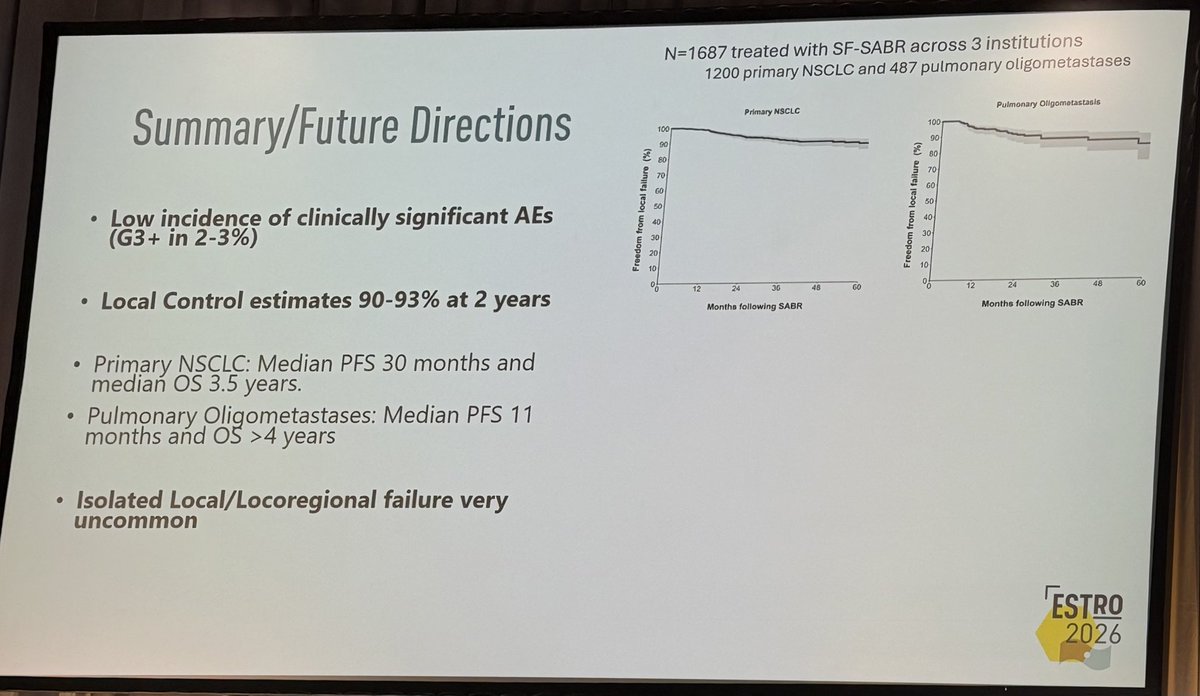
| Cohort | n | Median PFS | Median OS |
|---|---|---|---|
| Primary NSCLC | 1200 | 30 mo | 3.5 yrs |
| Pulmonary oligometastases | 487 | 11 mo | >4 yrs |
+2 more figures
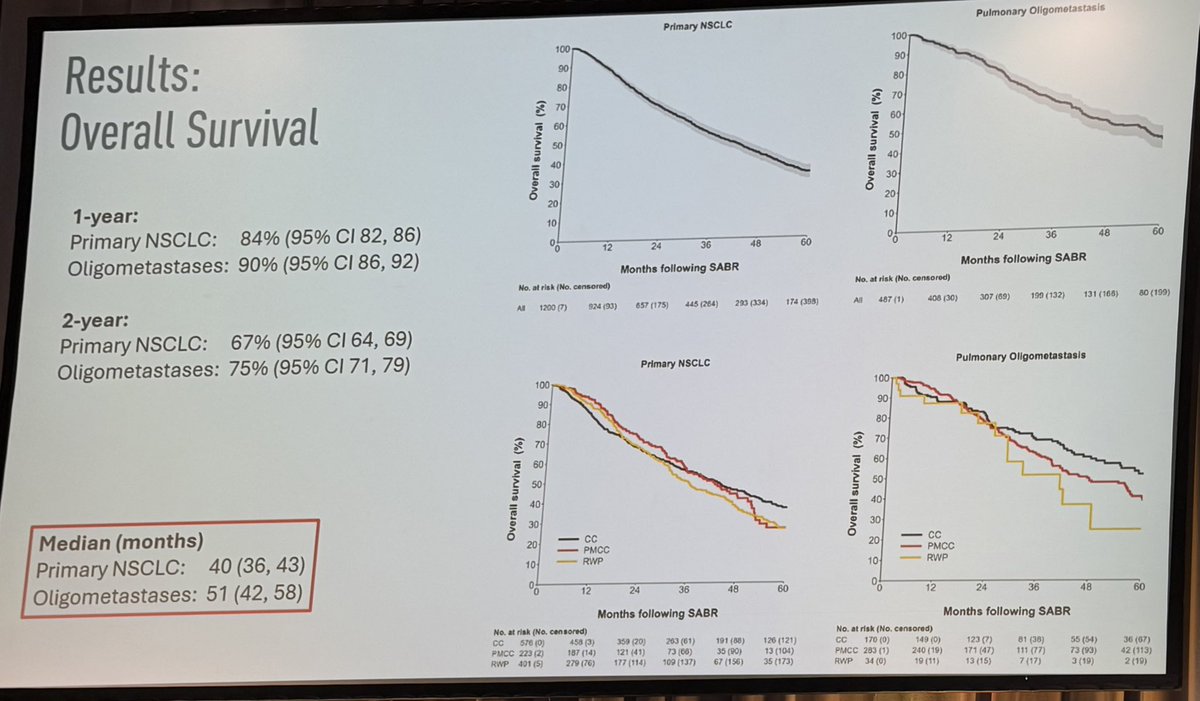
| Endpoint | Primary NSCLC | Oligometastases |
|---|---|---|
| 1yr OS | 84% (95% CI 82, 86) | 90% (95% CI 86, 92) |
| 2yr OS | 67% (95% CI 64, 69) | 75% (95% CI 71, 79) |
| Median OS | 40 mo (36, 43) | 51 mo (42, 58) |
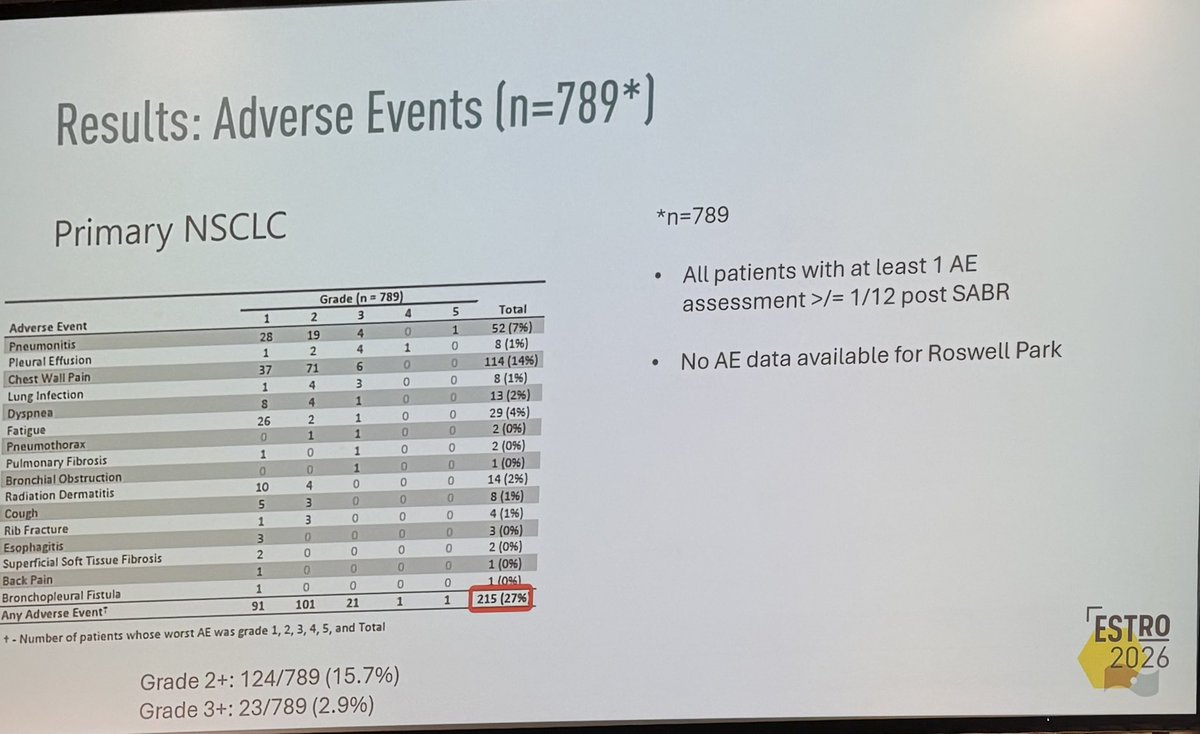
| Adverse event (n=789) | n (%) |
|---|---|
| Any AE | 215 (27%) |
| Grade 2+ | 124 (15.7%) |
| Grade 3+ | 23 (2.9%) |
| Chest wall pain | 114 (14%) |
| Pneumonitis | 52 (7%) |
| Fatigue | 29 (4%) |
| Dyspnea | 13 (2%) |
6 details
Pooled analysis of 1687 pts treated with single-fraction SABR at three centres (Peter MacCallum, Cleveland Clinic, Roswell Park): 1200 primary NSCLC and 487 pulmonary oligometastases. Whether the contributing cohorts were prospective or retrospective is not stated in source.
Eligibility, operability, tumour size and central vs peripheral location are not reported in source. Cohort mix differs sharply by centre: Roswell Park supplied 401 of the NSCLC pts but only 34 oligomet pts, while Peter Mac supplied 283 of 487 oligomet pts.
Single fraction throughout, but the prescribed dose is not reported in source. Without it the outcome cannot be mapped onto a schedule a reader could write, which is the one parameter that would carry this into planning.
No primary endpoint is stated in the source. Reported outcomes are local control, freedom from local failure, PFS, OS and adverse events, each descriptive rather than tested against a comparator.
Local control 90-93% at 2 years across both cohorts, with isolated local or locoregional failure described as very uncommon. Survival separates by cohort while local outcome does not.
| Centre | Primary NSCLC | Pulmonary oligomets |
|---|---|---|
| Cleveland Clinic | 576 | 170 |
| Peter MacCallum | 223 | 283 |
| Roswell Park | 401 | 34 |
AE reporting covers 789 primary NSCLC pts only, with no Roswell Park data and no oligometastasis toxicity in source. Within that subset chest wall pain and pneumonitis dominate and G3+ events stay at 2.9%.
Single-fraction SABR already carries randomised support: RTOG 0915 in peripheral early-stage NSCLC and SAFRON II in pulmonary oligometastases, both randomised single against multi-fraction schedules. This series adds scale and follow-up at three high-volume centres, which is what a non-randomised dataset can contribute, and no comparator.
Toxicity rests on 789 of 1687 pts, with one centre absent from the AE table and the oligometastatic cohort not represented in it at all. Centre mix is uneven, so pooled rates carry each centre's own selection rather than a common one.
The question the thread raises, whether one-stop SABR should be used more often, is not the question this dataset answers. What it does show is that local control near 90-93% and G3+ toxicity near 3% hold at scale outside a protocol, which is the usual worry about a schedule with no second chance. The unreported dose sits between that reassurance and a prescription.
Pooled uncontrolled series across three centres, no multi-fraction comparator and no stated design; dose unreported, so outcomes cannot be tied to a prescription.
- Whether single-fraction outcomes hold for central tumours
- Durability of single-fraction ablation for pulmonary oligometastases beyond first progression
- Toxicity of single-fraction SABR in the oligometastatic cohort
📚 Sources · 🐦 1 tweet
👏🏽👏🏽👏🏽@neildwallaceie at #ESTRO26 - 1687 patients receiving single fraction SABR for #lungcancer and pulmonary oligomets, @PeterMacRadOnc / @ClevelandClinic / @RoswellPark. Fantastic local control, and low adverse rates. Should we be using “one stop” SABR more often #radonc ? pic.twitter.com/w2IlGKRU5o
— Shankar Siva (@_ShankarSiva) May 18, 2026