Prostate
Staging round-up, not new randomised data: the nodal-coverage question is whether a negative PSMA-PET licenses PLND omission when half of nodal disease sits outside the surgical template.
ePLND vs PSMA-PET staging (AUA2026 round-up)
TL;DRAUA2026 round-up: PSMA-PET NPV ~96% may allow PLND omission in intermediate risk; 47.7% of nodal mets sit outside ePLND template.
The RT-relevant number is toxicity sequencing: 19-29% lower limb lymphedema after PLND plus salvage pelvic nodal RT versus 0-9% after pelvic nodal RT alone, with 2-22% genital lymphedema in the combined group. If PSMA-PET is negative and PLND is omitted, later elective or salvage pelvic nodal coverage carries far less lymphedema cost.
In intermediate-risk pts with a PSMA-PET negative for nodal involvement, this supports omitting PLND before planned or possible pelvic nodal RT; it does not settle the high-risk case, where the round-up calls the decision individual. The longer read
Sequencing drives the toxicity: 19-29% lower limb lymphedema after PLND plus salvage pelvic nodal RT versus 0-9% after pelvic nodal RT alone, plus 2-22% genital lymphedema in the combined group. A pt who skips PLND arrives at elective or salvage nodal coverage with a much lower lymphedema burden.
The template itself is the weak point: 47.7% of nodal metastases in a 1253-man PSMA-PET series lay outside ePLND boundaries, and LND carried a 6-10x DVT/PE risk increase in Tyritzis. With a PSMA-PET negative for LNI in intermediate-risk disease, the yield no longer justifies routine dissection.

+3 more figures

| Treatment | Lower limb lymphedema | Genital lymphedema |
|---|---|---|
| RP with PLND | 0-14% | n/a |
| Pelvic node RT | 0-9% | n/a |
| PLND + salvage pelvic node RT | 19-29% | 2-22% |

10 details 5 trials watching
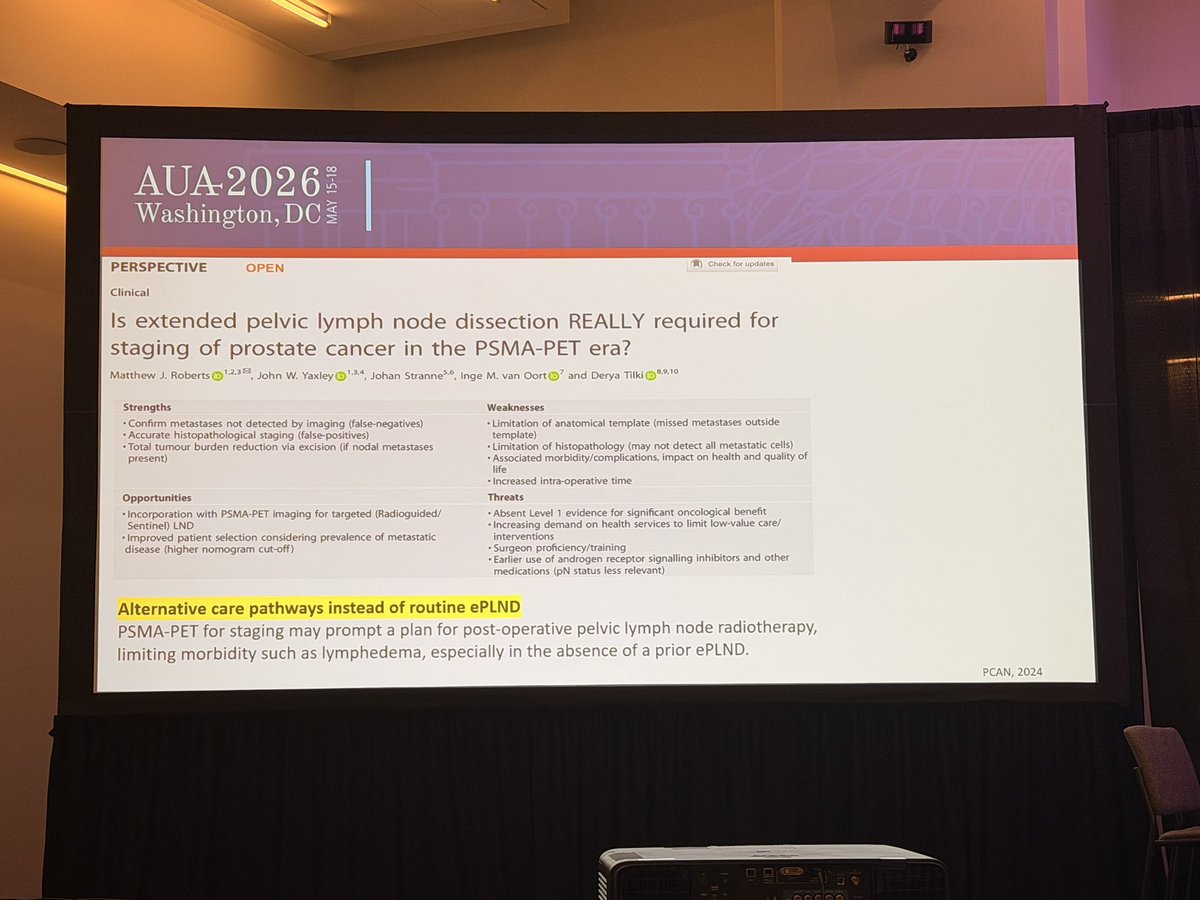
AUA 2026 podium round-up of the ePLND question in the PSMA-PET era. Draws on a 1253-man primary staging series (Yaxley, BJUI 2019), a systematic review of lymphedema (Clinckaert, Cancers 2022), a cohort of 3544 pts (Tyritzis, J Urol 2015) and a SWOT perspective (Roberts, PCAN 2024). No new dataset.
Staging yield argues against template adequacy: 47.7% of nodal metastases fell outside ePLND boundaries. PSMA-PET NPV is given as ~96% in the source text without its parent series named.
Lymphedema tracks the combination, not either modality alone: 0-14% after RP with PLND, 0-9% after pelvic nodal RT, 19-29% after PLND plus salvage pelvic nodal RT with 2-22% genital lymphedema. LND also carried a 6-10x DVT/PE risk increase in Tyritzis.
The argument is that a template operation cannot stage what sits outside the template, so its role narrows to pts in whom imaging is likely wrong. The slide's own conclusion keeps high-risk disease individualized rather than resolved, and explicitly asks that the possibility of adjuvant or salvage pelvic RT enter that conversation.
Slide-level source: NPV ~96% has no denominator, cohort or PSMA tracer attached here, and no BCR effect size is reported for the RCTs the round-up invokes. The lymphedema review's authors note the absent uniform definition, so 19-29% is a range across heterogeneous ascertainment, not a pooled estimate.
- Does ePLND improve BCR-free survival in any risk group? recruiting Dutch National Randomized Study: PSMA-PET/CT As a Triage Tool for Pelvic Lymph Node Dissection in Prostatectomy Patients Phase NAn=706 · primary completion 2025-07 · PSMA-PET triage to ePLND, n=706, prognosis endpointrecruiting Extended vs. No Pelvic Lymph Node Dissection During Radical Prostatectomy. DISSECTION 2.0. Phase NAn=400 · primary completion 2027-02 · randomises ePLND vs none in PSMA-negative high riskn=270 · primary completion 2028-02 · RP+ePLND vs RP±SRT, Briganti >=7%
- PSMA-PET NPV by risk group and tracer recruiting Preoperative PSMA PET/CT As Triage for EPLND in Patients Scheduled for RALP (PrePSMA) Phase NAn=600 · primary completion 2029-12 · tests whether PSMA-PET can replace ePLND staging
- Nodal RT after PSMA-PET staging without prior PLND n=250 · primary completion 2031-05 · PSMA-N0M0 randomised to prostate-only vs WPRT
📚 Sources · 🐦 1 tweet
At #AUA2026, the message was clear:⁰📌 ePLND provides staging information, but its therapeutic benefit remains uncertain.⁰📌 RCTs have not shown consistent improvements in BCR outcomes.⁰📌 PSMA PET/CT has a high NPV (~96%) and may safely avoid unnecessary PLND in… pic.twitter.com/7vJFe2hG77
— DR CARVAJAL (@RomanCarvajal) May 17, 2026