Prostate
2026-10-01 ASTRO Annual Meeting 2026
NRG/RTOG 0815 Decipher GC score and STAD benefit
ForIntermediate-risk prostate cancer receiving definitive RT
TL;DRAdding STAD to RT cut 10-yr DM by 8% absolute in Int/High GC vs 1% in Low GC, intermediate-risk prostate (n=395).
Low GC (<0.45) covered 44% of this intermediate-risk cohort and gained only 1% absolute 10-yr DM reduction from STAD, vs 8% in Int/High GC. That pushes Decipher toward the ADT-omission decision with definitive RT, pending interaction testing and the prospective de-escalation trials.
In intermediate-risk prostate cancer planned for definitive RT, a low Decipher GC (<0.45) supports discussing STAD omission given a 1% absolute 10-yr DM difference; it does not extend to Int/High GC, where the difference was 8%.
Low GC (<0.45) covered 44% of this intermediate-risk cohort and gained only 1% absolute 10-yr DM reduction from STAD, vs 8% in Int/High GC. That pushes Decipher toward the ADT-omission decision with definitive RT.
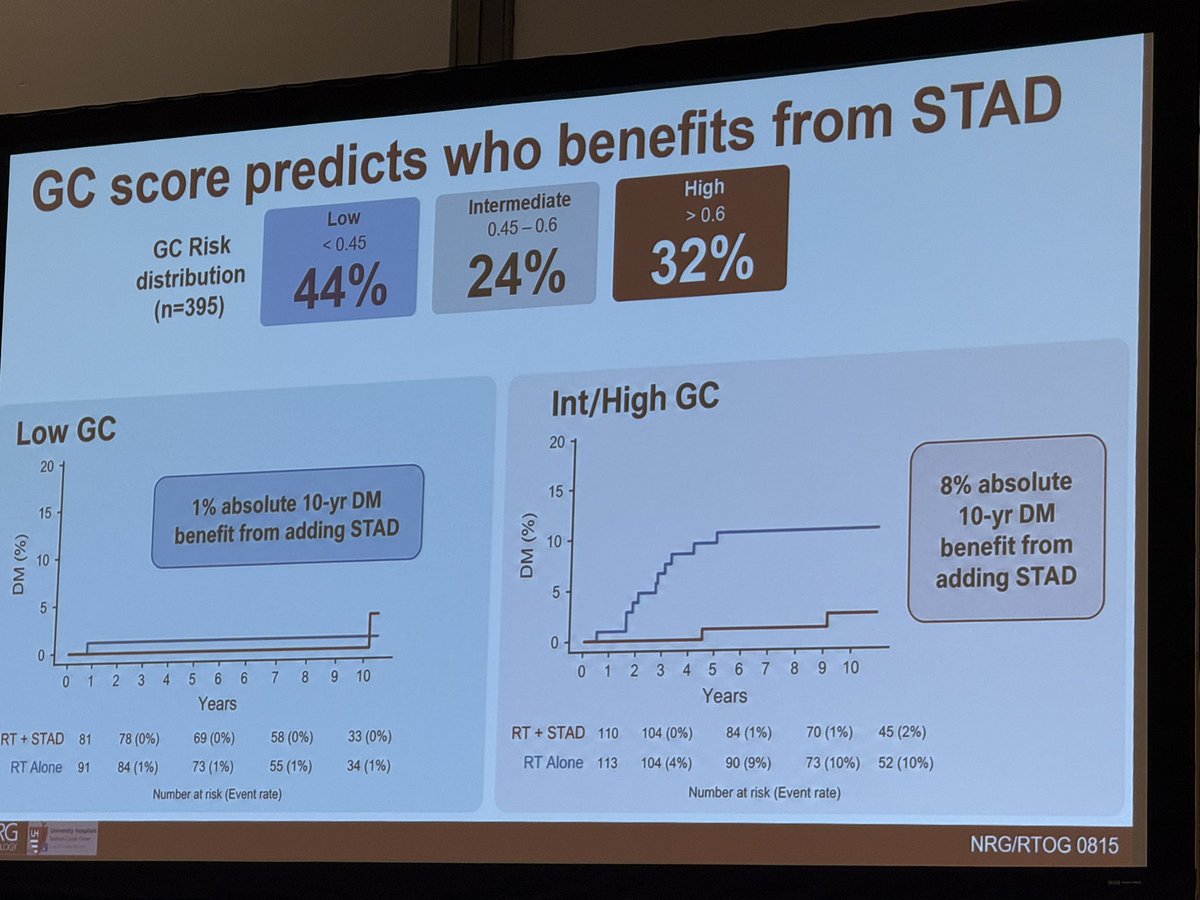
| GC group | Share of cohort | Absolute 10-yr DM benefit from adding STAD |
|---|---|---|
| Low (<0.45) | 44% | 1% |
| Int/High (≥0.45) | 24% + 32% | 8% |
+1 more figure
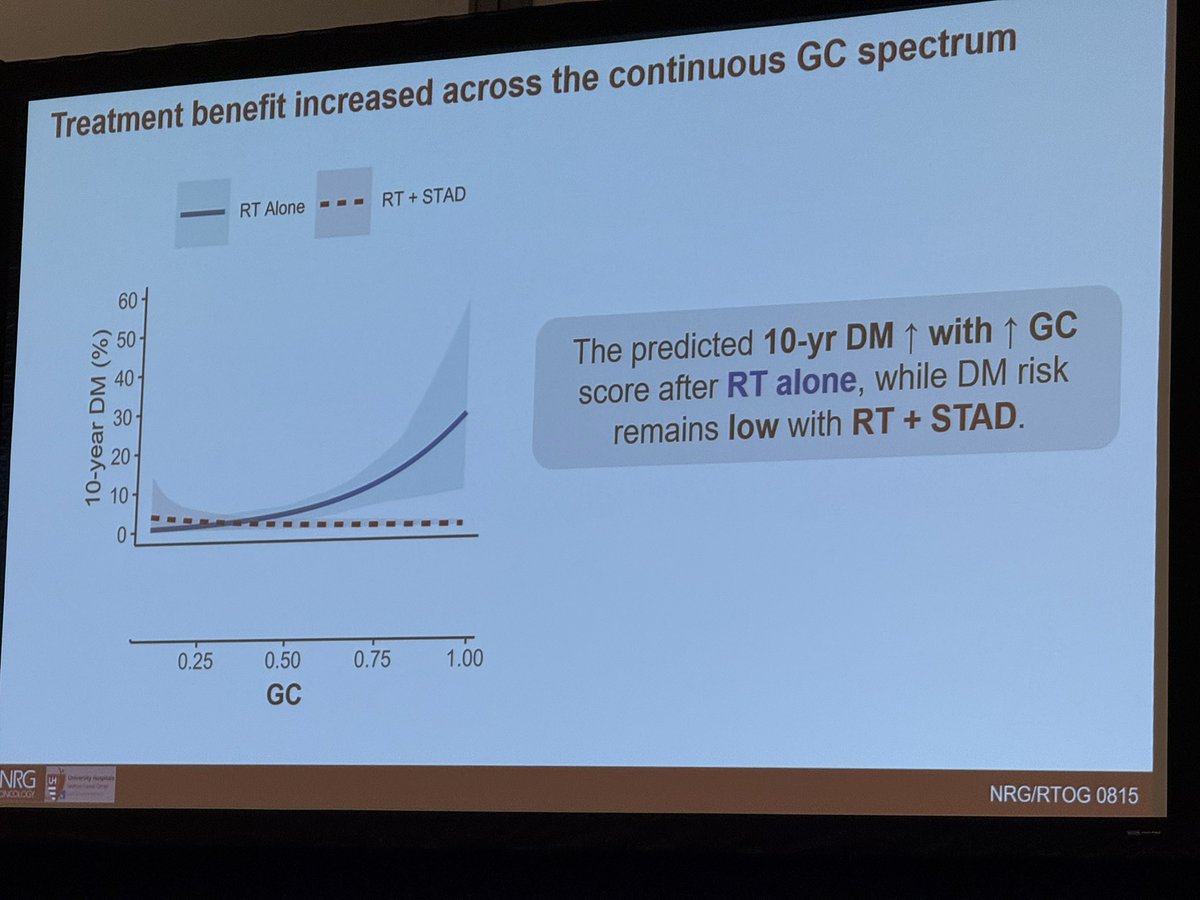
9 details 2 trials watching
Secondary analysis of the NRG/RTOG 0815 RCT of RT alone vs RT + short-term ADT (STAD). Decipher GC available in n=395. Prespecification not stated in source.
Intermediate-risk prostate cancer. GC distribution: Low (<0.45) 44%, intermediate (0.45-0.6) 24%, high (>0.6) 32%.
10-yr distant metastasis (DM) by GC group and across the continuous GC score.
Absolute 10-yr DM benefit from adding STAD: 1% in Low GC vs 8% in Int/High GC. In the continuous model, predicted DM after RT alone rose with GC while staying low with RT + STAD.
Prior Decipher work in RT trials was largely prognostic; this reads as a predictive signal for ADT benefit within a randomized comparison. NRG-GU010 is testing GC-guided ADT de-intensification prospectively.
No HR, CI, or interaction p in source, so effect modification is shown visually, not tested on the slide. Int and High GC are pooled for the dichotomous read.
If the interaction holds, roughly 44% of intermediate-risk pts may gain little from STAD in DM terms. Other endpoints (OS, BCR) and ADT toxicity trade-offs by GC are not in source.
Secondary biomarker analysis of an RCT; prespecification, interaction p, and HR/CI not in source. Only absolute 10-yr differences reported.
- Formal GC × STAD interaction test and HR by GC group
- Does low-GC STAD omission hold prospectively? n=2050 · primary completion 2026-11 · phase 3 Decipher-low UIR de-intensification armn=222 · primary completion 2027-12 · UIR SBRT without ADT, Decipher-guided selection
- Effect of GC on STAD benefit for OS and BCR
📚 Sources · 🐦 1 tweet
🚨Decipher score predictive of ADT benefit for preventing metastasis in patients with intermediate-risk #ProstateCancer in secondary analysis of @NRGonc RTOG 0815 RCT@angela_jia_ @ASTRO_org #ASTRO26 pic.twitter.com/YokjDQVxKa
— Tyler Seibert MD PhD (@TylerSbrt) September 29, 2026
GETUG P05
ForIntermediate-risk prostate cancer, <T3a, N0M0, no ADT, IPSS ≤15
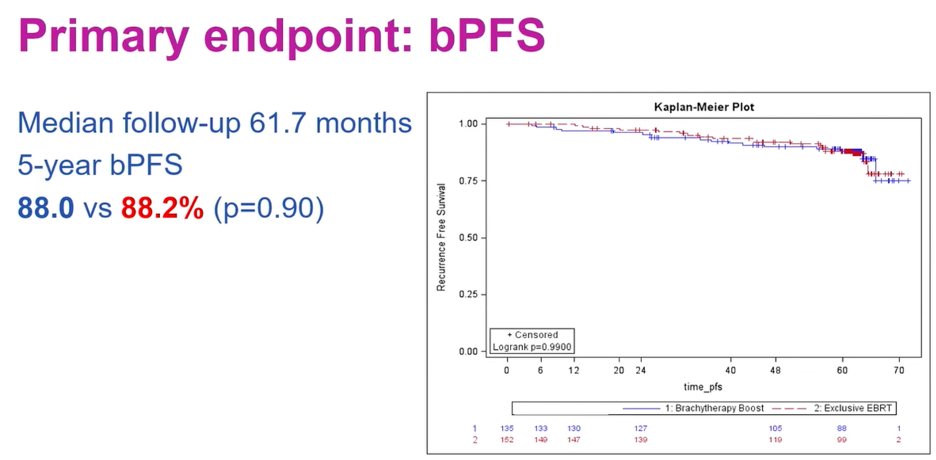
88.0% vs 88.2%
p=0.90, not met
TL;DR5-yr bPFS 88% vs 88.2% (p=0.90) for brachy boost vs 80 Gy EBRT in intermediate-risk PCa without ADT; late GU toxicity higher with boost.
The read is toxicity, not control: boost cut acute GI toxicity (29.9% vs 41.2%) but raised late all-grade GU toxicity (82.2% vs 63.6%, p=0.0006), late G2 GU 34.1% vs 17.9%. Against 80 Gy in 2Gy fractions without ADT, the boost bought no 5-yr bPFS, which weighs against routine boost here.
In intermediate-risk prostate cancer treated without ADT, this questions adding an LDR or HDR boost over 80 Gy EBRT for biochemical control; it does not address boost given with ADT or high-risk disease. The longer read
Boost cut acute GI toxicity (29.9% vs 41.2%) but raised late all-grade GU toxicity (82.2% vs 63.6%, p=0.0006), with no 5-yr bPFS gain over 80 Gy EBRT without ADT. This weighs against routine LDR or HDR boost for ADT-free intermediate-risk pts.
+2 more figures
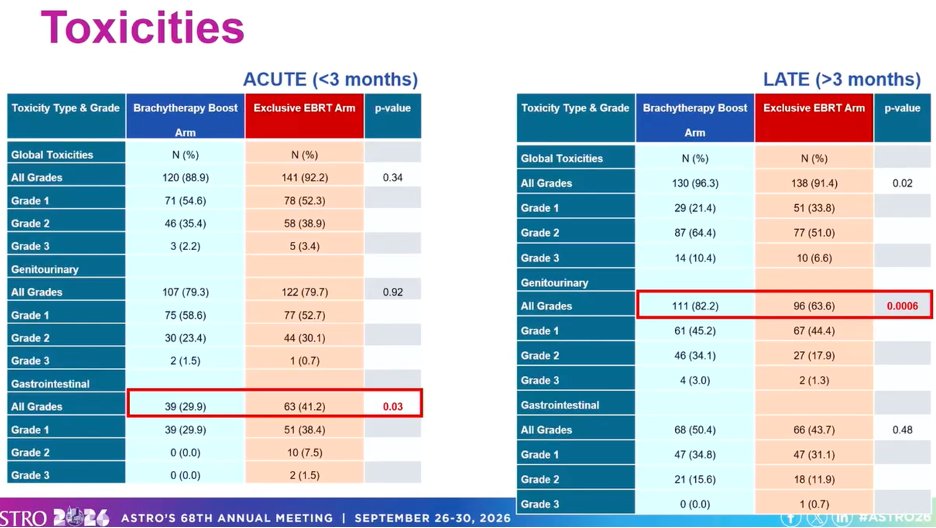
| Toxicity, all grades | Brachytherapy Boost | Exclusive EBRT | p |
|---|---|---|---|
| Acute global | 88.9% | 92.2% | 0.34 |
| Acute GU | 79.3% | 79.7% | 0.92 |
| Acute GI | 29.9% | 41.2% | 0.03 |
| Late global | 96.3% | 91.4% | 0.02 |
| Late GU | 82.2% | 63.6% | 0.0006 |
| Late GI | 50.4% | 43.7% | 0.48 |

9 details 1 trial watching
Phase 3 RCT, 1:1 randomisation, n=288. Median follow-up 61.7 mo.
Intermediate-risk prostate adenocarcinoma, age 18-80, expected survival ≥10y, ECOG ≤2. Excluded T3a or greater, any ADT, nodal or distant disease, IPSS >15 or active IBD.
Both arms: EBRT 46Gy at 2Gy/fx to prostate + 1cm SV. Boost arm then received LDR 110Gy or HDR 14Gy 1-4 wk later; control received an EBRT boost of 34Gy at 2Gy/fx to prostate.
Primary: 5-yr bPFS. Secondary: toxicities, OS, PCSS, IPSS, IIEF-5, QLQ-C30.
5-yr bPFS 88% vs 88.2% (p=0.90); no benefit in GG2 or GG3. 5-yr OS 96.0 vs 92.7% (p=0.30).
Acute GI toxicity lower with boost (29.9% vs 41.2%, p=0.03). Late all-grade GU higher with boost (82.2% vs 63.6%, p=0.0006); late GI similar (p=0.48).
ASCENDE-RT supported LDR boost over dose-escalated EBRT, but delivered with ADT. GETUG P05 isolates the boost question without ADT and finds no bPFS gain against an 80 Gy EBRT control.
LDR and HDR boosts pooled, so neither modality is tested on its own. bPFS at 5 yr may be early for a dose-response difference to emerge; GG subgroup estimates not shown.
With equal biochemical control, the decision shifts to toxicity profile and logistics: boost trades less acute GI for more late GU toxicity. Longer follow-up is needed before excluding a late-emerging bPFS separation.
Randomised phase 3, prespecified bPFS primary not met at 5 yr; null boost result runs against prior boost-favoring data. Power and hypothesis not stated in source.
- Does a bPFS difference emerge beyond 5 years?
- LDR vs HDR boost outcomes analyzed separately active Improving Quality of Life After Prostate Brachytherapy: a Comparison of HDR and LDR Brachytherapy Phase NAn=195 · primary completion 2019-12 · randomised HDR vs LDR boost, PSA RFS + toxicity
- Boost vs hypofractionated or SBRT EBRT in intermediate risk
📚 Sources · 🐦 1 tweet
GETUG P05: Ph 3 RCT of 46 Gy EBRT + LDR/HDR brachy boost vs dose-escalated 80 Gy EBRT in IR PCa, no ADT (n=288)
— Rashid K. Sayyid (@RKSayyid) September 28, 2026
🔹5-yr bPFS: 88% vs 88.2% (p=0.90)
🔹No bPFS benefit in iether GG2 or 3 pts
🔹5-yr OS: 96% vs 92.7% (p=0.30)
🔹Acute GI toxicity lower w/ brachy: 30% vs 41% (p=0.03)… pic.twitter.com/qoxDCnJV4b
LUNAR vs SATURN
ForM1 oligorecurrent prostate cancer post-RP, SBRT-eligible
TL;DRMedian time to progression 19.4 mo with SBRT + 177Lu-PNT2002 vs 21.7 mo with SBRT + 6 mo AAT; IPTW-adjusted HR 1.39 (0.56-3.45), p=0.47.
The MDT read is the SBRT-alone reference: median time to progression 6.0 mo with 18/18 progressing, vs 19.4 and 21.7 mo with either systemic partner. That frames the question as which partner to add to SBRT, not whether to add one, and RLT keeps pts eugonadal with numerically fewer grade ≥3 AEs (10% vs 20%, p=0.357).
SBRT alone carried a 6.0 mo median time to progression with 18/18 progressing, so the MDT decision is which systemic partner to pair, not whether. PSADT (HR 0.87 per month) is the selection variable worth carrying into MDT planning.
177Lu-PNT2002 gave euPFS not significantly different from 6 mo AAT (HR 1.39, 0.56-3.45) with grade ≥3 AEs 10% vs 20%, a hormone-sparing option worth testing randomly. The wide CI leaves the regimen choice open.
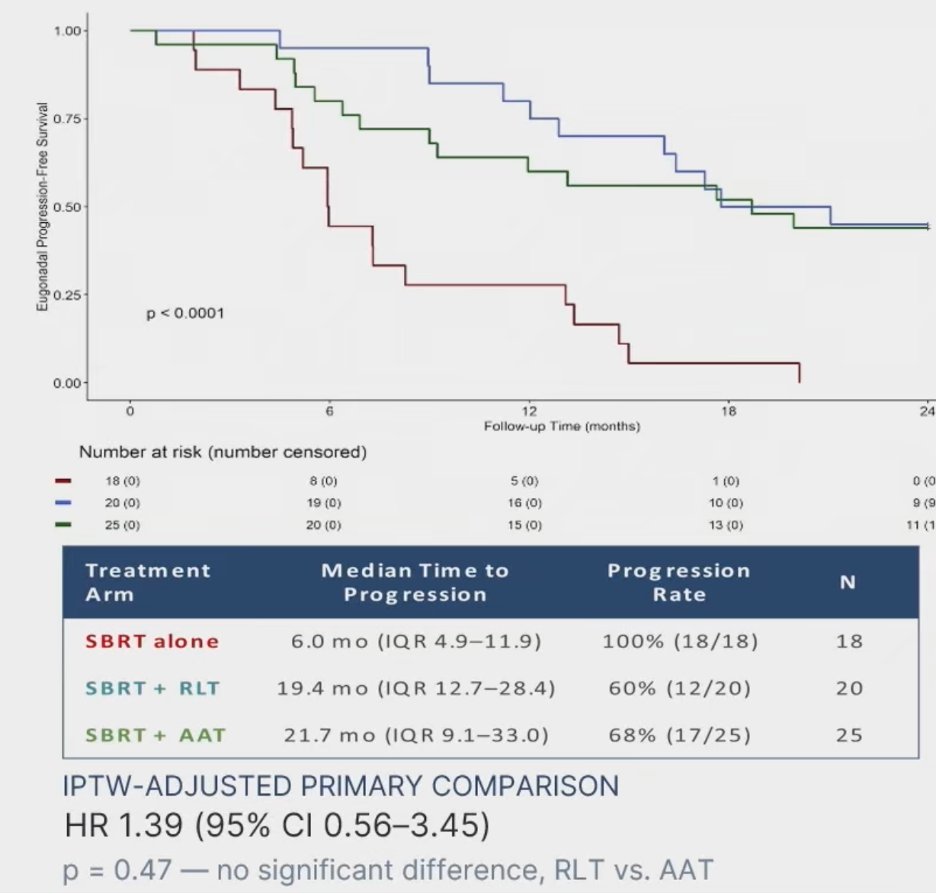
| Arm | Median time to progression | Progression rate |
|---|---|---|
| SBRT alone | 6.0 mo (IQR 4.9-11.9) | 100% (18/18) |
| SBRT + RLT | 19.4 mo (IQR 12.7-28.4) | 60% (12/20) |
| SBRT + AAT | 21.7 mo (IQR 9.1-33.0) | 68% (17/25) |
+2 more figures
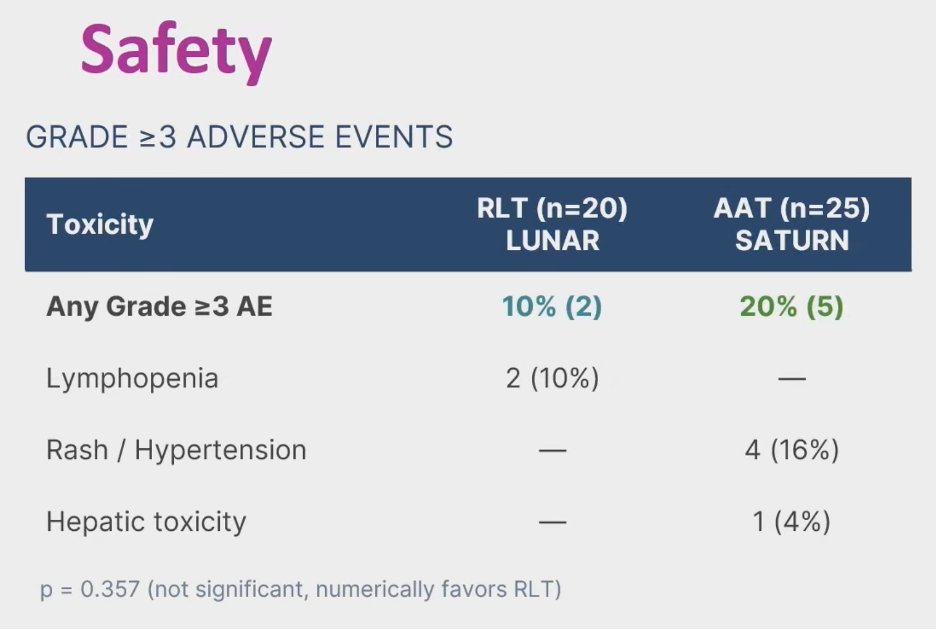
| Grade ≥3 AE | RLT (n=20) | AAT (n=25) |
|---|---|---|
| Any grade ≥3 | 10% (2) | 20% (5) |
| Lymphopenia | 2 (10%) | none listed |
| Rash / hypertension | none listed | 4 (16%) |
| Hepatic toxicity | none listed | 1 (4%) |
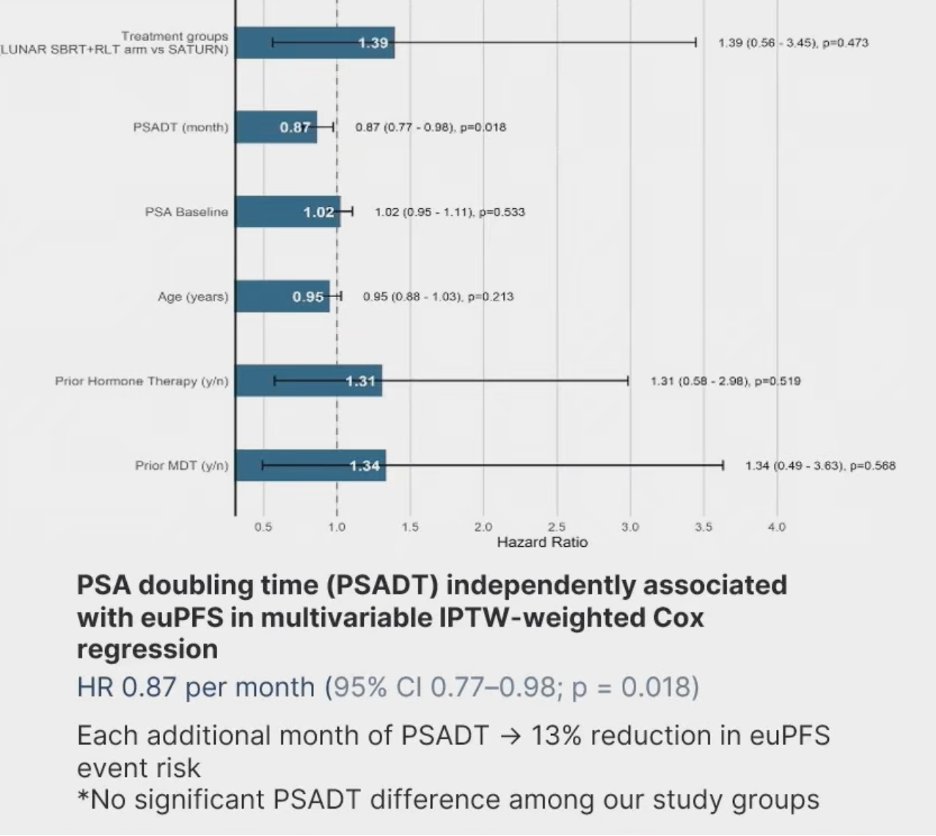
9 details
Cross-trial IPD comparison pooling the LUNAR SBRT + RLT arm and SATURN SBRT + AAT, IPTW-adjusted. Total n=63; randomization between partners not applicable.
M1 oligorecurrent PCa post-RP. Arms: SBRT + RLT n=20, SBRT + AAT n=25, SBRT alone n=18.
RLT arm: 177Lu-PNT2002 with SBRT. AAT arm: 6 mo androgen annihilation therapy with SBRT.
Primary comparison: eugonadal PFS (euPFS), RLT vs AAT, IPTW-adjusted.
HR 1.39 (95% CI 0.56-3.45), p=0.47, no significant difference RLT vs AAT. PSADT independently associated with euPFS, HR 0.87 per month.
Grade ≥3 AEs 10% RLT vs 20% AAT, p=0.357. RLT events were lymphopenia; AAT events were rash/hypertension and hepatic toxicity.
Extends the SBRT-plus-systemic-partner question in oligorecurrent disease by testing PSMA RLT against intensified hormonal therapy, rather than either against SBRT alone, but only across trials.
SBRT-alone group shown unadjusted with unstated provenance. Wide CI means non-inferiority of RLT is not shown; HR point estimate numerically disfavors one arm.
RLT may be a eugonadal alternative to AAT as an SBRT partner, with a different toxicity profile. Short PSADT remains a prognostic signal regardless of partner and may inform selection; a randomized head-to-head is needed.
Non-randomized cross-trial IPD comparison of two small arms; IPTW cannot balance unmeasured confounders, and the wide CI cannot establish equivalence of RLT and AAT.
- Randomized head-to-head of RLT vs AAT with SBRT
- Can PSADT select oligorecurrent pts for SBRT alone?
📚 Sources · 🐦 1 tweet
LUNAR vs SATURN: cross-trial IPD comparison of SBRT + 177Lu-PNT2002 RLT vs SBRT + 6 mo androgen annhilation therapy (AAT) the in M1 oligorecurrent PCa post-RP (n=63)
— Rashid K. Sayyid (@RKSayyid) September 30, 2026
🔹Median time to progression: 19.4 mo RLT vs 21.7 mo AAT vs 6.0 mo SBRT alone
🔹Adjusted euPFS similar w/ RLT vs… pic.twitter.com/bn7sstnbvy
NRG/RTOG 0534 SPPORT PAM50 subtypes
ForPost-RP PSA 0.1-2.0 ng/mL, pT2/pT3 N0M0, Gleason ≤9, salvage RT
TL;DRPAM50 Luminal B predicted STADT benefit with salvage RT: 5-y FFP gain 31% vs 10% non-Luminal B (p-int=.01); 10-y MFS 20% vs -3%.
The RT decision here is adding STADT to salvage prostate bed RT: Luminal B tumors gained 31% absolute 5-y FFP from ADT vs 10% in non-Luminal B (p-int=.01). The legible arm-level panel does not cleanly isolate a PLNRT increment (HR 0.64, p=0.16), so subtype informs the ADT add-on more than nodal coverage.
In a post-RP pt with PSA 0.1-2.0 ng/mL, N0M0, heading to salvage prostate bed RT, a PAM50 Luminal B call supports the case for STADT; it does not settle ADT omission for non-Luminal B pts or the pelvic nodal question. The longer read
The salvage RT decision it informs is the STADT add-on: Luminal B tumors gained 31% absolute 5-y FFP from ADT vs 10% in non-Luminal B (p-int=.01). PLNRT's increment over STADT is not resolved by subtype (HR 0.64, p=0.16), so the nodal-field decision stays where SPPORT left it.
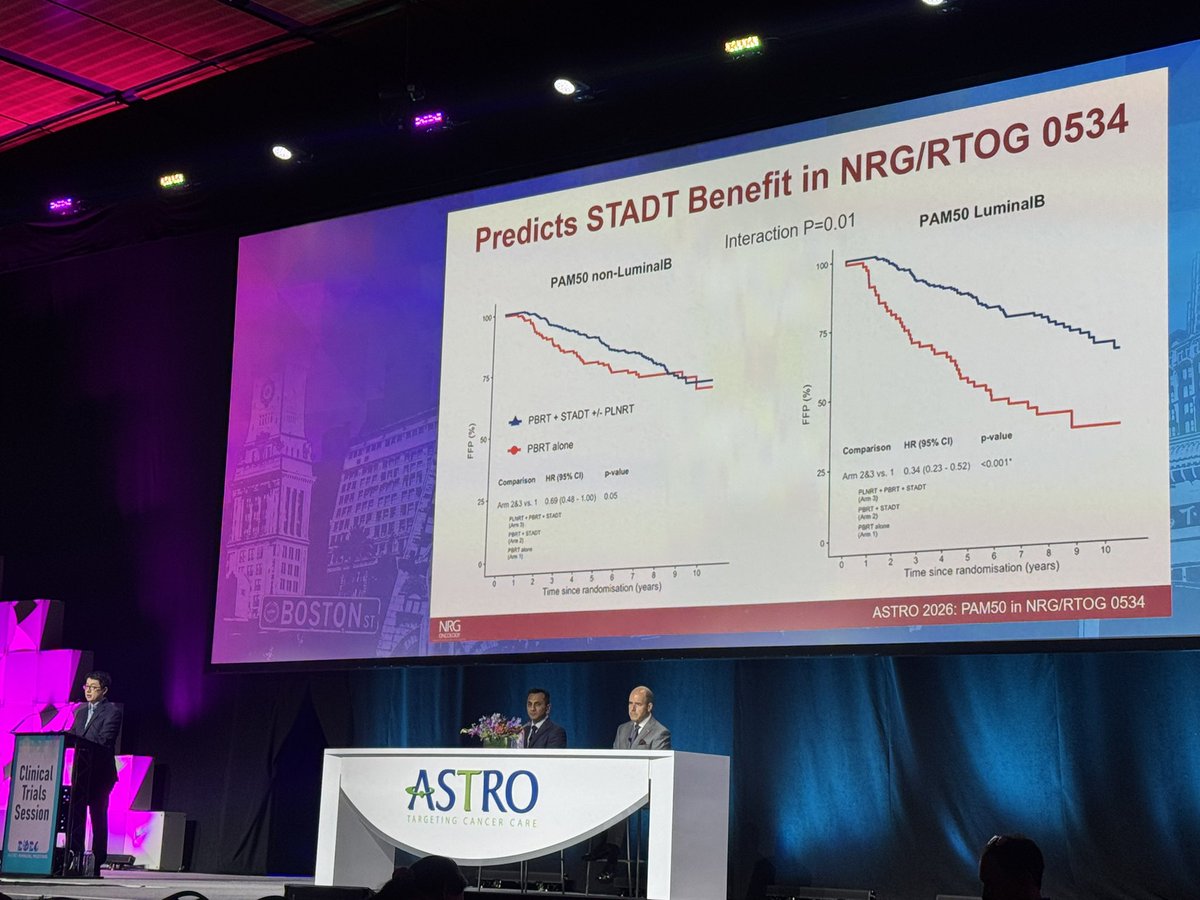
+2 more figures
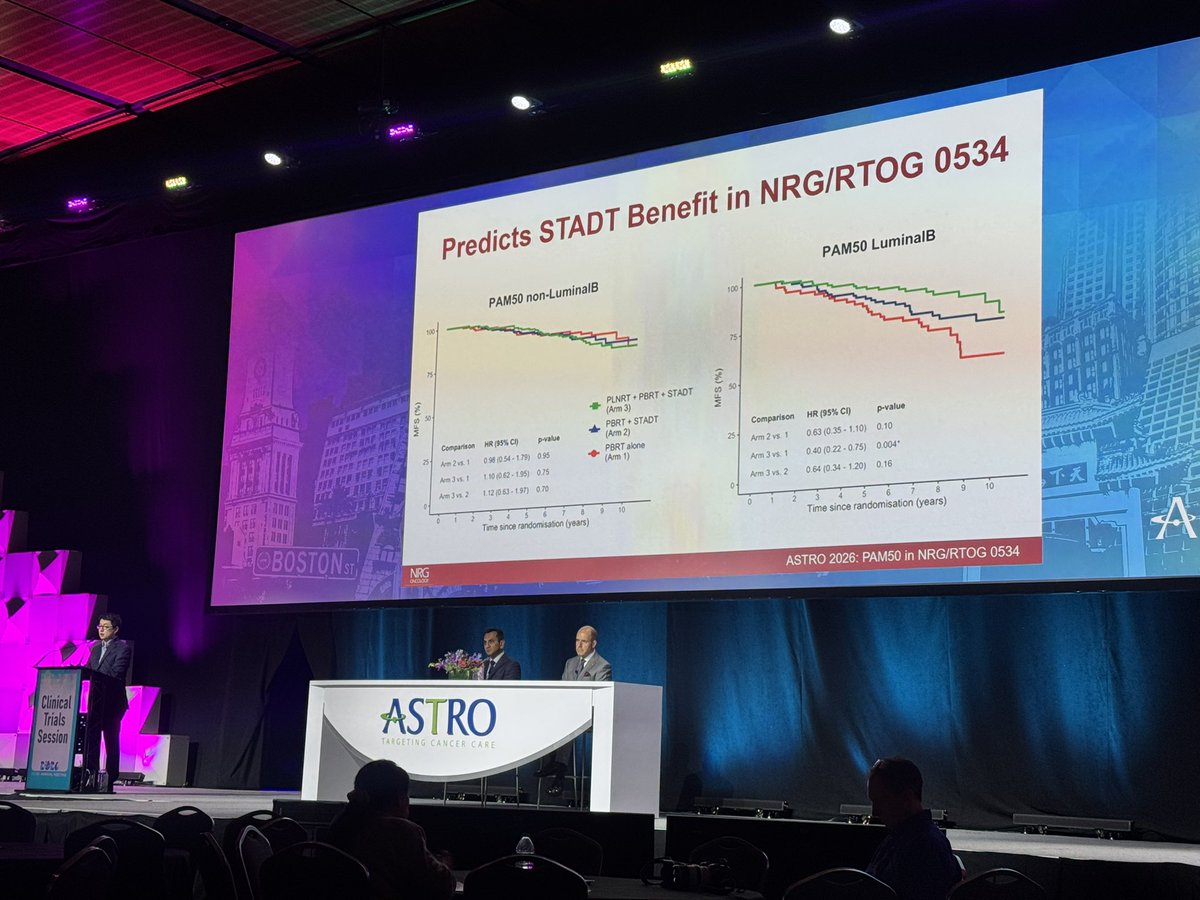
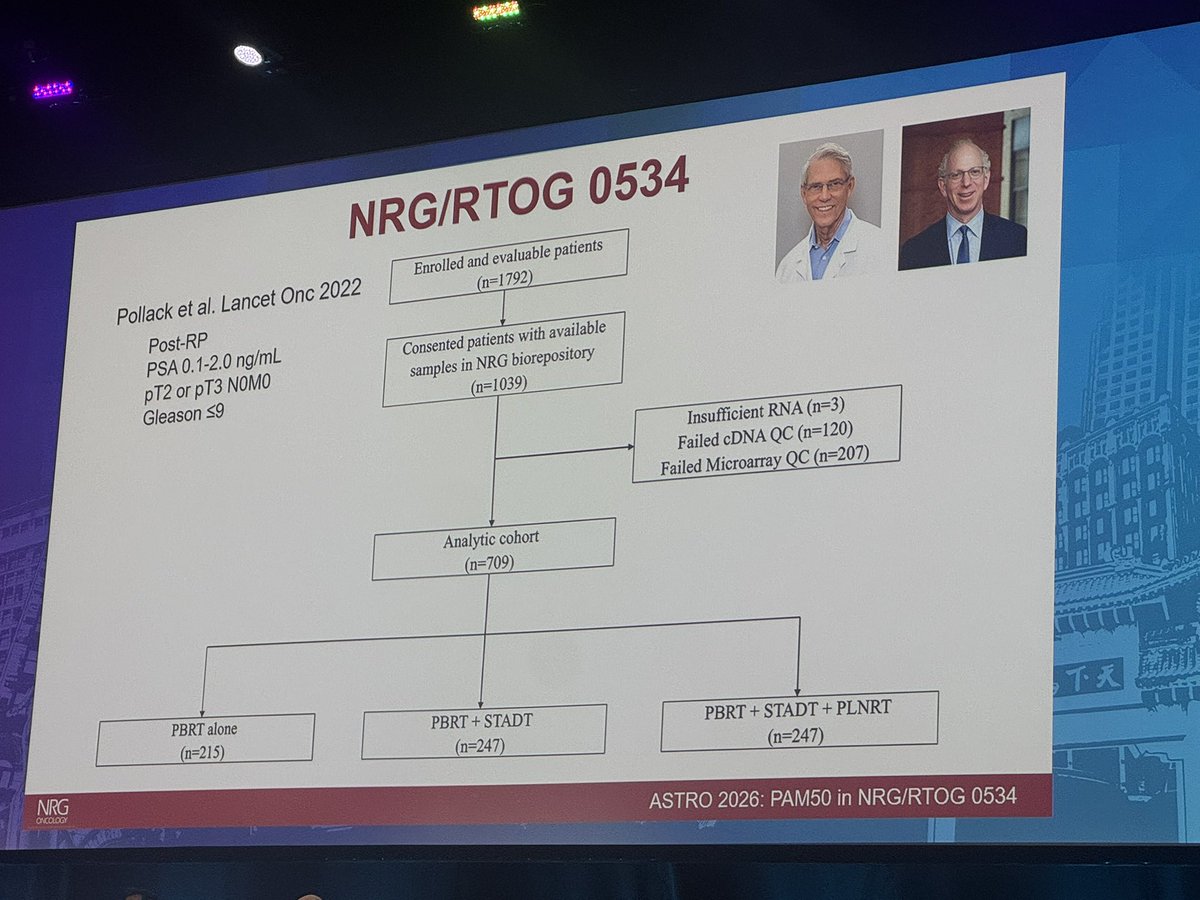
9 details
Transcriptomic PAM50 subtyping of archived tissue from NRG/RTOG 0534 SPPORT, a three-arm salvage RT trial (Pollack, Lancet Onc 2022). Whether the biomarker analysis was prespecified is not stated in source.
Post-RP, PSA 0.1-2.0 ng/mL, pT2 or pT3 N0M0, Gleason ≤9. Analytic cohort n=709 of 1792 enrolled; 1039 had biorepository samples, with 330 lost to RNA or QC failure.
Arms: PBRT alone (n=215), PBRT + STADT (n=247), PBRT + STADT + PLNRT (n=247). Dose and fractionation not reported in source.
Luminal B carried the larger ADT benefit on FFP (p-int=.01) and MFS (p-int=.05). One FFP panel shows ADT arms vs PBRT alone HR 0.34 (0.23-0.52), p<0.001; panel attribution not legible in OCR.
| Endpoint | Luminal B | non-Luminal B | p-interaction |
|---|---|---|---|
| 5-y FFP benefit | 31% | 10% | .01 |
| 10-y MFS benefit | 20% | -3% | .05 |
RTOG 9601 and SPPORT established ADT with salvage RT in unselected post-RP pts. This analysis asks which of those pts carry the benefit, using subtype rather than PSA or pathology alone.
Tissue was available for under half the trial, so the subset may differ from the randomized population. Arm-level slides do not resolve PLNRT's contribution by subtype in legible form.
Subtype appears to concentrate ADT benefit in Luminal B, raising de-escalation potential for non-Luminal B. It does not establish safe ADT omission, which needs a prospective selected design.
Secondary biomarker analysis in tissue-available subset; prespecification not stated. MFS interaction borderline. Needs prospective PAM50-selected validation before guiding ADT use.
- Can non-Luminal B pts omit STADT with salvage RT?
- Does PAM50 subtype select for pelvic nodal RT?
- Validation of PAM50 in a second salvage RT trial
📚 Sources · 🐦 1 tweet
New #ASTRO2026 data from @NRGOnc /RTOG 0534 SPPORT 🔬🧬 presented by Shuang (George) Zhao @UTMDAnderson. PAM50 Luminal B = both prognostic & predictive of benefit from postop ADT.
— Lauren Henke, MD, MSCI (@lauren_henke) September 27, 2026
📈 5-y FFP benefit: 31% vs 10% (p-int=.01)
🎯 10-y MFS: 20% vs -3% (p-int=.05)#Pcsm @Astro_org pic.twitter.com/BRJsYDWiQS
NRG/RTOG 0815 long-term follow-up
ForNon-metastatic intermediate-risk prostate, dose-escalated EBRT or brachy boost
HR 0.87
95% CI 0.72-1.04, p=0.13; did not meet OS
TL;DROS HR 0.87, p=0.13 (not met), but 6 mo STAD cut PSA failure (HR 0.60) and DM (HR 0.35) in intermediate-risk PCa on dose-escalated RT.
Dose escalation (79.2 Gy or brachy boost) did not absorb the STAD benefit: distant metastases 40 vs 14 events (HR 0.35), prostate cancer deaths 19 vs 5. With 422 of 446 deaths non-prostate, OS was never going to decide this, so add-vs-omit STAD hinges on DM reduction weighed against cardiac and sexual toxicity.
In intermediate-risk prostate cancer (mostly single-factor, Gleason 7) on dose-escalated RT, this supports discussing 6 mo STAD for fewer distant metastases against cardiac and sexual toxicity; it does not address pts with all 3 risk factors and ≥50% positive cores, who were excluded. The longer read
Dose escalation to 79.2 Gy or brachy boost did not make STAD redundant: distant metastases 40 vs 14 events (HR 0.35), prostate cancer deaths 19 vs 5. With 422 of 446 deaths non-prostate, the add-vs-omit STAD decision rests on DM reduction against cardiac and sexual toxicity, not OS.
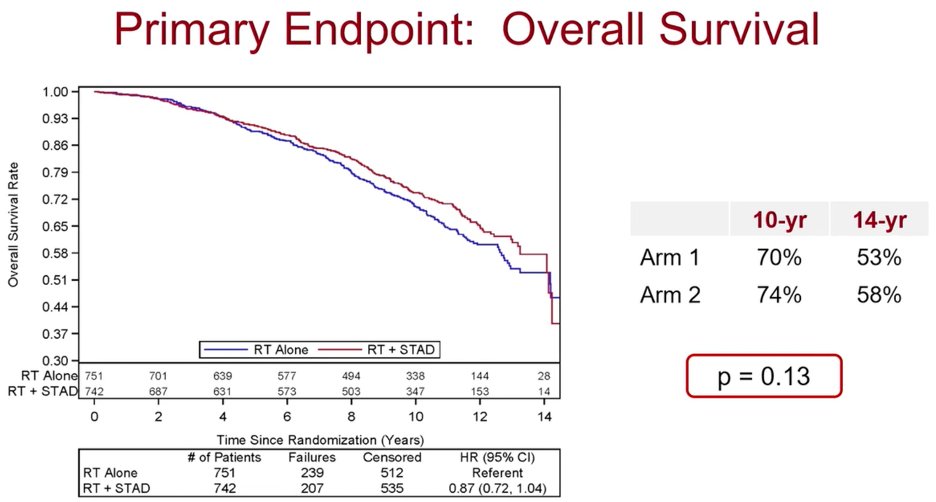
| Arm | 10-yr OS | 14-yr OS | HR (95% CI) | p |
|---|---|---|---|---|
| RT Alone | 70% | 53% | Referent | n/a |
| RT + STAD | 74% | 58% | 0.87 (0.72, 1.04) | 0.13 |
+3 more figures
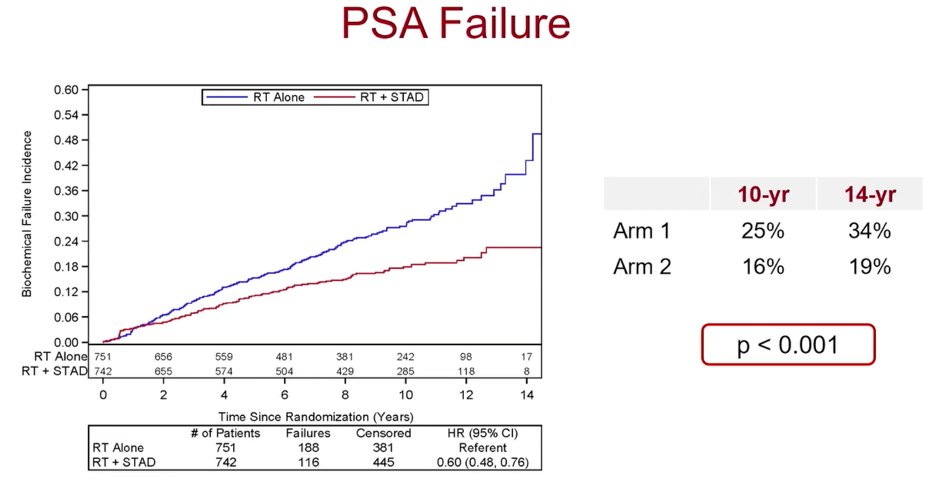
| Arm | 10-yr PSA failure | 14-yr PSA failure | HR (95% CI) | p |
|---|---|---|---|---|
| RT Alone | 25% | 34% | Referent | n/a |
| RT + STAD | 16% | 19% | 0.60 (0.48, 0.76) | <0.001 |
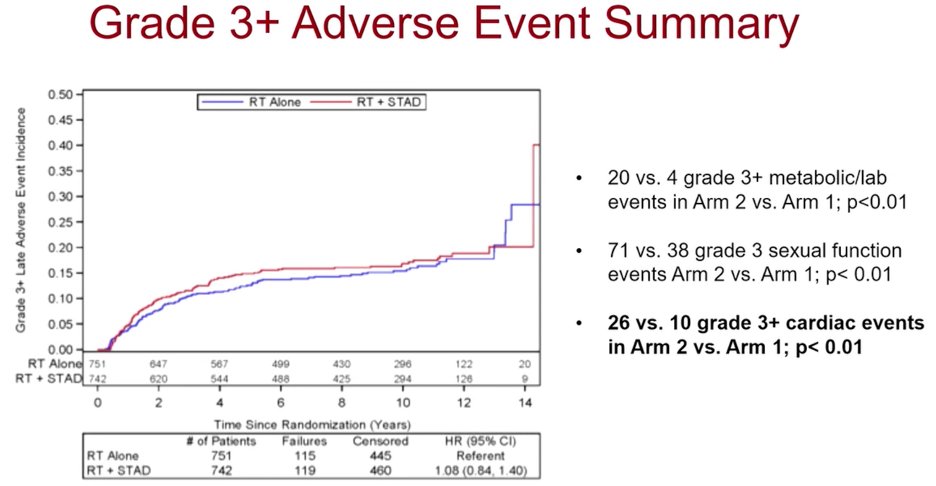
| Grade 3+ late event | RT + STAD | RT Alone | p |
|---|---|---|---|
| Any (HR, 95% CI) | 1.08 (0.84, 1.40) | Referent | n/a |
| Metabolic/lab | 20 | 4 | <0.01 |
| Sexual function (grade 3) | 71 | 38 | <0.01 |
| Cardiac | 26 | 10 | <0.01 |

10 details
Phase III prospective randomized trial, n=1493 (751 RT alone, 742 RT + STAD). Stratified by number of risk factors, ACE-27 comorbidity and RT modality. Median follow-up 9.4 y overall, 10.3 y in survivors.
Non-metastatic intermediate-risk prostate cancer with ≥1 of: Gleason 7, PSA >10 to ≤20 ng/mL, T2b-T2c; all 3 factors with ≥50% positive cores excluded. Median age 68, 67% single risk factor, 92% Gleason 7, median PSA 8.1 ng/mL.
Dose-escalated EBRT 79.2 Gy, or EBRT + LDR or HDR brachytherapy boost; 89% received EBRT alone. RT QA >90% per protocol or acceptable variation for contours and dose.
6 months STAD: LHRH agonist + antiandrogen. Protocol-compliant or acceptable in 91% (LHRH) and 87% (antiandrogen).
Primary: overall survival. Secondary: biochemical failure, local failure, distant metastasis, prostate cancer death, salvage therapy initiation, non-prostate cancer death.
Overall grade ≥3 late AEs similar (HR 1.08, 95% CI 0.84-1.40). STAD added grade ≥3 cardiac (26 vs 10), metabolic/lab (20 vs 4) and grade 3 sexual (71 vs 38) events, all p<0.01. EPIC hormone/sexual deficits largely recovered by 60 months.
The trials that established STAD with RT used doses now considered inadequate; 0815 tests whether dose escalation makes STAD redundant, and the DM and PCSM data say it does not. The OS null mirrors the low prostate-specific mortality of this risk group rather than contradicting the hormonal-benefit literature.
Local failure was a secondary endpoint but its result is not reported in source, so the in-field contribution of STAD cannot be isolated. DM and prostate-death benefits rest on small event counts (14 vs 40, 5 vs 19), and smaller subgroups had wide CIs.
STAD buys disease control and fewer prostate cancer deaths without excess non-prostate mortality (HR 0.93), at an early QoL and late cardiac cost. Investigators could not identify a subgroup without PSA-failure or DM benefit; better selection (advanced imaging, genomics, MMAI) remains open.
CONSORT flow
Randomized phase III, long-term analysis; prespecified OS primary not met, secondary disease-control gains support current selective STAD use rather than shifting it.
- Which intermediate-risk pts can safely omit STAD?
- Can genomic classifiers or MMAI select STAD benefit?
- Does PSMA PET staging change STAD benefit?
📚 Sources · 🐦 1 tweet · 📄 1 paper
NRG/RTOG 0815: Ph 3 RCT of dose-escalated RT ± 6 mo STAD in IR PCa (n=1493; median f/u 10.3 y)
— Rashid K. Sayyid (@RKSayyid) September 28, 2026
🚨OS: 10-y 70% (RT alone) vs 74% (RT+STAD); 14-y 53% vs 58% (HR 0.87; p=0.13)
🔹PSA failure: 25% vs 16% at 10 y; 34% vs 19% at 14 y (HR 0.60; p<0.001)
🔹MFS: 67% vs 72% at 10 y; 50%… pic.twitter.com/G5qfgfc9CI
Abstract
PROSTOX Ultra post-prostatectomy SBRT (SCIMITAR, EXCALIBUR)
ForPost-RP prostate cancer receiving 5-fx prostate-bed SBRT ± pelvic nodes
TL;DRGermline 32-mirSNP score kept continuous AUC 0.814/0.824 for late G2+ GU AEs after post-op SBRT; intact 0.50 cutoff failed, recalibrated 0.25 gave pooled AUC 0.748.
Reported via UroToday →
SCIMITAR logged 23.6% late G2+ GU AEs after 30-34 Gy in 5 fx to the bed, and age, pad use, IPSS and time from RP did not predict them (all p > 0.2). The germline score was the only stratifier that separated pts, which makes it a candidate input for counseling and risk-adaptive bed SBRT planning once the 0.25 cutoff is validated externally.
In post-RP pts being considered for 5-fx prostate-bed SBRT, a PROSTOX Ultra result is interpretable only against the post-op 0.25 cutoff, not the intact 0.50; it does not yet support choosing between SBRT and conventional fractionation. The longer read
SCIMITAR logged 23.6% late G2+ GU AEs after 30-34 Gy in 5 fx to the bed, and no clinical factor tested predicted them (all p > 0.2). The germline score preserved ranking (continuous AUC 0.814/0.824), making it a candidate stratifier for bed SBRT counseling and planning once the 0.25 cutoff is externally validated.
9 details
Biomarker evaluation across two prospective post-op SBRT cohorts, SCIMITAR (NCT03541850) and EXCALIBUR (NCT04915508). Continuous AUC and dichotomized performance at the intact 0.50 threshold, then exploratory recalibration targeting sensitivity >=0.65 and specificity >=0.70. AUCs bootstrapped (1,000 iterations) and pooled by fixed-effects meta-analysis.
Post-radical prostatectomy pts: SCIMITAR 100 enrolled, 89 evaluable; EXCALIBUR 74 evaluable. Germline DNA from saliva, scored with the unmodified intact-prostate model.
SCIMITAR: 30-34 Gy in 5 fractions ± pelvic nodes. EXCALIBUR: 5-fraction SBRT to the prostate bed ± nodes. Per-cohort nodal fraction not given in source.
Late grade 2+ GU adverse events, the toxicity that the source says limits broader post-op RT adoption. Grading system and follow-up not stated.
Continuous discrimination held in both cohorts, but the intact 0.50 cutoff was misaligned post-op (EXCALIBUR dichotomized AUC <0.50). At the recalibrated 0.25 cutoff the pooled AUC was 0.748.
| Metric | SCIMITAR | EXCALIBUR |
|---|---|---|
| Late G2+ GU AEs | 21/89 (23.6%) | not reported in source |
| Continuous AUC | 0.814 | 0.824 |
| Dichotomized AUC at 0.50 | 0.755 | <0.50 |
| Specificity at 0.50 | 0.985 | 0.926 |
| Sensitivity at 0.50 | 0.546 | not reported in source |
| Median score, tox vs no tox | 0.547 vs 0.049, p<0.0001 | 0.338 vs 0.043, p=0.009 |
| Dichotomized AUC at 0.25 | 0.750 | 0.727 |
In intact-prostate SBRT, PROSTOX Ultra predicts late GU AEs at a prespecified 0.50 threshold. Post-op, the risk ordering transferred while the decision threshold moved down, which the authors attribute to context, not to a different signal.
EXCALIBUR event count is not reported, so its AUCs rest on an unknown number of toxicity cases. Specificity was high at 0.50 in both cohorts, meaning the miss was in sensitivity, and the recalibration trades specificity back in a way the source does not quantify at 0.25.
The finding that generalizes is the continuous score, not a specific cutoff. Whether 0.25 is the right post-op trigger, and whether acting on it lowers GU toxicity, are both untested.
Biomarker analysis of two small post-op cohorts; the 0.25 cutoff was derived and assessed in the same data, so the recalibrated trigger lacks independent validation.
- Does the 0.25 post-op threshold hold in an independent cohort?
- Does the score predict GU toxicity with conventionally fractionated post-op RT?
- Does risk-adaptive planning lower GU toxicity in high-score pts?
📚 Sources · 📄 1 paper
Abstract
Post-operative biomarkers in prostate cancer (Spratt, ASTRO 2026)
TL;DRPAM50 luminal B selected apalutamide benefit with salvage RT in NRG GU006 (5yr MFS 95% vs 82%, HR 0.27); non-luminal B showed none.
Reported via UroToday →
MARCAPPOSEIDONRTOG 9601RTOG 0534NRG GU002NRG GU006BALANCERTOG 0815
Two selectors for adding hormone therapy to post-op RT now point the same way: pre-RT PSA above 0.50 ng/mL (POSEIDON OS HR 0.72 and 0.69) and PAM50 luminal B (GU006 MFS HR 0.27). Adverse pathology count did not predict benefit, so margin, SVI and GG4-5 alone should not drive the ADT add-on.
In post-RP biochemical recurrence going to salvage RT with pre-RT PSA ≤0.50 ng/mL, these data question routine ADT addition; PAM50 luminal B and higher PSA identify the pts in whom intensification showed benefit. The longer read
For the salvage RT consult, pre-RT PSA ≤0.50 ng/mL showed no OS gain from adding HT (HR 1.14 and 0.94), and non-luminal B tumors gained nothing from apalutamide in GU006. Adverse pathology count was prognostic only. SYMPHONY will next test 5fx SBRT, dose reduction and elective nodal coverage.
GU006 is a prospective biomarker-stratified test: 6mo apalutamide with SRT improved 5yr MFS 95% vs 82% in luminal B, with no signal in non-luminal B (HR 1.06). POSEIDON showed 24mo vs 4-6mo ADT did not improve OS (HR 0.96), so duration escalation is unsupported.
10 details 4 trials watching
Invited ASTRO 2026 review talk (Spratt), reported by UroToday. It brings together POSEIDON IPD meta-analysis, an adverse-feature IPD meta-analysis, NRG GU006, RTOG 0534 post-hoc PAM50 and MMAI analyses in RTOG 9601/0534.
Post-RP recurrent prostate cancer. GU006 enrolled PSA 0.1-1.0 ng/mL, N0M0. RTOG 0534 enrolled PSA 0.1-2.0 ng/mL, N0M0.
GU006: salvage RT + 6 months apalutamide vs placebo, blinded 1:1, stratified by margin status, pre-SRT PSA (<0.5 vs ≥0.5-1.0) and PAM50 subtype. POSEIDON compared RT ± HT and short-term (4-6mo) vs long-term (24mo) ADT.
POSEIDON overall OS benefit from HT was not statistically significant (HR 0.87, p=0.06), and longer ADT gave no extra benefit (HR 0.96). Adverse feature count had no significant interaction with HT benefit.
| Comparison / PSA stratum | OS HR (95% CI) | p |
|---|---|---|
| Overall: RT + HT vs RT alone | 0.87 (0.76-1.01) | 0.06 |
| Overall: 24mo vs 4-6mo ADT | 0.96 (0.83-1.10) | 0.56 |
| PSA ≤0.20 ng/mL | 1.14 (0.83-1.57) | 0.42 |
| PSA 0.21-0.50 ng/mL | 0.94 (0.74-1.19) | 0.70 |
| PSA 0.51-1.0 ng/mL | 0.72 (0.54-0.96) | 0.02 |
| PSA >1.0 ng/mL | 0.69 (0.48-0.98) | 0.03 |
| Endpoint | Luminal B | Non-luminal B |
|---|---|---|
| 5yr bPFS (apa vs pbo) | 72% vs 54% | 70% vs 71% |
| bPFS HR | 0.45 (95% CI 0.24-0.86), p=0.0062 | 0.95 (80% CI 0.65-1.41), p=0.44 |
| 5yr MFS (apa vs pbo) | 95% vs 82% | 90% vs 89% |
| MFS HR | 0.27 (95% CI 0.07-0.95), p=0.029 | 1.06 (95% CI 0.41-2.78), p=0.90 |
GU006 prospectively confirms the luminal B signal first suggested in retrospective subtyping work (Zhao, JAMA Oncol 2017) and seen again in RTOG 0534 post-hoc. Decipher carries Simon level 1B validation across RTOG 9601, RTOG 0534, NRG GU002 and NRG GU006.
GU006 subgroup estimates are imprecise (luminal B MFS CI 0.07-0.95). The non-luminal B bPFS HR is reported with an 80% CI. MMAI risk estimates are approximate curve reads with no prior independent validation step.
The talk's thesis is selection over intensification: PSA level and PAM50 subtype appear predictive of HT benefit, while adverse pathology is prognostic only. Optimal SRT fractionation, dose and nodal coverage stay open, and the SYMPHONY trials are designed to test them.
- Does PAM50 selection hold for longer ADT or other ARSIs with salvage RT?
- Is 5-fraction prostate bed SBRT non-inferior to conventional salvage RT? recruiting Post-prostatectomy Radiation Therapy--Moderate Versus Ultra-hypofractionated (Also Known as Stereotactic Body Radiation Therapy [SBRT]) Phase 2n=136 · primary completion 2026-11 · ph 2 post-RP ultra- vs moderate hypofx, 2y QoL endpointrecruiting Salvage Stereotactic Body Radiotherapy of the Prostate Bed for Biochemical Recurrence After Radical Prostatectomy. Phase NAn=284 · primary completion 2029-02 · randomised ph II/III salvage bed SBRT vs SOC RT post-RPn=206 · primary completion 2031-09 · phase 3 5-fx bed SBRT vs moderate hypofx, PRO noninferiority
- Does elective nodal RT add benefit in PSMA-era salvage? n=196 · primary completion 2023-04 · PEACE V: whole pelvic RT + MDT vs MDT, nodal oligorecurrence
📚 Sources · 📄 1 paper
Abstract
GUAM international consensus guideline on GU adverse events after prostate RT
ForProstate cancer pts receiving definitive or post-RP RT with GU toxicity
TL;DRDelphi panel (48 experts, ≥75% agreement): 76% favor moderate hypofx over SBRT at baseline IPSS 15–19; no dose-volume constraint reached consensus.
Reported via UroToday →
The technique read is that baseline IPSS now gates fractionation: 76% favored moderate hypofx over SBRT at IPSS 15–19, and MIRAGE (2-mm MRI-guided margins, late G≥2 GU 51% → 27%) was the margin evidence cited. Yet no bladder or urethral dose-volume constraint reached consensus, so planning-level GU sparing still rests on institutional choice.
In an intact-prostate pt with baseline IPSS 15–19 weighing SBRT vs moderate hypofx, this panel leaned toward moderate hypofx; it does not address post-RP pts, and at IPSS ≥20 the question shifts toward urology referral for an outlet procedure before RT. The longer read
Baseline IPSS now formally gates fractionation: 76% favored moderate hypofx over SBRT at IPSS 15–19, with full bladder endorsed by 85%. MIRAGE margins were cited, but no bladder or urethral dose-volume constraint reached consensus, so planning limits stay institutional.
For urologic surgeons, the timing question is answered: 94% would wait ≥8 weeks after an outlet procedure before RT, and 85% would consider a prophylactic procedure for severe LUTS, but 95% not when irritative symptoms predominate. The IPSS ≥20 referral trigger drew 74%, just below the consensus bar.
12 details 2 trials watching
Systematic review (183 articles) plus 3-round modified Delphi, May 2025 to Feb 2026. Consensus = ≥75% agreement; independent peer review, endorsed by ASTRO and ESTRO.
Panel of 48 experts from 15 countries: 34 radiation oncologists, 7 medical oncologists, 7 urologic oncologists across North America, Europe, Asia and Australia. Scope: acute medical mgmt, RT technique, outlet obstruction, urology referral, HBOT.
76% favored moderate hypofx over SBRT at baseline IPSS 15–19; 85% endorsed a full bladder at sim and treatment. No specific dose-volume constraint reached consensus.
Intact prostate: alpha blockers first for obstructive, anti-spasmodics first for irritative symptoms; post-RP: anti-spasmodics first. 80% against prophylactic medication; 80% add a 2nd agent rather than switch.
MIRAGE was cited for margin reduction (late G≥2 GU 51% → 27% with 2-mm MRI-guided vs 4-mm CT-guided). CHHiP, PROFIT, RTOG 0415 and HYDRA were cited as showing no consistent late GU excess with moderate hypofx; RICH-ART supports HBOT for radiation cystitis.
Several reported positions (74% IPSS ≥20 referral, 66% ≥12-wk wait, 52% SBRT after outlet procedure) fall below the ≥75% consensus bar. Panel is radonc-weighted, and this read comes from a conference summary, not the full manuscript.
Formalizes IPSS as a fractionation and referral gate and standardizes symptom-directed pharmacotherapy. It leaves dose-volume constraints, urethral contouring reliability and RT-specific drug evidence open; BEFORE, RadTARGET, RELIEF and DESTINATION-2 are named as ongoing.
| Setting | Preferred 1st line | Subsequent options (in order) |
|---|---|---|
| Intact prostate, obstructive | Alpha blockers | PDE5-Is, NSAIDs, steroids, anti-spasmodics |
| Intact prostate, irritative | Anti-spasmodics | Alpha blockers, NSAIDs, phenazopyridine, cranberry |
| Post-prostatectomy | Anti-spasmodics | Not specified in source |
| Recommendation | Agreement |
|---|---|
| No prophylactic GU medication before symptom onset | 80% |
| Add 2nd agent rather than switch if 1st line inadequate | 80% |
| Alpha blockers do not/probably do not help post-RP | 74% |
| Moderate hypofx over SBRT at baseline IPSS 15–19 | 76% |
| Full bladder at simulation and treatment | 85% |
| Refer for outlet procedure at IPSS ≥20 | 74% |
| Wait ≥8 wk after outlet procedure before RT | 94% |
| Wait ≥12 wk after outlet procedure before RT | 66% |
| SBRT safe after outlet procedure once obstruction resolved | 52% |
| Prophylactic outlet procedure for severe LUTS | 85% |
| No outlet procedure when irritative symptoms predominate | 95% |
| IPSS threshold | Panelists |
|---|---|
| 10–14 | 16% |
| 15–19 | 61% |
| 20–24 | 21% |
| ≥25 | 2% |
| IPSS threshold | Panelists |
|---|---|
| 15–19 | 34% |
| 20–24 | 47% |
| 25–29 | 15% |
| ≥30 | 4% |
Delphi consensus over a systematic review; agreement figures are opinion, not outcomes. First RT-specific GU toxicity framework, with core technique questions left unresolved.
- Optimal bladder and urethral dose-volume constraints for GU toxicity recruiting Daily Adaptive Radiation Therapy Using an Individualized Approach for Prostate Cancer Phase NAn=132 · primary completion 2027-01 · urethral-sparing adaptive SBRT, EPIC-26 urinary primary EPn=42 · primary completion 2028-01 · SUPR-SABR urethral sparing, GU tox vs historical SABR
- RT-specific evidence for alpha blockers and anti-spasmodics
- Reliability of urethral contouring for sparing
📚 Sources · 📄 1 paper
Abstract
2026-09-30 ASTRO Annual Meeting 2026
REVELUTION (relugolix vs leuprolide + RT, PROs)
ForLocalized intermediate/high-risk prostate cancer, RT + ADT, ADT-naive
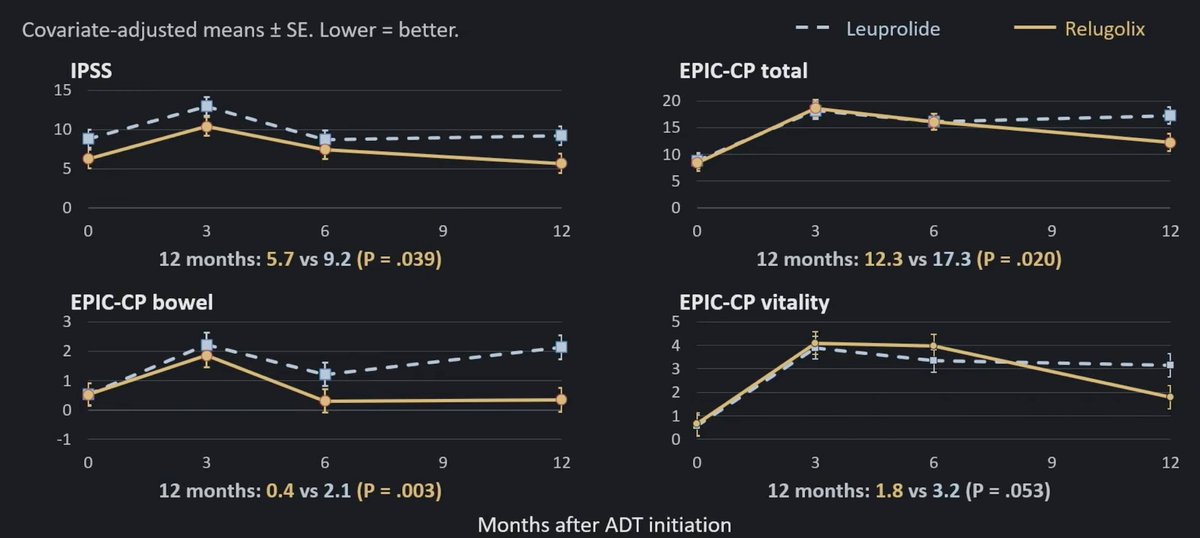
TL;DRAt 12 mo, relugolix vs leuprolide with RT: IPSS 5.66 vs 9.22 (p=0.039), EPIC-CP total 12.25 vs 17.25 (p=0.02); post hoc.
The PRO gap tracks with faster testosterone recovery on relugolix (mean 199.7 vs 142.0 ng/dL at 12 mo, P=.010), which plausibly explains better urinary and EPIC-CP total scores. For RT + short-course ADT, that recovery kinetic is the relevant variable when choosing GnRH agent; whether it costs anything in biochemical control is untested here.
In an ADT-naive man with localized intermediate- or high-risk prostate cancer starting RT + ADT, this offers hypothesis-level support for relugolix on 12-mo urinary and overall PRO burden; it says nothing about biochemical or oncologic control.
In RT + ADT for localized intermediate/high-risk disease, relugolix was linked to lower IPSS (5.66 vs 9.22) and EPIC-CP total (12.25 vs 17.25) at 12 mo, with higher mean testosterone. That informs agent choice when RT-related urinary and bowel symptoms are the concern, pending oncologic data.
Mean testosterone at 12 mo was higher on relugolix (199.7 vs 142.0 ng/dL), consistent with faster recovery after an oral antagonist. The PRO benefit may reflect that recovery; disease control with relugolix in this curative RT setting is not addressed by this analysis.
Also covered Jun 16
+2 more figures
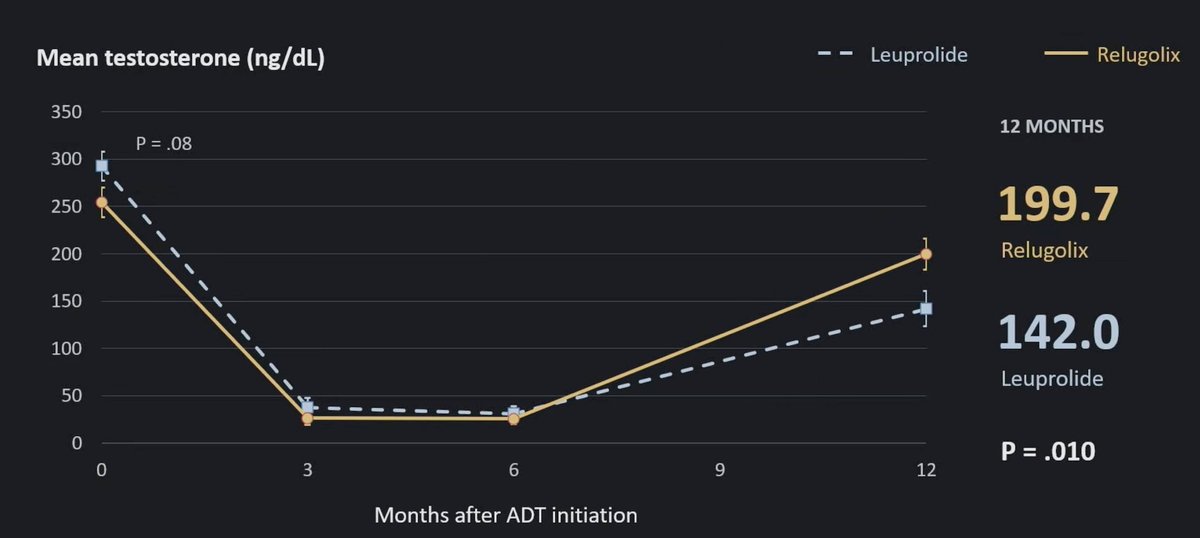
| Arm | Mean testosterone at 12 MONTHS (ng/dL) | P |
|---|---|---|
| Relugolix | 199.7 | .010 |
| Leuprolide | 142.0 | .010 |
9 details 1 trial watching
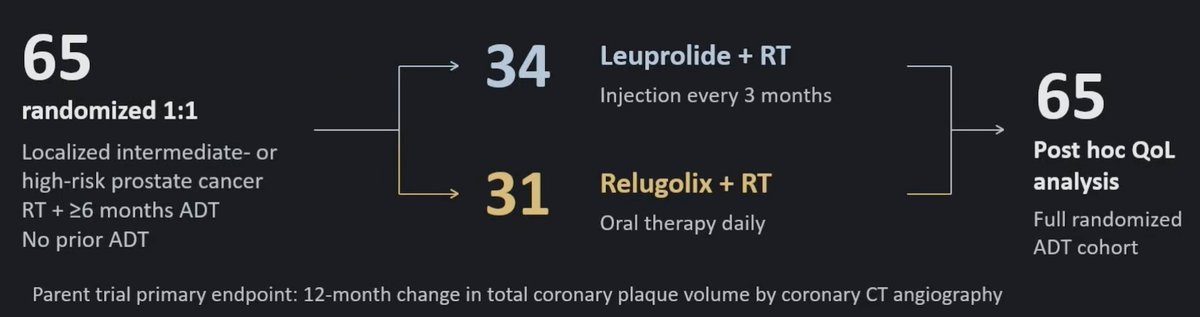
Post hoc QoL analysis of a 1:1 randomized trial, N=65. Parent trial primary: 12-month change in total coronary plaque volume by coronary CT angiography.
Localized intermediate- or high-risk prostate cancer, receiving RT + ADT, no prior ADT.
Relugolix oral daily vs leuprolide injection every 3 months, each with RT.
Relugolix favored on IPSS and EPIC-CP total at 12 mo; incontinence, irritation, sexual and SHIM did not differ (all P≥.15). Mean testosterone at 12 mo 199.7 vs 142.0 ng/dL (P=.010), higher on relugolix.
| Endpoint | Relugolix + RT | Leuprolide + RT | p |
|---|---|---|---|
| IPSS | 5.66 | 9.22 | 0.039 |
| EPIC-CP total | 12.25 | 17.25 | 0.02 |
HERO compared relugolix with leuprolide in advanced prostate cancer; this analysis extends the comparison to the curative RT setting, but only on PROs and testosterone, not disease control.
Open route difference (oral vs injection) could bias self-reported outcomes. Whether pts were still on ADT at 12 mo is not stated, so the testosterone and PRO gaps may reflect recovery timing rather than on-treatment tolerability.
The urinary and global PRO advantage aligns with faster testosterone recovery on relugolix. Whether that recovery trades against biochemical control after RT is the unanswered question.
Post hoc QoL analysis of a trial powered for coronary plaque, N=65; PRO differences not a prespecified endpoint and route of administration unblinded.
- Does faster testosterone recovery on relugolix affect biochemical control after RT?
- Do PRO differences hold in a prespecified, larger trial? n=110 · primary completion 2027-07 · relugolix vs leuprolide, 6 mo ADT, QoL as stated aim
📚 Sources · 🐦 1 tweet
Relugolix vs Leuprolide + RT for Localized PCa: PROs in the REVELUTION RCT @urotoday #ASTRO26
— Zach Klaassen (@zklaassen_md) September 30, 2026
Relugolix vs Leuprolide:
📌T @ 12 mos: 199.7 vs 142.0 ng/dL; p=0.01
📌@ 12 mos:
- ⬇️ IPSS (5.66 vs 9.22; p=0.039)
- ⬇️ EPIC-CP total (12.25 vs 17.25; p=0.02)
- ⬇️ EPIC-CP bowel… pic.twitter.com/Ek2xLZsl3u
RTOG 3506 (STEEL)
ForPost-RP BCR with ≥1 high-risk feature, receiving SRT + 24mo ADT
HR 0.62
80% CI 0.42-0.91, one-sided p=0.052
TL;DRPFS HR 0.62 (80% CI 0.42-0.91, one-sided p=0.052) adding enzalutamide to SRT + 24mo ADT in high-risk post-RP BCR; BF at 2y 11% vs 19%.
Both arms received SRT + 24 months GnRHa, so the trial isolates ARSI intensification, not the RT contribution; SRT dose and field are not reported in source. BF at 2y dropped 19% to 11%, but Gr 3-4 lymphopenia rose 15% vs 5%, worth weighing if pelvic nodal fields are in the plan.
In post-RP BCR with Gleason 8-10, SVI, pN1, persistent PSA or PSA ≥0.7 already planned for SRT + 24 months ADT, this supports discussing enzalutamide as investigational intensification; it does not extend to lower-risk BCR or shorter ADT courses.
RT was fixed across arms, so this informs what to pair with SRT, not dose or field; technique is not reported in source. BF at 2y 11% vs 19% suggests the SRT + 24mo ADT backbone still leaves room for intensification in high-risk BCR.
Enzalutamide 160 mg on top of 24 months GnRHa cut PFS hazard (HR 0.62, 80% CI 0.42-0.91) in a screening design. Gr 3-4 lymphopenia 15% vs 5% and hypertension 8% vs 5% are the toxicity trade to weigh pending phase III.

| Arm | PFS HR (80% CI) | p |
|---|---|---|
| SRT+ENH ADT | 0.62 (0.42, 0.91) | one-sided p=0.052 |
| SRT+STD ADT | Referent | n/a |
+2 more figures
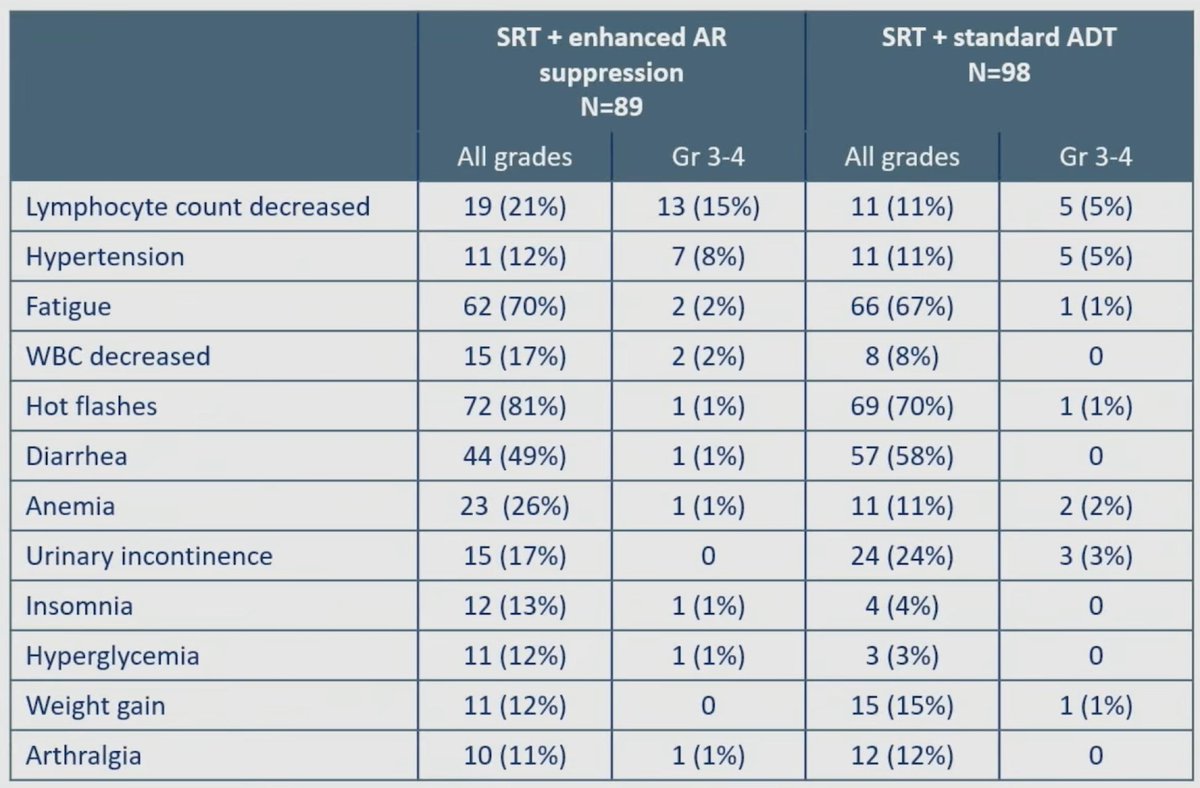
| AE (all grades) | SRT + enhanced AR suppression (N=89) | SRT + standard ADT (N=98) |
|---|---|---|
| Lymphocyte count decreased | 19 (21%) | 11 (11%) |
| Hot flashes | 72 (81%) | 69 (70%) |
| WBC decreased | 15 (17%) | 8 (8%) |
| Anemia | 23 (26%) | 11 (11%) |
| Diarrhea | 44 (49%) | 57 (58%) |
| Urinary incontinence | 15 (17%) | 24 (24%) |
| Hyperglycemia | 11 (12%) | 3 (3%) |
8 details
Randomized phase II, 1:1, n=188, final results. Median follow-up 33.1 mos. Designed with a one-sided type I error of 0.10.
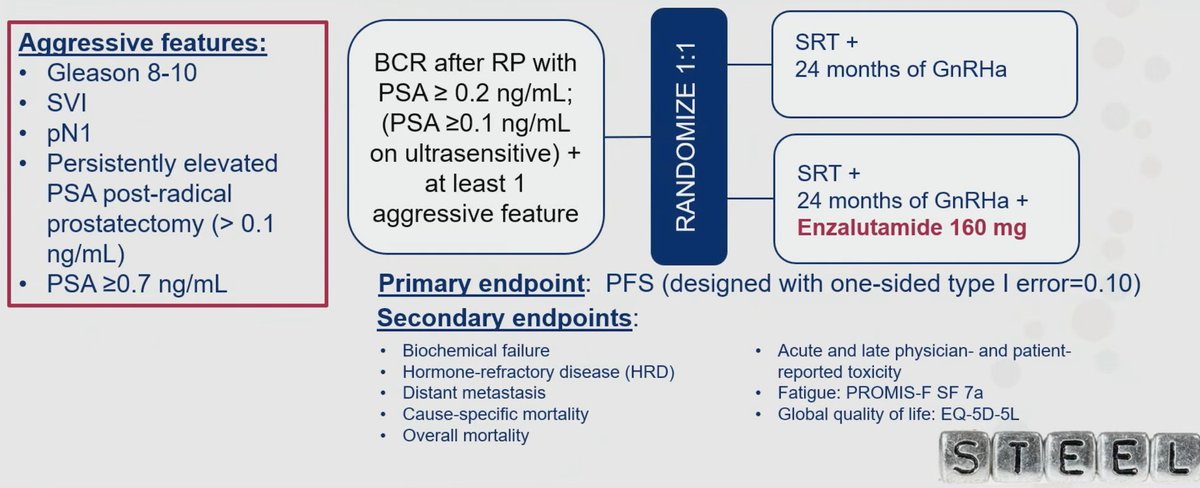
BCR after RP with PSA ≥0.2 ng/mL (or ≥0.1 ng/mL ultrasensitive) plus ≥1 aggressive feature: Gleason 8-10, SVI, pN1, persistently elevated post-RP PSA >0.1 ng/mL, or PSA ≥0.7 ng/mL.
Control: 24 months GnRHa. Experimental: 24 months GnRHa + enzalutamide 160 mg.
Salvage RT in both arms. Dose, fractionation and target volume (prostate bed vs pelvic nodes) are not reported in source.
Primary: PFS. Secondary: biochemical failure, hormone-refractory disease, distant metastasis, cause-specific and overall mortality, physician- and patient-reported toxicity, fatigue (PROMIS-F SF 7a), global QoL (EQ-5D-5L).
PFS HR 0.62 (80% CI 0.42-0.91), one-sided p=0.052. BF at 2 yrs 11% vs 19%.
More Gr 3-4 lymphopenia with enza, 13 (15%) vs 5 (5%), and Gr 3-4 hypertension 7 (8%) vs 5 (5%). All-grade hot flashes 81% vs 70%.
RTOG 9601, GETUG-AFU 16 and SPPORT established adding ADT to SRT; STEEL asks the next question, whether an ARSI on top of long-course ADT adds further. EMBARK tested enzalutamide in high-risk BCR without RT, a different setting.
SRT technique not reported, so RT transferability can't be judged. PFS definition and blinding not stated in source. The 24-month ADT control is itself intensified relative to many current practices.
The signal clears the trial's own screening threshold, but no OS or metastasis data in source, so the cost in lymphopenia and hypertension is set against a surrogate benefit only. The question is now phase III-ready, not practice-ready.
Randomized phase II screening design: one-sided α 0.10, 80% CI, surrogate PFS endpoint, 33mo median f/u. Needs phase III confirmation before ARSI intensification with SRT.
- Does PFS gain translate to MFS or OS?
- Phase III confirmation of ARSI intensification with salvage RT
- Role of pelvic nodal RT alongside enhanced AR suppression
📚 Sources · 🐦 1 tweet
Final Results from RTOG 3506 (STEEL): Randomized Ph II -- 24 mos of Enza + ADT vs ADT in HR Pts with BCR Undergoing Salvage RT @EdwinPosadasMD @urotoday #ASTRO26
— Zach Klaassen (@zklaassen_md) September 29, 2026
📌n=188, mFU 33.1 mos
📌Enza + ADT vs ADT, PFS: HR 0.62, 80%CI 0.41-0.91; p = 0.052
📌BF @ 2 yrs: 11% vs 19% pic.twitter.com/fkHw8hzOri
2026-09-28 ASTRO Annual Meeting 2026
PACE-A
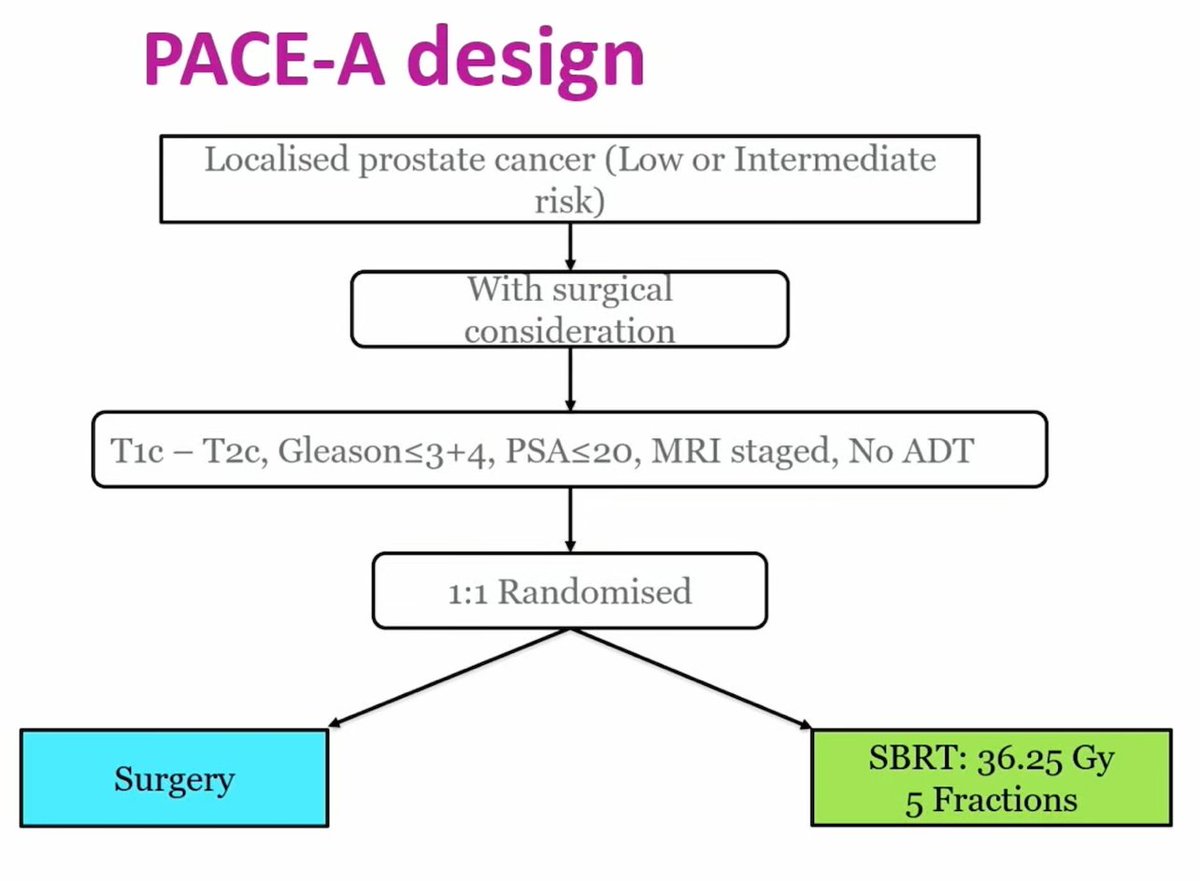
ForLocalised low/intermediate-risk PCa (GG1-2), surgical candidates, no ADT
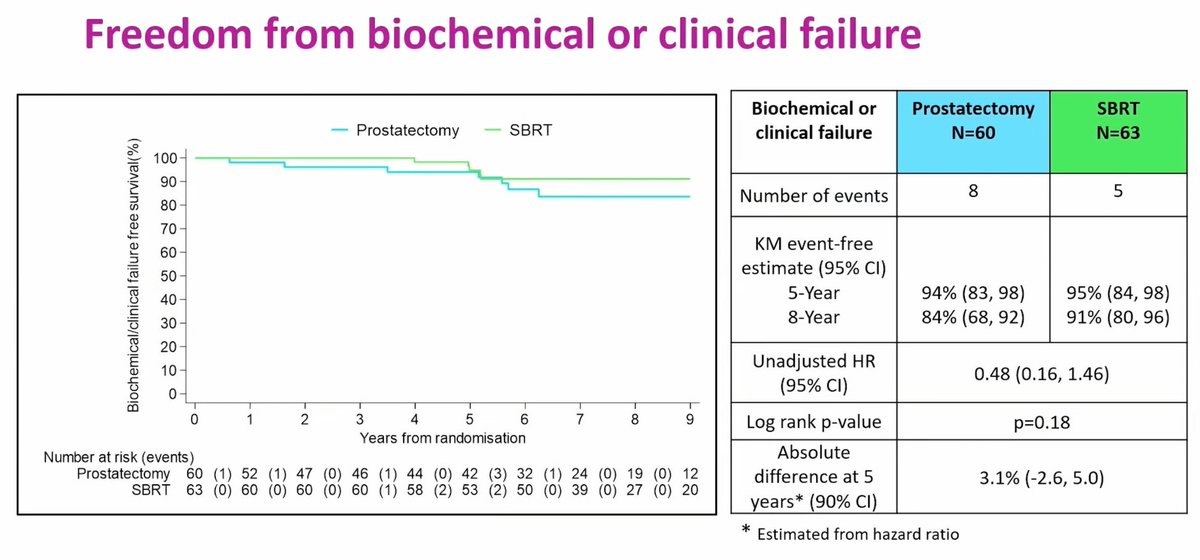
TL;DR≥1 urinary pad 14/29 (48%) RP vs 3/36 (8%) SBRT; BCF HR 0.48 (95% CI 0.16-1.46), mFU 8 yrs, GG1-2 localised PCa.
The continence gap is the RT read: ≥1 pad in 14/29 (48%) after RP vs 3/36 (8%) after 36.25 Gy/5fx, with bowel toxicity 0 (0%) on SBRT. With mFU 8 yrs and 7 deaths none from PCa, this supports SBRT as the lower-urinary-morbidity option when counselling surgical candidates, though efficacy parity rests on 13 events.
In an MRI-staged GG1-2, PSA ≤20 surgical candidate choosing between RP and SBRT, this supports framing continence as the main differentiator; it does not extend to GG3+ disease or pts needing ADT. The longer read
36.25 Gy/5fx with no ADT delivered pad use in 3/36 (8%) and no moderate/big bowel problems, so five-fraction SBRT holds its functional advantage against a surgical, not just a conventional RT, comparator in GG1-2 disease.
Pad use after RP was 14/29 (48%) against 3/36 (8%) after SBRT, with BCF HR 0.48 (0.16-1.46) at mFU 8 yrs. For GG1-2 surgical candidates, the continence trade-off is now randomised evidence, while efficacy parity remains unproven on 13 events.

| Arm | ≥1 urinary pad |
|---|---|
| Prostatectomy | 14/29 (48%) |
| SBRT | 3/36 (8%) |
+3 more figures
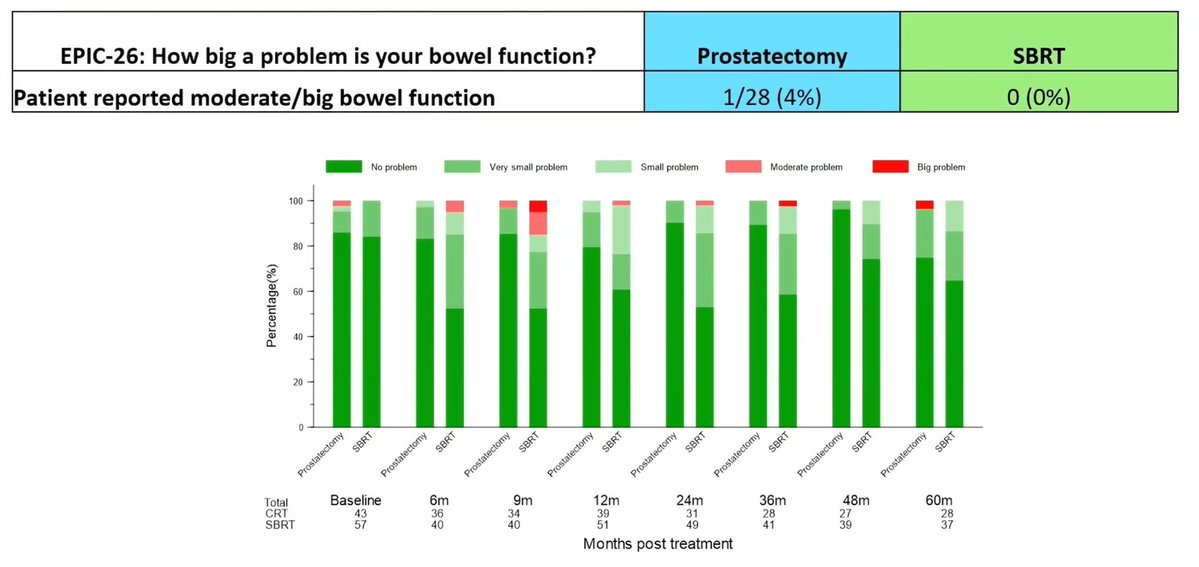
| Arm | Moderate/big bowel problem |
|---|---|
| Prostatectomy | 1/28 (4%) |
| SBRT | 0 (0%) |
12 details
1:1 randomised RP vs SBRT, n=123 (60 RP, 63 SBRT), 10 UK centres. Median follow-up 8 yrs. Phase not stated in source.
Localised low or intermediate risk PCa with surgical consideration: T1c-T2c, Gleason ≤3+4, PSA ≤20, MRI staged, no ADT.
SBRT 36.25 Gy in 5 fractions. Target volume and margins not reported in source.
Biochemical or clinical failure: 13 events, HR 0.48 (95% CI 0.16-1.46), log rank p=0.18. Absolute 5-yr difference 3.1% (90% CI -2.6, 5.0), estimated from HR. 7 deaths, none from PCa, HR 0.55 (0.12-2.46).
Patient-reported ≥1 urinary pad 14/29 (48%) RP vs 3/36 (8%) SBRT. Moderate/big bowel problem 1/28 (4%) RP vs 0 (0%) SBRT.
PACE-B tested SBRT against conventional RT; PACE-A supplies the surgical comparison in the same programme. ProtecT remains the reference randomised comparison of RP vs RT in localised disease, with a different RT technique and population.
PRO denominators (29 and 36) sit well below the 60 and 63 randomised, so responder bias could inflate or shrink the pad gap. Timepoint for the pad comparison not stated in source.
The trial answers the toxicity question more convincingly than the efficacy one: the urinary continence difference is large, while the BCF CI spans a threefold range either way. Oncologic equivalence of SBRT vs RP in GG1-2 is not settled by these data.
CONSORT flow
Randomised but small: 13 BCF events cannot establish oncologic equivalence. Primary endpoint not stated in source; PRO denominators show heavy attrition.
- Oncologic noninferiority of SBRT vs RP in GG1-2 disease
- Durability of the continence gap with complete PRO capture
📚 Sources · 🐦 1 tweet
#ASTRO26 Plenary -- PACE-A: 5-yr Outcomes of RP vs SBRT for GG1-2 PCa @nickva1 @urotoday
— Zach Klaassen (@zklaassen_md) September 28, 2026
📍n=123 (60 RP, 63 SBRT), mFU 8 yrs, 10 🇬🇧 centers
📍13 BCF events: HR 0.48, 95% CI 0:16-1.46
📍7 deaths (no PCa): HR 0.55, 95% CI 0.12, 2.46
📍EPIC-26 >=1 urinary pad: 14/29 (48%) RP vs… pic.twitter.com/tSYdMxDayT
STOP
ForPSMA PET ≤3 mets, CI-negative BCR or de novo oligometastatic HSPC
TL;DR3-yr biochemical progression 21% vs 60% (p=0.004) adding SBRT to intermittent ADT in PSMA PET-detected, conventional-imaging-negative oligometastatic HSPC/BCR.
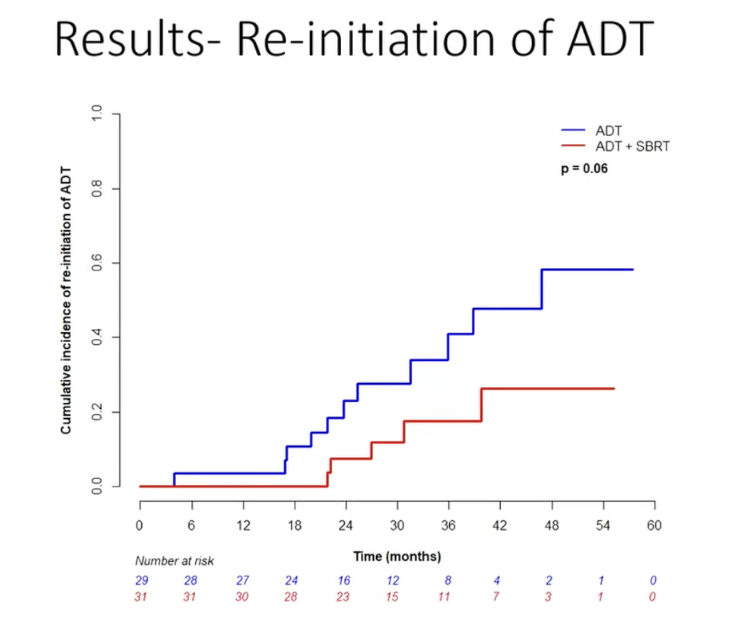
The RT read is durability of the ADT-free interval: consolidating all PSMA-avid sites during a fixed 8-9 month ADT course left median time to biochemical progression not reached vs 27 mo. ADT re-initiation trended the same way (p=0.06), so SBRT's value here is extending time off ADT, not replacing it.
In CI-negative, PSMA PET-positive recurrent or de novo HSPC with ≤3 deposits already planned for a finite ADT course, this supports adding SBRT to prolong biochemical control; it does not address MDT without ADT or disease visible on conventional imaging.
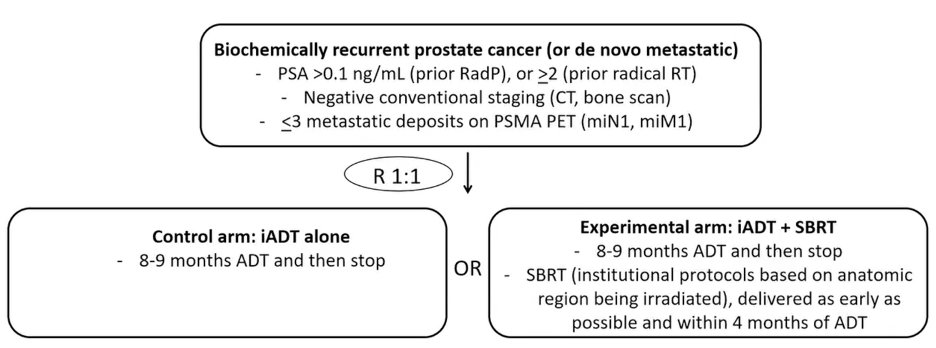
Consolidating all PSMA-avid sites (≤3) within 4 months of ADT start cut 3-yr biochemical progression from 60% to 21%. SBRT technique was institutional by anatomic region, so no dose/fractionation standard emerges; the decision it informs is adding MDT to a short ADT course, not using MDT alone.
Both arms stopped ADT after 8-9 months, so the SBRT benefit plays out as a longer ADT-free interval. ADT re-initiation trended lower (p=0.06) but was not significant, so evidence that SBRT spares cumulative ADT exposure is still missing.

+2 more figures
9 details 4 trials watching
Randomised 1:1, n=60. Primary endpoint was feasibility, met with 91% of eligible pts enrolled. Phase not stated in source.
Biochemically recurrent prostate cancer (or de novo metastatic) with negative conventional staging (CT, bone scan) and ≤3 deposits on PSMA PET (miN1, miM1). PSA >0.1 ng/mL after RadP or ≥2 after radical RT.
Both arms received 8-9 months ADT, then stopped. Intermittent ADT is the backbone and the ADT-free interval is the tested space.
SBRT to all PSMA-avid sites per institutional protocol by anatomic region, delivered within 4 months of ADT. No uniform dose/fractionation reported in source.
Biochemical progression favored SBRT (p=0.004); ADT re-initiation trended lower but was not significant (p=0.06). QoL (EORTC QLQ-C30 global health) was collected; values not legible in source.
| Endpoint | iADT + SBRT | iADT alone | p |
|---|---|---|---|
| 3-yr biochemical progression | 21% | 60% | 0.004 |
| Median time to biochemical progression | NR | 27 mo | not reported in source |
| Cumulative incidence of ADT re-initiation | not reported in source | not reported in source | 0.06 |
STOMP and ORIOLE tested MDT without continuous ADT in conventionally or PSMA-staged oligorecurrence. STOP instead layers SBRT onto a finite ADT course in CI-occult, PSMA-only disease, a population neither directly addressed.
Feasibility-powered, so the efficacy effect size is imprecise and vulnerable to imbalance. Heterogeneous SBRT protocols prevent a dose recommendation, and hard endpoints (MFS, OS) are not reported in source.
The signal is that PSMA-guided consolidation makes a short ADT course more durable. What it does not settle is whether that delays metastatic progression or reduces lifetime ADT exposure, the endpoint that trended but missed.
Randomised but n=60 with a feasibility primary; efficacy is secondary, SBRT unstandardized, and ADT re-initiation not significant. Needs a powered trial.
- Does SBRT delay metastatic progression or improve OS beyond biochemical control? recruiting Veterans Affairs Seamless Phase II/III Randomized Trial of STAndard Systemic theRapy With or Without PET-directed Local Therapy for Oligometastatic pRosTate Cancer Phase 2/3n=464 · primary completion 2026-09 · phase 2/3 SST ± PET-directed local tx, CRPC-free survivalrecruiting Metastasis Directed Stereotactic Body Radiotherapy for Oligo Metastatic Hormone Sensitive Prostate Cancer Phase NAn=118 · primary completion 2031-12 · randomised MD-SBRT vs SOC, PSMA-PET oligomet HSPC
- Optimal SBRT dose/fractionation for PSMA-only oligorecurrence
- Does SBRT reduce cumulative ADT exposure in a powered trial? active Comparison of Intermittent Androgen Deprivation Therapy With or Without Irradiation Recovery in Prostate Cancer Patients Phase NAn=256 · primary completion 2026-06 · randomised IADT ± RT, PET-detected ≤5 nodal metsnot yet Best Salvage Treatment for High-risk Relapsing Prostate Cancer (PEACE-9 - ESCALATE-RT) Phase 3n=140 · primary completion 2030-07 · phase 3 MDT added to intermittent ADT, time to restart
📚 Sources · 🐦 1 tweet
STOP: RCT of iADT +/- SBRT in PSMA PET+/ CI-oligometastatic HSPC/BCR (n=60)
— Rashid K. Sayyid (@RKSayyid) September 28, 2026
🔹91% of eligible pts enrolled → feasibility endpoint met
🔹3-yr biochemical progression: 21% vs 60% favoring iADT+SBRT (p=0.004)
🔹Median time to biochemical progression: NR vs 27 mo
🔹3-yr ADT… pic.twitter.com/IkvZS1UiBu
2026-09-22
Testosterone Treatment in Prostate Cancer Survivors (Bhasin RCT) NCT03716739
ForHypogonadal men post-RP, pT2 Gleason 3+3/3+4, undetectable PSA ≥2 yr
TL;DRSexual activity +0.91 daily events vs placebo (95% CI 0.56-1.26, P<.001), zero biochemical recurrences, 12wk TRT in hypogonadal men post-RP for Gleason 3+3/3+4.
Men treated with RT or ADT were excluded, so the zero-BCR signal does not transfer to post-RT survivors, the hypogonadal population a radiation oncologist actually follows. Post-RT pts retain prostate tissue, and this trial offers no data on TRT against that background.
In hypogonadal men with undetectable PSA ≥2 years after RP for pT2 Gleason 3+3 or 3+4 disease, this supports short-term TRT as an evidence-backed option for sexual symptoms; it does not extend to post-RT, post-ADT, or higher-grade survivors. The longer read
For the urologist following hypogonadal men after RP for pT2 Gleason 3+3/3+4 disease, this provides the first randomized efficacy data for TRT, with an effect above the stated MCID. It does not settle oncologic safety: 0 vs 0 BCR over 12 wk plus 3 mo in a near-zero-risk cohort cannot rule out harm.
10 details 1 trial watching
Randomized, placebo-controlled, double-blind, parallel-group phase 2 (SPIRIT), 2 academic centers, 1:1, N=136. Enrollment May 2019 to last visit May 2025; target revised from 142 to 134 with DSMB concurrence.
Men ≥40 post-RP for organ-confined pT2N0M0, Gleason 3+3 or 3+4, preop PSA <10, undetectable PSA ≥2 yr. Hypogonadal (T <275 ng/dL and/or free T ≤70 pg/mL) plus low libido, ED, or fatigue. Mean age 68.6; 38% Gleason 6, 62% Gleason 7.
Testosterone cypionate 100 mg IM weekly × 12 wk vs placebo. Total T rose 349 ng/dL (95% CI 283-415) more than placebo; adherence 95% vs 94%.
Primary efficacy: change in sexual activity (PDQ question 4). Primary safety: biochemical recurrence (≥2 consecutive PSA ≥0.2 ng/mL). Secondary: desire, erectile function, affect, body composition, VO2 peak, stair-climb power.
No biochemical recurrence in either arm. Erythrocytosis in 3 TRT pts; SAEs 1 vs 3; no MACE or VTE. One TRT pt had detectable PSA 0.1 to <0.2 ng/mL during treatment.
Described by the authors as the first randomized placebo-controlled trial of TRT in prostate cancer survivors; prior support for TRT after RP rested on observational series. Many guidelines still list prostate cancer history as a TRT contraindication.
Baseline recurrence risk in this cohort is so low that 0 vs 0 BCR carries little information about harm. Erectile function did not move despite EPIC-26 gains, and no P value adjustment was made across secondaries.
The efficacy case for TRT in this population is now randomized and exceeds the MCID. The safety case remains a short-horizon absence of events, which justifies a larger long-term trial rather than settling the contraindication.
| Endpoint | Treatment effect (95% CI) | P |
|---|---|---|
| Sexual activity (PDQ-4), 1° EP | 0.91 (0.56 to 1.26) | <.001 |
| Sexual desire (DISF-SD) | 2.96 (1.46 to 4.45) | <.001 |
| EPIC-26 sexual domain | 5.35 (1.63 to 9.07) | .005 |
| Erectile function (IIEF) | 0.93 (−0.43 to 2.29) | .18 |
| Energy | 1.43 (−0.53 to 3.40) | .15 |
| PANAS positive affect | 0.60 (−0.85 to 2.04) | .42 |
| PANAS negative affect | −1.39 (−2.53 to −0.25) | .02 |
| Event | Placebo | Testosterone |
|---|---|---|
| Biochemical recurrence | 0 | 0 |
| ≥1 AE, pts (events) | 47 (138) | 49 (160) |
| SAEs, pts (events) | 1 (1) | 3 (3) |
| Erythrocytosis (Hb >18 g/dL) | 0 | 3 (3) |
| MACE | 0 | 0 |
| VTE | 0 | 0 |
| Bone fractures | 3 (3) | 0 |
CONSORT flow
Efficacy primary met in a clean double-blind RCT, but the question that gates practice (oncologic safety) is untestable at N=136 and 12 wk; authors frame it as proof-of-concept.
- Long-term oncologic safety of TRT after RP recruiting Impact of Peri-operative tEstosterone Levels on oNcological and Functional Outcomes in RadiCal prostatEctomy Phase 3n=140 · primary completion 2027-12 · phase 3 TRT gel vs placebo post-RP, oncologic outcomes
- TRT safety in post-RT or higher-grade survivors
- Durability of benefit beyond 12 weeks
📚 Sources · 📄 1 paper
Abstract
2026-08-29
PROTEUS
ForHigh-risk prostate cancer, perioperative setting
TL;DR5-yr BCR-FS 44%, MFS 71%, CSS 92% at 60-mo median f/u in a real-world high-risk prostate cancer benchmark cohort.
Also covered May 31
7 details 1 trial watching
Design not stated in source; described as a real-world benchmark. Median follow-up 60 mo.
Reported: 5-yr BCR-FS, 5-yr MFS, 5-yr CSS. No primary endpoint or effect size stated.
Framed as a reference point for perioperative treatment strategies in high-risk disease, not a test of one. Useful only once the cohort definition and treatments received are known, since those determine which trial populations it can benchmark.
| Endpoint | 5-yr estimate |
|---|---|
| BCR-FS | 44% |
| MFS | 71% |
| CSS | 92% |
Descriptive benchmark with no comparator, N, eligibility, or treatment details in source; cannot classify impact on any perioperative decision.
- Which perioperative strategies improve on this BCR-FS benchmark? active COACTION Trial - COmbination Androgen bloCkade in inTermediate to hIgh-risk prOstate caNcer Phase 4n=144 · primary completion 2026-03 · RCT neoadjuvant leuprorelin+darolutamide pre-RP, pCR EP
- Cohort high-risk definition and treatments received
📚 Sources · 🐦 1 tweet
🔹 Median follow-up: 60 mo
— Can Aydogdu (@CanDAydogdu) August 28, 2026
🔹 5-yr BCR-FS: 44%
🔹 5-yr MFS: 71%
🔹 5-yr CSS: 92%
Providing a real-world benchmark to contextualize perioperative treatment strategies in this high-risk population.
📄 https://t.co/NyszMg9uCA#ProstateCancer #PROTEUS #Urology
2026-08-27 ASTRO Annual Meeting 2025
MARCAP Consortium
ForLocalized prostate cancer, NCCN intermediate to high risk, definitive RT
TL;DRIPD meta-analysis, 10,853 pts: ADT added to RT improved MFS HR 0.83 and OS HR 0.86; dose escalation improved bRFS only.
Reported via UroToday →
The dose-invariance result is the load-bearing one: ADT's benefit was identical at ≥74 Gy and <74 Gy (both HR 0.83), so escalating dose does not buy out the ADT decision. Adjuvant prolongation carries the benefit (MFS HR 0.84), neoadjuvant prolongation does not (HR 0.95), which moves sequencing, not just duration.
In NCCN intermediate- and high-risk localized prostate cancer receiving definitive RT, this supports adding and prolonging ADT on the adjuvant side rather than substituting dose escalation; it does not address node-positive or post-prostatectomy salvage settings. The longer read
ADT's benefit was identical at ≥74 Gy and <74 Gy (HR 0.83 both), so escalation does not buy out the hormone decision, and HEAT showed escalation to 79.2 Gy improved biochemical RFS but not MFS or OS. Adjuvant prolongation carries the survival benefit; neoadjuvant prolongation (HR 0.95) does not.
The duration and sequencing read: extending adjuvant ADT from 4-6 to 18-36 months gave MFS HR 0.84 and OS HR 0.85, while extending neoadjuvant ADT from 3-4 to 6-9 months gave HR 0.95 for both. Relative benefit held across NCCN groups, so risk stratification changes NNT, not effect size.
9 details 5 trials watching
Individual patient data meta-analysis from the MARCAP Consortium, 12 eligible trials, 10,853 patients, median follow-up 11.4 years (IQR 9.0-15.0). Three intensification questions analyzed separately: ADT use, neoadjuvant ADT prolongation, adjuvant ADT prolongation.
Localized prostate cancer treated with definitive radiotherapy, stratified by NCCN prognostic risk group. The RT ± ADT comparison ran 2,557 control vs 2,579 experimental (NCCN high 32.6% vs 32.8%, intermediate 47.6% vs 48.7%); the adjuvant-prolongation comparison was high-risk enriched at 71.5% vs 71.1% NCCN high across 1,900 vs 1,874 pts.
Dose was analyzed as a binary ≥74 Gy vs <74 Gy split, with the companion HEAT analysis using 64 to <74 Gy vs ≥74 Gy and escalation up to 79.2 Gy. Brachytherapy boost is discussed as an escalation route alongside external-beam dose.
ADT addition improved MFS HR 0.83 (0.77-0.89) and OS HR 0.86 (0.80-0.92). Adjuvant prolongation improved MFS HR 0.84 (0.78-0.91) and OS HR 0.85 (0.78-0.94); neoadjuvant prolongation did neither (MFS HR 0.95, OS HR 0.95). 10-yr MFS 61% (59-63) with ADT vs 52% (50-54) without; 10-yr OS 65% (63-67) vs 57% (55-59).
| Intervention | Intermediate risk | High risk |
|---|---|---|
| ADT addition | 18.0 | 8.4 |
| Adjuvant ADT prolongation | 16.1 | 10.4 |
The 2022 HEAT network meta-analysis (13 trials, 11,862 pts) found dose escalation improved biochemical RFS but not MFS or OS, and named high-dose RT plus long-term ADT the best strategy. PROG 05/09 and GETUG-18 are invoked to explain the gap: a 21% 5-year biochemical benefit in low risk where metastasis is rare, versus 3% in high risk where it is not.
The pooled trials span 30+ years of practice, so the RT technique behind the <74 Gy stratum is not the technique a reader delivers today. The stated optimal durations (closer to 12 months high risk, 24+ months very high risk) come from DHARMA, accepted but unpublished, so that specific number is not yet auditable.
The framing claim is that dose escalation and ADT are not interchangeable levers: escalation buys biochemical control, ADT buys metastasis-free and overall survival, and the two do not substitute. The dogma that dose escalation obviates ADT is named as widely repeated and never demonstrated.
IPD meta-analysis of randomised trials, large N, long f/u. Reinforces ADT intensification over dose escalation; no new randomisation, and duration guidance rests on unpublished DHARMA.
- Optimal adjuvant ADT duration by prognostic risk group active A Study of Shorter Course Hormone Therapy and Radiation for High-risk Prostate Cancer Phase 2n=50 · primary completion 2026-10 · shorter-course ADT with brachy + hypofx EBRT, high-riskrecruiting Artificial Intelligence Driven Personalisation of Radiotherapy and Concomitant Androgen Deprivation Therapy for Prostate Cancer Patients (the HypoPro Trial) Phase 2n=30 · primary completion 2026-10 · MMAI classifier individualises ADT duration, high-risk
- Does dose escalation change ADT benefit with modern brachytherapy boost active Comparative Study of Radiotherapy Treatments to Treat High Risk Prostate Cancer Patients Phase 3n=307 · primary completion 2028-12 · phase 3 HDR brachy boost vs dose-escalated RT + ADTrecruiting Androgen Suppression Combined With Nodal Irradiation and Dose Escalated Prostate Treatment Phase 3n=710 · primary completion 2032-10 · phase 3 SBRT vs EBRT + brachy boost, all on ADTrecruiting PRO-BOOST-LC: Whole-Gland Boost Strategies Versus SBRT Monotherapy in PSMA-Staged Localized and Locally Advanced Prostate Cancer Phase 2/3n=1000 · primary completion 2033-12 · randomised brachy or SBRT boost vs SBRT alone, + ADT
- Whether intermediate-risk subsets warrant long-term ADT
📚 Sources · 📄 1 paper
Abstract
2026-08-21
Focal Ablation vs IMRT Toxicity (SEER-Medicare)
ForLocalized prostate cancer, fee-for-service Medicare, mean age ~73
TL;DRGI toxicity favored focal therapy at 24mo (11.0% vs 21.5%, OR 0.45) but GU toxicity favored IMRT (41.7% vs 29.3%, OR 1.69).
The GI advantage rests on diagnosis claims alone: procedure-code-only GI events were too few to report and not significantly different, while the GU excess with FT was concrete (incontinence therapy 17.4% vs 7.5%). For an RT reader counseling an older man weighing ablation, that asymmetry is the point.
In an older man with localized prostate cancer choosing between focal ablation and IMRT, this supports counseling that the tradeoff runs GU-for-GI rather than uniformly lower toxicity with ablation; it does not extend to SBRT or proton patients, who were excluded. The longer read
The IMRT comparator is a 2010-2017, ≥20-fraction cohort with SBRT, protons and rectal hydrogel excluded, so the GI toxicity attributed to radiation predates spacer-era rectal sparing. That caps how much of this GI gap should carry into a current consent conversation, while the GU result (incontinence therapy 17.4% vs 7.5% favoring IMRT) transfers intact.
For ablation, the toxicity cost is concrete and periurethral: incontinence therapy 17.4% vs 7.5% and erectile dysfunction 18.2% vs 13.1%, both P<.01. The offsetting GI advantage collapsed in the procedure-only analysis, so the low-morbidity premise for cryotherapy and laser ablation in older men is weaker than the headline suggests.
10 details 5 trials watching
Retrospective SEER-Medicare claims analysis of localized prostate cancer diagnosed 2010-2017. 797 focal therapy patients Mahalanobis matched 2:1 to 1,594 IMRT patients on demographics, Medicaid eligibility, comorbidity, flu vaccination, primary care access, year, cancer characteristics and ADT. Logistic regression at 6, 12 and 24 months.
Fee-for-service Medicare beneficiaries with localized PCa as first and only cancer, continuously enrolled parts A and B from 12 months pre-diagnosis through 24 months post-treatment. New York, Idaho and Massachusetts registries excluded for missing AJCC staging. Patients who died within 24 months of treatment were excluded.
IMRT defined as external beam with no surgery plus ≥20 IMRT fractions and an IMRT planning code; a gap of ≥30 days between radiation dates counted as a separate course. SBRT and proton patients were excluded, as were patients with rectal hydrogel spacer, so the IMRT arm is conventional fractionation without a rectal spacer.
Presence of claims indicative of a GI or GU complication within 6, 12 and 24 months of treatment, assessed both as combined diagnosis and procedure codes and as procedure codes only. No patient-reported outcomes and no graded toxicity scale.
Direction reversed by organ system: GI favored focal therapy from 12 months onward, GU favored IMRT at every window measured. The 0-6 month GI comparison was null (OR 1.06, P=.81).
| Toxicity / window | FT | IMRT | OR (95% CI) |
|---|---|---|---|
| GI 0-6 mo | 3.6% | 3.5% | 1.06 (0.67-1.67), P=.81 |
| GI 0-12 mo | 6.2% | 9.5% | 0.63 (0.45-0.88) |
| GI 0-24 mo | 11.0% | 21.5% | 0.45 (0.35-0.58) |
| GU 0-12 mo | 34.6% | 15.8% | 2.69 (2.21-3.28) |
| GU 0-24 mo | 41.7% | 29.3% | 1.69 (1.42-2.01) |
GU excess with focal therapy was driven by incontinence therapy (17.4% vs 7.5%) and erectile dysfunction (18.2% vs 13.1%), both P<.01. GI events with IMRT were predominantly rectal bleeding and colitis; the authors note related procedures were rare and not significantly different.
Focal therapy patients were disproportionately rural (6.4% vs 1.9%) and lower-income (51.5% vs 38.7% in the lowest two quintiles) before matching, so claim-generating behavior may differ by arm independent of toxicity. Baseline continence and erectile function were unmeasured, which matters most for the two endpoints driving the GU result.
The GI result is fragile in a specific way the abstract does not foreground: it collapses to one diagnosis subcategory and disappears in the procedure-only analysis. The GU result is the more robust half, and it runs against the premise that ablation is the lower-toxicity option.
Claims-based retrospective matching, not randomised; toxicity defined by diagnosis codes, and the GI difference vanished when restricted to procedure codes. No PROs, no baseline function.
- Does the tradeoff hold vs SBRT or spacer-era IMRT? n=184 · primary completion 2027-06 · IRE vs prostatectomy or RT, side-effect endpointn=356 · primary completion 2029-08 · focal therapy vs usual care RCT, ISUP 2/3
- Do patient-reported outcomes track the claims-based GU signal? n=300 · primary completion 2030-12 · prospective validated urinary/sexual PROs after HIFUn=200 · primary completion 2032-03 · questionnaire outcomes across HIFU, cryo, laser, IRE
- Do HIFU and RFA carry the same GU profile as cryo/laser? n=354 · primary completion 2028-12 · HIFU hemi-ablation, continence + toxicity endpoints
📚 Sources · 📄 1 paper
Abstract
2026-08-14
NRG-GU005 NCT03367702
ForLocalized favorable intermediate-risk prostate, T1-T2b, GG1-2, PSA <20
88.6% vs 92.1%
SBRT not superior; adjusted HR 1.40 (0.91-2.13), P=.12
TL;DR3yr DFS 88.6% SBRT vs 92.1% MH-IMRT, superiority rejected (adjusted HR 1.40, 0.91-2.13); bowel and GU toxicity favored SBRT.
The number that should move practice is biochemical failure: 7.8% vs 4.2% at 3yr (adj HR 1.82, 1.01-3.27), while local failure was flat at 1.2% vs 1.0%. The SBRT prescription was deliberately modest, 36.25 Gy/5 fx with dose uniformity prioritized and urethral max held to 38.78 Gy, so this reads as a dose and margin question, not a verdict on 5 fractions.
In favorable intermediate-risk localized prostate cancer choosing between 5-fraction SBRT and moderate hypofractionation, this supports the toxicity and convenience case for SBRT while flagging a 3-year PSA-failure gap; it does not speak to unfavorable intermediate or high-risk disease, or to dose-escalated SBRT regimens. The longer read
Biochemical failure, not DFS, carries the read: 7.8% vs 4.2% at 3yr (adj HR 1.82, 1.01-3.27) with local failure flat at 1.2% vs 1.0%. The prescription was deliberately uniform, 36.25 Gy/5 fx with urethral max 38.78 Gy and no focal boost, so this argues about dose and margin rather than about 5 fractions.
Also covered Jul 8
13 details 5 trials watching
Phase 3, international, open-label, 1:1 randomized superiority trial across 136 centers, accruing November 2017 to June 2022 with last follow-up October 2024. N=698 randomized (353 SBRT, 345 MH-IMRT), median follow-up 3.2 years. Two coprimary end points, patient-reported QoL and DFS, each tested at 2-sided alpha .05 with no study-wise correction, so both had to be positive for a positive trial.
Localized cT1-T2b, either Gleason 3+4 (GG2) with PSA <20 ng/mL or Gleason 3+3 (GG1) with PSA 10-20 ng/mL. Median age 68 (range 42-84); 80% White, 13% Black, 3% Asian; 81.7% T1c and 88.1% Zubrod 0. Stratified by risk group and by rectal manipulation, of whom 55.6% used spacer alone and 40.3% no device.
SBRT 36.25 Gy in 5 fractions (7.25 Gy per fraction), delivered as prescribed in 96.6%; MH-IMRT 70 Gy/28 fx in 70.6% or 60 Gy/20 fx in 26.6%. Rectal constraints were max 38 Gy to 0.03 mL and 18 Gy to 50%; bladder 39 Gy and 15 Gy. Where PTV max exceeded 38.78 Gy the urethra had to be contoured and capped at 38.78 Gy, a deliberately uniform, non-escalated prescription. Protocol-compliant or acceptable variation in 97.7% and 97.2% of arms.
Coprimary: MCID frequency in EPIC-26 urinary irritative/obstructive and bowel domains at 24 months, and DFS at 3 years (powered for HR 0.62). Secondary: the other EPIC-26 domains at 12 and 24 months, overall survival, biochemical DFS, regional and distant failure. EPIC-26 adherence was 82% at 1yr and 84% at 2yr.
Urinary irritative/obstructive MCID was flat (35.4% vs 33.7%, P=.68); bowel MCID favored SBRT (34.9% vs 43.8%, P=.03). DFS superiority was rejected at a 91-event interim (HR 1.38, 0.91-2.09), with 3yr rates 88.6% vs 92.1% and no adjusted difference (HR 1.40, P=.12).
| Endpoint | SBRT | MH-IMRT | Effect |
|---|---|---|---|
| Biochemical failure | 7.8% | 4.2% | adj HR 1.82 (1.01-3.27), P=.046 |
| Local failure | 1.2% | 1.0% | P=.97 |
| Overall survival | n/a | n/a | P=.65; adj HR 1.15 (0.55-2.41), P=.70 |
Grade 3+4 GU adverse events were lower with SBRT (0.6% vs 2.5%, P=.04), as were any-grade rectal hemorrhage (10.5% vs 17.3%, P=.01) and fatigue (39.2% vs 50.8%, P=.002). Longitudinal bowel scores favored SBRT (LS mean 2.68 [1.02-4.34], P=.002) and urinary incontinence scores likewise (LS mean 2.91 [0.85-4.97], P=.006).
PACE-B and HYPO-RT-PC established that 5-fraction prostate SBRT is tolerable and non-inferior on biochemical control; this trial asked the harder superiority question and lost it, and adds a rectal-manipulation stratification neither predecessor used, which balanced spacer use across arms rather than leaving it a center-level confounder.
The biochemical failure signal, the one result that argues against SBRT, sits on 3-year rates with a CI whose lower bound touches unity (adj HR 1.82, 1.01-3.27) and cannot be separated from the higher benign PSA bounce rate after SBRT, which the trial was not designed to distinguish from true failure. Local, regional and distant failure events were too few to analyze (8 vs 7, 4 vs 2, 4 vs 4), so the mechanism behind the PSA gap is unobserved.
The authors attribute the PSA-control gap to a possible lower biologically effective dose and smaller SBRT margins, the same two choices that plausibly produced the bowel benefit. If that trade is real, it is tunable: focal boost to the dominant intraprostatic lesion was explicitly excluded here and is where the next version of this question belongs.
CONSORT flow
Randomised phase 3, prespecified coprimary endpoints, ITT: the DFS superiority hypothesis was rejected and biochemical failure ran higher with SBRT, contesting the assumption 5 fractions cost nothing.
- Whether benign PSA bounce explains the biochemical failure gap
- Does focal boost to the dominant intraprostatic lesion close it recruiting Image-guided Focal Dose Escalation- Primary pc Treated With Primary External Beam Hypofract.Stereotactic rt Phase NAn=374 · primary completion 2025-08 · randomised focal dose escalation, SBRT vs IMRT/IGRTn=186 · primary completion 2032-08 · randomised DIL boost vs whole-gland boost in SBRTrecruiting Phase III Adaptive Adaptive Stereostactic Body Radiotherapy (SBRT) With Dose Escalation for High-Risk Prostate Cancer Phase NAn=390 · primary completion 2033-04 · DIL dose-escalated SBRT vs mod hypofx, high risk
- Late GI/GU toxicity and QoL beyond 2 years n=68 · primary completion 2025-10 · 5y cumulative GI/GU/sexual toxicity, MR-linac SBRTactive Germline DNA-Based Radiosensitivity Biomarker Influence on Toxicity Following Prostate Radiotherapy, GARUDA Trial Phase NAn=208 · primary completion 2027-12 · long-term physician-scored GU toxicity after SBRT
📚 Sources · 📄 1 paper
Abstract
2026-08-13
Testosterone recovery post-ADT discontinuation (podcast review)
TL;DRReview of two datasets: 25% of real-world pts recovered T within 12mo; 54% relugolix vs 3% leuprolide at 90d in HERO.
HERO
For short-course ADT with RT, the recovery question is now quantified: only 25% of real-world pts on injectable ADT had documented T >280 ng/dl within 12mo of stopping, and testing happened in only about 40% at all. The authors position relugolix for short-term or intermittent regimens, not continuous long-term ADT.
In men finishing a defined course of ADT, especially short-term ADT with RT or an intermittent strategy, these data support checking testosterone after discontinuation rather than assuming recovery; they do not inform men on continuous long-term ADT.
Short-course ADT with definitive or salvage RT is exactly the setting the authors name as where recovery matters, and the real-world number is sobering: 25% recovery to >280 ng/dl within 12mo, in a cohort where only about 40% were tested at all. That argues for scheduling a post-ADT testosterone check rather than assuming recovery.
The choice between an oral GnRH antagonist and a depot agonist carries a recovery consequence in this post hoc read: 54% vs 3% at 90 days, median 86 vs 112 days. Relevant when planning intermittent or defined-duration ADT, not continuous therapy.
10 details 4 trials watching
Sponsored podcast article (Pfizer with Sumitomo Pharma), reviewing two published papers: a retrospective real-world Optum EHR/oncology cohort (2020-2021 data) and a post hoc subgroup of the phase 3 HERO trial. No new analysis is presented here.
Real-world cohort: 3875 men who initiated and discontinued injectable ADT, of whom 1553 (about 40%) had at least one testosterone test within 12 months of stopping. HERO subgroup: 184 men who completed 48 weeks of ADT, 137 relugolix and 47 leuprolide.
Relugolix 360 mg loading dose then 120 mg orally once daily; leuprolide IM every 12 weeks. The real-world cohort predates relugolix availability, so it covers injectable formulations only.
Recovery thresholds differ between the two sources. Real-world: testosterone >280 ng/dl on any test within 12 months. HERO subgroup: >280 ng/dl or >80% of baseline, assessed to 90 days post discontinuation.
Real-world recovery was 25% (390/1553) at 12 months, with lower adjusted risk of new-onset diabetes (HR 0.47, 0.27-0.79). HERO 90-day cumulative incidence was 54% relugolix vs 3% leuprolide (nominal p=.002), median time to recovery 86 vs 112 days.
| Outcome | HR | 95% CI |
|---|---|---|
| New-onset diabetes | 0.47 | 0.27-0.79 |
| New-onset depression | 0.58 | 0.33-1.02 |
| Treatment for sexual dysfunction | 1.33 | 0.99-1.78 |
| Subgroup | Relugolix | Leuprolide |
|---|---|---|
| Overall cumulative incidence | 54% | 3% |
| Baseline T at/above pretreatment median | 71% | 6% |
| Age ≤65 | 78% | 13% |
| Age >65 | 47% | 0% |
| Biochemical recurrence | 57% | 0% |
In the HERO post-discontinuation window, any AE and grade 3+ AE were 96% and 15% in both groups over 30 days; serious AEs 12% relugolix vs 11% leuprolide. Day-90 PSA rose slightly more with relugolix (0.39 vs 0.06 ng/ml), with no correlation between rising testosterone and rising PSA.
The two sources are not comparable on their own terms: different recovery definitions, different windows (12 months vs 90 days), and no relugolix in the real-world arm, so the cross-source read is descriptive only. The 86 vs 112 day medians come from a window that ends at 90 days, so the leuprolide median sits beyond the observation period.
The clinically usable claim is the testing-behaviour one: recovery is rarely documented because testosterone is rarely measured after ADT stops. Whether faster biochemical recovery translates into the bone, metabolic and mood outcomes cited as the motivation is untested here.
- Does faster testosterone recovery improve bone, metabolic or cardiovascular outcomes n=110 · primary completion 2027-07 · relugolix vs leuprolide: cholesterol, glucose, QoLrecruiting REVELUTION-2: Relugolix+Abiraterone Acetate (AA) Versus Leuprolide+AA Cardiac Trial Phase 3n=72 · primary completion 2029-07 · phase 3 cardiac endpoints, relugolix vs leuprolide + AA
- Recovery rates beyond 90 days with relugolix not yet Relugolix in Combination With Radiation Therapy for Treating Patients With High Risk Prostate Cancer Phase 2n=90 · primary completion 2025-10 · relugolix duration comparison with DXA + RT
- Recovery after longer ADT durations than 48 weeks active Comeback From Long coursE Androgen Deprivation Therapy (ADT) With RElugolix and Darolutamide (CLEARED) Phase 2n=33 · primary completion 2028-11 · T recovery rate after 2y relugolix + darolutamide
📚 Sources · 📄 1 paper
2026-08-10 ASCO Genitourinary Cancers Symposium 2022
HERO
ForAdvanced prostate cancer, completing 48wk ADT, no ongoing ADT planned
TL;DR90-day testosterone recovery to ≥280 ng/dL 53.9% with relugolix vs 3.2% with leuprolide after 48wk ADT.
Reported via UroToday →
For intermediate-risk prostate cancer treated with RT plus short-course ADT, the recovery kinetic is the deliverable: median 86.0 days to normal T on relugolix vs 2 of 47 recovering on leuprolide by day 90. That gates the choice of agent when ADT is a fixed 4 to 6 month adjunct to RT and the goal is off-treatment hypogonadism time, not depth of suppression.
In men finishing a defined short-course ADT with RT and no plan for ongoing suppression, this informs agent choice on recovery speed; it does not apply to men continuing ADT indefinitely or to those where prolonged suppression is the therapeutic aim. The longer read
When ADT is a defined 4 to 6 month adjunct to definitive RT, agent choice can be made on recovery speed rather than suppression depth. Median 86.0 days to normal testosterone (95% CI 65.0, 92.0) on relugolix is a concrete planning figure for counselling on off-treatment hypogonadism.
Relevant only where ADT is time-limited by design. The parent trial's depth advantage (96.7% vs 88.8% sustained castration) and this recovery signal point the same way, but neither is tied to an oncologic endpoint, so sequencing and continuous-suppression decisions are untouched.
8 details
Subset analysis of the phase 3 HERO trial, which randomized 934 men with advanced prostate cancer 2:1 to relugolix or leuprolide for 48 weeks. This report covers a 90-day recovery period after treatment discontinuation.
184 men who completed 48 weeks of assigned therapy and had no plan to start alternative ADT within the next 12 weeks (24 weeks after a last leuprolide 3-month depot). 137 had received relugolix, 47 leuprolide.
Relugolix 120 mg orally once daily after a single 360 mg loading dose on Day 1, versus leuprolide injections every 12 weeks, each for 48 weeks.
Time to testosterone recovery to ≥280 ng/dL by Kaplan-Meier, PSA during the recovery phase, and adverse events during recovery. No oncologic efficacy endpoint in this analysis.
During recovery, 96% of men had at least one adverse event and 15% had a grade ≥3 event, similar in both groups.
The 90-day window sits inside the pharmacologic tail of a 3-month leuprolide depot, so part of the 53.9% vs 3.2% gap is measurement timing rather than a durable biologic difference. The leuprolide median of 112.0 days derives from 2 recovery events.
Consistent in direction with the parent HERO result, where relugolix gave deeper sustained castration (96.7% vs 88.8%, difference 7.9%, 95% CI 4.1 to 11.8, P<0.001). The trade the two readings define is depth of suppression on-treatment against speed of recovery off-treatment, both favoring the oral antagonist.
This settles a kinetic question, not a clinical one: no recurrence, quality-of-life, or cardiometabolic endpoint is tied to the faster recovery here. Whether restoring normal testosterone months earlier translates into measurable benefit, or into a PSA that reflects recovering physiology rather than disease, remains untested.
| Metric | Relugolix | Leuprolide |
|---|---|---|
| n in recovery subset | 137 | 47 |
| Baseline T entering recovery (mean±SD) | 427±142 ng/dL | 404±127 ng/dL |
| Recovered T | 74 | 2 |
| Median time to recovery | 86.0 d (95% CI 65.0, 92.0) | 112.0 d (95% CI 112.0, NE) |
| Median PSA at day 90 | 0.39 ng/mL (0 to 233.1) | 0.06 ng/mL (0 to 14.0) |
Post-hoc subset of a phase 3 trial, non-randomised entry criterion, 137 vs 47 arms; recovery kinetics are a pharmacologic expectation, not a new clinical outcome.
- Does faster testosterone recovery change QoL or cardiometabolic outcomes
- Is higher day-90 PSA on relugolix physiologic or disease-driven
- Recovery kinetics after short-course ADT with definitive radiotherapy
📚 Sources · 📄 1 paper
Abstract
2026-08-07
PSMA PET Natural History Study in PSMA-Positive BCR
ForBiochemically recurrent prostate ca, post-definitive + salvage RT, PSA ≥ 0.5
TL;DRBaseline data on first 130 pts: most BCR men with PSADT >9-12mo still have PSMA PET findings once PSA exceeds 5.
Reported via UroToday →
The RT-relevant point is where the disease sits: prostate bed recurrence and nodal disease are the dominant baseline patterns, all in men who already had or declined salvage RT. If most slow-PSADT pts light up above PSA 5, PET positivity alone cannot gate metastasis-directed SBRT, and the trigger has to come from kinetics or serial change.
In post-salvage-RT BCR with PSADT over 9mo and a PSMA PET showing a few nodal or bed lesions, this supports serial imaging over reflex systemic therapy; it says nothing about pts with rapid PSADT or conventional-imaging metastases. The longer read
Nodal disease and prostate bed recurrence dominate the baseline patterns in men already past salvage RT, so this is the population MDT gets offered to. If most slow-PSADT pts are PET-positive above PSA 5, lesion count reflects scan timing more than biology, which weakens PET positivity as the gate for SBRT.
Only about a third of the cohort has started any therapy, and only 5 of the first ~150 progressed on conventional imaging at ~1.5yr. That is the counterweight to reflex mCSPC-style doublet therapy triggered by PSMA PET findings in men whose PSA kinetics are slow.
11 details
Prospective observational natural history cohort at the NCI, presented at GU-ASCO 2026. Baseline data on the first 130 pts; the cohort is ongoing at a median follow-up of about 2 years with interim outcome data pending.
Men with biochemical recurrence after definitive therapy, all of whom had already received salvage radiation or declined it. PSA ≥ 0.5 required for a baseline PET. Deliberately framed as PSMA-positive BCR, a state that would not have been detectable in the historical trials these pts map onto and that excluded them from metastatic trials.
The presented analysis is cross-sectional: PSMA PET findings at baseline against PSA doubling time, the field's working predictor of metastasis in BCR. Imaging cadence is protocolized at annual if the baseline PET is negative, every 6 months if anything is seen, including equivocal findings.
Among pts with slow kinetics (PSADT > 9mo and > 12mo), the majority still had PSMA PET findings once PSA was above 5: nodal disease, prostate bed recurrence, and small equivocal bone lesions. Only about a third have started any therapy. A companion poster found 5 of the first ~150 pts progressed on conventional imaging at roughly 1.5yr, and over 95% showed no abrupt PET change out of step with PSA.
The counts are reported conversationally in an interview ("about 130", "the first 150 or so", "that number's five"), with no stratum denominators and no CIs, so the PSADT-by-PET relationship cannot be quantified from this source. Allowing any therapy under 6 months, including SBRT and intermittent ADT, means the observed group is not an untreated comparator.
The claim being staked is that PSMA PET positivity in BCR is near-ubiquitous above PSA 5 and therefore weakly discriminating, so it should not by itself trigger treatment. What the cohort has not yet shown is whether PET burden or its change over time adds anything to PSA doubling time for predicting the outcomes that matter.
Baseline cross-sectional read of an ongoing single-institution cohort, median f/u ~2yr, no outcome analysis yet. Numbers reported conversationally, not tabulated.
- Does PET burden or its change add to PSA doubling time for predicting progression?
- Which PSMA-positive BCR pts can safely be observed off therapy?
- Are small equivocal bone lesions on PSMA PET true metastases?
📚 Sources · 📄 1 paper
Abstract
USPCC 2026 Point-Counterpoint: PSMA PET Response Assessment in APMR
ForAPMR / mCRPC starting ARSI or bipolar androgen therapy, serial PSMA PET considered
TL;DRHigh vs low δ-percent SUVmax carried HR 5.03 (1.17-21.65) for OS; δ-absolute SUVmax HR 9.31 (1.81-47.87).
Reported via UroToday →
The prognostic separation is real but the direction of uptake change is the confound: ADT and ARSI can raise PSMA expression independent of burden, so a flare on restaging PET after starting an ARSI is not evidence to abandon a planned metastasis-directed course. Timing of the post-treatment scan relative to systemic therapy start is the parameter that gates interpretation.
In APMR pts imaged shortly after starting abiraterone, enzalutamide, or bipolar androgen therapy, rising PSMA uptake does not reliably separate progression from AR-driven expression change; it does not speak to baseline staging PET, where the evidence base is separate. The longer read
Metastasis-directed therapy decisions increasingly rest on restaging PSMA PET. If that scan follows ARSI initiation, increased lesion avidity may reflect AR-driven PSMA upregulation rather than new disease, so scan timing relative to systemic therapy start gates whether the images should redirect a planned SBRT course.
Post-ARSI uptake change stratifies outcomes (DPSM HR 5.03, DASM HR 9.31 for OS) but was measured in 16 pts, and rising uptake at 2-4 months does not establish treatment failure. Time to therapy change should still be driven by PSA and conventional imaging.
9 details 5 trials watching
A point-counterpoint conference presentation, arguing the negative position. The evidence marshalled is three published studies: a prospective single-arm imaging trial (n=16 evaluable), a bipolar androgen therapy series (n=6), and the RECIP 1.0 framework paper.
The anchor trial enrolled pts with APMR starting abiraterone or enzalutamide, imaged with 18F-DCFPyL PET/CT immediately before therapy and again at 2-4 months. The BAT series imaged at baseline and 3 months.
Prognostic separation was consistent across both quantitative stratifiers, with DPSM HR 5.03 (95% CI 1.17-21.65) and DASM HR 9.31 (95% CI 1.81-47.87) for overall survival. A mixed but predominantly increased uptake pattern marked the shorter time to therapy change.
| Stratifier | Median time to therapy change | Median OS | p (TTC / OS) |
|---|---|---|---|
| Low DPSM | 12.2 mo (11.3-NA) | 37.2 mo (28.9-NA) | reference |
| High DPSM | 6.5 mo (4.6-NA) | 17.8 mo (13.9-NA) | 0.0001 / 0.02 |
| Low DASM | 12.2 mo (11.3-NA) | NA (37.2-NA) | reference |
| High DASM | 6.9 mo (6.1-NA) | 17.8 mo (13.9-NA) | 0.003 / 0.002 |
RECIP 1.0 is the field's standardization attempt, categorizing PD/PR/SD/CR by combining PSMA PET with CT, but it was derived in the radioligand therapy setting and its transfer to AR-directed therapy is exactly what Rowe argues is unestablished.
Beyond the small samples, the measurement layer itself is unvalidated: repeatability work using Bland-Altman, ICC, and within-subject coefficient of variation found lesion identification and segmentation variability material even above 1.5 cm³. A biomarker whose test-retest behaviour is uncertain cannot support a serial-change decision rule.
The talk separates two claims that often get merged: that post-therapy PSMA PET change is prognostic, which the data support, and that it is a valid response assessment, which requires reproducibility and a therapy-independent relationship between uptake and burden. Prognostic value in a 16-patient series does not license per-patient treatment decisions.
Conference position talk, not a result. Its supporting datasets are n=16 and n=6 prospective series; no comparative design establishes or refutes PET response assessment.
- Kinetics of AR-axis therapy effects on PSMA expression recruiting Assessing Efficacy of Neoadjuvant ADT in Localized High-Risk Prostate Cancer Patients Utilizing 18F-Flotufolastat PSMA PET/CT Phase 2n=50 · primary completion 2030-02 · PSMA PET before and after neoadjuvant ADT, pre-RPrecruiting PSMA PET for Treatment Response evaLuation of systemIC Therapies in prostAte caNcer (PELICAN)n=1300 · primary completion 2034-04 · SUVmax/SUVmean on PSMA PET pre-abiraterone, n=1300
- Repeatability thresholds for SUV and lesion segmentation
- RECIP validation outside radioligand therapy not yet Prognostic Value of 177Lutetium-PSMA Single Photon Emission Tomography and Timing of Responsen=280 · primary completion 2026-09 · RECIP 1.0 by SPECT at cycle 2, not PETn=27 · primary completion 2027-07 · PSMA PET response endpoint after RT plus ADT/ARPIrecruiting Phase II Non-Randomized Study Evaluating POSLUMA-PSMA PET Response After Oligo- Metastatic/Progressive-directed Treatment With Radiotherapy (PROMPT-R) Phase 2n=50 · primary completion 2028-05 · PSMA PET response 6/12mo after ablative RT
📚 Sources · 📄 1 paper
Abstract
2026-07-31
GÖTEBORG-1 active surveillance, 25-year follow-up
ForScreen-detected very-low/low/intermediate-risk localized PC on AS
TL;DR25-yr PC-specific survival 94% (CI 91-98%) on AS, but 22-yr failure-free survival 68% and treatment-free survival 38%.
RT was the exit for 44 of 488 men, but the paper reports no outcomes by treatment, so the efficacy of delayed RT after AS can't be separated out. Failure kept accruing past 10 yr in every risk group. For a man choosing AS over upfront RT, the trade is decades of monitoring, not a 10-15 yr window.
In a screen-detected very-low or low-risk man, this supports AS as low risk for PC death out to 25 yr. In intermediate-risk disease (24-yr PCSS 85%, 19-yr FFS 55%), it supports discussing upfront definitive therapy as a real alternative. It does not extend to high-risk PC. The longer read
RT was the exit for 44 of 488 men, with no outcomes reported by treatment, so the efficacy of delayed RT can't be judged from this paper. Failure keeps accruing past 10 yr, which matters when counseling a man choosing between AS and upfront RT.
RP was the main exit from AS (141 of 232 discontinuations). Gleason score (HR 3.12) and PSA density (HR 1.78) at diagnosis predicted later failure, which helps identify men who might do better with upfront surgery than with prolonged surveillance.
12 details
Observational AS cohort inside the GÖTEBORG-1 PSA screening trial (1995 to 2014 diagnoses, follow-up to Dec 31, 2023). Data were collected prospectively, but AS was not randomized and followed no predefined protocol. Kaplan-Meier estimates plus a multivariable Cox model for failure.
Of 1052 screen-detected PCs, 494 (47%) were on AS and 488 were included: 251 very-low, 129 low, 108 intermediate risk. High-risk excluded. Median age 66, PSA 4.1 ng/ml, PSA density 0.12.
Treatment-free, failure-free (noncurative PSA relapse, starting HT, metastasis, or PC death), PC-specific, and overall survival, all measured from diagnosis.
RT was the active treatment for 44 men leaving AS, against 141 RP. Post-RT relapse was defined as nadir +2 ng/ml. No dose, technique, or RT-specific outcome is reported.
PCSS 94% at 25 yr against FFS 68% at 22 yr; 14 PC deaths and 81 failures. Gleason score (HR 3.12) and PSA density (HR 1.78) predicted failure.
| Endpoint | 15 yr | 20 yr | 22 yr | 25 yr |
|---|---|---|---|---|
| PC-specific survival | 97% (CI 95-99%) | 95% (CI 93-98%) | n/a | 94% (CI 91-98%) |
| Overall survival | 63% (CI 58-67%) | 46% (CI 41-51%) | n/a | 32% (CI 26-38%) |
| Treatment-free survival | 48% (CI 43-54%) | 43% (CI 37-50%) | 38% (CI 31-46%) | n/a |
| Failure-free survival | 81% (CI 77-85%) | 74% (CI 68-81%) | 68% (CI 60-78%) | n/a |
| Endpoint | Very low (n=251) | Low (n=129) | Intermediate (n=108) |
|---|---|---|---|
| TFS 19 yr | 55% (CI 48-63) | 35% (CI 26-47) | 30% (CI 18-48) |
| FFS 19 yr | 85% | 74% | 55% |
| PCSS 24 yr | 99% (CI 97-100) | 92% (CI 83-100) | 85% (CI 75-95) |
| OS 24 yr | 38% (CI 30-48) | 34% (CI 26-45) | 22% (CI 12-37) |
PC mortality falls in the range of ProtecT (3.4%) and the Toronto cohort (5.7% at 15 yr). It is roughly half of PIVOT (11.4%) and well below SPCG-4, a gap the authors attribute to screen detection versus clinical diagnosis.
Gleason reclassification after 2005 means some low-risk pts here would be intermediate risk today. Failure lumps PC death with untreated low-level PSA relapse. Risk-group differences in PCSS were not formally tested.
Failure hazard stayed roughly constant over time, and nearly half of failures came >10 yr after diagnosis, so there is no safe point to stop monitoring. Failures in Gleason 6 pts show that some Gleason 6 tumors do progress.
Nonrandomized AS cohort with no comparator arm and no predefined surveillance protocol. Pre-MRI sextant selection limits how far the result transfers to contemporary AS.
- Does MRI-based selection and monitoring lower long-term AS failure?
- Is there any safe point to stop AS monitoring?
- How does intermediate-risk AS perform under modern grading?
📚 Sources · 📄 1 paper
POSEIDON
ForPost-RP prostate cancer receiving PORT, median pre-PORT PSA 0.3 ng/mL
HR 0.87
95% CI 0.76–1.01, p=0.06; not met
TL;DRIPD meta-analysis of 6 RCTs: adding HT to PORT did not improve OS (HR 0.87, 95% CI 0.76–1.01, p=0.06); benefit confined to pre-PORT PSA >0.5 ng/mL.
MFS improved (HR 0.79) but never cleared the ICECaP 0.81 surrogate threshold at any pre-PORT PSA, so the bPFS/MFS gains behind GETUG-AFU 16 and RTOG 0534 were not expected to translate to OS. Duration showed no interaction (p=0.17); long-term HT OS benefit on splines appears only at PSA ≥1.6 ng/mL, above most modern early salvage.
In PET-negative BCR after RP heading to early salvage PORT at PSA ≤0.5 ng/mL, this questions adding HT for survival; above 0.5 ng/mL it supports HT, with no OS evidence favoring 24 over 4–6 mo; it does not extend to PSMA PET-positive nodal disease. The longer read
For early salvage PORT at pre-PORT PSA ≤0.5 ng/mL, HT added no OS benefit, so RT alone is a defensible default in PET-negative BCR. Above 0.5 ng/mL the OS HR falls to 0.72 to 0.69; long-term HT OS benefit on splines appears only at PSA ≥1.6 ng/mL.
Duration showed no OS interaction (p=0.17) and prolonging short to long course did not improve OS (HR 0.89), so 4–6 mo carries the supported benefit. MFS gains did not clear the ICECaP threshold, weakening MFS as a basis for systemic intensification with PORT.
14 details 5 trials watching
IPD meta-analysis of six randomised phase 3 trials via the MARCAP consortium (PROSPERO CRD42019134376), one-stage Cox stratified by trial. 6057 pts, median follow-up 9.0y (IQR 7.2–10.7).
Men receiving PORT after radical prostatectomy for recurrent prostate cancer. Median pre-PORT PSA 0.3 ng/mL in the any-HT and short-term sets, 0.5 ng/mL in the long-term set. Race and ethnicity data not available.
Short-term HT 4–6 mo (GETUG-AFU 16, NRG/RTOG 0534, RADICALS-HD two-way and three-way), predominantly GnRH agonist. Long-term HT 24 mo (RADICALS three-way, RTOG 9601); RTOG 9601 used high-dose bicalutamide monotherapy.
Primary: overall survival. Secondary: MFS, event-free survival, biochemical recurrence; prespecified interaction tests for pre-PORT PSA and HT duration.
No OS benefit overall (HR 0.87, p=0.06) despite MFS gain (HR 0.79, p<0.001). OS benefit limited to pre-PORT PSA >0.5 ng/mL (interaction p=0.02), with NNT 22 at 0.51–1.00 and 12 at >1.00 ng/mL.
| Comparison | N | OS HR (95% CI) | MFS HR (95% CI) |
|---|---|---|---|
| Any HT + PORT vs PORT | 5026 | 0.87 (0.76–1.01), p=0.06 | 0.79 (0.70–0.89), p<0.001 |
| Short-term HT (4–6 mo) | 3938 | 0.93 (0.77–1.11) | 0.82 (0.71–0.95) |
| Long-term HT (24 mo) | 1088 | 0.79 (0.63–1.00), p=0.049 | 0.74 (0.60–0.91), p=0.004 |
| Short → long prolongation | 1523 | 0.89 (0.68–1.16), p=0.37 | 0.76 (0.61–0.95), p=0.02 |
| Pre-PORT PSA (ng/mL) | OS HR (95% CI) | 10y OS PORT vs PORT+HT | 10y NNT (death) |
|---|---|---|---|
| ≤0.20 | 1.14 (0.83–1.57) | 89.9% vs 87.4% | negative |
| 0.21–0.50 | 0.94 (0.74–1.19) | 84.9% vs 84.5% | negative |
| 0.51–1.00 | 0.72 (0.54–0.96) | 76.4% vs 80.9% | 22 |
| >1.00 | 0.69 (0.48–0.98) | 72.4% vs 80.5% | 12 |
GETUG-AFU 16 and RTOG 0534 established HT with salvage RT on biochemical endpoints; per the ASCO Post write-up only RTOG 9601, a late-salvage trial, had shown an OS benefit. POSEIDON pools these trials and finds the OS signal tracks pre-PORT PSA rather than HT duration.
Duration comparison is confounded: long-term HT trials enrolled higher-PSA, higher-risk pathology. The PSA interaction is model-dependent (continuous PSA: one-stage p=0.19, two-stage p=0.04) and no multiplicity correction was applied. RT dose and field detail not reported in source excerpt.
The trial-level MFS gains held but did not clear the ICECaP surrogate threshold, so the historical case for routine HT with low-PSA salvage rests on endpoints that do not predict OS here. Short-term HT may suffice where HT is used; NRG GU006 (PAM50, apalutamide) tests biomarker selection.
Pooled randomised IPD with prespecified OS primary not met, undercutting routine HT with low-PSA PORT. The PSA >0.5 benefit rests on subgroup interaction, not a primary comparison.
- Does PSMA PET staging change which pts benefit from HT with PORT?
- Can a genomic classifier outperform pre-PORT PSA for selecting HT?
- Does ARSI-based short-term HT change the OS read? active Radiation Therapy With or Without Apalutamide in Treating Patients With Recurrent Prostate Cancer, the BALANCE Trial Phase 2n=298 · primary completion 2025-03 · ph2 SRT ± apalutamide, placebo-controlled, post-RPn=586 · primary completion 2026-11 · ph3 apalutamide added to ADT + RT, pN+ post-RPactive Combined Apalutamide, Radiotherapy, and LHRH Agonist in Prostate Cancer Patients After Prostatectomy Phase 3n=490 · primary completion 2028-09 · ph3 apalutamide + SRT + LHRHa vs SRT + LHRHa post-RPactive A Study of Adding Apalutamide to Radiotherapy and LHRH Agonist in High-Risk Patients With Hormone-Sensitive Prostate Cancer Phase 3n=691 · primary completion 2029-08 · ph3 apalutamide + RT + LHRHa post-RP, PSMA-PET 1° EPrecruiting Treating Prostate Cancer That Has Come Back After Surgery With Apalutamide and Targeted Radiation Based on PET Imaging Phase 3n=804 · primary completion 2032-12 · ph3 apalutamide+abiraterone added to SRT + short ADT
📚 Sources · 📄 2 papers
Abstract
2026-07-26
PACE-B
ForLow-/intermediate-risk localised prostate cancer, definitive RT
64% vs 69% leak-free
diff +5.51% (95% CI -2.70 to +13.72), p=0.19
TL;DR5-yr PROMs: leak-free 64% (164/258) SBRT vs 69% (172/249) CRT, p=0.19; no domain differed significantly.
The transient 2-yr urinary leakage excess after SBRT converged by 5 yr, which is the number that settles the fractionation conversation: 36.25 Gy/5 fx carried no durable continence penalty against 78 Gy/39 fx or 62 Gy/20 fx. Note the irritative/obstructive domain was not collected, so the symptom cluster patients complain of most after SBRT is unmeasured here.
In low-/intermediate-risk localised prostate cancer choosing between five-fraction SBRT and conventional or moderately hypofractionated RT, these 5-yr PROMs support fractionation choice on convenience rather than late continence, sexual, or bowel risk; they do not extend to high-risk disease, nodal treatment, or randomised comparison with prostatectomy. The longer read
The 2-yr urinary leakage excess after 36.25 Gy/5 fx converged by 5 yr, removing the late-toxicity argument for holding a low-/intermediate-risk patient on 78 Gy/39 fx or 62 Gy/20 fx. Caveat for consent: the EPIC-26 irritative/obstructive domain was not collected, so the urgency and flow symptoms patients ask about are unmeasured here.
11 details 4 trials watching
Phase 3 international randomised trial, 1:1 central allocation by ICR-CTSU with permuted blocks, stratified by centre and NCCN risk group. Treatment allocation was open-label. Of 874 randomised, 844 formed the analysis population (SBRT=414, CRT=430), median follow-up 85.7 and 85.6 mo.
Men with low-/intermediate-risk localised prostate cancer. Baseline characteristics balanced; baseline PROM data pooled across arms given equivalent pretreatment function.
SBRT 36.25 Gy in five fractions versus CRT 78 Gy in 39 fractions or 62 Gy in 20 fractions. Image-guidance method was not analysed as a variable, and rectal spacer use is not reported in this analysis.
Primary comparison: SBRT vs CRT at 5 yr for each PROM endpoint, using EPIC-26 urinary incontinence, sexual and bowel domains plus the Vaizey faecal incontinence score at baseline, 1, 2 and 5 yr. Binary outcomes by chi-squared with Wilson 95% CIs; continuous by Mann-Whitney.
All predefined between-group differences were nonsignificant. Sexual domain median score fell from 48.7 (IQR 22.2-77.8) to 26.3 (IQR 16.7-57) for SBRT and 54.2 (IQR 27.8-75.0) to 24.3 (IQR 16.7-52.8) for CRT, p=0.89.
Moderate or big urinary leakage problems reached 6% (15/250) SBRT and 4% (9/244) CRT; bowel problems 5% in both arms. Solid stool incontinence never/rarely in 94% (232/248) SBRT and 90% (217/241) CRT; liquid stool 92% in both.
PACE-B previously showed SBRT non-inferior to conventional and moderately hypofractionated RT for efficacy but with higher cumulative GU adverse events; these PROMs argue that excess did not persist to 5 yr. Against TrueNTH's robotic prostatectomy benchmark at 1 yr (42% leak- and pad-free, 6% of baseline-potent men retaining intercourse-adequate erections), the RT curves sit far better, and PACE-A reported pad use of 4.6% after SBRT versus 46.9% after prostatectomy.
The EPIC-26 irritative/obstructive domain was not included, removing the symptom cluster most often attributed to SBRT, though the authors note no 5-yr difference was seen in prior reporting. There is no untreated control arm, so age-related decline is unseparated from treatment effect, and no analysis by image-guidance method.
The clinically useful claim is narrow and real: five fractions buys convenience without a late functional cost relative to 20 or 39 fractions. The cross-modality framing against surgery is the weaker half, comparing separate cohorts at different timepoints with a shared instrument rather than a randomised contrast.
CONSORT flow
Prespecified 5-yr PROM analysis of a phase 3 RCT; all between-group differences nonsignificant, supporting five-fraction SBRT already in guideline use. Attrition to ~60% limits precision.
- Irritative/obstructive symptom trajectory at 5 yr after prostate SBRT active Stereotactic Body Radiation Therapy or Intensity-Modulated Radiation Therapy in Treating Patients With Stage IIA-B Prostate Cancer Phase 3n=692 · primary completion 2027-12 · phase 3 SBRT vs IMRT with QoL questionnaire endpointrecruiting Is Adaptive SBRT for Prostate vs Image-guided Radiotherapy a True Evolution (ASPIRE) Phase 3n=320 · primary completion 2030-02 · adaptive vs image-guided SBRT, urinary outcomes
- Whether rectal spacer or image-guidance method alters 5-yr PROMs n=179 · primary completion 2027-04 · phase 3 CT- vs MRI-guided SBRT, questionnaire PROMsn=500 · primary completion 2027-12 · SpaceOAR Vue for late GI toxicity in SBRT pts, n=500
- 5-yr PROMs for the TrueNTH prostatectomy cohort
📚 Sources · 📄 1 paper
Abstract
2026-07-22
ProtecT (cribriform morphology secondary analysis)
ForPSA-screened clinically localized prostate cancer, cribriform status on diagnostic biopsy
TL;DRSecondary analysis: cribriform-negative disease (87% of reviewed cohort) got no significant 15-yr metastasis reduction from early radical treatment vs monitoring.
Reported via UroToday →
For the RT reader this is a selection question, not a technique one: it asks whether cribriform status identifies the ProtecT subgroup that actually earned the metastasis reduction from radical treatment. RT here was EBRT with 3-6mo neoadjuvant ADT, a dated backbone. No subgroup HRs, CIs or event counts appear in the source excerpt.
In PSA-screened clinically localized disease with cribriform-negative grade group 2 on biopsy, this analysis supports treating long-term metastasis risk as comparable to grade group 1; it says nothing about cribriform-positive pts, where guidelines already discourage surveillance. The longer read
The decision this moves is whether to offer definitive RT at all, not how to deliver it: cribriform-negative grade group 2 showed metastasis risk equivalent to grade group 1 at 15 years. The RT arm was EBRT with 3-6mo neoadjuvant ADT in a pre-MRI, systematic-biopsy cohort, so transferability to current practice is limited. No subgroup effect sizes in source.
Relevant to how neoadjuvant ADT exposure is weighed against a metastasis benefit that this analysis does not find in the 87% cribriform-negative majority. ProtecT's ADT was 3 to 6 months alongside EBRT. The result argues for a biomarker-gated rather than grade-group-gated treatment decision.
Bears on the counselling conversation before radical prostatectomy in grade group 2: cribriform-negative pts carried the same 15-year metastasis risk as grade group 1, supporting surveillance discussion in that stratum. Cribriform-positive disease is untouched by this read, and guidelines already discourage surveillance there.
9 details
Secondary pathological analysis of the ProtecT randomized trial (active monitoring vs radical prostatectomy vs EBRT with neoadjuvant ADT). Central review of biopsy slides retrieved for 712 of 1,643 randomized pts, with both intention-to-treat and per-protocol analyses, the latter accounting for crossover to radical treatment.
PSA-screened men with clinically localized prostate cancer, the original ProtecT eligibility. Slides were regraded under 2019 ISUP criteria rather than the trial-era 2005 criteria; the presenter reports regrading did not change the picture. Age, PSA and revised Gleason score did not differ significantly across arms in the reviewed subset.
The RT arm was external-beam radiotherapy with 3 to 6 months of neoadjuvant ADT. No dose, fractionation or target volume is given in the source. The presenter notes cribriform-positive disease was more prevalent in this arm, attributed to chance since cribriform status was not a randomization characteristic.
Primary: metastases at 15-year median follow-up, analysed by cribriform status. Multivariable Cox modelling was used to compare metastasis risk across grade groups within the cribriform-negative stratum.
Roughly 13% of the reviewed cohort was cribriform-positive. Among the 87% cribriform-negative, early radical treatment produced no statistically significant reduction in 15-year metastases vs active monitoring, in both ITT and per-protocol analyses. Cribriform-negative grade group 2 carried metastasis risk equivalent to grade group 1.
Slides were available for under half the randomized cohort, so the analysis rests on whichever centres have so far returned material. The source excerpt is a video interview that stops mid-presentation and reports no HRs, CIs or event counts, so the size of the null in the cribriform-negative group cannot be judged from it.
The interest here is the inverse of the usual cribriform argument. Rather than showing cribriform-positive pts do badly on surveillance, the useful signal is that cribriform-negative grade group 2 behaves like grade group 1 over 15 years, which is a de-escalation read. Whether the cribriform-positive stratum shows the reciprocal benefit is not in the source excerpt.
Post-hoc subgroup of a non-stratified variable in 712 of 1,643 pts, with a non-significant negative result and no effect sizes in the source.
- Metastasis outcomes in the cribriform-positive stratum on active monitoring
- Whether cribriform status holds as a marker in MRI-targeted biopsy cohorts
- Reproducibility of binary cribriform calls across pathologists
📚 Sources · 📄 1 paper
Abstract
ESTRO Prostate SBRT Consensus Recommendations
TL;DRDelphi: 36.25 Gy/5 fx standard, 100% vote against elective pelvic nodal RT with prostate SBRT outside trial.
PACE-BPACE-CHYPO-RT-PCNRG-GU005hypo-FLAMEMIRAGEPARTIQoL
Two operational lines move practice: elective pelvic nodal RT alongside prostate SBRT is rejected 100% (12 votes) outside a trial, and intra-fraction tracking is only carried by 71% (10 votes) once PTV margin drops below 5 mm, no consensus. Prior BPH surgery is permitted with a median 6-month wait (range 2-12).
In ISUP 2-3, cT1c-cT2c, PSA <20 ng/mL localised prostate cancer, this supports five-fraction SBRT as a standard option without elective pelvic nodal coverage or a rectal spacer; it does not extend to cT3b, ISUP 5, or pts needing nodal irradiation. The longer read
The actionable lines are operational: no elective pelvic nodal RT with prostate SBRT outside a trial (100%, 12 votes), no routine rectal spacer (85%, 11 votes), and intra-fraction tracking only at 71% (10 votes) once PTV margin falls under 5 mm. Standard is 36.25 Gy/5 fx to 95% PTV with 40 Gy to 95% CTV.
15 details 5 trials watching
ESTRO task force literature review, then two Delphi survey rounds with a purposively selected expert panel, refined at ESTRO 2025 in Vienna. Ten multiple-choice questions covered areas of controversy. Consensus was predefined at ≥75% agreement, strong consensus at ≥90%, thresholds borrowed from APCCC.
Panel: eleven radiation oncologists, three medical physicists, one RTT from nine European countries. Voting counts per question ran 12 to 14. Target patient population is localised prostate cancer, with ISUP 2-3, cT1c-cT2c, PSA <20 ng/mL carrying strong consensus for SBRT as standard treatment outside a trial.
Standard is 36.25 Gy in five fractions of 7.25 Gy to 95% of the PTV, with 40 Gy to 95% of the prostate CTV (PACE-B), or 42.7 Gy in seven fractions of 6.1 Gy (HYPO-RT-PC). Prostate is contoured on T2-weighted planning MRI registered to CT; seminal vesicles omitted in low risk, proximal 1 cm included for all in PACE, proximal 2 cm to 30 Gy/5 fx in Gleason 4+3 or NCCN high risk. Rectal, bladder, femoral head, bowel and optional urethra PRV / penile bulb / crura constraints are given for five-fraction schedules only.
ADT per existing international guidelines, independent of the radiation schedule (100%, 13 votes). Intermediate risk: short-term ADT with conventional fractionation improves overall and cancer-specific survival by 7%, with no added benefit beyond roughly four months. High risk: long-term ADT plus RT improves overall and disease-specific survival irrespective of dose escalation.
No efficacy endpoint. The output is a set of recommendations plus per-question panel agreement percentages, so every "result" here is opinion measured against opinion.
The dose recommendation tracks PACE-B rather than splitting the difference with HYPO-RT-PC, whose lower biologically effective dose was still non-inferior, which the authors read as evidence 40 Gy in five fractions may not be needed for everyone. The unresolved counterweight is NRG-GU005, presented in preliminary form at ASTRO 2025: 36.25 Gy in five fractions gave lower side effects but a slightly higher three-year biochemical relapse rate, cause not yet determined. On protons, PARTIQoL found no difference in outcomes or QoL versus IMRT, with pencil beam scanning in only 48% of cases.
High-risk practice is running ahead of its evidence: HYPO-RT-PC is the only phase III reporting oncologic outcomes in high-risk pts and they were 11% of participants, while PACE-C has published toxicity but not oncological outcomes. Urethral sparing is recommended on mechanistic and single-study grounds while a post hoc PACE-B analysis found no significant association between urinary substructure dose and late urinary toxicity, and the panel itself flags the PACE-B urethra V42 <50% constraint as possibly too permissive.
The document's real contribution is the negative recommendations: no elective pelvic nodal RT with prostate SBRT outside a trial (100%, 12 votes) and no routine rectal spacer (85%, 11 votes), both areas where practice has drifted ahead of randomised data. It does not settle prostate volume cut-off, prophylactic medication, or whether intra-fraction tracking is required below a 5 mm margin, all of which returned no consensus.
| Category | Recommend SBRT (% of votes) |
|---|---|
| ISUP 2 | 100% (13 votes) |
| ISUP 3 | 100% (13 votes) |
| ISUP 4 | 38% (5 votes) |
| ISUP 5 | 0% (0 votes) |
| cT1c-cT2a | 100% (13 votes) |
| cT2b-cT2c | 100% (13 votes) |
| cT3a | 38% (5 votes) |
| cT3b | 0% (0 votes) |
| cT4 | 0% (0 votes) |
| PSA <20 ng/mL | 100% (13 votes) |
| PSA 20-40 ng/mL | 8% (1 vote) |
| PSA >40 ng/mL | 0% (0 votes) |
| Question | Vote | Level |
|---|---|---|
| Elective pelvic nodal RT with prostate SBRT (Q6) | No 100% (12 votes) | Strong consensus against |
| Bladder/bowel prep protocol (Q8) | Yes 100% (14 votes) | Strong consensus |
| ADT per existing guidelines, fractionation-independent (Q7) | Yes 100% (13 votes) | Strong consensus |
| Rectal spacer (Q9) | No 85% (11 votes) | Consensus against |
| Max IPSS cut-off (Q3) | Yes 85% (11 votes) | Consensus; median 17, range 10-20 |
| Max prostate volume cut-off (Q2) | Yes 62% (8 votes) | No consensus; median 90 cc, range 70-150 |
| Prophylactic meds (α1-blockers etc, Q4) | No 46% (6 votes) | No consensus |
| SBRT after BPH surgery (Q5) | Selected pts with waiting period 100% (13 votes) | Strong consensus; median wait 6 mo, range 2-12 |
- Cause of higher 3y biochemical relapse with 36.25 Gy in NRG-GU005
- Whether focal GTV dose escalation improves outcome in high-risk SBRT recruiting Image-guided Focal Dose Escalation- Primary pc Treated With Primary External Beam Hypofract.Stereotactic rt Phase NAn=374 · primary completion 2025-08 · randomised focal dose escalation vs no boost, cN0n=54 · primary completion 2027-06 · SBRT + mpMRI focal boost, unfavourable/high-risk
- Whether online adaptive RT improves toxicity over non-adaptive SBRT recruiting Adaptive Radiation Therapy (ART) Stereotactic Ablative Body Radiotherapy (SABR) for Primary Localized Prostate Cancer Phase NAn=164 · primary completion 2026-08 · margin-less adaptive 2 fx vs standard 5 fx SABR QoLrecruiting Is Adaptive SBRT for Prostate vs Image-guided Radiotherapy a True Evolution (ASPIRE) Phase 3n=320 · primary completion 2030-02 · phase 3 adaptive vs image-guided SBRT, urinary EPrecruiting Image-Guidance and Online Adaptation With Stereotactic Body Radiation Therapy for the Treatment of Localized Prostate Cancer, MANTICORE Trial Phase NAn=186 · primary completion 2031-12 · online adaptation vs IGRT SBRT, toxicity endpoint
📚 Sources · 📄 1 paper
2026-07-19
TROG 08.03 RAVES QOL Substudy
ForPost-RP prostate cancer with adverse pathology (margins, EPE, or SVI)
Severe urinary leakage 16% vs 2%
aRT vs no RT at 5 yr, p = 0.01
TL;DRSevere urinary leakage 16% vs 2% at 5yr with aRT vs no RT; timing of salvage RT unrelated to QOL.
The QOL benefit of a salvage approach is avoidance, not delay: 52% of the sRT arm never needed RT, and among men who did get RT, severe urinary leakage at 5 yr was the same whether early or late (16% vs 13%, p = 0.7), with no coefficient linking RP-to-RT interval to any domain. Dose was 64 Gy/32 fx fossa-only, no ADT, no nodes.
For a man with adverse pathology after RP and an undetectable PSA, this supports PSA surveillance with early salvage rather than adjuvant RT on functional grounds; it does not speak to men needing ADT, pelvic nodal RT, or Gleason 9 disease, who were sparse or excluded here. The longer read
Delay buys nothing functionally: among men who received RT, severe urinary leakage at 5 yr was 16% aRT vs 13% sRT (p = 0.7) and no RP-to-RT interval coefficient reached significance. The advantage of a salvage policy is that 52% of that arm never needed RT. Dose was 64 Gy/32 fx fossa-only, 3D-CRT era, no ADT or nodes.
For counselling after RP with adverse pathology, the functional cost quoted to a man should be conditional on recurring: irradiated men reported severe urinary leakage of 16% at 5 yr against 2% in those never irradiated, but that no-RT group is defined by not recurring, not by randomization. Continence counselling is unchanged by RT timing.
11 details
Protocol-planned secondary analysis of the TROG 08.03 RAVES phase 3 noninferiority RCT, 166 aRT vs 167 sRT. Median follow-up 6 yr (IQR 4 to 7.1) in both arms. Complete-case analysis, no imputation, chi-square per timepoint.
High-risk features after RP: positive margins, extraprostatic extension, or seminal vesicle invasion. 82% Gleason 7, 3% Gleason 8, 12% Gleason 9. Median age 63.8 vs 63.9 yr (p = 0.9).
64 Gy in 32 fractions to the prostate fossa in both arms, mostly 3D-CRT rather than IMRT. aRT within 6 mo of RP; sRT triggered at PSA 0.20 ng/ml and delivered within 4 mo. Concurrent ADT and pelvic nodal treatment were not permitted.
Primary: proportion with a minimal clinically important change, defined as a >0.5 SD decline from baseline on each QLQ-PR25 domain. MCIC thresholds were 7 points urinary, 2 points bowel, 14 sexual activity, 12 sexual functioning. Global QOL by QLQ-C30.
The RP-to-RT interval regression is the cleanest read: no coefficient approached significance at 3, 4, or 5 yr in any domain, with the largest estimate 0.20 (95% CI -0.29 to 0.70, p = 0.4).
| Endpoint at 5 yr | Adjuvant RT | No RT | p |
|---|---|---|---|
| MCIC bowel symptoms | 37% (40/109) | 12% (6/50) | not reported in source |
| Severe urinary leakage | 18/111 (16) | 1/50 (2) | 0.01 |
| Severe urinary leakage at 4 yr | 15/124 (12) | 1/59 (1.7) | 0.02 |
| Urinary urgency | 18/110 (16) | 3/50 (6) | 0.072 |
GETUG-AFU 17 and RADICALS reported the same directional late GU penalty for adjuvant RT, though cross-trial comparison is blocked by differing urinary grading. Prior clinician-rated series put CTCAE grade 2 incontinence at 10 to 20%, bracketing the 16% seen here.
The aRT versus never-irradiated comparison is not randomized: those 87 men were selected by not recurring, so comorbidity and baseline continence are unbalanced by construction. The sRT-received group's worse sexual activity at 3 and 4 yr is confounded by higher-risk disease and likely more ADT off-protocol, and the 5-yr sexual functioning cells are as small as n = 10.
The patient-reported bowel signal is invisible on CTCAE (RAVES showed no clinician-rated GI difference), and the patient-reported urinary trend never reached consistent significance despite a 70% vs 54% clinician-rated G2+ GU gap. The two instruments are measuring different things, and neither alone describes what a man experiences.
CONSORT flow
Protocol-planned secondary analysis of a randomized trial; supports the established early-salvage standard. Exploratory, unadjusted for multiple testing, 3D-CRT era.
- Long-term patient-reported QOL with hypofractionated postprostatectomy RT
- QOL impact of adding short-course ADT and pelvic nodal RT post-RP
- Whether IMRT eliminates the patient-reported bowel signal
📚 Sources · 📄 1 paper
2026-07-15
STAMPEDE abiraterone ± enzalutamide in high-risk non-metastatic prostate cancer (meta-analysis) NCT00268476
ForHigh-risk non-metastatic prostate cancer (N+ or high-risk N0) starting ADT
HR 0.53
95% CI 0.44-0.64, p<0.0001; 6-yr MFS 82% vs 69%
TL;DRMFS HR 0.53 (0.44-0.64) and OS HR 0.60 (0.48-0.73) adding 2yr abiraterone ± enzalutamide to ADT in high-risk non-metastatic prostate cancer.
The MFS benefit held whether or not RT was planned: HR 0.54 (0.44-0.67) with RT vs 0.51 (0.34-0.76) without, interaction p=0.67. So abiraterone adds to prostate RT and does not stand in for it. The RT was 74 Gy/37 fx to prostate + SVs, and the source does not describe pelvic nodal fields for the 39% who were N+.
In N+ or high-risk N0 non-metastatic prostate cancer starting long-course ADT with prostate RT, this supports 2 yr of abiraterone + prednisolone without enzalutamide. It does not extend to men treated with prostatectomy, who were not studied. The longer read
The abiraterone benefit is independent of planned RT (MFS HR 0.54 with vs 0.51 without, interaction p=0.67), and RT was mandated for N0. It stacks on 74 Gy/37 fx to prostate + SVs with 3 yr ADT. The source does not describe pelvic nodal fields, and only 71% of N+ pts had RT planned.
Two years of abiraterone + prednisolone added to 3 yr ADT improved OS (HR 0.60). Adding enzalutamide gave no extra MFS benefit (interaction HR 1.02) and raised grade 3+ AEs to 58% vs 32%. Enzalutamide adds cost and toxicity without added efficacy.
11 details 4 trials watching
Prespecified IPD meta-analysis of two open-label, randomised (1:1) phase 3 trials in the STAMPEDE platform, run at 113 UK and Swiss sites. N=1974, randomised 2011-2016, with no overlapping controls. Median follow-up was 72 mo.
High-risk non-metastatic prostate cancer on conventional imaging: N+, or N0 with at least two of T3/T4, Gleason 8-10, or PSA ≥40 ng/mL. Pts relapsing with high-risk features were also eligible. Median age was 68, and 774 (39%) were node-positive. Clinically significant cardiovascular disease was excluded.
All pts received 3 yr ADT. The combination arm added abiraterone 1000 mg + prednisolone 5 mg daily for 2 yr, and the second trial also added enzalutamide 160 mg. If RT was omitted, treatment could continue until progression.
Per local guidelines: 74 Gy/37 fx to prostate + SVs or a hypofractionated equivalent. RT was mandated for N0 and encouraged for N+. RT was planned in 85% overall: 99% of N0, 71% of N+ and 7% of previously treated pts.
Primary: MFS, which was changed from OS before any efficacy inspection and approved by the steering committee on Dec 2, 2019. Secondary endpoints were OS, prostate cancer-specific survival, biochemical failure-free survival, PFS and toxicity.
Both trials showed the benefit on their own: MFS HR 0.54 in the abiraterone trial and 0.53 in the abiraterone + enzalutamide trial, with no between-trial heterogeneity (I² p=0.90).
| Endpoint | Combination | Control | HR (95% CI) |
|---|---|---|---|
| MFS (1°) | 6-yr 82% | 6-yr 69% | 0.53 (0.44-0.64), p<0.0001 |
| OS | 6-yr 86% | 6-yr 77% | 0.60 (0.48-0.73), p<0.0001 |
| Prostate cancer-specific survival | median not reached | median not reached | 0.49 (0.37-0.65), p<0.0001 |
| Biochemical failure-free survival | median not reached | median 86 mo | 0.39 (0.33-0.47), p<0.0001 |
| PFS | median not reached | median not reached | 0.44 (0.36-0.54), p<0.0001 |
| Subgroup | HR (95% CI) | p interaction |
|---|---|---|
| RT planned: yes | 0.54 (0.44-0.67) | 0.67 |
| RT planned: no | 0.51 (0.34-0.76) | 0.67 |
| N0 | 0.60 (0.46-0.78) | 0.22 |
| N+ | 0.49 (0.38-0.64) | 0.22 |
| WHO PS 0 | 0.47 (0.38-0.58) | 0.00656 |
| WHO PS 1-2 | 0.86 (0.58-1.28) | 0.00656 |
| NSAID/aspirin: no | 0.62 (0.51-0.77) | 0.0052 |
| NSAID/aspirin: yes | 0.32 (0.21-0.48) | 0.0052 |
| AE | Abi trial: combo | Abi trial: control | Abi+enza trial: combo | Abi+enza trial: control |
|---|---|---|---|---|
| Any grade 3+ | 37% | 29% | 58% | 32% |
| Hypertension | 5% | 1% | 14% | 2% |
| ALT increase | 6% | <1% | 13% | 1% |
Grade 3+ AEs in the first 24 mo were 37% vs 29% in the abiraterone trial and 58% vs 32% in the abiraterone + enzalutamide trial. The main drivers were hypertension and ALT elevation. There were 7 grade 5 events, all in the combination arms.
The backbone is long-course ADT with prostate RT, which the authors frame as standard for this population. Adding enzalutamide to abiraterone also gave no extra benefit here, consistent with the modest rPFS gains and absent OS benefit the authors cite from that combination in mCRPC.
Staging used conventional imaging only. Toxicity was reported only for the first 2 yr, and data on subsequent therapy are unreliable. Heterogeneity by PS 1-2 (HR 0.86, 0.58-1.28) makes the benefit less certain in less fit men.
Abiraterone intensification improved MFS and OS on top of ADT whether or not RT was planned. Enzalutamide added toxicity without extra efficacy. Open questions are the right duration, the benefit after prostatectomy, and the benefit in PSMA-staged disease, none of which were tested.
Pooled IPD from two randomised phase 3 trials, 72-mo f/u, with both MFS and OS improved. The OS→MFS switch was prespecified before efficacy was seen. Authors call it a new standard.
- Is 2 years the optimal abiraterone duration? recruiting Reduced Length of ADT and ARTA With XRT in High-Risk Prostate Cancer (RELAX): A Randomised Trial Phase 2n=206 · primary completion 2035-01 · 9mo ADT + 6mo ARTA vs 2y ADT with RT, high-risk N0M0
- Benefit after radical prostatectomy untested recruiting Treating Prostate Cancer That Has Come Back After Surgery With Apalutamide and Targeted Radiation Based on PET Imaging Phase 3n=804 · primary completion 2032-12 · post-RP BCR: apalutamide+abiraterone added to SRT+ADT
- Benefit in relapse after prior local therapy underrepresented active Finite Androgen Ablation With or Without Abiraterone Acetate and Prednisone in Treating Patients With Recurrent Prostate Cancer Phase 2n=310 · primary completion 2027-02 · recurrent PCa: finite ADT ± abiraterone, randomisedrecruiting Treating Prostate Cancer That Has Come Back After Surgery With Apalutamide and Targeted Radiation Based on PET Imaging Phase 3n=804 · primary completion 2032-12 · phase 3 ARSI intensification in post-RP BCR
📚 Sources · 📄 1 paper
2026-07-09 ASTRO Annual Meeting 2024
ASTRO 2024: SBRT for Unfavorable Intermediate-Risk Prostate Cancer
TL;DRConference education session on SBRT for UIR prostate: 5 fractions over 1-2wks, 1-2% bothersome toxicity vs 10-30% with 45-fraction 2D era.
Reported via UroToday →
RTOG 9408PACE BHYPO-RT-PCFLAME 2.0FORT
The actionable detail is the urethral-constraint critique of PACE-B: contouring was optional and constrained only "if visualized" (V44Gy <20%), so hotspots ≥120% put ~48Gy (≈121Gy EQD2) on the urethra. That reframes the 5.4% vs 3.7% G2+ GU gap as a planning artifact, not an SBRT property, and argues for contouring and constraining the urethra in 5-fraction prostate plans. The longer read
Contour and constrain the urethra in 5-fraction prostate plans: PACE-B made it optional ("if visualized", V44Gy <20%), and plausible ≥120% hotspots mean ~48Gy (≈121Gy EQD2) there, which reframes the 5.4% vs 3.7% G2+ GU gap as planning, not modality. Separately, RTOG 9408 keeps 4mo ADT tied to UIR, not FIR.
14 details 4 trials watching
ASTRO 2024 education session (EDU 16), not a trial report. Dr Daniel Spratt reviews risk stratification, fractionation history, and the SBRT evidence base for unfavorable intermediate-risk prostate cancer.
Unfavorable intermediate-risk disease, defined since 2013 by Gleason grade group 3 (HR 3.49 for distant mets) or ≥2 intermediate risk factors (HR 2.40). FIR and UIR also separate on cumulative PCSM incidence (p=0.013).
Options span brachytherapy and EBRT (protons or photons/IGRT) across conventional (~40fx), moderate hypofractionation (~20fx), and ultra-hypofractionation (~5fx). Era contrast: 1980s 2D delivered 45 fractions over 9 weeks with 10-30% bothersome GU/GI toxicity; modern SBRT is 5 fractions over 1-2 weeks with 1-2%.
RTOG 9408 secondary analysis anchors the ADT question: in UIR, 4mo ADT improved distant metastasis (HR 0.48, 0.28-0.83, P=.008) and PCSM (HR 0.40, 0.26-0.60, P<.001), with no benefit in FIR. PACE-B 5yr showed no significant EFS difference for SBRT vs conventional/moderate hypofractionation.
| Question | Endpoint | Result |
|---|---|---|
| UIR vs FIR prognosis | Distant metastasis | HR 2.36 (95% CI 1.44-3.89), P=.001 |
| UIR vs FIR prognosis | PCSM | HR 1.84 (95% CI 1.29-2.62), P=.001 |
| ADT benefit in UIR | Distant metastasis | HR 0.48 (95% CI 0.28-0.83), P=.008 |
| ADT benefit in UIR | PCSM | HR 0.40 (95% CI 0.26-0.60), P<.001 |
| ADT benefit in FIR | DM / PCSM | No improvement |
PACE-B G2+ GU 5.4% SBRT vs 3.7% control (p=0.28), no significant bowel difference. Pooled SBRT series: late grade ≥3 GU 2.0% (1.4-2.8%) and GI 1.1% (0.6-2.0%), with dose associated with both better biochemical control (P=.018) and worse late G3+ GU (P=.014).
The session's argument is that SBRT toxicity is a planning problem, not a modality problem: PACE-B did not require urethral contouring, so likely hotspots of ≥120% (≥48Gy, ~121Gy EQD2 to urethra) can explain the GU excess. Focal-boost work (36.25Gy/5fx + DIL to 45-50Gy; Loblaw's 35Gy prostate / 25Gy pelvis / 50Gy DIL) points the field toward whole-gland de-escalation with a boost.
Single-speaker synthesis with the speaker's own interpretive framing rather than a systematic review; the urethral-hotspot explanation for PACE-B GU toxicity is inference, not a reported dosimetric analysis. The captured excerpt truncates mid-FLAME 2.0 and never reaches the FORT trial named in the keywords.
- Does mandatory urethral constraint erase SBRT's GU excess? recruiting Daily Adaptive Radiation Therapy Using an Individualized Approach for Prostate Cancer Phase NAn=132 · primary completion 2026-07 · urethral-sparing adaptive SBRT, EPIC-26 acute GU 1° EPn=42 · primary completion 2028-01 · SUPR-SABR urethra sparing vs historical GU tox rates
- Does whole-gland de-escalation with DIL boost preserve biochemical control? n=58 · primary completion 2028-01 · microboost SBRT with whole gland dropped to 30-35 Gy
- Optimal DIL boost dose in 5 fractions n=132 · primary completion 2025-02 · 5-fraction MR-guided SBRT with SIB to the DIL
📚 Sources · 📄 1 paper
Abstract
HYDRA
ForLocalised prostate cancer, definitive external-beam RT
TL;DRNo PFS difference for either isodose (HR 0.92) or dose-escalated MHFRT (HR 0.94), but escalation raises late G2+ GI (OR 1.48).
The split that matters is isodose vs dose-escalated MHFRT, not hypofractionation itself: escalation adds no PFS (HR 0.94, 0.82-1.09) and costs bowel on both physician grading (OR 1.48) and patient report (OR 1.68). GU was unchanged in both strata. The schedule decision lands on 60 Gy in 20 fractions.
In a man with localised prostate cancer starting definitive prostate-only EBRT, this supports an isodose moderately hypofractionated schedule over a dose-escalated one; it does not extend to five-fraction ultrahypofractionation, post-prostatectomy salvage, or whole-pelvis treatment. The longer read
The decision this moves is schedule selection, not modality: escalated MHFRT shows no PFS gain (HR 0.94, 0.82-1.09) and raises late G2+ GI (OR 1.48) plus patient-reported bowel decrement (OR 1.68), while isodose shows neither. 60 Gy in 20 fractions is the defensible default for prostate-only volumes.
7 details 5 trials watching
IPD meta-analysis of randomised phase 3 CFRT vs MHFRT trials via the MARCAP consortium. Searches on Dec 15, 2023 and re-run Jan 8, 2025 screened 1696 records down to 7 eligible trials. Three separate analyses: efficacy, physician-scored late toxicity, and patient-reported outcomes.
Localised prostate cancer on trials that published patient-level efficacy AND late toxicity data. 3454 pts across three isodose trials, 2426 pts across four dose-escalated trials. Trials whose CFRT arm fell below modern dose were excluded.
The intervention split is the whole point: isodose MHFRT (same equivalent dose in fewer fractions, eg 60 Gy in 20 fractions) versus dose-escalated MHFRT. The CFRT comparator had to deliver ≥70 Gy in 2 Gy equivalents.
Primary (efficacy): progression-free survival. Co-primary toxicity endpoints: late grade 2 or higher GU and GI. Co-primary PRO endpoints: clinically-significant decrement in urinary or bowel quality of life.
The GI signal sits entirely in the dose-escalated stratum and shows up on both physician grading and patient report; the isodose stratum carries neither. GU odds ran above 1 in both comparisons with intervals crossing unity.
CHHiP and PROFIT established 60 Gy in 20 fractions as non-inferior to conventional fractionation. The escalated schedules were built on the premise that a higher equivalent dose in fewer fractions would improve control; pooled here that premise fails on PFS while adding bowel toxicity.
Toxicity scales and PRO instruments were not uniform across the seven trials, and the dose-escalated stratum pools four schedules that are not interchangeable, so the OR describes escalation as a class, not one regimen. Follow-up also differs between strata (5.4 vs 7.1 yrs).
With efficacy answered as a null, the schedule decision turns entirely on toxicity, and the toxicity difference runs one way. Escalating per-fraction dose beyond isodose buys no measurable PFS while adding bowel morbidity that pts themselves report, which leaves little argument for an escalated MHFRT schedule in intact localised disease.
Pooled IPD from seven randomised phase 3 trials, aligned with existing moderate-hypofractionation practice; refines which regimen rather than establishing a new modality or population.
- Does the escalation bowel signal extend to five-fraction ultrahypofractionation? recruiting Comparing Moderately Ultra Hypofractionated Radiation Treatments for Prostate Cancer Phase 2n=204 · primary completion 2030-11 · randomised 20fx vs 5fx post-op bed +/- pelvisrecruiting Salvage Moderate Hypofractionated Versus Ultrahypofractionated Radiotherapy for Biochemical Recurrence After Radical Prostatectomy in Prostate Cancer Phase 3n=270 · primary completion 2034-12 · phase 3 moderate vs ultrahypo salvage, toxicity EP
- Do rectal spacers and daily IGRT narrow the dose-escalated GI gap? n=500 · primary completion 2027-12 · SpaceOAR Vue for late GI toxicity under SBRTn=84 · primary completion 2027-12 · Barrigel anterior rectal sparing in post-op RT
- Same toxicity read when MHFRT covers whole-pelvis nodal volumes? n=18 · primary completion 2026-08 · 20/16/12fx pelvic nodal RT with prostate SIB
📚 Sources · 📄 1 paper
Abstract
2026-07-08 ASTRO Annual Meeting 2025
NRG-GU005 (quality of life)
ForLocalized intermediate-risk prostate cancer, median age 68, no ADT specified
Bowel 33% vs 46% at 1 yr
p=0.002; 2yr bowel/UIO primary PRO endpoint not reported in source
TL;DRFewer MCID declines with SBRT at 1yr bowel (33% vs 46%, p=0.002) and sexual (34% vs 44%, p=0.026).
Reported via UroToday →
The QoL separation is domain-specific, not global: bowel and sexual at 1yr, urinary incontinence at 2yr, with no longitudinal effect in sexual or hormonal. Rectal manipulation (SpaceOAR 55%) and the 38.78 Gy PTV max cap gate transfer, since the bowel and GU signals came from a spacer-heavy, urethra-constrained delivery.
In localized intermediate-risk prostate cancer choosing between 5-fraction SBRT and moderate hypofractionation, this supports SBRT on patient-reported bowel, sexual, and continence grounds; it does not speak to high-risk disease, nodal coverage, or oncologic non-inferiority, which the trial's primary endpoint carries. The longer read
Domain-specific, not global: bowel and sexual at 1yr, incontinence at 2yr, with no longitudinal sexual or hormonal effect. The 38.78 Gy PTV max cap and 55% SpaceOAR use gate transfer, since the favorable GU and bowel profile came from a urethra-constrained, spacer-heavy delivery, not from five fractions alone.
Also covered Aug 14
11 details
Randomized, non-blinded phase III, 1:1, N=698 (MH-IMRT 345, SBRT 353), stratified by Gleason score, PSA, and rectal manipulation. The trial's oncologic primary endpoint sits elsewhere; this analysis reports the patient-reported secondary endpoints.
Localized intermediate-risk prostate cancer, median age 68 (IMRT) and 69 (SBRT). Two patients were ineligible (one high-risk, one PSA out of window). Baseline EPIC domains were balanced across arms, all p≥0.093.
SBRT 36.25 Gy in 5 fractions delivered 2-3 per week, PTV expansion 5mm except 3mm posteriorly and anteriorly, PTV max capped at 38.78 Gy unless the urethra was visualized and contoured (acceptable variation 43.5 Gy). MH-IMRT 70 Gy/28 fx or 60 Gy/20 fx, PTV expansion 8mm except 5mm posteriorly. CTV was prostate ± 1cm proximal seminal vesicles. Rectal manipulation was common: SpaceOAR in 55% overall.
EPIC-26 at baseline, 12 and 24 months. MCID thresholds: >5 points urinary irritative/obstructive, >6 urinary incontinence, >10 sexual, >4 bowel and hormonal. Individual MCID rather than group mean scores was the analytic unit, with an exploratory longitudinal linear model adjusted for baseline score, arm, stratification factors, T-stage, age, and race.
The arm-level MCID and toxicity comparisons are tabulated above. Longitudinal modeling of urinary incontinence gave a least square mean difference of 2.91 (95% CI 0.85-4.97, p=0.0058) favoring SBRT, while sexual and hormonal domains showed no significant treatment effect.
| Domain / timepoint | SBRT | MH-IMRT | p |
|---|---|---|---|
| Bowel, 1 yr | 33% | 46% | 0.002 |
| Sexual, 1 yr | 34% | 44% | 0.026 |
| Urinary incontinence, 2 yr | 26% | 35% | 0.023 |
| Event | SBRT | MH-IMRT | p |
|---|---|---|---|
| Treatment-related G≥3 GU | 0.6% | 2.5% | 0.04 |
| Rectal hemorrhage, any grade | 10.5% | 17.3% | 0.01 |
| Fatigue, any grade | 39.2% | 50.8% | 0.0025 |
Investigator-reported toxicity favored SBRT across the board: grade ≥3 GU 0.6% vs 2.5% (p=0.04), any-grade rectal hemorrhage 10.5% vs 17.3% (p=0.01), any-grade fatigue 39.2% vs 50.8% (p=0.0025). The GU finding is the one that most often runs the other way in ultrahypofractionation series, so it is worth reading as the trial's own answer to the pre-trial toxicity concern.
PACE-B is the other large randomized SBRT vs moderate hypofractionation comparison, and both trials show lower urinary incontinence decline with SBRT despite differing MCID definitions. Prior patient-level meta-analysis had suggested less clinically meaningful bowel and urinary irritative/obstructive decline at two years with SBRT, and the 1-year bowel result here is directionally consistent.
Differential attrition ran against the IMRT arm: 22 IMRT patients (6.4%) died or withdrew before year 1 versus 4 SBRT patients (1.1%), and 22 IMRT patients never received the assigned RT after withdrawal versus 1 in the SBRT arm. Completion was 79.9% (IMRT) and 84.0% (SBRT) at year 1. The domain-by-timepoint pattern (bowel and sexual at 1yr, incontinence at 2yr) is the kind of scattered significance that multiplicity should temper.
The trial was designed when the open question was whether five fractions cost the patient something. The PRO answer is that it does not, and the investigator-reported toxicity answer is that it may cost less. What the QoL data cannot do is settle whether SBRT is oncologically non-inferior, which is the primary endpoint and is not reported in this source.
CONSORT flow
Prespecified PRO secondary analysis of a phase III trial, non-blinded with patient-reported endpoints; aligns with PACE-B rather than establishing a new position. Oncologic primary endpoint not reported here.
- Oncologic non-inferiority of SBRT vs MH-IMRT in this trial
- Whether bowel benefit holds without rectal spacer
- Durability of QoL separation beyond 2 years
📚 Sources · 📄 1 paper
Abstract
10-yr SBRT Survival/Toxicity (Meier et al.)
ForLocalised low- or intermediate-risk prostate, no ADT, prostate volume up to 100 cc
TL;DR10-yr RFS 90% overall (94% LR, 86% IR) with 40 Gy/5 fx; grade 3 late toxicity 1.4-1.5%, no grade 4-5.
Two-thirds of relapses fell between 5 and 10 yr, so the reassurance PACE-B gives at 5 yr is provisional. The unfavorable IR subgroup sits at 77% (60-93) vs 92% for favorable IR (p=0.002), which is where the ADT-with-SBRT question actually lives, not in the pooled 86% IR number.
In unfavorable intermediate-risk prostate considered for 40 Gy/5 fx monotherapy, the 77% 10-yr RFS (vs 92% favorable IR) is the number that informs an ADT discussion; the favorable IR and low-risk data do not carry that concern. The longer read
Two-thirds of relapses fell between 5 and 10 yr, so PACE-B's 5-yr reassurance is provisional. Within IR, unfavorable pts sat at 77% (60-93) vs 92% favorable (p=0.002) with 40 Gy/5 fx and no ADT, which is where the ADT-addition question lives, not in the pooled 86%.
11 details 4 trials watching
Investigator-initiated phase 2 nonrandomized trial across 21 centers (community, regional, academic), enrolling Jan 2008 to Apr 2010. 310 evaluable pts, median age 68, median follow-up 9 yr. Kaplan-Meier estimation with log-rank comparison of LR vs IR.
172 low-risk (T1b-T2a, Gleason 6, PSA under 10) and 138 intermediate-risk (T1b-T2b, Gleason 7 or Gleason 6 with PSA 10-20), all confirmed by central pathologic review. IR pts subclassified favorable vs unfavorable by MSK criteria. Prostate volume up to 100 cc allowed; prior TURP and baseline AUA score were not exclusions.
40 Gy in 5 fractions (8 Gy x 5, equivalent to ~100 Gy at 2 Gy/fx assuming a/b = 2) on a noncoplanar robotic platform. Fiducial tracking with translational and rotational intrafractional motion correction was mandatory. Androgen suppression was not allowed, so the outcomes are RT-attributable.
Relapse defined as biochemical failure (nadir + 2), clinical failure, or administration of any salvage, antiandrogen, or systemic therapy. Late toxicity was physician-reported, CTCAE v3, events beyond 3 mo. Day 0 was the last day of treatment.
10-yr OS 84% (76-91). Freedom from local failure 96% (93-99) overall. The separation that matters is within IR: favorable 92% vs unfavorable 77%, p = 0.002, whereas LR vs IR overall was not significant (p = 0.19).
| Group | 10-yr RFS (95% CI) | p |
|---|---|---|
| Whole group | 92% (87-96) | n/a |
| Low risk | 94% (89-99) | 0.19 (LR vs IR) |
| Intermediate risk | 86% (77-94) | 0.19 (LR vs IR) |
| MSK favorable IR | 92% (90-100) | 0.002 (fav vs unfav) |
| MSK unfavorable IR | 77% (60-93) | 0.002 (fav vs unfav) |
Four pts had five grade 3 events, all GU, and no grade 4-5 events occurred. Cumulative 10-yr grade 3 rates were 1.4% LR and 1.5% IR, far below the 10% rate the trial deemed acceptable. Grade 2+ GU 14% exceeds grade 2+ GI 2.1% by roughly sevenfold; no new late grade 3+ events after year 5.
IR relapse-free survival (86%) sits above the 74-78% 10-yr RFS of dose-escalated EBRT in RTOG 0126, and the authors note an updated HYPO-RT-PC now shows superior 10-yr RFS in the 6.1 Gy x 7 arm. Toxicity matched Fuller's CyberKnife trial but was lower than the PACE-B SBRT arm and PATRIOT, both of which treated substantial fractions on a conventional linac.
The toxicity advantage over PACE-B and PATRIOT is confounded by platform, and the sponsor makes that platform, so the comparison cannot separate tracking from delivery-era and case-mix differences. Toxicity is physician-reported CTCAE only, with no patient-reported instrument, which understates GU bother relative to the EPIC-based comparators. Comparator EBRT series (RTOG 0126) predate modern IGRT.
The durability question, not the toxicity question, is what 10 yr answers here: two-thirds of relapses occurred between 5 and 10 yr, in this trial and in Fuller's. That timing means a 5-yr non-inferiority readout is structurally optimistic for both arms, and it reframes what PACE-B's 5-yr result can and cannot settle.
Single-arm nonrandomized phase 2, no concurrent comparator; sponsor-funded with device-specific delivery. Extends existing 5-yr SBRT data rather than testing a new question.
- Whether ADT improves outcomes for unfavorable intermediate-risk pts receiving SBRT n=310 · primary completion 2025-12 · phase 3 prostate SRT +/- short-term ADT, bDFSn=222 · primary completion 2027-12 · SBRT without ADT in UIR, Decipher-gatedn=392 · primary completion 2030-04 · SBRT + 6-mo ADT vs SBRT alone, NCCN UIR cohort
- Whether intrafractional tracking, not platform, drives the toxicity difference recruiting Is Adaptive SBRT for Prostate vs Image-guided Radiotherapy a True Evolution (ASPIRE) Phase 3n=320 · primary completion 2030-02 · adaptive vs image-guided SBRT, urinary endpoint
- 10-yr PACE-B relapse rates vs conventional fractionation
📚 Sources · 📄 1 paper
American Radium Society AUC: Local Intraprostatic Recurrence
ForIsolated intraprostatic recurrence after definitive prostate RT
TL;DRSevere GU toxicity 20% after salvage RP vs 5.6% SBRT, 9.6% HDR: panel prefers biopsy-confirmed reirradiation.
The modality recommendation is a toxicity argument, not an efficacy one: MASTER found adjusted 5-yr recurrence-free survival of 50% to 60% across modalities with no survival difference vs RP, so reirradiation wins on severe GU toxicity (5.6% SBRT, 9.6% HDR vs 20% RP). Target volume then follows concordance, focal when mpMRI and systematic biopsy agree, whole-gland when they do not.
In a man with rising PSA after conventionally fractionated definitive prostate EBRT whose PSMA PET and mpMRI show isolated intraprostatic recurrence, this supports biopsy confirmation before reirradiation rather than ADT alone; it does not extend to recurrence after primary brachytherapy or to nodal or distant failure. The longer read
Every accepted schema fits in six or fewer fractions (34 Gy or 40 Gy in 5 fractions, 36 Gy in 6 fractions per GETUG-AFU 31, HDR 27 Gy in 2 fractions), and focal CTV is mpMRI plus choline PET GTV with a 5-7 mm margin bound by the capsule. None of it was validated after hypofractionated primary RT.
ADT alone is recommended against for confirmed local recurrence. Only a short 4-6 mo LHRH agonist is endorsed, as a radiosensitizer with salvage SBRT, and the panel reached no agreement on relugolix (HERO's cardiac benefit was an unplanned secondary, PRONOUNCE did not replicate). Classic ADT is preferred over novel hormonal agents.
Salvage RP holds equivalent adjusted 5-yr recurrence-free survival in MASTER (50% to 60% across modalities, no survival difference vs RP), so the case against it is toxicity: severe GU 20% vs 5.6% after SBRT. Biopsy and ablation should not be combined in one procedure, since histologic confirmation must precede salvage.
9 details 4 trials watching
PRISMA systematic review of PubMed and Embase (searched 28 June 2022) across four topics, excluding conference abstracts, non-English publications and series of fewer than five patients. A 12-member multidisciplinary panel of radiation oncologists, urologists and medical oncologists voted in two rounds by modified Delphi, with RAND methodology defining disagreement.
Scope is tier A disease, local-only intraprostatic radiorecurrence after definitive RT, with BCR defined as PSA 2.0 ng/ml above nadir. Evidence was restricted to men whose primary treatment was conventionally fractionated EBRT, and prior brachytherapy patients were excluded from the synthesis. Every variant presumes the patient wants curative-intent local salvage.
All accepted salvage schemas fit in six or fewer fractions. For focal salvage, GETUG-AFU 31 defines GTV by mpMRI plus choline PET with a 5-7 mm margin bound by the prostatic capsule; whole-gland salvage SBRT has prospective support from the Fuller series. Dose constraints and IGRT method are out of scope.
Long hormone courses are recommended against across all salvage scenarios. A short 4-6 mo LHRH agonist carries moderate consensus as a radiosensitizer with salvage SBRT in patients without cardiac history, weaker consensus with cardiac comorbidity, and classic ADT is preferred over novel hormonal agents.
The toxicity read that drives the reirradiation preference comes from pooled retrospective data that could not evaluate sexual toxicity and included no PSMA PET selection. Approaches that combine biopsy and ablation in one procedure are discouraged, since histologic confirmation must precede salvage.
No prior consensus guideline addressed intraprostatic radiorecurrence exclusively. The hormone-only comparators being displaced (Crook intermittent vs continuous ADT, TOAD immediate vs delayed, EMBARK enzalutamide MFS benefit) all enrolled before PET-based selection and none isolated a biopsy-confirmed, local-only cohort. RTOG 0526 reported after MASTER closed, adding prospective LDR support.
The search closed 28 June 2022 with an acknowledged lag to publication. MASTER carries between-study heterogeneity and follow-up asymmetry favoring older modalities, so its flat efficacy comparison is not a randomised one. The hormone recommendation rests on no qualifying study and is extrapolated from de novo intermediate-risk data.
Settled: image, biopsy with both systematic and targeted cores, then prefer reirradiation over hormones alone. Not settled: the modality for a second salvage, for castrate-resistant local recurrence, for short PSA doubling time, or after prior grade 3 toxicity, all of which drew panel disagreement.
| Variant | Panel position |
|---|---|
| Variant 1: isolated intraprostatic recurrence | Reirradiation usually appropriate; cryotherapy or HIFU may be appropriate; ADT alone not recommended |
| Variant 2: short PSA doubling time, short interval to failure | HIFU may be appropriate, but disagreement across all interventions; ADT alone not recommended |
| Variant 3: castrate-resistant local recurrence | Disagreement on intervention; androgen suppression uniformly not recommended |
| Variant 4: second local salvage | Disagreement on which modality to select |
| Variant 5: prior grade ≥3 toxicity | Disagreement; active surveillance may be appropriate; ADT can be considered |
| Modality | Severe GU | Severe GI |
|---|---|---|
| Salvage RP (reference) | 20% | 1.8% |
| SBRT | 5.6% | not reported in source |
| HDR brachytherapy | 9.6% | 0.0%, p < 0.01 vs RP |
| LDR brachytherapy | 9.1% | not reported in source |
| Scenario | Target volume |
|---|---|
| mpMRI and systematic biopsy agree on lesion location | Focal favored |
| History of grade ≥3 toxicity from initial RT course | Focal favored |
| Lesion occult on mpMRI, localised by PET plus systematic biopsy | Focal or whole-gland both appropriate |
| mpMRI and systematic biopsy disagree on lesion location | Whole-gland preferred |
| Recurrent lesion in a different location to the index lesion | Whole-gland preferred, focal appropriate in selected cases |
Appropriate use criteria from a 12-member Delphi panel; the output is a recommendation grid, not an efficacy result. No trial endpoint, so efficacy verdicts do not apply.
- Salvage outcomes after primary hypofractionated RT or prior brachytherapy n=60 · primary completion 2024-11 · RO-PIP: salvage ultra-hypofx EBRT vs HDR, pt-reported toxrecruiting Stereotactic Re-irradiation of Local Recurrences of Prostate Cancer After Radiotherapy Phase 2n=55 · primary completion 2029-12 · focal SBRT reRT, G2/G3 GU-GI tox 1° EPn=30 · primary completion 2032-01 · salvage HDR after prior EBRT or LDR brachytherapy
- Whether short ADT adds oncologic benefit to salvage reirradiation
- Optimal modality for castrate-resistant or second local salvage n=50 · primary completion 2025-03 · focal salvage HDR, biopsy/MRI-guided local recurrence
📚 Sources · 📄 1 paper
2026-07-07
ARTO NCT03449719
ForOligometastatic CRPC, ≤3 sites, no prior systemic therapy for CRPC
TL;DRAdding SBRT to all met sites improved OS: median NR vs 50 mo, HR 0.55 (0.33-0.92), p=0.021 in omCRPC.
The prescription is the transferable part: 1-5 fractions at BED ≥100 Gy to ALL sites, not an index lesion, so this is ablative comprehensive MDT rather than debulking. That, plus a control arm on a modern ARSI backbone, is what separates ARTO from the hormone-sensitive MDT trials and moves the question from omission to comprehensive ablation in CRPC.
In mCRPC with three or fewer sites and no prior CRPC-directed systemic therapy, this supports discussing comprehensive ablative SBRT alongside starting abiraterone; it does not extend to polymetastatic disease or to pts already progressing through an ARSI. The longer read
The transferable parameter is the prescription: 1-5 fractions at BED ≥100 Gy to ALL sites, not an index lesion. If a lesion cannot reach that dose, the pt has not had the tested intervention. This moves comprehensive ablative MDT from PSA-directed to survival-directed intent in CRPC.
The abiraterone plus ADT backbone was identical in both arms, so the OS difference is not a systemic-therapy effect and does not change drug choice or sequencing. What changes is the referral: a pt starting abiraterone for CRPC with ≤3 sites is now a radiotherapy conversation, not systemic therapy alone.
Also covered Jun 12
9 details 5 trials watching
Multicentre phase 2 randomised open-label trial, 16 academic and community centres in Italy, 1:1 by random permuted blocks, stratified by centre, ECOG PS and number of metastases. Enrolment Jan 2, 2019 to Sept 7, 2022; median follow-up 53 months (IQR 43-60). ITT analysis.
Age ≥18 with prostate adenocarcinoma and metastatic castrate-resistant disease, no more than three metastatic sites, and no previous systemic therapy for the mCRPC state. N=157 (control 82, experimental 75). No race or ethnicity data collected.
Both arms received ADT plus oral abiraterone acetate 1000 mg daily. The experimental arm added SBRT; the systemic backbone was identical, so the contrast isolates the radiotherapy.
SBRT delivered to all sites of metastatic disease in one to five fractions at a biologically effective dose ≥100 Gy. Comprehensive ablative intent, not treatment of an index lesion.
Primary: 6-month biochemical response (PSA decline ≥50% from baseline), reported previously. After the primary was met the power calculation was updated post-hoc for overall survival, finalised before unmasking; this report is an unplanned long-term OS analysis.
Most common grade 3-4 events were infectious complications (five control, zero experimental) and cardiovascular disorders (three each). One treatment-related death, in the control group, from myocardial failure. No excess grade 3-4 toxicity attributable to SBRT in the reported events.
STOMP and ORIOLE established MDT in hormone-sensitive oligometastatic disease without a systemic backbone, and SABR-COMET tested SABR across mixed histologies. ARTO is the randomised test in castrate-resistant disease with an ARSI given to both arms, which is the setting those trials leave open.
Open-label with no sham, and the OS power calculation was revised after the primary read, so the alpha spent on this comparison is not the trial's original design. The experimental median is not reached, meaning the reported HR rests on a control-arm curve that is itself only partly mature at 53 months.
A survival signal from comprehensive ablation on top of a modern ARSI backbone is the strongest randomised argument yet that MDT in CRPC is doing more than delaying PSA progression. What it does not settle is whether the benefit tracks the ablative dose, the completeness of coverage, or simply the favourable biology of pts whose disease stayed oligometastatic into castration resistance.
See the OS figures above; per-arm event counts beyond the medians and HR are not reported in source.
CONSORT flow
Randomised phase 2, but the OS analysis is unplanned with post-hoc power revision and the primary endpoint was 6-month PSA response. N=157.
- Does the OS benefit hold in a prespecified phase 3? active Prostate-cancer Treatment Using Stereotactic Radiotherapy for Oligometastases Ablation in Hormone-sensitive Patients Phase 3n=550 · primary completion 2026-06 · randomised phase 3, SBRT to all mets in mHSPCrecruiting Veterans Affairs Seamless Phase II/III Randomized Trial of STAndard Systemic theRapy With or Without PET-directed Local Therapy for Oligometastatic pRosTate Cancer Phase 2/3n=464 · primary completion 2026-09 · phase 2/3 SST +/- PET-directed local therapyrecruiting Metastasis-directed Therapy in Oligoprogressive Castration-refractory Prostate Cancer Phase 3n=246 · primary completion 2029-01 · phase 3 MDT in oligoprogressive CRPC, n=246
- Is benefit dose-dependent or driven by completeness of ablation? recruiting HIghly MetAstatic Life Prolonging Therapy-Resistant Prostate Cancer: Role of Stereotactic Radiotherapy for Bone and Lymph Node Metastases (HIMARS) Phase NAn=18 · primary completion 2028-05 · volume-escalated SBRT, defines max tolerated volume
- Does MDT benefit persist with newer ARSIs or PSMA radioligand therapy? n=107 · primary completion 2030-10 · 225Ac vs 177Lu-PSMA-617 with MDT SBRT
📚 Sources · 📄 1 paper
Abstract
2026-06-25
ENZARAD (ANZUP 1303)
ForHigh-risk localized/locally-advanced prostate, EBRT candidates, 2yr ADT
HR 0.88
95% CI 0.67-1.15, p=0.34; 8yr 74% vs 72%, did not meet 1° EP
TL;DR8yr MFS 74% vs 72%, HR 0.88 (0.67-1.15), p=0.34: enzalutamide added to 2yr ADT + RT missed its primary endpoint.
Reported via UroToday →
The signal tracks the pelvic field, not the drug: MFS HR 0.47 (0.29-0.76) with pelvic RT planned and 0.43 (0.20-0.92) in cN1, both declared before randomization. RT was 78Gy or 46Gy plus brachy boost with 46Gy elective nodes for cN1, so this transfers directly. It moves the intensification decision toward pts you were already covering nodally.
In cN1 or node-covered high-risk localized prostate going to 2yr ADT plus definitive EBRT, this supports adding enzalutamide; in cN0 prostate-only fields, including 'very high-risk' by Gleason and PSA, it does not. The longer read
The benefit tracks the field, not the risk label: MFS HR 0.47 (0.29-0.76) where pelvic RT was planned, versus 0.85 (0.64-1.13) in 'very high-risk' disease. RT was 78Gy or 46Gy plus brachy boost, with 46Gy elective nodes plus gross nodal boost for cN1, so it maps onto standard practice. It ties the intensification call to your nodal coverage decision.
Enzalutamide x24mo was tested against an active NSAA x6mo, not ADT alone, so the flat all-comer MFS HR 0.88 argues against routine ARSI substitution rather than against intensification in general. The cN1 MFS HR 0.43 (0.20-0.92) is where the drug earns its place. Sequencing and biomarker selection remain open.
11 details
International investigator-initiated phase 3, N=802 from 8 countries, accrued March 2014 to June 2018, median follow-up 8 years. Powered at 80% for an HR 0.67. Primary was changed from OS to MFS during the trial because deaths ran below projection.
High-risk clinically localized or locally-advanced disease suitable for EBRT: 90% Gleason 8-10, 36% PSA >20 ng/ml, 12% cN1 by conventional imaging. 40% planned for pelvic RT and 8% for a brachytherapy boost.
Experimental: enzalutamide 160 mg daily x 24 months plus LHRH agonist x24 months. Control: conventional NSAA x6 months plus LHRH agonist x24 months. The control is an active antiandrogen, not ADT alone.
Prostate to 78Gy, or 46Gy plus brachytherapy boost, starting 16 weeks after hormonal therapy. Pelvic nodal RT required for cN1 (46Gy elective nodes plus boost to gross nodes) and optional for cN0 but declared before randomization. QA was unusually tight: credentialing, benchmarking, real-time review of the first 5 plans per site, then 20% random sampling.
Primary: MFS. Secondary: OS, CSS, PSA PFS, clinical PFS, castration resistance, HRQoL, adverse events, cost-effectiveness. Main effects by unstratified log-rank at alpha=0.05, Cox HRs, all p-values nominal without multiplicity adjustment, five prespecified subgroups tested by interaction.
Primary MFS not met. PFS favored enzalutamide at a nominal p=0.044 and OS was flat; the subgroup detail sits in the table above.
| Subgroup | MFS HR (95% CI) | OS HR (95% CI) |
|---|---|---|
| cN1 (regional nodes) | 0.43 (0.20-0.92) | 0.46 (0.17-1.26) |
| Pelvic field RT planned | 0.47 (0.29-0.76) | 0.53 (0.30-0.95) |
| 'Very high-risk' | 0.85 (0.64-1.13) | 0.81 (0.57-1.13) |
STAMPEDE's abiraterone-based intensification in non-metastatic high-risk disease produced an MFS HR 0.53 against ENZARAD's 0.88, and the ENZARAD cN1 subgroup HR mirrors the STAMPEDE result. The gap plausibly reflects population, not drug: cN1 11% vs 39%, median PSA 14 vs 35 ng/ml, cT3-4 47% vs 92%.
The pelvic-RT subgroup is not a clean randomized comparison of pelvic coverage: it carried 28% N1 and 62% Gleason 9/10 against 0% N1 and 49% Gleason 9/10 in the no-pelvic-RT group, so risk enrichment and biological interaction are entangled. The presenter named both explanations and could separate neither.
Two prespecified subgroups moving together on MFS and OS, with OS HRs tracking MFS HRs as ICECaP surrogacy predicts, is more internally consistent than a lone subgroup blip. It still does not establish that enzalutamide works only when the pelvis is treated.
Adequately powered phase 3 missed its primary MFS endpoint against an active NSAA control; benefit rests on two prespecified subgroups with overlapping risk composition.
- Which pelvic-RT subgroups drive the enzalutamide benefit
- Biomarkers identifying who needs ARSI intensification
- Whether pooled ARPI trial data confirms the nodal signal
📚 Sources · 📄 1 paper
Abstract
2026-06-18
PRIMARY2 NCT05154162
ForBiopsy-naive suspected PCa, PI-RADS 2 + red flag or PI-RADS 3, PSA ≤20, ≤cT2
12% vs 16%
–3.7% (95% CI –8.9 to 1.5), p=0.0093; non-inferior at 10% margin
TL;DRBiopsy avoided in 49%; csPCa 12% vs 16% with PSMA-PET vs systematic biopsy, non-inferior in ITT, in biopsy-naive men with equivocal or high-risk non-suspicious MRI.
The csPCa shortfall sits in GS 3+4 disease: GS ≥4+3=7 was found in 14 (4%) PSMA-PET vs 16 (5%) biopsy pts, while clinically insignificant diagnoses fell from 105 (32%) to 46 (14%). Men reaching definitive-treatment consults through this pathway are filtered away from low-grade disease, not from GS ≥4+3; only 7 (1%) have had RT so far.
In a biopsy-naive man with PI-RADS 3, or PI-RADS 2 plus a red flag, and PSA ≤20 ng/mL, this informs replacing systematic biopsy with PSMA-PET triage and PSA surveillance if PET-negative; it does not extend to PI-RADS 4–5 MRI. The longer read
Half the PSMA-PET arm (163/331) avoided biopsy, and biopsied pts needed fewer cores (mean 19.6 vs 24.8). The catch for the proceduralist: 35 control pts never got their biopsy vs 7 PSMA-PET, and non-inferiority fails in the worst case once 4 of those 35 are assumed csPCa.
8 details
Investigator-initiated phase 3 non-inferiority RCT at seven Australian hospitals; 1:1 web-based randomisation stratified by site, no masking. N=660 (329 systematic biopsy, 331 PSMA-PET); median follow-up 6.0 mo (IQR 5.1–7.0).
Biopsy-naive men with suspected csPCa and PI-RADS 3, or PI-RADS 2 plus ≥1 red flag (PSA density >0.1 ng/mL/mL, abnormal DRE, strong family history, BRCA mutation, PSA >10 ng/mL, PSA doubling time <36 mo, PSA velocity >0.75 ng/mL/yr); PSA ≤20 ng/mL, ≤cT2. Median age 61, median PSA 5.2 ng/mL, PI-RADS 2 in 335 (51%).
Experimental: pelvic-only [68Ga]Ga-PSMA-11 PET-CT (1.8–2.2 MBq/kg) read on the PRIMARY score; score 3–5 → PSMA-targeted TP biopsy, score 1–2 → no biopsy and PSA review at 6, 12, 18, 24 mo. Control: systematic TP biopsy, ≥12 cores, MRI-targeted cores permitted for PI-RADS 3.
Co-primary: csPCa (GS 3+4 with ≥10% pattern 4, or higher) on biopsy within 3 mo, NI margin 10%; and biopsy avoidance within 6 mo in the PSMA-PET arm vs a 20% threshold. Secondary: clinically insignificant PCa, alternate csPCa definitions, core number, inter-reader agreement, complications and PROs.
Both co-primaries met in ITT: csPCa detection non-inferior (p=0.0093) and biopsy avoided in 163 (49%) of 331. 166 (50%) of 329 scanned were PRIMARY-negative; central vs local agreement κ=0.81 (95% CI 0.75–0.87).
| Endpoint | PSMA-PET | Systematic biopsy | Difference |
|---|---|---|---|
| csPCa (GS 3+4 with ≥10% pattern 4, or higher) | 39 (12%) | 51 (16%) | –3.7% (95% CI –8.9 to 1.5), p=0.0093, NI |
| Clinically insignificant PCa | 46 (14%) | 105 (32%) | –18% (97.5% CI –25 to –11), p<0.0001 |
| No cancer on biopsy | 73 (22%) | 138 (42%) | not reported |
| GS ≥3+4=7 (any pattern 4 fraction) | 56 (17%) | 79 (24%) | –7.1% (95% CI –13.2 to –1.0) |
| GS ≥4+3=7 | 14 (4%) | 16 (5%) | –0.6% (–3.8 to 2.5) |
| Mean cores per biopsied pt | 19.6 (SD 12.1) | 24.8 (SD 9.0) | not reported |
| MRI | PSMA-PET | Systematic biopsy |
|---|---|---|
| PI-RADS 2 | 15/155 (10%) | 22/180 (12%) |
| PI-RADS 3 | 24/176 (14%) | 29/149 (19%) |
| Analysis | PSMA-PET | Systematic biopsy | Difference (95% CI) |
|---|---|---|---|
| Covariate-adjusted (prespecified) | 8% | 13% | –4.8% (–9.5 to –0.1) |
| Per-protocol (prespecified) | 27/236 (11%) | 47/255 (18%) | –7.0% (–13.3 to –0.7) |
| Biopsy per protocol (post-hoc) | 39/324 (12%) | 51/294 (17%) | –5.3% (–11.0 to 0.3) |
| Best case (prespecified) | 14% | 16% | –1.6% (–7.3 to 4.1) |
Among biopsied pts, pain 33 (21%) PSMA-PET vs 62 (21%) control, haematuria 60 (38%) vs 126 (43%), haematospermia 77 (48%) vs 133 (45%). SHIM-assessed erectile dysfunction did not rise after biopsy: 50 (31%) of 160 vs 91 (31%) of 294.
The MRI-first pathway (PROMIS, PRECISION) defines who with a suspicious scan is biopsied; PRIMARY2 targets the equivocal or non-suspicious MRI group it leaves behind. The prior evidence was the non-randomised PRIMARY study, which showed improved NPV for csPCa in an MRI-triaged population, and the authors found no prior RCT of PSMA-PET in the diagnostic setting.
Per-protocol analysis excluded 169 (26%) of 660 for out-of-window imaging or biopsy, or off-protocol biopsy type. Baseline MRI mix was imbalanced (PI-RADS 2 in 55% control vs 47% PSMA-PET), and the csPCa gap was wider in PI-RADS 3 (14% vs 19%). Single-country, accredited-camera Ga-68 protocol; ethnicity not collected.
The biopsy-avoidance benefit is clear; the detection claim rests on the ITT and covariate-adjusted analyses, since per-protocol and post-hoc bounds fall past the margin. The shortfall concentrates below GS 4+3 (GS ≥4+3=7: –0.6%), so the open question is whether PSA surveillance recaptures missed GS 3+4 disease in the 159 unbiopsied PET-negative men.
CONSORT flow
ITT met the 10% NI margin, but per-protocol (lower CI –13.3) and post-hoc (–11.0) bounds cross it; 35 vs 7 unbiopsied pts, worst case fails at 4.
- Missed csPCa in PET-negative men on PSA surveillance beyond 6 months
- Transferability to other PSMA radiopharmaceuticals and centres
- Cost-effectiveness of PSMA-PET triage vs systematic biopsy
📚 Sources · 📄 1 paper
2026-06-16
REVELUTION
ForNon-metastatic intermediate/high-risk prostate cancer receiving definitive RT + ADT
68.9 mm³ adjusted mean difference
Leuprolide vs relugolix; crude 56 vs 25 mm³. CI/p not reported in source
TL;DRAdjusted 12-mo total plaque volume rose 68.9 mm³ more with leuprolide vs relugolix in men getting prostate RT.
Reported via UroToday →
Every man here got prostate ± pelvic nodal RT, so this is an RT-clinic decision, not a med-onc one: for the 6-month ADT course you prescribe alongside definitive RT, the agonist added 68.9 mm³ of adjusted total plaque volume at 12 months, driven by non-calcified plaque. A radiation-alone control cohort was enrolled in parallel, though its comparison was not reported in source.
For the intermediate/high-risk man starting definitive prostate RT with 6+ months of concurrent ADT, particularly with elevated ASCVD 10-year risk, this supports weighing agent choice on cardiovascular grounds; it says nothing about ADT duration or about men on ADT without RT. The longer read
The entire cohort received prostate ± pelvic nodal RT, so this is your ADT prescription, not someone else's: the agonist added 68.9 mm³ of adjusted total plaque volume at 12 months, driven by non-calcified plaque. It moves agent selection for the 6-month course accompanying definitive RT, particularly in men with elevated baseline ASCVD risk.
This supplies the missing mechanism under HERO's MACE difference: comparable testosterone suppression, divergent coronary plaque trajectory, with the signal in non-calcified rather than calcified plaque. It argues the agonist-antagonist cardiovascular gap is pharmacologic rather than an artifact, though the population here is non-metastatic and radiotherapy-treated.
Also covered Sep 30
11 details 4 trials watching
Single-institution, parallel-cohort, open-label randomized trial across four Emory-affiliated centers, enrolling June 2020 to 2024. ADT-eligible pts randomized 1:1 relugolix vs leuprolide, stratified by ASCVD 10-year risk score; a parallel prospective RT-alone cohort was enrolled as control.
94 men with non-metastatic prostate cancer, intermediate and high risk, all treated with pelvic radiotherapy to the prostate with or without pelvic nodes. Lower-risk men eligible for definitive RT alone without planned ADT formed the parallel arm.
Relugolix 360 mg day 1, then 120 mg daily; leuprolide in 3-month depots. ADT given for at least six months, longer by cancer risk tier.
All pts received pelvic radiotherapy to the prostate with or without the pelvic lymph nodes. Dose, fractionation and technique are not reported in source.
Primary: change in total plaque volume. Secondary: changes in plaque subtypes (non-calcified, calcified, low-attenuation). Serial CCTA at baseline (within 7 days of treatment start) and 12 months, blinded to arm, quantified by the automated HeartFlow tool; 12-month mean difference by ANCOVA adjusted for age, statin use and baseline plaque volume.
The adjusted total-plaque-volume difference of 68.9 mm³ favouring relugolix was driven mainly by non-calcified plaque; calcified and low-attenuation plaque showed no significant difference with low absolute change. Per-arm CIs and p-values are not reported in source.
| Measure | Leuprolide | Relugolix |
|---|---|---|
| Total plaque volume, crude difference | 56 mm³ | 25 mm³ |
HERO (2020) showed a lower MACE rate with relugolix vs leuprolide and drove the FDA approval, but offered no mechanism, since both agents suppress testosterone comparably and share the hypogonadal metabolic profile. REVELUTION supplies the candidate mechanism, accelerated coronary atherosclerosis under GnRH agonism, consistent with the 2010s observational signal that agonists carry higher cardiovascular risk than orchiectomy.
The imaging endpoint is validated as a predictor of MACE, not a substitute for it, and 12 months is short for plaque trajectories. The parallel RT-alone cohort was not randomized against either ADT arm, so the no-hormone comparison is observational and cannot isolate radiotherapy's own contribution to plaque change.
If the agonist-antagonist difference is real and mechanistic, the decision it moves is which ADT agent accompanies definitive RT in a man with baseline cardiovascular risk, not whether to give ADT at all. It does not establish that changing agent prevents events; that inference still rests on HERO.
Small single-institution randomized trial with an imaging surrogate (plaque volume), not clinical MACE. Supplies a mechanism for HERO rather than independent outcome evidence.
- Does the plaque difference translate to fewer clinical cardiovascular events recruiting Effects of Relugolix vs Leuprolide on Cardiac Function in Patients With Prostate Cancer Phase 2n=70 · primary completion 2027-12 · relugolix vs leuprolide, cardiac MRI + performancerecruiting REVELUTION-2: Relugolix+Abiraterone Acetate (AA) Versus Leuprolide+AA Cardiac Trial Phase 3n=72 · primary completion 2029-07 · relugolix vs leuprolide + AA, cardiac CTA, pelvic RT
- Plaque trajectory beyond 12 months and after ADT completion n=100 · primary completion 2026-12 · randomised CCTA vs usual care, ADT >12mo planned
- Does pelvic radiotherapy itself contribute to coronary plaque change n=200 · primary completion 2029-11 · ADT cardiotox cohort enrolls with and without RT
📚 Sources · 📄 1 paper
Abstract
2026-06-12
ARTO NCT03449719
ForOligometastatic CRPC, ≤3 nonvisceral lesions, starting first-line abiraterone
92% v 68.3%
OR 5.34 (95% CI, 2.05 to 13.88; P = .001)
TL;DRAdding SBRT to abiraterone in oligometastatic CRPC: biochemical response 92% vs 68.3%, OR 5.34; PFS HR 0.35.
Surfaced from a review's discussed trials
The systemic backbone is fixed (AAP both arms), so the entire effect is RT-attributable: PFS HR 0.35 for ablating ≤3 nonvisceral lesions. That isolates the metastasis-directed question in castration-resistant disease, where prior randomized MDT data sit in the hormone-sensitive setting. Dose and fractionation are not in the source text, which limits direct transfer.
In castration-resistant pts with three or fewer nonvisceral metastases starting first-line abiraterone, this supports considering metastasis-directed SBRT concurrently; it does not extend to visceral, higher-volume, or hormone-sensitive metastatic disease. The longer read
The randomized contrast is SBRT alone, since AAP is fixed in both arms: PFS HR 0.35 (95% CI 0.21-0.57) for ablating ≤3 nonvisceral lesions. This moves the offer-MDT-at-castration-resistance decision, though dose, fractionation and target volume are absent from the source text, so technique transfer cannot be judged.
Systemic management is unchanged: both arms received first-line abiraterone and prednisone, so nothing here alters drug choice or sequencing. The read is whether to involve radiation oncology at the start of AAP in low-volume CRPC, with progression deferred (HR 0.35) but no survival endpoint reported.
Also covered Jul 7
8 details 5 trials watching
Multicenter randomized phase 2, 1:1 allocation, N=157 enrolled January 2019 to September 2022. Median follow-up not reported in source.
Oligometastatic castrate-resistant prostate cancer, defined as three or fewer nonvisceral metastatic lesions. Visceral disease excluded by definition.
Both arms received abiraterone acetate and prednisone (AAP). The experimental arm added concomitant SBRT, so AAP is a fixed backbone and the randomized contrast is radiotherapy alone.
SBRT to all sites of disease, delivered concomitantly with AAP. Dose, fractionation and target-volume detail are not reported in the source text, which gates how directly the result transfers to a given SBRT practice.
Primary: biochemical response, PSA decrease ≥50% from baseline at 6 months. Secondary: complete biochemical response (PSA <0.2 ng/mL at 6 months) and progression-free survival. No survival endpoint reported.
No toxicity reported in source, so the added burden of ablating up to three lesions is unquantified. PSA endpoints are mechanically sensitive to removing PSA-producing deposits, and the 6-month timepoint precedes any durability read.
STOMP and ORIOLE established the randomized signal for metastasis-directed therapy in hormone-sensitive oligometastatic disease. ARTO's addition is that the signal persists on an ARSI backbone in castration-resistant disease, a setting those trials did not test.
The PFS HR 0.35 is the more meaningful of the two results, since it is less mechanically coupled to ablating PSA-producing lesions than the primary endpoint. What remains unsettled is whether deferring progression on an ARSI translates into anything durable, which a phase 2 sized for a 6-month PSA readout cannot answer.
Randomized phase 2 with a 6-month PSA surrogate primary endpoint; no OS, no reported toxicity, and phase 3 confirmation in CRPC is absent.
- Does the PFS benefit translate to overall survival n=102 · primary completion 2027-04 · randomised SBRT in oligomet CRPC on ARSi backbonerecruiting Metastasis-directed Therapy in Oligoprogressive Castration-refractory Prostate Cancer Phase 3n=246 · primary completion 2029-01 · phase 3 MDT in castration-refractory, up to 5 lesions
- SBRT-attributable toxicity when ablating up to three sites recruiting SBRT Versus Hypofractionated Radiotherapy for Biochemically Recurrent or Oligometastatic Prostate Adenocarcinoma Phase 3n=118 · primary completion 2030-01 · phase 3 powered on SBRT toxicity vs hypofx RTrecruiting Fractionated Stereotactic Radiotherapy Plus Second-generation Antiandrogen for Oligometastatic Castration-resistant Prostate Cancer Patients. Phase 2n=51 · primary completion 2030-05 · SBRT + abiraterone/enza in mCRPC, safety endpoint
- Whether benefit holds beyond three lesions recruiting HIghly MetAstatic Life Prolonging Therapy-Resistant Prostate Cancer: Role of Stereotactic Radiotherapy for Bone and Lymph Node Metastases (HIMARS) Phase NAn=18 · primary completion 2028-05 · volume-escalated SRT in high-volume mets, MTV endpoint
📚 Sources · 📄 1 paper
Abstract
WOLVERINE
ForOligometastatic prostate cancer, up to 5 mets, mostly castration-sensitive
TL;DRIPD meta-analysis of 6 randomised phase 2 trials, 472 pts: MDT improved PFS (HR 0.44, 0.35-0.56), OS non-significant (HR 0.63, 0.39-1.00, p=0.051).
Surfaced from a review's discussed trials
The endpoint that survives every sensitivity cut is PFS (HR 0.44, and 0.46 excluding the observation-SOC trials), while OS stops at HR 0.63 (0.39-1.00, p=0.051). CRFS 0.58 in CSPC is the more decision-relevant signal, since delaying castration resistance is what MDT is being asked to buy. Nothing here resolves dose, target, or which oligo burden benefits.
In castration-sensitive oligometastatic prostate cancer with up to five lesions and a treated primary, this supports adding MDT for progression-free and castration resistance-free benefit; it does not establish an OS benefit, and the CRPC-only and untreated-primary populations are thinly represented. The longer read
The endpoint that survives every sensitivity cut is PFS (HR 0.44, and 0.46 excluding the observation-SOC trials), and CRFS 0.58 in CSPC is what MDT is being asked to buy. None of the constituent trials' dose, fractionation or target-selection choices are resolved by pooling, and rPFS carried I²=50% heterogeneity, so how to deliver MDT stays a local decision.
MDT deferred castration resistance (CRFS HR 0.58) in the castration-sensitive subset (n=257), which is the sequencing-relevant read: the question is whether local therapy buys time before ARPI escalation. Note the SOC arm actually got MORE second-generation ARPI (59.8% vs 50.4%), so the systemic backbone was not favouring MDT.
10 details 5 trials watching
Systematic review and individual patient data meta-analysis (X-MET collaboration), PROSPERO CRD42023479078. Searched Embase, PubMed, CENTRAL, MEDLINE and ClinicalTrials.gov to Nov 3 2023, updated May 4 2025; dual independent screening in Covidence, Cochrane RoB 2.0. Of 2975 studies screened, 7 phase 2 trials randomising 574 men were included.
Published randomised prospective trials in oligometastatic (up to five metastases) prostate cancer with data sufficient for PFS and OS. Most patients were castration-sensitive (n=375, 65%); ARTO enrolled entirely CRPC and the two EXTEND baskets a CRPC subset. The primary tumour had received prior definitive local therapy in 491 patients (85.5%), required in every trial except the EXTEND baskets and ARTO.
Co-primary: progression-free survival and overall survival. Secondary: radiographic PFS and castration resistance-free survival. Primary analysis restricted to the six trials randomising MDT plus SOC versus SOC, with both a random-effects trial-level analysis and a patient-level analysis stratified by trial.
Effect sizes are in the endpoint table. Trial- and patient-level estimates agreed closely on all four endpoints, and OS showed HR<1 in every individual trial without reaching significance in aggregate.
The constituent trials are the ones that currently drive MDT practice: STOMP and ORIOLE (small randomised phase 2, ADT-free intervals and progression), ARTO (MDT added to abiraterone in CRPC), the two EXTEND hormone baskets, and the prostate subgroup of SABR-COMET (16 men). Pooling them raises precision on PFS but cannot add the phase 3 evidence none of them supply, and the ongoing randomised phase 3 programmes remain the gate.
The SOC arm was not one thing: observation in all or part of STOMP, ORIOLE and COMET-SABR, and second-generation ARPI use differed between arms (59.8%, n=134 in SOC vs 50.4%, n=125 in MDT), which cuts against MDT rather than for it. Four abstract-only randomised primary analyses could not supply IPD and were excluded, and the prostate contribution from SABR-COMET is 16 men.
PFS is where the estimate is tight and consistent; OS is where the question stays open, and at p=0.051 the honest read is an underpowered signal, not a negative result. The endpoint most likely to matter to practice is CRFS (HR 0.58) in castration-sensitive disease, because deferring castration resistance is the outcome MDT is being asked to deliver.
Pools only phase 2 trials with non-blinded randomisation and mixed SOC; co-primary OS missed (p=0.051). Supports existing MDT practice rather than establishing level 1 evidence.
- Does MDT extend overall survival in a phase 3 population active Prostate-cancer Treatment Using Stereotactic Radiotherapy for Oligometastases Ablation in Hormone-sensitive Patients Phase 3n=550 · primary completion 2026-06 · phase 3 SBRT to all oligomets, 550 pts, mHSPCrecruiting Veterans Affairs Seamless Phase II/III Randomized Trial of STAndard Systemic theRapy With or Without PET-directed Local Therapy for Oligometastatic pRosTate Cancer Phase 2/3n=464 · primary completion 2026-09 · seamless ph2/3, CRPC-free survival, PET-directedrecruiting Metastasis Directed Stereotactic Body Radiotherapy for Oligo Metastatic Hormone Sensitive Prostate Cancer Phase NAn=118 · primary completion 2031-12 · randomised ph3 MD-SBRT vs standard tx, 1-3 mets
- Optimal dose, fractionation and target selection for prostate MDT recruiting OligoCare TwiCs (Trials Within Cohorts) Trial Comparing Acute Toxicity in Single-fraction vs Multiple-fraction SBRT for Metastasis-directed Treatment (SPRINT) Phase NAn=302 · primary completion 2029-02 · single- vs multi-fraction SBRT, acute toxicity 1° EPrecruiting SBRT Versus Hypofractionated Radiotherapy for Biochemically Recurrent or Oligometastatic Prostate Adenocarcinoma Phase 3n=118 · primary completion 2030-01 · ph3 SBRT vs hypofx RT in oligomet/BCR prostate
- Upper bound on metastasis number that still benefits
📚 Sources · 📄 1 paper
Abstract
ORIOLE NCT02680587
ForHormone-sensitive oligorecurrent prostate ca, 1-3 mets on conventional imaging, ADT-free
19% vs 61%
7/36 vs 11/18, P=.005
TL;DR6-mo composite progression 19% vs 61% with SABR (P=.005); mPFS not reached vs 5.8 mo, HR 0.30.
Surfaced from a review's discussed trials
The actionable RT parameter is target selection, not dose: 16 of 36 SABR pts had PSMA-avid lesions left untreated because planning was blinded to PET, and those men progressed at 38% vs 5% by 6mo (distant MFS 6.0 vs 29.0mo, HR 0.19). That argues total consolidation of PET-avid disease, so PSMA-PET-based planning is the decision this moves.
In hormone-sensitive oligorecurrent prostate cancer with 1-3 conventionally imaged mets and no recent ADT, this supports deferring ADT with SABR to all PET-avid sites; it does not speak to de novo synchronous oligometastatic or castration-resistant disease. The longer read
Target selection, not dose, is the transferable parameter: planning was blinded to PSMA-PET, so 16/36 SABR pts had avid lesions untreated, and they progressed 38% vs 5% at 6mo with distant MFS 6.0 vs 29.0mo (HR 0.19). That argues for PET-based planning and total consolidation of avid disease. Dose and fractionation are not reported in source text.
The comparator here is observation with ADT deferral, not a systemic regimen, so the read is about sequencing: SABR pushed median PFS from 5.8 months to not reached in men deliberately kept off ADT. Whether that delay costs anything downstream is untested at 18.8 months median follow-up.
11 details 5 trials watching
Phase 2, 2-arm randomized trial across 3 US radiation facilities affiliated with one university hospital. 80 men screened, 54 randomized 2:1 to SABR or observation, accrual May 2016 to March 2018, data cutoff May 20 2019. Median follow-up 18.8 months (range 5.8-35.0).
Recurrent hormone-sensitive prostate cancer with 1 to 3 metastases detected on conventional imaging (CT, MRI, or bone scan), asymptomatic, arisen within the prior 6 months, no larger than 5.0 cm. Prior definitive treatment of the primary required; salvage prostate-bed or pelvic RT allowed. No ADT within 6 months of enrollment or 3 or more years total. Median age 68 in both arms; Gleason grade ran higher in the observation arm (mean 8 vs 7).
SABR to metastatic sites, with treatment planning blinded to PSMA-PET, so PET-avid lesions outside the conventional-imaging map were left untreated in 16 of 36 SABR pts. Dose and fractionation are not reported in the source text. Local control 98.9% at 6 months.
Primary: progression at 6 months, a composite of PSA rise, radiographic progression on conventional imaging, symptomatic progression, ADT initiation for any reason, or death. Secondary: SABR toxicity, 6-month local control, PFS, Brief Pain Inventory QoL, and concordance between conventional imaging and PSMA-PET.
No grade 3 or higher adverse events in either arm. No differences in Brief Pain Inventory scores between arms or within either arm over time.
Sits alongside STOMP, the other randomized trial of metastasis-directed therapy versus surveillance in oligorecurrent hormone-sensitive disease, and reaches the same directional conclusion from an independent population. What ORIOLE adds is the PSMA-PET consolidation question, which STOMP's choline-PET-selected design could not isolate.
The composite primary is driven partly by ADT initiation for any reason, a clinician decision made without blinding in an open trial, so the treating team's knowledge of arm allocation can move the endpoint directly. The PET-untreated-lesion comparison is a within-arm post-randomization subgroup (19 vs 16 men), not a randomized contrast, and the men whose conventional imaging missed more disease plausibly had more disease to begin with.
The trial makes two distinct claims and they carry different weight. That SABR beats observation on a 6-month composite in a 54-man phase 2 is a signal, not a standard; that leaving PSMA-avid disease untreated tracks with earlier and more distant failure is the finding that changed how the field plans these treatments, even though it rests on an observational contrast inside one arm.
CONSORT flow
Phase 2, N=54, 6-month composite primary including ADT initiation, median f/u 18.8mo. Hypothesis-generating for MDT; no OS or definitive endpoint.
- Does deferring ADT via SABR change overall survival n=162 · primary completion 2031-04 · randomises RDT alone vs RDT + ADT, PFS primary
- Optimal SABR dose and fractionation for prostate oligometastases recruiting OligoCare TwiCs (Trials Within Cohorts) Trial Comparing Acute Toxicity in Single-fraction vs Multiple-fraction SBRT for Metastasis-directed Treatment (SPRINT) Phase NAn=302 · primary completion 2029-02 · single- vs multi-fraction SBRT, acute toxicity primary
- Does PSMA-PET-guided total consolidation improve outcomes prospectively recruiting Treatment With Darolutamide +/- Radiation Therapy for Patients With a Castration Resistant Cancer and Metastases Detected by Functional Imaging Phase 3n=336 · primary completion 2029-10 · phase 3 darolutamide +/- SBRT to functional-imaging metsn=1000 · primary completion 2030-12 · prospective registry, PSMA PET-guided directed RTrecruiting Metastasis Directed Stereotactic Body Radiotherapy for Oligo Metastatic Hormone Sensitive Prostate Cancer Phase NAn=118 · primary completion 2031-12 · randomised MD-SBRT vs SOC, PSMA-PET-defined 1-3 mets
📚 Sources · 📄 1 paper
Abstract
EAU 2026: What Evidence Do We Have from Intensification with SBRT?
TL;DRSession review of MDT in oligometastatic prostate: ARTO the only randomised OS signal; no effect sizes reported in source.
Reported via UroToday →
Selection is the weak point, not delivery: eligibility still rests on a lesion count of up to five, while the PSMA PET burden analysis cited suggests imaging-derived burden stratifies more finely. Adding Ra-223 to MDT (RAVENS) gained neither PFS nor MFS, so intensifying the radiation side has no support yet; the live decision is whether to ablate at all outside metachronous oligorecurrence.
In metachronous oligorecurrent hormone-sensitive disease with a low lesion burden, this supports MDT to delay progression and defer systemic therapy; it does not extend to de novo synchronous presentation, where STAMPEDE2, PLATON, TERPS and OLIGOPRESTO are still accruing. The longer read
MDT is being asked to earn its place on selection, not technique: the up-to-five lesion cutoff is the enrolment gate across these trials, and RAVENS found no PFS or MFS gain from adding Ra-223 to ablation. Outside metachronous oligorecurrence the RT case is unproven, with STAMPEDE2, PLATON, TERPS and OLIGOPRESTO still accruing.
The systemic read is de-escalation, not addition: SOLAR (21 pts) asked whether testosterone can recover with PSA suppressed after MDT, and WOLVERINE delayed castration resistance without a significant OS gain. ARTO's OS and PCSS signal sits in castration-resistant disease, so it does not license dropping systemic therapy in hormone-sensitive pts.
9 details 3 trials watching
- 🔍 EAU 2026 thematic session talk (Fonteyne, Ghent), a round-up of prior trials, not a new dataset
- 🔍 De novo synchronous evidence is thin; STAMPEDE2, PLATON, TERPS and OLIGOPRESTO still accruing
- 🔍 SOLAR (21 pts) asked whether testosterone can recover with PSA suppressed after MDT
- 🔍 Eligibility still keys on a lesion count of up to five; PSMA PET burden proposed as a finer stratifier
- 📊 MDT evidence by setting, as characterised in the session (no effect sizes reported in source)
Trial Setting Reported signal STOMP / ORIOLE Metachronous oligorecurrent HSPC Local control, delayed progression, minimal toxicity RADIOSA Oligorecurrent HSPC ADT + MDT improved PFS vs MDT alone WOLVERINE Oligometastatic PCa PFS and rPFS improved, CRPC delayed, OS not significant ARTO Castration-resistant oligometastatic PFS plus OS and PCSS improved vs SOC alone RAVENS Oligometastatic PCa Ra-223 added to MDT: no PFS or MFS gain - 📊 ARTO framed as the first randomised trial suggesting an OS and PCSS benefit from adding MDT
- ⚠️ That OS signal is one trial, in castration-resistant disease, and unreplicated in this evidence base
- ⚠️ WOLVERINE gained PFS, rPFS and delayed CRPC, but no significant OS difference
- ⚠️ SOLAR vs SATURN (synchronous vs metachronous) is a cross-trial comparison, hypothesis-generating only
- Does MDT benefit de novo synchronous oligometastatic HSPC? not yet Radiotherapy for Prostate and Oligo-metastatic Lesions in Patients With Low-burden Oligo-metastatic Prostate Cancer Phase NAn=30 · primary completion 2025-09 · prospective prostate + oligomet RT in low-burden OMPCrecruiting Prostate Radiotherapy and Metastasis-Directed Therapy in Synchronous Oligometastatic Prostate Cancern=700 · primary completion 2028-12 · 700-pt registry, MDT SBRT in de novo synchronous
- Can systemic therapy be safely de-escalated after MDT?
- Which imaging or biomarker metric selects MDT candidates? not yet Maximal Cytoreductive Therapies on Post-treatment Metastases in Pts With mHSPC During Apalutamide Plus ADT Treatment Phase 2n=47 · primary completion 2025-12 · post-ADT PSMA PET oligopersistence gates MDT
📚 Sources · 📄 1 paper
Abstract
RADIOSA NCT03940235
ForMetachronous oligorecurrent hormone-sensitive prostate cancer, ≤3 lesions
TL;DRcPFS 32.2 vs 15.1 mo, HR 0.43, adding 6 months of ADT to ablative SBRT in metachronous oligorecurrence.
Surfaced from a review's discussed trials
The RT is nearly free here: one G3 event (left ureter stenosis) and no late toxicity across 105 pts treated to a stated BED >100 Gy, so the entire cost of this decision is 6 months of castration. SBRT alone still gave 15.1-mo cPFS, the benchmark for deferring systemic therapy in a selected pt.
In a man with metachronous oligorecurrence, three or fewer nodal or bone lesions after radical local treatment, this supports adding a short ADT course to ablative SBRT over SBRT alone; it does not extend to synchronous, higher-volume, or castration-resistant disease. The longer read
The RT side of the decision is nearly free: one G3 event (left ureter stenosis) and no late toxicity at a stated BED >100 Gy. The 15.1-mo SBRT-alone cPFS is the benchmark that ablative prescription buys, so a softer nodal dose is not this control arm.
The systemic question is duration, not agent: 6 months of LHRH started within a week of SBRT, 22 G1 events, all resolved. cPFS 32.2 vs 15.1 mo (HR 0.43) with no OS or castration-resistance readout leaves open whether this modifies disease or defers detection.
8 details 5 trials watching
Single-centre randomised open-label phase 2 at the European Institute of Oncology, Milan. 105 pts assigned 1:1 between Aug 1, 2019 and April 30, 2023; median follow-up 31 months (IQR 16-36). Modified intention-to-treat analysis, 3 pts lost to follow-up.
Metachronous oligorecurrent hormone-sensitive disease: biochemical progression after radical local treatment with ≤3 lesions (pelvic nodal, extra-regional nodal, or bone) on next-generation imaging, ECOG 0-1. Median age 70 (IQR 65-75). Stratified by doubling time (≤3 vs >3 mo), node vs bone, and PET vs MRI.
30 Gy in 3 fractions every other day to all oligometastatic sites, or equivalent regimens by site. Stated EQD2 98.6 Gy (α/β 1.5 Gy) and BED >100 Gy, an ablative prescription rather than a symptomatic one, which is the dose the control-arm result belongs to.
6 months of ADT with an LHRH analogue in the combination arm, begun within 1 week before SBRT; no ADT in the control arm. The RT backbone is fixed across arms, so the randomised variable is the short systemic course alone.
Primary: clinical progression-free survival, assessed in 51 pts per group. No overall survival, ADT-free survival, or castration-resistance readout is reported in source.
Radiation contributed one G1 GI event; the only G3 was a left ureter stenosis in the combination arm, with no late toxicity in either group. The 22 G1 events were ADT-attributed and had resolved by last follow-up, so the harm ledger sits with the systemic course, not the RT.
STOMP and ORIOLE established MDT against observation in metachronous oligorecurrence, partly on the strength of keeping men off systemic therapy. EXTEND tested the mirror-image addition, MDT layered onto hormone therapy. This is the first randomised trial in this setting to report improved cPFS for the combination.
Progression was assessed unmasked, and PSA suppression from the randomised ADT gates the restaging that defines the event. Median follow-up sits below the combination arm's median cPFS of 32.2 mo, so the tail after testosterone recovery is thin. No biomarker separates the pts who would do well on SBRT alone.
Local and systemic therapy read as additive here rather than redundant, but the trade is priced in cPFS only. Whether 6 months is the right duration, and for whom SBRT alone suffices, is exactly what the investigators leave to future biomarker work.
CONSORT flow
Randomised, prespecified primary cPFS hit (HR 0.43). Single-centre, N=105, surrogate composite endpoint, so it supports adding short ADT to MDT rather than establishing it.
- Optimal ADT duration alongside metastasis-directed SBRT active Testing the Addition of the Drug Relugolix to the Usual Radiation Therapy for Advanced-Stage Prostate Cancer, The NRG Promethean Study Phase 2n=194 · primary completion 2029-02 · SBRT +/- relugolix vs placebo in oligomet CSPCn=162 · primary completion 2031-04 · randomises RDT +/- ADT in radiorecurrent oligomet CSPC
- Biomarkers identifying pts who do well with SBRT alone active Immune Response Evaluation in Oligorecurrent and Oligoprogressive Prostate Cancer Patients Treated With SBRT Phase NAn=40 · primary completion 2026-07 · immune profiling of SBRT + ADT in oligorecurrence
- Whether cPFS benefit translates to OS or delayed castration resistance active Prostate-cancer Treatment Using Stereotactic Radiotherapy for Oligometastases Ablation in Hormone-sensitive Patients Phase 3n=550 · primary completion 2026-06 · phase 3, n=550, SBRT + SOC in oligomet HSPCrecruiting Metastasis Directed Stereotactic Body Radiotherapy for Oligo Metastatic Hormone Sensitive Prostate Cancer Phase NAn=118 · primary completion 2031-12 · phase 3 MD-SBRT vs standard tx, failure-free survival
📚 Sources · 📄 1 paper
Abstract
2026-06-04 ASCO Annual Meeting 2026
MROQC ADT Practice Patterns
ForIntact high-risk M0, N0-1 prostate cancer, definitive RT
TL;DRGuideline-concordant ≥18mo ADT intended in 67.0% of high-risk M0/N0-1 pts receiving definitive RT; ARPI recommended in 23.2% of STAMPEDE-eligible pts post-publication.
Facility-level variability in ≥18mo ADT recommendations persisted after adjusting for cN1, grade group and PSA (P<.0001), so treating site, not only tumor features, shapes duration. Among STAMPEDE M0-eligible pts, ARPI recommendations reached only 23.2% after publication, a gap a department can audit directly in its own high-risk RT cohort. The longer read
Grade group drove concordant ADT recommendations most (GG5 OR 9.45, GG4 OR 6.23), and site-level variability survived adjustment (P<.0001). For an RT department the benchmark is concrete: 67.0% intended ≥18mo ADT and 23.2% ARPI uptake in STAMPEDE M0-eligible pts after publication.
9 details
Prospective statewide quality-consortium data (MROQC), N=553 across 26 centers, June 2020 to November 2024. Multivariable analysis of predictors, a mixed-effects model with treatment site as random intercept, and ARPI adoption compared before vs after STAMPEDE M0 publication.
Intact high-risk M0, N0-1 prostate cancer treated with definitive RT: cT3/4 13.3%, cN1 19.9%, GG 4-5 75.0%, PSA ≥20 ng/mL 40.0%. 27.9% met STAMPEDE M0 criteria (≥2 of cT3/T4, GG 4-5, PSA ≥40 ng/mL, or cN1).
Primary: intended guideline-concordant ADT (GC-ADT, ≥18 months) per 2022 AUA/ASTRO. Also assessed: ARPI recommendation in STAMPEDE-eligible pts and facility-level variability.
91.3% recommended any ADT, 67.0% guideline-concordant. ARPI recommendations in STAMPEDE-eligible pts rose from 0% to 23.2% after publication; facility variability persisted on MVA (P<.0001).
| Factor | OR (95% CI) |
|---|---|
| cN1 | 2.94 (1.44-5.99) |
| GG4 | 6.23 (2.85-13.62) |
| GG5 | 9.45 (4.46-20.06) |
| PSA ≥40 ng/mL | 3.64 (1.22-10.87) |
Benchmarks practice against the 2022 AUA/ASTRO 18-36 month recommendation and STAMPEDE M0 ARPI intensification criteria. Single-state data, and the source offers no comparison with other practice settings.
The abstract gives no reasons for sub-18mo recommendations (comorbidity, pt preference, toxicity), so non-concordance is not necessarily poor care. The ARPI comparison is an uncontrolled before-after design, and no OR is reported for cT3/4.
The strongest predictors of a concordant recommendation were grade group (GG5 OR 9.45) and cN1, consistent with shorter courses being offered when high-risk status rests on other features. Residual site variability points to local norms beyond the modelled case mix, though unmeasured covariates could contribute.
Practice-patterns study of intended ADT recommendations; no efficacy or outcome endpoint, so nothing here confirms or challenges SOC.
- Delivered vs intended ADT duration in routine definitive RT practice
- Drivers of facility-level variation in ADT duration recommendations
- Barriers to ARPI intensification in STAMPEDE M0-eligible pts
📚 Sources · 📄 1 paper
Abstract
2026-05-31
COMPPARE
ForDe novo non-metastatic prostate cancer, excluding very high risk
TL;DRBowel urgency 5.7% vs 6% (p=0.28), proton vs IMRT; no significant difference in G2+ GI toxicity or 3-yr biochemical control, localized prostate.
The RT variable that tracked with GI toxicity was the rectal spacer, not the particle: 2-yr cumulative G2+ GI was 4.4% IMRT and 4.7% proton with spacer vs 7.2% and 8.7% without (Gray's test p=0.009). Observed IMRT rates sat well below the hypothesized control rates, leaving little absolute room for a proton advantage.
In de novo non-metastatic prostate cancer short of very high risk, this questions choosing protons over IMRT to reduce bowel urgency, bowel frequency, or G2+ GI toxicity; it does not address late toxicity or long-term disease control.
Rectal spacer, not modality, tracked with 2-yr G2+ GI toxicity: 4.4% IMRT and 4.7% proton with spacer vs 7.2% and 8.7% without (Gray's test p=0.009). With observed IMRT GI rates far below hypothesized, the rectal-sparing decision carries more weight than the proton referral.

+1 more figure

| Group | 2-yr cumulative CTCAE GI G2+ |
|---|---|
| IMRT, no spacer | 7.2% (5.0%, 9.9%) |
| Proton, no spacer | 8.7% (5.0%, 14%) |
| IMRT, spacer | 4.4% (2.8%, 6.4%) |
| Proton, spacer | 4.7% (3.6%, 6.0%) |
| Gray's test p-value | 0.009 |
10 details 1 trial watching
Prospective comparison of proton and photon cohorts, PCORI-funded, 51 PT and IMRT centers. 2524 accrued July 2018 to October 2022; schema lists a proton cohort of 1500 and a photon cohort of 1000. Source does not describe randomisation.
All de novo prostate cancer except very high risk and metastatic. Baseline characteristics and risk-group mix by cohort not reported in source.
Proton therapy vs photon IMRT, with rectal spacer use analysed as a stratum. Dose, fractionation, target volume and ADT use not reported in source.
Powered hypotheses (90% power): EPIC bowel urgency, EPIC bowel frequency, CTCAE v5 ≥G2 GI toxicity. Exploratory: freedom from PSA progression at 3 years.
No significant difference on any powered GI endpoint or on 3-yr biochemical control (see table).
| Endpoint | PT | IMRT | Hypothesized PT vs IMRT | p |
|---|---|---|---|---|
| Bowel urgency (EPIC) | 5.7% | 6% | 7% vs 15% | 0.28 |
| Bowel frequency (EPIC) | 3.5% | 4% | 4% vs 10% | 0.43 |
| GI toxicity (CTCAE ≥G2) | 5.2% | 5.6% | 20% vs 29% | 0.60 |
| 3-yr freedom from progression (PSA) | 98.0% | 97.9% | 91% vs 89% (exploratory) | 0.90 |
GI G2+ toxicity point estimates were lower with a rectal spacer in both cohorts (Gray's test p=0.009). GU toxicity not reported in source.
PARTIQoL randomised the same proton vs IMRT question in localized prostate cancer and also found no bowel-function advantage for protons. COMPPARE adds a larger multicentre cohort read in the same direction.
Control event rates came in far below the powering assumptions, so the hypothesized absolute differences were never plausible at observed rates. Spacer use by cohort is not reported, so the modality comparison may be confounded by rectal sparing strategy.
The null holds across patient-reported and physician-graded GI endpoints, and the spacer stratum suggests GI toxicity tracks rectal sparing more than particle type. It does not settle late toxicity or long-term outcomes.
Source calls these early results; late toxicity and long-term control immature. No randomisation described, so the null GI comparison carries cohort selection bias.
- Proton vs IMRT late GI toxicity beyond early follow-up n=102 · primary completion 2028-12 · late GI tox, protons vs photons, high-risk pelvic RT
- Long-term disease control with protons vs IMRT
- Does a rectal spacer erase any residual proton GI advantage?
📚 Sources · 🐦 1 tweet
#COMPPARE early results: in localized #ProstateCancer, #proton therapy vs #IMRT showed no sig difference in pt-reported bowel urgency/frequency, ≥G2 GI toxicity, or 3-year biochemical control. Longer follow-up needed for late toxicity/long term outcomes #ASCO2026 pic.twitter.com/yli4l8nEOY
— QianJanieQin (@QianJanieQin) May 31, 2026
PROTEUS
TL;DRNo primary effect size in source; most distant mets were PSMA PET-detected (53.0% apalutamide group, 60.7% in the other group).
MFS here is largely a PET endpoint: most distant metastases were identified by PSMA PET (53.0% apalutamide group, 60.7% in the other group). Any MFS difference needs reading against conventional-imaging MFS endpoints with that ascertainment shift in mind.
The MFS read hinges on how events were detected: most distant metastases were PSMA PET-identified (53.0% apalutamide group, 60.7% in the other group). Whether adding apalutamide to ADT moves a conventional-imaging metastasis endpoint cannot be judged from source tweets; no effect size reported.
Also covered Aug 29
9 details 1 trial watching
Design not stated in source. Commentary frames the comparison as an ADT + apalutamide arm vs ADT alone; results published in NEJM alongside ASCO 2026.
Source names EFS and MFS. Primary endpoint and its effect size are not reported in source tweets.
Most distant metastases were identified by PSMA PET: 53.0% of those in the apalutamide group and 60.7% in the second group (label truncated in source).
The BCR counts (60 vs 50 per 100) come from a hypothetical thought experiment, not trial data. The arm attribution of the 60.7% figure is truncated in the source tweet.
A PET-dominated MFS event mix means the endpoint is not interchangeable with conventional-imaging MFS. Whether the result is a benefit or a negative trial, as the commentator frames the debate, cannot be settled from the source.
Source tweets give no primary endpoint result, design, phase or population; only the imaging mode of distant-met detection is stated.
- Primary endpoint effect size pending full presentation
- Does an MFS difference hold by conventional imaging alone? n=1503 · primary completion 2027-03 · apalutamide + RT in high-risk; conventional-imaging MFS
- Does PSMA PET-detected MFS track overall survival?
📚 Sources · 🐦 3 tweets
#ASCO26
— Daniel E Spratt (@DrSpratticus) May 31, 2026
The PROTEUS trial results are now online...buckle up as we wait to see the full presentation. This is going to be a trial that is likely highly controversial until the full results are published.
Some may call this a homerun, others may call this the largest negative…
Thought experiment:
— Sean McBride (@seanmmcbride) May 31, 2026
Let's take a very simple hypothetical trial involving 100 patients in the APA arm and 100 patients in the ADT alone arm. Pulling from PROTEUS EFS data, assume that, by 5 years, 60 patients in the ADT arm have had a BCR compared to 50 in the ADT+APA arm.… pic.twitter.com/WJaiDlJnQs
#ASCO26
— Daniel E Spratt (@DrSpratticus) May 31, 2026
Talk about real-time updates. NEJM paper now online and my predictions and inferences appear true.
Majority of MFS events were by PET not conventional imaging. "Most distant metastases were identified by PSMA PET (53.0% of those in the apalutamide group and 60.7% in the… https://t.co/Yz4myY0flq
CAN-2409 NCT01436968
ForIntermediate or high-risk localised prostate cancer, EBRT candidates, ECOG 0-2
HR 0.70
95% CI 0.52-0.94, p=0.016; median NR vs 86.1 mo
TL;DRDFS HR 0.70 (0.52-0.94), 2y biopsy persistence/recurrence 19.6% vs 36.4%, adding intraprostatic aglatimagene to EBRT in intermediate/high-risk localised prostate cancer.
The effect is local: 2y post-treatment biopsy persistence/recurrence 19.6% vs 36.4% (p=0.0015), while OS and PCSM were not different (1 PCSM event per arm). That places it beside ADT, SIB and brachy boost as a local-intensification option; the discussant's RTOG 9408 benchmark, 4mo ADT added to 66.6 Gy, showed 2y positive biopsy 40% vs 20%.
In intermediate or high-risk localised prostate cancer planned for 78 Gy in 2 Gy, 60 Gy in 3 Gy or 70 Gy in 2.5 Gy fractions, this supports intraprostatic aglatimagene as a DFS-improving addition; it does not extend to pts whose EBRT includes a brachytherapy or SIB boost. The longer read
Local control is the RT read: 2y biopsy persistence/recurrence 19.6% vs 36.4% (p=0.0015) on 78 Gy or hypofractionated EBRT, with OS and PCSM not different. It sits beside ADT, SIB and brachy boost as local intensification, none of which was tested with it here.

| Trial | Arms | Local endpoint | Control vs intensified |
|---|---|---|---|
| RTOG 9408 | RT 66.6Gy vs + 4m ADT | 2yr post-Rx biopsy positive | 40% vs 20% |
| ASCENDE-RT | 46Gy + DE-EBRT 23Gy vs 46Gy + LDR-BT | 10y local failure | 7.1% vs 1.5% |
| FLAME | RT 77Gy vs + SIB 95Gy | Crude local failure | 7.7% vs 2.7% |
| CAN-2409 | RT 78Gy + placebo vs + CAN-2409 | 2yr post-Rx biopsy positive | 36.4% vs 19.6% |
8 details
Phase 3, randomised 2:1, double-blind, placebo-controlled at 51 US and Puerto Rico centres (26 community, 25 institutional or military). Accrual Feb 2012 to Sept 2021; median follow-up 50.3 mo (IQR 35.2-63.3).
Intermediate or high-risk localised prostate cancer planned for EBRT, age ≥18, ECOG 0-2. N=745 (496 vs 249); 591 (79%) White, 121 (16%) Black.
Three courses of intraprostatic aglatimagene (5 × 10^11 viral particles) plus valacyclovir vs placebo plus valacyclovir. Stratified by risk category and ADT use; ADT optional.
78 Gy in 2 Gy fractions, or hypofractionated 60 Gy in 3 Gy or 70 Gy in 2.5 Gy fractions. No boost regimen described in source.
Primary: DFS, time from randomisation to prostate cancer recurrence or death, ITT. Safety in all pts receiving ≥1 injection.
Per the discussant, the DFS gain was driven mainly by 2y post-treatment biopsy pCR; OS and PCSM not significantly different.
| Endpoint | Aglatimagene + valacyclovir | Placebo + valacyclovir | Effect |
|---|---|---|---|
| Median DFS | NR (95% CI 121.78-NR) | 86.1 mo | HR 0.70 (0.52-0.94), p=0.016 |
| 2y post-Rx biopsy pCR | 80.4% | 63.6% | not stated |
| 2y biopsy persistence/recurrence | 19.6% | 36.4% | p=0.0015 |
G3+ TEAEs 8% vs 7%; most common G3+ event AKI (2% each). SAEs 6% vs 7%, treatment-related SAEs 2% each. No treatment-related deaths.
The discussant set it against established local-intensification strategies: ADT in RTOG 9408, LDR brachy boost in ASCENDE-RT and focal SIB in FLAME. None was tested head-to-head or in combination with aglatimagene.
Long accrual (Feb 2012 to Sept 2021). Safety population (479 and 232) smaller than randomised arms (496 and 249). MFS and biochemical recurrence not presented; funded by Candel Therapeutics and NIH.
A positive blinded phase 3 of an oncolytic-viral agent with RT and no toxicity penalty, but the benefit currently rests on biopsy-defined local persistence. Whether that converts to MFS or PCSM, and whether it holds against boost-level dose intensification, is unsettled.
CONSORT flow
Blinded phase 3 met DFS at 50.3mo, but gain driven by 2y biopsy persistence; OS/PCSM not different, and no boost-level dose intensification in control.
- Does the biopsy-driven DFS gain translate into MFS or PCSM benefit?
- Added value over brachytherapy boost or focal SIB dose intensification
- Interaction with ADT use and duration
📚 Sources · 🐦 1 tweet · 📄 1 paper
🗣️Prostate Oral Abstract #ASCO25
— Michael Serzan, MD (@MikeSerzanMD) June 3, 2025
👉Dr @angela_jia_ discusses "Better Treatments, Better Selection: Improving Patient Outcomes in Localized Prostate Cancer"
🔑 KEY TAKE AWAYS
- #CAN2409 improves DFS and 2yr PathCR however PCSM and OS remain immature.
❓How to integrate with… pic.twitter.com/WamsneYBI1
Abstract
2026-05-30 ASCO Annual Meeting 2026
A-DREAM
FormHSPC, PSA <0.2 after 18-24mo ADT + ≥12mo ARPI
41.0% (32/78)
80% CI 33.1-48.9%, one-sided p 0.0249
TL;DR41% treatment-free with eugonadal T at 18mo after stopping ADT+ARPI in responding mHSPC (80% CI 33.1-48.9%, one-sided p 0.0249).
The RT-relevant detail is baseline burden: 51.3% had prostate RT and 29.5% had RT to metastatic sites, so the cohort that tolerated interruption was heavily locally treated, and 4 pts (5.1%) took RT as their non-protocol next step off ADT. Metastasis-directed RT is not tested here, but this is the population where a de-intensification question meets it.
In mHSPC with PSA under 0.2 after 18-24 months of ADT plus at least 12 months of ARPI, this supports discussing a protocolized interruption with PSA and testosterone monitoring; it does not extend to pts with persistent PSA or to unselected metastatic disease. The longer read
The cohort was RT-heavy before interruption: 51.3% had prostate radiation and 29.5% had radiation to metastatic sites, and 4 (5.1%) took radiation as their non-protocol next step off ADT. Metastasis-directed RT to extend time off systemic therapy is the randomizable question this describes but does not test.
The composite splits usefully: 57.7% stayed treatment-free for 18 months but only 66.7% recovered testosterone (median 9.0 months), so gonadal recovery, not disease control, is the rate limiter in a median-age-70 cohort. Counsel the two risks separately before interrupting.

+3 more figures


| Characteristic | Value |
|---|---|
| Median age | 70 (49-90) |
| High volume (CHAARTED) | 27 (35.1%) |
| Low volume (CHAARTED) | 50 (64.9%) |
| Prostate RT as local therapy | 40 (51.3%) |
| RT to metastatic sites | 23 (29.5%) |
11 details 5 trials watching
Alliance single-arm phase 2, N=75 planned, 78 eligible enrolled 07/2022-03/2024. Median follow-up 26.9 months. Monitoring PSA and testosterone q3mo, scans at least q6mo (q3mo with rising PSA), QOL q6mo.
mHSPC on ADT + ARPI with PSA <0.2 stable or falling after 18-24 months of ADT and at least 12 months of ARPI. Median age 70 (49-90), 84.6% White, 64.9% low volume by CHAARTED, 35.1% high volume. Median PSA prior to starting ADT+ARPI 18.99 ng/mL.
Not an intervention, but the cohort was RT-heavy at baseline: 40 (51.3%) had radiation as local therapy, 31 (39.7%) had no local therapy, 7 (9.0%) prostatectomy +/- RT. 23 (29.5%) had radiation to metastatic sites. Dose and fractionation not reported in source.
Primary: treatment-free with eugonadal testosterone (T ≥150 ng/dL) at 18 months. Secondary: time to eugonadal T, duration off treatment, QOL. Exploratory: rPFS, TTNT, OS (CSS/NCSS), cost. Re-initiation triggered by PSA ≥5 ng/mL, PCWG3 radiographic change, or prostate-cancer-related symptoms.
Primary endpoint met: 32/78 (41.0%), 80% CI 33.1-48.9%, one-sided p 0.0249. Testosterone recovered in 52 (66.7%) by 18 months with median time to eugonadal T 9.0 months (95% CI 8.4-12.4); 45 (57.7%) stayed treatment-free for 18 months. rPFS 15/78 events, median NE; OS 4/78 events, median NE.
The 18-month primary readout is short for a de-intensification question whose real risk is late: 4 of 29 pts who resumed per protocol later progressed and discontinued the original ARPI, so re-treatment did not uniformly restore control. Deaths (4) included non-prostate causes (myelodysplastic syndrome, influenza, myocardial infarction), and with no continuous-treatment arm the OS curve carries no comparative information.
Intermittent ADT has been tested before in metastatic disease (SWOG 9346 could not exclude an OS decrement with intermittent therapy in mHSPC), but A-DREAM asks the question in the modern ARPI-intensified era with a molecularly deeper response gate, which is why the cohort's off-treatment rate looks better than the older intermittent literature suggests. That comparison is a rationale, not a result: A-DREAM has no randomised arm.
The number that matters clinically is not 41% but its two components: testosterone recovery is the rate limiter (66.7% recovered, median 9.0 months), while disease control off treatment was more common (57.7% treatment-free at 18 months). A trial that de-intensifies successfully on disease grounds can still miss its endpoint on gonadal recovery in an older cohort, and that distinction determines who to counsel.
Single-arm phase 2, no continuous-treatment control, 18mo primary readout in a deeply selected responder cohort. Interruption safety needs a randomised comparator.
- Does interruption cost overall survival vs continuous ADT+ARPI active A Study of an Intermittent ADT Approach With Apalutamide Monotherapy in Participants With mCSPC Phase 3n=420 · primary completion 2026-10 · phase 3 intermittent vs continuous, rPFS non-inferiorityrecruiting Optimal PSA Triggered Individual Management of Androgen Sensitive Prostate Cancer Phase 2n=160 · primary completion 2030-10 · randomised intermittent relugolix+ARPI after PSA response
- Which responders recover testosterone and which do not active Comeback From Long coursE Androgen Deprivation Therapy (ADT) With RElugolix and Darolutamide (CLEARED) Phase 2n=33 · primary completion 2028-11 · 1° EP is T recovery rate after 2y relugolix+darolutamidenot yet Clinical Trial to Observe the Effects of Tamoxifen on Testosterone Recovery in Medically Castrated Prostate Cancer Patients Phase 2n=96 · primary completion 2030-10 · tamoxifen vs no tamoxifen for T recovery post-ADT
- Can metastasis-directed RT extend time off systemic therapy n=254 · primary completion 2031-08 · PSMA-guided SBRT added after 6mo darolutamide+ADT
📚 Sources · 🐦 1 tweet
Can treatment be safely stopped in selected patients with mHSPC?
— MJosé Juan (@mjuanfi81) May 30, 2026
Phase II A-DREAM trial, 41% of responders remained treatment-free with testosterone recovery 18m after stopping ADT/ARPI. At a median FU of 21 months, 35% of patients required treatment re-initiation.@OncoAlert pic.twitter.com/iW2VDBWWhN
Precision Oncology: New Biomarkers in GU Practice (Panel)
TL;DRDiscussant session on biomarker readiness in prostate cancer; discordance between Decipher and clinical risk emerged in 24% of events.
ENZAMETCHARTED
The transferable point for an RT reader is the training-context caveat: the Decipher-type classifiers cited were developed in cohorts that did not use ARPIs, and only 427 of 3816 pts had tissue. A genomic score used to escalate or omit RT intensification carries that generalizability gap into the clinic.
Decipher sits inside RT intensification decisions (whole-pelvis coverage, ADT duration, adjuvant vs salvage timing), and the session's caveat lands directly there: the classifiers were validated on cohorts that predate ARPI use, and only 427 of 3816 pts contributed tissue. A score used to justify escalating or omitting RT-adjacent therapy inherits that gap.
The ENZAMET DPMC ≤0.85 read is the practical one: triplet with docetaxel showed worse OS than ADT + enza in that biomarker group, but assignment to docetaxel was not randomised and those pts skewed high-volume and older. It is not a reason to withhold docetaxel by genomic score.
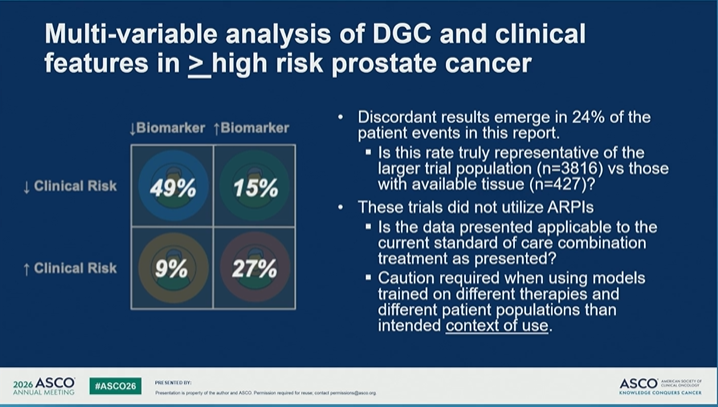
+3 more figures

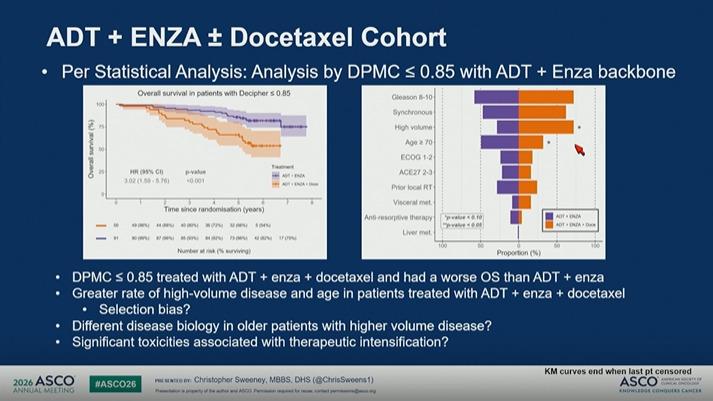

11 details
Discussant / education session at ASCO 2026 (Joshua Lang, MD, MS), reviewing biomarker evidence across GU practice rather than reporting a new trial. Slides cover the 2026 treatment landscape, a Decipher-vs-clinical-risk multivariable analysis, and the ENZAMET biomarker sub-analysis.
Decipher and clinical risk disagreed in 24% of patient events, with 15% biomarker-high/clinical-low and 9% biomarker-low/clinical-high. In the ENZAMET DPMC ≤0.85 group, ADT + enza + docetaxel showed worse OS than ADT + enza; no hazard ratio is legible in the source OCR.
The discussant's own caveats are the substance: tissue was available for 427 of 3816 pts, the source trials did not use ARPIs, and the ENZAMET docetaxel comparison was not randomised (docetaxel added by protocol amendment after 88 pts accrued). The worse-OS signal is confounded by more high-volume disease and older age in the docetaxel group.
The unifying claim is that a classifier's context of use is part of its validity: a model trained on pre-ARPI therapy and on the minority of pts with banked tissue should not be read as calibrated to today's ADT + ARPI backbone. Genomics is framed as distinct from germline genetics, with HRR and tumor-suppressor tissue panels held as current SOC.
- Do pre-ARPI-trained genomic classifiers stay calibrated on ADT+ARPI backbones?
- Does tissue-availability dropout bias biomarker cohort conclusions?
📚 Sources · 🐦 1 tweet
#ASCO26 GU Oncology Spotlight 🚨
— Dra. María Natalia Gandur Quiroga (@nataliagandur) May 30, 2026
🔬 Precision Oncology: How to Apply New Biomarkers in Clinical Practice
Excellent discussion by Joshua M. Lang, MD, MS@JoshLangMD@OncoAlert@ASCO
This session captured the real challenge of precision oncology in GU cancers:
A biomarker is only… pic.twitter.com/ubfk49XPiM
ENZAMET + Decipher
FormHSPC on ADT + enzalutamide, Decipher score available
TL;DRDecipher >0.85 predicts docetaxel benefit in mHSPC on ADT+enza: HR(OS) 0.75 (0.43-1.33) vs 1.94 (0.95-3.96) if ≤0.85, interaction p=0.04.
In mHSPC starting ADT + enzalutamide with a Decipher score available, this offers hypothesis-level support for weighing docetaxel intensification above the 0.85 cut and for questioning it below; it does not extend to patients on other ARSIs or to those without genomic testing. The longer read
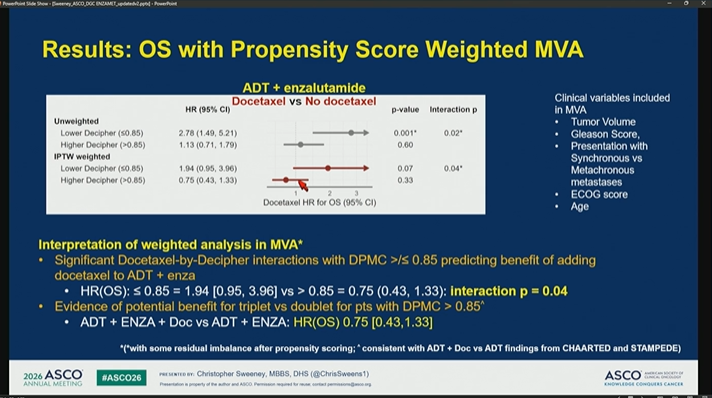
| Analysis | Lower Decipher (≤0.85) | Higher Decipher (>0.85) | Interaction p |
|---|---|---|---|
| Unweighted HR (95% CI) | 2.78 (1.49, 5.21) | 1.13 (0.71, 1.79) | 0.02 |
| Unweighted p-value | 0.001 | 0.60 | |
| IPTW weighted HR (95% CI) | 1.94 (0.95, 3.96) | 0.75 (0.43, 1.33) | 0.04 |
| IPTW weighted p-value | 0.07 | 0.33 |
+2 more figures


8 details
Post-hoc genomic-classifier analysis of the ENZAMET ADT + enzalutamide cohort, N=320, testing whether Decipher (DPMC) predicts docetaxel benefit. Docetaxel receipt was investigator-elected, not randomised, so a propensity-score IPTW model carries the comparison.
mHSPC on an ADT + enzalutamide backbone with an evaluable Decipher score, split at the prespecified 0.85 cut. A separate panel restricts to low-volume disease.
Overall survival, read two ways: prognostic (Decipher stratum on ADT + enza) and predictive (docetaxel-by-Decipher interaction).
Prognostic signal is the cleanest number on the slide deck: HR 3.02 (1.50-5.76) for DPMC >0.85 on ADT + enza. The predictive claim rests on the interaction, p=0.02 unweighted and p=0.04 after IPTW, not on either stratum reaching significance.
Docetaxel was not randomised within this cohort, so IPTW is doing the causal work and the authors concede residual imbalance after propensity scoring. Low-volume panel numbers are small (n at risk 14 and 13 in the reported strata) with a CI of 1.70 (0.32, 8.06), wide enough to be uninformative.
Presented as level 1B evidence consistent with CHAARTED and STAMPEDE, where docetaxel benefit concentrated in high-volume disease. This analysis proposes a genomic rather than volumetric selector for the same decision.
The strongest defensible claim is the prognostic one: DPMC >0.85 marks worse OS on ADT + enza. The predictive claim (add docetaxel above 0.85, omit it below) is directionally consistent across unweighted and weighted models but is not established by a single non-randomised interaction.
Post-hoc biomarker subgroup with non-randomised docetaxel use; both stratum HRs non-significant after weighting, residual imbalance conceded. Read rests on an interaction p=0.04.
- Prospective validation of Decipher-guided docetaxel selection in mHSPC
- Does the 0.85 cut hold on ARSI backbones other than enzalutamide
- Whether low Decipher predicts docetaxel harm or only absent benefit
📚 Sources · 🐦 1 tweet
#ASCO26 GU Oncology Spotlight 🚨
— Dra. María Natalia Gandur Quiroga (@nataliagandur) May 30, 2026
🔬 ENZAMET + Decipher | Part 2
Can genomics guide docetaxel intensification in mHSPC?
Outstanding presentation by @ChrisSweeney1.@OncoAlert@ASCO
After Part 1, the key question was:
➡️ Can a genomic classifier identify which patients with… pic.twitter.com/nJYMxuXelV
ARACOG (AFT-47)
ForAdvanced prostate cancer (mHSPC, nmCRPC, mCRPC) starting an ARSI
daro -15.8 vs enza -36.1
median % change in MCCD at 24 wks, P=0.009
TL;DREnzalutamide MCCD decline -36.1 vs -15.8 for darolutamide at 24wks (P=0.009) in randomized phase 2, N=111.
The comparison is between each pt's own worst-hit domain, and those differed by arm (PALFAM for daro, SWM for enza), so the read is how far the worst domain falls, not which one. Crossover before 24wks was scored at crossover inside the randomized arm, which attenuates rather than widens the gap. Moves ARSI selection when cognitive burden matters, not efficacy.
In a man starting an ARSI for mHSPC or nmCRPC where cognitive burden is a live concern, this supports darolutamide over enzalutamide on measured cognition; it does not speak to disease control, which was never compared head-to-head. The longer read
For ARSI selection where the two drugs are treated as equivalent on disease control, this puts a measured number on the cognitive difference (median MCCD -15.8 vs -36.1, P=0.009) instead of an AE-table impression. It moves drug choice, not sequencing or line of therapy.

| Metric | Darolutamide (N=48) | Enzalutamide (N=47) |
|---|---|---|
| Maximally changed module | PALFAM | SWM |
| Domain | Visual memory / executive function | Working memory / executive function |
| Median change, baseline to 24 wks | -15.8 | -36.1 |
| Between-arm P | P=0.009 | P=0.009 |
+2 more figures


8 details
Randomized open-label phase 2 from the Alliance for Clinical Trials in Oncology, N=111, stratified by age (<65, 65-80, >80). Enrolled 8/17/2021 to 3/11/2025, with CANTAB modules, PROMs and timed-up-and-go collected at 12 and 24 weeks.
Men with mCRPC, nmCRPC or mHSPC. Randomization was stratified by age across three bands (<65, 65-80, >80), so the design anticipated an older population. Baseline cognitive eligibility criteria not reported in source.
Darolutamide was provided by the study; enzalutamide was given through standard of care, so the two arms differed in drug supply as well as drug. Doses and concurrent ADT not reported in source.
Primary: % change from baseline to 24 weeks in the Maximally Changed Cognitive Domain (MCCD), drawn from 5 remotely delivered CANTAB modules (SWM, PALFAM, OTS, SSP, RVP) covering executive function, visual memory, attention and working memory. Blood for polygenic hazard score and AR testing, PROMs and timed-up-and-go were collected alongside.
Median MCCD change -15.8 with darolutamide (PALFAM) vs -36.1 with enzalutamide (SWM), P=0.009, across 48 and 47 pts in the primary analysis. No oncologic endpoint was reported in source.
The two drugs have never been compared head-to-head for efficacy, and cognition in ARAMIS and ARASENS (darolutamide) and PROSPER and ARCHES (enzalutamide) was captured as clinician-graded adverse events against placebo, not measured with a battery. Mild executive dysfunction is exactly the harm an AE table structurally misses.
Pts crossing over before 24 weeks carried their crossover score into the randomized arm, which should attenuate the gap rather than widen it. CANTAB is a research battery, not a clinical diagnostic, and no link to function, falls or discontinuation is reported in source. 24 weeks says little about years of therapy.
This shifts an argument that has run on mechanism and on AE tables onto measured performance. Where the two drugs are treated as interchangeable for disease control, cognition becomes a defensible tiebreaker. What it does not settle is whether an MCCD gap of this size is felt by the pt.
Randomized, prespecified primary endpoint met against a named comparator; open-label design and the composite MCCD construct temper it. Consistent with darolutamide's known limited CNS penetration.
- Whether the MCCD difference translates to function, falls, or discontinuation
- Durability of cognitive divergence beyond 24 weeks
- Whether apalutamide differs from enzalutamide on the same testing
📚 Sources · 🐦 2 tweets
#ASCO26 GU Oncology Spotlight 🚨
— Dra. María Natalia Gandur Quiroga (@nataliagandur) May 30, 2026
🔬 Abstract 5005 | ARACOG / AFT-47
Cognitive effects of darolutamide vs enzalutamide
Presented by Alicia K. Morgans, MD, MPH, FASCO@CaPsurvivorship @OncoAlert@ASCO
In prostate cancer, we often discuss AR pathway inhibitors through the lens… pic.twitter.com/vpZr1w6kc6
ARACOG (AFT-47) met its primary endpoint: enzalutamide caused significantly greater cognitive decline than darolutamide at 24 weeks in advanced prostate cancer.
— Katy Beckermann (@katy_beckermann) May 30, 2026
Randomized open-label phase 2, 111 pts (mHSPC, mCRPC, nmCRPC), DAR vs ENZ.
Cognition was measured with CANTAB, a… pic.twitter.com/kj4vfGRVyp
TALAPRO-3
ForHRR-deficient metastatic hormone-sensitive prostate cancer, enzalutamide/ADT candidates
HR 0.48
95% CI 0.36-0.65, P<0.001; 3yr rPFS 77% vs 56%
TL;DR3yr rPFS 77% vs 56%, stratified HR 0.48 (0.36-0.65), p<0.001, adding talazoparib to enzalutamide in HRR-deficient mCSPC.
In HRR-deficient metastatic prostate cancer starting enzalutamide plus ADT, this supports considering talazoparib upfront rather than reserving it, including for non-BRCA HRR alterations; it does not speak to HRR-proficient disease, which the trial excluded. The longer read

| Panel | Arm | Events/N | Median rPFS (95% CI), mo | HR (95% CI) |
|---|---|---|---|---|
| A ITT | Talazoparib+enzalutamide | 67/300 | NC (NC-NC) | 0.48 (0.36-0.65), P<0.001 |
| A ITT | Placebo+enzalutamide | 126/299 | 45.8 (37.7-NC) | |
| B BRCA | Talazoparib+enzalutamide | 22/104 | NC (NC-NC) | 0.37 (0.22-0.61) |
| B BRCA | Placebo+enzalutamide | 49/103 | 35.1 (18.6-NC) | |
| C Non-BRCA | Placebo+enzalutamide | 77/196 | NC (40.5-NC) | 0.57 (0.39-0.82) |
8 details 4 trials watching
Randomised, placebo-controlled phase 3 of talazoparib plus enzalutamide vs placebo plus enzalutamide, with ADT in both arms. ITT N=599 (300 vs 299), analysed as ITT with prespecified BRCA and non-BRCA subgroups.
HRR-deficient metastatic prostate cancer; the BRCA subgroup was 104 vs 103 and non-BRCA 196 vs 196, so BRCA carried roughly a third of the trial. Detailed eligibility and stratification factors are not reported in source.
Talazoparib added to an enzalutamide/ADT backbone that both arms received, so the comparison isolates the PARP inhibitor's contribution rather than the androgen-signaling backbone. Doses not reported in source.
Primary: imaging-based rPFS. Overall survival, safety and response endpoints are not reported in the source tweet or figure.
Landmark 3yr rPFS 77% vs 56%; median rPFS not reached in the talazoparib arm against 45.8 mo on placebo. Effect held in both molecular subgroups, numerically larger in BRCA (HR 0.37) than non-BRCA (HR 0.57).
| Population | Events/N talazoparib | Events/N placebo | Median placebo arm | HR (95% CI) |
|---|---|---|---|---|
| ITT | 67/300 | 126/299 | 45.8 (37.7-NC) | 0.48 (0.36-0.65) stratified |
| BRCA | 22/104 | 49/103 | 35.1 (18.6-NC) | 0.37 (0.22-0.61) unstratified |
| Non-BRCA | 45/196 | 77/196 | NC (40.5-NC) | 0.57 (0.39-0.82) unstratified |
TALAPRO-2 tested the same combination in first-line mCRPC across all comers; here the population is HRR-selected and the HR is numerically stronger. PROpel and MAGNITUDE established the PARP-plus-ARSI question in mCRPC, with MAGNITUDE's benefit confined to HRR-altered pts, which is the population this trial enrolled outright.
The talazoparib arm's median rPFS is NC (NC-NC) in both ITT and BRCA panels, so the absolute duration of benefit is unmeasured and the curves may still converge. No OS signal is available in source, and toxicity of the doublet (the practical cost of adding a PARP inhibitor to lifelong ARSI) is entirely absent from what was published in the thread.
The non-BRCA HR of 0.57 is the number that decides how wide this goes: if it holds, the case extends past BRCA to the broader HRR panel rather than collapsing to a BRCA-only result as earlier PARP trials did. What it does not settle is whether an rPFS gain of this size converts to survival, or whether the same result would follow sequential rather than upfront talazoparib.
CONSORT flow
Randomised double-blind phase 3, prespecified 1° rPFS hit with HR 0.48 in a biomarker-defined population, consistent across BRCA and non-BRCA. OS immature.
- Does the rPFS gain convert to overall survival n=1054 · primary completion 2022-10 · TALAPRO-2 mCRPC, mature OS readout of same combon=599 · primary completion 2026-02 · TALAPRO-3 itself; OS is a secondary endpoint
- Upfront combination vs sequential talazoparib after progression recruiting Talazoparib Plus Enzalutamide After Progression to Abiraterone in Metastatic Prostate Cancer: (TEAM PC) Phase 2n=78 · primary completion 2026-01 · talazoparib + enza 1L mCRPC after abiraterone PDrecruiting A Study of Talazoparib With or Without Enzalutamide in People With Prostate Cancer Who Have Previously Received Abiraterone Acetate Phase 2n=126 · primary completion 2029-03 · talazoparib +/- enza post-abiraterone, HRR-mutated
- Toxicity cost of indefinite PARP plus ARSI
📚 Sources · 🐦 1 tweet
JUST In: TALAPRO-3 published in @NEJM
— Toni Choueiri, MD (@DrChoueiri) May 30, 2026
Adding #talazoparib to enzalutamide/ADT
=>3-year rPFS: 77% vs 56% in HRR-deficient metastatic prostate cancer !
Looking forward to full presentation by @neerajaiims who keeps changing SOC, one trial at a time. @ASCO #ASCO26 @OncoAlert pic.twitter.com/nXiPk4DIXg
Clinico-transcriptomic Risk Stratification (Abstract 5000)
ForNCCN high-risk / very-high-risk localized prostate, definitive RT + ADT
TL;DR~¼ of NCCN ≥HR pts carry discordant clinical vs biomarker risk; 22-gene GC independently prognostic for MFS, DM, OS.
The de-escalation cell is where the risk sits: 9% of NCCN ≥HR pts read clinically high but biomarker low, and the framework withholds AAP from them. The 15% running the other way is the easier sell. What moves is whether GC gets ordered at consult, not any planning parameter.
In NCCN high-risk or very-high-risk localized prostate headed for definitive RT + ADT, this supports ordering a 22-gene GC before the abiraterone decision; it does not speak to post-prostatectomy salvage, node-positive, or metastatic disease. The longer read
RT + ADT is fixed in both branches, so nothing here touches dose, target volume, or fractionation; the framework is a consult-time test-order decision. Reclassification runs both ways, 15% clinically lower but biomarker higher and 9% the reverse, on GC bands of 0.6 and 0.85.
Intensification with AAP in localized disease gets a biomarker gate instead of an NCCN label: NCCN class and GC each contribute up to 2 points, and a sum ≥ 3 triggers AAP. GC was tested as prognostic across MFS, DM, and OS; no treatment-by-GC interaction is reported, so predictive value is unestablished.

+3 more figures
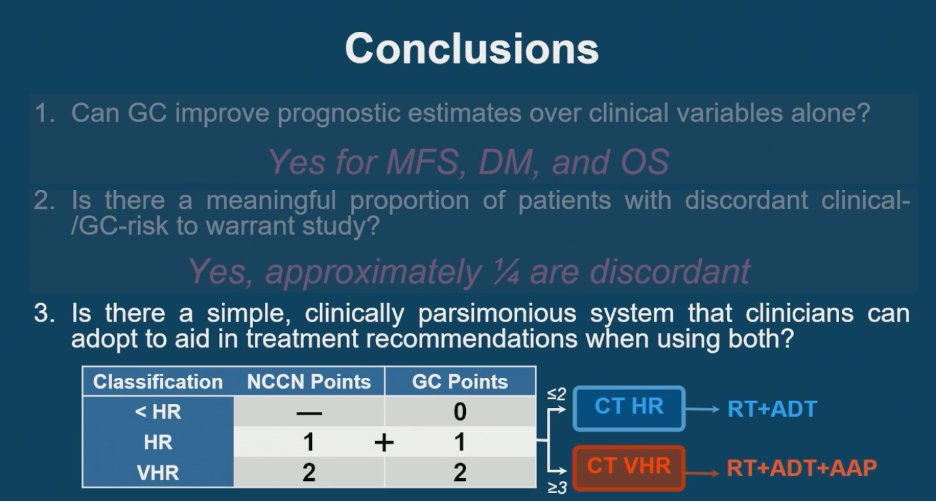

| Clinical risk | ↓ Biomarker | ↑ Biomarker |
|---|---|---|
| ↓ Clinical | 49% | 15% |
| ↑ Clinical | 9% | 27% |

8 details
Clinico-transcriptomic analysis of NRG cohorts modeling the 22-gene GC as a continuous variable (per 0.1 unit) alongside clinical covariates, with treatment carried as a covariate. Contributing trials, N, and follow-up duration are not reported in the source.
NCCN ≥ high-risk localized prostate, spanning NCCN HR and VHR. Baseline age, PSA, and grade distributions are not reported in the source.
Every branch of the framework keeps RT + ADT. No dose, fractionation, target volume, or ADT duration is reported, so RT enters as a fixed backbone rather than a variable under test.
Prognostic performance assessed on MFS, distant metastasis, and OS. No single primary endpoint is stated, and the framework itself is not compared against a randomized alternative.
GC was independently prognostic for all three endpoints (p<0.001); the row-level hazard ratios are not legible in the source slide. Approximately ¼ of the ≥HR population carries discordant clinical vs biomarker risk.
| Score (NCCN + GC) | CT risk | Recommendation |
|---|---|---|
| ≤ 2 points | CT HR | RT + ADT |
| ≥ 3 points | CT VHR | RT + ADT + AAP |
STAMPEDE M0 (Attard, Lancet 2022) is the external yardstick: the CT HR and CT VHR curves are overlaid on that trial's RT + ADT arm rather than on a randomized internal control. Eligibility, staging era, and ADT duration differ between cohorts, so the vertical gap carries trial effects alongside risk-group effects.
The GC term's hazard ratios and confidence intervals are not legible in the source, so the size of the increment over clinical variables cannot be checked. The 9% clinically-high / biomarker-low cell is where the framework withholds intensification, and its outcomes are the ones a reader most needs before acting.
The contribution is a parsimonious integer score computable at the consult desk, extending Spratt et al. (JCO 2018) to the modern VHR population. What it does not settle is whether the signal separating these curves also identifies who benefits from AAP: a prognostic split widens absolute benefit for a uniformly effective drug without any interaction, and none is reported here.
Retrospective pooled analysis; GC shown prognostic, not predictive. Intensification threshold benchmarked against STAMPEDE across trials, not randomized within cohort; no treatment-by-GC interaction in source.
- Does GC predict abiraterone benefit or only prognosis?
- Prospective validation of the ≥3-point intensification threshold
- Whether NCCN VHR pts with GC < 0.6 can omit AAP
📚 Sources · 🐦 2 tweets
#ASCO26 GU Oncology Spotlight 🚨
— Dra. María Natalia Gandur Quiroga (@nataliagandur) May 30, 2026
🔬 Abstract 5000 | High-risk prostate cancer
Clinico-transcriptomic risk stratification to guide abiraterone intensification
Presented by Krishnan R. Patel, MD, MHS@Krishnan_Patel@OncoAlert@ASCO
In high-risk localized prostate cancer,… pic.twitter.com/pZSCiTyGB8
#ASCO26 Dr. Patel presented a clinically practical framework integrating NCCN clinical risk + a 22-gene genomic classifier to guide treatment intensification in high-risk localized prostate cancer.
— Julian Chavarriaga (@chavarriagaj) May 30, 2026
Key findings:
🔹 The genomic classifier independently improved prognostic… pic.twitter.com/fRcdTmfBec
2026-05-22
PEACE V-STORM NCT03569241
ForPelvic nodal oligorecurrence (≤5 PET+ nodes) after radical local prostate tx
4yr 76% vs 63%, HR 0.62
80% CI 0.44-0.86, p=0.063 (α 0.20)
TL;DR4yr MFS 76% vs 63% (HR 0.62, 80% CI 0.44-0.86) favoring whole-pelvis ENRT over MDT for pelvic nodal oligorecurrence, both with 6mo ADT.
The RT signal is regional: 4yr locoregional RFS 85% vs 62% (HR 0.45), consistent with MDT failing mostly in the pelvis. The benefit sat in PSMA-staged pts (HR 0.48) and PSA <1 (HR 0.27), so it moves the choice from nodal SBRT to whole-pelvis 45/25 with 65 Gy SIB. Prostate bed inclusion, not the pelvic field, drove added GI toxicity.
In a man with up to five PET-detected pelvic nodal recurrences below the aortic bifurcation after radical local treatment, this supports whole-pelvis ENRT with nodal SIB over nodal SBRT alone, both with 6 mo ADT; it does not extend to para-aortic, bone, or visceral disease. The longer read
The RT signal is regional: 4yr locoregional RFS 85% vs 62% (HR 0.45), consistent with MDT failing mostly in the pelvis. The benefit sat in PSMA-staged pts (HR 0.48) and PSA <1 (HR 0.27), so it moves the choice from nodal SBRT to whole-pelvis 45/25 with 65 Gy SIB. Prostate bed inclusion, not the pelvic field, drove added GI toxicity.
11 details 2 trials watching
Phase 2, open-label, randomised (1:1) trial at 21 hospitals in Australia, Belgium, Italy, Norway, Spain, Switzerland. Minimisation stratified by PET tracer (choline vs PSMA) and MDT type (sLND vs SBRT/SIB). Median follow-up 50 mo (IQR 42-58).
Biochemical relapse after RP, postoperative RT or definitive RT, with ≤5 PET-detected pelvic nodes up to the aortic bifurcation. Excluded: bone/visceral mets, nodes above the bifurcation, testosterone <50 ng/dL. Median PSA 1.00 vs 0.85 ng/mL; 81% and 83% PSMA-staged.
ENRT: 45 Gy/25 fx whole pelvis + 65 Gy SIB to PET+ nodes, IMRT/VMAT mandatory. MDT: SBRT 30 Gy/3 fx every other day, 3 mm PTV margin, or extended sLND. Prostate bed RT ≥66 Gy/33 fx suggested for high-risk RP features in both arms, with benchmark-case QA.
6 mo LHRH agonist or antagonist in both arms, started no later than the first fraction. ADT was not to be restarted without clinical progression.
Primary: MFS (any M1 on PET or death). Secondary: bRFS, locoregional RFS, ADT-free survival, late G2+ GU/GI toxicity. OS, PCSS and time to castration resistance had too few events to report.
4yr cumulative G2+ GU 28% vs 31% (p=0.73) and GI 7% vs 9% (p=0.93), MDT vs ENRT. One ENRT pt had a recto-urethral fistula needing surgery. No treatment-related deaths.
First randomised comparison of MDT vs ENRT for nodal oligorecurrence. The single-arm GETUG-P07-OLIGOPELVIS reported 3yr bRFS 45% with ENRT, in a higher-PSA, choline-staged cohort. POINTER-PC (phase 3) and GETUG-P12-OLIGOPELVIS 2 are the confirmatory tests.
Prostate bed RT was unevenly used (25% vs 41%) and linked to both local control and GI toxicity, which muddies attribution to the pelvic field. No central PET review, and the PSA and nodal-level subgroups are post hoc.
The MFS gain is mostly prevention of further nodal (M1a) spread, consistent with PSMA PET under-staging microscopic pelvic disease. It does not settle whether the benefit holds at higher PSA or with choline staging, or whether it reaches survival.
| Endpoint | ENRT | MDT | HR (80% CI), p |
|---|---|---|---|
| MFS (1°) | 76% (69-81) | 63% (56-69) | 0.62 (0.44-0.86), p=0.063 |
| bRFS | 57% (50-64) | 41% (34-47) | 0.62 (0.48-0.80), p=0.014 |
| Locoregional RFS | 85% (80-90) | 62% (55-69) | 0.45 (0.31-0.65), p=0.0047 |
| ADT-free survival | 77% (70-82) | 60% (53-67) | 0.60 (0.43-0.83), p=0.049 |
| Subgroup | HR (80% CI) | Interaction p |
|---|---|---|
| PSMA PET | 0.48 (0.32-0.72) | 0.12 |
| Choline PET | 1.21 (0.64-2.28) | 0.12 |
| PSA <1 | 0.27 (0.14-0.52) | 0.029 |
| PSA ≥1 | 1.00 (0.67-1.50) | 0.029 |
| No common iliac node | 0.49 (0.33-0.74) | 0.20 |
| Common iliac node | 1.04 (0.55-1.95) | 0.20 |
| Endpoint | MDT | ENRT | p |
|---|---|---|---|
| 4yr cumulative G2+ GU | 27/97 (28%) | 29/93 (31%) | 0.73 |
| 4yr cumulative G2+ GI | 7/97 (7%) | 8/93 (9%) | 0.93 |
| G3 urinary incontinence | 6 (6%) | 9 (10%) | n/a |
| G3 diarrhoea | 1 (1%) | 2 (2%) | n/a |
CONSORT flow
Randomised phase 2 hit its MFS primary at 50 mo median f/u, but was powered at α 0.20 with 80% CIs; authors call for phase 3 confirmation (POINTER-PC).
- Will phase 3 (POINTER-PC) confirm ENRT over MDT? not yet Best Salvage Treatment for High-risk Relapsing Prostate Cancer (PEACE-9 - ESCALATE-RT) Phase 3n=140 · primary completion 2030-07 · phase 3 MDT ± WPRT in oligorecurrence, ADT + enza
- Is ENRT benefit confined to PSMA-staged, PSA <1 pts?
- Role of prostate bed RT when PSMA PET is locally negative recruiting Comparing "Salvage" Radiotherapy and Individualized PSMA PET/CT Targeted Treatment in With Relapsing Prostate Cancer Phase 3n=450 · primary completion 2027-10 · phase 3 standard SRT vs PSMA-individualized therapy
📚 Sources · 📄 1 paper
2026-05-19 ESTRO Congress 2026
ePLND vs PSMA-PET staging (AUA2026 round-up)
TL;DRAUA2026 round-up: PSMA-PET NPV ~96% may allow PLND omission in intermediate risk; 47.7% of nodal mets sit outside ePLND template.
The RT-relevant number is toxicity sequencing: 19-29% lower limb lymphedema after PLND plus salvage pelvic nodal RT versus 0-9% after pelvic nodal RT alone, with 2-22% genital lymphedema in the combined group. If PSMA-PET is negative and PLND is omitted, later elective or salvage pelvic nodal coverage carries far less lymphedema cost.
In intermediate-risk pts with a PSMA-PET negative for nodal involvement, this supports omitting PLND before planned or possible pelvic nodal RT; it does not settle the high-risk case, where the round-up calls the decision individual. The longer read
Sequencing drives the toxicity: 19-29% lower limb lymphedema after PLND plus salvage pelvic nodal RT versus 0-9% after pelvic nodal RT alone, plus 2-22% genital lymphedema in the combined group. A pt who skips PLND arrives at elective or salvage nodal coverage with a much lower lymphedema burden.
The template itself is the weak point: 47.7% of nodal metastases in a 1253-man PSMA-PET series lay outside ePLND boundaries, and LND carried a 6-10x DVT/PE risk increase in Tyritzis. With a PSMA-PET negative for LNI in intermediate-risk disease, the yield no longer justifies routine dissection.

+3 more figures

| Treatment | Lower limb lymphedema | Genital lymphedema |
|---|---|---|
| RP with PLND | 0-14% | n/a |
| Pelvic node RT | 0-9% | n/a |
| PLND + salvage pelvic node RT | 19-29% | 2-22% |

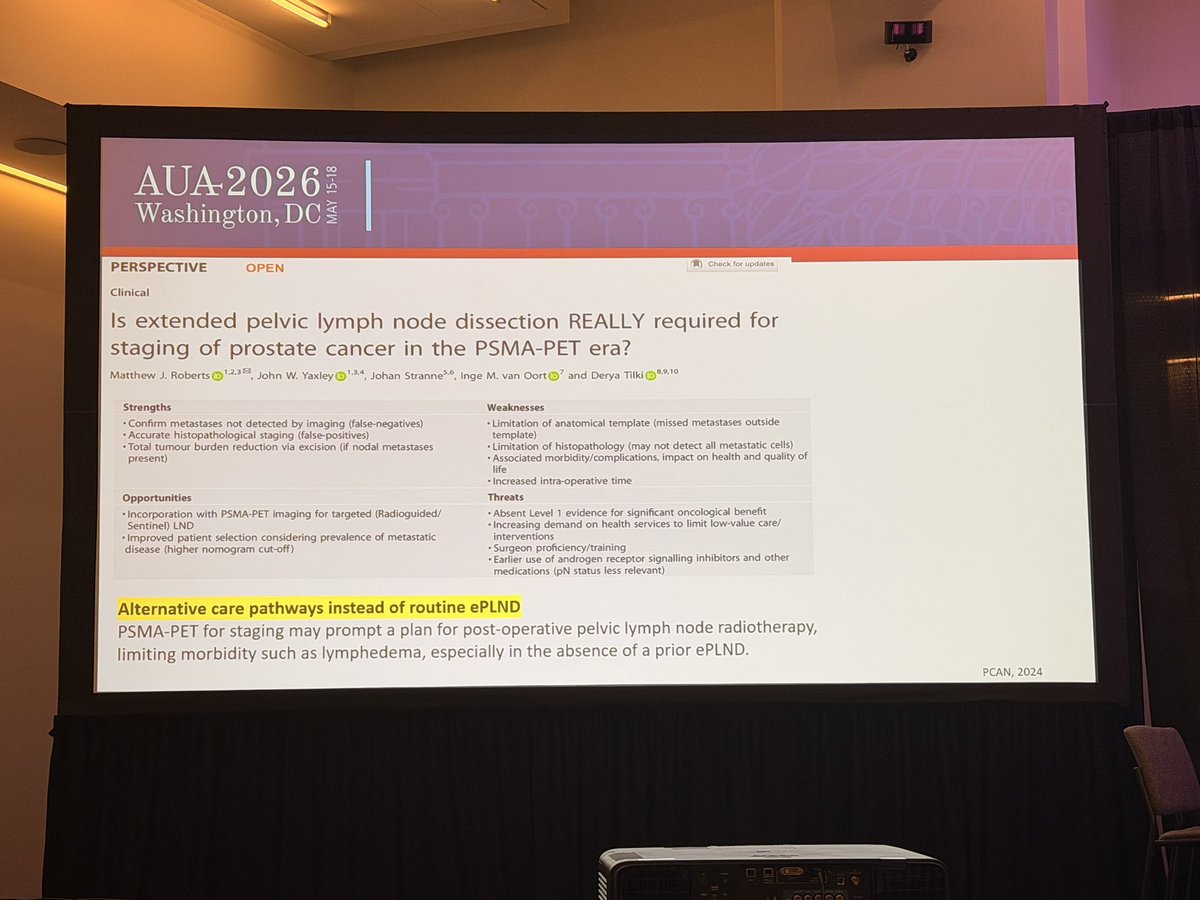
10 details 5 trials watching
AUA 2026 podium round-up of the ePLND question in the PSMA-PET era. Draws on a 1253-man primary staging series (Yaxley, BJUI 2019), a systematic review of lymphedema (Clinckaert, Cancers 2022), a cohort of 3544 pts (Tyritzis, J Urol 2015) and a SWOT perspective (Roberts, PCAN 2024). No new dataset.
Staging yield argues against template adequacy: 47.7% of nodal metastases fell outside ePLND boundaries. PSMA-PET NPV is given as ~96% in the source text without its parent series named.
Lymphedema tracks the combination, not either modality alone: 0-14% after RP with PLND, 0-9% after pelvic nodal RT, 19-29% after PLND plus salvage pelvic nodal RT with 2-22% genital lymphedema. LND also carried a 6-10x DVT/PE risk increase in Tyritzis.
The argument is that a template operation cannot stage what sits outside the template, so its role narrows to pts in whom imaging is likely wrong. The slide's own conclusion keeps high-risk disease individualized rather than resolved, and explicitly asks that the possibility of adjuvant or salvage pelvic RT enter that conversation.
Slide-level source: NPV ~96% has no denominator, cohort or PSMA tracer attached here, and no BCR effect size is reported for the RCTs the round-up invokes. The lymphedema review's authors note the absent uniform definition, so 19-29% is a range across heterogeneous ascertainment, not a pooled estimate.
- Does ePLND improve BCR-free survival in any risk group? recruiting Dutch National Randomized Study: PSMA-PET/CT As a Triage Tool for Pelvic Lymph Node Dissection in Prostatectomy Patients Phase NAn=706 · primary completion 2025-07 · PSMA-PET triage to ePLND, n=706, prognosis endpointrecruiting Extended vs. No Pelvic Lymph Node Dissection During Radical Prostatectomy. DISSECTION 2.0. Phase NAn=400 · primary completion 2027-02 · randomises ePLND vs none in PSMA-negative high riskn=270 · primary completion 2028-02 · RP+ePLND vs RP±SRT, Briganti >=7%
- PSMA-PET NPV by risk group and tracer recruiting Preoperative PSMA PET/CT As Triage for EPLND in Patients Scheduled for RALP (PrePSMA) Phase NAn=600 · primary completion 2029-12 · tests whether PSMA-PET can replace ePLND staging
- Nodal RT after PSMA-PET staging without prior PLND n=250 · primary completion 2031-05 · PSMA-N0M0 randomised to prostate-only vs WPRT
📚 Sources · 🐦 1 tweet
At #AUA2026, the message was clear:⁰📌 ePLND provides staging information, but its therapeutic benefit remains uncertain.⁰📌 RCTs have not shown consistent improvements in BCR outcomes.⁰📌 PSMA PET/CT has a high NPV (~96%) and may safely avoid unnecessary PLND in… pic.twitter.com/7vJFe2hG77
— DR CARVAJAL (@RomanCarvajal) May 17, 2026
2026-05-18 ESTRO Congress 2026
HEAT NCT01794403
ForLocalized low- to intermediate-risk prostate, IPSS <12, gland <80 cc
7% vs 7.4%
p-non-inferiority = 0.007 at 4.25y, margin 12%
TL;DRInterim: BF 7% vs 7.4% at 4.25y, p-non-inferiority 0.007, 5-fx SBRT non-inferior to 26-fx IMRT with ADT allowed.
The design detail that transfers is the SIB: 36.25 Gy/5 fx with GTV boost to 40 Gy, against a 70.2 Gy/26 fx IMRT comparator rather than conventional fractionation, with ≤6 months ADT permitted in both arms. That combination is closer to what most departments now offer than HYPO-RT-PC or PACE-B, so it addresses whether 5 fractions holds up when the control arm is already moderately hypofractionated.
In localized low- to intermediate-risk disease with IPSS <12 and gland under 80 cc, including men receiving short-course ADT, this supports 5-fraction SBRT as an option against moderate hypofractionation; it does not speak to high-risk disease or nodal coverage. The longer read
The transferable parameters are 36.25 Gy/5 fx with GTV SIB to 40 Gy against a 70.2 Gy/26 fx IMRT comparator, with ≤6 months ADT permitted in both arms. Acute G2+ GI favored 5 fractions and late G2+ GI and GU were comparable at median 59.7 months, so this moves the fractionation choice in low- to intermediate-risk disease.
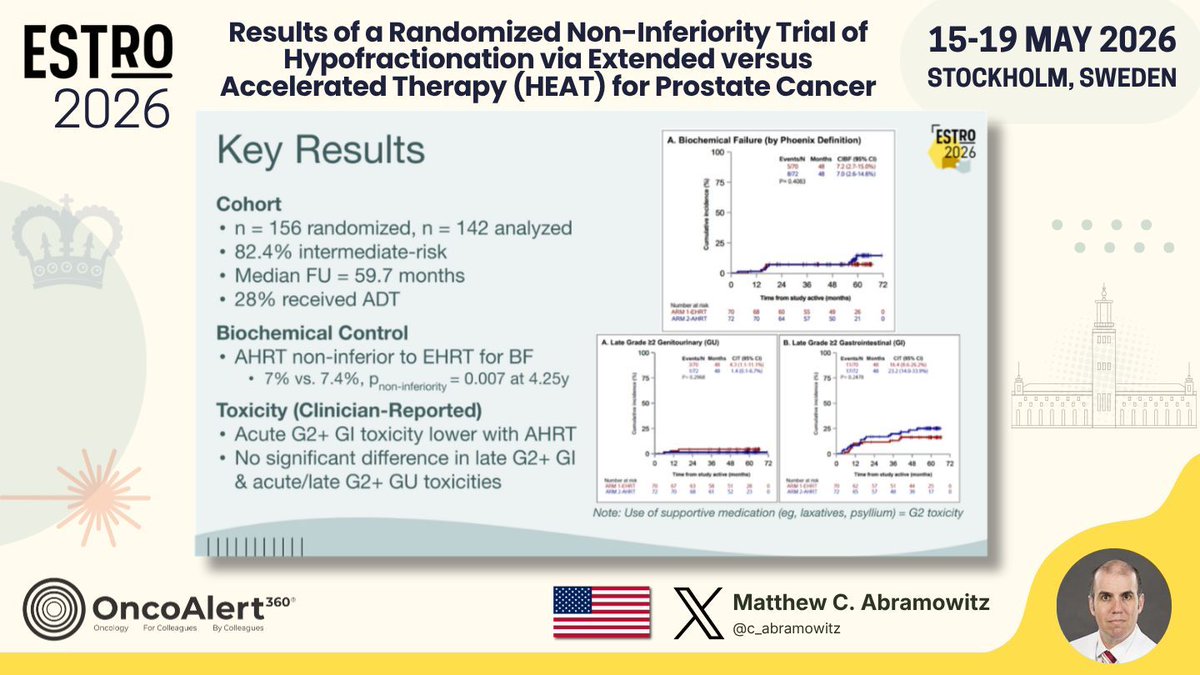
+2 more figures
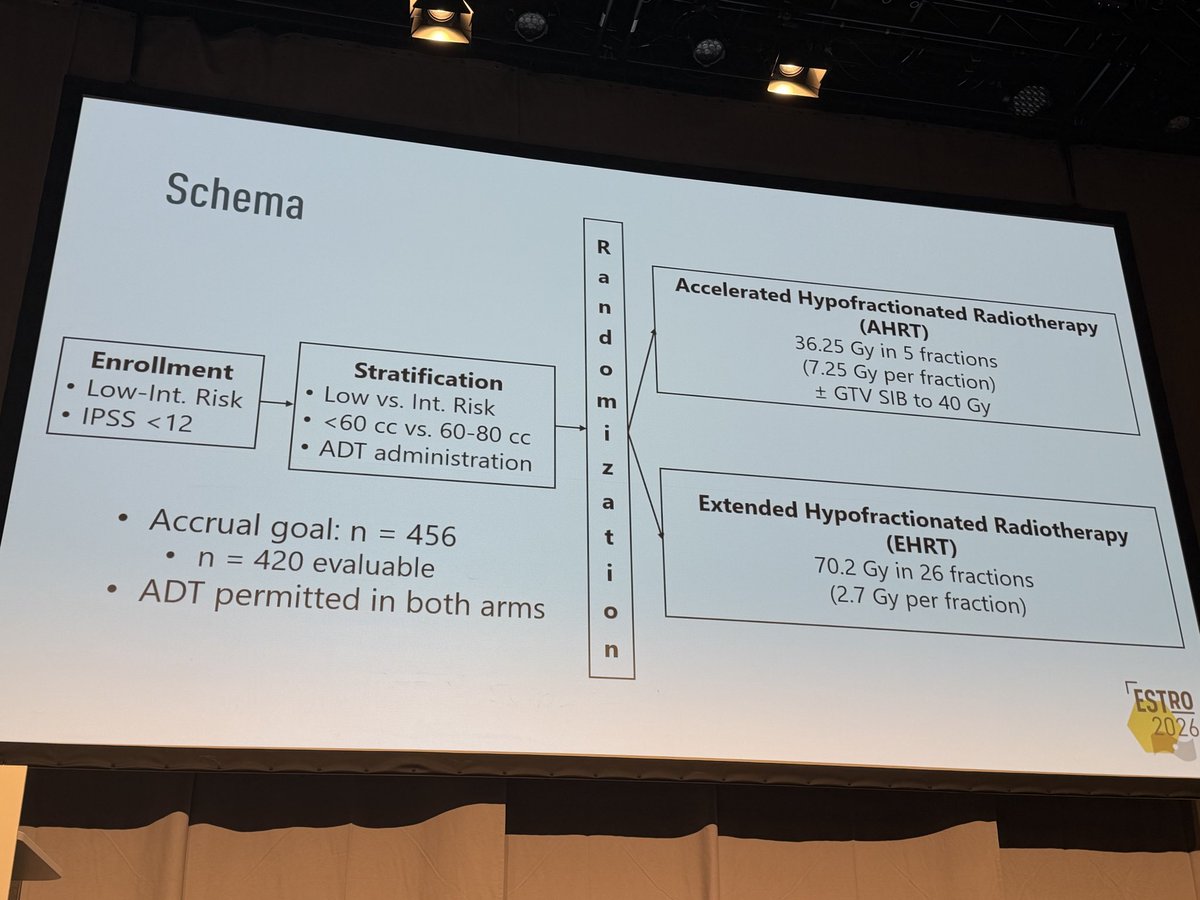
| Arm | Dose | Fractions | Dose per fraction |
|---|---|---|---|
| AHRT | 36.25 Gy (+ GTV SIB to 40 Gy) | 5 | 7.25 Gy |
| EHRT | 70.2 Gy | 26 | 2.7 Gy |
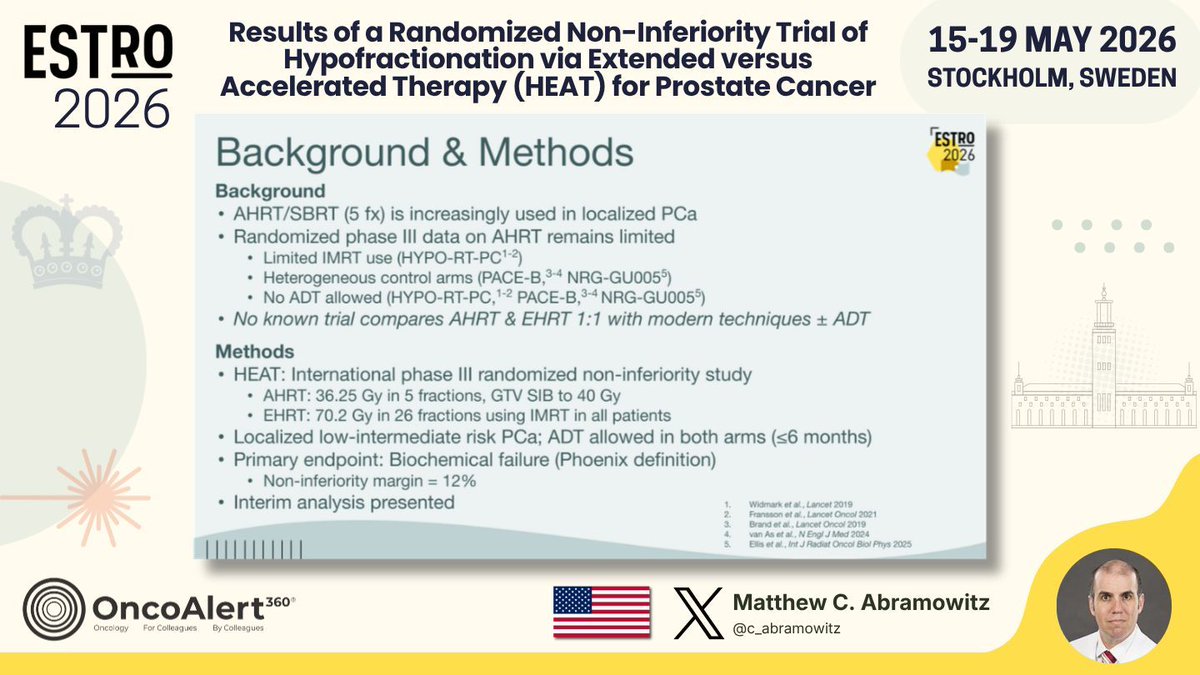
9 details 5 trials watching
International phase III randomized non-inferiority trial, 1:1, comparing accelerated (AHRT) vs extended (EHRT) hypofractionation. Interim analysis presented; accrual goal n = 456 with 420 evaluable, and 142 analyzed so far. Median follow-up 59.7 months.
Localized low- to intermediate-risk prostate cancer with IPSS <12. Stratified by risk group, prostate volume (<60 cc vs 60-80 cc) and ADT administration. 82.4% intermediate-risk; 28% received ADT.
AHRT: 36.25 Gy in 5 fractions (7.25 Gy per fraction) with GTV SIB to 40 Gy. EHRT: 70.2 Gy in 26 fractions (2.7 Gy per fraction), IMRT in all patients. ADT permitted in both arms, ≤6 months.
Primary: biochemical failure, Phoenix definition, with a non-inferiority margin of 12%. Clinician-reported acute and late GI and GU toxicity reported alongside.
BF 7% vs 7.4%, p-non-inferiority = 0.007 at 4.25y, meeting the non-inferiority criterion.
Acute G2+ GI toxicity lower with AHRT. No significant difference in late G2+ GI or in acute or late G2+ GU. Note that use of supportive medication (laxatives, psyllium) was scored as G2.
The presenters position HEAT against HYPO-RT-PC (limited IMRT use), PACE-B and NRG-GU005 (heterogeneous control arms), all of which allowed no ADT. HEAT is framed as the first trial comparing AHRT and EHRT 1:1 with modern technique plus ADT.
Event counts are low (7% vs 7.4%) against a 12% margin, so the interval around the difference is wide relative to the difference being excluded. The comparator is itself hypofractionated, so this does not test 5 fractions against conventional fractionation.
The question HEAT answers is narrower than 'does SBRT work': it asks whether 5 fractions holds when the control arm is already 26 fractions of IMRT and short ADT is on the table. A positive interim read supports 5 fractions as a default offer in this risk band, but the final prespecified analysis is what settles it.
Interim analysis at 142 of a planned 420 evaluable; prespecified final primary analysis is the gate. Wide 12% margin relative to observed event rates.
- Does non-inferiority hold at the final prespecified analysis
- Effect of concurrent ADT on the fractionation comparison n=60 · primary completion 2028-02 · randomises SBRT +/- relugolix in cFIR/cgUIRn=130 · primary completion 2028-11 · adds ultra-short ADT to single-fraction SBRT
- Late GU outcomes beyond 5 years with 7.25 Gy fractions n=100 · primary completion 2027-10 · 36.25 Gy/5 fx, 1-2mm PTV, late urethra toxicityn=175 · primary completion 2028-12 · 3 fx vs 5 fx benchmark, late GU grade 2+ 1° EPrecruiting Erectile Dysfunction in Good Prognosis Prostate Cancer : Comparison Between Brachytherapy and Stereotactic Body Radiotherapy Phase NAn=240 · primary completion 2030-04 · 7.25 Gy x5 vs I-125 brachy, f/u to 2030
📚 Sources · 🐦 2 tweets
Day FOUR of #ESTRO26 Coverage by OncoAlert 🚨
— OncoAlert (@OncoAlert) May 18, 2026
Results of a Randomized Non-Inferiority Trial of Hypofractionation via Extended versus Accelerated Therapy (HEAT) for Prostate Cancer Presented by Matthew C. Abramowitz🇺🇸 #RadOnc ☢️ #ProstateCancer
HEAT is an international phase… pic.twitter.com/IkSTgQHwXK
The HEAT trial is another randomized demonstration of the safety & efficacy of SBRT compared to hypofractionted RT in #prostatecancer at #ESTRO26 pic.twitter.com/c9sNb3KOqo
— Pierre Blanchard, MD (@PBlanchardMD) May 18, 2026
2026-05-17 ESTRO Congress 2026
POP-RT vs PEACE-2
TL;DRWPRT bFFS HR 0.50 (POP-RT) vs bPFS HR 0.97 (PEACE-2); pelvic RT benefit vanishes with 3yr ADT, PSMA staging.
POP-RTPEACE-2
The reversal tracks four coupled changes, and the one an RT reader controls is target volume: with 36 months ADT, 78 Gy EQD2 and PSMA staging, WPRT bought nothing biochemically (HR 0.97, p=0.73) where it halved biochemical failure at 24 months ADT and 74-76 Gy (HR 0.50). This moves elective nodal coverage toward optional in PSMA-staged very-high-risk N0M0 on 3 years of ADT, not in conventionally staged pts.
In very-high-risk N0M0 prostate staged by PSMA PET and planned for 36 months ADT with dose-escalated RT, this questions routine whole-pelvis coverage; it does not extend to conventionally staged pts or shorter ADT, where POP-RT still supports it. The longer read
Target volume is the variable you own here. WPRT halved biochemical failure at 24 months ADT and 74-76 Gy EQD2 (HR 0.50) but returned HR 0.97 (p=0.73) at 36 months ADT, 78 Gy and PSMA staging, with no toxicity penalty either way. Elective nodal coverage becomes conditional on staging and ADT length, not automatic.
ADT duration is the confounder doing the heavy lifting: 24 vs 36 months separates the two trials as much as the RT volume does. If 3 years of ADT is what erases the nodal-RT signal, then shortening ADT for tolerability reopens the case for pelvic coverage, so the systemic and RT decisions cannot be made independently in very-high-risk N0M0.

| Endpoint | POP-RT HR (95% CI), p | PEACE-2 HR (95% CI), p |
|---|---|---|
| bFFS / bPFS | 0.50 (0.42-0.61), p<0.001 | 0.97 (0.81-1.16), p=0.73 |
| cFFS / cPFS | 0.74 (0.61-0.90), p=0.002 | 0.81 (0.63-1.03), p=0.09 |
| MFS | 0.72 (0.58-0.89), p=0.002 | 0.93 (0.74-1.17), p=0.54 |
8 details 4 trials watching
Two independent phase III, open-label, randomized trials of whole-pelvis RT vs prostate-only RT, set side by side in a curator comparison graphic. POP-RT accrued 2011-2016 (median f/u 6.3-7.2 yr, updated); PEACE-2 accrued 2018-2023 and reads out at ~5.5 yr median f/u as an interim analysis (ESTRO 2026).
POP-RT enrolled high / very-high-risk localized N0M0 disease staged by conventional CT and bone scan. PEACE-2 restricted to very-high-risk N0M0 with PSMA PET/CT widely used, so its N0 is a cleaner, node-negative-by-molecular-imaging population.
Both delivered IMRT to whole pelvis plus prostate boost against prostate-only IMRT. Prostate dose was 74-76 Gy EQD2 in POP-RT and 78 Gy EQD2 in PEACE-2, so the control arm in the newer trial is the better-treated prostate.
ADT was a GnRH analog plus antiandrogen in both, but 24 months in POP-RT vs 36 months in PEACE-2. The extra year of systemic control is the single most plausible eraser of a nodal-RT effect.
Primary: bFFS in POP-RT, biochemical PFS in PEACE-2. Secondaries overlap (clinical failure/progression, MFS, OS, toxicity), with PEACE-2 adding CSS. The endpoints are close analogues but not identically defined, which limits how tightly the HRs can be compared.
Both trials reported comparable Grade ≥2 late GU toxicity between arms, with no significant increase in toxicity from WPRT in either. Toxicity is therefore not the lever in this decision; efficacy is.
POP-RT remains the only randomized trial to show a clear elective pelvic RT benefit (bFFS HR 0.50, MFS HR 0.72). PEACE-2's null biochemical result (HR 0.97) at interim is the first randomized read to contradict it, and it does so with a systemic and staging backbone POP-RT never had.
The two trials differ simultaneously in ADT duration, prostate dose, staging modality, risk band and accrual era, so no single factor can be assigned the loss of effect. PEACE-2's read is also interim with shorter follow-up than POP-RT's, and biochemical endpoints mature earliest, so the later endpoints are the least settled.
The graphic's own reading is that longer ADT, modern staging and intensified local therapy may reduce the incremental benefit of elective pelvic RT in very-high-risk disease. That is a hypothesis this comparison cannot test: it settles nothing about which of the four changes did the work, and a reader who shortens ADT while omitting pelvic RT is borrowing from both trials at once.
| Endpoint | POP-RT | PEACE-2 |
|---|---|---|
| Biochemical (bFFS / bPFS) | HR 0.50 (0.42-0.61), p<0.001 | HR 0.97 (0.81-1.16), p=0.73 |
| Clinical (cFFS / cPFS) | HR 0.74 (0.61-0.90), p=0.002 | HR 0.81 (0.63-1.03), p=0.09 |
| MFS | HR 0.72 (0.58-0.89), p=0.002 | HR 0.93 (0.74-1.17), p=0.54 |
- Does PEACE-2's cPFS signal mature into benefit at final analysis?
- Is longer ADT or PSMA staging the reason pelvic RT stopped working? n=250 · primary completion 2031-05 · PSMA-N0M0 randomised to PORT vs prostate+WPRTrecruiting Abi/Pred + ADT vs ADT in PSMA-Positive, Conventionally Node-Negative Prostate Cancer Phase 2n=140 · primary completion 2033-04 · PSMA+ cN0 nodes: ADT vs abi/pred intensification
- Does elective pelvic RT still help pts on shorter ADT? recruiting Phase II Trial of PSA Response-based Androgen Deprivation Therapy and Nodal Coverage for Prostate Cancer Early Salvage Radiotherapy (RANGER) Phase 2n=68 · primary completion 2030-11 · adds pelvic nodal RT + 4mo ADT in PSA nonrespondersn=250 · primary completion 2031-05 · prostate-only vs whole-pelvis RT, high-risk N0
📚 Sources · 🐦 1 tweet
POP RT Vs PEACE II
— Rohit Malde (@roxboxfix) May 18, 2026
2 years ADT + WPRT
Vs 3 years ADT + Prostate Only RT
Tough to choose or you already have a choice ?? pic.twitter.com/42kdSKQYKW
PRIME NCT03561961
ForHigh-risk, very high-risk or node-positive non-metastatic prostate; ECOG 0-2
TL;DRInterim: acute grade ≥2 GU ~5.4% vs ~4.0% (p=0.59) for 5-fx SBRT vs 25-fx, both with whole-pelvis RT; BFFS immature.
The transferable parameter is the nodal dose: 25 Gy in 5 fractions to elective pelvis in both arms, with SIB to involved nodes permitted only in the SBRT arm. Late grade ≥2 GU ran ~10-12% vs ~9-11% at 1-2 yr, so the 5-fraction schedule carried no toxicity penalty over 25 fractions in a node-covered field.
In high-risk or node-positive non-metastatic prostate cancer where whole-pelvis RT and ~2 years of ADT are already planned, this supports 5-fraction delivery on toxicity grounds; it does not yet inform biochemical control, and does not extend to pts treated to prostate alone. The longer read
The gate is the elective nodal dose: 25 Gy in 5 fractions to whole pelvis in both arms, SIB to involved nodes only in the SBRT arm. Grade 3+ GU/GI stayed <1% either way, so the decision this moves is whether pelvic coverage can be compressed to 5 fractions, not whether it controls nodes.

+1 more figure

| Feature | HYPO-RT-PC | PRIME |
|---|---|---|
| Fractionation | 42.7 Gy/7 fx vs 78 Gy/39 fx | 36.25 Gy/5 fx vs 68 Gy/25 fx |
| Pelvic RT | None (prostate + SV) | Whole pelvis, 25 Gy/5 fx, both arms |
| ADT | Not permitted | Long course (~2 years), both arms |
| Nodal status | Node-negative only | Includes node-positive |
| Primary result | 10-yr FFS 72% vs 65%, adj HR 0.84 (95% CI 0.69-1.03) | BFFS not yet mature |
9 details 3 trials watching
Phase III, open-label, randomized non-inferiority trial from Tata Memorial Centre and collaborating Indian centres. Accrual 2018 to 2023, completed at ~434 pts, 1:1, stratified by risk group and nodal status. Interim analysis with follow-up of 1 to 2 years.
High-risk, very high-risk and/or node-positive non-metastatic prostate cancer, ECOG 0-2, life expectancy 10 years. PSMA PET/CT staging was permitted, so nodal staging is not uniform across the cohort.
Arm A 36.25 Gy in 5 fractions (7.25 Gy/fx), every other day. Arm B ~68 Gy in 25 fractions (2.7 Gy/fx) over ~5 weeks. Both arms received whole-pelvis elective nodal RT at 25 Gy in 5 fractions or equivalent, with SIB to positive nodes allowed in the SBRT arm; delivery was modern IMRT/VMAT with daily IGRT.
Long-course ADT (~2 years) in both arms, so the randomised variable is fractionation alone, not systemic intensity.
Primary: biochemical failure-free survival (Phoenix, nadir + 2 ng/mL). Secondary: acute and late toxicity (RTOG/CTCAE v4.0/5.0), OS, MFS, cFFS, QoL (EORTC QLQ-C30, QLQ-PR25, IPSS) and cost-effectiveness.
No BFFS, MFS or OS estimate is reported in the source. The interim efficacy statement is only no signal of inferiority for the SBRT arm, with mature 4 to 5 year data awaited.
| Toxicity | SBRT 5 fx | Mod hypo 25 fx | p |
|---|---|---|---|
| Acute GU (≤90 days) | ~5.4% | ~4.0% | 0.59 |
| Acute GI (≤90 days) | ~2.2% | ~3.7% | 0.20 |
| Late GU (1-2 yr) | ~10-12% | ~9-11% | NS |
| Late GI (1-2 yr) | ~5-7% | ~4-6% | NS |
| Grade 3+ GU/GI | <1% | <1% | not reported |
QoL by EORTC QLQ-C30, QLQ-PR25 and IPSS showed urinary and bowel domains stable and comparable between arms, with transient declines during and soon after treatment then recovery. ADT-related sexual and hormonal effects were similar, as expected with a fixed 2-year backbone in both arms.
HYPO-RT-PC gave level-1 support for ultra-hypofractionation (10-yr FFS 72% vs 65%, adjusted HR 0.84, 95% CI 0.69-1.03), but in node-negative pts with no pelvic RT and no ADT, mostly on 3D-CRT. PRIME asks the fractionation question where the target includes the pelvis and the backbone is 2 years of ADT, so its toxicity read is not inherited from that trial.
Toxicity reaches the reader as approximate values on a third-party summary graphic rather than a published table, and late follow-up of 1 to 2 years is short for the GU and GI events that separate fractionation schedules. Open-label design also leaves the QoL and IPSS readouts unblinded.
If BFFS holds at 4 to 5 years, the practical claim is that elective pelvic coverage can be delivered in 5 fractions instead of 25, compressing a 5-week course to 1 to 2 weeks where linac time rations access. Toxicity is the necessary first gate and it clears; non-inferiority is an efficacy claim and nothing here tests it yet.
Interim toxicity and QoL readout at 1-2 yr; primary BFFS not reported and 4-5 yr efficacy pending. Safety comparability cannot establish non-inferiority of 5-fraction SBRT.
- Adequacy of 25 Gy/5 fx elective nodal dose for microscopic disease recruiting A Trial of 5 Fraction Prostate SBRT Versus 5 Fraction Prostate and Pelvic Nodal SBRT Phase 3n=1128 · primary completion 2028-06 · phase 3, 5-fx prostate vs prostate+pelvic nodal SBRTrecruiting PRO-BOOST-N: Prostate-First Versus Combined Prostate and Nodal Dose Escalation in PSMA PET-Staged Node-Positive Prostate Cancer Phase 2/3n=600 · primary completion 2033-12 · randomises nodal dose escalation over UHF whole-pelvis
- Late GU/GI toxicity beyond 2 years with 5-fraction whole-pelvis RT
- Mature BFFS non-inferiority at 4-5 years recruiting Comparing Moderately Ultra Hypofractionated Radiation Treatments for Prostate Cancer Phase 2n=204 · primary completion 2030-11 · non-inferiority: 25 Gy/5 fx vs 44 Gy/20 fx pelvic nodes
📚 Sources · 🐦 1 tweet
PRIME trial
— Rohit Malde (@roxboxfix) May 18, 2026
Can we safely deliver ultra-short SBRT including pelvic nodal irradiation in biologically aggressive disease treated with ADT?
With Pelvic RT
Moderate hypofractionation:
~68 Gy/25#/5w
Vs
Extreme hypofractionation/SBRT:
36.25 Gy / 5 # /1-2w
Compare HYPO RT PC pic.twitter.com/7NABknLsD5
PIVOTALboost
ForHigh-risk localised prostate, 20-fraction IMRT candidates
TL;DRAdding pelvic nodal IMRT to a focal prostate boost in 20fx raised early bowel toxicity only; 2yr G2+ rates similar across arms.
The 2-year cumulative G2+ rates run in the wrong direction for a toxicity argument against nodal RT: bowel 6.5% (4.5-9.5) and bladder 16.5% (13.1-20.6) in the nodes+boost arm, below both prostate-only arms. Whatever excess bowel toxicity nodal RT causes lives inside 18 weeks. That removes late toxicity as the reason to omit pelvic nodes in 20fx, and leaves the decision resting entirely on the unreported efficacy endpoint.
In high-risk localised prostate planned for 20-fraction IMRT, this supports that adding a focal boost with or without pelvic nodal coverage does not raise 2-year G2+ bowel or bladder toxicity; it says nothing about whether either improves biochemical control. The longer read
At 2 years, the nodes-plus-boost arm sat at 6.5% G2+ bowel (4.5-9.5) and 16.5% bladder (13.1-20.6), below both prostate-only arms, so the excess bowel toxicity from pelvic coverage is confined to the first 18 weeks. In a 20-fraction schedule, late morbidity is no longer the argument for omitting elective nodal RT or a focal boost.

| Arm | Bowel G2+ (95% CI) | Bladder G2+ (95% CI) |
|---|---|---|
| Prostate (n=281) | 8.2% (5.7-11.7) | 19.5% (15.5-24.4) |
| Prostate+Boost (n=345) | 8.7% (6.3-12.1) | 24.1% (20.2-28.7) |
| Prostate+Nodes+Boost (n=347) | 6.5% (4.5-9.5) | 16.5% (13.1-20.6) |
+1 more figure
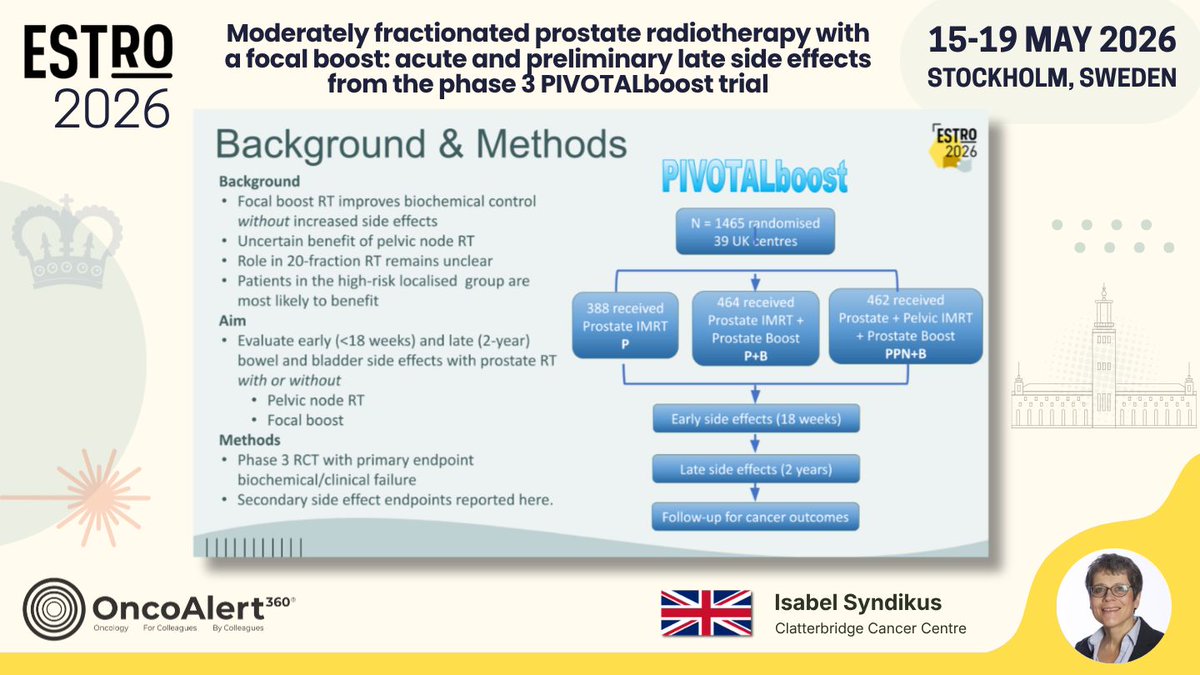
8 details 5 trials watching
Phase 3 RCT, N=1465 randomised at 39 UK centres. Primary endpoint is biochemical/clinical failure; the side-effect endpoints presented here are secondary. Early toxicity assessed to 18 weeks, late toxicity at 2 years.
Localised prostate cancer, with the slides naming the high-risk localised group as most likely to benefit from the interventions under test. Full eligibility criteria not stated in the source.
20-fraction moderately hypofractionated IMRT in all arms. Randomisation is to prostate alone (388), prostate + focal boost (464), or prostate + pelvic nodes + focal boost (462), so the trial separates the boost question from the nodal question. Prescription dose and boost dose level not stated in the source slides.
Primary: biochemical/clinical failure, not reported at this presentation. Secondary (reported here): early bowel and bladder side effects to 18 weeks and late G2+ events at 2 years.
Nodal RT increased early bowel side effects, resolving by 18 weeks. Late cumulative rates were reported for the 973 (74%) patients with at least 2 years' follow-up.
The nodal question in prostate RT is currently split: POP-RT favoured whole-pelvis RT on biochemical failure-free survival while PEACE-2 was null on its nodal comparison, and both used conventional or near-conventional fractionation. PIVOTALboost is the first randomised test of pelvic nodal coverage in a 20-fraction schedule, so its eventual efficacy readout is the one that transfers to how most UK and increasingly non-UK practice actually delivers prostate RT.
The late analysis rests on the 74% with 2 years of follow-up, so a differential drop-out by arm would bias the comparison, and cumulative-incidence estimates at 2 years cannot address the fibrotic and stricture toxicity that appears at 5 to 10 years. The source does not state the grading instrument, and a clinician-graded versus patient-reported difference materially changes the size of a G2+ bowel signal.
A safety readout without its efficacy partner cannot move the nodal decision on its own, but it does close off one of the two arguments against nodal coverage in the hypofractionated era. The remaining argument is whether pelvic nodal RT does anything for disease control, which this trial is powered to answer and has not yet reported.
CONSORT flow
Randomised phase 3, but this is the secondary toxicity readout only; the biochemical/clinical failure primary endpoint is unreported, so it settles safety, not benefit.
- Does pelvic nodal RT improve biochemical/clinical failure at 20 fractions? n=18 · primary completion 2026-08 · 20fx pelvic nodal RT with prostate SIBrecruiting Phase III Adaptive Adaptive Stereostactic Body Radiotherapy (SBRT) With Dose Escalation for High-Risk Prostate Cancer Phase NAn=390 · primary completion 2033-04 · WPRT + DIL boost vs standard RT, high risk
- Does the focal intraprostatic boost add control over prostate IMRT alone? recruiting Image-guided Focal Dose Escalation- Primary pc Treated With Primary External Beam Hypofract.Stereotactic rt Phase NAn=374 · primary completion 2025-08 · arm A focal dose escalation vs arm B IMRTactive Standard Moderately Hypofractionated RT vs. Ultra-hypofractionated Focal Lesion Ablative Microboost in Prostate Cancer Phase NAn=484 · primary completion 2032-01 · Hypo-FLAME microboost vs standard 20fx RTrecruiting Addition of Focal Boost to Primary Radiotherapy for Prostate Cancer in 12 or 20 Fractions Phase NAn=1016 · primary completion 2040-10 · randomises focal boost vs none at 20fx
- Do G2+ rates diverge beyond 2 years as late fibrotic toxicity matures?
📚 Sources · 🐦 1 tweet
Day THREE of #ESTRO26 Coverage by OncoAlert 🚨
— OncoAlert (@OncoAlert) May 17, 2026
Moderately fractionated prostate radiotherapy with a focal boost: acute and preliminary late side effects from the phase 3 PIVOTALboost trial Presented by Isabel Syndikus 🇬🇧 #RadOnc ☢️
In the PIVOTALboost trial, we treated 1314… pic.twitter.com/cGuR1j2Qos
PACE-NODES
ForHigh-risk localised prostate (T3a-T4, Gleason 8-10, or PSA>20), on 12-36mo ADT
28% vs 21%
PPN-SBRT vs P-SBRT; no effect size or p-value reported in source
TL;DRCTCAE G2+ GI toxicity 28% vs 21% with added pelvic nodal SBRT; no GU difference, symptoms resolved by 12wk.
Nodal SBRT at 25Gy/5f costs 7 points of acute G2+ GI (28% vs 21%) and nothing in GU, with the EPIC-26 bowel signal at 4 weeks resolving by 12. That makes acute tolerability a weak argument against 5f elective nodal coverage; the decision now waits on late effects and the immature failure endpoint.
In high-risk localised prostate already planned for 5f prostate SBRT plus 12-36mo ADT, this supports the feasibility of extending to pelvic nodes without a GU penalty; it says nothing yet about whether nodal coverage improves control. The longer read
The cost of adding 25Gy/5f to the pelvis is 7 points of acute G2+ GI (28% vs 21%), transient by 12 weeks, with no GU penalty. The gating practical fact is deliverability: 11% of PPN-SBRT patients never received allocation on unmet constraints.

| Endpoint | PPN-SBRT | P-SBRT |
|---|---|---|
| CTCAE G2+ GI, 12wk | 28% | 21% |
| Did not receive allocation | 11% | 4% |
+1 more figure
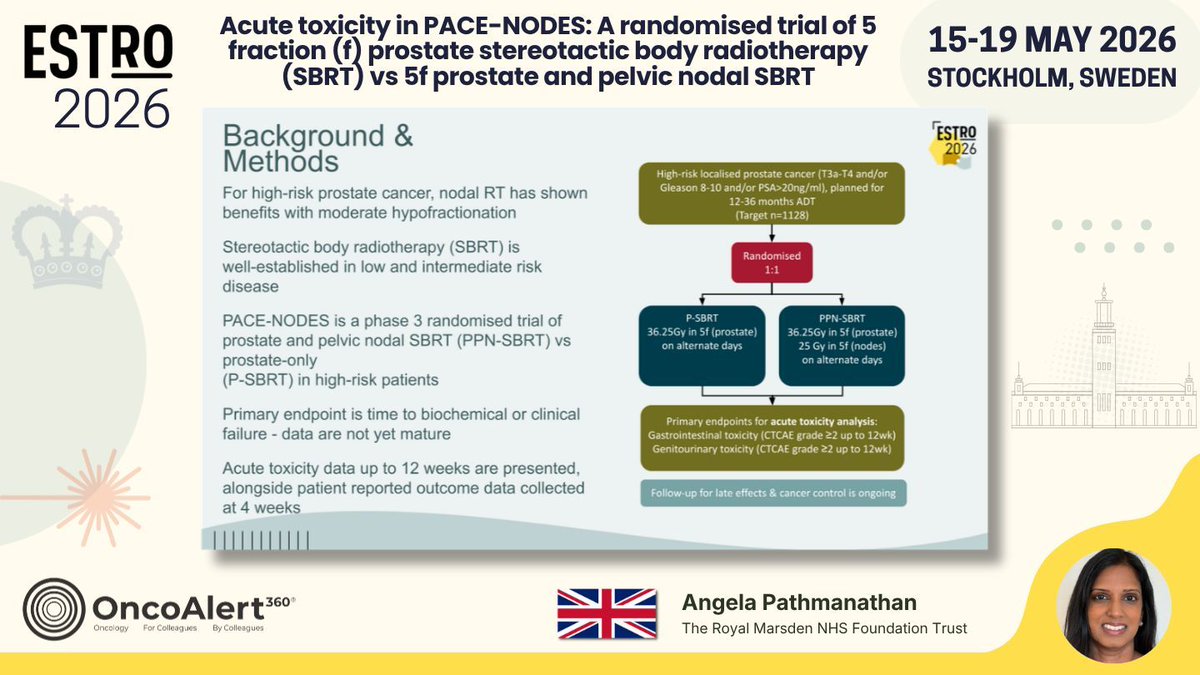
10 details 3 trials watching
Phase 3 randomised 1:1 multicentre trial, target n=1128, 1166 randomised. This presentation reports the acute toxicity analysis only; the efficacy primary is time to biochemical or clinical failure and is not yet mature.
High-risk localised prostate cancer: T3a-T4 and/or Gleason 8-10 and/or PSA>20ng/ml, all planned for 12-36 months ADT.
Both arms 36.25Gy in 5 fractions to the prostate on alternate days. PPN-SBRT adds 25Gy in 5 fractions to the pelvic nodes; P-SBRT is prostate-only.
Primary for this analysis: CTCAE grade ≥2 GI and grade ≥2 GU toxicity up to 12 weeks. Patient-reported EPIC-26 domain scores collected at 4 weeks.
GI was the only separating domain; GU did not differ by clinician or patient report, and the GI gap had closed by 12 weeks.
11% of PPN-SBRT and 4% of P-SBRT patients did not receive their allocated treatment, mostly because planning constraints were not met, which is itself a deliverability signal for 5f nodal treatment.
Patient-reported outcomes were captured at 4 weeks only, so the 12-week convergence rests on clinician CTCAE grading. No effect size, confidence interval or p-value for the GI difference appears in the source, and late GI toxicity is the endpoint that historically decides elective nodal coverage.
The trial's answer so far is about deliverability rather than benefit: 5f nodal SBRT can be given across multiple centres at an acute cost confined to transient bowel symptoms. Whether that cost is worth paying depends entirely on the failure endpoint still to read out.
Acute-toxicity readout only; the efficacy primary (time to biochemical or clinical failure) is immature, so the nodal-coverage question stays open.
- Late GI toxicity beyond the 12-week acute window n=100 · primary completion 2027-10 · 1-2mm PTV margins to cut late rectal toxicityn=500 · primary completion 2027-12 · late GI toxicity as primary endpoint after prostate SBRT
- Whether 5f nodal SBRT improves biochemical or clinical failure recruiting PRO-BOOST-N: Prostate-First Versus Combined Prostate and Nodal Dose Escalation in PSMA PET-Staged Node-Positive Prostate Cancer Phase 2/3n=600 · primary completion 2033-12 · randomises nodal dose in cN1 ultrahypofx pelvic RT
- Which anatomy or constraints drove the 11% non-delivery rate
📚 Sources · 🐦 1 tweet
Day THREE of #ESTRO26 Coverage by OncoAlert 🚨
— OncoAlert (@OncoAlert) May 17, 2026
Acute toxicity in PACE-NODES: A randomised trial of 5 fraction (f) prostate stereotactic body radiotherapy (SBRT) vs 5f prostate and pelvic nodal SBRT
Presented by Angela Pathmanathan 🇬🇧 #RadOnc ☢️ #ProstateCancer
PACE-NODES is a… pic.twitter.com/z9bAOiKSIy
PEACE-2
ForVery-high-risk localized prostate, N0M0, ≥2 of Gleason ≥8 / T3-T4 / PSA ≥20
HR 0.81
95% CI 0.63-1.03, p=0.088, primary endpoint not met
TL;DRcPFS HR 0.81 (0.63-1.03), p=0.088: pelvic RT over prostate-only missed its primary endpoint in very-high-risk N0M0.
The target-volume decision is the whole trial: ADT × 3 years and the systemic backbone were fixed, so the 4.2-point 7yr cPFS gap (67.1% vs 62.9%, p=0.088) is what elective pelvic coverage buys in conventionally-staged N0M0 disease. No dose or fractionation appears in the source slides, and staging used conventional imaging or choline PET, not PSMA.
In very-high-risk localized prostate cancer staged N0M0 on conventional imaging or choline PET, this questions routine elective pelvic nodal coverage added to 3 years of ADT; it does not address PSMA-staged or node-positive disease. The longer read
Target volume is the randomized variable with the systemic backbone fixed, so the 7yr cPFS gap of 67.1% vs 62.9% (HR 0.81, p=0.088) is the entire return on elective pelvic coverage in conventionally-staged N0M0. Dose and fractionation are absent from source, blocking a technique-level transfer.
ADT × 3 years ran in every arm and cabazitaxel × 4 cycles was the second randomization, so nothing here moves systemic choice. The relevant read is prognostic: fewer than 1 in 10 men died of prostate cancer in a decade, which questions intensification in this clinicopathologically-defined very-high-risk group.

| Arm | 7yr cPFS | HR (95% CI) | p |
|---|---|---|---|
| Pelvic RT | 67.1% [61.6; 72.2] | 0.81 [0.63; 1.03] | 0.088 |
| Prostate only RT | 62.9% [57.4; 68.1] | n/a | n/a |
+2 more figures


9 details 5 trials watching
International multicenter randomized trial with four arms crossing two questions: RT target volume (prostate only vs pelvis) and cabazitaxel × 4 cycles vs none. Primary: cPFS. The target-volume comparison reads out at 7 years.
Very-high-risk localized prostate cancer defined as ≥2 risk factors among Gleason ≥8, T3-T4, and PSA ≥20 ng/mL. N0M0 by conventional imaging or choline PET/CT.
Androgen deprivation therapy × 3 years in every arm, with cabazitaxel × 4 cycles as the second randomization. The systemic backbone is held constant across the target-volume comparison.
The randomized variable is target volume alone: prostate-only RT versus pelvic RT. Dose, fractionation, and nodal CTV definition are not reported in the source slides.
Primary: cPFS. Secondary: PSA response at 3 months, bPFS, metastasis-free survival, prostate-cancer-specific survival, OS, acute and long-term tolerance, QoL, and biopsy biomarkers.
cPFS HR 0.81 (0.63-1.03), p=0.088 on multivariable analysis, so the primary endpoint was not met. 7yr cPFS 67.1% pelvic versus 62.9% prostate-only. Toxicity and secondary endpoints are not reported in these slides.
POP-RT, a single-center randomized trial of roughly 224 men, reported a whole-pelvis benefit that made elective nodal coverage common practice in high-risk disease. PEACE-2 is larger and multicenter and does not reproduce a comparable signal on its own primary endpoint.
Staging predates routine PSMA PET, so occult nodal disease sits in both arms and dilutes a target-volume comparison. The RT dose, fractionation, and pelvic CTV definition are absent from the source, which blocks a transfer judgment to any specific technique.
The plenary's own conclusion turned on prognosis rather than the RT question: with fewer than 1 in 10 men dying of prostate cancer in the first decade, the "very high-risk" definition itself is what the investigators challenged. A cohort with that little cancer-specific mortality has little room for a target-volume difference to show up in cPFS.
CONSORT flow
Randomized, prespecified cPFS primary, adequate accrual (380 vs 381) and 7yr readout. Negative result contests routine elective pelvic coverage in N0M0 very-high-risk disease.
- Does PSMA PET staging identify a subgroup where pelvic RT helps n=250 · primary completion 2031-05 · PSMA-N0M0 high-risk randomised to PORT vs whole-pelvis RTrecruiting PRO-BOOST-N: Prostate-First Versus Combined Prostate and Nodal Dose Escalation in PSMA PET-Staged Node-Positive Prostate Cancer Phase 2/3n=600 · primary completion 2033-12 · PSMA PET-staged cN1M0: nodal dose escalation vs…
- Biomarkers to guide intensification vs de-intensification in very-high-risk disease
- Pelvic RT toxicity and QoL tradeoff not reported in source n=700 · primary completion 2021-12 · longitudinal GI/heme/GU toxicity + HRQoL after WPRTactive Hypofractionated Whole-Pelvis Radiotherapy (WPRT) vs Conventionally-Fractionated WPRT in Prostate Cancer Phase 2n=58 · primary completion 2026-09 · QoL of 5-fraction vs 25-fraction WPRTn=400 · primary completion 2027-03 · late GI toxicity, protons vs photons, whole-pelvis RT
📚 Sources · 🐦 1 tweet
📣@PBlanchardMD shows #ESTRO26 that pelvic #radiotherapy in high risk #prostatecancer does not have a large improve in outcomes.
— Shankar Siva (@_ShankarSiva) May 17, 2026
- With only 1 in 10 dying of prostate cancer in 10 years, are these patients truly “high risk”? #pcsm #radonc pic.twitter.com/D0XrGD6iNX