Bladder
2026-09-21
ASTRO Clinical Practice Guideline: RT for Bladder Cancer
ForBladder cancer, high-grade cT1 NMIBC through metastatic disease
TL;DRTMT recommended (strong, high QoE) as alternative to RC for select cT2-4aN0M0 MIBC; bladder-alone 5500 cGy/20 fx or 6400-6480 cGy/32-36 fx.
Elective pelvic nodes stay conditional: no validated RCT vs bladder-only RT, and bladder-only series show ~7% pelvic nodal recurrence. Prostate and proximal urethra are conditionally added for base/neck, T4 or prostatic urethral involvement. Investigational concurrent IO warrants caution with moderately hypofractionated whole-pelvis chemoRT or >400 cGy/fx.
In select cT2-4aN0M0 MIBC (solitary, <7 cm, no extensive CIS or hydronephrosis), this supports TMT with concurrent chemo as an alternative to RC; it gives only conditional, expert-opinion support to consolidative local therapy in cN2-3M0 disease after systemic response. The longer read
Elective pelvic nodes stay conditional: no validated RCT vs bladder-only RT, and bladder-only series show ~7% pelvic nodal recurrence. Prostate and proximal urethra are conditionally added for base/neck, T4 or prostatic urethral involvement. Investigational concurrent IO warrants caution with moderately hypofractionated whole-pelvis chemoRT or >400 cGy/fx.
Concurrent chemo is the preferred radiosensitizer (cisplatin ± 5-FU, 5-FU + mitomycin-C, low-dose gemcitabine), with neoadjuvant/induction systemic therapy for cT3-4 or N1-3 disease graded strong on low QoE. Perioperative chemo-IO and ADC-IO have no comparative TMT data, and concurrent checkpoint inhibitors stay investigational pending SWOG/NRG 1806.
TMT is graded a strong, high-QoE alternative to RC for select cT2-4aN0M0 MIBC, and for cN1M0 after neoadjuvant therapy TMT and RC sit side by side. A maximal, not necessarily visibly complete, TURBT precedes chemoRT, and MIBC relapse after TMT goes to salvage RC.
8 details 3 trials watching
Clinical practice guideline, not a trial. Systematic review of Ovid MEDLINE and Embase, January 2009 to November 18, 2024, yielding 153 studies; retrospective series limited to ≥65 pts (KQ1) and ≥100 pts (KQ2). Consensus by modified Delphi, threshold ≥75% agreement (≥90% for expert-opinion recs).
Adults (≥18 years) with bladder cancer treated with RT, across 4 KQs: bladder preservation, intact-bladder technique and dose, postoperative RT, noncurative RT. Out of scope: surgical management of MIBC, systemic-therapy specifics, intravesical therapy.
Preferred concurrent radiosensitizers: cisplatin ± 5-FU, 5-FU + mitomycin-C, or low-dose gemcitabine; carbogen and nicotinamide an alternative. Capecitabine ± mitomycin-C or single-agent 5-FU for pts ineligible for those agents.
Simulation and daily treatment supine with empty bladder and rectum; fiducials help delineate a tumor boost. 2 to 4 weeks from maximal TURBT to RT is typical, and post-TMT cystoscopy with biopsy follows at 8 to 12 weeks.
Caution, not absolute contraindication, for active inflammatory bowel disease, prior pelvic RT, or severely reduced bladder capacity. Elective nodal coverage is weighed against bowel toxicity.
Prior RTOG and NRG studies put the prostate in the field under 3-D CRT; the guideline narrows that to base/neck, T4 or prostatic urethral involvement. SWOG/NRG 1806 allowed bladder-only or bladder plus pelvic nodes, which the task force reads as equipoise on elective nodal coverage. Bladder-only series report ~7% pelvic nodal recurrence.
Search closed November 18, 2024 and excluded abstract-only reports. Histology guidance rests mostly on pure urothelial data, and ctDNA after TMT is not yet prospectively validated.
TMT is framed as curative treatment alongside RC within multidisciplinary shared decision-making, not a fallback for unfit pts. The guideline names access as the binding constraint: Black pts with MIBC are less likely to receive curative-intent cystectomy or chemoRT.
| Scenario | Recommendation | Strength | QoE |
|---|---|---|---|
| Select cT2-4aN0M0 MIBC | TMT as alternative to RC | Strong | High |
| High-grade cT1N0M0 NMIBC, T1 recurrence, cystectomy declined/ineligible | TMT or clinical trial | Conditional | Low |
| cN1M0 | TMT or RC after neoadjuvant/induction systemic therapy | Strong | Low |
| cN2-3M0, stable/responding after systemic therapy | Consolidative local therapy | Conditional | Expert opinion |
| Any TMT | Concurrent radiosensitizing systemic therapy | Strong | High (chemo); Moderate (carbogen/nicotinamide) |
| TMT, cT3-4 or N1-3 | Neoadjuvant/induction systemic therapy | Strong | Low |
| Bladder preservation | Maximal TURBT before chemoRT | Strong | Low |
| Setting | Dose-fractionation | Strength | QoE |
|---|---|---|---|
| Bladder alone, intact cT1-4N0M0 | 5500 cGy/20 fx or 6400-6480 cGy/32-36 fx | Strong | High |
| cT1N0M0 option | 6120 cGy/34 fx | Ungraded remark | n/a |
| Bladder + elective nodes, cT2-4N0M0 | Nodes + bladder 4000-4600 cGy, bladder boost to 6400-6480 cGy/32-36 fx | Strong | Low |
| Nodal alternative | Nodes 4000-4400 cGy/20 fx, bladder 5500 cGy/20 fx | Ungraded remark | n/a |
| Gross nodes, cT2-4N1-3M0 | Focal boost, tolerance-dependent; up to 6400-6480 cGy/32-36 fx | Conditional | Low |
| Escalation above 6400-6480 cGy | Not outside trial or multi-institutional registry | Strong | Moderate |
| Schedule | Daily RT, no mid-treatment break for cystoscopic assessment | Strong | Moderate |
| Recommendation | Strength | QoE |
|---|---|---|
| Whole bladder full dose, or reduced dose to uninvolved bladder + partial tumor boost (cT2-4N0-3M0) | Strong | Moderate |
| Elective pelvic nodes optional in cT2-4N0M0; higher-risk features (cT3-4, hydronephrosis, LVI, incomplete TURBT) | Conditional | Moderate |
| Prostate/proximal urethra for base/neck tumors, T4, or prostatic urethral involvement | Conditional | Moderate |
| IMRT/VMAT with daily CBCT to verify bladder volume | Strong | Low |
| Adaptive RT when coverage/OAR constraints or setup reproducibility fail | Conditional | Moderate |
ASTRO guideline from systematic review (153 studies) plus modified Delphi; output is graded recommendations, not outcomes. Elective nodal RT and adjuvant RT stay conditional.
- Elective pelvic nodal RT vs bladder-only RT in cN0 MIBC
- Concurrent checkpoint inhibitor added to TMT chemoRT n=520 · primary completion 2027-01 · phase 3 pembro + CRT vs CRT alone, N0M0 MIBCactive Chemoradiotherapy With or Without Atezolizumab in Treating Patients With Localized Muscle Invasive Bladder Cancer Phase 3n=475 · primary completion 2027-06 · phase 3 CRT ± atezolizumab in localized MIBC
- 5-fraction adaptive RT vs moderate hypofractionation recruiting Testing Shorter Duration Radiation Therapy Versus the Usual Radiation Therapy in Patients Receiving the Usual Chemotherapy Treatment for Bladder Cancer, ARCHER Study Phase 3n=486 · primary completion 2030-05 · phase 3 ultra-hypofx vs hypofx chemoRT, cT2-T3N0M0
📚 Sources · 📄 1 paper
2026-07-31
Dose-escalated RT for MIBC (retrospective)
ForMIBC T2-3, M0 (node+ allowed), post-TURBT curative RT ± concurrent chemo
TL;DR2y invasive local recurrence 5.5% vs 27.5% with SIB dose escalation in MIBC TMT (adjusted SHR 0.20, p=0.035); no OS, MFS or G2+ toxicity difference.
Pattern of failure is the RT read: standard-dose invasive failures sat at the original tumour site (14 within vs 2 outside), and the escalated cohort had 1 invasive failure inside the boost. A 60Gy/20fx or 70Gy/32fx SIB to the primary on daily CBCT carried no G2+ GU/GI cost, which supports testing primary-tumour escalation in TMT.
In a unifocal MIBC TMT candidate without hydronephrosis, this supports a primary-tumour SIB as a trial-worthy option rather than routine practice; it does not extend to multifocal disease, which the escalated cohort never included. The longer read
Standard-dose invasive failures clustered at the original tumour site (14 within vs 2 outside), the dose-limited failure pattern a primary boost targets. The SIB (up to 60Gy/20fx or 70Gy/32fx) on daily CBCT added no G2+ GU/GI toxicity at 23 mo median f/u, so the open question is late effects rather than deliverability.
12 details 1 trial watching
Multicentre retrospective cohort from 3 centres, March 2015 to May 2025. N=107: 39 dose-escalated vs 68 standard. Median follow-up 23 mo (range 3-104).
Curative-intent MIBC after TURBT, RT with or without concurrent chemo; node-positive allowed if M0. Metastatic or palliative-intent pts excluded. 51% received no chemo, mostly for poor PS or comorbidity.
Standard: 55Gy/20fx or 64Gy/32fx whole bladder. Escalation: SIB up to 60Gy/20fx or 70Gy/32fx to the primary lesion. Empty-bladder CT sim, daily CBCT, MRI/FDG PET fusion in select pts.
2-year local control for invasive and non-invasive disease, metastasis-free survival, OS, bladder preservation and toxicity. Invasive recurrence analysed by Fine-Gray competing-risk models.
Invasive recurrence was the only endpoint that separated (adjusted SHR 0.20, p=0.035); non-invasive recurrence, metastasis and OS did not differ. Full arm values in the table.
| Endpoint | Escalated (n=39) | Standard (n=68) | Effect |
|---|---|---|---|
| 2y invasive local recurrence | 5.5% | 27.5% | SHR 0.20 (0.05-0.89), p=0.035 (MVA, T stage) |
| 2y non-invasive recurrence | 6.7% | 9.9% | SHR 0.88 (0.23-3.33); MVA p=0.79 |
| 2y metastasis | 21.1% | 32.3% | MVA p=0.75 |
| 2y OS | 71.1% | 64.4% | p=0.5 |
| G2+ GU toxicity | 17.9% | 22.1% | p=0.8 |
| G2+ GI toxicity | 5.1% | 7.4% | p=0.9 |
| Cohort / site | Invasive | Non-invasive |
|---|---|---|
| Escalated, within boost field | 1 | 0 |
| Escalated, outside boost field | 1 | 3 |
| Standard, within original tumour site | 14 | 2 |
| Standard, outside original tumour site | 2 | 5 |
G2+ GU 17.9% vs 22.1% and G2+ GI 5.1% vs 7.4% (escalated vs standard), no difference (p=0.8, p=0.9). G3 toxicity only in 2 standard-dose pts; no early cessation.
BC2001 and BCON built modern TMT on radiosensitisation of whole-bladder RT, not on dose to the primary. RAIDER tested tumour-focused adaptive escalation prospectively; this series adds a routine-practice, CBCT-era hypofractionated experience in the same direction.
Asymmetric outcome ascertainment: 3 standard-arm recurrences were imaging-only and presumed invasive, while every escalated recurrence was cystoscopy-confirmed. Chemo use (56% vs 44%) and hypofractionation (97% vs 87%) also favoured the escalated cohort, and f/u starts at 3 mo, short for late bladder toxicity.
The in-field failure pattern in the standard cohort gives escalation a mechanistic rationale; the magnitude is not trustworthy given selection. Bladder preservation was high in both groups partly because relapsed pts were unfit for cystectomy, so it conflates control with fitness.
Retrospective, non-randomised; escalated cohort selected (all unifocal, less hydronephrosis). Few invasive events (2 vs 16), adjusted for T stage only, so dose cannot be separated from selection.
- Does SIB primary-tumour escalation reduce invasive recurrence in a randomised TMT trial?
- Is the benefit preserved in multifocal MIBC?
- Late GU toxicity beyond 2 years with a 60Gy/20fx or 70Gy/32fx boost? recruiting Hypofractionated IMRT With Concurrent Chemotherapy in Muscle-invasive Bladder Cancer (HIRACUM) Phase NAn=53 · primary completion 2026-12 · MIBC chemo-hypo-IMRT 56-64Gy/20fx, toxicity + QoL
📚 Sources · 📄 1 paper
2026-06-29 ASTRO Annual Meeting 2025
BART
ForPost-cystectomy MIBC, pT3-4 / pN+ / R+, chemo-treated, no adjuvant IO
87.1% vs 76.0%
HR 0.43, 95% CI 0.20-0.96, p=0.04
TL;DR2yr LRFFS 87.1% vs 76.0% with adjuvant pelvic RT after cystectomy, HR 0.43 (0.20-0.96), p=0.04; OS unchanged.
Reported via UroToday →
The RT read is the per-protocol and subgroup magnitude: LRFFS HR 0.27 (0.10-0.71) among those actually irradiated, and HR 0.22 (0.06-0.75) in pN+. Target was cystectomy bed plus full pelvic nodes to 50.4Gy/28fx with stoma-sparing IMRT, a plan deliverable in standard practice, and late G3+ toxicity was 8.4% vs 10.5%. That moves the offer-RT decision for pN+ disease.
In pN+ or pT3-4 urothelial MIBC after cystectomy and cisplatin-based chemotherapy, this supports discussing adjuvant pelvic RT for locoregional control; it does not inform pts receiving adjuvant nivolumab, who were unrepresented here. The longer read
The deliverable read is technique plus magnitude: 50.4Gy/28fx to cystectomy bed and full pelvic nodes with stoma-sparing IMRT and daily IGRT, late G3+ 8.4% vs 10.5%, LRFFS HR 0.22 (0.06-0.75) in pN+. This moves the offer-adjuvant-RT decision for pN+ or margin-positive disease.
Chemotherapy was neoadjuvant in 71% and adjuvant in 20%, and no pt received immunotherapy, so this speaks to a failure mode the chemo backbone did not cover: 26% locoregional recurrence under observation. It does not change regimen choice, but it questions whether adjuvant nivolumab alone addresses pelvic failure.
With a median 20 nodes dissected and a 4.6% positive margin rate, locoregional recurrence still reached 26% without RT, so this is not attributable to inadequate surgery. For pT3-4, pN+, or R+ specimens, it argues for referral for adjuvant RT discussion rather than surveillance alone.
12 details 2 trials watching
Phase III multicenter RCT, 1:1 adjuvant radiotherapy versus observation, N=153 accrued 2016-2024 (RT 77, observation 76). Stratified by nodal stage (N0 vs N+) and chemotherapy timing. Median follow-up 47 months; per-protocol comparison by log rank, with Fine-Gray competing-risk subdistribution HRs for LRFFS (competing risks distant metastases, non-cancer death) and DFS.
High-risk non-metastatic urothelial MIBC post radical cystectomy: T3-4, N1-3, or R+. 62% pT3-T4, 41% pN+, variant histology component in 28%. Median age 57, median nodes dissected 20, positive margin rate 4.6%, neobladder in 2.6%.
Chemotherapy was neoadjuvant in 71% and adjuvant in 20%; 9.2% received none. No patient received immunotherapy in either arm.
50.4Gy in 28 fractions to the cystectomy bed and pelvic nodes. CTV covered common iliac, internal and external iliac, presacral and obturator nodes plus the cystectomy bed. Stoma and bowel sparing IMRT with daily onboard image guidance. 63 of 77 allocated received planned RT.
Primary: 2-year locoregional failure-free survival. Secondary: bladder cancer-specific survival, disease-free survival, overall survival.
Primary endpoint met. Overall 37% recurred, 18% locoregionally (8% RT vs 26% observation, p=0.006), and there were no isolated locoregional recurrences in the RT arm. Survival endpoints all favored RT numerically without reaching significance.
| Endpoint | Adjuvant RT | Observation | Effect size |
|---|---|---|---|
| LRFFS (primary) | 87.1% | 76.0% | HR 0.43 (0.20-0.96), p=0.04 |
| LRFFS per protocol | 93.2% | 75.0% | HR 0.27 (0.10-0.71), p=0.008 |
| DFS | 71.6% | 58.7% | HR 0.62 (0.36-1.05), p=0.07 |
| Bladder cancer-specific survival | 79.6% | 65.0% | HR 0.59 (0.33-1.10), p=0.09 |
| Overall survival | 70.4% | 57.4% | HR 0.78 (0.49-1.26), p=0.31 |
Grade 3 GI events were low and no higher with RT (1.6% vs 4.1%); the cost was grade 2 GI (17.5% vs 1.4%) with no toxicity-related discontinuation. Late grade 3+ toxicity was similar (8.4% vs 10.5%, p=0.60).
The comparator that defines current adjuvant practice is CheckMate 274 (adjuvant nivolumab), which no BART patient received, so this addresses a locoregional failure mode nivolumab was never shown to control. Prior adjuvant RT evidence in this space is the smaller Egyptian NCI randomised experience; BART is described as the largest RCT here.
Accrual over eight years fell short of target, so the survival endpoints are underpowered rather than negative: the OS CI (0.49-1.26) is compatible with both a substantial benefit and modest harm. 14 of 77 allocated to RT never received it and were analyzed with observation (n=90), which is the per-protocol comparison the headline HR 0.27 comes from.
This establishes that pelvic RT after cystectomy does what RT does elsewhere: it controls the field it treats, at an acceptable late-toxicity cost. What it does not establish is whether preventing a locoregional recurrence in a disease this systemically aggressive translates into survival, which the planned MERCY IPD meta-analysis is meant to answer.
CONSORT flow
Randomised, primary endpoint met, prespecified stratification. Adjuvant RT is not standard post-cystectomy; this is the first positive phase III. Underpowered for OS, no IO backbone.
- Does locoregional control translate into an overall survival benefit active Adjuvant Radiotherapy in Patients With Pathological High-risk Bladder Cancer (GETUG-AFU 30) Phase NAn=81 · primary completion 2027-12 · randomised adjuvant pelvic RT post-RC + PLND
- Adjuvant radiotherapy combined with adjuvant immunotherapy recruiting Adjuvant Concurrent Immunotherapy and Radiotherapy for the Treatment of Bladder Cancer Phase 1n=10 · primary completion 2027-04 · phase 1 concurrent adjuvant IO + RT safety
- Generalizability to older pts with limited lymphadenectomy
📚 Sources · 📄 1 paper
Abstract
2026-06-17
INDIBLADE
ForStage II/III cT2-4aN0-2 MIBC, bladder-preservation candidates
78% at 2yr
0.67-0.9
TL;DR2yr bladder-intact EFS 78% (0.67-0.9) after induction ipi/nivo then chemoRT in cT2-4aN0-2 MIBC; 2yr OS 96% (0.91-1).
The RT-relevant gap is technique: the source gives no dose, fractionation, radiosensitizer, or whether the pelvic nodes were covered, and the cohort explicitly includes N1-2 and cT4a, so elective nodal coverage is exactly the parameter a reader needs and does not get. Bladder-intact EFS 78% at 2yr is the endpoint that gates preservation counselling.
In cT2-4aN0-2 MIBC where bladder preservation is already on the table, this supports discussing induction ipi/nivo before chemoradiation as investigational sequencing; it does not extend to cystectomy-eligible pts choosing surgery, nor to cT4b or M1 disease.
Technique is the missing variable: no dose, fractionation, or target volume, and with cT4a and N1-2 admitted, whether the pelvic nodes were treated is the parameter that decides whether 78% bladder-intact EFS transfers. Until that is published, this changes counselling tone, not planning.
Dual checkpoint blockade as induction, not concurrent or adjuvant, is the sequencing question here, and pts still completed chemoradiation afterwards. Cycles and dosing are not in source, so the regimen is not yet reproducible; 2yr OS 96% argues the sequence is at least deliverable.
Bladder-intact EFS 78% at 2yr bears on which cT2-4aN0-2 pts get offered preservation instead of upfront radical cystectomy. Salvage cystectomy rate is not reported in source, so the number that matters most for surgical planning, how many came to the OR anyway, is missing.
9 details
Single-arm bladder-preservation study of induction ipilimumab plus nivolumab followed by chemoradiation. Phase, N, number of sites and median follow-up are not reported in the source tweet; results are read out at 2 years.
Stage II/III muscle-invasive bladder cancer, cT2-4aN0-2. That range admits both node-positive and cT4a disease, a broader population than many bladder-preservation series. No further eligibility, performance status or baseline detail in source.
Induction ipilimumab + nivolumab, then chemoradiation. Dosing, number of induction cycles, and the concurrent radiosensitizer are not reported in source.
The chemoradiation component is named but not specified: no total dose, fractionation, technique, or target volume. Whether the cT4a and N1-2 pts received elective pelvic nodal coverage is unstated, which is the parameter that most gates transfer to another practice.
Primary read: 2yr bladder-intact event-free survival, 78% (0.67-0.9). 2yr OS 96% (0.91-1). Whether the trial prespecified bladder-intact EFS as its primary endpoint is not stated in source.
The 96% 2yr OS sits well above what an unselected cT2-4aN0-2 population would predict, which points at selection; the source reports no eligibility filter to judge that against. With no cystectomy or pathologic-response denominator reported, bladder-intact EFS cannot be separated into pts who never needed salvage vs pts who declined it.
The claim on offer is that adding induction ipi/nivo raises the ceiling of trimodality therapy, but a single arm cannot isolate the immunotherapy's contribution from the chemoradiation backbone. What it does establish is feasibility: pts got through induction dual checkpoint blockade and still completed CRT, with 2yr OS 96%.
Single-arm induction immunotherapy plus CRT with 2yr follow-up and wide CI; no randomised comparator against standard chemoradiation or cystectomy.
- Salvage cystectomy rate and pathologic response not reported
- Immunotherapy contribution over chemoradiation alone unproven
- Nodal coverage and RT dose for cT4a/N1-2 pts unstated
📚 Sources · 🐦 1 tweet
‼️ INDIBLADE: stage II/III (cT2-4aN0-2) MIBC -> induction ipilimumab plus nivolumab -> CRT
— NonsparseOncologist (@5_utr) June 17, 2026
2-year bladder-intact event-free survival is 78% (0.67−0.9) 🤩
2-year overall survival was 96% (0.91−1)
Lots of bladders can be potentially spared!https://t.co/LzTe72GYHD
2026-05-30 ASCO Annual Meeting 2026
RAD-IO
ForMIBC cT2-T3 (13% N+), bladder-preservation intent, 75% prior neoadjuvant chemo
TL;DR12-mo DFS 40/50 (80%, 95% CI 0.67-0.89) with durvalumab added to 5FU/MMC chemoRT, clearing the pre-set GO bar (≥75%).
The RT is unchanged from standard UK practice (55Gy/20fr bladder, 46Gy/20fr nodes when N+), so nothing here alters target volume or dose. What is new is that durvalumab was delivered neoadjuvant, synchronous AND adjuvant around that backbone, and only 61% completed it, which is the number gating any future randomised trial design.
In cT2-T3 MIBC pts choosing bladder preservation with 5FU/MMC chemoRT, this supports enrolling on a checkpoint-inhibitor chemoRT trial rather than adding durvalumab off protocol; it does not extend to cisplatin-ineligible pts having RT alone or to those with extensive nodal disease. The longer read
The RT is unchanged: 55Gy/20fr bladder, 46Gy/20fr to nodes in the N+ expansion, standard UK practice, so no target-volume or dose decision moves. The trial's value for an RT reader is that a 12-month adjuvant IO tail can be run around that backbone at all, though only 61% completed it.
Durvalumab was given in all three positions (neoadjuvant, synchronous, adjuvant 12 months) on a 5FU/MMC backbone, and 39% discontinued early. That delivery figure, not the 80% DFS, is what constrains which durvalumab schedule is worth randomising in bladder preservation.

+3 more figures


| Treatment status | N = 54 | % |
|---|---|---|
| Completed planned treatment | 33 | 61 |
| Discontinued early | 21 | 39 |

| Baseline | Number | % |
|---|---|---|
| Age, median (IQR) | 69 | 62-76 |
| Female | 10 | 18 |
| Male | 45 | 82 |
| Prior neoadjuvant chemo, yes | 41 | 75 |
| cT2 | 44 | 80 |
| cT3 | 11 | 20 |
| N+ | 7 | 13 |
10 details
Single-arm multi-stage feasibility and safety trial of durvalumab added to 5-fluorouracil/mitomycin C chemoradiotherapy in muscle-invasive bladder cancer. N=55 enrolled, 54 treated. A stage 1 expansion opened to node-positive pts, the first 6 with N+ disease.
Median age 69 (IQR 62-76), 45 (82%) male. cT2 in 44 (80%), cT3 in 11 (20%), N+ in 7 (13%) (N1 4, N2 3). 41 (75%) had prior neoadjuvant chemotherapy, so this is largely a post-NAC bladder-preservation population.
Durvalumab before, during and for 12 months after chemoRT, with 5-fluorouracil and mitomycin C as the radiosensitising backbone. 33/54 (61%) completed planned treatment; 21/54 (39%) discontinued early.
55Gy in 20 fractions to bladder; node-positive pts received 46Gy in 20 fractions to nodes alongside the bladder dose. This is the standard UK hypofractionated schedule, not an escalated or de-escalated variant.
Primary: disease-free survival rate at 12 months post chemoRT, read against a prespecified GO/NO-GO framework (GO ≥75%, contextual 60-75%, NO-GO <60%).
40/50 (80%) disease free at 12 months, 95% CI 0.67 to 0.89, clearing the GO threshold. 2 pts pending and 3 not evaluable. Investigators report very high bladder preservation and survival versus their previous trial data; those comparator figures are not given in the source.
The benchmark is the team's own BC2001 trial (James, JCO 2016), whose chemotherapy randomisation gave DFS HR 0.78 (0.60-1.02), stratified logrank p=0.07 on the slide shown. Comparison is to that historic control experience, not to a contemporaneous arm.
A 12-month DFS read is short for a preservation strategy where salvage cystectomy and late nodal relapse both fall outside the window. The evaluable denominator dropped from 55 to 50, and with 2 still pending the point estimate can move relative to a 75% threshold it clears by 5 points.
This clears a feasibility gate, not an efficacy one: the design question it answers is whether a randomised trial of durvalumab plus chemoRT is worth running, and the answer is yes. The 39% early discontinuation is the finding that should shape that trial, since a 12-month adjuvant tail that four in ten pts do not finish may not be the schedule worth randomising.
Single-arm feasibility/safety trial, N=55, 12-mo endpoint benchmarked against historic in-house CRT data. No randomised comparator; hard maturity gate applies.
- Which durvalumab component (neoadjuvant, synchronous, adjuvant) drives benefit
- Whether 80% 12-mo DFS survives a randomised comparator
- Drivers of the 39% early discontinuation
📚 Sources · 🐦 3 tweets
RAD-IO at #ASCO26: durvalumab added to chemoradiation in muscle-invasive bladder cancer cleared its efficacy bar in a bladder-preservation approach. Single-arm, benchmarked against prior CRT data.
— Katy Beckermann (@katy_beckermann) May 30, 2026
Durvalumab given before, during, and 12 months after chemoRT (55Gy/20Fr +… pic.twitter.com/UXxwoZzaMC
#ASCO26 🔬 Abstract 4504 | RAD-IO
— Dra. María Natalia Gandur Quiroga (@nataliagandur) May 30, 2026
Durvalumab + chemoradiotherapy in muscle-invasive bladder cancer
Presented by Nicholas D. James, PhD, MBBS, FRCP@OncoAlert@ASCO
Bladder preservation in MIBC remains one of the most important curative-intent questions in GU oncology.
The key… pic.twitter.com/W6JqzTVsJ3
RAD-IO: chemoradiation (5FU+MMC) + Durva in MIBC. #ASCO26 pic.twitter.com/yTyhkdjCox
— Álvaro Pinto (@dralvaropinto) May 30, 2026
Management After pCR in MIBC (Panel)
TL;DRPanel review: sandwich immunotherapy regimens continue planned adjuvant therapy regardless of pCR, with de-escalation still unanswered.
SWOG 8710ABACUSCHECKMATE-274KEYNOTE-905VOLGANIAGARAVESPERKEYNOTE-B15
In MIBC pts who reach pT0N0 at cystectomy on a sandwich regimen, this supports completing planned adjuvant therapy rather than stopping on pathologic response; after cisplatin-based chemo alone, surveillance remains the presented standard.

+2 more figures

| Setting | Trial | Reported outcome |
|---|---|---|
| Cisplatin-ineligible | KEYNOTE-905 | Periop EVP now standard |
| Cisplatin-ineligible | VOLGA | EV + durva/treme improved EFS (press release) |
| Cisplatin-eligible | NIAGARA | 24-mo OS 82.2% vs 75.2% |
| Cisplatin-eligible | VESPER | 5-yr OS 66% vs 57%, ddMVAC > gem/cis |
| Cisplatin-eligible | KEYNOTE-B15 | OS improved vs gem/cis, under FDA review |

11 details
ASCO 2026 GU education session, not a trial. Synthesizes SWOG 8710, NIAGARA, VESPER, KEYNOTE-905, KEYNOTE-B15 and VOLGA into a position on what to do after pCR.
The practice answer presented is continue: resume durvalumab for 8 months post-cystectomy on the NIAGARA regimen, resume EVP post-cystectomy on perioperative EVP. Surveillance after pCR is standard only for cisplatin-based chemo alone.
The continue-vs-stop question has never been randomized. Not all pts in the source trials completed adjuvant therapy, often for toxicity, so the observed benefit reflects a mixed delivered dose rather than the full planned course.
The session names the two open questions itself: the relative contribution of the pre- versus postoperative components, and whether adjuvant therapy can be de-escalated on pCR or another biomarker. Neither is answerable from an intention-to-treat perioperative design.
- Relative contribution of pre- vs postoperative components
- Can adjuvant therapy be de-escalated based on pCR or biomarkers
📚 Sources · 🐦 1 tweet
#ASCO26 GU Oncology Spotlight 🚨
— Dra. María Natalia Gandur Quiroga (@nataliagandur) May 30, 2026
🔬 Management in Bladder Cancer After Pathologic Complete Disease Response
Presented by Brendan J. Guercio, MD@OncoAlert@ASCO
In muscle-invasive bladder cancer, pCR after neoadjuvant therapy is one of the most powerful prognostic signals we… pic.twitter.com/sMd2In7X3p
Living Longer, Living Better (GU Discussant)
TL;DRASCO 2026 GU discussant on curing more while preserving organ, bladder, and kidney function across MIBC, RCC, and ctDNA selection.
EV209EV309RAMPART
For an RT reader the delivery slide is the actionable part: full 55 Gy in 20 fractions was given in 54 (100) with no extension or delay in 47 (87) alongside durvalumab, so the immunotherapy did not cost RT intensity. EV-309 then places chemoradiation as the randomised comparator, meaning the bladder-preservation standard is now the control arm.
In cT2-4a N0 MIBC being counselled for bladder preservation, this supports discussing chemoradiation plus checkpoint blockade as deliverable and trials of EV-based sparing as open questions; it does not extend to node-positive or metastatic disease. The longer read
The delivery slide is the actionable part: full 55 Gy in 20 fractions in 54 (100) with no extension or delay in 47 (87) while durvalumab ran concurrently, so RT intensity survived the combination. EV-309 then makes chemoradiotherapy the randomised control arm for a drug-only bladder-sparing strategy.
Systemic components absorbed the attrition: chemotherapy discontinued early in 12 (22) and durvalumab in 21 (39). In adjuvant RCC the discussant's position is that adjuvant IO has no proven benefit in non-clear cell disease, while ctDNA separates 24-mo DFS far better than pathology (79.9% vs 38.8% on pembrolizumab).
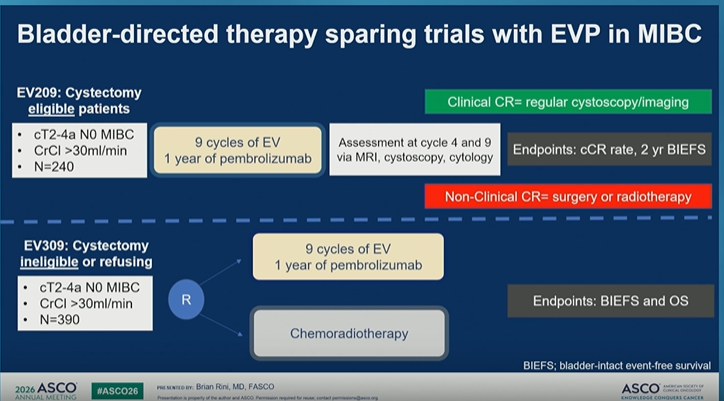
EV-209 keeps cystectomy as the fallback for non-clinical-CR pts in cystectomy-eligible cT2-4a N0 MIBC (N=240), and EV-309 (N=390) enrols only pts ineligible for or refusing cystectomy. Bladder-intact event-free survival counts cystectomy as an event, so the trials are structured around deferring surgery, not replacing it outright.

+2 more figures

9 details 4 trials watching
Discussant presentation, not an original trial. Brian Rini, MD, FASCO discusses ASCO 2026 GU data spanning MIBC bladder preservation, adjuvant RCC, and ctDNA-based selection.
The chemoradiation regimen under discussion is 55 Gy in 20 fractions with mitomycin C and 5-FU. All 54 (100) received the full dose and 47 (87) had no extension or delay, so adding durvalumab did not erode RT delivery.
Concurrent mitomycin C plus 5-FU with durvalumab. Mitomycin C dose reduced in 4 (7), 5-FU Week 1 dose reduced in 9 (17), chemotherapy discontinued early in 12 (22). Durvalumab completed in 33 (61), discontinued early in 21 (39) for toxicity and progression.
The EV platform reframes the comparison: EV-309 randomises cystectomy-ineligible or refusing cT2-4a N0 pts (N=390) against chemoradiotherapy for BIEFS and OS, while EV-209 (N=240) tests EV plus pembrolizumab in cystectomy-eligible pts with cCR and 2yr BIEFS. In adjuvant RCC the discussant's read is that adjuvant IO has no proven benefit in non-clear cell disease, with RAMPART non-clear cell subgroups too small to resolve it.
Selection, not intensification, is the through-line. Pathologic features are called a crude selection tool, and the ctDNA-stratified adjuvant RCC curves separate far more than pathology does (ctDNA-negative 24-mo DFS 79.9% on pembrolizumab and 72.9% on placebo, versus 38.8% and 18.3% in ctDNA-positive pts). The same logic sits under bladder preservation, where the unanswered question is which pt keeps their bladder, not whether the regimen can be delivered.
Everything here is second-hand from a discussant slide deck, so denominators, CIs and per-arm attributions are partial. The RAMPART non-clear cell forest plot arrived with row association uncertain in OCR, and its point estimates are not attributed to specific histologies. Central pathology review is still ongoing.
| Component | Outcome | Number (%) |
|---|---|---|
| Radiotherapy | Received full 55 Gy in 20 fractions | 54 (100) |
| Radiotherapy | No extension or delay | 47 (87) |
| Chemotherapy | Mitomycin C dose reduced | 4 (7) |
| Chemotherapy | 5-FU Week 1 dose reduced | 9 (17) |
| Chemotherapy | Chemotherapy discontinued early | 12 (22) |
| Durvalumab | Completed | 33 (61) |
| Durvalumab | Discontinued early | 21 (39) |
- Long-term bladder preservation, function and QoL after chemoradiation plus durvalumab n=11 · primary completion 2026-02 · chemoRT +/- durvalumab, node-positive bladder
- Whether EV-based bladder sparing beats chemoradiotherapy on BIEFS and OS recruiting A Study to Find Out if Enfortumab Vedotin Given With Pembrolizumab Helps People With Muscle-invasive Bladder Cancer Keep Their Bladder Phase 2n=240 · primary completion 2027-11 · phase 2 EV+pembro bladder-sparing, n=240recruiting Enfortumab Vedotin in Combination With Pembrolizumab vs. Concurrent Chemoradiotherapy (cCRT) in People With Muscle Invasive Bladder Cancer (EV-309) Phase 3n=390 · primary completion 2030-03 · phase 3 EV+pembro vs cCRT, bladder preservationn=56 · primary completion 2031-04 · response-adapted EVP induction, cCRT or RC on failure
- Whether ctDNA-guided selection changes adjuvant RCC outcomes
📚 Sources · 🐦 1 tweet
#ASCO26 GU Oncology Spotlight 🚨
— Dra. María Natalia Gandur Quiroga (@nataliagandur) May 30, 2026
🔬 Living Longer, Living Better: Can We Have It All?
Discussant: Brian I. Rini, MD, FASCO@OncoAlert@ASCO
This GU session captured one of the central tensions in curative-intent oncology:
Can we improve cure rates while preserving quality of… pic.twitter.com/AMwrRZZM2Q
2026-05-21
Bladder Adjuvant Radiotherapy
ForPost-cystectomy MIBC, pT3-4 / pN+ / margin+ / ≤10 nodes dissected
87.1% v 76.0%
HR 0.43 (95% CI, 0.20 to 0.96), P = .04
TL;DR2yr LRFS 87.1% vs 76.0% with adjuvant pelvic IMRT after RC, HR 0.43 (0.20-0.96), P=.04; DFS/BCSS/OS not significant.
The RT read is the target volume and the technique: stoma-sparing IG-IMRT, 50.4Gy/28fx to cystectomy bed plus pelvic nodes, with no additional severe toxicity reported. That combination is deliverable in a standard department today, so this moves the offer-vs-observe decision for a pT3-4 or pN+ postcystectomy patient rather than leaving adjuvant pelvic RT as a historical toxicity concern.
In a postcystectomy MIBC patient with pT3-4, pN+, positive margin, or ≤10 nodes dissected who has completed perioperative chemotherapy, this supports discussing adjuvant pelvic RT for locoregional control; it does not address patients who received adjuvant immunotherapy. The longer read
The transferable detail is the technique: stoma-sparing IG-IMRT, 50.4Gy/28fx to cystectomy bed plus pelvic nodes, with no additional severe toxicity reported. Elective nodal coverage was standard in the treated volume. This moves the offer-versus-observe decision for pT3-4 or pN+ postcystectomy patients.
Over 90% of patients received perioperative chemotherapy (71% neoadjuvant), so the RT benefit sits on top of a modern systemic backbone rather than substituting for it. No patient received immunotherapy, so how adjuvant RT interacts with adjuvant checkpoint blockade in this same high-risk group is untested here.
Surgical adequacy is embedded in eligibility: ≤10 nodes dissected and positive margin were qualifying high-risk features alongside T3-4 and N1-3. That reframes a limited lymphadenectomy or a close margin as a trigger for adjuvant RT referral rather than observation.
10 details
Multicenter phase III RCT, 1:1 adjuvant RT versus observation after radical cystectomy. 153 patients randomly assigned June 2016 to May 2024 (Obs 76, RT 77), stratified by nodal involvement and chemotherapy timing. Median follow-up 47 months.
Nonmetastatic urothelial MIBC, high risk after RC by any one of T3-4, N1-3, positive margin, or ≤10 nodes dissected. Baseline load was heavy: 62% pT3-T4 and 41% pN+.
Over 90% received systemic chemotherapy (71% neoadjuvant, 20% adjuvant). None received immunotherapy in either arm.
Stoma-sparing IG-IMRT, 50.4Gy in 28 fractions, prescribed to the cystectomy bed and pelvic nodes. Elective nodal coverage was part of the treated volume, not an optional add-on.
Primary: 2-year locoregional recurrence-free survival. Secondary: disease-free survival, bladder cancer-specific survival, overall survival.
The primary endpoint was met; secondary endpoints all favored RT numerically without reaching significance. See the endpoint table for arm-level rates and hazard ratios.
| Endpoint | RT | Obs | HR (95% CI) |
|---|---|---|---|
| LRFS (1°) | 87.1% | 76.0% | 0.43 (0.20-0.96), P=.04 |
| DFS | 71.6% | 58.7% | 0.62 (0.36-1.05) |
| BCSS | 79.6% | 65.0% | 0.59 (0.33-1.10) |
| OS | 70.4% | 57.4% | 0.78 (0.49-1.26) |
The authors report no additional severe toxicity with adjuvant pelvic IMRT. Grade-level AE breakdown is not reported in the source abstract.
The primary endpoint is a 2-year locoregional readout under a 47-month median follow-up, so the headline reports early control rather than durability. Accrual spanned eight years, during which adjuvant immunotherapy entered practice in this exact population, and the control arm reflects none of it.
Adjuvant pelvic RT after cystectomy has been an open question since the older Egyptian NCI randomized experience, which used larger fields and conventional technique. This is the modern IMRT-era answer, and it lands positive on local control only, not survival.
A HR of 0.43 on locoregional control with an upper CI bound of 0.96 is a real but fragile signal in 153 patients. The consistent numeric direction across DFS (HR 0.62), BCSS (HR 0.59), and OS (HR 0.78) is reassuring but underpowered, and none of it settles whether locoregional control converts to survival.
CONSORT flow
Randomised, prespecified 2yr LRFS primary endpoint met in a setting where adjuvant RT is not standard. Small N and borderline CI limit confidence, not internal validity.
- Does locoregional benefit persist alongside adjuvant immunotherapy
- Does 2yr LRFS gain translate to survival with longer follow-up
- Which high-risk feature drives the benefit: pN+, margin, or nodal yield
📚 Sources · 📄 1 paper
Abstract
2026-05-19 ESTRO Congress 2026
Bladder-preserving TMT multicenter analysis (URONCOR)
ForcT2-T4aN0M0 MIBC treated with definitive TMT, median age 76
TL;DRCLR 63.7% in a 369-pt Spanish TMT cohort; salvage cystectomy 9.7%, image-guidance quality and 5-FU-based CRT predicted local response.
The modifiable RT variable here is verification protocol: weekly portal imaging carried OR 0.35 (0.20-0.60) for complete local response, with VMAT trending favorable, across a 2010 to 2022 accrual. Dose, fractionation and target volume are not reported in source, so what transfers is the case for daily volumetric IGRT in a filling, moving organ.
In cT2-T4aN0M0 MIBC pts in their seventies weighing bladder preservation against cystectomy, this real-world series supports TMT delivered with modern image guidance and a 5-FU-based backbone; it does not inform node-positive or metastatic disease and carries no head-to-head against radical cystectomy. The longer read
Verification protocol is the modifiable variable: weekly portal imaging carried OR 0.35 (0.20-0.60) for complete local response, with VMAT trending favorable. Dose, fractionation and target volume are not reported in source, so what transfers is the case for daily volumetric IGRT and adaptive planning rather than a specific prescription.
The concurrent backbone mattered: 5-FU-based CRT carried OR 4.9 (1.1-22.1) for complete local response, though the CI leaves the magnitude open and comparator regimens are unnamed in source. Systemic failure at 10.7% ran at or above local-only failure at 10.1%, keeping perioperative systemic therapy questions live.
Salvage cystectomy was performed in 9.7% against 28.8% who progressed, so in a median-age-76 cohort most failures were not surgically rescued. With no in-cohort cystectomy comparator, this informs counseling on bladder preservation for cT2-T4aN0M0 disease without establishing equivalence to upfront radical cystectomy.

10 details
Multicenter retrospective cohort, Spain, 2010 to 2022, N=369 treated with definitive trimodality therapy (maximal TURBT then concurrent chemoradiotherapy). Predictors of response identified by multivariable logistic regression. Follow-up duration not reported in source.
cT2-T4aN0M0 MIBC selected for bladder preservation. Median age 76, 85.1% male. Fitness for cystectomy and completeness of TURBT are not reported in source.
Concurrent chemoradiotherapy, regimen at each center's discretion. 5-FU-based CRT predicted higher complete local response (OR 4.9, 95% CI 1.1-22.1, p=0.038). The comparator regimens are not named in source.
Dose, fractionation and target volume are not reported in source. The only technique signals reported are verification frequency (weekly portal imaging, OR 0.35 for CLR) and a non-significant trend favoring VMAT.
Primary: complete local response (CLR). Secondary: OS, CSS, recurrence patterns, salvage cystectomy. No OS or CSS estimate appears in the source, so the survival half of the conclusion cannot be checked.
CLR 63.7%, salvage cystectomy 9.7%. Progression 28.8%, with systemic failure (10.7%) running at or above local-only failure (10.1%).
BC2001 established the locoregional-control gain from adding chemotherapy to bladder radiotherapy, and the pooled RTOG bladder-preservation experience set the complete-response benchmark; both were protocol populations. This adds European real-world multicenter data at a median age of 76, with no internal cystectomy comparator.
No follow-up duration, OS or CSS estimate is reported, so the durability behind the preservation claim cannot be judged. The 5-FU odds ratio spans 1.1 to 22.1, compatible with a marginal or a large effect, and in a retrospective series regimen choice tracks renal function and performance status.
Systemic failure at 10.7% running at or above local-only failure at 10.1% argues the ceiling in this population is micrometastatic disease rather than the bladder, which caps what further local intensification can buy. Read conservatively, the predictors favor modern image guidance and an active concurrent backbone, not any specific verification schedule.
Retrospective multicenter cohort with no cystectomy comparator; imaging and chemo predictors come from multivariable regression across a 2010-2022 era shift, so a causal reading is unsupported.
- Does daily volumetric IGRT improve complete local response vs weekly portal imaging?
- Which concurrent chemotherapy backbone maximizes complete local response in TMT?
- Long-term bladder-intact survival vs radical cystectomy in matched populations
📚 Sources · 🐦 1 tweet
📢 Presentamos en #ESTRO26 nuestro análisis multicéntrico sobre preservación vesical en cáncer vesical músculo-invasivo tratado con TMT.
— URONCOR (@URONCOR) May 19, 2026
🔎 En 369 pacientes, la respuesta completa clínica se asoció a menor recurrencia local y mejor supervivencia!@fcounago #NicoFeltes pic.twitter.com/aQjjkcHGP4