STOP: iADT ± SBRT in PSMA PET-oligometastatic HSPC/BCR
ForBCR or de novo HSPC, negative CT/bone scan, ≤3 PSMA PET deposits (miN1, miM1)
TL;DR3-yr biochemical progression 21% vs 60% (p=0.004) with SBRT added to iADT in PSMA PET+/CI-oligometastatic HSPC/BCR, n=60.
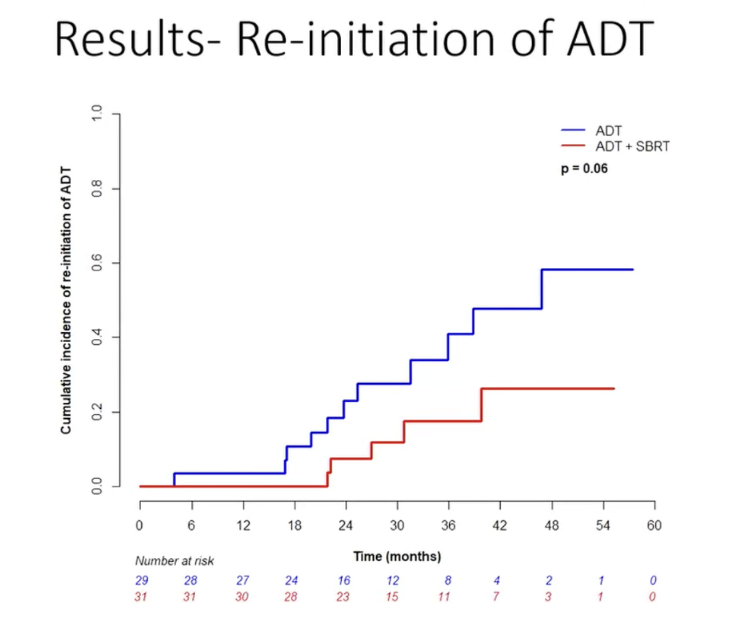
ADT was fixed at 8-9 months in both arms, so the 21% vs 60% 3-yr biochemical progression gap isolates SBRT, delivered within 4 months of ADT. Dose and fractionation followed institutional protocols and are not reported in source, which limits transfer. ADT re-initiation trended lower (p=0.06).
In BCR or de novo HSPC with negative CT/bone scan and ≤3 PSMA PET deposits where 8-9 months of iADT is planned, this supports adding SBRT for biochemical control; it does not extend to conventional-imaging-visible metastatic disease.
ADT was fixed at 8-9 months in both arms, so the 21% vs 60% 3-yr biochemical progression gap isolates SBRT, delivered within 4 months of ADT. Dose, fractionation and target volume followed institutional protocols and are not in source. miN1 and miM1 are pooled, so SBRT vs elective nodal RT stays open.
A finite 8-9 month ADT course alone left 60% with biochemical progression at 3 yr, vs 21% with SBRT added. The time-off-ADT read is weaker: re-initiation of ADT p=0.06. No ARPI intensification arm, so the hormonal backbone question is untouched.

+2 more figures
9 details 5 trials watching
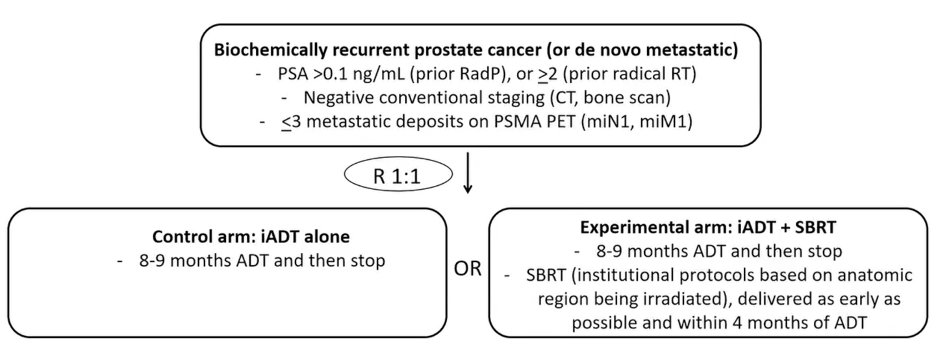
RCT, R 1:1, n=60, iADT alone vs iADT + SBRT. Phase, blinding, site count and median follow-up are not stated in source.
Biochemically recurrent prostate cancer (or de novo metastatic), hormone-sensitive. PSA >0.1 ng/mL after prior RadP or ≥2 after prior radical RT, negative conventional staging (CT, bone scan), and ≤3 metastatic deposits on PSMA PET (miN1, miM1).
Both arms: 8-9 months ADT, then stop. ADT agent not reported in source.
SBRT per institutional protocols based on the anatomic region irradiated, delivered as early as possible and within 4 months of ADT. Dose, fractionation and target volume are not reported in source.
Feasibility endpoint: enrolment of eligible pts. Also reported: biochemical progression, re-initiation of ADT, QoL (EORTC QLQ-C30 global health status).
Feasibility met with 91% of eligible pts enrolled. Arm-level efficacy is in the table; QoL values are not reported in source.
| Endpoint | iADT + SBRT | iADT alone | p |
|---|---|---|---|
| 3-yr biochemical progression | 21% | 60% | p=0.004 |
| Median time to biochemical progression | NR | 27 mo | not reported in source |
| Cumulative incidence of ADT re-initiation | not captured in source | not captured in source | p=0.06 |
STOMP and ORIOLE tested MDT against observation without hormone therapy. EXTEND added MDT to intermittent hormone therapy, the closest design. STOP moves that question to PSMA PET-positive, conventional-imaging-negative disease.
Biochemical progression definition and testosterone recovery after ADT cessation are not in source, and both shape a PSA endpoint. SBRT dose varied by institution. The source tweet is truncated, so the 3-yr ADT re-initiation rates are missing.
With the ADT course held constant, the biochemical gap is an SBRT-attributable signal. It does not settle whether that converts into longer time off ADT (p=0.06), MFS or OS, or whether SBRT alone would do as well.
Randomised but n=60 with a feasibility endpoint; efficacy readout is biochemical progression only. No MFS, OS or toxicity in source.
- Does SBRT added to iADT improve MFS or castration-resistance-free survival? recruiting Veterans Affairs Seamless Phase II/III Randomized Trial of STAndard Systemic theRapy With or Without PET-directed Local Therapy for Oligometastatic pRosTate Cancer Phase 2/3n=464 · primary completion 2026-09 · phase 2/3 SST ± PET-directed local tx; CRPC-free survivaln=60 · primary completion 2030-12 · same RCT (iADT ± SBRT), follow-up running to 2030
- Does the ADT re-initiation trend (p=0.06) hold in a powered trial? active Comparison of Intermittent Androgen Deprivation Therapy With or Without Irradiation Recovery in Prostate Cancer Patients Phase NAn=256 · primary completion 2026-06 · n=256 RCT of iADT ± RT in PET-detected nodal oligomets
- SBRT alone vs SBRT plus iADT in PSMA PET-only oligometastatic HSPC n=873 · primary completion 2027-04 · phase 3 MDT ± 1 mo ADT or 6 mo ADT+ARTA; PMFS, mCRPC-FSactive Androgen Deprivation Therapy for Oligo-recurrent Prostate Cancer in Addition to radioTherapy Phase 3n=280 · primary completion 2027-10 · phase 3 MDRT ± ADT (leuprorelin), MPFS endpoint
📚 Sources · 🐦 1 tweet
STOP: RCT of iADT +/- SBRT in PSMA PET+/ CI-oligometastatic HSPC/BCR (n=60)
— Rashid K. Sayyid (@RKSayyid) September 28, 2026
🔹91% of eligible pts enrolled → feasibility endpoint met
🔹3-yr biochemical progression: 21% vs 60% favoring iADT+SBRT (p=0.004)
🔹Median time to biochemical progression: NR vs 27 mo
🔹3-yr ADT… pic.twitter.com/IkvZS1UiBu
The longer read
The design question here is narrower and cleaner than in most metastasis-directed therapy trials. Both arms received the same finite course of ADT and then stopped, so the comparison isolates what SBRT adds once the systemic backbone is held constant. STOMP and ORIOLE compared MDT against observation, with no hormone therapy in either arm. EXTEND tested MDT added to intermittent hormone therapy in oligometastatic prostate cancer, which is the closest precedent in logic. STOP moves that same question into disease that only PSMA PET can see, with CT and bone scan negative, which is the population now filling clinics as PSMA PET replaces conventional staging at recurrence.
The efficacy readout is biochemical progression: 21% vs 60% at 3 years, p=0.004, with the median not reached vs 27 mo. Biochemical progression after stopping ADT is a soft endpoint. It depends on how fast testosterone recovers, how often PSA is drawn and how progression is defined, and the source gives none of these. The control arm figure is still informative on its own terms: a majority of men given 8-9 months of ADT alone had progressed biochemically by 3 years, which argues that a finite hormone course without local consolidation does not hold PSMA PET-only disease for long.
Several features should temper confidence in the size of the effect. The trial enrolled 60 men and its stated success was feasibility, with 91% of eligible pts enrolled, so the efficacy comparison carries wide uncertainty and no confidence interval appears in the source. A p-value of this size in a trial this small can rest on a handful of events. The endpoint closest to what a patient feels, re-initiation of ADT, came in at p=0.06 and did not reach the conventional threshold. Re-initiation is a clinician decision, and blinding is not stated, so that endpoint is open to knowledge of arm in either direction. A QoL slide was shown but no values were captured, and toxicity is absent from the source entirely.
For a radiation oncologist the transferability gap is technique. SBRT followed institutional protocols by anatomic region, with no dose, fractionation or target volume in the source. Nodal (miN1) and distant (miM1) deposits are pooled, so the trial says nothing about whether pelvic nodal recurrences are better served by SBRT to the involved node or by elective nodal RT, and no in-field vs out-of-field failure data are given. The timing parameter is the one concrete instruction: SBRT as early as possible and within 4 months of ADT.
What this supports is the already common habit of consolidating PSMA PET-only oligometastatic HSPC with SBRT when a short ADT course is being given. What it leaves untouched is whether ADT is needed at all alongside SBRT, and whether intensified hormonal therapy would erase the difference. The result would be misleading if the PSA separation reflects delayed biochemical relapse without a matching delay in metastatic progression or castration resistance, and only a larger trial with MFS and time-off-ADT endpoints can answer that.