onc brain

About · curated by Nick Boehling, MD · @nb2276

2026-09-28 ASTRO Annual Meeting 2026

digest generated 2026-10-05

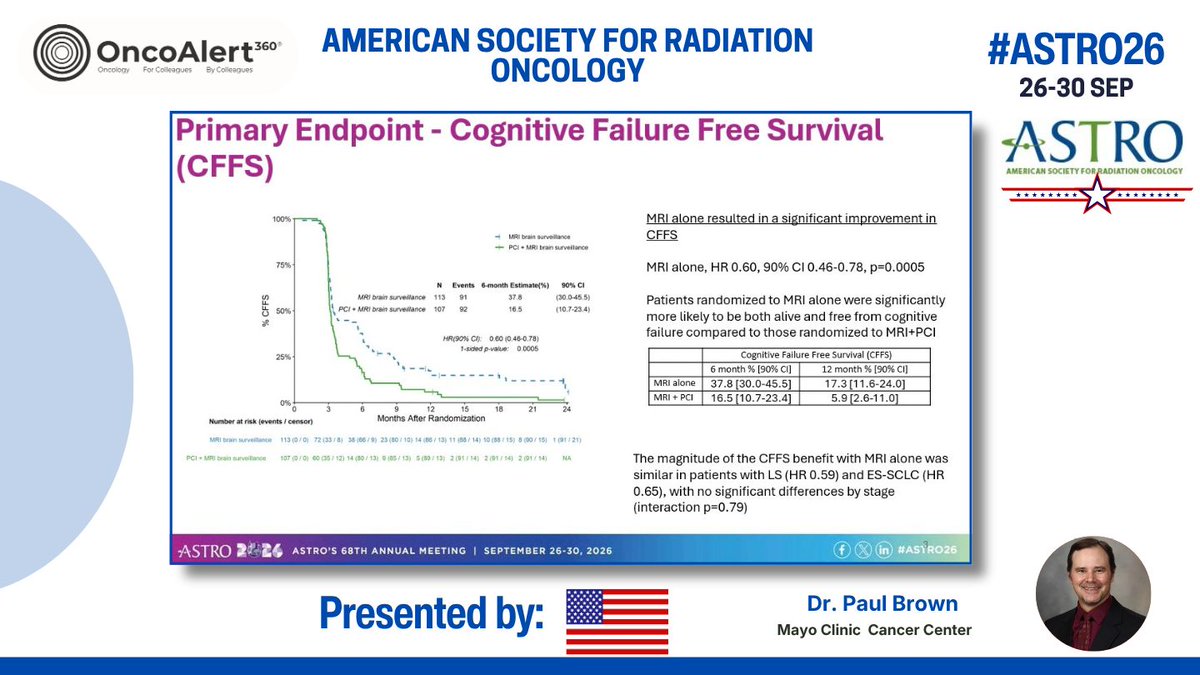
SWOG S1827/MAVERICK: CFFS HR 0.60 (90% CI 0.46-0.78) favoring MRI surveillance alone over PCI 25 Gy/10 fx in LS/ES-SCLC; interim OS HR 0.90, final analysis pending.
CNS-directed RT led the day: MRI surveillance beat PCI on CFFS in LS/ES-SCLC (HR 0.60, interim OS HR 0.90), and Cs-131 tiles cut SBR vs cavity SRT after brain met resection (HR 0.06). Prostate: PACE-A SBRT vs prostatectomy has only 13 BCF events; STOP SBRT + iADT in PSMA PET-oligomet HSPC/BCR cut 3-yr biochemical progression, 21% vs 60%.

Prostate

Two small randomised SBRT trials: PACE-A vs prostatectomy in localised low/intermediate-risk PCa (N=123, no NI margin in source) and STOP adding SBRT to iADT in PSMA PET-oligometastatic HSPC/BCR (n=60).

Early signal

STOP: iADT ± SBRT in PSMA PET-oligometastatic HSPC/BCR

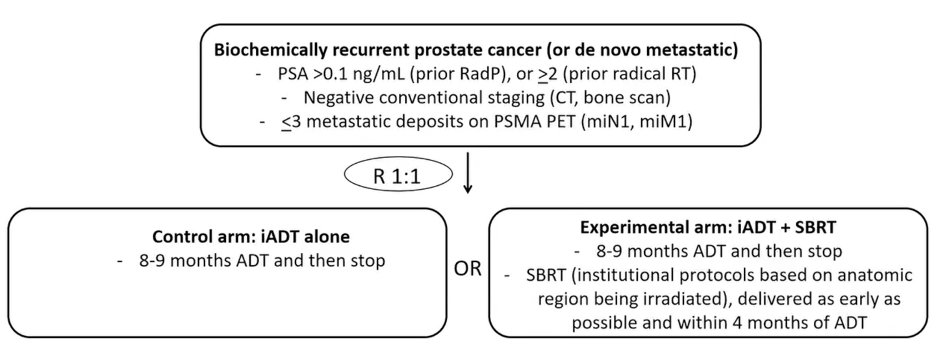
ForBCR or de novo HSPC, negative CT/bone scan, ≤3 PSMA PET deposits (miN1, miM1)

TL;DR3-yr biochemical progression 21% vs 60% (p=0.004) with SBRT added to iADT in PSMA PET+/CI-oligometastatic HSPC/BCR, n=60.

Why it mattersRadiation oncology

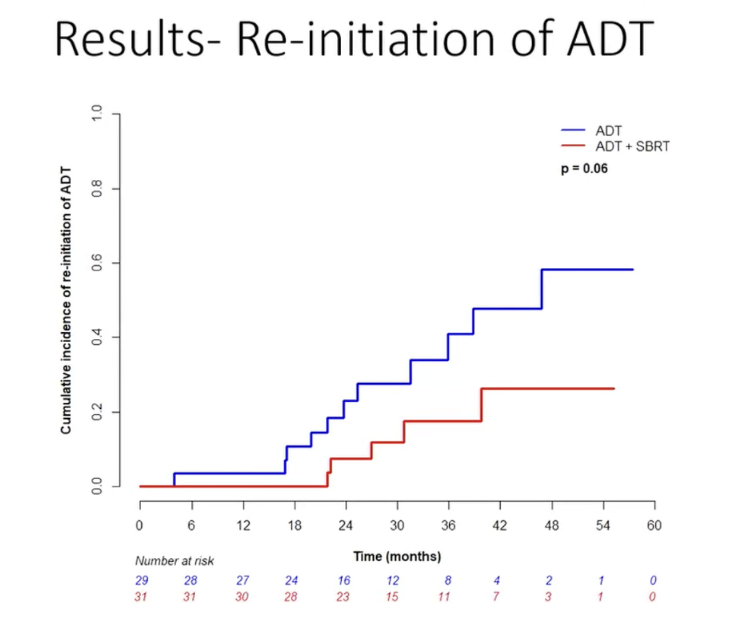
ADT was fixed at 8-9 months in both arms, so the 21% vs 60% 3-yr biochemical progression gap isolates SBRT, delivered within 4 months of ADT. Dose and fractionation followed institutional protocols and are not reported in source, which limits transfer. ADT re-initiation trended lower (p=0.06).

Monday clinic

In BCR or de novo HSPC with negative CT/bone scan and ≤3 PSMA PET deposits where 8-9 months of iADT is planned, this supports adding SBRT for biochemical control; it does not extend to conventional-imaging-visible metastatic disease. The longer read

Cumulative incidence of biochemical progression, ADT vs ADT + SBRT: p = 0.004.
+2 more figures
Cumulative incidence of re-initiation of ADT, ADT vs ADT + SBRT: p = 0.06.
Schema: R 1:1, iADT alone (8-9 months ADT then stop) vs iADT + SBRT (SBRT within 4 months of ADT). ≤3 metastatic deposits on PSMA PET.
9 details 5 trials watching

RCT, R 1:1, n=60, iADT alone vs iADT + SBRT. Phase, blinding, site count and median follow-up are not stated in source.

Biochemically recurrent prostate cancer (or de novo metastatic), hormone-sensitive. PSA >0.1 ng/mL after prior RadP or ≥2 after prior radical RT, negative conventional staging (CT, bone scan), and ≤3 metastatic deposits on PSMA PET (miN1, miM1).

Both arms: 8-9 months ADT, then stop. ADT agent not reported in source.

SBRT per institutional protocols based on the anatomic region irradiated, delivered as early as possible and within 4 months of ADT. Dose, fractionation and target volume are not reported in source.

Feasibility endpoint: enrolment of eligible pts. Also reported: biochemical progression, re-initiation of ADT, QoL (EORTC QLQ-C30 global health status).

Feasibility met with 91% of eligible pts enrolled. Arm-level efficacy is in the table; QoL values are not reported in source.

EndpointiADT + SBRTiADT alonep
3-yr biochemical progression21%60%p=0.004
Median time to biochemical progressionNR27 monot reported in source
Cumulative incidence of ADT re-initiationnot captured in sourcenot captured in sourcep=0.06

STOMP and ORIOLE tested MDT against observation without hormone therapy. EXTEND added MDT to intermittent hormone therapy, the closest design. STOP moves that question to PSMA PET-positive, conventional-imaging-negative disease.

BCR or de novo metastatic HSPC with negative conventional staging and ≤3 PSMA PET deposits (miN1, miM1)
Does not represent conventional-imaging-visible metastatic disease or more than 3 PSMA PET deposits.

Biochemical progression definition and testosterone recovery after ADT cessation are not in source, and both shape a PSA endpoint. SBRT dose varied by institution. The source tweet is truncated, so the 3-yr ADT re-initiation rates are missing.

With the ADT course held constant, the biochemical gap is an SBRT-attributable signal. It does not settle whether that converts into longer time off ADT (p=0.06), MFS or OS, or whether SBRT alone would do as well.

Randomised but n=60 with a feasibility endpoint; efficacy readout is biochemical progression only. No MFS, OS or toxicity in source.

Sourced from @RKSayyid

📚 Sources · 🐦 1 tweet
Confirmatory

PACE-A NCT01584258

ForLocalised low/intermediate-risk PCa, Gleason ≤3+4, PSA ≤20, RP candidate

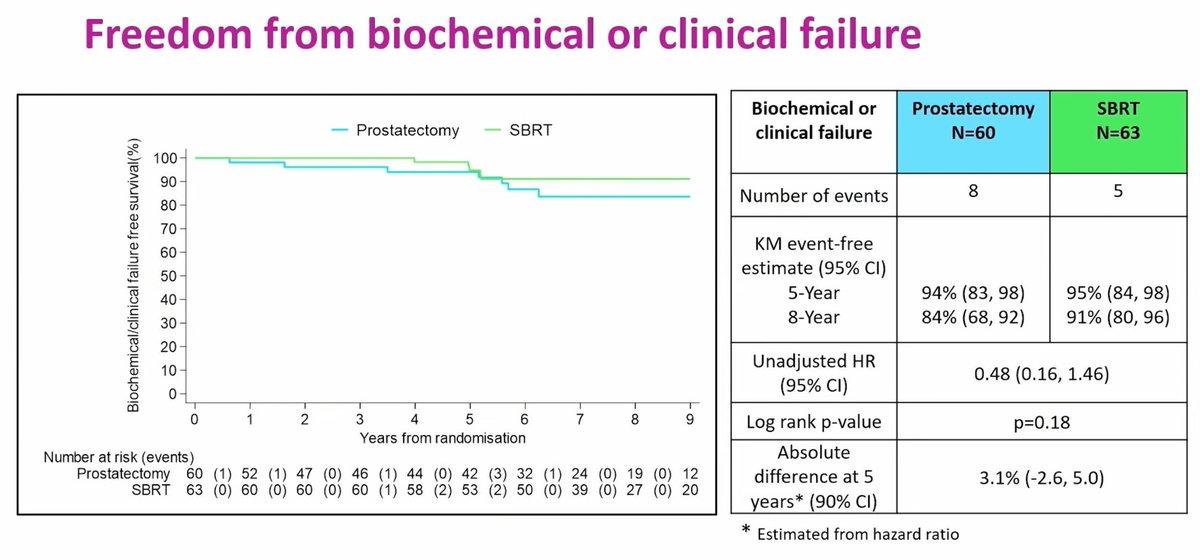
TL;DRSBRT 36.25 Gy/5fx vs prostatectomy: 13 BCF events, HR 0.48 (95% CI 0.16-1.46), p=0.18; 5-yr BCF-free 94.8% vs 94.1% in localised low/intermediate-risk PCa.

Why it mattersRadiation oncology

Failure was scored at nadir+2 ng/ml after SBRT but >0.2 ng/ml after prostatectomy, so the BCF comparison is not symmetric; salvage is the cleaner read (RT in 5 prostatectomy pts, surgery in 1 SBRT pt). At 36.25 Gy in 5 fractions without ADT, this informs counselling surgical candidates on definitive SBRT.

Monday clinic

In a man with low or intermediate-risk localised prostate cancer (cT1-T2, Gleason ≤3+4, PSA ≤20) who is a prostatectomy candidate, this supports presenting SBRT without ADT as a definitive alternative; it does not extend to disease above Gleason 3+4 or PSA 20. The longer read

Also covered Oct 4

PACE-A
ArmNEvents5-Year event-free (95% CI)8-Year event-free (95% CI)
Prostatectomy60894% (83, 98)84% (68, 92)
SBRT63595% (84, 98)91% (80, 96)
+2 more figures
Patient-reported use of ≥1 urinary pad: prostatectomy 14/29 (48%), SBRT 3/36 (8%).
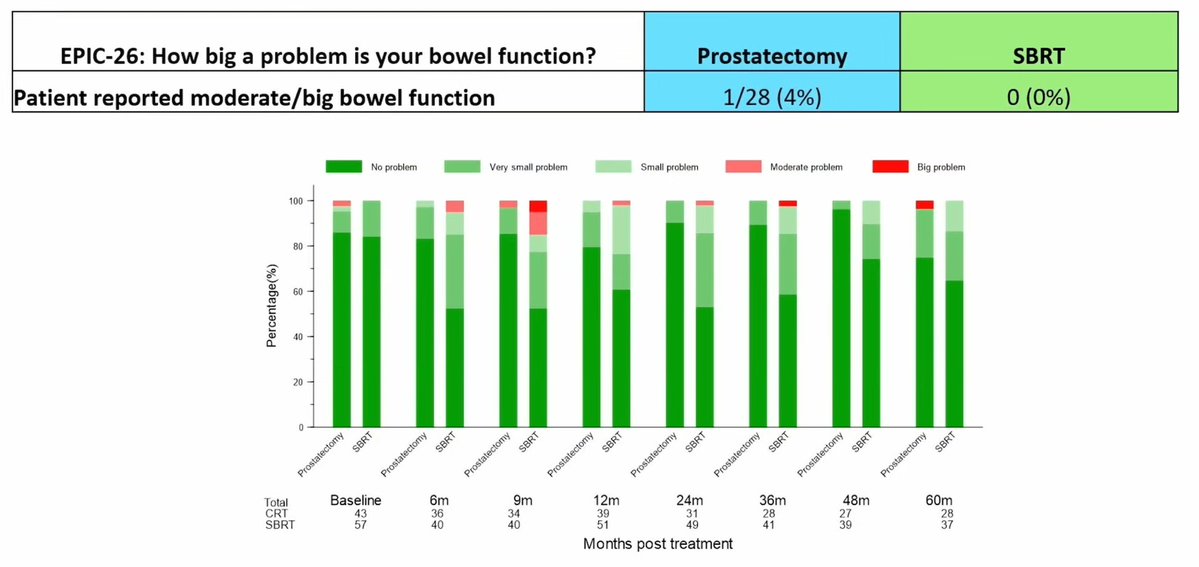
EPIC-26 moderate/big bowel function problem: prostatectomy 1/28 (4%), SBRT 0 (0%).
14 details

Phase III, open-label, multicohort RCT (PACE); PACE-A randomised 1:1 to SBRT or prostatectomy. N=123 (63 SBRT, 60 prostatectomy) from 8 centres per the abstract, August 2012 to February 2022. Median follow-up 8 years (IQR 6.1-8.0); analysis by intention to treat.

Men with localised prostate cancer, cT1-T2, Gleason ≤3+4, PSA ≤20 ng/mL, MRI staged, who were suitable candidates for prostatectomy. Median age 65.5 years (IQR 60.5-68.6), median PSA 7.9 ng/mL (IQR 5.9-11.0); 5.7% low-risk and 94.3% intermediate-risk.

SBRT 36.25 Gy in 5 fractions over 1-2 weeks, with no ADT permitted. Target volume, margins, platform and any intraprostatic boost are not reported in source.

Comparator was radical prostatectomy by open, laparoscopic or robot-assisted approach. The split between approaches and nodal dissection practice is not reported in source.

Freedom from biochemical/clinical failure: PSA rise (nadir+2 ng/ml post-RT or >0.2 ng/ml post-prostatectomy), ADT start, recurrence, metastases or prostate cancer death. The source does not state whether this was the prespecified primary endpoint or give a non-inferiority margin. Function by EPIC-26 and clinician-reported CTCAE.

13 BCF events (5 SBRT, 8 prostatectomy), unadjusted HR 0.48 (95% CI 0.16-1.46; p=0.18). BCF-free at 5 years 94.8% (84.6, 98.3) SBRT vs 94.1% (82.6, 98.1) prostatectomy; at 8 years 91.2% (80.1, 96.2) vs 83.7% (68.4, 92.0). Seven deaths, none from prostate cancer.

EndpointSBRTProstatectomy
≥1 urinary pad at 5 yrs (EPIC-26)3/36 (8.3%)14/29 (48%)
Moderate/big bowel problem (EPIC-26)01/28 (3.6%)
CTCAE G≥2 GI1/54 (2%)0
CTCAE G≥2 GU2/53 (3.8%)1/40 (2.5%)

At 5 years, ≥1 urinary pad in 3/36 (8.3%) SBRT vs 14/29 (48%) prostatectomy. Moderate/big bowel problem in 0 SBRT vs 1/28 (3.6%) prostatectomy. Clinician-reported G≥2 GI 1/54 (2%) vs 0 and G≥2 GU 2/53 (3.8%) vs 1/40 (2.5%), SBRT vs prostatectomy. Sexual function is not reported in source.

ProtecT is the randomised reference for surgery against radiotherapy in localised disease, using conventionally fractionated RT rather than SBRT. PACE-B, a sibling cohort of the same trial, compared SBRT with longer-course RT in men not headed for surgery. This is the direct randomised SBRT against prostatectomy efficacy comparison that the abstract describes as lacking.

men with low or intermediate-risk localised prostate cancer (cT1-T2, Gleason ≤3+4, PSA ≤20 ng/mL) who are surgical candidates and treated without ADT
Does not represent disease above Gleason 3+4 or PSA 20 ng/mL, or men receiving ADT with RT.

Failure thresholds differ by arm, so PSA failure is detectable earlier after surgery than after SBRT. The 5-year pad figures rest on 36 and 29 respondents of 63 and 60 randomised. The tweet reports 10 centres against the abstract's 8, and the slide labels the absolute-difference interval 90% CI where the abstract says 95%.

The 5-year rates are near identical and the 8-year gap rests on few men at risk, so the defensible read is no detectable difference, not SBRT superiority. The continence contrast is the largest effect in the dataset and the bowel penalty usually set against RT is not visible here. It does not settle metastasis or mortality outcomes.

CONSORT flow
Randomized123
↓
SBRT
allocated 63
Prostatectomy
allocated 60

Randomised phase III supporting an already-listed SBRT option, but only 13 events, a CI spanning both directions, no non-inferiority margin, and arm-specific failure definitions. Supports, does not prove, equivalence.

  • Metastasis and prostate cancer mortality by arm with more events
  • SBRT vs prostatectomy above Gleason 3+4 or with ADT
  • Sexual function by arm, not reported in source

Sourced from @zklaassen_md, N. van As et al.

📚 Sources · 🐦 1 tweet · 📄 1 paper
📄 PAPER N. van As; J. Patel; A. Tree et al. · ASTRO 2026 Annual Meeting (2026-09)
Efficacy of Radical Prostatectomy Versus Stereotactic Body Radiotherapy (SBRT) for Localised Prostate Cancer: Results from an international Phase III Randomised Controlled Trial (PACE - A)
Abstract
ASTRO 2026 abstract LBA 32 · PL 01 - Plenary Session · 2026-09-28 · presented by Nicholas van As, MD, MB<br/><br/>Purpose/Objective(s): Treatment selection for localised prostate cancer (LPCa) is often influenced by expected functional outcomes, assuming comparable cancer control between treatments. Randomised evidence comparing efficacy of radical prostatectomy and stereotactic body radiotherapy (SBRT) is lacking.<br/>Materials/Methods: PACE (NCT01584258) is phase III, open label, multicohort randomised controlled trial. In PACE-A, men with LPCa (cT1-T2, Gleason score =3+4, PSA =20 ng/mL) who were suitable candidates for prostatectomy were randomised (1:1) to SBRT or prostatectomy. SBRT was delivered to 36.25 Gy in 5 fractions over 1-2 weeks. Prostatectomy could be open, laparoscopic, or robot assisted. Androgen deprivation therapy was not permitted. Freedom from biochemical/clinical failure (BCF), based on PSA rises (nadir+2ng/ml or >0.2 ng/ml post radiotherapy or prostatectomy) or commencement of ADT or recurrence or metastases or prostate cancer death was analysed using Cox proportional hazards and log-rank test by intention to treat.<br/>Results: 123 patients were randomised from 8 centres between August 2012 and February 2022 (60 prostatectomy, 63 SBRT). Baseline characteristics were well-balanced between groups. Median age was 65.5 years (IQR 60.5-68.6), median pre-treatment PSA was 7.9ng/mL (IQR 5.9-11.0), 5.7% and 94.3% of patients had low/intermediate-risk disease, respectively. With median follow-up of 8 years (IQR: 6.1 – 8.0), 13 BCF events had occurred (5 SBRT, 8 prostatectomy), unadjusted hazard ratio 0.48 (95% CI 0:16-1.46; p=0.18). The estimated absolute difference at 5 years (based on the HR) is 3.1% (95% CI -2.6, 5.0) with 5-year BCF-free rates 94.8% (84.6, 98.3) and 94.1% (82.6, 98.1) for SBRT and prostatectomy. 8-year rates were 91.2% (80.1, 96.2) and 83.7% (68.4, 92.0). Subsequent treatment for progression included surgery in 1 SBRT patient and radiotherapy in 5 prostatectomy patients. ADT was administered to 5 patients (3 prostatectomy, 2 SBRT). At 5 years, using Expanded Prostate Cancer Index Composite 26-item (EPIC-26) questionnaire, use of =1 urinary pad was reported by 3/36(8.3%) SBRT patients and 14/29(48%) prostatectomy patients. 1/28(3.6%) prostatectomy patient and 0 SBRT patients reported moderate/big bowel function problem. Clinician reported CTCAE grade =2 gastrointestinal side effects were reported by 1/54(2%) patient receiving SBRT and 0 prostatectomy patients. Grade =2 genitourinary side effects occurred in 2/53 (3.8%) receiving SBRT and1/40 (2.5%) patients undergoing prostatectomy.<br/>Conclusion: With long-term follow-up, both prostatectomy and SBRT achieved excellent biochemical control in patients with localised prostate cancer. These findings support SBRT as an effective non-surgical treatment option with comparable long-term disease control to prostatectomy.
📝 https://amportal.astro.org/sessions/pl-01-22946/efficacy-of-radical-prostatectomy-versus-stereotactic-body-radiotherapy-sbrt-for-localised-pr-114308 10.1016/j.ijrobp.2026.06.3129

CNS

ROADS tests intraoperative Cs-131 tiles against post-op cavity SRT after brain met resection; 17.8% of the SRT arm never received SRT and median f/u is 12.9 mo.

Challenges SOC

ROADS NCT04365374

ForNewly diagnosed brain met, index lesion 2.0-7.0 cm, indicated for resection

Time to surgical bed recurrence (co-primary with SB-RFS) local control

HR 0.06

95% CI 0.01-0.46, p=0.0070; median NR vs 17.4 mo

TL;DRTime-to-SBR HR 0.06 (0.01-0.46) for Cs-131 tiles vs post-op cavity SRT after brain met resection; 12-mo SBR 1.3% vs 15.4%.

Why it mattersRadiation oncology

The control was not a weak arm: 92.2% got multi-fraction cavity SRT (27 Gy/3 or 30 Gy/5) and 12-mo SBR was 15.4%, in line with published fractionated series. The SBR HR stayed 0.06 in per-protocol while OS did not hold (HR 0.73, p=0.2156), so the cavity-control decision moves, the survival claim does not. TBRT prescription dose is not in the source text.

Monday clinic

In a pt with a newly diagnosed brain metastasis 2.0-7.0 cm indicated for resection, this supports intraoperative Cs-131 tile placement as an alternative to post-op cavity SRT for surgical bed control; it does not address unresected lesions, which received SRT in both arms. The longer read

Also covered May 30

11 details

Randomized, open-label, non-inferiority phase 3 across 32 US centers; 240 consented, 230 randomized 1:1 pre-operatively (115 per arm). Efficacy in the pre-specified mITT population (103 R+TBRT, 101 R+SRT). Median follow-up 12.9 mo (IQR 5.9-22.8); data cut-off October 2025.

Newly diagnosed brain metastases indicated for resection, with one surgical index metastasis 2.0-7.0 cm. mITT required surgery, pathologically confirmed metastasis, and any follow-up information; 14 did not have surgery, 11 had ineligible pathology, 1 had no follow-up.

R+TBRT: collagen tiles each carrying four Cs-131 seeds implanted in the cavity at resection, with post-op CT for dosimetry; prescription dose not reported in source text. R+SRT: volume-dependent cavity SRT, 17-20 Gy/1, 27 Gy/3 or 30 Gy/5, planned 21±7 days from surgery, multi-fraction in 92.2%, median start 27.0 days (range 6-47). Non-index metastases received SRT in both arms.

Co-primary: time-to-SBR (death censored) and SB-RFS (SBR or death), with site-reported SBR centrally reviewed by two neuroradiologists. Secondary: OS, FACT-Br QoL, KPS, Barthel ADL, neurocognition, LMD, RN (site-reported). NI margin HR 1.26; fixed hierarchy from non-inferiority to superiority to OS.

Non-inferiority and then superiority were met for both co-primaries. Local control findings held across mITT, ITT and per-protocol populations; the OS difference did not hold in per-protocol.

Any AE in 83 pts (79.0%) with R+TBRT vs 67 (80.7%) with R+SRT, risk difference -1.7% (95% CI -13.2 to 9.8). ≥G3 TRAEs 20.0% vs 21.7%. 12-mo RN 5.3% vs 5.7% (HR 0.85, p=0.76). No differences in FACT-Br, KPS, Barthel ADL or neurocognition.

Post-op cavity SRT became standard on trials showing better surgical bed control than observation; Mahajan et al. reported 12-month freedom-from-SBR of 72% with single-fraction SRT vs 43% with observation. Multi-institutional fractionated series report 84-87%, and the ROADS control arm (12-mo SBR 15.4%) sits in that range, so tiles beat a contemporary comparator.

pts with a newly diagnosed brain metastasis 2.0-7.0 cm indicated for resection at US centers able to implant Cs-131 tiles
Does not represent unresected metastases, which received SRT in both arms, or pts found intra-operatively to have non-metastatic pathology.

Central reviewers were not told the assignment, but seed susceptibility artifact on MRI may have revealed it, and RN was site-reported. The SB-RFS definition was corrected in May 2025 (death had been specified as a censoring event), creating two co-primaries. No granular systemic therapy data, so the OS mechanism cannot be examined.

The surgical bed control result is consistent across analysis populations and rests on few events (1 vs 12). The OS difference is unexplained by distant brain failure or LMD, did not persist in per-protocol, and the authors state it requires validation. How tiles compare with pre-operative SRT (NCT03741673, NCT05438212) is untested.

CONSORT flow
Assessed / enrolled 240
↓ 10 excluded
Randomized230
↓
R+TBRT
allocated 115
analyzed 103
12-mo SBR 1.3%
R+SRT
allocated 115
analyzed 101
12-mo SBR 15.4%

Randomized phase 3 beat contemporary fractionated SRT on both co-primaries, but 12.9-mo follow-up, 1 vs 12 SBR events, open-label, and 17.8% SRT non-completion hold it short of practice-changing.

  • Does the OS difference replicate in an independent trial?
  • TBRT vs pre-operative SRT for resected brain metastases
  • Late radiation necrosis and cavity control beyond 12.9-mo median follow-up

Sourced from Weinberg, Jeffrey S. et al.

📚 Sources · 📄 1 paper
📄 PAPER Weinberg, Jeffrey S.; Imber, Brandon S.; DiNapoli, Vincent et al. · Journal of Clinical Oncology (2026-09)
Surgery and tile-based radiation therapy versus surgery and stereotactic radiation for newly diagnosed brain metastases (ROADS): a randomized, open-label, phase 3 trial
Abstract
PURPOSE Post-operative stereotactic radiation (SRT) is the standard-of-care for resected brain metastases. Implantation of cesium-131 collagen tiles (tile-based radiation therapy, TBRT) initiates focal radiation immediately after resection, potentially offering therapeutic and logistical advantages. ROADS: a randomized, open-label, non-inferiority, phase 3 trial ( NCT04365374 ) compared the safety and efficacy of resection with TBRT (R+TBRT) to resection with SRT (R+SRT) for patients with a newly diagnosed brain metastasis indicated for surgical resection. PATIENTS AND METHODS Across 32 United States centers, patients were pre-operatively randomized 1:1 to resection R+TBRT or R+SRT. Any non-resected brain metastases received SRT post-operatively. Co-primary outcomes were time-to-surgical bed recurrence (SBR) and surgical bed recurrence-free survival (SB-RFS). Outcomes were analyzed using Cox proportional hazards models with stratification factors as covariates. Multiplicity was controlled by hierarchical testing. Analyses used the pre-specified modified intent-to-treat (mITT) population (patients who underwent surgery, had pathologic confirmation of brain metastasis, and had follow-up information). RESULTS From April 2021 through August 2025, 230 patients were randomized (115 per arm); 204 of whom (103 R+TBRT, 101 R+SRT) comprised the mITT population. Median follow-up was 12.9 months. Median time-to-SBR was not reached (R+TBRT) versus 17.4 months (R+SRT) (hazard ratio [HR]: 0.06; 95% confidence interval [CI]: 0.01–0.46; p=0.0070). SB-RFS was improved with R+TBRT, with a median of not reached versus 10.9 months (R+SRT) (HR: 0.48; 95% CI: 0.30–0.76; p=0.0021). Overall adverse events did not appear to differ: 83 patients (79.0%, 95% CI: 70.0–86.4) (R+TBRT) versus 67 patients (80.7%, 95% CI:70.6–88.6) (R+SRT). CONCLUSION For patients with newly diagnosed brain metastases requiring resection, R+TBRT significantly improved SBR and SB-RFS, demonstrating both non-inferiority and superiority.

Thoracic / Lung

PCI omission in SCLC with MRI surveillance: CFFS favors omission, OS non-inferiority (upper 90% CI bound 1.25) awaits the final analysis at 190 deaths.

Challenges SOC

SWOG S1827/MAVERICK

ForLS or ES-SCLC, no brain mets on MRI after first-line therapy, PS 0-2

Cognitive failure-free survival safety

HR 0.60

90% CI 0.46-0.78, 1-sided p=0.001 (abstract), p=0.0005 (slide)

TL;DRCFFS HR 0.60 (90% CI 0.46-0.78) favoring MRI surveillance alone over PCI 25 Gy/10 fx in LS/ES-SCLC; interim OS HR 0.90.

Why it mattersRadiation oncology

The HA-PCI escape route is closed: 77% of PCI was hippocampal-avoidant, and MRI-arm pts pre-declared for HA-PCI still did better than HA-PCI (HR 0.63, 90% CI 0.47-0.83). The omission decision now rests on OS, where the interim upper bound of 1.20 sits inside the 1.25 margin with 190 deaths still pending.

Monday clinic

In LS or ES-SCLC with a clean brain MRI after first-line therapy and access to q3-month MRI in year 1, this supports surveillance alone over PCI, including HA-PCI; it does not extend to pts who cannot complete MRI surveillance. The longer read

Also covered Sep 14

SWOG S1827/MAVERICK
TimepointMRI aloneMRI + PCI
6 month CFFS37.8% (90% CI 30.0-45.5)16.5% (90% CI 10.7-23.4)
12 month CFFS17.3%5.9%
+2 more figures
SWOG S1827/MAVERICK
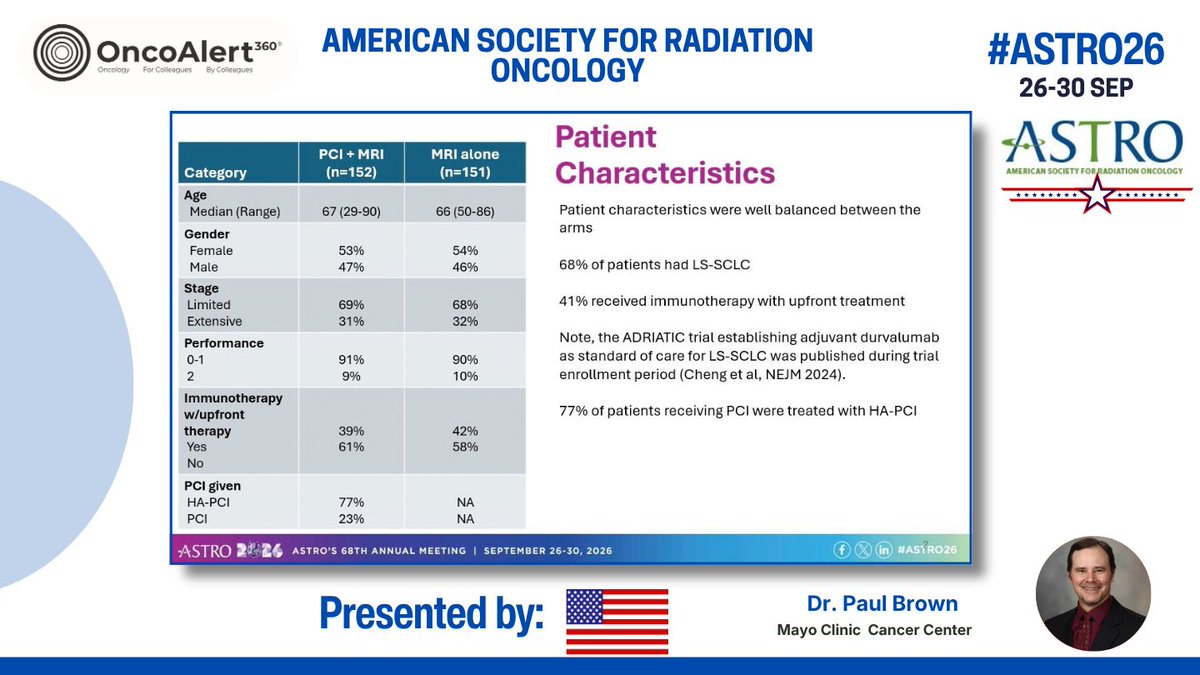
CharacteristicPCI + MRI (n=152)MRI alone (n=151)
Limited stage69%68%
Performance status 0-191%90%
Immunotherapy with upfront therapy39%42%
HA-PCI among PCI given77%NA
SWOG S1827/MAVERICK
11 details 3 trials watching

International randomized phase III, 304 pts randomly assigned 01/2020 to 12/2025. Stratified by stage (LS/ES), receipt of IO, and PS (0-1 vs 2). Median follow-up for living pts 22 months.

LS or ES-SCLC after completing initial therapy, with no BM on MRI before enrollment. 68% LS-SCLC, 41% received immunotherapy with upfront treatment.

PCI 25 Gy in 10 fx, hippocampal avoidance at physician discretion (77% HA-PCI). At brain metastases, RT was recommended in both arms, WBRT or SRS allowed.

Primary: CFFS, time to first cognitive failure on any of HVLT-R, COWA, or Trail Making, or death, by 1-sided 0.05 log-rank. Key secondary: OS non-inferiority with MRI alone, margin 1.25 on the upper 90% CI. MRI and cognitive testing q3 months in year 1, q6 months in year 2.

CFFS favored MRI alone across stage and HA-PCI analyses (table above). Interim OS HR 0.90 (90% CI 0.67-1.20) at 128 deaths, and cognitive failure by Fine-Gray gave a subdistribution HR of 0.62. BM were decreased with PCI with no PFS difference, magnitudes not reported in source.

AnalysisHR90% CIp
Overall (1° EP)0.600.46-0.780.001 abstract, 0.0005 slide
LS-SCLC0.59not reported in sourceinteraction 0.79 slide, 0.92 abstract
ES-SCLC0.65not reported in sourcesame interaction test
HA-PCI intended (declared pre-randomization)0.630.47-0.830.006

The toxicity signal is neurocognitive: objective failure was more frequent with PCI. Day 180 patient-reported cognitive concerns were not different (PROMIS p=0.07, MDASI p=0.69), while longitudinal modeling favored MRI alone. Other toxicities not reported in source.

The source frames the PCI benefit (fewer BM, better OS) as coming from pre-MRI era studies. Takahashi's Japanese randomized trial had already questioned PCI under MRI surveillance in ES-SCLC, and NRG CC003 tested hippocampal avoidance within PCI. This is the first randomized readout covering LS-SCLC under MRI surveillance.

LS or ES-SCLC with no brain metastases on MRI after initial therapy, followed with scheduled MRI through 24 months
Does not represent pts without restaging brain MRI or without access to q3-month MRI surveillance.

The CFFS table lists 115 and 107 pts against 151 and 152 randomized, with no explanation in source. Slide and abstract p-values differ. The prespecified Day 180 PRO endpoints were negative, so the patient-reported benefit rests on longitudinal modeling.

Hippocampal avoidance did not rescue PCI on this endpoint, which leaves OS as the only argument for prophylaxis. The interim OS estimate is compatible with non-inferiority but is not the final analysis, and 22 months is short for LS pts with curative intent.

CONSORT flow
Randomized304
↓
MRI alone
allocated 151
6-mo CFFS 37.8%
PCI + MRI
allocated 152
6-mo CFFS 16.5%

Randomized phase III, prespecified primary met against PCI. Not labelled practice-changing because the OS non-inferiority analysis is preliminary (128 of 190 deaths) and follow-up is short for LS.

Sourced from @OncoAlert, C. G. Rusthoven et al.

📚 Sources · 🐦 1 tweet · 📄 1 paper
📄 PAPER C. G. Rusthoven; M. Redman; P. D. Brown et al. · ASTRO 2026 Annual Meeting (2026-09)
SWOG S1827/MAVERICK: A Randomized Phase III Trial of Brain MRI Surveillance with and without Prophylactic Cranial Irradiation (PCI) for Small-Cell Lung Cancer (SCLC)
Abstract
ASTRO 2026 abstract LBA 03 · CT 01 - Clinical Trials Session · 2026-09-27 · presented by Paul Brown, MD<br/><br/>Purpose/Objective(s): For SCLC, studies from the pre-MRI era demonstrated a reduction in brain metastases (BM) and improved overall survival (OS) with PCI. We hypothesized that brain MRI surveillance without PCI would result in improved cognitive failure free survival (CFFS) without a decline in OS.<br/>Materials/Methods: This international phase III trial enrolled patients (pts) with limited (LS) and extensive-stage (ES) SCLC who had completed initial therapy, with no BM on MRI prior to enrollment. Pts were randomized to MRI surveillance +/- PCI (25 Gy in 10 Fx), stratified by stage (LS/ES), receipt of immunotherapy (IO), and PS (0-1 vs 2). MRIs were q3 months during year 1 and q6 months during year 2 in both arms. Cognitive testing was performed at the same time points using the Hopkins Verbal Learning Test-Revised, Controlled Oral Word Association, and Trail Making Test. The primary objective was to compare CFFS defined as the time to first cognitive failure (CF) on any test or death, using a 1-sided 0.05 level log-rank test. The key secondary objective was to evaluate if OS was not inferior with MRI alone, with a non-inferiority margin for the upper bound 90% CI of 1.25. The final OS analysis will take place after 190 deaths. Additional objectives included comparing cumulative incidence of CF by Fine-Gray, BM-free survival, and toxicities. Patient reported cognitive concerns (via the MDASI-BT cognitive factor score and the PROMIS CFSF4a) and overall quality of life (QOL) (single-item LASA) were analyzed and preliminary results are presented.<br/>Results: From 01/2020 to 12/2025, 304 pts were randomly assigned; 68% had LS-SCLC. The median follow-up for living pts is 22 months. CFFS was improved with MRI alone (HR 0.60, 90% CI 0.46-0.78, p=0.001). Subgroup analyses of CFFS demonstrated no significant differences in the benefit of MRI alone by either stage (LS/ES, interaction-p=0.92) or receipt of IO (yes/no, interaction-p=0.25). Of pts receiving PCI, 77% had hippocampal-avoidant (HA)-PCI. CFFS was superior for pts in the MRI arm who would have received HA-PCI (declared pre-randomization) compared to HA-PCI (HR 0.63, 90% CI 0.47-0.83, p=0.006). Preliminary analysis of OS at 128 deaths suggests no difference in OS (HR for MRI alone vs MRI+PCI: 0.90, 90% CI 0.67-1.20). There was a decreased risk of CF with MRI alone (subdistribution HR 0.62, 90% CI 0.48-0.79, p=0.001). At the Day 180 primary endpoint assessment for patient reported outcomes, no statistically significant differences in PROMIS or MDASI cognitive concerns (p=0.07 and 0.69, respectively) were found; however, pre-specified longitudinal modeling demonstrated improvements with MRI alone in PROMIS cognitive concerns that were significant at all time points and improved overall QOL on LASA at 90 and 180 days (all p<0.05).<br/>Conclusion: Compared to MRI+PCI, MRI alone is associated with superior CFFS, reduced cognitive failure, and improvements in longitudinal QOL outcomes. These results support MRI surveillance alone as the standard of care for pts with SCLC.
📝 https://amportal.astro.org/sessions/ct-01-22948/swog-s1827-maverick-a-randomized-phase-iii-trial-of-brain-mri-surveillance-with-and-without-p-114268 10.1016/j.ijrobp.2026.06.2463