Early signal
STAR-TREC
ForRectal adenocarcinoma <40 mm, mrT1-T3bN0, ECOG 0-1, TME otherwise feasible
TL;DR12-mo TME-free survival 78.5% with LCCRT vs 60.6% with SCRT, HR 1.90 (1.29-2.81), in mrT1-T3bN0 rectal cancer.
For an RT reader the actionable number is the response gradient: cCR 64% with 50 Gy/25 fx plus capecitabine vs 36% with 25 Gy/5 fx, which is what drives the 78.5% vs 60.6% TME-free survival. Acute SAE grade ≥3 within 4 weeks of RT ran higher with LCCRT (6% vs 1%), so the trade is upfront toxicity for organ preservation.
In rectal adenocarcinoma under 40 mm staged mrT1-T3bN0 where TME is feasible and the patient wants organ preservation, this supports long-course chemoradiotherapy over short-course as the preservation schedule; it does not address node-positive, larger, or metastatic disease, and 30-month preservation is still unreported.
This is a randomised head-to-head of two schedules inside a preservation pathway: 50 Gy/25 fx plus capecitabine gave cCR 64% vs 36% with 25 Gy/5 fx at 16-20 weeks, driving TME-free survival 78.5% vs 60.6%. Acute grade ≥3 SAEs within 4 weeks of RT were 6% vs 1%, the cost of that gradient.
Concurrent capecitabine 825 mg/m² twice daily with 50 Gy/25 fx was well tolerated, with 18 (11%) of 161 needing at least one dose modification, and the chemoradiotherapy arm doubled cCR (64% vs 36%) over radiotherapy alone. The schedule choice, not systemic escalation, is what moves preservation here.
Response-adapted preservation kept 78.5% TME-free at 12 months after LCCRT, but transanal excision for near-complete response ran 40% after SCRT vs 23% after LCCRT, so the schedule changes how much local surgery you end up doing. 22% of TME specimens had positive nodes despite node-negative MRI.
12 details 4 trials watching
Open-label, international, multicentre, parallel-group, superiority phase 2/3 trial at 37 hospitals in the UK, Netherlands, Sweden, Denmark, and Belgium. Phase 2 randomised 1:1:1 (LCCRT-OP, SCRT-OP, TME); phase 3 used a partially randomised patient-preference design, with those choosing organ preservation randomised 1:1 between the two RT schedules, stratified by country and MRI T category.
Biopsy-confirmed rectal adenocarcinoma <40 mm staged mrT1-T3bN0, ECOG 0-1, aged ≥16 (UK) or ≥18 elsewhere. Excluded: diameter >40 mm, metastatic disease, MRI-defined nodal involvement or extramural venous invasion, tumour within 1 mm of mesorectal fascia, anterior tumours above the peritoneal reflection, mucinous histology. Median age 67, 72% male, 80% below the peritoneal reflection.
LCCRT-OP: 50 Gy in 25 fractions with oral capecitabine 825 mg/m² twice daily. SCRT-OP: 25 Gy in five fractions. Completion was high in both groups: 159 (99%) of 161 LCCRT participants and 168 (100%) SCRT. 18 (11%) of 161 receiving LCCRT needed at least one capecitabine dose modification for toxicity.
Phase 3 primary: organ preservation 30 months after treatment initiation (absence of TME, stoma, or local recurrence), assessed in the mITT population and not reported in this analysis. This report gives the 12-month implementation outcomes: TME-free survival, clinical complete response at the second response assessment, and serious adverse events. Bayesian framework with Cox models for time-to-event outcomes.
Response-adapted decision-making at 16-20 weeks explains the divergence: cCR 64% vs 36% favoured LCCRT-OP while TAE for near-complete response was commoner after SCRT-OP (23% vs 40%), and the resulting TME-free survival gap was 78.5% vs 60.6%.
| Event | LCCRT-OP | SCRT-OP | Primary TME |
|---|---|---|---|
| Gastrointestinal disorders | 4 (2%) | 6 (4%) | 6 (8%) |
| Procedural complications | 3 (2%) | 5 (3%) | 5 (6%) |
Grade 3-4 serious adverse events were most often gastrointestinal (2% LCCRT vs 4% SCRT vs 8% TME) and procedural complications (2% vs 3% vs 6%). Grade ≥3 SAEs within four weeks of finishing RT were 9 (6%) LCCRT-OP vs 2 (1%) SCRT-OP. In the TME group, grade ≥3 SAEs occurred in 14 (18%) of 78, with one postoperative death from sepsis after anastomotic leakage and intraperitoneal perforation from anastomotic leak in 12 (15%).
The phase 2 effect (HR 3.7, 1.7-8.0) was far larger than the pooled 12-month estimate (HR 1.90), and the authors ran exploratory post-hoc analyses of stratification variables, tumour length, and centre organ-preservation volume to explain the phase difference. Baseline MRI excluded nodal disease, yet 17 (22%) of TME specimens carried positive nodes, so occult nodal disease is present in the preserved cohort too and is not captured by a 12-month TME-free endpoint. The primary TME comparator in phase 3 was self-selected, not randomised.
TME-free survival at 12 months is an implementation readout, not durable organ preservation: it counts who has avoided surgery so far, not who stays disease-free without it. The clinically load-bearing question, whether the higher cCR rate after 50 Gy/25 fx converts into sustained preservation without a local-recurrence penalty, waits on the 30-month endpoint.
CONSORT flow
Interim 12-month implementation analysis; prespecified 30-month organ-preservation primary endpoint unreported. Phase 3 TME arm by patient preference, not randomisation.
- Does the 12-month TME-free gap hold at the 30-month organ-preservation endpoint n=66 · primary completion 2025-09 · SCRT vs LCRT plus consolidation, organ preservation
- Local recurrence and salvage rates after non-operative management recruiting Nordic ORgan Preservation Pilot Approach Nonrandomised Single-Arm Trial for Non-Operative Management of Rectal Cancer Phase NAn=200 · primary completion 2028-12 · single-arm NOM cohort reporting local regrowth raterecruiting Asian Watch-and-Wait Database (AWWD)n=337 · primary completion 2029-10 · W&W registry after short- or long-course neoadjuvant RT
- Whether a later response assessment would narrow the short-course deficit recruiting Organ Preservation in Rectal Cancer: Contact X-ray Brachytherapy vs Extending the Waiting Interval and Local Excision Phase NAn=168 · primary completion 2025-03 · extends waiting interval after SCRT before response call
📚 Sources · 📄 1 paper
Moderately hypofractionated partial breast reirradiation
ForIsolated IBTR after BCS + WBI, T1-2, unifocal, ≥48mo interval, age ≥50
TL;DR40Gy/15fx PBI re-RT after second lumpectomy: 3yr LR-FS, DR-FS and OS all 86%, no grade 3+ late events (N=11).
The transferable read is the fractionation, not the outcome: 40 Gy / 2.67 Gy daily PBI met every OAR objective with heart Dmean 1.44 Gy and ipsilateral lung V16Gy 7.74%, so a once-daily 15-fraction re-RT can be planned inside standard constraints. That removes the BID-visit burden that limits RTOG 1014 uptake, though no plan sum with the first WBI course was possible.
For the woman with an isolated T1-2 IBTR ≥4 years after BCS plus WBI who wants to keep her breast, this supports offering once-daily hypofractionated PBI re-RT rather than only BID schedules; it says nothing about multifocal, T4, or short-interval recurrence, where mastectomy remains the comparator.
The transferable detail is the plan, not the outcome: 40 Gy / 2.67 Gy daily PBI with direct-planning IMRT achieved heart Dmean 1.44 Gy and ipsilateral lung V16Gy 7.74%, well inside objectives, in previously whole-breast-irradiated tissue. That makes a once-daily 15-fraction re-RT schedule planable without the BID burden, though no plan sum with the first course was possible.
Repeat lumpectomy rather than salvage mastectomy held in 9 of 11 at 3 years, with recurrences at 11 and 15 months. Selection was tight: unifocal T1-2 on triple imaging, ≥48 months from primary treatment. SLNB was attempted in 8 and failed to identify a node in 2, which is worth flagging when planning axillary staging at second conservation.
16 details 2 trials watching
Retrospective review of a departmental re-RT database, single institution (Porto), treated 2017-2021. Thirteen identified, two excluded (different fractionation; T4 treated with WBI), leaving N = 11. Median follow-up 41 months (27-62), Kaplan-Meier estimates with two-sided log-rank comparisons.
Isolated ipsilateral breast tumor recurrence after BCS plus whole-breast irradiation, all T1-2, clinically node negative, no metastatic disease before second BCS. Inclusion required age ≥ 50, unifocal disease on ultrasound, mammography and MRI, size < 2-3 cm, and an interval of ≥ 48 months from primary treatment. Median age at recurrence 63 (41-81), ECOG 0-1 in all.
Initial course was whole-breast irradiation at 2 Gy/fraction in all 11, with a 10 Gy / 5 fraction boost in 2. Re-RT was partial breast, 40 Gy at 2.67 Gy daily, direct-planning IMRT, supine, without DIBH. Median interval between courses 107 months (27-239).
No registered primary. LR-FS, DR-FS and OS by Kaplan-Meier from the day of re-RT completion, with adverse events graded by CTCAE v5.0 (acute < 90 days, late > 90 days) and cosmesis by the Harris scale.
At 3 years, 9/11 free from local recurrence, 10/11 from distant recurrence, 9/11 alive, each 86%. Two local recurrences, at 11 and 15 months. TAM-stratified LR-FS was 100% low risk, 80% intermediate, 100% in the single high-risk patient; the OS difference between low and intermediate risk was not significant (p = 0.75).
| Parameter | Objective | Achieved mean (range) |
|---|---|---|
| PTV V95% | > 98% | 98.36 (98-99.45) |
| PTV V107% | < 2% | 0 (0) |
| Ipsi lung V16Gy | < 15% | 7.74 (1.41-14.98) |
| Ipsi lung V8Gy | < 35% | 13.22 (2.78-34.58) |
| Heart Dmean | < 3.2 Gy | 1.44 (0.48-3.09) |
| Heart V16Gy | < 5% | 1.53 (0-4.89) |
| Contra lung V4Gy | < 10% | 1.09 (0-8.74) |
No grade 3 or higher late reactions. Acute events were skin-limited, most commonly grade 1-2 dermatitis (8 grade 1 erythema, 2 grade 1 pigmentation, 1 pruritus). At 1 year, grade 1 fibrosis in 9 and grade 1-2 oedema in 5, breast pain grade 1 in 2. No cardiopulmonary events, no rib fractures. Cosmesis good in 6, fair in 2, poor in 3.
RTOG 1014 (45 Gy / 1.5 Gy BID, 3D-CRT, n = 66) reported 7% late grade 3 and no grade 4-5 at 5.5 years; Janssen 2018 (n = 83, 45 Gy / 1.8 Gy daily) reported a 15% LR rate at 35 months. Brachytherapy series sit at 94-100% third-IBTR-free survival with 8-11% grade 3-4 complications. This cohort's toxicity is at or below all of them, on a fraction of the patient numbers and follow-up.
The first course's dose distribution was unavailable, so no composite plan sum could be produced and cumulative OAR dose stays uncharacterized, which is the number that actually gates re-RT safety. Cosmesis was scored unblinded by the treating radiation oncologist, and the reported confidence intervals (46-62%, 52-65%, 47-63%) do not contain their own 86% point estimates as printed.
The contribution is schedule feasibility, not efficacy: a once-daily 15-fraction re-RT plan met every published constraint with wide margin, which is what a department needs before abandoning BID. Whether 40 Gy in 15 fractions matches 45 Gy BID for in-breast control remains untested; two events in 11 patients cannot answer it.
Retrospective single-arm series, N=11, 2 events, median f/u 41 months. No comparator vs mastectomy or vs the established BID re-RT schedules.
- Does 40 Gy/15fx match 45 Gy BID for in-breast control? n=30 · primary completion 2025-08 · same 40Gy/15fx re-RT schedule, skin toxicityn=171 · primary completion 2027-06 · rPBI 5fx after prior WBI, in-breast recurrence
- Late fibrosis beyond 4 years in the overlap volume
- Cumulative OAR dose without a first-course plan sum
📚 Sources · 📄 1 paper
PSMA PET Natural History Study in PSMA-Positive BCR
ForBiochemically recurrent prostate ca, post-definitive + salvage RT, PSA ≥ 0.5
TL;DRBaseline data on first 130 pts: most BCR men with PSADT >9-12mo still have PSMA PET findings once PSA exceeds 5.
Reported via UroToday →
The RT-relevant point is where the disease sits: prostate bed recurrence and nodal disease are the dominant baseline patterns, all in men who already had or declined salvage RT. If most slow-PSADT pts light up above PSA 5, PET positivity alone cannot gate metastasis-directed SBRT, and the trigger has to come from kinetics or serial change.
In post-salvage-RT BCR with PSADT over 9mo and a PSMA PET showing a few nodal or bed lesions, this supports serial imaging over reflex systemic therapy; it says nothing about pts with rapid PSADT or conventional-imaging metastases.
Nodal disease and prostate bed recurrence dominate the baseline patterns in men already past salvage RT, so this is the population MDT gets offered to. If most slow-PSADT pts are PET-positive above PSA 5, lesion count reflects scan timing more than biology, which weakens PET positivity as the gate for SBRT.
Only about a third of the cohort has started any therapy, and only 5 of the first ~150 progressed on conventional imaging at ~1.5yr. That is the counterweight to reflex mCSPC-style doublet therapy triggered by PSMA PET findings in men whose PSA kinetics are slow.
11 details
Prospective observational natural history cohort at the NCI, presented at GU-ASCO 2026. Baseline data on the first 130 pts; the cohort is ongoing at a median follow-up of about 2 years with interim outcome data pending.
Men with biochemical recurrence after definitive therapy, all of whom had already received salvage radiation or declined it. PSA ≥ 0.5 required for a baseline PET. Deliberately framed as PSMA-positive BCR, a state that would not have been detectable in the historical trials these pts map onto and that excluded them from metastatic trials.
The presented analysis is cross-sectional: PSMA PET findings at baseline against PSA doubling time, the field's working predictor of metastasis in BCR. Imaging cadence is protocolized at annual if the baseline PET is negative, every 6 months if anything is seen, including equivocal findings.
Among pts with slow kinetics (PSADT > 9mo and > 12mo), the majority still had PSMA PET findings once PSA was above 5: nodal disease, prostate bed recurrence, and small equivocal bone lesions. Only about a third have started any therapy. A companion poster found 5 of the first ~150 pts progressed on conventional imaging at roughly 1.5yr, and over 95% showed no abrupt PET change out of step with PSA.
The counts are reported conversationally in an interview ("about 130", "the first 150 or so", "that number's five"), with no stratum denominators and no CIs, so the PSADT-by-PET relationship cannot be quantified from this source. Allowing any therapy under 6 months, including SBRT and intermittent ADT, means the observed group is not an untreated comparator.
The claim being staked is that PSMA PET positivity in BCR is near-ubiquitous above PSA 5 and therefore weakly discriminating, so it should not by itself trigger treatment. What the cohort has not yet shown is whether PET burden or its change over time adds anything to PSA doubling time for predicting the outcomes that matter.
Baseline cross-sectional read of an ongoing single-institution cohort, median f/u ~2yr, no outcome analysis yet. Numbers reported conversationally, not tabulated.
- Does PET burden or its change add to PSA doubling time for predicting progression?
- Which PSMA-positive BCR pts can safely be observed off therapy?
- Are small equivocal bone lesions on PSMA PET true metastases?
📚 Sources · 📄 1 paper
Abstract
SIB-CRT vs Standard CRT for LARC (NCT02195141) NCT02195141
ForStage II/III rectal adenocarcinoma, neoadjuvant chemoRT candidates
15.2% vs 18.4%
P=0.695, primary endpoint not met
TL;DR9yr LC 87.1% vs 70.1% (HR 0.40, P=0.038) and OS 74.3% vs 48.9% (HR 0.43) favoring SIB dose escalation.
The boost was 56 Gy to PGTV and 60 Gy to involved lateral nodes on a 50 Gy/25 fx pelvic base, a deliverable prescription with acute G3 toxicity 14.5% vs 19.6%. LC 87.1% vs 70.1% is the mechanistically coherent signal; the OS and MFS separation on 106 pts is not, and gates any move to boost outside a trial.
In stage II/III LARC where perioperative chemotherapy is not planned or not tolerated, this supports testing an integrated boost to gross disease and involved lateral nodes; it gives no read on pts receiving modern TNT, where the subgroup showed no added benefit.
The prescription is deliverable and specified: 56 Gy to PGTV, 60 Gy to involved lateral nodes, on a 50 Gy/25 fx pelvic base, with acute G3 toxicity 14.5% vs 19.6% and no late toxicity reported. LC 87.1% vs 70.1% is the endpoint a boost can own; treat the OS and MFS separation as hypothesis-generating for a boost trial, not license to escalate off-protocol.
The benefit was confined to pts who did not receive perioperative chemotherapy (9yr DFS 70.8%, HR 0.343, P=.014), with no additional benefit in those who did, and chemo receipt was not randomized. Read as a signal about RT dose in chemotherapy-ineligible pts rather than any argument against systemic intensification.
9 details 5 trials watching
Prospective randomized phase 2, 1:1, N=106 (55 SIB-CRT, 51 CRT), accrued August 2013 to February 2015. Median follow-up 116.6 months, which is the study's real asset.
Stage II/III rectal adenocarcinoma. Radical surgery planned 6 to 8 weeks after chemoradiotherapy. Perioperative chemotherapy was not randomized, and its receipt defines the subgroup that carries the result.
Both arms received 50 Gy/25 fx to the pelvis. The experimental arm added a simultaneous integrated boost of 56 Gy to PGTV and 60 Gy to lateral metastatic nodes where present, so the escalation targets gross primary and involved lateral nodes rather than the elective volume.
Primary: pCR rate. Secondary: DFS, OS, MFS, LC, CSS and toxicity. Every result the conclusion rests on is secondary.
Acute grade 3 toxicity 14.5% (SIB-CRT) vs 19.6% (CRT), primarily radiation dermatitis. Late toxicity is not reported in the source, which matters most for a boost delivered near bowel and for pts followed nearly a decade.
Neoadjuvant dose escalation in LARC has repeatedly raised pCR without translating to survival; this trial reports the mirror image, a null pCR (15.2% vs 18.4%) with survival separation. The result also sits against the TNT era, where systemic intensification rather than RT dose is the current lever, and the chemo-receiving subgroup here showed no additional benefit.
The survival claim is a secondary-endpoint result from 51 vs 55 pts, so a handful of events moves each HR, and no confidence intervals are reported in the source. The driving subgroup is defined by non-randomized chemotherapy receipt, and the higher rate of curative treatment in the SIB arm (89.1% vs 78.4%) is itself a plausible route to the OS difference independent of dose.
A pelvic boost has a defensible mechanism for LC 87.1% vs 70.1% and essentially none for MFS 70.8% vs 47.2%. The authors attribute the distant benefit to intensified control of micrometastases; the simpler reading is that a small trial with a large curative-treatment imbalance produced correlated secondary endpoints.
| Endpoint | SIB-CRT | CRT | Effect |
|---|---|---|---|
| DFS | 70.8% | 47.4% | HR 0.46, P=0.013 |
| OS | 74.3% | 48.9% | HR 0.43, P=0.008 |
| MFS | 70.8% | 47.2% | HR 0.48, P=0.017 |
| LC | 87.1% | 70.1% | HR 0.40, P=0.038 |
| CSS | 77.4% | 57.2% | P=0.027 |
| pCR | 15.2% | 18.4% | P=0.695 |
CONSORT flow
Randomized phase 2, N=106, primary endpoint (pCR) missed; survival gains are secondary endpoints with wide implied precision and a non-randomized chemo subgroup driving them.
- Does SIB add anything on a total neoadjuvant therapy backbone n=37 · primary completion 2026-05 · SIB-SCRT plus CAPOX and PD-1 in high-risk LARCn=156 · primary completion 2026-12 · randomises GTV SIB 58.75 vs 50 Gy/25f for CRrecruiting THeragnostic Utilities for Neoplastic DisEases of the Rectum by MRI Guided Radiotherapy Phase NAn=179 · primary completion 2027-01 · RT dose escalation gated by early regression index
- Late GI and GU toxicity of the boost beyond 9 years active Safety of a Boost (CXB or EBRT) in Combination With Neoadjuvant Chemoradiotherapy for Early Rectal Adenocarcinoma Phase 3n=148 · primary completion 2023-06 · safety endpoint for CXB vs EBRT boost after nCRTrecruiting Standard Dose Versus High Dose of Radiotherapy in Rectal Preservation With Chemo-radiotherapy in Rectal Cancer Patients Phase 3n=162 · primary completion 2026-12 · 62 Gy vs 50.4 Gy phase 3, dose-escalation toxicity
- Whether the curative-treatment rate imbalance explains the OS gap
📚 Sources · 📄 1 paper
Abstract
Dose-Escalated RT for Muscle-Invasive Bladder Cancer
ForMIBC (T2-T3, N0-N1) post-TURBT, curative-intent trimodality or RT alone
TL;DR2yr invasive local recurrence 5.5% vs 27.5% with SIB dose escalation, adjusted SHR 0.20 (0.05-0.89), p=0.035; no OS or MFS difference.
The boost was a simultaneous integrated boost to the primary lesion, 60Gy/20fx or 70Gy/32fx, deliverable on daily CBCT without an elective-volume change, and G2+ GU toxicity did not rise (17.9% vs 22.1%). Half the cohort got no chemotherapy, so this speaks directly to the chemo-ineligible pt where RT intensity is the only lever left.
In an MIBC pt going to bladder preservation who cannot take concurrent chemotherapy, this supports discussing a boost to the primary lesion as the available intensification; it says nothing about pts with multifocal disease, who were entirely absent from the escalated cohort.
The boost was simultaneous integrated, 60Gy/20fx or 70Gy/32fx to the primary lesion, elective volume unchanged, on daily CBCT with MRI/PET fusion for delineation, and G2+ GU toxicity did not rise (17.9% vs 22.1%). That combination makes the escalation technically transferable today, and moves the dose decision for the chemo-ineligible pt.
Half the cohort (51%) received no concurrent chemotherapy, mostly for performance status, and absence of chemo carried worse OS (HR 2.83 [1.42, 5.63], p<0.01). Chemo showed no association with invasive local recurrence on univariable analysis, so this frames RT dose, not the radiosensitiser, as the intensification available when a pt cannot take cisplatin.
Salvage cystectomy was performed in only 2 standard-dose and 1 escalated pt, because most pts with invasive relapse were judged unfit for surgery at recurrence. Bladder preservation rates here therefore reflect operability as much as disease control, which matters when counselling a marginal-fitness pt that salvage is a real fallback.
10 details
Multicentre retrospective cohort across three centres, March 2015 to May 2025, chosen to capture the daily-CBCT image-guidance era. N=107 (39 dose-escalated, 68 standard), median follow-up 23 months (range 3 to 104).
MIBC after TURBT treated with curative intent, with or without concurrent chemotherapy; node-positive pts eligible if non-metastatic. Metastatic or palliative-intent pts excluded. T2 86%, ECOG 2-3 in half the cohort, hypofractionation in 91%.
Standard cohort received 55Gy/20fx or 64Gy/32fx to the whole bladder. Escalated cohort received a simultaneous integrated boost to the primary lesion, up to 60Gy/20fx or 70Gy/32fx. CT simulation with empty bladder; MRI and FDG PET fused for target delineation in selected pts; daily CBCT in all but one pt.
2-year local control for invasive and non-invasive disease, metastasis-free survival, overall survival, bladder preservation, and toxicity. Local control analysed by Fine-Gray competing-risk models, univariable then multivariable adjusted for T stage.
Dose escalation was associated with lower invasive local recurrence; non-invasive recurrence, metastasis, and survival did not differ. Numbers are in the outcomes table above.
| Endpoint | Dose escalation | Standard dose | Effect |
|---|---|---|---|
| 2yr invasive local recurrence (CI) | 5.5% | 27.5% | SHR 0.20 (0.05, 0.89), p=0.035 (adj T stage) |
| 2yr non-invasive recurrence (CI) | 6.7% | 9.9% | SHR 0.88 (0.23-3.33), p=0.98 |
| 2yr metastasis (CI) | 21.1% | 32.3% | p=0.79 univariable |
| 2yr overall survival | 71.1% | 64.4% | p=0.5 |
| G2+ GU toxicity | 17.9% (7) | 22.1% (15) | p=0.8 |
| G2+ GI toxicity | 5.1% (2) | 7.4% (5) | p=0.9 |
No difference in G2+ GU (17.9% vs 22.1%, p=0.8) or G2+ GI toxicity (5.1% vs 7.4%, p=0.9). Grade 3 toxicity in 2 pts (2.9%), both in the standard-dose arm. No pt required early cessation of treatment for toxicity.
The direction matches BC2001 and BCON, which established chemoradiation and hypoxic modification as ways to improve local control within bladder preservation but never randomised the RT dose itself. The open question these left, whether escalating the primary lesion adds control on top of a modern image-guided plan, is what this cohort probes, at retrospective strength rather than randomised.
The escalated cohort was systematically more favourable: 100% single-focus disease vs 65%, hydronephrosis in 10% vs 28%, T3 in 8% vs 16%. Only T stage entered the multivariable model, and with 18 invasive events total the model could not have supported more. Recurrence ascertainment differed by arm: 3 standard-dose recurrences were presumed invasive on CT and MDT consensus while every escalated-cohort recurrence was confirmed cystoscopically.
The local-control signal is real in this dataset but its magnitude is not transferable: an SHR of 0.20 resting on 2 events versus 16, in cohorts that differ on tumour focality, is an effect size that would be expected to shrink under randomisation. What survives the caveats is a tolerability finding, that an integrated boost to the primary did not raise G2+ GU or GI toxicity.
Retrospective, N=107, 18 total invasive events driving the SHR; boost cohort had single-focus disease and less hydronephrosis, with only T stage adjusted.
- Does the local-control benefit survive randomisation and balanced tumour focality?
- Can multifocal MIBC be boosted at all, or only unifocal disease?
- Late GU toxicity beyond 23 months with an integrated boost
📚 Sources · 📄 1 paper
Proactive Immune Cell Sparing SBRT (NCT04273893) NCT04273893
PREPRINTnot peer-reviewed
ForEarly-stage NSCLC (cT1-T2 N0) medically inoperable, treated with 5-fraction SBRT
13.4% (5.3%)
95% CI 2.8 to 24.0, p = 0.014
TL;DRALC reduction 13.4% (5.3%) less with immune-sparing planning across all timepoints (95% CI 2.8-24.0, p=0.01) in early-stage lung SBRT.
The dosimetric recipe is the transferable part: adding heart, great vessels, thoracic spine and lymph-node-stations as OARs down to 40 cGy/fx cut LN-station V5 by 58% and spine V5 by 87% without loosening RTOG 0813/0915 constraints or lung sparing (total lung-PTV V10 unchanged, 0%). The benefit concentrated in central tumors and peripheral PTV >20cc, which is where a planner would spend the effort.
In a medically inoperable early-stage NSCLC patient with a central or larger peripheral (PTV >20cc) tumor being planned for 5-fraction SBRT, this supports adding immune-rich structures as secondary optimization objectives; it does not inform peripheral PTV <20cc cases, where no ALC difference was seen.
The transferable part is the planning recipe: adding heart, great vessels, thoracic spine and lymph-node-stations as OARs down to 40 cGy/fx cut LN-station V5 by 58% and spine V5 by 87% with RTOG 0813/0915 constraints intact and total lung-PTV V10 unchanged (0%). The gain concentrated in central tumors and peripheral PTV >20cc, which is where the planning effort is worth spending.
12 details 3 trials watching
Phase II randomized trial, 1:1, unmasked, single institution, accrual February 2020 to April 2023, database lock June 2024. 55 randomized, 4 withdrew or were ineligible, 51 analyzed (25 optimized, 26 standard). Randomization used permuted blocks of 2 and 4, stratified by tumor location.
Early-stage NSCLC, pathologically or imaging-confirmed, unable or unwilling to undergo surgery; ECOG 0-2; pre-RT ALC > 0.5 x 10^9 cells/L. Prior-recurrence pts eligible. Excluded prior thoracic RT within 2 years and systemic therapy within the prior year or planned within 6 months post-SBRT. Median age 74 both arms; cT1 in 100% optimized vs 88.5% standard.
SBRT 45-60 Gy in 5 fractions (BED 85.5-132 Gy) by IMRT or VMAT, 6X-FFF, 4DCT-based ITV, PTV margin 5mm radial and 8mm superior-inferior, daily CBCT. Both arms met RTOG 0813/0915 constraints; the optimized arm added heart, great vessels, thoracic spine and lymph-node-stations (Chapet atlas) contoured to a 40 cGy per fraction threshold as competing OARs.
Primary: in vivo lymphocyte depletion (ALC change) at end-of-treatment, 4 weeks and 6 months, plus safety/toxicity comparison. OS and EFS were unplanned subgroup analyses, descriptive only.
Two grade 3 events (lung infection) in the optimized arm vs four in the standard arm (dyspnea, hypoxia, lung infection); all recovered. Grade 2 events in 6 (24%) optimized vs 9 (35%) standard. No grade 2+ pneumonitis and no grade 4+ toxicity in either arm.
The premise rests on the observed link between post-RT lymphopenia and worse outcomes rather than on any prior trial that randomized immune-organ sparing, so there is no comparator trial to place this against. The authors cite lung SBRT plus immunotherapy improving 4-year EFS from 53% to 77% as the alternative route to the same immune endpoint, which is an add-a-drug strategy rather than a planning one.
Chance imbalance runs against the optimized arm on some axes (fewer treatment-naive: 64.0% vs 88.5%) and toward it on others (more central tumors: 36.0% vs 23.1%), and with 51 pts neither is correctable by adjustment. The LN V5 35.4cc OS split is a post-hoc median dichotomy on the same small cohort, so it cannot be read as an independent confirmation of the ALC result. Only 15 central tumors carried the largest effect estimate.
The trial establishes that the dose can be moved, and that ALC follows it, in a setting where the target dose was held fixed. What it does not establish is that the lymphocyte curve translates into disease control, and the OS and EFS signals here are explicitly underpowered and unplanned.
| Organ | Integral dose | V5 | V10 |
|---|---|---|---|
| Aorta | 35% | 48% | 69% |
| Heart | 21% | 43% | 68% |
| Vena cava | 37% | 58% | 75% |
| Thoracic spine | 57% | 87% | 92% |
| Lymph-node-stations | 37% | 58% | 68% |
| Total lung - PTV | 5% | 8% | 0% |
| Timepoint | Optimized | Standard | Between-group diff |
|---|---|---|---|
| Immediately post | -16% | -31% | 15.1% (95% CI 3.7-26.5), p=0.01 |
| 4 weeks | -22% | -34% | 12.3% (95% CI 0.2-24.5), p=0.05 |
| 6 months | -16% | -26% | 10.4% (95% CI -4.7-25.5), p=0.17 |
CONSORT flow
Preprint, single-institution phase II, N=51, endpoint is a lymphocyte surrogate not a clinical outcome; survival analyses unplanned and underpowered.
- Does reduced RIIS translate into disease control or survival benefit n=212 · primary completion 2026-11 · lymphocyte-sparing vs conventional RT, randomised
- Whether immune-organ sparing adds anything when SBRT is combined with immunotherapy active Testing the Addition of the Drug Atezolizumab to the Usual Radiation Treatment for Patients With Early Non-small Cell Lung Cancer Phase 3n=415 · primary completion 2024-08 · phase 3 SBRT +/- atezolizumab, stage I-IIA NSCLC
- Which immune-rich organ dominates RIIS when multiple OARs compete active Thymus Dosimetric and Morphologic Predictors of Radiation-Induced Lymphopenia in Stage III NSCLCn=450 · primary completion 2027-12 · thymus dose vs lymphopenia in thoracic RT
📚 Sources · 📄 1 paper
Abstract
10-yr SBRT Survival/Toxicity (Meier et al.)
ForLocalised low- or intermediate-risk prostate, no ADT, prostate volume up to 100 cc
TL;DR10-yr RFS 90% overall (94% LR, 86% IR) with 40 Gy/5 fx; grade 3 late toxicity 1.4-1.5%, no grade 4-5.
Two-thirds of relapses fell between 5 and 10 yr, so the reassurance PACE-B gives at 5 yr is provisional. The unfavorable IR subgroup sits at 77% (60-93) vs 92% for favorable IR (p=0.002), which is where the ADT-with-SBRT question actually lives, not in the pooled 86% IR number.
In unfavorable intermediate-risk prostate considered for 40 Gy/5 fx monotherapy, the 77% 10-yr RFS (vs 92% favorable IR) is the number that informs an ADT discussion; the favorable IR and low-risk data do not carry that concern.
Two-thirds of relapses fell between 5 and 10 yr, so PACE-B's 5-yr reassurance is provisional. Within IR, unfavorable pts sat at 77% (60-93) vs 92% favorable (p=0.002) with 40 Gy/5 fx and no ADT, which is where the ADT-addition question lives, not in the pooled 86%.
11 details 4 trials watching
Investigator-initiated phase 2 nonrandomized trial across 21 centers (community, regional, academic), enrolling Jan 2008 to Apr 2010. 310 evaluable pts, median age 68, median follow-up 9 yr. Kaplan-Meier estimation with log-rank comparison of LR vs IR.
172 low-risk (T1b-T2a, Gleason 6, PSA under 10) and 138 intermediate-risk (T1b-T2b, Gleason 7 or Gleason 6 with PSA 10-20), all confirmed by central pathologic review. IR pts subclassified favorable vs unfavorable by MSK criteria. Prostate volume up to 100 cc allowed; prior TURP and baseline AUA score were not exclusions.
40 Gy in 5 fractions (8 Gy x 5, equivalent to ~100 Gy at 2 Gy/fx assuming a/b = 2) on a noncoplanar robotic platform. Fiducial tracking with translational and rotational intrafractional motion correction was mandatory. Androgen suppression was not allowed, so the outcomes are RT-attributable.
Relapse defined as biochemical failure (nadir + 2), clinical failure, or administration of any salvage, antiandrogen, or systemic therapy. Late toxicity was physician-reported, CTCAE v3, events beyond 3 mo. Day 0 was the last day of treatment.
10-yr OS 84% (76-91). Freedom from local failure 96% (93-99) overall. The separation that matters is within IR: favorable 92% vs unfavorable 77%, p = 0.002, whereas LR vs IR overall was not significant (p = 0.19).
| Group | 10-yr RFS (95% CI) | p |
|---|---|---|
| Whole group | 92% (87-96) | n/a |
| Low risk | 94% (89-99) | 0.19 (LR vs IR) |
| Intermediate risk | 86% (77-94) | 0.19 (LR vs IR) |
| MSK favorable IR | 92% (90-100) | 0.002 (fav vs unfav) |
| MSK unfavorable IR | 77% (60-93) | 0.002 (fav vs unfav) |
Four pts had five grade 3 events, all GU, and no grade 4-5 events occurred. Cumulative 10-yr grade 3 rates were 1.4% LR and 1.5% IR, far below the 10% rate the trial deemed acceptable. Grade 2+ GU 14% exceeds grade 2+ GI 2.1% by roughly sevenfold; no new late grade 3+ events after year 5.
IR relapse-free survival (86%) sits above the 74-78% 10-yr RFS of dose-escalated EBRT in RTOG 0126, and the authors note an updated HYPO-RT-PC now shows superior 10-yr RFS in the 6.1 Gy x 7 arm. Toxicity matched Fuller's CyberKnife trial but was lower than the PACE-B SBRT arm and PATRIOT, both of which treated substantial fractions on a conventional linac.
The toxicity advantage over PACE-B and PATRIOT is confounded by platform, and the sponsor makes that platform, so the comparison cannot separate tracking from delivery-era and case-mix differences. Toxicity is physician-reported CTCAE only, with no patient-reported instrument, which understates GU bother relative to the EPIC-based comparators. Comparator EBRT series (RTOG 0126) predate modern IGRT.
The durability question, not the toxicity question, is what 10 yr answers here: two-thirds of relapses occurred between 5 and 10 yr, in this trial and in Fuller's. That timing means a 5-yr non-inferiority readout is structurally optimistic for both arms, and it reframes what PACE-B's 5-yr result can and cannot settle.
Single-arm nonrandomized phase 2, no concurrent comparator; sponsor-funded with device-specific delivery. Extends existing 5-yr SBRT data rather than testing a new question.
- Whether ADT improves outcomes for unfavorable intermediate-risk pts receiving SBRT n=310 · primary completion 2025-12 · phase 3 prostate SRT +/- short-term ADT, bDFSn=222 · primary completion 2027-12 · SBRT without ADT in UIR, Decipher-gatedn=392 · primary completion 2030-04 · SBRT + 6-mo ADT vs SBRT alone, NCCN UIR cohort
- Whether intrafractional tracking, not platform, drives the toxicity difference recruiting Is Adaptive SBRT for Prostate vs Image-guided Radiotherapy a True Evolution (ASPIRE) Phase 3n=320 · primary completion 2030-02 · adaptive vs image-guided SBRT, urinary endpoint
- 10-yr PACE-B relapse rates vs conventional fractionation
📚 Sources · 📄 1 paper
ARTO NCT03449719
ForOligometastatic CRPC, ≤3 sites, no prior systemic therapy for CRPC
TL;DRAdding SBRT to all met sites improved OS: median NR vs 50 mo, HR 0.55 (0.33-0.92), p=0.021 in omCRPC.
The prescription is the transferable part: 1-5 fractions at BED ≥100 Gy to ALL sites, not an index lesion, so this is ablative comprehensive MDT rather than debulking. That, plus a control arm on a modern ARSI backbone, is what separates ARTO from the hormone-sensitive MDT trials and moves the question from omission to comprehensive ablation in CRPC.
In mCRPC with three or fewer sites and no prior CRPC-directed systemic therapy, this supports discussing comprehensive ablative SBRT alongside starting abiraterone; it does not extend to polymetastatic disease or to pts already progressing through an ARSI.
The transferable parameter is the prescription: 1-5 fractions at BED ≥100 Gy to ALL sites, not an index lesion. If a lesion cannot reach that dose, the pt has not had the tested intervention. This moves comprehensive ablative MDT from PSA-directed to survival-directed intent in CRPC.
The abiraterone plus ADT backbone was identical in both arms, so the OS difference is not a systemic-therapy effect and does not change drug choice or sequencing. What changes is the referral: a pt starting abiraterone for CRPC with ≤3 sites is now a radiotherapy conversation, not systemic therapy alone.
Also covered Jun 12
9 details 5 trials watching
Multicentre phase 2 randomised open-label trial, 16 academic and community centres in Italy, 1:1 by random permuted blocks, stratified by centre, ECOG PS and number of metastases. Enrolment Jan 2, 2019 to Sept 7, 2022; median follow-up 53 months (IQR 43-60). ITT analysis.
Age ≥18 with prostate adenocarcinoma and metastatic castrate-resistant disease, no more than three metastatic sites, and no previous systemic therapy for the mCRPC state. N=157 (control 82, experimental 75). No race or ethnicity data collected.
Both arms received ADT plus oral abiraterone acetate 1000 mg daily. The experimental arm added SBRT; the systemic backbone was identical, so the contrast isolates the radiotherapy.
SBRT delivered to all sites of metastatic disease in one to five fractions at a biologically effective dose ≥100 Gy. Comprehensive ablative intent, not treatment of an index lesion.
Primary: 6-month biochemical response (PSA decline ≥50% from baseline), reported previously. After the primary was met the power calculation was updated post-hoc for overall survival, finalised before unmasking; this report is an unplanned long-term OS analysis.
Most common grade 3-4 events were infectious complications (five control, zero experimental) and cardiovascular disorders (three each). One treatment-related death, in the control group, from myocardial failure. No excess grade 3-4 toxicity attributable to SBRT in the reported events.
STOMP and ORIOLE established MDT in hormone-sensitive oligometastatic disease without a systemic backbone, and SABR-COMET tested SABR across mixed histologies. ARTO is the randomised test in castrate-resistant disease with an ARSI given to both arms, which is the setting those trials leave open.
Open-label with no sham, and the OS power calculation was revised after the primary read, so the alpha spent on this comparison is not the trial's original design. The experimental median is not reached, meaning the reported HR rests on a control-arm curve that is itself only partly mature at 53 months.
A survival signal from comprehensive ablation on top of a modern ARSI backbone is the strongest randomised argument yet that MDT in CRPC is doing more than delaying PSA progression. What it does not settle is whether the benefit tracks the ablative dose, the completeness of coverage, or simply the favourable biology of pts whose disease stayed oligometastatic into castration resistance.
See the OS figures above; per-arm event counts beyond the medians and HR are not reported in source.
CONSORT flow
Randomised phase 2, but the OS analysis is unplanned with post-hoc power revision and the primary endpoint was 6-month PSA response. N=157.
- Does the OS benefit hold in a prespecified phase 3? active Prostate-cancer Treatment Using Stereotactic Radiotherapy for Oligometastases Ablation in Hormone-sensitive Patients Phase 3n=550 · primary completion 2026-06 · randomised phase 3, SBRT to all mets in mHSPCrecruiting Veterans Affairs Seamless Phase II/III Randomized Trial of STAndard Systemic theRapy With or Without PET-directed Local Therapy for Oligometastatic pRosTate Cancer Phase 2/3n=464 · primary completion 2026-09 · phase 2/3 SST +/- PET-directed local therapyrecruiting Metastasis-directed Therapy in Oligoprogressive Castration-refractory Prostate Cancer Phase 3n=246 · primary completion 2029-01 · phase 3 MDT in oligoprogressive CRPC, n=246
- Is benefit dose-dependent or driven by completeness of ablation? recruiting HIghly MetAstatic Life Prolonging Therapy-Resistant Prostate Cancer: Role of Stereotactic Radiotherapy for Bone and Lymph Node Metastases (HIMARS) Phase NAn=18 · primary completion 2028-05 · volume-escalated SBRT, defines max tolerated volume
- Does MDT benefit persist with newer ARSIs or PSMA radioligand therapy? n=107 · primary completion 2030-10 · 225Ac vs 177Lu-PSMA-617 with MDT SBRT
📚 Sources · 📄 1 paper
Abstract
INDIBLADE
ForStage II/III cT2-4aN0-2 MIBC, bladder-preservation candidates
78% at 2yr
0.67-0.9
TL;DR2yr bladder-intact EFS 78% (0.67-0.9) after induction ipi/nivo then chemoRT in cT2-4aN0-2 MIBC; 2yr OS 96% (0.91-1).
The RT-relevant gap is technique: the source gives no dose, fractionation, radiosensitizer, or whether the pelvic nodes were covered, and the cohort explicitly includes N1-2 and cT4a, so elective nodal coverage is exactly the parameter a reader needs and does not get. Bladder-intact EFS 78% at 2yr is the endpoint that gates preservation counselling.
In cT2-4aN0-2 MIBC where bladder preservation is already on the table, this supports discussing induction ipi/nivo before chemoradiation as investigational sequencing; it does not extend to cystectomy-eligible pts choosing surgery, nor to cT4b or M1 disease.
Technique is the missing variable: no dose, fractionation, or target volume, and with cT4a and N1-2 admitted, whether the pelvic nodes were treated is the parameter that decides whether 78% bladder-intact EFS transfers. Until that is published, this changes counselling tone, not planning.
Dual checkpoint blockade as induction, not concurrent or adjuvant, is the sequencing question here, and pts still completed chemoradiation afterwards. Cycles and dosing are not in source, so the regimen is not yet reproducible; 2yr OS 96% argues the sequence is at least deliverable.
Bladder-intact EFS 78% at 2yr bears on which cT2-4aN0-2 pts get offered preservation instead of upfront radical cystectomy. Salvage cystectomy rate is not reported in source, so the number that matters most for surgical planning, how many came to the OR anyway, is missing.
9 details
Single-arm bladder-preservation study of induction ipilimumab plus nivolumab followed by chemoradiation. Phase, N, number of sites and median follow-up are not reported in the source tweet; results are read out at 2 years.
Stage II/III muscle-invasive bladder cancer, cT2-4aN0-2. That range admits both node-positive and cT4a disease, a broader population than many bladder-preservation series. No further eligibility, performance status or baseline detail in source.
Induction ipilimumab + nivolumab, then chemoradiation. Dosing, number of induction cycles, and the concurrent radiosensitizer are not reported in source.
The chemoradiation component is named but not specified: no total dose, fractionation, technique, or target volume. Whether the cT4a and N1-2 pts received elective pelvic nodal coverage is unstated, which is the parameter that most gates transfer to another practice.
Primary read: 2yr bladder-intact event-free survival, 78% (0.67-0.9). 2yr OS 96% (0.91-1). Whether the trial prespecified bladder-intact EFS as its primary endpoint is not stated in source.
The 96% 2yr OS sits well above what an unselected cT2-4aN0-2 population would predict, which points at selection; the source reports no eligibility filter to judge that against. With no cystectomy or pathologic-response denominator reported, bladder-intact EFS cannot be separated into pts who never needed salvage vs pts who declined it.
The claim on offer is that adding induction ipi/nivo raises the ceiling of trimodality therapy, but a single arm cannot isolate the immunotherapy's contribution from the chemoradiation backbone. What it does establish is feasibility: pts got through induction dual checkpoint blockade and still completed CRT, with 2yr OS 96%.
Single-arm induction immunotherapy plus CRT with 2yr follow-up and wide CI; no randomised comparator against standard chemoradiation or cystectomy.
- Salvage cystectomy rate and pathologic response not reported
- Immunotherapy contribution over chemoradiation alone unproven
- Nodal coverage and RT dose for cT4a/N1-2 pts unstated
📚 Sources · 🐦 1 tweet
‼️ INDIBLADE: stage II/III (cT2-4aN0-2) MIBC -> induction ipilimumab plus nivolumab -> CRT
— NonsparseOncologist (@5_utr) June 17, 2026
2-year bladder-intact event-free survival is 78% (0.67−0.9) 🤩
2-year overall survival was 96% (0.91−1)
Lots of bladders can be potentially spared!https://t.co/LzTe72GYHD
DOREMY NCT02106312
ForLocalized translocation-confirmed myxoid liposarcoma, trunk or extremity, resectable
TL;DR5yr LRFS 97.4% after 36Gy/18fx preop RT in myxoid liposarcoma, wound complications 21%, median f/u 66.4mo.
The number that moves the dose decision is 97.4% 5yr LRFS at 36 Gy, matched to a 21% wound complication rate, with only 3% late G3. Dose is 2 Gy daily to 36 Gy preop, standard fractionation, so it transfers directly. This is a de-escalation read confined to translocation-confirmed MLS.
In localized translocation-confirmed myxoid liposarcoma of trunk or extremity going to resection, this supports 36 Gy preop as a discussed option in place of 50 Gy; it does not extend to other soft tissue sarcoma histologies, which were not enrolled.
36 Gy in 2 Gy daily fractions preop yielded 97.4% 5yr LRFS (95% CI 93.9-100%) at median 66.4 mo, with late G3 in only 3%. Standard fractionation, no special technique required, so the de-escalation from 50 Gy transfers directly in translocation-confirmed MLS.
The surgical read is the wound complication rate: 21% overall, 16% needing intervention, after preop RT at the reduced dose. Whether that beats 50 Gy is untested here (no comparator arm), but it is the number to weigh against reconstruction planning in trunk and extremity resections.
10 details 1 trial watching
Prospective, single-group, phase 2 nonrandomized trial across 9 tertiary sarcoma centers in Europe and the US. Enrollment ran November 2010 to May 2020; data analyzed January to December 2025. Median follow-up 66.4 months (IQR 48.8-87.5).
Adults with biopsy-proven and translocation-confirmed localized myxoid liposarcoma of the trunk or extremity. N=90, mean age 47 (SD 13.1), 50 (56%) male.
Preoperative RT to a reduced dose of 36 Gy in once-daily 2-Gy fractions, followed by resection. Delivered per protocol in all patients. Three pts (3%) did not proceed to surgery because of intercurrent metastatic disease.
Long-term local recurrence-free survival, progression-free survival, disease-specific survival, overall survival, and late toxic effects. No single stated primary endpoint for this long-term analysis.
Wound complications in 18 pts (21%), with 14 (16%) requiring intervention. Late toxic effects were grade 2 in 13 pts (15%) and grade 3 in 3 pts (3%).
The authors argue the long-term data support adopting 36 Gy as an option through shared decision-making, explicitly on the grounds that a phase 3 trial is impractical in a rare cancer. That is an argument about feasibility, not about evidence level, and the reader should price it as such.
Fourteen-year accrual window spans changing surgical and imaging practice, so the wound complication rate reflects a long era rather than current technique. Late toxicity is reported only as pooled grade counts, without organ or site attribution, which limits comparison against 50 Gy series.
| Endpoint | 5yr rate | 95% CI |
|---|---|---|
| Local recurrence-free survival | 97.4% | 93.9-100% |
| Progression-free survival | 81.0% | 72.6-89.4% |
| Disease-specific survival | 89.5% | 82.6-96.4% |
| Overall survival | 88.5% | 81.2-95.8% |
Single-arm phase 2, no randomised 50 Gy comparator; authors concede phase 3 impractical in a rare histology. Long f/u strengthens but does not replace randomisation.
- Wound complication rate vs 50 Gy in a randomised comparison n=300 · primary completion 2031-01 · prospective MLS registry, 36Gy vs 50Gy preop arms
- Whether dose reduction extends to other translocation-driven sarcoma subtypes
- Local control beyond 10 years
📚 Sources · 📄 1 paper
Abstract
REVELUTION
ForNon-metastatic intermediate/high-risk prostate cancer receiving definitive RT + ADT
68.9 mm³ adjusted mean difference
Leuprolide vs relugolix; crude 56 vs 25 mm³. CI/p not reported in source
TL;DRAdjusted 12-mo total plaque volume rose 68.9 mm³ more with leuprolide vs relugolix in men getting prostate RT.
Reported via UroToday →
Every man here got prostate ± pelvic nodal RT, so this is an RT-clinic decision, not a med-onc one: for the 6-month ADT course you prescribe alongside definitive RT, the agonist added 68.9 mm³ of adjusted total plaque volume at 12 months, driven by non-calcified plaque. A radiation-alone control cohort was enrolled in parallel, though its comparison was not reported in source.
For the intermediate/high-risk man starting definitive prostate RT with 6+ months of concurrent ADT, particularly with elevated ASCVD 10-year risk, this supports weighing agent choice on cardiovascular grounds; it says nothing about ADT duration or about men on ADT without RT.
The entire cohort received prostate ± pelvic nodal RT, so this is your ADT prescription, not someone else's: the agonist added 68.9 mm³ of adjusted total plaque volume at 12 months, driven by non-calcified plaque. It moves agent selection for the 6-month course accompanying definitive RT, particularly in men with elevated baseline ASCVD risk.
This supplies the missing mechanism under HERO's MACE difference: comparable testosterone suppression, divergent coronary plaque trajectory, with the signal in non-calcified rather than calcified plaque. It argues the agonist-antagonist cardiovascular gap is pharmacologic rather than an artifact, though the population here is non-metastatic and radiotherapy-treated.
11 details 4 trials watching
Single-institution, parallel-cohort, open-label randomized trial across four Emory-affiliated centers, enrolling June 2020 to 2024. ADT-eligible pts randomized 1:1 relugolix vs leuprolide, stratified by ASCVD 10-year risk score; a parallel prospective RT-alone cohort was enrolled as control.
94 men with non-metastatic prostate cancer, intermediate and high risk, all treated with pelvic radiotherapy to the prostate with or without pelvic nodes. Lower-risk men eligible for definitive RT alone without planned ADT formed the parallel arm.
Relugolix 360 mg day 1, then 120 mg daily; leuprolide in 3-month depots. ADT given for at least six months, longer by cancer risk tier.
All pts received pelvic radiotherapy to the prostate with or without the pelvic lymph nodes. Dose, fractionation and technique are not reported in source.
Primary: change in total plaque volume. Secondary: changes in plaque subtypes (non-calcified, calcified, low-attenuation). Serial CCTA at baseline (within 7 days of treatment start) and 12 months, blinded to arm, quantified by the automated HeartFlow tool; 12-month mean difference by ANCOVA adjusted for age, statin use and baseline plaque volume.
The adjusted total-plaque-volume difference of 68.9 mm³ favouring relugolix was driven mainly by non-calcified plaque; calcified and low-attenuation plaque showed no significant difference with low absolute change. Per-arm CIs and p-values are not reported in source.
| Measure | Leuprolide | Relugolix |
|---|---|---|
| Total plaque volume, crude difference | 56 mm³ | 25 mm³ |
HERO (2020) showed a lower MACE rate with relugolix vs leuprolide and drove the FDA approval, but offered no mechanism, since both agents suppress testosterone comparably and share the hypogonadal metabolic profile. REVELUTION supplies the candidate mechanism, accelerated coronary atherosclerosis under GnRH agonism, consistent with the 2010s observational signal that agonists carry higher cardiovascular risk than orchiectomy.
The imaging endpoint is validated as a predictor of MACE, not a substitute for it, and 12 months is short for plaque trajectories. The parallel RT-alone cohort was not randomized against either ADT arm, so the no-hormone comparison is observational and cannot isolate radiotherapy's own contribution to plaque change.
If the agonist-antagonist difference is real and mechanistic, the decision it moves is which ADT agent accompanies definitive RT in a man with baseline cardiovascular risk, not whether to give ADT at all. It does not establish that changing agent prevents events; that inference still rests on HERO.
Small single-institution randomized trial with an imaging surrogate (plaque volume), not clinical MACE. Supplies a mechanism for HERO rather than independent outcome evidence.
- Does the plaque difference translate to fewer clinical cardiovascular events recruiting Effects of Relugolix vs Leuprolide on Cardiac Function in Patients With Prostate Cancer Phase 2n=70 · primary completion 2027-12 · relugolix vs leuprolide, cardiac MRI + performancerecruiting REVELUTION-2: Relugolix+Abiraterone Acetate (AA) Versus Leuprolide+AA Cardiac Trial Phase 3n=72 · primary completion 2029-07 · relugolix vs leuprolide + AA, cardiac CTA, pelvic RT
- Plaque trajectory beyond 12 months and after ADT completion n=100 · primary completion 2026-12 · randomised CCTA vs usual care, ADT >12mo planned
- Does pelvic radiotherapy itself contribute to coronary plaque change n=200 · primary completion 2029-11 · ADT cardiotox cohort enrolls with and without RT
📚 Sources · 📄 1 paper
Abstract
ARTO NCT03449719
ForOligometastatic CRPC, ≤3 nonvisceral lesions, starting first-line abiraterone
92% v 68.3%
OR 5.34 (95% CI, 2.05 to 13.88; P = .001)
TL;DRAdding SBRT to abiraterone in oligometastatic CRPC: biochemical response 92% vs 68.3%, OR 5.34; PFS HR 0.35.
Surfaced from a review's discussed trials
The systemic backbone is fixed (AAP both arms), so the entire effect is RT-attributable: PFS HR 0.35 for ablating ≤3 nonvisceral lesions. That isolates the metastasis-directed question in castration-resistant disease, where prior randomized MDT data sit in the hormone-sensitive setting. Dose and fractionation are not in the source text, which limits direct transfer.
In castration-resistant pts with three or fewer nonvisceral metastases starting first-line abiraterone, this supports considering metastasis-directed SBRT concurrently; it does not extend to visceral, higher-volume, or hormone-sensitive metastatic disease.
The randomized contrast is SBRT alone, since AAP is fixed in both arms: PFS HR 0.35 (95% CI 0.21-0.57) for ablating ≤3 nonvisceral lesions. This moves the offer-MDT-at-castration-resistance decision, though dose, fractionation and target volume are absent from the source text, so technique transfer cannot be judged.
Systemic management is unchanged: both arms received first-line abiraterone and prednisone, so nothing here alters drug choice or sequencing. The read is whether to involve radiation oncology at the start of AAP in low-volume CRPC, with progression deferred (HR 0.35) but no survival endpoint reported.
Also covered Jul 7
8 details 5 trials watching
Multicenter randomized phase 2, 1:1 allocation, N=157 enrolled January 2019 to September 2022. Median follow-up not reported in source.
Oligometastatic castrate-resistant prostate cancer, defined as three or fewer nonvisceral metastatic lesions. Visceral disease excluded by definition.
Both arms received abiraterone acetate and prednisone (AAP). The experimental arm added concomitant SBRT, so AAP is a fixed backbone and the randomized contrast is radiotherapy alone.
SBRT to all sites of disease, delivered concomitantly with AAP. Dose, fractionation and target-volume detail are not reported in the source text, which gates how directly the result transfers to a given SBRT practice.
Primary: biochemical response, PSA decrease ≥50% from baseline at 6 months. Secondary: complete biochemical response (PSA <0.2 ng/mL at 6 months) and progression-free survival. No survival endpoint reported.
No toxicity reported in source, so the added burden of ablating up to three lesions is unquantified. PSA endpoints are mechanically sensitive to removing PSA-producing deposits, and the 6-month timepoint precedes any durability read.
STOMP and ORIOLE established the randomized signal for metastasis-directed therapy in hormone-sensitive oligometastatic disease. ARTO's addition is that the signal persists on an ARSI backbone in castration-resistant disease, a setting those trials did not test.
The PFS HR 0.35 is the more meaningful of the two results, since it is less mechanically coupled to ablating PSA-producing lesions than the primary endpoint. What remains unsettled is whether deferring progression on an ARSI translates into anything durable, which a phase 2 sized for a 6-month PSA readout cannot answer.
Randomized phase 2 with a 6-month PSA surrogate primary endpoint; no OS, no reported toxicity, and phase 3 confirmation in CRPC is absent.
- Does the PFS benefit translate to overall survival n=102 · primary completion 2027-04 · randomised SBRT in oligomet CRPC on ARSi backbonerecruiting Metastasis-directed Therapy in Oligoprogressive Castration-refractory Prostate Cancer Phase 3n=246 · primary completion 2029-01 · phase 3 MDT in castration-refractory, up to 5 lesions
- SBRT-attributable toxicity when ablating up to three sites recruiting SBRT Versus Hypofractionated Radiotherapy for Biochemically Recurrent or Oligometastatic Prostate Adenocarcinoma Phase 3n=118 · primary completion 2030-01 · phase 3 powered on SBRT toxicity vs hypofx RTrecruiting Fractionated Stereotactic Radiotherapy Plus Second-generation Antiandrogen for Oligometastatic Castration-resistant Prostate Cancer Patients. Phase 2n=51 · primary completion 2030-05 · SBRT + abiraterone/enza in mCRPC, safety endpoint
- Whether benefit holds beyond three lesions recruiting HIghly MetAstatic Life Prolonging Therapy-Resistant Prostate Cancer: Role of Stereotactic Radiotherapy for Bone and Lymph Node Metastases (HIMARS) Phase NAn=18 · primary completion 2028-05 · volume-escalated SRT in high-volume mets, MTV endpoint
📚 Sources · 📄 1 paper
Abstract
ORIOLE NCT02680587
ForHormone-sensitive oligorecurrent prostate ca, 1-3 mets on conventional imaging, ADT-free
19% vs 61%
7/36 vs 11/18, P=.005
TL;DR6-mo composite progression 19% vs 61% with SABR (P=.005); mPFS not reached vs 5.8 mo, HR 0.30.
Surfaced from a review's discussed trials
The actionable RT parameter is target selection, not dose: 16 of 36 SABR pts had PSMA-avid lesions left untreated because planning was blinded to PET, and those men progressed at 38% vs 5% by 6mo (distant MFS 6.0 vs 29.0mo, HR 0.19). That argues total consolidation of PET-avid disease, so PSMA-PET-based planning is the decision this moves.
In hormone-sensitive oligorecurrent prostate cancer with 1-3 conventionally imaged mets and no recent ADT, this supports deferring ADT with SABR to all PET-avid sites; it does not speak to de novo synchronous oligometastatic or castration-resistant disease.
Target selection, not dose, is the transferable parameter: planning was blinded to PSMA-PET, so 16/36 SABR pts had avid lesions untreated, and they progressed 38% vs 5% at 6mo with distant MFS 6.0 vs 29.0mo (HR 0.19). That argues for PET-based planning and total consolidation of avid disease. Dose and fractionation are not reported in source text.
The comparator here is observation with ADT deferral, not a systemic regimen, so the read is about sequencing: SABR pushed median PFS from 5.8 months to not reached in men deliberately kept off ADT. Whether that delay costs anything downstream is untested at 18.8 months median follow-up.
11 details 5 trials watching
Phase 2, 2-arm randomized trial across 3 US radiation facilities affiliated with one university hospital. 80 men screened, 54 randomized 2:1 to SABR or observation, accrual May 2016 to March 2018, data cutoff May 20 2019. Median follow-up 18.8 months (range 5.8-35.0).
Recurrent hormone-sensitive prostate cancer with 1 to 3 metastases detected on conventional imaging (CT, MRI, or bone scan), asymptomatic, arisen within the prior 6 months, no larger than 5.0 cm. Prior definitive treatment of the primary required; salvage prostate-bed or pelvic RT allowed. No ADT within 6 months of enrollment or 3 or more years total. Median age 68 in both arms; Gleason grade ran higher in the observation arm (mean 8 vs 7).
SABR to metastatic sites, with treatment planning blinded to PSMA-PET, so PET-avid lesions outside the conventional-imaging map were left untreated in 16 of 36 SABR pts. Dose and fractionation are not reported in the source text. Local control 98.9% at 6 months.
Primary: progression at 6 months, a composite of PSA rise, radiographic progression on conventional imaging, symptomatic progression, ADT initiation for any reason, or death. Secondary: SABR toxicity, 6-month local control, PFS, Brief Pain Inventory QoL, and concordance between conventional imaging and PSMA-PET.
No grade 3 or higher adverse events in either arm. No differences in Brief Pain Inventory scores between arms or within either arm over time.
Sits alongside STOMP, the other randomized trial of metastasis-directed therapy versus surveillance in oligorecurrent hormone-sensitive disease, and reaches the same directional conclusion from an independent population. What ORIOLE adds is the PSMA-PET consolidation question, which STOMP's choline-PET-selected design could not isolate.
The composite primary is driven partly by ADT initiation for any reason, a clinician decision made without blinding in an open trial, so the treating team's knowledge of arm allocation can move the endpoint directly. The PET-untreated-lesion comparison is a within-arm post-randomization subgroup (19 vs 16 men), not a randomized contrast, and the men whose conventional imaging missed more disease plausibly had more disease to begin with.
The trial makes two distinct claims and they carry different weight. That SABR beats observation on a 6-month composite in a 54-man phase 2 is a signal, not a standard; that leaving PSMA-avid disease untreated tracks with earlier and more distant failure is the finding that changed how the field plans these treatments, even though it rests on an observational contrast inside one arm.
CONSORT flow
Phase 2, N=54, 6-month composite primary including ADT initiation, median f/u 18.8mo. Hypothesis-generating for MDT; no OS or definitive endpoint.
- Does deferring ADT via SABR change overall survival n=162 · primary completion 2031-04 · randomises RDT alone vs RDT + ADT, PFS primary
- Optimal SABR dose and fractionation for prostate oligometastases recruiting OligoCare TwiCs (Trials Within Cohorts) Trial Comparing Acute Toxicity in Single-fraction vs Multiple-fraction SBRT for Metastasis-directed Treatment (SPRINT) Phase NAn=302 · primary completion 2029-02 · single- vs multi-fraction SBRT, acute toxicity primary
- Does PSMA-PET-guided total consolidation improve outcomes prospectively recruiting Treatment With Darolutamide +/- Radiation Therapy for Patients With a Castration Resistant Cancer and Metastases Detected by Functional Imaging Phase 3n=336 · primary completion 2029-10 · phase 3 darolutamide +/- SBRT to functional-imaging metsn=1000 · primary completion 2030-12 · prospective registry, PSMA PET-guided directed RTrecruiting Metastasis Directed Stereotactic Body Radiotherapy for Oligo Metastatic Hormone Sensitive Prostate Cancer Phase NAn=118 · primary completion 2031-12 · randomised MD-SBRT vs SOC, PSMA-PET-defined 1-3 mets
📚 Sources · 📄 1 paper
Abstract
RAPCHEM (BOOG 2010-03) NCT01872975
ForcT1-2 (<5cm) cN1 breast cancer, post-neoadjuvant chemo and surgery
2.9% (24/838)
Low 2.4%, intermediate 3.2%, high 2.8%
TL;DR10yr locoregional recurrence 2.9% (24/838) with response-adapted RT after neoadjuvant chemo; 2.4% in the RT-omission-eligible low-risk group.
Reported via The ASCO Post →
The allocation rule, not the recurrence rate, is the transferable part: ypN0 after mastectomy received no RT at all and still ran 2.4% at 10yr, and ypN1 pts had regional nodes omitted entirely. Dose, fractionation and target-volume detail are not reported in source, which limits direct transfer.
In cT1-2 cN1 pts who convert to ypN0 after neoadjuvant chemotherapy, this supports the safety of a de-escalated RT volume over 10 years; it does not extend to cN2-3 disease, and the randomised comparison remains open.
The transferable content is the allocation rule: ypN0 after mastectomy got no RT and ran 2.4% at 10yr, ypN1 had regional nodes omitted at 3.2%. Dose, fractionation and target volumes are not reported in source, so the volume decision transfers but the technique does not.
The de-escalation is entirely downstream of chemotherapy response: nodal clearance after neoadjuvant treatment is what unlocks the smaller RT volume, which raises the stakes on regimen choice and on documenting response. It does not change drug selection or sequencing itself.
8 details 3 trials watching
Prospective multicentre cohort, N=848 across 17 Dutch centres, accrued 2011-2015, presented at EBCC15 with 10-year follow-up; 838 completed follow-up. Not randomised: every patient received the RT volume their risk group assigned.
Breast tumour under 5 cm with 1 to 3 involved lymph nodes at presentation, treated with neoadjuvant chemotherapy then surgery (BCS or mastectomy). Most underwent axillary lymph node dissection.
Volume was set by post-chemotherapy nodal status. ypN0: breast RT after BCS, none after mastectomy. ypN1: breast or chest wall only, regional nodes omitted. ypN2+: breast or chest wall plus regional nodal irradiation. Dose and fractionation are not reported in source.
24 of 838 (2.9%) had a locoregional recurrence without distant spread at 10 years. Per-group counts appear in the detail table; the rates do not separate across strata.
The randomised test of this exact question is NSABP B-51/RTOG 1304 (NCT01872975), which the investigators expect in about 3 years; until then no trial has randomised ypN0 pts to nodal RT versus omission. Prior nodal-RT evidence (MA.20, EORTC 22922) was built in upfront-surgery populations, so it cannot arbitrate a post-chemotherapy response-adapted rule.
The 2.9% rate is uninterpretable without a comparator: a low event count in a de-escalated cohort is equally consistent with the omitted RT having been unnecessary and with the cohort being low-risk to begin with. ALND staging also means the ypN0 label carries more information than a modern sentinel-node ypN0 does.
The finding that recurrence is flat at 2.4% / 3.2% / 2.8% across escalating risk is the intended signal: the added RT in the higher strata may be doing the work that keeps them level with the low-risk group. It does not settle whether the low-risk group needed any RT, only that the allocation rule did not produce a visible failure.
Single-arm prospective cohort with no randomised comparator; allocation used ALND-era nodal staging. Confirmatory randomised answer (NSABP B-51) still pending.
- Does response-adapted RT omission hold under sentinel-node-only staging?
- Late toxicity avoided by omitting regional nodal irradiation n=827 · primary completion 2029-12 · randomised WBI alone vs WB+RNI in pN1 post-BCSnot yet A Study of Postoperative Regional Nodal Radiotherapy in Intermediate-risk Breast Cancer Phase 3n=3142 · primary completion 2032-12 · phase 3 RNI vs no RNI, toxicity evaluated
- Distant recurrence and survival in the de-escalated groups not yet A Study of Postoperative Regional Nodal Radiotherapy in Intermediate-risk Breast Cancer Phase 3n=3142 · primary completion 2032-12 · tumor-free survival non-inferiority without RNI
📚 Sources · 📄 1 paper
Abstract
MIRACLE-2
ForMSS rectal ca ≤10cm from anal verge, synchronous unresectable mets, 1L
ETS 76.0%
95% CI 62.4%-86.8%; single-arm, no comparator
TL;DRORR 68%, mOS 23.2mo with upfront HFRT/SBRT then chemo + tislelizumab in MSS unresectable metastatic rectal ca; 18% reached NED.
The RT-relevant claim rests on sequencing: HFRT to primary AND HFRT/SBRT to metastases delivered BEFORE any systemic therapy, with 18% (9/50) converting to NED. Dose and fractionation are not reported in source, which blocks transfer to practice. G3/4 lymphopenia 36.7% is the cost of irradiating primary plus mets ahead of cytotoxics.
In 1L MSS rectal cancer with synchronous unresectable liver or lung mets, this supports enrolling on a conversion-intent RT-first protocol rather than changing off-trial practice; it does not extend to resectable disease, MSI-high tumors, or non-rectal colon primaries.
The sequencing is the intervention: HFRT to a primary ≤10cm from the anal verge plus HFRT/SBRT to metastases delivered before any systemic therapy, with 9/50 converting to NED. Dose and fractionation are not reported in source, which blocks transfer. G3/4 lymphopenia 36.7% quantifies the cost of that combined pelvic and visceral burden.
Backbone was biomarker-gated (FOLFOX-bev for RAS/BRAF-mutant at 56.0%, FOLFIRI-cetuximab for WT) with tislelizumab 200mg Q2W added to both, so the PD-1 contribution is unmeasurable. DOR 8.0mo and 1-year DOR 20% show no durable-responder tail, arguing against real checkpoint activity in MSS disease.
Conversion is the surgical read: 18% (9/50) reached NED via primary resection plus metastasectomy or local ablation after RT-first induction, and watch-and-wait was considered for cCR where sphincter preservation failed. The 9/50 rate sets the yield to weigh when accepting these pts for staged resection planning.

| Outcome | n (%) | 95% CI |
|---|---|---|
| CR | 1 (2.0%) | n/a |
| PR | 33 (66.0%) | n/a |
| ORR | 34 (68.0%) | 53.6%-80.0% |
| DCR | 44 (88.0%) | 76.0%-95.2% |
| ETS | 38 (76.0%) | 62.4%-86.8% |
10 details 3 trials watching
Prospective single-arm phase I study at Fudan University Shanghai Cancer Center with a Fujian Cancer Hospital branch. Efficacy data available for N=50 as of Dec 31, 2025, median follow-up 19.9 months (95% CI 16.4-23.4). Reassessment every 8 weeks.
MSS rectal cancer with primary ≤10 cm from anal verge on MRI and synchronous unresectable metastases. 38 males (76.0%), median age 57 (range 30-73). Liver mets 52.0%, lung 8.0%, both 40.0%; RAS/BRAF mutant in 56.0%.
Hypofractionated RT to the primary and HFRT or SBRT to metastases, delivered first, before systemic therapy. Dose, fractionation and target volumes are not reported in source, so the RT prescription cannot be reproduced from this abstract.
After RT: FOLFOX-bevacizumab-tislelizumab for RAS/BRAF-mutant pts, FOLFIRI-cetuximab-tislelizumab for wild-type. Tislelizumab 200mg Q2W. Median eight treatment courses (range 3-12). Resectable disease went to primary resection plus metastasectomy or local ablation; watch-and-wait was considered for cCR where sphincter preservation was not possible.
Primary: ETS rate (≥20% target lesion reduction at 8 weeks post systemic initiation). Secondary: DCR, DOR, OS, PFS, safety. Note the headline ORR and OS circulating with this abstract are secondary, not the registered primary.
No grade 5 TRAEs. All-grade lymphopenia 95.9%, anemia 91.8%, leukopenia 69.4%. G3/4: lymphopenia 36.7%, neutropenia 26.5%, leukopenia 20.4%. The marrow and lymphoid toxicity dominates, which is the expected signature of irradiating a pelvic primary plus liver/lung mets ahead of FOLFOX or FOLFIRI.
The RT prescription is absent from the abstract, so the intervention cannot be replicated. DOR median 8.0 months with a 1-year DOR rate of 20% sits awkwardly under a 68% ORR, and PFS 9.3 months against OS 23.2 months means most of the survival curve is post-progression, where subsequent lines rather than the studied regimen are acting.
The trial's own conclusion claims only a high ETS rate and manageable safety, not an immune-resistance mechanism. Whether RT contributed anything beyond debulking is untestable in a single-arm design where every patient also received chemotherapy plus a PD-1 antibody.
| Endpoint | Median | 95% CI | 1-yr rate |
|---|---|---|---|
| OS | 23.2 mo | 15.1-31.3 | 93.3% |
| PFS | 9.3 mo | 7.1-11.5 | 33.4% |
| DOR (n=34 CR/PR) | 8.0 mo | 5.2-10.8 | 20% |
Single-arm phase I, N=50, no randomised comparator; median f/u 19.9mo with OS still immature. Hard maturity gate: single-arm never reaches confirmatory.
- Does RT add anything over chemo plus PD-1 alone in MSS mCRC? recruiting Regorafenib Alone or in Combination With Hypofractionated/Low-dose Radiotherapy Plus Toripalimab for Metastatic Colorectal Cancer Phase 2n=108 · primary completion 2025-04 · randomised: regorafenib +/- HFRT/LDRT + toripalimabnot yet A Combination Therapy Including Anti-PD-1 Immunotherapy in MSS Rectal Cancer With Resectable Distal Metastasis Phase 2n=52 · primary completion 2027-09 · SCRT then tislelizumab combo, MSS rectal w/ mets
- Durability beyond 1 year given 20% 1-yr DOR rate
- Optimal RT dose and fractionation for primary plus metastases recruiting Standard Systemic Therapy Combined With High/Low-dose Radiotherapy Plus Toripalimab for Metastatic Colorectal Cancer Phase 2n=96 · primary completion 2026-12 · TORCH-M: high vs low-dose RT + toripalimab, MSS mCRC
📚 Sources · 🐦 1 tweet
MIRACLE-2: RT to primary/mets -> chemo + tislelizumab in MSS unresectable met rectal ca (N=50): 68% ORR & median OS 23 mo.
— Dr. Nina Niu Sanford (@NiuSanford) May 31, 2026
Early, single-arm data, but ~1 in 5 pts reached NED.
Suggests RT + systemic + PD1 blockade could overcome immune resistance in MSS mCRC. #ASCO26 @OncoAlert pic.twitter.com/sjnUW8x7f3
CAN-2409 NCT01436968
ForIntermediate or high-risk localised prostate, planned definitive EBRT, ECOG 0-2
TL;DRDFS median NR vs 86.1mo, HR 0.70 (0.52-0.94), p=0.016, adding intraprostatic gene therapy to definitive EBRT.
The RT read is local persistence: 2yr post-Rx biopsy positivity 19.6% vs 36.4% (p=0.0015), the mechanism behind the DFS curve. That sits in the same range dose intensification already buys (FLAME crude local failure 2.7% vs 7.7%), and ADT was optional and unreported by arm, so whether the gain survives a modern 78Gy-plus-boost, ADT-intensified plan is untested.
In intermediate or high-risk localised prostate going to definitive EBRT, this supports an added intraprostatic strategy for local persistence but competes with dose intensification the trial did not use; it says nothing about pts already receiving a brachy or SIB boost.
Local persistence is the read: 2yr post-Rx biopsy positivity 19.6% vs 36.4% (p=0.0015). RT was 78Gy/2Gy or hypofractionated 60Gy/3Gy or 70Gy/2.5Gy with no specified boost, so this competes with rather than complements the LDR boost and SIB strategies (ASCENDE-RT, FLAME) that already buy local control.
ADT was optional and stratified but not reported by arm, so the interaction between hormonal control and this intraprostatic viral therapy is unresolved. With OS and PCSM at one event per arm at 50.3mo median follow-up, nothing here changes systemic sequencing in localised disease.

| Endpoint | CAN-2409 | Placebo | Effect |
|---|---|---|---|
| DFS (median) | NR | 86.1 mo | HR 0.7 (0.52-0.94), p=0.0155 |
| 2yr post-Rx biopsy pCR | 80.4% | 63.6% | n/a |
| 2yr local persistence/recurrence | 19.6% | 36.4% | p=0.0015 |
| Overall survival | Not significantly different | Not significantly different | median f/u 50.3mo |
| PCSM | 1 event | 1 event | Not significantly different |
+1 more figure

| Trial | Comparison | Local endpoint | Control | Experimental |
|---|---|---|---|---|
| RTOG 9408 | RT 66.6Gy +/- 4m ADT | 2yr post-Rx biopsy positive | 40% | 20% |
| ASCENDE-RT | RT 46Gy + DE-EBRT 23Gy vs RT 46Gy + LDR-BT (I-125) | 10y local failure | 7.1% | 1.5% |
| FLAME | RT 77Gy vs RT 77Gy + SIB 95Gy | Crude local failure | 7.7% | 2.7% |
| CAN-2409 | RT 78Gy + placebo vs RT 78Gy + CAN-2409 | 2yr post-Rx biopsy positive | 36.4% | 19.6% |
11 details 3 trials watching
Phase 3, randomised 2:1, double-blind, placebo-controlled across 51 US and Puerto Rico centres (26 community, 25 institutional or military). Enrolment ran Feb 21, 2012 to Sept 9, 2021; median follow-up 50.3 months (IQR 35.2-63.3).
Men aged 18+ with intermediate or high-risk localised prostate cancer planning EBRT, ECOG 0-2. N=745 (496 aglatimagene, 249 placebo); 591 (79%) White, 121 (16%) Black. Randomisation stratified by risk category and ADT use.
Three courses of intraprostatic aglatimagene besadenovec 5 × 10^11 viral particles plus oral valacyclovir prodrug, versus placebo plus valacyclovir. ADT was optional in both arms.
Standard-of-care EBRT at investigator discretion: 78 Gy in 2 Gy fractions, or hypofractionated 60 Gy in 3 Gy or 70 Gy in 2.5 Gy. No boost strategy (brachytherapy or SIB) was specified, and target volume was not reported in source.
Primary: disease-free survival, time from randomisation to prostate cancer recurrence or death, ITT. Safety assessed in all who received at least one injection. Discussant flagged MFS and biochemical recurrence as not reported.
Median DFS not reached (95% CI 121.78 to NR) versus 86.1 months, HR 0.70 (0.52-0.94), p=0.016. Two-year post-treatment biopsy positivity 19.6% vs 36.4% (p=0.0015). OS and PCSM showed no significant difference, with one PCSM event per arm.
| Event | Aglatimagene (n=479) | Placebo (n=232) |
|---|---|---|
| Grade 3+ TEAE | 40 (8%) | 17 (7%) |
| Acute kidney injury G3+ | 9 (2%) | 4 (2%) |
| Serious AE | 28 (6%) | 17 (7%) |
| Treatment-related SAE | 8 (2%) | 5 (2%) |
Grade 3+ TEAEs 40/479 (8%) vs 17/232 (7%); most common was acute kidney injury in both arms (9 [2%] vs 4 [2%]). Treatment-related serious AEs in eight (2%) versus five (2%). No treatment-related deaths.
The discussant set the biopsy signal against the field's established local-control levers: RTOG 9408 (2yr biopsy positive 40% to 20% with 4mo ADT), ASCENDE-RT (10y local failure 7.1% to 1.5% with an LDR boost) and FLAME (crude local failure 7.7% to 2.7% with a 95Gy SIB). Each buys local control the reader can already deliver.
The nine-and-a-half-year accrual window straddles the field's move to hypofractionation, PSMA PET staging and ARSI intensification, so the control arm's 86.1-month DFS reflects an older standard. ADT use was a stratification factor but is not reported by arm in source, leaving the interaction between the viral therapy and hormonal control unresolved.
The result establishes that intraprostatic immunotherapy can reduce residual local disease at two years, which is a real mechanistic finding. What it does not settle is whether that reduction is additive to, or merely duplicative of, the local control a modern boost already delivers, and whether it converts to survival: OS and PCSM sit at one event per arm.
CONSORT flow
DFS driven by a 2yr biopsy endpoint; OS and PCSM immature (1 event per arm). Accrual spanned 9.5yr of changing RT dose intensification and staging.
- Additive value over brachytherapy or SIB dose intensification n=91 · primary completion 2026-08 · phase 2 MRI-guided DIL boost, recurrence endpointn=91 · primary completion 2027-12 · DIL boost read out by post-treatment biopsy controlrecruiting PRO-BOOST-LC: Whole-Gland Boost Strategies Versus SBRT Monotherapy in PSMA-Staged Localized and Locally Advanced Prostate Cancer Phase 2/3n=1000 · primary completion 2033-12 · randomises HDR/LDR brachy or SBRT boost vs SBRT alone
- Whether DFS gain converts to OS or PCSM benefit
- Effect in ADT-treated versus ADT-free strata
📚 Sources · 🐦 1 tweet · 📄 1 paper
🗣️Prostate Oral Abstract #ASCO25
— Michael Serzan, MD (@MikeSerzanMD) June 3, 2025
👉Dr @angela_jia_ discusses "Better Treatments, Better Selection: Improving Patient Outcomes in Localized Prostate Cancer"
🔑 KEY TAKE AWAYS
- #CAN2409 improves DFS and 2yr PathCR however PCSM and OS remain immature.
❓How to integrate with… pic.twitter.com/WamsneYBI1
Abstract
OCEANUS
ForAdvanced or refractory NSCLC receiving both RT and an ICI
20.3 vs 16.0 mo
aHR 0.68, 95% CI 0.47-0.99, P=.045 (sequential vs concurrent)
TL;DRSequential iRT beat concurrent for OS in newly diagnosed advanced NSCLC (20.3 vs 16.0 mo, aHR 0.68, P=.045); territory-wide cohort.
For an RT reader the actionable variable is timing, and the only signal here favors giving RT sequentially rather than concurrently with ICI (20.3 vs 16.0 mo, aHR 0.68). But the source reports no dose, fractionation, target volume or pneumonitis rate, so the parameter that would let you transfer this to a plan is absent.
In newly diagnosed advanced NSCLC already going on an ICI who also need thoracic or palliative RT, this weakly supports separating RT from the ICI start rather than overlapping them; it says nothing about stage III unresectable chemoRT-plus-durvalumab, where the concurrent-then-consolidation standard is randomized.
The only actionable variable is timing: sequential rather than concurrent RT with ICI carried longer OS (20.3 vs 16.0 mo, aHR 0.68). Dose, fractionation, target volume and pneumonitis rates are absent from the source, so the parameters that would let you build a plan around this are missing.
Chemotherapy alongside iRT was associated with longer OS in newly diagnosed advanced disease but not in refractory disease, and ICI maintenance after RT in refractory pts was not significant (11.2 vs 6.7 mo, P=.20). This argues against dropping the chemo backbone in the newly diagnosed setting when RT is added.
13 details 3 trials watching
Territory-wide retrospective cohort (OCEANUS) using the Hong Kong Hospital Authority CDARS, covering more than 90% of the population. Propensity score overlap weighting was the primary method with IPTW for sensitivity; analysis ran December 2024 to April 2025. Landmark analysis was applied, and refractory pts had to survive at least 90 days.
NSCLC diagnosed January 1, 2010 to December 31, 2021 who subsequently received iRT for advanced or refractory disease. Of 3522 pts who received ICIs, 335 received RT: 155 newly diagnosed advanced and 180 refractory. 247 (73.7%) male, median age 64 (range 34-90).
The exposure is RT timing relative to ICI, sequential vs concurrent, in newly diagnosed disease, and RT with vs without ICI maintenance in refractory disease. Dose, fractionation, modality, target volume and irradiated site are not reported in the source, which is the gap that limits transfer to a specific plan.
Primary: real-world OS after landmark, estimated with weighted Kaplan-Meier and Cox models. Where proportional hazards were violated per Schoenfeld residuals, effects were summarized with restricted mean survival time.
Sequential iRT carried longer OS than concurrent in newly diagnosed advanced disease, aHR 0.68 (0.47-0.99), P=.045. In refractory disease the ICI-maintenance difference was not significant (P=.20), and added chemotherapy showed no significant OS association there.
PACIFIC established consolidation durvalumab after concurrent chemoRT in stage III unresectable disease, and PEMBRO-RT and MDACC randomized data tested RT added to pembrolizumab in metastatic disease, but none of these randomize sequential against concurrent iRT in advanced NSCLC. That question has no randomized answer, which is why a 155-pt weighted cohort is currently among the larger reads on it.
Timing was clinician-assigned, so pts pushed to concurrent RT plausibly had more urgent, symptomatic or bulky disease, an indication bias that overlap weighting on recorded covariates cannot remove. The 2010-2021 window also mixes ICI eras, agents and lines, and the source reports no toxicity, so the pneumonitis risk that motivates avoiding concurrency is unmeasured here.
The result argues that separating RT from ICI administration does not cost survival and may favor it, which is the opposite of the abscopal-synergy rationale often used to justify concurrency. It does not establish causality, define an interval, or identify which pts the timing matters for.
Retrospective propensity-weighted registry cohort, 155 pts in the primary comparison, P=.045 with CI touching 1.0. Authors themselves call it hypothesis generating.
- Optimal interval between RT and ICI administration active Concurrent or Sequential Immunotherapy and Radiation Therapy in Patients With Metastatic Lung Cancer Phase 1n=78 · primary completion 2026-12 · randomises seq vs concurrent SBRT + nivo/ipi in stage IV
- Whether concurrent iRT increases pneumonitis in advanced NSCLC n=150 · primary completion 2027-02 · biomarker cohort tracking pneumonitis after CRT then ICI
- Which pts, if any, benefit from concurrent rather than sequential timing active Concurrent or Sequential Immunotherapy and Radiation Therapy in Patients With Metastatic Lung Cancer Phase 1n=78 · primary completion 2026-12 · same SBRT dose levels in each timing arm, stage IV NSCLC
📚 Sources · 📄 1 paper
Abstract
RAD-IO
ForMIBC cT2-T3 (13% N+), bladder-preservation intent, 75% prior neoadjuvant chemo
TL;DR12-mo DFS 40/50 (80%, 95% CI 0.67-0.89) with durvalumab added to 5FU/MMC chemoRT, clearing the pre-set GO bar (≥75%).
The RT is unchanged from standard UK practice (55Gy/20fr bladder, 46Gy/20fr nodes when N+), so nothing here alters target volume or dose. What is new is that durvalumab was delivered neoadjuvant, synchronous AND adjuvant around that backbone, and only 61% completed it, which is the number gating any future randomised trial design.
In cT2-T3 MIBC pts choosing bladder preservation with 5FU/MMC chemoRT, this supports enrolling on a checkpoint-inhibitor chemoRT trial rather than adding durvalumab off protocol; it does not extend to cisplatin-ineligible pts having RT alone or to those with extensive nodal disease.
The RT is unchanged: 55Gy/20fr bladder, 46Gy/20fr to nodes in the N+ expansion, standard UK practice, so no target-volume or dose decision moves. The trial's value for an RT reader is that a 12-month adjuvant IO tail can be run around that backbone at all, though only 61% completed it.
Durvalumab was given in all three positions (neoadjuvant, synchronous, adjuvant 12 months) on a 5FU/MMC backbone, and 39% discontinued early. That delivery figure, not the 80% DFS, is what constrains which durvalumab schedule is worth randomising in bladder preservation.

+3 more figures


| Treatment status | N = 54 | % |
|---|---|---|
| Completed planned treatment | 33 | 61 |
| Discontinued early | 21 | 39 |

| Baseline | Number | % |
|---|---|---|
| Age, median (IQR) | 69 | 62-76 |
| Female | 10 | 18 |
| Male | 45 | 82 |
| Prior neoadjuvant chemo, yes | 41 | 75 |
| cT2 | 44 | 80 |
| cT3 | 11 | 20 |
| N+ | 7 | 13 |
10 details
Single-arm multi-stage feasibility and safety trial of durvalumab added to 5-fluorouracil/mitomycin C chemoradiotherapy in muscle-invasive bladder cancer. N=55 enrolled, 54 treated. A stage 1 expansion opened to node-positive pts, the first 6 with N+ disease.
Median age 69 (IQR 62-76), 45 (82%) male. cT2 in 44 (80%), cT3 in 11 (20%), N+ in 7 (13%) (N1 4, N2 3). 41 (75%) had prior neoadjuvant chemotherapy, so this is largely a post-NAC bladder-preservation population.
Durvalumab before, during and for 12 months after chemoRT, with 5-fluorouracil and mitomycin C as the radiosensitising backbone. 33/54 (61%) completed planned treatment; 21/54 (39%) discontinued early.
55Gy in 20 fractions to bladder; node-positive pts received 46Gy in 20 fractions to nodes alongside the bladder dose. This is the standard UK hypofractionated schedule, not an escalated or de-escalated variant.
Primary: disease-free survival rate at 12 months post chemoRT, read against a prespecified GO/NO-GO framework (GO ≥75%, contextual 60-75%, NO-GO <60%).
40/50 (80%) disease free at 12 months, 95% CI 0.67 to 0.89, clearing the GO threshold. 2 pts pending and 3 not evaluable. Investigators report very high bladder preservation and survival versus their previous trial data; those comparator figures are not given in the source.
The benchmark is the team's own BC2001 trial (James, JCO 2016), whose chemotherapy randomisation gave DFS HR 0.78 (0.60-1.02), stratified logrank p=0.07 on the slide shown. Comparison is to that historic control experience, not to a contemporaneous arm.
A 12-month DFS read is short for a preservation strategy where salvage cystectomy and late nodal relapse both fall outside the window. The evaluable denominator dropped from 55 to 50, and with 2 still pending the point estimate can move relative to a 75% threshold it clears by 5 points.
This clears a feasibility gate, not an efficacy one: the design question it answers is whether a randomised trial of durvalumab plus chemoRT is worth running, and the answer is yes. The 39% early discontinuation is the finding that should shape that trial, since a 12-month adjuvant tail that four in ten pts do not finish may not be the schedule worth randomising.
Single-arm feasibility/safety trial, N=55, 12-mo endpoint benchmarked against historic in-house CRT data. No randomised comparator; hard maturity gate applies.
- Which durvalumab component (neoadjuvant, synchronous, adjuvant) drives benefit
- Whether 80% 12-mo DFS survives a randomised comparator
- Drivers of the 39% early discontinuation
📚 Sources · 🐦 3 tweets
RAD-IO at #ASCO26: durvalumab added to chemoradiation in muscle-invasive bladder cancer cleared its efficacy bar in a bladder-preservation approach. Single-arm, benchmarked against prior CRT data.
— Katy Beckermann (@katy_beckermann) May 30, 2026
Durvalumab given before, during, and 12 months after chemoRT (55Gy/20Fr +… pic.twitter.com/UXxwoZzaMC
#ASCO26 🔬 Abstract 4504 | RAD-IO
— Dra. María Natalia Gandur Quiroga (@nataliagandur) May 30, 2026
Durvalumab + chemoradiotherapy in muscle-invasive bladder cancer
Presented by Nicholas D. James, PhD, MBBS, FRCP@OncoAlert@ASCO
Bladder preservation in MIBC remains one of the most important curative-intent questions in GU oncology.
The key… pic.twitter.com/W6JqzTVsJ3
RAD-IO: chemoradiation (5FU+MMC) + Durva in MIBC. #ASCO26 pic.twitter.com/yTyhkdjCox
— Álvaro Pinto (@dralvaropinto) May 30, 2026
A-DREAM
FormHSPC, PSA <0.2 after 18-24mo ADT + ≥12mo ARPI
41.0% (32/78)
80% CI 33.1-48.9%, one-sided p 0.0249
TL;DR41% treatment-free with eugonadal T at 18mo after stopping ADT+ARPI in responding mHSPC (80% CI 33.1-48.9%, one-sided p 0.0249).
The RT-relevant detail is baseline burden: 51.3% had prostate RT and 29.5% had RT to metastatic sites, so the cohort that tolerated interruption was heavily locally treated, and 4 pts (5.1%) took RT as their non-protocol next step off ADT. Metastasis-directed RT is not tested here, but this is the population where a de-intensification question meets it.
In mHSPC with PSA under 0.2 after 18-24 months of ADT plus at least 12 months of ARPI, this supports discussing a protocolized interruption with PSA and testosterone monitoring; it does not extend to pts with persistent PSA or to unselected metastatic disease.
The cohort was RT-heavy before interruption: 51.3% had prostate radiation and 29.5% had radiation to metastatic sites, and 4 (5.1%) took radiation as their non-protocol next step off ADT. Metastasis-directed RT to extend time off systemic therapy is the randomizable question this describes but does not test.
The composite splits usefully: 57.7% stayed treatment-free for 18 months but only 66.7% recovered testosterone (median 9.0 months), so gonadal recovery, not disease control, is the rate limiter in a median-age-70 cohort. Counsel the two risks separately before interrupting.

+3 more figures


| Characteristic | Value |
|---|---|
| Median age | 70 (49-90) |
| High volume (CHAARTED) | 27 (35.1%) |
| Low volume (CHAARTED) | 50 (64.9%) |
| Prostate RT as local therapy | 40 (51.3%) |
| RT to metastatic sites | 23 (29.5%) |
11 details 5 trials watching
Alliance single-arm phase 2, N=75 planned, 78 eligible enrolled 07/2022-03/2024. Median follow-up 26.9 months. Monitoring PSA and testosterone q3mo, scans at least q6mo (q3mo with rising PSA), QOL q6mo.
mHSPC on ADT + ARPI with PSA <0.2 stable or falling after 18-24 months of ADT and at least 12 months of ARPI. Median age 70 (49-90), 84.6% White, 64.9% low volume by CHAARTED, 35.1% high volume. Median PSA prior to starting ADT+ARPI 18.99 ng/mL.
Not an intervention, but the cohort was RT-heavy at baseline: 40 (51.3%) had radiation as local therapy, 31 (39.7%) had no local therapy, 7 (9.0%) prostatectomy +/- RT. 23 (29.5%) had radiation to metastatic sites. Dose and fractionation not reported in source.
Primary: treatment-free with eugonadal testosterone (T ≥150 ng/dL) at 18 months. Secondary: time to eugonadal T, duration off treatment, QOL. Exploratory: rPFS, TTNT, OS (CSS/NCSS), cost. Re-initiation triggered by PSA ≥5 ng/mL, PCWG3 radiographic change, or prostate-cancer-related symptoms.
Primary endpoint met: 32/78 (41.0%), 80% CI 33.1-48.9%, one-sided p 0.0249. Testosterone recovered in 52 (66.7%) by 18 months with median time to eugonadal T 9.0 months (95% CI 8.4-12.4); 45 (57.7%) stayed treatment-free for 18 months. rPFS 15/78 events, median NE; OS 4/78 events, median NE.
The 18-month primary readout is short for a de-intensification question whose real risk is late: 4 of 29 pts who resumed per protocol later progressed and discontinued the original ARPI, so re-treatment did not uniformly restore control. Deaths (4) included non-prostate causes (myelodysplastic syndrome, influenza, myocardial infarction), and with no continuous-treatment arm the OS curve carries no comparative information.
Intermittent ADT has been tested before in metastatic disease (SWOG 9346 could not exclude an OS decrement with intermittent therapy in mHSPC), but A-DREAM asks the question in the modern ARPI-intensified era with a molecularly deeper response gate, which is why the cohort's off-treatment rate looks better than the older intermittent literature suggests. That comparison is a rationale, not a result: A-DREAM has no randomised arm.
The number that matters clinically is not 41% but its two components: testosterone recovery is the rate limiter (66.7% recovered, median 9.0 months), while disease control off treatment was more common (57.7% treatment-free at 18 months). A trial that de-intensifies successfully on disease grounds can still miss its endpoint on gonadal recovery in an older cohort, and that distinction determines who to counsel.
Single-arm phase 2, no continuous-treatment control, 18mo primary readout in a deeply selected responder cohort. Interruption safety needs a randomised comparator.
- Does interruption cost overall survival vs continuous ADT+ARPI active A Study of an Intermittent ADT Approach With Apalutamide Monotherapy in Participants With mCSPC Phase 3n=420 · primary completion 2026-10 · phase 3 intermittent vs continuous, rPFS non-inferiorityrecruiting Optimal PSA Triggered Individual Management of Androgen Sensitive Prostate Cancer Phase 2n=160 · primary completion 2030-10 · randomised intermittent relugolix+ARPI after PSA response
- Which responders recover testosterone and which do not active Comeback From Long coursE Androgen Deprivation Therapy (ADT) With RElugolix and Darolutamide (CLEARED) Phase 2n=33 · primary completion 2028-11 · 1° EP is T recovery rate after 2y relugolix+darolutamidenot yet Clinical Trial to Observe the Effects of Tamoxifen on Testosterone Recovery in Medically Castrated Prostate Cancer Patients Phase 2n=96 · primary completion 2030-10 · tamoxifen vs no tamoxifen for T recovery post-ADT
- Can metastasis-directed RT extend time off systemic therapy n=254 · primary completion 2031-08 · PSMA-guided SBRT added after 6mo darolutamide+ADT
📚 Sources · 🐦 1 tweet
Can treatment be safely stopped in selected patients with mHSPC?
— MJosé Juan (@mjuanfi81) May 30, 2026
Phase II A-DREAM trial, 41% of responders remained treatment-free with testosterone recovery 18m after stopping ADT/ARPI. At a median FU of 21 months, 35% of patients required treatment re-initiation.@OncoAlert pic.twitter.com/iW2VDBWWhN
CHRYSALIS-2
ForTreatment-naive advanced NSCLC with atypical (uncommon) EGFR mutation
TL;DRMedian OS 41.0 mo (95% CI 27.7-NE) with 1L amivantamab + lazertinib in atypical EGFR-mutant NSCLC, single-arm n=49.
In treatment-naive advanced NSCLC with an atypical EGFR mutation, this supports amivantamab plus lazertinib as a prospectively benchmarked option where none is established; it does not extend to classical exon 19del/L858R disease or exon 20 insertions.

+1 more figure
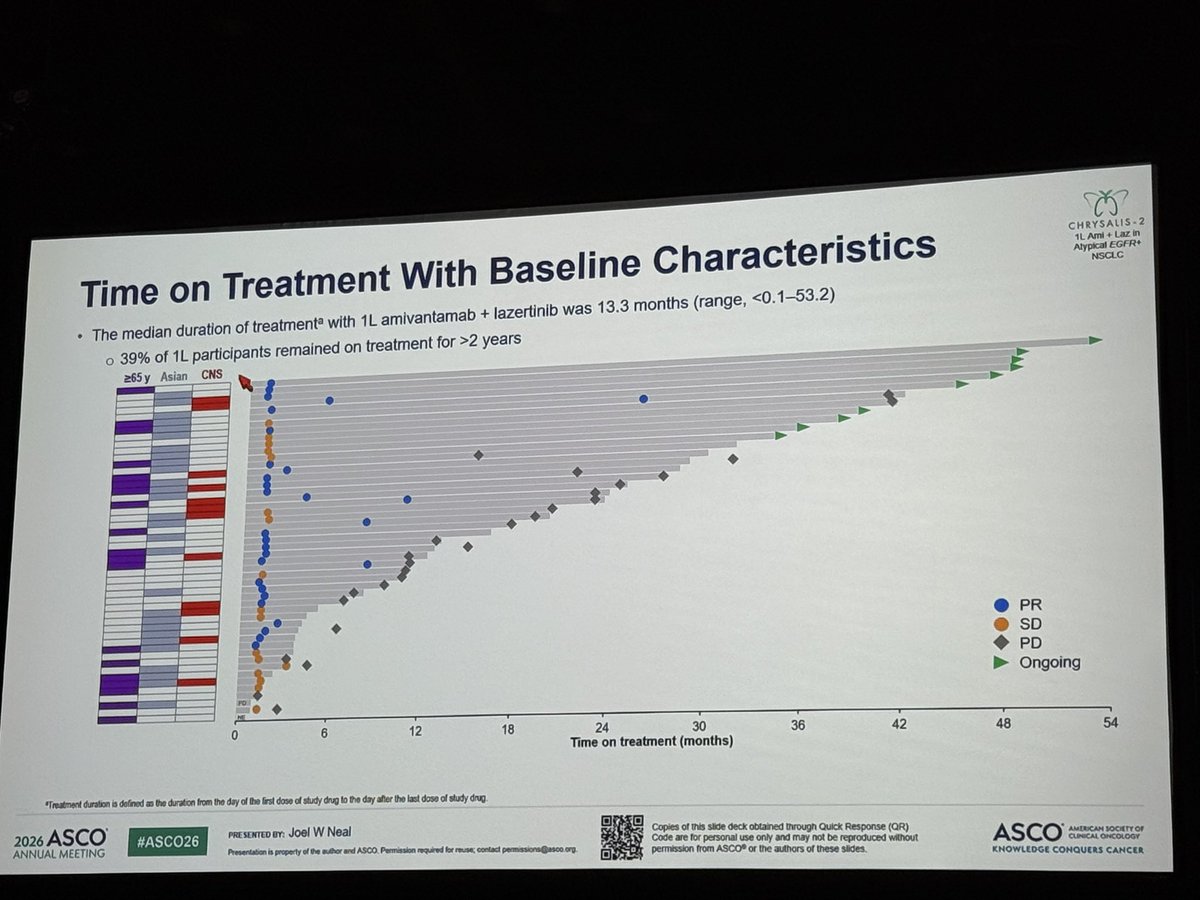
8 details 3 trials watching
Single-arm expansion cohort of the CHRYSALIS-2 program, n=49, 1L atypical EGFR-mutated advanced NSCLC. Median follow-up 31.3 mo. No randomised comparator arm.
Treatment-naive advanced NSCLC harbouring an atypical (uncommon) EGFR mutation. Baseline strata shown on the swimmer plot include age ≥65y, Asian ancestry and CNS involvement; per-stratum counts are not reported in source.
IV amivantamab (EGFR/MET bispecific) plus lazertinib (third-generation EGFR TKI). No chemotherapy backbone. Median duration of treatment 13.3 months (range <0.1-53.2), with 39% of 1L participants still on treatment beyond 2 years.
Median OS 41.0 mo (95% CI 27.7-NE), described by the presenters as roughly 3.5 years. The upper CI bound is not estimable, so the point estimate is anchored on the lower bound of 27.7 mo.
Reported only as consistent with prior reports, no new safety signals with longer follow-up. No grade 3+ rates, infusion-reaction rates or dermatologic AE rates appear in the source.
The atypical EGFR label pools biologically distinct alterations (G719X, S768I, L861Q and compound variants) whose single-agent TKI sensitivity differs; n=49 cannot resolve per-variant benefit, and the curator's read of no variant-outcome association is an absence of signal in a small cohort, not evidence of uniformity. No comparator, so the 41.0 mo median cannot be positioned against afatinib or osimertinib series in the same population.
Atypical EGFR is the part of the EGFR-mutant space where no regimen is settled, so a 41.0 mo median in 49 pts is meaningful as a benchmark even without randomisation. The practical question this leaves open is whether the bispecific's added toxicity and IV schedule are justified over an oral TKI alone, which this design cannot answer.
Single-arm n=49 expansion cohort, no randomised comparator against afatinib or osimertinib in atypical EGFR. Maturity gate: single-arm never reaches confirmatory.
- Doublet vs single-agent osimertinib or afatinib in atypical EGFR n=480 · primary completion 2029-02 · phase 3 firmonertinib vs osimertinib/afatinib, PACC 1L
- Which atypical EGFR variants drive the durable-response tail
- Whether subcutaneous amivantamab preserves efficacy with less infusion burden n=418 · primary completion 2024-01 · phase 3 SC vs IV ami + lazertinib, randomisedrecruiting A Study of Amivantamab in Participants With Advanced or Metastatic Solid Tumors Including Epidermal Growth Factor Receptor (EGFR)-Mutated Non-Small Cell Lung Cancer Phase 2n=520 · primary completion 2027-08 · SC co-formulation activity + safety cohorts
📚 Sources · 🐦 1 tweet
Amivantamab + lazertinib achieved a median OS of 41.0 months in treatment-naïve atypical EGFR-mutant NSCLC, with no clear association between EGFR variant subtype and outcome. A compelling option. Meanwhile, amivantamab continues evaluation across multiple tumor types. #ASCO26 pic.twitter.com/aWn3Ja60Ji
— Chul Kim (@chulkimMD) May 29, 2026
ESAONA
For1L EGFR-mutant NSCLC with brain metastases
95.5% vs 79.6%
p = 0.0004
TL;DRiORR 95.5% vs 79.6% (p=0.0004) and intracranial PFS HR 0.46 favoring asandeutertinib in 1L EGFR-mutant NSCLC with brain mets.
The RT-relevant number is intracranial PFS: median not reached vs 17.5 mo, HR 0.46. If a first-line TKI holds CNS disease that long, the deferral-of-brain-RT window widens, but the source reports no prior-RT stratification, no CNS-RT use by arm, and no lesion size or symptom criteria, so this cannot yet gate an SRS-versus-defer decision.
In treatment-naive EGFR-mutant NSCLC with asymptomatic brain metastases, this supports the case for TKI-first CNS control as a hypothesis, not a change in practice; it says nothing about symptomatic or large lesions where local therapy is already indicated.
Intracranial PFS median not reached vs 17.5 mo, HR 0.46, is the number that touches the SRS-timing decision in asymptomatic brain mets. The source gives no prior-RT stratification and no salvage-RT rates by arm, so the deferral question stays open rather than answered.
The intracranial effect (HR 0.46) is roughly double the systemic one (HR 0.64), so the case for asandeutertinib rests on CNS penetration rather than broad potency. Serious TRAEs run 10.8% vs 7.1%, a real but modest trade against a phase II endpoint with no OS.

| Endpoint | Asandeutertinib (n=111) | Osimertinib (n=113) | Effect |
|---|---|---|---|
| Intracranial ORR (BICR) | 95.5% (89.8-98.5) | 79.6% (71.0-86.6) | p = 0.0004 |
| Intracranial PFS (BICR) | Median not reached | 17.5 mo (15.18-NA) | HR 0.46, p = 0.0020 |
| Overall PFS (BICR) | Median not reached | 17.2 mo (15.18-19.55) | HR 0.64, p = 0.0473 |
| Any TRAE | 99.1% | 95.6% | n/a |
| Serious TRAE | 10.8% | 7.1% | n/a |
7 details 4 trials watching
Randomised phase II, N=224, asandeutertinib (n=111) vs osimertinib (n=113). Endpoints read by BICR. Follow-up duration, stratification factors and alpha allocation are not reported in the source slide.
First-line EGFR-mutated NSCLC with brain metastases. The source does not state lesion number, size, symptom status, or whether prior CNS radiotherapy was permitted, which is the eligibility gate an RT reader needs.
Intracranial ORR by BICR is the headline, with intracranial PFS and overall PFS reported alongside. No overall survival data in source.
Any TRAE 99.1% vs 95.6%; serious TRAE 10.8% vs 7.1%. The excess serious-event rate is small in absolute terms but sits on a phase II denominator, and no organ-level breakdown is given in source.
The intracranial separation (HR 0.46) is larger than the systemic one (HR 0.64), which points at CNS penetration rather than a general potency gain as the mechanism. For radiation oncology the question is whether that CNS margin is durable enough to defer SRS in asymptomatic pts; a phase II with unreached medians and no OS cannot answer it.
CONSORT flow
Phase II, conference-slide source only; no OS, borderline overall-PFS p, and no reported CNS-RT or prior-RT stratification. Needs phase III before displacing osimertinib.
- Does intracranial PFS benefit translate to overall survival
- Salvage brain RT and SRS rates by arm recruiting Observation or Upfront Cranial RT in Oncogene Mutated NSCLC With Asymptomatic BM: A Phase III RCT Phase 3n=190 · primary completion 2025-12 · randomises upfront SRS/WBRT vs TKI alone, asx BMrecruiting A Study of Stereotactic Radiosurgery (SRS) and Standard Treatment in People With Lung Cancer That Has Spread to the Brain Phase 2n=56 · primary completion 2027-12 · SRS after 3mo osimertinib vs osimertinib alonerecruiting Early or Delayed Intervention of Brain Radiotherapy Combined With Almonertinib in EGFR Mutated NSCLC With Brain Metastases Phase 3n=232 · primary completion 2028-12 · early vs delayed SRS timing on 3G TKI, phase 3
- Activity in symptomatic or leptomeningeal CNS disease recruiting A Clinical Trial of Furmonertinib Combined With Anlotinib as First-line Treatment for Advanced NSCLC With EGFR-sensitive Mutations and Brain Metastasis Phase 2n=146 · primary completion 2027-09 · 1L 3G TKI + anlotinib, brain/LM mets at dx
📚 Sources · 🐦 1 tweet
#ASCO26 🧠🌍
— Dr Rishabh Jain (@DrRishabhOnco) May 30, 2026
Could a next-generation EGFR TKI outperform osimertinib in patients with brain metastases?
The phase II ESAONA trial suggests the answer may be yes.
🧪 LBA2007 | ESAONA
1L EGFR-mutated NSCLC with brain metastases
👥 n=224
⚔️ Asandeutertinib vs Osimertinib
Key… https://t.co/mEOKGNKgf7 pic.twitter.com/pUQuH6i2cV
OptiTROP-Lung05 NCT06448312
For1L stage IIIB-IV NSCLC, PD-L1 TPS ≥1%, EGFR/ALK wild-type, ECOG 0-1
HR 0.35
95% CI 0.26-0.47, p<0.0001; NR vs 5.7 mo
TL;DRmPFS NR vs 5.7mo, HR 0.35 (0.26-0.47) for sac-TMT + pembro in 1L PD-L1+ NSCLC.
In treatment-naive PD-L1 TPS ≥1% advanced NSCLC without EGFR/ALK alteration, this supports a TROP2 ADC plus pembro as a chemo-free option worth watching; it does not address pts already committed to pembro plus platinum chemo, nor PD-L1-negative disease.

| Arm | PFS events, n (%) | Median PFS, mo (95% CI) | HR (95% CI) |
|---|---|---|---|
| Sac-TMT + Pembro (n=208) | 66 (31.7) | NR (13.6, NE) | 0.35 (0.26, 0.47), p<0.0001 |
| Pembro (n=205) | 128 (62.4) | 5.7 (4.3, 7.0) | n/a |
+3 more figures

| PD-L1 stratum | Sac-TMT + Pembro median, mo | Pembro median, mo | HR (95% CI) |
|---|---|---|---|
| TPS ≥50% | NR (NE, NE) | 9.5 (6.9, 13.8) | 0.47 (0.29, 0.77) |
| TPS 1-49% | NR (11.1, NE) | 4.3 (2.9, 5.5) | 0.28 (0.19, 0.41) |

| Arm | OS events, n (%) | Median OS, mo (95% CI) | HR (95% CI) |
|---|---|---|---|
| Sac-TMT + Pembro (n=208) | 33 (15.9) | NR (NE, NE) | 0.55 (0.36, 0.85) |
| Pembro (n=205) | 54 (26.3) | NR (NE, NE) | n/a |

13 details 3 trials watching
Randomized, multicenter, open-label phase 3 (NCT06448312), 1:1, N=413. Stratified by histology (squamous vs non-squamous), PD-L1 TPS (1-49% vs ≥50%), and ECOG (0 vs 1). Median follow-up 10.5 months at this analysis.
Locally advanced stage IIIB/IIIC or metastatic stage IV NSCLC with no prior systemic antitumor therapy. Required PD-L1 TPS ≥1% by IHC 22C3 central lab, no sensitizing EGFR or ALK alteration, ECOG 0 or 1.
Sac-TMT 4 mg/kg Q2W plus pembrolizumab 400 mg versus pembrolizumab 400 mg Q6W alone, until progression or unacceptable toxicity. Pembro was capped at a maximum of 18 cycles in both arms. One pt in the pembro group never received assigned treatment.
Primary: PFS by BICR. Key secondary: OS. Other secondary: investigator-assessed PFS, ORR, DCR, DOR, safety. The updated efficacy boundary at the actual 194 PFS events was 0.0174 (2-sided).
PFS crossed its boundary at p<0.0001. OS was descriptive at the PFS interim, HR 0.55 (0.36, 0.85) with both medians not reached and only 33 vs 54 deaths.
The pembro-alone control performed as expected for an all-comers TPS ≥1% population, with the TPS ≥50% arm reaching 9.5 mo and the TPS 1-49% arm 4.3 mo, consistent with the KEYNOTE-042 signal that low-expressors gain least from single-agent IO. This is the setting where chemo-IO has historically been chosen, so the trial tests whether an ADC can occupy that slot instead of platinum doublet chemotherapy.
No toxicity data in the source, which is the decisive missing piece for a doublet whose entire premise is avoiding chemotherapy. The comparator is pembro monotherapy rather than the chemo-IO most oncologists actually give at TPS 1-49%, so the PFS gap partly measures a weak control rather than a strong experimental arm.
An HR of 0.35 with a median not reached is a large PFS effect, and the OS point estimate moves in the same direction, but neither settles whether sac-TMT plus pembro beats the regimen it would actually replace. The larger effect in TPS 1-49% (HR 0.28) than TPS ≥50% (HR 0.47) is the expected pattern when the control arm is weakest in the low-expressors, not evidence of a biomarker-selected ADC effect.
CONSORT flow
PFS interim of an open-label phase 3; OS descriptive at 10.5 mo f/u with both medians NR. No safety data in source, and no comparison vs pembro + chemo.
- Benefit vs pembrolizumab plus platinum chemotherapy, the real-world comparator n=614 · primary completion 2028-01 · phase 3 sac-TMT + pembro vs pembro alone, TPS >=50%, OSrecruiting Pembrolizumab With or Without Maintenance Sacituzumab Tirumotecan (Sac-TMT; MK-2870) in Metastatic Squamous Non-small Cell Lung Cancer (NSCLC) [MK-2870-023] Phase 3n=851 · primary completion 2029-01 · 1L sq NSCLC: pembro + platinum backbone, sac-TMT maint
- Safety and ILD rates of sac-TMT combined with pembrolizumab n=30 · primary completion 2026-12 · phase 1 safety/tolerability of sac-TMT + pembro
- Whether the OS signal holds at the final prespecified analysis
📚 Sources · 🐦 2 tweets
Right patient. Right treatment. Right timing.
— Yakup Ergün (@dr_yakupergun) May 30, 2026
The result: curves like these👇#ASCO26 https://t.co/72KByLKz90
🔁REVIEW #ASCO26 #LCSM Oral
— Hidehito HORINOUCHI (@HHorinouchi) May 30, 2026
🔥OptiTROP-Lung05: 1L Sac-TMT + Pembro vs Pembro in PD-L1+ NSCLC
✅mPFS NR vs 5.7m (HR 0.35)
✅ORR 70.2% vs 42.0%
✅OS HR 0.55 (95%CI 0.36-0.85, immature)
🎙️Dr. Caicun Zhou
🔗 https://t.co/DcbK1dGrhO@OncoAlert @Larvol @ASCO @IASLC https://t.co/512k6dZviW pic.twitter.com/Vdo86N50h9
PEACE V-STORM NCT03569241
ForPelvic nodal oligorecurrence (≤5 nodes) on PET after radical local therapy
63% vs 76% at 4yr
HR 0·62 (80% CI 0·44-0·86), p=0·063; α set at 0·20
TL;DR4yr MFS 76% vs 63% with elective pelvic nodal RT over MDT, HR 0·62 (80% CI 0·44-0·86), p=0·063.
The clean radiation read is locoregional control, not MFS: 85% vs 62% at 4 years, HR 0·45 (80% CI 0·31-0·65), and pelvic nodal relapse fell from 29% to 8%. Toxicity did not follow the field: grade 2+ GI 9% vs 7%. Prostate bed inclusion, not pelvic volume, drove GI events (OR 4·6 [95% CI 1·5-15·8]).
In a man with ≤5 PET-positive pelvic nodes after prostatectomy or definitive RT, this supports treating the whole pelvis with a nodal boost rather than nodes alone when 6 months of ADT is being given; it says nothing about node-negative biochemical relapse or extrapelvic disease.
Field size is the whole question and locoregional control is the clean answer: 85% vs 62% at 4 years, HR 0·45, with pelvic nodal relapse 8% vs 29%. The deliverable is 45 Gy/25 fx whole pelvis to L4-L5 with a 65 Gy SIB, and the added pelvic volume cost nothing in GI toxicity (9% vs 7%); the prostate bed did (OR 4·6).
Both arms received an identical 6 months of ADT, so nothing here changes systemic choice, but ADT-free survival was 77% vs 60% at 4 years (HR 0·60) with median time off ADT beyond 48 months. For men who would otherwise be considered for ADT intensification on PSA doubling time, local therapy is competing for the same population.
8 details
Phase 2, open-label, randomised 1:1, investigator-initiated, 21 hospitals across Australia, Belgium, Italy, Norway, Spain and Switzerland. Recruited June 11, 2018 to April 30, 2021; median follow-up 50 months (IQR 42-58). Stratified by PET tracer (choline vs PSMA) and MDT type (sLND vs SBRT); participants and investigators unmasked.
Biochemical relapse after radical prostatectomy, postoperative RT, or definitive RT, with up to five PET-detected pelvic nodes (pelvis defined up to the aortic bifurcation, common iliac included). Bone, visceral, or above-bifurcation nodal disease excluded, as was previous RT overlapping current fields. Median age 70-71, median PSA at inclusion 1·00 vs 0·85 ng/mL, 91% and 86% EAU high-risk BCR, and 55-62% had a single positive node.
MDT arm: SBRT 30 Gy in 3 fractions every other day to 90% of the PTV with a 3 mm margin, or salvage lymph node dissection. ENRT arm: 45 Gy in 25 fractions to the whole pelvis on a modified RTOG 2009 template (upper limit L4-L5) with a simultaneous integrated boost to 65 Gy on PET-positive nodes; IMRT or rotational technique mandatory, with a benchmark-case QA programme. Prostate bed RT (≥66 Gy/33 fx) was advised for pT3-4, Gleason ≥8, or positive margins and given to 25% of MDT and 41% of ENRT pts.
Both groups received 6 months of LHRH agonist or antagonist, started no later than the first fraction (or day 1-10 postoperatively after sLND). Every patient who started intended local therapy plus ADT completed it. Physicians were instructed not to restart ADT absent clinical progression.
Primary: metastasis-free survival (any M1 on PET or death), with local or pelvic nodal relapse explicitly NOT counted as an event. Secondary: biochemical RFS, locoregional RFS, ADT-free survival, and late grade 2+ GU/GI toxicity to 48 months. OS, prostate cancer-specific survival, and time to castration resistance had insufficient events and are deferred.
Grade 2+ GU events above baseline at 4 years were 28% MDT vs 31% ENRT (absolute difference 3%, p=0·73) and grade 2+ GI 7% vs 9% (difference 2%, p=0·93). Most common grade 3 events were urinary incontinence (6% vs 10%) and diarrhoea (1% vs 2%). In post-hoc analysis the driver of toxicity was the prostate bed, not the pelvic volume: GI OR 4·6 (95% CI 1·5-15·8), p=0·0085 and GU OR 1·85 (0·95-3·60), p=0·068 with bed inclusion. No treatment-related deaths.
The single-arm GETUG-P07 OLIGOPELVIS reported 3-year bRFS of 45% for ENRT against 57% at 4 years here, though its median PSA was 3-4 ng/mL and staging was choline-based, so the populations differ. Against the ADT-intensification trials, EMBARK and PRESTO enrolled the PSA-doubling-time population that simulations put at up to 40% pelvic nodal relapse on PET, and this trial's median time off ADT exceeded 48 months in MDT and was not reached in ENRT, versus 13-18 months with RT alone and 16-17 months with ADT alone across earlier series.
No central PET review at baseline or follow-up, so the primary endpoint depends on local reads (authors cite κ 0·74 for pelvic nodes). Curves did not separate in year 1 because of the shared 6 months of ADT, which strains the proportional hazards assumption the HR summarises. The open-label design plausibly biased adverse-event attribution in both directions, and prostate bed RT was left to physician discretion, so a treatment that materially changed both toxicity and local recurrence was not randomised.
The result reads as a field-size question answered on pattern of failure rather than on distant control: relapse after MDT was predominantly locoregional, meaning PSMA PET missed nodal disease in at least half of pts treated to visible targets only. That reframes ENRT less as escalation than as compensation for imaging sensitivity that has not caught up with the treatment paradigm it enabled.
| Endpoint | MDT | ENRT | HR (80% CI) | p |
|---|---|---|---|---|
| MFS (1°) | 63% (56-69) | 76% (69-81) | 0·62 (0·44-0·86) | 0·063 |
| Biochemical RFS | 41% (34-47) | 57% (50-64) | 0·62 (0·48-0·80) | 0·014 |
| Locoregional RFS | 62% (55-69) | 85% (80-90) | 0·45 (0·31-0·65) | 0·0047 |
| ADT-free survival | 60% (53-67) | 77% (70-82) | 0·60 (0·43-0·83) | 0·049 |
CONSORT flow
Phase 2 powered at α=0·20; primary MFS p=0·063 would not clear conventional significance, and the authors themselves await a phase 3 (POINTER-PC).
- Does the MFS benefit hold at conventional significance in phase 3
- Is ENRT plus ADT better than intermittent ADT alone
- Should prostate bed RT be omitted when PSMA PET is bed-negative
📚 Sources · 📄 1 paper
Single-fraction SABR pooled analysis, 1687 pts
ForPrimary NSCLC or pulmonary oligomets selected for single-fraction SABR
TL;DRLocal control 90-93% at 2yr and G3+ AEs 2.9% across 1687 single-fraction SABR pts at 3 centres.
The oligomet read is the gap between local control and PFS: 90-93% LC at 2yr against median PFS 11 mo, so distant failure, not the treated lesion, drives the course. For primary NSCLC the same LC sits with median PFS 30 mo, which is the split that should decide whether one-visit ablation is offered as definitive treatment or as a break from systemic therapy.
In early-stage primary NSCLC where visit burden drives the fractionation choice, this supports single fraction as a durable local option (LC 90-93% at 2yr, G3+ 2.9%); tumour location and operability are not reported, so who it represents stays open.
Local control holds at 90-93% at 2yr for a primary and for a metastasis alike, so the single fraction is not the variable separating outcomes; median PFS is (30 vs 11 mo). Tumour size and location go unreported, so the target selection behind that number is unmeasured.
For a pt with pulmonary oligometastases, one-visit ablation gave 90-93% local control at 2yr but median PFS of 11 mo, so it clears the treated lesion without changing the systemic course. That frames referral as a local step between systemic lines, not a substitute for one.
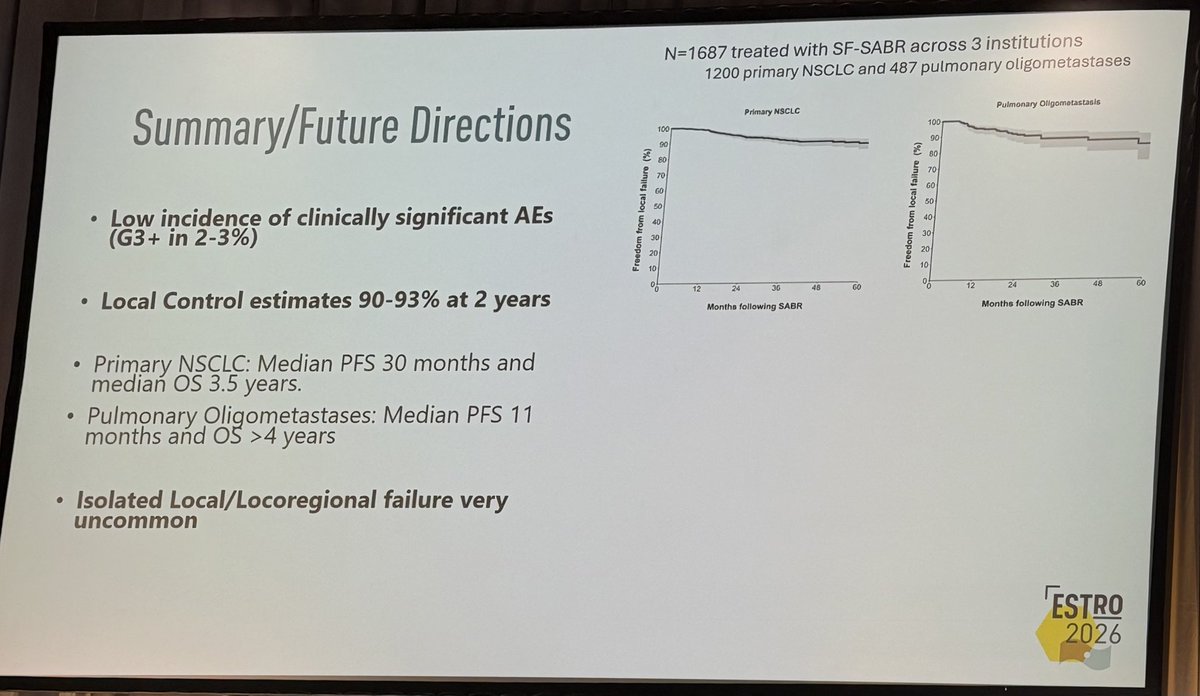
| Cohort | n | Median PFS | Median OS |
|---|---|---|---|
| Primary NSCLC | 1200 | 30 mo | 3.5 yrs |
| Pulmonary oligometastases | 487 | 11 mo | >4 yrs |
+2 more figures
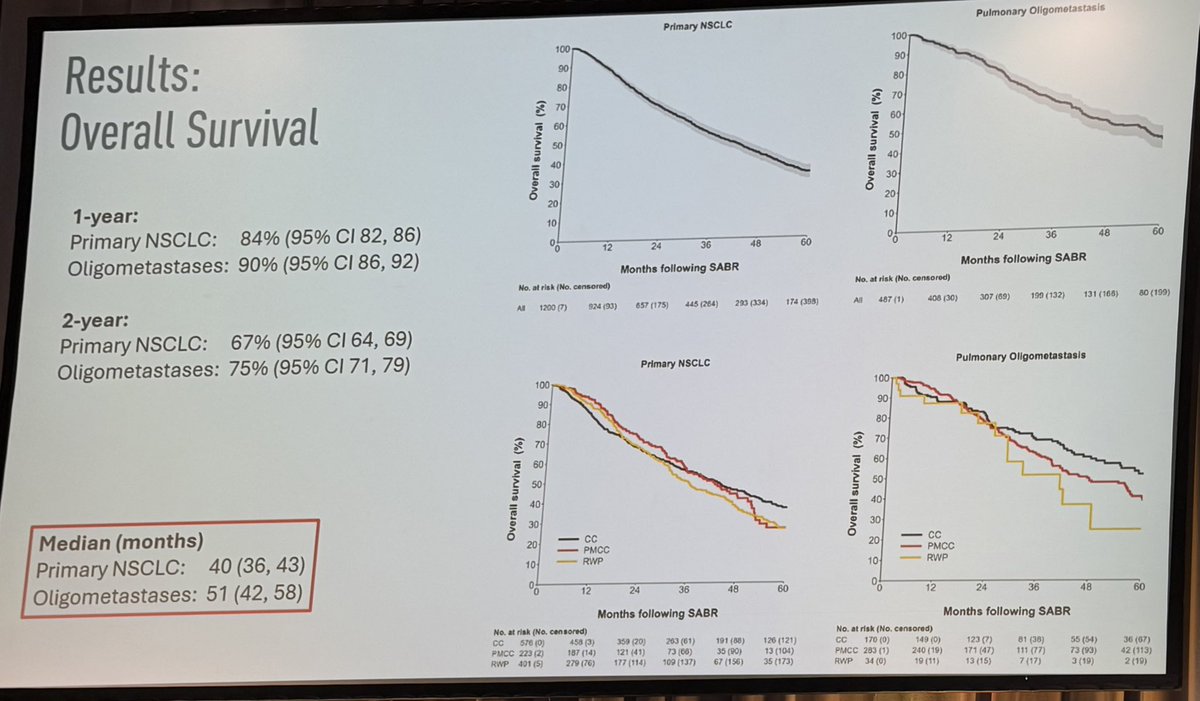
| Endpoint | Primary NSCLC | Oligometastases |
|---|---|---|
| 1yr OS | 84% (95% CI 82, 86) | 90% (95% CI 86, 92) |
| 2yr OS | 67% (95% CI 64, 69) | 75% (95% CI 71, 79) |
| Median OS | 40 mo (36, 43) | 51 mo (42, 58) |
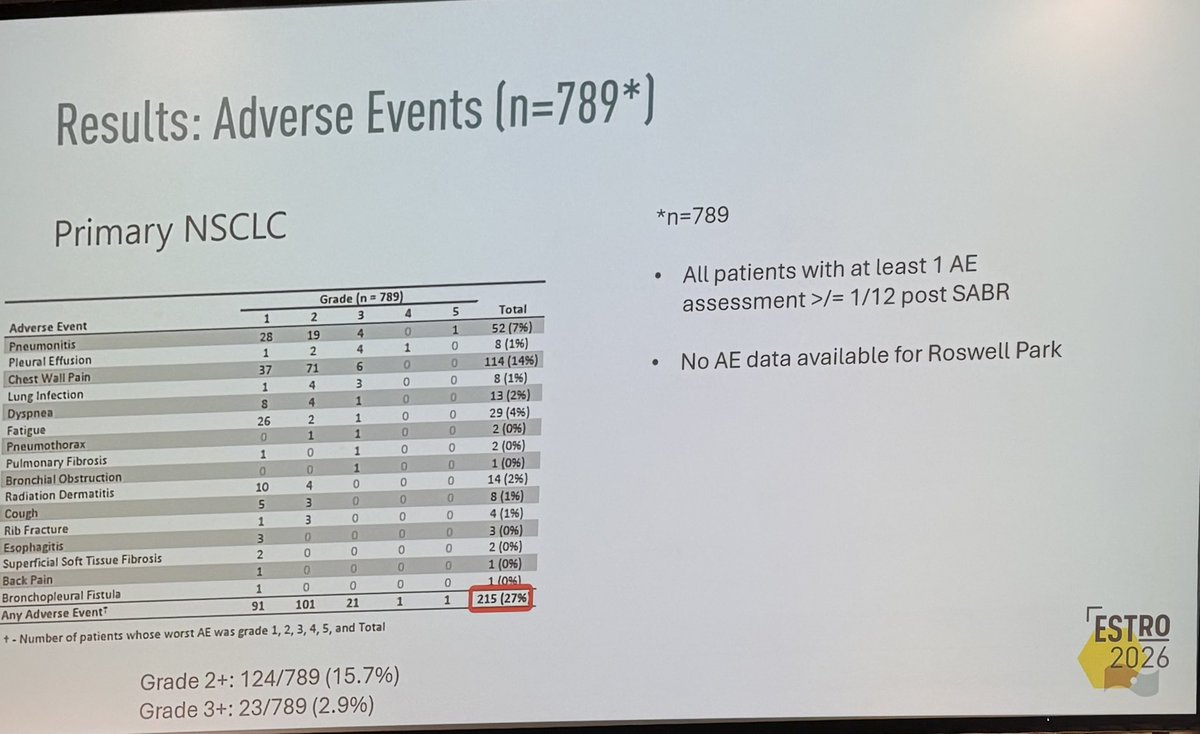
| Adverse event (n=789) | n (%) |
|---|---|
| Any AE | 215 (27%) |
| Grade 2+ | 124 (15.7%) |
| Grade 3+ | 23 (2.9%) |
| Chest wall pain | 114 (14%) |
| Pneumonitis | 52 (7%) |
| Fatigue | 29 (4%) |
| Dyspnea | 13 (2%) |
6 details
Pooled analysis of 1687 pts treated with single-fraction SABR at three centres (Peter MacCallum, Cleveland Clinic, Roswell Park): 1200 primary NSCLC and 487 pulmonary oligometastases. Whether the contributing cohorts were prospective or retrospective is not stated in source.
Eligibility, operability, tumour size and central vs peripheral location are not reported in source. Cohort mix differs sharply by centre: Roswell Park supplied 401 of the NSCLC pts but only 34 oligomet pts, while Peter Mac supplied 283 of 487 oligomet pts.
Single fraction throughout, but the prescribed dose is not reported in source. Without it the outcome cannot be mapped onto a schedule a reader could write, which is the one parameter that would carry this into planning.
No primary endpoint is stated in the source. Reported outcomes are local control, freedom from local failure, PFS, OS and adverse events, each descriptive rather than tested against a comparator.
Local control 90-93% at 2 years across both cohorts, with isolated local or locoregional failure described as very uncommon. Survival separates by cohort while local outcome does not.
| Centre | Primary NSCLC | Pulmonary oligomets |
|---|---|---|
| Cleveland Clinic | 576 | 170 |
| Peter MacCallum | 223 | 283 |
| Roswell Park | 401 | 34 |
AE reporting covers 789 primary NSCLC pts only, with no Roswell Park data and no oligometastasis toxicity in source. Within that subset chest wall pain and pneumonitis dominate and G3+ events stay at 2.9%.
Single-fraction SABR already carries randomised support: RTOG 0915 in peripheral early-stage NSCLC and SAFRON II in pulmonary oligometastases, both randomised single against multi-fraction schedules. This series adds scale and follow-up at three high-volume centres, which is what a non-randomised dataset can contribute, and no comparator.
Toxicity rests on 789 of 1687 pts, with one centre absent from the AE table and the oligometastatic cohort not represented in it at all. Centre mix is uneven, so pooled rates carry each centre's own selection rather than a common one.
The question the thread raises, whether one-stop SABR should be used more often, is not the question this dataset answers. What it does show is that local control near 90-93% and G3+ toxicity near 3% hold at scale outside a protocol, which is the usual worry about a schedule with no second chance. The unreported dose sits between that reassurance and a prescription.
Pooled uncontrolled series across three centres, no multi-fraction comparator and no stated design; dose unreported, so outcomes cannot be tied to a prescription.
- Whether single-fraction outcomes hold for central tumours
- Durability of single-fraction ablation for pulmonary oligometastases beyond first progression
- Toxicity of single-fraction SABR in the oligometastatic cohort
📚 Sources · 🐦 1 tweet
👏🏽👏🏽👏🏽@neildwallaceie at #ESTRO26 - 1687 patients receiving single fraction SABR for #lungcancer and pulmonary oligomets, @PeterMacRadOnc / @ClevelandClinic / @RoswellPark. Fantastic local control, and low adverse rates. Should we be using “one stop” SABR more often #radonc ? pic.twitter.com/w2IlGKRU5o
— Shankar Siva (@_ShankarSiva) May 18, 2026
OPERA
ForRectal cancer on watch-and-wait pathway after neoadjuvant therapy
TL;DRW14 clinical response (DRE+rectoscopy) identified 76% good responders; 5yr organ preservation 75% A vs 83% B, p=0.24.
The transferable read is timing: response can be called at W14, one month after NAT ends, on DRE plus rectoscopy, with MRI TRG1-2 concordance of 98% (80/82). nCR at W14 preserved organs as well as cCR (77% vs 81%), so a near-complete response reflecting radiation effect does not by itself send a patient to TME.
In rectal pts on a watch-and-wait pathway, this supports assessing response at W14 rather than deferring to W24 and reassessing nCR rather than treating it as failure; it does not address pts never eligible for organ preservation.
Response can be called at W14, one month after NAT ends, on DRE plus rectoscopy, with MRI TRG1-2 concordance of 98% (80/82). nCR at that point preserved organs as well as cCR (77% vs 81%), so a near-complete response reflecting radiation effect does not itself justify TME.
The surgical decision this moves is when to abandon watch-and-wait. A W14 nCR reached 5yr organ preservation of 77% versus 81% for cCR, so early near-complete response is not evidence for proceeding to TME. Regrowth and salvage counts are not reported in source.
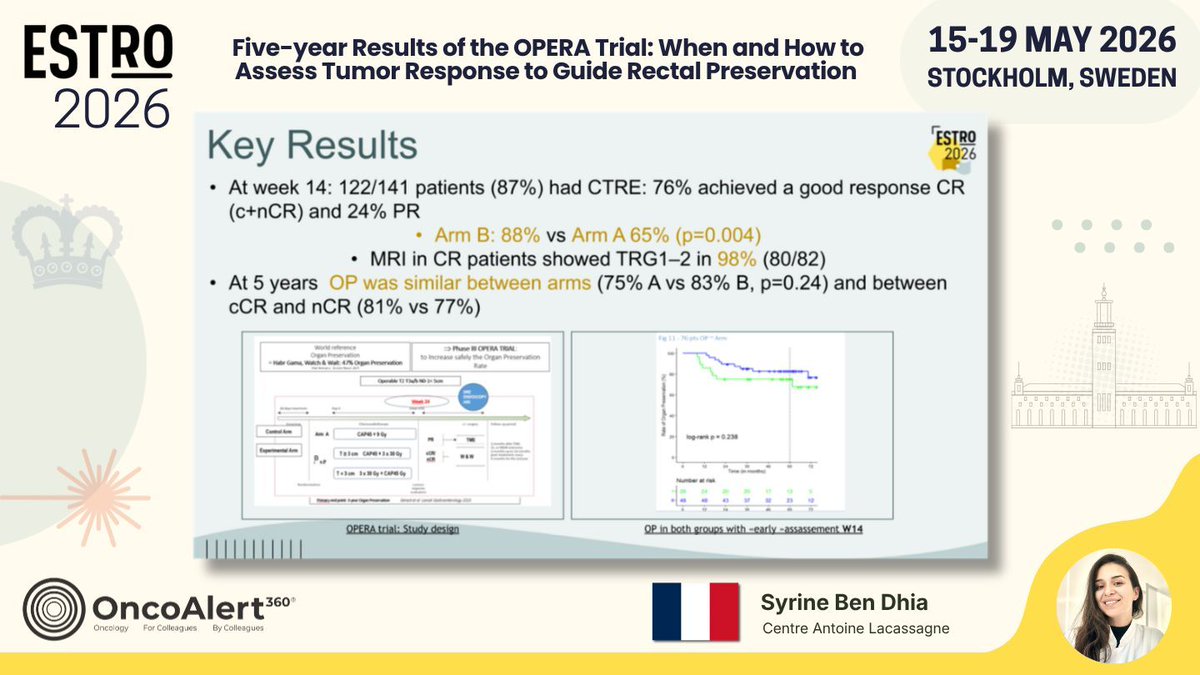
| Endpoint | Arm A | Arm B | Overall |
|---|---|---|---|
| W14 good response (cCR+nCR) | 65% | 88% | 76% |
| W14 partial response | n/a | n/a | 24% |
| 5yr organ preservation | 75% | 83% | p=0.24 |
| CTRE performed at W14 | n/a | n/a | 122/141 (87%) |
+2 more figures


10 details
Post-hoc analysis of the randomised OPERA trial (two arms, A and B), reporting 5-year organ-preservation outcomes. The parent trial assessed response at week 24 with a three-modality triad (DRE, rectoscopy, MRI); this analysis asks whether the week 14 read is good enough.
Week-14 clinical tumor response evaluation (CTRE) by DRE and rectoscopy, categorised CR / nCR / PR, with cCR + nCR counted as a "good" clinical response. MRI graded by TRG. CTRE was correlated with relapse and 5-year organ-preservation rates.
Both arms received neoadjuvant therapy with organ preservation as the goal, and good responders at W14 either proceeded to organ preservation or were reassessed at W24. Dose, fractionation, and the content distinguishing Arm A from Arm B are not reported in source, which limits how far the arm difference transfers.
CTRE was obtainable in 122/141 (87%) at W14. MRI confirmed TRG1-2 in 98% (80/82) of clinical CR pts, and 5-year organ preservation did not differ by arm (p=0.24) or by response depth (cCR 81% vs nCR 77%).
Watch-and-wait practice has largely settled on later response assessment, with the OPRA framing of consolidation timing and the registry experience both anchoring the decision point well beyond three months. This analysis argues the clinical exam carries most of that information a month after NAT ends, which is earlier than the field currently commits.
The 19 pts without CTRE at W14 (141 minus 122) are unaccounted for in source, and selective assessability would bias the 76% good-response figure upward. The arm difference (88% vs 65%, p=0.004) is uninterpretable here because the randomised contrast is not described.
The clinically useful claim is that nCR is a radiation effect, not residual tumor, and the 5-year organ-preservation parity between cCR and nCR (81% vs 77%) is the evidence for it. What the source does not settle is regrowth: organ preservation at 5 years is a net figure that can absorb salvage, so equal preservation does not establish equal local control.
Post-hoc timepoint analysis of 141 pts; W14 vs W24 assessment was never randomised, and no relapse or regrowth data reported in source.
- Regrowth and salvage rates behind the 5yr organ preservation figures
- What distinguished Arm A from Arm B
- Outcomes of the 19 pts without W14 CTRE
📚 Sources · 🐦 1 tweet
Day FOUR of #ESTRO26 Coverage by OncoAlert 🚨
— OncoAlert (@OncoAlert) May 18, 2026
Five-year Results of the OPERA Trial: When and How to Assess Tumor Response to Guide Rectal Preservation Presented by Syrine Ben Dhia 🇫🇷 #RadOnc ☢️
This post-hoc analysis of the OPERA trial evaluated early tumor response… pic.twitter.com/KUanFTxeFh
HEAT NCT01794403
ForLocalized low- to intermediate-risk prostate, IPSS <12, gland <80 cc
7% vs 7.4%
p-non-inferiority = 0.007 at 4.25y, margin 12%
TL;DRInterim: BF 7% vs 7.4% at 4.25y, p-non-inferiority 0.007, 5-fx SBRT non-inferior to 26-fx IMRT with ADT allowed.
The design detail that transfers is the SIB: 36.25 Gy/5 fx with GTV boost to 40 Gy, against a 70.2 Gy/26 fx IMRT comparator rather than conventional fractionation, with ≤6 months ADT permitted in both arms. That combination is closer to what most departments now offer than HYPO-RT-PC or PACE-B, so it addresses whether 5 fractions holds up when the control arm is already moderately hypofractionated.
In localized low- to intermediate-risk disease with IPSS <12 and gland under 80 cc, including men receiving short-course ADT, this supports 5-fraction SBRT as an option against moderate hypofractionation; it does not speak to high-risk disease or nodal coverage.
The transferable parameters are 36.25 Gy/5 fx with GTV SIB to 40 Gy against a 70.2 Gy/26 fx IMRT comparator, with ≤6 months ADT permitted in both arms. Acute G2+ GI favored 5 fractions and late G2+ GI and GU were comparable at median 59.7 months, so this moves the fractionation choice in low- to intermediate-risk disease.
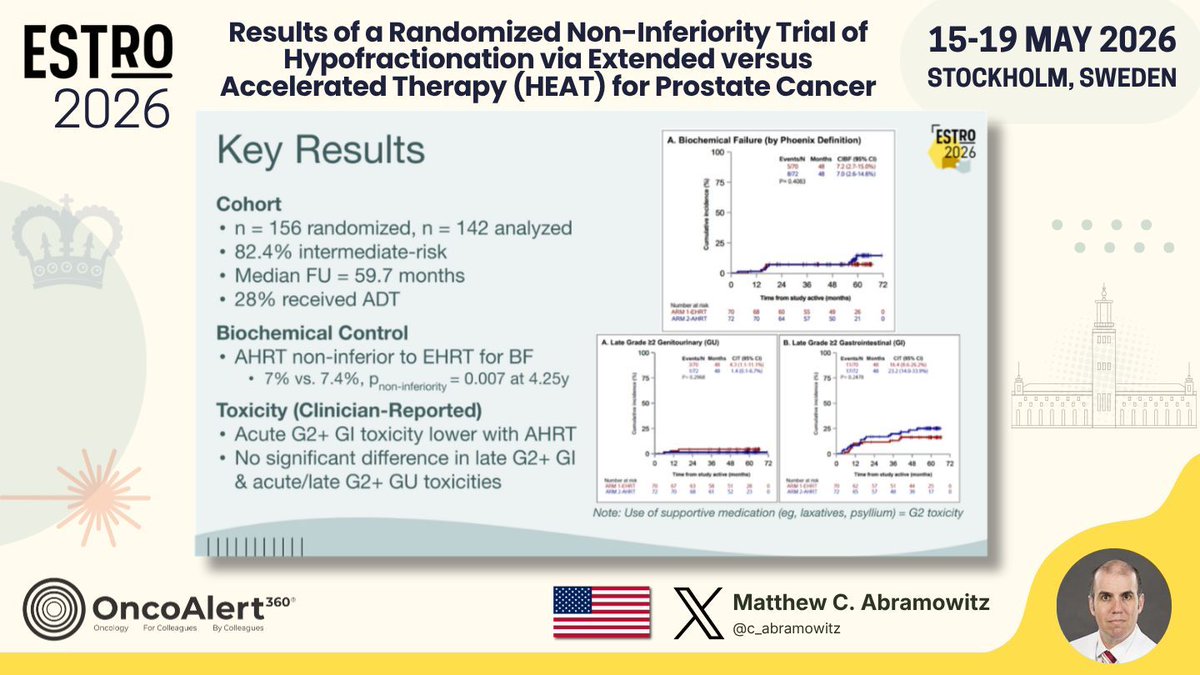
+2 more figures
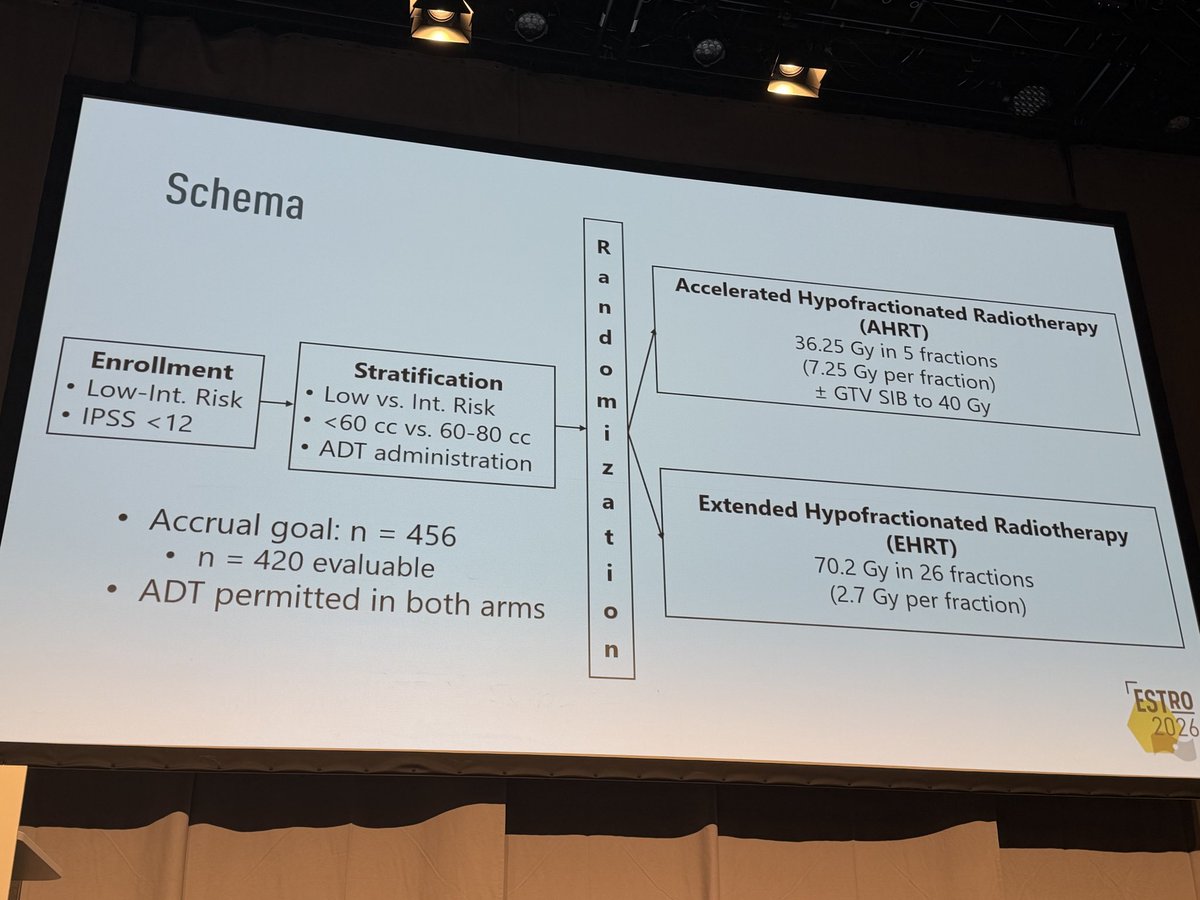
| Arm | Dose | Fractions | Dose per fraction |
|---|---|---|---|
| AHRT | 36.25 Gy (+ GTV SIB to 40 Gy) | 5 | 7.25 Gy |
| EHRT | 70.2 Gy | 26 | 2.7 Gy |
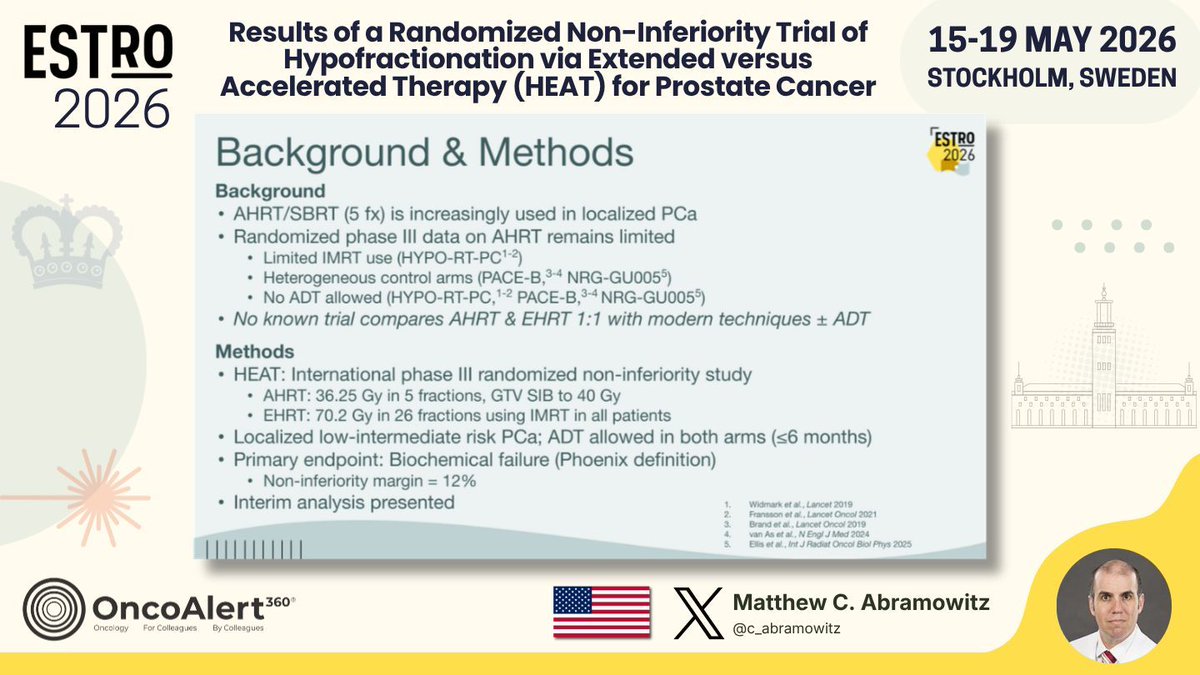
9 details 5 trials watching
International phase III randomized non-inferiority trial, 1:1, comparing accelerated (AHRT) vs extended (EHRT) hypofractionation. Interim analysis presented; accrual goal n = 456 with 420 evaluable, and 142 analyzed so far. Median follow-up 59.7 months.
Localized low- to intermediate-risk prostate cancer with IPSS <12. Stratified by risk group, prostate volume (<60 cc vs 60-80 cc) and ADT administration. 82.4% intermediate-risk; 28% received ADT.
AHRT: 36.25 Gy in 5 fractions (7.25 Gy per fraction) with GTV SIB to 40 Gy. EHRT: 70.2 Gy in 26 fractions (2.7 Gy per fraction), IMRT in all patients. ADT permitted in both arms, ≤6 months.
Primary: biochemical failure, Phoenix definition, with a non-inferiority margin of 12%. Clinician-reported acute and late GI and GU toxicity reported alongside.
BF 7% vs 7.4%, p-non-inferiority = 0.007 at 4.25y, meeting the non-inferiority criterion.
Acute G2+ GI toxicity lower with AHRT. No significant difference in late G2+ GI or in acute or late G2+ GU. Note that use of supportive medication (laxatives, psyllium) was scored as G2.
The presenters position HEAT against HYPO-RT-PC (limited IMRT use), PACE-B and NRG-GU005 (heterogeneous control arms), all of which allowed no ADT. HEAT is framed as the first trial comparing AHRT and EHRT 1:1 with modern technique plus ADT.
Event counts are low (7% vs 7.4%) against a 12% margin, so the interval around the difference is wide relative to the difference being excluded. The comparator is itself hypofractionated, so this does not test 5 fractions against conventional fractionation.
The question HEAT answers is narrower than 'does SBRT work': it asks whether 5 fractions holds when the control arm is already 26 fractions of IMRT and short ADT is on the table. A positive interim read supports 5 fractions as a default offer in this risk band, but the final prespecified analysis is what settles it.
Interim analysis at 142 of a planned 420 evaluable; prespecified final primary analysis is the gate. Wide 12% margin relative to observed event rates.
- Does non-inferiority hold at the final prespecified analysis
- Effect of concurrent ADT on the fractionation comparison n=60 · primary completion 2028-02 · randomises SBRT +/- relugolix in cFIR/cgUIRn=130 · primary completion 2028-11 · adds ultra-short ADT to single-fraction SBRT
- Late GU outcomes beyond 5 years with 7.25 Gy fractions n=100 · primary completion 2027-10 · 36.25 Gy/5 fx, 1-2mm PTV, late urethra toxicityn=175 · primary completion 2028-12 · 3 fx vs 5 fx benchmark, late GU grade 2+ 1° EPrecruiting Erectile Dysfunction in Good Prognosis Prostate Cancer : Comparison Between Brachytherapy and Stereotactic Body Radiotherapy Phase NAn=240 · primary completion 2030-04 · 7.25 Gy x5 vs I-125 brachy, f/u to 2030
📚 Sources · 🐦 2 tweets
Day FOUR of #ESTRO26 Coverage by OncoAlert 🚨
— OncoAlert (@OncoAlert) May 18, 2026
Results of a Randomized Non-Inferiority Trial of Hypofractionation via Extended versus Accelerated Therapy (HEAT) for Prostate Cancer Presented by Matthew C. Abramowitz🇺🇸 #RadOnc ☢️ #ProstateCancer
HEAT is an international phase… pic.twitter.com/IkSTgQHwXK
The HEAT trial is another randomized demonstration of the safety & efficacy of SBRT compared to hypofractionted RT in #prostatecancer at #ESTRO26 pic.twitter.com/c9sNb3KOqo
— Pierre Blanchard, MD (@PBlanchardMD) May 18, 2026
INRT-AIR & DARTBOARD pooled analysis
ForHNSCC oropharynx/larynx/hypopharynx, stage I-IVB, excluding T1-2N0 larynx
TL;DR5yr solitary elective nodal recurrence 0% with ENI omission in HNSCC; 5yr OS 87%, PFS 74%, n=117.
The number that matters is 0% solitary elective nodal recurrence at 5 yrs: elective volumes are where the parotid, constrictor and pharyngeal dose lives, and this is the first pooled long-term read that omitting them does not trade nodal control. MDADI 84.9 at 12 mo with no significant decline is the swallowing correlate. No dose or CTV detail in source, so the contouring approach cannot be replicated from this abstract.
In stage I-IVB oropharynx, larynx or hypopharynx SCC being planned for definitive chemoRT, this supports enrolling on an INRT protocol rather than adopting nodal omission off-trial; it does not extend to T1-2N0 larynx, which was excluded.
This is the elective-volume decision, the one de-escalation lever definitive chemoRT has never randomised. 0% solitary elective nodal recurrence at 5 yrs with MDADI 84.9 at 12 mo says the trade is not nodal control, but the nodal selection ran through an AI model on staging PET/CT, so the transferable piece may be the selection step, not the omission.

+1 more figure

11 details 2 trials watching
Patient-level pooled analysis of 2 prospective trials, INRT-AIR and DARTBOARD, both testing involved nodal radiotherapy. N=117, median follow-up 3.4 years. No randomised comparator arm receiving standard elective nodal irradiation.
HNSCC of oropharynx, larynx, and hypopharynx, stage I-IVB, explicitly excluding T1-2N0 larynx. Completed PET/CT and neck CT were required for eligibility, which is also the imaging substrate the nodal-selection step depends on.
Definitive chemoradiotherapy with omission of elective nodal irradiation (ENI), treating involved nodes only (INRT). Suspicious node identification was assisted by an artificial-intelligence model reading the staging PET/CT and neck CT. Dose, fractionation and margin expansions are not reported in the source.
5-yr solitary elective nodal recurrence 0%. 3-yr cumulative incidence: local 9.5%, regional 4.3%, distant 11%. 5-yr OS 87%, PFS 74%. Mean composite MDADI 84.9 at 12 months with no significant decline after treatment.
Pooling two protocols with different designs into one patient-level cohort assumes their INRT definitions were interchangeable, which the source does not establish. Median follow-up of 3.4 years supports a 5-year estimate on a shrinking risk set, and HPV status, which drives OS in an oropharynx-weighted cohort, is not reported.
The zero solitary elective nodal failures make the mechanistic case that undissected, PET-negative elective levels rarely harbour disease that only ENI would sterilise. What the pooled cohort cannot settle is whether the result survives outside two experienced centres using an AI-assisted nodal-selection step, which is precisely the component a general department would have to reproduce.
Pooled single-arm prospective cohorts, n=117, no randomised comparator against standard elective nodal RT. Presenters state randomised evidence needed before non-trial use.
- Randomised INRT vs elective nodal irradiation in definitive chemoRT recruiting Dose De-escalation and Sentinel LN Mapping Driven Radiotherapy of Contralateral Neck in Ipsilateral Node Positive HNSCC Phase NAn=147 · primary completion 2027-01 · sentinel node mapping tailors contralateral neck volumerecruiting Invert-Prospective Phase II Randomized Trial of Involved Nodal Versus Elective Neck RadioTherapy Phase 2n=80 · primary completion 2028-07 · randomised INRT vs ENI, solitary elective recurrence
- Does AI-assisted nodal selection outperform physician contouring
- Whether INRT toxicity benefit is measurable against standard elective volumes
📚 Sources · 🐦 1 tweet
Day FOUR of #ESTRO26 Coverage by OncoAlert 🚨
— OncoAlert (@OncoAlert) May 18, 2026
Omission of elective nodal irradiation in HNSCC: long-term results and patient-level pooled analysis from 2 prospective trials (INRT-AIR & DARTBOARD)
Presenter Sympascho Young 🇺🇸
A patient-level pooled analysis of 117 patients… pic.twitter.com/KaaT70nSNH
FASTRACK II NCT02613819
ForPrimary RCC ≤10cm, T1b-dominant, medically inoperable or declined surgery
100% at 36, 60, 84 mo
ITT population, RECIST-assessed, median f/u 62 mo
TL;DR100% freedom from local progression at 36, 60, and 84mo after single-fraction 26Gy or 42Gy/3fx SABR in inoperable primary RCC.
The transferable detail is the size-adapted prescription: 26Gy in one fraction under 4cm, 42Gy/3fx above it, with median tumour 46mm and 65% T1b or higher. That is a larger-tumour cohort than most ablation series, and zero local failures out to 84mo supports offering SABR when a 77-year-old is turned down for nephrectomy.
In a medically inoperable or surgery-declining patient with a primary RCC up to 10cm, including T1b and larger where thermal ablation is a poor fit, this supports SABR as a durable local option; it does not speak to the operable patient, where nephrectomy remains untested against it.
The transferable detail is the size-adapted prescription: 26Gy single fraction under 4cm, 42Gy/3fx above it, in a cohort with median tumour 46mm and 65% at least T1b. Zero local failures to 84mo supports offering SABR when the patient is turned down for nephrectomy; bowel toxicity (two colonic obstructions) sets the technical ceiling.
This is the non-surgical arm of the small-renal-mass conversation getting real prospective follow-up, at a median tumour of 46mm where thermal ablation performs worst. It changes what you can tell a high-risk or surgery-declining patient at referral; it does not test SABR against partial nephrectomy in an operable patient, which remains unstudied.
10 details
Non-randomised phase 2, eight hospitals in Australia and the Netherlands, run by TROG and ANZUP. Enrolment July 28 2016 to Feb 27 2020; 71 enrolled, one withdrew consent before treatment. This report is the pre-planned final follow-up at a median of 62 months (IQR 60-72).
Histologically confirmed primary RCC, medically inoperable, high risk, or declined surgery, ECOG ≤2, tumours ≤10 cm, N0-N1. Median age 77 years (70-82), 49 (70%) male. Median tumour size 46 mm (37-55), with 39 (56%) T1b, six (9%) T2a and one (1%) T3a.
Size-adapted prescription: 26 Gy in a single fraction for tumours ≤4 cm, 42 Gy in three fractions 48 h apart for tumours >4 cm. Histological confirmation was required before treatment, so this is a biopsy-proven cohort rather than a radiographic-diagnosis one.
Primary: freedom from local progression by RECIST, assessed in the intention-to-treat population, as was safety.
100% local control at 36, 60 and 84 months, with no local recurrences and no cancer-related deaths reported in the cohort.
Seven (10%) patients had at least one treatment-related grade 3 event within 9 months: pain in four (6%), nausea and vomiting in three (4%), colonic obstruction in two (3%), diarrhoea in one (1%). No grade 4 events and no treatment-related deaths; no new long-term safety signals emerged with extended follow-up.
A 100% point estimate in 70 pts carries a wide confidence bound that the headline hides, and RECIST is an imperfect local-control instrument after ablative RT, where a treated mass commonly persists without viable tumour. Renal function trajectory, the endpoint that actually competes with nephrectomy, is not reported in this source.
Prior SABR evidence in primary RCC was retrospective and pooled, so a prospective multicentre dataset at 84 months is the new contribution rather than the effect size itself. Comparison to partial nephrectomy and thermal ablation remains indirect: no randomised trial has run, and this cohort was selected against surgery by definition.
The finding that transfers is durability at a tumour size where thermal ablation performs worst, with a median of 46 mm and 65% at least T1b. What it does not settle is whether SABR is a choice rather than a fallback, which needs a randomised or matched comparison in operable pts, with renal function as a co-primary.
Single-arm phase 2, N=70, inoperable or surgery-declining pts only. No randomised comparator vs partial nephrectomy or thermal ablation. Maturity gate holds despite 62mo f/u.
- SABR vs partial nephrectomy in operable pts
- Renal function trajectory after SABR vs nephrectomy
- SABR vs thermal ablation in T1b tumours
📚 Sources · 📄 1 paper
Abstract
PRIME NCT03561961
ForHigh-risk, very high-risk or node-positive non-metastatic prostate; ECOG 0-2
TL;DRInterim: acute grade ≥2 GU ~5.4% vs ~4.0% (p=0.59) for 5-fx SBRT vs 25-fx, both with whole-pelvis RT; BFFS immature.
The transferable parameter is the nodal dose: 25 Gy in 5 fractions to elective pelvis in both arms, with SIB to involved nodes permitted only in the SBRT arm. Late grade ≥2 GU ran ~10-12% vs ~9-11% at 1-2 yr, so the 5-fraction schedule carried no toxicity penalty over 25 fractions in a node-covered field.
In high-risk or node-positive non-metastatic prostate cancer where whole-pelvis RT and ~2 years of ADT are already planned, this supports 5-fraction delivery on toxicity grounds; it does not yet inform biochemical control, and does not extend to pts treated to prostate alone.
The gate is the elective nodal dose: 25 Gy in 5 fractions to whole pelvis in both arms, SIB to involved nodes only in the SBRT arm. Grade 3+ GU/GI stayed <1% either way, so the decision this moves is whether pelvic coverage can be compressed to 5 fractions, not whether it controls nodes.

+1 more figure

| Feature | HYPO-RT-PC | PRIME |
|---|---|---|
| Fractionation | 42.7 Gy/7 fx vs 78 Gy/39 fx | 36.25 Gy/5 fx vs 68 Gy/25 fx |
| Pelvic RT | None (prostate + SV) | Whole pelvis, 25 Gy/5 fx, both arms |
| ADT | Not permitted | Long course (~2 years), both arms |
| Nodal status | Node-negative only | Includes node-positive |
| Primary result | 10-yr FFS 72% vs 65%, adj HR 0.84 (95% CI 0.69-1.03) | BFFS not yet mature |
9 details 3 trials watching
Phase III, open-label, randomized non-inferiority trial from Tata Memorial Centre and collaborating Indian centres. Accrual 2018 to 2023, completed at ~434 pts, 1:1, stratified by risk group and nodal status. Interim analysis with follow-up of 1 to 2 years.
High-risk, very high-risk and/or node-positive non-metastatic prostate cancer, ECOG 0-2, life expectancy 10 years. PSMA PET/CT staging was permitted, so nodal staging is not uniform across the cohort.
Arm A 36.25 Gy in 5 fractions (7.25 Gy/fx), every other day. Arm B ~68 Gy in 25 fractions (2.7 Gy/fx) over ~5 weeks. Both arms received whole-pelvis elective nodal RT at 25 Gy in 5 fractions or equivalent, with SIB to positive nodes allowed in the SBRT arm; delivery was modern IMRT/VMAT with daily IGRT.
Long-course ADT (~2 years) in both arms, so the randomised variable is fractionation alone, not systemic intensity.
Primary: biochemical failure-free survival (Phoenix, nadir + 2 ng/mL). Secondary: acute and late toxicity (RTOG/CTCAE v4.0/5.0), OS, MFS, cFFS, QoL (EORTC QLQ-C30, QLQ-PR25, IPSS) and cost-effectiveness.
No BFFS, MFS or OS estimate is reported in the source. The interim efficacy statement is only no signal of inferiority for the SBRT arm, with mature 4 to 5 year data awaited.
| Toxicity | SBRT 5 fx | Mod hypo 25 fx | p |
|---|---|---|---|
| Acute GU (≤90 days) | ~5.4% | ~4.0% | 0.59 |
| Acute GI (≤90 days) | ~2.2% | ~3.7% | 0.20 |
| Late GU (1-2 yr) | ~10-12% | ~9-11% | NS |
| Late GI (1-2 yr) | ~5-7% | ~4-6% | NS |
| Grade 3+ GU/GI | <1% | <1% | not reported |
QoL by EORTC QLQ-C30, QLQ-PR25 and IPSS showed urinary and bowel domains stable and comparable between arms, with transient declines during and soon after treatment then recovery. ADT-related sexual and hormonal effects were similar, as expected with a fixed 2-year backbone in both arms.
HYPO-RT-PC gave level-1 support for ultra-hypofractionation (10-yr FFS 72% vs 65%, adjusted HR 0.84, 95% CI 0.69-1.03), but in node-negative pts with no pelvic RT and no ADT, mostly on 3D-CRT. PRIME asks the fractionation question where the target includes the pelvis and the backbone is 2 years of ADT, so its toxicity read is not inherited from that trial.
Toxicity reaches the reader as approximate values on a third-party summary graphic rather than a published table, and late follow-up of 1 to 2 years is short for the GU and GI events that separate fractionation schedules. Open-label design also leaves the QoL and IPSS readouts unblinded.
If BFFS holds at 4 to 5 years, the practical claim is that elective pelvic coverage can be delivered in 5 fractions instead of 25, compressing a 5-week course to 1 to 2 weeks where linac time rations access. Toxicity is the necessary first gate and it clears; non-inferiority is an efficacy claim and nothing here tests it yet.
Interim toxicity and QoL readout at 1-2 yr; primary BFFS not reported and 4-5 yr efficacy pending. Safety comparability cannot establish non-inferiority of 5-fraction SBRT.
- Adequacy of 25 Gy/5 fx elective nodal dose for microscopic disease recruiting A Trial of 5 Fraction Prostate SBRT Versus 5 Fraction Prostate and Pelvic Nodal SBRT Phase 3n=1128 · primary completion 2028-06 · phase 3, 5-fx prostate vs prostate+pelvic nodal SBRTrecruiting PRO-BOOST-N: Prostate-First Versus Combined Prostate and Nodal Dose Escalation in PSMA PET-Staged Node-Positive Prostate Cancer Phase 2/3n=600 · primary completion 2033-12 · randomises nodal dose escalation over UHF whole-pelvis
- Late GU/GI toxicity beyond 2 years with 5-fraction whole-pelvis RT
- Mature BFFS non-inferiority at 4-5 years recruiting Comparing Moderately Ultra Hypofractionated Radiation Treatments for Prostate Cancer Phase 2n=204 · primary completion 2030-11 · non-inferiority: 25 Gy/5 fx vs 44 Gy/20 fx pelvic nodes
📚 Sources · 🐦 1 tweet
PRIME trial
— Rohit Malde (@roxboxfix) May 18, 2026
Can we safely deliver ultra-short SBRT including pelvic nodal irradiation in biologically aggressive disease treated with ADT?
With Pelvic RT
Moderate hypofractionation:
~68 Gy/25#/5w
Vs
Extreme hypofractionation/SBRT:
36.25 Gy / 5 # /1-2w
Compare HYPO RT PC pic.twitter.com/7NABknLsD5
PACE-NODES
ForHigh-risk localised prostate (T3a-T4, Gleason 8-10, or PSA>20), on 12-36mo ADT
28% vs 21%
PPN-SBRT vs P-SBRT; no effect size or p-value reported in source
TL;DRCTCAE G2+ GI toxicity 28% vs 21% with added pelvic nodal SBRT; no GU difference, symptoms resolved by 12wk.
Nodal SBRT at 25Gy/5f costs 7 points of acute G2+ GI (28% vs 21%) and nothing in GU, with the EPIC-26 bowel signal at 4 weeks resolving by 12. That makes acute tolerability a weak argument against 5f elective nodal coverage; the decision now waits on late effects and the immature failure endpoint.
In high-risk localised prostate already planned for 5f prostate SBRT plus 12-36mo ADT, this supports the feasibility of extending to pelvic nodes without a GU penalty; it says nothing yet about whether nodal coverage improves control.
The cost of adding 25Gy/5f to the pelvis is 7 points of acute G2+ GI (28% vs 21%), transient by 12 weeks, with no GU penalty. The gating practical fact is deliverability: 11% of PPN-SBRT patients never received allocation on unmet constraints.

| Endpoint | PPN-SBRT | P-SBRT |
|---|---|---|
| CTCAE G2+ GI, 12wk | 28% | 21% |
| Did not receive allocation | 11% | 4% |
+1 more figure
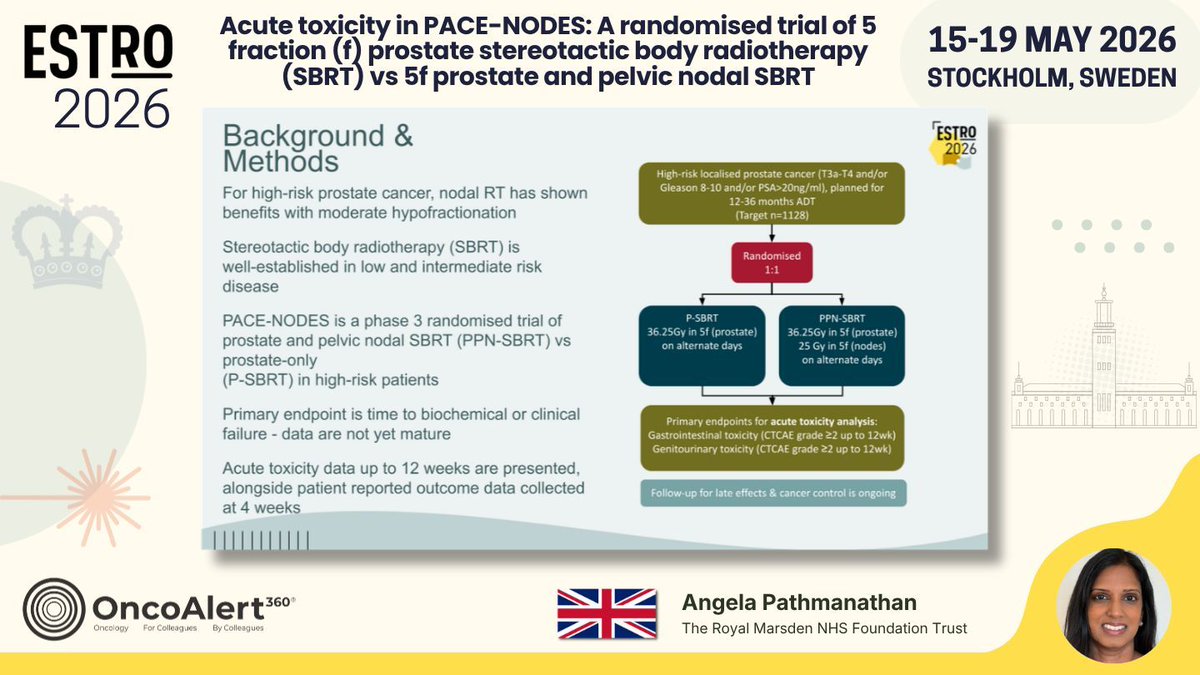
10 details 3 trials watching
Phase 3 randomised 1:1 multicentre trial, target n=1128, 1166 randomised. This presentation reports the acute toxicity analysis only; the efficacy primary is time to biochemical or clinical failure and is not yet mature.
High-risk localised prostate cancer: T3a-T4 and/or Gleason 8-10 and/or PSA>20ng/ml, all planned for 12-36 months ADT.
Both arms 36.25Gy in 5 fractions to the prostate on alternate days. PPN-SBRT adds 25Gy in 5 fractions to the pelvic nodes; P-SBRT is prostate-only.
Primary for this analysis: CTCAE grade ≥2 GI and grade ≥2 GU toxicity up to 12 weeks. Patient-reported EPIC-26 domain scores collected at 4 weeks.
GI was the only separating domain; GU did not differ by clinician or patient report, and the GI gap had closed by 12 weeks.
11% of PPN-SBRT and 4% of P-SBRT patients did not receive their allocated treatment, mostly because planning constraints were not met, which is itself a deliverability signal for 5f nodal treatment.
Patient-reported outcomes were captured at 4 weeks only, so the 12-week convergence rests on clinician CTCAE grading. No effect size, confidence interval or p-value for the GI difference appears in the source, and late GI toxicity is the endpoint that historically decides elective nodal coverage.
The trial's answer so far is about deliverability rather than benefit: 5f nodal SBRT can be given across multiple centres at an acute cost confined to transient bowel symptoms. Whether that cost is worth paying depends entirely on the failure endpoint still to read out.
Acute-toxicity readout only; the efficacy primary (time to biochemical or clinical failure) is immature, so the nodal-coverage question stays open.
- Late GI toxicity beyond the 12-week acute window n=100 · primary completion 2027-10 · 1-2mm PTV margins to cut late rectal toxicityn=500 · primary completion 2027-12 · late GI toxicity as primary endpoint after prostate SBRT
- Whether 5f nodal SBRT improves biochemical or clinical failure recruiting PRO-BOOST-N: Prostate-First Versus Combined Prostate and Nodal Dose Escalation in PSMA PET-Staged Node-Positive Prostate Cancer Phase 2/3n=600 · primary completion 2033-12 · randomises nodal dose in cN1 ultrahypofx pelvic RT
- Which anatomy or constraints drove the 11% non-delivery rate
📚 Sources · 🐦 1 tweet
Day THREE of #ESTRO26 Coverage by OncoAlert 🚨
— OncoAlert (@OncoAlert) May 17, 2026
Acute toxicity in PACE-NODES: A randomised trial of 5 fraction (f) prostate stereotactic body radiotherapy (SBRT) vs 5f prostate and pelvic nodal SBRT
Presented by Angela Pathmanathan 🇬🇧 #RadOnc ☢️ #ProstateCancer
PACE-NODES is a… pic.twitter.com/z9bAOiKSIy
OLIGOMA NCT04495309
ForMetastatic breast cancer, ≤5 lesions, any treatment line; mostly ER+/HER2- first-line
35.8 vs 20.4 mo
HR 0.48 (95%-CI 0.25-0.91), p=0.021
TL;DRmPFS 35.8 vs 20.4mo, HR 0.48 (0.25-0.91) p=0.021 with ablative RT to all lesions in oligometastatic breast.
The RT question here is whether ALL lesions must be treated: eligibility required ablative RT to every metastasis, and pts needing palliative RT to all sites were excluded, so this is comprehensive ablation, not selective consolidation. With 2/3 bone lesions and >80% carrying 1-3 mets, the transferable case is the low-burden bone-dominant pt. No dose or fractionation reported in source.
In ER+/HER2- metastatic breast with 1-3 mostly bone lesions starting first-line systemic therapy, this supports discussing ablative RT to all sites; it does not extend to pts with >5 lesions or those needing palliative RT to every site.
The transferable detail is the eligibility rule, not the HR: RT went to ALL metastatic lesions, and pts needing palliative RT to every site were excluded. With >80% carrying 1-3 mets and 2/3 bone, this is comprehensive ablation of low-burden disease. Dose and fractionation not reported in source.
The systemic regimen was fixed by tumor board BEFORE randomisation, so the PFS separation is attributable to RT rather than to differential drug management. Nearly three-quarters were on first-line endocrine or chemotherapy, so the question this moves is whether to pause and refer for ablation at diagnosis of oligometastatic disease, not which regimen to pick.

+3 more figures

| Arm | QLQ-C30 summary, mean (95%-CI) | Between-group change (ANCOVA) |
|---|---|---|
| Experimental | 72.2 (67.2-77.2) | -2.1 (-9.2-5.1) |
| Control | 74.3 (69.3-79.3) | n/a |


9 details 5 trials watching
Randomised trial (ARO-2021-09), systemic therapy alone vs systemic therapy plus local ablative radiotherapy to all metastatic lesions. Stratified by type of systemic therapy and treatment line. Systemic regimen was set by multidisciplinary tumor board before randomisation, so the only variable is RT.
Metastatic breast cancer, any treatment line, maximum 5 lesions. Median age 58 (experimental) vs 59 (control); ER positive 76.7% vs 81.8%, HER2 positive 7.5% vs 15.0%. Nearly three-quarters were on first-line endocrine or chemotherapy. >80% had 1-3 metastases and 2/3 of lesions were bone.
Local ablative RT was delivered to all metastatic lesions, not a selected subset. Palliative RT to symptomatic metastases was permitted, but pts requiring palliative RT to all metastases were not eligible. Dose, fractionation and technique not reported in source.
Co-primary: PFS and quality of life (EORTC QLQ-C30) at 12 weeks post-randomisation. Secondary: overall survival, toxicity, compliance, QLQ-C30 and QLQ-BR23, and patient satisfaction with cancer care (EORTC PATSAT C33).
Both co-primary endpoints read out in the trial's favour: PFS separated, and the 12-week QoL difference stayed inside the prespecified non-inferiority margin of -10 points with baseline adjustment. OS not reported in source.
Beyond the accrual shortfall, the QoL co-primary rested on n=64 of 87 randomised, and 12 weeks is too early to capture late RT toxicity in a population with a 35.8-month median PFS. Toxicity and compliance were secondary and are not reported in source.
This is the first RCT to show a PFS benefit from MDT in oligometastatic breast cancer specifically, a histology under-represented in the earlier mixed-tumour MDT randomised experience. Eight trials in the same question (TAORMINA, STEREO-SEIN, LARA, CLEAR, COSMO, ARCHER, ISTMET, OLIGAMI) are still recruiting, so the field will not settle on 87 pts.
The result establishes direction, not magnitude: an HR of 0.48 from an early-terminated trial is the estimate most likely to regress. What it does settle is the tolerability question, since short-term QoL was not degraded by treating every lesion. Which pts benefit most, by lesion count, site and systemic line, remains open.
CONSORT flow
Recruitment stopped at <20% of initial target; 87 pts, PFS CI 0.25-0.91. Positive and randomised, but underpowered against eight ongoing confirmatory trials.
- Which oligometastatic breast subgroups benefit most from MDT n=340 · primary completion 2026-11 · phase 3 MDT with subtype-specific systemic therapynot yet Adding Surgery and Radiation to the Usual Treatment for HER2-Positive Breast Cancer That Had Already Spread at Diagnosis Phase 3n=562 · primary completion 2032-05 · HER2+ de novo, 1-5 mets, SBRT added to SOC
- Does the PFS benefit translate to overall survival n=150 · primary completion 2025-08 · randomised SABR vs SOC in de novo oligomet BCn=345 · primary completion 2025-12 · TAORMINA: randomised SABR + systemic, 1-5 mets
- Optimal dose and fractionation for bone-dominant ablation recruiting OligoCare TwiCs (Trials Within Cohorts) Trial Comparing Acute Toxicity in Single-fraction vs Multiple-fraction SBRT for Metastasis-directed Treatment (SPRINT) Phase NAn=302 · primary completion 2029-02 · SPRINT: single- vs multi-fraction SBRT randomised
📚 Sources · 🐦 3 tweets
📌 Metastases-directed treatment in Patients with Oligometastatic Breast Cancer: Results from the OLIGOMA-trial (ARO-2021-09, NCT04495309) @DavidKrugMD 👏🏻 #ESTRO26 @ESTRO_RT @OncoAlert #OncoAlertAF pic.twitter.com/YDMef0fXRm
— Elisabetta Bonzano MD, PhD (@to_be_elizabeth) May 17, 2026
❗️ The OLIGOMA trial results just dropped at #ESTRO26 and they are massive. A 15-month improvement in median PFS for OMD breast cancer (HR = 0.48). This adds to the growing mountain of evidence that MDT (Metastasis-Directed Therapy) works. Lets’s go 🧵 1/n pic.twitter.com/5uiEVSYtdH
— NonsparseOncologist (@5_utr) May 17, 2026
Here are some details!
— Jeff Ryckman (@jryckman3) May 17, 2026
On OLIGOMA, nearly 3/4 were first line endocrine or chemotherapy. #ESTRO26 #OncTwitter@CJTsaiMDPhD pic.twitter.com/r3kJzNNsyK