onc brain

2026-05-18

digest generated 2026-05-20

NRG/RTOG 1005: concurrent SIB noninferior to sequential boost for IBR (HR 1.31, NI p=0.037) in 2,354 pts, 15F vs 31F.
NRG 1005 and EXTEND led: concurrent SIB noninferior in breast (15F vs 31F, efficiency without penalty), MDT improves PFS across oligometastatic histologies (HR 0.54). Prostate carried the most contested signals, PEACE 2 going null on pelvic RT against prior POP-RT evidence. TORPEdO neutralized the proton HR-QoL argument in oropharyngeal CRT.

Lower GI

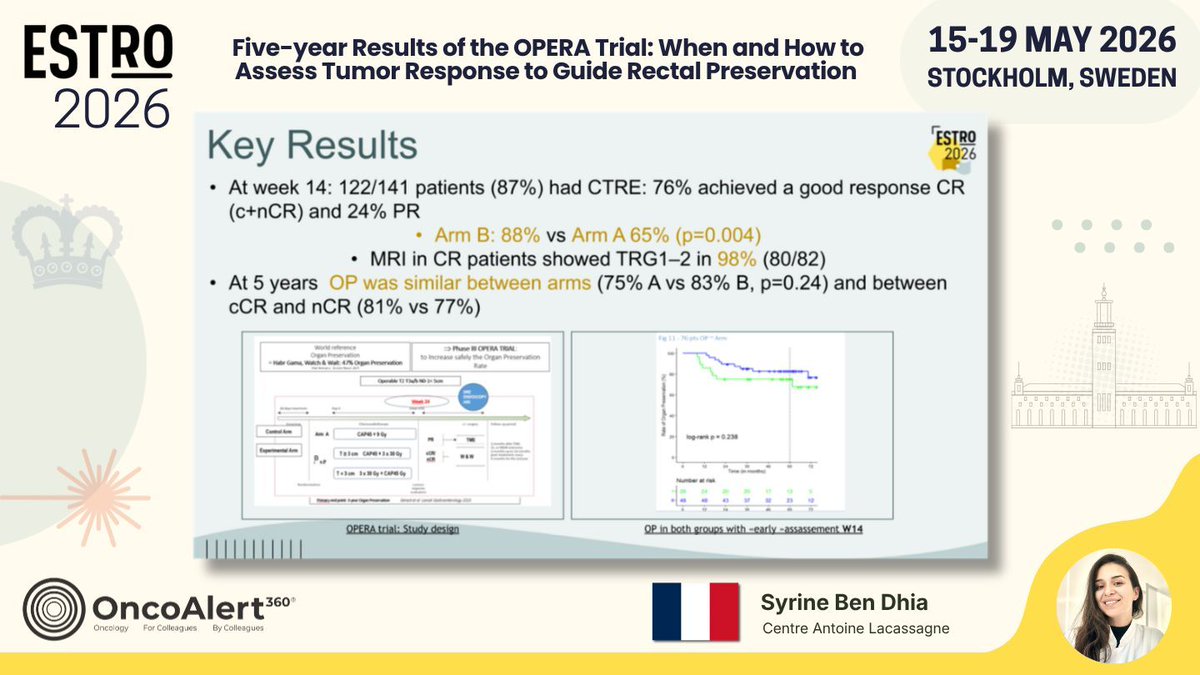
OPERA post-hoc clarifies W14 CTRE as a reliable response gate for rectal organ-preservation decisions.

OPERA Trial (5-year rectal preservation)

Sourced from @OncoAlert

ForLocally advanced rectal cancer, post-NAT, organ preservation candidate

OPERA post-hoc: W14 DRE+rectoscopy reliably identifies cCR; 5-yr organ preservation 75% vs 83% (Arm A vs B, p=0.24).

W14 good response: Arm B 88% vs Arm A 65% (p=0.004). 5-yr OP: 75% (A) vs 83% (B), p=0.24; cCR 81% vs nCR 77%.
  • πŸ” Post-hoc analysis of OPERA trial; N=141 with CTRE at W14 (122/141, 87%)
  • πŸ” W14 assessment: DRE + rectoscopy (Β±MRI); defined CR, near-CR (nCR), partial response (PR)
  • πŸ“Š W14 good response (cCR+nCR): 76%; PR: 24%
  • πŸ“Š Good response by arm: Arm B 88% vs Arm A 65% (p=0.004)
  • πŸ“Š MRI TRG1-2 concordance in W14 CR pts: 98% (80/82)
  • πŸ“Š 5-yr organ preservation rates
    • By arm: 75% (Arm A) vs 83% (Arm B), p=0.24
    • By response depth: cCR 81% vs nCR 77% (similar)
  • ⚠️ Post-hoc analysis; W14 response classification not prespecified as primary decision gate in original OPERA design
  • ⚠️ nCR likely reflects radiation side effects (mucosal change), not residual tumor; authors caution against using nCR to justify radical surgery
  • ❓ Whether W14 CTRE alone (without W24 MRI) is sufficient to safely defer W24 reassessment in nCR pts
πŸ“š Sources Β· 🐦 1 tweet
vs leading data
  • Original OPERA trial compared standard vs contact X-ray boost; this analysis cuts across both arms to validate timing of response assessment
  • Can W14 CTRE safely replace W24 full reassessment for nCR patients?
  • Does earlier OP selection improve functional outcomes vs W24-guided approach?

Head & Neck

Two trials probe de-escalation: ENI omission via INRT and proton vs photon for HR-QoL in oropharyngeal CRT.

INRT-AIR & DARTBOARD (ENI omission in HNSCC)

Sourced from @OncoAlert

ForHNSCC oropharynx/larynx/hypopharynx, stage I-IVB (excl. T1-2N0 larynx), treated

ENI omission via INRT in HNSCC: 5-yr elective nodal recurrence 0%, 5-yr OS 87%, 5-yr PFS 74% across 117 pts.

5-yr OS 87%, 5-yr PFS 74%; 3-yr LR 9.5%, RR 4.3%, DM 11%; elective nodal recurrence 0% at 5 yrs. N=117, median f/u 3.4 yrs.
  • πŸ“Š 5-yr solitary elective nodal recurrence risk: 0%
  • πŸ“Š 5-yr OS 87%, 5-yr PFS 74%
  • πŸ“Š 3-yr local recurrence 9.5%, regional recurrence 4.3%, distant metastasis 11%
  • πŸ“Š Mean composite MDADI score at 12 months: 84.9, no significant decline post-treatment
  • πŸ” Patient-level pooled analysis, 2 prospective trials (INRT-AIR + DARTBOARD), N=117, median f/u 3.4 yrs
  • πŸ” Eligibility: oropharynx, larynx, hypopharynx HNSCC, stage I-IVB (excl. T1-2N0 larynx); PET/CT + neck CT required
  • πŸ” INRT approach uses AI model to identify suspicious lymph nodes, omitting traditional ENI fields
  • ⚠️ No randomised comparator; pooled single-arm data from 2 non-randomised prospective trials
  • ⚠️ Authors explicitly state randomised evidence required before non-trial implementation
πŸ“š Sources Β· 🐦 1 tweet
vs leading data
  • Standard CRT with ENI historically associated with significant OAR dose and long-term toxicity; MDADI preservation here suggests meaningful dysphagia benefit vs historical CRT cohorts
  • Does ENI omission hold in HPV-negative or high nodal burden subgroups?
  • Randomised trial vs standard ENI CRT needed to confirm OS/PFS equivalence
  • Long-term dysphagia and xerostomia outcomes beyond 12 months?

TORPEdO (CRUK/18/010)

Sourced from @OncoAlert, @AmadeoWals, McBride et al.

ForOropharyngeal SCC requiring bilateral neck concurrent CRT, p16+/-

TORPEdO: IMPT vs IMRT in OPSCC, no difference in patient-reported UW-QoL composite at 12 months; phase 3 RCT, N=205.

  • πŸ“Š UW-QoL physical composite: no difference between IMPT and IMRT at 3, 12, or 24 months post-RT
  • πŸ“ No numeric effect sizes in source; OCR states 'no differences in mean scores between arms' at all reported timepoints
  • πŸ” Phase 3 RCT; 2:1 IMPT:IMRT; bilateral neck OPSCC requiring concurrent CRT; N=205
  • πŸ” Dose: 70 Gy/56 Gy in 33 fractions over 6.5 weeks + cisplatin 100 mg/mΒ² D1+D22, identical both arms
  • πŸ” Stratified by T-stage, N-stage, p16 status, smoking history
  • πŸ” Clinician-reported co-primary (CTCAE G3 weight loss β‰₯20% or gastrostomy dependence at 12mo) not presented in this HR-QoL report
  • ⚠️ Identical planning constraints across arms at predominantly novel UK proton centers may have attenuated IMPT dosimetric advantage
  • ⚠️ Some pts have meaningful HR-QoL deterioration up to 2 years post-CRT; 5-year follow-up ongoing
πŸ“š Sources Β· 🐦 2 tweets Β· πŸ“„ 1 paper
πŸ“„ PAPER McBride; Riaz; Sherman et al. Β· Lancet (London, England) (2026-05)
Proton versus photon therapy for oropharyngeal cancer.
πŸ“ McBride SM, Riaz N, Sherman EJ, Tsai CJ, Mell LK. Proton versus photon therapy for oropharyngeal cancer. Lancet. 2026 May 16;407(10542):1917.
vs leading data
  • Lancet 2026 (McBride, Riaz et al., PMID 42134353): concurrent publication on proton vs photon for oropharyngeal cancer
  • Clinician co-primary result (G3 weight loss/gastrostomy at 12mo) not presented here
  • Does proton center experience or planning approach modify the null HR-QoL result?
  • Will late toxicity differences emerge at 5-year follow-up?

Breast

NRG/RTOG 1005 resolves the boost-sequencing question: concurrent SIB is noninferior and cuts treatment to 15 fractions.

NRG/RTOG 1005 NCT01349322

Sourced from Vicini et al.

ForHigh-risk early breast cancer, post-lumpectomy, BCT candidates

Concurrent boost during WBI noninferior to sequential boost for IBR (HR 1.31, 90% CI 0.84-2.04) with no toxicity or cosmesis penalty; saves treatment time.

  • πŸ“Š 1Β° EP (IBR): HR 1.31 (90% CI 0.84-2.04), p=0.037 for noninferiority; upper bound 2.04 < prespecified margin of 2.12
  • πŸ“Š 7-yr IBR: 2.2% sequential vs 2.6% concurrent
  • πŸ” Phase III non-inferiority RCT, N=2,354 enrolled (2,255 eligible); 278 sites, North America + 6 countries; median f/u 7.3 yrs
  • πŸ” Sequential arm: WBI 50 Gy/25F or 42.7 Gy/16F + boost 12-14 Gy/6-7F after. Concurrent arm: WBI 40 Gy/15F + simultaneous integrated boost 8 Gy/15F (0.53 Gy/day)
  • πŸ” High-risk early BC post-lumpectomy: 52.7% grade 3, 29.6% ER-neg, 16.7% LVI, 16.3% nodal involvement, 61.8% received chemo
  • πŸ“Š Cosmesis (BCTOS, 3-yr): mean change 0.16 sequential vs 0.18 concurrent; noninferiority met (1-sided p<0.0001). Physician-rated excellent/good 85.9% vs 82.4% (p=0.34)
  • πŸ“Š No significant differences in DFS, DDFS, OS, or regional nodal recurrence between arms
  • ⚠️ G3-4 AEs uncommon and similar between arms (p=0.81); most common: radiation dermatitis, fatigue, breast pain
  • ⚠️ Superiority analysis (protocol-specified secondary, triggered after NI met) not significant; concurrent is non-inferior, not better, for IBR
πŸ“š Sources Β· πŸ“„ 1 paper
πŸ“„ PAPER Vicini; Winter; Freedman et al. Β· Journal of clinical oncology : official journal of the American Society of Clinical Oncology (2026-05)
Concurrent Versus Sequential Radiation Dose Escalation to the Surgical Cavity for Conservative Treatment of High-Risk Early Breast Cancer: NRG/RTOG 1005 Phase III Trial.
Abstract
PURPOSE: For patients with breast cancer undergoing breast conservation, escalating the dose (boost) of radiation to the lumpectomy cavity after whole-breast irradiation (WBI) reduces ipsilateral breast recurrence (IBR) but extends treatment duration. This phase III trial investigated whether boost delivery during WBI versus after WBI provides noninferior IBR and preserves cosmetic appearance.<br/><br/>METHODS: NRG/RTOG 1005 randomly assigned patients at higher risk for IBR after lumpectomy and axillary surgery to either a sequential boost of 12 Gy in six fractions(F) or 14 Gy in 7F after WBI of 50 Gy in 25F or 42.7 Gy in 16F (sequential arm) or a concurrent boost of 8 Gy in 15F of 0.53 Gy per day with WBI of 40 Gy in 15F (concurrent arm) using 3-dimensional conformal radiation therapy (RT) or intensity-modulated RT. Based on 1.59% 5-year IBR for the sequential arm, defining the noninferiority margin as a hazard ratio upper limit on the 90% CI of 2.12, 2,312 patients provide 80% power for noninferiority of IBR as first recurrence for the concurrent arm. Secondary end points included disease-free survival and overall survival, adverse events (AEs), and cosmetic outcomes.<br/><br/>RESULTS: Between May 24, 2011, and June 20, 2014, 2,354 patients were randomly assigned, with 2,255 eligible for analysis (sequential arm, n = 1,118; concurrent arm, n = 1,137). With median follow-up of 7.3 years, there were 56 IBR events; 5- and 7-year IBR were 2.1% and 2.2% on the sequential arm and 1.9% and 2.6% on the concurrent arm, respectively. The noninferiority criterion was met: HR (90% CI): 1.31 (0.84 to 2.04), P = .037. No differences were observed in AEs, cosmetic outcomes, or survival between arms.<br/><br/>CONCLUSION: Concurrent boost during WBI results in noninferior IBR compared with sequential boost without worsening toxicity or cosmetic outcomes and reduces overall treatment time.
πŸ“ Vicini FA, Winter K, Freedman GM, Arthur DW, Rosenstein BS, Bentzen SM, Li XA, Halyard MY, Woodward WA, Bleicher RJ, Taghian A, Lyons J, Tomberlin JK, Seaward SA, Cheston SB, Hoover AC, Anderson BM, Perera FE, Poppe MM, Petersen IA, Jhawar S, Hijal T, Moughan J, Movsas B, White JR. Concurrent Versus Sequential Radiation Dose Escalation to the Surgical Cavity for Conservative Treatment of High-Risk Early Breast Cancer: NRG/RTOG 1005 Phase III Trial. J Clin Oncol. 2026 May 11:JCO2502465. ; PMCID: PMC13166090.
vs leading data
  • Concurrent boost reduces total RT fractions from ~31-32F to 15F, cutting treatment duration roughly by half vs standard sequential approach
  • Efficacy with ultra-hypofractionated WBI (e.g., 5-fraction FAST-Forward schedule) + concurrent boost?
  • Long-term cosmesis beyond 3 years with concurrent approach?

Hepatobiliary

Largest EBRT cohort for HCC to date repositions ablative RT alongside resection and thermal ablation for BCLC-0/A.

HCC EBRT multinational IPD cohort

Sourced from Moon et al.

ForHCC BCLC-0/A, treatment-naive and experienced, eligible for ablative EBRT

HCC EBRT multinational IPD (n=4,913): mOS 4.6yr BCLC-A, comparable to resection/ablation.

  • πŸ“Š mOS 6.8yr (95% CI 5.7-8.7) for BCLC-0; 4.6yr (95% CI 4.1-5.1) for BCLC-A
  • πŸ“Š Treatment-naive BCLC-0: mOS not reached (95% CI 8.6-NR); BCLC-A: 5.4yr (95% CI 4.5-6.7)
  • πŸ” Systematic review + IPD from multinational cohorts; 4,913 pts, median f/u 5.0yr
  • πŸ” Stratified by BCLC stage and treatment-naive vs experienced; random-effects Cox modeling
  • πŸ“Š Ablative RT dose and more recent treatment year both associated with reduced mortality in multivariable model
  • πŸ“ Higher BCLC stage, higher tumor burden, worse PS, and Child-Pugh B/C all associated with increased mortality risk
  • ⚠️ Retrospective IPD meta-analysis β€” no randomised comparator arm; selection into EBRT vs other modalities not controlled
  • ⚠️ Heterogeneous RT techniques, fractionation, and eras across contributing institutions; era effect acknowledged
πŸ“š Sources Β· πŸ“„ 1 paper
πŸ“„ PAPER Moon; Yanagihara; Dawson et al. Β· Journal of clinical oncology : official journal of the American Society of Clinical Oncology (2026-05)
Overall Survival Among Patients With Hepatocellular Carcinoma Treated With External Beam Radiation Therapy: Individual Patient Data Outcomes From a Multinational Cohort.
Abstract
PURPOSE: External beam radiation therapy (EBRT) has gained delayed acceptance as a recommended first-line treatment modality for patients with hepatocellular carcinoma (HCC), given limited evidence that it improves overall survival (OS). We analyzed individual patient data (IPD) from an international cohort to assess OS among patients with HCC treated with EBRT.<br/><br/>METHODS: We performed a systematic review of publications that assessed EBRT, met prespecified technical standards for HCC, and reported OS (search date December 15, 2022). Corresponding authors were invited to submit IPD for the study. We performed Kaplan-Meier survival analyses to determine OS and restricted mean survival time (RMST) stratified by Barcelona Clinic Liver Cancer (BCLC) stage and treatment status (ie, treatment-na&#xef;ve and experienced). We performed random effects Cox proportional hazards modeling to assess clinical characteristics associated with OS.<br/><br/>RESULTS: Data were provided on 4,913 patients treated with EBRT with a median follow-up time of 5.0 years. The median OS was 6.8 years (95% CI, 5.7 to 8.7) for BCLC-0 and 4.6 years (95% CI, 4.1 to 5.1) for BCLC-A. Among treatment-na&#xef;ve patients, the median OS was not reached (95% CI, 8.6 to not reached) for BCLC-0 and was 5.4 years (95% CI, 4.5 to 6.7) for BCLC-A. In multivariable models, more advanced BCLC stage, higher tumor burden, worse performance status, and Child-Pugh class B or C were associated with a higher risk of mortality. Ablative radiation dose and more recent year of treatment were associated with a reduced risk of death.<br/><br/>CONCLUSION: To our knowledge, this study represents the largest multinational cohort of patients with HCC treated with EBRT. OS outcomes with EBRT for very early- and early-stage HCC appear to be comparable with resection, thermal ablation, and other ablative locoregional therapies. These data support the inclusion of EBRT in the BCLC HCC clinical decision-making process.
πŸ“ Moon AM, Yanagihara TK, Dawson LA, Yu JI, Lawrence TS, Kim TH, Yan M, Iwata H, Nabavizadeh N, Apisarnthanarax S, Dunne EM, Lock MI, Chuong MD, Chiang CL, Scorsetti M, Katoh N, Sioshansi S, Numata K, Liu HY, Iwamoto H, Wakatsuki M, Chen Y, Pollom EL, Gkika E, Jabbour SK, Munoz-Schuffenegger P, Dutta D, Hajj C, Ueno M, Hallemeier CL, Feldman AM, MΓ©ndΓ¨z Romero A, Tan X, Molla M, Tepper JE, Torres F, Reig M; EBRT Collaboration Group. Overall Survival Among Patients With Hepatocellular Carcinoma Treated With External Beam Radiation Therapy: Individual Patient Data Outcomes From a Multinational Cohort. J Clin Oncol. 2026 May 15:JCO2502399.
vs leading data
  • OS appears comparable to resection, thermal ablation, and other ablative locoregional therapies for BCLC-0/A
  • Randomised comparison of EBRT vs thermal ablation/resection for BCLC-A still needed
  • Optimal dose-fractionation regimen across tumor size and liver function subgroups

Oligometastatic / Mets

EXTEND adds the most robust randomized evidence yet for MDT across oligometastatic histologies.

EXTEND Trial

Sourced from Sherry et al.

ForOligometastatic solid tumors, 1-5 mets, multiple histologies, on SOC systemic th

EXTEND phase II: MDT+SOC improves PFS vs SOC across oligometastatic histologies, HR 0.54 (0.41-0.72), p<0.001, 53-mo follow-up.

  • πŸ“Š 1Β° EP PFS: HR 0.54 (95% CI 0.41-0.72), p<0.001 across all baskets, per-protocol set
  • πŸ“Š PFS benefit persisted excluding prostate baskets: HR 0.60 (95% CI 0.40-0.89)
  • πŸ” Phase II randomized multicenter; N=334 per protocol (MDT+SOC n=166, SOC n=168); 1-5 mets, 6 histology baskets; median f/u 53 mo
  • πŸ’Š MDT was radiotherapy for 98% of metastases (370/379)
  • πŸ“Š Basket-level PFS superiority: pancreas, prostate, and 'Other' baskets; breast and kidney baskets inconclusive
  • ⚠️ Phase II basket design; breast and kidney baskets inconclusive, limiting generalizability to those histologies
  • ⚠️ Basket-specific powering means some baskets underpowered for definitive conclusions; prostate over-represented
πŸ“š Sources Β· πŸ“„ 1 paper
πŸ“„ PAPER Sherry; Haymaker; Wang et al. Β· Journal of clinical oncology : official journal of the American Society of Clinical Oncology (2026-05)
Addition of Metastasis-Directed Therapy to Standard of Care for Oligometastatic Solid Tumors: Primary Analysis of All Tumor-Histology Baskets of the Phase II Randomized EXTEND Trial.
Abstract
PURPOSE: We tested the hypothesis that adding metastasis-directed therapy (MDT) to standard of care (SOC) systemic therapy improves progression-free survival (PFS) among patients with oligometastatic disease.<br/><br/>METHODS: EXTEND was a multicenter randomized phase II trial. Patients with 1-5 metastases were randomized to MDT+SOC vs SOC in 1 of 6 baskets (breast, pancreas, kidney, two prostate baskets, and an "Other" basket) with basket-specific stratification and powering. PFS, the primary endpoint, was pre-specified in the per-protocol set within each basket, across all baskets, and across all baskets excluding the prostate baskets. Exploratory endpoints included circulating tumor DNA (ctDNA) and immune profiling.<br/><br/>RESULTS: From 2018 through 2023, 521 patients were screened, 350 were randomized, and 334 were analyzed per protocol (MDT+SOC, n=166; SOC, n=168). Radiotherapy was used as MDT for 98% of metastases (370/379). Overall, after median follow-up of 53 months, PFS was improved with MDT+SOC (HR 0.54, 95% CI 0.41 to 0.72, p < 0.001). Similarly, PFS was improved when excluding the prostate baskets (HR, 0.60; 95% CI: 0.40 to 0.89). Within each basket, PFS superiority was identified for the pancreas, prostate, and "Other" baskets, whereas the breast and kidney baskets were inconclusive. At enrollment, detectable ctDNA correlated with shorter PFS and survival; by contrast, ctDNA clearance 3-months post-enrollment correlated with improved survival. MDT+SOC-induced systemic immune activation was most pronounced among baskets demonstrating PFS superiority.<br/><br/>CONCLUSION: The phase II EXTEND trial supports the addition of MDT to SOC for oligometastatic disease. Histology-specific efficacy signals were identified for phase III testing. Translational insights suggest the potential for optimizing the definition of oligometastasis using ctDNA, and point to systemic immune responses as a possible mechanism of benefit from MDT.
πŸ“ Sherry AD, Haymaker C, Wang S, Liu S, Bathala TK, Medina-Rosales MN, Seo A, Hara K, Reddy J, Chun SG, Mayo LL, Walker G, Pant S, Zhao D, Kovitz CA, Ramirez D, Ha CS, Smith BD, Gomez D, Cohen L, Koong AC, Reuben A, Tannir N, Corn PG, Tran PT, Siddiqui BA, Subudhi SK, Msaouel P, Ludmir EB, Tang C. Addition of Metastasis-Directed Therapy to Standard of Care for Oligometastatic Solid Tumors: Primary Analysis of All Tumor-Histology Baskets of the Phase II Randomized EXTEND Trial. J Clin Oncol. 2026 May 16:101200JCO2502856.
vs leading data
  • Translational: ctDNA detectable at enrollment correlated with shorter PFS/OS; ctDNA clearance at 3 mo correlated with improved survival
  • MDT+SOC-induced systemic immune activation most pronounced in baskets showing PFS superiority
  • Phase III confirmation needed per histology, especially breast and kidney
  • Can ctDNA clearance at 3 months serve as a predictive biomarker for MDT benefit?
  • Which histologies drive immune activation and does that predict PFS benefit?

Kidney

FASTRACK II at 62-mo median f/u delivers the longest local control data yet for SABR in primary RCC.

FASTRACK II (TROG 15.03) NCT02613819

Sourced from Siva et al.

ForInoperable or surgery-declined primary RCC, ≀10 cm, N0-N1, median age 77

FASTRACK II: 100% local control at 36, 60, and 84 months with SABR for primary RCC (N=70, median f/u 62 mo).

  • πŸ“Š 1Β° EP (freedom from local progression): 100% at 36, 60, and 84 months
  • πŸ” Non-randomised phase 2, N=70, 8 sites (Australia + Netherlands), median f/u 62 mo (IQR 60-72)
  • πŸ” Eligible: medically inoperable, high-risk, or surgery-declined; ECOG PS ≀2; tumour ≀10 cm; N0-N1
  • πŸ’Š 26 Gy single fraction (tumours ≀4 cm) or 42 Gy in 3 fractions q48h (>4 cm)
  • πŸ” Tumour staging: T1a 34%, T1b 56%, T2a 9%, T3a 1%; 1 pt N1; median tumour 46 mm
  • πŸ“Š G3 toxicity within 9 mo: 10% of pts (nausea/vomiting 4%, pain 6%, colonic obstruction 3%, diarrhoea 1%); no G4 events, no treatment-related deaths
  • πŸ“Š No new long-term safety signals; no cancer-related deaths in cohort
  • ⚠️ Single-arm, no comparator vs partial nephrectomy or active surveillance; local control rate uninterpretable without a control arm
  • ⚠️ Predominantly inoperable/elderly cohort (median age 77); generalisability to surgical candidates limited
πŸ“š Sources Β· πŸ“„ 1 paper
πŸ“„ PAPER Siva; Pryor; Martin et al. Β· The Lancet. Oncology (2026-05)
Long-term outcomes of stereotactic ablative body radiotherapy for primary kidney cancer (TROG 15.03 FASTRACK II): a multicentre, non-randomised, phase 2 study.
Abstract
BACKGROUND: Stereotactic ablative body radiotherapy (SABR) is an emerging, non-invasive alternative for primary renal cell carcinoma. We aimed to provide the final long-term trial outcomes of TransTasman Radiation Oncology Group (TROG) 15.03 FASTRACK II, the first phase 2 trial investigating SABR for primary renal cell carcinoma to our knowledge.<br/><br/>METHODS: FASTRACK II was a non-randomised, phase 2 study conducted in eight hospitals in Australia and the Netherlands by TROG and the Australian and New Zealand Urogenital and Prostate (ANZUP) Cancer Trials Group. Here, we report the final pre-planned follow-up results. Adult patients (aged &#x2265;18 years) with histologically confirmed primary renal cell carcinoma, who were medically inoperable, high risk, or declined surgery, had an Eastern Cooperative Oncology Group performance status of 2 or less, had tumours 10 cm or less in size, and had N0-N1 disease were included. Patients underwent either a single fraction SABR of 26 Gy for tumours 4 cm or less in maximum diameter, or 42 Gy in three fractions delivered 48 h apart for tumours more than 4 cm in maximum diameter. The primary outcome was freedom from local progression to assess local control after SABR evaluated with the Response Evaluation Criteria in Solid Tumours. The primary endpoint and safety were evaluated in the intention-to-treat population. A patient representative was involved in the study design and conduct. The trial was registered with ClinicalTrials.gov (NCT02613819) and is closed to enrolment.<br/><br/>FINDINGS: Between July 28, 2016, and Feb 27, 2020, 71 patients were enrolled and one withdrew consent before treatment. Median follow-up was 62 months (IQR 60-72), median age was 77 years (70-82). 49 (70%) of 70 patients were male and 21 (30%) were female. Race and ethnicity data were not collected. The median tumour size was 46 mm (37-55), with 24 (34%) patients with T1a disease, 39 (56%) with T1b disease, six (9%) with T2a disease, and one (1%) with T3a disease. One patient (1%) had nodal involvement (N1). SABR resulted in 100% local control at 36 months, 60 months, and 84 months. Seven (10%) patients had at least one grade 3 adverse event within 9 months of SABR that was designated possibly, probably, or definitely related to treatment: nausea and vomiting (three [4%] events); abdominal, flank, or tumour pain (four [6%]); colonic obstruction (two [3%]); and diarrhoea (one [1%]). No new long-term safety signals, grade 4 events, or treatment-related deaths were noted.<br/><br/>INTERPRETATION: Long-term follow-up supports the safety and local control of SABR for non-surgical patients with renal cell carcinoma, with no observed local recurrences or cancer-related deaths in this cohort, which had predominantly T1b disease or higher.<br/><br/>FUNDING: The Cancer Australia Priority-driven Collaborative Cancer Research Scheme and Varian.
πŸ“ Siva S, Pryor D, Martin J, Hardcastle N, Moon D, Kron T, Higgs B, Foroudi F, Ruben J, Sridharan S, Montgomery R, Davey R, Lin C, Shaw M, Lawrentschuk N, Appu S, Vanneste BGL, Hofman MS, Murphy DG, De Abreu Lourenco R, Mancuso P, Brook NR, Raman A, Wong LM, Sidhom M, Wood S, Ali M, Bressel M. Long-term outcomes of stereotactic ablative body radiotherapy for primary kidney cancer (TROG 15.03 FASTRACK II): a multicentre, non-randomised, phase 2 study. Lancet Oncol. 2026 May 17:S1470-2045(26)00091-4.
vs leading data
  • Consistent with earlier SABR-for-RCC signals (SAFIR, STAR-TRK) but none randomised; confirmatory RCT vs surgery/surveillance absent
  • Randomised comparison vs partial nephrectomy or active surveillance needed
  • Outcomes in surgical candidates who decline surgery vs true inoperable pts
  • Role of SABR in T2b-T3 or node-positive disease

Prostate

Pelvic RT in VHR disease remains contested (PEACE 2 null) while HEAT adds interim NI support for AHRT vs EHRT.

PEACE 2

Sourced from @PBlanchardMD

ForVHR localized prostate (Gleason β‰₯8/T3-4/PSA β‰₯20), N0M0 conventional imaging

PEACE 2: pelvic RT did not improve cPFS vs prostate-only RT in VHR prostate (HR 0.81, p=0.088); no effect on MFS, OS, or PCSS.

PEACE 2
Arm7-yr cPFSHR (95% CI)p
Pelvic RT67.1% [61.6-72.2]0.81 (0.63-1.03)0.088
Prostate-only RT62.9% [57.4-68.1]refref
  • πŸ“Š Primary EP cPFS: HR 0.81 (95% CI 0.63-1.03), p=0.088; not significant
  • πŸ“Š 7-yr cPFS 67.1% pelvic RT vs 62.9% prostate-only; 4.2% absolute difference
  • πŸ“Š No effect on MFS, OS, or PCSS (no effect sizes reported in source for secondary EPs)
  • πŸ” Phase III, 4-arm international RCT; N=380 prostate-only vs 381 pelvic RT arms
  • πŸ” VHR eligibility: Gleason β‰₯8, T3-T4, or PSA β‰₯20; N0M0 on conventional imaging or Choline PET
  • πŸ’Š All arms: ADT x 3yr + high-dose RT; Arms C/D added cabazitaxel x 4 cycles
  • ⚠️ Conventional imaging staging only; PSMA PET not required; occult nodal pts in both arms may dilute pelvic RT signal
πŸ“š Sources Β· 🐦 1 tweet
vs leading data
  • vs POP-RT (NEJM 2021): pelvic RT improved bFFS (HR 0.49) in VHR pts; PEACE 2 null; populations and systemic therapy differ
  • Does PSMA PET-based staging identify who benefits from pelvic RT?
  • Do cabazitaxel arms (C vs D) show differential pelvic RT benefit?
  • How to reconcile PEACE 2 null result with POP-RT benefit signal?

HEAT Trial NCT01794403

Sourced from @OncoAlert, @PBlanchardMD

ForLow-intermediate risk localized PCa, IPSS <12

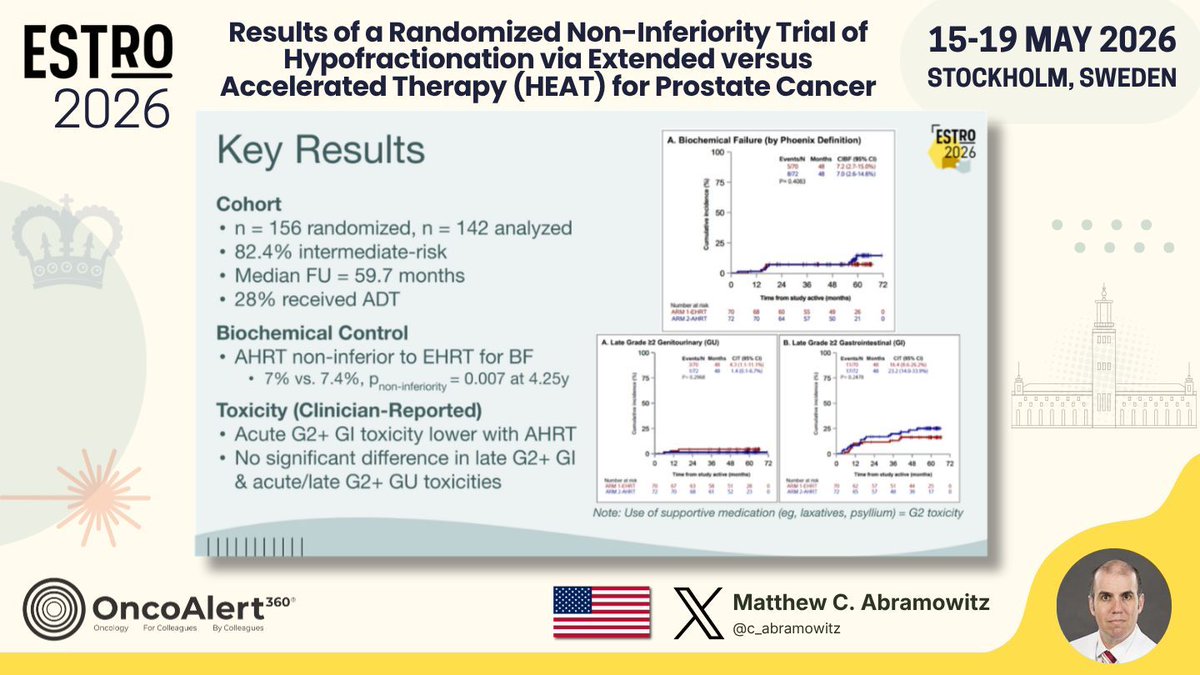
HEAT: AHRT non-inferior to EHRT for BF at 4.25y interim (7% vs 7.4%, P non-inf = 0.007) in low-intermediate risk PCa.

HEAT Trial
ArmBF at 4.25yP non-inf
AHRT7%0.007
EHRT7.4%ref
  • πŸ” Trial design
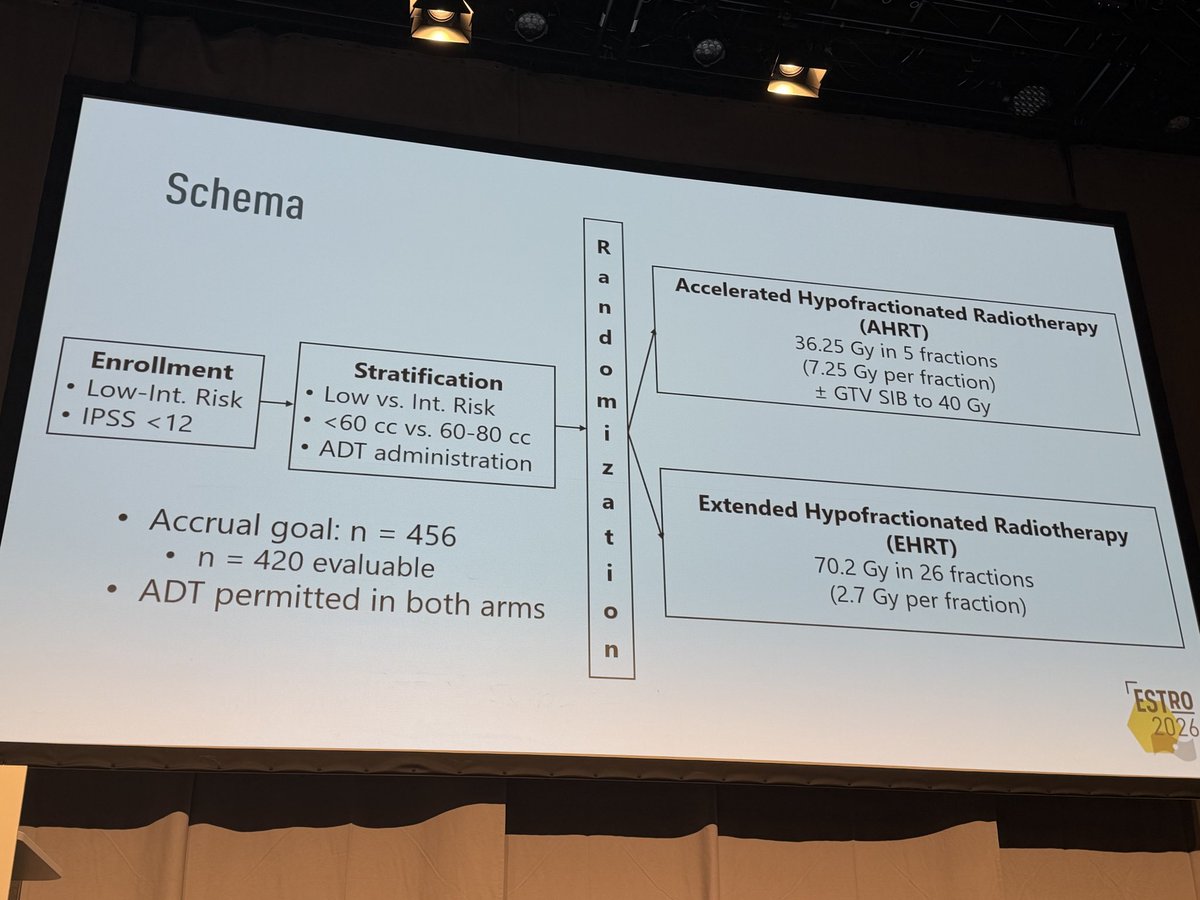
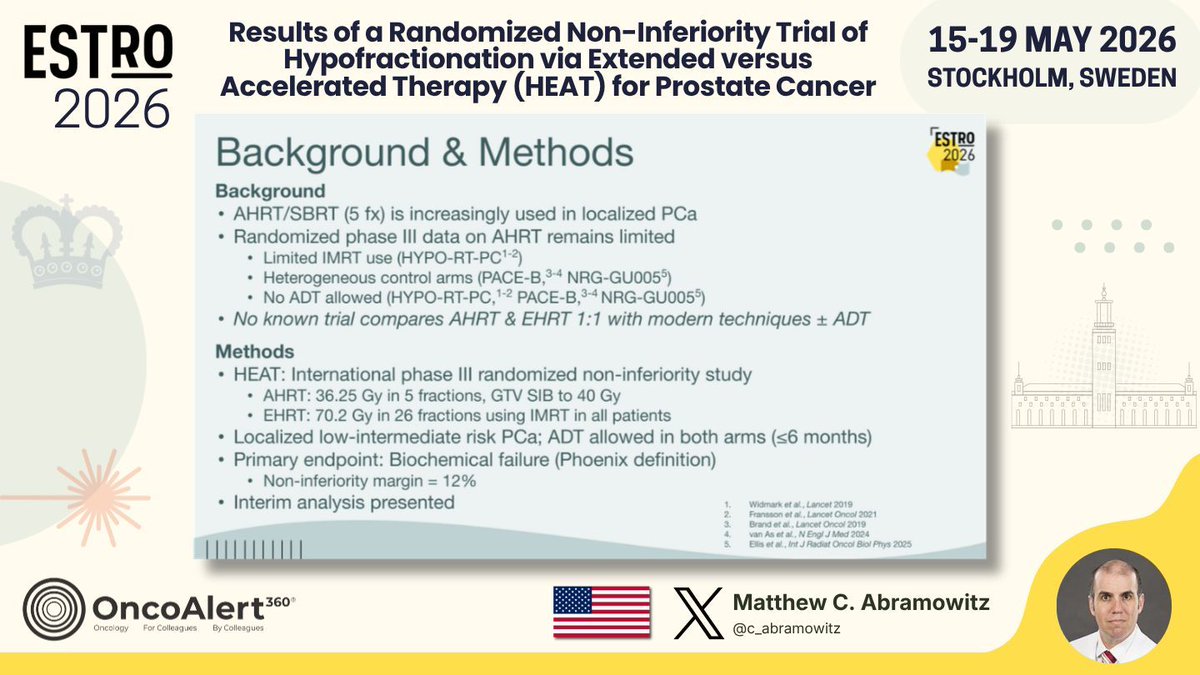
    • Phase III randomized non-inferiority; non-inferiority margin 12%
    • AHRT: 36.25 Gy/5 fx (7.25 Gy/fx) + GTV SIB to 40 Gy
    • EHRT: 70.2 Gy/26 fx via IMRT (IMRT in all pts, per protocol)
    • ADT ≀6 months permitted in both arms; 28% received ADT
  • πŸ” Cohort (interim analysis)
    • n=156 randomized, n=142 analyzed; 420 evaluable total (accrual goal 456)
    • 82.4% intermediate-risk; median FU 59.7 months
    • Stratified by risk group, prostate volume (<60 cc vs 60-80 cc), ADT use
  • πŸ“Š Acute G2+ GI toxicity lower with AHRT; no difference in late G2+ GI or acute/late G2+ GU toxicities
  • ⚠️ G2 GI toxicity definition includes supportive medication use (laxatives, psyllium); inflates apparent acute GI rate
  • ⚠️ Interim analysis; 156 of 420 evaluable pts; final primary analysis at full accrual pending
πŸ“š Sources Β· 🐦 2 tweets
vs leading data
  • HYPO-RT-PC/PACE-B/NRG-GU005 excluded ADT or used heterogeneous controls; HEAT first 1:1 AHRT vs EHRT with modern IMRT + ADT in both arms
  • Non-inferiority confirmed at final full-cohort primary analysis?
  • Late GU/GI toxicity durability beyond 5 years with AHRT