Confirmatory
MARCAP Consortium
ForLocalized prostate cancer, NCCN intermediate to high risk, definitive RT
TL;DRIPD meta-analysis, 10,853 pts: ADT added to RT improved MFS HR 0.83 and OS HR 0.86; dose escalation improved bRFS only.
Reported via UroToday →
The dose-invariance result is the load-bearing one: ADT's benefit was identical at ≥74 Gy and <74 Gy (both HR 0.83), so escalating dose does not buy out the ADT decision. Adjuvant prolongation carries the benefit (MFS HR 0.84), neoadjuvant prolongation does not (HR 0.95), which moves sequencing, not just duration.
In NCCN intermediate- and high-risk localized prostate cancer receiving definitive RT, this supports adding and prolonging ADT on the adjuvant side rather than substituting dose escalation; it does not address node-positive or post-prostatectomy salvage settings.
ADT's benefit was identical at ≥74 Gy and <74 Gy (HR 0.83 both), so escalation does not buy out the hormone decision, and HEAT showed escalation to 79.2 Gy improved biochemical RFS but not MFS or OS. Adjuvant prolongation carries the survival benefit; neoadjuvant prolongation (HR 0.95) does not.
The duration and sequencing read: extending adjuvant ADT from 4-6 to 18-36 months gave MFS HR 0.84 and OS HR 0.85, while extending neoadjuvant ADT from 3-4 to 6-9 months gave HR 0.95 for both. Relative benefit held across NCCN groups, so risk stratification changes NNT, not effect size.
9 details 5 trials watching
Individual patient data meta-analysis from the MARCAP Consortium, 12 eligible trials, 10,853 patients, median follow-up 11.4 years (IQR 9.0-15.0). Three intensification questions analyzed separately: ADT use, neoadjuvant ADT prolongation, adjuvant ADT prolongation.
Localized prostate cancer treated with definitive radiotherapy, stratified by NCCN prognostic risk group. The RT ± ADT comparison ran 2,557 control vs 2,579 experimental (NCCN high 32.6% vs 32.8%, intermediate 47.6% vs 48.7%); the adjuvant-prolongation comparison was high-risk enriched at 71.5% vs 71.1% NCCN high across 1,900 vs 1,874 pts.
Dose was analyzed as a binary ≥74 Gy vs <74 Gy split, with the companion HEAT analysis using 64 to <74 Gy vs ≥74 Gy and escalation up to 79.2 Gy. Brachytherapy boost is discussed as an escalation route alongside external-beam dose.
ADT addition improved MFS HR 0.83 (0.77-0.89) and OS HR 0.86 (0.80-0.92). Adjuvant prolongation improved MFS HR 0.84 (0.78-0.91) and OS HR 0.85 (0.78-0.94); neoadjuvant prolongation did neither (MFS HR 0.95, OS HR 0.95). 10-yr MFS 61% (59-63) with ADT vs 52% (50-54) without; 10-yr OS 65% (63-67) vs 57% (55-59).
| Intervention | Intermediate risk | High risk |
|---|---|---|
| ADT addition | 18.0 | 8.4 |
| Adjuvant ADT prolongation | 16.1 | 10.4 |
The 2022 HEAT network meta-analysis (13 trials, 11,862 pts) found dose escalation improved biochemical RFS but not MFS or OS, and named high-dose RT plus long-term ADT the best strategy. PROG 05/09 and GETUG-18 are invoked to explain the gap: a 21% 5-year biochemical benefit in low risk where metastasis is rare, versus 3% in high risk where it is not.
The pooled trials span 30+ years of practice, so the RT technique behind the <74 Gy stratum is not the technique a reader delivers today. The stated optimal durations (closer to 12 months high risk, 24+ months very high risk) come from DHARMA, accepted but unpublished, so that specific number is not yet auditable.
The framing claim is that dose escalation and ADT are not interchangeable levers: escalation buys biochemical control, ADT buys metastasis-free and overall survival, and the two do not substitute. The dogma that dose escalation obviates ADT is named as widely repeated and never demonstrated.
IPD meta-analysis of randomised trials, large N, long f/u. Reinforces ADT intensification over dose escalation; no new randomisation, and duration guidance rests on unpublished DHARMA.
- Optimal adjuvant ADT duration by prognostic risk group active A Study of Shorter Course Hormone Therapy and Radiation for High-risk Prostate Cancer Phase 2n=50 · primary completion 2026-10 · shorter-course ADT with brachy + hypofx EBRT, high-riskrecruiting Artificial Intelligence Driven Personalisation of Radiotherapy and Concomitant Androgen Deprivation Therapy for Prostate Cancer Patients (the HypoPro Trial) Phase 2n=30 · primary completion 2026-10 · MMAI classifier individualises ADT duration, high-risk
- Does dose escalation change ADT benefit with modern brachytherapy boost active Comparative Study of Radiotherapy Treatments to Treat High Risk Prostate Cancer Patients Phase 3n=307 · primary completion 2028-12 · phase 3 HDR brachy boost vs dose-escalated RT + ADTrecruiting Androgen Suppression Combined With Nodal Irradiation and Dose Escalated Prostate Treatment Phase 3n=710 · primary completion 2032-10 · phase 3 SBRT vs EBRT + brachy boost, all on ADTrecruiting PRO-BOOST-LC: Whole-Gland Boost Strategies Versus SBRT Monotherapy in PSMA-Staged Localized and Locally Advanced Prostate Cancer Phase 2/3n=1000 · primary completion 2033-12 · randomised brachy or SBRT boost vs SBRT alone, + ADT
- Whether intermediate-risk subsets warrant long-term ADT
📚 Sources · 📄 1 paper
Abstract
HERO
ForAdvanced prostate cancer, completing 48wk ADT, no ongoing ADT planned
TL;DR90-day testosterone recovery to ≥280 ng/dL 53.9% with relugolix vs 3.2% with leuprolide after 48wk ADT.
Reported via UroToday →
For intermediate-risk prostate cancer treated with RT plus short-course ADT, the recovery kinetic is the deliverable: median 86.0 days to normal T on relugolix vs 2 of 47 recovering on leuprolide by day 90. That gates the choice of agent when ADT is a fixed 4 to 6 month adjunct to RT and the goal is off-treatment hypogonadism time, not depth of suppression.
In men finishing a defined short-course ADT with RT and no plan for ongoing suppression, this informs agent choice on recovery speed; it does not apply to men continuing ADT indefinitely or to those where prolonged suppression is the therapeutic aim.
When ADT is a defined 4 to 6 month adjunct to definitive RT, agent choice can be made on recovery speed rather than suppression depth. Median 86.0 days to normal testosterone (95% CI 65.0, 92.0) on relugolix is a concrete planning figure for counselling on off-treatment hypogonadism.
Relevant only where ADT is time-limited by design. The parent trial's depth advantage (96.7% vs 88.8% sustained castration) and this recovery signal point the same way, but neither is tied to an oncologic endpoint, so sequencing and continuous-suppression decisions are untouched.
8 details
Subset analysis of the phase 3 HERO trial, which randomized 934 men with advanced prostate cancer 2:1 to relugolix or leuprolide for 48 weeks. This report covers a 90-day recovery period after treatment discontinuation.
184 men who completed 48 weeks of assigned therapy and had no plan to start alternative ADT within the next 12 weeks (24 weeks after a last leuprolide 3-month depot). 137 had received relugolix, 47 leuprolide.
Relugolix 120 mg orally once daily after a single 360 mg loading dose on Day 1, versus leuprolide injections every 12 weeks, each for 48 weeks.
Time to testosterone recovery to ≥280 ng/dL by Kaplan-Meier, PSA during the recovery phase, and adverse events during recovery. No oncologic efficacy endpoint in this analysis.
During recovery, 96% of men had at least one adverse event and 15% had a grade ≥3 event, similar in both groups.
The 90-day window sits inside the pharmacologic tail of a 3-month leuprolide depot, so part of the 53.9% vs 3.2% gap is measurement timing rather than a durable biologic difference. The leuprolide median of 112.0 days derives from 2 recovery events.
Consistent in direction with the parent HERO result, where relugolix gave deeper sustained castration (96.7% vs 88.8%, difference 7.9%, 95% CI 4.1 to 11.8, P<0.001). The trade the two readings define is depth of suppression on-treatment against speed of recovery off-treatment, both favoring the oral antagonist.
This settles a kinetic question, not a clinical one: no recurrence, quality-of-life, or cardiometabolic endpoint is tied to the faster recovery here. Whether restoring normal testosterone months earlier translates into measurable benefit, or into a PSA that reflects recovering physiology rather than disease, remains untested.
| Metric | Relugolix | Leuprolide |
|---|---|---|
| n in recovery subset | 137 | 47 |
| Baseline T entering recovery (mean±SD) | 427±142 ng/dL | 404±127 ng/dL |
| Recovered T | 74 | 2 |
| Median time to recovery | 86.0 d (95% CI 65.0, 92.0) | 112.0 d (95% CI 112.0, NE) |
| Median PSA at day 90 | 0.39 ng/mL (0 to 233.1) | 0.06 ng/mL (0 to 14.0) |
Post-hoc subset of a phase 3 trial, non-randomised entry criterion, 137 vs 47 arms; recovery kinetics are a pharmacologic expectation, not a new clinical outcome.
- Does faster testosterone recovery change QoL or cardiometabolic outcomes
- Is higher day-90 PSA on relugolix physiologic or disease-driven
- Recovery kinetics after short-course ADT with definitive radiotherapy
📚 Sources · 📄 1 paper
Abstract
STELLAR NCT02533271
ForDistal/middle-third rectal adeno, cT3-4 and/or cN+, age 18-70, ECOG 0-1
64.5% v 62.3%
HR 0.883, 1-sided 95% CI to 1.11, P<.001 for noninferiority
TL;DR3yr DFS 64.5% v 62.3% (HR 0.883, NI margin 1.43, P<.001 NI): 5x5Gy then CAPOX non-inferior to 50Gy/25f CRT in LARC.
Every pt got IMRT, unlike RAPIDO, Polish II or PRODIGE 23, and 3yr LRR was 8.4% v 11.0% with 25Gy/5fx to a full elective pelvic CTV, so the short-course arm did not trade local control for convenience. Compliance was the mechanism: 100% completed 5x5Gy with no dose reduction. This supports offering 5x5Gy over 50Gy/25f when the systemic phase is the priority.
In cT3-4 or node-positive mid/low rectal cancer where getting full-dose neoadjuvant chemo delivered is the constraint, this supports 25Gy/5fx followed by CAPOX instead of long-course chemoradiation; it does not extend to upper rectal tumors or pts over 70, both excluded.
All pts received IMRT with full elective pelvic CTV coverage, unlike RAPIDO, Polish II or PRODIGE 23, and 3yr LRR was 8.4% v 11.0% with 25Gy/5fx. Every TNT pt completed all five fractions with no dose reduction. This supports 5x5Gy over 50Gy/25f without conceding local control.
Moving CAPOX preoperatively raised full-dose preop completion of the systemic phase but cut it the other way on delivery overall, 74.8% v 93.2%. Four preop cycles produced no distant-metastasis benefit (3yr DM 22.8% v 24.7%), unlike the heavier RAPIDO and PRODIGE 23 programs, so cycle number may matter for distant control.
TME at 6-8 weeks after short-course RT plus chemotherapy gave R0 resection in 91.5% v 87.8% (P=.189) and grade III+ complications of 14.0% v 15.7% (P=.625), so the compressed schedule did not degrade the operation. Sustained cCR was higher after TNT (21.8% v 12.3% for pCR plus sustained cCR), enlarging the nonoperative-management pool to 9.4% v 3.4%.
12 details 5 trials watching
Multicenter open-label randomized phase III noninferiority trial, 16 hospitals across 11 provinces of China, accrual August 2015 to August 2018, N=599 randomly assigned 1:1 (TNT 302, CRT 297). Stratified by tumor location, clinical stage and MRF status; median follow-up 35.0 months (range 8.3-63.9).
Age 18-70, ECOG 0-1, rectal adenocarcinoma of the distal or middle third (0-10cm from anal verge), cT3-4 and/or node-positive, no distant metastases, no prior anticancer treatment. Arms were balanced: cT4 15.9% v 12.8%, MRF involvement 56.3% v 56.2%, clinical stage III 85.8% v 83.5%.
TNT arm received 25Gy in 5 fractions over one week; CRT arm 50Gy in 25 fractions over 5 weeks with concurrent capecitabine 825mg/m2 twice daily. All patients received IMRT, a departure from RAPIDO, Polish II and PRODIGE 23. CTV covered mesorectum, presacral space, internal iliac, obturator nodes and ischiorectal fossa; superior border at the sacral promontory, inferior 2-3cm distal to the tumor, external iliacs added only for cT4b; CTV-to-PTV expansion 0.5-1.0cm.
TNT arm: 4 cycles CAPOX (oxaliplatin 130mg/m2 day 1, capecitabine 1,000mg/m2 twice daily days 1-14) starting 7-14 days after radiotherapy, then TME, then 2 further cycles. CRT arm: concurrent capecitabine during radiotherapy, then TME, then 6 cycles CAPOX. Total mesorectal excision was scheduled 6-8 weeks after preoperative treatment in both arms; a watch-and-wait pathway was permitted for clinical complete responders.
Primary: 3-year disease-free survival, noninferiority claimed if the upper bound of the 95% CI of the HR was at or below 1.43 (an 11% absolute margin against an assumed 65% CRT rate). Secondary endpoints were overall survival, metastasis-free survival, locoregional recurrence and surgical complications. Target accrual 600 with at least 194 DFS events for 80% power at one-sided alpha 0.05.
Acute grade III-V toxicity during preoperative treatment was 26.5% with TNT versus 12.6% with CRT (P<.001), driven almost entirely by hematologic events (grade 3-4 15.8% v 2.0%, P<.001) rather than by anything the radiotherapy added. Radiotherapy delivery itself was cleaner in the short-course arm, with no dose reductions at all, and grade III+ surgical complications were comparable (14.0% v 15.7%, P=.625). Grade III-IV toxicity during adjuvant chemotherapy ran lower after TNT (3.3% v 11.8%, P=.003).
STELLAR is the third randomized trial of short-course radiotherapy plus neoadjuvant chemotherapy against long-course CRT, after Polish II and RAPIDO, with PRODIGE 23 addressing the adjacent question of chemotherapy sequencing around long-course CRT. Its 3-year LRR of 8.4% with TNT sits alongside RAPIDO and PRODIGE 23 (4%-8.3%) and well below Polish II (21%-22%), which enrolled a heavier fixed cT3/cT4 population. Unlike RAPIDO and PRODIGE 23, STELLAR showed no reduction in distant metastasis (3-year DM 22.8% v 24.7%), and its OS advantage mirrors the early Polish II signal that later disappeared at 8 years.
The 11% noninferiority margin is wide, and the authors concede in retrospect that a narrower margin or larger sample would have been defensible given how close the arms proved. Distant metastasis, the endpoint short-course TNT was designed to move, did not separate at all (22.8% v 24.7%), which weakens the mechanistic case for the OS difference. Adjuvant chemotherapy completion also differed between arms (60.0% v 48.3%, P=.009), so postoperative treatment intensity is not held constant across the comparison.
The defensible read is the primary endpoint: 25Gy in 5 fractions followed by CAPOX delivers the same 3-year DFS and the same locoregional control as 50Gy in 25 fractions, in one week of radiotherapy instead of five. The 11.4-point OS separation is the number that will be quoted and the one least supported, since neither MFS nor LRR moved and the same pattern in Polish II did not survive longer follow-up. What transfers most reliably is the technique: full elective pelvic coverage with IMRT at 5x5Gy, delivered without a single dose reduction.
| Endpoint (3yr) | TNT | CRT | Effect size |
|---|---|---|---|
| DFS (1°) | 64.5% (58.3-70.7) | 62.3% (56.1-68.5) | HR 0.883, 1-sided 95% CI to 1.11, P<.001 NI |
| OS | 86.5% (82.1-90.8) | 75.1% (69.4-80.8) | HR 0.67 (0.46-0.97), P=.033 |
| MFS | 77.1% (71.7-82.6) | 75.3% (70.0-80.7) | HR 0.88 (0.63-1.24), P=.475 |
| LRR | 8.4% (4.6-12.2) | 11.0% (6.5-15.5) | HR 0.80 (0.45-1.44), P=.461 |
| Subgroup | DFS HR (95% CI), P | OS HR (95% CI), P |
|---|---|---|
| cT4 | 0.621 (0.328 to 1.177), .144 | 0.362 (0.152 to 0.859), .021 |
| Distance to anal verge ≤5cm | 0.706 (0.485 to 1.028), .070 | 0.540 (0.318 to 0.916), .022 |
| cT2-3 | 0.916 (0.674 to 1.245), .575 | 0.752 (0.493 to 1.149), .187 |
| Distance >5cm | 1.120 (0.744 to 1.687), .587 | 0.808 (0.468 to 1.394), .443 |
CONSORT flow
Prespecified noninferiority met on 3yr DFS with adequate accrual, but open-label, 35mo follow-up only, and the OS gain is a secondary endpoint unsupported by MFS or LRR.
- Does the 3yr OS advantage survive 5-10 year follow-up active Short RT Versus RCT,Followed by Chemo.and Organ Preservation for Interm and High-risk Rectal Cancer Patients Phase 3n=702 · primary completion 2023-09 · ACO/ARO/AIO-18.1: 5x5Gy vs 54Gy CRT, n=702
- Optimal number of preoperative chemotherapy cycles with short-course RT n=42 · primary completion 2026-11 · 5x5Gy then 9 cycles mFOLFOX6, CR rate 1° EPactive Preoperative Sequential Short-course Radiation Therapy and FOLFOX for Locally Advanced Rectal Cancer Phase 2n=364 · primary completion 2028-12 · SCRT then 4 cycles FOLFOX vs CRT, n=364n=608 · primary completion 2029-12 · phase 3 SCRT+CAPOX vs SCRT+CAPOXIRI, n=608
- Late toxicity and quality of life, not yet reported recruiting Short Course Radiation Therapy and Combination Chemotherapy for the Treatment of Stage II-III Rectal Cancer Phase 1n=25 · primary completion 2026-10 · SCRT then chemo with QoL assessment as endpoint
📚 Sources · 📄 1 paper
Abstract
TNTCRT NCT03177382
ForHigh-risk stage II/III rectal cancer, cT4/cN2/MRF+/EMVI, age ≤70
HR 0.674
95% CI 0.489-0.929, P=.016; 3-year DFS 74.8% v 66.0%
TL;DR3-year DFS 74.8% v 66.0%, HR 0.674, for doublet CAPOX bracketing long-course chemoradiation vs conventional nCRT in high-risk LARC.
RT is fixed in both arms, so the RT read is what intensified chemo does around it: locoregional failure stayed 6.03% v 6.19% and the DFS gain is distant. The pCR jump (26.37% v 9.80%) is the lever for organ-preservation selection. LCRT dose and fractionation are not reported in source text.
In MRI-defined high-risk stage II/III rectal cancer at or under age 70, this supports doublet CAPOX bracketing long-course chemoradiation over nCRT plus adjuvant chemo; it does not extend to pts over 70 or to short-course RT based TNT.
RT is identical in both arms, so the read is what intensified chemo does around a fixed LCRT backbone: locoregional failure held at 6.03% v 6.19%, and the DFS gain is distant. Dose, fractionation and target volume are not reported in source text.
The same doublet moved from postoperative to preoperative, with oxaliplatin added concurrent to RT. Grade ≥3 toxicity front-loads into the neoadjuvant phase (27.59% v 8.56%) but whole-course severe toxicity is comparable, so the decision this moves is sequencing, not drug choice.
Intensification did not degrade operability: major postoperative complications 3.98% v 2.94%, and roughly 87% v 90% reached total mesorectal excision. pCR 26.37% v 9.80% widens the pool for a nonoperative discussion, though watch-and-wait was not tested here.
8 details 5 trials watching
Multicenter randomized phase III, N=458, accrual June 6, 2017 to December 27, 2023, median follow-up 51 months. Primary endpoint: DFS. Blinding is not reported and the two regimens are not maskable.
Stage II/III LARC aged 18 to 70 with at least one MRI high-risk feature (cT4a-b, cN2, mesorectal fascia involvement, or cT3c-d with EMVI). Baseline burden was heavy: cT4 47.82%, cN2 75.98%, threatened MRF 70.96%, EMVI 54.80%.
Experimental: one cycle induction CAPOX, LCRT with two cycles concurrent CAPOX, three cycles consolidation CAPOX, then surgery, so all cytotoxic therapy precedes resection. Control: LCRT with concurrent capecitabine, surgery, then six cycles adjuvant CAPOX at 4 to 8 weeks.
Long-course RT in both arms, so RT is the fixed element and the randomized variable is chemotherapy timing plus oxaliplatin exposure. Dose, fractionation, technique and target volume are not reported in the source text, nor is whether concurrent doublet chemotherapy altered RT delivery.
Primary: DFS. Secondary results reported here: MFS, pCR, locoregional failure, overall survival, grade ≥3 adverse events, major postoperative complications.
Primary endpoint met, with MFS moving in step and pCR strongly favoring the experimental arm, while locoregional failure and 3-year OS did not separate. See the efficacy table.
| Endpoint | Doublet-LC TNT | nCRT | Effect size |
|---|---|---|---|
| 3-year DFS (primary) | 74.8% | 66.0% | HR 0.674 (0.489-0.929), P=.016 |
| 3-year MFS | 77.7% | 67.6% | HR 0.655 (0.469-0.915), P=.013 |
| pCR | 26.37% | 9.80% | P<.001 |
| Locoregional failure | 6.03% | 6.19% | P=.943 |
| 3-year OS | 90.2% | 87.5% | P=.167 |
| Measure | Doublet-LC TNT | nCRT | P |
|---|---|---|---|
| Grade ≥3 AE, neoadjuvant phase | 27.59% | 8.56% | <.001 |
| Severe toxicity, entire course | 28.02% | 24.32% | .371 |
| Major postoperative complications | 3.98% | 2.94% | .567 |
Grade ≥3 toxicity front-loads into the neoadjuvant phase with the doublet, but severe toxicity across the entire treatment course and major postoperative complications were comparable. Total mesorectal excision was performed in approximately 87% (TNT) and 90% (nCRT).
Sits alongside RAPIDO, PRODIGE-23 and STELLAR, the trials that established TNT, but keeps long-course chemoradiation as the RT backbone rather than short-course RT. Unlike RAPIDO's longer follow-up, intensification here did not increase locoregional failure.
Control-arm adjuvant CAPOX delivery and completion are not reported, and a TNT advantage partly reflects therapy planned but not received when postoperative chemotherapy under-delivers. Accrual spanned 2017 to 2023, during which TNT became routine, so control-arm contemporaneity drifted. Age was capped at 70.
The gain is distant, not local: MFS tracks DFS while locoregional failure is flat and low in both arms, which says long-course chemoradiation with a fluoropyrimidine is near its local ceiling in this population and the remaining room is systemic. The pCR tripling is the organ-preservation lever, but pCR is a resection-specimen endpoint and this trial did not test nonoperative management.
CONSORT flow
Randomized phase III, primary DFS met at 51mo median f/u, but TNT is already established by RAPIDO, PRODIGE-23, STELLAR; this refines regimen rather than the paradigm.
- Doublet long-course TNT versus short-course RT based TNT head to head active Short-Course Radiotherapy Followed by Neoadjuvant Chemotherapy and Camrelizumab in Locally Advanced Rectal Cancer (UNION) Phase 3n=231 · primary completion 2023-03 · randomised SCRT+CAPOX vs long-course CRT then CAPOX, pCRrecruiting Optimizing Immunotherapy Combined With Neoadjuvant Chemoradiotherapy for Locally Advanced Rectal Cancer Phase 2n=228 · primary completion 2027-06 · SCRT vs long-course CRT with CAPOX in one TNT trialn=608 · primary completion 2029-12 · SCRT plus CAPOX arm, doublet vs triplet consolidation
- Benefit-risk of this intensified regimen above age 70 not yet CGA Guided Ultrafractionated RT and Systemic Treatment in Elderly or Frail Patients with Inoperable Localized CRC Phase 2n=124 · primary completion 2027-11 · CGA-guided RT plus systemic tx, enrols age 70 and over
- Whether the higher pCR converts to durable organ preservation recruiting Organ Preservation First Strategy and Intentional Watch and Wait for MRI Defined Low-risk Rectal Cancer Phase NAn=96 · primary completion 2025-09 · organ-preservation rate after IMRT plus consolidation CapeOX
📚 Sources · 📄 2 papers
Abstract
GÖTEBORG-1
ForScreen-detected very-low/low/intermediate-risk prostate cancer on active surveillance
TL;DR25yr PC-specific survival 94% on active surveillance, but failure-free survival fell to 68% at 22yr.
The RT-relevant number is durability of the cure window: 18 of 81 failures were PSA relapse after RP or RT, and failure-free survival kept falling to 68% at 22 yr with no plateau. Intermediate-risk 19-yr failure-free survival was 55%, which frames how long a deferred definitive-RT candidate stays salvageable.
In screen-detected very-low-risk disease, this supports counselling that deferring prostatectomy or radiotherapy carries roughly 1% PC death at 24 yr; it is weaker footing for intermediate-risk pts, where 19-yr failure-free survival was 55% and 24-yr PC-specific survival 85%.
Forty-four men came to RT after leaving surveillance, and 18 of 81 failures were PSA relapse after RP or RT, so a share of deferred pts arrive needing salvage rather than definitive intent. Intermediate-risk failure-free survival was 55% at 19 yr, which bounds how long deferral stays safe.
Forty-four of 81 failures were starting hormonal therapy, mostly for symptoms, meaning the commonest surveillance failure lands as ADT rather than a cancer death. PC-specific survival stayed 94% at 25 yr, so the trade is systemic therapy exposure, not mortality.
RP was the dominant exit from surveillance, 141 of 232 discontinuations. Gleason 7 carried failure HR 3.12 (1.59-6.13) and PSA density per doubling HR 1.78 (1.22-2.59), the two factors that should gate whether an AS candidate is counselled toward earlier resection.
11 details
Prospective observational cohort nested in the Göteborg-1 PSA screening trial. Of 1052 men diagnosed with screen-detected PC between 1995 and 2014, 494 (47%) had AS as primary strategy and 488 were analysed after excluding 6 with high-risk disease. Follow-up closed December 31, 2023; median follow-up among survivors 18.0 yr.
Very low risk 251 (51%), low risk 129 (26%), intermediate risk 108 (22%). Median age 66 yr (IQR 63-68), PSA 4.1 ng/ml, PSA density 0.12 ng/ml/cm3. Intermediate risk was T1-2, Gleason 7, PSA <20; high-risk disease (Gleason 8 or above) was excluded.
AS was defined as no treatment within 6 mo of diagnosis, with no predefined selection or follow-up protocol. PSA every 6-12 mo, repeat biopsy on clinical or PSA progression, early rebiopsy when the diagnostic core carried under 2 mm of cancer. Sextant biopsies until 2009, 10-12 cores thereafter.
RT was a discontinuation endpoint, not a protocol intervention: 44 men received radiotherapy as primary treatment after leaving AS versus 141 radical prostatectomy and 47 hormonal therapy. No dose, fractionation, or target volume is reported. Post-RT failure was defined by the nadir +2 ng/ml rule.
Kaplan-Meier treatment-free, failure-free, PC-specific and overall survival, measured from diagnosis. Failure was a composite: noncurative PSA relapse, starting hormonal treatment, metastasis, or PC death, whichever came first. Curves truncated at 22 yr for treatment- and failure-free survival for want of men at risk.
232 men discontinued AS, 81 met the failure definition, 14 died of PC. Risk of failure rose with Gleason 7 (HR 3.12), PSA density per doubling (HR 1.78), and T2a-c stage (HR 1.89); age and PSA alone were not associated.
| Endpoint | 15 yr | 20 yr | 22-25 yr |
|---|---|---|---|
| PC-specific survival | 97% (95-99) | 95% (93-98) | 94% (91-98) at 25 yr |
| Overall survival | 63% (58-67) | 46% (41-51) | 32% (26-38) at 25 yr |
| Treatment-free survival | 48% (43-54) | 43% (37-50) | 38% (31-46) at 22 yr |
| Failure-free survival | 81% (77-85) | 74% (68-81) | 68% (60-78) at 22 yr |
| Endpoint | Very low risk | Low risk | Intermediate risk |
|---|---|---|---|
| Treatment-free survival, 19 yr | 55% (48-63) | 35% (26-47) | 30% (18-48) |
| Failure-free survival, 19 yr | 85% | 74% | 55% |
| PC-specific survival, 24 yr | 99% (97-100) | 92% (83-100) | 85% (75-95) |
| Overall survival, 24 yr | 38% (30-48) | 34% (26-45) | 22% (12-37) |
Treatment-free survival at 15 yr (48%) sits between the Toronto AS cohort (55% at 15 yr) and Canary PASS (49% at 10 yr). PC mortality is close to ProtecT (3.4%) and Toronto (5.7% at 15 yr), and well below PIVOT (11.4%) and SPCG-4, which enrolled clinically diagnosed rather than screen-detected men.
Sextant biopsy through 2009 and MRI in only 21 of 488 men mean baseline risk group is systematically understated, so some "very-low-risk" failures were likely misclassified intermediate-risk disease at entry. The 2005 Gleason revision shifts the same tumours upward today. The composite failure endpoint also pools an untreated low-value PSA relapse with PC death.
The two headline numbers point in opposite directions and both are real: cancer-specific survival of 94% at 25 yr says AS is safe, while failure-free survival of 68% at 22 yr with no plateau says the cure window closes for a substantial minority. The authors' framing is the useful one: there is no point at which monitoring can be stopped safely.
Prospective single-strategy cohort nested in a screening RCT, no randomised treatment comparator; extends known AS safety signal to 25 yr rather than contesting it.
- Does MRI-and-targeted-biopsy-era AS lower the long-term failure rate
- Is intermediate-risk AS safe beyond 19 yr
- Optimal surveillance intensity after 15 yr on AS
📚 Sources · 📄 1 paper
PACE-B
ForLow-/intermediate-risk localised prostate cancer, definitive RT
64% vs 69% leak-free
diff +5.51% (95% CI -2.70 to +13.72), p=0.19
TL;DR5-yr PROMs: leak-free 64% (164/258) SBRT vs 69% (172/249) CRT, p=0.19; no domain differed significantly.
The transient 2-yr urinary leakage excess after SBRT converged by 5 yr, which is the number that settles the fractionation conversation: 36.25 Gy/5 fx carried no durable continence penalty against 78 Gy/39 fx or 62 Gy/20 fx. Note the irritative/obstructive domain was not collected, so the symptom cluster patients complain of most after SBRT is unmeasured here.
In low-/intermediate-risk localised prostate cancer choosing between five-fraction SBRT and conventional or moderately hypofractionated RT, these 5-yr PROMs support fractionation choice on convenience rather than late continence, sexual, or bowel risk; they do not extend to high-risk disease, nodal treatment, or randomised comparison with prostatectomy.
The 2-yr urinary leakage excess after 36.25 Gy/5 fx converged by 5 yr, removing the late-toxicity argument for holding a low-/intermediate-risk patient on 78 Gy/39 fx or 62 Gy/20 fx. Caveat for consent: the EPIC-26 irritative/obstructive domain was not collected, so the urgency and flow symptoms patients ask about are unmeasured here.
11 details 4 trials watching
Phase 3 international randomised trial, 1:1 central allocation by ICR-CTSU with permuted blocks, stratified by centre and NCCN risk group. Treatment allocation was open-label. Of 874 randomised, 844 formed the analysis population (SBRT=414, CRT=430), median follow-up 85.7 and 85.6 mo.
Men with low-/intermediate-risk localised prostate cancer. Baseline characteristics balanced; baseline PROM data pooled across arms given equivalent pretreatment function.
SBRT 36.25 Gy in five fractions versus CRT 78 Gy in 39 fractions or 62 Gy in 20 fractions. Image-guidance method was not analysed as a variable, and rectal spacer use is not reported in this analysis.
Primary comparison: SBRT vs CRT at 5 yr for each PROM endpoint, using EPIC-26 urinary incontinence, sexual and bowel domains plus the Vaizey faecal incontinence score at baseline, 1, 2 and 5 yr. Binary outcomes by chi-squared with Wilson 95% CIs; continuous by Mann-Whitney.
All predefined between-group differences were nonsignificant. Sexual domain median score fell from 48.7 (IQR 22.2-77.8) to 26.3 (IQR 16.7-57) for SBRT and 54.2 (IQR 27.8-75.0) to 24.3 (IQR 16.7-52.8) for CRT, p=0.89.
Moderate or big urinary leakage problems reached 6% (15/250) SBRT and 4% (9/244) CRT; bowel problems 5% in both arms. Solid stool incontinence never/rarely in 94% (232/248) SBRT and 90% (217/241) CRT; liquid stool 92% in both.
PACE-B previously showed SBRT non-inferior to conventional and moderately hypofractionated RT for efficacy but with higher cumulative GU adverse events; these PROMs argue that excess did not persist to 5 yr. Against TrueNTH's robotic prostatectomy benchmark at 1 yr (42% leak- and pad-free, 6% of baseline-potent men retaining intercourse-adequate erections), the RT curves sit far better, and PACE-A reported pad use of 4.6% after SBRT versus 46.9% after prostatectomy.
The EPIC-26 irritative/obstructive domain was not included, removing the symptom cluster most often attributed to SBRT, though the authors note no 5-yr difference was seen in prior reporting. There is no untreated control arm, so age-related decline is unseparated from treatment effect, and no analysis by image-guidance method.
The clinically useful claim is narrow and real: five fractions buys convenience without a late functional cost relative to 20 or 39 fractions. The cross-modality framing against surgery is the weaker half, comparing separate cohorts at different timepoints with a shared instrument rather than a randomised contrast.
CONSORT flow
Prespecified 5-yr PROM analysis of a phase 3 RCT; all between-group differences nonsignificant, supporting five-fraction SBRT already in guideline use. Attrition to ~60% limits precision.
- Irritative/obstructive symptom trajectory at 5 yr after prostate SBRT active Stereotactic Body Radiation Therapy or Intensity-Modulated Radiation Therapy in Treating Patients With Stage IIA-B Prostate Cancer Phase 3n=692 · primary completion 2027-12 · phase 3 SBRT vs IMRT with QoL questionnaire endpointrecruiting Is Adaptive SBRT for Prostate vs Image-guided Radiotherapy a True Evolution (ASPIRE) Phase 3n=320 · primary completion 2030-02 · adaptive vs image-guided SBRT, urinary outcomes
- Whether rectal spacer or image-guidance method alters 5-yr PROMs n=179 · primary completion 2027-04 · phase 3 CT- vs MRI-guided SBRT, questionnaire PROMsn=500 · primary completion 2027-12 · SpaceOAR Vue for late GI toxicity in SBRT pts, n=500
- 5-yr PROMs for the TrueNTH prostatectomy cohort
📚 Sources · 📄 1 paper
Abstract
TROG 08.03 RAVES QOL Substudy
ForPost-RP prostate cancer with adverse pathology (margins, EPE, or SVI)
Severe urinary leakage 16% vs 2%
aRT vs no RT at 5 yr, p = 0.01
TL;DRSevere urinary leakage 16% vs 2% at 5yr with aRT vs no RT; timing of salvage RT unrelated to QOL.
The QOL benefit of a salvage approach is avoidance, not delay: 52% of the sRT arm never needed RT, and among men who did get RT, severe urinary leakage at 5 yr was the same whether early or late (16% vs 13%, p = 0.7), with no coefficient linking RP-to-RT interval to any domain. Dose was 64 Gy/32 fx fossa-only, no ADT, no nodes.
For a man with adverse pathology after RP and an undetectable PSA, this supports PSA surveillance with early salvage rather than adjuvant RT on functional grounds; it does not speak to men needing ADT, pelvic nodal RT, or Gleason 9 disease, who were sparse or excluded here.
Delay buys nothing functionally: among men who received RT, severe urinary leakage at 5 yr was 16% aRT vs 13% sRT (p = 0.7) and no RP-to-RT interval coefficient reached significance. The advantage of a salvage policy is that 52% of that arm never needed RT. Dose was 64 Gy/32 fx fossa-only, 3D-CRT era, no ADT or nodes.
For counselling after RP with adverse pathology, the functional cost quoted to a man should be conditional on recurring: irradiated men reported severe urinary leakage of 16% at 5 yr against 2% in those never irradiated, but that no-RT group is defined by not recurring, not by randomization. Continence counselling is unchanged by RT timing.
11 details
Protocol-planned secondary analysis of the TROG 08.03 RAVES phase 3 noninferiority RCT, 166 aRT vs 167 sRT. Median follow-up 6 yr (IQR 4 to 7.1) in both arms. Complete-case analysis, no imputation, chi-square per timepoint.
High-risk features after RP: positive margins, extraprostatic extension, or seminal vesicle invasion. 82% Gleason 7, 3% Gleason 8, 12% Gleason 9. Median age 63.8 vs 63.9 yr (p = 0.9).
64 Gy in 32 fractions to the prostate fossa in both arms, mostly 3D-CRT rather than IMRT. aRT within 6 mo of RP; sRT triggered at PSA 0.20 ng/ml and delivered within 4 mo. Concurrent ADT and pelvic nodal treatment were not permitted.
Primary: proportion with a minimal clinically important change, defined as a >0.5 SD decline from baseline on each QLQ-PR25 domain. MCIC thresholds were 7 points urinary, 2 points bowel, 14 sexual activity, 12 sexual functioning. Global QOL by QLQ-C30.
The RP-to-RT interval regression is the cleanest read: no coefficient approached significance at 3, 4, or 5 yr in any domain, with the largest estimate 0.20 (95% CI -0.29 to 0.70, p = 0.4).
| Endpoint at 5 yr | Adjuvant RT | No RT | p |
|---|---|---|---|
| MCIC bowel symptoms | 37% (40/109) | 12% (6/50) | not reported in source |
| Severe urinary leakage | 18/111 (16) | 1/50 (2) | 0.01 |
| Severe urinary leakage at 4 yr | 15/124 (12) | 1/59 (1.7) | 0.02 |
| Urinary urgency | 18/110 (16) | 3/50 (6) | 0.072 |
GETUG-AFU 17 and RADICALS reported the same directional late GU penalty for adjuvant RT, though cross-trial comparison is blocked by differing urinary grading. Prior clinician-rated series put CTCAE grade 2 incontinence at 10 to 20%, bracketing the 16% seen here.
The aRT versus never-irradiated comparison is not randomized: those 87 men were selected by not recurring, so comorbidity and baseline continence are unbalanced by construction. The sRT-received group's worse sexual activity at 3 and 4 yr is confounded by higher-risk disease and likely more ADT off-protocol, and the 5-yr sexual functioning cells are as small as n = 10.
The patient-reported bowel signal is invisible on CTCAE (RAVES showed no clinician-rated GI difference), and the patient-reported urinary trend never reached consistent significance despite a 70% vs 54% clinician-rated G2+ GU gap. The two instruments are measuring different things, and neither alone describes what a man experiences.
CONSORT flow
Protocol-planned secondary analysis of a randomized trial; supports the established early-salvage standard. Exploratory, unadjusted for multiple testing, 3D-CRT era.
- Long-term patient-reported QOL with hypofractionated postprostatectomy RT
- QOL impact of adding short-course ADT and pelvic nodal RT post-RP
- Whether IMRT eliminates the patient-reported bowel signal
📚 Sources · 📄 1 paper
HYDRA
ForLocalised prostate cancer, definitive external-beam RT
TL;DRNo PFS difference for either isodose (HR 0.92) or dose-escalated MHFRT (HR 0.94), but escalation raises late G2+ GI (OR 1.48).
The split that matters is isodose vs dose-escalated MHFRT, not hypofractionation itself: escalation adds no PFS (HR 0.94, 0.82-1.09) and costs bowel on both physician grading (OR 1.48) and patient report (OR 1.68). GU was unchanged in both strata. The schedule decision lands on 60 Gy in 20 fractions.
In a man with localised prostate cancer starting definitive prostate-only EBRT, this supports an isodose moderately hypofractionated schedule over a dose-escalated one; it does not extend to five-fraction ultrahypofractionation, post-prostatectomy salvage, or whole-pelvis treatment.
The decision this moves is schedule selection, not modality: escalated MHFRT shows no PFS gain (HR 0.94, 0.82-1.09) and raises late G2+ GI (OR 1.48) plus patient-reported bowel decrement (OR 1.68), while isodose shows neither. 60 Gy in 20 fractions is the defensible default for prostate-only volumes.
7 details 5 trials watching
IPD meta-analysis of randomised phase 3 CFRT vs MHFRT trials via the MARCAP consortium. Searches on Dec 15, 2023 and re-run Jan 8, 2025 screened 1696 records down to 7 eligible trials. Three separate analyses: efficacy, physician-scored late toxicity, and patient-reported outcomes.
Localised prostate cancer on trials that published patient-level efficacy AND late toxicity data. 3454 pts across three isodose trials, 2426 pts across four dose-escalated trials. Trials whose CFRT arm fell below modern dose were excluded.
The intervention split is the whole point: isodose MHFRT (same equivalent dose in fewer fractions, eg 60 Gy in 20 fractions) versus dose-escalated MHFRT. The CFRT comparator had to deliver ≥70 Gy in 2 Gy equivalents.
Primary (efficacy): progression-free survival. Co-primary toxicity endpoints: late grade 2 or higher GU and GI. Co-primary PRO endpoints: clinically-significant decrement in urinary or bowel quality of life.
The GI signal sits entirely in the dose-escalated stratum and shows up on both physician grading and patient report; the isodose stratum carries neither. GU odds ran above 1 in both comparisons with intervals crossing unity.
CHHiP and PROFIT established 60 Gy in 20 fractions as non-inferior to conventional fractionation. The escalated schedules were built on the premise that a higher equivalent dose in fewer fractions would improve control; pooled here that premise fails on PFS while adding bowel toxicity.
Toxicity scales and PRO instruments were not uniform across the seven trials, and the dose-escalated stratum pools four schedules that are not interchangeable, so the OR describes escalation as a class, not one regimen. Follow-up also differs between strata (5.4 vs 7.1 yrs).
With efficacy answered as a null, the schedule decision turns entirely on toxicity, and the toxicity difference runs one way. Escalating per-fraction dose beyond isodose buys no measurable PFS while adding bowel morbidity that pts themselves report, which leaves little argument for an escalated MHFRT schedule in intact localised disease.
Pooled IPD from seven randomised phase 3 trials, aligned with existing moderate-hypofractionation practice; refines which regimen rather than establishing a new modality or population.
- Does the escalation bowel signal extend to five-fraction ultrahypofractionation? recruiting Comparing Moderately Ultra Hypofractionated Radiation Treatments for Prostate Cancer Phase 2n=204 · primary completion 2030-11 · randomised 20fx vs 5fx post-op bed +/- pelvisrecruiting Salvage Moderate Hypofractionated Versus Ultrahypofractionated Radiotherapy for Biochemical Recurrence After Radical Prostatectomy in Prostate Cancer Phase 3n=270 · primary completion 2034-12 · phase 3 moderate vs ultrahypo salvage, toxicity EP
- Do rectal spacers and daily IGRT narrow the dose-escalated GI gap? n=500 · primary completion 2027-12 · SpaceOAR Vue for late GI toxicity under SBRTn=84 · primary completion 2027-12 · Barrigel anterior rectal sparing in post-op RT
- Same toxicity read when MHFRT covers whole-pelvis nodal volumes? n=18 · primary completion 2026-08 · 20/16/12fx pelvic nodal RT with prostate SIB
📚 Sources · 📄 1 paper
Abstract
NRG-GU005 (quality of life)
ForLocalized intermediate-risk prostate cancer, median age 68, no ADT specified
Bowel 33% vs 46% at 1 yr
p=0.002; 2yr bowel/UIO primary PRO endpoint not reported in source
TL;DRFewer MCID declines with SBRT at 1yr bowel (33% vs 46%, p=0.002) and sexual (34% vs 44%, p=0.026).
Reported via UroToday →
The QoL separation is domain-specific, not global: bowel and sexual at 1yr, urinary incontinence at 2yr, with no longitudinal effect in sexual or hormonal. Rectal manipulation (SpaceOAR 55%) and the 38.78 Gy PTV max cap gate transfer, since the bowel and GU signals came from a spacer-heavy, urethra-constrained delivery.
In localized intermediate-risk prostate cancer choosing between 5-fraction SBRT and moderate hypofractionation, this supports SBRT on patient-reported bowel, sexual, and continence grounds; it does not speak to high-risk disease, nodal coverage, or oncologic non-inferiority, which the trial's primary endpoint carries.
Domain-specific, not global: bowel and sexual at 1yr, incontinence at 2yr, with no longitudinal sexual or hormonal effect. The 38.78 Gy PTV max cap and 55% SpaceOAR use gate transfer, since the favorable GU and bowel profile came from a urethra-constrained, spacer-heavy delivery, not from five fractions alone.
Also covered Aug 14
11 details
Randomized, non-blinded phase III, 1:1, N=698 (MH-IMRT 345, SBRT 353), stratified by Gleason score, PSA, and rectal manipulation. The trial's oncologic primary endpoint sits elsewhere; this analysis reports the patient-reported secondary endpoints.
Localized intermediate-risk prostate cancer, median age 68 (IMRT) and 69 (SBRT). Two patients were ineligible (one high-risk, one PSA out of window). Baseline EPIC domains were balanced across arms, all p≥0.093.
SBRT 36.25 Gy in 5 fractions delivered 2-3 per week, PTV expansion 5mm except 3mm posteriorly and anteriorly, PTV max capped at 38.78 Gy unless the urethra was visualized and contoured (acceptable variation 43.5 Gy). MH-IMRT 70 Gy/28 fx or 60 Gy/20 fx, PTV expansion 8mm except 5mm posteriorly. CTV was prostate ± 1cm proximal seminal vesicles. Rectal manipulation was common: SpaceOAR in 55% overall.
EPIC-26 at baseline, 12 and 24 months. MCID thresholds: >5 points urinary irritative/obstructive, >6 urinary incontinence, >10 sexual, >4 bowel and hormonal. Individual MCID rather than group mean scores was the analytic unit, with an exploratory longitudinal linear model adjusted for baseline score, arm, stratification factors, T-stage, age, and race.
The arm-level MCID and toxicity comparisons are tabulated above. Longitudinal modeling of urinary incontinence gave a least square mean difference of 2.91 (95% CI 0.85-4.97, p=0.0058) favoring SBRT, while sexual and hormonal domains showed no significant treatment effect.
| Domain / timepoint | SBRT | MH-IMRT | p |
|---|---|---|---|
| Bowel, 1 yr | 33% | 46% | 0.002 |
| Sexual, 1 yr | 34% | 44% | 0.026 |
| Urinary incontinence, 2 yr | 26% | 35% | 0.023 |
| Event | SBRT | MH-IMRT | p |
|---|---|---|---|
| Treatment-related G≥3 GU | 0.6% | 2.5% | 0.04 |
| Rectal hemorrhage, any grade | 10.5% | 17.3% | 0.01 |
| Fatigue, any grade | 39.2% | 50.8% | 0.0025 |
Investigator-reported toxicity favored SBRT across the board: grade ≥3 GU 0.6% vs 2.5% (p=0.04), any-grade rectal hemorrhage 10.5% vs 17.3% (p=0.01), any-grade fatigue 39.2% vs 50.8% (p=0.0025). The GU finding is the one that most often runs the other way in ultrahypofractionation series, so it is worth reading as the trial's own answer to the pre-trial toxicity concern.
PACE-B is the other large randomized SBRT vs moderate hypofractionation comparison, and both trials show lower urinary incontinence decline with SBRT despite differing MCID definitions. Prior patient-level meta-analysis had suggested less clinically meaningful bowel and urinary irritative/obstructive decline at two years with SBRT, and the 1-year bowel result here is directionally consistent.
Differential attrition ran against the IMRT arm: 22 IMRT patients (6.4%) died or withdrew before year 1 versus 4 SBRT patients (1.1%), and 22 IMRT patients never received the assigned RT after withdrawal versus 1 in the SBRT arm. Completion was 79.9% (IMRT) and 84.0% (SBRT) at year 1. The domain-by-timepoint pattern (bowel and sexual at 1yr, incontinence at 2yr) is the kind of scattered significance that multiplicity should temper.
The trial was designed when the open question was whether five fractions cost the patient something. The PRO answer is that it does not, and the investigator-reported toxicity answer is that it may cost less. What the QoL data cannot do is settle whether SBRT is oncologically non-inferior, which is the primary endpoint and is not reported in this source.
CONSORT flow
Prespecified PRO secondary analysis of a phase III trial, non-blinded with patient-reported endpoints; aligns with PACE-B rather than establishing a new position. Oncologic primary endpoint not reported here.
- Oncologic non-inferiority of SBRT vs MH-IMRT in this trial
- Whether bowel benefit holds without rectal spacer
- Durability of QoL separation beyond 2 years
📚 Sources · 📄 1 paper
Abstract
EORTC 22033-26033/NCIC-CTG/TROG/MRC-CTU
ForClinical high-risk WHO grade 2 glioma, first-line, molecularly classified
No significant difference
PFS and OS both ns between RT and TMZ arms; effect size not reported in source
TL;DRMature phase III: RT (50.4Gy/28fx) vs dose-dense TMZ in high-risk WHO grade 2 LGG, no PFS or OS difference in any molecular subtype.
The RT-relevant read is what this does NOT license: single-modality TMZ never beat RT, so deferring 50.4Gy/28fx to spare late toxicity buys nothing on PFS or OS. IDH wild-type was the one split (OS 2.5 vs 4.7 yrs, HR 0.47 [0.27-0.82], P=.0068), post hoc and n=64, and those tumors now grade as GBM.
In molecularly classified high-risk WHO grade 2 glioma being planned for first-line therapy, this supports neither leading modality over the other and does not address the combined-modality RT plus alkylator approach that is standard for IDH-mutant astrocytoma.
50.4Gy in 28fx as sole therapy was not beaten by TMZ, so deferring RT to postpone late neurocognitive cost does not buy an outcome advantage. The trial says nothing about RT dose, target volume or the combined-modality regimen a high-risk grade 2 astrocytoma now receives, so it does not move the modern RT decision, only closes the omission argument.
Dose-dense TMZ 75 mg/m² 21/28d for up to 12 cycles as sole first-line therapy is equivalent, not superior, to RT, and the schedule was never tested against the combined-modality standard. The IDH wild-type OS advantage (2.5 vs 4.7 yrs, HR 0.47 [0.27-0.82]) is post hoc in n=64 tumors that now classify as GBM.
8 details 2 trials watching
Randomised phase III, four-group intergroup trial (EORTC/NCIC-CTG/TROG/MRC-CTU), N=478, comparing two single-modality first-line strategies. This is the mature analysis; a post hoc reclassification to 2021 WHO criteria was possible in 73% (351/478) with analyzable tissue.
Clinical high-risk WHO grade 2 low-grade glioma, treatment-naive. Post hoc molecular strata: IDHmt/1p19q non-codeleted astrocytoma n=178, IDHmt/1p19q codeleted oligodendroglioma n=109, IDH wild-type n=64.
Standard fractionation, 28 × 1.8 Gy (50.4 Gy), delivered as the entire assigned treatment. No concurrent or adjuvant systemic therapy in the RT arm, which is the gap between this trial and how grade 2 glioma is treated now.
Dose-dense temozolomide 75 mg/m² once daily, 21 of 28 days, up to 12 cycles, given as sole first-line therapy with RT withheld.
Primary: progression-free survival. Overall survival and differential response by molecular marker were the mature-analysis questions.
No significant difference in PFS or OS between arms, and the null held across every molecular subtype except IDH wild-type, where OS favored TMZ.
| Subtype (n) | RT | TMZ | HR |
|---|---|---|---|
| IDHmt astrocytoma, non-codel (n=178) | 6.6-6.7 yrs (either arm) | 6.6-6.7 yrs (either arm) | 0.67-1.44, P=.93 |
| IDHmt oligodendroglioma, 1p/19q codel (n=109) | 12.9 yrs (9.4-NR) | 14.9 yrs (10.1-NR) | 0.88 (0.52-1.49), P=.63 |
| IDH wild-type (n=64) | 2.5 yrs (1.8-3.3) | 4.7 yrs (2.2-7.2) | 0.47 (0.27-0.82), P=.0068 |
RTOG 9802 established RT followed by PCV as the high-risk grade 2 benchmark, and combined-modality therapy is now standard for IDH-mutant astrocytoma. EORTC 22033 tested neither arm of that question: it asked which single modality to lead with, and answered that it does not matter.
Molecular strata are post hoc in 73% of the enrolled population, so subtype comparisons carry both selection and multiplicity risk. The IDH wild-type finding rests on n=64, and under 2021 criteria those tumors would not be enrolled as grade 2 at all.
The durable contribution is prognostic rather than therapeutic: median OS of 12.9-14.9 years in codeleted oligodendroglioma against 6.6-6.7 years in IDH-mutant astrocytoma quantifies how far molecular class outweighs modality choice. The finding that pts ≥40 fared better than <40 undercuts the age-40 cutoff that still gates high-risk definitions.
Mature randomised phase III, primary endpoint negative in both arms and across molecular subtypes; the IDHwt survival difference is post hoc, n=64.
- Optimal sequencing of RT and alkylator in IDH-mutant astrocytoma
- Whether IDH inhibitors displace upfront RT in low-risk grade 2 glioma n=90 · primary completion 2027-10 · PROs: vorasidenib vs RT vs surveillance in grade 2 IDH-mutn=150 · primary completion 2031-11 · real-world vorasidenib, grade 2, no immediate RT need
- Late neurocognitive cost of combined-modality vs single-modality
📚 Sources · 📄 1 paper
Abstract
ENZARAD (ANZUP 1303)
ForHigh-risk localized/locally-advanced prostate, EBRT candidates, 2yr ADT
HR 0.88
95% CI 0.67-1.15, p=0.34; 8yr 74% vs 72%, did not meet 1° EP
TL;DR8yr MFS 74% vs 72%, HR 0.88 (0.67-1.15), p=0.34: enzalutamide added to 2yr ADT + RT missed its primary endpoint.
Reported via UroToday →
The signal tracks the pelvic field, not the drug: MFS HR 0.47 (0.29-0.76) with pelvic RT planned and 0.43 (0.20-0.92) in cN1, both declared before randomization. RT was 78Gy or 46Gy plus brachy boost with 46Gy elective nodes for cN1, so this transfers directly. It moves the intensification decision toward pts you were already covering nodally.
In cN1 or node-covered high-risk localized prostate going to 2yr ADT plus definitive EBRT, this supports adding enzalutamide; in cN0 prostate-only fields, including 'very high-risk' by Gleason and PSA, it does not.
The benefit tracks the field, not the risk label: MFS HR 0.47 (0.29-0.76) where pelvic RT was planned, versus 0.85 (0.64-1.13) in 'very high-risk' disease. RT was 78Gy or 46Gy plus brachy boost, with 46Gy elective nodes plus gross nodal boost for cN1, so it maps onto standard practice. It ties the intensification call to your nodal coverage decision.
Enzalutamide x24mo was tested against an active NSAA x6mo, not ADT alone, so the flat all-comer MFS HR 0.88 argues against routine ARSI substitution rather than against intensification in general. The cN1 MFS HR 0.43 (0.20-0.92) is where the drug earns its place. Sequencing and biomarker selection remain open.
11 details
International investigator-initiated phase 3, N=802 from 8 countries, accrued March 2014 to June 2018, median follow-up 8 years. Powered at 80% for an HR 0.67. Primary was changed from OS to MFS during the trial because deaths ran below projection.
High-risk clinically localized or locally-advanced disease suitable for EBRT: 90% Gleason 8-10, 36% PSA >20 ng/ml, 12% cN1 by conventional imaging. 40% planned for pelvic RT and 8% for a brachytherapy boost.
Experimental: enzalutamide 160 mg daily x 24 months plus LHRH agonist x24 months. Control: conventional NSAA x6 months plus LHRH agonist x24 months. The control is an active antiandrogen, not ADT alone.
Prostate to 78Gy, or 46Gy plus brachytherapy boost, starting 16 weeks after hormonal therapy. Pelvic nodal RT required for cN1 (46Gy elective nodes plus boost to gross nodes) and optional for cN0 but declared before randomization. QA was unusually tight: credentialing, benchmarking, real-time review of the first 5 plans per site, then 20% random sampling.
Primary: MFS. Secondary: OS, CSS, PSA PFS, clinical PFS, castration resistance, HRQoL, adverse events, cost-effectiveness. Main effects by unstratified log-rank at alpha=0.05, Cox HRs, all p-values nominal without multiplicity adjustment, five prespecified subgroups tested by interaction.
Primary MFS not met. PFS favored enzalutamide at a nominal p=0.044 and OS was flat; the subgroup detail sits in the table above.
| Subgroup | MFS HR (95% CI) | OS HR (95% CI) |
|---|---|---|
| cN1 (regional nodes) | 0.43 (0.20-0.92) | 0.46 (0.17-1.26) |
| Pelvic field RT planned | 0.47 (0.29-0.76) | 0.53 (0.30-0.95) |
| 'Very high-risk' | 0.85 (0.64-1.13) | 0.81 (0.57-1.13) |
STAMPEDE's abiraterone-based intensification in non-metastatic high-risk disease produced an MFS HR 0.53 against ENZARAD's 0.88, and the ENZARAD cN1 subgroup HR mirrors the STAMPEDE result. The gap plausibly reflects population, not drug: cN1 11% vs 39%, median PSA 14 vs 35 ng/ml, cT3-4 47% vs 92%.
The pelvic-RT subgroup is not a clean randomized comparison of pelvic coverage: it carried 28% N1 and 62% Gleason 9/10 against 0% N1 and 49% Gleason 9/10 in the no-pelvic-RT group, so risk enrichment and biological interaction are entangled. The presenter named both explanations and could separate neither.
Two prespecified subgroups moving together on MFS and OS, with OS HRs tracking MFS HRs as ICECaP surrogacy predicts, is more internally consistent than a lone subgroup blip. It still does not establish that enzalutamide works only when the pelvis is treated.
Adequately powered phase 3 missed its primary MFS endpoint against an active NSAA control; benefit rests on two prespecified subgroups with overlapping risk composition.
- Which pelvic-RT subgroups drive the enzalutamide benefit
- Biomarkers identifying who needs ARSI intensification
- Whether pooled ARPI trial data confirms the nodal signal
📚 Sources · 📄 1 paper
Abstract
WOLVERINE
ForOligometastatic prostate cancer, up to 5 mets, mostly castration-sensitive
TL;DRIPD meta-analysis of 6 randomised phase 2 trials, 472 pts: MDT improved PFS (HR 0.44, 0.35-0.56), OS non-significant (HR 0.63, 0.39-1.00, p=0.051).
Surfaced from a review's discussed trials
The endpoint that survives every sensitivity cut is PFS (HR 0.44, and 0.46 excluding the observation-SOC trials), while OS stops at HR 0.63 (0.39-1.00, p=0.051). CRFS 0.58 in CSPC is the more decision-relevant signal, since delaying castration resistance is what MDT is being asked to buy. Nothing here resolves dose, target, or which oligo burden benefits.
In castration-sensitive oligometastatic prostate cancer with up to five lesions and a treated primary, this supports adding MDT for progression-free and castration resistance-free benefit; it does not establish an OS benefit, and the CRPC-only and untreated-primary populations are thinly represented.
The endpoint that survives every sensitivity cut is PFS (HR 0.44, and 0.46 excluding the observation-SOC trials), and CRFS 0.58 in CSPC is what MDT is being asked to buy. None of the constituent trials' dose, fractionation or target-selection choices are resolved by pooling, and rPFS carried I²=50% heterogeneity, so how to deliver MDT stays a local decision.
MDT deferred castration resistance (CRFS HR 0.58) in the castration-sensitive subset (n=257), which is the sequencing-relevant read: the question is whether local therapy buys time before ARPI escalation. Note the SOC arm actually got MORE second-generation ARPI (59.8% vs 50.4%), so the systemic backbone was not favouring MDT.
10 details 5 trials watching
Systematic review and individual patient data meta-analysis (X-MET collaboration), PROSPERO CRD42023479078. Searched Embase, PubMed, CENTRAL, MEDLINE and ClinicalTrials.gov to Nov 3 2023, updated May 4 2025; dual independent screening in Covidence, Cochrane RoB 2.0. Of 2975 studies screened, 7 phase 2 trials randomising 574 men were included.
Published randomised prospective trials in oligometastatic (up to five metastases) prostate cancer with data sufficient for PFS and OS. Most patients were castration-sensitive (n=375, 65%); ARTO enrolled entirely CRPC and the two EXTEND baskets a CRPC subset. The primary tumour had received prior definitive local therapy in 491 patients (85.5%), required in every trial except the EXTEND baskets and ARTO.
Co-primary: progression-free survival and overall survival. Secondary: radiographic PFS and castration resistance-free survival. Primary analysis restricted to the six trials randomising MDT plus SOC versus SOC, with both a random-effects trial-level analysis and a patient-level analysis stratified by trial.
Effect sizes are in the endpoint table. Trial- and patient-level estimates agreed closely on all four endpoints, and OS showed HR<1 in every individual trial without reaching significance in aggregate.
The constituent trials are the ones that currently drive MDT practice: STOMP and ORIOLE (small randomised phase 2, ADT-free intervals and progression), ARTO (MDT added to abiraterone in CRPC), the two EXTEND hormone baskets, and the prostate subgroup of SABR-COMET (16 men). Pooling them raises precision on PFS but cannot add the phase 3 evidence none of them supply, and the ongoing randomised phase 3 programmes remain the gate.
The SOC arm was not one thing: observation in all or part of STOMP, ORIOLE and COMET-SABR, and second-generation ARPI use differed between arms (59.8%, n=134 in SOC vs 50.4%, n=125 in MDT), which cuts against MDT rather than for it. Four abstract-only randomised primary analyses could not supply IPD and were excluded, and the prostate contribution from SABR-COMET is 16 men.
PFS is where the estimate is tight and consistent; OS is where the question stays open, and at p=0.051 the honest read is an underpowered signal, not a negative result. The endpoint most likely to matter to practice is CRFS (HR 0.58) in castration-sensitive disease, because deferring castration resistance is the outcome MDT is being asked to deliver.
Pools only phase 2 trials with non-blinded randomisation and mixed SOC; co-primary OS missed (p=0.051). Supports existing MDT practice rather than establishing level 1 evidence.
- Does MDT extend overall survival in a phase 3 population active Prostate-cancer Treatment Using Stereotactic Radiotherapy for Oligometastases Ablation in Hormone-sensitive Patients Phase 3n=550 · primary completion 2026-06 · phase 3 SBRT to all oligomets, 550 pts, mHSPCrecruiting Veterans Affairs Seamless Phase II/III Randomized Trial of STAndard Systemic theRapy With or Without PET-directed Local Therapy for Oligometastatic pRosTate Cancer Phase 2/3n=464 · primary completion 2026-09 · seamless ph2/3, CRPC-free survival, PET-directedrecruiting Metastasis Directed Stereotactic Body Radiotherapy for Oligo Metastatic Hormone Sensitive Prostate Cancer Phase NAn=118 · primary completion 2031-12 · randomised ph3 MD-SBRT vs standard tx, 1-3 mets
- Optimal dose, fractionation and target selection for prostate MDT recruiting OligoCare TwiCs (Trials Within Cohorts) Trial Comparing Acute Toxicity in Single-fraction vs Multiple-fraction SBRT for Metastasis-directed Treatment (SPRINT) Phase NAn=302 · primary completion 2029-02 · single- vs multi-fraction SBRT, acute toxicity 1° EPrecruiting SBRT Versus Hypofractionated Radiotherapy for Biochemically Recurrent or Oligometastatic Prostate Adenocarcinoma Phase 3n=118 · primary completion 2030-01 · ph3 SBRT vs hypofx RT in oligomet/BCR prostate
- Upper bound on metastasis number that still benefits
📚 Sources · 📄 1 paper
Abstract
RADIOSA NCT03940235
ForMetachronous oligorecurrent hormone-sensitive prostate cancer, ≤3 lesions
TL;DRcPFS 32.2 vs 15.1 mo, HR 0.43, adding 6 months of ADT to ablative SBRT in metachronous oligorecurrence.
Surfaced from a review's discussed trials
The RT is nearly free here: one G3 event (left ureter stenosis) and no late toxicity across 105 pts treated to a stated BED >100 Gy, so the entire cost of this decision is 6 months of castration. SBRT alone still gave 15.1-mo cPFS, the benchmark for deferring systemic therapy in a selected pt.
In a man with metachronous oligorecurrence, three or fewer nodal or bone lesions after radical local treatment, this supports adding a short ADT course to ablative SBRT over SBRT alone; it does not extend to synchronous, higher-volume, or castration-resistant disease.
The RT side of the decision is nearly free: one G3 event (left ureter stenosis) and no late toxicity at a stated BED >100 Gy. The 15.1-mo SBRT-alone cPFS is the benchmark that ablative prescription buys, so a softer nodal dose is not this control arm.
The systemic question is duration, not agent: 6 months of LHRH started within a week of SBRT, 22 G1 events, all resolved. cPFS 32.2 vs 15.1 mo (HR 0.43) with no OS or castration-resistance readout leaves open whether this modifies disease or defers detection.
8 details 5 trials watching
Single-centre randomised open-label phase 2 at the European Institute of Oncology, Milan. 105 pts assigned 1:1 between Aug 1, 2019 and April 30, 2023; median follow-up 31 months (IQR 16-36). Modified intention-to-treat analysis, 3 pts lost to follow-up.
Metachronous oligorecurrent hormone-sensitive disease: biochemical progression after radical local treatment with ≤3 lesions (pelvic nodal, extra-regional nodal, or bone) on next-generation imaging, ECOG 0-1. Median age 70 (IQR 65-75). Stratified by doubling time (≤3 vs >3 mo), node vs bone, and PET vs MRI.
30 Gy in 3 fractions every other day to all oligometastatic sites, or equivalent regimens by site. Stated EQD2 98.6 Gy (α/β 1.5 Gy) and BED >100 Gy, an ablative prescription rather than a symptomatic one, which is the dose the control-arm result belongs to.
6 months of ADT with an LHRH analogue in the combination arm, begun within 1 week before SBRT; no ADT in the control arm. The RT backbone is fixed across arms, so the randomised variable is the short systemic course alone.
Primary: clinical progression-free survival, assessed in 51 pts per group. No overall survival, ADT-free survival, or castration-resistance readout is reported in source.
Radiation contributed one G1 GI event; the only G3 was a left ureter stenosis in the combination arm, with no late toxicity in either group. The 22 G1 events were ADT-attributed and had resolved by last follow-up, so the harm ledger sits with the systemic course, not the RT.
STOMP and ORIOLE established MDT against observation in metachronous oligorecurrence, partly on the strength of keeping men off systemic therapy. EXTEND tested the mirror-image addition, MDT layered onto hormone therapy. This is the first randomised trial in this setting to report improved cPFS for the combination.
Progression was assessed unmasked, and PSA suppression from the randomised ADT gates the restaging that defines the event. Median follow-up sits below the combination arm's median cPFS of 32.2 mo, so the tail after testosterone recovery is thin. No biomarker separates the pts who would do well on SBRT alone.
Local and systemic therapy read as additive here rather than redundant, but the trade is priced in cPFS only. Whether 6 months is the right duration, and for whom SBRT alone suffices, is exactly what the investigators leave to future biomarker work.
CONSORT flow
Randomised, prespecified primary cPFS hit (HR 0.43). Single-centre, N=105, surrogate composite endpoint, so it supports adding short ADT to MDT rather than establishing it.
- Optimal ADT duration alongside metastasis-directed SBRT active Testing the Addition of the Drug Relugolix to the Usual Radiation Therapy for Advanced-Stage Prostate Cancer, The NRG Promethean Study Phase 2n=194 · primary completion 2029-02 · SBRT +/- relugolix vs placebo in oligomet CSPCn=162 · primary completion 2031-04 · randomises RDT +/- ADT in radiorecurrent oligomet CSPC
- Biomarkers identifying pts who do well with SBRT alone active Immune Response Evaluation in Oligorecurrent and Oligoprogressive Prostate Cancer Patients Treated With SBRT Phase NAn=40 · primary completion 2026-07 · immune profiling of SBRT + ADT in oligorecurrence
- Whether cPFS benefit translates to OS or delayed castration resistance active Prostate-cancer Treatment Using Stereotactic Radiotherapy for Oligometastases Ablation in Hormone-sensitive Patients Phase 3n=550 · primary completion 2026-06 · phase 3, n=550, SBRT + SOC in oligomet HSPCrecruiting Metastasis Directed Stereotactic Body Radiotherapy for Oligo Metastatic Hormone Sensitive Prostate Cancer Phase NAn=118 · primary completion 2031-12 · phase 3 MD-SBRT vs standard tx, failure-free survival
📚 Sources · 📄 1 paper
Abstract
NRG Oncology RTOG 0539 NCT00895622
ForWHO grade 1-3 meningioma, newly diagnosed or recurrent, any resection extent
TL;DR10-yr PFS 85.2% observed low-risk, 72.2% intermediate-risk at 54 Gy, 42.5% high-risk at 60 Gy.
The transferable RT read is the target: 54 Gy/30 fx for intermediate-risk and 60 Gy/30 fx for high-risk, with grade 3+ RT-attributed toxicity 9.6% and 15.1%. Recurrent grade 1 salvaged with RT reached only 67.0% 10-yr OS, worse than upfront grade 2 post-GTR at 91.0%, which argues against deferring RT in a grade 1 you expect to recur.
In newly diagnosed WHO grade 2 meningioma after GTR, this supports upfront 54 Gy while NRG BN003 and ROAM read out; it does not speak to observation in that group, since no untreated grade 2 arm was enrolled.
The transferable parameters are 54 Gy/30 fx intermediate-risk and 60 Gy/30 fx high-risk, with grade 3+ RT-attributed toxicity of 9.6% and 15.1%. Recurrent grade 1 salvaged with RT reached only 67.0% 10-yr OS vs 91.0% for upfront grade 2 post-GTR, which argues against deferring RT in a grade 1 likely to recur.
Extent of resection carried more weight than histology: STR vs GTR gave PFS HR 2.58 (1.09-6.11) and OS HR 3.38 (1.28-8.91) on multivariable analysis. Even in observed low-risk grade 1 disease, 10-yr PFS was 88.0% after GTR vs 72.7% after STR, so a Simpson-grade decision at the first operation still shows at 10 years.
10 details 4 trials watching
Multi-arm prospective phase 2 trial (NCT00895622) of risk-adapted management, not randomised: each risk group followed its own assigned strategy. 244 consented, 165 eligible and treated per protocol. Original primary endpoint was 3-yr PFS, previously reported; this is the mature analysis with data cutoff 8/15/2023 and median follow-up 12.1, 12.0 and 11.1 years across the three cohorts.
Adults ≥18 with Zubrod 0-1 and histologically confirmed unifocal WHO grade 1-3 meningioma, newly diagnosed or recurrent, any resection extent, with centrally confirmed pathology. Median age 56, 62 in the high-risk group; 65.5% female overall. Recurrent disease made up 30.8% of the intermediate and 47.2% of the high-risk cohorts.
Group 1 (grade 1 post-GTR/STR) was observed only. Group 2 (recurrent grade 1, or newly diagnosed grade 2 post-GTR) received 54 Gy in 30 fractions. Group 3 (newly diagnosed grade 2 post-STR, newly diagnosed grade 3, or recurrent grade 2/3) received 60 Gy in 30 fractions.
The gradient tracks risk assignment cleanly at 10 years, and the two Cox covariates that survive adjustment are recurrent disease and subtotal resection, both for PFS and OS. See the cohort and covariate tables above.
| Cohort | Management | 10-yr PFS | 10-yr OS | 10-yr cum. incidence progression |
|---|---|---|---|---|
| Low (grp 1, n=60) | Observation | 85.2% (75.7-94.8) | 94.1% (87.6-100) | 8.9% (3.2-18.2) |
| Intermediate (grp 2, n=52) | RT 54 Gy | 72.2% (59.2-85.1) | 84.7% (74.2-95.2) | 21.2% (10.8-33.9) |
| High (grp 3, n=53) | RT 60 Gy | 42.5% (28.7-56.3) | 51.1% (37.0-65.2) | 39.3% (25.8-52.5) |
| Covariate | PFS HR (95% CI), p | OS HR (95% CI), p |
|---|---|---|
| Recurrent vs initial | 2.5 (1.01-6.18), p=0.047 | 2.86 (1.06-7.70), p=0.038 |
| STR vs GTR | 2.58 (1.09-6.11), p=0.031 | 3.38 (1.28-8.91), p=0.014 |
Grade 3+ AEs attributed to radiotherapy occurred in 5 pts (9.6%) of the intermediate-risk and 8 pts (15.1%) of the high-risk cohorts. Newly reported late events in the intermediate group were auditory and neurologic grade 3 plus one grade 4 hemorrhage. Zubrod, MMSE and neurologic function score were stable over time.
This is the mature counterpart to the trial's own 3-yr landmark reports and now sits as the benchmark alongside the ongoing de-escalation questions in NRG BN003 (NCT03180268) and ROAM/EORTC 1308, both of which test whether grade 2 post-GTR needs RT at all. Until those read out, the 10-yr PFS 72.2% and OS 84.7% here are the reference numbers for treating that group.
Pathology was graded under the WHO criteria of the enrolment era, so some group 1 tumors would likely be reclassified today, which is the trial's own proposed explanation for the poor recurrent grade 1 outcomes. Subgroup estimates rest on very small denominators, with intervals such as 15.0% (0-42.0%) for recurrent grade 2 PFS that cannot support a practice decision on their own.
The trial settles the low-risk question (observe after GTR, 10-yr PFS 88.0%) and confirms that high-risk disease is not controlled by 60 Gy, with 10-yr PFS 42.5%. What it cannot settle is whether the intermediate-risk result reflects RT or favorable biology, since no group 2 patient went untreated.
Non-randomised risk-adapted phase 2 with mature 10+ yr follow-up; supports existing consensus (observe post-GTR grade 1, RT otherwise) rather than testing it against a control.
- Does grade 2 meningioma post-GTR need adjuvant RT at all recruiting Observation or Radiation Therapy in Treating Patients With Newly Diagnosed Grade II Meningioma That Has Been Completely Removed by Surgery Phase 3n=163 · primary completion 2027-06 · randomised RT vs observation, GTR grade II
- Whether molecular classification reassigns recurrent grade 1 tumors n=210 · primary completion 2026-03 · methylation + histone PTM signature for recurrence
- How to improve first-line treatment for high-risk meningioma recruiting Vismodegib, FAK Inhibitor GSK2256098, Capivasertib, and Abemaciclib in Treating Patients With Progressive Meningiomas Phase 2n=124 · primary completion 2027-01 · mutation-matched targeted arms, progressive tumorsactive A Trial of Increased Dose Intensity Modulated Proton Therapy (IMPT) for High-Grade Meningiomas Phase NAn=21 · primary completion 2027-08 · dose-escalated IMPT, STR grade II / grade III
📚 Sources · 📄 1 paper
Abstract
AREST
ForpT1-2N0 oral SCC post adequate resection, ≥1 intermediate-risk feature
HR 0.52
95% CI 0.30-0.91, p=0.02; 3yr LRFS 89.2% vs 80.9%
TL;DR3yr LRFS 89.2% vs 80.9% with adjuvant RT after adequate resection of intermediate-risk pT1-2N0 OSCC; HR 0.52, no OS gain.
Transfer hinges on the surgery: benefit was shown only after margins ≥5mm and a ≥16-node level I-III dissection, so a lesser neck operation is not the population studied. Per-protocol the effect strengthens (HR 0.43, 91.1% vs 80.9%), and competing-risk LRF ran 10.6% vs 18.9%. Dose was 60Gy/30fx to bed plus at-risk nodes.
In an intermediate-risk pT1-2N0 oral tongue resection, this is the first randomised evidence supporting adjuvant RT for loco-regional control, with no survival gain shown; buccal mucosa benefit looked smaller and stays exploratory, and node-positive or close-margin disease sits outside the trial.
The target was the resected bed plus at-risk neck at 60Gy/30fx, so this transfers directly to standard post-op practice with no unusual technique requirement. Per-protocol the estimate strengthens to HR 0.43 (91.1% vs 80.9%), so the ITT figure likely understates a completed course. No toxicity data to set against it.
RT was only tested after margins ≥5mm and a ≥16-node level I-III dissection, so the referral question sits downstream of node yield and margin width. A neck below that bar is outside the evidence entirely, and the features driving the referral (DOI ≥5 to ≤10mm, PNI, LVE, poor differentiation) come off the specimen.

| Arm | 3yr LRFS (95% CI) | HR (95% CI) | p |
|---|---|---|---|
| Adjuvant RT | 89.2% (84.3-93.3) | 0.52 (0.30-0.91) | 0.02 |
| Observation | 80.9% (74.6-86.1) | reference | n/a |
8 details 3 trials watching
Multicentre open-label phase III RCT from India, 1:1 randomisation, N=392 (191 adjuvant RT, 201 observation), stratified by oral cavity subsite, PNI/LVE and differentiation. Median follow-up 47.2 months (IQR 30-59.4).
pT1-2, pN0 OSCC after adequate surgery, defined as clear margins ≥5mm plus at least ipsilateral level I-III neck dissection yielding ≥16 nodes. At least one intermediate risk factor required: DOI ≥5 to ≤10mm, PNI, LVE, or poor differentiation. Baseline characteristics reported as balanced.
60Gy in 30 fractions over 6 weeks to the resected tumour bed and the at-risk neck nodal region. Technique, target volume detail and dose constraints are not reported in the source.
Primary: loco-regional recurrence-free survival, from randomisation to first documented local and/or regional recurrence of the index cancer. Kaplan-Meier 3-year point estimates with log-rank comparison; DFS and OS secondary.
Primary endpoint met on both ITT and per-protocol analysis, and reproduced in the competing-risk analysis. DFS and OS did not differ between arms.
| Analysis | Adjuvant RT | Observation | HR (95% CI), p |
|---|---|---|---|
| 3yr LRFS, per-protocol | 91.1% | 80.9% | 0.43 (0.23-0.80), p=0.01 |
| Cumulative LRF, ITT | 10.6% | 18.9% | 0.52 (0.30-0.91), p=0.021 |
| Cumulative LRF, per-protocol | 8.7% | 18.9% | 0.43 (0.23-0.79), p=0.007 |
The randomised adjuvant evidence in resected head and neck cancer (EORTC 22931, RTOG 9501) tested chemoradiation against radiation in high-risk disease defined by positive margins and extranodal extension, leaving the intermediate-risk indication to retrospective series, which the abstract itself names as the basis for the debate. This is the first randomised test of that indication in an adequately resected node-negative cohort.
The observation arm reached 80.9% 3-year LRFS against the 70% the sample size assumed, so the trial ran event-poor and the DFS and OS comparisons are underpowered rather than reassuring. No toxicity, xerostomia or quality-of-life data appear in the source, so the price of the local control gain is unquantified. The subsite effect is exploratory.
The whole content of the result is loco-regional control at a median 47.2 months, with no survival separation, so the decision turns on how the reader values preventing a recurrence in a cohort whose failures are visible and often salvageable. The exploratory oral tongue over buccal mucosa split, if it replicates, would narrow the indication rather than extend adjuvant RT to every intermediate-risk resection.
CONSORT flow
First randomised test of an indication previously grounded in retrospective data; primary endpoint met, but open-label and the gain is loco-regional only, no DFS or OS.
- Does the oral tongue vs buccal mucosa subsite effect replicate? recruiting A Study of Radiation Therapy After Surgery in People With Oral Tongue Squamous Cell Carcinoma Phase 2n=24 · primary completion 2027-06 · pT1-2 pN0-2b oral tongue only, post-op IMRT
- Toxicity and QoL cost of the loco-regional control gain recruiting A Study of Radiation Therapy After Surgery in People With Oral Tongue Squamous Cell Carcinoma Phase 2n=24 · primary completion 2027-06 · post-op IMRT sparing tongue site; QoL questionnairesnot yet A Study Evaluating the Contribution of Non-Coplanar Beam Arrangement in Reducing Toxicity in Radiotherapy for Upper Aerodigestive Tract Cancers Phase NAn=70 · primary completion 2028-02 · non-coplanar vs coplanar EBRT, OAR dose + xerostomia
- Whether longer follow-up reveals any survival difference
📚 Sources · 🐦 1 tweet · 📄 1 paper
#ASCO26
— Dr Rishabh Jain (@DrRishabhOnco) May 27, 2026
🗣️ The AREST trial tackles one of the biggest gray zones in oral cavity cancer.
After adequate surgery in pT1-2N0 OSCC with intermediate-risk features:
✅ Adjuvant RT improved loco-regional control
❌ No OS benefit observed
3-year LRFS:
🔹 89.2% vs 80.9%
🔹 HR 0.52… https://t.co/qsALPFX032 pic.twitter.com/F4XzTMETih
Abstract
COMPPARE
ForDe novo localized prostate cancer, excluding very high risk and metastatic
5.7% vs 6%
P=0.28, hypothesized 7% vs 15%
TL;DRProton vs IMRT: no difference in bowel urgency (5.7% vs 6%), ≥G2 GI toxicity (5.2% vs 5.6%), or 3yr disease control.
The spacer table is the actionable finding, not the modality comparison: 2yr GI G2+ fell to 4.4% (IMRT) and 4.7% (proton) with a spacer vs 7.2% and 8.7% without, P=0.009. Rectal separation, available at any IMRT center, delivered what particle therapy did not.
In de novo localized prostate cancer outside very high risk, this argues the rectal-sparing decision sits with spacer placement rather than referral to a proton center; it says nothing about late GU endpoints or very high risk disease.
The spacer stratum, not the modality arm, is where the toxicity separated: 2yr GI G2+ 4.4% (IMRT, spacer) and 4.7% (proton, spacer) vs 7.2% and 8.7% without, P=0.009. That moves the rectal-sparing decision toward spacer placement at your own center rather than proton referral.

| Outcome | Hypothesized IMRT | Hypothesized PT | Actual IMRT | Actual PT | P-value |
|---|---|---|---|---|---|
| Bowel urgency | 15% | 7% | 6% | 5.7% | 0.28 |
| Bowel frequency | 10% | 4% | 4% | 3.5% | 0.43 |
| GI toxicity CTCAEv5 ≥2 | 29% | 20% | 5.6% | 5.2% | 0.60 |
| Freedom from progression 3yr | 89% | 91% | 97.9% | 98.0% | 0.90 |
+2 more figures

| Group | 2yr cumulative CTCAE v5 GI G2+ | P |
|---|---|---|
| IMRT, no spacer | 7.2% (5.0%, 9.9%) | 0.009 |
| Proton, no spacer | 8.7% (5.0%, 14%) | |
| IMRT, spacer | 4.4% (2.8%, 6.4%) | |
| Proton, spacer | 4.7% (3.6%, 6.0%) |

8 details 4 trials watching
Prospective nonrandomised comparative-effectiveness cohort study funded by PCORI, comparing proton therapy and IMRT across 51 centers. Accrual 2524 pts from July 2018 to October 2022, allocated to a proton cohort (1500) and a photon cohort (1000).
All de novo prostate cancer except very high risk and metastatic. The exclusion is the boundary that matters: the pts in whom elective nodal coverage and integral dose arguments are strongest were never enrolled.
Primary: patient-reported bowel urgency and bowel frequency (EPIC) and CTCAE v5 ≥G2 GI toxicity, each powered at 90%. Freedom from disease progression at 3 years (PSA) was exploratory, not powered.
Every prespecified comparison was null. The more telling result is that observed rates undershot the design assumptions in both arms: ≥G2 GI toxicity 5.6% IMRT and 5.2% proton against 29% and 20% hypothesized.
Rectal spacer use separated the toxicity curves where modality did not. 2yr cumulative ≥G2 GI toxicity was 4.4% (2.8%, 6.4%) IMRT with spacer and 4.7% (3.6%, 6.0%) proton with spacer, vs 7.2% (5.0%, 9.9%) and 8.7% (5.0%, 14%) without, P=0.009 by Gray's test.
The ≥G2 GI rates here are far below the toxicity burden that motivated the proton hypothesis, and align with the modern IMRT plus spacer experience rather than the older photon series the 29% assumption was drawn from.
Cohort allocation, not randomisation, so the arms differ by referral pattern, geography, and insurance in ways baseline adjustment cannot fully absorb. The unequal cohort sizes (1500 vs 1000) reflect enrollment at proton-capable centers, not a design ratio.
A null comparative-effectiveness result in a low-event setting is weak evidence of equivalence and strong evidence that the toxicity target moved. The question the field now needs answered is late toxicity and second malignancy, which 3 years cannot address.
Nonrandomised prospective cohort comparison; residual confounding unaddressable. Null on every prespecified endpoint, but 3yr follow-up cannot capture the late toxicity protons are argued to prevent.
- Late GI and GU toxicity beyond 3 years n=303 · primary completion 2026-12 · proton vs IMRT hypofx registry, f/u to 2026n=400 · primary completion 2027-03 · randomised proton vs photon, late GI primary EPrecruiting Reduction of Gastrointestinal Toxicity in Prostate Cancer by Proton Spot Placement Phase NAn=500 · primary completion 2030-01 · proton LET vs rectal/bladder toxicity, n=500
- Second malignancy risk from integral dose
- Whether protons add anything once a spacer is placed n=50 · primary completion 2025-09 · 2-arm spacer trial in pts planned for proton
📚 Sources · 🐦 1 tweet
#COMPPARE early results: in localized #ProstateCancer, #proton therapy vs #IMRT showed no sig difference in pt-reported bowel urgency/frequency, ≥G2 GI toxicity, or 3-year biochemical control. Longer follow-up needed for late toxicity/long term outcomes #ASCO2026 pic.twitter.com/yli4l8nEOY
— QianJanieQin (@QianJanieQin) May 31, 2026
ARACOG (AFT-47)
ForAdvanced prostate cancer (mHSPC, nmCRPC, mCRPC) starting an ARSI
daro -15.8 vs enza -36.1
median % change in MCCD at 24 wks, P=0.009
TL;DREnzalutamide MCCD decline -36.1 vs -15.8 for darolutamide at 24wks (P=0.009) in randomized phase 2, N=111.
The comparison is between each pt's own worst-hit domain, and those differed by arm (PALFAM for daro, SWM for enza), so the read is how far the worst domain falls, not which one. Crossover before 24wks was scored at crossover inside the randomized arm, which attenuates rather than widens the gap. Moves ARSI selection when cognitive burden matters, not efficacy.
In a man starting an ARSI for mHSPC or nmCRPC where cognitive burden is a live concern, this supports darolutamide over enzalutamide on measured cognition; it does not speak to disease control, which was never compared head-to-head.
For ARSI selection where the two drugs are treated as equivalent on disease control, this puts a measured number on the cognitive difference (median MCCD -15.8 vs -36.1, P=0.009) instead of an AE-table impression. It moves drug choice, not sequencing or line of therapy.

| Metric | Darolutamide (N=48) | Enzalutamide (N=47) |
|---|---|---|
| Maximally changed module | PALFAM | SWM |
| Domain | Visual memory / executive function | Working memory / executive function |
| Median change, baseline to 24 wks | -15.8 | -36.1 |
| Between-arm P | P=0.009 | P=0.009 |
+2 more figures


8 details
Randomized open-label phase 2 from the Alliance for Clinical Trials in Oncology, N=111, stratified by age (<65, 65-80, >80). Enrolled 8/17/2021 to 3/11/2025, with CANTAB modules, PROMs and timed-up-and-go collected at 12 and 24 weeks.
Men with mCRPC, nmCRPC or mHSPC. Randomization was stratified by age across three bands (<65, 65-80, >80), so the design anticipated an older population. Baseline cognitive eligibility criteria not reported in source.
Darolutamide was provided by the study; enzalutamide was given through standard of care, so the two arms differed in drug supply as well as drug. Doses and concurrent ADT not reported in source.
Primary: % change from baseline to 24 weeks in the Maximally Changed Cognitive Domain (MCCD), drawn from 5 remotely delivered CANTAB modules (SWM, PALFAM, OTS, SSP, RVP) covering executive function, visual memory, attention and working memory. Blood for polygenic hazard score and AR testing, PROMs and timed-up-and-go were collected alongside.
Median MCCD change -15.8 with darolutamide (PALFAM) vs -36.1 with enzalutamide (SWM), P=0.009, across 48 and 47 pts in the primary analysis. No oncologic endpoint was reported in source.
The two drugs have never been compared head-to-head for efficacy, and cognition in ARAMIS and ARASENS (darolutamide) and PROSPER and ARCHES (enzalutamide) was captured as clinician-graded adverse events against placebo, not measured with a battery. Mild executive dysfunction is exactly the harm an AE table structurally misses.
Pts crossing over before 24 weeks carried their crossover score into the randomized arm, which should attenuate the gap rather than widen it. CANTAB is a research battery, not a clinical diagnostic, and no link to function, falls or discontinuation is reported in source. 24 weeks says little about years of therapy.
This shifts an argument that has run on mechanism and on AE tables onto measured performance. Where the two drugs are treated as interchangeable for disease control, cognition becomes a defensible tiebreaker. What it does not settle is whether an MCCD gap of this size is felt by the pt.
Randomized, prespecified primary endpoint met against a named comparator; open-label design and the composite MCCD construct temper it. Consistent with darolutamide's known limited CNS penetration.
- Whether the MCCD difference translates to function, falls, or discontinuation
- Durability of cognitive divergence beyond 24 weeks
- Whether apalutamide differs from enzalutamide on the same testing
📚 Sources · 🐦 2 tweets
#ASCO26 GU Oncology Spotlight 🚨
— Dra. María Natalia Gandur Quiroga (@nataliagandur) May 30, 2026
🔬 Abstract 5005 | ARACOG / AFT-47
Cognitive effects of darolutamide vs enzalutamide
Presented by Alicia K. Morgans, MD, MPH, FASCO@CaPsurvivorship @OncoAlert@ASCO
In prostate cancer, we often discuss AR pathway inhibitors through the lens… pic.twitter.com/vpZr1w6kc6
ARACOG (AFT-47) met its primary endpoint: enzalutamide caused significantly greater cognitive decline than darolutamide at 24 weeks in advanced prostate cancer.
— Katy Beckermann (@katy_beckermann) May 30, 2026
Randomized open-label phase 2, 111 pts (mHSPC, mCRPC, nmCRPC), DAR vs ENZ.
Cognition was measured with CANTAB, a… pic.twitter.com/kj4vfGRVyp
SWOG/NRG S1914 NCT04214262
ForT1-3N0M0 NSCLC ≤7cm, medically inoperable or declined surgery, ≥1 risk factor
HR 1.15
95% CI 0.65-2.01, p=0.63; primary endpoint not met
TL;DROS HR 1.15 (0.65-2.01), p=0.63: atezolizumab added to SBRT failed, with more local failures (13% vs 7%) and G≥3 AEs (12% vs 2%).
The RT read is that adding IO did not just fail to help, it tracked with MORE local failure (13% vs 7%), inside a BED ≥100 Gy 3-8 fraction regimen that is already delivering >90% in-field control. Central review of those events is pending, so treat the local signal as unconfirmed. This closes the question of routinely sequencing atezolizumab around definitive SBRT off-protocol.
In medically inoperable T1-3N0M0 NSCLC with high-risk features (size ≥2 cm, SUV ≥6.2, or poorly differentiated histology), this supports SBRT alone at BED ≥100 Gy without added checkpoint blockade; it does not address IO for node-positive or operable early-stage disease.
SBRT alone at BED ≥100 Gy in 3-8 fractions remains the standard, and adding atezolizumab tracked with MORE local failure (13% vs 7%) rather than better in-field durability. Central review of those events is pending. Regional (2% vs 3%) and distant (4% vs 5%) failure were unchanged, so the out-of-field rationale also went unrewarded.
Neoadjuvant/concurrent/adjuvant atezolizumab 1200 mg Q3W × 8 cycles bought no OS or PFS benefit and cost a six-fold rise in G≥3 AEs (12% vs 2%) including a G5 respiratory failure. This argues against porting PACIFIC-style consolidation logic into node-negative early-stage disease pending the PD-L1 analysis.
11 details
Randomized phase III SWOG/NRG cooperative-group trial, accrual 8/13/20 to 9/6/24, 417 randomized / 403 eligible (201 SBRT alone, 202 atezolizumab + SBRT) against an accrual goal of 432. Closed at the first interim analysis for futility on both OS and PFS. Median follow-up in living pts was 12 months (range 0.03-49).
T1-3N0M0 NSCLC ≤7 cm, medically inoperable or declined surgery, with ≥1 recurrence risk factor: tumor diameter ≥2 cm, ≥6.2 (SUV), or moderately/poorly/undifferentiated histology. Median age 73 (41-91), 89% ECOG 0-1, median tumor diameter 2.3 cm. Stratified by location (central vs peripheral), size (<4 vs ≥4 cm) and PS.
SBRT in 3-8 fractions to a BED ≥100 Gy in both arms, i.e. standard definitive dosing rather than a de-escalated backbone. In the experimental arm SBRT began with cycle 3, so radiation was delivered after two neoadjuvant atezolizumab cycles and concurrently with the third.
Atezolizumab 1200 mg IV Q3W for 8 cycles, given neoadjuvantly, concurrently and adjuvantly around SBRT. No protocol treatment was received by 6 pts on S and 8 on AS.
Primary: overall survival, compared by 1-sided stratified log-rank at the 2.5% level. Secondary: PFS, failure patterns, toxicity, QoL.
Neither OS nor PFS favored the IO arm, and local failure ran higher with atezolizumab. See the failure-pattern table and primary endpoint above.
| Failure site | SBRT alone | Atezo + SBRT |
|---|---|---|
| Local | 7% | 13% |
| Regional | 2% | 3% |
| Distant | 4% | 5% |
G≥3 AEs 12% on AS vs 2% on S (21 G3, 1 G4, and 1 G5 respiratory failure with atezolizumab; 3 G3 and 1 G4 with SBRT alone). A six-fold excess of high-grade toxicity with no efficacy return is the safety read.
The prior randomized phase II (PMID 37478883) suggested benefit from adding immunotherapy to SBRT; this larger phase III does not reproduce it. It also sits against PACIFIC-era logic, where consolidation IO helps after chemoRT for stage III, and shows that result does not port down to node-negative disease treated with ablative SBRT.
Follow-up is short (median 12 mo alive) and central review of local recurrence events is not complete, so the local-failure imbalance is provisional. The smoker subgroup harm signal was not multiplicity-controlled, and PD-L1 status, QoL and correlative blood/tissue analyses are all still pending.
A negative primary endpoint with a directionally worse PFS, worse local control and six-fold more high-grade toxicity is stronger than a null result: it argues against the abscopal/radiosensitization rationale in this setting. It does not exclude benefit in a biomarker-selected subset, which the pending PD-L1 analysis will test.
CONSORT flow
Phase III, primary OS endpoint not met, closed at interim for futility. Reaffirms SBRT alone as SoC and refutes the earlier phase II IO signal.
- Does a PD-L1-defined subset benefit from IO added to SBRT?
- Will central review confirm the excess local failures with atezolizumab?
- Is the worse outcome in former/never smokers real or chance?
📚 Sources · 📄 1 paper
Abstract
TORPEdO
ForOropharyngeal SCC requiring concurrent chemo-RT with bilateral neck treatment
No difference vs IMRT
Mean scores similar at 3/12/24 mo post RT; no effect size reported in source
TL;DRNo mean UW-QoL physical composite difference IMPT vs IMRT at 3/12/24 mo post RT, 205 pts.
Both arms were prescribed the same 70 Gy / 56 Gy in 33 fractions under identical constraints, so this tests IMPT under photon-derived objectives, not its dosimetric ceiling. The physical composite (saliva, taste, chewing, swallowing) separates at no timepoint from week 6, weakening the QoL case for referring unselected bilateral-neck OPSCC pts to protons.
In oropharyngeal SCC needing bilateral-neck chemoradiotherapy, patient-reported QoL alone does not support a proton referral; it does not speak to unilateral-neck, RT-alone, or reirradiation pts, where the sparing case differs.
The referral decision is what moves: with identical prescriptions (70 Gy / 56 Gy in 33 fractions) and matched constraints, IMPT showed no mean UW-QoL physical composite advantage at any timepoint from week 6. That argues for model-based selection of individual patients over categorical proton referral in bilateral-neck OPSCC.

+1 more figure

9 details
Multicentre phase 3 RCT, 2:1 randomisation to IMPT vs IMRT, 205 pts recruited. Stratified by T-stage, N-stage, p16 status and smoking history. This ESTRO 2026 presentation reports the longitudinal HR-QoL analysis only.
Oropharyngeal SCC requiring concurrent chemo-radiotherapy including bilateral neck treatment. p16 status was a stratification factor, not an exclusion, so both HPV-driven and HPV-negative disease are represented.
70 Gy / 56 Gy in 33 fractions over 6.5 weeks in both arms, IMPT vs IMRT. Same dose, same schedule, same constraints, so delivery technique is the only variable.
Concurrent cisplatin 100mg/m2 on D1 and D22, identical in both arms. The systemic backbone is fixed, so nothing here reads on regimen choice.
Co-primary (clinician): CTCAE grade 3 weight loss (≥20% decrease from baseline) or gastrostomy dependence at 12 months post RT. Co-primary (patient): UW-QoL physical composite of saliva, taste, chewing, swallowing, appearance and speech at 12 months post CRT.
No difference in mean UW-QoL physical composite between arms at 3, 12 and 24 months post RT, with similar trajectories from week 6 post CRT and similar results across multiple PRO instruments. Scores fell at end of treatment then recovered, most stabilising from 12 months. No effect sizes given in source.
Non-randomised proton series in oropharynx have reported lower gastrostomy dependence and xerostomia than photon comparators, and that expectation is what this trial was built to test. The randomised patient-reported comparison does not reproduce a separation. No cross-trial numbers are in the source.
A composite of six domains dilutes a benefit confined to one, xerostomia being the obvious candidate. 90% CIs and no stated non-inferiority margin mean this is an absence of difference, not demonstrated equivalence. The commentary point that UK proton centres are early on the learning curve is untestable from the source.
The clean part of this design, matched dose and matched constraints, is also what bounds the answer: IMPT was planned to objectives written for photons, so the trial measures what protons deliver under photon rules rather than what they can achieve when pushed. It supports selecting patients by individual sparing benefit rather than referring bilateral-neck OPSCC to protons as a class.
Randomised phase 3 PRO co-primary shows no arm difference, supporting IMRT as standard. Clinician-reported co-primary and effect sizes absent from source.
- Clinician co-primary (weight loss / gastrostomy) result not yet reported
- Whether proton-experienced centres would show a QoL difference
- HR-QoL beyond 2 years; follow-up ongoing to 5 years
📚 Sources · 🐦 2 tweets · 📄 1 paper
Day FOUR of #ESTRO26 Coverage by OncoAlert 🚨
— OncoAlert (@OncoAlert) May 18, 2026
Health-related quality of life in the phase III trial of Toxicity Reduction using Proton Beam Therapy for Oropharyngeal Cancer (TORPEdO;CRUK/18/010) Presented by Matthew Tyler🇬🇧 #RadOnc ☢️
TORPEdO, a multicentre phase 3… pic.twitter.com/ZP6yK7RThL
TORPEdO. Misma planificación + constraints idénticas y centros UK noveles probablemente limitaron el potencial de #IMPT.
— Amadeo Wals (@AmadeoWals) May 18, 2026
Centros con alta experiencia se siguen viendo ventajas clínicas . La QA rigurosa del UK es una fortaleza, pero no maximiza la diferencia.#ESTRO26 #HNCSM https://t.co/rASp3QDIk1
EXTEND
ForOligometastatic solid tumors, 1-5 metastases, on standard systemic therapy
HR 0.54
95% CI 0.41-0.72, p<0.001
TL;DRPFS HR 0.54 (0.41-0.72), p<0.001 for MDT added to SOC across 6 oligometastatic baskets; RT delivered 98% of MDT.
The prostate-excluded HR 0.60 (0.40-0.89) is the number that matters for an RT reader: the benefit survives removal of the two prostate baskets, where MDT is already routine. RT delivered 98% of MDT (370/379), so this is a radiotherapy result, though dose and fractionation are not reported in source.
In a patient with 1-5 metastases from pancreas or a non-breast, non-kidney histology already on standard systemic therapy, this supports discussing MDT as an addition rather than a deferral; it does not resolve the breast or kidney question, where the baskets were inconclusive.
RT delivered 98% of MDT (370/379 metastases), so the all-basket HR 0.54 and the prostate-excluded HR 0.60 (0.40-0.89) are radiotherapy effect sizes. The prostate-excluded analysis is the one that moves practice beyond the population where MDT is already routine, though dose, fractionation and target volume are not reported in source.
MDT was added on top of standard systemic therapy rather than substituted for it, so nothing here supports deferring or de-escalating systemic treatment. The ctDNA findings (detectable at enrollment with shorter PFS, clearance at 3 months with better survival) are the medonc-relevant signal, pointing toward a molecular rather than lesion-count definition of who to refer.
13 details 5 trials watching
Multicenter randomized phase II basket trial, 6 histology baskets with basket-specific stratification and powering. Accrual 2018 to 2023, median follow-up 53 months.
Patients with 1-5 metastases on standard-of-care systemic therapy, allocated to breast, pancreas, kidney, two prostate baskets, or an "Other" basket. 521 screened, 350 randomized, 334 analyzed per protocol (MDT+SOC n=166; SOC n=168).
Radiotherapy delivered 98% of MDT (370/379 metastases), so this is effectively a radiotherapy trial. Dose, fractionation, technique and target-volume definition are not reported in source.
Primary: PFS, pre-specified in the per-protocol set at three levels (within each basket, across all baskets, and across all baskets excluding the prostate baskets). Exploratory: ctDNA and immune profiling.
All-basket PFS HR 0.54 (95% CI 0.41-0.72), p<0.001; excluding prostate, HR 0.60 (95% CI 0.40-0.89). Superiority in pancreas, prostate and "Other"; breast and kidney inconclusive. No per-basket effect sizes reported in source.
SABR-COMET randomized 99 patients across mixed histologies; STOMP and ORIOLE were prostate-only and smaller. EXTEND's contribution is scale plus histology resolution: it keeps a benefit when the prostate baskets are removed, which the prostate-only trials could not address.
The primary analysis is per-protocol rather than ITT, and an unblinded PFS endpoint in a trial that ablates the very lesions being measured favors the intervention arm. The "Other" basket is a mixed-histology pool, so its superiority signal is the hardest of the three to carry into a single phase III.
The prostate-excluded HR 0.60 is the trial's most load-bearing number, since it shows the pooled result is not simply the prostate literature reasserting itself. The ctDNA correlations (detectable at enrollment with worse PFS and survival; clearance at 3 months with better survival) point at a biological rather than anatomic definition of oligometastasis, which is the more interesting question EXTEND raises without settling.
CONSORT flow
Randomized phase II, per-protocol primary, histology-specific signals explicitly framed as hypothesis-generating for phase III. Consistent with SABR-COMET / STOMP / ORIOLE direction.
- Does MDT-driven PFS benefit translate to overall survival n=340 · primary completion 2026-11 · OLIGAMI: randomised MDT after 12wk systemic, breastactive Stereotactic Ablative Radiotherapy for Comprehensive Treatment of Oligometastatic (1-3 Metastases) Cancer Phase NAn=330 · primary completion 2030-11 · SABR-COMET-style RCT with OS as primary, 1-3 mets
- Can ctDNA select oligometastatic patients for MDT n=60 · primary completion 2027-12 · SABR cohort tracking ctDNA dynamics as biomarker
- Confirmatory phase III in pancreas oligometastatic disease recruiting Stereotactic Body Radiotherapy in Patients With Rare Oligometastatic Cancers (OligoRARE) Phase NAn=200 · primary completion 2028-08 · phase III SBRT+SOC, OS endpoint, pancreas among sitesactive SENECA: First Line metaStatic pancrEatic caNcer Primary and Distant (if Oligometastatic) lEsion direCted rAdiotherapy Phase 3n=108 · primary completion 2030-01 · randomised phase 3 SBRT vs chemo alone, 1L met pancreas
📚 Sources · 📄 1 paper
Abstract
PIVOTALboost
ForHigh-risk localised prostate, 20-fraction IMRT candidates
TL;DRAdding pelvic nodal IMRT to a focal prostate boost in 20fx raised early bowel toxicity only; 2yr G2+ rates similar across arms.
The 2-year cumulative G2+ rates run in the wrong direction for a toxicity argument against nodal RT: bowel 6.5% (4.5-9.5) and bladder 16.5% (13.1-20.6) in the nodes+boost arm, below both prostate-only arms. Whatever excess bowel toxicity nodal RT causes lives inside 18 weeks. That removes late toxicity as the reason to omit pelvic nodes in 20fx, and leaves the decision resting entirely on the unreported efficacy endpoint.
In high-risk localised prostate planned for 20-fraction IMRT, this supports that adding a focal boost with or without pelvic nodal coverage does not raise 2-year G2+ bowel or bladder toxicity; it says nothing about whether either improves biochemical control.
At 2 years, the nodes-plus-boost arm sat at 6.5% G2+ bowel (4.5-9.5) and 16.5% bladder (13.1-20.6), below both prostate-only arms, so the excess bowel toxicity from pelvic coverage is confined to the first 18 weeks. In a 20-fraction schedule, late morbidity is no longer the argument for omitting elective nodal RT or a focal boost.

| Arm | Bowel G2+ (95% CI) | Bladder G2+ (95% CI) |
|---|---|---|
| Prostate (n=281) | 8.2% (5.7-11.7) | 19.5% (15.5-24.4) |
| Prostate+Boost (n=345) | 8.7% (6.3-12.1) | 24.1% (20.2-28.7) |
| Prostate+Nodes+Boost (n=347) | 6.5% (4.5-9.5) | 16.5% (13.1-20.6) |
+1 more figure
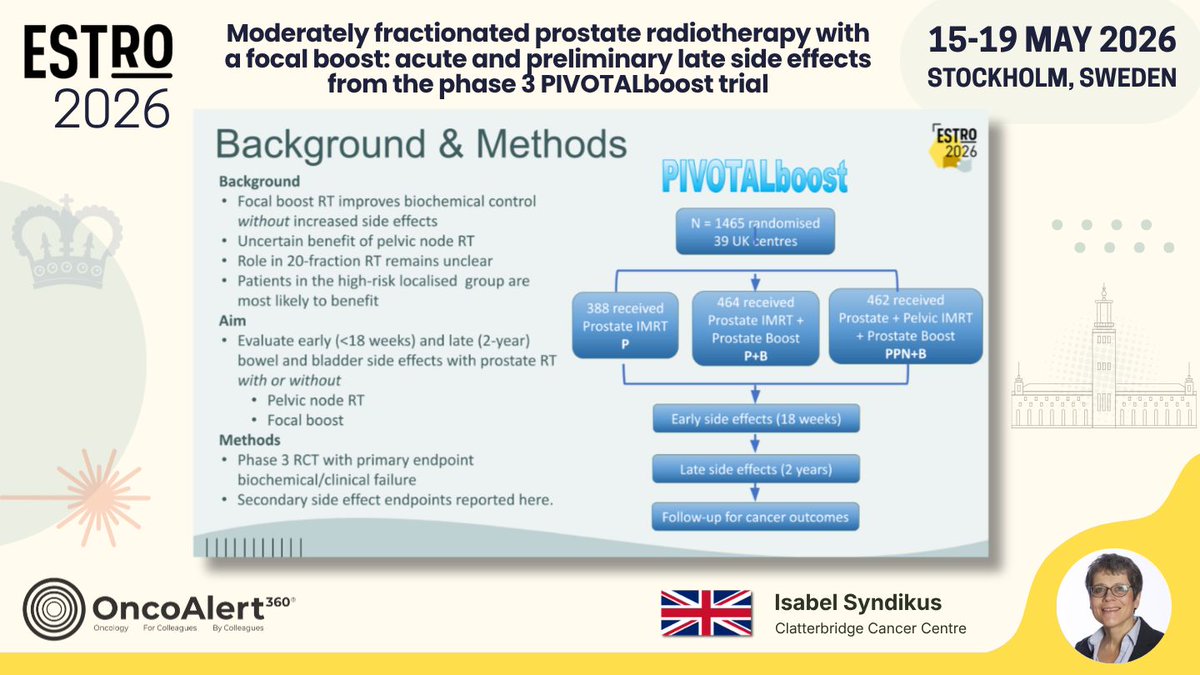
8 details 5 trials watching
Phase 3 RCT, N=1465 randomised at 39 UK centres. Primary endpoint is biochemical/clinical failure; the side-effect endpoints presented here are secondary. Early toxicity assessed to 18 weeks, late toxicity at 2 years.
Localised prostate cancer, with the slides naming the high-risk localised group as most likely to benefit from the interventions under test. Full eligibility criteria not stated in the source.
20-fraction moderately hypofractionated IMRT in all arms. Randomisation is to prostate alone (388), prostate + focal boost (464), or prostate + pelvic nodes + focal boost (462), so the trial separates the boost question from the nodal question. Prescription dose and boost dose level not stated in the source slides.
Primary: biochemical/clinical failure, not reported at this presentation. Secondary (reported here): early bowel and bladder side effects to 18 weeks and late G2+ events at 2 years.
Nodal RT increased early bowel side effects, resolving by 18 weeks. Late cumulative rates were reported for the 973 (74%) patients with at least 2 years' follow-up.
The nodal question in prostate RT is currently split: POP-RT favoured whole-pelvis RT on biochemical failure-free survival while PEACE-2 was null on its nodal comparison, and both used conventional or near-conventional fractionation. PIVOTALboost is the first randomised test of pelvic nodal coverage in a 20-fraction schedule, so its eventual efficacy readout is the one that transfers to how most UK and increasingly non-UK practice actually delivers prostate RT.
The late analysis rests on the 74% with 2 years of follow-up, so a differential drop-out by arm would bias the comparison, and cumulative-incidence estimates at 2 years cannot address the fibrotic and stricture toxicity that appears at 5 to 10 years. The source does not state the grading instrument, and a clinician-graded versus patient-reported difference materially changes the size of a G2+ bowel signal.
A safety readout without its efficacy partner cannot move the nodal decision on its own, but it does close off one of the two arguments against nodal coverage in the hypofractionated era. The remaining argument is whether pelvic nodal RT does anything for disease control, which this trial is powered to answer and has not yet reported.
CONSORT flow
Randomised phase 3, but this is the secondary toxicity readout only; the biochemical/clinical failure primary endpoint is unreported, so it settles safety, not benefit.
- Does pelvic nodal RT improve biochemical/clinical failure at 20 fractions? n=18 · primary completion 2026-08 · 20fx pelvic nodal RT with prostate SIBrecruiting Phase III Adaptive Adaptive Stereostactic Body Radiotherapy (SBRT) With Dose Escalation for High-Risk Prostate Cancer Phase NAn=390 · primary completion 2033-04 · WPRT + DIL boost vs standard RT, high risk
- Does the focal intraprostatic boost add control over prostate IMRT alone? recruiting Image-guided Focal Dose Escalation- Primary pc Treated With Primary External Beam Hypofract.Stereotactic rt Phase NAn=374 · primary completion 2025-08 · arm A focal dose escalation vs arm B IMRTactive Standard Moderately Hypofractionated RT vs. Ultra-hypofractionated Focal Lesion Ablative Microboost in Prostate Cancer Phase NAn=484 · primary completion 2032-01 · Hypo-FLAME microboost vs standard 20fx RTrecruiting Addition of Focal Boost to Primary Radiotherapy for Prostate Cancer in 12 or 20 Fractions Phase NAn=1016 · primary completion 2040-10 · randomises focal boost vs none at 20fx
- Do G2+ rates diverge beyond 2 years as late fibrotic toxicity matures?
📚 Sources · 🐦 1 tweet
Day THREE of #ESTRO26 Coverage by OncoAlert 🚨
— OncoAlert (@OncoAlert) May 17, 2026
Moderately fractionated prostate radiotherapy with a focal boost: acute and preliminary late side effects from the phase 3 PIVOTALboost trial Presented by Isabel Syndikus 🇬🇧 #RadOnc ☢️
In the PIVOTALboost trial, we treated 1314… pic.twitter.com/cGuR1j2Qos
APBI-IMRT Florence NCT02104895
ForEarly breast cancer post-BCS, pT <25 mm, margins ≥5 mm, age >40
7.7% vs 4.2%
HR 1.57 (95% CI 0.82-3.04), p=0.17
TL;DR15-yr IBTR 7.7% APBI vs 4.2% WBI, HR 1.57 (0.82-3.04) p=0.17; excess driven by new ipsilateral primaries, not true local relapse.
The 5-fraction 30Gy IMRT schedule is what transfers: this is the longest follow-up for that specific PBI regimen, and the 15-yr excess sits in new ipsilateral primaries (5.9% vs 2.7%, p=0.09) rather than local relapse (2.1% vs 1.6%, p=0.75). That distinction is the whole case for keeping PBI in Florence-eligible pts, and it rests on adjudication, not on a powered endpoint.
In a woman over 40 after breast-conserving surgery with a tumour under 25 mm and margins of at least 5 mm, this supports offering 5-fraction PBI as a durable option; it does not extend to node-positive disease, close margins, or younger patients.
The transferable parameter is 30Gy in 5 fractions by IMRT, now with 15-yr follow-up. The excess ipsilateral events are new primaries (5.9% vs 2.7%, p=0.09), not local relapse (2.1% vs 1.6%, p=0.75), which is the distinction that justifies continuing PBI in Florence-eligible pts.
Nothing here moves systemic therapy: distant metastasis 2.7% vs 4.6% and breast-cancer deaths 2.3% vs 3.1% are indistinguishable at 15 years. What matters downstream is the new-primary rate of 5.9% with PBI, which shapes how much ipsilateral surveillance a de-escalated local approach earns.

+2 more figures


10 details
Phase III equivalence trial, 1:1 randomisation, n=520, accrued 2005-2013, median follow-up 15 years. Powered at 80% against a 5-year estimated IBTR of 3% with a 5% equivalence margin. Survival outcomes analysed ITT; toxicity and cosmesis per protocol after 14 withdrawals.
Post-breast-conserving-surgery early breast cancer: pT <25 mm, final surgical margins ≥5 mm, age >40 years. A selected, low-risk population by design.
PBI arm: 30Gy in 5 fractions delivered by IMRT (n=260). WBI arm: 50Gy in 25 fractions plus a 10Gy in 5-fraction tumour-bed boost (n=260).
No endpoint separated the arms at 15 years. The IBTR point estimate favours WBI (HR 1.57, 95% CI 0.82-3.04, p=0.17) but the confidence interval spans unity.
Florence remains the only randomised test of a 5-fraction IMRT PBI schedule with follow-up this long; other external-beam PBI randomisations used different dose and fractionation, so their recurrence rates are not directly interchangeable with this one. The direction here, a numerically higher IBTR concentrated in new primaries, is the pattern PBI trials have consistently reported when they separate the two.
The trial was sized for 5-year equivalence, so the 15-year IBTR comparison is a long-term description rather than a powered test, and the upper CI bound of 3.04 leaves room for a real excess. The relapse-versus-new-primary split is an adjudicated distinction, not a molecularly confirmed one, and it carries the entire reassurance.
The result supports continuing PBI in Florence-eligible pts rather than expanding the indication. It does not settle whether the new-primary excess is a genuine consequence of leaving untreated breast tissue unirradiated, which is biologically the expected cost of the approach and would not be captured by any local-control endpoint.
CONSORT flow
Randomised phase III with mature 15-yr follow-up; no significant difference on any oncological endpoint. Supports an already guideline-listed de-escalation rather than establishing a new one.
- Whether the new-primary excess reflects untreated ipsilateral breast tissue
- Ipsilateral surveillance intensity after partial-breast irradiation
- Applicability of 5-fraction PBI below age 40
📚 Sources · 🐦 1 tweet
📌 Fifteen-year outcomes of the randomised APBI-IMRT Florence phase Ill trial of partial versus whole-breast irradiation in early breast cancer ✨
— Elisabetta Bonzano MD, PhD (@to_be_elizabeth) May 17, 2026
Excellent presentation led by @CarlottaB 👏🏻#ESTRO26 @Icro_Meattini @ESTRO_RT @OncoAlert #OncoAlertAF pic.twitter.com/1j4bIA2nyC
IMPORT HIGH
ForInvasive early breast, pT1-3 pN0-pN3a M0, post-BCS, requiring tumour bed boost
3.7% vs 3.5% 10yr IBTR (48Gy SIB vs 40+16Gy)
95% CI 2.6-5.3 vs 2.4-5.0; 53Gy/15F 5.5% (4.1, 7.3)
TL;DR10yr IBTR 3.7% with 48Gy/15F SIB vs 3.5% with 40Gy/15F + 16Gy/8F sequential; 53Gy/15F higher at 5.5%.
The decision this hardens is delivery, not dose: 48Gy/15F SIB holds at 3.7% (2.6, 5.3) IBTR at 10 years against 3.5% (2.4, 5.0) for a sequential 16Gy/8F phase, in a higher risk group. 53Gy/15F sits at 5.5% (4.1, 7.3), so escalation buys nothing.
For a woman after breast conserving surgery for pT1-3 pN0-pN3a invasive disease who needs a tumour bed boost, the 10-year data support the integrated 48Gy/15F arm over a separate sequential boost; they do not speak to boost omission or to 5-fraction whole-breast schedules.
Three weeks, one plan: the boost is integrated into 15 fractions with a modest dose reduction to whole breast distant from tumour, and IBTR at 10 years matches the sequential 16Gy/8F phase. Escalating the integrated boost to 53Gy/15F does not improve local control.

| Dose group | 10yr IBTR (95% CI) | 10yr OS abs. diff vs 40Gy/15F |
|---|---|---|
| 40Gy/15F + 16Gy/8F | 3.5% (2.4, 5.0) | reference |
| 48Gy/15F (3.2Gy/F) | 3.7% (2.6, 5.3) | -0.5 (-3.0, 2.8) |
| 53Gy/15F (3.5Gy/F) | 5.5% (4.1, 7.3) | 1.5 (-1.4, 5.1) |
+1 more figure

8 details 4 trials watching
Three-arm randomised multicentre trial, 1:1:1, N=2617 across 76 UK hospitals, recruited 2009-2015. Annual clinical follow-up to 10 years; PRO and photographic assessment collected only to 5 years.
Women ≥18 after breast conserving surgery for invasive early breast cancer, pT1-3, pN0-pN3a, M0, all requiring a tumour bed boost. Described as a higher-than-average risk group.
40Gy/15F + 16Gy/8F sequential boost (N=871), 48Gy/15F SIB at 3.2Gy/F (N=874), 53Gy/15F SIB at 3.5Gy/F (N=872). The SIB arms escalate to the regions at highest risk with a modest dose reduction to whole breast distant from tumour, all delivered in 3 weeks.
Endpoint reported here: ipsilateral breast tumour relapse at 10 years. The original sample size calculation assumed a 5% control rate at 5 years. Absolute OS difference and clinician-assessed normal tissue effects also reported.
The 5-year ordering holds at 10 years: the two lower-dose groups sit close together and 53Gy/15F stays highest. Both absolute OS differences vs 40Gy/15F have intervals containing zero.
Moderate/marked effects at 10 years were given as bounds across all randomised groups: <18% breast distortion or shrinkage, <10% induration, <2% telangiectasia, <2% breast oedema. No per-arm split reported in source.
EORTC 22881-10882 established the tumour bed boost itself; IMPORT HIGH asks how to deliver it and whether more dose helps. At 10 years, integration works and escalation does not, the same ranking the 5-year publication (Coles et al. Lancet 2023;401:2124-37) reported.
PRO and photographic assessment stopped at 5 years, so the 10-year toxicity comparison rests on clinician scoring reported as all-group bounds, not per-arm rates. Observed IBTR also ran below the 5% control rate the sample size calculation assumed.
The practical read is fraction count, not dose: a boost folded into 15 fractions removes the separate 16Gy/8F phase with no 10-year IBTR cost, while 53Gy/15F returns nothing. What the trial does not settle is whether the same integration transfers to 5-fraction whole-breast schedules.
CONSORT flow
Mature 10yr follow-up of a 2617-pt randomised trial; extends the 5-year Lancet 2023 read rather than changing it. No formal 10yr non-inferiority margin stated in source.
- Simultaneous integrated boost within 5-fraction whole-breast schedules recruiting Ultra-hypofractioNated Adjuvant Radiotherapy ± sImultaneous Integrated Boost for Low-risk Breast Cancer Patients Phase 2n=65 · primary completion 2025-10 · ultra-hypofx WBI +/- SIB, low-risk, phase 2recruiting Ultra Hypo-fractionated Adjuvant Whole Breast Radiation Therapy With Simultaneous Integrated Boost for Early-Stage Breast Cancer (H-ASSIST) Phase 2n=90 · primary completion 2028-02 · 5-fraction WBI with SIB tumor bed boost, phase 2
- Patient-reported cosmesis beyond 5 years, unmeasured after photographic follow-up ended n=139 · primary completion 2025-12 · 10y registry with cosmesis + QoL assessmentsn=50 · primary completion 2028-09 · cosmesis + PROMs to 60mo after ultra-short WBI/SIB
📚 Sources · 🐦 1 tweet
Day THREE of #ESTRO26 Coverage by OncoAlert 🚨
— OncoAlert (@OncoAlert) May 17, 2026
Ten-year results of the IMPORT HIGH trial (ISRCTN47437448): Dose escalated simultaneous integrated boost radiotherapy in early breast cancer Presented by Charlotte Coles 🇬🇧 #RadOnc ☢️
Ten-year IMPORT HIGH trial data show that a… pic.twitter.com/7RqVy2SrQm
DBCG HYPO
ForNode-negative early breast cancer or DCIS, post-BCS whole-breast RT
24.7% vs 19.5% at 10 yr
HR 0.76 (95% CI 0.62-0.92), p=0.005, favouring 40 Gy/15 fr
TL;DR10yr grade 2-3 breast induration 24.7% (50Gy) vs 19.5% (40Gy), HR 0.76 (0.62-0.92), p=0.005, no recurrence penalty.
The fibrosis separation persists at a decade, 24.7% vs 19.5%, HR 0.76 (0.62-0.92): 40 Gy/15 fr is not merely non-inferior on late morbidity, it is better, with OS numerically higher (93.0% vs 92.1%, p=0.10). For a node-negative or DCIS patient, the residual argument for 25 fractions is gone.
For node-negative invasive breast cancer or DCIS after breast conservation, this supports 40 Gy/15 fr over 50 Gy/25 fr on late induration with no recurrence cost; node-positive and regional nodal irradiation populations were not enrolled and are not addressed.
The fibrosis separation persists at a decade, 24.7% vs 19.5%, HR 0.76 (0.62-0.92), so 40 Gy/15 fr is superior on late induration rather than merely non-inferior. In node-negative disease or DCIS, whole-breast only, the late-tissue argument for 25 fractions has no support here.

| Endpoint (10-yr) | 50 Gy/25 fr | 40 Gy/15 fr | HR (95% CI), p |
|---|---|---|---|
| Grade 2-3 breast induration | 24.7% | 19.5% | 0.76 (0.62-0.92), p=0.005 |
| Overall survival | 92.1% | 93.0% | 0.81 (0.63-1.04), p=0.10 |
+1 more figure

8 details 5 trials watching
Phase III randomised non-inferiority trial, 1:1, run across Denmark, Norway and Germany from 2009-2014. These are the prespecified 10-year analyses of toxicity, recurrence and survival, at a median follow-up of 12.8 years.
1,882 women with node-negative breast cancer or DCIS. After exclusions (13 and 16), 933 and 936 women were analysed in the two arms, with 917 carried into the morbidity analysis of one arm.
Whole-breast irradiation only: 50 Gy in 25 fractions versus 40 Gy in 15 fractions. No regional nodal irradiation question is posed, and boost details are not reported in the source slides.
Primary: grade ≥2 breast induration at 3 years, requiring two consecutive visits or the final follow-up. Morbidity was scored at years 0, 1, 2, 3, 4, 5 and 10; recurrence and survival are the co-reported 10-year outcomes.
The toxicity endpoint is the positive result here: 10-year grade 2-3 induration 24.7% with 50 Gy vs 19.5% with 40 Gy, HR 0.76 (0.62-0.92), p=0.005. The fibrosis advantage of hypofractionation is durable, not an early-follow-up artefact.
START-B and the UK 10-year hypofractionation data established 40 Gy/15 fr as at least equivalent for control with less normal-tissue effect; DBCG HYPO reproduces that direction in a contemporary node-negative and DCIS population treated 2009-2014, in an era of CT planning and modern systemic therapy rather than the 1990s cohorts.
Breast induration is a clinician-scored endpoint and the source does not state whether assessment was blinded, which matters when the two arms are trivially distinguishable by treatment duration. Locoregional recurrence, distant failure and breast cancer mortality are reported only as 'no significant difference' with no event counts or confidence intervals in the source, so the precision of the non-inferiority claim cannot be judged from these slides.
A 5.2-percentage-point absolute reduction in decade-level grade 2-3 induration is a real cosmetic and symptomatic difference in a population most of whom will never recur. The OS HR of 0.81 (0.63-1.04) is directionally in favour of the shorter schedule but is not significant and should not be read as a survival benefit of hypofractionation.
Randomised phase III, prespecified 10-yr analysis, 12.8-yr median follow-up, primary toxicity endpoint favours 40 Gy/15 fr. Reinforces already-standard moderate hypofractionation rather than changing it.
- How does 40 Gy/15 fr compare with five-fraction schedules on 10-yr fibrosis? n=2100 · primary completion 2029-03 · randomised 1 wk vs 3 wk adjuvant WBI, non-inferiorityrecruiting 5 fr Ultrahypofractionated WBI and SIB for Breast Cancer With Unfavorable Characteristics Phase NAn=458 · primary completion 2029-06 · 26 Gy/5 fr + SIB vs 40.05 Gy/15 fr + SIB, randomisedrecruiting Ultra-Hypofractionated vs Moderate Hypofractionated Radiotherapy for Regional Lymph Nodes in High Risk Breast Cancer Phase NAn=1950 · primary completion 2034-03 · 26 Gy/5 fr vs 40-42.5 Gy/15-16 fr nodal RT
- Does the induration benefit hold with regional nodal irradiation? recruiting Hypofractionated Irradiation At Regional Nodal Area for Breast Cancer Vs Existed Standard Treatment Phase 3n=801 · primary completion 2022-12 · phase 3 hypofx vs conventional RNI, safety endpointactive Hypofractionated vs. Conventional Regional Nodal Radiation Therapy for Patients With Invasive Breast Cancer Phase 2n=805 · primary completion 2030-02 · 3 wk vs 5 wk nodal RT, arm edema and recurrence
- Locoregional recurrence event counts and confidence intervals
📚 Sources · 🐦 1 tweet
Day TWO of #ESTRO26 Coverage by OncoAlert 🚨
— OncoAlert (@OncoAlert) May 17, 2026
10-year Follow-Up of the DBCG HYPO Trial: Breast Induration, Recurrence and Survival After Hypofractionated Whole Breast Irradiation Presented by Hanna Forsberg 🇩🇰 @BOffersen #RadOnc ☢️ #BreastCancer
The DBCG HYPO trial reports… pic.twitter.com/4qf9R3HZwT
HypoG-01
ForBreast cancer receiving adjuvant RT incl. nodal volumes, ESTRO-contoured
118 events / 1260 pts
Median f/u 4.8 yrs; LRR 20/118, iLRR sites in-volume 20/30 (67%)
TL;DR118 first events over 4.8yr median f/u; 67% of LRR sites in-volume, patterns comparable across 40Gy/15fx and 50Gy/25fx.
The actionable number is 20/30 iLRR sites in-volume, with 19/30 nodal and concentrated in levels 1 and 2: failures are happening inside correctly contoured CTVs, not at their edges, so this argues against widening nodal volumes and supports ESTRO contouring as drawn. Per-arm event counts not reported in source.
In node-involved breast cancer planned for adjuvant regional nodal RT, this supports keeping ESTRO-guideline CTVs rather than expanding level 1 to 2 coverage for geographic-miss concern; it does not address volume choice in pts contoured outside those guidelines.
20/30 iLRR sites were in-volume and 19/30 nodal, mainly levels 1 and 2. Recurrences are inside correctly drawn CTVs, so the fix is not a wider nodal volume, and ESTRO contouring holds under 40 Gy/15 fx. Per-arm counts not reported in source.
19/30 recurrence sites were nodal, concentrated in levels 1 and 2, the levels most affected when axillary dissection is replaced by sentinel-node-only management. Relevant to how much residual nodal risk surgical de-escalation leaves for RT to absorb; the analysis does not stratify by axillary surgery type.

| Event / site | n |
|---|---|
| Isolated distant recurrence | 61 |
| Second malignancy | 37 |
| Isolated locoregional recurrence | 19 |
| Concomitant locoregional recurrence | 1 |
| LRR as first event | 20 / 118 |
| iLRR sites in-volume | 20 / 30 (67%) |
| iLRR sites nodal | 19 / 30 |
+1 more figure

9 details 5 trials watching
Pre-planned secondary analysis of the HypoG-01 phase III trial, analysed ITT. N=1,260, median follow-up 4.8 years. Reported as a patterns-of-failure and dosimetric mapping study, not a re-test of the parent efficacy endpoint.
Randomisation was 40 Gy/15 fractions over 3 weeks vs 50 Gy/25 fractions over 5 weeks, each with a tumour-bed boost. Contouring followed ESTRO guidelines, which is what makes the in-volume/marginal classification interpretable rather than institution-specific.
Primary event was the first oncological event: locoregional recurrence, distant recurrence, or second malignancy. LRR was classified against the CTV as in-volume (within CTV), marginal (outside CTV but ≥50% prescribed dose), or out-of-volume (<50%). Planned dose at each recurrence site was re-estimated on the original planning CT.
118 first events. Distant recurrence and second malignancy dominated (61 and 37); LRR was the least common first event at 20/118. Among 30 iLRR sites, 20 (67%) were in-volume and 19/30 were nodal, mainly levels 1 and 2.
The dosimetric read is retrospective by construction: dose at the recurrence site is estimated on the initial plan CT, so anatomic change and registration error over a median 4.8 years both push sites toward an in-volume label. The event count also caps what can be concluded, since 30 sites split across two arms leaves the "not obviously different" claim underpowered rather than negative.
START-B and FAST-Forward established that moderate and ultra-hypofractionation do not cost local control, but neither mapped recurrence sites against the CTV. The contribution here is geographic rather than actuarial: it tests whether the *volume*, not the *dose per fraction*, is where hypofractionated regional treatment could fail.
A 67% in-volume rate reframes residual LRR as a biology problem, not a coverage problem: pts recurred where dose was delivered. The nodal concentration in levels 1 and 2 is the one signal worth watching, since those are the levels most variably treated when surgical axillary management is de-escalated.
Pre-planned secondary analysis, descriptive only. No per-arm effect size or statistical comparison in source; 30 iLRR sites cannot exclude an arm difference.
- Per-arm LRR site distribution, 40 Gy/15 fx vs 50 Gy/25 fx recruiting Hypofractionated Irradiation At Regional Nodal Area for Breast Cancer Vs Existed Standard Treatment Phase 3n=801 · primary completion 2022-12 · phase 3 hypofx vs conventional RNI, node-positiverecruiting Conventionally Fractionated vs. Hypofractionated Comprehensive Nodal Irradiation for Breast Cancer Using Pencil Beam Scanning Proton Therapy Phase 3n=276 · primary completion 2038-02 · phase 3 3wk vs 5wk comprehensive nodal RT, protons
- Does ultra-hypofractionation shift nodal failure geography? n=768 · primary completion 2029-01 · randomised ultrahypo vs moderate hypo RNI, 4 cohortsrecruiting Ultra-Hypofractionated vs Moderate Hypofractionated Radiotherapy for Regional Lymph Nodes in High Risk Breast Cancer Phase NAn=1950 · primary completion 2034-03 · 26Gy/5fx vs 40Gy/15fx RNI, n=1950, recurrence f/u
- Level 1-2 coverage after sentinel-node-only axillary management n=205 · primary completion 2027-12 · RNI volume tailored to SLND-alone vs SLND+ALND
📚 Sources · 🐦 1 tweet
Day TWO of #ESTRO26 Coverage by OncoAlert 🚨
— OncoAlert (@OncoAlert) May 16, 2026
Patterns of locoregional and distant recurrence and dosimetric analysis in the HypoG-01 phase III trial Presented by Louis Munschi 🇫🇷 #RadOnc ☢️
In the HypoG-01 phase III trial (1260 patients, median follow-up 4.8 years), 118… pic.twitter.com/ogARInu0fB
Tumour bed boost after BCS+WBRT (Dutch cohort)
ForPost-BCS invasive breast cancer receiving WBRT, boost decision pending
TL;DR10yr IBTR 1.2% with 0-2 risk factors regardless of boost, supporting boost omission in the modern systemic era.
The decision this moves is boost omission, and the number that moves it is 10yr IBTR 1.2% in the 0-2 risk-factor group whether or not a boost was given, on 15,085 vs 13,845 pts. Note the ≥3 group ran higher WITH boost (3.3% vs 2.7%), which is allocation bias, not boost harm. Boost dose and fractionation are not in the source.
In a post-BCS patient over 40 with grade 1-2, hormone-receptor-positive disease receiving guideline-concordant systemic therapy, this supports omitting the tumour bed boost; it does not resolve the boost question for pts carrying three or more risk factors.
The omission decision rests on 10yr IBTR of 1.2% in the 0-2 risk-factor group with and without boost (15,085 vs 13,845 pts). The ≥3 stratum ran higher WITH boost (3.3% vs 2.7%), a signature of risk-based allocation rather than boost harm. Boost dose and fractionation are absent from the source.

| Risk factors | N no boost | N boost | 5yr no boost | 5yr boost | 10yr no boost | 10yr boost |
|---|---|---|---|---|---|---|
| 0-2 | 15,085 | 13,845 | 0.6% | 0.7% | 1.2% | 1.2% |
| ≥ 3 | 149 | 733 | 1.3% | 2.9% | 2.7% | 3.3% |
| Uncertain | 592 | 944 | 0.8% | 3.3% | 1.4% | 3.6% |
+2 more figures


9 details
Population-based Dutch cohort from the Netherlands Cancer Registry linked to pathology, on behalf of the DBRT group. Treatment years 2012-2016, follow-up to 10 years. Observational, no randomisation and no adjusted comparison reported in source.
Breast-conserving treatment with or without an RT boost, N=31,348 across the three risk strata. Stratification is by a count of five risk factors: age ≤40, grade 3, triple-negative, guideline-indicated systemic therapy not adequately given, and no pCR after neoadjuvant chemo in TNBC or HER2+.
Whole-breast RT with or without a tumour bed boost. Boost dose, fractionation, technique (photon vs electron vs SIB) and the WBRT schedule are not reported in the source slides, which limits transfer to a specific departmental protocol.
Primary: ipsilateral breast tumour recurrence (IBTR), histologically confirmed, identified by an algorithm over pathology report codes and free text. Reported as cumulative incidence at 5 and 10 years by risk-factor count. Benchmarked against the Assisi thresholds: omission acceptable at <3% 10yr IBTR with boost, <6% without.
IBTR was low in every stratum. The only cell crossing an Assisi threshold was ≥3 risk factors treated with a boost at 10 years, and even there the no-boost value in the same stratum was lower.
EORTC 22881-10882 established that a boost roughly halves IBTR, and that trial's control-arm event rates were an order of magnitude above these. IMPORT HIGH and the 2024 Assisi think tank both moved the field toward de-escalating or restricting the boost; this cohort supplies the contemporary absolute rates those recommendations assumed but could not show.
Boost was allocated by guideline-based risk, so the boost groups are adversely selected and the raw contrast understates any boost effect; the higher rate in the ≥3 boost group is the visible signature of that confounding. The ≥3 no-boost cell holds only 149 pts, and the 'uncertain' stratum (592 / 944) shows a boost-no-boost gap wide enough to suggest unmeasured risk is driving allocation there too.
The finding is about absolute rather than relative benefit: a preserved 50% relative reduction applied to a 1.2% 10-year event rate is not worth five extra fractions and a fibrosis penalty. What the cohort cannot say is whether the boost is the reason those low-risk rates are low, since roughly half the low-risk group received one.
Registry cohort, no randomisation and no adjusted effect estimate; boost allocation confounded by risk. Supports the direction already set by IMPORT HIGH and Assisi thresholds.
- Which ≥3 risk-factor subgroups actually benefit from a boost
- Whether boost omission holds under randomised testing in low-risk pts
- Boost dose and technique used across this cohort
📚 Sources · 🐦 1 tweet
Day TWO of #ESTRO26 Coverage by OncoAlert 🚨
— OncoAlert (@OncoAlert) May 16, 2026
Is a boost to the tumour bed still indicated after breast-conserving surgery and whole-breast radiotherapy in the era of modern systemic therapy? Presented by Femke Froklage 🇳🇱 #RadOnc ☢️
We aimed to identify a subgroup of breast… pic.twitter.com/RqK5r9XPqW
OligoCare
ForOligometastatic solid tumors treated with SABR, mixed primaries and lesion sites
TL;DRReal-world SABR local failure 5.0% at 1yr, 11.4% at 3yr across 2447 pts / 3533 lesions; CRC worst at 19.6%.
The actionable RT signal is minimum PTV dose, called the single most critical technical factor, and the de novo vs repeat OMD gap the authors attribute to higher delivered dose. CRC failed most (19.6% at 3yr) despite the highest median dose per fraction, which argues for escalation or combination rather than coverage alone. No dose thresholds are reported in source.
For a prostate or NSCLC oligomet being planned for SABR, this real-world cohort supports expecting durable in-field control (8.1% and 9.8% failure at 3yr); it does not support the same expectation for a colorectal met, where 3yr failure reached 19.6%.
Minimum PTV dose is named the most critical technical factor, so coverage of the low-dose region, not the prescription isodose, is where the planning attention goes. CRC failed worst (19.6% at 3yr) despite the highest median dose per fraction, so escalation alone may not close that gap. No dose thresholds reported in source.
SABR delivers 88.6% in-field control at 3yr in routine practice, so local failure is not the dominant driver of progression in most oligometastatic primaries. The exception is colorectal, at 19.6% failure by 3yr, where the authors suggest combination systemic approaches alongside local therapy rather than dose escalation alone.

| Primary | Total | 1 year | 3 years |
|---|---|---|---|
| Colorectal | 518 | 9.3% | 19.6% |
| Breast | 378 | 4.1% | 11.3% |
| NSCLC | 530 | 6.0% | 9.8% |
| Prostate | 1021 | 2.7% | 8.1% |
+2 more figures


10 details 4 trials watching
Prospective EORTC OligoCare registry cohort, interim analysis. 57 institutions, enrolment July 2019 to July 2025. No randomisation and no comparator arm; technique and dose were chosen by the treating institution.
2447 eligible pts with 3533 lesions. Median age 69 (range 28-94), 69% male. Primaries reported for the local-control breakdown were prostate (1021), NSCLC (530), colorectal (518) and breast (378).
SABR to oligometastatic lesions across bone (869 non-vertebral, 515 spine), lung (807), non-regional nodes (558), liver (306), brain (231) and other (247) sites. Minimum PTV dose was the technical factor most associated with outcome; specific dose and fractionation schedules are not reported in source.
Local in-field progression, reported as cumulative incidence with 99% CI, at 1 and 3 years. Median follow-up 31 months, minimum 6 months.
Overall local in-field progression 5.0% at 1yr and 11.4% at 3yr, ie 88.6% local control at 3yr. By primary, colorectal was the outlier and prostate the best.
Randomised oligometastatic SABR trials (SABR-COMET, STOMP, ORIOLE) were built on much smaller, more selected cohorts and reported survival or progression endpoints rather than lesion-level in-field control at this scale. This registry does not test the SABR question those trials asked; it reports what in-field control looks like once SABR is delivered in routine multi-institutional practice.
Dose and fractionation were institution-chosen, so the minimum-PTV-dose association is confounded by target site, prior irradiation and case selection. No PTV dose threshold, no per-primary dose data and no toxicity are reported in source, so the technical conclusion cannot be translated into a planning constraint.
The CRC finding is the one that changes a plan: worst local control despite the highest median dose per fraction points at intrinsic radioresistance rather than underdosing, and the authors call for escalation or combination strategies. The de novo versus repeat OMD gap is reported as a dose effect, which is plausible but is exactly the kind of comparison a registry cannot separate from the reasons a lesion is being re-treated.
Prospective multi-site registry, no randomised comparator, institution-chosen technique. Large real-world cohort supports existing SABR practice in OMD rather than testing it.
- Minimum PTV dose threshold that predicts local control
- Combination or dose-escalation strategies for colorectal oligomets recruiting Fruquintinib Combined With Sintilimab ± Radiotherapy for Third-line Treatment of Colorectal Cancer With Liver Metastases Phase 2n=62 · primary completion 2026-10 · SBRT+LDRT with sintilimab/fruquintinib, MSS CRC liverrecruiting Low and Intermediate Risk OliGometastatic ColoREctal CancEr PatieNts Treated with Stereotactic ABlative Radiotherapy Phase NAn=204 · primary completion 2031-04 · randomised SABR + chemo in 1-3 CRC oligomets
- Whether repeat OMD failure reflects dose or disease biology active Bony M - Stereotactic Ablative Radiotherapy (SABR) of Bony Metastases in Patients With Oligometastatic Disease Phase NAn=67 · primary completion 2023-01 · SABR in de novo vs recurrent OMD bone lesionsn=397 · primary completion 2028-06 · MR-guided adaptive SBRT, tumor control by site
📚 Sources · 🐦 1 tweet
📣 #ESTRO26 - @UmbertoRicardo e2irradiate @EORTC prospective OLIGOCARE registry of SABR for oligomets. ~2500 patients, ~3500 mets.
— Shankar Siva (@_ShankarSiva) May 17, 2026
➡️ local failure 5% at 1 year and 11% at 3 years
➡️ Colorectal cancer has higher risk of progression
➡️ minimum PTV dose correlated with outcome… pic.twitter.com/cx4zERqHhK