Meta-analysis
MARCAP Consortium
ForLocalized prostate cancer, NCCN intermediate to high risk, definitive RT
TL;DRIPD meta-analysis, 10,853 pts: ADT added to RT improved MFS HR 0.83 and OS HR 0.86; dose escalation improved bRFS only.
Reported via UroToday →
The dose-invariance result is the load-bearing one: ADT's benefit was identical at ≥74 Gy and <74 Gy (both HR 0.83), so escalating dose does not buy out the ADT decision. Adjuvant prolongation carries the benefit (MFS HR 0.84), neoadjuvant prolongation does not (HR 0.95), which moves sequencing, not just duration.
In NCCN intermediate- and high-risk localized prostate cancer receiving definitive RT, this supports adding and prolonging ADT on the adjuvant side rather than substituting dose escalation; it does not address node-positive or post-prostatectomy salvage settings.
ADT's benefit was identical at ≥74 Gy and <74 Gy (HR 0.83 both), so escalation does not buy out the hormone decision, and HEAT showed escalation to 79.2 Gy improved biochemical RFS but not MFS or OS. Adjuvant prolongation carries the survival benefit; neoadjuvant prolongation (HR 0.95) does not.
The duration and sequencing read: extending adjuvant ADT from 4-6 to 18-36 months gave MFS HR 0.84 and OS HR 0.85, while extending neoadjuvant ADT from 3-4 to 6-9 months gave HR 0.95 for both. Relative benefit held across NCCN groups, so risk stratification changes NNT, not effect size.
9 details 5 trials watching
Individual patient data meta-analysis from the MARCAP Consortium, 12 eligible trials, 10,853 patients, median follow-up 11.4 years (IQR 9.0-15.0). Three intensification questions analyzed separately: ADT use, neoadjuvant ADT prolongation, adjuvant ADT prolongation.
Localized prostate cancer treated with definitive radiotherapy, stratified by NCCN prognostic risk group. The RT ± ADT comparison ran 2,557 control vs 2,579 experimental (NCCN high 32.6% vs 32.8%, intermediate 47.6% vs 48.7%); the adjuvant-prolongation comparison was high-risk enriched at 71.5% vs 71.1% NCCN high across 1,900 vs 1,874 pts.
Dose was analyzed as a binary ≥74 Gy vs <74 Gy split, with the companion HEAT analysis using 64 to <74 Gy vs ≥74 Gy and escalation up to 79.2 Gy. Brachytherapy boost is discussed as an escalation route alongside external-beam dose.
ADT addition improved MFS HR 0.83 (0.77-0.89) and OS HR 0.86 (0.80-0.92). Adjuvant prolongation improved MFS HR 0.84 (0.78-0.91) and OS HR 0.85 (0.78-0.94); neoadjuvant prolongation did neither (MFS HR 0.95, OS HR 0.95). 10-yr MFS 61% (59-63) with ADT vs 52% (50-54) without; 10-yr OS 65% (63-67) vs 57% (55-59).
| Intervention | Intermediate risk | High risk |
|---|---|---|
| ADT addition | 18.0 | 8.4 |
| Adjuvant ADT prolongation | 16.1 | 10.4 |
The 2022 HEAT network meta-analysis (13 trials, 11,862 pts) found dose escalation improved biochemical RFS but not MFS or OS, and named high-dose RT plus long-term ADT the best strategy. PROG 05/09 and GETUG-18 are invoked to explain the gap: a 21% 5-year biochemical benefit in low risk where metastasis is rare, versus 3% in high risk where it is not.
The pooled trials span 30+ years of practice, so the RT technique behind the <74 Gy stratum is not the technique a reader delivers today. The stated optimal durations (closer to 12 months high risk, 24+ months very high risk) come from DHARMA, accepted but unpublished, so that specific number is not yet auditable.
The framing claim is that dose escalation and ADT are not interchangeable levers: escalation buys biochemical control, ADT buys metastasis-free and overall survival, and the two do not substitute. The dogma that dose escalation obviates ADT is named as widely repeated and never demonstrated.
IPD meta-analysis of randomised trials, large N, long f/u. Reinforces ADT intensification over dose escalation; no new randomisation, and duration guidance rests on unpublished DHARMA.
- Optimal adjuvant ADT duration by prognostic risk group active A Study of Shorter Course Hormone Therapy and Radiation for High-risk Prostate Cancer Phase 2n=50 · primary completion 2026-10 · shorter-course ADT with brachy + hypofx EBRT, high-riskrecruiting Artificial Intelligence Driven Personalisation of Radiotherapy and Concomitant Androgen Deprivation Therapy for Prostate Cancer Patients (the HypoPro Trial) Phase 2n=30 · primary completion 2026-10 · MMAI classifier individualises ADT duration, high-risk
- Does dose escalation change ADT benefit with modern brachytherapy boost active Comparative Study of Radiotherapy Treatments to Treat High Risk Prostate Cancer Patients Phase 3n=307 · primary completion 2028-12 · phase 3 HDR brachy boost vs dose-escalated RT + ADTrecruiting Androgen Suppression Combined With Nodal Irradiation and Dose Escalated Prostate Treatment Phase 3n=710 · primary completion 2032-10 · phase 3 SBRT vs EBRT + brachy boost, all on ADTrecruiting PRO-BOOST-LC: Whole-Gland Boost Strategies Versus SBRT Monotherapy in PSMA-Staged Localized and Locally Advanced Prostate Cancer Phase 2/3n=1000 · primary completion 2033-12 · randomised brachy or SBRT boost vs SBRT alone, + ADT
- Whether intermediate-risk subsets warrant long-term ADT
📚 Sources · 📄 1 paper
Abstract
POSEIDON
ForPost-prostatectomy biochemical recurrence, PET-negative, pre-PORT PSA the gating variable
HR 0·87
95% CI 0·76–1·01, p=0·06, not met
TL;DROS HR 0·87 (0·76–1·01), p=0·06 for adding hormone therapy to PORT; benefit only above pre-PORT PSA 0·5 ng/mL.
The gate is pre-PORT PSA, not risk features. Below 0·5 ng/mL point estimates favour PORT alone (HR 1·14 at ≤0·20); above it, HR 0·72 and 0·69 with NNT 22 and 12. Long-term HT only separates on spline at PSA ≥1·6 ng/mL, above what early salvage practice sees.
In PET-negative post-prostatectomy biochemical recurrence referred at PSA 0·2 to 0·5 ng/mL, this questions adding hormone therapy to prostate-bed radiotherapy; it does not address PSMA-PET-positive nodal recurrence or pts already above 0·5 ng/mL, where the survival signal sits.
For the pt referred at PSA 0·2 to 0·5 ng/mL, the point estimates favour PORT alone (HR 1·14 at ≤0·20, 0·94 at 0·21–0·50), so the routine 6-month ADT add-on has no survival footing in the range early salvage now targets. Above 0·5 ng/mL the HRs are 0·72 and 0·69 with NNT 22 and 12.
Duration is not the lever: prolonging 6 months to 24 within RADICALS gave OS HR 0·89 (0·68–1·16), and the long-term cohort's apparent advantage tracks its higher baseline PSA and worse pathology. RTOG 9601 used bicalutamide, not castration, so the one OS-positive trial does not validate GnRH intensification.
13 details
IPD meta-analysis of randomised phase 3 trials of PORT with or without hormone therapy, MARCAP consortium, PROSPERO CRD42019134376. One-stage framework, univariable Cox stratified by trial, intention-to-treat. Six randomised comparisons, 6057 pts, median follow-up 9·0 years.
Post-radical-prostatectomy pts receiving prostate-bed radiotherapy, adjuvant or salvage. Median pre-PORT PSA 0·3 ng/mL overall (0·5 in the long-term cohort). Positive margins in 57–60%, Gleason 7 in about two-thirds, seminal vesicle invasion 16–17%. Race and ethnicity data were not available.
Short-term arm was 4–6 months, predominantly GnRH agonist. Long-term was 24 months, GnRH agonist in 425 (86%) of 492 RADICALS three-way pts, with RTOG 9601 contributing bicalutamide monotherapy rather than castration.
PORT to the prostate bed with or without pelvic nodes, per each contributing trial. Dose, fractionation and nodal-volume detail are not reported in the source text, so the RT technique is not standardised across the six randomisations.
Primary: overall survival. Secondary MFS, event-free survival, biochemical recurrence (Fine–Gray). Prespecified interaction testing on pre-PORT PSA and hormone therapy duration, plus 10-year restricted mean survival time and NNT.
The primary endpoint was not met. The signal sits entirely in the PSA interaction and in MFS, both shown in the detail tables.
| Pre-PORT PSA (ng/mL) | HR (95% CI) | p |
|---|---|---|
| ≤0·20 | 1·14 (0·83–1·57) | 0·43 |
| 0·21–0·50 | 0·94 (0·74–1·19) | 0·70 |
| 0·51–1·00 | 0·72 (0·54–0·96) | 0·02 |
| >1·00 | 0·69 (0·48–0·98) | 0·03 |
| Comparison | OS HR (95% CI) | MFS HR (95% CI) |
|---|---|---|
| Short-term (4–6 mo) added to PORT | 0·93 (0·77–1·11) | 0·82 (0·71–0·95) |
| Long-term (24 mo) added to PORT | 0·79 (0·63–1·00) | 0·74 (0·60–0·91) |
| Prolong short to long | 0·89 (0·68–1·16) | 0·76 (0·61–0·95) |
RTOG 9601 remains the only contributing trial to show an OS benefit, and it enrolled late salvage at higher PSA with bicalutamide, exactly the high-PSA stratum where benefit persists here. The contrast with intact-prostate radiotherapy, where the same consortium's 2022 Lancet Oncology analysis found an OS benefit for added ADT, is the point: the postoperative setting does not inherit it.
The short-term and long-term comparisons draw on different trial populations, and the long-term cohort carried higher PSA and worse pathology, so the duration read is not a clean randomised contrast outside the 1523-pt RADICALS exploratory analysis. Spline thresholds of 1·6 and 2·0 ng/mL sit at the sparse tail of a cohort with median PSA 0·3.
MFS improved while OS did not, and the authors show the MFS effect never clears the ICECaP 0·81 threshold, so the divergence is not simply immature follow-up. What the analysis cannot settle is whether hormone therapy is inert at low PSA or whether its cancer-specific benefit is cancelled by other-cause mortality in pts with indolent disease.
IPD meta-analysis of six randomised trials, prespecified PSA interaction, 9-yr follow-up. Contradicts routine hormone therapy with PORT at low PSA. Duration contrast is exploratory.
- Biomarker to identify who benefits from hormone therapy with PORT
- Does hormone therapy benefit persist in PSMA-PET-staged salvage
- Why MFS gain does not translate to overall survival
📚 Sources · 📄 2 papers
Abstract
HYDRA
ForLocalised prostate cancer, definitive external-beam RT
TL;DRNo PFS difference for either isodose (HR 0.92) or dose-escalated MHFRT (HR 0.94), but escalation raises late G2+ GI (OR 1.48).
The split that matters is isodose vs dose-escalated MHFRT, not hypofractionation itself: escalation adds no PFS (HR 0.94, 0.82-1.09) and costs bowel on both physician grading (OR 1.48) and patient report (OR 1.68). GU was unchanged in both strata. The schedule decision lands on 60 Gy in 20 fractions.
In a man with localised prostate cancer starting definitive prostate-only EBRT, this supports an isodose moderately hypofractionated schedule over a dose-escalated one; it does not extend to five-fraction ultrahypofractionation, post-prostatectomy salvage, or whole-pelvis treatment.
The decision this moves is schedule selection, not modality: escalated MHFRT shows no PFS gain (HR 0.94, 0.82-1.09) and raises late G2+ GI (OR 1.48) plus patient-reported bowel decrement (OR 1.68), while isodose shows neither. 60 Gy in 20 fractions is the defensible default for prostate-only volumes.
7 details 5 trials watching
IPD meta-analysis of randomised phase 3 CFRT vs MHFRT trials via the MARCAP consortium. Searches on Dec 15, 2023 and re-run Jan 8, 2025 screened 1696 records down to 7 eligible trials. Three separate analyses: efficacy, physician-scored late toxicity, and patient-reported outcomes.
Localised prostate cancer on trials that published patient-level efficacy AND late toxicity data. 3454 pts across three isodose trials, 2426 pts across four dose-escalated trials. Trials whose CFRT arm fell below modern dose were excluded.
The intervention split is the whole point: isodose MHFRT (same equivalent dose in fewer fractions, eg 60 Gy in 20 fractions) versus dose-escalated MHFRT. The CFRT comparator had to deliver ≥70 Gy in 2 Gy equivalents.
Primary (efficacy): progression-free survival. Co-primary toxicity endpoints: late grade 2 or higher GU and GI. Co-primary PRO endpoints: clinically-significant decrement in urinary or bowel quality of life.
The GI signal sits entirely in the dose-escalated stratum and shows up on both physician grading and patient report; the isodose stratum carries neither. GU odds ran above 1 in both comparisons with intervals crossing unity.
CHHiP and PROFIT established 60 Gy in 20 fractions as non-inferior to conventional fractionation. The escalated schedules were built on the premise that a higher equivalent dose in fewer fractions would improve control; pooled here that premise fails on PFS while adding bowel toxicity.
Toxicity scales and PRO instruments were not uniform across the seven trials, and the dose-escalated stratum pools four schedules that are not interchangeable, so the OR describes escalation as a class, not one regimen. Follow-up also differs between strata (5.4 vs 7.1 yrs).
With efficacy answered as a null, the schedule decision turns entirely on toxicity, and the toxicity difference runs one way. Escalating per-fraction dose beyond isodose buys no measurable PFS while adding bowel morbidity that pts themselves report, which leaves little argument for an escalated MHFRT schedule in intact localised disease.
Pooled IPD from seven randomised phase 3 trials, aligned with existing moderate-hypofractionation practice; refines which regimen rather than establishing a new modality or population.
- Does the escalation bowel signal extend to five-fraction ultrahypofractionation? recruiting Comparing Moderately Ultra Hypofractionated Radiation Treatments for Prostate Cancer Phase 2n=204 · primary completion 2030-11 · randomised 20fx vs 5fx post-op bed +/- pelvisrecruiting Salvage Moderate Hypofractionated Versus Ultrahypofractionated Radiotherapy for Biochemical Recurrence After Radical Prostatectomy in Prostate Cancer Phase 3n=270 · primary completion 2034-12 · phase 3 moderate vs ultrahypo salvage, toxicity EP
- Do rectal spacers and daily IGRT narrow the dose-escalated GI gap? n=500 · primary completion 2027-12 · SpaceOAR Vue for late GI toxicity under SBRTn=84 · primary completion 2027-12 · Barrigel anterior rectal sparing in post-op RT
- Same toxicity read when MHFRT covers whole-pelvis nodal volumes? n=18 · primary completion 2026-08 · 20/16/12fx pelvic nodal RT with prostate SIB
📚 Sources · 📄 1 paper
Abstract
WOLVERINE
ForOligometastatic prostate cancer, up to 5 mets, mostly castration-sensitive
TL;DRIPD meta-analysis of 6 randomised phase 2 trials, 472 pts: MDT improved PFS (HR 0.44, 0.35-0.56), OS non-significant (HR 0.63, 0.39-1.00, p=0.051).
Surfaced from a review's discussed trials
The endpoint that survives every sensitivity cut is PFS (HR 0.44, and 0.46 excluding the observation-SOC trials), while OS stops at HR 0.63 (0.39-1.00, p=0.051). CRFS 0.58 in CSPC is the more decision-relevant signal, since delaying castration resistance is what MDT is being asked to buy. Nothing here resolves dose, target, or which oligo burden benefits.
In castration-sensitive oligometastatic prostate cancer with up to five lesions and a treated primary, this supports adding MDT for progression-free and castration resistance-free benefit; it does not establish an OS benefit, and the CRPC-only and untreated-primary populations are thinly represented.
The endpoint that survives every sensitivity cut is PFS (HR 0.44, and 0.46 excluding the observation-SOC trials), and CRFS 0.58 in CSPC is what MDT is being asked to buy. None of the constituent trials' dose, fractionation or target-selection choices are resolved by pooling, and rPFS carried I²=50% heterogeneity, so how to deliver MDT stays a local decision.
MDT deferred castration resistance (CRFS HR 0.58) in the castration-sensitive subset (n=257), which is the sequencing-relevant read: the question is whether local therapy buys time before ARPI escalation. Note the SOC arm actually got MORE second-generation ARPI (59.8% vs 50.4%), so the systemic backbone was not favouring MDT.
10 details 5 trials watching
Systematic review and individual patient data meta-analysis (X-MET collaboration), PROSPERO CRD42023479078. Searched Embase, PubMed, CENTRAL, MEDLINE and ClinicalTrials.gov to Nov 3 2023, updated May 4 2025; dual independent screening in Covidence, Cochrane RoB 2.0. Of 2975 studies screened, 7 phase 2 trials randomising 574 men were included.
Published randomised prospective trials in oligometastatic (up to five metastases) prostate cancer with data sufficient for PFS and OS. Most patients were castration-sensitive (n=375, 65%); ARTO enrolled entirely CRPC and the two EXTEND baskets a CRPC subset. The primary tumour had received prior definitive local therapy in 491 patients (85.5%), required in every trial except the EXTEND baskets and ARTO.
Co-primary: progression-free survival and overall survival. Secondary: radiographic PFS and castration resistance-free survival. Primary analysis restricted to the six trials randomising MDT plus SOC versus SOC, with both a random-effects trial-level analysis and a patient-level analysis stratified by trial.
Effect sizes are in the endpoint table. Trial- and patient-level estimates agreed closely on all four endpoints, and OS showed HR<1 in every individual trial without reaching significance in aggregate.
The constituent trials are the ones that currently drive MDT practice: STOMP and ORIOLE (small randomised phase 2, ADT-free intervals and progression), ARTO (MDT added to abiraterone in CRPC), the two EXTEND hormone baskets, and the prostate subgroup of SABR-COMET (16 men). Pooling them raises precision on PFS but cannot add the phase 3 evidence none of them supply, and the ongoing randomised phase 3 programmes remain the gate.
The SOC arm was not one thing: observation in all or part of STOMP, ORIOLE and COMET-SABR, and second-generation ARPI use differed between arms (59.8%, n=134 in SOC vs 50.4%, n=125 in MDT), which cuts against MDT rather than for it. Four abstract-only randomised primary analyses could not supply IPD and were excluded, and the prostate contribution from SABR-COMET is 16 men.
PFS is where the estimate is tight and consistent; OS is where the question stays open, and at p=0.051 the honest read is an underpowered signal, not a negative result. The endpoint most likely to matter to practice is CRFS (HR 0.58) in castration-sensitive disease, because deferring castration resistance is the outcome MDT is being asked to deliver.
Pools only phase 2 trials with non-blinded randomisation and mixed SOC; co-primary OS missed (p=0.051). Supports existing MDT practice rather than establishing level 1 evidence.
- Does MDT extend overall survival in a phase 3 population active Prostate-cancer Treatment Using Stereotactic Radiotherapy for Oligometastases Ablation in Hormone-sensitive Patients Phase 3n=550 · primary completion 2026-06 · phase 3 SBRT to all oligomets, 550 pts, mHSPCrecruiting Veterans Affairs Seamless Phase II/III Randomized Trial of STAndard Systemic theRapy With or Without PET-directed Local Therapy for Oligometastatic pRosTate Cancer Phase 2/3n=464 · primary completion 2026-09 · seamless ph2/3, CRPC-free survival, PET-directedrecruiting Metastasis Directed Stereotactic Body Radiotherapy for Oligo Metastatic Hormone Sensitive Prostate Cancer Phase NAn=118 · primary completion 2031-12 · randomised ph3 MD-SBRT vs standard tx, 1-3 mets
- Optimal dose, fractionation and target selection for prostate MDT recruiting OligoCare TwiCs (Trials Within Cohorts) Trial Comparing Acute Toxicity in Single-fraction vs Multiple-fraction SBRT for Metastasis-directed Treatment (SPRINT) Phase NAn=302 · primary completion 2029-02 · single- vs multi-fraction SBRT, acute toxicity 1° EPrecruiting SBRT Versus Hypofractionated Radiotherapy for Biochemically Recurrent or Oligometastatic Prostate Adenocarcinoma Phase 3n=118 · primary completion 2030-01 · ph3 SBRT vs hypofx RT in oligomet/BCR prostate
- Upper bound on metastasis number that still benefits
📚 Sources · 📄 1 paper
Abstract
FIRESTORM
ForHigh-risk meningioma (WHO gr 2 post-STR, recurrent gr 2, any gr 3), postop RT
HR 0.40
95% CI 0.24-0.69, P = .001 (MVA); IPTW HR 0.45 (0.24-0.83)
TL;DR5-yr PFS 65.8% vs 38.8% with dose-escalated postop RT (BED ≥79.2 Gy) in high-risk meningioma; MVA HR 0.40.
The benefit survives the obvious confounders: excluding the 35 single-fraction SRS cases from SD-RT, DE-RT still gave 5-yr PFS 65.8% vs 41.7% (HR 0.56, 0.36-0.86), and photon-alone escalation matched carbon on PFS (68.3% vs 61.1%) with 0% grade ≥3 radionecrosis. That makes 66-70 Gy conventionally fractionated photons the practical escalation route, not particle referral.
In a subtotally resected WHO grade 2 or any grade 3 meningioma being planned for postoperative RT, this supports considering escalation beyond 60 Gy/30 fx rather than defaulting to it; it does not speak to gross-totally resected grade 1 disease.
Photon-alone escalation to 70 Gy/35 fx or 66 Gy/33 fx matched carbon on 5-yr PFS (68.3% vs 61.1%) with zero grade ≥3 radionecrosis, versus 9.1% in the carbon subgroup. Boost PTV margins were 0.5 to 2 mm off cavity and residual tumor. That makes escalation a standard photon department decision, not a particle referral.
14 details
Individual patient-level meta-analysis pooling 248 patients from 7 international institutions, all retrospective except one prospective trial. Median follow-up 67.1 months (range 2.13-178). PFS was the primary outcome, analyzed by Kaplan-Meier, Cox MVA, and IPTW propensity weighting.
High-risk meningioma per RTOG 0539: newly diagnosed WHO grade 2 after STR/biopsy, any recurrent grade 2, or any grade 3. 188 (75.8%) were grade 2, 103 (41.5%) recurrent, and 182 (75.2%) had Simpson grade 4/STR. Median age 60; 55 (22.2%) had prior RT.
DE-RT was defined by biologically effective dose ≥79.2 Gy (equivalent to 66 Gy in 33 fractions) or receipt of a carbon-ion boost; anything below that threshold counted as SD-RT. Photon DE-RT used a sequential or simultaneous integrated boost with a 0.5 to 2 mm PTV margin, versus 1-2 cm CTV margins in the SD-RT arm. Carbon DE-RT boosted 16 Gy/8 fx after 50 Gy/25 fx photons with a 6 mm CTV margin.
Whole-cohort 3- and 5-yr PFS were 62.8% and 45.0%. DE-RT improved 3-yr (86.4% vs 55.6%) and 5-yr PFS (65.8% vs 38.8%), P = .0022, holding on stratified Cox by grade (HR 0.40, 0.22-0.73) and after IPTW (3-yr 84.7% vs 55.8%). OS was not improved on MVA or IPTW.
| Subgroup | 3-yr PFS DE-RT vs SD-RT | 5-yr PFS DE-RT vs SD-RT | MVA HR (95% CI) | P |
|---|---|---|---|---|
| Simpson 1-3 | 87.5% vs 55.9% | 70.0% vs 40.0% | 0.31 (0.08-1.14) | .08 |
| Simpson 4-5 | 86.3% vs 55.4% | 63.3% vs 38.4% | 0.55 (0.36-0.84) | .006 |
| Cohort | Any-grade RN | Grade ≥3 RN |
|---|---|---|
| DE-RT overall | 20 of 59 (33.9%) | 3 of 59 (5.1%) |
| DE-RT mixed carbon/photon | 15 of 33 (45%) | 3 of 33 (9.1%) |
| DE-RT photon-alone | 5 of 26 (19.2%) | 0% |
| SD-RT | 25 of 189 (13.2%) | 6 of 189 (3.2%) |
Any-grade radionecrosis was 33.9% with DE-RT vs 13.2% with SD-RT (P = .001), but grade ≥3 RN did not differ (5.1% vs 3.2%, P = .47). All 3 grade ≥3 events in the DE-RT arm occurred in the mixed carbon-photon cohort; the photon-alone DE-RT cohort had none, and its any-grade RN rate was not significantly higher than SD-RT (P = .41). One grade 5 event occurred in each arm.
Published series anchored on RTOG 0539 report 5-yr PFS of roughly 40% to 60% with 60 Gy/30 fx, which is what the SD-RT arm reproduces (45.0% overall). The escalation signal draws on MARCIE (carbon boost) and the Zeng et al. photon series, both contributors to this pool, so the comparison is partly internal rather than independent.
DE-RT was delivered at only 2 of 7 institutions, one carbon-only and one photon-only, so treatment arm is nearly collinear with center, and unmeasured practice differences (DOTATATE PET planning, response assessment, supportive care) travel with it. Molecular classification was unavailable, and P values were not adjusted for multiple testing across the subgroup analyses.
The Simpson 1-3 subgroup showed absolute separation as large as Simpson 4-5 (5-yr PFS 70.0% vs 40.0%) without reaching significance (P = .08 on MVA), which the authors attribute to a smaller GTR subset and fewer events rather than an absent effect. Whether escalation belongs in fully resected disease is the open question, and the PFS-only benefit means the case rests on avoiding local progression and its neurologic morbidity, not on survival.
Retrospective IPD pooling, DE-RT confined to 2 centers, no randomization; IPTW cannot remove selection. Direction consistent across every sensitivity analysis, but prospective randomization still needed.
- Benefit of dose escalation after gross total resection
- Whether molecular subgroups predict DE-RT benefit
- Prospective randomized confirmation of the PFS signal
📚 Sources · 📄 1 paper
Abstract
Single-fraction SABR pooled analysis, 1687 pts
ForPrimary NSCLC or pulmonary oligomets selected for single-fraction SABR
TL;DRLocal control 90-93% at 2yr and G3+ AEs 2.9% across 1687 single-fraction SABR pts at 3 centres.
The oligomet read is the gap between local control and PFS: 90-93% LC at 2yr against median PFS 11 mo, so distant failure, not the treated lesion, drives the course. For primary NSCLC the same LC sits with median PFS 30 mo, which is the split that should decide whether one-visit ablation is offered as definitive treatment or as a break from systemic therapy.
In early-stage primary NSCLC where visit burden drives the fractionation choice, this supports single fraction as a durable local option (LC 90-93% at 2yr, G3+ 2.9%); tumour location and operability are not reported, so who it represents stays open.
Local control holds at 90-93% at 2yr for a primary and for a metastasis alike, so the single fraction is not the variable separating outcomes; median PFS is (30 vs 11 mo). Tumour size and location go unreported, so the target selection behind that number is unmeasured.
For a pt with pulmonary oligometastases, one-visit ablation gave 90-93% local control at 2yr but median PFS of 11 mo, so it clears the treated lesion without changing the systemic course. That frames referral as a local step between systemic lines, not a substitute for one.
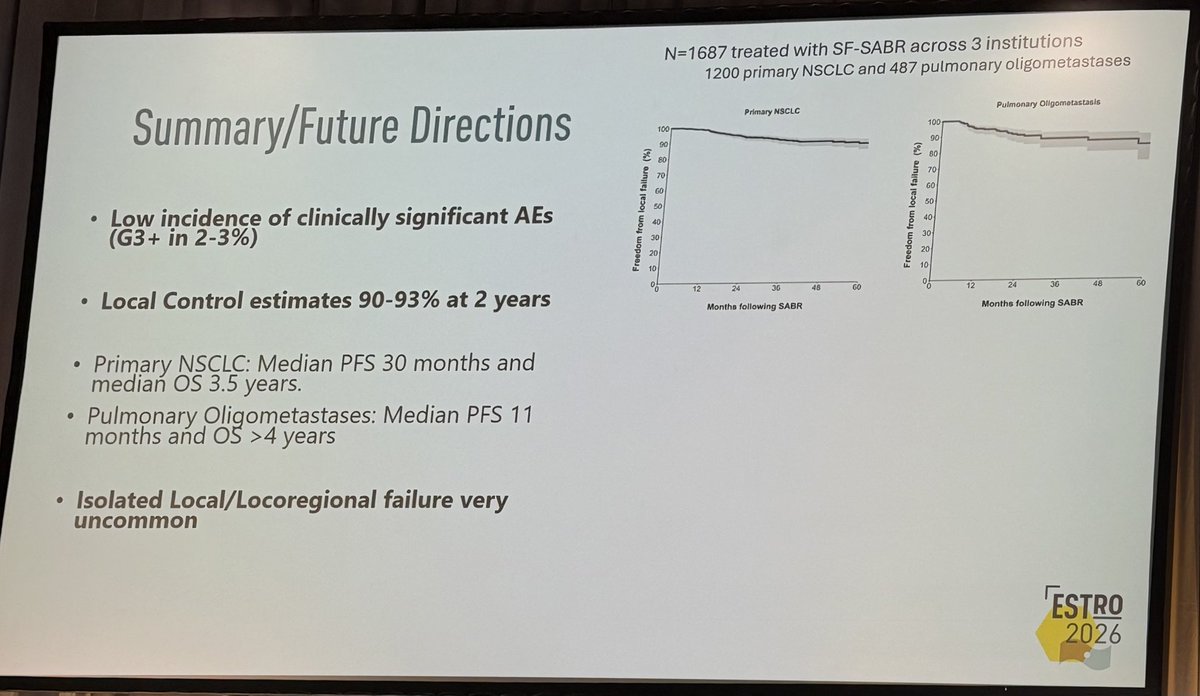
| Cohort | n | Median PFS | Median OS |
|---|---|---|---|
| Primary NSCLC | 1200 | 30 mo | 3.5 yrs |
| Pulmonary oligometastases | 487 | 11 mo | >4 yrs |
+2 more figures
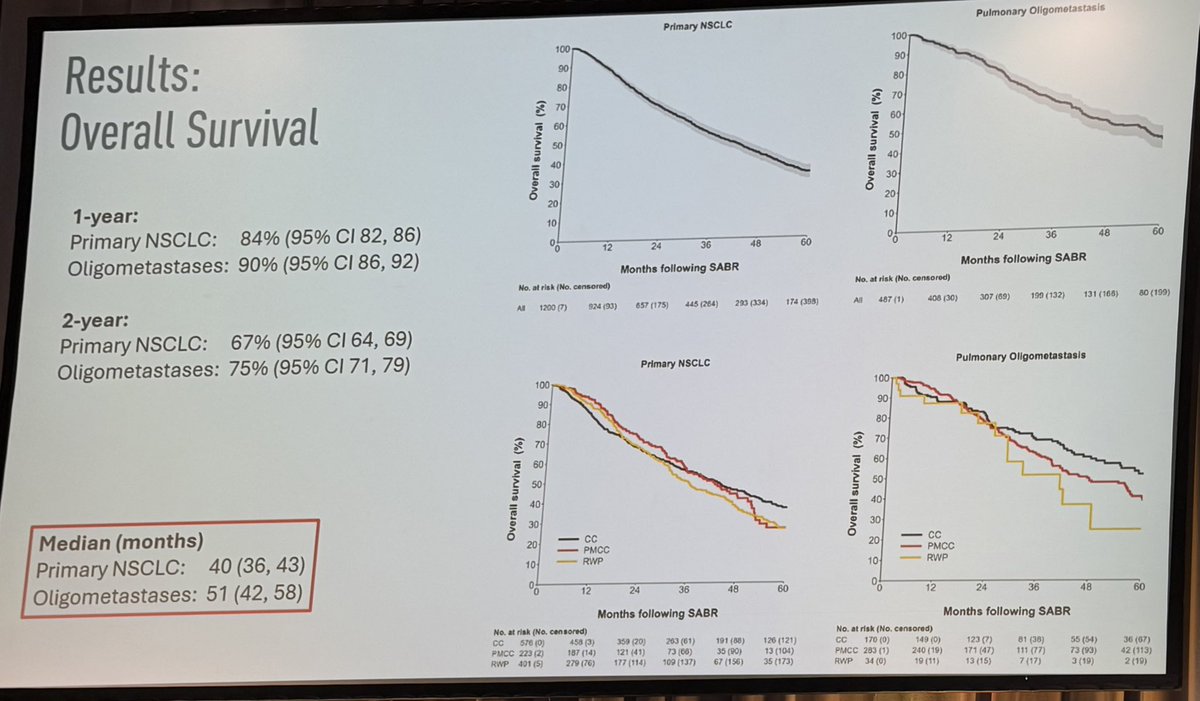
| Endpoint | Primary NSCLC | Oligometastases |
|---|---|---|
| 1yr OS | 84% (95% CI 82, 86) | 90% (95% CI 86, 92) |
| 2yr OS | 67% (95% CI 64, 69) | 75% (95% CI 71, 79) |
| Median OS | 40 mo (36, 43) | 51 mo (42, 58) |
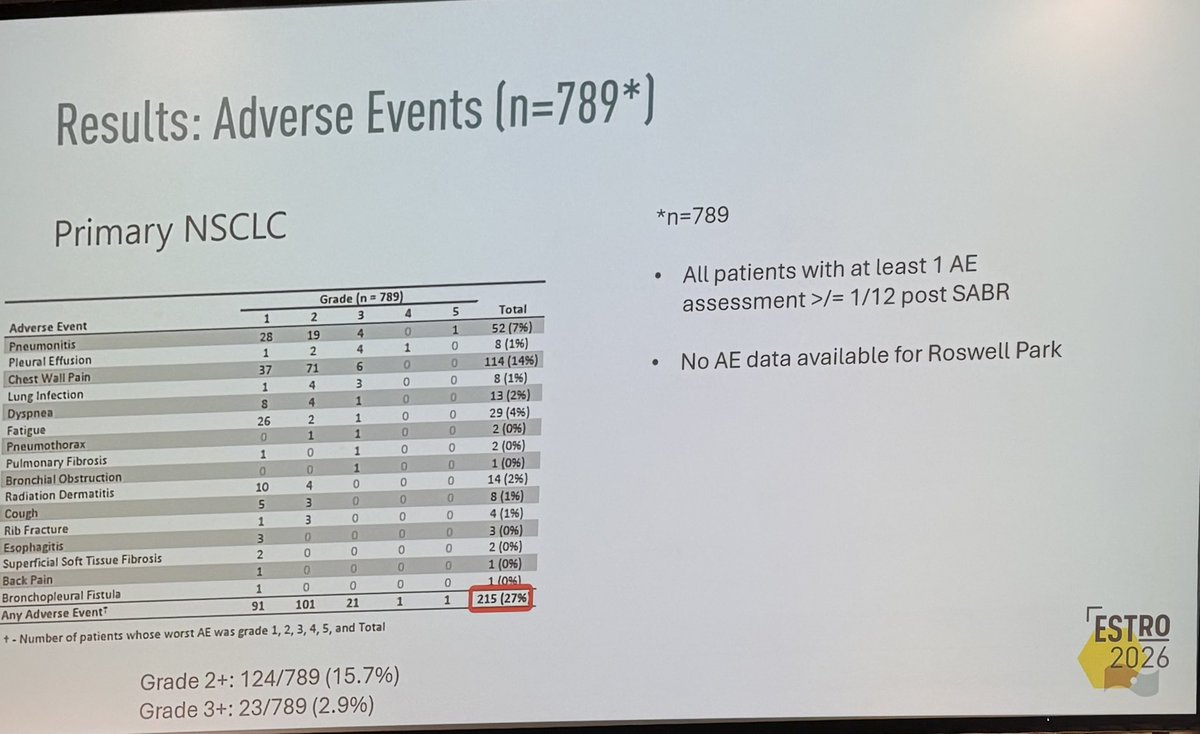
| Adverse event (n=789) | n (%) |
|---|---|
| Any AE | 215 (27%) |
| Grade 2+ | 124 (15.7%) |
| Grade 3+ | 23 (2.9%) |
| Chest wall pain | 114 (14%) |
| Pneumonitis | 52 (7%) |
| Fatigue | 29 (4%) |
| Dyspnea | 13 (2%) |
6 details
Pooled analysis of 1687 pts treated with single-fraction SABR at three centres (Peter MacCallum, Cleveland Clinic, Roswell Park): 1200 primary NSCLC and 487 pulmonary oligometastases. Whether the contributing cohorts were prospective or retrospective is not stated in source.
Eligibility, operability, tumour size and central vs peripheral location are not reported in source. Cohort mix differs sharply by centre: Roswell Park supplied 401 of the NSCLC pts but only 34 oligomet pts, while Peter Mac supplied 283 of 487 oligomet pts.
Single fraction throughout, but the prescribed dose is not reported in source. Without it the outcome cannot be mapped onto a schedule a reader could write, which is the one parameter that would carry this into planning.
No primary endpoint is stated in the source. Reported outcomes are local control, freedom from local failure, PFS, OS and adverse events, each descriptive rather than tested against a comparator.
Local control 90-93% at 2 years across both cohorts, with isolated local or locoregional failure described as very uncommon. Survival separates by cohort while local outcome does not.
| Centre | Primary NSCLC | Pulmonary oligomets |
|---|---|---|
| Cleveland Clinic | 576 | 170 |
| Peter MacCallum | 223 | 283 |
| Roswell Park | 401 | 34 |
AE reporting covers 789 primary NSCLC pts only, with no Roswell Park data and no oligometastasis toxicity in source. Within that subset chest wall pain and pneumonitis dominate and G3+ events stay at 2.9%.
Single-fraction SABR already carries randomised support: RTOG 0915 in peripheral early-stage NSCLC and SAFRON II in pulmonary oligometastases, both randomised single against multi-fraction schedules. This series adds scale and follow-up at three high-volume centres, which is what a non-randomised dataset can contribute, and no comparator.
Toxicity rests on 789 of 1687 pts, with one centre absent from the AE table and the oligometastatic cohort not represented in it at all. Centre mix is uneven, so pooled rates carry each centre's own selection rather than a common one.
The question the thread raises, whether one-stop SABR should be used more often, is not the question this dataset answers. What it does show is that local control near 90-93% and G3+ toxicity near 3% hold at scale outside a protocol, which is the usual worry about a schedule with no second chance. The unreported dose sits between that reassurance and a prescription.
Pooled uncontrolled series across three centres, no multi-fraction comparator and no stated design; dose unreported, so outcomes cannot be tied to a prescription.
- Whether single-fraction outcomes hold for central tumours
- Durability of single-fraction ablation for pulmonary oligometastases beyond first progression
- Toxicity of single-fraction SABR in the oligometastatic cohort
📚 Sources · 🐦 1 tweet
👏🏽👏🏽👏🏽@neildwallaceie at #ESTRO26 - 1687 patients receiving single fraction SABR for #lungcancer and pulmonary oligomets, @PeterMacRadOnc / @ClevelandClinic / @RoswellPark. Fantastic local control, and low adverse rates. Should we be using “one stop” SABR more often #radonc ? pic.twitter.com/w2IlGKRU5o
— Shankar Siva (@_ShankarSiva) May 18, 2026
Multinational HCC EBRT IPD Cohort
ForVery early / early-stage HCC (BCLC-0 or A), incl. treatment-naive
TL;DRMedian OS 6.8y BCLC-0 and 4.6y BCLC-A across 4,913 EBRT-treated HCC pts, comparable to resection and ablation.
The modifiable RT variable in the Cox model is ablative dose, which was associated with reduced mortality, so the transferable read is that dose, not simply delivering EBRT, tracks with the outcome. Fractionation and dose thresholds are not given in the abstract. This is the citation for putting EBRT on the BCLC-0/A allocation discussion.
In BCLC-0 or A HCC where resection, transplant, or ablation is not feasible or is declined, this supports discussing ablative-dose EBRT as a locoregional option; it does not establish EBRT over resection or ablation in a pt eligible for either.
Ablative dose was the modifiable variable associated with reduced mortality, so the transferable read is dose, not simply offering EBRT. Dose thresholds, fractionation, and modality mix are not given in the source abstract. This is the citation for putting EBRT into the BCLC-0/A allocation discussion at tumor board.
Child-Pugh B or C, performance status, and tumor burden drove mortality in the multivariable model, which is the gating frame for who gets locoregional therapy at all. For the med onc coordinating a BCLC-0/A pt, EBRT enters the locoregional menu alongside ablation rather than as a last resort.
Median OS of 6.8 y (BCLC-0) and 4.6 y (BCLC-A) in EBRT-treated pts is a cross-literature benchmark against resection and ablation, not a head-to-head. It bears on referral for the medically inoperable or anatomically difficult pt, and does not establish EBRT over resection in a fully resectable candidate.
9 details 2 trials watching
Systematic review of EBRT publications meeting prespecified HCC technical standards (search date December 15, 2022), with corresponding authors invited to contribute individual patient data. Kaplan-Meier OS and RMST stratified by BCLC stage and treatment status; random-effects Cox for covariates. No comparator arm.
4,913 pts treated with EBRT, median follow-up 5.0 years, multinational. Analyses split by BCLC stage and by treatment-naive vs treatment-experienced; the headline read sits in BCLC-0 and BCLC-A.
EBRT delivered per each contributing series, gated by the prespecified technical standards rather than one protocol. Ablative dose was associated with a reduced risk of death; specific dose levels, fractionation, and modality mix are not given in the source abstract.
Overall survival by Kaplan-Meier and restricted mean survival time, stratified by BCLC stage and treatment status. Covariate associations from multivariable random-effects Cox modeling.
Median OS 6.8 y (95% CI 5.7-8.7) for BCLC-0 and 4.6 y (95% CI 4.1-5.1) for BCLC-A. Treatment-naive: not reached (95% CI 8.6-NR) for BCLC-0, 5.4 y (95% CI 4.5-6.7) for BCLC-A.
| Cohort | BCLC-0 | BCLC-A |
|---|---|---|
| All pts | 6.8 y (95% CI 5.7-8.7) | 4.6 y (95% CI 4.1-5.1) |
| Treatment-naive | NR (95% CI 8.6-NR) | 5.4 y (95% CI 4.5-6.7) |
The authors frame these medians as comparable with resection, thermal ablation, and other ablative locoregional therapies, a cross-study benchmark rather than a randomised comparison. EBRT's exclusion from BCLC has rested on the absence of OS evidence, which is the gap this cohort is built to fill.
IPD came only from authors who published and agreed to share, so contributing centers are self-selected and unmeasured selection at the patient level (who was routed to EBRT rather than resection) is unrecoverable. More recent year of treatment predicting survival mixes technique gains with stage migration and modern systemic salvage over a multi-decade accrual window.
The claim is an allocation claim, not an efficacy claim: EBRT belongs in the BCLC decision tree as an option to be weighed. It does not settle sequencing against ablation in a pt eligible for both, and the ablative-dose signal makes the quality of the RT, not its mere availability, the operative variable.
Largest EBRT IPD cohort argues for a BCLC allocation change, but it is pooled non-randomised data with no head-to-head comparator against resection or ablation.
- Ablative dose threshold and fractionation driving the survival association
- EBRT vs thermal ablation head-to-head in early HCC recruiting Stereotactic Radiosurgery Versus Radiofrequency Ablation for Primary Liver Cancer Phase 2n=130 · primary completion 2025-01 · phase 2 SBRT vs RFA, inoperable primary liver caactive Stereotactic Body Radiotherapy Versus Radiofrequency Ablation for Unresectable, Small (≤ 3 cm) HCC Phase NAn=178 · primary completion 2026-12 · randomised SBRT vs RFA, unresectable HCC <=3cm
- Selection differences between EBRT-treated and resected early-stage pts