Living Longer, Living Better (GU Discussant)
TL;DRASCO 2026 GU discussant on curing more while preserving organ, bladder, and kidney function across MIBC, RCC, and ctDNA selection.
EV209EV309RAMPART
For an RT reader the delivery slide is the actionable part: full 55 Gy in 20 fractions was given in 54 (100) with no extension or delay in 47 (87) alongside durvalumab, so the immunotherapy did not cost RT intensity. EV-309 then places chemoradiation as the randomised comparator, meaning the bladder-preservation standard is now the control arm.
In cT2-4a N0 MIBC being counselled for bladder preservation, this supports discussing chemoradiation plus checkpoint blockade as deliverable and trials of EV-based sparing as open questions; it does not extend to node-positive or metastatic disease.
The delivery slide is the actionable part: full 55 Gy in 20 fractions in 54 (100) with no extension or delay in 47 (87) while durvalumab ran concurrently, so RT intensity survived the combination. EV-309 then makes chemoradiotherapy the randomised control arm for a drug-only bladder-sparing strategy.
Systemic components absorbed the attrition: chemotherapy discontinued early in 12 (22) and durvalumab in 21 (39). In adjuvant RCC the discussant's position is that adjuvant IO has no proven benefit in non-clear cell disease, while ctDNA separates 24-mo DFS far better than pathology (79.9% vs 38.8% on pembrolizumab).
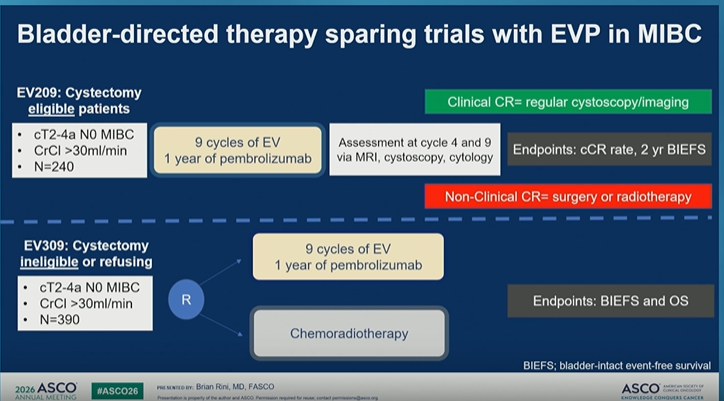
EV-209 keeps cystectomy as the fallback for non-clinical-CR pts in cystectomy-eligible cT2-4a N0 MIBC (N=240), and EV-309 (N=390) enrols only pts ineligible for or refusing cystectomy. Bladder-intact event-free survival counts cystectomy as an event, so the trials are structured around deferring surgery, not replacing it outright.

+2 more figures

9 details 4 trials watching
Discussant presentation, not an original trial. Brian Rini, MD, FASCO discusses ASCO 2026 GU data spanning MIBC bladder preservation, adjuvant RCC, and ctDNA-based selection.
The chemoradiation regimen under discussion is 55 Gy in 20 fractions with mitomycin C and 5-FU. All 54 (100) received the full dose and 47 (87) had no extension or delay, so adding durvalumab did not erode RT delivery.
Concurrent mitomycin C plus 5-FU with durvalumab. Mitomycin C dose reduced in 4 (7), 5-FU Week 1 dose reduced in 9 (17), chemotherapy discontinued early in 12 (22). Durvalumab completed in 33 (61), discontinued early in 21 (39) for toxicity and progression.
The EV platform reframes the comparison: EV-309 randomises cystectomy-ineligible or refusing cT2-4a N0 pts (N=390) against chemoradiotherapy for BIEFS and OS, while EV-209 (N=240) tests EV plus pembrolizumab in cystectomy-eligible pts with cCR and 2yr BIEFS. In adjuvant RCC the discussant's read is that adjuvant IO has no proven benefit in non-clear cell disease, with RAMPART non-clear cell subgroups too small to resolve it.
Selection, not intensification, is the through-line. Pathologic features are called a crude selection tool, and the ctDNA-stratified adjuvant RCC curves separate far more than pathology does (ctDNA-negative 24-mo DFS 79.9% on pembrolizumab and 72.9% on placebo, versus 38.8% and 18.3% in ctDNA-positive pts). The same logic sits under bladder preservation, where the unanswered question is which pt keeps their bladder, not whether the regimen can be delivered.
Everything here is second-hand from a discussant slide deck, so denominators, CIs and per-arm attributions are partial. The RAMPART non-clear cell forest plot arrived with row association uncertain in OCR, and its point estimates are not attributed to specific histologies. Central pathology review is still ongoing.
| Component | Outcome | Number (%) |
|---|---|---|
| Radiotherapy | Received full 55 Gy in 20 fractions | 54 (100) |
| Radiotherapy | No extension or delay | 47 (87) |
| Chemotherapy | Mitomycin C dose reduced | 4 (7) |
| Chemotherapy | 5-FU Week 1 dose reduced | 9 (17) |
| Chemotherapy | Chemotherapy discontinued early | 12 (22) |
| Durvalumab | Completed | 33 (61) |
| Durvalumab | Discontinued early | 21 (39) |
- Long-term bladder preservation, function and QoL after chemoradiation plus durvalumab n=11 · primary completion 2026-02 · chemoRT +/- durvalumab, node-positive bladder
- Whether EV-based bladder sparing beats chemoradiotherapy on BIEFS and OS recruiting A Study to Find Out if Enfortumab Vedotin Given With Pembrolizumab Helps People With Muscle-invasive Bladder Cancer Keep Their Bladder Phase 2n=240 · primary completion 2027-11 · phase 2 EV+pembro bladder-sparing, n=240recruiting Enfortumab Vedotin in Combination With Pembrolizumab vs. Concurrent Chemoradiotherapy (cCRT) in People With Muscle Invasive Bladder Cancer (EV-309) Phase 3n=390 · primary completion 2030-03 · phase 3 EV+pembro vs cCRT, bladder preservationn=56 · primary completion 2031-04 · response-adapted EVP induction, cCRT or RC on failure
- Whether ctDNA-guided selection changes adjuvant RCC outcomes
📚 Sources · 🐦 1 tweet
#ASCO26 GU Oncology Spotlight 🚨
— Dra. María Natalia Gandur Quiroga (@nataliagandur) May 30, 2026
🔬 Living Longer, Living Better: Can We Have It All?
Discussant: Brian I. Rini, MD, FASCO@OncoAlert@ASCO
This GU session captured one of the central tensions in curative-intent oncology:
Can we improve cure rates while preserving quality of… pic.twitter.com/AMwrRZZM2Q
The longer read
Discussant sessions are worth reading precisely because they arbitrate, and the arbitration here lands on selection rather than escalation. Three separate threads (bladder preservation with checkpoint blockade added to chemoradiation, adjuvant IO in non-clear cell RCC, and ctDNA-stratified adjuvant risk) all resolve to the same complaint: the field can deliver the treatment, and cannot yet name the patient who needs it.
For a radiation oncologist the most immediately usable fact is the delivery table. A hypofractionated 55 Gy in 20 fractions schedule with mitomycin C and 5-FU was given in full to every one of the 54 pts, and 47 of them had no extension or delay, with durvalumab layered on top. That matters because the standard worry when a checkpoint inhibitor joins chemoradiation is not efficacy but attrition: treatment breaks, reduced dose intensity, and a bladder-preservation course that quietly becomes a lower-dose course. It did not happen. The pressure instead fell on the systemic components, with chemotherapy discontinued early in 12 (22) and durvalumab discontinued early in 21 (39). That asymmetry is the useful read, and it argues that RT is the robust element of the combination rather than the fragile one. The discussant is careful to say what this does not establish, which is anything about long-term bladder preservation, bladder function, symptom burden or QoL, all of which need longer follow-up. Delivery feasibility is a necessary condition for a preservation strategy, not evidence that the bladder is worth preserving on these terms.
The structural point sits in the EV trials. EV-209 asks whether enfortumab vedotin plus pembrolizumab can produce a clinical CR durable enough to hold in cystectomy-eligible cT2-4a N0 disease, with non-CR patients falling through to surgery or radiotherapy. EV-309 is the more consequential design for an RT reader, because it randomises cystectomy-ineligible or refusing patients against chemoradiotherapy on BIEFS and OS. Trimodality therapy has spent two decades arguing for parity with cystectomy; it is now the comparator that a drug-only strategy has to beat. Whether that comparison is fair will depend on what chemoradiation regimen the control arm actually uses, and on whether local salvage is counted as an event or a feature, since a bladder-intact endpoint treats cystectomy and death as equivalent failures in a way that flatters whichever arm defers surgery longer.
The RCC material should move confidence in the opposite direction. The RAMPART non-clear cell subgroups have few patients and few events, the point estimates swing widely, the confidence intervals are wide, and central pathology review has not finished. The discussant's conclusion, that adjuvant IO has no proven benefit in non-clear cell RCC, is the honest reading of an underpowered subgroup rather than a positive claim of no effect. Against that, the ctDNA data are the striking contrast: separation by ctDNA status (24-mo DFS 79.9% and 72.9% in ctDNA-negative pembrolizumab and placebo pts, against 38.8% and 18.3% in ctDNA-positive pts) dwarfs anything pathologic staging delivers. The obvious caution is that only 30 patients per arm were ctDNA-positive, so this is prognostic signal with thin numbers, and it says nothing yet about whether treating on the basis of ctDNA changes an outcome.