Bladder
Trimodality is being pressured from both sides: RAD-IO adds durvalumab to 55Gy/20fr chemoRT with RT delivery intact, while EV-309 puts chemoradiation in the control arm against an EV-only bladder-sparing pathway.
RAD-IO
ForMIBC cT2-T3 (13% N+), bladder-preservation intent, 75% prior neoadjuvant chemo
TL;DR12-mo DFS 40/50 (80%, 95% CI 0.67-0.89) with durvalumab added to 5FU/MMC chemoRT, clearing the pre-set GO bar (≥75%).
The RT is unchanged from standard UK practice (55Gy/20fr bladder, 46Gy/20fr nodes when N+), so nothing here alters target volume or dose. What is new is that durvalumab was delivered neoadjuvant, synchronous AND adjuvant around that backbone, and only 61% completed it, which is the number gating any future randomised trial design.
In cT2-T3 MIBC pts choosing bladder preservation with 5FU/MMC chemoRT, this supports enrolling on a checkpoint-inhibitor chemoRT trial rather than adding durvalumab off protocol; it does not extend to cisplatin-ineligible pts having RT alone or to those with extensive nodal disease.
The RT is unchanged: 55Gy/20fr bladder, 46Gy/20fr to nodes in the N+ expansion, standard UK practice, so no target-volume or dose decision moves. The trial's value for an RT reader is that a 12-month adjuvant IO tail can be run around that backbone at all, though only 61% completed it.
Durvalumab was given in all three positions (neoadjuvant, synchronous, adjuvant 12 months) on a 5FU/MMC backbone, and 39% discontinued early. That delivery figure, not the 80% DFS, is what constrains which durvalumab schedule is worth randomising in bladder preservation.

+3 more figures


| Treatment status | N = 54 | % |
|---|---|---|
| Completed planned treatment | 33 | 61 |
| Discontinued early | 21 | 39 |

| Baseline | Number | % |
|---|---|---|
| Age, median (IQR) | 69 | 62-76 |
| Female | 10 | 18 |
| Male | 45 | 82 |
| Prior neoadjuvant chemo, yes | 41 | 75 |
| cT2 | 44 | 80 |
| cT3 | 11 | 20 |
| N+ | 7 | 13 |
10 details
Single-arm multi-stage feasibility and safety trial of durvalumab added to 5-fluorouracil/mitomycin C chemoradiotherapy in muscle-invasive bladder cancer. N=55 enrolled, 54 treated. A stage 1 expansion opened to node-positive pts, the first 6 with N+ disease.
Median age 69 (IQR 62-76), 45 (82%) male. cT2 in 44 (80%), cT3 in 11 (20%), N+ in 7 (13%) (N1 4, N2 3). 41 (75%) had prior neoadjuvant chemotherapy, so this is largely a post-NAC bladder-preservation population.
Durvalumab before, during and for 12 months after chemoRT, with 5-fluorouracil and mitomycin C as the radiosensitising backbone. 33/54 (61%) completed planned treatment; 21/54 (39%) discontinued early.
55Gy in 20 fractions to bladder; node-positive pts received 46Gy in 20 fractions to nodes alongside the bladder dose. This is the standard UK hypofractionated schedule, not an escalated or de-escalated variant.
Primary: disease-free survival rate at 12 months post chemoRT, read against a prespecified GO/NO-GO framework (GO ≥75%, contextual 60-75%, NO-GO <60%).
40/50 (80%) disease free at 12 months, 95% CI 0.67 to 0.89, clearing the GO threshold. 2 pts pending and 3 not evaluable. Investigators report very high bladder preservation and survival versus their previous trial data; those comparator figures are not given in the source.
The benchmark is the team's own BC2001 trial (James, JCO 2016), whose chemotherapy randomisation gave DFS HR 0.78 (0.60-1.02), stratified logrank p=0.07 on the slide shown. Comparison is to that historic control experience, not to a contemporaneous arm.
A 12-month DFS read is short for a preservation strategy where salvage cystectomy and late nodal relapse both fall outside the window. The evaluable denominator dropped from 55 to 50, and with 2 still pending the point estimate can move relative to a 75% threshold it clears by 5 points.
This clears a feasibility gate, not an efficacy one: the design question it answers is whether a randomised trial of durvalumab plus chemoRT is worth running, and the answer is yes. The 39% early discontinuation is the finding that should shape that trial, since a 12-month adjuvant tail that four in ten pts do not finish may not be the schedule worth randomising.
Single-arm feasibility/safety trial, N=55, 12-mo endpoint benchmarked against historic in-house CRT data. No randomised comparator; hard maturity gate applies.
- Which durvalumab component (neoadjuvant, synchronous, adjuvant) drives benefit
- Whether 80% 12-mo DFS survives a randomised comparator
- Drivers of the 39% early discontinuation
📚 Sources · 🐦 3 tweets
RAD-IO at #ASCO26: durvalumab added to chemoradiation in muscle-invasive bladder cancer cleared its efficacy bar in a bladder-preservation approach. Single-arm, benchmarked against prior CRT data.
— Katy Beckermann (@katy_beckermann) May 30, 2026
Durvalumab given before, during, and 12 months after chemoRT (55Gy/20Fr +… pic.twitter.com/UXxwoZzaMC
#ASCO26 🔬 Abstract 4504 | RAD-IO
— Dra. María Natalia Gandur Quiroga (@nataliagandur) May 30, 2026
Durvalumab + chemoradiotherapy in muscle-invasive bladder cancer
Presented by Nicholas D. James, PhD, MBBS, FRCP@OncoAlert@ASCO
Bladder preservation in MIBC remains one of the most important curative-intent questions in GU oncology.
The key… pic.twitter.com/W6JqzTVsJ3
RAD-IO: chemoradiation (5FU+MMC) + Durva in MIBC. #ASCO26 pic.twitter.com/yTyhkdjCox
— Álvaro Pinto (@dralvaropinto) May 30, 2026
Management After pCR in MIBC (Panel)
TL;DRPanel review: sandwich immunotherapy regimens continue planned adjuvant therapy regardless of pCR, with de-escalation still unanswered.
SWOG 8710ABACUSCHECKMATE-274KEYNOTE-905VOLGANIAGARAVESPERKEYNOTE-B15
In MIBC pts who reach pT0N0 at cystectomy on a sandwich regimen, this supports completing planned adjuvant therapy rather than stopping on pathologic response; after cisplatin-based chemo alone, surveillance remains the presented standard.

+2 more figures

| Setting | Trial | Reported outcome |
|---|---|---|
| Cisplatin-ineligible | KEYNOTE-905 | Periop EVP now standard |
| Cisplatin-ineligible | VOLGA | EV + durva/treme improved EFS (press release) |
| Cisplatin-eligible | NIAGARA | 24-mo OS 82.2% vs 75.2% |
| Cisplatin-eligible | VESPER | 5-yr OS 66% vs 57%, ddMVAC > gem/cis |
| Cisplatin-eligible | KEYNOTE-B15 | OS improved vs gem/cis, under FDA review |

11 details
ASCO 2026 GU education session, not a trial. Synthesizes SWOG 8710, NIAGARA, VESPER, KEYNOTE-905, KEYNOTE-B15 and VOLGA into a position on what to do after pCR.
The practice answer presented is continue: resume durvalumab for 8 months post-cystectomy on the NIAGARA regimen, resume EVP post-cystectomy on perioperative EVP. Surveillance after pCR is standard only for cisplatin-based chemo alone.
The continue-vs-stop question has never been randomized. Not all pts in the source trials completed adjuvant therapy, often for toxicity, so the observed benefit reflects a mixed delivered dose rather than the full planned course.
The session names the two open questions itself: the relative contribution of the pre- versus postoperative components, and whether adjuvant therapy can be de-escalated on pCR or another biomarker. Neither is answerable from an intention-to-treat perioperative design.
- Relative contribution of pre- vs postoperative components
- Can adjuvant therapy be de-escalated based on pCR or biomarkers
📚 Sources · 🐦 1 tweet
#ASCO26 GU Oncology Spotlight 🚨
— Dra. María Natalia Gandur Quiroga (@nataliagandur) May 30, 2026
🔬 Management in Bladder Cancer After Pathologic Complete Disease Response
Presented by Brendan J. Guercio, MD@OncoAlert@ASCO
In muscle-invasive bladder cancer, pCR after neoadjuvant therapy is one of the most powerful prognostic signals we… pic.twitter.com/sMd2In7X3p
Living Longer, Living Better (GU Discussant)
TL;DRASCO 2026 GU discussant on curing more while preserving organ, bladder, and kidney function across MIBC, RCC, and ctDNA selection.
EV209EV309RAMPART
For an RT reader the delivery slide is the actionable part: full 55 Gy in 20 fractions was given in 54 (100) with no extension or delay in 47 (87) alongside durvalumab, so the immunotherapy did not cost RT intensity. EV-309 then places chemoradiation as the randomised comparator, meaning the bladder-preservation standard is now the control arm.
In cT2-4a N0 MIBC being counselled for bladder preservation, this supports discussing chemoradiation plus checkpoint blockade as deliverable and trials of EV-based sparing as open questions; it does not extend to node-positive or metastatic disease.
The delivery slide is the actionable part: full 55 Gy in 20 fractions in 54 (100) with no extension or delay in 47 (87) while durvalumab ran concurrently, so RT intensity survived the combination. EV-309 then makes chemoradiotherapy the randomised control arm for a drug-only bladder-sparing strategy.
Systemic components absorbed the attrition: chemotherapy discontinued early in 12 (22) and durvalumab in 21 (39). In adjuvant RCC the discussant's position is that adjuvant IO has no proven benefit in non-clear cell disease, while ctDNA separates 24-mo DFS far better than pathology (79.9% vs 38.8% on pembrolizumab).
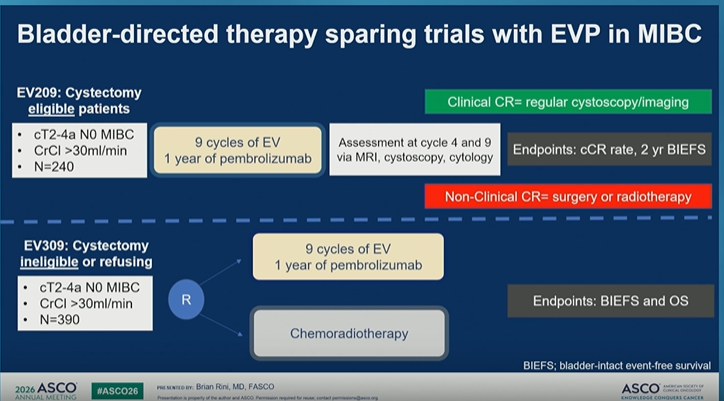
EV-209 keeps cystectomy as the fallback for non-clinical-CR pts in cystectomy-eligible cT2-4a N0 MIBC (N=240), and EV-309 (N=390) enrols only pts ineligible for or refusing cystectomy. Bladder-intact event-free survival counts cystectomy as an event, so the trials are structured around deferring surgery, not replacing it outright.

+2 more figures

9 details 4 trials watching
Discussant presentation, not an original trial. Brian Rini, MD, FASCO discusses ASCO 2026 GU data spanning MIBC bladder preservation, adjuvant RCC, and ctDNA-based selection.
The chemoradiation regimen under discussion is 55 Gy in 20 fractions with mitomycin C and 5-FU. All 54 (100) received the full dose and 47 (87) had no extension or delay, so adding durvalumab did not erode RT delivery.
Concurrent mitomycin C plus 5-FU with durvalumab. Mitomycin C dose reduced in 4 (7), 5-FU Week 1 dose reduced in 9 (17), chemotherapy discontinued early in 12 (22). Durvalumab completed in 33 (61), discontinued early in 21 (39) for toxicity and progression.
The EV platform reframes the comparison: EV-309 randomises cystectomy-ineligible or refusing cT2-4a N0 pts (N=390) against chemoradiotherapy for BIEFS and OS, while EV-209 (N=240) tests EV plus pembrolizumab in cystectomy-eligible pts with cCR and 2yr BIEFS. In adjuvant RCC the discussant's read is that adjuvant IO has no proven benefit in non-clear cell disease, with RAMPART non-clear cell subgroups too small to resolve it.
Selection, not intensification, is the through-line. Pathologic features are called a crude selection tool, and the ctDNA-stratified adjuvant RCC curves separate far more than pathology does (ctDNA-negative 24-mo DFS 79.9% on pembrolizumab and 72.9% on placebo, versus 38.8% and 18.3% in ctDNA-positive pts). The same logic sits under bladder preservation, where the unanswered question is which pt keeps their bladder, not whether the regimen can be delivered.
Everything here is second-hand from a discussant slide deck, so denominators, CIs and per-arm attributions are partial. The RAMPART non-clear cell forest plot arrived with row association uncertain in OCR, and its point estimates are not attributed to specific histologies. Central pathology review is still ongoing.
| Component | Outcome | Number (%) |
|---|---|---|
| Radiotherapy | Received full 55 Gy in 20 fractions | 54 (100) |
| Radiotherapy | No extension or delay | 47 (87) |
| Chemotherapy | Mitomycin C dose reduced | 4 (7) |
| Chemotherapy | 5-FU Week 1 dose reduced | 9 (17) |
| Chemotherapy | Chemotherapy discontinued early | 12 (22) |
| Durvalumab | Completed | 33 (61) |
| Durvalumab | Discontinued early | 21 (39) |
- Long-term bladder preservation, function and QoL after chemoradiation plus durvalumab n=11 · primary completion 2026-02 · chemoRT +/- durvalumab, node-positive bladder
- Whether EV-based bladder sparing beats chemoradiotherapy on BIEFS and OS recruiting A Study to Find Out if Enfortumab Vedotin Given With Pembrolizumab Helps People With Muscle-invasive Bladder Cancer Keep Their Bladder Phase 2n=240 · primary completion 2027-11 · phase 2 EV+pembro bladder-sparing, n=240recruiting Enfortumab Vedotin in Combination With Pembrolizumab vs. Concurrent Chemoradiotherapy (cCRT) in People With Muscle Invasive Bladder Cancer (EV-309) Phase 3n=390 · primary completion 2030-03 · phase 3 EV+pembro vs cCRT, bladder preservationn=56 · primary completion 2031-04 · response-adapted EVP induction, cCRT or RC on failure
- Whether ctDNA-guided selection changes adjuvant RCC outcomes
📚 Sources · 🐦 1 tweet
#ASCO26 GU Oncology Spotlight 🚨
— Dra. María Natalia Gandur Quiroga (@nataliagandur) May 30, 2026
🔬 Living Longer, Living Better: Can We Have It All?
Discussant: Brian I. Rini, MD, FASCO@OncoAlert@ASCO
This GU session captured one of the central tensions in curative-intent oncology:
Can we improve cure rates while preserving quality of… pic.twitter.com/AMwrRZZM2Q