Combined
MARCAP Consortium
ForLocalized prostate cancer, NCCN intermediate to high risk, definitive RT
TL;DRIPD meta-analysis, 10,853 pts: ADT added to RT improved MFS HR 0.83 and OS HR 0.86; dose escalation improved bRFS only.
Reported via UroToday →
The dose-invariance result is the load-bearing one: ADT's benefit was identical at ≥74 Gy and <74 Gy (both HR 0.83), so escalating dose does not buy out the ADT decision. Adjuvant prolongation carries the benefit (MFS HR 0.84), neoadjuvant prolongation does not (HR 0.95), which moves sequencing, not just duration.
In NCCN intermediate- and high-risk localized prostate cancer receiving definitive RT, this supports adding and prolonging ADT on the adjuvant side rather than substituting dose escalation; it does not address node-positive or post-prostatectomy salvage settings.
ADT's benefit was identical at ≥74 Gy and <74 Gy (HR 0.83 both), so escalation does not buy out the hormone decision, and HEAT showed escalation to 79.2 Gy improved biochemical RFS but not MFS or OS. Adjuvant prolongation carries the survival benefit; neoadjuvant prolongation (HR 0.95) does not.
The duration and sequencing read: extending adjuvant ADT from 4-6 to 18-36 months gave MFS HR 0.84 and OS HR 0.85, while extending neoadjuvant ADT from 3-4 to 6-9 months gave HR 0.95 for both. Relative benefit held across NCCN groups, so risk stratification changes NNT, not effect size.
9 details 5 trials watching
Individual patient data meta-analysis from the MARCAP Consortium, 12 eligible trials, 10,853 patients, median follow-up 11.4 years (IQR 9.0-15.0). Three intensification questions analyzed separately: ADT use, neoadjuvant ADT prolongation, adjuvant ADT prolongation.
Localized prostate cancer treated with definitive radiotherapy, stratified by NCCN prognostic risk group. The RT ± ADT comparison ran 2,557 control vs 2,579 experimental (NCCN high 32.6% vs 32.8%, intermediate 47.6% vs 48.7%); the adjuvant-prolongation comparison was high-risk enriched at 71.5% vs 71.1% NCCN high across 1,900 vs 1,874 pts.
Dose was analyzed as a binary ≥74 Gy vs <74 Gy split, with the companion HEAT analysis using 64 to <74 Gy vs ≥74 Gy and escalation up to 79.2 Gy. Brachytherapy boost is discussed as an escalation route alongside external-beam dose.
ADT addition improved MFS HR 0.83 (0.77-0.89) and OS HR 0.86 (0.80-0.92). Adjuvant prolongation improved MFS HR 0.84 (0.78-0.91) and OS HR 0.85 (0.78-0.94); neoadjuvant prolongation did neither (MFS HR 0.95, OS HR 0.95). 10-yr MFS 61% (59-63) with ADT vs 52% (50-54) without; 10-yr OS 65% (63-67) vs 57% (55-59).
| Intervention | Intermediate risk | High risk |
|---|---|---|
| ADT addition | 18.0 | 8.4 |
| Adjuvant ADT prolongation | 16.1 | 10.4 |
The 2022 HEAT network meta-analysis (13 trials, 11,862 pts) found dose escalation improved biochemical RFS but not MFS or OS, and named high-dose RT plus long-term ADT the best strategy. PROG 05/09 and GETUG-18 are invoked to explain the gap: a 21% 5-year biochemical benefit in low risk where metastasis is rare, versus 3% in high risk where it is not.
The pooled trials span 30+ years of practice, so the RT technique behind the <74 Gy stratum is not the technique a reader delivers today. The stated optimal durations (closer to 12 months high risk, 24+ months very high risk) come from DHARMA, accepted but unpublished, so that specific number is not yet auditable.
The framing claim is that dose escalation and ADT are not interchangeable levers: escalation buys biochemical control, ADT buys metastasis-free and overall survival, and the two do not substitute. The dogma that dose escalation obviates ADT is named as widely repeated and never demonstrated.
IPD meta-analysis of randomised trials, large N, long f/u. Reinforces ADT intensification over dose escalation; no new randomisation, and duration guidance rests on unpublished DHARMA.
- Optimal adjuvant ADT duration by prognostic risk group active A Study of Shorter Course Hormone Therapy and Radiation for High-risk Prostate Cancer Phase 2n=50 · primary completion 2026-10 · shorter-course ADT with brachy + hypofx EBRT, high-riskrecruiting Artificial Intelligence Driven Personalisation of Radiotherapy and Concomitant Androgen Deprivation Therapy for Prostate Cancer Patients (the HypoPro Trial) Phase 2n=30 · primary completion 2026-10 · MMAI classifier individualises ADT duration, high-risk
- Does dose escalation change ADT benefit with modern brachytherapy boost active Comparative Study of Radiotherapy Treatments to Treat High Risk Prostate Cancer Patients Phase 3n=307 · primary completion 2028-12 · phase 3 HDR brachy boost vs dose-escalated RT + ADTrecruiting Androgen Suppression Combined With Nodal Irradiation and Dose Escalated Prostate Treatment Phase 3n=710 · primary completion 2032-10 · phase 3 SBRT vs EBRT + brachy boost, all on ADTrecruiting PRO-BOOST-LC: Whole-Gland Boost Strategies Versus SBRT Monotherapy in PSMA-Staged Localized and Locally Advanced Prostate Cancer Phase 2/3n=1000 · primary completion 2033-12 · randomised brachy or SBRT boost vs SBRT alone, + ADT
- Whether intermediate-risk subsets warrant long-term ADT
📚 Sources · 📄 1 paper
Abstract
STAR-TREC
ForRectal adenocarcinoma <40 mm, mrT1-T3bN0, ECOG 0-1, TME otherwise feasible
TL;DR12-mo TME-free survival 78.5% with LCCRT vs 60.6% with SCRT, HR 1.90 (1.29-2.81), in mrT1-T3bN0 rectal cancer.
For an RT reader the actionable number is the response gradient: cCR 64% with 50 Gy/25 fx plus capecitabine vs 36% with 25 Gy/5 fx, which is what drives the 78.5% vs 60.6% TME-free survival. Acute SAE grade ≥3 within 4 weeks of RT ran higher with LCCRT (6% vs 1%), so the trade is upfront toxicity for organ preservation.
In rectal adenocarcinoma under 40 mm staged mrT1-T3bN0 where TME is feasible and the patient wants organ preservation, this supports long-course chemoradiotherapy over short-course as the preservation schedule; it does not address node-positive, larger, or metastatic disease, and 30-month preservation is still unreported.
This is a randomised head-to-head of two schedules inside a preservation pathway: 50 Gy/25 fx plus capecitabine gave cCR 64% vs 36% with 25 Gy/5 fx at 16-20 weeks, driving TME-free survival 78.5% vs 60.6%. Acute grade ≥3 SAEs within 4 weeks of RT were 6% vs 1%, the cost of that gradient.
Concurrent capecitabine 825 mg/m² twice daily with 50 Gy/25 fx was well tolerated, with 18 (11%) of 161 needing at least one dose modification, and the chemoradiotherapy arm doubled cCR (64% vs 36%) over radiotherapy alone. The schedule choice, not systemic escalation, is what moves preservation here.
Response-adapted preservation kept 78.5% TME-free at 12 months after LCCRT, but transanal excision for near-complete response ran 40% after SCRT vs 23% after LCCRT, so the schedule changes how much local surgery you end up doing. 22% of TME specimens had positive nodes despite node-negative MRI.
12 details 4 trials watching
Open-label, international, multicentre, parallel-group, superiority phase 2/3 trial at 37 hospitals in the UK, Netherlands, Sweden, Denmark, and Belgium. Phase 2 randomised 1:1:1 (LCCRT-OP, SCRT-OP, TME); phase 3 used a partially randomised patient-preference design, with those choosing organ preservation randomised 1:1 between the two RT schedules, stratified by country and MRI T category.
Biopsy-confirmed rectal adenocarcinoma <40 mm staged mrT1-T3bN0, ECOG 0-1, aged ≥16 (UK) or ≥18 elsewhere. Excluded: diameter >40 mm, metastatic disease, MRI-defined nodal involvement or extramural venous invasion, tumour within 1 mm of mesorectal fascia, anterior tumours above the peritoneal reflection, mucinous histology. Median age 67, 72% male, 80% below the peritoneal reflection.
LCCRT-OP: 50 Gy in 25 fractions with oral capecitabine 825 mg/m² twice daily. SCRT-OP: 25 Gy in five fractions. Completion was high in both groups: 159 (99%) of 161 LCCRT participants and 168 (100%) SCRT. 18 (11%) of 161 receiving LCCRT needed at least one capecitabine dose modification for toxicity.
Phase 3 primary: organ preservation 30 months after treatment initiation (absence of TME, stoma, or local recurrence), assessed in the mITT population and not reported in this analysis. This report gives the 12-month implementation outcomes: TME-free survival, clinical complete response at the second response assessment, and serious adverse events. Bayesian framework with Cox models for time-to-event outcomes.
Response-adapted decision-making at 16-20 weeks explains the divergence: cCR 64% vs 36% favoured LCCRT-OP while TAE for near-complete response was commoner after SCRT-OP (23% vs 40%), and the resulting TME-free survival gap was 78.5% vs 60.6%.
| Event | LCCRT-OP | SCRT-OP | Primary TME |
|---|---|---|---|
| Gastrointestinal disorders | 4 (2%) | 6 (4%) | 6 (8%) |
| Procedural complications | 3 (2%) | 5 (3%) | 5 (6%) |
Grade 3-4 serious adverse events were most often gastrointestinal (2% LCCRT vs 4% SCRT vs 8% TME) and procedural complications (2% vs 3% vs 6%). Grade ≥3 SAEs within four weeks of finishing RT were 9 (6%) LCCRT-OP vs 2 (1%) SCRT-OP. In the TME group, grade ≥3 SAEs occurred in 14 (18%) of 78, with one postoperative death from sepsis after anastomotic leakage and intraperitoneal perforation from anastomotic leak in 12 (15%).
The phase 2 effect (HR 3.7, 1.7-8.0) was far larger than the pooled 12-month estimate (HR 1.90), and the authors ran exploratory post-hoc analyses of stratification variables, tumour length, and centre organ-preservation volume to explain the phase difference. Baseline MRI excluded nodal disease, yet 17 (22%) of TME specimens carried positive nodes, so occult nodal disease is present in the preserved cohort too and is not captured by a 12-month TME-free endpoint. The primary TME comparator in phase 3 was self-selected, not randomised.
TME-free survival at 12 months is an implementation readout, not durable organ preservation: it counts who has avoided surgery so far, not who stays disease-free without it. The clinically load-bearing question, whether the higher cCR rate after 50 Gy/25 fx converts into sustained preservation without a local-recurrence penalty, waits on the 30-month endpoint.
CONSORT flow
Interim 12-month implementation analysis; prespecified 30-month organ-preservation primary endpoint unreported. Phase 3 TME arm by patient preference, not randomisation.
- Does the 12-month TME-free gap hold at the 30-month organ-preservation endpoint n=66 · primary completion 2025-09 · SCRT vs LCRT plus consolidation, organ preservation
- Local recurrence and salvage rates after non-operative management recruiting Nordic ORgan Preservation Pilot Approach Nonrandomised Single-Arm Trial for Non-Operative Management of Rectal Cancer Phase NAn=200 · primary completion 2028-12 · single-arm NOM cohort reporting local regrowth raterecruiting Asian Watch-and-Wait Database (AWWD)n=337 · primary completion 2029-10 · W&W registry after short- or long-course neoadjuvant RT
- Whether a later response assessment would narrow the short-course deficit recruiting Organ Preservation in Rectal Cancer: Contact X-ray Brachytherapy vs Extending the Waiting Interval and Local Excision Phase NAn=168 · primary completion 2025-03 · extends waiting interval after SCRT before response call
📚 Sources · 📄 1 paper
STELLAR NCT02533271
ForDistal/middle-third rectal adeno, cT3-4 and/or cN+, age 18-70, ECOG 0-1
64.5% v 62.3%
HR 0.883, 1-sided 95% CI to 1.11, P<.001 for noninferiority
TL;DR3yr DFS 64.5% v 62.3% (HR 0.883, NI margin 1.43, P<.001 NI): 5x5Gy then CAPOX non-inferior to 50Gy/25f CRT in LARC.
Every pt got IMRT, unlike RAPIDO, Polish II or PRODIGE 23, and 3yr LRR was 8.4% v 11.0% with 25Gy/5fx to a full elective pelvic CTV, so the short-course arm did not trade local control for convenience. Compliance was the mechanism: 100% completed 5x5Gy with no dose reduction. This supports offering 5x5Gy over 50Gy/25f when the systemic phase is the priority.
In cT3-4 or node-positive mid/low rectal cancer where getting full-dose neoadjuvant chemo delivered is the constraint, this supports 25Gy/5fx followed by CAPOX instead of long-course chemoradiation; it does not extend to upper rectal tumors or pts over 70, both excluded.
All pts received IMRT with full elective pelvic CTV coverage, unlike RAPIDO, Polish II or PRODIGE 23, and 3yr LRR was 8.4% v 11.0% with 25Gy/5fx. Every TNT pt completed all five fractions with no dose reduction. This supports 5x5Gy over 50Gy/25f without conceding local control.
Moving CAPOX preoperatively raised full-dose preop completion of the systemic phase but cut it the other way on delivery overall, 74.8% v 93.2%. Four preop cycles produced no distant-metastasis benefit (3yr DM 22.8% v 24.7%), unlike the heavier RAPIDO and PRODIGE 23 programs, so cycle number may matter for distant control.
TME at 6-8 weeks after short-course RT plus chemotherapy gave R0 resection in 91.5% v 87.8% (P=.189) and grade III+ complications of 14.0% v 15.7% (P=.625), so the compressed schedule did not degrade the operation. Sustained cCR was higher after TNT (21.8% v 12.3% for pCR plus sustained cCR), enlarging the nonoperative-management pool to 9.4% v 3.4%.
12 details 5 trials watching
Multicenter open-label randomized phase III noninferiority trial, 16 hospitals across 11 provinces of China, accrual August 2015 to August 2018, N=599 randomly assigned 1:1 (TNT 302, CRT 297). Stratified by tumor location, clinical stage and MRF status; median follow-up 35.0 months (range 8.3-63.9).
Age 18-70, ECOG 0-1, rectal adenocarcinoma of the distal or middle third (0-10cm from anal verge), cT3-4 and/or node-positive, no distant metastases, no prior anticancer treatment. Arms were balanced: cT4 15.9% v 12.8%, MRF involvement 56.3% v 56.2%, clinical stage III 85.8% v 83.5%.
TNT arm received 25Gy in 5 fractions over one week; CRT arm 50Gy in 25 fractions over 5 weeks with concurrent capecitabine 825mg/m2 twice daily. All patients received IMRT, a departure from RAPIDO, Polish II and PRODIGE 23. CTV covered mesorectum, presacral space, internal iliac, obturator nodes and ischiorectal fossa; superior border at the sacral promontory, inferior 2-3cm distal to the tumor, external iliacs added only for cT4b; CTV-to-PTV expansion 0.5-1.0cm.
TNT arm: 4 cycles CAPOX (oxaliplatin 130mg/m2 day 1, capecitabine 1,000mg/m2 twice daily days 1-14) starting 7-14 days after radiotherapy, then TME, then 2 further cycles. CRT arm: concurrent capecitabine during radiotherapy, then TME, then 6 cycles CAPOX. Total mesorectal excision was scheduled 6-8 weeks after preoperative treatment in both arms; a watch-and-wait pathway was permitted for clinical complete responders.
Primary: 3-year disease-free survival, noninferiority claimed if the upper bound of the 95% CI of the HR was at or below 1.43 (an 11% absolute margin against an assumed 65% CRT rate). Secondary endpoints were overall survival, metastasis-free survival, locoregional recurrence and surgical complications. Target accrual 600 with at least 194 DFS events for 80% power at one-sided alpha 0.05.
Acute grade III-V toxicity during preoperative treatment was 26.5% with TNT versus 12.6% with CRT (P<.001), driven almost entirely by hematologic events (grade 3-4 15.8% v 2.0%, P<.001) rather than by anything the radiotherapy added. Radiotherapy delivery itself was cleaner in the short-course arm, with no dose reductions at all, and grade III+ surgical complications were comparable (14.0% v 15.7%, P=.625). Grade III-IV toxicity during adjuvant chemotherapy ran lower after TNT (3.3% v 11.8%, P=.003).
STELLAR is the third randomized trial of short-course radiotherapy plus neoadjuvant chemotherapy against long-course CRT, after Polish II and RAPIDO, with PRODIGE 23 addressing the adjacent question of chemotherapy sequencing around long-course CRT. Its 3-year LRR of 8.4% with TNT sits alongside RAPIDO and PRODIGE 23 (4%-8.3%) and well below Polish II (21%-22%), which enrolled a heavier fixed cT3/cT4 population. Unlike RAPIDO and PRODIGE 23, STELLAR showed no reduction in distant metastasis (3-year DM 22.8% v 24.7%), and its OS advantage mirrors the early Polish II signal that later disappeared at 8 years.
The 11% noninferiority margin is wide, and the authors concede in retrospect that a narrower margin or larger sample would have been defensible given how close the arms proved. Distant metastasis, the endpoint short-course TNT was designed to move, did not separate at all (22.8% v 24.7%), which weakens the mechanistic case for the OS difference. Adjuvant chemotherapy completion also differed between arms (60.0% v 48.3%, P=.009), so postoperative treatment intensity is not held constant across the comparison.
The defensible read is the primary endpoint: 25Gy in 5 fractions followed by CAPOX delivers the same 3-year DFS and the same locoregional control as 50Gy in 25 fractions, in one week of radiotherapy instead of five. The 11.4-point OS separation is the number that will be quoted and the one least supported, since neither MFS nor LRR moved and the same pattern in Polish II did not survive longer follow-up. What transfers most reliably is the technique: full elective pelvic coverage with IMRT at 5x5Gy, delivered without a single dose reduction.
| Endpoint (3yr) | TNT | CRT | Effect size |
|---|---|---|---|
| DFS (1°) | 64.5% (58.3-70.7) | 62.3% (56.1-68.5) | HR 0.883, 1-sided 95% CI to 1.11, P<.001 NI |
| OS | 86.5% (82.1-90.8) | 75.1% (69.4-80.8) | HR 0.67 (0.46-0.97), P=.033 |
| MFS | 77.1% (71.7-82.6) | 75.3% (70.0-80.7) | HR 0.88 (0.63-1.24), P=.475 |
| LRR | 8.4% (4.6-12.2) | 11.0% (6.5-15.5) | HR 0.80 (0.45-1.44), P=.461 |
| Subgroup | DFS HR (95% CI), P | OS HR (95% CI), P |
|---|---|---|
| cT4 | 0.621 (0.328 to 1.177), .144 | 0.362 (0.152 to 0.859), .021 |
| Distance to anal verge ≤5cm | 0.706 (0.485 to 1.028), .070 | 0.540 (0.318 to 0.916), .022 |
| cT2-3 | 0.916 (0.674 to 1.245), .575 | 0.752 (0.493 to 1.149), .187 |
| Distance >5cm | 1.120 (0.744 to 1.687), .587 | 0.808 (0.468 to 1.394), .443 |
CONSORT flow
Prespecified noninferiority met on 3yr DFS with adequate accrual, but open-label, 35mo follow-up only, and the OS gain is a secondary endpoint unsupported by MFS or LRR.
- Does the 3yr OS advantage survive 5-10 year follow-up active Short RT Versus RCT,Followed by Chemo.and Organ Preservation for Interm and High-risk Rectal Cancer Patients Phase 3n=702 · primary completion 2023-09 · ACO/ARO/AIO-18.1: 5x5Gy vs 54Gy CRT, n=702
- Optimal number of preoperative chemotherapy cycles with short-course RT n=42 · primary completion 2026-11 · 5x5Gy then 9 cycles mFOLFOX6, CR rate 1° EPactive Preoperative Sequential Short-course Radiation Therapy and FOLFOX for Locally Advanced Rectal Cancer Phase 2n=364 · primary completion 2028-12 · SCRT then 4 cycles FOLFOX vs CRT, n=364n=608 · primary completion 2029-12 · phase 3 SCRT+CAPOX vs SCRT+CAPOXIRI, n=608
- Late toxicity and quality of life, not yet reported recruiting Short Course Radiation Therapy and Combination Chemotherapy for the Treatment of Stage II-III Rectal Cancer Phase 1n=25 · primary completion 2026-10 · SCRT then chemo with QoL assessment as endpoint
📚 Sources · 📄 1 paper
Abstract
TNTCRT NCT03177382
ForHigh-risk stage II/III rectal cancer, cT4/cN2/MRF+/EMVI, age ≤70
HR 0.674
95% CI 0.489-0.929, P=.016; 3-year DFS 74.8% v 66.0%
TL;DR3-year DFS 74.8% v 66.0%, HR 0.674, for doublet CAPOX bracketing long-course chemoradiation vs conventional nCRT in high-risk LARC.
RT is fixed in both arms, so the RT read is what intensified chemo does around it: locoregional failure stayed 6.03% v 6.19% and the DFS gain is distant. The pCR jump (26.37% v 9.80%) is the lever for organ-preservation selection. LCRT dose and fractionation are not reported in source text.
In MRI-defined high-risk stage II/III rectal cancer at or under age 70, this supports doublet CAPOX bracketing long-course chemoradiation over nCRT plus adjuvant chemo; it does not extend to pts over 70 or to short-course RT based TNT.
RT is identical in both arms, so the read is what intensified chemo does around a fixed LCRT backbone: locoregional failure held at 6.03% v 6.19%, and the DFS gain is distant. Dose, fractionation and target volume are not reported in source text.
The same doublet moved from postoperative to preoperative, with oxaliplatin added concurrent to RT. Grade ≥3 toxicity front-loads into the neoadjuvant phase (27.59% v 8.56%) but whole-course severe toxicity is comparable, so the decision this moves is sequencing, not drug choice.
Intensification did not degrade operability: major postoperative complications 3.98% v 2.94%, and roughly 87% v 90% reached total mesorectal excision. pCR 26.37% v 9.80% widens the pool for a nonoperative discussion, though watch-and-wait was not tested here.
8 details 5 trials watching
Multicenter randomized phase III, N=458, accrual June 6, 2017 to December 27, 2023, median follow-up 51 months. Primary endpoint: DFS. Blinding is not reported and the two regimens are not maskable.
Stage II/III LARC aged 18 to 70 with at least one MRI high-risk feature (cT4a-b, cN2, mesorectal fascia involvement, or cT3c-d with EMVI). Baseline burden was heavy: cT4 47.82%, cN2 75.98%, threatened MRF 70.96%, EMVI 54.80%.
Experimental: one cycle induction CAPOX, LCRT with two cycles concurrent CAPOX, three cycles consolidation CAPOX, then surgery, so all cytotoxic therapy precedes resection. Control: LCRT with concurrent capecitabine, surgery, then six cycles adjuvant CAPOX at 4 to 8 weeks.
Long-course RT in both arms, so RT is the fixed element and the randomized variable is chemotherapy timing plus oxaliplatin exposure. Dose, fractionation, technique and target volume are not reported in the source text, nor is whether concurrent doublet chemotherapy altered RT delivery.
Primary: DFS. Secondary results reported here: MFS, pCR, locoregional failure, overall survival, grade ≥3 adverse events, major postoperative complications.
Primary endpoint met, with MFS moving in step and pCR strongly favoring the experimental arm, while locoregional failure and 3-year OS did not separate. See the efficacy table.
| Endpoint | Doublet-LC TNT | nCRT | Effect size |
|---|---|---|---|
| 3-year DFS (primary) | 74.8% | 66.0% | HR 0.674 (0.489-0.929), P=.016 |
| 3-year MFS | 77.7% | 67.6% | HR 0.655 (0.469-0.915), P=.013 |
| pCR | 26.37% | 9.80% | P<.001 |
| Locoregional failure | 6.03% | 6.19% | P=.943 |
| 3-year OS | 90.2% | 87.5% | P=.167 |
| Measure | Doublet-LC TNT | nCRT | P |
|---|---|---|---|
| Grade ≥3 AE, neoadjuvant phase | 27.59% | 8.56% | <.001 |
| Severe toxicity, entire course | 28.02% | 24.32% | .371 |
| Major postoperative complications | 3.98% | 2.94% | .567 |
Grade ≥3 toxicity front-loads into the neoadjuvant phase with the doublet, but severe toxicity across the entire treatment course and major postoperative complications were comparable. Total mesorectal excision was performed in approximately 87% (TNT) and 90% (nCRT).
Sits alongside RAPIDO, PRODIGE-23 and STELLAR, the trials that established TNT, but keeps long-course chemoradiation as the RT backbone rather than short-course RT. Unlike RAPIDO's longer follow-up, intensification here did not increase locoregional failure.
Control-arm adjuvant CAPOX delivery and completion are not reported, and a TNT advantage partly reflects therapy planned but not received when postoperative chemotherapy under-delivers. Accrual spanned 2017 to 2023, during which TNT became routine, so control-arm contemporaneity drifted. Age was capped at 70.
The gain is distant, not local: MFS tracks DFS while locoregional failure is flat and low in both arms, which says long-course chemoradiation with a fluoropyrimidine is near its local ceiling in this population and the remaining room is systemic. The pCR tripling is the organ-preservation lever, but pCR is a resection-specimen endpoint and this trial did not test nonoperative management.
CONSORT flow
Randomized phase III, primary DFS met at 51mo median f/u, but TNT is already established by RAPIDO, PRODIGE-23, STELLAR; this refines regimen rather than the paradigm.
- Doublet long-course TNT versus short-course RT based TNT head to head active Short-Course Radiotherapy Followed by Neoadjuvant Chemotherapy and Camrelizumab in Locally Advanced Rectal Cancer (UNION) Phase 3n=231 · primary completion 2023-03 · randomised SCRT+CAPOX vs long-course CRT then CAPOX, pCRrecruiting Optimizing Immunotherapy Combined With Neoadjuvant Chemoradiotherapy for Locally Advanced Rectal Cancer Phase 2n=228 · primary completion 2027-06 · SCRT vs long-course CRT with CAPOX in one TNT trialn=608 · primary completion 2029-12 · SCRT plus CAPOX arm, doublet vs triplet consolidation
- Benefit-risk of this intensified regimen above age 70 not yet CGA Guided Ultrafractionated RT and Systemic Treatment in Elderly or Frail Patients with Inoperable Localized CRC Phase 2n=124 · primary completion 2027-11 · CGA-guided RT plus systemic tx, enrols age 70 and over
- Whether the higher pCR converts to durable organ preservation recruiting Organ Preservation First Strategy and Intentional Watch and Wait for MRI Defined Low-risk Rectal Cancer Phase NAn=96 · primary completion 2025-09 · organ-preservation rate after IMRT plus consolidation CapeOX
📚 Sources · 📄 2 papers
Abstract
SIB-CRT vs Standard CRT for LARC (NCT02195141) NCT02195141
ForStage II/III rectal adenocarcinoma, neoadjuvant chemoRT candidates
15.2% vs 18.4%
P=0.695, primary endpoint not met
TL;DR9yr LC 87.1% vs 70.1% (HR 0.40, P=0.038) and OS 74.3% vs 48.9% (HR 0.43) favoring SIB dose escalation.
The boost was 56 Gy to PGTV and 60 Gy to involved lateral nodes on a 50 Gy/25 fx pelvic base, a deliverable prescription with acute G3 toxicity 14.5% vs 19.6%. LC 87.1% vs 70.1% is the mechanistically coherent signal; the OS and MFS separation on 106 pts is not, and gates any move to boost outside a trial.
In stage II/III LARC where perioperative chemotherapy is not planned or not tolerated, this supports testing an integrated boost to gross disease and involved lateral nodes; it gives no read on pts receiving modern TNT, where the subgroup showed no added benefit.
The prescription is deliverable and specified: 56 Gy to PGTV, 60 Gy to involved lateral nodes, on a 50 Gy/25 fx pelvic base, with acute G3 toxicity 14.5% vs 19.6% and no late toxicity reported. LC 87.1% vs 70.1% is the endpoint a boost can own; treat the OS and MFS separation as hypothesis-generating for a boost trial, not license to escalate off-protocol.
The benefit was confined to pts who did not receive perioperative chemotherapy (9yr DFS 70.8%, HR 0.343, P=.014), with no additional benefit in those who did, and chemo receipt was not randomized. Read as a signal about RT dose in chemotherapy-ineligible pts rather than any argument against systemic intensification.
9 details 5 trials watching
Prospective randomized phase 2, 1:1, N=106 (55 SIB-CRT, 51 CRT), accrued August 2013 to February 2015. Median follow-up 116.6 months, which is the study's real asset.
Stage II/III rectal adenocarcinoma. Radical surgery planned 6 to 8 weeks after chemoradiotherapy. Perioperative chemotherapy was not randomized, and its receipt defines the subgroup that carries the result.
Both arms received 50 Gy/25 fx to the pelvis. The experimental arm added a simultaneous integrated boost of 56 Gy to PGTV and 60 Gy to lateral metastatic nodes where present, so the escalation targets gross primary and involved lateral nodes rather than the elective volume.
Primary: pCR rate. Secondary: DFS, OS, MFS, LC, CSS and toxicity. Every result the conclusion rests on is secondary.
Acute grade 3 toxicity 14.5% (SIB-CRT) vs 19.6% (CRT), primarily radiation dermatitis. Late toxicity is not reported in the source, which matters most for a boost delivered near bowel and for pts followed nearly a decade.
Neoadjuvant dose escalation in LARC has repeatedly raised pCR without translating to survival; this trial reports the mirror image, a null pCR (15.2% vs 18.4%) with survival separation. The result also sits against the TNT era, where systemic intensification rather than RT dose is the current lever, and the chemo-receiving subgroup here showed no additional benefit.
The survival claim is a secondary-endpoint result from 51 vs 55 pts, so a handful of events moves each HR, and no confidence intervals are reported in the source. The driving subgroup is defined by non-randomized chemotherapy receipt, and the higher rate of curative treatment in the SIB arm (89.1% vs 78.4%) is itself a plausible route to the OS difference independent of dose.
A pelvic boost has a defensible mechanism for LC 87.1% vs 70.1% and essentially none for MFS 70.8% vs 47.2%. The authors attribute the distant benefit to intensified control of micrometastases; the simpler reading is that a small trial with a large curative-treatment imbalance produced correlated secondary endpoints.
| Endpoint | SIB-CRT | CRT | Effect |
|---|---|---|---|
| DFS | 70.8% | 47.4% | HR 0.46, P=0.013 |
| OS | 74.3% | 48.9% | HR 0.43, P=0.008 |
| MFS | 70.8% | 47.2% | HR 0.48, P=0.017 |
| LC | 87.1% | 70.1% | HR 0.40, P=0.038 |
| CSS | 77.4% | 57.2% | P=0.027 |
| pCR | 15.2% | 18.4% | P=0.695 |
CONSORT flow
Randomized phase 2, N=106, primary endpoint (pCR) missed; survival gains are secondary endpoints with wide implied precision and a non-randomized chemo subgroup driving them.
- Does SIB add anything on a total neoadjuvant therapy backbone n=37 · primary completion 2026-05 · SIB-SCRT plus CAPOX and PD-1 in high-risk LARCn=156 · primary completion 2026-12 · randomises GTV SIB 58.75 vs 50 Gy/25f for CRrecruiting THeragnostic Utilities for Neoplastic DisEases of the Rectum by MRI Guided Radiotherapy Phase NAn=179 · primary completion 2027-01 · RT dose escalation gated by early regression index
- Late GI and GU toxicity of the boost beyond 9 years active Safety of a Boost (CXB or EBRT) in Combination With Neoadjuvant Chemoradiotherapy for Early Rectal Adenocarcinoma Phase 3n=148 · primary completion 2023-06 · safety endpoint for CXB vs EBRT boost after nCRTrecruiting Standard Dose Versus High Dose of Radiotherapy in Rectal Preservation With Chemo-radiotherapy in Rectal Cancer Patients Phase 3n=162 · primary completion 2026-12 · 62 Gy vs 50.4 Gy phase 3, dose-escalation toxicity
- Whether the curative-treatment rate imbalance explains the OS gap
📚 Sources · 📄 1 paper
Abstract
POSEIDON
ForPost-prostatectomy biochemical recurrence, PET-negative, pre-PORT PSA the gating variable
HR 0·87
95% CI 0·76–1·01, p=0·06, not met
TL;DROS HR 0·87 (0·76–1·01), p=0·06 for adding hormone therapy to PORT; benefit only above pre-PORT PSA 0·5 ng/mL.
The gate is pre-PORT PSA, not risk features. Below 0·5 ng/mL point estimates favour PORT alone (HR 1·14 at ≤0·20); above it, HR 0·72 and 0·69 with NNT 22 and 12. Long-term HT only separates on spline at PSA ≥1·6 ng/mL, above what early salvage practice sees.
In PET-negative post-prostatectomy biochemical recurrence referred at PSA 0·2 to 0·5 ng/mL, this questions adding hormone therapy to prostate-bed radiotherapy; it does not address PSMA-PET-positive nodal recurrence or pts already above 0·5 ng/mL, where the survival signal sits.
For the pt referred at PSA 0·2 to 0·5 ng/mL, the point estimates favour PORT alone (HR 1·14 at ≤0·20, 0·94 at 0·21–0·50), so the routine 6-month ADT add-on has no survival footing in the range early salvage now targets. Above 0·5 ng/mL the HRs are 0·72 and 0·69 with NNT 22 and 12.
Duration is not the lever: prolonging 6 months to 24 within RADICALS gave OS HR 0·89 (0·68–1·16), and the long-term cohort's apparent advantage tracks its higher baseline PSA and worse pathology. RTOG 9601 used bicalutamide, not castration, so the one OS-positive trial does not validate GnRH intensification.
13 details
IPD meta-analysis of randomised phase 3 trials of PORT with or without hormone therapy, MARCAP consortium, PROSPERO CRD42019134376. One-stage framework, univariable Cox stratified by trial, intention-to-treat. Six randomised comparisons, 6057 pts, median follow-up 9·0 years.
Post-radical-prostatectomy pts receiving prostate-bed radiotherapy, adjuvant or salvage. Median pre-PORT PSA 0·3 ng/mL overall (0·5 in the long-term cohort). Positive margins in 57–60%, Gleason 7 in about two-thirds, seminal vesicle invasion 16–17%. Race and ethnicity data were not available.
Short-term arm was 4–6 months, predominantly GnRH agonist. Long-term was 24 months, GnRH agonist in 425 (86%) of 492 RADICALS three-way pts, with RTOG 9601 contributing bicalutamide monotherapy rather than castration.
PORT to the prostate bed with or without pelvic nodes, per each contributing trial. Dose, fractionation and nodal-volume detail are not reported in the source text, so the RT technique is not standardised across the six randomisations.
Primary: overall survival. Secondary MFS, event-free survival, biochemical recurrence (Fine–Gray). Prespecified interaction testing on pre-PORT PSA and hormone therapy duration, plus 10-year restricted mean survival time and NNT.
The primary endpoint was not met. The signal sits entirely in the PSA interaction and in MFS, both shown in the detail tables.
| Pre-PORT PSA (ng/mL) | HR (95% CI) | p |
|---|---|---|
| ≤0·20 | 1·14 (0·83–1·57) | 0·43 |
| 0·21–0·50 | 0·94 (0·74–1·19) | 0·70 |
| 0·51–1·00 | 0·72 (0·54–0·96) | 0·02 |
| >1·00 | 0·69 (0·48–0·98) | 0·03 |
| Comparison | OS HR (95% CI) | MFS HR (95% CI) |
|---|---|---|
| Short-term (4–6 mo) added to PORT | 0·93 (0·77–1·11) | 0·82 (0·71–0·95) |
| Long-term (24 mo) added to PORT | 0·79 (0·63–1·00) | 0·74 (0·60–0·91) |
| Prolong short to long | 0·89 (0·68–1·16) | 0·76 (0·61–0·95) |
RTOG 9601 remains the only contributing trial to show an OS benefit, and it enrolled late salvage at higher PSA with bicalutamide, exactly the high-PSA stratum where benefit persists here. The contrast with intact-prostate radiotherapy, where the same consortium's 2022 Lancet Oncology analysis found an OS benefit for added ADT, is the point: the postoperative setting does not inherit it.
The short-term and long-term comparisons draw on different trial populations, and the long-term cohort carried higher PSA and worse pathology, so the duration read is not a clean randomised contrast outside the 1523-pt RADICALS exploratory analysis. Spline thresholds of 1·6 and 2·0 ng/mL sit at the sparse tail of a cohort with median PSA 0·3.
MFS improved while OS did not, and the authors show the MFS effect never clears the ICECaP 0·81 threshold, so the divergence is not simply immature follow-up. What the analysis cannot settle is whether hormone therapy is inert at low PSA or whether its cancer-specific benefit is cancelled by other-cause mortality in pts with indolent disease.
IPD meta-analysis of six randomised trials, prespecified PSA interaction, 9-yr follow-up. Contradicts routine hormone therapy with PORT at low PSA. Duration contrast is exploratory.
- Biomarker to identify who benefits from hormone therapy with PORT
- Does hormone therapy benefit persist in PSMA-PET-staged salvage
- Why MFS gain does not translate to overall survival
📚 Sources · 📄 2 papers
Abstract
Consolidative TRT + Atezolizumab Maintenance in ES-SCLC NCT04462276
ForES-SCLC with ≥SD after carbo-etoposide-atezolizumab induction, unselected
6.7 vs 13.4 mo
HR 1.55 (95% CI 0.90-2.69), P = .34; primary end point not met
TL;DRPrimary EP missed: mOS 6.7 vs 13.4mo (HR 1.55, P=.34) with consolidative 30Gy/10fx; trial halted for fatal SAEs.
The failure is toxicity, not tumor control: PFS was identical (2.4 vs 2.6 mo) while fatal AEs hit 19.4% vs 3.0%, and TRT carried an AE HR of 2.47 (1.15-5.32). Dose was modest (30 Gy/10 fx, postinduction volumes, below OAR thresholds), so de-escalating the plan is not the obvious fix; baseline DLCO SB and radiation-induced lymphopenia are the selection levers.
In unselected ES-SCLC responding to chemoimmunotherapy, this argues against offering consolidative thoracic RT during atezolizumab maintenance off-trial, particularly with low baseline DLCO; it says nothing about limited-stage disease or thoracic RT given without concurrent IO maintenance.
The dose was already conservative (30 Gy/10 fx, postinduction volumes, below OAR thresholds) and no dosimetric parameter tracked with serious events, so de-escalating the plan is not an obvious mitigation. Concurrent vs sequential timing did not change AE risk either. Selection (baseline DLCO SB 45.3 vs 56.7 in fatal-AE pts) and lymphocyte-sparing planning are the live levers.
Arm B's mOS of 13.4 mo and 56.6% 1-yr OS beat the IMpower133 atezolizumab benchmark, so maintenance alone was performing normally and the detriment is attributable to the added modality. TRT carried an AE HR of 2.47 (1.15-5.32) while longer atezolizumab exposure did not, which supports continuing maintenance unmodified rather than adding thoracic RT off-trial.
12 details 5 trials watching
Multicenter open-label phase 2 randomized trial (TREASURE, AIO-TRK-0320) at 20 sites in Germany and Austria, accrual September 2020 to August 2022, follow-up to September 2024, database lock April 2025, post hoc OS update April 2026. Planned 104 randomized for 80% power on a 20% absolute 12-month OS improvement; halted at 68 on SMC recommendation.
ES-SCLC with at least stable disease after induction carboplatin-etoposide-atezolizumab. 34 per arm, mean age 63.3 vs 65.6 y, 63.2% male, ECOG 0-1, thoracic PR in 82.4% overall. Randomization stratified by brain metastases, induction response, and prophylactic cranial irradiation.
30 Gy in 10 fractions to the postinduction thoracic primary and involved lymph node volume. Doses and volumes sat within or below typical clinical ranges and below established organ-at-risk thresholds, and concurrent versus sequential delivery relative to atezolizumab made no difference to AE occurrence.
Primary: overall survival from randomization, by stratified log-rank and multivariable Cox in the ITT population. Secondary: PFS and frequency plus severity of AEs and SAEs. Sensitivity analyses in per-protocol and an adjusted ITT excluding fatal AEs.
SAEs 61.3% vs 18.2% (P < .001) and fatal AEs 19.4% vs 3.0% (P = .04), dominated by infection and respiratory events. Grade 3 or greater trAE rate in arm A (26%) exceeded published benchmarks for atezolizumab monotherapy and for consolidative TRT without immunotherapy, which is the argument for an interaction between the two modalities rather than either alone.
Arm B tracked or beat the IMpower133 atezolizumab benchmark (13.4 mo and 56.6% 1-yr vs 12.3 mo and 51.7%), so the control arm was not underperforming; arm A fell well below it. Prior prospective single-arm series of TRT added to chemoimmunotherapy reported no toxicity increase, while randomized PACIFIC-2 and CheckMate-73L in NSCLC both showed more fatal infections in the concurrent thoracic RT plus IO arms.
Early termination at 68 of 104 makes every efficacy estimate exploratory, and the OS confidence interval (0.90-2.69) crosses 1. Causal attribution of the deaths was contested: investigators called 4 of the arm A fatalities unrelated, the SMC reclassified 3 of those as possibly or probably related. Risk-factor analyses (DLCO SB, GTV, dosimetry) are small-N and post hoc.
The PFS/OS dissociation is the load-bearing observation. Identical PFS argues the RT did nothing systemically, so the OS gap most plausibly reflects treatment-related deaths rather than faster progression, a reading the adjusted-ITT sensitivity analysis complicates by remaining consistent after excluding fatal AEs.
| Endpoint | Arm A (+TRT) | Arm B | P |
|---|---|---|---|
| Any toxic effects | 30 (96.8%) | 25 (75.8%) | .02 |
| SAEs | 19 (61.3%) | 6 (18.2%) | <.001 |
| trAEs | 71.0% | 30.3% | .001 |
| trSAEs | 29.0% | 6.1% | .01 |
| Fatal AEs | 6 (19.4%) | 1 (3.0%) | .04 |
CONSORT flow
Randomized, prespecified OS primary, halted early for fatal SAEs; result contests the single-arm safety data that encouraged consolidative TRT in the IO era.
- Can DLCO or lymphocyte kinetics select pts who tolerate consolidative TRT active Thymus Dosimetric and Morphologic Predictors of Radiation-Induced Lymphopenia in Stage III NSCLCn=450 · primary completion 2027-12 · thymus dose + morphology as RT lymphopenia predictors
- Does lymphocyte-sparing planning mitigate the infection signal n=55 · primary completion 2023-05 · SBRT planning optimized to cut lymphocyte depletionn=212 · primary completion 2026-11 · randomises lymphocyte-sparing vs conventional thoracic RT
- Is the late 2-year OS crossover real or small-numbers noise recruiting Phase II Trial of Consolidative Thoracic Radiotherapy for ES-SCLC After Standard Care of Chemo-immunotherapy Phase NAn=104 · primary completion 2025-09 · consolidative TRT after chemo-IO, PD-L1 maintenancerecruiting Association of Thoraco-mediastinal Radiotherapy With Maintenance Immunotherapy Treatment With Atezolizumab Phase 2n=37 · primary completion 2026-12 · consolidative TRT + atezolizumab maintenance in ES-SCLC
📚 Sources · 📄 1 paper
Abstract
ARTO NCT03449719
ForOligometastatic CRPC, ≤3 sites, no prior systemic therapy for CRPC
TL;DRAdding SBRT to all met sites improved OS: median NR vs 50 mo, HR 0.55 (0.33-0.92), p=0.021 in omCRPC.
The prescription is the transferable part: 1-5 fractions at BED ≥100 Gy to ALL sites, not an index lesion, so this is ablative comprehensive MDT rather than debulking. That, plus a control arm on a modern ARSI backbone, is what separates ARTO from the hormone-sensitive MDT trials and moves the question from omission to comprehensive ablation in CRPC.
In mCRPC with three or fewer sites and no prior CRPC-directed systemic therapy, this supports discussing comprehensive ablative SBRT alongside starting abiraterone; it does not extend to polymetastatic disease or to pts already progressing through an ARSI.
The transferable parameter is the prescription: 1-5 fractions at BED ≥100 Gy to ALL sites, not an index lesion. If a lesion cannot reach that dose, the pt has not had the tested intervention. This moves comprehensive ablative MDT from PSA-directed to survival-directed intent in CRPC.
The abiraterone plus ADT backbone was identical in both arms, so the OS difference is not a systemic-therapy effect and does not change drug choice or sequencing. What changes is the referral: a pt starting abiraterone for CRPC with ≤3 sites is now a radiotherapy conversation, not systemic therapy alone.
Also covered Jun 12
9 details 5 trials watching
Multicentre phase 2 randomised open-label trial, 16 academic and community centres in Italy, 1:1 by random permuted blocks, stratified by centre, ECOG PS and number of metastases. Enrolment Jan 2, 2019 to Sept 7, 2022; median follow-up 53 months (IQR 43-60). ITT analysis.
Age ≥18 with prostate adenocarcinoma and metastatic castrate-resistant disease, no more than three metastatic sites, and no previous systemic therapy for the mCRPC state. N=157 (control 82, experimental 75). No race or ethnicity data collected.
Both arms received ADT plus oral abiraterone acetate 1000 mg daily. The experimental arm added SBRT; the systemic backbone was identical, so the contrast isolates the radiotherapy.
SBRT delivered to all sites of metastatic disease in one to five fractions at a biologically effective dose ≥100 Gy. Comprehensive ablative intent, not treatment of an index lesion.
Primary: 6-month biochemical response (PSA decline ≥50% from baseline), reported previously. After the primary was met the power calculation was updated post-hoc for overall survival, finalised before unmasking; this report is an unplanned long-term OS analysis.
Most common grade 3-4 events were infectious complications (five control, zero experimental) and cardiovascular disorders (three each). One treatment-related death, in the control group, from myocardial failure. No excess grade 3-4 toxicity attributable to SBRT in the reported events.
STOMP and ORIOLE established MDT in hormone-sensitive oligometastatic disease without a systemic backbone, and SABR-COMET tested SABR across mixed histologies. ARTO is the randomised test in castrate-resistant disease with an ARSI given to both arms, which is the setting those trials leave open.
Open-label with no sham, and the OS power calculation was revised after the primary read, so the alpha spent on this comparison is not the trial's original design. The experimental median is not reached, meaning the reported HR rests on a control-arm curve that is itself only partly mature at 53 months.
A survival signal from comprehensive ablation on top of a modern ARSI backbone is the strongest randomised argument yet that MDT in CRPC is doing more than delaying PSA progression. What it does not settle is whether the benefit tracks the ablative dose, the completeness of coverage, or simply the favourable biology of pts whose disease stayed oligometastatic into castration resistance.
See the OS figures above; per-arm event counts beyond the medians and HR are not reported in source.
CONSORT flow
Randomised phase 2, but the OS analysis is unplanned with post-hoc power revision and the primary endpoint was 6-month PSA response. N=157.
- Does the OS benefit hold in a prespecified phase 3? active Prostate-cancer Treatment Using Stereotactic Radiotherapy for Oligometastases Ablation in Hormone-sensitive Patients Phase 3n=550 · primary completion 2026-06 · randomised phase 3, SBRT to all mets in mHSPCrecruiting Veterans Affairs Seamless Phase II/III Randomized Trial of STAndard Systemic theRapy With or Without PET-directed Local Therapy for Oligometastatic pRosTate Cancer Phase 2/3n=464 · primary completion 2026-09 · phase 2/3 SST +/- PET-directed local therapyrecruiting Metastasis-directed Therapy in Oligoprogressive Castration-refractory Prostate Cancer Phase 3n=246 · primary completion 2029-01 · phase 3 MDT in oligoprogressive CRPC, n=246
- Is benefit dose-dependent or driven by completeness of ablation? recruiting HIghly MetAstatic Life Prolonging Therapy-Resistant Prostate Cancer: Role of Stereotactic Radiotherapy for Bone and Lymph Node Metastases (HIMARS) Phase NAn=18 · primary completion 2028-05 · volume-escalated SBRT, defines max tolerated volume
- Does MDT benefit persist with newer ARSIs or PSMA radioligand therapy? n=107 · primary completion 2030-10 · 225Ac vs 177Lu-PSMA-617 with MDT SBRT
📚 Sources · 📄 1 paper
Abstract
RTOG 1112 NCT01730937
ForLocally advanced HCC unsuitable for local-regional therapy, 74% macrovascular invasion
15.8 vs 12.3 mo
HR 0.77, 90% CI 0.59-1.01, 1-sided P=.06 (did not meet)
TL;DRmOS 15.8 vs 12.3mo, HR 0.77 (90% CI 0.59-1.01), 1-sided P=.06; adjusted HR 0.72, P=.04; PFS HR 0.55.
The PFS signal is where SBRT earns its place: 9.2 vs 5.5 mo, HR 0.55 (95% CI 0.40-0.75), in a cohort 74% macrovascular-invasion positive, at 27.5 to 50 Gy in 5 fx with no excess G3+ toxicity (47% vs 42%, P=.52). That moves the add-SBRT-to-systemic decision in vascular-invasion HCC, even with sorafenib as the backbone.
In locally advanced HCC with macrovascular invasion who are unsuitable for or refractory to local-regional therapy, this supports adding 5-fraction SBRT to first-line systemic therapy; it does not address SBRT layered onto current IO-based regimens.
Personalized SBRT at 27.5 to 50 Gy in 5 fractions produced mPFS 9.2 vs 5.5 mo, HR 0.55 (95% CI 0.40-0.75), in a cohort 74% macrovascular-invasion positive, with G3+ toxicity indistinguishable from systemic therapy alone (47% vs 42%, P=.52). That is the case for offering liver SBRT alongside systemic therapy in vascular-invasion HCC.
The systemic backbone was fixed at sorafenib in both arms, so the OS and PFS deltas reflect the addition of RT, not drug choice. The open question for a med onc is sequencing: whether the HR 0.55 PFS gain persists on an IO-based first-line backbone, which is untested here.
10 details 5 trials watching
Multicenter phase 3 RCT, 1:1, stratified by performance status, liver function, degree of metastases and macrovascular invasion. 193 randomized, 177 eligible; accrual April 2013 to March 2021, stopped early once standard-of-care systemic therapy changed.
HCC unsuitable for or refractory to standard local-regional therapies and candidates for first-line systemic therapy. 150 of 177 (84.7%) male, median age 66 (IQR 60-72), macrovascular invasion in 131 (74.0%).
Personalized SBRT, 27.5 to 50 Gy in 5 fractions, delivered before sorafenib. The dose range is individualized rather than fixed, so the prescription reflects liver reserve and target geometry, not a single protocol dose.
Sorafenib in both arms; the experimental arm added SBRT first. The systemic backbone is identical, so the difference is attributable to radiation.
Primary: overall survival. Secondary: progression-free survival, adverse events, quality of life. The primary OS comparison was tested 1-sided with 90% CIs.
OS 15.8 vs 12.3 mo, HR 0.77 (90% CI 0.59-1.01), 1-sided P=.06; adjusted for stratification factors HR 0.72 (95% CI 0.52-0.99), 2-sided P=.04. PFS 9.2 vs 5.5 mo, HR 0.55 (95% CI 0.40-0.75), P<.001.
| Measure | Sorafenib | SBRT + sorafenib | P |
|---|---|---|---|
| Tx-related G3+ AE | 37 of 88 (42%) | 39 of 83 (47%) | P=.52 |
| Tx-related deaths | 2 | 1 | n/a |
| Improved QoL at 6 mo | 2 of 20 (10%) | 6 of 17 (35%) | n/a |
Treatment-related G3+ AEs 47% (39 of 83) with SBRT vs 42% (37 of 88) with sorafenib alone, P=.52. Treatment-related deaths: 2 sorafenib (unspecified, liver failure), 1 SBRT arm (lung infection).
The sorafenib comparator is the SHARP-era standard, and 1L HCC has since moved to IO-based combinations, which is why accrual closed. No randomised trial has yet tested SBRT against, or added to, those current regimens.
Early closure leaves the OS test underpowered, and the 2-sided P=.04 comes from the stratification-adjusted model rather than the primary unadjusted analysis. QoL was assessed in only 20 and 17 evaluable pts at 6 months, too few to weigh against the toxicity comparison.
The consistency between an OS HR of 0.77 and a PFS HR of 0.55 in a 74% macrovascular-invasion cohort argues the local effect is real and that OS dilution reflects competing liver and systemic events, not absence of benefit. What it does not settle is whether that local effect survives on top of a systemic backbone that already controls disease better than sorafenib did.
CONSORT flow
Randomised phase 3, prespecified OS primary, but 1-sided P=.06 misses and accrual closed early; comparator arm is sorafenib, now superseded.
- Does SBRT benefit persist on IO-based first-line systemic therapy recruiting Testing Immunotherapy With or Without Stereotactic Body Radiation Therapy in Patients With Advanced Liver Cancer, HELIO-RT Trial Phase 3n=226 · primary completion 2029-03 · phase 3 IO +/- SBRT in advanced HCC
- Optimal sequencing of SBRT relative to systemic therapy start not yet Second-line Systemic Therapy Combined with SBRT for HCC with Oligoprogression After Standard First-line Systemic Treatment Phase 2n=70 · primary completion 2026-10 · SBRT added at oligoprogression on 2nd-linerecruiting SBRT Plus Systemic Therapy vs Systemic Therapy Alone in BCLC C Hepatocellular Carcinoma Phase 2n=184 · primary completion 2027-11 · SBRT + systemic vs systemic alone, BCLC C, OS 1°
- Which macrovascular-invasion subgroups gain most from SBRT recruiting Atezolizumab Plus Bevacizumab Alone or Combined with External Beam Radiotherapy for HCC with Macrovascular Invasion Phase 2n=138 · primary completion 2026-03 · atezo/bev +/- EBRT to the invaded vesselrecruiting Using Radiotherapy and Immunotherapy to Treat Advanced Liver Cancer Before Transplant Phase 1/2n=48 · primary completion 2031-06 · Vp1-3 only, SBRT + atezo/bev to transplant
📚 Sources · 📄 1 paper
Abstract
ENZARAD (ANZUP 1303)
ForHigh-risk localized/locally-advanced prostate, EBRT candidates, 2yr ADT
HR 0.88
95% CI 0.67-1.15, p=0.34; 8yr 74% vs 72%, did not meet 1° EP
TL;DR8yr MFS 74% vs 72%, HR 0.88 (0.67-1.15), p=0.34: enzalutamide added to 2yr ADT + RT missed its primary endpoint.
Reported via UroToday →
The signal tracks the pelvic field, not the drug: MFS HR 0.47 (0.29-0.76) with pelvic RT planned and 0.43 (0.20-0.92) in cN1, both declared before randomization. RT was 78Gy or 46Gy plus brachy boost with 46Gy elective nodes for cN1, so this transfers directly. It moves the intensification decision toward pts you were already covering nodally.
In cN1 or node-covered high-risk localized prostate going to 2yr ADT plus definitive EBRT, this supports adding enzalutamide; in cN0 prostate-only fields, including 'very high-risk' by Gleason and PSA, it does not.
The benefit tracks the field, not the risk label: MFS HR 0.47 (0.29-0.76) where pelvic RT was planned, versus 0.85 (0.64-1.13) in 'very high-risk' disease. RT was 78Gy or 46Gy plus brachy boost, with 46Gy elective nodes plus gross nodal boost for cN1, so it maps onto standard practice. It ties the intensification call to your nodal coverage decision.
Enzalutamide x24mo was tested against an active NSAA x6mo, not ADT alone, so the flat all-comer MFS HR 0.88 argues against routine ARSI substitution rather than against intensification in general. The cN1 MFS HR 0.43 (0.20-0.92) is where the drug earns its place. Sequencing and biomarker selection remain open.
11 details
International investigator-initiated phase 3, N=802 from 8 countries, accrued March 2014 to June 2018, median follow-up 8 years. Powered at 80% for an HR 0.67. Primary was changed from OS to MFS during the trial because deaths ran below projection.
High-risk clinically localized or locally-advanced disease suitable for EBRT: 90% Gleason 8-10, 36% PSA >20 ng/ml, 12% cN1 by conventional imaging. 40% planned for pelvic RT and 8% for a brachytherapy boost.
Experimental: enzalutamide 160 mg daily x 24 months plus LHRH agonist x24 months. Control: conventional NSAA x6 months plus LHRH agonist x24 months. The control is an active antiandrogen, not ADT alone.
Prostate to 78Gy, or 46Gy plus brachytherapy boost, starting 16 weeks after hormonal therapy. Pelvic nodal RT required for cN1 (46Gy elective nodes plus boost to gross nodes) and optional for cN0 but declared before randomization. QA was unusually tight: credentialing, benchmarking, real-time review of the first 5 plans per site, then 20% random sampling.
Primary: MFS. Secondary: OS, CSS, PSA PFS, clinical PFS, castration resistance, HRQoL, adverse events, cost-effectiveness. Main effects by unstratified log-rank at alpha=0.05, Cox HRs, all p-values nominal without multiplicity adjustment, five prespecified subgroups tested by interaction.
Primary MFS not met. PFS favored enzalutamide at a nominal p=0.044 and OS was flat; the subgroup detail sits in the table above.
| Subgroup | MFS HR (95% CI) | OS HR (95% CI) |
|---|---|---|
| cN1 (regional nodes) | 0.43 (0.20-0.92) | 0.46 (0.17-1.26) |
| Pelvic field RT planned | 0.47 (0.29-0.76) | 0.53 (0.30-0.95) |
| 'Very high-risk' | 0.85 (0.64-1.13) | 0.81 (0.57-1.13) |
STAMPEDE's abiraterone-based intensification in non-metastatic high-risk disease produced an MFS HR 0.53 against ENZARAD's 0.88, and the ENZARAD cN1 subgroup HR mirrors the STAMPEDE result. The gap plausibly reflects population, not drug: cN1 11% vs 39%, median PSA 14 vs 35 ng/ml, cT3-4 47% vs 92%.
The pelvic-RT subgroup is not a clean randomized comparison of pelvic coverage: it carried 28% N1 and 62% Gleason 9/10 against 0% N1 and 49% Gleason 9/10 in the no-pelvic-RT group, so risk enrichment and biological interaction are entangled. The presenter named both explanations and could separate neither.
Two prespecified subgroups moving together on MFS and OS, with OS HRs tracking MFS HRs as ICECaP surrogacy predicts, is more internally consistent than a lone subgroup blip. It still does not establish that enzalutamide works only when the pelvis is treated.
Adequately powered phase 3 missed its primary MFS endpoint against an active NSAA control; benefit rests on two prespecified subgroups with overlapping risk composition.
- Which pelvic-RT subgroups drive the enzalutamide benefit
- Biomarkers identifying who needs ARSI intensification
- Whether pooled ARPI trial data confirms the nodal signal
📚 Sources · 📄 1 paper
Abstract
ARS Appropriate Use Criteria: Locoregionally Recurrent Rectal Cancer
TL;DRUpdated ARS appropriate use criteria for LRRC, built on 116 references (10 randomized phase 2/3), reaffirming combined-modality therapy toward R0 resection.
The RT-relevant content sits in PICO question 4 (role of RT/reirradiation), but the excerpt stops before the appropriateness ratings, so dose, fractionation and reirradiation technique recommendations are not reported in source text. What is stated: preoperative RT, systemic therapy, or both are positioned as tools to raise the odds of an R0 resection, which frames RT as resectability-directed rather than definitive.
In a previously irradiated patient with pelvic sidewall or presacral recurrence being staged for salvage, this frames preoperative RT or chemoRT as a means to margin-negative resection; it does not settle reirradiation dose or the nonoperative alternative.
RT is framed as resectability-directed: preoperative RT, systemic therapy, or both to raise the odds of R0. The reirradiation question (PICO 4) is posed but its appropriateness ratings, dose and technique are not in the source excerpt, so the decision a previously irradiated pelvis actually turns on is not reportable here.
Preoperative systemic therapy sits alongside RT as a downsizing tool rather than a competing pathway, and immunotherapy is named within the PICO question on systemic therapy. Specific regimen and sequencing ratings are not in the source excerpt.
The document is explicitly resection-centered: margin-negative resection is called the ultimate determinant of survival and local control. Resectability assessment by compartment, sidewall, sacral and visceral involvement on MRI drives the operative approach, with everything preoperative judged by whether it makes R0 more likely.
10 details 5 trials watching
Literature-based systematic review plus RAND/UCLA modified Delphi appropriateness rating, run under the standing ARS AUC methodology with PICOTS framing and PRISMA 2020 assessment. Two rounds of voting; ratings collapse to usually not appropriate, may be appropriate, usually appropriate.
Locoregionally recurrent rectal cancer. Eligible evidence was prospective observational, phase 2/3, and retrospective series of at least 25 patients, published January 1, 2013 to July 16, 2025, English language, animal studies excluded.
There is no efficacy endpoint. The output is an appropriateness rating per treatment option across five PICO questions: surgery, preoperative/perioperative therapy, nonoperative management, RT/reirradiation, and systemic therapy.
116 references carried the evidence: 10 well-designed randomized phase 2/3, 29 moderately well designed, 76 retrospective, 1 meta-analysis. The committee's stated conclusion is that margin-negative resection is the ultimate determinant of survival and local control, with preoperative systemic therapy, RT, or both used to facilitate it.
| Study design | n |
|---|---|
| Well-designed (randomized phase 2 and phase 3) | 10 |
| Moderately well designed (matched cohort, phase 2) | 29 |
| Design limitations (retrospective) | 76 |
| Meta-analysis | 1 |
Two thirds of the evidence base (76 of 116) is retrospective, so a modified Delphi vote is doing work the trials cannot. The document is an executive summary: the per-scenario appropriateness grid, which is the part a reader would carry to tumor board, is not in the source excerpt available here.
The committee explicitly declines to move practice, framing the update as reassurance about combined-modality therapy rather than a new position. For a radiation oncologist the operative question is where RT sits relative to surgical resectability, and the summary answers it in one direction only: RT is a means to R0, not an alternative to it.
- Role of nonoperative management in LRRC recruiting Radiotherapy Dose Escalation for Non-operative Management of Unresectable Locally Recurrent Rectal Cancer (STEP-UP) Phase NAn=30 · primary completion 2029-12 · RT dose escalation for unresectable LRRC, no surgery
- Optimal reirradiation dose and technique in previously irradiated pelvis recruiting Pencil Beam Proton Therapy for Pelvic Recurrences in Rectal Cancer Patients Previously Treated With Radiotherapy Phase 2n=65 · primary completion 2025-10 · dose-escalated proton reRT, prior pelvic RT >30Gy EQD2n=31 · primary completion 2025-12 · carbon ion reRT 74Gy/20Fx, unresectable LRRCrecruiting Hypofractionated Radiotherapy Plus Immunotherapy Versus Conventional Radiotherapy in Locally Recurrent Rectal Cancer Phase 2n=221 · primary completion 2030-03 · randomised 15-30Gy/5Fx reRT vs conventional RT
- Preoperative chemoRT vs systemic therapy alone before salvage resection n=44 · primary completion 2028-12 · preop chemoRT + PD-1 then radical salvage surgery
📚 Sources · 📄 1 paper
Abstract
INDIBLADE
ForStage II/III cT2-4aN0-2 MIBC, bladder-preservation candidates
78% at 2yr
0.67-0.9
TL;DR2yr bladder-intact EFS 78% (0.67-0.9) after induction ipi/nivo then chemoRT in cT2-4aN0-2 MIBC; 2yr OS 96% (0.91-1).
The RT-relevant gap is technique: the source gives no dose, fractionation, radiosensitizer, or whether the pelvic nodes were covered, and the cohort explicitly includes N1-2 and cT4a, so elective nodal coverage is exactly the parameter a reader needs and does not get. Bladder-intact EFS 78% at 2yr is the endpoint that gates preservation counselling.
In cT2-4aN0-2 MIBC where bladder preservation is already on the table, this supports discussing induction ipi/nivo before chemoradiation as investigational sequencing; it does not extend to cystectomy-eligible pts choosing surgery, nor to cT4b or M1 disease.
Technique is the missing variable: no dose, fractionation, or target volume, and with cT4a and N1-2 admitted, whether the pelvic nodes were treated is the parameter that decides whether 78% bladder-intact EFS transfers. Until that is published, this changes counselling tone, not planning.
Dual checkpoint blockade as induction, not concurrent or adjuvant, is the sequencing question here, and pts still completed chemoradiation afterwards. Cycles and dosing are not in source, so the regimen is not yet reproducible; 2yr OS 96% argues the sequence is at least deliverable.
Bladder-intact EFS 78% at 2yr bears on which cT2-4aN0-2 pts get offered preservation instead of upfront radical cystectomy. Salvage cystectomy rate is not reported in source, so the number that matters most for surgical planning, how many came to the OR anyway, is missing.
9 details
Single-arm bladder-preservation study of induction ipilimumab plus nivolumab followed by chemoradiation. Phase, N, number of sites and median follow-up are not reported in the source tweet; results are read out at 2 years.
Stage II/III muscle-invasive bladder cancer, cT2-4aN0-2. That range admits both node-positive and cT4a disease, a broader population than many bladder-preservation series. No further eligibility, performance status or baseline detail in source.
Induction ipilimumab + nivolumab, then chemoradiation. Dosing, number of induction cycles, and the concurrent radiosensitizer are not reported in source.
The chemoradiation component is named but not specified: no total dose, fractionation, technique, or target volume. Whether the cT4a and N1-2 pts received elective pelvic nodal coverage is unstated, which is the parameter that most gates transfer to another practice.
Primary read: 2yr bladder-intact event-free survival, 78% (0.67-0.9). 2yr OS 96% (0.91-1). Whether the trial prespecified bladder-intact EFS as its primary endpoint is not stated in source.
The 96% 2yr OS sits well above what an unselected cT2-4aN0-2 population would predict, which points at selection; the source reports no eligibility filter to judge that against. With no cystectomy or pathologic-response denominator reported, bladder-intact EFS cannot be separated into pts who never needed salvage vs pts who declined it.
The claim on offer is that adding induction ipi/nivo raises the ceiling of trimodality therapy, but a single arm cannot isolate the immunotherapy's contribution from the chemoradiation backbone. What it does establish is feasibility: pts got through induction dual checkpoint blockade and still completed CRT, with 2yr OS 96%.
Single-arm induction immunotherapy plus CRT with 2yr follow-up and wide CI; no randomised comparator against standard chemoradiation or cystectomy.
- Salvage cystectomy rate and pathologic response not reported
- Immunotherapy contribution over chemoradiation alone unproven
- Nodal coverage and RT dose for cT4a/N1-2 pts unstated
📚 Sources · 🐦 1 tweet
‼️ INDIBLADE: stage II/III (cT2-4aN0-2) MIBC -> induction ipilimumab plus nivolumab -> CRT
— NonsparseOncologist (@5_utr) June 17, 2026
2-year bladder-intact event-free survival is 78% (0.67−0.9) 🤩
2-year overall survival was 96% (0.91−1)
Lots of bladders can be potentially spared!https://t.co/LzTe72GYHD
KEYNOTE-689 vs NIVOPOSTOP
TL;DREducational round-up contrasting perioperative pembro vs postoperative nivo in resectable LA-HNSCC; 3yr DFS ~63% vs 53% cited for NIVOPOSTOP.
KEYNOTE-689NIVOPOSTOP
RT is the constant in both frameworks, not the variable: cisplatin CRT stays the postoperative backbone and the question is only where IO is inserted around it. The source gives no dose, fractionation or target volume, and no in-field vs out-of-field failure data, so nothing here changes an RT plan.
Postoperative cisplatin CRT is unchanged in both designs; only the IO timing moves. With no dose, fractionation, target volume or locoregional failure data in the source, the radiation decision is untouched, though a neoadjuvant pembro window shifts the timing of adjuvant CRT initiation.
The two designs answer different sequencing questions: pembro started before surgery and continued through adjuvant CRT and maintenance, versus nivo added to postoperative CRT only in high-risk pathology. Only NIVOPOSTOP carries a number here, 3-year DFS approximately 63% vs 53%.
The perioperative design puts two cycles of pembrolizumab before resection, so the operation is delayed by a neoadjuvant window. The source reports no compromise in surgery completion but gives no numbers on delay, resectability, or margin status.

10 details 2 trials watching
- 🔍 Curator-shared teaching infographic (single-author X post), not a primary trial report or peer-reviewed review
- 🔍 Trial framing as presented in the graphic
Feature KEYNOTE-689 NIVOPOSTOP (GORTEC 2018-01) Drug Pembrolizumab Nivolumab Setting Perioperative (before + after surgery) Purely postoperative Population Resectable Stage III-IVA HNSCC High-risk resected HNSCC Control arm Surgery → RT/CRT Post-op CRT Primary endpoint Event-Free Survival (EFS) Disease-Free Survival (DFS) - 🔍 RT is fixed background in both: adjuvant cisplatin CRT in the KEYNOTE-689 experimental arm, postoperative cisplatin CRT in both NIVOPOSTOP arms
- 🔍 NIVOPOSTOP high-risk features listed
- Positive margins
- Extranodal extension (ENE)
- ≥4 involved nodes
- Extensive perineural invasion and other adverse pathological features
- 📊 NIVOPOSTOP: 3-year DFS approximately 63% vs 53% with standard CRT alone
- 📊 KEYNOTE-689: no effect size reported in source; graphic states only "significant improvement in EFS"
- ⚠️ No HR, CI, or p-value given for either trial in the source
- ⚠️ "3-year DFS approximately 63% vs 53%" is an approximation in the source, not a reported trial value
- ⚠️ No RT dose, fractionation, or target volume reported for either trial in source
- ⚠️ Graphic asserts higher PD-L1 CPS derives greater benefit with no supporting numbers
- Head-to-head of perioperative vs postoperative IO timing n=80 · primary completion 2029-02 · perioperative IO vs pembro + surgery + adjuvant RT
- Whether PD-L1 CPS should gate IO in resected HNSCC
- Locoregional failure patterns with IO added to postoperative CRT n=173 · primary completion 2025-11 · anti-PD-1 added to adjuvant CCRT, DFS primary
📚 Sources · 🐦 1 tweet
🧠 High-yield: KEYNOTE-689 vs NIVOPOSTOP
— Dr Rupam Manna MD (@DrRupamOncology) June 15, 2026
These two trials are redefining standards for resectable LA-HNSCC.
1/ KEYNOTE-689 (NEJM 2025)
Perioperative pembro → significant EFS benefit
First positive perioperative IO trial in >2 decades
2/ NIVOPOSTOP (ASCO 2025)
Post-op nivo +… pic.twitter.com/1mRQr9jmVX
ARTO NCT03449719
ForOligometastatic CRPC, ≤3 nonvisceral lesions, starting first-line abiraterone
92% v 68.3%
OR 5.34 (95% CI, 2.05 to 13.88; P = .001)
TL;DRAdding SBRT to abiraterone in oligometastatic CRPC: biochemical response 92% vs 68.3%, OR 5.34; PFS HR 0.35.
Surfaced from a review's discussed trials
The systemic backbone is fixed (AAP both arms), so the entire effect is RT-attributable: PFS HR 0.35 for ablating ≤3 nonvisceral lesions. That isolates the metastasis-directed question in castration-resistant disease, where prior randomized MDT data sit in the hormone-sensitive setting. Dose and fractionation are not in the source text, which limits direct transfer.
In castration-resistant pts with three or fewer nonvisceral metastases starting first-line abiraterone, this supports considering metastasis-directed SBRT concurrently; it does not extend to visceral, higher-volume, or hormone-sensitive metastatic disease.
The randomized contrast is SBRT alone, since AAP is fixed in both arms: PFS HR 0.35 (95% CI 0.21-0.57) for ablating ≤3 nonvisceral lesions. This moves the offer-MDT-at-castration-resistance decision, though dose, fractionation and target volume are absent from the source text, so technique transfer cannot be judged.
Systemic management is unchanged: both arms received first-line abiraterone and prednisone, so nothing here alters drug choice or sequencing. The read is whether to involve radiation oncology at the start of AAP in low-volume CRPC, with progression deferred (HR 0.35) but no survival endpoint reported.
Also covered Jul 7
8 details 5 trials watching
Multicenter randomized phase 2, 1:1 allocation, N=157 enrolled January 2019 to September 2022. Median follow-up not reported in source.
Oligometastatic castrate-resistant prostate cancer, defined as three or fewer nonvisceral metastatic lesions. Visceral disease excluded by definition.
Both arms received abiraterone acetate and prednisone (AAP). The experimental arm added concomitant SBRT, so AAP is a fixed backbone and the randomized contrast is radiotherapy alone.
SBRT to all sites of disease, delivered concomitantly with AAP. Dose, fractionation and target-volume detail are not reported in the source text, which gates how directly the result transfers to a given SBRT practice.
Primary: biochemical response, PSA decrease ≥50% from baseline at 6 months. Secondary: complete biochemical response (PSA <0.2 ng/mL at 6 months) and progression-free survival. No survival endpoint reported.
No toxicity reported in source, so the added burden of ablating up to three lesions is unquantified. PSA endpoints are mechanically sensitive to removing PSA-producing deposits, and the 6-month timepoint precedes any durability read.
STOMP and ORIOLE established the randomized signal for metastasis-directed therapy in hormone-sensitive oligometastatic disease. ARTO's addition is that the signal persists on an ARSI backbone in castration-resistant disease, a setting those trials did not test.
The PFS HR 0.35 is the more meaningful of the two results, since it is less mechanically coupled to ablating PSA-producing lesions than the primary endpoint. What remains unsettled is whether deferring progression on an ARSI translates into anything durable, which a phase 2 sized for a 6-month PSA readout cannot answer.
Randomized phase 2 with a 6-month PSA surrogate primary endpoint; no OS, no reported toxicity, and phase 3 confirmation in CRPC is absent.
- Does the PFS benefit translate to overall survival n=102 · primary completion 2027-04 · randomised SBRT in oligomet CRPC on ARSi backbonerecruiting Metastasis-directed Therapy in Oligoprogressive Castration-refractory Prostate Cancer Phase 3n=246 · primary completion 2029-01 · phase 3 MDT in castration-refractory, up to 5 lesions
- SBRT-attributable toxicity when ablating up to three sites recruiting SBRT Versus Hypofractionated Radiotherapy for Biochemically Recurrent or Oligometastatic Prostate Adenocarcinoma Phase 3n=118 · primary completion 2030-01 · phase 3 powered on SBRT toxicity vs hypofx RTrecruiting Fractionated Stereotactic Radiotherapy Plus Second-generation Antiandrogen for Oligometastatic Castration-resistant Prostate Cancer Patients. Phase 2n=51 · primary completion 2030-05 · SBRT + abiraterone/enza in mCRPC, safety endpoint
- Whether benefit holds beyond three lesions recruiting HIghly MetAstatic Life Prolonging Therapy-Resistant Prostate Cancer: Role of Stereotactic Radiotherapy for Bone and Lymph Node Metastases (HIMARS) Phase NAn=18 · primary completion 2028-05 · volume-escalated SRT in high-volume mets, MTV endpoint
📚 Sources · 📄 1 paper
Abstract
RADIOSA NCT03940235
ForMetachronous oligorecurrent hormone-sensitive prostate cancer, ≤3 lesions
TL;DRcPFS 32.2 vs 15.1 mo, HR 0.43, adding 6 months of ADT to ablative SBRT in metachronous oligorecurrence.
Surfaced from a review's discussed trials
The RT is nearly free here: one G3 event (left ureter stenosis) and no late toxicity across 105 pts treated to a stated BED >100 Gy, so the entire cost of this decision is 6 months of castration. SBRT alone still gave 15.1-mo cPFS, the benchmark for deferring systemic therapy in a selected pt.
In a man with metachronous oligorecurrence, three or fewer nodal or bone lesions after radical local treatment, this supports adding a short ADT course to ablative SBRT over SBRT alone; it does not extend to synchronous, higher-volume, or castration-resistant disease.
The RT side of the decision is nearly free: one G3 event (left ureter stenosis) and no late toxicity at a stated BED >100 Gy. The 15.1-mo SBRT-alone cPFS is the benchmark that ablative prescription buys, so a softer nodal dose is not this control arm.
The systemic question is duration, not agent: 6 months of LHRH started within a week of SBRT, 22 G1 events, all resolved. cPFS 32.2 vs 15.1 mo (HR 0.43) with no OS or castration-resistance readout leaves open whether this modifies disease or defers detection.
8 details 5 trials watching
Single-centre randomised open-label phase 2 at the European Institute of Oncology, Milan. 105 pts assigned 1:1 between Aug 1, 2019 and April 30, 2023; median follow-up 31 months (IQR 16-36). Modified intention-to-treat analysis, 3 pts lost to follow-up.
Metachronous oligorecurrent hormone-sensitive disease: biochemical progression after radical local treatment with ≤3 lesions (pelvic nodal, extra-regional nodal, or bone) on next-generation imaging, ECOG 0-1. Median age 70 (IQR 65-75). Stratified by doubling time (≤3 vs >3 mo), node vs bone, and PET vs MRI.
30 Gy in 3 fractions every other day to all oligometastatic sites, or equivalent regimens by site. Stated EQD2 98.6 Gy (α/β 1.5 Gy) and BED >100 Gy, an ablative prescription rather than a symptomatic one, which is the dose the control-arm result belongs to.
6 months of ADT with an LHRH analogue in the combination arm, begun within 1 week before SBRT; no ADT in the control arm. The RT backbone is fixed across arms, so the randomised variable is the short systemic course alone.
Primary: clinical progression-free survival, assessed in 51 pts per group. No overall survival, ADT-free survival, or castration-resistance readout is reported in source.
Radiation contributed one G1 GI event; the only G3 was a left ureter stenosis in the combination arm, with no late toxicity in either group. The 22 G1 events were ADT-attributed and had resolved by last follow-up, so the harm ledger sits with the systemic course, not the RT.
STOMP and ORIOLE established MDT against observation in metachronous oligorecurrence, partly on the strength of keeping men off systemic therapy. EXTEND tested the mirror-image addition, MDT layered onto hormone therapy. This is the first randomised trial in this setting to report improved cPFS for the combination.
Progression was assessed unmasked, and PSA suppression from the randomised ADT gates the restaging that defines the event. Median follow-up sits below the combination arm's median cPFS of 32.2 mo, so the tail after testosterone recovery is thin. No biomarker separates the pts who would do well on SBRT alone.
Local and systemic therapy read as additive here rather than redundant, but the trade is priced in cPFS only. Whether 6 months is the right duration, and for whom SBRT alone suffices, is exactly what the investigators leave to future biomarker work.
CONSORT flow
Randomised, prespecified primary cPFS hit (HR 0.43). Single-centre, N=105, surrogate composite endpoint, so it supports adding short ADT to MDT rather than establishing it.
- Optimal ADT duration alongside metastasis-directed SBRT active Testing the Addition of the Drug Relugolix to the Usual Radiation Therapy for Advanced-Stage Prostate Cancer, The NRG Promethean Study Phase 2n=194 · primary completion 2029-02 · SBRT +/- relugolix vs placebo in oligomet CSPCn=162 · primary completion 2031-04 · randomises RDT +/- ADT in radiorecurrent oligomet CSPC
- Biomarkers identifying pts who do well with SBRT alone active Immune Response Evaluation in Oligorecurrent and Oligoprogressive Prostate Cancer Patients Treated With SBRT Phase NAn=40 · primary completion 2026-07 · immune profiling of SBRT + ADT in oligorecurrence
- Whether cPFS benefit translates to OS or delayed castration resistance active Prostate-cancer Treatment Using Stereotactic Radiotherapy for Oligometastases Ablation in Hormone-sensitive Patients Phase 3n=550 · primary completion 2026-06 · phase 3, n=550, SBRT + SOC in oligomet HSPCrecruiting Metastasis Directed Stereotactic Body Radiotherapy for Oligo Metastatic Hormone Sensitive Prostate Cancer Phase NAn=118 · primary completion 2031-12 · phase 3 MD-SBRT vs standard tx, failure-free survival
📚 Sources · 📄 1 paper
Abstract
RTOG 0848 NCT01013649
ForResected pancreatic head adenocarcinoma, post 6 cycles adjuvant gemcitabine-based chemo
HR 0.96
90% CI 0.79-1.18, 1-sided P=.38; did not meet OS
TL;DRAdjuvant CXRT after 6 cycles gemcitabine-based chemo missed OS (HR 0.96), but node-negative pts gained: 5yr OS 48.1% vs 28.6%.
The whole RT read sits in 91 node-negative pts: 5yr OS 48.1% vs 28.6%, median OS 3.9 vs 3.0 yr, with interaction P=.022. Delivery was standard and QA'd (50.4 Gy/28 fx, tumor bed plus pancreatojejunostomy plus regional nodes, 81% IMRT), so the technique transfers directly. G4-5 toxicity was unchanged (6% v 5%).
In a resected pancreatic head adenocarcinoma pt who is node-negative and progression-free after adjuvant chemotherapy, this supports discussing CXRT; it does not extend to node-positive disease, where no treatment effect was seen, or to margin-positive pts (only 10 node-negative/margin-positive across both arms).
The RT signal is confined to 91 node-negative pts: 5yr OS 48.1% vs 28.6%, median OS 3.9 vs 3.0 yr, interaction P=.022. Technique transfers unchanged (50.4 Gy/28 fx, tumor bed plus pancreatojejunostomy plus regional nodes, 81% IMRT, real-time central review), and G4-5 toxicity was flat at 6% v 5%.
The systemic backbone dates the result: 67% got single-agent gemcitabine, 28% gemcitabine plus erlotinib, and no pt received FOLFIRINOX. Unselected CXRT after six cycles adds nothing (OS HR 0.96), so referral for adjuvant RT stays off the default path, though the grade 3 excess (38% v 19%) is GI and lymphopenic, not prohibitive.
10 details 2 trials watching
Prospective randomized phase IIR/III, two-step, multicenter (RTOG then NRG). Step 2 opened November 2009, closed October 2018, analyzed December 2023. Randomization 1:1, unmasked, stratified by nodal status, CA19-9, margins and adjuvant systemic treatment.
Curative-intent gross total resection of pancreatic head adenocarcinoma with documented microscopic margin status; body/tail excluded. Only pts without recurrence after five cycles of chemotherapy entered step 2: 546 entered step 1, 354 randomized (174 chemo, 180 chemo+CXRT). 74% node-positive, 17% margin-positive, 81% T3.
Step 1 was gemcitabine (67%), gemcitabine plus erlotinib (28%) or non-oxaliplatin gemcitabine combinations (5%); no pt received FOLFIRINOX. Both arms then took a sixth cycle; the experimental arm followed with CXRT within 21 days, sensitized by capecitabine (83%) or infusional 5-FU (15%).
50.4 Gy in 28 fractions to the postoperative tumor bed, pancreatojejunostomy and regional nodes; median delivered dose 50.4 Gy over 28 fractions and 38 days. 81% IMRT, 19% 3D conformal, 79% with no interruptions, 88% received ≥50 Gy. Centers were IROC-credentialed and every plan underwent real-time central review before start.
Primary: overall survival from second-step randomization. Secondary: DFS and adverse events (CTCAE v4.0). Final analysis triggered at the earlier of 316 OS events or 5 years of potential follow-up for all pts; it fired on the latter with 270 events, cutting power to 72%.
Grade 4 or 5 AEs were not increased (6% v 5%, P=.68), with one grade 5 in each arm (hepatic failure, sepsis). Grade 3 rose to 38% v 19% (P<.001), driven by GI events and decreased lymphocyte count; grade 3 nonhematologic 22% v 11% (P=.004).
ESPAC-1 reported adjuvant CXRT as detrimental, but accrued 1994-2000 with split-course lower-dose 2D planning, no postoperative imaging to exclude incomplete resection or early metastases, and no QA. RTOG 9704's post hoc analysis linked RT protocol deviations to worse survival, the specific failure mode 0848 designed its real-time review to prevent.
Accrual took almost 9 years and the OS event rate ran below projection, so the trial read out on a follow-up trigger at 270 of 316 planned events (power 72% for the hypothesized HR 0.76). The node-negative arms hold 42 and 49 pts, and the subgroup rests on an interaction P=.022 across nine tested subgroups.
The negative primary settles that unselected adjuvant CXRT adds nothing after gemcitabine-based chemotherapy, while the safety profile removes the ESPAC-1-era objection that RT here is harmful. What stays open is whether the node-negative signal reflects a real locoregional benefit in pts with lower competing distant risk, and whether it survives a modern FOLFIRINOX backbone.
| Endpoint | Chemo (n=42) | Chemo+CXRT (n=49) |
|---|---|---|
| 5yr OS (95% CI) | 28.6 (14.9-42.2) | 48.1 (33.3-62.9) |
| Median OS, yr (95% CI) | 3.0 (2.2-4.0) | 3.9 (2.5-NR) |
| Median DFS, yr (95% CI) | 1.5 (0.8-2.7) | 2.3 (1.4-NR) |
CONSORT flow
Prespecified stratified phase III, primary OS endpoint negative overall. Node-negative benefit rests on a subgroup interaction (P=.022) in 91 pts, hypothesis-generating not definitive.
- Does the node-negative CXRT benefit hold on a FOLFIRINOX backbone?
- Can SBRT substitute for conventional CXRT in this setting? active mFOLFIRINOX With or Without Stereotactic Body Radiotherapy in Locally Advanced Pancreatic Adenocarcinoma Phase 2n=92 · primary completion 2025-01 · candidate match
- How to select for RT benefit when nodal status follows neoadjuvant therapy? active Carboplatin, Nab-Paclitaxel, Durvalumab Before Surgery and Adjuvant Therapy in Head and Neck Squamous Cell Carcinoma Phase 2n=39 · primary completion 2022-02 · candidate match
📚 Sources · 📄 1 paper
MROQC ADT Practice Patterns
ForIntact high-risk M0/N0-1 prostate ca planned for definitive RT
TL;DR67.0% of 553 high-risk pts got guideline-concordant ADT (≥18mo); ARPI use 23.2% among STAMPEDE-eligible post-publication.
The deviation is concentrated where the guideline is weakest-anchored: cN1 (OR 2.94) and GG4-5 (OR 6.23 / 9.45) drove ≥18mo recommendations, so the third of pts NOT getting guideline-concordant ADT are largely single-factor high-risk. Facility remained a predictor after case-mix adjustment (P<.0001), which points at practice culture, not patient selection.
For a man with single-factor high-risk localized disease (GG4-5 or PSA ≥20 alone) heading to definitive RT, this frames how much of the ≥18mo ADT recommendation is guideline versus local habit; it does not address post-prostatectomy salvage or M1 disease.
GC-ADT tracked the features that also define STAMPEDE M0 eligibility (GG4 OR 6.23, GG5 OR 9.45, cN1 OR 2.94), so the non-concordant third is enriched for single-factor high-risk disease. Facility stayed predictive after case-mix adjustment (P<.0001), making department habit, not patient selection, the target.
ARPI intensification reached only 23.2% of STAMPEDE M0-eligible pts after publication, up from 0%. With 27.9% of this high-risk RT population eligible, the referral and co-management pathway for adding an ARPI to definitive RT plus ADT is the bottleneck, not the evidence.
9 details
Prospective observational analysis within the Michigan Radiation Oncology Quality Consortium (MROQC), a statewide quality collaborative. 26 centers, accrual June 2020 to November 2024, N=553. Intended ADT duration and ARPI use were collected prospectively at the treatment decision, not abstracted retrospectively.
Intact (non-postoperative) high-risk M0/N0-1 prostate cancer planned for definitive radiotherapy. Risk features: cT3/4 13.3%, cN1 19.9%, GG 4-5 75.0%, PSA ≥20 ng/mL 40.0%.
Primary outcome was intended guideline-concordant ADT (GC-ADT, ≥18 months) per the 2022 AUA/ASTRO recommendation of 18-36 months. Secondary analyses covered multivariable predictors of GC-ADT, ARPI adoption before versus after STAMPEDE M0 publication, and facility-level variability via a mixed-effects model with treatment site as random intercept.
91.3% were recommended ADT and 67.0% were guideline-concordant. Among the 27.9% meeting STAMPEDE M0 eligibility, ARPI recommendation went from 0% pre-publication to 23.2% after. Site-level variability remained significant on multivariable analysis (P<.0001).
| Factor | OR (95% CI) |
|---|---|
| cN1 | 2.94 (1.44 to 5.99) |
| GG4 | 6.23 (2.85 to 13.62) |
| GG5 | 9.45 (4.46 to 20.06) |
| PSA ≥40 | 3.64 (1.22 to 10.87) |
The 2022 AUA/ASTRO guideline sets 18-36 months, and STAMPEDE M0 supports ARPI intensification for ≥2 of cT3/T4, GG 4-5, PSA ≥40, or cN1. Both benchmarks are met by a minority here, echoing the long-standing gap between the long-course ADT durations tested in EORTC 22863 and RTOG 9202 era trials and what is actually intended in practice.
Intended duration is a proxy for delivered duration, so the true concordance rate could fall further with early discontinuation. STAMPEDE M0 eligibility was applied to a cohort accrued partly before that trial reported, so the 23.2% post-publication figure reflects an adoption curve still in motion rather than a steady state.
The finding that facility explains variance after adjusting for cN1, grade group, and PSA is the load-bearing result: with case mix accounted for, where a man is treated still moves how long he is recommended ADT. That is a quality-improvement target rather than an evidence gap, and it is the kind of signal a consortium is uniquely built to detect and act on.
Prospective practice-pattern survey of intended treatment, no efficacy endpoint. Documents a care-delivery gap rather than testing whether the guideline duration is right.
- Does intended ADT duration match delivered duration?
- Which facility-level factors drive the residual variability?
- Optimal ADT duration for single-factor high-risk disease
📚 Sources · 📄 1 paper
Abstract
mRCAT-III NCT06507371
ForpMMR/MSS cT3-4N0/+M0 rectal adenoCa, ≤10cm from anal verge, no lateral node
61.0% vs 28.6%
P<0.0001, blinded independent central review
TL;DRpCR 61.0% vs 28.6% (P<0.0001) when elective nodal RT was omitted and tislelizumab added in pMMR/MSS LARC.
The RT variable here is target volume, not dose: both arms got 5Gy x 5d, and the experimental target was tumor bed alone with tumor-draining nodes deliberately spared. That inverts the usual de-escalation logic (smaller field proposed to IMPROVE efficacy by preserving nodal immunity), but tislelizumab moves with it, so the pCR gain cannot be assigned to the field change.
In pMMR/MSS cT3-4 rectal cancer ≤10cm from the verge with no positive lateral node, this raises the question of elective nodal omission with PD-1 blockade but does not yet support dropping nodal coverage outside a trial, and says nothing about dMMR/MSI-H disease.
The only RT variable is target volume: 5Gy x 5d in both arms, tumor bed alone versus conventional fields including the tumor-draining nodes. Elective nodal omission is being proposed to improve efficacy rather than reduce toxicity, but with no recurrence data reported, the coverage decision stays unchanged outside a trial.
Tislelizumab was added to an unchanged CAPOX backbone in a pMMR/MSS population, where checkpoint blockade has generally underperformed. The 61.0% vs 28.6% pCR is the sequencing signal, though the concurrent field reduction means the drug's independent contribution is not isolated.
All patients proceeded to TME, so the higher pCR (61.0% vs 28.6%) and MPR (77.9% vs 50.6%) bear on the depth of response at resection and, via the unreported organ-preservation secondary, on which patients might avoid it. Nodal yield and recurrence after unirradiated draining nodes are not reported.

| Endpoint (ITT) | Experimental (N=77) | Control (N=77) | P |
|---|---|---|---|
| pCR rate | 61.0 (47/77) | 28.6 (22/77) | <0.001 |
| MPR rate | 77.9 (60/77) | 50.6 (39/77) | <0.001 |
+1 more figure

10 details 5 trials watching
Multicenter, open-label, randomized phase 3 across 17 hospitals in China (NCT06507371). 1:1 allocation, n=77 per arm, stratified by clinical N stage (cN0 vs cN+). Pathologic response read by blinded independent central review.
Rectal adenocarcinoma with lower edge ≤10 cm from the anal verge, cT3-4 N0/+ M0, MSS/pMMR, age 18-75, ECOG PS 0-1. No positive lateral lymph node permitted, which excludes the population where lateral nodal management is itself contested.
Both arms received 5Gy x 5 days. The experimental arm's modification was target volume only: radiation to the tumor bed without tumor-draining lymph nodes, against conventional short-course fields in the control. Dose and fractionation were held constant, so the field is the only RT variable.
Experimental: tislelizumab 200 mg IV d1 plus oxaliplatin 130 mg/m² IV d1 and capecitabine 1000 mg/m² PO d1-14. Control: the same CAPOX backbone without tislelizumab. Both followed by TME, then adjuvant therapy and follow-up.
Primary: pCR rate in the ITT population. Secondary: MPR rate, TRG, organ preservation rate, EFS, OS and AEs. Only pCR and MPR are reported in the source; the time-to-event secondaries are not.
The presentation states the experimental approach reduced the incidence of severe gastrointestinal adverse events, consistent with a smaller irradiated volume, but no grade-specific rates are reported in source.
The control arm's 28.6% pCR sits above what short-course RT with consolidation chemotherapy has historically produced in pMMR disease, so the comparator is not obviously weak. The experimental result approaches the response depth usually reserved for dMMR/MSI-H disease, where checkpoint blockade already produces high complete-response rates; extending that to MSS is the claim being made.
Nodal recurrence is the outcome that decides whether sparing the tumor-draining nodes is safe, and no recurrence, EFS or OS data appear in the source. A pCR advantage at TME cannot answer it, and the cN+ stratum is where a nodal-omission failure would show first.
The trial's mechanistic premise, that irradiating draining nodes depletes the lymphocyte reservoir a PD-1 agent needs, is testable but not tested here: the field change and the checkpoint inhibitor were introduced together. A three-arm design (node-sparing RT + CAPOX, conventional RT + CAPOX + tislelizumab) would be needed to separate them.
CONSORT flow
Randomised phase 3, 1° EP met by central review, but confounds nodal-target omission with PD-1 addition and reports no recurrence or survival data.
- Nodal recurrence risk after sparing tumor-draining lymph nodes recruiting Nodal-Region Sparing Short-Course RT With Chemo-PD-1/Bevacizumab vs. Short-Course RT With Chemotherapy as TNT in pMMR/MSS Locally Advanced Rectal Cancer Phase 2n=76 · primary completion 2029-06 · nodal-sparing vs standard SCRT TNT in pMMR/MSSrecruiting Node-Sparing Short-Course Radiotherapy Sequential Chemotherapy and PD-1 Inhibitor for Mid/Low pMMR/MSS Rectal Cancer (MODIFI-RC-II) Phase 2/3n=430 · primary completion 2030-12 · randomised node-sparing vs conventional field, n=430
- Whether tislelizumab or field reduction drives the pCR gain recruiting Neoadjuvant Long-course Chemoradiation Plus PD-1 Blockade for Mid-low Locally Advanced Rectal Cancer Phase 2n=186 · primary completion 2024-03 · CRT ± tislelizumab, fixed field: isolates the PD-1 armnot yet Neoadjuvant Chemoradiotherapy Followed by Chemotherapy With or Without Tislelizumab for Resectable Ultra-low Rectal Cancer: The RELIEVE-02 Study Phase 3n=154 · primary completion 2027-12 · phase 3 CRT+chemo ± tislelizumab, ultra-low pMMR/MSS
- Organ preservation and EFS with node-sparing short-course RT recruiting Nodes-sparing Short-course Radiation Combined With CAPOX and Tislelizumab for MSS Middle and Low Rectal Cancer Phase 2n=32 · primary completion 2024-08 · node-sparing SCRT + CAPOX/tisle, organ preservation 2° EP
📚 Sources · 🐦 1 tweet
One of most interesting rectal ca studies at #ASCO26
— Dr. Nina Niu Sanford (@NiuSanford) June 2, 2026
P3 RCT in pMMR LARC: Node-sparing short-course RT + CAPOX + tislelizumab doubled pCR v conventional SCRT + CAPOX (61 v 29%)
Hypothesis = sparing elective node RT preserves antitumor immunity & improves PD1 response @OncoAlert pic.twitter.com/6xvA6ne0mg
LBA8005: Concurrent Thoracic RT + Chemoimmunotherapy in ES-SCLC
ForTreatment-naive ES-SCLC on durvalumab/platinum/etoposide, ECOG 0-1, thoracic lesion
10.0 vs 11.8 mo
HR 1.14, 95% CI 0.84-1.56, p=0.40 (primary endpoint not met)
TL;DRmOS 10.0 vs 11.8 mo, HR 1.14 (0.84-1.56), p=0.40: adding 30Gy/10fx consolidative TRT to chemo-IO did not improve survival.
The consolidative-TRT habit carried over from CREST does not survive an IO backbone: OS HR 1.14, and both landmark subgroups (completers HR 1.02, no brain/liver mets HR 1.10) sit on or above 1.0, so there is no population here in which 30Gy/10fx earned its place. Source gives no local control or toxicity numbers, so the mechanism stays open.
In treatment-naive ES-SCLC starting durvalumab plus platinum/etoposide, this argues against routinely adding 30Gy/10fx thoracic RT during cycles 2-4; it does not address consolidative TRT after IO completion, nor PCI, which was permitted in both arms.
The 30Gy/10fx schedule that CREST validated does not hold up on an IO backbone (HR 1.14), and enriching for the fitter patient did not help: completers HR 1.02, no brain/liver mets HR 1.10. Note this tested CONCURRENT RT at day 21-28, not post-induction consolidation, so that decision is still open.
The systemic regimen was identical in both arms, so this is a clean read that thoracic RT adds nothing to durvalumab plus carboplatin/etoposide, not a comment on the backbone itself. PFS was flat (5.1 vs 5.0 mo), and referral for concurrent thoracic RT during cycles 2-4 is not supported.

| Arm | Median OS | 95% CI | HR (95% CI), p |
|---|---|---|---|
| Chemoimmunotherapy plus TRT | 10.0 months | 8.3 - 11.7 | 1.14 (0.84 - 1.56), p=0.40 |
| Chemoimmunotherapy | 11.8 months | 10.0 - 13.6 | reference |
+2 more figures

| Arm | Median PFS | 95% CI | HR (95% CI), p |
|---|---|---|---|
| Chemoimmunotherapy plus TRT | 5.1 months | 4.7 - 5.4 | 1.10 (0.84 - 1.45), p=0.49 |
| Chemoimmunotherapy | 5.0 months | 4.6 - 5.4 | reference |

9 details 5 trials watching
Randomized phase III, 1:1, N=228 (115 TRT vs 113 control). Stratified by liver metastases and brain metastases. Primary: overall survival; key secondary ORR, PFS, toxicity.
Treatment-naive confirmed SCLC, stage IV or stage III ineligible for curative chemoradiation, ECOG PS 0-1, at least one measurable thoracic lesion. Asymptomatic or stable brain metastases allowed.
Both arms: 4 cycles durvalumab 1500 mg + carboplatin AUC=5 + etoposide 100 mg/m2 IV d1 with d2-3 IV or 200 mg/m2 PO d2-4, Q3W, then durvalumab 1500 mg Q4W until progression, toxicity, or patient choice.
30 Gy in 10 fractions starting day 21-28, so delivered concurrently with the later chemoimmunotherapy cycles rather than as post-chemo consolidation. PCI 25-30 Gy to responders and WBRT 20-30 Gy for brain metastases were optional per local routine in both arms. Target volume, technique, and dose constraints not reported in source.
Primary endpoint not met. PFS was likewise flat (5.1 vs 5.0 mo, HR 1.10, p=0.49), and neither landmark subgroup shifted the estimate below 1.0.
| Population | TRT median OS | Control median OS | HR (95% CI), p |
|---|---|---|---|
| Completed all 4 chemo-IO courses | 11.9 mo (9.7-14.1) | 12.1 mo (9.4-14.8) | 1.02 (0.72-1.44), p=0.92 |
| No brain or liver mets | 11.9 mo (6.2-17.7) | 13.2 mo (10.4-16.1) | 1.10 (0.65-1.87), p=0.72 |
CREST (Slotman, Lancet 2015) established the same 30 Gy/10 fx schedule as consolidative TRT after chemotherapy alone and showed a 2-year OS gain. This trial asks the schedule against a durvalumab-containing backbone and finds nothing, which is the relevant question now that chemo-IO is standard first line.
Toxicity was a key secondary but no AE data appear in the source slides, so a harm-versus-local-benefit tradeoff cannot be assessed. No local control or pattern-of-failure endpoint is shown, and permitted PCI plus WBRT in both arms further blurs the RT contrast between arms.
The timing choice matters for how far the null generalizes: day 21-28 puts RT alongside active chemo-IO, not after it, so this tests concurrent thoracic RT rather than the CREST consolidation paradigm. What it does not settle is whether the null reflects absent local benefit or a benefit cancelled by added toxicity.
CONSORT flow
Randomised phase III, primary OS endpoint, prespecified stratification; result diverges from CREST-era practice of consolidative TRT. Design internally valid for the null claim.
- Does consolidative TRT after completing chemo-IO still help? n=150 · primary completion 2025-03 · RT to all residual lesions post chemo-IO in ES-SCLCrecruiting Phase II Trial of Consolidative Thoracic Radiotherapy for ES-SCLC After Standard Care of Chemo-immunotherapy Phase NAn=104 · primary completion 2025-09 · ph2 TRT after chemo-IO then PD-1/L1 maintenancenot yet Addition of Thoracic Consolidation Radiotherapy to the Maintenance Immunotherapy for ES-SCLC (STONE-001) Phase 3n=182 · primary completion 2028-12 · randomised TRT added to IO maintenance after inductionn=165 · primary completion 2028-12 · consolidative RT to residual disease during IO
- Did concurrent TRT add toxicity that offset local benefit? active Chemotherapy and Immunotherapy in Extensive-Stage Small-Cell Lung Cancer With Thoracic Radiotherapy Phase 2n=35 · primary completion 2027-09 · safety/feasibility of concurrent TRT with chemo-durva
- Local control and pattern-of-failure outcomes unreported
📚 Sources · 🐦 1 tweet
🚨 #ASCO26 | #️⃣LBA8005⁰☢️ Concurrent thoracic radiotherapy + chemoimmunotherapy in ES-SCLC
— Masahiro TORASAWA, MD. PhD. (@M_Torasawa) June 2, 2026
👥 ES-SCLC⁰Durvalumab + platinum/etoposide⁰± concurrent thoracic radiotherapy⁰TRT: 30 Gy / 10 fractions, starting day 21–28
📊 Randomized phase III⁰ChemoIO + TRT: n=115⁰ChemoIO… pic.twitter.com/TDA5amz59e
RT + Systemic Therapy: What to Continue vs Hold (Speers)
TL;DRASCO 2026 education session slides triaging concurrent systemic agents with breast/CW + RNI into continue, caution, and hold/sequence.
HERANCCTG N9831APHINITYKATHERINEATEMPTDESTINY-Breast05COMBARTKEYNOTE-522
The operational content is the PK column: talazoparib 5t½ 19 days and pembrolizumab 5t½ ~110 days mean a brief hold buys nothing, so the mitigation is field size, lung dose and monitoring rather than a washout. Field size, not agent class, gates the CDK4/6i and olaparib calls.
In a pt starting breast/CW + RNI while on T-DXd, this supports concurrent treatment with lung-dose scrutiny rather than a hold; it does not extend to baseline ILD or active pulmonary disease, where sequencing is advised.
Plan geometry, not the drug name, does the deciding: large lung volumes, IMN coverage, bolus and reconstruction move T-DM1 into caution, high lung-dose plans move T-DXd, and field size gates CDK4/6i and olaparib. Where 5t½ is long (pembrolizumab ~110 days, T-DXd 30 days) a hold is unavailable, so the lever is dose constraints and surveillance.
The washout column tells you what a hold actually costs: capecitabine 4 hrs and veliparib 1 day are free to interrupt, talazoparib 19 days and T-DXd 30 days are not. Olaparib is asked to start 2-12 wks after RT completes on the OlympiA paradigm, which is a sequencing constraint on adjuvant planning, not a toxicity call.

+3 more figures


14 details 4 trials watching
ASCO 2026 education session slide set from Corey W. Speers, adapted from Wong, Speers, Schaverien, ASCO Educational Book 2026, Table 5. It is an allocation framework, not a trial: agents are sorted into continue, caution, and hold/sequence for concurrent use with breast/chest wall + RNI.
The RT context throughout is breast/CW + regional nodal irradiation. The modifiers that move an agent between buckets are plan-level, not drug-level: large lung volumes, IMN coverage, bolus, reconstruction, CNS SRS for T-DM1, high lung-dose plans and thoracic/lung RT for T-DXd, and field size for CDK4/6 inhibitors and olaparib.
Each agent is anchored to its half-life and five-half-life washout: olaparib 15 hr / 3 days, veliparib 5.5 hr / 1 day, talazoparib 90 hr / 19 days, capecitabine ~45 min / 4 hrs, palbociclib 28.8 hr / 6 days, abemaciclib-ribociclib 24-55 hr / 5-11 days, T-DM1 4 days / 20 days, T-DXd 6 days / 30 days, pembrolizumab 22 days / ~110 days. The stated default outside protocol is PK-based washout → RT → resume.
T-DXd's dominant toxicity is ILD: ~12% at 5.4 mg/kg with ~0.9% fatal, and 9.6% vs 1.6% for T-DM1 in DESTINY-Breast05; RT timing within the T-DXd arm showed 10.7% sequential vs 9.6% concurrent. Veliparib carries dose-limiting moist desquamation and fibrosis with concurrent RT (TBCRC 024). T-DM1 signals are dermatitis (possibly underreported), a small pneumonitis signal, and CNS radionecrosis with SRS.
The HER2 mAb call rests on trial precedent rather than new data: HERA started trastuzumab after chemotherapy and XRT, NCCTG N9831 gave XRT concurrently with trastuzumab, and APHINITY gave trastuzumab plus pertuzumab concurrently with RT. The immunotherapy call rests on KEYNOTE-522, whose V1 protocol required restarting pembrolizumab ≥2 wks post-RT and whose V2 amendment permitted concurrency; the post-hoc of 1,174 pts (715 irradiated) found numerically fewer G3-5 and immune AEs in the concurrent group.
The evidence tiers behind the buckets are uneven and the slide says so: the KEYNOTE-522 concurrency read is post-hoc with no adjustment for why pts were irradiated concurrently versus sequentially, and the CDK4/6i call rests on limited prospective data, most evidence retrospective, with a single trial cited (NCT05996107). P-RAD's endpoint is a biomarker (T-cell infiltration, tertiary lymphoid structures), not a clinical outcome.
The organizing logic is that PK sets whether a hold is even available, and plan geometry sets whether it is needed. Where 5t½ is short (capecitabine 4 hrs, veliparib 1 day, olaparib 3 days) the framework holds because it costs almost nothing; where 5t½ is long (talazoparib 19 days, T-DXd 30 days, pembrolizumab ~110 days) it concedes that a hold is theatre and shifts to lung dose, field size and surveillance. The unresolved item it flags rather than settles is T-DM1 vs T-DXd, where the mAbs are described as settled and the ADCs are not.
| Agent | Call | Basis given |
|---|---|---|
| Endocrine therapy | Continue | Minimal radiosensitization |
| Trastuzumab ± pertuzumab | Continue | Generally safe; modern heart-sparing |
| T-DM1 | Continue | Dermatitis + pneumonitis vigilance; caution with CNS SRS |
| Pembrolizumab | Continue | Pneumonitis vigilance + immune-toxicity workflows |
| T-DXd | Caution | Sequence/hold for high lung-dose or active pulmonary disease |
| CDK4/6 inhibitors | Caution | Usually hold for large fields; concurrent only in protocol |
| Olaparib | Caution | Reasonable with limited fields; protocol settings only |
| Cytotoxic chemo (anthracycline/taxane/platinum) | Hold / sequence | Sequence, do not give concurrently |
| Capecitabine | Hold / sequence | Adjuvant paradigm non-concurrent |
| Veliparib / talazoparib | Hold / sequence | Veliparib + RT severe acute/late tox |
| mTOR / PI3K agents | Hold / sequence | Mucosal, skin, metabolic, inflammatory risk; ESMO-ESTRO advises caution |
- T-DM1 vs T-DXd concurrency with locoregional RT
- Prospective CDK4/6i concurrent RT safety data recruiting Safety Assessment of Concurrent Radiotherapy and Novel Systemic Therapy for Breast Cancer Phase NAn=148 · primary completion 2026-01 · CDK4/6i during breast/CW ± nodal RT, n=148 safetyn=15 · primary completion 2026-09 · phase 1b abemaciclib + letrozole concurrent preop RT
- Whether short-course preop RT priming translates to outcomes n=120 · primary completion 2025-12 · randomised no/low/high dose preop RT boost + pembrorecruiting Preoperative Immunotherapy Combined With Stereotactic Radiation Therapy Boost in the Treatment of HER2-negative Breast Cancer Phase 2n=78 · primary completion 2028-02 · preop RT boost + randomised pembro vs placebo, HER2-neg
📚 Sources · 🐦 1 tweet
#ASCO26
— Yakup Ergün (@dr_yakupergun) June 1, 2026
Which treatments should continue with RT, and which should be held?
From the Great presentation by Dr. Corey W. Speers pic.twitter.com/9B7e0HePDZ
MIRACLE-2
ForMSS rectal ca ≤10cm from anal verge, synchronous unresectable mets, 1L
ETS 76.0%
95% CI 62.4%-86.8%; single-arm, no comparator
TL;DRORR 68%, mOS 23.2mo with upfront HFRT/SBRT then chemo + tislelizumab in MSS unresectable metastatic rectal ca; 18% reached NED.
The RT-relevant claim rests on sequencing: HFRT to primary AND HFRT/SBRT to metastases delivered BEFORE any systemic therapy, with 18% (9/50) converting to NED. Dose and fractionation are not reported in source, which blocks transfer to practice. G3/4 lymphopenia 36.7% is the cost of irradiating primary plus mets ahead of cytotoxics.
In 1L MSS rectal cancer with synchronous unresectable liver or lung mets, this supports enrolling on a conversion-intent RT-first protocol rather than changing off-trial practice; it does not extend to resectable disease, MSI-high tumors, or non-rectal colon primaries.
The sequencing is the intervention: HFRT to a primary ≤10cm from the anal verge plus HFRT/SBRT to metastases delivered before any systemic therapy, with 9/50 converting to NED. Dose and fractionation are not reported in source, which blocks transfer. G3/4 lymphopenia 36.7% quantifies the cost of that combined pelvic and visceral burden.
Backbone was biomarker-gated (FOLFOX-bev for RAS/BRAF-mutant at 56.0%, FOLFIRI-cetuximab for WT) with tislelizumab 200mg Q2W added to both, so the PD-1 contribution is unmeasurable. DOR 8.0mo and 1-year DOR 20% show no durable-responder tail, arguing against real checkpoint activity in MSS disease.
Conversion is the surgical read: 18% (9/50) reached NED via primary resection plus metastasectomy or local ablation after RT-first induction, and watch-and-wait was considered for cCR where sphincter preservation failed. The 9/50 rate sets the yield to weigh when accepting these pts for staged resection planning.

| Outcome | n (%) | 95% CI |
|---|---|---|
| CR | 1 (2.0%) | n/a |
| PR | 33 (66.0%) | n/a |
| ORR | 34 (68.0%) | 53.6%-80.0% |
| DCR | 44 (88.0%) | 76.0%-95.2% |
| ETS | 38 (76.0%) | 62.4%-86.8% |
10 details 3 trials watching
Prospective single-arm phase I study at Fudan University Shanghai Cancer Center with a Fujian Cancer Hospital branch. Efficacy data available for N=50 as of Dec 31, 2025, median follow-up 19.9 months (95% CI 16.4-23.4). Reassessment every 8 weeks.
MSS rectal cancer with primary ≤10 cm from anal verge on MRI and synchronous unresectable metastases. 38 males (76.0%), median age 57 (range 30-73). Liver mets 52.0%, lung 8.0%, both 40.0%; RAS/BRAF mutant in 56.0%.
Hypofractionated RT to the primary and HFRT or SBRT to metastases, delivered first, before systemic therapy. Dose, fractionation and target volumes are not reported in source, so the RT prescription cannot be reproduced from this abstract.
After RT: FOLFOX-bevacizumab-tislelizumab for RAS/BRAF-mutant pts, FOLFIRI-cetuximab-tislelizumab for wild-type. Tislelizumab 200mg Q2W. Median eight treatment courses (range 3-12). Resectable disease went to primary resection plus metastasectomy or local ablation; watch-and-wait was considered for cCR where sphincter preservation was not possible.
Primary: ETS rate (≥20% target lesion reduction at 8 weeks post systemic initiation). Secondary: DCR, DOR, OS, PFS, safety. Note the headline ORR and OS circulating with this abstract are secondary, not the registered primary.
No grade 5 TRAEs. All-grade lymphopenia 95.9%, anemia 91.8%, leukopenia 69.4%. G3/4: lymphopenia 36.7%, neutropenia 26.5%, leukopenia 20.4%. The marrow and lymphoid toxicity dominates, which is the expected signature of irradiating a pelvic primary plus liver/lung mets ahead of FOLFOX or FOLFIRI.
The RT prescription is absent from the abstract, so the intervention cannot be replicated. DOR median 8.0 months with a 1-year DOR rate of 20% sits awkwardly under a 68% ORR, and PFS 9.3 months against OS 23.2 months means most of the survival curve is post-progression, where subsequent lines rather than the studied regimen are acting.
The trial's own conclusion claims only a high ETS rate and manageable safety, not an immune-resistance mechanism. Whether RT contributed anything beyond debulking is untestable in a single-arm design where every patient also received chemotherapy plus a PD-1 antibody.
| Endpoint | Median | 95% CI | 1-yr rate |
|---|---|---|---|
| OS | 23.2 mo | 15.1-31.3 | 93.3% |
| PFS | 9.3 mo | 7.1-11.5 | 33.4% |
| DOR (n=34 CR/PR) | 8.0 mo | 5.2-10.8 | 20% |
Single-arm phase I, N=50, no randomised comparator; median f/u 19.9mo with OS still immature. Hard maturity gate: single-arm never reaches confirmatory.
- Does RT add anything over chemo plus PD-1 alone in MSS mCRC? recruiting Regorafenib Alone or in Combination With Hypofractionated/Low-dose Radiotherapy Plus Toripalimab for Metastatic Colorectal Cancer Phase 2n=108 · primary completion 2025-04 · randomised: regorafenib +/- HFRT/LDRT + toripalimabnot yet A Combination Therapy Including Anti-PD-1 Immunotherapy in MSS Rectal Cancer With Resectable Distal Metastasis Phase 2n=52 · primary completion 2027-09 · SCRT then tislelizumab combo, MSS rectal w/ mets
- Durability beyond 1 year given 20% 1-yr DOR rate
- Optimal RT dose and fractionation for primary plus metastases recruiting Standard Systemic Therapy Combined With High/Low-dose Radiotherapy Plus Toripalimab for Metastatic Colorectal Cancer Phase 2n=96 · primary completion 2026-12 · TORCH-M: high vs low-dose RT + toripalimab, MSS mCRC
📚 Sources · 🐦 1 tweet
MIRACLE-2: RT to primary/mets -> chemo + tislelizumab in MSS unresectable met rectal ca (N=50): 68% ORR & median OS 23 mo.
— Dr. Nina Niu Sanford (@NiuSanford) May 31, 2026
Early, single-arm data, but ~1 in 5 pts reached NED.
Suggests RT + systemic + PD1 blockade could overcome immune resistance in MSS mCRC. #ASCO26 @OncoAlert pic.twitter.com/sjnUW8x7f3
CAN-2409 NCT01436968
ForIntermediate or high-risk localised prostate, planned definitive EBRT, ECOG 0-2
TL;DRDFS median NR vs 86.1mo, HR 0.70 (0.52-0.94), p=0.016, adding intraprostatic gene therapy to definitive EBRT.
The RT read is local persistence: 2yr post-Rx biopsy positivity 19.6% vs 36.4% (p=0.0015), the mechanism behind the DFS curve. That sits in the same range dose intensification already buys (FLAME crude local failure 2.7% vs 7.7%), and ADT was optional and unreported by arm, so whether the gain survives a modern 78Gy-plus-boost, ADT-intensified plan is untested.
In intermediate or high-risk localised prostate going to definitive EBRT, this supports an added intraprostatic strategy for local persistence but competes with dose intensification the trial did not use; it says nothing about pts already receiving a brachy or SIB boost.
Local persistence is the read: 2yr post-Rx biopsy positivity 19.6% vs 36.4% (p=0.0015). RT was 78Gy/2Gy or hypofractionated 60Gy/3Gy or 70Gy/2.5Gy with no specified boost, so this competes with rather than complements the LDR boost and SIB strategies (ASCENDE-RT, FLAME) that already buy local control.
ADT was optional and stratified but not reported by arm, so the interaction between hormonal control and this intraprostatic viral therapy is unresolved. With OS and PCSM at one event per arm at 50.3mo median follow-up, nothing here changes systemic sequencing in localised disease.

| Endpoint | CAN-2409 | Placebo | Effect |
|---|---|---|---|
| DFS (median) | NR | 86.1 mo | HR 0.7 (0.52-0.94), p=0.0155 |
| 2yr post-Rx biopsy pCR | 80.4% | 63.6% | n/a |
| 2yr local persistence/recurrence | 19.6% | 36.4% | p=0.0015 |
| Overall survival | Not significantly different | Not significantly different | median f/u 50.3mo |
| PCSM | 1 event | 1 event | Not significantly different |
+1 more figure

| Trial | Comparison | Local endpoint | Control | Experimental |
|---|---|---|---|---|
| RTOG 9408 | RT 66.6Gy +/- 4m ADT | 2yr post-Rx biopsy positive | 40% | 20% |
| ASCENDE-RT | RT 46Gy + DE-EBRT 23Gy vs RT 46Gy + LDR-BT (I-125) | 10y local failure | 7.1% | 1.5% |
| FLAME | RT 77Gy vs RT 77Gy + SIB 95Gy | Crude local failure | 7.7% | 2.7% |
| CAN-2409 | RT 78Gy + placebo vs RT 78Gy + CAN-2409 | 2yr post-Rx biopsy positive | 36.4% | 19.6% |
11 details 3 trials watching
Phase 3, randomised 2:1, double-blind, placebo-controlled across 51 US and Puerto Rico centres (26 community, 25 institutional or military). Enrolment ran Feb 21, 2012 to Sept 9, 2021; median follow-up 50.3 months (IQR 35.2-63.3).
Men aged 18+ with intermediate or high-risk localised prostate cancer planning EBRT, ECOG 0-2. N=745 (496 aglatimagene, 249 placebo); 591 (79%) White, 121 (16%) Black. Randomisation stratified by risk category and ADT use.
Three courses of intraprostatic aglatimagene besadenovec 5 × 10^11 viral particles plus oral valacyclovir prodrug, versus placebo plus valacyclovir. ADT was optional in both arms.
Standard-of-care EBRT at investigator discretion: 78 Gy in 2 Gy fractions, or hypofractionated 60 Gy in 3 Gy or 70 Gy in 2.5 Gy. No boost strategy (brachytherapy or SIB) was specified, and target volume was not reported in source.
Primary: disease-free survival, time from randomisation to prostate cancer recurrence or death, ITT. Safety assessed in all who received at least one injection. Discussant flagged MFS and biochemical recurrence as not reported.
Median DFS not reached (95% CI 121.78 to NR) versus 86.1 months, HR 0.70 (0.52-0.94), p=0.016. Two-year post-treatment biopsy positivity 19.6% vs 36.4% (p=0.0015). OS and PCSM showed no significant difference, with one PCSM event per arm.
| Event | Aglatimagene (n=479) | Placebo (n=232) |
|---|---|---|
| Grade 3+ TEAE | 40 (8%) | 17 (7%) |
| Acute kidney injury G3+ | 9 (2%) | 4 (2%) |
| Serious AE | 28 (6%) | 17 (7%) |
| Treatment-related SAE | 8 (2%) | 5 (2%) |
Grade 3+ TEAEs 40/479 (8%) vs 17/232 (7%); most common was acute kidney injury in both arms (9 [2%] vs 4 [2%]). Treatment-related serious AEs in eight (2%) versus five (2%). No treatment-related deaths.
The discussant set the biopsy signal against the field's established local-control levers: RTOG 9408 (2yr biopsy positive 40% to 20% with 4mo ADT), ASCENDE-RT (10y local failure 7.1% to 1.5% with an LDR boost) and FLAME (crude local failure 7.7% to 2.7% with a 95Gy SIB). Each buys local control the reader can already deliver.
The nine-and-a-half-year accrual window straddles the field's move to hypofractionation, PSMA PET staging and ARSI intensification, so the control arm's 86.1-month DFS reflects an older standard. ADT use was a stratification factor but is not reported by arm in source, leaving the interaction between the viral therapy and hormonal control unresolved.
The result establishes that intraprostatic immunotherapy can reduce residual local disease at two years, which is a real mechanistic finding. What it does not settle is whether that reduction is additive to, or merely duplicative of, the local control a modern boost already delivers, and whether it converts to survival: OS and PCSM sit at one event per arm.
CONSORT flow
DFS driven by a 2yr biopsy endpoint; OS and PCSM immature (1 event per arm). Accrual spanned 9.5yr of changing RT dose intensification and staging.
- Additive value over brachytherapy or SIB dose intensification n=91 · primary completion 2026-08 · phase 2 MRI-guided DIL boost, recurrence endpointn=91 · primary completion 2027-12 · DIL boost read out by post-treatment biopsy controlrecruiting PRO-BOOST-LC: Whole-Gland Boost Strategies Versus SBRT Monotherapy in PSMA-Staged Localized and Locally Advanced Prostate Cancer Phase 2/3n=1000 · primary completion 2033-12 · randomises HDR/LDR brachy or SBRT boost vs SBRT alone
- Whether DFS gain converts to OS or PCSM benefit
- Effect in ADT-treated versus ADT-free strata
📚 Sources · 🐦 1 tweet · 📄 1 paper
🗣️Prostate Oral Abstract #ASCO25
— Michael Serzan, MD (@MikeSerzanMD) June 3, 2025
👉Dr @angela_jia_ discusses "Better Treatments, Better Selection: Improving Patient Outcomes in Localized Prostate Cancer"
🔑 KEY TAKE AWAYS
- #CAN2409 improves DFS and 2yr PathCR however PCSM and OS remain immature.
❓How to integrate with… pic.twitter.com/WamsneYBI1
Abstract
OCEANUS
ForAdvanced or refractory NSCLC receiving both RT and an ICI
20.3 vs 16.0 mo
aHR 0.68, 95% CI 0.47-0.99, P=.045 (sequential vs concurrent)
TL;DRSequential iRT beat concurrent for OS in newly diagnosed advanced NSCLC (20.3 vs 16.0 mo, aHR 0.68, P=.045); territory-wide cohort.
For an RT reader the actionable variable is timing, and the only signal here favors giving RT sequentially rather than concurrently with ICI (20.3 vs 16.0 mo, aHR 0.68). But the source reports no dose, fractionation, target volume or pneumonitis rate, so the parameter that would let you transfer this to a plan is absent.
In newly diagnosed advanced NSCLC already going on an ICI who also need thoracic or palliative RT, this weakly supports separating RT from the ICI start rather than overlapping them; it says nothing about stage III unresectable chemoRT-plus-durvalumab, where the concurrent-then-consolidation standard is randomized.
The only actionable variable is timing: sequential rather than concurrent RT with ICI carried longer OS (20.3 vs 16.0 mo, aHR 0.68). Dose, fractionation, target volume and pneumonitis rates are absent from the source, so the parameters that would let you build a plan around this are missing.
Chemotherapy alongside iRT was associated with longer OS in newly diagnosed advanced disease but not in refractory disease, and ICI maintenance after RT in refractory pts was not significant (11.2 vs 6.7 mo, P=.20). This argues against dropping the chemo backbone in the newly diagnosed setting when RT is added.
13 details 3 trials watching
Territory-wide retrospective cohort (OCEANUS) using the Hong Kong Hospital Authority CDARS, covering more than 90% of the population. Propensity score overlap weighting was the primary method with IPTW for sensitivity; analysis ran December 2024 to April 2025. Landmark analysis was applied, and refractory pts had to survive at least 90 days.
NSCLC diagnosed January 1, 2010 to December 31, 2021 who subsequently received iRT for advanced or refractory disease. Of 3522 pts who received ICIs, 335 received RT: 155 newly diagnosed advanced and 180 refractory. 247 (73.7%) male, median age 64 (range 34-90).
The exposure is RT timing relative to ICI, sequential vs concurrent, in newly diagnosed disease, and RT with vs without ICI maintenance in refractory disease. Dose, fractionation, modality, target volume and irradiated site are not reported in the source, which is the gap that limits transfer to a specific plan.
Primary: real-world OS after landmark, estimated with weighted Kaplan-Meier and Cox models. Where proportional hazards were violated per Schoenfeld residuals, effects were summarized with restricted mean survival time.
Sequential iRT carried longer OS than concurrent in newly diagnosed advanced disease, aHR 0.68 (0.47-0.99), P=.045. In refractory disease the ICI-maintenance difference was not significant (P=.20), and added chemotherapy showed no significant OS association there.
PACIFIC established consolidation durvalumab after concurrent chemoRT in stage III unresectable disease, and PEMBRO-RT and MDACC randomized data tested RT added to pembrolizumab in metastatic disease, but none of these randomize sequential against concurrent iRT in advanced NSCLC. That question has no randomized answer, which is why a 155-pt weighted cohort is currently among the larger reads on it.
Timing was clinician-assigned, so pts pushed to concurrent RT plausibly had more urgent, symptomatic or bulky disease, an indication bias that overlap weighting on recorded covariates cannot remove. The 2010-2021 window also mixes ICI eras, agents and lines, and the source reports no toxicity, so the pneumonitis risk that motivates avoiding concurrency is unmeasured here.
The result argues that separating RT from ICI administration does not cost survival and may favor it, which is the opposite of the abscopal-synergy rationale often used to justify concurrency. It does not establish causality, define an interval, or identify which pts the timing matters for.
Retrospective propensity-weighted registry cohort, 155 pts in the primary comparison, P=.045 with CI touching 1.0. Authors themselves call it hypothesis generating.
- Optimal interval between RT and ICI administration active Concurrent or Sequential Immunotherapy and Radiation Therapy in Patients With Metastatic Lung Cancer Phase 1n=78 · primary completion 2026-12 · randomises seq vs concurrent SBRT + nivo/ipi in stage IV
- Whether concurrent iRT increases pneumonitis in advanced NSCLC n=150 · primary completion 2027-02 · biomarker cohort tracking pneumonitis after CRT then ICI
- Which pts, if any, benefit from concurrent rather than sequential timing active Concurrent or Sequential Immunotherapy and Radiation Therapy in Patients With Metastatic Lung Cancer Phase 1n=78 · primary completion 2026-12 · same SBRT dose levels in each timing arm, stage IV NSCLC
📚 Sources · 📄 1 paper
Abstract
RAD-IO
ForMIBC cT2-T3 (13% N+), bladder-preservation intent, 75% prior neoadjuvant chemo
TL;DR12-mo DFS 40/50 (80%, 95% CI 0.67-0.89) with durvalumab added to 5FU/MMC chemoRT, clearing the pre-set GO bar (≥75%).
The RT is unchanged from standard UK practice (55Gy/20fr bladder, 46Gy/20fr nodes when N+), so nothing here alters target volume or dose. What is new is that durvalumab was delivered neoadjuvant, synchronous AND adjuvant around that backbone, and only 61% completed it, which is the number gating any future randomised trial design.
In cT2-T3 MIBC pts choosing bladder preservation with 5FU/MMC chemoRT, this supports enrolling on a checkpoint-inhibitor chemoRT trial rather than adding durvalumab off protocol; it does not extend to cisplatin-ineligible pts having RT alone or to those with extensive nodal disease.
The RT is unchanged: 55Gy/20fr bladder, 46Gy/20fr to nodes in the N+ expansion, standard UK practice, so no target-volume or dose decision moves. The trial's value for an RT reader is that a 12-month adjuvant IO tail can be run around that backbone at all, though only 61% completed it.
Durvalumab was given in all three positions (neoadjuvant, synchronous, adjuvant 12 months) on a 5FU/MMC backbone, and 39% discontinued early. That delivery figure, not the 80% DFS, is what constrains which durvalumab schedule is worth randomising in bladder preservation.

+3 more figures


| Treatment status | N = 54 | % |
|---|---|---|
| Completed planned treatment | 33 | 61 |
| Discontinued early | 21 | 39 |

| Baseline | Number | % |
|---|---|---|
| Age, median (IQR) | 69 | 62-76 |
| Female | 10 | 18 |
| Male | 45 | 82 |
| Prior neoadjuvant chemo, yes | 41 | 75 |
| cT2 | 44 | 80 |
| cT3 | 11 | 20 |
| N+ | 7 | 13 |
10 details
Single-arm multi-stage feasibility and safety trial of durvalumab added to 5-fluorouracil/mitomycin C chemoradiotherapy in muscle-invasive bladder cancer. N=55 enrolled, 54 treated. A stage 1 expansion opened to node-positive pts, the first 6 with N+ disease.
Median age 69 (IQR 62-76), 45 (82%) male. cT2 in 44 (80%), cT3 in 11 (20%), N+ in 7 (13%) (N1 4, N2 3). 41 (75%) had prior neoadjuvant chemotherapy, so this is largely a post-NAC bladder-preservation population.
Durvalumab before, during and for 12 months after chemoRT, with 5-fluorouracil and mitomycin C as the radiosensitising backbone. 33/54 (61%) completed planned treatment; 21/54 (39%) discontinued early.
55Gy in 20 fractions to bladder; node-positive pts received 46Gy in 20 fractions to nodes alongside the bladder dose. This is the standard UK hypofractionated schedule, not an escalated or de-escalated variant.
Primary: disease-free survival rate at 12 months post chemoRT, read against a prespecified GO/NO-GO framework (GO ≥75%, contextual 60-75%, NO-GO <60%).
40/50 (80%) disease free at 12 months, 95% CI 0.67 to 0.89, clearing the GO threshold. 2 pts pending and 3 not evaluable. Investigators report very high bladder preservation and survival versus their previous trial data; those comparator figures are not given in the source.
The benchmark is the team's own BC2001 trial (James, JCO 2016), whose chemotherapy randomisation gave DFS HR 0.78 (0.60-1.02), stratified logrank p=0.07 on the slide shown. Comparison is to that historic control experience, not to a contemporaneous arm.
A 12-month DFS read is short for a preservation strategy where salvage cystectomy and late nodal relapse both fall outside the window. The evaluable denominator dropped from 55 to 50, and with 2 still pending the point estimate can move relative to a 75% threshold it clears by 5 points.
This clears a feasibility gate, not an efficacy one: the design question it answers is whether a randomised trial of durvalumab plus chemoRT is worth running, and the answer is yes. The 39% early discontinuation is the finding that should shape that trial, since a 12-month adjuvant tail that four in ten pts do not finish may not be the schedule worth randomising.
Single-arm feasibility/safety trial, N=55, 12-mo endpoint benchmarked against historic in-house CRT data. No randomised comparator; hard maturity gate applies.
- Which durvalumab component (neoadjuvant, synchronous, adjuvant) drives benefit
- Whether 80% 12-mo DFS survives a randomised comparator
- Drivers of the 39% early discontinuation
📚 Sources · 🐦 3 tweets
RAD-IO at #ASCO26: durvalumab added to chemoradiation in muscle-invasive bladder cancer cleared its efficacy bar in a bladder-preservation approach. Single-arm, benchmarked against prior CRT data.
— Katy Beckermann (@katy_beckermann) May 30, 2026
Durvalumab given before, during, and 12 months after chemoRT (55Gy/20Fr +… pic.twitter.com/UXxwoZzaMC
#ASCO26 🔬 Abstract 4504 | RAD-IO
— Dra. María Natalia Gandur Quiroga (@nataliagandur) May 30, 2026
Durvalumab + chemoradiotherapy in muscle-invasive bladder cancer
Presented by Nicholas D. James, PhD, MBBS, FRCP@OncoAlert@ASCO
Bladder preservation in MIBC remains one of the most important curative-intent questions in GU oncology.
The key… pic.twitter.com/W6JqzTVsJ3
RAD-IO: chemoradiation (5FU+MMC) + Durva in MIBC. #ASCO26 pic.twitter.com/yTyhkdjCox
— Álvaro Pinto (@dralvaropinto) May 30, 2026
Living Longer, Living Better (GU Discussant)
TL;DRASCO 2026 GU discussant on curing more while preserving organ, bladder, and kidney function across MIBC, RCC, and ctDNA selection.
EV209EV309RAMPART
For an RT reader the delivery slide is the actionable part: full 55 Gy in 20 fractions was given in 54 (100) with no extension or delay in 47 (87) alongside durvalumab, so the immunotherapy did not cost RT intensity. EV-309 then places chemoradiation as the randomised comparator, meaning the bladder-preservation standard is now the control arm.
In cT2-4a N0 MIBC being counselled for bladder preservation, this supports discussing chemoradiation plus checkpoint blockade as deliverable and trials of EV-based sparing as open questions; it does not extend to node-positive or metastatic disease.
The delivery slide is the actionable part: full 55 Gy in 20 fractions in 54 (100) with no extension or delay in 47 (87) while durvalumab ran concurrently, so RT intensity survived the combination. EV-309 then makes chemoradiotherapy the randomised control arm for a drug-only bladder-sparing strategy.
Systemic components absorbed the attrition: chemotherapy discontinued early in 12 (22) and durvalumab in 21 (39). In adjuvant RCC the discussant's position is that adjuvant IO has no proven benefit in non-clear cell disease, while ctDNA separates 24-mo DFS far better than pathology (79.9% vs 38.8% on pembrolizumab).
EV-209 keeps cystectomy as the fallback for non-clinical-CR pts in cystectomy-eligible cT2-4a N0 MIBC (N=240), and EV-309 (N=390) enrols only pts ineligible for or refusing cystectomy. Bladder-intact event-free survival counts cystectomy as an event, so the trials are structured around deferring surgery, not replacing it outright.

+2 more figures

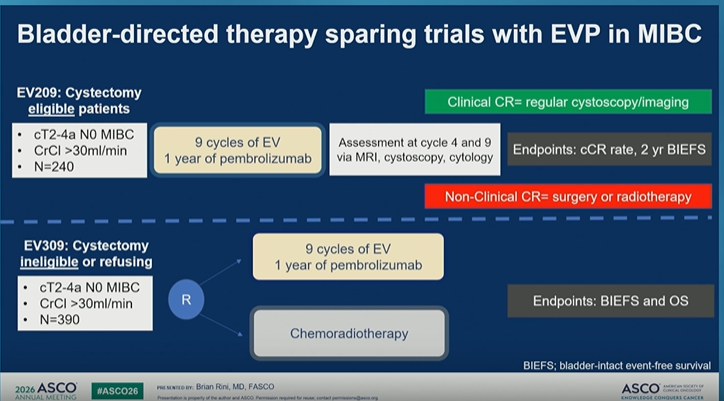
9 details 4 trials watching
Discussant presentation, not an original trial. Brian Rini, MD, FASCO discusses ASCO 2026 GU data spanning MIBC bladder preservation, adjuvant RCC, and ctDNA-based selection.
The chemoradiation regimen under discussion is 55 Gy in 20 fractions with mitomycin C and 5-FU. All 54 (100) received the full dose and 47 (87) had no extension or delay, so adding durvalumab did not erode RT delivery.
Concurrent mitomycin C plus 5-FU with durvalumab. Mitomycin C dose reduced in 4 (7), 5-FU Week 1 dose reduced in 9 (17), chemotherapy discontinued early in 12 (22). Durvalumab completed in 33 (61), discontinued early in 21 (39) for toxicity and progression.
The EV platform reframes the comparison: EV-309 randomises cystectomy-ineligible or refusing cT2-4a N0 pts (N=390) against chemoradiotherapy for BIEFS and OS, while EV-209 (N=240) tests EV plus pembrolizumab in cystectomy-eligible pts with cCR and 2yr BIEFS. In adjuvant RCC the discussant's read is that adjuvant IO has no proven benefit in non-clear cell disease, with RAMPART non-clear cell subgroups too small to resolve it.
Selection, not intensification, is the through-line. Pathologic features are called a crude selection tool, and the ctDNA-stratified adjuvant RCC curves separate far more than pathology does (ctDNA-negative 24-mo DFS 79.9% on pembrolizumab and 72.9% on placebo, versus 38.8% and 18.3% in ctDNA-positive pts). The same logic sits under bladder preservation, where the unanswered question is which pt keeps their bladder, not whether the regimen can be delivered.
Everything here is second-hand from a discussant slide deck, so denominators, CIs and per-arm attributions are partial. The RAMPART non-clear cell forest plot arrived with row association uncertain in OCR, and its point estimates are not attributed to specific histologies. Central pathology review is still ongoing.
| Component | Outcome | Number (%) |
|---|---|---|
| Radiotherapy | Received full 55 Gy in 20 fractions | 54 (100) |
| Radiotherapy | No extension or delay | 47 (87) |
| Chemotherapy | Mitomycin C dose reduced | 4 (7) |
| Chemotherapy | 5-FU Week 1 dose reduced | 9 (17) |
| Chemotherapy | Chemotherapy discontinued early | 12 (22) |
| Durvalumab | Completed | 33 (61) |
| Durvalumab | Discontinued early | 21 (39) |
- Long-term bladder preservation, function and QoL after chemoradiation plus durvalumab n=11 · primary completion 2026-02 · chemoRT +/- durvalumab, node-positive bladder
- Whether EV-based bladder sparing beats chemoradiotherapy on BIEFS and OS recruiting A Study to Find Out if Enfortumab Vedotin Given With Pembrolizumab Helps People With Muscle-invasive Bladder Cancer Keep Their Bladder Phase 2n=240 · primary completion 2027-11 · phase 2 EV+pembro bladder-sparing, n=240recruiting Enfortumab Vedotin in Combination With Pembrolizumab vs. Concurrent Chemoradiotherapy (cCRT) in People With Muscle Invasive Bladder Cancer (EV-309) Phase 3n=390 · primary completion 2030-03 · phase 3 EV+pembro vs cCRT, bladder preservationn=56 · primary completion 2031-04 · response-adapted EVP induction, cCRT or RC on failure
- Whether ctDNA-guided selection changes adjuvant RCC outcomes
📚 Sources · 🐦 1 tweet
#ASCO26 GU Oncology Spotlight 🚨
— Dra. María Natalia Gandur Quiroga (@nataliagandur) May 30, 2026
🔬 Living Longer, Living Better: Can We Have It All?
Discussant: Brian I. Rini, MD, FASCO@OncoAlert@ASCO
This GU session captured one of the central tensions in curative-intent oncology:
Can we improve cure rates while preserving quality of… pic.twitter.com/AMwrRZZM2Q
Neo-CRAG
ForcT3N2-3M0 / cT4 gastric or Siewert II-III EGJ adenocarcinoma, D2-resectable
HR 0.750
95% CI 0.607-0.928, P=0.008; 3yr DFS 55.6% vs 42.4%
TL;DRAdding preop 45Gy/25fx to periop XELOX raised 3yr DFS 55.6% vs 42.4%, HR 0.750; mOS 67.5 vs 37.6mo.
The RT case here rests on locoregional control: LRR after R0 fell to 9.4% from 18.3%, tracking the ypN0 (56.1% vs 36.4%) and pCR gains, which is the mechanistic chain CRITICS and TOPGEAR never produced. Dose was conventional 45Gy/25fx preoperatively, and G3+ postop complications stayed flat (9.0% vs 7.6%), so the deliverability objection to preop RT before D2 loses force.
In node-heavy cT3N2+ or cT4 gastric/Siewert II-III disease heading to D2 resection, this supports revisiting preoperative chemoRT rather than chemo alone; it does not speak to cT2N0-N1 disease or to pts already committed to a FLOT backbone.
Conventional 45Gy/25fx delivered preoperatively, after cycle 1 of chemo, halved locoregional recurrence after R0 resection (9.4% vs 18.3%) with no excess G3+ postoperative complications (9.0% vs 7.6%). That combination, a local-control gain without a surgical-morbidity cost, is what the omission decision in node-heavy cT3N2+ disease has been waiting for.
The systemic backbone was XELOX in both arms, so the DFS gain is attributable to radiotherapy rather than to the regimen, but the control arm's 37.6 mo median OS is the caveat: this does not tell you whether radiotherapy still adds on top of FLOT, whose own advantage is partly locoregional. Sequencing of RT after cycle 1 with attenuated dosing was deliverable.
Every pt was intended for standardized D2 resection, and preoperative chemoRT did not degrade it: G3+ postoperative complications were 9.0% vs 7.6%, and 448 of 620 randomised pts reached gastrectomy. ypN0 rose to 56.1% from 36.4%, which changes what the surgeon can expect to find in the nodal basin rather than the extent of dissection required.

| Endpoint | CRT | CT | Effect size |
|---|---|---|---|
| 3yr DFS | 55.6% (50.1-61.1) | 42.4% (36.9-47.9) | HR 0.750 (0.607-0.928), P=0.008 |
| Median DFS | 52.7 mo | 24.4 mo | n/a |
| 5yr OS | 50.1% | 44.2% | HR 0.781 (0.628-0.970), P=0.025 |
| Median OS | 67.5 mo | 37.6 mo | n/a |
9 details
Randomised, multicenter, phase 3 trial, N=620 (310 per group), 13 referral hospitals in China, accrual 2013-2022. Follow-up on the DFS curve extends past 120 months.
High-risk locally advanced gastric or EGJ adenocarcinoma: cT3N2-3M0, cT4aN+M0, or cT4bNanyM0, Siewert II/III permitted. 225 (36.3%) had an EGJ primary, and every pt was intended for standardized D2 resection.
Both arms: 3 cycles preoperative XELOX (oxaliplatin 130 mg/m² D1, capecitabine 1000 mg/m² BID D1-14, Q3W) then D2 gastrectomy then 3 adjuvant XELOX cycles.
CRT arm added concurrent 45 Gy / 25 fractions after cycle 1 of preoperative chemo, with attenuated concurrent dosing (oxaliplatin 100 mg/m², capecitabine 825 mg/m²). Target volume not specified in source.
Primary: disease-free survival, from randomization to progression, relapse, or death. Secondary: overall survival, pCR, R0 resection, safety.
Primary endpoint met. The locoregional read is the one an RT reader needs: LRR 9.4% vs 18.3% among R0-resected pts.
G3+ haematologic toxicity 14.6% vs 10.3%, the expected cost of concurrent chemoRT. G3+ postoperative complications were comparable, 9.0% vs 7.6%, so preoperative RT did not measurably worsen D2 surgical morbidity.
CRITICS (postoperative chemoRT after D1+ surgery) and TOPGEAR (preoperative chemoRT with ECF/FLOT) both failed to show a survival gain for radiotherapy in this disease. Neo-CRAG differs on three axes at once: RT given preoperatively, D2 resection mandated, and enrolment restricted to node-heavy cT3N2+ or cT4 disease.
The 2013-2022 accrual window means the control arm reflects a doublet era; a 37.6 mo median OS in the control group is short against contemporary FLOT-treated series. Single-country enrolment with uniformly high-quality D2 surgery also caps generalisability to centres with variable nodal dissection.
The pCR, downstaging, ypN0 and LRR gradient forms a coherent mechanistic chain from RT to the DFS separation, which is what earlier negative trials lacked. What it does not settle is whether that chain survives a stronger systemic backbone, since much of FLOT's advantage over a doublet is itself locoregional.
CONSORT flow
Randomised ph3, prespecified DFS met with OS support, but the chemo backbone is XELOX not FLOT, so it contests RT omission without settling it.
- Does preoperative chemoRT still add benefit on a FLOT backbone?
- Generalizability outside high-volume D2 centers
- Optimal target volume and elective nodal coverage not reported in source
📚 Sources · 🐦 1 tweet
Neo-CRAG: Ph3 RCT (n=620, gastric/GEJ) - adding neoadj chemoRT to peri-op XELOX improved OS (68 v 38 mo).
— Dr. Nina Niu Sanford (@NiuSanford) May 30, 2026
Limitation=non-FLOT, BUT still relevant IMO b/c:
1) DFS/OS benefit substantial.
2) Improvements in pCR, downstg, LRR supports plausible RT effect on OS. #ASCO26 @OncoAlert pic.twitter.com/eeM0Z8p20M
SWOG/NRG S1914 NCT04214262
ForT1-3N0M0 NSCLC ≤7cm, medically inoperable or declined surgery, ≥1 risk factor
HR 1.15
95% CI 0.65-2.01, p=0.63; primary endpoint not met
TL;DROS HR 1.15 (0.65-2.01), p=0.63: atezolizumab added to SBRT failed, with more local failures (13% vs 7%) and G≥3 AEs (12% vs 2%).
The RT read is that adding IO did not just fail to help, it tracked with MORE local failure (13% vs 7%), inside a BED ≥100 Gy 3-8 fraction regimen that is already delivering >90% in-field control. Central review of those events is pending, so treat the local signal as unconfirmed. This closes the question of routinely sequencing atezolizumab around definitive SBRT off-protocol.
In medically inoperable T1-3N0M0 NSCLC with high-risk features (size ≥2 cm, SUV ≥6.2, or poorly differentiated histology), this supports SBRT alone at BED ≥100 Gy without added checkpoint blockade; it does not address IO for node-positive or operable early-stage disease.
SBRT alone at BED ≥100 Gy in 3-8 fractions remains the standard, and adding atezolizumab tracked with MORE local failure (13% vs 7%) rather than better in-field durability. Central review of those events is pending. Regional (2% vs 3%) and distant (4% vs 5%) failure were unchanged, so the out-of-field rationale also went unrewarded.
Neoadjuvant/concurrent/adjuvant atezolizumab 1200 mg Q3W × 8 cycles bought no OS or PFS benefit and cost a six-fold rise in G≥3 AEs (12% vs 2%) including a G5 respiratory failure. This argues against porting PACIFIC-style consolidation logic into node-negative early-stage disease pending the PD-L1 analysis.
11 details
Randomized phase III SWOG/NRG cooperative-group trial, accrual 8/13/20 to 9/6/24, 417 randomized / 403 eligible (201 SBRT alone, 202 atezolizumab + SBRT) against an accrual goal of 432. Closed at the first interim analysis for futility on both OS and PFS. Median follow-up in living pts was 12 months (range 0.03-49).
T1-3N0M0 NSCLC ≤7 cm, medically inoperable or declined surgery, with ≥1 recurrence risk factor: tumor diameter ≥2 cm, ≥6.2 (SUV), or moderately/poorly/undifferentiated histology. Median age 73 (41-91), 89% ECOG 0-1, median tumor diameter 2.3 cm. Stratified by location (central vs peripheral), size (<4 vs ≥4 cm) and PS.
SBRT in 3-8 fractions to a BED ≥100 Gy in both arms, i.e. standard definitive dosing rather than a de-escalated backbone. In the experimental arm SBRT began with cycle 3, so radiation was delivered after two neoadjuvant atezolizumab cycles and concurrently with the third.
Atezolizumab 1200 mg IV Q3W for 8 cycles, given neoadjuvantly, concurrently and adjuvantly around SBRT. No protocol treatment was received by 6 pts on S and 8 on AS.
Primary: overall survival, compared by 1-sided stratified log-rank at the 2.5% level. Secondary: PFS, failure patterns, toxicity, QoL.
Neither OS nor PFS favored the IO arm, and local failure ran higher with atezolizumab. See the failure-pattern table and primary endpoint above.
| Failure site | SBRT alone | Atezo + SBRT |
|---|---|---|
| Local | 7% | 13% |
| Regional | 2% | 3% |
| Distant | 4% | 5% |
G≥3 AEs 12% on AS vs 2% on S (21 G3, 1 G4, and 1 G5 respiratory failure with atezolizumab; 3 G3 and 1 G4 with SBRT alone). A six-fold excess of high-grade toxicity with no efficacy return is the safety read.
The prior randomized phase II (PMID 37478883) suggested benefit from adding immunotherapy to SBRT; this larger phase III does not reproduce it. It also sits against PACIFIC-era logic, where consolidation IO helps after chemoRT for stage III, and shows that result does not port down to node-negative disease treated with ablative SBRT.
Follow-up is short (median 12 mo alive) and central review of local recurrence events is not complete, so the local-failure imbalance is provisional. The smoker subgroup harm signal was not multiplicity-controlled, and PD-L1 status, QoL and correlative blood/tissue analyses are all still pending.
A negative primary endpoint with a directionally worse PFS, worse local control and six-fold more high-grade toxicity is stronger than a null result: it argues against the abscopal/radiosensitization rationale in this setting. It does not exclude benefit in a biomarker-selected subset, which the pending PD-L1 analysis will test.
CONSORT flow
Phase III, primary OS endpoint not met, closed at interim for futility. Reaffirms SBRT alone as SoC and refutes the earlier phase II IO signal.
- Does a PD-L1-defined subset benefit from IO added to SBRT?
- Will central review confirm the excess local failures with atezolizumab?
- Is the worse outcome in former/never smokers real or chance?
📚 Sources · 📄 1 paper
Abstract
High-dose hyperfractionated SIB RT vs standard-dose RT (limited-stage SCLC) NCT03214003
ForLS-SCLC, age 18-70, ECOG 0-1, PET-CT staged, ≤2 prior chemo courses
TL;DRmOS 60.7 vs 39.5mo, HR 0.55 (0.37-0.72), p=0.003 for 54Gy SIB vs 45Gy BID, no added toxicity.
The dose went to GTV only: PTV stayed 45Gy in both arms, so this is an SIB boost, not a uniform 54Gy plan, and that is why grade 3-4 oesophagitis stayed at 13%. Local PFS HR 0.51 against a null MFS (HR 0.81) locates the benefit in the chest. Deliverable on VMAT with PET-defined involved fields.
In a fit LS-SCLC patient under 70 with PET-defined disease starting concurrent chemoRT, this supports an SIB boost to 54Gy/30 BID over uniform 45Gy; it does not speak to patients over 70, ECOG 2, or once-daily schedules.
The escalation is an SIB to GTV only, with PTV held at 45Gy in both arms, which is why grade 3-4 oesophagitis stayed at 13% vs 12%. Local PFS HR 0.51 against a null MFS (HR 0.81) confirms a chest-confined benefit. PET-defined involved fields, no elective nodal irradiation.
The chemotherapy backbone was fixed and identical (4 cycles platinum-etoposide, 99% completion in both arms), so the OS gain is attributable to the RT dose, not the regimen. Grade 3-4 neutropenia was unchanged at 44% vs 41%, so referring a fit under-70 patient for the boost schedule carries no extra haematologic cost.
10 details 1 trial watching
Open-label randomised phase 3, 16 public hospitals in China, 1:1, enrolled June 30 2017 to April 6 2021. Stratified by ECOG, stage, prior chemotherapy course, and platinum choice. Median follow-up 46 months (IQR 33-56); terminated early by the DSMB in April 2021 on interim benefit.
Aged 18-70, ECOG 0-1, VALSG limited-stage confirmed on whole-body FDG PET-CT and brain MRI, previously untreated or after one to two courses of platinum-etoposide. Median age 64, 46% female, 86% stage III, 79% current or former smokers. Age over 70 and ECOG 2 were excluded.
Four cycles of cisplatin 75 mg/m² (or carboplatin AUC 5) with etoposide 100 mg/m² days 1-3 every 3 weeks; 99% completed all four cycles in both arms. PCI 25 Gy in 10 fractions for responsive disease, given to 82% vs 81%.
VMAT, 6-MV, 30 twice-daily fractions over 3 weeks, minimum 6 h apart, starting 0-42 days after cycle 1. Experimental arm delivered a simultaneous integrated boost of 54 Gy to GTV/IGTV with the PTV at 45 Gy; the control arm had 45 Gy to both GTV and PTV. Target volumes were PET-positive lesions only, with elective nodal irradiation omitted and a 5 mm CTV margin.
Primary: overall survival in the ITT population, from the start of chemotherapy. Secondary: PFS, local PFS, metastatic-free survival, disease control rate, acute and late toxicity, and HRQOL (reported elsewhere).
No toxicity penalty for the boost: grade 3-4 oesophagitis 13% vs 12% (p=0.84) and pneumonitis 5% vs 6% (p=0.663). Grade 3-4 neutropenia 44% vs 41%. Late grade 3 pneumonitis in 2 vs 3 pts, no late grade 3 oesophagitis or pulmonary fibrosis in either arm. One treatment-related death (myocardial infarction, 54 Gy arm).
CONVERT (66 Gy in 33 once-daily fractions) and CALGB 30610/RTOG 0538 (70 Gy once daily) both failed to beat 45 Gy twice daily, with median OS 25 vs 30 mo and 28.5 vs 30.1 mo respectively. Neither escalated arm was hyperfractionated or accelerated. The Nordic phase 2 (60 Gy in 40 twice-daily fractions) did show a gain, 2-year OS 74.2% vs 48.1%, and this trial is the phase 3 counterpart of that signal.
Stopping at the interim analysis with 224 of a planned 326 pts inflates the observed effect, and the appendix-level subgroup analysis has not been done. There was no centralised QA of contouring or planning across the 16 centres, and prognostic variables that plausibly drive a dose effect (tumour volume, PTV size) were not balanced by design.
The 21.2-month OS gain is larger than the trial powered for (assumed HR 0.65, 37 vs 24 mo), and the control arm's 39.5 mo sits well above the 20.8-30 mo reported elsewhere for 45 Gy. That points to cohort selection (PET staging, VALSG limited stage, age and ECOG caps) rather than an underperforming control, which is reassuring for internal validity but limits transfer. Local PFS separating (HR 0.51) while MFS does not (HR 0.81) is the mechanistically coherent read for a dose escalation confined to the chest.
CONSORT flow
Randomised phase 3, prespecified OS primary hit at interim. Diverges from CONVERT/CALGB 30610 dose-escalation failures. Early stopping and single-country cohort temper it.
- Tolerability of 54Gy BID SIB in pts over 70
- Replication outside China with centralised RT quality assurance
- Optimal boost dose between 54Gy and 60Gy twice daily recruiting Dose-Escalation Radiotherapy in Limited-Stage Small Cell Lung Cancer: A Phase III Randomized Trial Phase 3n=300 · primary completion 2028-09 · randomises 45 vs 60 vs SIB 45-54Gy BID
📚 Sources · 📄 1 paper
Bladder-preserving TMT multicenter analysis (URONCOR)
ForcT2-T4aN0M0 MIBC treated with definitive TMT, median age 76
TL;DRCLR 63.7% in a 369-pt Spanish TMT cohort; salvage cystectomy 9.7%, image-guidance quality and 5-FU-based CRT predicted local response.
The modifiable RT variable here is verification protocol: weekly portal imaging carried OR 0.35 (0.20-0.60) for complete local response, with VMAT trending favorable, across a 2010 to 2022 accrual. Dose, fractionation and target volume are not reported in source, so what transfers is the case for daily volumetric IGRT in a filling, moving organ.
In cT2-T4aN0M0 MIBC pts in their seventies weighing bladder preservation against cystectomy, this real-world series supports TMT delivered with modern image guidance and a 5-FU-based backbone; it does not inform node-positive or metastatic disease and carries no head-to-head against radical cystectomy.
Verification protocol is the modifiable variable: weekly portal imaging carried OR 0.35 (0.20-0.60) for complete local response, with VMAT trending favorable. Dose, fractionation and target volume are not reported in source, so what transfers is the case for daily volumetric IGRT and adaptive planning rather than a specific prescription.
The concurrent backbone mattered: 5-FU-based CRT carried OR 4.9 (1.1-22.1) for complete local response, though the CI leaves the magnitude open and comparator regimens are unnamed in source. Systemic failure at 10.7% ran at or above local-only failure at 10.1%, keeping perioperative systemic therapy questions live.
Salvage cystectomy was performed in 9.7% against 28.8% who progressed, so in a median-age-76 cohort most failures were not surgically rescued. With no in-cohort cystectomy comparator, this informs counseling on bladder preservation for cT2-T4aN0M0 disease without establishing equivalence to upfront radical cystectomy.

10 details
Multicenter retrospective cohort, Spain, 2010 to 2022, N=369 treated with definitive trimodality therapy (maximal TURBT then concurrent chemoradiotherapy). Predictors of response identified by multivariable logistic regression. Follow-up duration not reported in source.
cT2-T4aN0M0 MIBC selected for bladder preservation. Median age 76, 85.1% male. Fitness for cystectomy and completeness of TURBT are not reported in source.
Concurrent chemoradiotherapy, regimen at each center's discretion. 5-FU-based CRT predicted higher complete local response (OR 4.9, 95% CI 1.1-22.1, p=0.038). The comparator regimens are not named in source.
Dose, fractionation and target volume are not reported in source. The only technique signals reported are verification frequency (weekly portal imaging, OR 0.35 for CLR) and a non-significant trend favoring VMAT.
Primary: complete local response (CLR). Secondary: OS, CSS, recurrence patterns, salvage cystectomy. No OS or CSS estimate appears in the source, so the survival half of the conclusion cannot be checked.
CLR 63.7%, salvage cystectomy 9.7%. Progression 28.8%, with systemic failure (10.7%) running at or above local-only failure (10.1%).
BC2001 established the locoregional-control gain from adding chemotherapy to bladder radiotherapy, and the pooled RTOG bladder-preservation experience set the complete-response benchmark; both were protocol populations. This adds European real-world multicenter data at a median age of 76, with no internal cystectomy comparator.
No follow-up duration, OS or CSS estimate is reported, so the durability behind the preservation claim cannot be judged. The 5-FU odds ratio spans 1.1 to 22.1, compatible with a marginal or a large effect, and in a retrospective series regimen choice tracks renal function and performance status.
Systemic failure at 10.7% running at or above local-only failure at 10.1% argues the ceiling in this population is micrometastatic disease rather than the bladder, which caps what further local intensification can buy. Read conservatively, the predictors favor modern image guidance and an active concurrent backbone, not any specific verification schedule.
Retrospective multicenter cohort with no cystectomy comparator; imaging and chemo predictors come from multivariable regression across a 2010-2022 era shift, so a causal reading is unsupported.
- Does daily volumetric IGRT improve complete local response vs weekly portal imaging?
- Which concurrent chemotherapy backbone maximizes complete local response in TMT?
- Long-term bladder-intact survival vs radical cystectomy in matched populations
📚 Sources · 🐦 1 tweet
📢 Presentamos en #ESTRO26 nuestro análisis multicéntrico sobre preservación vesical en cáncer vesical músculo-invasivo tratado con TMT.
— URONCOR (@URONCOR) May 19, 2026
🔎 En 369 pacientes, la respuesta completa clínica se asoció a menor recurrencia local y mejor supervivencia!@fcounago #NicoFeltes pic.twitter.com/aQjjkcHGP4
OPERA
ForRectal cancer on watch-and-wait pathway after neoadjuvant therapy
TL;DRW14 clinical response (DRE+rectoscopy) identified 76% good responders; 5yr organ preservation 75% A vs 83% B, p=0.24.
The transferable read is timing: response can be called at W14, one month after NAT ends, on DRE plus rectoscopy, with MRI TRG1-2 concordance of 98% (80/82). nCR at W14 preserved organs as well as cCR (77% vs 81%), so a near-complete response reflecting radiation effect does not by itself send a patient to TME.
In rectal pts on a watch-and-wait pathway, this supports assessing response at W14 rather than deferring to W24 and reassessing nCR rather than treating it as failure; it does not address pts never eligible for organ preservation.
Response can be called at W14, one month after NAT ends, on DRE plus rectoscopy, with MRI TRG1-2 concordance of 98% (80/82). nCR at that point preserved organs as well as cCR (77% vs 81%), so a near-complete response reflecting radiation effect does not itself justify TME.
The surgical decision this moves is when to abandon watch-and-wait. A W14 nCR reached 5yr organ preservation of 77% versus 81% for cCR, so early near-complete response is not evidence for proceeding to TME. Regrowth and salvage counts are not reported in source.
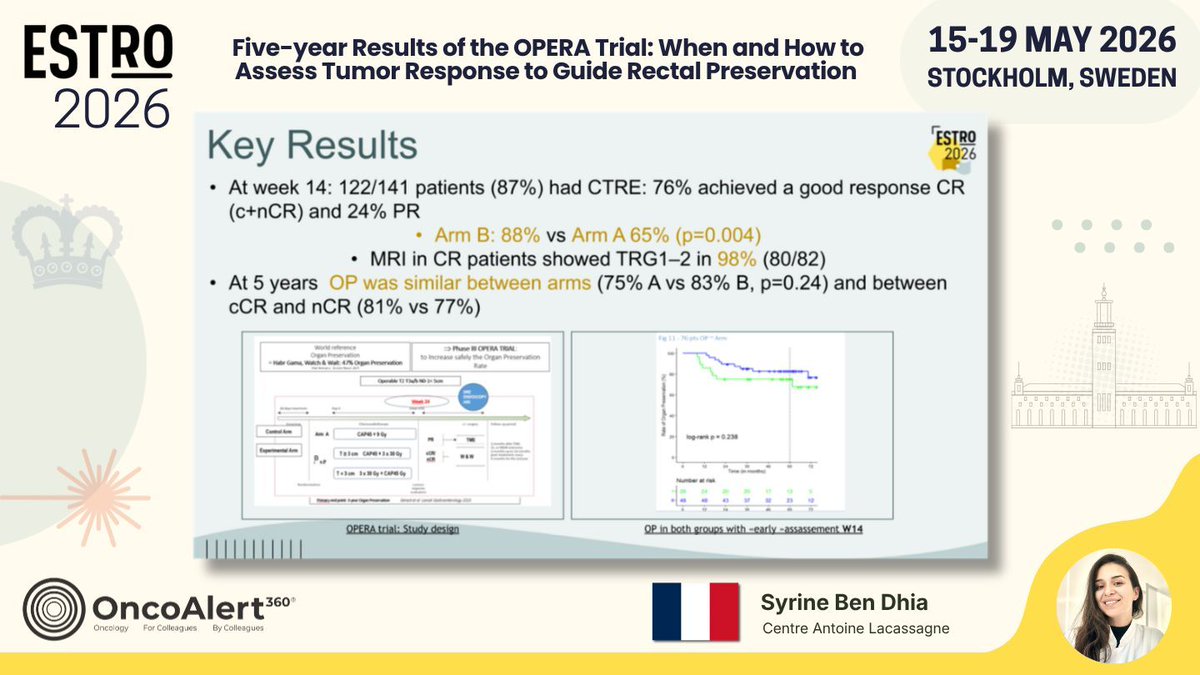
| Endpoint | Arm A | Arm B | Overall |
|---|---|---|---|
| W14 good response (cCR+nCR) | 65% | 88% | 76% |
| W14 partial response | n/a | n/a | 24% |
| 5yr organ preservation | 75% | 83% | p=0.24 |
| CTRE performed at W14 | n/a | n/a | 122/141 (87%) |
+2 more figures


10 details
Post-hoc analysis of the randomised OPERA trial (two arms, A and B), reporting 5-year organ-preservation outcomes. The parent trial assessed response at week 24 with a three-modality triad (DRE, rectoscopy, MRI); this analysis asks whether the week 14 read is good enough.
Week-14 clinical tumor response evaluation (CTRE) by DRE and rectoscopy, categorised CR / nCR / PR, with cCR + nCR counted as a "good" clinical response. MRI graded by TRG. CTRE was correlated with relapse and 5-year organ-preservation rates.
Both arms received neoadjuvant therapy with organ preservation as the goal, and good responders at W14 either proceeded to organ preservation or were reassessed at W24. Dose, fractionation, and the content distinguishing Arm A from Arm B are not reported in source, which limits how far the arm difference transfers.
CTRE was obtainable in 122/141 (87%) at W14. MRI confirmed TRG1-2 in 98% (80/82) of clinical CR pts, and 5-year organ preservation did not differ by arm (p=0.24) or by response depth (cCR 81% vs nCR 77%).
Watch-and-wait practice has largely settled on later response assessment, with the OPRA framing of consolidation timing and the registry experience both anchoring the decision point well beyond three months. This analysis argues the clinical exam carries most of that information a month after NAT ends, which is earlier than the field currently commits.
The 19 pts without CTRE at W14 (141 minus 122) are unaccounted for in source, and selective assessability would bias the 76% good-response figure upward. The arm difference (88% vs 65%, p=0.004) is uninterpretable here because the randomised contrast is not described.
The clinically useful claim is that nCR is a radiation effect, not residual tumor, and the 5-year organ-preservation parity between cCR and nCR (81% vs 77%) is the evidence for it. What the source does not settle is regrowth: organ preservation at 5 years is a net figure that can absorb salvage, so equal preservation does not establish equal local control.
Post-hoc timepoint analysis of 141 pts; W14 vs W24 assessment was never randomised, and no relapse or regrowth data reported in source.
- Regrowth and salvage rates behind the 5yr organ preservation figures
- What distinguished Arm A from Arm B
- Outcomes of the 19 pts without W14 CTRE
📚 Sources · 🐦 1 tweet
Day FOUR of #ESTRO26 Coverage by OncoAlert 🚨
— OncoAlert (@OncoAlert) May 18, 2026
Five-year Results of the OPERA Trial: When and How to Assess Tumor Response to Guide Rectal Preservation Presented by Syrine Ben Dhia 🇫🇷 #RadOnc ☢️
This post-hoc analysis of the OPERA trial evaluated early tumor response… pic.twitter.com/KUanFTxeFh