ASCO Annual Meeting 2026
MROQC ADT Practice Patterns
ForIntact high-risk M0, N0-1 prostate cancer, definitive RT
TL;DRGuideline-concordant ≥18mo ADT intended in 67.0% of high-risk M0/N0-1 pts receiving definitive RT; ARPI recommended in 23.2% of STAMPEDE-eligible pts post-publication.
Facility-level variability in ≥18mo ADT recommendations persisted after adjusting for cN1, grade group and PSA (P<.0001), so treating site, not only tumor features, shapes duration. Among STAMPEDE M0-eligible pts, ARPI recommendations reached only 23.2% after publication, a gap a department can audit directly in its own high-risk RT cohort.
Grade group drove concordant ADT recommendations most (GG5 OR 9.45, GG4 OR 6.23), and site-level variability survived adjustment (P<.0001). For an RT department the benchmark is concrete: 67.0% intended ≥18mo ADT and 23.2% ARPI uptake in STAMPEDE M0-eligible pts after publication.
9 details
Prospective statewide quality-consortium data (MROQC), N=553 across 26 centers, June 2020 to November 2024. Multivariable analysis of predictors, a mixed-effects model with treatment site as random intercept, and ARPI adoption compared before vs after STAMPEDE M0 publication.
Intact high-risk M0, N0-1 prostate cancer treated with definitive RT: cT3/4 13.3%, cN1 19.9%, GG 4-5 75.0%, PSA ≥20 ng/mL 40.0%. 27.9% met STAMPEDE M0 criteria (≥2 of cT3/T4, GG 4-5, PSA ≥40 ng/mL, or cN1).
Primary: intended guideline-concordant ADT (GC-ADT, ≥18 months) per 2022 AUA/ASTRO. Also assessed: ARPI recommendation in STAMPEDE-eligible pts and facility-level variability.
91.3% recommended any ADT, 67.0% guideline-concordant. ARPI recommendations in STAMPEDE-eligible pts rose from 0% to 23.2% after publication; facility variability persisted on MVA (P<.0001).
| Factor | OR (95% CI) |
|---|---|
| cN1 | 2.94 (1.44-5.99) |
| GG4 | 6.23 (2.85-13.62) |
| GG5 | 9.45 (4.46-20.06) |
| PSA ≥40 ng/mL | 3.64 (1.22-10.87) |
Benchmarks practice against the 2022 AUA/ASTRO 18-36 month recommendation and STAMPEDE M0 ARPI intensification criteria. Single-state data, and the source offers no comparison with other practice settings.
The abstract gives no reasons for sub-18mo recommendations (comorbidity, pt preference, toxicity), so non-concordance is not necessarily poor care. The ARPI comparison is an uncontrolled before-after design, and no OR is reported for cT3/4.
The strongest predictors of a concordant recommendation were grade group (GG5 OR 9.45) and cN1, consistent with shorter courses being offered when high-risk status rests on other features. Residual site variability points to local norms beyond the modelled case mix, though unmeasured covariates could contribute.
Practice-patterns study of intended ADT recommendations; no efficacy or outcome endpoint, so nothing here confirms or challenges SOC.
- Delivered vs intended ADT duration in routine definitive RT practice
- Drivers of facility-level variation in ADT duration recommendations
- Barriers to ARPI intensification in STAMPEDE M0-eligible pts
📚 Sources · 📄 1 paper
Abstract
AREST
ForResected pT1-2N0 OSCC, margins ≥5mm, ≥1 intermediate-risk feature
HR 0.52
95% CI 0.30-0.91, p=0.02 · 3-yr 89.2% vs 80.9% (ITT)
TL;DR3-yr LRFS 89.2% vs 80.9% (HR 0.52, p=0.02) with adjuvant RT vs observation in resected intermediate-risk pT1-2N0 OSCC; no significant DFS/OS difference.
Competing-risk LRF incidence was 10.6% vs 18.9% (HR 0.52) with 60Gy/30fx to tumor bed and at-risk neck. Controls had ≥5mm margins and a level I-III dissection with ≥16 nodes, so this is RT's increment over high-quality surgery alone. It moves adjuvant RT vs observation most for oral tongue, an exploratory subgroup.
In pT1-2N0 OSCC resected with ≥5mm margins and an adequate level I-III neck dissection but carrying PNI, LVE, poor differentiation or DOI ≥5 to ≤10mm, this supports discussing adjuvant RT for loco-regional control; it does not extend to close-margin, limited-neck or node-positive disease.
Competing-risk LRF incidence 10.6% vs 18.9% (HR 0.52) with 60Gy/30fx to tumor bed and at-risk neck, after surgery that already met ≥5mm margins and ≥16 nodes. It moves adjuvant RT vs observation in pT1-2N0 OSCC, strongest for oral tongue in an exploratory subgroup; smaller target volumes untested.
Benefit was measured against surgery with clear margins ≥5mm and an ipsilateral level I-III dissection yielding ≥16 nodes, so RT added loco-regional control even after high-quality resection. Pathology reporting of PNI, LVE, differentiation and DOI now gates the adjuvant referral; the data do not cover close margins or a limited neck.
9 details
Multicenter, open-label, phase III RCT from India, 1:1, stratified by oral cavity subsite, PNI/LVE and differentiation. N=392 (191 RT, 201 observation); median follow-up 47.2 mo (IQR 30-59.4). Powered at 80% to detect HR 0.6256, assuming 3-yr LRFS 70% with observation.
pT1-T2, pN0 OSCC after adequate surgery: clear margins ≥5mm and at least ipsilateral level I-III neck dissection with ≥16 nodes. Required ≥1 intermediate risk factor: DOI ≥5 to ≤10mm, PNI, LVE, or poor differentiation.
60Gy in 30 fractions over 6 weeks to the resected tumor bed and at-risk neck nodal region. Technique and nodal volume definitions not stated in source; no concurrent systemic therapy described.
Primary: loco-regional recurrence-free survival, from randomization to first local and/or regional recurrence. Also reported: cumulative incidence of loco-regional failure with death as competing event, DFS, OS.
LRFS benefit held on PP and competing-risk analyses; DFS and OS not significantly different, with no survival HRs in source.
| Endpoint | Adjuvant RT | Observation | HR (95% CI), p |
|---|---|---|---|
| 3-yr LRFS, ITT | 89.2% (84.3-93.3) | 80.9% (74.6-86.1) | 0.52 (0.30-0.91), p=0.02 |
| 3-yr LRFS, PP | 91.1% | 80.9% | 0.43 (0.23-0.80), p=0.01 |
| LRF cumulative incidence (death competing), ITT | 10.6% (6.1-15.1) | 18.9% (13.3-24.6) | 0.52 (0.30-0.91), p=0.021 |
| LRF cumulative incidence (death competing), PP | 8.7% (4.3-13.1) | 18.9% (13.3-24.6) | 0.43 (0.23-0.79), p=0.007 |
The abstract describes the evidence for adjuvant RT in this setting as largely retrospective; AREST is the randomised test of that practice. The RTOG and EORTC postoperative trials tested adding concurrent chemo to RT in high-risk resected disease and did not randomise RT itself against observation.
Control arm beat its design assumption (3-yr LRFS 80.9% vs 70% assumed), so the absolute gain sits against a lower-risk baseline than planned. Oral tongue vs buccal mucosa is an exploratory subgroup with no HR in source, and no result is given per risk factor. Salvage treatment at recurrence is not described, which bears on the OS read.
Loco-regional control improved without DFS or OS separation; one explanation is effective salvage of isolated recurrences in observed pts, which the abstract cannot confirm. The decision it moves is adjuvant RT vs observation after adequate resection, weighed against RT morbidity the abstract does not report.
CONSORT flow
Randomised phase III hit LRFS primary at 47.2 mo median f/u; DFS/OS not significantly different and no toxicity data in abstract, so supports rather than mandates adjuvant RT.
- Which intermediate-risk feature (PNI, LVE, DOI, grade) drives the benefit?
- Does the oral tongue benefit hold as a prespecified subgroup?
- Late RT toxicity and salvage outcomes in the observation arm
📚 Sources · 🐦 1 tweet · 📄 1 paper
#ASCO26
— Dr Rishabh Jain (@DrRishabhOnco) May 27, 2026
🗣️ The AREST trial tackles one of the biggest gray zones in oral cavity cancer.
After adequate surgery in pT1-2N0 OSCC with intermediate-risk features:
✅ Adjuvant RT improved loco-regional control
❌ No OS benefit observed
3-year LRFS:
🔹 89.2% vs 80.9%
🔹 HR 0.52… https://t.co/qsALPFX032 pic.twitter.com/F4XzTMETih
Abstract
mRCAT-III NCT06507371
ForpMMR/MSS cT3-4N0/+M0 rectal adenoCa, ≤10cm from anal verge, no lateral node
61.0% vs 28.6%
P<0.0001, blinded independent central review
TL;DRpCR 61.0% vs 28.6% (P<0.0001) when elective nodal RT was omitted and tislelizumab added in pMMR/MSS LARC.
The RT variable here is target volume, not dose: both arms got 5Gy x 5d, and the experimental target was tumor bed alone with tumor-draining nodes deliberately spared. That inverts the usual de-escalation logic (smaller field proposed to IMPROVE efficacy by preserving nodal immunity), but tislelizumab moves with it, so the pCR gain cannot be assigned to the field change.
In pMMR/MSS cT3-4 rectal cancer ≤10cm from the verge with no positive lateral node, this raises the question of elective nodal omission with PD-1 blockade but does not yet support dropping nodal coverage outside a trial, and says nothing about dMMR/MSI-H disease.
The only RT variable is target volume: 5Gy x 5d in both arms, tumor bed alone versus conventional fields including the tumor-draining nodes. Elective nodal omission is being proposed to improve efficacy rather than reduce toxicity, but with no recurrence data reported, the coverage decision stays unchanged outside a trial.
Tislelizumab was added to an unchanged CAPOX backbone in a pMMR/MSS population, where checkpoint blockade has generally underperformed. The 61.0% vs 28.6% pCR is the sequencing signal, though the concurrent field reduction means the drug's independent contribution is not isolated.
All patients proceeded to TME, so the higher pCR (61.0% vs 28.6%) and MPR (77.9% vs 50.6%) bear on the depth of response at resection and, via the unreported organ-preservation secondary, on which patients might avoid it. Nodal yield and recurrence after unirradiated draining nodes are not reported.

| Endpoint (ITT) | Experimental (N=77) | Control (N=77) | P |
|---|---|---|---|
| pCR rate | 61.0 (47/77) | 28.6 (22/77) | <0.001 |
| MPR rate | 77.9 (60/77) | 50.6 (39/77) | <0.001 |
+1 more figure

10 details 5 trials watching
Multicenter, open-label, randomized phase 3 across 17 hospitals in China (NCT06507371). 1:1 allocation, n=77 per arm, stratified by clinical N stage (cN0 vs cN+). Pathologic response read by blinded independent central review.
Rectal adenocarcinoma with lower edge ≤10 cm from the anal verge, cT3-4 N0/+ M0, MSS/pMMR, age 18-75, ECOG PS 0-1. No positive lateral lymph node permitted, which excludes the population where lateral nodal management is itself contested.
Both arms received 5Gy x 5 days. The experimental arm's modification was target volume only: radiation to the tumor bed without tumor-draining lymph nodes, against conventional short-course fields in the control. Dose and fractionation were held constant, so the field is the only RT variable.
Experimental: tislelizumab 200 mg IV d1 plus oxaliplatin 130 mg/m² IV d1 and capecitabine 1000 mg/m² PO d1-14. Control: the same CAPOX backbone without tislelizumab. Both followed by TME, then adjuvant therapy and follow-up.
Primary: pCR rate in the ITT population. Secondary: MPR rate, TRG, organ preservation rate, EFS, OS and AEs. Only pCR and MPR are reported in the source; the time-to-event secondaries are not.
The presentation states the experimental approach reduced the incidence of severe gastrointestinal adverse events, consistent with a smaller irradiated volume, but no grade-specific rates are reported in source.
The control arm's 28.6% pCR sits above what short-course RT with consolidation chemotherapy has historically produced in pMMR disease, so the comparator is not obviously weak. The experimental result approaches the response depth usually reserved for dMMR/MSI-H disease, where checkpoint blockade already produces high complete-response rates; extending that to MSS is the claim being made.
Nodal recurrence is the outcome that decides whether sparing the tumor-draining nodes is safe, and no recurrence, EFS or OS data appear in the source. A pCR advantage at TME cannot answer it, and the cN+ stratum is where a nodal-omission failure would show first.
The trial's mechanistic premise, that irradiating draining nodes depletes the lymphocyte reservoir a PD-1 agent needs, is testable but not tested here: the field change and the checkpoint inhibitor were introduced together. A three-arm design (node-sparing RT + CAPOX, conventional RT + CAPOX + tislelizumab) would be needed to separate them.
CONSORT flow
Randomised phase 3, 1° EP met by central review, but confounds nodal-target omission with PD-1 addition and reports no recurrence or survival data.
- Nodal recurrence risk after sparing tumor-draining lymph nodes recruiting Nodal-Region Sparing Short-Course RT With Chemo-PD-1/Bevacizumab vs. Short-Course RT With Chemotherapy as TNT in pMMR/MSS Locally Advanced Rectal Cancer Phase 2n=76 · primary completion 2029-06 · nodal-sparing vs standard SCRT TNT in pMMR/MSSrecruiting Node-Sparing Short-Course Radiotherapy Sequential Chemotherapy and PD-1 Inhibitor for Mid/Low pMMR/MSS Rectal Cancer (MODIFI-RC-II) Phase 2/3n=430 · primary completion 2030-12 · randomised node-sparing vs conventional field, n=430
- Whether tislelizumab or field reduction drives the pCR gain recruiting Neoadjuvant Long-course Chemoradiation Plus PD-1 Blockade for Mid-low Locally Advanced Rectal Cancer Phase 2n=186 · primary completion 2024-03 · CRT ± tislelizumab, fixed field: isolates the PD-1 armnot yet Neoadjuvant Chemoradiotherapy Followed by Chemotherapy With or Without Tislelizumab for Resectable Ultra-low Rectal Cancer: The RELIEVE-02 Study Phase 3n=154 · primary completion 2027-12 · phase 3 CRT+chemo ± tislelizumab, ultra-low pMMR/MSS
- Organ preservation and EFS with node-sparing short-course RT recruiting Nodes-sparing Short-course Radiation Combined With CAPOX and Tislelizumab for MSS Middle and Low Rectal Cancer Phase 2n=32 · primary completion 2024-08 · node-sparing SCRT + CAPOX/tisle, organ preservation 2° EP
📚 Sources · 🐦 1 tweet
One of most interesting rectal ca studies at #ASCO26
— Dr. Nina Niu Sanford (@NiuSanford) June 2, 2026
P3 RCT in pMMR LARC: Node-sparing short-course RT + CAPOX + tislelizumab doubled pCR v conventional SCRT + CAPOX (61 v 29%)
Hypothesis = sparing elective node RT preserves antitumor immunity & improves PD1 response @OncoAlert pic.twitter.com/6xvA6ne0mg
LBA8005: Concurrent Thoracic RT + Chemoimmunotherapy in ES-SCLC
ForTreatment-naive ES-SCLC on durvalumab/platinum/etoposide, ECOG 0-1, thoracic lesion
10.0 vs 11.8 mo
HR 1.14, 95% CI 0.84-1.56, p=0.40 (primary endpoint not met)
TL;DRmOS 10.0 vs 11.8 mo, HR 1.14 (0.84-1.56), p=0.40: adding 30Gy/10fx consolidative TRT to chemo-IO did not improve survival.
The consolidative-TRT habit carried over from CREST does not survive an IO backbone: OS HR 1.14, and both landmark subgroups (completers HR 1.02, no brain/liver mets HR 1.10) sit on or above 1.0, so there is no population here in which 30Gy/10fx earned its place. Source gives no local control or toxicity numbers, so the mechanism stays open.
In treatment-naive ES-SCLC starting durvalumab plus platinum/etoposide, this argues against routinely adding 30Gy/10fx thoracic RT during cycles 2-4; it does not address consolidative TRT after IO completion, nor PCI, which was permitted in both arms.
The 30Gy/10fx schedule that CREST validated does not hold up on an IO backbone (HR 1.14), and enriching for the fitter patient did not help: completers HR 1.02, no brain/liver mets HR 1.10. Note this tested CONCURRENT RT at day 21-28, not post-induction consolidation, so that decision is still open.
The systemic regimen was identical in both arms, so this is a clean read that thoracic RT adds nothing to durvalumab plus carboplatin/etoposide, not a comment on the backbone itself. PFS was flat (5.1 vs 5.0 mo), and referral for concurrent thoracic RT during cycles 2-4 is not supported.

| Arm | Median OS | 95% CI | HR (95% CI), p |
|---|---|---|---|
| Chemoimmunotherapy plus TRT | 10.0 months | 8.3 - 11.7 | 1.14 (0.84 - 1.56), p=0.40 |
| Chemoimmunotherapy | 11.8 months | 10.0 - 13.6 | reference |
+2 more figures

| Arm | Median PFS | 95% CI | HR (95% CI), p |
|---|---|---|---|
| Chemoimmunotherapy plus TRT | 5.1 months | 4.7 - 5.4 | 1.10 (0.84 - 1.45), p=0.49 |
| Chemoimmunotherapy | 5.0 months | 4.6 - 5.4 | reference |

9 details 5 trials watching
Randomized phase III, 1:1, N=228 (115 TRT vs 113 control). Stratified by liver metastases and brain metastases. Primary: overall survival; key secondary ORR, PFS, toxicity.
Treatment-naive confirmed SCLC, stage IV or stage III ineligible for curative chemoradiation, ECOG PS 0-1, at least one measurable thoracic lesion. Asymptomatic or stable brain metastases allowed.
Both arms: 4 cycles durvalumab 1500 mg + carboplatin AUC=5 + etoposide 100 mg/m2 IV d1 with d2-3 IV or 200 mg/m2 PO d2-4, Q3W, then durvalumab 1500 mg Q4W until progression, toxicity, or patient choice.
30 Gy in 10 fractions starting day 21-28, so delivered concurrently with the later chemoimmunotherapy cycles rather than as post-chemo consolidation. PCI 25-30 Gy to responders and WBRT 20-30 Gy for brain metastases were optional per local routine in both arms. Target volume, technique, and dose constraints not reported in source.
Primary endpoint not met. PFS was likewise flat (5.1 vs 5.0 mo, HR 1.10, p=0.49), and neither landmark subgroup shifted the estimate below 1.0.
| Population | TRT median OS | Control median OS | HR (95% CI), p |
|---|---|---|---|
| Completed all 4 chemo-IO courses | 11.9 mo (9.7-14.1) | 12.1 mo (9.4-14.8) | 1.02 (0.72-1.44), p=0.92 |
| No brain or liver mets | 11.9 mo (6.2-17.7) | 13.2 mo (10.4-16.1) | 1.10 (0.65-1.87), p=0.72 |
CREST (Slotman, Lancet 2015) established the same 30 Gy/10 fx schedule as consolidative TRT after chemotherapy alone and showed a 2-year OS gain. This trial asks the schedule against a durvalumab-containing backbone and finds nothing, which is the relevant question now that chemo-IO is standard first line.
Toxicity was a key secondary but no AE data appear in the source slides, so a harm-versus-local-benefit tradeoff cannot be assessed. No local control or pattern-of-failure endpoint is shown, and permitted PCI plus WBRT in both arms further blurs the RT contrast between arms.
The timing choice matters for how far the null generalizes: day 21-28 puts RT alongside active chemo-IO, not after it, so this tests concurrent thoracic RT rather than the CREST consolidation paradigm. What it does not settle is whether the null reflects absent local benefit or a benefit cancelled by added toxicity.
CONSORT flow
Randomised phase III, primary OS endpoint, prespecified stratification; result diverges from CREST-era practice of consolidative TRT. Design internally valid for the null claim.
- Does consolidative TRT after completing chemo-IO still help? n=150 · primary completion 2025-03 · RT to all residual lesions post chemo-IO in ES-SCLCrecruiting Phase II Trial of Consolidative Thoracic Radiotherapy for ES-SCLC After Standard Care of Chemo-immunotherapy Phase NAn=104 · primary completion 2025-09 · ph2 TRT after chemo-IO then PD-1/L1 maintenancenot yet Addition of Thoracic Consolidation Radiotherapy to the Maintenance Immunotherapy for ES-SCLC (STONE-001) Phase 3n=182 · primary completion 2028-12 · randomised TRT added to IO maintenance after inductionn=165 · primary completion 2028-12 · consolidative RT to residual disease during IO
- Did concurrent TRT add toxicity that offset local benefit? active Chemotherapy and Immunotherapy in Extensive-Stage Small-Cell Lung Cancer With Thoracic Radiotherapy Phase 2n=35 · primary completion 2027-09 · safety/feasibility of concurrent TRT with chemo-durva
- Local control and pattern-of-failure outcomes unreported
📚 Sources · 🐦 1 tweet
🚨 #ASCO26 | #️⃣LBA8005⁰☢️ Concurrent thoracic radiotherapy + chemoimmunotherapy in ES-SCLC
— Masahiro TORASAWA, MD. PhD. (@M_Torasawa) June 2, 2026
👥 ES-SCLC⁰Durvalumab + platinum/etoposide⁰± concurrent thoracic radiotherapy⁰TRT: 30 Gy / 10 fractions, starting day 21–28
📊 Randomized phase III⁰ChemoIO + TRT: n=115⁰ChemoIO… pic.twitter.com/TDA5amz59e
RT + Systemic Therapy: What to Continue vs Hold (Speers)
TL;DRASCO 2026 education session slides triaging concurrent systemic agents with breast/CW + RNI into continue, caution, and hold/sequence.
HERANCCTG N9831APHINITYKATHERINEATEMPTDESTINY-Breast05COMBARTKEYNOTE-522
The operational content is the PK column: talazoparib 5t½ 19 days and pembrolizumab 5t½ ~110 days mean a brief hold buys nothing, so the mitigation is field size, lung dose and monitoring rather than a washout. Field size, not agent class, gates the CDK4/6i and olaparib calls.
In a pt starting breast/CW + RNI while on T-DXd, this supports concurrent treatment with lung-dose scrutiny rather than a hold; it does not extend to baseline ILD or active pulmonary disease, where sequencing is advised.
Plan geometry, not the drug name, does the deciding: large lung volumes, IMN coverage, bolus and reconstruction move T-DM1 into caution, high lung-dose plans move T-DXd, and field size gates CDK4/6i and olaparib. Where 5t½ is long (pembrolizumab ~110 days, T-DXd 30 days) a hold is unavailable, so the lever is dose constraints and surveillance.
The washout column tells you what a hold actually costs: capecitabine 4 hrs and veliparib 1 day are free to interrupt, talazoparib 19 days and T-DXd 30 days are not. Olaparib is asked to start 2-12 wks after RT completes on the OlympiA paradigm, which is a sequencing constraint on adjuvant planning, not a toxicity call.

+3 more figures


14 details 4 trials watching
ASCO 2026 education session slide set from Corey W. Speers, adapted from Wong, Speers, Schaverien, ASCO Educational Book 2026, Table 5. It is an allocation framework, not a trial: agents are sorted into continue, caution, and hold/sequence for concurrent use with breast/chest wall + RNI.
The RT context throughout is breast/CW + regional nodal irradiation. The modifiers that move an agent between buckets are plan-level, not drug-level: large lung volumes, IMN coverage, bolus, reconstruction, CNS SRS for T-DM1, high lung-dose plans and thoracic/lung RT for T-DXd, and field size for CDK4/6 inhibitors and olaparib.
Each agent is anchored to its half-life and five-half-life washout: olaparib 15 hr / 3 days, veliparib 5.5 hr / 1 day, talazoparib 90 hr / 19 days, capecitabine ~45 min / 4 hrs, palbociclib 28.8 hr / 6 days, abemaciclib-ribociclib 24-55 hr / 5-11 days, T-DM1 4 days / 20 days, T-DXd 6 days / 30 days, pembrolizumab 22 days / ~110 days. The stated default outside protocol is PK-based washout → RT → resume.
T-DXd's dominant toxicity is ILD: ~12% at 5.4 mg/kg with ~0.9% fatal, and 9.6% vs 1.6% for T-DM1 in DESTINY-Breast05; RT timing within the T-DXd arm showed 10.7% sequential vs 9.6% concurrent. Veliparib carries dose-limiting moist desquamation and fibrosis with concurrent RT (TBCRC 024). T-DM1 signals are dermatitis (possibly underreported), a small pneumonitis signal, and CNS radionecrosis with SRS.
The HER2 mAb call rests on trial precedent rather than new data: HERA started trastuzumab after chemotherapy and XRT, NCCTG N9831 gave XRT concurrently with trastuzumab, and APHINITY gave trastuzumab plus pertuzumab concurrently with RT. The immunotherapy call rests on KEYNOTE-522, whose V1 protocol required restarting pembrolizumab ≥2 wks post-RT and whose V2 amendment permitted concurrency; the post-hoc of 1,174 pts (715 irradiated) found numerically fewer G3-5 and immune AEs in the concurrent group.
The evidence tiers behind the buckets are uneven and the slide says so: the KEYNOTE-522 concurrency read is post-hoc with no adjustment for why pts were irradiated concurrently versus sequentially, and the CDK4/6i call rests on limited prospective data, most evidence retrospective, with a single trial cited (NCT05996107). P-RAD's endpoint is a biomarker (T-cell infiltration, tertiary lymphoid structures), not a clinical outcome.
The organizing logic is that PK sets whether a hold is even available, and plan geometry sets whether it is needed. Where 5t½ is short (capecitabine 4 hrs, veliparib 1 day, olaparib 3 days) the framework holds because it costs almost nothing; where 5t½ is long (talazoparib 19 days, T-DXd 30 days, pembrolizumab ~110 days) it concedes that a hold is theatre and shifts to lung dose, field size and surveillance. The unresolved item it flags rather than settles is T-DM1 vs T-DXd, where the mAbs are described as settled and the ADCs are not.
| Agent | Call | Basis given |
|---|---|---|
| Endocrine therapy | Continue | Minimal radiosensitization |
| Trastuzumab ± pertuzumab | Continue | Generally safe; modern heart-sparing |
| T-DM1 | Continue | Dermatitis + pneumonitis vigilance; caution with CNS SRS |
| Pembrolizumab | Continue | Pneumonitis vigilance + immune-toxicity workflows |
| T-DXd | Caution | Sequence/hold for high lung-dose or active pulmonary disease |
| CDK4/6 inhibitors | Caution | Usually hold for large fields; concurrent only in protocol |
| Olaparib | Caution | Reasonable with limited fields; protocol settings only |
| Cytotoxic chemo (anthracycline/taxane/platinum) | Hold / sequence | Sequence, do not give concurrently |
| Capecitabine | Hold / sequence | Adjuvant paradigm non-concurrent |
| Veliparib / talazoparib | Hold / sequence | Veliparib + RT severe acute/late tox |
| mTOR / PI3K agents | Hold / sequence | Mucosal, skin, metabolic, inflammatory risk; ESMO-ESTRO advises caution |
- T-DM1 vs T-DXd concurrency with locoregional RT
- Prospective CDK4/6i concurrent RT safety data recruiting Safety Assessment of Concurrent Radiotherapy and Novel Systemic Therapy for Breast Cancer Phase NAn=148 · primary completion 2026-01 · CDK4/6i during breast/CW ± nodal RT, n=148 safetyn=15 · primary completion 2026-09 · phase 1b abemaciclib + letrozole concurrent preop RT
- Whether short-course preop RT priming translates to outcomes n=120 · primary completion 2025-12 · randomised no/low/high dose preop RT boost + pembrorecruiting Preoperative Immunotherapy Combined With Stereotactic Radiation Therapy Boost in the Treatment of HER2-negative Breast Cancer Phase 2n=78 · primary completion 2028-02 · preop RT boost + randomised pembro vs placebo, HER2-neg
📚 Sources · 🐦 1 tweet
#ASCO26
— Yakup Ergün (@dr_yakupergun) June 1, 2026
Which treatments should continue with RT, and which should be held?
From the Great presentation by Dr. Corey W. Speers pic.twitter.com/9B7e0HePDZ
ctDNA and Local Regrowth/Distant Mets in Nonoperative Rectal Cancer
ForMSS stage I-III rectal ca, cCR/nCR after NAT, on nonoperative management
TL;DRctDNA sensitivity for local regrowth only 41% (12/29), specificity 94%; distant mets sensitivity 74%, specificity 97%.
The number that gates watch-and-wait practice is 41% sensitivity for local regrowth (12/29 samples): a negative ctDNA cannot license lengthening MRI or endoscopy intervals in an organ-preservation protocol. Specificity 94% means a positive result is worth acting on, and ctDNA+ at regrowth tracked ypT3-4 in 6/8 vs 3/14 (p=0.01).
In a stage I-III MSS rectal pt in watch-and-wait after TNT or CRT, a positive ctDNA supports intensified assessment for regrowth or distant disease; a negative result does not support relaxing endoscopic or MRI surveillance intervals.
Watch-and-wait after TNT or chemoRT is an RT-owned pathway, and this says the surveillance burden that sustains it cannot be shifted to blood. Sensitivity for local regrowth was 41% (12/29); a negative ctDNA does not support lengthening MRI or proctoscopy intervals in a pt whose rectum you preserved.
The distant-metastasis read is where ctDNA earns its place: sensitivity 74%, specificity 97% (31/42 and 611/627), versus 41% locally. That supports using serial ctDNA to trigger systemic restaging and escalation decisions, not to arbitrate local status.
ctDNA positivity at the time of regrowth tracked more advanced salvage pathology: ypT3-4 in 6/8 (75%) vs 3/14 (21%), p=0.01. A regrowth found in a ctDNA-positive pt is more likely to be a deeper-invading tumor, which informs how the salvage TME is planned rather than whether it is offered.

| Outcome | Sensitivity | Specificity | Accuracy |
|---|---|---|---|
| For local regrowth | 12 / 29 (41%) | 480 / 509 (94%) | 492 / 538 (91%) |
| For distant metastasis | 31 / 42 (74%) | 611 / 627 (97%) | 642 / 669 (96%) |
11 details
Single-institution cohort from MD Anderson's INTERCEPT program, 2020-2024, N=110, with serial tumor-informed ctDNA during nonoperative management. Median follow-up 25 months (IQR 18-37).
Microsatellite stable stage I-III rectal adenocarcinoma achieving cCR or near-cCR after neoadjuvant therapy and managed nonoperatively. Median age 56; baseline cT3 in 72 and cT4 in 16; 69 received TNT, 41 CRT or chemotherapy alone.
Local regrowth and distant metastasis by longitudinal ctDNA status, by first post-NAT ctDNA (within 180 days), and per-sample accuracy for an event within ±90 days of each draw. Salvage-surgery pathology by ctDNA status at regrowth.
Twenty-three pts (21%) had local regrowth and 12 (11%) distant metastasis. Ever-positive ctDNA separated both curves (log rank p=0.0002 for regrowth, p<.0001 for metastasis). The per-sample table carries the operating characteristics.
Per-sample analysis pools 669 draws from 110 pts without accounting for repeated measures, so the confidence around 41% is softer than the denominator suggests. The first-post-NAT comparison rests on n=12 evaluable pts as reported in the source. No comparison against MRI or endoscopy, the tests ctDNA would have to beat.
The asymmetry between local (41%) and distant (74%) sensitivity is the informative result: intraluminal regrowth from a small residual burden sheds too little DNA to be caught reliably, while metastatic disease does. That biology argues for ctDNA as a distant-recurrence tool layered onto, not substituted for, luminal surveillance.
Retrospective single-center cohort; per-sample analysis treats 669 draws from 110 pts as independent. No head-to-head against MRI/endoscopy surveillance.
- Does ctDNA add anything over MRI plus endoscopy in NOM surveillance?
- Can draw timing or a lower assay threshold raise local regrowth sensitivity?
- Does ctDNA-triggered restaging improve salvage outcomes?
📚 Sources · 🐦 1 tweet
Important study re: ctDNA for non-op surveillance in rectal ca.
— Dr. Nina Niu Sanford (@NiuSanford) June 1, 2026
Pos ctDNA associated w regrowth (60%) & distant mets (60%), but neg ctDNA doesn't exclude local regrowth (sensitivity only 41%)
ctDNA good for risk stratification but not surveillance replacement #ASCO26 @OncoAlert pic.twitter.com/UQQub5QfNB
DeLLphi-304
For2L SCLC after platinum, with or without baseline brain metastases
TL;DRPost hoc CNS analysis: median CNS PFS NE vs 7.2mo, HR 0.54 (0.39-0.75) favoring 2L tarlatamab in SCLC.
For an RT reader the actionable number is the brain-met subset: CNS PFS 6.5 vs 4.2mo, HR 0.40 (0.24, 0.66) by mRANO-BM BICR, with CNS CR 14.9% vs 5.4%. But >70% had prior CNS-directed treatment and no RT exposure or intracranial-failure pattern is reported, so this informs surveillance interval rather than deferring SRS.
In relapsed SCLC with treated, asymptomatic brain metastases entering 2L, this supports tarlatamab as systemic therapy with meaningful intracranial activity; it does not address untreated or symptomatic CNS disease, where local therapy remains the studied path.
The brain-met subset read by mRANO-BM BICR gives CNS PFS 6.5 vs 4.2mo, HR 0.40 (0.24, 0.66), which is the number to hold against a systemic-only strategy. But >70% had prior CNS-directed therapy and neither RT exposure nor in-field versus out-of-field failure is reported, so it moves the surveillance interval, not the decision to offer SRS.
Intracranial activity is now a differentiator for tarlatamab in 2L SCLC rather than an unknown: CNS CR 14.9% vs 5.4% and CNS disease control 77.6% vs 71.4%, with median duration of CNS disease control 8.2 vs 5.2mo. That supports keeping a pt with treated, stable brain metastases on the bispecific rather than defaulting to chemotherapy for CNS coverage.

| Arm | n | Median CNS PFS (95% CI) | HR (95% CI) |
|---|---|---|---|
| Tarlatamab | 67 | 6.5 (4.3, 13.7) | 0.40 (0.24, 0.66) |
| Chemotherapy | 56 | 4.2 (2.9, 5.5) | n/a |
+2 more figures

| Arm | n | Median CNS PFS (95% CI) | HR (95% CI) |
|---|---|---|---|
| Tarlatamab | 254 | NE (13.7, NE) | 0.54 (0.39, 0.75) |
| Chemotherapy | 255 | 7.2 (5.6, NE) | n/a |
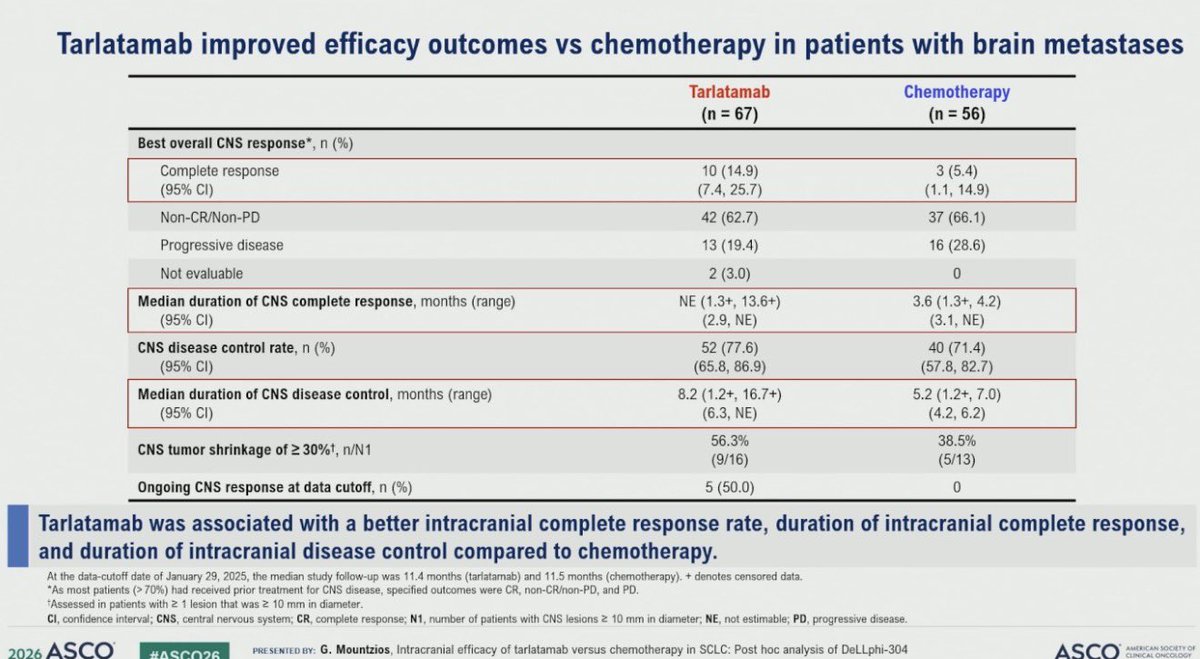
| CNS outcome | Tarlatamab (n=67) | Chemotherapy (n=56) |
|---|---|---|
| Complete response, n (%) | 10 (14.9) | 3 (5.4) |
| Non-CR/non-PD, n (%) | 42 (62.7) | 37 (66.1) |
| Progressive disease, n (%) | 13 (19.4) | 16 (28.6) |
| CNS disease control rate, n (%) | 52 (77.6) | 40 (71.4) |
| Median duration of CNS disease control, mo | 8.2 (1.2+, 16.7+) | 5.2 (1.2+, 7.0) |
10 details 1 trial watching
Post hoc intracranial analysis of the randomised DeLLphi-304 trial of second-line tarlatamab versus chemotherapy in SCLC. Two assessment frameworks: investigator RECIST in the ITT population and mRANO-BM by BICR in pts with baseline brain metastases. Data cutoff January 29, 2025; median follow-up 11.4 mo (tarlatamab) and 11.5 mo (chemotherapy).
ITT n=254 tarlatamab versus n=255 chemotherapy. The brain-metastasis cohort was n=67 versus n=56, defined as ≥1 brain metastasis at baseline per mRANO-BM by BICR plus ≥1 post-baseline scan. More than 70% had already received CNS-directed treatment, which is why the response categories were CR, non-CR/non-PD and PD rather than a conventional ORR.
This analysis reports time to CNS progression or death (CNS PFS) in the ITT population and in the brain-metastasis subset, plus best overall CNS response, CNS disease control rate, duration of CNS complete response and duration of CNS disease control. None of these was the trial's registered primary endpoint.
Both CNS PFS comparisons favor tarlatamab, and the effect is larger in the brain-metastasis subset (HR 0.40) than in the ITT population (HR 0.54). Intracranial complete response was 14.9% versus 5.4%, and CNS tumor shrinkage ≥30% occurred in 9/16 versus 5/13 pts with measurable lesions ≥10mm.
Brain metastases develop in the majority of SCLC pts, and second-line systemic options have historically been judged on extracranial disease with CNS control assumed to be the province of SRS, WBRT or prophylactic cranial irradiation. A bispecific T-cell engager showing an intracranial complete response rate of 14.9% is the notable part, because the working assumption for large-molecule agents has been limited intracranial penetration.
The ITT median CNS PFS was not estimable at 11.4 months of follow-up, so the ITT curve rests on the early portion of the data and the point estimate can still move. The two populations were also read with different tools and different models (stratified Cox for ITT, unstratified for the subset), so the ITT and subset HRs are not strictly comparable to each other.
The result establishes that intracranial disease does not progress faster under tarlatamab than under chemotherapy, and probably progresses more slowly. What it does not establish is whether that activity is sufficient to defer local therapy in a patient who would otherwise be referred for SRS, since the source reports no radiotherapy exposure data and no in-field versus out-of-field failure pattern.
Post hoc intracranial analysis of a randomised trial; CNS endpoints were not the registered primary, and the brain-met subset HR comes from an unstratified model.
- Does intracranial activity permit deferral of SRS in untreated brain mets
- Activity in CNS-treatment-naive or symptomatic brain metastases n=35 · primary completion 2029-02 · phase 2 tarlatamab, active asymptomatic brain mets
- Durability of CNS control beyond 12 months follow-up
📚 Sources · 🐦 1 tweet
Dr. @g_mountzios #ASCO26 presents CNS outcomes with 2L tarlatamab in DeLLphi-304. Improved time to CNS progression overall (HR 0.54). In pts with brain nets, tarlatamab vs chemo CNS CR rate 15% vs 5% with DCR 78% vs 71% and time to CBS progression 6.5m vs 4.2m, HR 0.40 pic.twitter.com/5i8jL1zlKW
— Stephen V Liu, MD (@StephenVLiu) June 1, 2026
RAD-IO
ForMIBC cT2-T3 (13% N+), bladder-preservation intent, 75% prior neoadjuvant chemo
TL;DR12-mo DFS 40/50 (80%, 95% CI 0.67-0.89) with durvalumab added to 5FU/MMC chemoRT, clearing the pre-set GO bar (≥75%).
The RT is unchanged from standard UK practice (55Gy/20fr bladder, 46Gy/20fr nodes when N+), so nothing here alters target volume or dose. What is new is that durvalumab was delivered neoadjuvant, synchronous AND adjuvant around that backbone, and only 61% completed it, which is the number gating any future randomised trial design.
In cT2-T3 MIBC pts choosing bladder preservation with 5FU/MMC chemoRT, this supports enrolling on a checkpoint-inhibitor chemoRT trial rather than adding durvalumab off protocol; it does not extend to cisplatin-ineligible pts having RT alone or to those with extensive nodal disease.
The RT is unchanged: 55Gy/20fr bladder, 46Gy/20fr to nodes in the N+ expansion, standard UK practice, so no target-volume or dose decision moves. The trial's value for an RT reader is that a 12-month adjuvant IO tail can be run around that backbone at all, though only 61% completed it.
Durvalumab was given in all three positions (neoadjuvant, synchronous, adjuvant 12 months) on a 5FU/MMC backbone, and 39% discontinued early. That delivery figure, not the 80% DFS, is what constrains which durvalumab schedule is worth randomising in bladder preservation.

+3 more figures


| Treatment status | N = 54 | % |
|---|---|---|
| Completed planned treatment | 33 | 61 |
| Discontinued early | 21 | 39 |

| Baseline | Number | % |
|---|---|---|
| Age, median (IQR) | 69 | 62-76 |
| Female | 10 | 18 |
| Male | 45 | 82 |
| Prior neoadjuvant chemo, yes | 41 | 75 |
| cT2 | 44 | 80 |
| cT3 | 11 | 20 |
| N+ | 7 | 13 |
10 details
Single-arm multi-stage feasibility and safety trial of durvalumab added to 5-fluorouracil/mitomycin C chemoradiotherapy in muscle-invasive bladder cancer. N=55 enrolled, 54 treated. A stage 1 expansion opened to node-positive pts, the first 6 with N+ disease.
Median age 69 (IQR 62-76), 45 (82%) male. cT2 in 44 (80%), cT3 in 11 (20%), N+ in 7 (13%) (N1 4, N2 3). 41 (75%) had prior neoadjuvant chemotherapy, so this is largely a post-NAC bladder-preservation population.
Durvalumab before, during and for 12 months after chemoRT, with 5-fluorouracil and mitomycin C as the radiosensitising backbone. 33/54 (61%) completed planned treatment; 21/54 (39%) discontinued early.
55Gy in 20 fractions to bladder; node-positive pts received 46Gy in 20 fractions to nodes alongside the bladder dose. This is the standard UK hypofractionated schedule, not an escalated or de-escalated variant.
Primary: disease-free survival rate at 12 months post chemoRT, read against a prespecified GO/NO-GO framework (GO ≥75%, contextual 60-75%, NO-GO <60%).
40/50 (80%) disease free at 12 months, 95% CI 0.67 to 0.89, clearing the GO threshold. 2 pts pending and 3 not evaluable. Investigators report very high bladder preservation and survival versus their previous trial data; those comparator figures are not given in the source.
The benchmark is the team's own BC2001 trial (James, JCO 2016), whose chemotherapy randomisation gave DFS HR 0.78 (0.60-1.02), stratified logrank p=0.07 on the slide shown. Comparison is to that historic control experience, not to a contemporaneous arm.
A 12-month DFS read is short for a preservation strategy where salvage cystectomy and late nodal relapse both fall outside the window. The evaluable denominator dropped from 55 to 50, and with 2 still pending the point estimate can move relative to a 75% threshold it clears by 5 points.
This clears a feasibility gate, not an efficacy one: the design question it answers is whether a randomised trial of durvalumab plus chemoRT is worth running, and the answer is yes. The 39% early discontinuation is the finding that should shape that trial, since a 12-month adjuvant tail that four in ten pts do not finish may not be the schedule worth randomising.
Single-arm feasibility/safety trial, N=55, 12-mo endpoint benchmarked against historic in-house CRT data. No randomised comparator; hard maturity gate applies.
- Which durvalumab component (neoadjuvant, synchronous, adjuvant) drives benefit
- Whether 80% 12-mo DFS survives a randomised comparator
- Drivers of the 39% early discontinuation
📚 Sources · 🐦 3 tweets
RAD-IO at #ASCO26: durvalumab added to chemoradiation in muscle-invasive bladder cancer cleared its efficacy bar in a bladder-preservation approach. Single-arm, benchmarked against prior CRT data.
— Katy Beckermann (@katy_beckermann) May 30, 2026
Durvalumab given before, during, and 12 months after chemoRT (55Gy/20Fr +… pic.twitter.com/UXxwoZzaMC
#ASCO26 🔬 Abstract 4504 | RAD-IO
— Dra. María Natalia Gandur Quiroga (@nataliagandur) May 30, 2026
Durvalumab + chemoradiotherapy in muscle-invasive bladder cancer
Presented by Nicholas D. James, PhD, MBBS, FRCP@OncoAlert@ASCO
Bladder preservation in MIBC remains one of the most important curative-intent questions in GU oncology.
The key… pic.twitter.com/W6JqzTVsJ3
RAD-IO: chemoradiation (5FU+MMC) + Durva in MIBC. #ASCO26 pic.twitter.com/yTyhkdjCox
— Álvaro Pinto (@dralvaropinto) May 30, 2026
Management After pCR in MIBC (Panel)
TL;DRPanel review: sandwich immunotherapy regimens continue planned adjuvant therapy regardless of pCR, with de-escalation still unanswered.
SWOG 8710ABACUSCHECKMATE-274KEYNOTE-905VOLGANIAGARAVESPERKEYNOTE-B15
In MIBC pts who reach pT0N0 at cystectomy on a sandwich regimen, this supports completing planned adjuvant therapy rather than stopping on pathologic response; after cisplatin-based chemo alone, surveillance remains the presented standard.

+2 more figures

| Setting | Trial | Reported outcome |
|---|---|---|
| Cisplatin-ineligible | KEYNOTE-905 | Periop EVP now standard |
| Cisplatin-ineligible | VOLGA | EV + durva/treme improved EFS (press release) |
| Cisplatin-eligible | NIAGARA | 24-mo OS 82.2% vs 75.2% |
| Cisplatin-eligible | VESPER | 5-yr OS 66% vs 57%, ddMVAC > gem/cis |
| Cisplatin-eligible | KEYNOTE-B15 | OS improved vs gem/cis, under FDA review |

11 details
ASCO 2026 GU education session, not a trial. Synthesizes SWOG 8710, NIAGARA, VESPER, KEYNOTE-905, KEYNOTE-B15 and VOLGA into a position on what to do after pCR.
The practice answer presented is continue: resume durvalumab for 8 months post-cystectomy on the NIAGARA regimen, resume EVP post-cystectomy on perioperative EVP. Surveillance after pCR is standard only for cisplatin-based chemo alone.
The continue-vs-stop question has never been randomized. Not all pts in the source trials completed adjuvant therapy, often for toxicity, so the observed benefit reflects a mixed delivered dose rather than the full planned course.
The session names the two open questions itself: the relative contribution of the pre- versus postoperative components, and whether adjuvant therapy can be de-escalated on pCR or another biomarker. Neither is answerable from an intention-to-treat perioperative design.
- Relative contribution of pre- vs postoperative components
- Can adjuvant therapy be de-escalated based on pCR or biomarkers
📚 Sources · 🐦 1 tweet
#ASCO26 GU Oncology Spotlight 🚨
— Dra. María Natalia Gandur Quiroga (@nataliagandur) May 30, 2026
🔬 Management in Bladder Cancer After Pathologic Complete Disease Response
Presented by Brendan J. Guercio, MD@OncoAlert@ASCO
In muscle-invasive bladder cancer, pCR after neoadjuvant therapy is one of the most powerful prognostic signals we… pic.twitter.com/sMd2In7X3p
Living Longer, Living Better (GU Discussant)
TL;DRASCO 2026 GU discussant on curing more while preserving organ, bladder, and kidney function across MIBC, RCC, and ctDNA selection.
EV209EV309RAMPART
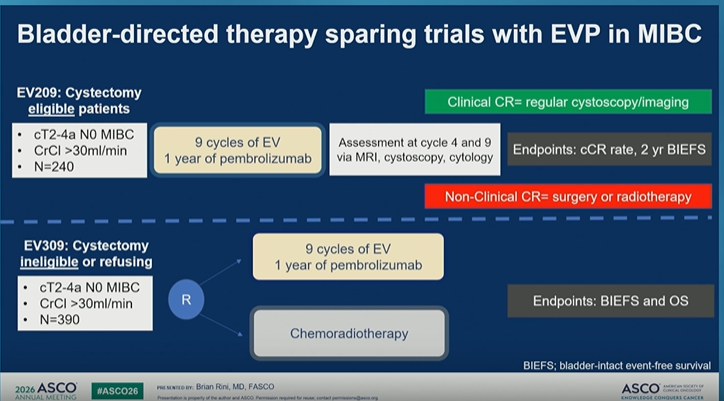
For an RT reader the delivery slide is the actionable part: full 55 Gy in 20 fractions was given in 54 (100) with no extension or delay in 47 (87) alongside durvalumab, so the immunotherapy did not cost RT intensity. EV-309 then places chemoradiation as the randomised comparator, meaning the bladder-preservation standard is now the control arm.
In cT2-4a N0 MIBC being counselled for bladder preservation, this supports discussing chemoradiation plus checkpoint blockade as deliverable and trials of EV-based sparing as open questions; it does not extend to node-positive or metastatic disease.
The delivery slide is the actionable part: full 55 Gy in 20 fractions in 54 (100) with no extension or delay in 47 (87) while durvalumab ran concurrently, so RT intensity survived the combination. EV-309 then makes chemoradiotherapy the randomised control arm for a drug-only bladder-sparing strategy.
Systemic components absorbed the attrition: chemotherapy discontinued early in 12 (22) and durvalumab in 21 (39). In adjuvant RCC the discussant's position is that adjuvant IO has no proven benefit in non-clear cell disease, while ctDNA separates 24-mo DFS far better than pathology (79.9% vs 38.8% on pembrolizumab).
EV-209 keeps cystectomy as the fallback for non-clinical-CR pts in cystectomy-eligible cT2-4a N0 MIBC (N=240), and EV-309 (N=390) enrols only pts ineligible for or refusing cystectomy. Bladder-intact event-free survival counts cystectomy as an event, so the trials are structured around deferring surgery, not replacing it outright.

+2 more figures

9 details 4 trials watching
Discussant presentation, not an original trial. Brian Rini, MD, FASCO discusses ASCO 2026 GU data spanning MIBC bladder preservation, adjuvant RCC, and ctDNA-based selection.
The chemoradiation regimen under discussion is 55 Gy in 20 fractions with mitomycin C and 5-FU. All 54 (100) received the full dose and 47 (87) had no extension or delay, so adding durvalumab did not erode RT delivery.
Concurrent mitomycin C plus 5-FU with durvalumab. Mitomycin C dose reduced in 4 (7), 5-FU Week 1 dose reduced in 9 (17), chemotherapy discontinued early in 12 (22). Durvalumab completed in 33 (61), discontinued early in 21 (39) for toxicity and progression.
The EV platform reframes the comparison: EV-309 randomises cystectomy-ineligible or refusing cT2-4a N0 pts (N=390) against chemoradiotherapy for BIEFS and OS, while EV-209 (N=240) tests EV plus pembrolizumab in cystectomy-eligible pts with cCR and 2yr BIEFS. In adjuvant RCC the discussant's read is that adjuvant IO has no proven benefit in non-clear cell disease, with RAMPART non-clear cell subgroups too small to resolve it.
Selection, not intensification, is the through-line. Pathologic features are called a crude selection tool, and the ctDNA-stratified adjuvant RCC curves separate far more than pathology does (ctDNA-negative 24-mo DFS 79.9% on pembrolizumab and 72.9% on placebo, versus 38.8% and 18.3% in ctDNA-positive pts). The same logic sits under bladder preservation, where the unanswered question is which pt keeps their bladder, not whether the regimen can be delivered.
Everything here is second-hand from a discussant slide deck, so denominators, CIs and per-arm attributions are partial. The RAMPART non-clear cell forest plot arrived with row association uncertain in OCR, and its point estimates are not attributed to specific histologies. Central pathology review is still ongoing.
| Component | Outcome | Number (%) |
|---|---|---|
| Radiotherapy | Received full 55 Gy in 20 fractions | 54 (100) |
| Radiotherapy | No extension or delay | 47 (87) |
| Chemotherapy | Mitomycin C dose reduced | 4 (7) |
| Chemotherapy | 5-FU Week 1 dose reduced | 9 (17) |
| Chemotherapy | Chemotherapy discontinued early | 12 (22) |
| Durvalumab | Completed | 33 (61) |
| Durvalumab | Discontinued early | 21 (39) |
- Long-term bladder preservation, function and QoL after chemoradiation plus durvalumab n=11 · primary completion 2026-02 · chemoRT +/- durvalumab, node-positive bladder
- Whether EV-based bladder sparing beats chemoradiotherapy on BIEFS and OS recruiting A Study to Find Out if Enfortumab Vedotin Given With Pembrolizumab Helps People With Muscle-invasive Bladder Cancer Keep Their Bladder Phase 2n=240 · primary completion 2027-11 · phase 2 EV+pembro bladder-sparing, n=240recruiting Enfortumab Vedotin in Combination With Pembrolizumab vs. Concurrent Chemoradiotherapy (cCRT) in People With Muscle Invasive Bladder Cancer (EV-309) Phase 3n=390 · primary completion 2030-03 · phase 3 EV+pembro vs cCRT, bladder preservationn=56 · primary completion 2031-04 · response-adapted EVP induction, cCRT or RC on failure
- Whether ctDNA-guided selection changes adjuvant RCC outcomes
📚 Sources · 🐦 1 tweet
#ASCO26 GU Oncology Spotlight 🚨
— Dra. María Natalia Gandur Quiroga (@nataliagandur) May 30, 2026
🔬 Living Longer, Living Better: Can We Have It All?
Discussant: Brian I. Rini, MD, FASCO@OncoAlert@ASCO
This GU session captured one of the central tensions in curative-intent oncology:
Can we improve cure rates while preserving quality of… pic.twitter.com/AMwrRZZM2Q
A-DREAM
FormHSPC, PSA <0.2 after 18-24mo ADT + ≥12mo ARPI
41.0% (32/78)
80% CI 33.1-48.9%, one-sided p 0.0249
TL;DR41% treatment-free with eugonadal T at 18mo after stopping ADT+ARPI in responding mHSPC (80% CI 33.1-48.9%, one-sided p 0.0249).
The RT-relevant detail is baseline burden: 51.3% had prostate RT and 29.5% had RT to metastatic sites, so the cohort that tolerated interruption was heavily locally treated, and 4 pts (5.1%) took RT as their non-protocol next step off ADT. Metastasis-directed RT is not tested here, but this is the population where a de-intensification question meets it.
In mHSPC with PSA under 0.2 after 18-24 months of ADT plus at least 12 months of ARPI, this supports discussing a protocolized interruption with PSA and testosterone monitoring; it does not extend to pts with persistent PSA or to unselected metastatic disease.
The cohort was RT-heavy before interruption: 51.3% had prostate radiation and 29.5% had radiation to metastatic sites, and 4 (5.1%) took radiation as their non-protocol next step off ADT. Metastasis-directed RT to extend time off systemic therapy is the randomizable question this describes but does not test.
The composite splits usefully: 57.7% stayed treatment-free for 18 months but only 66.7% recovered testosterone (median 9.0 months), so gonadal recovery, not disease control, is the rate limiter in a median-age-70 cohort. Counsel the two risks separately before interrupting.

+3 more figures


| Characteristic | Value |
|---|---|
| Median age | 70 (49-90) |
| High volume (CHAARTED) | 27 (35.1%) |
| Low volume (CHAARTED) | 50 (64.9%) |
| Prostate RT as local therapy | 40 (51.3%) |
| RT to metastatic sites | 23 (29.5%) |
11 details 5 trials watching
Alliance single-arm phase 2, N=75 planned, 78 eligible enrolled 07/2022-03/2024. Median follow-up 26.9 months. Monitoring PSA and testosterone q3mo, scans at least q6mo (q3mo with rising PSA), QOL q6mo.
mHSPC on ADT + ARPI with PSA <0.2 stable or falling after 18-24 months of ADT and at least 12 months of ARPI. Median age 70 (49-90), 84.6% White, 64.9% low volume by CHAARTED, 35.1% high volume. Median PSA prior to starting ADT+ARPI 18.99 ng/mL.
Not an intervention, but the cohort was RT-heavy at baseline: 40 (51.3%) had radiation as local therapy, 31 (39.7%) had no local therapy, 7 (9.0%) prostatectomy +/- RT. 23 (29.5%) had radiation to metastatic sites. Dose and fractionation not reported in source.
Primary: treatment-free with eugonadal testosterone (T ≥150 ng/dL) at 18 months. Secondary: time to eugonadal T, duration off treatment, QOL. Exploratory: rPFS, TTNT, OS (CSS/NCSS), cost. Re-initiation triggered by PSA ≥5 ng/mL, PCWG3 radiographic change, or prostate-cancer-related symptoms.
Primary endpoint met: 32/78 (41.0%), 80% CI 33.1-48.9%, one-sided p 0.0249. Testosterone recovered in 52 (66.7%) by 18 months with median time to eugonadal T 9.0 months (95% CI 8.4-12.4); 45 (57.7%) stayed treatment-free for 18 months. rPFS 15/78 events, median NE; OS 4/78 events, median NE.
The 18-month primary readout is short for a de-intensification question whose real risk is late: 4 of 29 pts who resumed per protocol later progressed and discontinued the original ARPI, so re-treatment did not uniformly restore control. Deaths (4) included non-prostate causes (myelodysplastic syndrome, influenza, myocardial infarction), and with no continuous-treatment arm the OS curve carries no comparative information.
Intermittent ADT has been tested before in metastatic disease (SWOG 9346 could not exclude an OS decrement with intermittent therapy in mHSPC), but A-DREAM asks the question in the modern ARPI-intensified era with a molecularly deeper response gate, which is why the cohort's off-treatment rate looks better than the older intermittent literature suggests. That comparison is a rationale, not a result: A-DREAM has no randomised arm.
The number that matters clinically is not 41% but its two components: testosterone recovery is the rate limiter (66.7% recovered, median 9.0 months), while disease control off treatment was more common (57.7% treatment-free at 18 months). A trial that de-intensifies successfully on disease grounds can still miss its endpoint on gonadal recovery in an older cohort, and that distinction determines who to counsel.
Single-arm phase 2, no continuous-treatment control, 18mo primary readout in a deeply selected responder cohort. Interruption safety needs a randomised comparator.
- Does interruption cost overall survival vs continuous ADT+ARPI active A Study of an Intermittent ADT Approach With Apalutamide Monotherapy in Participants With mCSPC Phase 3n=420 · primary completion 2026-10 · phase 3 intermittent vs continuous, rPFS non-inferiorityrecruiting Optimal PSA Triggered Individual Management of Androgen Sensitive Prostate Cancer Phase 2n=160 · primary completion 2030-10 · randomised intermittent relugolix+ARPI after PSA response
- Which responders recover testosterone and which do not active Comeback From Long coursE Androgen Deprivation Therapy (ADT) With RElugolix and Darolutamide (CLEARED) Phase 2n=33 · primary completion 2028-11 · 1° EP is T recovery rate after 2y relugolix+darolutamidenot yet Clinical Trial to Observe the Effects of Tamoxifen on Testosterone Recovery in Medically Castrated Prostate Cancer Patients Phase 2n=96 · primary completion 2030-10 · tamoxifen vs no tamoxifen for T recovery post-ADT
- Can metastasis-directed RT extend time off systemic therapy n=254 · primary completion 2031-08 · PSMA-guided SBRT added after 6mo darolutamide+ADT
📚 Sources · 🐦 1 tweet
Can treatment be safely stopped in selected patients with mHSPC?
— MJosé Juan (@mjuanfi81) May 30, 2026
Phase II A-DREAM trial, 41% of responders remained treatment-free with testosterone recovery 18m after stopping ADT/ARPI. At a median FU of 21 months, 35% of patients required treatment re-initiation.@OncoAlert pic.twitter.com/iW2VDBWWhN
Precision Oncology: New Biomarkers in GU Practice (Panel)
TL;DRDiscussant session on biomarker readiness in prostate cancer; discordance between Decipher and clinical risk emerged in 24% of events.
ENZAMETCHARTED
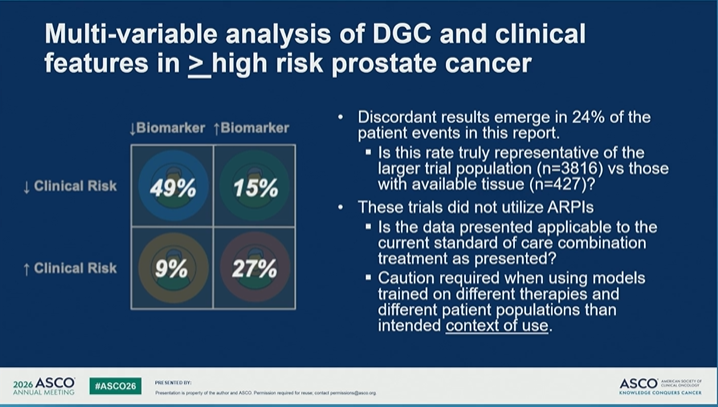
The transferable point for an RT reader is the training-context caveat: the Decipher-type classifiers cited were developed in cohorts that did not use ARPIs, and only 427 of 3816 pts had tissue. A genomic score used to escalate or omit RT intensification carries that generalizability gap into the clinic.
Decipher sits inside RT intensification decisions (whole-pelvis coverage, ADT duration, adjuvant vs salvage timing), and the session's caveat lands directly there: the classifiers were validated on cohorts that predate ARPI use, and only 427 of 3816 pts contributed tissue. A score used to justify escalating or omitting RT-adjacent therapy inherits that gap.
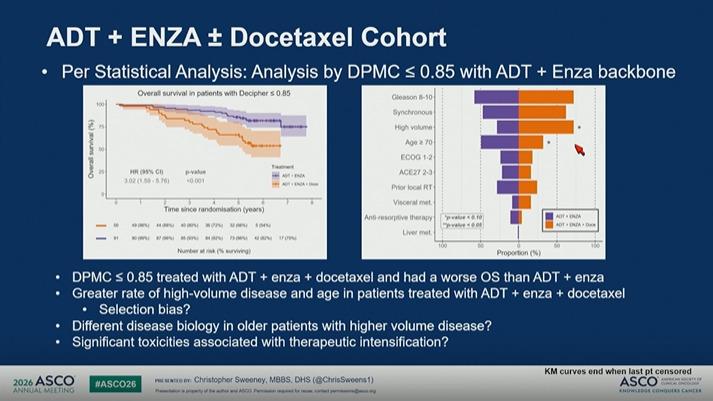
The ENZAMET DPMC ≤0.85 read is the practical one: triplet with docetaxel showed worse OS than ADT + enza in that biomarker group, but assignment to docetaxel was not randomised and those pts skewed high-volume and older. It is not a reason to withhold docetaxel by genomic score.
+3 more figures


11 details
Discussant / education session at ASCO 2026 (Joshua Lang, MD, MS), reviewing biomarker evidence across GU practice rather than reporting a new trial. Slides cover the 2026 treatment landscape, a Decipher-vs-clinical-risk multivariable analysis, and the ENZAMET biomarker sub-analysis.
Decipher and clinical risk disagreed in 24% of patient events, with 15% biomarker-high/clinical-low and 9% biomarker-low/clinical-high. In the ENZAMET DPMC ≤0.85 group, ADT + enza + docetaxel showed worse OS than ADT + enza; no hazard ratio is legible in the source OCR.
The discussant's own caveats are the substance: tissue was available for 427 of 3816 pts, the source trials did not use ARPIs, and the ENZAMET docetaxel comparison was not randomised (docetaxel added by protocol amendment after 88 pts accrued). The worse-OS signal is confounded by more high-volume disease and older age in the docetaxel group.
The unifying claim is that a classifier's context of use is part of its validity: a model trained on pre-ARPI therapy and on the minority of pts with banked tissue should not be read as calibrated to today's ADT + ARPI backbone. Genomics is framed as distinct from germline genetics, with HRR and tumor-suppressor tissue panels held as current SOC.
- Do pre-ARPI-trained genomic classifiers stay calibrated on ADT+ARPI backbones?
- Does tissue-availability dropout bias biomarker cohort conclusions?
📚 Sources · 🐦 1 tweet
#ASCO26 GU Oncology Spotlight 🚨
— Dra. María Natalia Gandur Quiroga (@nataliagandur) May 30, 2026
🔬 Precision Oncology: How to Apply New Biomarkers in Clinical Practice
Excellent discussion by Joshua M. Lang, MD, MS@JoshLangMD@OncoAlert@ASCO
This session captured the real challenge of precision oncology in GU cancers:
A biomarker is only… pic.twitter.com/ubfk49XPiM
ENZAMET + Decipher
FormHSPC on ADT + enzalutamide, Decipher score available
TL;DRDecipher >0.85 predicts docetaxel benefit in mHSPC on ADT+enza: HR(OS) 0.75 (0.43-1.33) vs 1.94 (0.95-3.96) if ≤0.85, interaction p=0.04.
In mHSPC starting ADT + enzalutamide with a Decipher score available, this offers hypothesis-level support for weighing docetaxel intensification above the 0.85 cut and for questioning it below; it does not extend to patients on other ARSIs or to those without genomic testing.
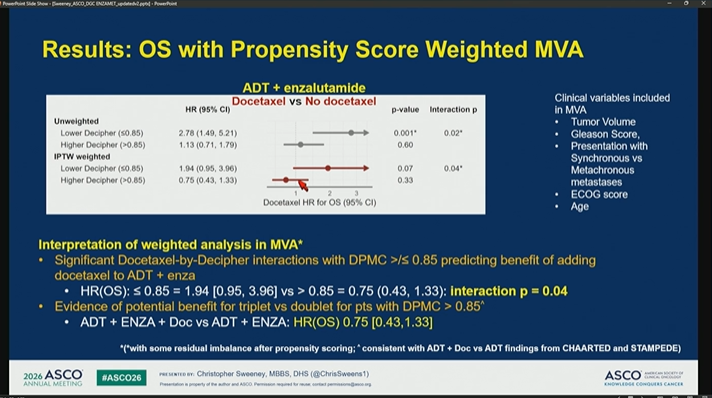
| Analysis | Lower Decipher (≤0.85) | Higher Decipher (>0.85) | Interaction p |
|---|---|---|---|
| Unweighted HR (95% CI) | 2.78 (1.49, 5.21) | 1.13 (0.71, 1.79) | 0.02 |
| Unweighted p-value | 0.001 | 0.60 | |
| IPTW weighted HR (95% CI) | 1.94 (0.95, 3.96) | 0.75 (0.43, 1.33) | 0.04 |
| IPTW weighted p-value | 0.07 | 0.33 |
+2 more figures


8 details
Post-hoc genomic-classifier analysis of the ENZAMET ADT + enzalutamide cohort, N=320, testing whether Decipher (DPMC) predicts docetaxel benefit. Docetaxel receipt was investigator-elected, not randomised, so a propensity-score IPTW model carries the comparison.
mHSPC on an ADT + enzalutamide backbone with an evaluable Decipher score, split at the prespecified 0.85 cut. A separate panel restricts to low-volume disease.
Overall survival, read two ways: prognostic (Decipher stratum on ADT + enza) and predictive (docetaxel-by-Decipher interaction).
Prognostic signal is the cleanest number on the slide deck: HR 3.02 (1.50-5.76) for DPMC >0.85 on ADT + enza. The predictive claim rests on the interaction, p=0.02 unweighted and p=0.04 after IPTW, not on either stratum reaching significance.
Docetaxel was not randomised within this cohort, so IPTW is doing the causal work and the authors concede residual imbalance after propensity scoring. Low-volume panel numbers are small (n at risk 14 and 13 in the reported strata) with a CI of 1.70 (0.32, 8.06), wide enough to be uninformative.
Presented as level 1B evidence consistent with CHAARTED and STAMPEDE, where docetaxel benefit concentrated in high-volume disease. This analysis proposes a genomic rather than volumetric selector for the same decision.
The strongest defensible claim is the prognostic one: DPMC >0.85 marks worse OS on ADT + enza. The predictive claim (add docetaxel above 0.85, omit it below) is directionally consistent across unweighted and weighted models but is not established by a single non-randomised interaction.
Post-hoc biomarker subgroup with non-randomised docetaxel use; both stratum HRs non-significant after weighting, residual imbalance conceded. Read rests on an interaction p=0.04.
- Prospective validation of Decipher-guided docetaxel selection in mHSPC
- Does the 0.85 cut hold on ARSI backbones other than enzalutamide
- Whether low Decipher predicts docetaxel harm or only absent benefit
📚 Sources · 🐦 1 tweet
#ASCO26 GU Oncology Spotlight 🚨
— Dra. María Natalia Gandur Quiroga (@nataliagandur) May 30, 2026
🔬 ENZAMET + Decipher | Part 2
Can genomics guide docetaxel intensification in mHSPC?
Outstanding presentation by @ChrisSweeney1.@OncoAlert@ASCO
After Part 1, the key question was:
➡️ Can a genomic classifier identify which patients with… pic.twitter.com/nJYMxuXelV
ARACOG (AFT-47)
ForAdvanced prostate cancer (mHSPC, nmCRPC, mCRPC) starting an ARSI
daro -15.8 vs enza -36.1
median % change in MCCD at 24 wks, P=0.009
TL;DREnzalutamide MCCD decline -36.1 vs -15.8 for darolutamide at 24wks (P=0.009) in randomized phase 2, N=111.
The comparison is between each pt's own worst-hit domain, and those differed by arm (PALFAM for daro, SWM for enza), so the read is how far the worst domain falls, not which one. Crossover before 24wks was scored at crossover inside the randomized arm, which attenuates rather than widens the gap. Moves ARSI selection when cognitive burden matters, not efficacy.
In a man starting an ARSI for mHSPC or nmCRPC where cognitive burden is a live concern, this supports darolutamide over enzalutamide on measured cognition; it does not speak to disease control, which was never compared head-to-head.
For ARSI selection where the two drugs are treated as equivalent on disease control, this puts a measured number on the cognitive difference (median MCCD -15.8 vs -36.1, P=0.009) instead of an AE-table impression. It moves drug choice, not sequencing or line of therapy.

| Metric | Darolutamide (N=48) | Enzalutamide (N=47) |
|---|---|---|
| Maximally changed module | PALFAM | SWM |
| Domain | Visual memory / executive function | Working memory / executive function |
| Median change, baseline to 24 wks | -15.8 | -36.1 |
| Between-arm P | P=0.009 | P=0.009 |
+2 more figures


8 details
Randomized open-label phase 2 from the Alliance for Clinical Trials in Oncology, N=111, stratified by age (<65, 65-80, >80). Enrolled 8/17/2021 to 3/11/2025, with CANTAB modules, PROMs and timed-up-and-go collected at 12 and 24 weeks.
Men with mCRPC, nmCRPC or mHSPC. Randomization was stratified by age across three bands (<65, 65-80, >80), so the design anticipated an older population. Baseline cognitive eligibility criteria not reported in source.
Darolutamide was provided by the study; enzalutamide was given through standard of care, so the two arms differed in drug supply as well as drug. Doses and concurrent ADT not reported in source.
Primary: % change from baseline to 24 weeks in the Maximally Changed Cognitive Domain (MCCD), drawn from 5 remotely delivered CANTAB modules (SWM, PALFAM, OTS, SSP, RVP) covering executive function, visual memory, attention and working memory. Blood for polygenic hazard score and AR testing, PROMs and timed-up-and-go were collected alongside.
Median MCCD change -15.8 with darolutamide (PALFAM) vs -36.1 with enzalutamide (SWM), P=0.009, across 48 and 47 pts in the primary analysis. No oncologic endpoint was reported in source.
The two drugs have never been compared head-to-head for efficacy, and cognition in ARAMIS and ARASENS (darolutamide) and PROSPER and ARCHES (enzalutamide) was captured as clinician-graded adverse events against placebo, not measured with a battery. Mild executive dysfunction is exactly the harm an AE table structurally misses.
Pts crossing over before 24 weeks carried their crossover score into the randomized arm, which should attenuate the gap rather than widen it. CANTAB is a research battery, not a clinical diagnostic, and no link to function, falls or discontinuation is reported in source. 24 weeks says little about years of therapy.
This shifts an argument that has run on mechanism and on AE tables onto measured performance. Where the two drugs are treated as interchangeable for disease control, cognition becomes a defensible tiebreaker. What it does not settle is whether an MCCD gap of this size is felt by the pt.
Randomized, prespecified primary endpoint met against a named comparator; open-label design and the composite MCCD construct temper it. Consistent with darolutamide's known limited CNS penetration.
- Whether the MCCD difference translates to function, falls, or discontinuation
- Durability of cognitive divergence beyond 24 weeks
- Whether apalutamide differs from enzalutamide on the same testing
📚 Sources · 🐦 2 tweets
#ASCO26 GU Oncology Spotlight 🚨
— Dra. María Natalia Gandur Quiroga (@nataliagandur) May 30, 2026
🔬 Abstract 5005 | ARACOG / AFT-47
Cognitive effects of darolutamide vs enzalutamide
Presented by Alicia K. Morgans, MD, MPH, FASCO@CaPsurvivorship @OncoAlert@ASCO
In prostate cancer, we often discuss AR pathway inhibitors through the lens… pic.twitter.com/vpZr1w6kc6
ARACOG (AFT-47) met its primary endpoint: enzalutamide caused significantly greater cognitive decline than darolutamide at 24 weeks in advanced prostate cancer.
— Katy Beckermann (@katy_beckermann) May 30, 2026
Randomized open-label phase 2, 111 pts (mHSPC, mCRPC, nmCRPC), DAR vs ENZ.
Cognition was measured with CANTAB, a… pic.twitter.com/kj4vfGRVyp
TALAPRO-3
ForHRR-deficient metastatic hormone-sensitive prostate cancer, enzalutamide/ADT candidates
HR 0.48
95% CI 0.36-0.65, P<0.001; 3yr rPFS 77% vs 56%
TL;DR3yr rPFS 77% vs 56%, stratified HR 0.48 (0.36-0.65), p<0.001, adding talazoparib to enzalutamide in HRR-deficient mCSPC.
In HRR-deficient metastatic prostate cancer starting enzalutamide plus ADT, this supports considering talazoparib upfront rather than reserving it, including for non-BRCA HRR alterations; it does not speak to HRR-proficient disease, which the trial excluded.

| Panel | Arm | Events/N | Median rPFS (95% CI), mo | HR (95% CI) |
|---|---|---|---|---|
| A ITT | Talazoparib+enzalutamide | 67/300 | NC (NC-NC) | 0.48 (0.36-0.65), P<0.001 |
| A ITT | Placebo+enzalutamide | 126/299 | 45.8 (37.7-NC) | |
| B BRCA | Talazoparib+enzalutamide | 22/104 | NC (NC-NC) | 0.37 (0.22-0.61) |
| B BRCA | Placebo+enzalutamide | 49/103 | 35.1 (18.6-NC) | |
| C Non-BRCA | Placebo+enzalutamide | 77/196 | NC (40.5-NC) | 0.57 (0.39-0.82) |
8 details 4 trials watching
Randomised, placebo-controlled phase 3 of talazoparib plus enzalutamide vs placebo plus enzalutamide, with ADT in both arms. ITT N=599 (300 vs 299), analysed as ITT with prespecified BRCA and non-BRCA subgroups.
HRR-deficient metastatic prostate cancer; the BRCA subgroup was 104 vs 103 and non-BRCA 196 vs 196, so BRCA carried roughly a third of the trial. Detailed eligibility and stratification factors are not reported in source.
Talazoparib added to an enzalutamide/ADT backbone that both arms received, so the comparison isolates the PARP inhibitor's contribution rather than the androgen-signaling backbone. Doses not reported in source.
Primary: imaging-based rPFS. Overall survival, safety and response endpoints are not reported in the source tweet or figure.
Landmark 3yr rPFS 77% vs 56%; median rPFS not reached in the talazoparib arm against 45.8 mo on placebo. Effect held in both molecular subgroups, numerically larger in BRCA (HR 0.37) than non-BRCA (HR 0.57).
| Population | Events/N talazoparib | Events/N placebo | Median placebo arm | HR (95% CI) |
|---|---|---|---|---|
| ITT | 67/300 | 126/299 | 45.8 (37.7-NC) | 0.48 (0.36-0.65) stratified |
| BRCA | 22/104 | 49/103 | 35.1 (18.6-NC) | 0.37 (0.22-0.61) unstratified |
| Non-BRCA | 45/196 | 77/196 | NC (40.5-NC) | 0.57 (0.39-0.82) unstratified |
TALAPRO-2 tested the same combination in first-line mCRPC across all comers; here the population is HRR-selected and the HR is numerically stronger. PROpel and MAGNITUDE established the PARP-plus-ARSI question in mCRPC, with MAGNITUDE's benefit confined to HRR-altered pts, which is the population this trial enrolled outright.
The talazoparib arm's median rPFS is NC (NC-NC) in both ITT and BRCA panels, so the absolute duration of benefit is unmeasured and the curves may still converge. No OS signal is available in source, and toxicity of the doublet (the practical cost of adding a PARP inhibitor to lifelong ARSI) is entirely absent from what was published in the thread.
The non-BRCA HR of 0.57 is the number that decides how wide this goes: if it holds, the case extends past BRCA to the broader HRR panel rather than collapsing to a BRCA-only result as earlier PARP trials did. What it does not settle is whether an rPFS gain of this size converts to survival, or whether the same result would follow sequential rather than upfront talazoparib.
CONSORT flow
Randomised double-blind phase 3, prespecified 1° rPFS hit with HR 0.48 in a biomarker-defined population, consistent across BRCA and non-BRCA. OS immature.
- Does the rPFS gain convert to overall survival n=1054 · primary completion 2022-10 · TALAPRO-2 mCRPC, mature OS readout of same combon=599 · primary completion 2026-02 · TALAPRO-3 itself; OS is a secondary endpoint
- Upfront combination vs sequential talazoparib after progression recruiting Talazoparib Plus Enzalutamide After Progression to Abiraterone in Metastatic Prostate Cancer: (TEAM PC) Phase 2n=78 · primary completion 2026-01 · talazoparib + enza 1L mCRPC after abiraterone PDrecruiting A Study of Talazoparib With or Without Enzalutamide in People With Prostate Cancer Who Have Previously Received Abiraterone Acetate Phase 2n=126 · primary completion 2029-03 · talazoparib +/- enza post-abiraterone, HRR-mutated
- Toxicity cost of indefinite PARP plus ARSI
📚 Sources · 🐦 1 tweet
JUST In: TALAPRO-3 published in @NEJM
— Toni Choueiri, MD (@DrChoueiri) May 30, 2026
Adding #talazoparib to enzalutamide/ADT
=>3-year rPFS: 77% vs 56% in HRR-deficient metastatic prostate cancer !
Looking forward to full presentation by @neerajaiims who keeps changing SOC, one trial at a time. @ASCO #ASCO26 @OncoAlert pic.twitter.com/nXiPk4DIXg
Clinico-transcriptomic Risk Stratification (Abstract 5000)
ForNCCN high-risk / very-high-risk localized prostate, definitive RT + ADT
TL;DR~¼ of NCCN ≥HR pts carry discordant clinical vs biomarker risk; 22-gene GC independently prognostic for MFS, DM, OS.
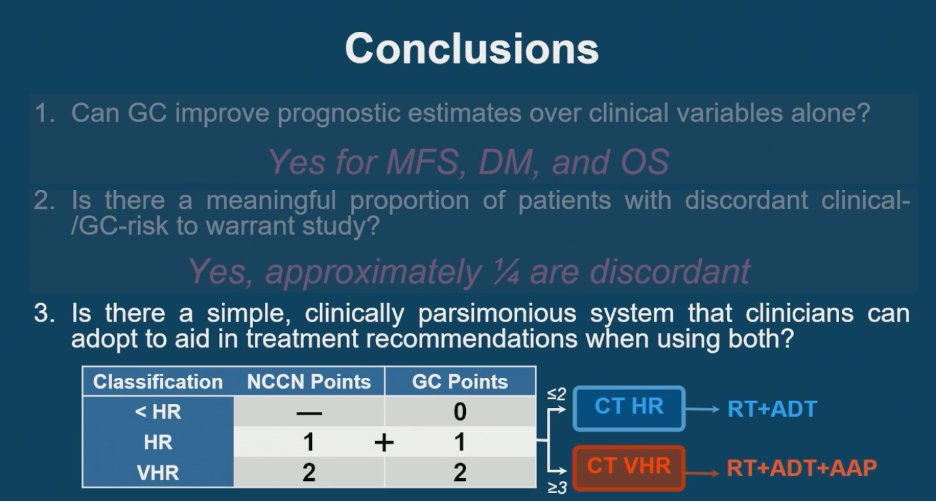
The de-escalation cell is where the risk sits: 9% of NCCN ≥HR pts read clinically high but biomarker low, and the framework withholds AAP from them. The 15% running the other way is the easier sell. What moves is whether GC gets ordered at consult, not any planning parameter.
In NCCN high-risk or very-high-risk localized prostate headed for definitive RT + ADT, this supports ordering a 22-gene GC before the abiraterone decision; it does not speak to post-prostatectomy salvage, node-positive, or metastatic disease.
RT + ADT is fixed in both branches, so nothing here touches dose, target volume, or fractionation; the framework is a consult-time test-order decision. Reclassification runs both ways, 15% clinically lower but biomarker higher and 9% the reverse, on GC bands of 0.6 and 0.85.
Intensification with AAP in localized disease gets a biomarker gate instead of an NCCN label: NCCN class and GC each contribute up to 2 points, and a sum ≥ 3 triggers AAP. GC was tested as prognostic across MFS, DM, and OS; no treatment-by-GC interaction is reported, so predictive value is unestablished.

+3 more figures

| Clinical risk | ↓ Biomarker | ↑ Biomarker |
|---|---|---|
| ↓ Clinical | 49% | 15% |
| ↑ Clinical | 9% | 27% |

8 details
Clinico-transcriptomic analysis of NRG cohorts modeling the 22-gene GC as a continuous variable (per 0.1 unit) alongside clinical covariates, with treatment carried as a covariate. Contributing trials, N, and follow-up duration are not reported in the source.
NCCN ≥ high-risk localized prostate, spanning NCCN HR and VHR. Baseline age, PSA, and grade distributions are not reported in the source.
Every branch of the framework keeps RT + ADT. No dose, fractionation, target volume, or ADT duration is reported, so RT enters as a fixed backbone rather than a variable under test.
Prognostic performance assessed on MFS, distant metastasis, and OS. No single primary endpoint is stated, and the framework itself is not compared against a randomized alternative.
GC was independently prognostic for all three endpoints (p<0.001); the row-level hazard ratios are not legible in the source slide. Approximately ¼ of the ≥HR population carries discordant clinical vs biomarker risk.
| Score (NCCN + GC) | CT risk | Recommendation |
|---|---|---|
| ≤ 2 points | CT HR | RT + ADT |
| ≥ 3 points | CT VHR | RT + ADT + AAP |
STAMPEDE M0 (Attard, Lancet 2022) is the external yardstick: the CT HR and CT VHR curves are overlaid on that trial's RT + ADT arm rather than on a randomized internal control. Eligibility, staging era, and ADT duration differ between cohorts, so the vertical gap carries trial effects alongside risk-group effects.
The GC term's hazard ratios and confidence intervals are not legible in the source, so the size of the increment over clinical variables cannot be checked. The 9% clinically-high / biomarker-low cell is where the framework withholds intensification, and its outcomes are the ones a reader most needs before acting.
The contribution is a parsimonious integer score computable at the consult desk, extending Spratt et al. (JCO 2018) to the modern VHR population. What it does not settle is whether the signal separating these curves also identifies who benefits from AAP: a prognostic split widens absolute benefit for a uniformly effective drug without any interaction, and none is reported here.
Retrospective pooled analysis; GC shown prognostic, not predictive. Intensification threshold benchmarked against STAMPEDE across trials, not randomized within cohort; no treatment-by-GC interaction in source.
- Does GC predict abiraterone benefit or only prognosis?
- Prospective validation of the ≥3-point intensification threshold
- Whether NCCN VHR pts with GC < 0.6 can omit AAP
📚 Sources · 🐦 2 tweets
#ASCO26 GU Oncology Spotlight 🚨
— Dra. María Natalia Gandur Quiroga (@nataliagandur) May 30, 2026
🔬 Abstract 5000 | High-risk prostate cancer
Clinico-transcriptomic risk stratification to guide abiraterone intensification
Presented by Krishnan R. Patel, MD, MHS@Krishnan_Patel@OncoAlert@ASCO
In high-risk localized prostate cancer,… pic.twitter.com/pZSCiTyGB8
#ASCO26 Dr. Patel presented a clinically practical framework integrating NCCN clinical risk + a 22-gene genomic classifier to guide treatment intensification in high-risk localized prostate cancer.
— Julian Chavarriaga (@chavarriagaj) May 30, 2026
Key findings:
🔹 The genomic classifier independently improved prognostic… pic.twitter.com/fRcdTmfBec
PREPEC
ForSkin- or nipple-sparing mastectomy, therapeutic or risk-reducing, implant reconstruction
79.2 vs 74.3
Difference 4.8 (95% CI 1.0-8.7), p=0.01
TL;DRPre-pectoral implant improved 24-mo BREAST-Q physical well-being (chest) by 4.8 points, but implant loss 21.1% vs 14.5%.
The 4.8-point BREAST-Q gain (1.0 to 8.7) sits against a 5.7-point higher implant loss rate (-2.4 to 13.8), so this is a trade-off, not a win. Source reports no post-mastectomy RT stratification or irradiated subgroup, so whether pre-pectoral holds up under PMRT is untested here.
In women planned for skin- or nipple-sparing mastectomy with implant reconstruction, this supports pre-pectoral placement for patient-reported chest well-being while flagging higher device loss; it does not address women who will need post-mastectomy radiotherapy.
Nothing in the source stratifies by post-mastectomy RT or reports capsular contracture, so the irradiated implant patient is not addressed. A 21.1% unplanned device loss rate at 24 months without radiation is the baseline to hold in mind when timing chest wall RT around a pre-pectoral reconstruction.
The primary endpoint is met (4.8 points, 1.0 to 8.7, p=0.01) but the prespecified non-inferiority safety hypothesis is not: unplanned device loss or replacement was 21.1% versus 14.5%. This makes plane selection a documented consent conversation about reoperation risk, not a default technique choice.

| IBBR assignment | N | 24-mo LS mean (95% CI) |
|---|---|---|
| Pre-pectoral IBBR | 191 | 79.2 (75.5 - 82.8) |
| Sub-pectoral IBBR | 189 | 74.3 (70.7 - 78.0) |
| Difference | 4.8 (1.0 - 8.7), p=0.01 |
+2 more figures

| Actual IBBR positioning | Unplanned loss/replacement at 24 mo, crude % (n/N) |
|---|---|
| Pre-pectoral IBBR | 21.1% (41 / 194) |
| Sub-pectoral IBBR | 14.5% (27 / 186) |
| Adjusted difference (95% CI) | 5.7 (-2.4 to 13.8) |

9 details
International randomized trial (PREPEC / OPBC-02) of pre-pectoral versus sub-pectoral implant-based breast reconstruction after skin-sparing or nipple-sparing mastectomy. Follow-up to 24 months, with 6 post-randomization patient-reported timepoints.
Women undergoing nipple-sparing or skin-sparing mastectomy in either the therapeutic or risk-reduction setting. Primary analysis included 191 pre-pectoral and 189 sub-pectoral; safety was analysed by actual positioning (194 versus 186).
Primary: long-term patient-reported physical well-being (chest) on BREAST-Q, scored 0 to 100 with higher better. Main secondary safety endpoint: unplanned loss or replacement of expander or implant.
Primary endpoint met; the safety endpoint moved against pre-pectoral placement. See the endpoint tables above.
Unplanned implant or expander loss or replacement at 24 months was 21.1% (41/194) pre-pectoral versus 14.5% (27/186) sub-pectoral, adjusted difference 5.7% (-2.4 to 13.8), which the investigators call inconsistent with the non-inferiority hypothesis.
Longitudinal completion ranged 83-95% and the primary estimate rests on multiple imputation with imputed baseline values, so the 4.8-point difference carries missing-data assumptions on top of its confidence interval. Surgeon and patient blinding is not feasible for a positioning trial, which cuts directly at a patient-reported primary endpoint.
The trial answers the PRO question it asked and simultaneously undercuts the assumption that pre-pectoral placement is device-safe. Whether a 4.8-point BREAST-Q gain is worth a 5.7-point absolute rise in unplanned reoperation is a preference-sensitive decision, not one the trial resolves.
Randomised, prespecified PRO primary endpoint met, but the safety co-read failed its non-inferiority hypothesis, so the trade-off, not the win, is the finding.
- Does pre-pectoral placement hold up under post-mastectomy radiotherapy
- Capsular contracture rates by implant plane
- Durability of the well-being advantage beyond 24 months
📚 Sources · 🐦 1 tweet
📌 Surgical de-escalation of implant-based breast reconstruction after mastectomy for breast cancer treatment or prevention: The international randomized phase I|I
— Elisabetta Bonzano MD, PhD (@to_be_elizabeth) May 30, 2026
PREPEC trial (ОРBC-02).
Presented by Walter Weber ✨#ASCO26 @OncoAlert #OncoAlertAF #BreastCancer pic.twitter.com/WE20JcBQG0
ROADS
ForResected brain metastasis >2 cm, post-op cavity radiation candidates
NR vs 17 mo
GammaTile vs SRS; no HR, CI, or p reported in source
TL;DRSurgical bed recurrence 1% with GammaTile brachytherapy vs 12% post-op SRS in resected brain mets >2cm, N=230.
The RT read is the bed-control mechanism: GammaTile puts dose in the cavity at resection, closing the gap where post-op SRS fails in cavities >2 cm, with median time to bed recurrence not reached vs 17 mo. LMD was 10% GT vs 3% SRS, so the trade is bed control against meningeal seeding when picking the cavity strategy.
In a resected brain metastasis larger than 2 cm being planned for cavity radiation, this questions post-op SRS as the default bed strategy; it does not extend to intact metastases, cavities under 2 cm, or pts already carrying leptomeningeal disease.
Bed control is the read: median time to bed recurrence not reached vs 17 mo with post-op SRS, in cavities >2 cm where SRS control is weakest, with radiation necrosis flat at 8% GT vs 7% SRS. LMD 10% GT vs 3% SRS is the counterweight when choosing the cavity strategy.
The cavity radiation decision moves into the operation itself: GammaTile is implanted at resection, so a met >2 cm being taken out becomes a pre-op discussion about tile placement rather than a post-op SRS referral. The 10% vs 3% LMD signal is the intraoperative trade to weigh.

| Endpoint | GammaTile | SRS |
|---|---|---|
| Time to surg bed recur | NR | 17 mo |
| Surg bed recur FS | NR | 11 mo |
| 2 yr OS | 62% | 36% |
10 details
Randomized trial of GammaTile brachytherapy vs post-op SRS after resection of a brain metastasis, N=230, reported as final results at ASCO 2026 (Weinberg). Randomization ratio, number of sites, and follow-up duration not reported in source.
Resected brain metastasis >2 cm, the size band where post-op cavity SRS control is weakest. Histology mix, number of brain metastases allowed, systemic disease status, and performance status not reported in source.
Experimental arm is GammaTile, a Cs-131 collagen tile implanted in the cavity at the time of resection, so dose starts without the post-op delay. SRS dose, fractionation, cavity margin, and time from surgery to SRS are not reported in source, and those are exactly the parameters that decide whether the control arm reflects the reader's own practice.
Primary I: time to surgical bed recurrence. Primary II: surgical bed recurrence-free survival. 2 yr OS is reported alongside them; the source does not state whether OS was a prespecified secondary.
Both primaries favor GammaTile with medians not reached vs 17 mo and 11 mo. No HR, confidence interval, or p-value appears in the source.
Radiation necrosis 7% SRS vs 8% GT, essentially flat. Leptomeningeal disease 3% SRS vs 10% GT is the signal that cuts against the arm winning on bed control; timing and denominators not reported in source.
Post-op cavity SRS became standard on N107C/CEC.3 and the MDACC randomized trial, both of which traded whole-brain neurocognitive toxicity for weaker bed control, with failure concentrated in larger cavities. ROADS attacks that residual failure directly rather than re-litigating whole-brain RT.
The 2 yr OS separation, 62% vs 36%, is far larger than bed recurrence alone (12% vs 1%) would mechanistically support, which points at arm imbalance, differential salvage, or systemic therapy that the source does not report. The trial is also inherently unblinded, and the LMD excess in the GammaTile arm has no reported timing to judge whether it is procedure-related seeding.
If the bed-control numbers hold in the full report, the cavity strategy for a large resected met becomes a surgical-planning decision made before the operation rather than a radiation-planning decision made after it. The OS claim should wait for the manuscript.
Randomized, both primaries reported, final analysis. Verdict held below practice-changing: conference-slide source with no HR, CI, or p-value, and unexplained LMD excess.
- Is the 2yr OS separation confirmed with hazard ratios and cause of death?
- Does the leptomeningeal excess with GammaTile reflect seeding or longer survival?
- Does the benefit hold against fractionated post-op SRS rather than single fraction?
📚 Sources · 🐦 1 tweet
🚨🚨 ASCO 2026 Final Results Randomized trial resected brain met Brachytherapy vs Post-Op SRS🚨
— PDBrown (@PDBrownOnc) May 30, 2026
- Incredible Surg Bed Control with Brachy (↑↑OS as well)
- Surg bed recurrence 12% SRS vs 1% GammaTile pic.twitter.com/PCTsCluyUd
CHRYSALIS-2
ForTreatment-naive advanced NSCLC with atypical (uncommon) EGFR mutation
TL;DRMedian OS 41.0 mo (95% CI 27.7-NE) with 1L amivantamab + lazertinib in atypical EGFR-mutant NSCLC, single-arm n=49.
In treatment-naive advanced NSCLC with an atypical EGFR mutation, this supports amivantamab plus lazertinib as a prospectively benchmarked option where none is established; it does not extend to classical exon 19del/L858R disease or exon 20 insertions.

+1 more figure
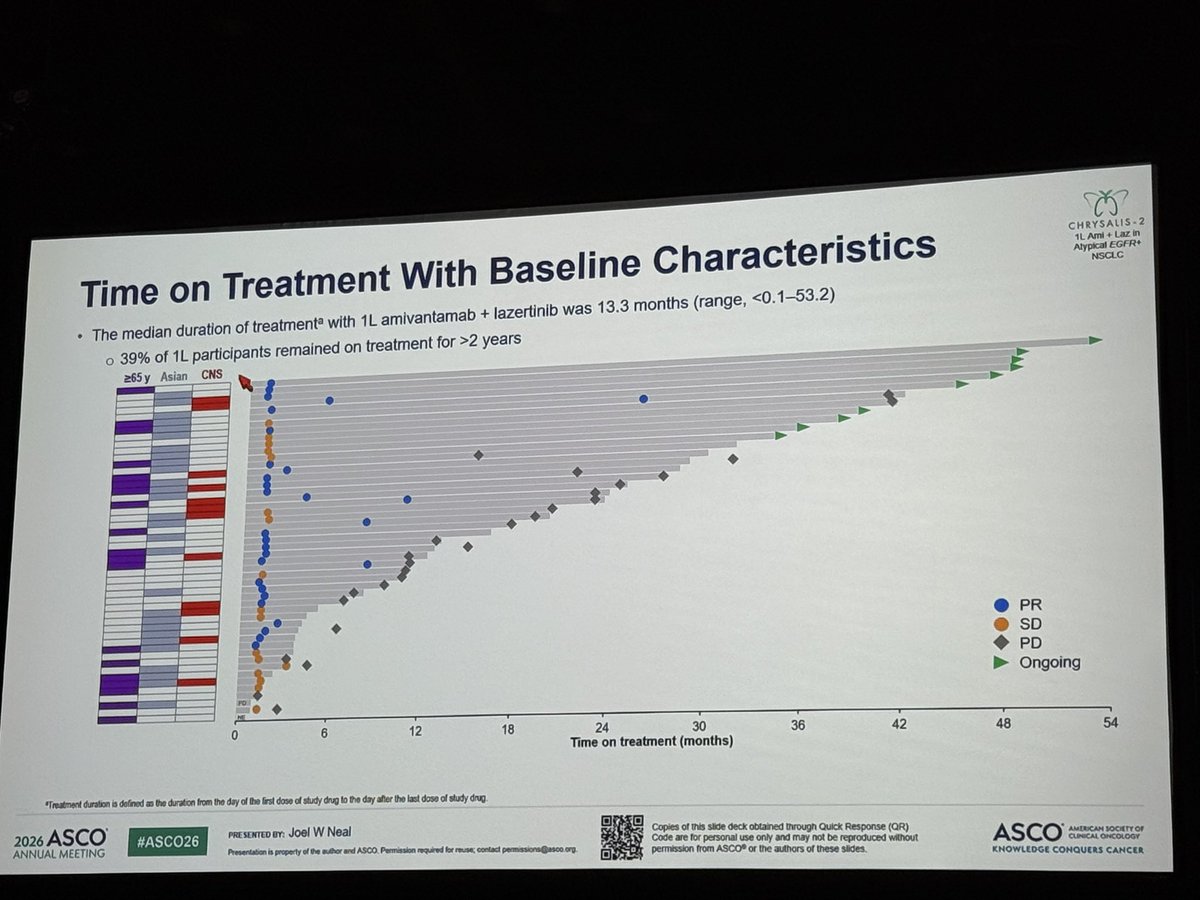
8 details 3 trials watching
Single-arm expansion cohort of the CHRYSALIS-2 program, n=49, 1L atypical EGFR-mutated advanced NSCLC. Median follow-up 31.3 mo. No randomised comparator arm.
Treatment-naive advanced NSCLC harbouring an atypical (uncommon) EGFR mutation. Baseline strata shown on the swimmer plot include age ≥65y, Asian ancestry and CNS involvement; per-stratum counts are not reported in source.
IV amivantamab (EGFR/MET bispecific) plus lazertinib (third-generation EGFR TKI). No chemotherapy backbone. Median duration of treatment 13.3 months (range <0.1-53.2), with 39% of 1L participants still on treatment beyond 2 years.
Median OS 41.0 mo (95% CI 27.7-NE), described by the presenters as roughly 3.5 years. The upper CI bound is not estimable, so the point estimate is anchored on the lower bound of 27.7 mo.
Reported only as consistent with prior reports, no new safety signals with longer follow-up. No grade 3+ rates, infusion-reaction rates or dermatologic AE rates appear in the source.
The atypical EGFR label pools biologically distinct alterations (G719X, S768I, L861Q and compound variants) whose single-agent TKI sensitivity differs; n=49 cannot resolve per-variant benefit, and the curator's read of no variant-outcome association is an absence of signal in a small cohort, not evidence of uniformity. No comparator, so the 41.0 mo median cannot be positioned against afatinib or osimertinib series in the same population.
Atypical EGFR is the part of the EGFR-mutant space where no regimen is settled, so a 41.0 mo median in 49 pts is meaningful as a benchmark even without randomisation. The practical question this leaves open is whether the bispecific's added toxicity and IV schedule are justified over an oral TKI alone, which this design cannot answer.
Single-arm n=49 expansion cohort, no randomised comparator against afatinib or osimertinib in atypical EGFR. Maturity gate: single-arm never reaches confirmatory.
- Doublet vs single-agent osimertinib or afatinib in atypical EGFR n=480 · primary completion 2029-02 · phase 3 firmonertinib vs osimertinib/afatinib, PACC 1L
- Which atypical EGFR variants drive the durable-response tail
- Whether subcutaneous amivantamab preserves efficacy with less infusion burden n=418 · primary completion 2024-01 · phase 3 SC vs IV ami + lazertinib, randomisedrecruiting A Study of Amivantamab in Participants With Advanced or Metastatic Solid Tumors Including Epidermal Growth Factor Receptor (EGFR)-Mutated Non-Small Cell Lung Cancer Phase 2n=520 · primary completion 2027-08 · SC co-formulation activity + safety cohorts
📚 Sources · 🐦 1 tweet
Amivantamab + lazertinib achieved a median OS of 41.0 months in treatment-naïve atypical EGFR-mutant NSCLC, with no clear association between EGFR variant subtype and outcome. A compelling option. Meanwhile, amivantamab continues evaluation across multiple tumor types. #ASCO26 pic.twitter.com/aWn3Ja60Ji
— Chul Kim (@chulkimMD) May 29, 2026
ESAONA
For1L EGFR-mutant NSCLC with brain metastases
95.5% vs 79.6%
p = 0.0004
TL;DRiORR 95.5% vs 79.6% (p=0.0004) and intracranial PFS HR 0.46 favoring asandeutertinib in 1L EGFR-mutant NSCLC with brain mets.
The RT-relevant number is intracranial PFS: median not reached vs 17.5 mo, HR 0.46. If a first-line TKI holds CNS disease that long, the deferral-of-brain-RT window widens, but the source reports no prior-RT stratification, no CNS-RT use by arm, and no lesion size or symptom criteria, so this cannot yet gate an SRS-versus-defer decision.
In treatment-naive EGFR-mutant NSCLC with asymptomatic brain metastases, this supports the case for TKI-first CNS control as a hypothesis, not a change in practice; it says nothing about symptomatic or large lesions where local therapy is already indicated.
Intracranial PFS median not reached vs 17.5 mo, HR 0.46, is the number that touches the SRS-timing decision in asymptomatic brain mets. The source gives no prior-RT stratification and no salvage-RT rates by arm, so the deferral question stays open rather than answered.
The intracranial effect (HR 0.46) is roughly double the systemic one (HR 0.64), so the case for asandeutertinib rests on CNS penetration rather than broad potency. Serious TRAEs run 10.8% vs 7.1%, a real but modest trade against a phase II endpoint with no OS.

| Endpoint | Asandeutertinib (n=111) | Osimertinib (n=113) | Effect |
|---|---|---|---|
| Intracranial ORR (BICR) | 95.5% (89.8-98.5) | 79.6% (71.0-86.6) | p = 0.0004 |
| Intracranial PFS (BICR) | Median not reached | 17.5 mo (15.18-NA) | HR 0.46, p = 0.0020 |
| Overall PFS (BICR) | Median not reached | 17.2 mo (15.18-19.55) | HR 0.64, p = 0.0473 |
| Any TRAE | 99.1% | 95.6% | n/a |
| Serious TRAE | 10.8% | 7.1% | n/a |
7 details 4 trials watching
Randomised phase II, N=224, asandeutertinib (n=111) vs osimertinib (n=113). Endpoints read by BICR. Follow-up duration, stratification factors and alpha allocation are not reported in the source slide.
First-line EGFR-mutated NSCLC with brain metastases. The source does not state lesion number, size, symptom status, or whether prior CNS radiotherapy was permitted, which is the eligibility gate an RT reader needs.
Intracranial ORR by BICR is the headline, with intracranial PFS and overall PFS reported alongside. No overall survival data in source.
Any TRAE 99.1% vs 95.6%; serious TRAE 10.8% vs 7.1%. The excess serious-event rate is small in absolute terms but sits on a phase II denominator, and no organ-level breakdown is given in source.
The intracranial separation (HR 0.46) is larger than the systemic one (HR 0.64), which points at CNS penetration rather than a general potency gain as the mechanism. For radiation oncology the question is whether that CNS margin is durable enough to defer SRS in asymptomatic pts; a phase II with unreached medians and no OS cannot answer it.
CONSORT flow
Phase II, conference-slide source only; no OS, borderline overall-PFS p, and no reported CNS-RT or prior-RT stratification. Needs phase III before displacing osimertinib.
- Does intracranial PFS benefit translate to overall survival
- Salvage brain RT and SRS rates by arm recruiting Observation or Upfront Cranial RT in Oncogene Mutated NSCLC With Asymptomatic BM: A Phase III RCT Phase 3n=190 · primary completion 2025-12 · randomises upfront SRS/WBRT vs TKI alone, asx BMrecruiting A Study of Stereotactic Radiosurgery (SRS) and Standard Treatment in People With Lung Cancer That Has Spread to the Brain Phase 2n=56 · primary completion 2027-12 · SRS after 3mo osimertinib vs osimertinib alonerecruiting Early or Delayed Intervention of Brain Radiotherapy Combined With Almonertinib in EGFR Mutated NSCLC With Brain Metastases Phase 3n=232 · primary completion 2028-12 · early vs delayed SRS timing on 3G TKI, phase 3
- Activity in symptomatic or leptomeningeal CNS disease recruiting A Clinical Trial of Furmonertinib Combined With Anlotinib as First-line Treatment for Advanced NSCLC With EGFR-sensitive Mutations and Brain Metastasis Phase 2n=146 · primary completion 2027-09 · 1L 3G TKI + anlotinib, brain/LM mets at dx
📚 Sources · 🐦 1 tweet
#ASCO26 🧠🌍
— Dr Rishabh Jain (@DrRishabhOnco) May 30, 2026
Could a next-generation EGFR TKI outperform osimertinib in patients with brain metastases?
The phase II ESAONA trial suggests the answer may be yes.
🧪 LBA2007 | ESAONA
1L EGFR-mutated NSCLC with brain metastases
👥 n=224
⚔️ Asandeutertinib vs Osimertinib
Key… https://t.co/mEOKGNKgf7 pic.twitter.com/pUQuH6i2cV
OptiTROP-Lung05 NCT06448312
For1L stage IIIB-IV NSCLC, PD-L1 TPS ≥1%, EGFR/ALK wild-type, ECOG 0-1
HR 0.35
95% CI 0.26-0.47, p<0.0001; NR vs 5.7 mo
TL;DRmPFS NR vs 5.7mo, HR 0.35 (0.26-0.47) for sac-TMT + pembro in 1L PD-L1+ NSCLC.
In treatment-naive PD-L1 TPS ≥1% advanced NSCLC without EGFR/ALK alteration, this supports a TROP2 ADC plus pembro as a chemo-free option worth watching; it does not address pts already committed to pembro plus platinum chemo, nor PD-L1-negative disease.

| Arm | PFS events, n (%) | Median PFS, mo (95% CI) | HR (95% CI) |
|---|---|---|---|
| Sac-TMT + Pembro (n=208) | 66 (31.7) | NR (13.6, NE) | 0.35 (0.26, 0.47), p<0.0001 |
| Pembro (n=205) | 128 (62.4) | 5.7 (4.3, 7.0) | n/a |
+3 more figures

| PD-L1 stratum | Sac-TMT + Pembro median, mo | Pembro median, mo | HR (95% CI) |
|---|---|---|---|
| TPS ≥50% | NR (NE, NE) | 9.5 (6.9, 13.8) | 0.47 (0.29, 0.77) |
| TPS 1-49% | NR (11.1, NE) | 4.3 (2.9, 5.5) | 0.28 (0.19, 0.41) |

| Arm | OS events, n (%) | Median OS, mo (95% CI) | HR (95% CI) |
|---|---|---|---|
| Sac-TMT + Pembro (n=208) | 33 (15.9) | NR (NE, NE) | 0.55 (0.36, 0.85) |
| Pembro (n=205) | 54 (26.3) | NR (NE, NE) | n/a |

13 details 3 trials watching
Randomized, multicenter, open-label phase 3 (NCT06448312), 1:1, N=413. Stratified by histology (squamous vs non-squamous), PD-L1 TPS (1-49% vs ≥50%), and ECOG (0 vs 1). Median follow-up 10.5 months at this analysis.
Locally advanced stage IIIB/IIIC or metastatic stage IV NSCLC with no prior systemic antitumor therapy. Required PD-L1 TPS ≥1% by IHC 22C3 central lab, no sensitizing EGFR or ALK alteration, ECOG 0 or 1.
Sac-TMT 4 mg/kg Q2W plus pembrolizumab 400 mg versus pembrolizumab 400 mg Q6W alone, until progression or unacceptable toxicity. Pembro was capped at a maximum of 18 cycles in both arms. One pt in the pembro group never received assigned treatment.
Primary: PFS by BICR. Key secondary: OS. Other secondary: investigator-assessed PFS, ORR, DCR, DOR, safety. The updated efficacy boundary at the actual 194 PFS events was 0.0174 (2-sided).
PFS crossed its boundary at p<0.0001. OS was descriptive at the PFS interim, HR 0.55 (0.36, 0.85) with both medians not reached and only 33 vs 54 deaths.
The pembro-alone control performed as expected for an all-comers TPS ≥1% population, with the TPS ≥50% arm reaching 9.5 mo and the TPS 1-49% arm 4.3 mo, consistent with the KEYNOTE-042 signal that low-expressors gain least from single-agent IO. This is the setting where chemo-IO has historically been chosen, so the trial tests whether an ADC can occupy that slot instead of platinum doublet chemotherapy.
No toxicity data in the source, which is the decisive missing piece for a doublet whose entire premise is avoiding chemotherapy. The comparator is pembro monotherapy rather than the chemo-IO most oncologists actually give at TPS 1-49%, so the PFS gap partly measures a weak control rather than a strong experimental arm.
An HR of 0.35 with a median not reached is a large PFS effect, and the OS point estimate moves in the same direction, but neither settles whether sac-TMT plus pembro beats the regimen it would actually replace. The larger effect in TPS 1-49% (HR 0.28) than TPS ≥50% (HR 0.47) is the expected pattern when the control arm is weakest in the low-expressors, not evidence of a biomarker-selected ADC effect.
CONSORT flow
PFS interim of an open-label phase 3; OS descriptive at 10.5 mo f/u with both medians NR. No safety data in source, and no comparison vs pembro + chemo.
- Benefit vs pembrolizumab plus platinum chemotherapy, the real-world comparator n=614 · primary completion 2028-01 · phase 3 sac-TMT + pembro vs pembro alone, TPS >=50%, OSrecruiting Pembrolizumab With or Without Maintenance Sacituzumab Tirumotecan (Sac-TMT; MK-2870) in Metastatic Squamous Non-small Cell Lung Cancer (NSCLC) [MK-2870-023] Phase 3n=851 · primary completion 2029-01 · 1L sq NSCLC: pembro + platinum backbone, sac-TMT maint
- Safety and ILD rates of sac-TMT combined with pembrolizumab n=30 · primary completion 2026-12 · phase 1 safety/tolerability of sac-TMT + pembro
- Whether the OS signal holds at the final prespecified analysis
📚 Sources · 🐦 2 tweets
Right patient. Right treatment. Right timing.
— Yakup Ergün (@dr_yakupergun) May 30, 2026
The result: curves like these👇#ASCO26 https://t.co/72KByLKz90
🔁REVIEW #ASCO26 #LCSM Oral
— Hidehito HORINOUCHI (@HHorinouchi) May 30, 2026
🔥OptiTROP-Lung05: 1L Sac-TMT + Pembro vs Pembro in PD-L1+ NSCLC
✅mPFS NR vs 5.7m (HR 0.35)
✅ORR 70.2% vs 42.0%
✅OS HR 0.55 (95%CI 0.36-0.85, immature)
🎙️Dr. Caicun Zhou
🔗 https://t.co/DcbK1dGrhO@OncoAlert @Larvol @ASCO @IASLC https://t.co/512k6dZviW pic.twitter.com/Vdo86N50h9
Neo-CRAG
ForcT3N2-3M0 / cT4 gastric or Siewert II-III EGJ adenocarcinoma, D2-resectable
HR 0.750
95% CI 0.607-0.928, P=0.008; 3yr DFS 55.6% vs 42.4%
TL;DRAdding preop 45Gy/25fx to periop XELOX raised 3yr DFS 55.6% vs 42.4%, HR 0.750; mOS 67.5 vs 37.6mo.
The RT case here rests on locoregional control: LRR after R0 fell to 9.4% from 18.3%, tracking the ypN0 (56.1% vs 36.4%) and pCR gains, which is the mechanistic chain CRITICS and TOPGEAR never produced. Dose was conventional 45Gy/25fx preoperatively, and G3+ postop complications stayed flat (9.0% vs 7.6%), so the deliverability objection to preop RT before D2 loses force.
In node-heavy cT3N2+ or cT4 gastric/Siewert II-III disease heading to D2 resection, this supports revisiting preoperative chemoRT rather than chemo alone; it does not speak to cT2N0-N1 disease or to pts already committed to a FLOT backbone.
Conventional 45Gy/25fx delivered preoperatively, after cycle 1 of chemo, halved locoregional recurrence after R0 resection (9.4% vs 18.3%) with no excess G3+ postoperative complications (9.0% vs 7.6%). That combination, a local-control gain without a surgical-morbidity cost, is what the omission decision in node-heavy cT3N2+ disease has been waiting for.
The systemic backbone was XELOX in both arms, so the DFS gain is attributable to radiotherapy rather than to the regimen, but the control arm's 37.6 mo median OS is the caveat: this does not tell you whether radiotherapy still adds on top of FLOT, whose own advantage is partly locoregional. Sequencing of RT after cycle 1 with attenuated dosing was deliverable.
Every pt was intended for standardized D2 resection, and preoperative chemoRT did not degrade it: G3+ postoperative complications were 9.0% vs 7.6%, and 448 of 620 randomised pts reached gastrectomy. ypN0 rose to 56.1% from 36.4%, which changes what the surgeon can expect to find in the nodal basin rather than the extent of dissection required.

| Endpoint | CRT | CT | Effect size |
|---|---|---|---|
| 3yr DFS | 55.6% (50.1-61.1) | 42.4% (36.9-47.9) | HR 0.750 (0.607-0.928), P=0.008 |
| Median DFS | 52.7 mo | 24.4 mo | n/a |
| 5yr OS | 50.1% | 44.2% | HR 0.781 (0.628-0.970), P=0.025 |
| Median OS | 67.5 mo | 37.6 mo | n/a |
9 details
Randomised, multicenter, phase 3 trial, N=620 (310 per group), 13 referral hospitals in China, accrual 2013-2022. Follow-up on the DFS curve extends past 120 months.
High-risk locally advanced gastric or EGJ adenocarcinoma: cT3N2-3M0, cT4aN+M0, or cT4bNanyM0, Siewert II/III permitted. 225 (36.3%) had an EGJ primary, and every pt was intended for standardized D2 resection.
Both arms: 3 cycles preoperative XELOX (oxaliplatin 130 mg/m² D1, capecitabine 1000 mg/m² BID D1-14, Q3W) then D2 gastrectomy then 3 adjuvant XELOX cycles.
CRT arm added concurrent 45 Gy / 25 fractions after cycle 1 of preoperative chemo, with attenuated concurrent dosing (oxaliplatin 100 mg/m², capecitabine 825 mg/m²). Target volume not specified in source.
Primary: disease-free survival, from randomization to progression, relapse, or death. Secondary: overall survival, pCR, R0 resection, safety.
Primary endpoint met. The locoregional read is the one an RT reader needs: LRR 9.4% vs 18.3% among R0-resected pts.
G3+ haematologic toxicity 14.6% vs 10.3%, the expected cost of concurrent chemoRT. G3+ postoperative complications were comparable, 9.0% vs 7.6%, so preoperative RT did not measurably worsen D2 surgical morbidity.
CRITICS (postoperative chemoRT after D1+ surgery) and TOPGEAR (preoperative chemoRT with ECF/FLOT) both failed to show a survival gain for radiotherapy in this disease. Neo-CRAG differs on three axes at once: RT given preoperatively, D2 resection mandated, and enrolment restricted to node-heavy cT3N2+ or cT4 disease.
The 2013-2022 accrual window means the control arm reflects a doublet era; a 37.6 mo median OS in the control group is short against contemporary FLOT-treated series. Single-country enrolment with uniformly high-quality D2 surgery also caps generalisability to centres with variable nodal dissection.
The pCR, downstaging, ypN0 and LRR gradient forms a coherent mechanistic chain from RT to the DFS separation, which is what earlier negative trials lacked. What it does not settle is whether that chain survives a stronger systemic backbone, since much of FLOT's advantage over a doublet is itself locoregional.
CONSORT flow
Randomised ph3, prespecified DFS met with OS support, but the chemo backbone is XELOX not FLOT, so it contests RT omission without settling it.
- Does preoperative chemoRT still add benefit on a FLOT backbone?
- Generalizability outside high-volume D2 centers
- Optimal target volume and elective nodal coverage not reported in source
📚 Sources · 🐦 1 tweet
Neo-CRAG: Ph3 RCT (n=620, gastric/GEJ) - adding neoadj chemoRT to peri-op XELOX improved OS (68 v 38 mo).
— Dr. Nina Niu Sanford (@NiuSanford) May 30, 2026
Limitation=non-FLOT, BUT still relevant IMO b/c:
1) DFS/OS benefit substantial.
2) Improvements in pCR, downstg, LRR supports plausible RT effect on OS. #ASCO26 @OncoAlert pic.twitter.com/eeM0Z8p20M
SPIN Score (Celiac Plexus Radiosurgery) NCT03323489
ForPancreatic cancer with retroperitoneal pain considered for celiac plexus SRS
TL;DRPost-hoc predictors of pain response after celiac SRS: response 32% / 53% / 89% by 0 / 1 / 2 SPIN points.
The actionable RT read is timing, not technique: neurotoxic chemo exposure carried OR 5.1 (p=0.009) against response, so the referral decision moves earlier in the disease course, before oxaliplatin or taxane neuropathy. Celiac SRS is NCCN-listed and single-fraction, so the gate is who you irradiate and when, not dose.
In pancreatic cancer pts with retroperitoneal pain scoring above 6 and no prior neurotoxic chemo, this supports considering celiac SRS earlier rather than after systemic lines; it does not tell you what to do for the chemo-exposed, low-pain pt, where response was 32%.
The gate on celiac SRS is patient selection and timing, not plan quality: neurotoxic chemo exposure carried OR 5.1 (p=0.009) against pain response, and 2-point pts responded 89% vs 32% at 0 points. Argues for taking the referral early rather than as last-line salvage.
The variable that mattered is one med onc controls: prior neurotoxic chemotherapy predicted failure of celiac SRS (OR 5.1, p=0.009). For a pt with severe retroperitoneal pain, this argues for a celiac SRS referral alongside, not after, an oxaliplatin or taxane backbone.

| SPIN score | n | Pain response |
|---|---|---|
| 0 | 31 | 32% |
| 1 | 40 | 53% |
| 2 | 19 | 89% |
10 details
Post-hoc analysis of the pivotal single-arm phase 2 celiac plexus radiosurgery trial (NCT03323489), n=90 evaluable. Candidate baseline predictors screened by univariate then multivariate logistic regression, with only multivariate-significant variables carried into the score. Internal validation by bootstrap resampling, 500 iterations, for an optimism-corrected AUC.
Pain response per parent protocol: a ≥2-point reduction in average pain on the Brief Pain Inventory-Short Form, baseline to three weeks. Parent-trial response was 53% (95% CI 42-64%).
Only neurotoxic chemotherapy exposure (OR 5.1, p=0.009) and baseline pain intensity (OR 1.8, p=0.003) survived multivariate analysis; age and therapy line dropped out to collinearity. The resulting 2-point score separated response into 32% / 53% / 89%, with AUC 0.716 apparent, 0.714 optimism-corrected.
| Predictor | Univariate | Multivariate |
|---|---|---|
| Neurotoxic chemo exposure | OR 5.33 (2.13-13.4), p<0.001 | OR 5.1, p=0.009 |
| Baseline pain intensity | OR 1.73, p=0.003 | OR 1.8, p=0.003 |
| Age | OR 1.06, p=0.014 | lost significance |
| Therapy line | OR 0.65, p=0.04 | lost significance |
The score was derived and internally validated in the same 90 pts, so the bootstrap corrects optimism from resampling but not from the variable-selection step that preceded it. The 2-point stratum is n=19, and the dichotomy at pain >6 was picked from the same data that shows steeper response above 7 and 8.
The neurotoxic-chemo term is the interesting one because it is a timing variable a clinician controls, not a fixed patient trait: it implies referral for celiac SRS competes with the systemic sequence rather than following it. Whether that reflects true nerve injury blunting an ablative pain response, or confounding by later-line disease biology, the post-hoc design cannot separate.
Post-hoc derivation on the parent trial's own 90 pts; internal bootstrap only, no external cohort. Design dominates the read regardless of effect size.
- External validation of the SPIN score in an independent cohort
- Is neurotoxic chemo effect causal or a proxy for later-line disease
- Durability of pain response beyond the 3-week endpoint
📚 Sources · 🐦 1 tweet
Celiac SRS = convenient, effective tx for intractable pain, but who benefits most?
— Dr. Nina Niu Sanford (@NiuSanford) May 30, 2026
Post-hoc Ph2 analysis identified 2 response predictors (SPIN score): severe baseline pain & no prior neurotoxic chemo.
Supports earlier use before potential chemo neuropathy. #ASCO26 @OncoAlert pic.twitter.com/3qFYU6N1iD
Wait or Treat (NCT05236946) NCT05236946
ForMetastatic EGFR/ALK+ NSCLC, asymptomatic measurable brain mets, ECOG 0-2
sub-HR 0.35
95% CI 0.21-0.59, p<0.001; 2y icPD 21.7% vs 50%
TL;DRUpfront cranial RT cut intracranial progression (sub-HR 0.35, 0.21-0.59, p<0.001) but 2y OS favored delayed RT, 48% vs 60%.
The intracranial win is real (2y progression 21.7% vs 50%, sub-HR 0.35) yet does not convert: 2y OS 48% upfront vs 60% delayed, HR 1.45. With necrosis reported ~6% upfront vs none delayed, and RT dose/technique unstated in source, this moves the timing decision toward deferral with MRI q3m surveillance.
In treatment-naive EGFR or ALK-driven metastatic NSCLC with asymptomatic measurable brain mets starting a TKI, this supports deferring cranial RT with q3m MRI rather than treating reflexively; it says nothing about symptomatic mets, large or dominant lesions, or oncogene-negative disease.
This is a timing question, not an omission question: both arms got cranial RT, and deferring cost 2y intracranial progression of 50% vs 21.7% while sparing necrosis (~6% upfront vs none delayed). Dose, fractionation, and WBRT-vs-SRS are absent from source, which is what gates transferring the toxicity read to your own technique.
The delayed arm's 1y intracranial progression of 25.7% on TKI plus chemotherapy is the number that makes upfront RT deferrable: most asymptomatic brain mets did not declare themselves in the first year. Deferral is contingent on q3m MRI surveillance, not on the TKI alone.
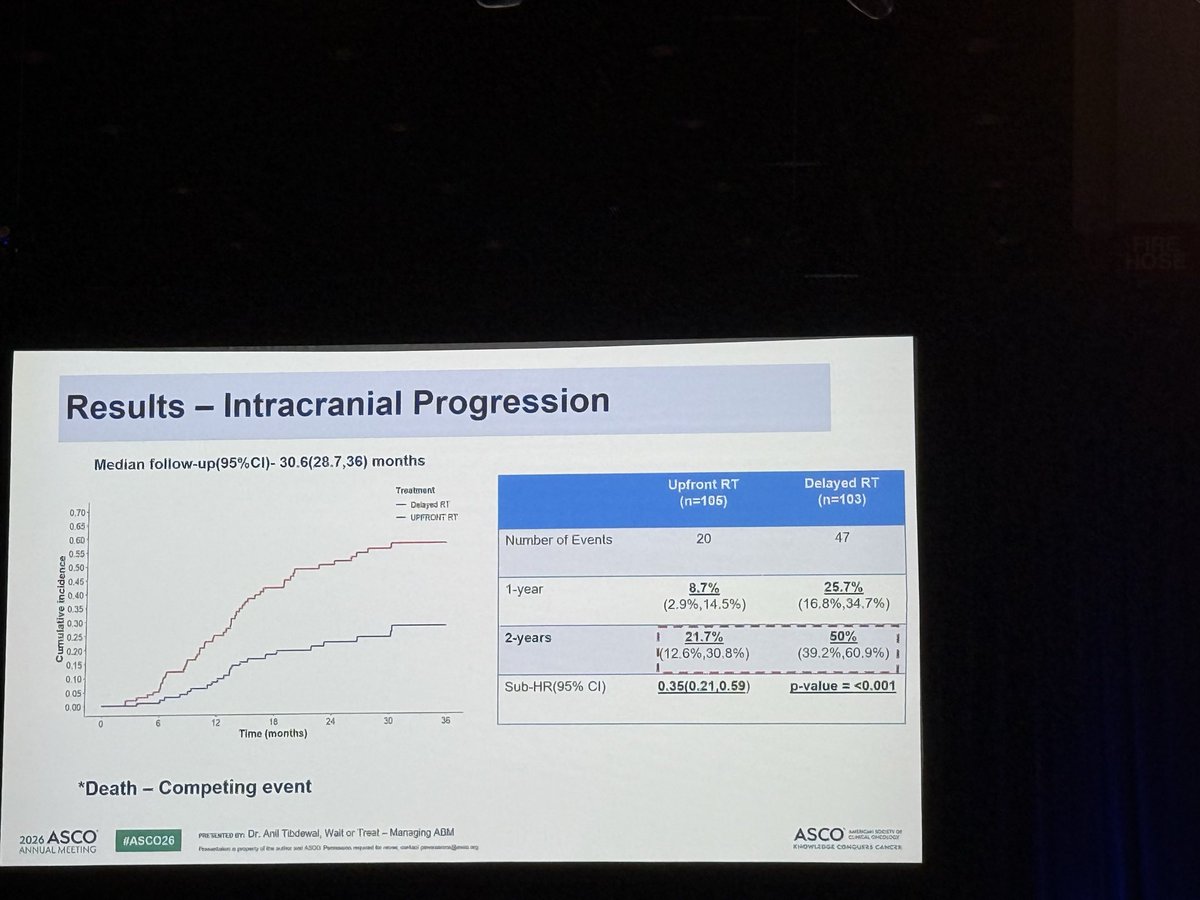
+2 more figures


10 details
Phase III open-label RCT, single-centre (Tata Memorial, Mumbai), N=208 randomised 1:1 to upfront (n=105) vs delayed cranial RT, both on TKI plus chemotherapy. Stratified by GPA (0-2 vs >2) and synchronous vs metachronous BM. Median follow-up 30.6 mo (28.7, 36).
Metastatic NSCLC with an EGFR or ALK alteration, ECOG PS 0-2, radiologically measurable brain metastases that were completely asymptomatic. Number, size, and location of lesions are not reported in source.
Upfront arm received cranial RT at diagnosis; the delayed arm received it at intracranial progression or patient's wish, so both arms are RT-exposed and the question is timing, not omission. Dose, fractionation, and technique (WBRT vs SRS) are not reported in source, which is the main barrier to transferring this result.
Primary: intracranial PFS. Secondary: OS, PFS, toxicity, ORR, neurocognition, PROM. Surveillance was MRI brain q3m for the first year, then q6m, which is what makes a delayed strategy safe to run.
Primary endpoint met. Survival ran the other way: 2y OS 48% upfront vs 60% delayed, OS HR 1.45, reported by attendees rather than captured in the slide OCR.
| Timepoint | Upfront RT (n=105) | Delayed RT (n=103) |
|---|---|---|
| 1-year | 8.7% (2.9%, 14.5%) | 25.7% (16.8%, 34.7%) |
| 2-years | 21.7% (12.6%, 30.8%) | 50% (39.2%, 60.9%) |
| Sub-HR (95% CI) | 0.35 (0.21, 0.59), p<0.001 | ref |
Radiation necrosis ~6% in the upfront arm and none in the delayed arm per attendee reports, and described as less severe when delayed. Full toxicity tables, neurocognition, and PROM were secondary endpoints not reported in the source.
The intracranial magnitude sits alongside the older WBRT-era data (QUARTZ, and the historic SRS-vs-WBRT trials) in showing that cranial RT controls the brain without buying survival. What is new is testing it where a CNS-penetrant TKI is the competing intracranial therapy, a setting those trials predate entirely.
Single-centre and open-label, and the RT prescription is absent from the source, so a reader cannot tell whether the necrosis signal reflects WBRT, SRS technique, or concurrent TKI exposure. Median follow-up of 30.6 mo is short relative to expected survival in this population, and the OS comparison was a secondary endpoint, not powered.
The result splits the two things RT is usually credited with: it clearly buys intracranial control, and it clearly does not buy time. Whether the OS direction is a real cost of upfront RT or noise in an underpowered secondary is the open question, and it decides whether deferral is merely non-inferior or actually preferred.
CONSORT flow
Randomised phase 3, prespecified intracranial PFS met, but the survival signal runs opposite the intracranial win. Directly contests reflex upfront cranial RT.
- Does the OS direction hold with longer follow-up?
- Was cranial RT whole-brain or stereotactic, at what dose?
- Neurocognition and PROM outcomes by RT timing
📚 Sources · 🐦 3 tweets
#ASCO26 | Wait or Treat? Brain RT in EGFR/ALK+ NSCLC
— OncLive.com (@OncLive) May 29, 2026
Presented by Dr Anil Ramakant Tibdewal.
A landmark Phase III randomized trial from @TataMemorial addressed a long-standing question: should asymptomatic brain metastases in oncogene-driven NSCLC receive upfront cranial RT or… pic.twitter.com/lRy9CfyQ8r
Should asymptomatic brain mets await systemic response in front line within EGFR/ALK context? I think yes. Despite reducing icPD, delayed brain RT OS looked better and radiation necrosis didn’t occur vs 6% #ASCO26 pic.twitter.com/O6d7GrvtU4
— Dr Riyaz Shah (@DrRiyazShah) May 29, 2026
No improvement in survival with up front radiation. OS favored delayed radiation with 2y OS 48% with early radiation vs 60% in late (OS HR 1.45). Also, radiation necrosis less common and less severe in delayed arm. Each case unique but delayed approach appealing #ASCO26 pic.twitter.com/wIhjqxhSaq
— Stephen V Liu, MD (@StephenVLiu) May 29, 2026