Bladder preservation after neoadjuvant/perioperative therapy in MIBC (reTURBT cohort)
ForMIBC cT2-4N0M0 urothelial, post-neoadjuvant IO/ADC, declining RC
TL;DRypT0Nx at reTURBT after neoadjuvant therapy: 24-mo EFS 87.6%, OS 96.7% in MIBC pts declining RC (n=54); non-pCR pts fared far worse.
Chemo-RT here was only salvage for residual tumor or recurrence, so this tests a bladder-sparing route that skips upfront RT. The split is stark: non-pCR at reTURBT gave 24-mo OS 50.4% vs 82.5% after RC, so residual disease at reTURBT is the point where definitive local therapy (RC or chemoRT) should be on the table.
In an MIBC pt with ypT0 at reTURBT plus negative MRI and cytology after IO-based neoadjuvant therapy who declines RC, this supports surveillance as a discussable option; it does not extend to pts with any residual disease at reTURBT.
Chemo-RT was used only as salvage for residual tumor or recurrence, so this tests bladder sparing without upfront RT. Non-pCR at reTURBT gave 24-mo OS 50.4% vs 82.5% after RC, marking residual disease as the point where definitive local therapy, including chemoRT, belongs.
Response at reTURBT after pembrolizumab-, SG- or nivolumab-based neoadjuvant therapy separated outcomes sharply: 24-mo EFS 87.6% with ypT0 vs 19.3% with residual disease. Depth of response to the systemic regimen, not the regimen label, drove eligibility for surveillance.
ypT0 at reTURBT pts who declined RC had 24-mo OS 96.7%, but EFS HR 1.96 (0.53-7.27) vs RC pCR is too imprecise to call equivalence. Residual disease at reTURBT tracked with far worse outcomes than RC, keeping cystectomy the default for incomplete responders.
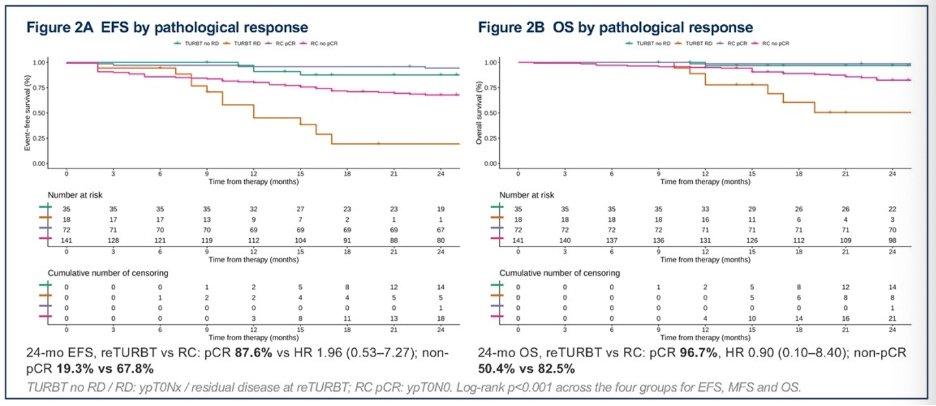
| Group | 24-mo EFS | 24-mo OS |
|---|---|---|
| reTURBT pCR | 87.6% | 96.7% |
| reTURBT vs RC, pCR (HR) | 1.96 (0.53-7.27) | 0.90 (0.10-8.40) |
| reTURBT non-pCR | 19.3% | 50.4% |
| RC non-pCR | 67.8% | 82.5% |
+2 more figures

13 details 3 trials watching
Pooled cohort from four neoadjuvant/perioperative trials (PURE-01, SURE-01, SURE-02, NURE-Combo), N=279 enrolled 02/2017-07/2025. Bladder preservation was pt choice, not a randomized allocation.
MIBC cT2-4N0M0, pure/predominant (≥50%) urothelial carcinoma. The reTURBT group (n=54) declined RC and required negative imaging, biopsy and cytology.
Pembrolizumab, sacituzumab govitecan, SG + pembrolizumab, or nivolumab + nab-paclitaxel, restaged with CT + multiparametric bladder MRI. Adjuvant/maintenance per protocol; deferred RC or chemo-RT only for residual tumor or recurrence.
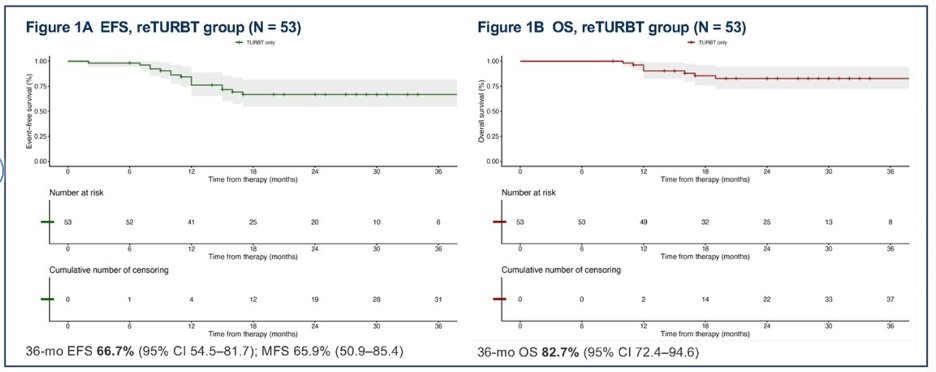
Whole reTURBT group: 36-mo EFS 66.7%, 36-mo OS 82.7%; 19% recurred, 13% distantly. Outcomes split sharply by response at reTURBT (Fig 2).
The comparator is the trials' own RC cohort, not a randomized arm. Trimodality therapy, the established bladder-sparing alternative, was not a planned arm here; chemo-RT appears only as salvage.
Four different regimens pooled into one small cohort. The tweet's comparison claim is truncated, and the 30/54 (56%) vs 43/213 (20%) schema figure carries no endpoint label in the source.
The pCR stratum looks good, but HRs vs RC of 1.96 (0.53-7.27) for EFS and 0.90 (0.10-8.40) for OS are too imprecise to call equivalence. Non-pCR at reTURBT is the clear failure mode and argues for definitive local therapy rather than continued surveillance.
Pts self-selected by declining RC; RC comparison non-randomized, pCR-stratum HR CIs span 1, reTURBT n=54 pooled across four heterogeneous phase 2 regimens.
- Durability of ypT0 at reTURBT beyond 36 months without cystectomy active Stage II-IIIa Urothelial Cancer Randomizing Pre-operative Nivolumab With or Without Relatlimab Phase 2n=90 · primary completion 2026-12 · bladder preservation in responders to nivo±relatlimabactive A Study of Risk Enabled Therapy After Neoadjuvant Immunochemotherapy for Bladder Cancer Phase 2n=81 · primary completion 2027-05 · cCR after AMVAC+nivo then active surveillance
- Would planned chemoRT rescue non-pCR pts at reTURBT? n=20 · primary completion 2027-09 · systemic tx response + genomics assign chemoRT vs RC
- Can ctDNA or MRI better select pts for surveillance?
📚 Sources · 🐦 1 tweet
Bladder preservation after neoadjuvant/perioperative therapy in 🇮🇹 MIBC pts who declined RC and underwent reTURBT (n=54)
— Rashid K. Sayyid (@RKSayyid) October 25, 2026
📌Negative imaging, biopsy & cytology
🔹19% recurred; 13% developed distant recurrence
🔹 ypT0Nx at reTURBT → 24-mo EFS 88%; MFS & OS >95%, comparable with… pic.twitter.com/2I402Cwxa9
The longer read
The question this cohort asks is narrower than it first looks. It does not test bladder preservation as a strategy against cystectomy. It describes what happened to the fifth of trial pts who, after neoadjuvant or perioperative systemic therapy, chose not to have their bladder removed and were restaged with reTURBT, MRI and cytology. That choice is the central methodological fact. Pts who decline RC differ from those who accept it in ways no restaging protocol captures: comorbidity, preference, perhaps a clinician's read of an exceptional response. Every comparison with the RC cohort inherits that selection, and the direction of the bias is hard to predict.
Within that frame, the useful signal is the split by response at reTURBT rather than the pooled numbers. Pts with no residual disease had 24-mo EFS 87.6% and OS 96.7%, and their HRs against RC pCR pts were 1.96 for EFS and 0.90 for OS, with intervals from 0.53 to 7.27 and 0.10 to 8.40. Those intervals are wide enough to fit real harm or real equivalence. The point estimate for EFS leans toward more events without the bladder out, which is expected: an intact bladder can grow new urothelial tumors, and some of those events are salvageable. A reader should not take the OS estimate as evidence of no survival cost. At this sample size it cannot exclude one.
The non-pCR stratum is more decisive. Residual disease at reTURBT went with 24-mo EFS 19.3% and OS 50.4%, against 67.8% and 82.5% for non-pCR pts who had RC. Even allowing for selection, that gap is large enough to treat residual disease at reTURBT as a firm stop signal for surveillance. For a radiation oncologist, this is where the cohort touches practice: chemo-RT was used here only as salvage for residual tumor or recurrence, never as planned consolidation. Whether planned chemoradiation after an incomplete response to modern IO- or ADC-based neoadjuvant therapy would close that gap is untested here, and it is the more interesting trial.
Trimodality therapy remains the bladder-sparing approach with the longer evidence base, and this cohort does not compete with it directly; it proposes a route that omits RT altogether for the best responders. That is plausible biologically, but four different regimens are pooled, follow-up runs only to 36 mo, and the reported recurrence rate of 19% includes 13% distant. For the result to be wrong in the direction that matters, late bladder recurrences after 36 mo would need to convert to metastatic disease at rates the current follow-up cannot see. Prospective selection criteria, ideally with a molecular marker added to imaging and cytology, are what would turn this from a description of self-selected responders into a usable pathway.