SARON
ForSynchronous 1-5 met driver-negative NSCLC, no PD after induction SACT
TL;DRmOS 31.0 vs 28.0 mo, HR 0.99 (0.63-1.55), adding consolidation RT to SACT in synchronous oligometastatic driver-negative NSCLC; PFS improved, magnitude not given.
The PFS gain from consolidation RT did not carry into OS (HR 0.99, 95% CI 0.63-1.55), and QoL and AEs did not differ. RT here was comprehensive: primary (+/- nodes) by conventional RT or SABR plus SABR/SRS to every met. That frames the consolidation decision for non-progressors after induction as disease control at no measured toxicity cost, not survival.
In de novo synchronous oligometastatic driver-negative NSCLC with CR/PR/SD after induction SACT, this supports consolidation RT for progression control but does not establish an OS gain; it does not extend to pts progressing on induction or to EGFR-mutated disease.
Comprehensive RT (primary +/- nodes by conventional RT or SABR, plus SABR/SRS to all mets) improved PFS without a QoL or AE penalty but left OS unchanged (HR 0.99). Consolidation for non-progressors after induction is a disease-control decision, not a survival one.
In pts who respond or stabilise on induction SACT, adding RT did not change OS (mOS 31.0 vs 28.0 mo). The systemic backbone and maintenance remain the survival lever, and per-arm subsequent therapy is not reported in source.
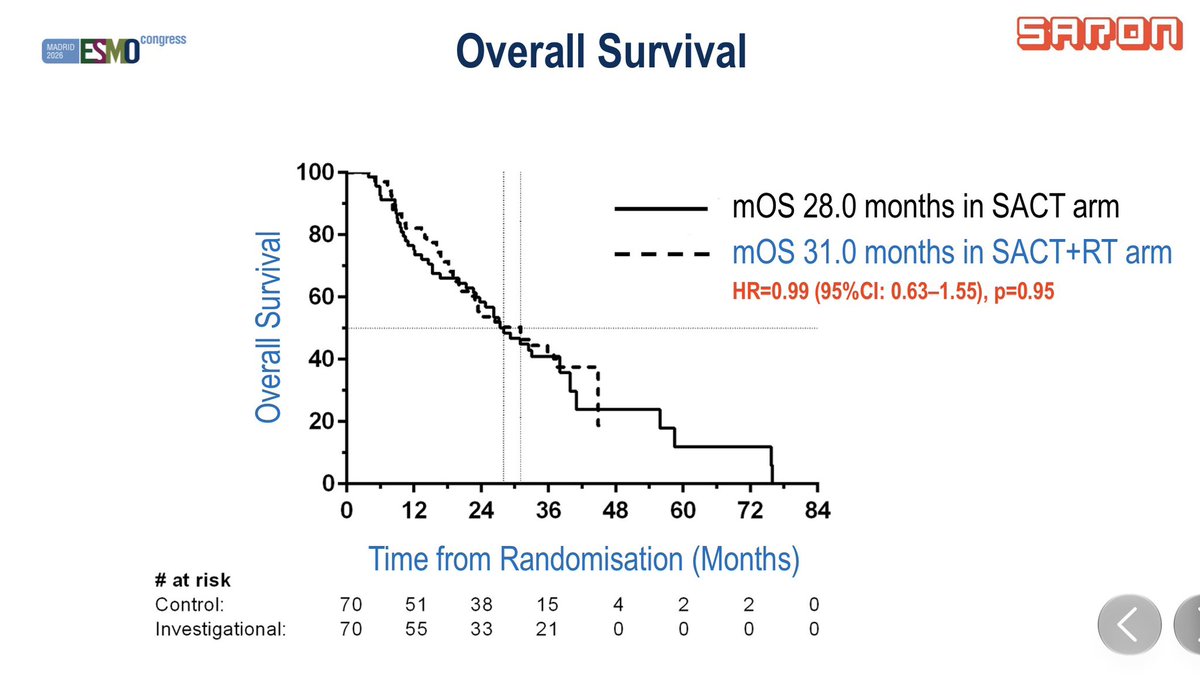
| Arm | mOS | HR (95% CI) | p |
|---|---|---|---|
| SACT (control) | 28.0 months | 0.99 (0.63-1.55) | 0.95 |
| SACT+RT | 31.0 months |
+1 more figure

11 details 2 trials watching
Randomised phase II, 1:1 by minimisation, stratified by histology, N-stage, met number, brain mets, SACT and site. N=200 registered, N=134 randomised; follow-up for 3 years or until death.
De novo synchronous oligometastatic NSCLC without driver mutation: 1-5 mets in up to 3 organs, PS 0-1, PET-CT and brain CT/MRI staged. Brain mets allowed only with at least one extracranial met. Randomised only with CR/PR/SD and PS 0-2 after 6-8 weeks induction SACT.
Conventional RT or SABR to the primary (+/- nodes) plus SABR/SRS to all metastases, delivered within a window of up to 4-6 further weeks of induction SACT. Dose and fractionation not reported in source.
PFS, OS, QoL and AEs reported. Which endpoint was primary is not stated in source.
PFS improved with RT (no effect size in source). OS HR 0.99 (95% CI 0.63-1.55), p=0.95; mOS 31.0 vs 28.0 mo.
No significant difference in AEs or QoL per presenter; no rates in source.
Gomez (Lancet Oncol 2016) and Iyengar (JAMA Oncol 2018) supported LCT after chemotherapy, while Elamin (ESMO 2025) and Iyengar (ASCO 2024) found no LCT benefit in oligo-persistent disease on chemo-IO. SARON's OS-null result sits with the latter.
The schema lists 134 randomised but the OS at-risk table shows 70 per arm, unresolved in source. Maintenance SACT was permitted, and its use by arm is not reported.
Comprehensive RT bought PFS without measured toxicity or QoL cost, but no OS benefit at this sample size. The CI is wide enough that a moderate OS effect in either direction is not excluded.
Randomised phase II, but source names no primary endpoint and gives no PFS magnitude; the only quantified result is a null OS with a wide CI.
- Does the PFS gain translate to OS with longer follow-up? recruiting Standard Maintenance Therapy (SMT) vs Local Consolidative Radiation Therapy and SMT in OM-NSCLC Phase 3n=190 · primary completion 2026-04 · phase 3 LCRT + maintenance vs maintenance, 1-5 mets
- Role of consolidation RT on a chemo-immunotherapy backbone not yet Local Consolidative Therapy Versus Maintenance Immunotherapy After First-Line Chemoimmunotherapy in Metastatic NSCLC Phase 2n=117 · primary completion 2029-12 · LCT vs maintenance IO after 1L chemo-IO PR
- Which oligometastatic subsets benefit (met number, brain mets)?
📚 Sources · 🐦 1 tweet
Presenting the UK’s SARON study Dr @fifimcdrmh to a full hall at #ESMO26
— Gerry Hanna (@gerryhanna) October 25, 2026
In patients with de novo oligometastatic mutation driver negative #NSCLC , consolidation radiotherapy to the primary and metastases improved PFS but no OS
No significant difference in QOL or AEs
Huge… pic.twitter.com/EmWoQXHalE
The longer read
SARON lands in a literature that has been drifting away from the early optimism about local consolidative therapy in oligometastatic NSCLC. The trial's own background slide lays out the arc: Gomez (Lancet Oncol 2016) and Iyengar (JAMA Oncol 2018) supported consolidation after chemotherapy, the EGFR-mutated TKI trials (Wang, JNCI 2023; Sun, JCO 2024) extended that to targeted therapy, and the more recent chemo-immunotherapy era data (Iyengar, ASCO 2024; Elamin, ESMO 2025) found no benefit in oligo-persistent disease. SARON asks the cleanest version of the question for the largest group, de novo synchronous driver-negative disease, and its answer on survival is null: HR 0.99 with mOS 31.0 vs 28.0 months.
The PFS-positive, OS-null pattern is familiar and has two readings. One is that consolidation RT delays progression at sites a subsequent line would have controlled anyway, so it moves the timing of failure without changing its endpoint. The other is that SARON could not see an OS effect that exists. The confidence interval, 0.63 to 1.55, cannot exclude a meaningful benefit or meaningful harm, and that width is what a randomised phase II produces for survival. The honest summary is that OS is undetermined rather than disproven, while the absence of any signal at all should temper expectations.
The design choices matter for how far the result travels. Randomisation happened after 6 to 8 weeks of induction SACT and only for pts with CR, PR or SD, so the trial tests consolidation in a population already selected for systemic sensitivity. That is the right population for the clinical question most radiation oncologists face, but it says nothing about upfront local therapy or about pts who progress on induction. Maintenance SACT was allowed, and without per-arm data on maintenance use and subsequent lines, the OS comparison is exposed to post-progression treatment differences. The source also leaves a numerical inconsistency: the schema lists 134 randomised, while the OS at-risk table starts at 70 per arm. That needs to be resolved in the full report before the numbers are cited.
What the trial does seem to establish is that comprehensive RT to the primary and all metastases did not cost QoL or add measurable toxicity, according to the presenter. That reframes the decision. Consolidation RT in this setting becomes a disease-control intervention with an apparently acceptable cost, reasonable to discuss when local progression would itself be morbid, rather than a survival intervention to offer every eligible pt. Two things would change the read: a PFS magnitude large enough to matter clinically, which the source does not give, and longer follow-up or pooled data showing late OS separation. Until the full PFS data and the endpoint are reported, the trial is better taken as evidence against a large OS effect than as a settled verdict on consolidation.