ESMO Congress 2026
AZUR-1 NCT05723562
FordMMR/MSI-H locally advanced rectal cancer, treatment-naive
TL;DRcCR12 68% (investigator) and cCR12+pCR 76% with dostarlimab alone in dMMR/MSI-H LARC, no recurrences to date at 26.3mo median f/u.
The RT-omission read hinges on the assessor: investigator cCR12 is 68%, central review 47% (54/116) with 38 pts still pending. Either figure exceeds the 21-41% post-TNT cCR range the source cites, which supports MMR testing before any pelvic RT is planned in LARC.
In dMMR/MSI-H LARC, this supports checkpoint-first, organ-preservation discussion before committing to chemoRT or TNT; it does not extend to pMMR/MSS rectal cancer. The longer read
Central review cCR12 is 47% (54/116) against investigator 68%, with 38 pts pending; both exceed the 21-41% post-TNT cCR range cited. In dMMR/MSI-H LARC, pelvic RT is shifting toward a salvage role, so MMR status should be known before simulation.
Nine cycles of dostarlimab 500 mg q3w delivered 68% cCR12 (INV) with 88% completing therapy and G≥3 immune-mediated AEs in 4 pts. This positions PD-1 monotherapy as the first move in dMMR/MSI-H LARC, ahead of oxaliplatin-based TNT.
Only 15 pts underwent resection after dostarlimab alone and 12 (80%) were pCR, so most surgical specimens showed no residual tumour. The surgical question becomes timing of salvage and surveillance intervals, not upfront TME, in dMMR/MSI-H LARC.
10 details 2 trials watching
Global single-arm phase II, registrational. Interim analysis, N=154 enrolled, median f/u 26.3 mo (range 2-36).
dMMR/MSI-H locally advanced rectal cancer. 144 pts had ≥12 mo f/u for investigator-assessed cCR12.
Dostarlimab 500 mg IV q3w for 9 cycles as monotherapy; chemotherapy, radiation and surgery reserved for non-responders.
Key endpoints: sustained cCR for 12 months (cCR12) after end of treatment by investigator and independent central review, and composite cCR12 (INV) + pCR.
cCR12 68% (INV) vs 47% (54/116) (ICR); composite cCR12+pCR 76%. Of 15 resected pts, 12 (80%) had pCR; no recurrences to date after cCR or pCR.
| Assessor | Evaluable | cCR12 |
|---|---|---|
| Investigator | 144 | 68% |
| Independent central review | 116 | 54/116 (47%) |
88% completed all 9 cycles. G≥3 immune-mediated AEs in 4 pts.
Post-TNT cCR is cited at 21-41% in LARC broadly; AZUR-1 exceeds that in a biomarker-selected group. It scales up the earlier small dostarlimab study that first showed durable cCR in dMMR LARC.
Investigator and central review diverge on cCR12, and ICR evaluability lagged because cCR was confirmed later. cCR12 is a surrogate for durable organ preservation; local regrowth risk beyond 3 years is unmeasured.
Durable cCR with no recurrences so far makes RT omission a realistic default question in dMMR LARC. Open: how long surveillance must run, and what salvage looks like for late regrowth.
Single-arm interim analysis without a randomised comparator; investigator vs central review cCR12 diverge, and durability beyond 26.3mo median f/u is unproven.
- Will ICR cCR12 converge with investigator rate as pending pts mature?
- Late local regrowth risk beyond 3 years without RT or surgery not yet Non-Operative Management and Following Immunotherapy for Colorectal Cancer and Other GI Cancersn=50 · primary completion 2029-06 · dMMR/MSI-H W&W registry after neoadjuvant IO
- Role of RT for dMMR pts without cCR after dostarlimab recruiting Study of Induction PD-1 Blockade in Subjects With Locally Advanced Mismatch Repair Deficient Solid Tumors Phase 2n=212 · primary completion 2026-11 · dostarlimab then capecitabine-IMRT in dMMR LARC
📚 Sources · 📄 2 papers
Abstract
Abstract
SANO
ForLocally advanced oesophageal cancer, cCR after nCRT
TL;DR5y OS 50% vs 54%, HR 1.17 (0.77-1.77) active surveillance vs surgery after cCR to nCRT; distant mets 46% vs 29%, P<.01.
The RT read is that nCRT alone was the definitive treatment for 43% of the surveillance arm, but distant mets rose to 46% vs 29% without immediate surgery. That makes cCR after nCRT a reasonable organ-preservation endpoint for selected pts. Whether early oesophagectomy suppresses distant spread, or the gap comes from how surveillance detects disease, is the open question.
In locally advanced oesophageal cancer with cCR on biopsies, EUS and PET-CT after nCRT, this supports active surveillance with surgery as needed as a discussable option; it does not address pts without cCR or nCRT regimens other than those used in SANO. The longer read
nCRT alone was definitive treatment for a large part of the surveillance arm, which makes cCR on biopsies, EUS and PET-CT the decision gate. The nCRT regimen is not stated in source, so dose transfer cannot be judged, and the distant-mets excess (46% vs 29%) matters when counselling responders.
Surgery as needed spared 85/198 (43%) a non-beneficial oesophagectomy with no significant 5y OS difference (HR 1.17). The distant-mets excess under surveillance (P<.01) raises the question of whether delaying resection gives up systemic control, and that 43% includes pts who progressed within 6 mo.
9 details 1 trial watching
Multicentre stepped-wedge cluster-randomised non-inferiority trial, 2017-2021, Netherlands Trial Register NTR-6803. This report covers 5y outcomes at median f/u 76 mo (IQR 67-86).
Locally advanced oesophageal cancer with a complete clinical response after nCRT, defined as no tumour on endoscopic biopsies, endoscopic ultrasound, or PET-CT. N=309: 198 active surveillance, 111 standard surgery.
nCRT was the common backbone. The regimen, dose and fractionation are not stated in source, so whether the result transfers to a given chemoRT protocol cannot be judged from this abstract.
The earlier report showed non-inferiority on two-year OS with improved QoL under surveillance. This analysis compares 5y OS and DFS by Cox regression and estimates distant metastasis incidence with competing-risk analysis.
OS and DFS were not significantly different, but distant mets were higher under surveillance (P<.01). 85/198 (43%) were spared non-beneficial oesophagectomy.
| Endpoint | Active surveillance (n=198) | Standard surgery (n=111) | Effect |
|---|---|---|---|
| 5y OS | 50% (95%CI 34-57) | 54% (95%CI 46-64) | HR 1.17 (95%CI 0.77-1.77) |
| DFS | not reported per arm | not reported per arm | HR 1.39 (95% CI 0.94-2.06) |
| 5y cumulative incidence distant mets | 46% (95%CI 39-53) | 29% (95%CI 21-37) | P<.01 |
This extends SANO's own 2y non-inferiority result and follows the preSANO cCR-assessment framework. It parallels the watch-and-wait paradigm in rectal cancer (OPRA). The randomised definitive-CRT question is being tested separately in NEEDS.
The 43% spared figure counts pts with distant mets within 6 mo of nCRT, which inflates the organ-preservation benefit. At 5y, no NI margin is reported, and an OS HR upper bound of 1.77 cannot exclude clinically relevant harm.
Survival parity holds at 5y, but the distant-mets excess is the signal to explain. It could reflect micrometastatic seeding during delayed resection, or disease surfacing on surveillance imaging that resection would have found later. The abstract cannot separate the two.
Long-term f/u of a cluster-randomised NI trial supporting emerging organ preservation; wide OS CI and a significant distant-mets excess stop short of practice-changing.
- Why are distant metastases higher under active surveillance?
- Does systemic therapy during surveillance offset the distant-mets excess? recruiting An Organ Preservation Strategies After Chemoradiotherapy Combined With Immunotherapy for Esophageal Cancer (PALACE3). Phase 3n=356 · primary completion 2028-03 · ph3 nCRT+IO organ preservation vs nCRT+surgery, 3y OS
- Which nCRT regimen maximizes durable cCR?
📚 Sources · 📄 2 papers
Abstract
Abstract
PE-PE NCT05578664
ForOligometastatic RCC, ≤3 mets within 5y of prior nephrectomy, MDT-eligible
HR 0.47
95% CI 0.24-0.92, p=0.024; mRFS 25.4 vs 11.0 mo
TL;DRmRFS 25.4 vs 11.0 mo, HR 0.47 (0.24-0.92), p=0.024, adding 1y perioperative pembrolizumab to SABR/surgery MDT in omRCC.
SABR was the MDT in 73% vs 72% of pts, so this is mostly pembrolizumab plus SABR vs SABR alone. Dose/fractionation and the local relapse secondary aren't in the abstract, so it can't yet show whether P changes in-field control or only cuts distant events. The decision it moves is whether SABR to all sites goes ahead with or without IO.
In post-nephrectomy omRCC with ≤3 mets within 5y planned for SABR or metastasectomy, this supports discussing 1y of perioperative pembrolizumab with MDT; it does not extend to >3 mets or relapse beyond 5y of nephrectomy. The longer read
SABR was the MDT in 73% vs 72%, so this tests IO on top of SABR to all sites. Dose and the local relapse secondary are unreported, so whether P improves in-field control or only distant events is unknown, and SABR technique itself is unchanged.
One year of pembrolizumab, started before MDT, gave HR 0.47 for RFS beyond the M1NED-within-1y adjuvant setting. G3 AEs were 7% and hypothyroidism 23%, and with 2 deaths there is no OS read to weigh against deferring IO until relapse.
10 details
Randomized 2:1, open-label, multicenter phase II, N=85 (56 P+MDT, 29 MDT alone). Median follow-up 17.5 mo.
omRCC after prior nephrectomy, ≤3 metastases within 5 years of Nx or prior metastasectomy, candidates for MDT to all metastatic sites. Baseline characteristics reported as balanced.
Pembrolizumab 400 mg q6w × 9 cycles (1 year), first dose before MDT. Median cycles delivered 6.6.
MDT was SABR in 73% vs 72% and surgery in 23% vs 28%. Dose, fractionation and target definition not reported in source.
Primary: relapse-free survival. Secondary: distant RFS, local relapse, OS, safety; only safety secondaries are reported in the abstract.
Any AE 80% vs 21%, G3 7% vs 3%. P-related AEs 59%, led by hypothyroidism 23%; no G4/5.
KEYNOTE-564 established adjuvant pembrolizumab after Nx and for M1NED within 1 year of Nx. PE-PE moves that into unresected oligomets ablated by SABR or surgery, including relapse up to 5 years out.
No local vs distant relapse split, so the site of benefit is unknown. RFS assessor blinding not stated in an open-label trial, and 2 of the 9 planned cycles went undelivered at the median.
The RFS gain is large but rests on 35 events, with a CI upper bound of 0.92. It does not settle whether IO at MDT beats IO deferred to relapse, which is the comparison that decides treatment-free intervals.
| Endpoint | P+MDT (n=56) | MDT alone (n=29) | Effect |
|---|---|---|---|
| Median RFS | 25.4 mo | 11.0 mo | HR 0.47 (95% CI 0.24-0.92), p=0.024 |
| RFS events | 19 | 16 | 35 total |
| Any AE | 80% | 21% | n/a |
| G3 AE | 7% | 3% | n/a |
CONSORT flow
Randomized phase II met its RFS primary, but N=85 with a 29-pt control arm, 17.5-mo median f/u, open-label, and only 2 deaths; abstract-only.
- Local vs distant relapse split: where does pembrolizumab add benefit?
- OS benefit vs deferring IO until relapse after MDT
- SABR dose/fractionation interaction with perioperative IO
📚 Sources · 📄 1 paper
Abstract
DASL-HiCaP NCT04136353
ForVery high-risk localised PCa, or PSA persistent/recurrent within 1 yr of RP
HR 0.42
95% CI 0.27-0.66, p=0.0001; 4-yr 95% vs 88%
TL;DR4-yr MFS-CI 95% vs 88%, HR 0.42 (0.27-0.66), adding darolutamide to 96-wk ADT plus prostate/bed and pelvic nodal RT in very high-risk disease.
Every pt received pelvic nodal RT with 96 wk of LHRH analog, so darolutamide's MFS-CI HR 0.42 is measured on top of elective nodal coverage, not instead of it. 29% were node-positive on CT and the benefit held across primary vs salvage RT and N+ vs N0 (subgroup HRs not in source). The decision it moves is ARSI intensification alongside whole-pelvis RT, not RT field or dose.
In very high-risk localised prostate cancer planned for 96 wk of ADT with prostate and pelvic nodal RT, this supports darolutamide intensification for MFS-CI; it does not yet establish an OS gain and gives thin data for post-RP salvage pts (15% of the cohort). The longer read
The RT backbone was fixed: prostate or prostate bed plus pelvic nodes in both arms, so the HR 0.42 adds to elective nodal RT rather than replacing it. Benefit was reported consistent for salvage RT and for CT node-positive pts (29%), but only 15% had prior RP and subgroup HRs are not in source.
Darolutamide 600 mg BID for 96 wk on top of 96 wk ADT cut MFS-CI events 27 vs 63 with G≥3 AEs 43% vs 36%, and fractures and cardiac G≥2 events no higher than placebo. OS (HR 0.88) and PCSS remain immature, so the ARSI choice in this setting hinges on surrogacy holding.
10 details 1 trial watching
International, placebo-controlled, randomised 1:1 phase III, N=1,106 accrued 30APR20 to 09AUG23. Single prespecified interim after 87 MFS-CI events, disclosed only if 2-sided p<0.012. Median follow-up 3.8 yr (IQR 3.3-4.5).
Very high-risk localised prostate cancer, or biochemically persistent/recurrent disease within 1 yr after RP. Median age 71, Gleason 9-10 in 73%, pelvic nodal involvement on CT in 29%, prior RP in 15%.
Darolutamide 600 mg BID vs placebo for 96 wk, both arms on an LHRH analog for 96 wk.
Definitive or salvage RT to prostate or prostate bed plus pelvic nodes in both arms. Dose and fractionation not reported in source.
Primary: MFS on conventional imaging (CT and/or Tc bone scan), chosen per ICECaP surrogacy for OS. Secondary: PSA-PFS, PCSS, OS.
Primary met at interim (table above). OncLive reports MFS benefit consistent across primary vs salvage RT and N+ vs N0, and castration resistance and subsequent hormonal therapy endpoints favouring darolutamide; no numbers given for those.
| Endpoint | Darolutamide N=553 | Placebo N=553 | HR (95% CI) |
|---|---|---|---|
| MFS-CI | 27 (95%) | 63 (88%) | 0.42 (0.27-0.66), p=0.0001 |
| PSA-PFS | 46 (91%) | 95 (83%) | 0.47 (0.33-0.67) |
| PCSS | 4 (99%) | 7 (99%) | 0.58 (0.17-1.97) |
| OS | 21 (97%) | 24 (95%) | 0.88 (0.49-1.59) |
| AE | Darolutamide | Placebo |
|---|---|---|
| Fatigue/asthenia G≥2 | 14% | 10% |
| Hypertension G≥2 | 7% | 9% |
| Fractures G≥2 | 2% | 3% |
| Cardiac G≥2 | 3% | 3% |
| Any AE G≥3 | 43% | 36% |
Any G≥3 AE 43% vs 36%. G≥2 fatigue/asthenia 14% vs 10%; hypertension, fractures and cardiac events not higher with darolutamide.
Tests the same ARSI-added-to-ADT-plus-RT question as ENZARAD (enzalutamide) and ATLAS (apalutamide), and sits against the STAMPEDE abiraterone data that currently anchor intensification in high-risk nonmetastatic disease. DASL-HiCaP differs by mandating pelvic nodal RT and including early post-RP salvage pts.
Staging and progression on conventional imaging in a PSMA-era practice; salvage pts are only 15%. Backbone was 96 wk ADT plus pelvic RT in everyone, so benefit with shorter ADT or prostate-only fields is untested.
The MFS-CI gain is large but OS events are few (21 vs 24) and PCSS is 99% in both arms at 4 yr. Whether this becomes a darolutamide option alongside abiraterone in this setting depends on surrogacy holding at final analysis.
CONSORT flow
Prespecified interim analysis, not the final primary analysis; MFS-CI surrogate with PCSS and OS immature (OS HR 0.88, CI crosses 1). Randomised, placebo-controlled design is otherwise clean.
- Does MFS-CI benefit translate to OS at final analysis?
- Benefit in PSMA PET-staged very high-risk disease recruiting Treatment of High-Risk Prostate Cancer Guided by Novel Diagnostic Radio- and Molecular Tracers Phase 2/3n=493 · primary completion 2030-07 · ph3 RT ± darolutamide, tracer-staged high-risk
- Darolutamide vs abiraterone intensification with pelvic RT
📚 Sources · 📄 3 papers
Abstract
Abstract
Abstract
UNION NCT04928807
ForcT3-4 or N+ rectal adenocarcinoma ≤10 cm from anal verge
TL;DR3-yr EFS 91.3% vs 77.4%, HR 0.33 (0.15-0.71), P=0.0029: SCRT → camrelizumab + CAPOX vs long-course CRT → CAPOX in LARC.
The control is long-course CRT, so the EFS gain (HR 0.33) comes with a switch to 25 Gy/5f. That makes SCRT the RT backbone for an IO-containing TNT, not a compromise. Because RT schedule and camrelizumab were changed together, the trial cannot say whether SCRT itself is what lets IO work in largely pMMR disease.
In cT3-4 or node-positive low/mid rectal adenocarcinoma, this supports SCRT followed by PD-1 inhibitor plus CAPOX as an evidence-backed TNT option. It does not settle IO use when no PD-1 agent equivalent to camrelizumab is available, or questions of organ preservation. The longer read
The experimental arm swapped 50.4 Gy/28f chemoRT for 25 Gy/5f and still improved 3-yr EFS (91.3% vs 77.4%). That puts SCRT forward as the RT platform for IO consolidation. Whether SCRT is synergistic or just interchangeable cannot be separated from the camrelizumab effect.
Adding camrelizumab across neoadjuvant and adjuvant CAPOX (up to 17 cycles) gave EFS HR 0.33 with G≥3 TRAE 51.3% vs 48.2%. It is a signal for PD-1 blockade beyond dMMR in LARC, though the MMR breakdown and OS are not in source, and camrelizumab availability outside China limits how far it transfers.
8 details 2 trials watching
Phase 3, randomized 1:1, N=231 (113 vs 118), accrued July 2021 to March 2023. Median follow-up 36.8 vs 35.6 mo at the October 1, 2025 cutoff.
cT3-4 or N+ rectal adenocarcinoma, tumor ≤10 cm from the anal verge. MMR/MSI composition of the enrolled cohort is not reported in source.
Experimental: SCRT 25 Gy/5f. Control: 50.4 Gy/28f with concurrent capecitabine 825 mg/m2 BID. Target volumes are not reported in source.
Both arms: 2 neoadjuvant + 6 adjuvant cycles of CAPOX. Experimental adds camrelizumab 200 mg d1 given alongside CAPOX for up to 17 cycles.
Primary: BIRC-assessed pCR rate (result not in source). Key secondary endpoints with prespecified α: investigator-assessed EFS and OS.
G≥3 TRAE over the whole treatment period 51.3% (59/115) vs 48.2% (54/112). The RT-attributable split is not reported.
RAPIDO set SCRT followed by consolidation chemo as a TNT option, and PRODIGE 23 did the same for an LCCRT-based approach. UNION is the first phase 3 to layer a PD-1 inhibitor onto SCRT in LARC, building on earlier SCRT + IO phase 2 signals such as TORCH.
The safety population (115 vs 112) does not match randomization (113 vs 118), so some pts received the other arm's treatment. Neoadjuvant CAPOX was only 2 cycles in the control arm, lighter than full TNT backbones. OS and surgical or organ-preservation outcomes are absent.
The EFS effect is large and was tested under alpha control, but it comes from a two-variable comparison. It supports the whole package and does not establish what SCRT or camrelizumab contributes individually.
| Endpoint | SCRT + camrelizumab + CAPOX | LCCRT + CAPOX | Effect |
|---|---|---|---|
| 3-yr EFS (investigator) | 91.3% (83.9-95.4) | 77.4% (67.9-84.4) | HR 0.33 (0.15-0.71), P=0.0029 |
| G≥3 TRAE | 51.3% (59/115) | 48.2% (54/112) | n/a |
| Median f/u | 36.8 mo (34.8-37.8) | 35.6 mo (34.3-36.9) | n/a |
CONSORT flow
Randomized phase 3, but the primary pCR result is not in source and EFS is secondary. SCRT and camrelizumab change together, so the benefit cannot be attributed to either.
- Does SCRT, versus long-course CRT, drive the immunotherapy benefit?
- Unreported pCR primary result and OS
- Benefit in confirmed pMMR/MSS pts specifically recruiting Neoadjuvant CAPOX With or Without Pucotenlimab Plus Selective Radiotherapy for Locally Advanced Rectal Cancer Phase 3n=556 · primary completion 2032-04 · phase 3 CAPOX ± pucotenlimab, pMMR/MSS LARCn=612 · primary completion 2032-12 · phase 3 SCRT+PD-1 iTNT vs LCRT TNT, MSS/pMMR only
📚 Sources · 📄 1 paper
Abstract
TOP-1 (BOOG 2016-01)
ForWomen ≥70, low-risk ER+ HER2- T1 BC after BCS, no endocrine therapy
TL;DR5-yr local recurrence 14.8% (95% CI 12.3-17.5) after BCS alone without RT or ET in women ≥70 with low-risk ER+ HER2- BC.
The trial removed endocrine therapy as well as RT, which earlier omission trials never did, and LR reached 14.8%, above the 10% ceiling it was powered to exclude. Salvage was mostly feasible (86 repeat BCS), but 70 pts received RT at recurrence anyway. So in ET-untreated older women, omitting RT often postpones it rather than avoiding it.
In a woman ≥70 with ≤2cm low-grade ER+ HER2- BC after BCS who will not take ET, this questions RT omission as low-risk; it does not test RT omission in women who do take ET. The longer read
In women ≥70 with low-risk ER+ disease, omitting RT without ET gave 14.8% 5-yr LR, and 70 of 123 recurrences received RT at salvage. Without ET, RT omission often means postponed RT, which reframes the omission conversation for pts declining or not offered ET.
Dutch guidelines do not advise ET for T1 low-grade ER+ BC, and this cohort shows what happens when RT is also dropped: 14.8% 5-yr LR. For pts in whom RT is omitted, the decision to withhold ET as well now carries a measured local cost.
10 details 2 trials watching
Prospective, multicenter, observational, single-arm cohort; N=792 of 800 planned (80% power to exclude a 10% 5-yr LR). Median f/u 5.1y; cumulative incidence with death as competing event.
Women ≥70y, ER ≥50%, HER2-negative, ≤1cm grade 1/2 or ≤2cm grade 1, free margins, after BCS with no RT and no ET. Median age 73.6y.
Primary: 5-yr LR, a histologically confirmed invasive ipsilateral event. Secondary: contralateral BC, OS, BC-specific survival.
5-yr LR 14.8% (95% CI 12.3-17.5), exceeding the prespecified 10% threshold. 2 of 81 deaths BC-related.
| Endpoint | Result |
|---|---|
| Local recurrence (invasive ipsilateral) | 123 pts · 5-yr 14.8% (95% CI 12.3-17.5) |
| Contralateral BC | 32 (4.0%) |
| Deaths, any cause | 81 (10.2%) |
| Deaths, BC-related | 2 (2.5% of deaths) |
PRIME II and CALGB 9343 supported RT omission in older women who received ET; TOP-1 tests the population that skips both. The trial's own benchmark is a national registry LR of 1.3% with RT, not a randomized arm.
Only invasive ipsilateral events counted, so DCIS recurrence is excluded from the primary. Registry comparator differs in era and selection, and ER+ low-grade recurrences accrue well beyond 5y.
Dropping both adjuvant therapies failed the study's own safety bar, while salvage remained mostly breast-conserving. The authors keep RT omission as a shared-decision option, but the result does not show which omitted therapy drove the excess.
Single-arm observational cohort against a historical registry benchmark; no concurrent RT or ET arm, and 5.1y f/u is short for low-grade ER+ recurrence kinetics.
- LR with ET alone after RT omission in this exact population n=1167 · primary completion 2027-09 · RT vs observation after BCS + planned ET, luminal An=202 · primary completion 2028-05 · ET alone, no RT; postmenopausal HR+ HER2-, RS ≤18
- Breast cancer-specific survival impact beyond 5 years
- Genomic or biomarker selection for safe omission of both RT and ET
📚 Sources · 📄 2 papers
Abstract
Abstract
KEYNOTE-975 NCT04210115
ForUntreated unresectable locally advanced ESCC/EAC/GEJ, dCRT candidates
HR 0.97
95% CI 0.77-1.23, P=0.3994; not met (boundary 0.0193)
TL;DREFS HR 0.97 (95% CI 0.77-1.23), median 15.2 vs 14.7 mo in PD-L1 CPS ≥10: no EFS gain adding concurrent pembro to dCRT in unresectable esophageal/GEJ cancer.
The trial failed in the enriched PD-L1 CPS ≥10 group, where IO was most likely to help, and the curves sat on top of each other (EFS HR 0.97, OS HR 1.00) at 47.1 mo median f/u. Grade 5 AEs ran 13% vs 10%, so concurrent pembro with 50-60 Gy dCRT adds toxicity without benefit. This leaves dCRT alone as the backbone.
In untreated unresectable esophageal or GEJ cancer going to dCRT, including PD-L1 CPS ≥10, this does not support concurrent pembrolizumab; it does not address consolidation-only IO after dCRT or the resectable trimodality setting. The longer read
Concurrent pembro with 50-60 Gy dCRT did not move EFS (HR 0.97) or OS (HR 1.00) in CPS ≥10 pts, and grade 5 AEs rose to 13% vs 10%. No local control or dose-stratified data in source, so the RT backbone stays dCRT alone with no IO-driven change to dose or volume.
PD-L1 CPS ≥10 enrichment did not rescue concurrent pembro (EFS HR 0.97, OS HR 1.00), and AE discontinuation rose to 34% vs 27%. Biomarker selection does not justify adding PD-1 blockade to dCRT; consolidation-only timing remains untested by this trial.
9 details
International phase 3, randomized 1:1, double-blind, placebo-controlled, multicenter; N=703. Results are from the second interim analysis (IA2), after which the study was stopped. Median follow-up 47.1 mo.
Previously untreated locally advanced unresectable ESCC, EAC or GEJ cancer (cTX N+ M0 or cT2-T4a NX M0), or cervical/upper thoracic EC with supraclavicular nodal M1 only. ECOG 0-1, ineligible for curative surgery but suitable for dCRT.
Pembro 200 mg or placebo Q3W for 8 cycles, then 400 mg or placebo Q6W for 5 cycles, concurrent with dCRT. Chemo backbone FP or FOLFOX by site choice.
50 Gy or 60 Gy with FP, or 50 Gy with FOLFOX, by site choice. Fractionation, technique and target volume not reported in source.
Dual primary: investigator-assessed EFS and OS, tested hierarchically in PD-L1 CPS ≥10, CPS ≥1, then all pts.
EFS not improved in CPS ≥10 (arm-level numbers in table), so every downstream comparison went untested and the study was stopped.
| Endpoint (CPS ≥10) | Pembro + dCRT | Pbo + dCRT | HR (95% CI), P |
|---|---|---|---|
| Median EFS (investigator) | 15.2 mo | 14.7 mo | 0.97 (0.77-1.23), P=0.3994; boundary 0.0193 |
| Median OS | 32.2 mo | 35.0 mo | 1.00 (0.77-1.30), nominal P=0.5003 |
| AE | Pembro + dCRT | Pbo + dCRT |
|---|---|---|
| Grade ≥3 | 100% | 100% |
| Grade 5 | 44 (13%) | 37 (10%) |
| Discontinuation for any AE | 117 (34%) | 97 (27%) |
Grade ≥3 AEs in 100% of both arms. Grade 5 AEs 44 (13%) vs 37 (10%), AE discontinuation 117 (34%) vs 97 (27%). Authors report no new safety signals.
Joins KUNLUN (durvalumab + dCRT) as a negative concurrent IO-dCRT trial in esophageal cancer. Adjuvant nivolumab per CheckMate 577 belongs to the resected trimodality setting and is untouched by this result.
RT dose and chemo backbone by site choice with no outcome breakdown, pooled histologies, and no local control or failure-pattern data in source to show whether IO changed in-field control.
A flat EFS and OS in the PD-L1-enriched group argues against a hidden benefit in the untested CPS ≥1 or all-comer groups. Whether timing (consolidation vs concurrent) or histology matters stays open.
CONSORT flow
Double-blind phase 3 stopped at IA2 after the gatekeeper EFS endpoint failed in the enriched CPS ≥10 group; reaffirms dCRT alone as standard. Downstream populations formally untested.
- Would consolidation-only IO after dCRT differ from concurrent dosing?
- Histology-specific EFS in ESCC vs EAC/GEJ
- Did pembro alter local control or failure patterns?
📚 Sources · 📄 1 paper
Abstract
SARON NCT02417662
ForSynchronous oligometastatic AGA-negative NSCLC, 1-5 mets, non-progressing on 1L SACT
HR 0.99
95% CI 0.63-1.55, p=0.95; mOS 31.0 vs 28.0 mo, not met
TL;DRConsolidation RT added to 1L SACT: mOS 31.0 vs 28.0mo (HR 0.99, p=0.95) despite mPFS 13.9 vs 8.9mo (HR 0.64) in synchronous oligometastatic AGA-negative NSCLC.
Pattern of failure is the RT read: 12-mo local failure fell 39.5% to 13.0%, but new distant mets ran 36.2% vs 32.3%. Comprehensive RT controls what it treats without changing systemic seeding, so consolidation in AGA-negative oligometastatic NSCLC is a PFS and local-control decision, not a survival claim.
In synchronous oligometastatic AGA-negative NSCLC stable or responding on 1L SACT, this supports consolidation RT for local control and PFS when lesions threaten morbidity; it does not support counselling a survival gain, and it does not address EGFR/ALK-positive disease. The longer read
12-mo local failure fell 39.5% to 13.0% with radical RT to primary ± nodes plus SABR to all OM sites, while new distant mets were unchanged (36.2% vs 32.3%). Consolidation is justified on local control and PFS; dose and fractionation are not reported in source, so technique transfer is unverified.
The OS null (HR 0.99) arose on a mixed backbone: 40.0% chemo, 15.0% IO, 45.0% chemo-IO, with IO added to control mid-trial. Whether consolidation adds survival on uniform 1L chemo-IO remains untested, so referral for RT is a PFS decision, not a survival one.
10 details 2 trials watching
Multicentre randomised (1:1) phase II, N=140 across 22 UK centres, Oct 2016 to Jul 2023. Stratified by SACT, histology, N-stage, number of metastases, brain mets and site. Median follow-up 37.4 mo.
Synchronous oligometastatic AGA-negative NSCLC, 1-5 metastases in ≤3 organs, all sites amenable to SABR/SRS, randomised after initial SACT with CR, PR or SD. Median age 68, 58.6% adenocarcinoma, 52.9% N2/3, 62.9% a single OM site.
SACT was 40.0% chemo, 15.0% IO and 45.0% chemo-IO; the control arm changed to include IO in January 2020. Median SACT cycles was 4 in both arms, with maintenance permitted.
Radical RT to the lung primary ± locoregional nodes plus SABR to all OM sites. 62/70 (88.6%) received RT: 51 conventional and 11 SABR to the primary, 54 SABR to ≥1 OM site. Dose and fractionation not reported in source.
OS. Major secondary: PFS. Also reported: cumulative incidence of local failure and new distant metastasis, AEs, EORTC QLQ-C30/LC13.
G≥3 AE rate 28.6% in both arms; 6 pts had a G3 event possibly RT-related. QoL similar between arms.
The Gomez LCT phase II reported OS 41.2 vs 17.0 mo, but in 49 pts before routine IO. SABR-COMET supported the oligometastatic paradigm with few lung primaries. SARON is the larger NSCLC-specific randomised test and does not reproduce the OS benefit.
Systemic backbone shifted mid-accrual, so the RT effect on a uniform chemo-IO backbone is not isolated. Post-progression therapy, including salvage RT in the control arm, is not reported in source and could compress OS.
RT did what it was aimed at: local failure fell and PFS improved, while new distant metastasis was unchanged. The OS null points to systemic relapse as the limiting event, so lesion count alone selects poorly for the pts in whom ablation alters natural history.
| Endpoint | SACT+RT | SACT | Effect |
|---|---|---|---|
| mOS (primary) | 31.0 mo | 28.0 mo | HR 0.99 (95% CI 0.63-1.55), p=0.95 |
| mPFS | 13.9 mo | 8.9 mo | HR 0.64 (95% CI 0.43-0.95), p=0.03 |
| 12-mo cumulative incidence, local failure | 13.0% | 39.5% | p<0.01 |
| 12-mo cumulative incidence, new distant mets | 36.2% | 32.3% | p=0.28 |
| G≥3 AE rate | 28.6% | 28.6% | n/a |
CONSORT flow
Randomised, completed analysis with OS as stated primary and null result, diverging from prior small LCT trial OS signal. Phase II size leaves OS CI wide.
- Does consolidation RT add OS on a uniform chemo-IO backbone? active Nivolumab and Ipilimumab With or Without Local Consolidation Therapy in Treating Patients With Stage IV Non-Small Cell Lung Cancer Phase 3n=339 · primary completion 2027-03 · phase 3 nivo/ipi ± local consolidation, stage IV NSCLCrecruiting First-line Immunotherapy-based Standard of Care and Local Ablative Treatments for Oligometastatic Non-small Cell Lung Cancer Patients. Phase 3n=124 · primary completion 2030-02 · phase 3 1L IO ± chemo with vs without radical local tx
- Can ctDNA or systemic response select pts who gain OS from consolidation?
- How much did control-arm salvage RT compress the OS difference?
📚 Sources · 📄 2 papers
Abstract
Abstract
EORTC 1420 Best-of NCT02984410
ForT1-T2 N0-1 OPSCC/SGSCC or T1 N0 HPSCC, fit for TOS or RT
+3.9 points
90%CI -2.7 to +10.5; p=0.326, not met
TL;DR12-mo MDADI adjusted difference +3.9 points (90%CI -2.7 to +10.5; p=0.326), TOS vs DO-IMRT; no swallowing difference, more mucosal toxicity with DO-IMRT.
The RT cost is mucosal, not swallowing: DO-IMRT carried mucositis 39% vs 10%, dry mouth 49% vs 14% and dysgeusia 46% vs 17%, against TOS hemorrhage 5% and fistula 2%, with G≥3 TRAEs 21% each. DO-IMRT dose, fractionation and target volume are not reported in source, so dysphagia-sparing constraints cannot be benchmarked.
In T1/T2 N0-1 oropharyngeal or supraglottic, or T1 N0 hypopharyngeal carcinoma fit for either modality, this supports choosing TOS or DO-IMRT on toxicity profile and preference rather than expected 12-month swallowing; it does not address T3-T4 or N2+ disease. The longer read
DO-IMRT's cost is mucosal: mucositis 39% vs 10%, dry mouth 49% vs 14%, dysgeusia 46% vs 17%, with G≥3 TRAEs 21% each. Dose and constraints are not reported in source, and 7/44 declined RT, so the arm's swallowing estimate rests on 64% evaluable.
All TOS pts were operated, with hemorrhage 5% and fistula 2%. Numerically higher 6-mo CR (98% vs 82%) and 2y EFS (84% vs 72%, HR=1.64, 95%CI 0.77-3.50) are not significant, so oncologic superiority of TOS is not established.
10 details 1 trial watching
Phase III, randomised 1:1, 25 centres in 9 countries, accrual 2018-2024. Powered (80%, alpha 10% two-sided) for a 10-point MDADI difference; 54 evaluable needed, 84 planned for 35% attrition, 86 randomised.
T1/T2 N0-1 OPSCC/SGSCC or T1 N0 HPSCC suitable for either TOS or DO-IMRT. Median age 64, 86% OPSCC, 49% HPV-positive; arms balanced.
Dysphagia-optimized IMRT (DO-IMRT). Dose, fractionation and target volumes not reported in source. 7/44 (16%) allocated to DO-IMRT declined treatment.
Primary: MDADI total score at 12 months (ANCOVA). Secondary: MDADI at 4.5, 6 and 9 months, PSS-HN, oncological outcomes, toxicity.
12-mo MDADI adjusted difference +3.9 points (90%CI -2.7 to +10.5; p=0.326), consistent across sensitivity analyses. Arm-level secondary outcomes are in the table.
| Endpoint | TOS | DO-IMRT | Effect |
|---|---|---|---|
| Unrestricted diet (PSS-HN) at 12 mo | 87% | 83% | n/a |
| Feeding tube at 12 mo | None | None | n/a |
| Complete response at 6 mo | 98% | 82% | n/a |
| 2y EFS | 84% | 72% | HR=1.64 (95%CI 0.77-3.50), p=0.200 |
| OS | 97% | 100% | n/a |
| G≥3 treatment-related AEs | 21% | 21% | n/a |
| AE | TOS | DO-IMRT |
|---|---|---|
| Mucositis | 10% | 39% |
| Dry mouth | 14% | 49% |
| Dysgeusia | 17% | 46% |
| Hemorrhage | 5% | n/a |
| Fistula | 2% | n/a |
G≥3 treatment-related AEs 21% in each arm. TOS: hemorrhage 5%, fistula 2%. DO-IMRT vs TOS: mucositis 39% vs 10%, dry mouth 49% vs 14%, dysgeusia 46% vs 17%.
ORATOR randomised TORS against RT in OPSCC and also found comparable function with different toxicity profiles. Best-of extends the comparison to supraglottic and hypopharyngeal primaries and to a phase III frame, but still with a small N.
The EFS HR CI (0.77-3.50) is wide and follow-up reaches only 2 years. A 49% HPV-positive mix limits transfer to HPV-positive de-escalation. RT technique is unreported, so the DO-IMRT arm cannot be audited.
With swallowing function apparently similar, toxicity profile and patient preference become the deciding factors. The numerically lower CR and EFS in the DO-IMRT arm (98% vs 82%; 84% vs 72%) are not significant and may partly reflect pts who declined RT, so they need longer follow-up before they carry weight.
CONSORT flow
Phase III, but differential 12-mo MDADI evaluability (86% vs 64%) and 16% refusal of DO-IMRT; CI does not exclude the 10-point margin, so equivalence is not shown.
- Does the EFS gap persist with longer follow-up?
- Swallowing function beyond 12 months n=150 · primary completion 2031-06 · MDADI at 2y, transoral resection vs IMRT, T1-T2 OPSCC
- Does HPV status modify the TOS vs RT comparison?
📚 Sources · 📄 1 paper
Abstract
SARON
ForSynchronous 1-5 met driver-negative NSCLC, no PD after induction SACT
TL;DRmOS 31.0 vs 28.0 mo, HR 0.99 (0.63-1.55), adding consolidation RT to SACT in synchronous oligometastatic driver-negative NSCLC; PFS improved, magnitude not given.
The PFS gain from consolidation RT did not carry into OS (HR 0.99, 95% CI 0.63-1.55), and QoL and AEs did not differ. RT here was comprehensive: primary (+/- nodes) by conventional RT or SABR plus SABR/SRS to every met. That frames the consolidation decision for non-progressors after induction as disease control at no measured toxicity cost, not survival.
In de novo synchronous oligometastatic driver-negative NSCLC with CR/PR/SD after induction SACT, this supports consolidation RT for progression control but does not establish an OS gain; it does not extend to pts progressing on induction or to EGFR-mutated disease. The longer read
Comprehensive RT (primary +/- nodes by conventional RT or SABR, plus SABR/SRS to all mets) improved PFS without a QoL or AE penalty but left OS unchanged (HR 0.99). Consolidation for non-progressors after induction is a disease-control decision, not a survival one.
In pts who respond or stabilise on induction SACT, adding RT did not change OS (mOS 31.0 vs 28.0 mo). The systemic backbone and maintenance remain the survival lever, and per-arm subsequent therapy is not reported in source.
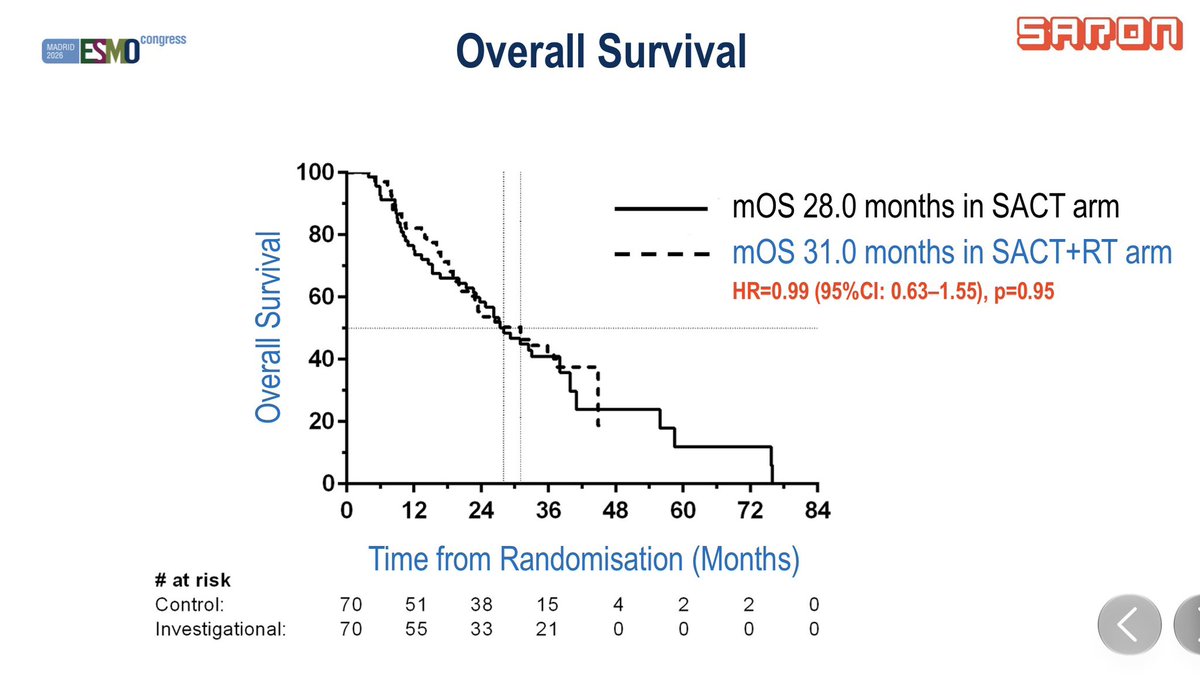
| Arm | mOS | HR (95% CI) | p |
|---|---|---|---|
| SACT (control) | 28.0 months | 0.99 (0.63-1.55) | 0.95 |
| SACT+RT | 31.0 months |
+1 more figure

11 details 2 trials watching
Randomised phase II, 1:1 by minimisation, stratified by histology, N-stage, met number, brain mets, SACT and site. N=200 registered, N=134 randomised; follow-up for 3 years or until death.
De novo synchronous oligometastatic NSCLC without driver mutation: 1-5 mets in up to 3 organs, PS 0-1, PET-CT and brain CT/MRI staged. Brain mets allowed only with at least one extracranial met. Randomised only with CR/PR/SD and PS 0-2 after 6-8 weeks induction SACT.
Conventional RT or SABR to the primary (+/- nodes) plus SABR/SRS to all metastases, delivered within a window of up to 4-6 further weeks of induction SACT. Dose and fractionation not reported in source.
PFS, OS, QoL and AEs reported. Which endpoint was primary is not stated in source.
PFS improved with RT (no effect size in source). OS HR 0.99 (95% CI 0.63-1.55), p=0.95; mOS 31.0 vs 28.0 mo.
No significant difference in AEs or QoL per presenter; no rates in source.
Gomez (Lancet Oncol 2016) and Iyengar (JAMA Oncol 2018) supported LCT after chemotherapy, while Elamin (ESMO 2025) and Iyengar (ASCO 2024) found no LCT benefit in oligo-persistent disease on chemo-IO. SARON's OS-null result sits with the latter.
The schema lists 134 randomised but the OS at-risk table shows 70 per arm, unresolved in source. Maintenance SACT was permitted, and its use by arm is not reported.
Comprehensive RT bought PFS without measured toxicity or QoL cost, but no OS benefit at this sample size. The CI is wide enough that a moderate OS effect in either direction is not excluded.
Randomised phase II, but source names no primary endpoint and gives no PFS magnitude; the only quantified result is a null OS with a wide CI.
- Does the PFS gain translate to OS with longer follow-up? recruiting Standard Maintenance Therapy (SMT) vs Local Consolidative Radiation Therapy and SMT in OM-NSCLC Phase 3n=190 · primary completion 2026-04 · phase 3 LCRT + maintenance vs maintenance, 1-5 mets
- Role of consolidation RT on a chemo-immunotherapy backbone not yet Local Consolidative Therapy Versus Maintenance Immunotherapy After First-Line Chemoimmunotherapy in Metastatic NSCLC Phase 2n=117 · primary completion 2029-12 · LCT vs maintenance IO after 1L chemo-IO PR
- Which oligometastatic subsets benefit (met number, brain mets)?
📚 Sources · 🐦 1 tweet
Presenting the UK’s SARON study Dr @fifimcdrmh to a full hall at #ESMO26
— Gerry Hanna (@gerryhanna) October 25, 2026
In patients with de novo oligometastatic mutation driver negative #NSCLC , consolidation radiotherapy to the primary and metastases improved PFS but no OS
No significant difference in QOL or AEs
Huge… pic.twitter.com/EmWoQXHalE
DeLLphi-305 NCT06211036
ForES-SCLC, no progression after 1L platinum-etoposide + durvalumab, ECOG 0-1
HR 0.42
95% CI 0.32-0.54, P<0.001; mOS 21.1 vs 12.7 mo
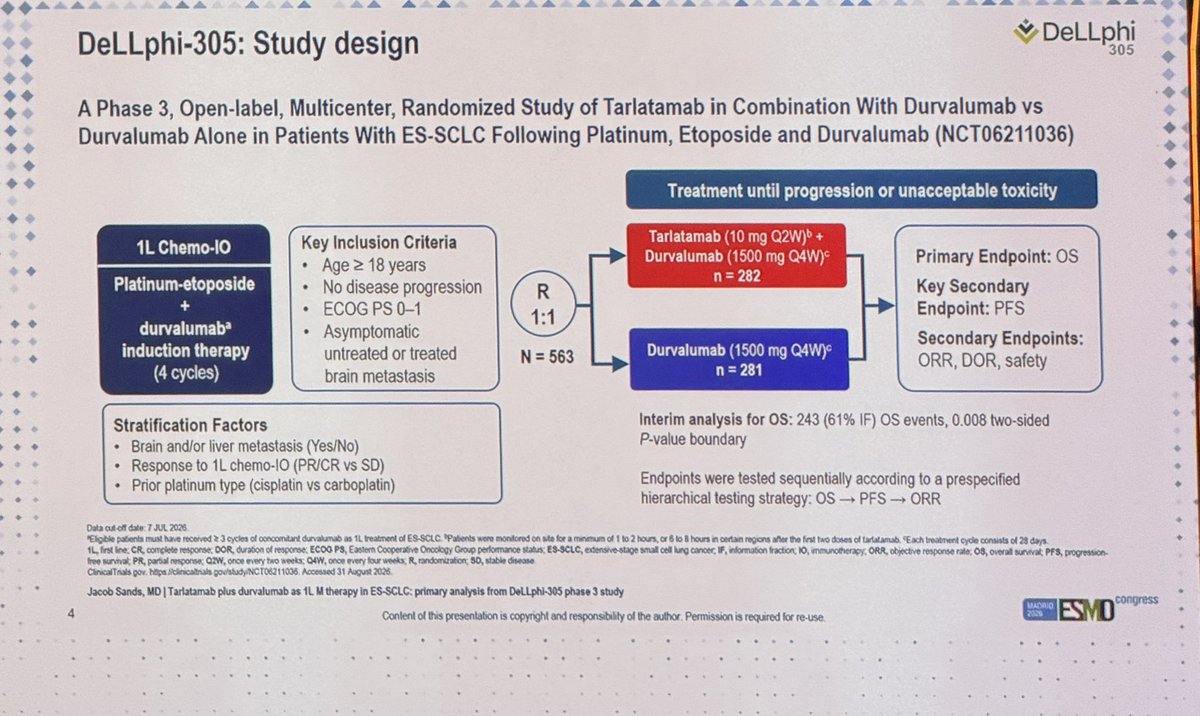
TL;DRmOS 21.1 vs 12.7 mo, HR 0.42 (0.32-0.54), adding tarlatamab to durvalumab 1L maintenance in ES-SCLC after chemo-IO induction.
Asymptomatic untreated brain mets were eligible and brain/liver mets were a stratification factor, so a cranial-disease subgroup read should exist; it is not in the source. The source also does not state whether consolidative thoracic RT or PCI was permitted, which gates how this maintenance backbone integrates with RT consolidation in ES-SCLC.
In ES-SCLC with no progression after 4 cycles of platinum-etoposide + durvalumab and ECOG 0-1, including asymptomatic brain mets, this supports adding tarlatamab to durvalumab maintenance; it does not inform pts who progressed on induction or ECOG ≥2. The longer read
Adds a BiTE to durvalumab maintenance with an OS HR of 0.42 and mOS 21.1 vs 12.7 mo, moving tarlatamab from later-line into 1L maintenance for induction nonprogressors. The post-dose monitoring requirement (1-2h, 6-8h in some regions) is an operational cost to plan for; AE rates are not in the source.

| Metric | Tarlatamab + Durvalumab (n = 282) | Durvalumab (n = 281) |
|---|---|---|
| Median OS, mo (95% CI) | 21.1 (20.8-NE) | 12.7 (11.2-14.8) |
| Median FU, mo | 15.9 | 16.1 |
| HR (95% CI); P | 0.42 (0.32-0.54); P < 0.001 | ref |
+2 more figures

10 details 1 trial watching
Phase 3, open-label, multicenter, randomized 1:1, N=563. OS interim analysis at 243 events (61% IF), two-sided boundary 0.008. Data cutoff 7 Jul 2026.
ES-SCLC after 4 cycles platinum-etoposide + durvalumab induction with no disease progression, ECOG PS 0-1, age ≥18. Asymptomatic untreated or treated brain mets allowed.
Tarlatamab 10 mg Q2W + durvalumab 1500 mg Q4W vs durvalumab 1500 mg Q4W alone, 28-day cycles, until progression or toxicity. On-site monitoring 1-2h (6-8h in some regions) after early tarlatamab doses.
Primary: OS. Key secondary: PFS. Secondary: ORR, DOR, safety. Tested hierarchically OS → PFS → ORR.
mOS 21.1 vs 12.7 mo, HR 0.42 (0.32-0.54), P<0.001; PFS 7.4 vs 1.9 mo, HR 0.34 (0.28-0.42); ORR 26% vs 4%.
| Endpoint | Tarlatamab + durvalumab | Durvalumab | Effect |
|---|---|---|---|
| Median PFS | 7.4 mo | 1.9 mo | HR 0.34 (0.28-0.42), P<0.001 |
| ORR | 26% | 4% | n/a |
Control arm is the current chemo-IO maintenance standard established by CASPIAN-era durvalumab, so the comparator is contemporary. Tarlatamab previously moved into later lines (DeLLphi-304); this trial tests it earlier, in the maintenance window.
Efficacy stop at 61% IF risks an inflated HR; median FU ~16 mo leaves the OS tail unknown. No safety data in source, and thoracic RT/PCI permissibility not stated.
A BiTE added at the point of maximal disease control nearly halves the death hazard over durvalumab alone. Unsettled: toxicity cost, durability beyond the interim, and integration with consolidative RT.
CONSORT flow
Randomized phase 3, OS primary met at prespecified interim boundary, labeled primary analysis; source calls it a game-changer. Safety data absent from source.
- Role of consolidative thoracic RT alongside tarlatamab maintenance
- OS durability with follow-up beyond the interim analysis
- Benefit and safety in pts with brain metastases n=35 · primary completion 2029-02 · ph2 tarlatamab intracranial efficacy, active SCLC brain mets
📚 Sources · 🐦 1 tweet
💥Game-changer in small cell #lungcancer! #ESMO26 LBA3 DeLLphi-305: Tarlatamab + durvalumab vs durvalumab 1L maintenance in ES-SCLC (n=563) after chemo-IO. Median OS ⬆️ 21.1 vs 12.7 mo (HR 0.42), PFS ⬆️7.4 vs 1.9 mo (HR 0.34), ORR 26% vs 4%. ☢️44% of pts still on T+D due to… pic.twitter.com/zwBot7Pt3N
— Shankar Siva (@_ShankarSiva) October 24, 2026
STAMPEDE, ENZARAD, PROTEUS and DASL in context
TL;DRESMO26 round-up of four intensification trials. STAMPEDE Decipher update suggests differential abiraterone benefit in cN0 disease (interaction P=.01).
STAMPEDEENZARADPROTEUSDASL
The RT-relevant read is that STAMPEDE's abiraterone benefit was reported as predominantly in pts receiving RT, and the ESMO26 Decipher data suggest the abiraterone benefit differs in cN0 disease (interaction P=.01). Subgroup HRs are not reported in source text, so this flags, rather than settles, genomic selection of who gets abiraterone added to RT.
STAMPEDE's abiraterone benefit was reported as predominantly with RT, so the intensification question sits on the RT backbone. The ESMO26 Decipher interaction in cN0 (P=.01) hints at genomic selection for adding abiraterone to RT; subgroup magnitudes are not in the source.
The Decipher update suggests abiraterone benefit is not uniform in cN0 disease (interaction P=.01), raising biomarker-gated intensification. No subgroup HRs are reported in source, and the ENZARAD, PROTEUS and DASL updates are not described in the truncated tweet.
Also covered Jul 15
7 details
- 🔍 Trade-press-style round-up tweet placing STAMPEDE, ENZARAD, PROTEUS and DASL against #ESMO26 updates
- 🔍 Disease state and RT dose/fractionation not stated in source
- 📊 STAMPEDE: abiraterone-based intensification improved MFS and OS, predominantly with RT, per source
- 📊 New #ESMO26 Decipher data: differential abiraterone benefit in cN0 disease, interaction P=.01
- ⚠️ No effect size reported in source tweet for MFS, OS, or the Decipher subgroups
- ⚠️ Decipher interaction is a biomarker subgroup analysis; hypothesis-generating until validated
- ⚠️ Tweet is truncated; ENZARAD, PROTEUS and DASL updates are not described in the source text
- Does Decipher score select cN0 pts for abiraterone with RT?
- Where do ENZARAD, PROTEUS and DASL fit relative to STAMPEDE?
📚 Sources · 🐦 1 tweet
Putting STAMPEDE, ENZARAD, PROTEUS & DASL into context with the latest #ESMO26 updates:
— Himanshu Nagar (@HimanshuNagarMD) October 24, 2026
STAMPEDE: Abiraterone-based intensification improved MFS AND OS, predominantly with RT. New #ESMO26 Decipher data suggests differential abi benefit in cN0 disease (interaction P=.01); using…
DASL-HiCaP NCT04135353
ForVery high-risk or N1 prostate, radical or early salvage RT + 2y ADT
HR 0.42
95% CI 0.27-0.66, p=0.0001; 4-yr MFS-CI 95% vs 88%
TL;DR4-yr MFS-CI 95% vs 88%, HR 0.42, adding darolutamide to prostate/bed + pelvic LN RT and 96 wk ADT in very high-risk prostate cancer.
Every metastasis-free survival (MFS) difference comes from metastases (9 vs 46). Deaths without prior metastases were 18 vs 17. Both arms got prostate/bed plus pelvic nodal RT with 96 wk ADT, so this is darolutamide on top of an already intensified RT backbone, in both radical and salvage settings. RT dose was not reported.
For a very high-risk patient (GG5, GG4 with adverse T stage or PSA, or cN1/pN1) planned for pelvic nodal RT with 2y ADT, this supports discussing darolutamide intensification. It does not extend to shorter ADT courses or to RT without nodal coverage. The longer read
Darolutamide cut metastases (9 vs 46) even though both arms got pelvic nodal RT and 96 wk ADT, so nodal coverage did not remove the distant-failure risk the drug addresses. The result covers both radical and early salvage RT. Dose/fractionation is not in the source, so it can't be checked against your own regimen.
The secondary endpoints all point the same way: time to CRPC HR 0.22 (0.09-0.52) and subsequent hormonal therapy HR 0.36 (0.21-0.60). This makes darolutamide the ARPI with placebo-controlled data alongside 2y ADT and RT. OS HR 0.88 (0.49-1.59) is still immature.
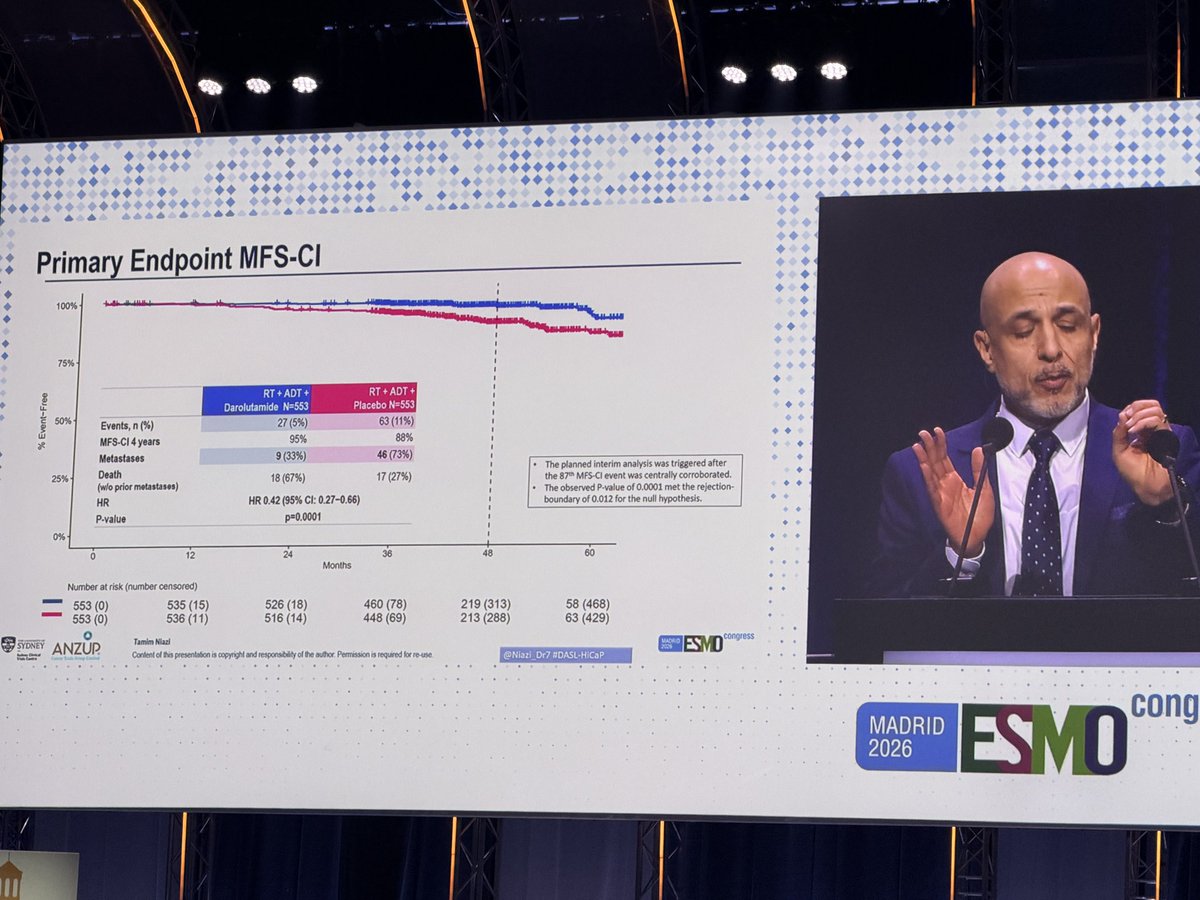
| MFS-CI | RT + ADT + Darolutamide N=553 | RT + ADT + Placebo N=553 |
|---|---|---|
| Events, n (%) | 27 (5%) | 63 (11%) |
| 4-yr MFS-CI | 95% | 88% |
| Metastases | 9 (33%) | 46 (73%) |
| Death (w/o prior metastases) | 18 (67%) | 17 (27%) |
| HR (95% CI), p | 0.42 (0.27-0.66), p=0.0001 | ref |
+2 more figures
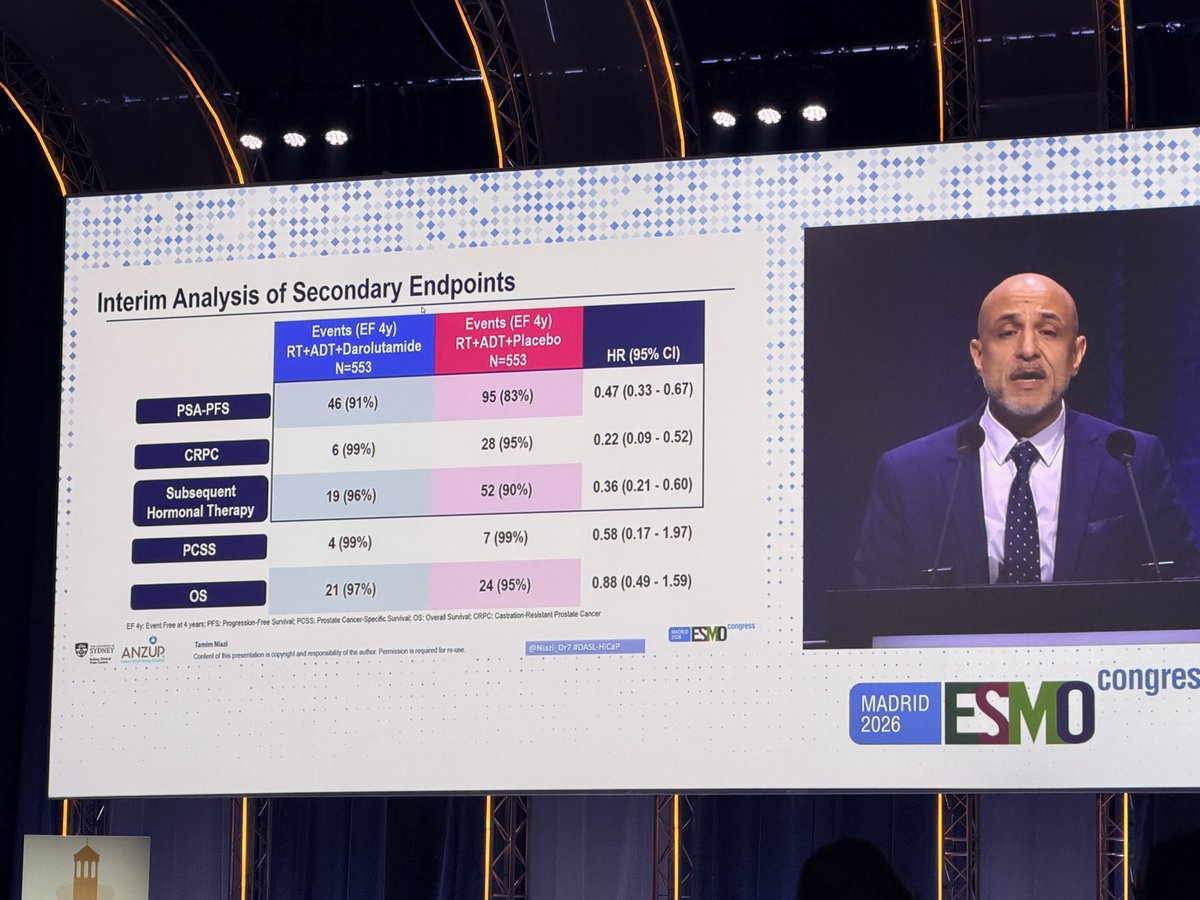
| Secondary endpoint (interim) | HR (95% CI) |
|---|---|
| PSA-PFS | 0.47 (0.33-0.67) |
| CRPC | 0.22 (0.09-0.52) |
| Subsequent hormonal therapy | 0.36 (0.21-0.60) |
| PCSS | 0.58 (0.17-1.97) |
| OS | 0.88 (0.49-1.59) |
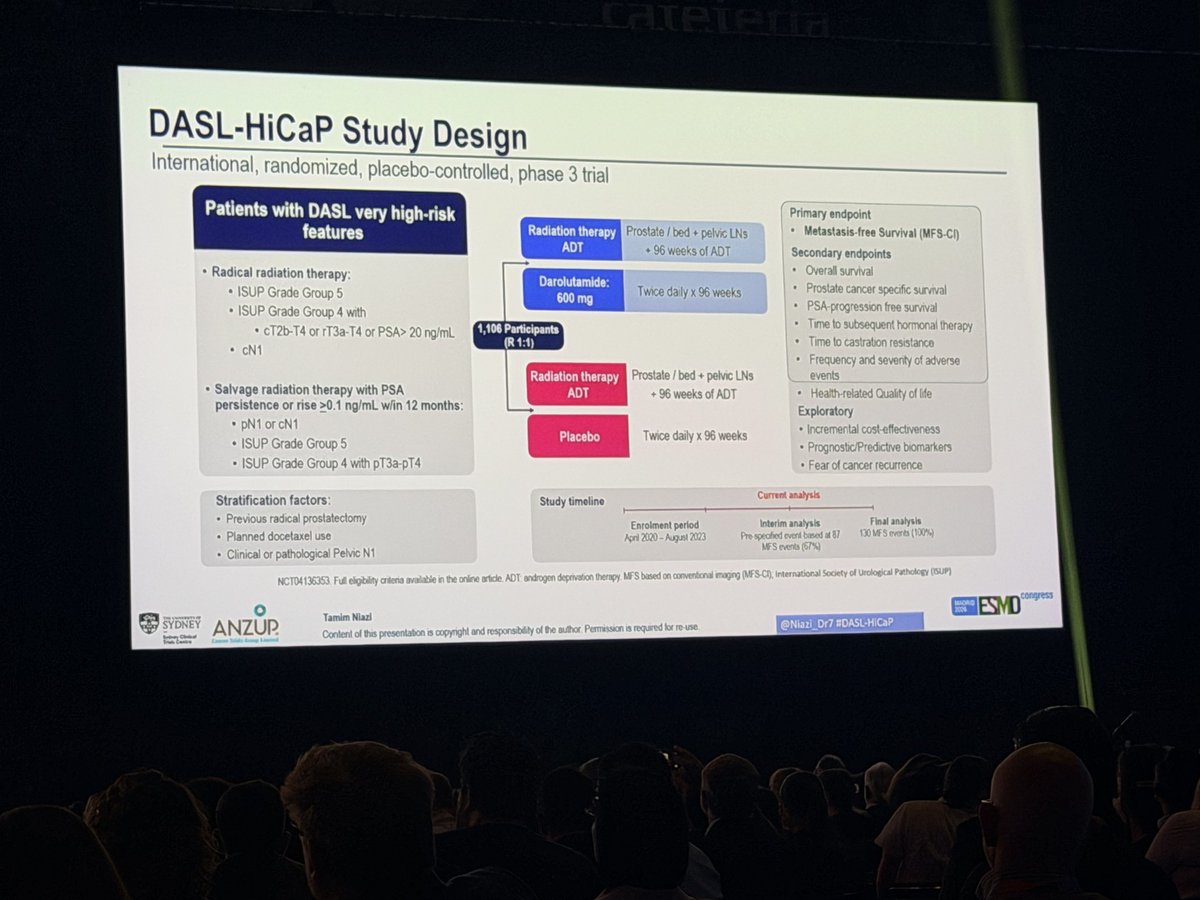
9 details
International, randomized, placebo-controlled phase 3, 1:1, N=1,106. Enrolment April 2020 to August 2023. Interim analysis triggered at the 87th MFS-CI event (67%); final analysis planned at 130 events.
DASL very high-risk pts getting radical RT (ISUP GG5, GG4 with cT2b-T4 / rT3a-T4 / PSA >20 ng/mL, or cN1) or salvage RT for PSA persistence or rise ≥0.1 ng/mL within 12 mo with pN1/cN1, GG5, or GG4 pT3a-pT4. Stratified by prior RP, planned docetaxel, pelvic N1.
Darolutamide 600 mg BID x 96 wk vs placebo. Both arms got 96 wk ADT. Docetaxel use was allowed as a stratification factor.
Both arms: prostate/bed + pelvic LNs. Dose, fractionation and imaging used for staging are not reported in the source.
Primary: MFS by conventional imaging (MFS-CI). Secondary: OS, PCSS, PSA-PFS, time to subsequent hormonal therapy, time to castration resistance, AEs, HRQoL.
Primary met at interim, HR 0.42 (0.27-0.66), p=0.0001, against a rejection boundary of 0.012. Authors report the benefit was consistent across all subgroups (no subgroup HRs in source).
Authors describe the treatment burden as similar to placebo. No AE rates or grade breakdown in source.
This sits alongside ENZARAD and the STAMPEDE M0 abiraterone work, which ask the same ARPI-plus-RT intensification question. DASL-HiCaP is the placebo-controlled test, it mandates pelvic nodal RT in both arms, and it includes an early-salvage cohort.
Event-driven interim with only 27 vs 63 events, so the estimate may shrink by the final analysis. MFS is read on conventional imaging, which may not match PSMA-staged practice. Primary vs salvage results are not shown separately.
The drug's effect is on metastases, not competing mortality, which supports a real anticancer benefit. Whether it becomes an OS benefit at PCSS HR 0.58 and OS HR 0.88 is still unknown.
CONSORT flow
Clean placebo-controlled phase 3, but this is the interim analysis (87/130 events). MFS is a surrogate and OS is immature. The prespecified final analysis is the gate.
- Does the MFS benefit translate to OS at final analysis?
- Is benefit similar in salvage vs radical RT cohorts?
- Does the effect hold in PSMA-PET staged pts?
📚 Sources · 🐦 1 tweet
DASL-HiCaP at #ESMO26, presented by @Niazi_Dr7: darolutamide + RT + 2 yrs ADT vs placebo in very high-risk prostate cancer (n=1,106)
— Alan Tan (@alantanmd) October 24, 2026
▪️ MFS HR 0.42, 4-yr MFS 95% vs 88%
▪️ PSA-PFS HR 0.47
▪️ Time to CRPC HR 0.22
▪️ OS immature (HR 0.88)#ProstateCancer pic.twitter.com/pfDHyuM2qW
PROTEUS Substudy
ForHR LPC/LAPC, conventionally staged M0, planned RP + PLND
HR 0.38
95% CI 0.26-0.55, p<0.0001
TL;DREFS HR 0.38 (95% CI 0.26-0.55) with perioperative apalutamide + ADT around RP + PLND in HR LPC/LAPC; MFS HR 0.49, nominal p only.
The testosterone curve is the hidden read: T recovery to ≥200 ng/dL took a median 20.7 mo (~9 mo from EOT), so much of the EFS window is BCF assessed under residual castration. TTST medians of 46.0 vs 12.3 mo carry ~20 mo of lead-time, which leaves the durable-benefit question with MFS and its nominal p=0.0193.
In conventionally staged HR LPC/LAPC headed for RP + PLND, this supports perioperative APA + ADT as an EFS-delaying option under discussion; it does not extend to PSMA PET-staged pts or to men treated with definitive RT. The longer read
Testosterone recovery took a median 20.7 mo (~9 mo from EOT), so the EFS gain is partly measured during residual castration. MFS HR 0.49 with nominal p=0.0193 is the endpoint that will decide whether perioperative APA + ADT changes disease course or only delays PSA events.
The surgical backbone was unchanged (RP + PLND in both arms), and the control arm's adjuvant management was left to physician discretion. Without baseline PSMA PET, some conventionally staged M0 candidates may have had occult disease, which matters when selecting HR LPC/LAPC pts for RP.

| Arm | Median | Rate (95% CI) |
|---|---|---|
| APA + ADT | Not reached | 63.0% (52.2-71.9) |
| RP + PLND alone | 19.1 months | 41.4% (35.6-47.1) |
| HR 0.38 (95% CI 0.26-0.55) | p<0.0001 | n/a |
+3 more figures

| Metastasis detection method, n (%) | APA + ADT | RP + PLND |
|---|---|---|
| PSMA PET | 9 (8.8) | 50 (16.3) |
| Conventional imaging | 1 (1.0) | 6 (2.0) |
| MFS HR 0.49 (95% CI 0.26-0.90) | nominal p=0.0193 | n/a |

| Arm | Median time to first subsequent therapy |
|---|---|
| APA + ADT | 46.0 months |
| RP + PLND alone | 12.3 months |
| HR 0.29 (95% CI 0.20-0.43), nominal p<0.0001 | n/a |
11 details 1 trial watching
Randomized 1:3, open-label, N=408, accrual July 2022 to October 2023. Stratified by cN0 vs cN1, Gleason 7 vs 8-10, and region. Phase not stated in source.
HR LPC/LAPC, conventionally staged M0 (CT + bone scan). No baseline PSMA PET.
APA 240 mg QD + ADT for 6 cycles neoadjuvant, RP + PLND, then 6 cycles adjuvant. Control: RP + PLND with local or systemic adjuvant tx at physician discretion.
Primary: EFS, time to first BCF (PSA progression), LRR, DM or death. Secondary/exploratory: MFS, time to first subsequent therapy.
EFS HR 0.38 (0.26-0.55), p<0.0001; MFS HR 0.49 (0.26-0.90), nominal p=0.0193; TTST HR 0.29 (0.20-0.43), nominal. Per-arm values in the figure captions.
proPSMA showed PSMA PET staging accuracy of 92% vs 65% for CT + bone scan, and EAU/ESMO advise PSMA PET/CT for high-risk disease where available. PROTEUS staged without it, so its M0 population differs from a modern PSMA-staged cohort.
1:3 allocation leaves 102 pts in the experimental arm. The control adjuvant strategy was at physician discretion, so the comparator is heterogeneous. Safety magnitudes were truncated in the source.
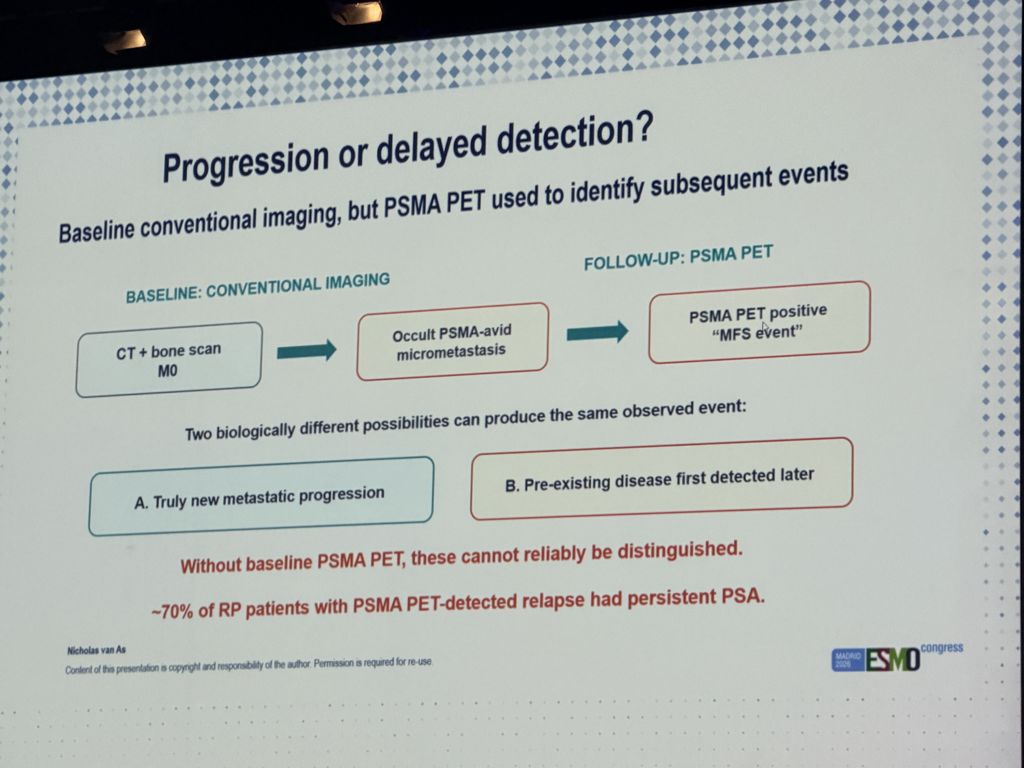
Lead-time from treatment exposure and slow testosterone recovery inflate the early-window endpoints. Whether metastatic progression is truly delayed, rather than PSMA-avid disease being detected later, is not settled without baseline PSMA PET.
CONSORT flow
Randomized, EFS met, but EFS leans on PSA failure during slow testosterone recovery; MFS nominal and PSMA-detection driven; TTST lead-time biased; no baseline PSMA PET.
- Does the EFS benefit hold in PSMA PET-staged M0 pts?
- Will MFS reach non-nominal significance with longer follow-up? n=2517 · primary completion 2026-12 · phase 3 parent RCT, MFS 1° EP vs placebo + ADT
- Does any benefit persist after testosterone recovery?
📚 Sources · 🐦 2 tweets
PROTEUS Substudy: Periop Apa + ADT with RP+PLND vs RP+PLND in HR PCa @urotoday #ESMO26
— Zach Klaassen (@zklaassen_md) October 24, 2026
Periop APA + ADT (+ RP+PLND; n= 102) vs RP+PLND alone (n=306)
🚨EFS: HR 0.38, 95% CI 0.26–0.55
🚨MFS: HR 0.49, 95% CI 0.26–0.90
🚨TT 1st Sub Rx: HR 0.29, 95% CI 0.20–0.43
🚨All Gr Hot Flush:… pic.twitter.com/v7zhSfLzrR
#ESMO26 PROTEUS discussion by Nicholas van As
— Alan Tan (@alantanmd) October 24, 2026
• No baseline PSMA PET; enrolled conventionally staged M0
• MFS events: true progression or delayed detection? Most were PSMA PET-detected (8.8% vs 16.3%)
• TTST HR 0.29, but ~20-mo lead-time bias#ProstateCancer pic.twitter.com/FfugtpcYwU