Consensus / guideline
Organs at Risk Radiation Dose Constraints: 2025 Update
TL;DRSFRO 2025 OAR dose-constraint update: normofractionated, moderate hypofractionated and ablative tables across skull base, H&N, lung, breast, oesophagus, liver.
START BFAST-FORWARDRTCMIENDOMETRE
The practical shift is coverage of ablative regimens per fraction number (1, 3, 4, 5, 8) alongside normofractionation, plus cardiac substructures (LAD, left ventricle) and a proposed dorsal vagal complex OAR. Numbers are tiered optimal vs mandatory, so a plan that exceeds an optimal value is a documented conversation, not a violation.
Practical shift is the per-fraction-number ablative columns (1, 3, 4, 5, 8) sitting alongside normofractionation in one grid, plus cardiac substructures (LAD, left ventricle) as constrained organs. The optimal versus mandatory tiering is what changes planning behaviour: it names which values are negotiable against target coverage.
12 details
SFRO consensus update, part of the RecoRad 4th edition, covering adult external beam radiotherapy and brachytherapy practice. Constraints were compiled from international consensus guidelines and clinical trial data, then validated by national reference experts rather than derived from a new dataset.
Tables are indexed by tumour site and by fractionation: normofractionation, moderate hypofractionation, accelerated hyperfractionation (lung), and ablative regimens split by fraction number (1, 3, 4, 5, 8). Dmax is approximated by D2 % in normofractionation and D0.035 cm3 in stereotactic plans; several hypofractionated entries are given as EQD2.
No clinical endpoint. The deliverable is a set of dose-volume objectives intended for direct implementation into treatment planning systems as standardized clinical objectives.
Constraints are tiered as optimal versus mandatory, with ALARA used where no numeric threshold is offered (parotid in the brain table, lacrymal gland under moderate hypofractionation). The authors require that pts be informed of the risk when a constraint is exceeded.
Breast constraints are anchored to the schedules of START B (40 Gy in 15) and FAST-FORWARD (26 Gy in 5); liver constraints are built on the ASTRO clinical practice guideline across 3, 5 and ≥ 20 fractions. This is a national harmonization layer over those sources, not a competing evidence synthesis.
The authors state most constraints still rest on 3D conformal-era data, which sits awkwardly with IMRT's larger low-dose bath and with ablative dose gradients. Biological modifiers of risk (individual radiosensitivity, genomic profile, concurrent immunotherapy) are not accounted for, and dose to immune organs at risk is named as unresolved.
The value here is harmonization, not novelty: the stated problem is the multiplicity of circulating constraint sets and the absence of a single reference. The optimal/mandatory tiering is the part that changes daily behaviour, because it tells a planner which values are negotiable against target coverage and which are not.
- Validity of 3D conformal-derived constraints under IMRT and SBRT
- Dose thresholds for immune organs at risk with concurrent immunotherapy
- Dorsal vagal complex as an OAR for radiation-induced nausea
📚 Sources · 📄 1 paper
BEACON-HCC
ForHCC across all stages, North American practice context
TL;DRNew North American HCC allocation framework; expert decisions 96.6% concordant with BEACON vs 72.4% with BCLC 2025 across 29 cases.
First major allocation framework to place EBRT/SBRT alongside TARE as a first-line locoregional option rather than a BCLC afterthought, extending to Class 1D (Vp1-2) and Class 3B (Vp3/4). The panel's own citation base for Class 3B is RTOG1112, which showed only a trend (p=0.06) for SBRT vs sorafenib, so the elevation runs ahead of randomised evidence.
For a cirrhotic patient with unifocal HCC not eligible for resection or transplant, this framework treats SBRT as a legitimate first-line ablative option rather than a fallback; it does not apply to Class 4A, where the panel explicitly withholds EBRT outside symptom palliation.
SBRT enters the allocation boxes as a first-line locoregional option across Classes 1A through 3A, not a salvage line, which changes referral expectations at tumor board. No dose or fractionation is specified anywhere in the framework, and the Class 3B citation is RTOG1112 at p=0.06, so the elevation runs ahead of randomised evidence.
The framework pushes back on reflexive systemic therapy for macrovascular invasion: Class 1D (Vp1-2) is routed to local or surgical options, and adjuvant therapy after complete response is explicitly not recommended. Systemic therapy stays the cornerstone only for Class 3B, 4A, and 4B.
Resection is preferred without CSPH, transplant with it, and both extend beyond early stage after downstaging response. Class 3B carries a cited RCT showing resection after neoadjuvant radiation beat up-front resection, and Vp1-2 patients with deep durable responses become transplant candidates rather than automatic exclusions.
9 details 4 trials watching
Modified Delphi consensus, 20 North American multidisciplinary experts, iterative discussion and voting over two rounds. Followed by a 29-case pilot concordance exercise against external experts.
Framework spans the full HCC spectrum, from unifocal ≤3 cm (Class 1A) to distant metastases (Class 4B). Class assignment keys on tumor burden, Vp level of portal invasion, and poor prognostic features (>8 cm, AFP >1000 ng/mL, poor differentiation).
EBRT including SBRT is named a first-line locoregional option in Classes 1A through 3A, on par with TARE, RFA/MWA, and TACE. No dose or fractionation is specified anywhere in the framework: the stated rationale is ablative dose delivered selectively to limit radiation-induced liver injury. In Class 4A, EBRT is not routinely indicated outside palliation of symptomatic disease.
Expert decisions matched BEACON in 28 of 29 cases (96.6%) vs 72.4% for BCLC 2025. The single discordant case was combination systemic plus locoregional therapy for vascular invasion reaching the right atrium.
| BEACON class | BCLC 2025 | AJCC v8 | Adaptation from BCLC |
|---|---|---|---|
| Class 1A | Very early (0) or early (A) | Stage 1A or 1B | Aligned; framework elevates SBRT and TARE |
| Class 1B | Early (A) | Stage 1B | Aligned |
| Class 1C | Early (A) | Stage 2 | Aligned |
| Class 1D | Advanced (C) | Stage 2 | Macrovascular invasion may suit local or surgical therapy: TARE, SBRT, resection |
| Class 2 | Early (A) | Stage 1A or 1B | Aligned; framework elevates SBRT and TARE |
| Class 3A | Intermediate (B) or advanced (C) | Stage 3A | Aligned; framework elevates SBRT and TARE |
| Class 3B | Advanced (C) | Stage 3B or 4A | Macrovascular invasion may be amenable to local therapy in selected cases |
| Class 4A | Intermediate (B) | Stage 3A | Extensive intrahepatic spread treated as systemic process |
| Class 4B | Advanced (C) | Stage 4B | Stage and treatment framework aligned |
BCLC keeps radiation outside its core allocation algorithm; BEACON moves it in. The supporting evidence the panel cites is uneven: DOSISPHERE (ORR 71 vs 36%, OS 26.6 vs 10.7 mo) for personalized-dosimetry TARE is randomised, while the SBRT case in Class 3B rests on RTOG1112, which reached only p=0.06 for OS vs sorafenib.
The 72.4% BCLC comparator was scored by BEACON's own authors against cases the same group selected, and 29 cases cannot exercise nine classes evenly. Round-1 per-class agreement is unreadable from the source table because vote counts and class labels arrived unpaired.
The framework's real claim is that intrahepatic burden and Vp level, not BCLC's stage buckets, should drive allocation, and that radiation-based modalities are burden-appropriate rather than stage-restricted. Whether that improves outcomes is untested: validation against empiric clinical data is deferred to the HCC-Live Consortium.
Delphi consensus framework, not an efficacy study. Concordance figures measure opinion against opinion. Elevates EBRT/TARE to first-line locoregional status in a formal allocation system.
- Head-to-head SBRT vs TARE for liver-confined HCC n=146 · primary completion 2028-12 · randomised phase 2 TARE vs SBRT, =3 HCC lesionsrecruiting Comparison of SBRT and SIRT With Combination IO for Locally-advanced, Unresectable HCCs (BIIRTH) Phase 2/3n=106 · primary completion 2034-03 · TACE-SBRT vs Y90 SIRT, PFS primary
- Does BEACON allocation improve survival vs BCLC allocation
- Optimal sequencing of ICI with locoregional therapy active Durvalumab/Tremelimumab in Neoadjuvant and Adjuvant Setting in Patients With HCC Treated by by Percutaneous Ablation Procedure Phase 2n=30 · primary completion 2027-09 · durva/treme before and after percutaneous ablationrecruiting Using Radiotherapy and Immunotherapy to Treat Advanced Liver Cancer Before Transplant Phase 1/2n=48 · primary completion 2031-06 · Y90/SBRT plus atezo-bev, transplant conversion
📚 Sources · 📄 1 paper
Abstract
IROCK Contouring Guidelines (RCC SABR)
ForLocalized RCC considered for SABR, including IVC thrombus, post-RN or post-RFA recurrence
TL;DRFirst international consensus contouring atlas for RCC SABR: median DSC 0.85 across 16 experts, 4 scenario-specific iGTV statements.
The two hardest scenarios are named and quantified: Case 1 (IVC thrombus) and Case 4 (post-RFA cavity) carried the worst agreement (DSC 0.85 and 0.75, HD 64.60 and 9.00 mm), driven by how far superiorly thrombus was covered and how much cavity was included. Both statements push toward larger volumes, so OAR priority and a 5 mm PTV are the gates on whether that transfers.
In a patient with post-RFA residual RCC or an IVC tumor thrombus being planned for SABR, this defines the target as the whole ablation cavity or the full thrombus rather than the visible nodule alone; it does not address dose selection or whether SABR beats nephrectomy.
Case 1 (IVC thrombus) and Case 4 (post-RFA cavity) carried the worst agreement, DSC 0.85 and 0.75 with HD 64.60 and 9.00 mm, and both consensus statements push toward the larger volume: full thrombus, entire ablation cavity. OAR constraints outrank coverage, and the 5 mm PTV assumes 4D-CT with daily CBCT.
12 details
International contouring consensus under IROCK, convened at ASTRO 2023. 16 radiation oncologists contoured 4** RCC SABR scenarios on CT alone via EduCase; a STAPLE algorithm generated the 95% consensus contour, refined across 2 online meetings in May and June 2024. Statements were revised to uniform (100%) agreement**.
Panelists, not patients: inclusion required ≥10 prior RCC SABR cases, with 14 of 16 having treated ≥10 in the preceding 12 months. Cases were a >10 cm RCC with IVC tumor thrombus, a central tumor abutting the hilum, a local recurrence post-nephrectomy, and a post-RFA cavity recurrence.
Target is the iGTV (GTV incorporating internal motion); no participant added a microscopic-spread margin, so no separate ITV is recommended. The most common PTV expansion was a uniform 5 mm, predicated on supine vacuum-cushion setup, 4D-CT sim, IV contrast and daily CBCT. Dose objectives and OAR constraints for 1, 3, or 5 fractions are tabulated from FASTRACK-II and AQuOS-II.
Overall median DSC 0.85 (range 0.40-0.95), median MDA 2.17 mm (0.71-10.82), median HD 9.00 mm (4.00-89.31), with DSC above 0.70 in every case. Two-way ANOVA showed all three metrics differed by case (P < .05); only MDA differed by participant (P = .03).
| Case | DSC | MDA (mm) | HD (mm) |
|---|---|---|---|
| 1: >10 cm RCC + IVC thrombus | 0.85, 0.79-0.85 | 6.69, 5.88-8.79 | 64.60, 64.44-86.40 |
| 2: central tumor at hilum | 0.90, 0.84-0.93 | 1.55, 1.00-2.09 | 7.92, 5.35-9.98 |
| 3: local recurrence post-RN | 0.91, 0.88-0.93 | 1.42, 1.18-1.89 | 6.18, 6.00-7.12 |
| 4: post-RFA cavity recurrence | 0.75, 0.60-0.79 | 2.50, 2.12-2.99 | 9.00, 9.00-12.39 |
IROCK previously supplied the outcome evidence (its pooled international analyses and the FASTRACK-II phase 2), and both showed heterogeneous dose, fractionation and planning conventions across contributing centers. This fills the delineation gap those datasets left open, and it borrows its constraint table from FASTRACK-II and the ongoing AQuOS-II rather than deriving new dose-response thresholds.
The renal substructure question is left deliberately unsettled: cortex is defined for use, hilum is explicitly not a dose-limiting OAR, on the reasoning that sparing an unvalidated structure would redistribute dose into parenchyma that does correlate with renal function. AQuOS-II is the trial that may resolve it.
CT-only images were supplied on purpose, for international accessibility, so measured variation likely overstates what an MRI-equipped center would see. Participants never recontoured post-consensus, so the guideline's own effect on agreement is unmeasured, and adoption assumes urology, radiology and nephrology collaboration plus advanced planning technology.
Expert consensus atlas, not an outcome study: 16-panel STAPLE contours with unanimous statements, no efficacy or toxicity endpoint, unvalidated prospectively.
- Does renal hilum sparing reduce artery stenosis or ureteric stricture?
- Does guideline adherence improve local control or reduce toxicity?
- Would MRI-based simulation narrow contour variability?
📚 Sources · 📄 1 paper
ESTRO Prostate SBRT Consensus Recommendations
TL;DRDelphi: 36.25 Gy/5 fx standard, 100% vote against elective pelvic nodal RT with prostate SBRT outside trial.
PACE-BPACE-CHYPO-RT-PCNRG-GU005hypo-FLAMEMIRAGEPARTIQoL
Two operational lines move practice: elective pelvic nodal RT alongside prostate SBRT is rejected 100% (12 votes) outside a trial, and intra-fraction tracking is only carried by 71% (10 votes) once PTV margin drops below 5 mm, no consensus. Prior BPH surgery is permitted with a median 6-month wait (range 2-12).
In ISUP 2-3, cT1c-cT2c, PSA <20 ng/mL localised prostate cancer, this supports five-fraction SBRT as a standard option without elective pelvic nodal coverage or a rectal spacer; it does not extend to cT3b, ISUP 5, or pts needing nodal irradiation.
The actionable lines are operational: no elective pelvic nodal RT with prostate SBRT outside a trial (100%, 12 votes), no routine rectal spacer (85%, 11 votes), and intra-fraction tracking only at 71% (10 votes) once PTV margin falls under 5 mm. Standard is 36.25 Gy/5 fx to 95% PTV with 40 Gy to 95% CTV.
15 details 5 trials watching
ESTRO task force literature review, then two Delphi survey rounds with a purposively selected expert panel, refined at ESTRO 2025 in Vienna. Ten multiple-choice questions covered areas of controversy. Consensus was predefined at ≥75% agreement, strong consensus at ≥90%, thresholds borrowed from APCCC.
Panel: eleven radiation oncologists, three medical physicists, one RTT from nine European countries. Voting counts per question ran 12 to 14. Target patient population is localised prostate cancer, with ISUP 2-3, cT1c-cT2c, PSA <20 ng/mL carrying strong consensus for SBRT as standard treatment outside a trial.
Standard is 36.25 Gy in five fractions of 7.25 Gy to 95% of the PTV, with 40 Gy to 95% of the prostate CTV (PACE-B), or 42.7 Gy in seven fractions of 6.1 Gy (HYPO-RT-PC). Prostate is contoured on T2-weighted planning MRI registered to CT; seminal vesicles omitted in low risk, proximal 1 cm included for all in PACE, proximal 2 cm to 30 Gy/5 fx in Gleason 4+3 or NCCN high risk. Rectal, bladder, femoral head, bowel and optional urethra PRV / penile bulb / crura constraints are given for five-fraction schedules only.
ADT per existing international guidelines, independent of the radiation schedule (100%, 13 votes). Intermediate risk: short-term ADT with conventional fractionation improves overall and cancer-specific survival by 7%, with no added benefit beyond roughly four months. High risk: long-term ADT plus RT improves overall and disease-specific survival irrespective of dose escalation.
No efficacy endpoint. The output is a set of recommendations plus per-question panel agreement percentages, so every "result" here is opinion measured against opinion.
The dose recommendation tracks PACE-B rather than splitting the difference with HYPO-RT-PC, whose lower biologically effective dose was still non-inferior, which the authors read as evidence 40 Gy in five fractions may not be needed for everyone. The unresolved counterweight is NRG-GU005, presented in preliminary form at ASTRO 2025: 36.25 Gy in five fractions gave lower side effects but a slightly higher three-year biochemical relapse rate, cause not yet determined. On protons, PARTIQoL found no difference in outcomes or QoL versus IMRT, with pencil beam scanning in only 48% of cases.
High-risk practice is running ahead of its evidence: HYPO-RT-PC is the only phase III reporting oncologic outcomes in high-risk pts and they were 11% of participants, while PACE-C has published toxicity but not oncological outcomes. Urethral sparing is recommended on mechanistic and single-study grounds while a post hoc PACE-B analysis found no significant association between urinary substructure dose and late urinary toxicity, and the panel itself flags the PACE-B urethra V42 <50% constraint as possibly too permissive.
The document's real contribution is the negative recommendations: no elective pelvic nodal RT with prostate SBRT outside a trial (100%, 12 votes) and no routine rectal spacer (85%, 11 votes), both areas where practice has drifted ahead of randomised data. It does not settle prostate volume cut-off, prophylactic medication, or whether intra-fraction tracking is required below a 5 mm margin, all of which returned no consensus.
| Category | Recommend SBRT (% of votes) |
|---|---|
| ISUP 2 | 100% (13 votes) |
| ISUP 3 | 100% (13 votes) |
| ISUP 4 | 38% (5 votes) |
| ISUP 5 | 0% (0 votes) |
| cT1c-cT2a | 100% (13 votes) |
| cT2b-cT2c | 100% (13 votes) |
| cT3a | 38% (5 votes) |
| cT3b | 0% (0 votes) |
| cT4 | 0% (0 votes) |
| PSA <20 ng/mL | 100% (13 votes) |
| PSA 20-40 ng/mL | 8% (1 vote) |
| PSA >40 ng/mL | 0% (0 votes) |
| Question | Vote | Level |
|---|---|---|
| Elective pelvic nodal RT with prostate SBRT (Q6) | No 100% (12 votes) | Strong consensus against |
| Bladder/bowel prep protocol (Q8) | Yes 100% (14 votes) | Strong consensus |
| ADT per existing guidelines, fractionation-independent (Q7) | Yes 100% (13 votes) | Strong consensus |
| Rectal spacer (Q9) | No 85% (11 votes) | Consensus against |
| Max IPSS cut-off (Q3) | Yes 85% (11 votes) | Consensus; median 17, range 10-20 |
| Max prostate volume cut-off (Q2) | Yes 62% (8 votes) | No consensus; median 90 cc, range 70-150 |
| Prophylactic meds (α1-blockers etc, Q4) | No 46% (6 votes) | No consensus |
| SBRT after BPH surgery (Q5) | Selected pts with waiting period 100% (13 votes) | Strong consensus; median wait 6 mo, range 2-12 |
- Cause of higher 3y biochemical relapse with 36.25 Gy in NRG-GU005
- Whether focal GTV dose escalation improves outcome in high-risk SBRT recruiting Image-guided Focal Dose Escalation- Primary pc Treated With Primary External Beam Hypofract.Stereotactic rt Phase NAn=374 · primary completion 2025-08 · randomised focal dose escalation vs no boost, cN0n=54 · primary completion 2027-06 · SBRT + mpMRI focal boost, unfavourable/high-risk
- Whether online adaptive RT improves toxicity over non-adaptive SBRT recruiting Adaptive Radiation Therapy (ART) Stereotactic Ablative Body Radiotherapy (SABR) for Primary Localized Prostate Cancer Phase NAn=164 · primary completion 2026-08 · margin-less adaptive 2 fx vs standard 5 fx SABR QoLrecruiting Is Adaptive SBRT for Prostate vs Image-guided Radiotherapy a True Evolution (ASPIRE) Phase 3n=320 · primary completion 2030-02 · phase 3 adaptive vs image-guided SBRT, urinary EPrecruiting Image-Guidance and Online Adaptation With Stereotactic Body Radiation Therapy for the Treatment of Localized Prostate Cancer, MANTICORE Trial Phase NAn=186 · primary completion 2031-12 · online adaptation vs IGRT SBRT, toxicity endpoint
📚 Sources · 📄 1 paper
EANO Consensus Statement on Radiation Necrosis
ForPost-cranial-RT pts with a new enhancing lesion, glioma or brain metastases
TL;DRDelphi consensus: 53/57 statements reached ≥80% agreement across 20 experts; perfusion MRI + amino acid PET preferred, bevacizumab for steroid-refractory RN.
The dose-volume numbers are the transferable part: V12Gy ~10 cm³ carrying 5-10% symptomatic necrosis in single-fraction SRS, and hypofractionated brain+target V20Gy (3fx) or V24Gy (5fx) <20 cm³ holding RN needing resection under 4%. That is a planning constraint, and it gates the single-session vs hypofractionated choice for larger or eloquent-region metastases.
For a patient 6-24 months out from SRS or cranial RT with a new enhancing lesion, this supports going to perfusion MRI plus amino acid PET before calling progression; it does not settle mixed lesions, where the panel still points to tissue.
The planning-relevant numbers: V12Gy ~10 cm³ carries 5-10% symptomatic necrosis after single-fraction SRS, while hypofractionated brain+target V20Gy (3fx) or V24Gy (5fx) <20 cm³ keeps RN requiring resection under 4%. Re-irradiation risk climbs to 25% above cumulative EQD2 130 Gy, which constrains repeat SRS for lesions over 2.0-3.0 cm.
Bevacizumab moves from rescue to a triggered step at steroid dependence >4 weeks or dexamethasone 8 mg/day, with four accepted dosing schemes and no evidence favouring one. The panel also flags added RN risk when SRS is combined with dual checkpoint blockade or antibody-drug conjugates, which bears on sequencing brain RT against systemic therapy.
Resection carries the lowest accepted agreement in the management table (80.0%) yet is positioned as giving diagnosis and definitive treatment in one step for accessible lesions. LITT reached 100% agreement as the option for treatment-resistant RN unsuitable for resection, which gives a documented pathway for the steroid-dependent or bevacizumab-cycling patient.
11 details 5 trials watching
Three-round Delphi. 57 statements drafted after literature review across epidemiology-pathophysiology (n=8), causes (n=10), imaging (n=10), histopathology (n=9), management (n=20), plus an exploratory research set of 8. Consensus prespecified at ≥80% agreement on a 5-point Likert scale.
The voting panel, not patients: 15 volunteers (2 radiation/clinical oncologists, 4 neuro-oncologists, 4 medical oncologists, 2 neurosurgeons, 1 neuropathologist, 1 neuroradiologist, 1 nuclear medicine physician), expanded by 5 more in round 1 (4 neuro-oncologists, 1 radiation/clinical oncologist) to 20 total. Clinically the scope is RN after RT for primary glial or metastatic brain tumors.
RN is called uncommon below EQD2 ~40 Gy (α/β 2 Gy), rising with dose per fraction, total dose and irradiated volume. V12Gy ~10 cm³ carries a 5-10% symptomatic necrosis risk after single-session SRS; for hypofractionated SRT, brain-plus-target V20Gy (3fx) or V24Gy (5fx) <20 cm³ associates with <10% any necrosis and <4% RN requiring resection. Re-irradiation risk stays under 10% at cumulative EQD2 100-110 Gy and reaches up to 25% above 130 Gy.
Consensus reached on 53 of 57 statements after three rounds. Diagnostic and management statements are tabulated separately in the details; the four that failed to reach 80% are not identified in the available text.
| Modality | Setting | Sensitivity | Specificity |
|---|---|---|---|
| T1 contrast-enhanced MRI alone | WHO grade 3-4 glioma | 68% | 77% |
| T1 contrast-enhanced MRI alone | Brain metastases | 79% | 76% |
| DSC rCBV | Grade 3-4 glioma | 87-90% | 86-88% |
| DSC rCBV | Brain metastases (418 lesions) | 83% | 78% |
| MR spectroscopy Cho/NAA | Glioma (455 pts) | 88% | 86% |
| Amino acid PET | Brain metastases (~400 pts) | 82% | 84% |
The document's practical contribution is a decision sequence rather than a new treatment: advanced MRI first, amino acid PET to add confidence, tissue when doubt persists, and treatment triggered only by symptoms of >7 days with increasing severity. Its most consequential position is moving bevacizumab from rescue to an expected next step at a defined steroid threshold (dependence >4 weeks or dexamethasone 8 mg/day), which is a lower bar than many centres apply.
Agreement percentages measure how a self-selected 20-person European panel voted, and the panel skews neuro-oncology (8 of 20) over radiation oncology (3 of 20) for a complication defined by dose and volume. FET and F-DOPA availability is largely European, so the imaging algorithm's top tier is not reproducible in most centres worldwide. The 4 non-consensus statements are not enumerated in the accessible text, so the reader cannot see where the panel actually split.
Delphi expert-opinion document, no efficacy endpoint. Agreement measured against opinion, not outcomes; authors state absence of Level 1 evidence and call for randomised trials.
- Optimal bevacizumab dose, interval and duration for symptomatic RN n=408 · primary completion 2028-07 · phase 3 bevacizumab vs dexamethasone, 1L sCRNrecruiting Corticodependent or Corticoresistant Brain Radionecrosis After Radiotherapy for Brain Metastases Phase 3n=84 · primary completion 2028-08 · randomised bev vs placebo in steroid-refractory RN
- Single-session SRS vs hypofractionated SRT for RN risk active Comparing Single vs Multiple Dose Radiation for Cancer Patients With Brain Metastasis and Receiving Immunotherapy Phase NAn=58 · primary completion 2028-03 · single vs fractionated SRS toxicity on ICIn=54 · primary completion 2029-02 · staged SRS vs FSRT, 2-5 cm mets, safety endpointn=504 · primary completion 2030-01 · phase 3 3x10 Gy SRT vs 1x20-25 Gy SRS
- Predictors of bevacizumab response and recurrence rate after treatment
📚 Sources · 📄 1 paper
Abstract
ESTRO OCSCC Post-op CTV Delineation Guidelines
ForResected oral cavity SCC proceeding to post-operative radiotherapy
TL;DRFirst ESTRO guideline for post-op CTV delineation in oral cavity SCC: GTV-P pre-op + 10 mm composited with surgical defect/flap + 5 mm.
The margin recipe is asymmetric and that is the operative detail: 10 mm around the re-created pre-op GTV-P but only 5 mm around the surgical defect or flap, composited rather than either alone. Fig 3.1/3.2 shows why, the re-created GTV-P extended superiorly beyond the defect into infratemporal fossa, a geographical miss if you contour the defect alone.
In resected OCSCC going to PORT, this supports re-creating the pre-op GTV-P from diagnostic MRI alongside the defect or flap rather than contouring the operative bed alone; it does not extend to R2 resections or other head and neck subsites.
The margin recipe is asymmetric: 10 mm around the re-created pre-op GTV-P but 5 mm around the surgical defect or flap, composited rather than either alone. Nodal margin is pENE-gated at 5 mm versus 10 mm on GTV-N pre-op. Fig 3.1/3.2 shows the pre-op GTV extending past the defect into infratemporal fossa, a geographical miss if you contour the bed alone.
11 details 5 trials watching
ESTRO-convened multi-disciplinary expert group developing delineation guidelines through discussion and review of current evidence and international practice. Drafts were reviewed by HNSCC experts from countries outside the authorship (Japan, Hong Kong, Australia, Brazil, Mexico, Canada, Denmark, France, Spain, Poland, Ireland, UK) and modified on their feedback. No efficacy endpoint, no patient cohort.
Patients with oral cavity squamous cell carcinoma requiring post-operative radiotherapy, regardless of margin status and other histological risk factors. R2 resection (macroscopic residual disease) is explicitly out of scope. Companion background manuscript from the same group covers indications for PORT.
Planning CT 2.0 mm slices (range 1-3 mm), skull base to below sterno-clavicular joint, IV contrast mandatory, rigid co-registration with pre-op contrast-enhanced CT and/or MRI matched to C1-C3 vertebral bodies or nearby bone, not to soft tissue. CTV-P is the composite of GTV-P pre-op + 10 mm and surgical defect/flap + 5 mm, edited for bone, fascia, air, teeth and any intra-oral prosthesis. Nodal margin is 5 mm on GTV-N pre-op without pENE, 10 mm with pENE.
None. The stated aim is consistency of delineation to enable multi-institutional audit, clinical trials and RTQA. Authors position prospective audits of practice and outcomes as the route to establishing these volumes as standard of care.
Extends the 2018 international CTV-P consensus for definitive HNSCC RT, whose 5+5 mm geometric expansion supplies the 10 mm used here around GTV-P pre-op. Cites the DAHANCA finding that geometric expansion is more conformal than anatomical margins, a post-hoc De-ESCALaTE analysis correlating the anatomical-to-geometric protocol change with lower late dysphagia, and non-randomised Dutch series where reducing the high-risk margin 10 mm to 6 mm cut salivary and constrictor dose. GORTEC's 2020 flap delineation guidance is named as an adjunct.
The 5 mm and 10 mm margins are imported from definitive-setting geometry and one surgical pathology series (>95 % of microscopic infiltration within 5 mm of GTV-P edge), not from post-operative recurrence mapping. The dose to dissected but uninvolved levels rests on a 1993 MD Anderson observation never tested prospectively, and is left to clinician discretion (EQD2 50-60 Gy). The whole method assumes accurate pre-op to planning CT co-registration, and the fallback where it fails is to treat the entire involved level, a larger volume.
The novel move is refusing to pick between the two available surrogates for a resected tumour: re-created pre-op GTV and operative bed are contoured independently and unioned, because each fails in a different direction. Fig 3.1 shows a GTV-P pre-op extending superiorly past the defect toward the infratemporal fossa, and Fig 8.1 a pectoralis major pedicled flap whose composite volume extends outside the oral cavity and is trimmed back. What is left unsettled is dose de-escalation to central flap tissue, where the guideline offers a flap avoidance structure for standardisation while stating there is a lack of data and consequently a lack of consensus.
| Volume | Indication | EQD2 dose |
|---|---|---|
| CTV-P post-op | PTV associated with post-op primary CTV | 60 Gy |
| CTV-P high-risk | Positive (<1 mm) margin, whole CTV-P or localised strip | over 60 Gy, e.g. 64-66 Gy |
| CTV-N1 | Involved nodal levels | 60 Gy |
| CTV-N2 | Undissected at-risk levels | 50 Gy |
| CTV-N2, dissected at-risk levels | Optimal dose unknown | 50 Gy to 60 Gy, clinician discretion |
| CTV-N high-risk | Pathological extranodal extension | over 60 Gy, e.g. 64-66 Gy |
ESTRO expert guideline, no efficacy endpoint. Fills a documented gap (no prior post-op HNSCC CTV consensus); authors themselves position prospective audit as the validation step.
- Optimal dose to dissected but uninvolved nodal levels recruiting Preservation of Swallowing in Respected Oral Cavity Squamous Cell Carcinoma: Examining Radiation Volume Effects (PRESERVE): A Randomized Trial Phase 2n=90 · primary completion 2026-09 · OCSCC RCT: omit RT to dissected pN0 hemi-neckn=50 · primary completion 2029-01 · compartment-based post-op volume reduction in HNSCCrecruiting De-Intensification of Postoperative Radiotherapy in Patients With Squamous Cell Carcinoma of the Head and Neck Phase 2/3n=508 · primary completion 2031-12 · omits elective neck RT after neck dissection
- Whether flap dose de-escalation is safe not yet Lipiodal Injection Technique for Free Flap Sparing Adjuvant RT Planning in HNC Phase Early 1n=10 · primary completion 2026-03 · lipiodol marks flap borders for sparing plansn=348 · primary completion 2031-03 · phase 3 RCT: flap-sparing vs standard post-op RT
- Whether 10 mm post-op primary margin can be reduced as in definitive setting
📚 Sources · 📄 1 paper
American Radium Society AUC: Local Intraprostatic Recurrence
ForIsolated intraprostatic recurrence after definitive prostate RT
TL;DRSevere GU toxicity 20% after salvage RP vs 5.6% SBRT, 9.6% HDR: panel prefers biopsy-confirmed reirradiation.
The modality recommendation is a toxicity argument, not an efficacy one: MASTER found adjusted 5-yr recurrence-free survival of 50% to 60% across modalities with no survival difference vs RP, so reirradiation wins on severe GU toxicity (5.6% SBRT, 9.6% HDR vs 20% RP). Target volume then follows concordance, focal when mpMRI and systematic biopsy agree, whole-gland when they do not.
In a man with rising PSA after conventionally fractionated definitive prostate EBRT whose PSMA PET and mpMRI show isolated intraprostatic recurrence, this supports biopsy confirmation before reirradiation rather than ADT alone; it does not extend to recurrence after primary brachytherapy or to nodal or distant failure.
Every accepted schema fits in six or fewer fractions (34 Gy or 40 Gy in 5 fractions, 36 Gy in 6 fractions per GETUG-AFU 31, HDR 27 Gy in 2 fractions), and focal CTV is mpMRI plus choline PET GTV with a 5-7 mm margin bound by the capsule. None of it was validated after hypofractionated primary RT.
ADT alone is recommended against for confirmed local recurrence. Only a short 4-6 mo LHRH agonist is endorsed, as a radiosensitizer with salvage SBRT, and the panel reached no agreement on relugolix (HERO's cardiac benefit was an unplanned secondary, PRONOUNCE did not replicate). Classic ADT is preferred over novel hormonal agents.
Salvage RP holds equivalent adjusted 5-yr recurrence-free survival in MASTER (50% to 60% across modalities, no survival difference vs RP), so the case against it is toxicity: severe GU 20% vs 5.6% after SBRT. Biopsy and ablation should not be combined in one procedure, since histologic confirmation must precede salvage.
9 details 4 trials watching
PRISMA systematic review of PubMed and Embase (searched 28 June 2022) across four topics, excluding conference abstracts, non-English publications and series of fewer than five patients. A 12-member multidisciplinary panel of radiation oncologists, urologists and medical oncologists voted in two rounds by modified Delphi, with RAND methodology defining disagreement.
Scope is tier A disease, local-only intraprostatic radiorecurrence after definitive RT, with BCR defined as PSA 2.0 ng/ml above nadir. Evidence was restricted to men whose primary treatment was conventionally fractionated EBRT, and prior brachytherapy patients were excluded from the synthesis. Every variant presumes the patient wants curative-intent local salvage.
All accepted salvage schemas fit in six or fewer fractions. For focal salvage, GETUG-AFU 31 defines GTV by mpMRI plus choline PET with a 5-7 mm margin bound by the prostatic capsule; whole-gland salvage SBRT has prospective support from the Fuller series. Dose constraints and IGRT method are out of scope.
Long hormone courses are recommended against across all salvage scenarios. A short 4-6 mo LHRH agonist carries moderate consensus as a radiosensitizer with salvage SBRT in patients without cardiac history, weaker consensus with cardiac comorbidity, and classic ADT is preferred over novel hormonal agents.
The toxicity read that drives the reirradiation preference comes from pooled retrospective data that could not evaluate sexual toxicity and included no PSMA PET selection. Approaches that combine biopsy and ablation in one procedure are discouraged, since histologic confirmation must precede salvage.
No prior consensus guideline addressed intraprostatic radiorecurrence exclusively. The hormone-only comparators being displaced (Crook intermittent vs continuous ADT, TOAD immediate vs delayed, EMBARK enzalutamide MFS benefit) all enrolled before PET-based selection and none isolated a biopsy-confirmed, local-only cohort. RTOG 0526 reported after MASTER closed, adding prospective LDR support.
The search closed 28 June 2022 with an acknowledged lag to publication. MASTER carries between-study heterogeneity and follow-up asymmetry favoring older modalities, so its flat efficacy comparison is not a randomised one. The hormone recommendation rests on no qualifying study and is extrapolated from de novo intermediate-risk data.
Settled: image, biopsy with both systematic and targeted cores, then prefer reirradiation over hormones alone. Not settled: the modality for a second salvage, for castrate-resistant local recurrence, for short PSA doubling time, or after prior grade 3 toxicity, all of which drew panel disagreement.
| Variant | Panel position |
|---|---|
| Variant 1: isolated intraprostatic recurrence | Reirradiation usually appropriate; cryotherapy or HIFU may be appropriate; ADT alone not recommended |
| Variant 2: short PSA doubling time, short interval to failure | HIFU may be appropriate, but disagreement across all interventions; ADT alone not recommended |
| Variant 3: castrate-resistant local recurrence | Disagreement on intervention; androgen suppression uniformly not recommended |
| Variant 4: second local salvage | Disagreement on which modality to select |
| Variant 5: prior grade ≥3 toxicity | Disagreement; active surveillance may be appropriate; ADT can be considered |
| Modality | Severe GU | Severe GI |
|---|---|---|
| Salvage RP (reference) | 20% | 1.8% |
| SBRT | 5.6% | not reported in source |
| HDR brachytherapy | 9.6% | 0.0%, p < 0.01 vs RP |
| LDR brachytherapy | 9.1% | not reported in source |
| Scenario | Target volume |
|---|---|
| mpMRI and systematic biopsy agree on lesion location | Focal favored |
| History of grade ≥3 toxicity from initial RT course | Focal favored |
| Lesion occult on mpMRI, localised by PET plus systematic biopsy | Focal or whole-gland both appropriate |
| mpMRI and systematic biopsy disagree on lesion location | Whole-gland preferred |
| Recurrent lesion in a different location to the index lesion | Whole-gland preferred, focal appropriate in selected cases |
Appropriate use criteria from a 12-member Delphi panel; the output is a recommendation grid, not an efficacy result. No trial endpoint, so efficacy verdicts do not apply.
- Salvage outcomes after primary hypofractionated RT or prior brachytherapy n=60 · primary completion 2024-11 · RO-PIP: salvage ultra-hypofx EBRT vs HDR, pt-reported toxrecruiting Stereotactic Re-irradiation of Local Recurrences of Prostate Cancer After Radiotherapy Phase 2n=55 · primary completion 2029-12 · focal SBRT reRT, G2/G3 GU-GI tox 1° EPn=30 · primary completion 2032-01 · salvage HDR after prior EBRT or LDR brachytherapy
- Whether short ADT adds oncologic benefit to salvage reirradiation
- Optimal modality for castrate-resistant or second local salvage n=50 · primary completion 2025-03 · focal salvage HDR, biopsy/MRI-guided local recurrence
📚 Sources · 📄 1 paper
ReCOG HNSCC Reirradiation Consensus
TL;DRInternational consensus: 24 of 31 statements reached ≥85% agreement; elective nodal irradiation not recommended (100%), definitive CTV = GTV + 5 mm.
RTOG 9610RTOG 9911GORTEC 2008-01GORTEC 98-03GORTEC-GETTEC
Two statements change planning immediately: elective nodal irradiation is off (100% agreement, no locoregional-failure or OS gain in the 505-pt Caudell cohort, more acute toxicity), and volume, not phase preference, picks the technique at 25 cc. Below 25 cc IMRT and SBRT are called equivalent (88%); above it IMRT is preferred (88%).
In a previously irradiated HNSCC recurrence being contoured this week, this supports omitting elective nodal volumes and using GTV + 5 mm for definitive CTV; it does not cover nasopharyngeal recurrence or rare histologies, which were excluded.
Two statements change planning immediately: elective nodal irradiation is off (100% agreement, no locoregional-failure or OS gain in the 505-pt Caudell cohort, more acute toxicity), and volume picks the technique at 25 cc, IMRT and SBRT equivalent below (88%), IMRT preferred above (88%). Definitive CTV is GTV + 5 mm (94%).
The panel decouples the reirradiation decision from final margin status: reirradiation can be considered when R0 is unlikely on preoperative imaging or surgical assessment even if pathology does not report positive margins (82%), because recurrent tumour sits as small islets in fibrotic tissue. RPA class I (resected, >2 yr interval) with R1 or extracapsular extension is the clearest postoperative indication (100%).
10 details 2 trials watching
Expert-driven clinical practice statement. A core group of six radiation oncologists, three physicists, and one research fellow drafted statements from the literature, then an international panel of 17 radiation oncologists voted once on 31 statements (agree / disagree / no opinion, no-opinion retained in the denominator). No second round.
Recurrent or second-primary HNSCC within a previously irradiated region, definitive or postoperative reirradiation. Nasopharyngeal cancers and rare histologies are excluded, the former covered by separate 2021 international recommendations.
Definitive: CTV = GTV + 5 mm (94%), IMRT to ~66 Gy for GTV >25 cc, IMRT or SBRT below 25 cc, SBRT at an equivalent ~40 Gy in five fractions. Postoperative: normofractionated IMRT ~60 Gy (94%), SBRT discouraged for lack of data. Elective nodal irradiation is not recommended in either setting (100%).
The output is agreement, not an outcome. Each statement carries an observed agreement percentage against predefined thresholds (high ≥85%, moderate 70-84%, low <70%) plus an Oxford-adapted evidence level 1 to 4.
24 of 31 (77%) statements reached high consensus. The seven moderate statements cluster on R0-unlikely postoperative indications (82%), RPA class III exclusion (76%), postoperative CTV rules (82%), the 66 Gy reference dose (82%), hyperfractionation (76%), SBRT dose (76%), and cord/brainstem cumulative limits (70%, the lowest).
| Scenario | Recommendation | Consensus | Evidence level |
|---|---|---|---|
| Definitive, GTV >25 cc | IMRT preferred, superior to SBRT | 88% | 3 |
| Definitive, GTV ≤25 cc (cT1-T2) | IMRT or SBRT, similar outcomes | 88% | 3 |
| Definitive IMRT dose | 66 Gy commonly used | 82% | 4 |
| Definitive CTV | GTV + 5 mm margin | 94% | 4 |
| Postoperative technique | Normofractionated IMRT over SBRT | 94% | 3 |
| Postoperative dose | 60 Gy commonly used | 94% | 3 |
| SBRT dose | ~40 Gy in five fractions | 76% | 3 |
| Elective nodal irradiation | Not recommended | 100% | 3 |
| Scenario | Statement | Consensus | Evidence level |
|---|---|---|---|
| Recurrence <6 mo | Reirradiation generally not advised | 100% | 2 |
| Recurrence 6-12 mo | Highly selected cases only | 88% | 2 |
| RPA class I, R1 or ECE | Postoperative reirradiation considered | 100% | 2 |
| R0 unlikely, margins negative | Reirradiation can still be considered | 82% | 4 |
| RPA class III | Generally no curative-intent reirradiation | 76% | 3 |
| Previous plan review | Distinguish in-field vs marginal failure | 100% | 3 |
The supporting literature reports pooled grade 3 or higher acute toxicity of 32% and late toxicity of 29% across 39 studies (3766 pts). Carotid blowout occurred in 41 (2.6%) of 1554 reirradiated pts with carotid involvement, with mortality in 29 (76%) of 38 with data. Mandibular osteoradionecrosis rates ranged 2% to 18%.
The technique statements track Vargo's multi-institutional comparison: in RPA class II, IMRT gave 2-yr OS 35.4% vs 18.6% for SBRT (p<0.001), but the difference vanished for ≥35 Gy in five fractions to ≤25 cc or T1-T2 targets. The 66 Gy threshold comes from Caudell's 505-pt cohort (2-yr OS 49.3% with ≥66 Gy vs 34.2% at 60.0-65.9 Gy vs 30.4% below 60 Gy), the same cohort that found no locoregional-control or OS gain from elective nodal irradiation.
Agreement was computed with no-opinion votes left in the denominator, so a statement can read as moderate because panellists abstained rather than objected, and the text does not report how often that happened. Evidence levels are also assigned to the highest available direct evidence, so a level 3 label does not mean the specific dose corridor or margin was tested at that level.
The moderate-agreement statements are the informative ones: they mark where the field genuinely splits (cord and brainstem cumulative limits, hyperfractionation, SBRT dose), and the authors read that split as clinical uncertainty rather than process failure. Sequencing against first-line immune checkpoint inhibitors is explicitly left open, with no randomised data on whether to treat locally first or defer.
- Optimal sequencing of reirradiation vs first-line immune checkpoint inhibitors active SBRT +/- Pembrolizumab in Patients With Local-Regionally Recurrent or Second Primary Head and Neck Carcinoma Phase 2n=86 · primary completion 2027-07 · SBRT reirradiation +/- pembrolizumab, PFS 1° EPrecruiting Re-Radiochemotherapy and Pembrolizumab vs. Immuno(Chemo)Therapy for Locoregionally Recurrent PD-L1 Positive (CPS≥1) HNSCC Phase 3n=214 · primary completion 2032-12 · phase 3 re-CRT + sequential pembro vs pembro alone
- Validated tissue recovery factor for cord and brainstem cumulative dose
- Whether hyperfractionated reirradiation improves outcomes outside nasopharynx
📚 Sources · 📄 1 paper
ARS Appropriate Use Criteria: Locoregionally Recurrent Rectal Cancer
TL;DRUpdated ARS appropriate use criteria for LRRC, built on 116 references (10 randomized phase 2/3), reaffirming combined-modality therapy toward R0 resection.
The RT-relevant content sits in PICO question 4 (role of RT/reirradiation), but the excerpt stops before the appropriateness ratings, so dose, fractionation and reirradiation technique recommendations are not reported in source text. What is stated: preoperative RT, systemic therapy, or both are positioned as tools to raise the odds of an R0 resection, which frames RT as resectability-directed rather than definitive.
In a previously irradiated patient with pelvic sidewall or presacral recurrence being staged for salvage, this frames preoperative RT or chemoRT as a means to margin-negative resection; it does not settle reirradiation dose or the nonoperative alternative.
RT is framed as resectability-directed: preoperative RT, systemic therapy, or both to raise the odds of R0. The reirradiation question (PICO 4) is posed but its appropriateness ratings, dose and technique are not in the source excerpt, so the decision a previously irradiated pelvis actually turns on is not reportable here.
Preoperative systemic therapy sits alongside RT as a downsizing tool rather than a competing pathway, and immunotherapy is named within the PICO question on systemic therapy. Specific regimen and sequencing ratings are not in the source excerpt.
The document is explicitly resection-centered: margin-negative resection is called the ultimate determinant of survival and local control. Resectability assessment by compartment, sidewall, sacral and visceral involvement on MRI drives the operative approach, with everything preoperative judged by whether it makes R0 more likely.
10 details 5 trials watching
Literature-based systematic review plus RAND/UCLA modified Delphi appropriateness rating, run under the standing ARS AUC methodology with PICOTS framing and PRISMA 2020 assessment. Two rounds of voting; ratings collapse to usually not appropriate, may be appropriate, usually appropriate.
Locoregionally recurrent rectal cancer. Eligible evidence was prospective observational, phase 2/3, and retrospective series of at least 25 patients, published January 1, 2013 to July 16, 2025, English language, animal studies excluded.
There is no efficacy endpoint. The output is an appropriateness rating per treatment option across five PICO questions: surgery, preoperative/perioperative therapy, nonoperative management, RT/reirradiation, and systemic therapy.
116 references carried the evidence: 10 well-designed randomized phase 2/3, 29 moderately well designed, 76 retrospective, 1 meta-analysis. The committee's stated conclusion is that margin-negative resection is the ultimate determinant of survival and local control, with preoperative systemic therapy, RT, or both used to facilitate it.
| Study design | n |
|---|---|
| Well-designed (randomized phase 2 and phase 3) | 10 |
| Moderately well designed (matched cohort, phase 2) | 29 |
| Design limitations (retrospective) | 76 |
| Meta-analysis | 1 |
Two thirds of the evidence base (76 of 116) is retrospective, so a modified Delphi vote is doing work the trials cannot. The document is an executive summary: the per-scenario appropriateness grid, which is the part a reader would carry to tumor board, is not in the source excerpt available here.
The committee explicitly declines to move practice, framing the update as reassurance about combined-modality therapy rather than a new position. For a radiation oncologist the operative question is where RT sits relative to surgical resectability, and the summary answers it in one direction only: RT is a means to R0, not an alternative to it.
- Role of nonoperative management in LRRC recruiting Radiotherapy Dose Escalation for Non-operative Management of Unresectable Locally Recurrent Rectal Cancer (STEP-UP) Phase NAn=30 · primary completion 2029-12 · RT dose escalation for unresectable LRRC, no surgery
- Optimal reirradiation dose and technique in previously irradiated pelvis recruiting Pencil Beam Proton Therapy for Pelvic Recurrences in Rectal Cancer Patients Previously Treated With Radiotherapy Phase 2n=65 · primary completion 2025-10 · dose-escalated proton reRT, prior pelvic RT >30Gy EQD2n=31 · primary completion 2025-12 · carbon ion reRT 74Gy/20Fx, unresectable LRRCrecruiting Hypofractionated Radiotherapy Plus Immunotherapy Versus Conventional Radiotherapy in Locally Recurrent Rectal Cancer Phase 2n=221 · primary completion 2030-03 · randomised 15-30Gy/5Fx reRT vs conventional RT
- Preoperative chemoRT vs systemic therapy alone before salvage resection n=44 · primary completion 2028-12 · preop chemoRT + PD-1 then radical salvage surgery
📚 Sources · 📄 1 paper
Abstract
GEC-ESTRO Breast Cancer Working Group APBI patient selection recommendations
TL;DRUpdated APBI selection criteria collapse to two groups (low-risk eligible, high-risk contraindicated), widening eligibility to pT1-2 ≤30mm, pN1mi, any histology.
The eligibility boundary moved, not the technique: pN1mi and multifocal disease within 2 cm are now inside the low-risk group, and the ceiling is 30 mm across all histologies. The 2010 intermediate tier is gone, so the contralateral question at consent is binary. BRCA 1-2 carriers are contraindicated regardless of age.
In a woman over 40 post-lumpectomy with a 25 mm pT2 pN1mi tumor and clear margins, this supports offering APBI where the 2010 criteria would not have; it does not extend to triple negative, BRCA carriers, or an unstaged axilla.
The eligibility boundary moved, not the technique: pN1mi and multifocal disease within 2 cm are now inside the low-risk group, with a 30 mm ceiling across all histologies. The intermediate tier is gone, so the APBI-vs-whole-breast conversation is binary. No dose, fractionation or target volume is specified in source.
Margin status is the surgical lever: a negative invasive margin qualifies, but DCIS requires ≥ 2 mm, so a close DCIS margin decides re-excision vs losing APBI eligibility. Unknown axillary status (pNx) is a contraindication, so skipping staging forecloses the option; pN1mi does not.
9 details
Evidence-based recommendation update from the GEC-ESTRO Breast Cancer Working Group. Systematic search 2010 to 2024 across PubMed, Medline, Scopus and Cochrane returned 618 articles, supplemented by reference lists, conference abstracts and book chapters. Ten prospective randomized trials and seven retrospective comparative studies with ≥ 5 yr median follow-up formed the evidence base.
Applies to pts after breast-conserving surgery being considered for partial breast irradiation. The low-risk group is age > 40 yr, unifocal or multifocal within 2 cm, pTis or T1-2 (≤ 30 mm), pN0 or pN1mi, all histology types, no EIC, no extensive LVI, negative invasive margins (≥ 2 mm for DCIS).
The document addresses who gets APBI, not how. No dose, fractionation, technique (brachytherapy vs external beam) or target-volume recommendation is given in the source text.
Two categories replace the prior scheme: low-risk good candidates and high-risk contraindicated. Contraindications are BRCA 1-2 mutation, age < 40 yr, positive invasive margins (< 2 mm for DCIS), multicentric or > 30 mm disease, triple negative, EIC positive, extensive LVI, and ≥ pN1a or pNx.
| Criterion | Low risk (APBI suitable) | High risk (APBI contraindicated) |
|---|---|---|
| Age | > 40 years | < 40 years |
| Germline | not specified | BRCA 1-2 mutation |
| T stage / size | pTis, T1-2 (≤ 30 mm) | > 30 mm |
| Focality | unifocal or multifocal within 2 cm | multicentric |
| Nodal status | pN0 or pN1mi | ≥ pN1a, or unknown axilla (pNx) |
| Histology | all histology types | triple negative |
| EIC | absent | EIC positive |
| LVI | no extensive LVI | extensive LVI |
| Margins | negative for invasive (≥ 2 mm for DCIS) | positive for invasive (< 2 mm for DCIS) |
Recommendation strength per criterion is not reported in the source text, so a reader cannot tell which thresholds rest on randomized data and which on panel opinion. The evidence base mixes ten randomized trials with seven retrospective comparative series without stated weighting.
The direction of travel is eligibility expansion: the authors state the 2010 criteria can be significantly expanded so more pts may receive APBI in routine practice. What the document does not settle is whether the widened boundary holds at the margins it moved most, node-micrometastatic and multifocal disease, where the randomized APBI trials enrolled few pts.
- IBTR outcomes for APBI in pN1mi disease
- Whether multifocal disease within 2 cm carries equivalent in-field control
- Whether triple negative warrants blanket APBI exclusion
📚 Sources · 📄 1 paper
Abstract
RT + Systemic Therapy: What to Continue vs Hold (Speers)
TL;DRASCO 2026 education session slides triaging concurrent systemic agents with breast/CW + RNI into continue, caution, and hold/sequence.
HERANCCTG N9831APHINITYKATHERINEATEMPTDESTINY-Breast05COMBARTKEYNOTE-522
The operational content is the PK column: talazoparib 5t½ 19 days and pembrolizumab 5t½ ~110 days mean a brief hold buys nothing, so the mitigation is field size, lung dose and monitoring rather than a washout. Field size, not agent class, gates the CDK4/6i and olaparib calls.
In a pt starting breast/CW + RNI while on T-DXd, this supports concurrent treatment with lung-dose scrutiny rather than a hold; it does not extend to baseline ILD or active pulmonary disease, where sequencing is advised.
Plan geometry, not the drug name, does the deciding: large lung volumes, IMN coverage, bolus and reconstruction move T-DM1 into caution, high lung-dose plans move T-DXd, and field size gates CDK4/6i and olaparib. Where 5t½ is long (pembrolizumab ~110 days, T-DXd 30 days) a hold is unavailable, so the lever is dose constraints and surveillance.
The washout column tells you what a hold actually costs: capecitabine 4 hrs and veliparib 1 day are free to interrupt, talazoparib 19 days and T-DXd 30 days are not. Olaparib is asked to start 2-12 wks after RT completes on the OlympiA paradigm, which is a sequencing constraint on adjuvant planning, not a toxicity call.

+3 more figures


14 details 4 trials watching
ASCO 2026 education session slide set from Corey W. Speers, adapted from Wong, Speers, Schaverien, ASCO Educational Book 2026, Table 5. It is an allocation framework, not a trial: agents are sorted into continue, caution, and hold/sequence for concurrent use with breast/chest wall + RNI.
The RT context throughout is breast/CW + regional nodal irradiation. The modifiers that move an agent between buckets are plan-level, not drug-level: large lung volumes, IMN coverage, bolus, reconstruction, CNS SRS for T-DM1, high lung-dose plans and thoracic/lung RT for T-DXd, and field size for CDK4/6 inhibitors and olaparib.
Each agent is anchored to its half-life and five-half-life washout: olaparib 15 hr / 3 days, veliparib 5.5 hr / 1 day, talazoparib 90 hr / 19 days, capecitabine ~45 min / 4 hrs, palbociclib 28.8 hr / 6 days, abemaciclib-ribociclib 24-55 hr / 5-11 days, T-DM1 4 days / 20 days, T-DXd 6 days / 30 days, pembrolizumab 22 days / ~110 days. The stated default outside protocol is PK-based washout → RT → resume.
T-DXd's dominant toxicity is ILD: ~12% at 5.4 mg/kg with ~0.9% fatal, and 9.6% vs 1.6% for T-DM1 in DESTINY-Breast05; RT timing within the T-DXd arm showed 10.7% sequential vs 9.6% concurrent. Veliparib carries dose-limiting moist desquamation and fibrosis with concurrent RT (TBCRC 024). T-DM1 signals are dermatitis (possibly underreported), a small pneumonitis signal, and CNS radionecrosis with SRS.
The HER2 mAb call rests on trial precedent rather than new data: HERA started trastuzumab after chemotherapy and XRT, NCCTG N9831 gave XRT concurrently with trastuzumab, and APHINITY gave trastuzumab plus pertuzumab concurrently with RT. The immunotherapy call rests on KEYNOTE-522, whose V1 protocol required restarting pembrolizumab ≥2 wks post-RT and whose V2 amendment permitted concurrency; the post-hoc of 1,174 pts (715 irradiated) found numerically fewer G3-5 and immune AEs in the concurrent group.
The evidence tiers behind the buckets are uneven and the slide says so: the KEYNOTE-522 concurrency read is post-hoc with no adjustment for why pts were irradiated concurrently versus sequentially, and the CDK4/6i call rests on limited prospective data, most evidence retrospective, with a single trial cited (NCT05996107). P-RAD's endpoint is a biomarker (T-cell infiltration, tertiary lymphoid structures), not a clinical outcome.
The organizing logic is that PK sets whether a hold is even available, and plan geometry sets whether it is needed. Where 5t½ is short (capecitabine 4 hrs, veliparib 1 day, olaparib 3 days) the framework holds because it costs almost nothing; where 5t½ is long (talazoparib 19 days, T-DXd 30 days, pembrolizumab ~110 days) it concedes that a hold is theatre and shifts to lung dose, field size and surveillance. The unresolved item it flags rather than settles is T-DM1 vs T-DXd, where the mAbs are described as settled and the ADCs are not.
| Agent | Call | Basis given |
|---|---|---|
| Endocrine therapy | Continue | Minimal radiosensitization |
| Trastuzumab ± pertuzumab | Continue | Generally safe; modern heart-sparing |
| T-DM1 | Continue | Dermatitis + pneumonitis vigilance; caution with CNS SRS |
| Pembrolizumab | Continue | Pneumonitis vigilance + immune-toxicity workflows |
| T-DXd | Caution | Sequence/hold for high lung-dose or active pulmonary disease |
| CDK4/6 inhibitors | Caution | Usually hold for large fields; concurrent only in protocol |
| Olaparib | Caution | Reasonable with limited fields; protocol settings only |
| Cytotoxic chemo (anthracycline/taxane/platinum) | Hold / sequence | Sequence, do not give concurrently |
| Capecitabine | Hold / sequence | Adjuvant paradigm non-concurrent |
| Veliparib / talazoparib | Hold / sequence | Veliparib + RT severe acute/late tox |
| mTOR / PI3K agents | Hold / sequence | Mucosal, skin, metabolic, inflammatory risk; ESMO-ESTRO advises caution |
- T-DM1 vs T-DXd concurrency with locoregional RT
- Prospective CDK4/6i concurrent RT safety data recruiting Safety Assessment of Concurrent Radiotherapy and Novel Systemic Therapy for Breast Cancer Phase NAn=148 · primary completion 2026-01 · CDK4/6i during breast/CW ± nodal RT, n=148 safetyn=15 · primary completion 2026-09 · phase 1b abemaciclib + letrozole concurrent preop RT
- Whether short-course preop RT priming translates to outcomes n=120 · primary completion 2025-12 · randomised no/low/high dose preop RT boost + pembrorecruiting Preoperative Immunotherapy Combined With Stereotactic Radiation Therapy Boost in the Treatment of HER2-negative Breast Cancer Phase 2n=78 · primary completion 2028-02 · preop RT boost + randomised pembro vs placebo, HER2-neg
📚 Sources · 🐦 1 tweet
#ASCO26
— Yakup Ergün (@dr_yakupergun) June 1, 2026
Which treatments should continue with RT, and which should be held?
From the Great presentation by Dr. Corey W. Speers pic.twitter.com/9B7e0HePDZ
EORTC Cutaneous Lymphoma Tumour Group RT Recommendations
TL;DRExpert-opinion dose recommendations consolidating reduced-dose RT (4-12 Gy) across cutaneous lymphoma subtypes; no randomised trials underpin any of it.
The operative number for an RT reader is the dose floor, not the ceiling: 8-12 Gy in two or three fractions holds ≥92% 1-yr local control in MF, while 4 Gy underperforms there but suffices for CD4+ small/medium T-LPD (100% remission, no relapses). That split is the prescribing decision, and it argues against one ultra-low-dose default across subtypes.
In a patient with a symptomatic MF plaque or an indolent pcMZL/pcFCL lesion, this supports prescribing 8-12 Gy rather than a 30-40 Gy course; it does not extend to advanced MF, Sézary syndrome, or DLBCL leg type, where the authors concede combined-modality room for improvement.
The prescribing decision is where the floor sits by subtype: 8-12 Gy in two or three fractions holds ≥92% 1-yr local control in MF, while 4 Gy underperforms there yet suffices for CD4+ small/medium T-LPD. Pair a 4 Gy start in indolent B-cell disease with a four-month response assessment and escalation to 24 Gy.
11 details 1 trial watching
Expert opinion from the EORTC cutaneous lymphoma tumour group, tabulating published retrospective and small prospective series (Tables 1 and 2) into a dose algorithm (Figs 2A/2B). No pooled estimate, no protocol-registered synthesis.
Covers MF, Sézary syndrome, pcALCL, CD4+ small/medium T-LPD, pcMZL, pcFCL, and DLBCL leg type. Explicitly excludes the aggressive CTCL variants (subcutaneous panniculitis-like, gamma/delta, CD8+ epidermotropic, NK/T), where the authors say low-dose RT has a limited role.
MF plaques/tumours 8-12 Gy in two or three fractions; low-dose TSEBT 8-12 Gy for palliation and up to 24 Gy pre-autologous transplant; pcALCL few relapses at 20 Gy, palliative 2×4 Gy; CD4+ T-LPD 4 Gy in two fractions; DLBCL leg type consolidation reduced to 30 Gy, with 20 Gy reported post-systemic. Modalities named: electrons, photons, kilovoltage X-ray, brachytherapy.
The efficacy signal is uniformly high ORR across the tabulated series, but the discriminating result is dose-dependent local control: ≥92% 1-yr local control after low-dose MF RT versus an inferior rate at 4 Gy, and 28% vs 5% local relapse for 4 Gy vs 8-50 Gy in the ILROG registry series (p < 0.001).
Grade 3/4 toxicity is absent across most tabulated low-dose series. The one clear dose-toxicity signal in MF local RT is 27% grade 3/4 following 12 Gy versus 0% after 4-8 Gy; a prospective DLBCL leg-type cohort reported 14%.
The reference frame is the 30-40 Gy conventional standard that governed cutaneous lymphoma until roughly two decades ago. This document formalises the retreat from it, but does so on a base the authors concede is retrospective, so it codifies practice already in motion rather than establishing it.
The dose tables mix single-lesion and per-patient denominators and span decades of technique, so a 4 Gy series and a 40 Gy series are not comparing like populations. Several tabulated rows report dose comparisons as n.s. in cohorts far too small to exclude a real difference, which is not the same as equivalence.
The unresolved question is not whether reduced dose works but where its floor sits, and the answer looks subtype-specific rather than universal. The authors' own response-adapted proposal (escalate to a cumulative 24 Gy for residual disease or failure after 4 Gy) concedes that 4 Gy alone is a starting position, not a definitive prescription.
- Dose floor for ultra-low-dose RT in indolent cutaneous B-cell lymphoma n=52 · primary completion 2025-12 · 4 Gy/2 fx in early-stage PCBCL, n=52
- Whether low-dose TSEBT plus immunotherapy prolongs remission in advanced MF/SS
- RT dose after systemic therapy in DLBCL leg type
📚 Sources · 📄 1 paper
ePLND vs PSMA-PET staging (AUA2026 round-up)
TL;DRAUA2026 round-up: PSMA-PET NPV ~96% may allow PLND omission in intermediate risk; 47.7% of nodal mets sit outside ePLND template.
The RT-relevant number is toxicity sequencing: 19-29% lower limb lymphedema after PLND plus salvage pelvic nodal RT versus 0-9% after pelvic nodal RT alone, with 2-22% genital lymphedema in the combined group. If PSMA-PET is negative and PLND is omitted, later elective or salvage pelvic nodal coverage carries far less lymphedema cost.
In intermediate-risk pts with a PSMA-PET negative for nodal involvement, this supports omitting PLND before planned or possible pelvic nodal RT; it does not settle the high-risk case, where the round-up calls the decision individual.
Sequencing drives the toxicity: 19-29% lower limb lymphedema after PLND plus salvage pelvic nodal RT versus 0-9% after pelvic nodal RT alone, plus 2-22% genital lymphedema in the combined group. A pt who skips PLND arrives at elective or salvage nodal coverage with a much lower lymphedema burden.
The template itself is the weak point: 47.7% of nodal metastases in a 1253-man PSMA-PET series lay outside ePLND boundaries, and LND carried a 6-10x DVT/PE risk increase in Tyritzis. With a PSMA-PET negative for LNI in intermediate-risk disease, the yield no longer justifies routine dissection.

+3 more figures

| Treatment | Lower limb lymphedema | Genital lymphedema |
|---|---|---|
| RP with PLND | 0-14% | n/a |
| Pelvic node RT | 0-9% | n/a |
| PLND + salvage pelvic node RT | 19-29% | 2-22% |

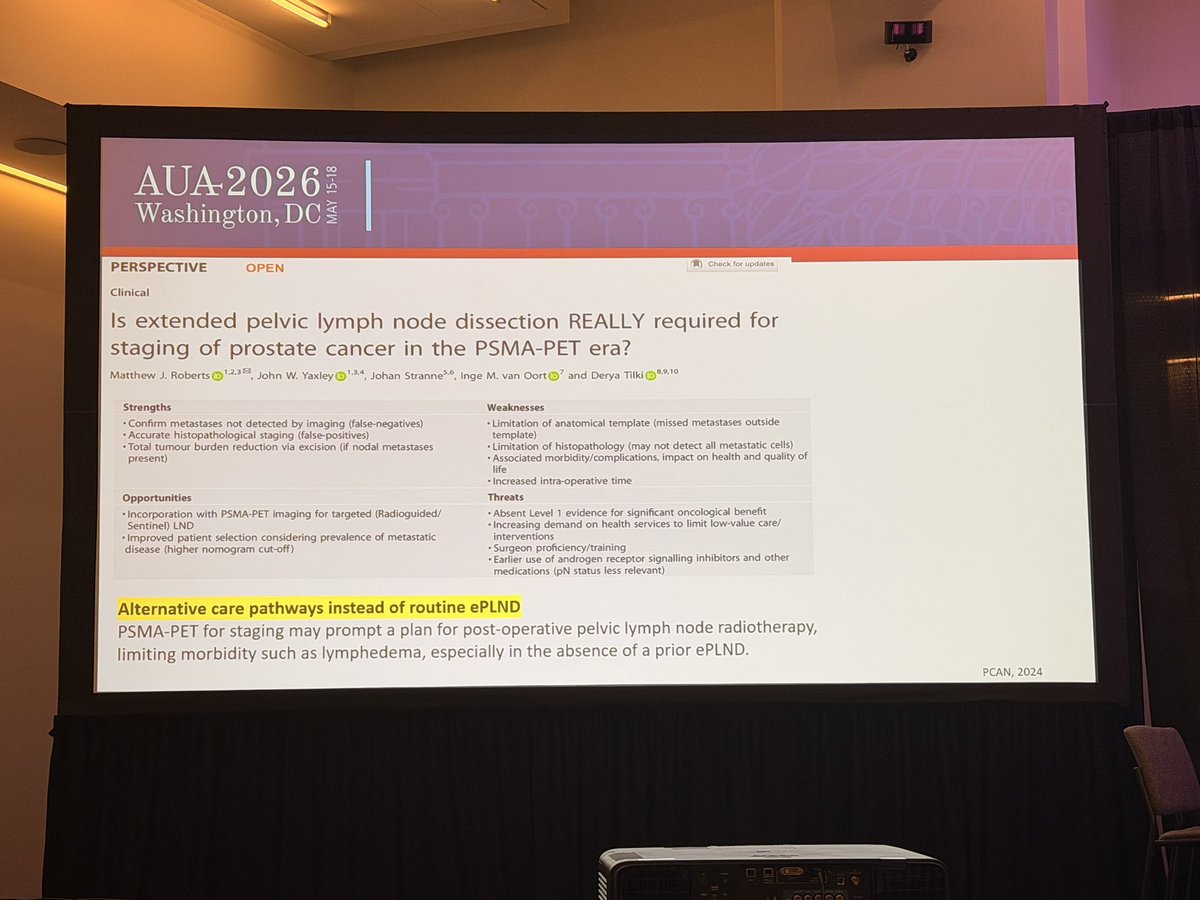
10 details 5 trials watching
AUA 2026 podium round-up of the ePLND question in the PSMA-PET era. Draws on a 1253-man primary staging series (Yaxley, BJUI 2019), a systematic review of lymphedema (Clinckaert, Cancers 2022), a cohort of 3544 pts (Tyritzis, J Urol 2015) and a SWOT perspective (Roberts, PCAN 2024). No new dataset.
Staging yield argues against template adequacy: 47.7% of nodal metastases fell outside ePLND boundaries. PSMA-PET NPV is given as ~96% in the source text without its parent series named.
Lymphedema tracks the combination, not either modality alone: 0-14% after RP with PLND, 0-9% after pelvic nodal RT, 19-29% after PLND plus salvage pelvic nodal RT with 2-22% genital lymphedema. LND also carried a 6-10x DVT/PE risk increase in Tyritzis.
The argument is that a template operation cannot stage what sits outside the template, so its role narrows to pts in whom imaging is likely wrong. The slide's own conclusion keeps high-risk disease individualized rather than resolved, and explicitly asks that the possibility of adjuvant or salvage pelvic RT enter that conversation.
Slide-level source: NPV ~96% has no denominator, cohort or PSMA tracer attached here, and no BCR effect size is reported for the RCTs the round-up invokes. The lymphedema review's authors note the absent uniform definition, so 19-29% is a range across heterogeneous ascertainment, not a pooled estimate.
- Does ePLND improve BCR-free survival in any risk group? recruiting Dutch National Randomized Study: PSMA-PET/CT As a Triage Tool for Pelvic Lymph Node Dissection in Prostatectomy Patients Phase NAn=706 · primary completion 2025-07 · PSMA-PET triage to ePLND, n=706, prognosis endpointrecruiting Extended vs. No Pelvic Lymph Node Dissection During Radical Prostatectomy. DISSECTION 2.0. Phase NAn=400 · primary completion 2027-02 · randomises ePLND vs none in PSMA-negative high riskn=270 · primary completion 2028-02 · RP+ePLND vs RP±SRT, Briganti >=7%
- PSMA-PET NPV by risk group and tracer recruiting Preoperative PSMA PET/CT As Triage for EPLND in Patients Scheduled for RALP (PrePSMA) Phase NAn=600 · primary completion 2029-12 · tests whether PSMA-PET can replace ePLND staging
- Nodal RT after PSMA-PET staging without prior PLND n=250 · primary completion 2031-05 · PSMA-N0M0 randomised to prostate-only vs WPRT
📚 Sources · 🐦 1 tweet
At #AUA2026, the message was clear:⁰📌 ePLND provides staging information, but its therapeutic benefit remains uncertain.⁰📌 RCTs have not shown consistent improvements in BCR outcomes.⁰📌 PSMA PET/CT has a high NPV (~96%) and may safely avoid unnecessary PLND in… pic.twitter.com/7vJFe2hG77
— DR CARVAJAL (@RomanCarvajal) May 17, 2026