GI Lower
2026-08-24
STAR-TREC
ForRectal adenocarcinoma ≤40 mm, mrT1-T3bN0, no EMVI, ECOG 0-1
78.5% vs 60.6%
HR 1.90 (95% CI 1.29-2.81); 30-mo organ-preservation 1° EP not yet reported
TL;DR12-mo TME-free survival 78.5% vs 60.6% (HR 1.90) favouring LCCRT over SCRT for organ preservation in mrT1-T3bN0 rectal cancer ≤40 mm.
RT delivery does not explain the gap: completion was 99% with LCCRT and 100% with SCRT, with 18 (11%) needing a capecitabine dose change, so the difference tracks fractionation plus concurrent chemo, which this design cannot separate. Nodes in 22% of TME specimens despite MRI N0 make mesorectal coverage relevant; target volume is not in source text.
In MRI node-negative rectal adenocarcinoma ≤40 mm (mrT1-T3bN0) choosing organ preservation, this supports LCCRT over SCRT as the response-adapted backbone at 12 mo; it does not extend to EMVI-positive, node-positive, or >40 mm tumours. The longer read
RT delivery does not explain the gap: completion was 99% with LCCRT and 100% with SCRT, so the TME-free survival difference tracks fractionation plus concurrent capecitabine, which this design cannot separate. Nodes in 22% of TME specimens despite MRI N0 make mesorectal coverage relevant; target volume is not in source text.
Primary TME carried G≥3 SAEs in 18%, anastomotic-leak perforation in 15% and one death, and 86% of phase 3 pts chose organ preservation. LCCRT-OP kept more pts TME-free at 12 mo, but nodes in 22% of TME specimens despite MRI N0 frame the surveillance and salvage question.
9 details 1 trial watching
Open-label, randomised phase 2/3 at 37 sites in five European countries. Phase 2 randomised 1:1:1 to LCCRT-OP, SCRT-OP or primary TME (N=120); phase 3 used a partially randomised patient-preference design, with OP choosers randomised 1:1. Bayesian framework; this 12-month analysis covers 426 pts recruited before Aug 8, 2023 (409 mITT).
Rectal adenocarcinoma ≤40 mm, mrT1-T3bN0 on MRI, ECOG 0-1, with primary TME judged reasonable. Excluded: MRI nodal involvement or EMVI, tumour within 1 mm of the mesorectal fascia, anterior tumours above the peritoneal reflection, predominantly mucinous histology, metastases. mrT2 in 242 (73%) OP pts; 266 (80%) below the peritoneal reflection.
LCCRT-OP: 50 Gy in 25 fractions with oral capecitabine 825 mg/m² twice daily. SCRT-OP: 25 Gy in five fractions. Response assessed at 16-20 weeks with TAE for near-complete response; target volume not in source text.
Phase 2 primary: feasibility, recruitment at months 12 and 24 against thresholds of ≥4 and ≥6 randomisations/month (achieved 3 and 6). Phase 3 primary: organ preservation at 30 months (no TME, stoma or local recurrence), not yet reported. This analysis reports 12-month TME-free survival, response and safety.
Phase 2 alone gave HR 3.7 (95% CI 1.7-8.0), with median TME-free survival 7.6 mo after SCRT-OP vs not reached after LCCRT-OP; pooling phase 3 pulled the estimate toward the null.
| Endpoint | LCCRT-OP (n=163) | SCRT-OP (n=168) | Effect |
|---|---|---|---|
| TME-free survival | 78.5% (95% CI 72.4-85.1) | 60.6% (53.6-68.4) | HR 1.90 (1.29-2.81), posterior P >99.5% |
| cCR at 16-20 wk | 104 (64%) | 61 (36%) | not reported |
| TAE for near-cCR | 38 (23%) | 68 (40%) | not reported |
| Endpoint | LCCRT-OP | SCRT-OP | Primary TME |
|---|---|---|---|
| G3-4 GI SAEs | 4 (2%) | 6 (4%) | 6 (8%) |
| G3-4 procedural SAEs | 3 (2%) | 5 (3%) | 5 (6%) |
| G≥3 SAEs within 4 wk of RT/CRT | 9/163 (6%) | 2/168 (1%) | n/a |
Primary TME: G≥3 SAEs in 14 (18%) of 78, intraperitoneal perforation from anastomotic leak in 12 (15%), and one postoperative death from sepsis. After TAE, perineal fistulation occurred in two (1%) OP pts. Capecitabine dose modification in 18 (11%) of 161.
At design, primary TME without neoadjuvant therapy was standard for this population. OPRA addressed watch-and-wait after neoadjuvant therapy in locally advanced disease; STAR-TREC is a randomised test of which radiation schedule best supports response-adapted organ preservation in smaller, node-negative tumours.
The shrinking HR from phase 2 to the pooled cohort suggests early overestimation, and phase-difference analyses are exploratory post-hoc. Occult nodes in 17 (22%) TME specimens imply MRI N0 misses nodal disease that organ-preserving arms never sample. Median follow-up was 34 and 35 mo, but outcomes were censored at 12 mo.
At 12 months, a longer RT course with capecitabine buys more complete responses and fewer TMEs than SCRT, at the cost of more acute SAEs. What it does not settle is durable organ preservation, local regrowth and function, all tied to the 30-month endpoint.
Governance-led interim at 12 mo; prespecified 30-mo organ-preservation endpoint not yet reached. Open-label, TME-free survival only, TME comparison non-randomised in phase 3.
- Does the LCCRT advantage persist at the 30-month organ-preservation endpoint?
- Local regrowth and bowel function after LCCRT vs SCRT organ preservation
- Can consolidation chemo after SCRT close the complete-response gap? n=66 · primary completion 2025-09 · SCRT or LCCRT → mFOLFOXIRI, organ preservation, cT2-4a
📚 Sources · 📄 1 paper
2026-08-07
STELLAR NCT02533271
ForDistal/middle-third rectal adeno, cT3-4 and/or cN+, age 18-70, ECOG 0-1
64.5% v 62.3%
HR 0.883, 1-sided 95% CI to 1.11, P<.001 for noninferiority
TL;DR3yr DFS 64.5% v 62.3% (HR 0.883, NI margin 1.43, P<.001 NI): 5x5Gy then CAPOX non-inferior to 50Gy/25f CRT in LARC.
Every pt got IMRT, unlike RAPIDO, Polish II or PRODIGE 23, and 3yr LRR was 8.4% v 11.0% with 25Gy/5fx to a full elective pelvic CTV, so the short-course arm did not trade local control for convenience. Compliance was the mechanism: 100% completed 5x5Gy with no dose reduction. This supports offering 5x5Gy over 50Gy/25f when the systemic phase is the priority.
In cT3-4 or node-positive mid/low rectal cancer where getting full-dose neoadjuvant chemo delivered is the constraint, this supports 25Gy/5fx followed by CAPOX instead of long-course chemoradiation; it does not extend to upper rectal tumors or pts over 70, both excluded. The longer read
All pts received IMRT with full elective pelvic CTV coverage, unlike RAPIDO, Polish II or PRODIGE 23, and 3yr LRR was 8.4% v 11.0% with 25Gy/5fx. Every TNT pt completed all five fractions with no dose reduction. This supports 5x5Gy over 50Gy/25f without conceding local control.
Moving CAPOX preoperatively raised full-dose preop completion of the systemic phase but cut it the other way on delivery overall, 74.8% v 93.2%. Four preop cycles produced no distant-metastasis benefit (3yr DM 22.8% v 24.7%), unlike the heavier RAPIDO and PRODIGE 23 programs, so cycle number may matter for distant control.
TME at 6-8 weeks after short-course RT plus chemotherapy gave R0 resection in 91.5% v 87.8% (P=.189) and grade III+ complications of 14.0% v 15.7% (P=.625), so the compressed schedule did not degrade the operation. Sustained cCR was higher after TNT (21.8% v 12.3% for pCR plus sustained cCR), enlarging the nonoperative-management pool to 9.4% v 3.4%.
12 details 5 trials watching
Multicenter open-label randomized phase III noninferiority trial, 16 hospitals across 11 provinces of China, accrual August 2015 to August 2018, N=599 randomly assigned 1:1 (TNT 302, CRT 297). Stratified by tumor location, clinical stage and MRF status; median follow-up 35.0 months (range 8.3-63.9).
Age 18-70, ECOG 0-1, rectal adenocarcinoma of the distal or middle third (0-10cm from anal verge), cT3-4 and/or node-positive, no distant metastases, no prior anticancer treatment. Arms were balanced: cT4 15.9% v 12.8%, MRF involvement 56.3% v 56.2%, clinical stage III 85.8% v 83.5%.
TNT arm received 25Gy in 5 fractions over one week; CRT arm 50Gy in 25 fractions over 5 weeks with concurrent capecitabine 825mg/m2 twice daily. All patients received IMRT, a departure from RAPIDO, Polish II and PRODIGE 23. CTV covered mesorectum, presacral space, internal iliac, obturator nodes and ischiorectal fossa; superior border at the sacral promontory, inferior 2-3cm distal to the tumor, external iliacs added only for cT4b; CTV-to-PTV expansion 0.5-1.0cm.
TNT arm: 4 cycles CAPOX (oxaliplatin 130mg/m2 day 1, capecitabine 1,000mg/m2 twice daily days 1-14) starting 7-14 days after radiotherapy, then TME, then 2 further cycles. CRT arm: concurrent capecitabine during radiotherapy, then TME, then 6 cycles CAPOX. Total mesorectal excision was scheduled 6-8 weeks after preoperative treatment in both arms; a watch-and-wait pathway was permitted for clinical complete responders.
Primary: 3-year disease-free survival, noninferiority claimed if the upper bound of the 95% CI of the HR was at or below 1.43 (an 11% absolute margin against an assumed 65% CRT rate). Secondary endpoints were overall survival, metastasis-free survival, locoregional recurrence and surgical complications. Target accrual 600 with at least 194 DFS events for 80% power at one-sided alpha 0.05.
Acute grade III-V toxicity during preoperative treatment was 26.5% with TNT versus 12.6% with CRT (P<.001), driven almost entirely by hematologic events (grade 3-4 15.8% v 2.0%, P<.001) rather than by anything the radiotherapy added. Radiotherapy delivery itself was cleaner in the short-course arm, with no dose reductions at all, and grade III+ surgical complications were comparable (14.0% v 15.7%, P=.625). Grade III-IV toxicity during adjuvant chemotherapy ran lower after TNT (3.3% v 11.8%, P=.003).
STELLAR is the third randomized trial of short-course radiotherapy plus neoadjuvant chemotherapy against long-course CRT, after Polish II and RAPIDO, with PRODIGE 23 addressing the adjacent question of chemotherapy sequencing around long-course CRT. Its 3-year LRR of 8.4% with TNT sits alongside RAPIDO and PRODIGE 23 (4%-8.3%) and well below Polish II (21%-22%), which enrolled a heavier fixed cT3/cT4 population. Unlike RAPIDO and PRODIGE 23, STELLAR showed no reduction in distant metastasis (3-year DM 22.8% v 24.7%), and its OS advantage mirrors the early Polish II signal that later disappeared at 8 years.
The 11% noninferiority margin is wide, and the authors concede in retrospect that a narrower margin or larger sample would have been defensible given how close the arms proved. Distant metastasis, the endpoint short-course TNT was designed to move, did not separate at all (22.8% v 24.7%), which weakens the mechanistic case for the OS difference. Adjuvant chemotherapy completion also differed between arms (60.0% v 48.3%, P=.009), so postoperative treatment intensity is not held constant across the comparison.
The defensible read is the primary endpoint: 25Gy in 5 fractions followed by CAPOX delivers the same 3-year DFS and the same locoregional control as 50Gy in 25 fractions, in one week of radiotherapy instead of five. The 11.4-point OS separation is the number that will be quoted and the one least supported, since neither MFS nor LRR moved and the same pattern in Polish II did not survive longer follow-up. What transfers most reliably is the technique: full elective pelvic coverage with IMRT at 5x5Gy, delivered without a single dose reduction.
| Endpoint (3yr) | TNT | CRT | Effect size |
|---|---|---|---|
| DFS (1°) | 64.5% (58.3-70.7) | 62.3% (56.1-68.5) | HR 0.883, 1-sided 95% CI to 1.11, P<.001 NI |
| OS | 86.5% (82.1-90.8) | 75.1% (69.4-80.8) | HR 0.67 (0.46-0.97), P=.033 |
| MFS | 77.1% (71.7-82.6) | 75.3% (70.0-80.7) | HR 0.88 (0.63-1.24), P=.475 |
| LRR | 8.4% (4.6-12.2) | 11.0% (6.5-15.5) | HR 0.80 (0.45-1.44), P=.461 |
| Subgroup | DFS HR (95% CI), P | OS HR (95% CI), P |
|---|---|---|
| cT4 | 0.621 (0.328 to 1.177), .144 | 0.362 (0.152 to 0.859), .021 |
| Distance to anal verge ≤5cm | 0.706 (0.485 to 1.028), .070 | 0.540 (0.318 to 0.916), .022 |
| cT2-3 | 0.916 (0.674 to 1.245), .575 | 0.752 (0.493 to 1.149), .187 |
| Distance >5cm | 1.120 (0.744 to 1.687), .587 | 0.808 (0.468 to 1.394), .443 |
CONSORT flow
Prespecified noninferiority met on 3yr DFS with adequate accrual, but open-label, 35mo follow-up only, and the OS gain is a secondary endpoint unsupported by MFS or LRR.
- Does the 3yr OS advantage survive 5-10 year follow-up active Short RT Versus RCT,Followed by Chemo.and Organ Preservation for Interm and High-risk Rectal Cancer Patients Phase 3n=702 · primary completion 2023-09 · ACO/ARO/AIO-18.1: 5x5Gy vs 54Gy CRT, n=702
- Optimal number of preoperative chemotherapy cycles with short-course RT n=42 · primary completion 2026-11 · 5x5Gy then 9 cycles mFOLFOX6, CR rate 1° EPactive Preoperative Sequential Short-course Radiation Therapy and FOLFOX for Locally Advanced Rectal Cancer Phase 2n=364 · primary completion 2028-12 · SCRT then 4 cycles FOLFOX vs CRT, n=364n=608 · primary completion 2029-12 · phase 3 SCRT+CAPOX vs SCRT+CAPOXIRI, n=608
- Late toxicity and quality of life, not yet reported recruiting Short Course Radiation Therapy and Combination Chemotherapy for the Treatment of Stage II-III Rectal Cancer Phase 1n=25 · primary completion 2026-10 · SCRT then chemo with QoL assessment as endpoint
📚 Sources · 📄 1 paper
Abstract
TNTCRT NCT03177382
ForHigh-risk stage II/III rectal cancer, cT4/cN2/MRF+/EMVI, age ≤70
HR 0.674
95% CI 0.489-0.929, P=.016; 3-year DFS 74.8% v 66.0%
TL;DR3-year DFS 74.8% v 66.0%, HR 0.674, for doublet CAPOX bracketing long-course chemoradiation vs conventional nCRT in high-risk LARC.
RT is fixed in both arms, so the RT read is what intensified chemo does around it: locoregional failure stayed 6.03% v 6.19% and the DFS gain is distant. The pCR jump (26.37% v 9.80%) is the lever for organ-preservation selection. LCRT dose and fractionation are not reported in source text.
In MRI-defined high-risk stage II/III rectal cancer at or under age 70, this supports doublet CAPOX bracketing long-course chemoradiation over nCRT plus adjuvant chemo; it does not extend to pts over 70 or to short-course RT based TNT. The longer read
RT is identical in both arms, so the read is what intensified chemo does around a fixed LCRT backbone: locoregional failure held at 6.03% v 6.19%, and the DFS gain is distant. Dose, fractionation and target volume are not reported in source text.
The same doublet moved from postoperative to preoperative, with oxaliplatin added concurrent to RT. Grade ≥3 toxicity front-loads into the neoadjuvant phase (27.59% v 8.56%) but whole-course severe toxicity is comparable, so the decision this moves is sequencing, not drug choice.
Intensification did not degrade operability: major postoperative complications 3.98% v 2.94%, and roughly 87% v 90% reached total mesorectal excision. pCR 26.37% v 9.80% widens the pool for a nonoperative discussion, though watch-and-wait was not tested here.
8 details 5 trials watching
Multicenter randomized phase III, N=458, accrual June 6, 2017 to December 27, 2023, median follow-up 51 months. Primary endpoint: DFS. Blinding is not reported and the two regimens are not maskable.
Stage II/III LARC aged 18 to 70 with at least one MRI high-risk feature (cT4a-b, cN2, mesorectal fascia involvement, or cT3c-d with EMVI). Baseline burden was heavy: cT4 47.82%, cN2 75.98%, threatened MRF 70.96%, EMVI 54.80%.
Experimental: one cycle induction CAPOX, LCRT with two cycles concurrent CAPOX, three cycles consolidation CAPOX, then surgery, so all cytotoxic therapy precedes resection. Control: LCRT with concurrent capecitabine, surgery, then six cycles adjuvant CAPOX at 4 to 8 weeks.
Long-course RT in both arms, so RT is the fixed element and the randomized variable is chemotherapy timing plus oxaliplatin exposure. Dose, fractionation, technique and target volume are not reported in the source text, nor is whether concurrent doublet chemotherapy altered RT delivery.
Primary: DFS. Secondary results reported here: MFS, pCR, locoregional failure, overall survival, grade ≥3 adverse events, major postoperative complications.
Primary endpoint met, with MFS moving in step and pCR strongly favoring the experimental arm, while locoregional failure and 3-year OS did not separate. See the efficacy table.
| Endpoint | Doublet-LC TNT | nCRT | Effect size |
|---|---|---|---|
| 3-year DFS (primary) | 74.8% | 66.0% | HR 0.674 (0.489-0.929), P=.016 |
| 3-year MFS | 77.7% | 67.6% | HR 0.655 (0.469-0.915), P=.013 |
| pCR | 26.37% | 9.80% | P<.001 |
| Locoregional failure | 6.03% | 6.19% | P=.943 |
| 3-year OS | 90.2% | 87.5% | P=.167 |
| Measure | Doublet-LC TNT | nCRT | P |
|---|---|---|---|
| Grade ≥3 AE, neoadjuvant phase | 27.59% | 8.56% | <.001 |
| Severe toxicity, entire course | 28.02% | 24.32% | .371 |
| Major postoperative complications | 3.98% | 2.94% | .567 |
Grade ≥3 toxicity front-loads into the neoadjuvant phase with the doublet, but severe toxicity across the entire treatment course and major postoperative complications were comparable. Total mesorectal excision was performed in approximately 87% (TNT) and 90% (nCRT).
Sits alongside RAPIDO, PRODIGE-23 and STELLAR, the trials that established TNT, but keeps long-course chemoradiation as the RT backbone rather than short-course RT. Unlike RAPIDO's longer follow-up, intensification here did not increase locoregional failure.
Control-arm adjuvant CAPOX delivery and completion are not reported, and a TNT advantage partly reflects therapy planned but not received when postoperative chemotherapy under-delivers. Accrual spanned 2017 to 2023, during which TNT became routine, so control-arm contemporaneity drifted. Age was capped at 70.
The gain is distant, not local: MFS tracks DFS while locoregional failure is flat and low in both arms, which says long-course chemoradiation with a fluoropyrimidine is near its local ceiling in this population and the remaining room is systemic. The pCR tripling is the organ-preservation lever, but pCR is a resection-specimen endpoint and this trial did not test nonoperative management.
CONSORT flow
Randomized phase III, primary DFS met at 51mo median f/u, but TNT is already established by RAPIDO, PRODIGE-23, STELLAR; this refines regimen rather than the paradigm.
- Doublet long-course TNT versus short-course RT based TNT head to head active Short-Course Radiotherapy Followed by Neoadjuvant Chemotherapy and Camrelizumab in Locally Advanced Rectal Cancer (UNION) Phase 3n=231 · primary completion 2023-03 · randomised SCRT+CAPOX vs long-course CRT then CAPOX, pCRrecruiting Optimizing Immunotherapy Combined With Neoadjuvant Chemoradiotherapy for Locally Advanced Rectal Cancer Phase 2n=228 · primary completion 2027-06 · SCRT vs long-course CRT with CAPOX in one TNT trialn=608 · primary completion 2029-12 · SCRT plus CAPOX arm, doublet vs triplet consolidation
- Benefit-risk of this intensified regimen above age 70 not yet CGA Guided Ultrafractionated RT and Systemic Treatment in Elderly or Frail Patients with Inoperable Localized CRC Phase 2n=124 · primary completion 2027-11 · CGA-guided RT plus systemic tx, enrols age 70 and over
- Whether the higher pCR converts to durable organ preservation recruiting Organ Preservation First Strategy and Intentional Watch and Wait for MRI Defined Low-risk Rectal Cancer Phase NAn=96 · primary completion 2025-09 · organ-preservation rate after IMRT plus consolidation CapeOX
📚 Sources · 📄 2 papers
Abstract
2026-08-01
SIB-CRT vs Standard CRT for LARC (NCT02195141) NCT02195141
ForStage II/III rectal adenocarcinoma, neoadjuvant chemoRT candidates
15.2% vs 18.4%
P=0.695, primary endpoint not met
TL;DR9yr LC 87.1% vs 70.1% (HR 0.40, P=0.038) and OS 74.3% vs 48.9% (HR 0.43) favoring SIB dose escalation.
The boost was 56 Gy to PGTV and 60 Gy to involved lateral nodes on a 50 Gy/25 fx pelvic base, a deliverable prescription with acute G3 toxicity 14.5% vs 19.6%. LC 87.1% vs 70.1% is the mechanistically coherent signal; the OS and MFS separation on 106 pts is not, and gates any move to boost outside a trial.
In stage II/III LARC where perioperative chemotherapy is not planned or not tolerated, this supports testing an integrated boost to gross disease and involved lateral nodes; it gives no read on pts receiving modern TNT, where the subgroup showed no added benefit. The longer read
The prescription is deliverable and specified: 56 Gy to PGTV, 60 Gy to involved lateral nodes, on a 50 Gy/25 fx pelvic base, with acute G3 toxicity 14.5% vs 19.6% and no late toxicity reported. LC 87.1% vs 70.1% is the endpoint a boost can own; treat the OS and MFS separation as hypothesis-generating for a boost trial, not license to escalate off-protocol.
The benefit was confined to pts who did not receive perioperative chemotherapy (9yr DFS 70.8%, HR 0.343, P=.014), with no additional benefit in those who did, and chemo receipt was not randomized. Read as a signal about RT dose in chemotherapy-ineligible pts rather than any argument against systemic intensification.
9 details 5 trials watching
Prospective randomized phase 2, 1:1, N=106 (55 SIB-CRT, 51 CRT), accrued August 2013 to February 2015. Median follow-up 116.6 months, which is the study's real asset.
Stage II/III rectal adenocarcinoma. Radical surgery planned 6 to 8 weeks after chemoradiotherapy. Perioperative chemotherapy was not randomized, and its receipt defines the subgroup that carries the result.
Both arms received 50 Gy/25 fx to the pelvis. The experimental arm added a simultaneous integrated boost of 56 Gy to PGTV and 60 Gy to lateral metastatic nodes where present, so the escalation targets gross primary and involved lateral nodes rather than the elective volume.
Primary: pCR rate. Secondary: DFS, OS, MFS, LC, CSS and toxicity. Every result the conclusion rests on is secondary.
Acute grade 3 toxicity 14.5% (SIB-CRT) vs 19.6% (CRT), primarily radiation dermatitis. Late toxicity is not reported in the source, which matters most for a boost delivered near bowel and for pts followed nearly a decade.
Neoadjuvant dose escalation in LARC has repeatedly raised pCR without translating to survival; this trial reports the mirror image, a null pCR (15.2% vs 18.4%) with survival separation. The result also sits against the TNT era, where systemic intensification rather than RT dose is the current lever, and the chemo-receiving subgroup here showed no additional benefit.
The survival claim is a secondary-endpoint result from 51 vs 55 pts, so a handful of events moves each HR, and no confidence intervals are reported in the source. The driving subgroup is defined by non-randomized chemotherapy receipt, and the higher rate of curative treatment in the SIB arm (89.1% vs 78.4%) is itself a plausible route to the OS difference independent of dose.
A pelvic boost has a defensible mechanism for LC 87.1% vs 70.1% and essentially none for MFS 70.8% vs 47.2%. The authors attribute the distant benefit to intensified control of micrometastases; the simpler reading is that a small trial with a large curative-treatment imbalance produced correlated secondary endpoints.
| Endpoint | SIB-CRT | CRT | Effect |
|---|---|---|---|
| DFS | 70.8% | 47.4% | HR 0.46, P=0.013 |
| OS | 74.3% | 48.9% | HR 0.43, P=0.008 |
| MFS | 70.8% | 47.2% | HR 0.48, P=0.017 |
| LC | 87.1% | 70.1% | HR 0.40, P=0.038 |
| CSS | 77.4% | 57.2% | P=0.027 |
| pCR | 15.2% | 18.4% | P=0.695 |
CONSORT flow
Randomized phase 2, N=106, primary endpoint (pCR) missed; survival gains are secondary endpoints with wide implied precision and a non-randomized chemo subgroup driving them.
- Does SIB add anything on a total neoadjuvant therapy backbone n=37 · primary completion 2026-05 · SIB-SCRT plus CAPOX and PD-1 in high-risk LARCn=156 · primary completion 2026-12 · randomises GTV SIB 58.75 vs 50 Gy/25f for CRrecruiting THeragnostic Utilities for Neoplastic DisEases of the Rectum by MRI Guided Radiotherapy Phase NAn=179 · primary completion 2027-01 · RT dose escalation gated by early regression index
- Late GI and GU toxicity of the boost beyond 9 years active Safety of a Boost (CXB or EBRT) in Combination With Neoadjuvant Chemoradiotherapy for Early Rectal Adenocarcinoma Phase 3n=148 · primary completion 2023-06 · safety endpoint for CXB vs EBRT boost after nCRTrecruiting Standard Dose Versus High Dose of Radiotherapy in Rectal Preservation With Chemo-radiotherapy in Rectal Cancer Patients Phase 3n=162 · primary completion 2026-12 · 62 Gy vs 50.4 Gy phase 3, dose-escalation toxicity
- Whether the curative-treatment rate imbalance explains the OS gap
📚 Sources · 📄 1 paper
Abstract
2026-06-21
ARS Appropriate Use Criteria: Locoregionally Recurrent Rectal Cancer
TL;DRUpdated ARS appropriate use criteria for LRRC, built on 116 references (10 randomized phase 2/3), reaffirming combined-modality therapy toward R0 resection.
The RT-relevant content sits in PICO question 4 (role of RT/reirradiation), but the excerpt stops before the appropriateness ratings, so dose, fractionation and reirradiation technique recommendations are not reported in source text. What is stated: preoperative RT, systemic therapy, or both are positioned as tools to raise the odds of an R0 resection, which frames RT as resectability-directed rather than definitive.
In a previously irradiated patient with pelvic sidewall or presacral recurrence being staged for salvage, this frames preoperative RT or chemoRT as a means to margin-negative resection; it does not settle reirradiation dose or the nonoperative alternative. The longer read
RT is framed as resectability-directed: preoperative RT, systemic therapy, or both to raise the odds of R0. The reirradiation question (PICO 4) is posed but its appropriateness ratings, dose and technique are not in the source excerpt, so the decision a previously irradiated pelvis actually turns on is not reportable here.
Preoperative systemic therapy sits alongside RT as a downsizing tool rather than a competing pathway, and immunotherapy is named within the PICO question on systemic therapy. Specific regimen and sequencing ratings are not in the source excerpt.
The document is explicitly resection-centered: margin-negative resection is called the ultimate determinant of survival and local control. Resectability assessment by compartment, sidewall, sacral and visceral involvement on MRI drives the operative approach, with everything preoperative judged by whether it makes R0 more likely.
10 details 5 trials watching
Literature-based systematic review plus RAND/UCLA modified Delphi appropriateness rating, run under the standing ARS AUC methodology with PICOTS framing and PRISMA 2020 assessment. Two rounds of voting; ratings collapse to usually not appropriate, may be appropriate, usually appropriate.
Locoregionally recurrent rectal cancer. Eligible evidence was prospective observational, phase 2/3, and retrospective series of at least 25 patients, published January 1, 2013 to July 16, 2025, English language, animal studies excluded.
There is no efficacy endpoint. The output is an appropriateness rating per treatment option across five PICO questions: surgery, preoperative/perioperative therapy, nonoperative management, RT/reirradiation, and systemic therapy.
116 references carried the evidence: 10 well-designed randomized phase 2/3, 29 moderately well designed, 76 retrospective, 1 meta-analysis. The committee's stated conclusion is that margin-negative resection is the ultimate determinant of survival and local control, with preoperative systemic therapy, RT, or both used to facilitate it.
| Study design | n |
|---|---|
| Well-designed (randomized phase 2 and phase 3) | 10 |
| Moderately well designed (matched cohort, phase 2) | 29 |
| Design limitations (retrospective) | 76 |
| Meta-analysis | 1 |
Two thirds of the evidence base (76 of 116) is retrospective, so a modified Delphi vote is doing work the trials cannot. The document is an executive summary: the per-scenario appropriateness grid, which is the part a reader would carry to tumor board, is not in the source excerpt available here.
The committee explicitly declines to move practice, framing the update as reassurance about combined-modality therapy rather than a new position. For a radiation oncologist the operative question is where RT sits relative to surgical resectability, and the summary answers it in one direction only: RT is a means to R0, not an alternative to it.
- Role of nonoperative management in LRRC recruiting Radiotherapy Dose Escalation for Non-operative Management of Unresectable Locally Recurrent Rectal Cancer (STEP-UP) Phase NAn=30 · primary completion 2029-12 · RT dose escalation for unresectable LRRC, no surgery
- Optimal reirradiation dose and technique in previously irradiated pelvis recruiting Pencil Beam Proton Therapy for Pelvic Recurrences in Rectal Cancer Patients Previously Treated With Radiotherapy Phase 2n=65 · primary completion 2025-10 · dose-escalated proton reRT, prior pelvic RT >30Gy EQD2n=31 · primary completion 2025-12 · carbon ion reRT 74Gy/20Fx, unresectable LRRCrecruiting Hypofractionated Radiotherapy Plus Immunotherapy Versus Conventional Radiotherapy in Locally Recurrent Rectal Cancer Phase 2n=221 · primary completion 2030-03 · randomised 15-30Gy/5Fx reRT vs conventional RT
- Preoperative chemoRT vs systemic therapy alone before salvage resection n=44 · primary completion 2028-12 · preop chemoRT + PD-1 then radical salvage surgery
📚 Sources · 📄 1 paper
Abstract
2026-06-02 ASCO Annual Meeting 2026
mRCAT-III NCT06507371
ForpMMR/MSS cT3-4N0/+M0 rectal adenoCa, ≤10cm from anal verge, no lateral node
61.0% vs 28.6%
P<0.0001, blinded independent central review
TL;DRpCR 61.0% vs 28.6% (P<0.0001) when elective nodal RT was omitted and tislelizumab added in pMMR/MSS LARC.
The RT variable here is target volume, not dose: both arms got 5Gy x 5d, and the experimental target was tumor bed alone with tumor-draining nodes deliberately spared. That inverts the usual de-escalation logic (smaller field proposed to IMPROVE efficacy by preserving nodal immunity), but tislelizumab moves with it, so the pCR gain cannot be assigned to the field change.
In pMMR/MSS cT3-4 rectal cancer ≤10cm from the verge with no positive lateral node, this raises the question of elective nodal omission with PD-1 blockade but does not yet support dropping nodal coverage outside a trial, and says nothing about dMMR/MSI-H disease. The longer read
The only RT variable is target volume: 5Gy x 5d in both arms, tumor bed alone versus conventional fields including the tumor-draining nodes. Elective nodal omission is being proposed to improve efficacy rather than reduce toxicity, but with no recurrence data reported, the coverage decision stays unchanged outside a trial.
Tislelizumab was added to an unchanged CAPOX backbone in a pMMR/MSS population, where checkpoint blockade has generally underperformed. The 61.0% vs 28.6% pCR is the sequencing signal, though the concurrent field reduction means the drug's independent contribution is not isolated.
All patients proceeded to TME, so the higher pCR (61.0% vs 28.6%) and MPR (77.9% vs 50.6%) bear on the depth of response at resection and, via the unreported organ-preservation secondary, on which patients might avoid it. Nodal yield and recurrence after unirradiated draining nodes are not reported.

| Endpoint (ITT) | Experimental (N=77) | Control (N=77) | P |
|---|---|---|---|
| pCR rate | 61.0 (47/77) | 28.6 (22/77) | <0.001 |
| MPR rate | 77.9 (60/77) | 50.6 (39/77) | <0.001 |
+1 more figure

10 details 5 trials watching
Multicenter, open-label, randomized phase 3 across 17 hospitals in China (NCT06507371). 1:1 allocation, n=77 per arm, stratified by clinical N stage (cN0 vs cN+). Pathologic response read by blinded independent central review.
Rectal adenocarcinoma with lower edge ≤10 cm from the anal verge, cT3-4 N0/+ M0, MSS/pMMR, age 18-75, ECOG PS 0-1. No positive lateral lymph node permitted, which excludes the population where lateral nodal management is itself contested.
Both arms received 5Gy x 5 days. The experimental arm's modification was target volume only: radiation to the tumor bed without tumor-draining lymph nodes, against conventional short-course fields in the control. Dose and fractionation were held constant, so the field is the only RT variable.
Experimental: tislelizumab 200 mg IV d1 plus oxaliplatin 130 mg/m² IV d1 and capecitabine 1000 mg/m² PO d1-14. Control: the same CAPOX backbone without tislelizumab. Both followed by TME, then adjuvant therapy and follow-up.
Primary: pCR rate in the ITT population. Secondary: MPR rate, TRG, organ preservation rate, EFS, OS and AEs. Only pCR and MPR are reported in the source; the time-to-event secondaries are not.
The presentation states the experimental approach reduced the incidence of severe gastrointestinal adverse events, consistent with a smaller irradiated volume, but no grade-specific rates are reported in source.
The control arm's 28.6% pCR sits above what short-course RT with consolidation chemotherapy has historically produced in pMMR disease, so the comparator is not obviously weak. The experimental result approaches the response depth usually reserved for dMMR/MSI-H disease, where checkpoint blockade already produces high complete-response rates; extending that to MSS is the claim being made.
Nodal recurrence is the outcome that decides whether sparing the tumor-draining nodes is safe, and no recurrence, EFS or OS data appear in the source. A pCR advantage at TME cannot answer it, and the cN+ stratum is where a nodal-omission failure would show first.
The trial's mechanistic premise, that irradiating draining nodes depletes the lymphocyte reservoir a PD-1 agent needs, is testable but not tested here: the field change and the checkpoint inhibitor were introduced together. A three-arm design (node-sparing RT + CAPOX, conventional RT + CAPOX + tislelizumab) would be needed to separate them.
CONSORT flow
Randomised phase 3, 1° EP met by central review, but confounds nodal-target omission with PD-1 addition and reports no recurrence or survival data.
- Nodal recurrence risk after sparing tumor-draining lymph nodes recruiting Nodal-Region Sparing Short-Course RT With Chemo-PD-1/Bevacizumab vs. Short-Course RT With Chemotherapy as TNT in pMMR/MSS Locally Advanced Rectal Cancer Phase 2n=76 · primary completion 2029-06 · nodal-sparing vs standard SCRT TNT in pMMR/MSSrecruiting Node-Sparing Short-Course Radiotherapy Sequential Chemotherapy and PD-1 Inhibitor for Mid/Low pMMR/MSS Rectal Cancer (MODIFI-RC-II) Phase 2/3n=430 · primary completion 2030-12 · randomised node-sparing vs conventional field, n=430
- Whether tislelizumab or field reduction drives the pCR gain recruiting Neoadjuvant Long-course Chemoradiation Plus PD-1 Blockade for Mid-low Locally Advanced Rectal Cancer Phase 2n=186 · primary completion 2024-03 · CRT ± tislelizumab, fixed field: isolates the PD-1 armnot yet Neoadjuvant Chemoradiotherapy Followed by Chemotherapy With or Without Tislelizumab for Resectable Ultra-low Rectal Cancer: The RELIEVE-02 Study Phase 3n=154 · primary completion 2027-12 · phase 3 CRT+chemo ± tislelizumab, ultra-low pMMR/MSS
- Organ preservation and EFS with node-sparing short-course RT recruiting Nodes-sparing Short-course Radiation Combined With CAPOX and Tislelizumab for MSS Middle and Low Rectal Cancer Phase 2n=32 · primary completion 2024-08 · node-sparing SCRT + CAPOX/tisle, organ preservation 2° EP
📚 Sources · 🐦 1 tweet
One of most interesting rectal ca studies at #ASCO26
— Dr. Nina Niu Sanford (@NiuSanford) June 2, 2026
P3 RCT in pMMR LARC: Node-sparing short-course RT + CAPOX + tislelizumab doubled pCR v conventional SCRT + CAPOX (61 v 29%)
Hypothesis = sparing elective node RT preserves antitumor immunity & improves PD1 response @OncoAlert pic.twitter.com/6xvA6ne0mg
2026-06-01 ASCO Annual Meeting 2026
ctDNA and Local Regrowth/Distant Mets in Nonoperative Rectal Cancer
ForMSS stage I-III rectal ca, cCR/nCR after NAT, on nonoperative management
TL;DRctDNA sensitivity for local regrowth only 41% (12/29), specificity 94%; distant mets sensitivity 74%, specificity 97%.
The number that gates watch-and-wait practice is 41% sensitivity for local regrowth (12/29 samples): a negative ctDNA cannot license lengthening MRI or endoscopy intervals in an organ-preservation protocol. Specificity 94% means a positive result is worth acting on, and ctDNA+ at regrowth tracked ypT3-4 in 6/8 vs 3/14 (p=0.01).
In a stage I-III MSS rectal pt in watch-and-wait after TNT or CRT, a positive ctDNA supports intensified assessment for regrowth or distant disease; a negative result does not support relaxing endoscopic or MRI surveillance intervals. The longer read
Watch-and-wait after TNT or chemoRT is an RT-owned pathway, and this says the surveillance burden that sustains it cannot be shifted to blood. Sensitivity for local regrowth was 41% (12/29); a negative ctDNA does not support lengthening MRI or proctoscopy intervals in a pt whose rectum you preserved.
The distant-metastasis read is where ctDNA earns its place: sensitivity 74%, specificity 97% (31/42 and 611/627), versus 41% locally. That supports using serial ctDNA to trigger systemic restaging and escalation decisions, not to arbitrate local status.
ctDNA positivity at the time of regrowth tracked more advanced salvage pathology: ypT3-4 in 6/8 (75%) vs 3/14 (21%), p=0.01. A regrowth found in a ctDNA-positive pt is more likely to be a deeper-invading tumor, which informs how the salvage TME is planned rather than whether it is offered.

| Outcome | Sensitivity | Specificity | Accuracy |
|---|---|---|---|
| For local regrowth | 12 / 29 (41%) | 480 / 509 (94%) | 492 / 538 (91%) |
| For distant metastasis | 31 / 42 (74%) | 611 / 627 (97%) | 642 / 669 (96%) |
11 details
Single-institution cohort from MD Anderson's INTERCEPT program, 2020-2024, N=110, with serial tumor-informed ctDNA during nonoperative management. Median follow-up 25 months (IQR 18-37).
Microsatellite stable stage I-III rectal adenocarcinoma achieving cCR or near-cCR after neoadjuvant therapy and managed nonoperatively. Median age 56; baseline cT3 in 72 and cT4 in 16; 69 received TNT, 41 CRT or chemotherapy alone.
Local regrowth and distant metastasis by longitudinal ctDNA status, by first post-NAT ctDNA (within 180 days), and per-sample accuracy for an event within ±90 days of each draw. Salvage-surgery pathology by ctDNA status at regrowth.
Twenty-three pts (21%) had local regrowth and 12 (11%) distant metastasis. Ever-positive ctDNA separated both curves (log rank p=0.0002 for regrowth, p<.0001 for metastasis). The per-sample table carries the operating characteristics.
Per-sample analysis pools 669 draws from 110 pts without accounting for repeated measures, so the confidence around 41% is softer than the denominator suggests. The first-post-NAT comparison rests on n=12 evaluable pts as reported in the source. No comparison against MRI or endoscopy, the tests ctDNA would have to beat.
The asymmetry between local (41%) and distant (74%) sensitivity is the informative result: intraluminal regrowth from a small residual burden sheds too little DNA to be caught reliably, while metastatic disease does. That biology argues for ctDNA as a distant-recurrence tool layered onto, not substituted for, luminal surveillance.
Retrospective single-center cohort; per-sample analysis treats 669 draws from 110 pts as independent. No head-to-head against MRI/endoscopy surveillance.
- Does ctDNA add anything over MRI plus endoscopy in NOM surveillance?
- Can draw timing or a lower assay threshold raise local regrowth sensitivity?
- Does ctDNA-triggered restaging improve salvage outcomes?
📚 Sources · 🐦 1 tweet
Important study re: ctDNA for non-op surveillance in rectal ca.
— Dr. Nina Niu Sanford (@NiuSanford) June 1, 2026
Pos ctDNA associated w regrowth (60%) & distant mets (60%), but neg ctDNA doesn't exclude local regrowth (sensitivity only 41%)
ctDNA good for risk stratification but not surveillance replacement #ASCO26 @OncoAlert pic.twitter.com/UQQub5QfNB
2026-05-31
MIRACLE-2
For1L MSS rectal cancer ≤10 cm from AV, synchronous unresectable mets
TL;DRORR 68.0%, mOS 23.2 mo, 18% NED with HFRT/SBRT then chemo-biologic + tislelizumab in 1L MSS rectal cancer with synchronous unresectable mets.
HFRT went to the primary and HFRT or SBRT to metastases before PD-1, but no dose, fractionation or target volume is reported, so the RT component cannot be reproduced. G3/4 lymphopenia 36.7% (all-grade 95.9%) is worth weighing when multisite RT precedes PD-1 blockade. Upfront RT to all sites in MSS disease stays investigational.
Every pt got HFRT to the primary and HFRT or SBRT to metastases before PD-1, but no dose, fractionation or target volume is reported, so the RT schedule cannot be reproduced. G3/4 lymphopenia 36.7% is worth weighing when multisite RT precedes PD-1 blockade.
The backbone was RAS/BRAF-selected: FOLFOX-bevacizumab for mutant, FOLFIRI-cetuximab for wild-type, each with tislelizumab. Short durability (mPFS 9.3 mo, 1-yr DOR rate 20%) tempers the claim that adding RT and PD-1 overcomes MSS immune resistance, and first-line regimen choice is unchanged.

| Best overall response | n (%) | 95% CI |
|---|---|---|
| CR | 1 (2.0%) | n/a |
| PR | 33 (66.0%) | n/a |
| SD | 10 (20.0%) | n/a |
| PD | 6 (12.0%) | n/a |
| ORR | 34 (68.0%) | 53.6%-80.0% |
| DCR | 44 (88.0%) | 76.0%-95.2% |
| ETS rate | 38 (76.0%) | 62.4%-86.8% |
10 details 1 trial watching
Prospective, single-arm, phase I. Efficacy data for N=50 as of December 31, 2025; median follow-up 19.9 mo (95% CI 16.4-23.4). Reassessment every 8 weeks.
MSS rectal cancer, primary ≤10 cm from anal verge on MRI, with synchronous unresectable metastases, first-line. 76.0% male, median age 57 (range 30-73); liver mets 52.0%, lung 8.0%, both 40.0%; RAS/BRAF mutant 56.0%.
HFRT to the primary and HFRT or SBRT to metastases, delivered before systemic therapy. Dose, fractionation and target volumes not reported in source.
RAS/BRAF-mutant: FOLFOX-bevacizumab-tislelizumab; wild-type: FOLFIRI-cetuximab-tislelizumab, tislelizumab 200mg Q2W per flowchart. Median 8 courses (range 3-12). Resectable disease went to primary resection plus metastasectomy/local ablation; watch-and-wait considered for primary cCR when the sphincter could not be preserved.
Primary: ETS rate (≥20% target lesion reduction at 8 wks after systemic start). Secondary: DCR, DOR, OS, PFS, safety.
18% (9/50) reached NED; how many got there via resection, ablation or watch-and-wait is not reported.
| Endpoint | Median (95% CI) | 1-yr rate |
|---|---|---|
| PFS | 9.3 mo (7.1-11.5) | 33.4% |
| OS | 23.2 mo (15.1-31.3) | 93.3% |
| DOR (34 CR/PR) | 8.0 mo (5.2-10.8) | 20% |
No grade 5 TRAEs. G3/4: lymphopenia 36.7%, neutropenia 26.5%, leukopenia 20.4%. All-grade lymphopenia 95.9%, anemia 91.8%.
PD-1 benefit in mCRC rests on MSI-H/dMMR disease (KEYNOTE-177), not MSS. This single arm cannot show RT converts MSS IO resistance, because the doublet plus bevacizumab or cetuximab backbone is itself active first-line.
Median OS 23.2 mo carries a wide CI (15.1-31.3) at 19.9 mo median follow-up. Primary endpoint ETS is an 8-week shrinkage measure, not a durable outcome.
High early shrinkage (ETS 76.0%, ORR 68.0%) sits against short durability (1-yr PFS 33.4%, 1-yr DOR rate 20%), so durable immune conversion is not yet shown. The testable claim, that RT to all disease sites sensitizes MSS tumors to PD-1 blockade, needs a randomised design and biomarker selection, which the authors flag as a priority.
Single-arm phase I, N=50, surrogate primary (ETS); no RT-free or IO-free control, so neither RT nor tislelizumab contribution is isolated.
- RT contribution vs systemic therapy + PD-1 alone in MSS rectal cancer
- Predictive biomarkers for RT + PD-1 response in MSS disease n=497 · primary completion 2028-10 · ctDNA methylation response tracking, RT ± PD-1 in mCRC
- Optimal RT dose/fractionation to prime PD-1 response
📚 Sources · 🐦 1 tweet
MIRACLE-2: RT to primary/mets -> chemo + tislelizumab in MSS unresectable met rectal ca (N=50): 68% ORR & median OS 23 mo.
— Dr. Nina Niu Sanford (@NiuSanford) May 31, 2026
Early, single-arm data, but ~1 in 5 pts reached NED.
Suggests RT + systemic + PD1 blockade could overcome immune resistance in MSS mCRC. #ASCO26 @OncoAlert pic.twitter.com/sjnUW8x7f3
2026-05-18 ESTRO Congress 2026
OPERA
ForRectal cancer on watch-and-wait pathway after neoadjuvant therapy
TL;DRW14 clinical response (DRE+rectoscopy) identified 76% good responders; 5yr organ preservation 75% A vs 83% B, p=0.24.
The transferable read is timing: response can be called at W14, one month after NAT ends, on DRE plus rectoscopy, with MRI TRG1-2 concordance of 98% (80/82). nCR at W14 preserved organs as well as cCR (77% vs 81%), so a near-complete response reflecting radiation effect does not by itself send a patient to TME.
In rectal pts on a watch-and-wait pathway, this supports assessing response at W14 rather than deferring to W24 and reassessing nCR rather than treating it as failure; it does not address pts never eligible for organ preservation. The longer read
Response can be called at W14, one month after NAT ends, on DRE plus rectoscopy, with MRI TRG1-2 concordance of 98% (80/82). nCR at that point preserved organs as well as cCR (77% vs 81%), so a near-complete response reflecting radiation effect does not itself justify TME.
The surgical decision this moves is when to abandon watch-and-wait. A W14 nCR reached 5yr organ preservation of 77% versus 81% for cCR, so early near-complete response is not evidence for proceeding to TME. Regrowth and salvage counts are not reported in source.
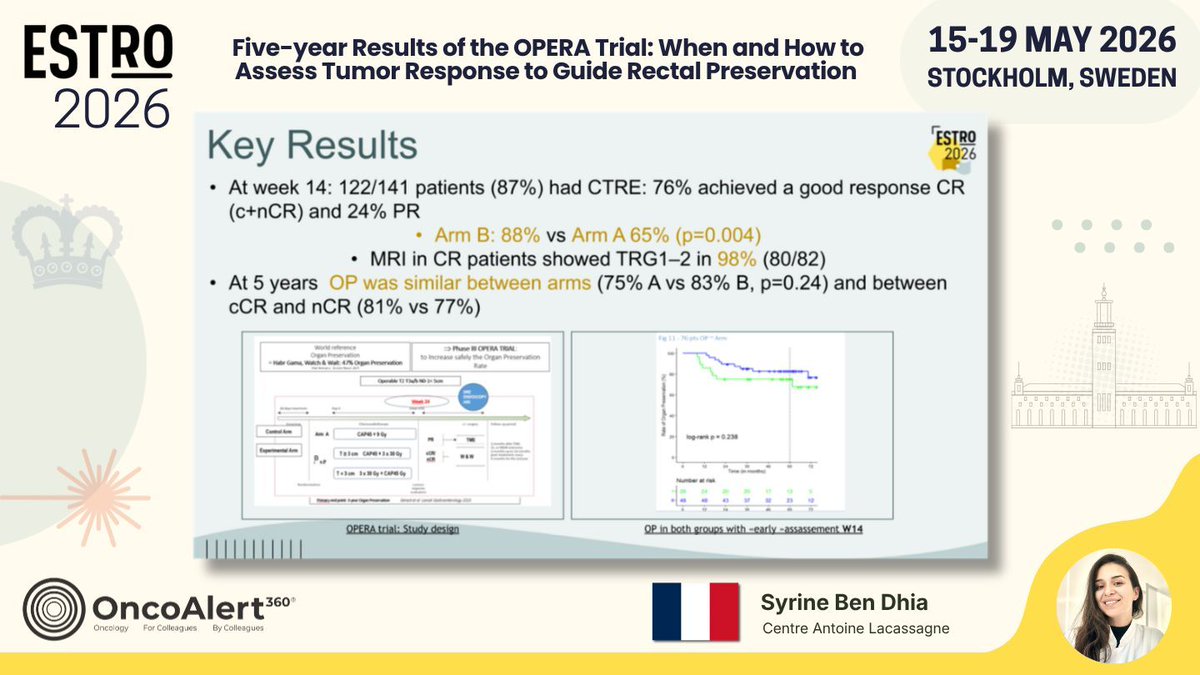
| Endpoint | Arm A | Arm B | Overall |
|---|---|---|---|
| W14 good response (cCR+nCR) | 65% | 88% | 76% |
| W14 partial response | n/a | n/a | 24% |
| 5yr organ preservation | 75% | 83% | p=0.24 |
| CTRE performed at W14 | n/a | n/a | 122/141 (87%) |
+2 more figures


10 details
Post-hoc analysis of the randomised OPERA trial (two arms, A and B), reporting 5-year organ-preservation outcomes. The parent trial assessed response at week 24 with a three-modality triad (DRE, rectoscopy, MRI); this analysis asks whether the week 14 read is good enough.
Week-14 clinical tumor response evaluation (CTRE) by DRE and rectoscopy, categorised CR / nCR / PR, with cCR + nCR counted as a "good" clinical response. MRI graded by TRG. CTRE was correlated with relapse and 5-year organ-preservation rates.
Both arms received neoadjuvant therapy with organ preservation as the goal, and good responders at W14 either proceeded to organ preservation or were reassessed at W24. Dose, fractionation, and the content distinguishing Arm A from Arm B are not reported in source, which limits how far the arm difference transfers.
CTRE was obtainable in 122/141 (87%) at W14. MRI confirmed TRG1-2 in 98% (80/82) of clinical CR pts, and 5-year organ preservation did not differ by arm (p=0.24) or by response depth (cCR 81% vs nCR 77%).
Watch-and-wait practice has largely settled on later response assessment, with the OPRA framing of consolidation timing and the registry experience both anchoring the decision point well beyond three months. This analysis argues the clinical exam carries most of that information a month after NAT ends, which is earlier than the field currently commits.
The 19 pts without CTRE at W14 (141 minus 122) are unaccounted for in source, and selective assessability would bias the 76% good-response figure upward. The arm difference (88% vs 65%, p=0.004) is uninterpretable here because the randomised contrast is not described.
The clinically useful claim is that nCR is a radiation effect, not residual tumor, and the 5-year organ-preservation parity between cCR and nCR (81% vs 77%) is the evidence for it. What the source does not settle is regrowth: organ preservation at 5 years is a net figure that can absorb salvage, so equal preservation does not establish equal local control.
Post-hoc timepoint analysis of 141 pts; W14 vs W24 assessment was never randomised, and no relapse or regrowth data reported in source.
- Regrowth and salvage rates behind the 5yr organ preservation figures
- What distinguished Arm A from Arm B
- Outcomes of the 19 pts without W14 CTRE
📚 Sources · 🐦 1 tweet
Day FOUR of #ESTRO26 Coverage by OncoAlert 🚨
— OncoAlert (@OncoAlert) May 18, 2026
Five-year Results of the OPERA Trial: When and How to Assess Tumor Response to Guide Rectal Preservation Presented by Syrine Ben Dhia 🇫🇷 #RadOnc ☢️
This post-hoc analysis of the OPERA trial evaluated early tumor response… pic.twitter.com/KUanFTxeFh