ePLND vs PSMA-PET staging (AUA2026 round-up)
TL;DRAUA2026 round-up: PSMA-PET NPV ~96% may allow PLND omission in intermediate risk; 47.7% of nodal mets sit outside ePLND template.
The RT-relevant number is toxicity sequencing: 19-29% lower limb lymphedema after PLND plus salvage pelvic nodal RT versus 0-9% after pelvic nodal RT alone, with 2-22% genital lymphedema in the combined group. If PSMA-PET is negative and PLND is omitted, later elective or salvage pelvic nodal coverage carries far less lymphedema cost.
In intermediate-risk pts with a PSMA-PET negative for nodal involvement, this supports omitting PLND before planned or possible pelvic nodal RT; it does not settle the high-risk case, where the round-up calls the decision individual.
Sequencing drives the toxicity: 19-29% lower limb lymphedema after PLND plus salvage pelvic nodal RT versus 0-9% after pelvic nodal RT alone, plus 2-22% genital lymphedema in the combined group. A pt who skips PLND arrives at elective or salvage nodal coverage with a much lower lymphedema burden.
The template itself is the weak point: 47.7% of nodal metastases in a 1253-man PSMA-PET series lay outside ePLND boundaries, and LND carried a 6-10x DVT/PE risk increase in Tyritzis. With a PSMA-PET negative for LNI in intermediate-risk disease, the yield no longer justifies routine dissection.

+3 more figures

| Treatment | Lower limb lymphedema | Genital lymphedema |
|---|---|---|
| RP with PLND | 0-14% | n/a |
| Pelvic node RT | 0-9% | n/a |
| PLND + salvage pelvic node RT | 19-29% | 2-22% |

10 details 5 trials watching
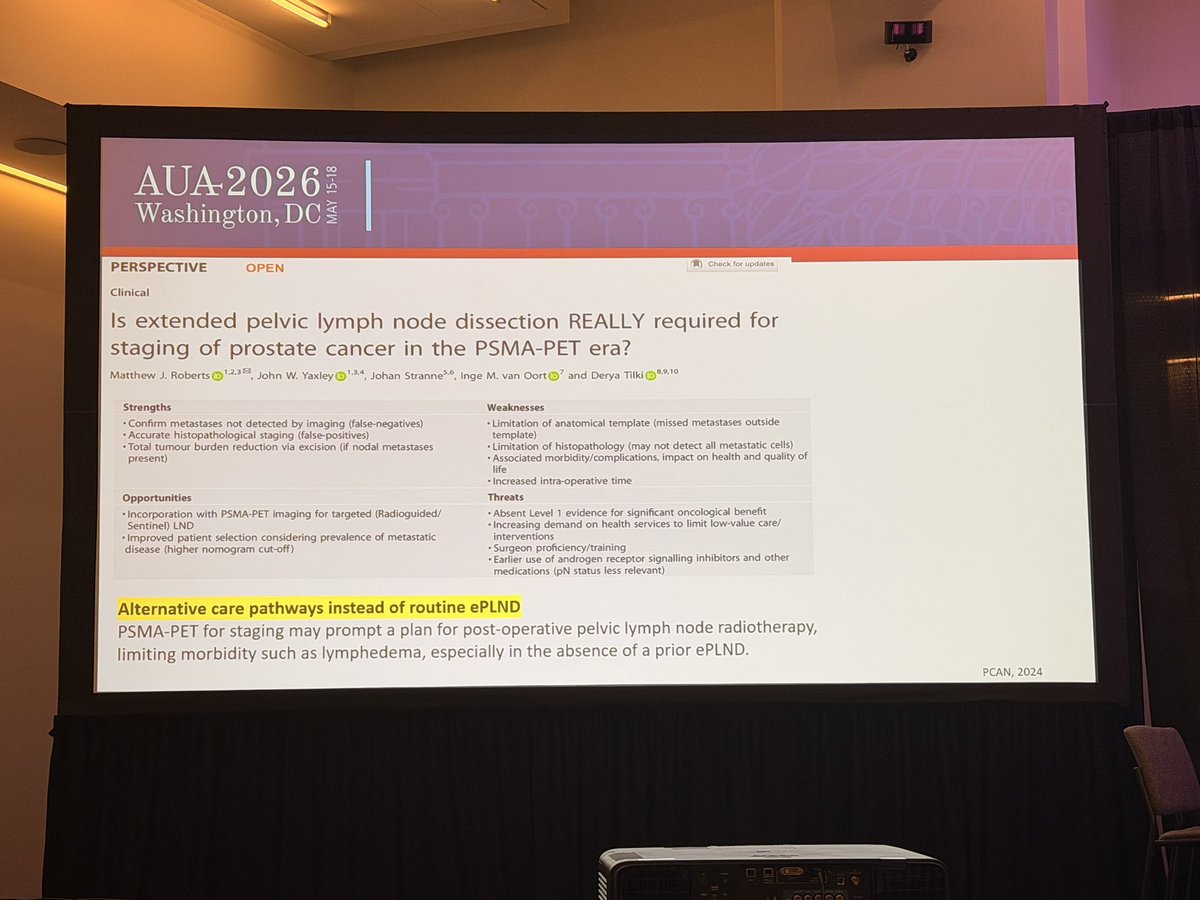
AUA 2026 podium round-up of the ePLND question in the PSMA-PET era. Draws on a 1253-man primary staging series (Yaxley, BJUI 2019), a systematic review of lymphedema (Clinckaert, Cancers 2022), a cohort of 3544 pts (Tyritzis, J Urol 2015) and a SWOT perspective (Roberts, PCAN 2024). No new dataset.
Staging yield argues against template adequacy: 47.7% of nodal metastases fell outside ePLND boundaries. PSMA-PET NPV is given as ~96% in the source text without its parent series named.
Lymphedema tracks the combination, not either modality alone: 0-14% after RP with PLND, 0-9% after pelvic nodal RT, 19-29% after PLND plus salvage pelvic nodal RT with 2-22% genital lymphedema. LND also carried a 6-10x DVT/PE risk increase in Tyritzis.
The argument is that a template operation cannot stage what sits outside the template, so its role narrows to pts in whom imaging is likely wrong. The slide's own conclusion keeps high-risk disease individualized rather than resolved, and explicitly asks that the possibility of adjuvant or salvage pelvic RT enter that conversation.
Slide-level source: NPV ~96% has no denominator, cohort or PSMA tracer attached here, and no BCR effect size is reported for the RCTs the round-up invokes. The lymphedema review's authors note the absent uniform definition, so 19-29% is a range across heterogeneous ascertainment, not a pooled estimate.
- Does ePLND improve BCR-free survival in any risk group? recruiting Dutch National Randomized Study: PSMA-PET/CT As a Triage Tool for Pelvic Lymph Node Dissection in Prostatectomy Patients Phase NAn=706 · primary completion 2025-07 · PSMA-PET triage to ePLND, n=706, prognosis endpointrecruiting Extended vs. No Pelvic Lymph Node Dissection During Radical Prostatectomy. DISSECTION 2.0. Phase NAn=400 · primary completion 2027-02 · randomises ePLND vs none in PSMA-negative high riskn=270 · primary completion 2028-02 · RP+ePLND vs RP±SRT, Briganti >=7%
- PSMA-PET NPV by risk group and tracer recruiting Preoperative PSMA PET/CT As Triage for EPLND in Patients Scheduled for RALP (PrePSMA) Phase NAn=600 · primary completion 2029-12 · tests whether PSMA-PET can replace ePLND staging
- Nodal RT after PSMA-PET staging without prior PLND n=250 · primary completion 2031-05 · PSMA-N0M0 randomised to prostate-only vs WPRT
📚 Sources · 🐦 1 tweet
At #AUA2026, the message was clear:⁰📌 ePLND provides staging information, but its therapeutic benefit remains uncertain.⁰📌 RCTs have not shown consistent improvements in BCR outcomes.⁰📌 PSMA PET/CT has a high NPV (~96%) and may safely avoid unnecessary PLND in… pic.twitter.com/7vJFe2hG77
— DR CARVAJAL (@RomanCarvajal) May 17, 2026
The longer read
The strongest datapoint on these slides is the one that reframes the question rather than answering it: in 1253 men staged with Ga-PSMA PET/CT, 47.7% of nodal metastases sat outside the boundaries of an extended template. A staging operation whose anatomical field misses roughly half of the disease it is meant to find cannot function as the reference standard the debate has historically treated it as, and that is a structural limitation rather than a technique or volume problem. The Roberts SWOT frames the same point from the other side: the listed weakness is the template, and the listed threat is the absence of level 1 evidence for oncological benefit. Neither claim is new, but the pairing is what makes the omission argument coherent rather than merely permissive.
For a radiation oncologist the interesting reasoning is about sequencing cost, not staging accuracy. The Clinckaert review's numbers are ranges, and its authors say plainly that the absence of a uniform lymphedema definition undermines any precise estimate, so they should not be read as effect sizes. But the ordering across the three groups is hard to explain away: 0-14% after prostatectomy with PLND, 0-9% after pelvic nodal radiotherapy, and 19-29% when both were delivered, with genital lymphedema appearing in 2-22% of that combined group. The combination is where the morbidity concentrates. That matters because the men most likely to need pelvic nodal radiotherapy later are precisely the men in whom a surgeon is most tempted to dissect nodes now, so the two interventions accumulate in the same patients rather than distributing across them.
The honest limitation is that this is a slide deck, and the quantities that would settle the clinical question are not on it. The ~96% negative predictive value appears in the tweet text with no cohort, no tracer detail, and no definition of the reference standard it was measured against, which is the number most load-bearing for an omission decision. The round-up asserts that randomised trials have not shown consistent biochemical recurrence improvement without naming them or reporting a single hazard ratio. A reader cannot audit either claim from what is here.
What the material does support is narrower than the headline. It is reasonable to conclude that in intermediate-risk disease with a PSMA-PET negative for nodal involvement, the yield of dissection is low enough and its added morbidity in combination with subsequent pelvic radiotherapy high enough that omission is defensible. The slide's own conclusion goes no further, and specifically declines to generalise to high-risk disease, where it asks that the possibility of adjuvant or salvage pelvic radiotherapy and its added side effects be part of the individual discussion. That is a reasonable place for the field to be. What would change the read is a trial that randomises the dissection question with pelvic nodal radiotherapy as a prespecified downstream variable, since every retrospective comparison here confounds who gets dissected with who gets irradiated.