ESTRO Congress 2026
ePLND vs PSMA-PET staging (AUA2026 round-up)
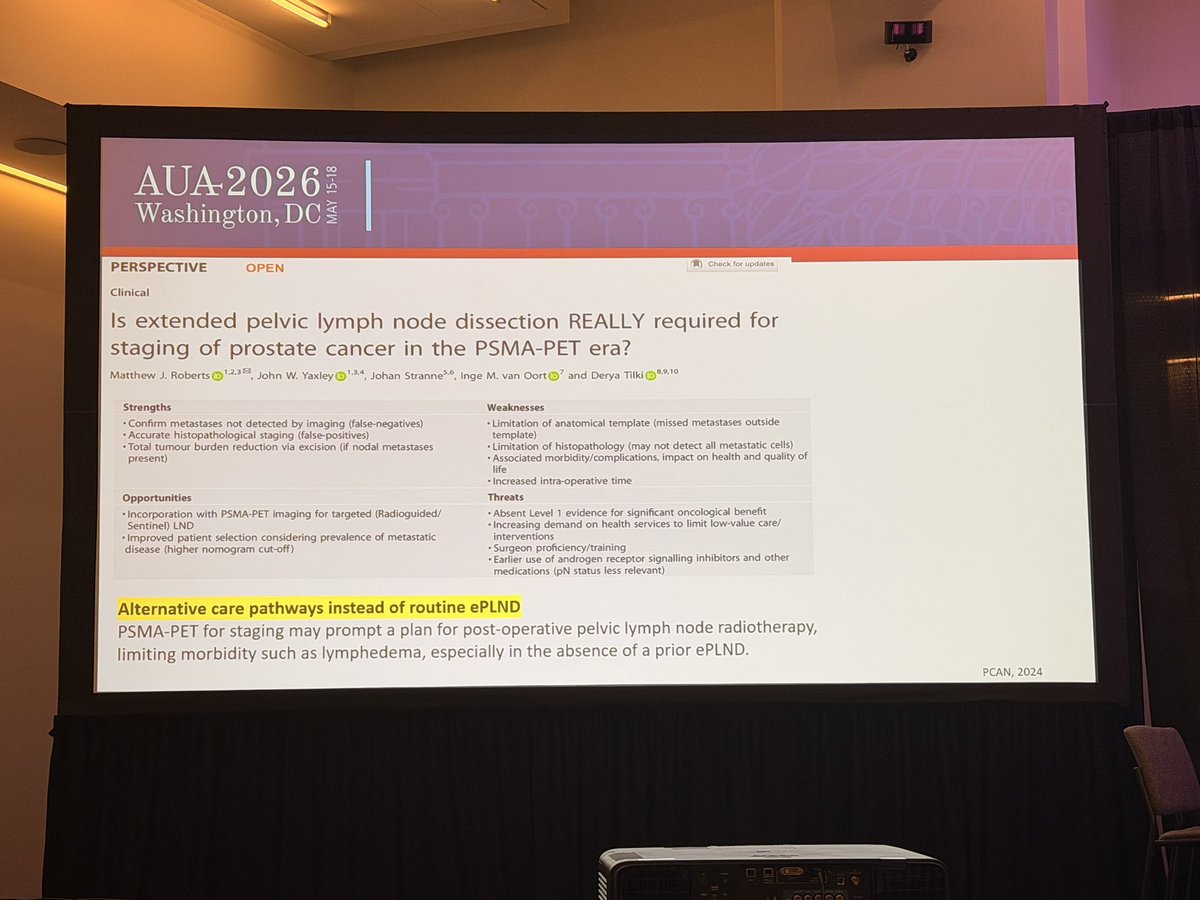
TL;DRAUA2026 round-up: PSMA-PET NPV ~96% may allow PLND omission in intermediate risk; 47.7% of nodal mets sit outside ePLND template.
The RT-relevant number is toxicity sequencing: 19-29% lower limb lymphedema after PLND plus salvage pelvic nodal RT versus 0-9% after pelvic nodal RT alone, with 2-22% genital lymphedema in the combined group. If PSMA-PET is negative and PLND is omitted, later elective or salvage pelvic nodal coverage carries far less lymphedema cost.
In intermediate-risk pts with a PSMA-PET negative for nodal involvement, this supports omitting PLND before planned or possible pelvic nodal RT; it does not settle the high-risk case, where the round-up calls the decision individual.
Sequencing drives the toxicity: 19-29% lower limb lymphedema after PLND plus salvage pelvic nodal RT versus 0-9% after pelvic nodal RT alone, plus 2-22% genital lymphedema in the combined group. A pt who skips PLND arrives at elective or salvage nodal coverage with a much lower lymphedema burden.
The template itself is the weak point: 47.7% of nodal metastases in a 1253-man PSMA-PET series lay outside ePLND boundaries, and LND carried a 6-10x DVT/PE risk increase in Tyritzis. With a PSMA-PET negative for LNI in intermediate-risk disease, the yield no longer justifies routine dissection.

+3 more figures

| Treatment | Lower limb lymphedema | Genital lymphedema |
|---|---|---|
| RP with PLND | 0-14% | n/a |
| Pelvic node RT | 0-9% | n/a |
| PLND + salvage pelvic node RT | 19-29% | 2-22% |

10 details 5 trials watching
AUA 2026 podium round-up of the ePLND question in the PSMA-PET era. Draws on a 1253-man primary staging series (Yaxley, BJUI 2019), a systematic review of lymphedema (Clinckaert, Cancers 2022), a cohort of 3544 pts (Tyritzis, J Urol 2015) and a SWOT perspective (Roberts, PCAN 2024). No new dataset.
Staging yield argues against template adequacy: 47.7% of nodal metastases fell outside ePLND boundaries. PSMA-PET NPV is given as ~96% in the source text without its parent series named.
Lymphedema tracks the combination, not either modality alone: 0-14% after RP with PLND, 0-9% after pelvic nodal RT, 19-29% after PLND plus salvage pelvic nodal RT with 2-22% genital lymphedema. LND also carried a 6-10x DVT/PE risk increase in Tyritzis.
The argument is that a template operation cannot stage what sits outside the template, so its role narrows to pts in whom imaging is likely wrong. The slide's own conclusion keeps high-risk disease individualized rather than resolved, and explicitly asks that the possibility of adjuvant or salvage pelvic RT enter that conversation.
Slide-level source: NPV ~96% has no denominator, cohort or PSMA tracer attached here, and no BCR effect size is reported for the RCTs the round-up invokes. The lymphedema review's authors note the absent uniform definition, so 19-29% is a range across heterogeneous ascertainment, not a pooled estimate.
- Does ePLND improve BCR-free survival in any risk group? recruiting Dutch National Randomized Study: PSMA-PET/CT As a Triage Tool for Pelvic Lymph Node Dissection in Prostatectomy Patients Phase NAn=706 · primary completion 2025-07 · PSMA-PET triage to ePLND, n=706, prognosis endpointrecruiting Extended vs. No Pelvic Lymph Node Dissection During Radical Prostatectomy. DISSECTION 2.0. Phase NAn=400 · primary completion 2027-02 · randomises ePLND vs none in PSMA-negative high riskn=270 · primary completion 2028-02 · RP+ePLND vs RP±SRT, Briganti >=7%
- PSMA-PET NPV by risk group and tracer recruiting Preoperative PSMA PET/CT As Triage for EPLND in Patients Scheduled for RALP (PrePSMA) Phase NAn=600 · primary completion 2029-12 · tests whether PSMA-PET can replace ePLND staging
- Nodal RT after PSMA-PET staging without prior PLND n=250 · primary completion 2031-05 · PSMA-N0M0 randomised to prostate-only vs WPRT
📚 Sources · 🐦 1 tweet
At #AUA2026, the message was clear:⁰📌 ePLND provides staging information, but its therapeutic benefit remains uncertain.⁰📌 RCTs have not shown consistent improvements in BCR outcomes.⁰📌 PSMA PET/CT has a high NPV (~96%) and may safely avoid unnecessary PLND in… pic.twitter.com/7vJFe2hG77
— DR CARVAJAL (@RomanCarvajal) May 17, 2026
Bladder-preserving TMT multicenter analysis (URONCOR)
ForcT2-T4aN0M0 MIBC treated with definitive TMT, median age 76
TL;DRCLR 63.7% in a 369-pt Spanish TMT cohort; salvage cystectomy 9.7%, image-guidance quality and 5-FU-based CRT predicted local response.
The modifiable RT variable here is verification protocol: weekly portal imaging carried OR 0.35 (0.20-0.60) for complete local response, with VMAT trending favorable, across a 2010 to 2022 accrual. Dose, fractionation and target volume are not reported in source, so what transfers is the case for daily volumetric IGRT in a filling, moving organ.
In cT2-T4aN0M0 MIBC pts in their seventies weighing bladder preservation against cystectomy, this real-world series supports TMT delivered with modern image guidance and a 5-FU-based backbone; it does not inform node-positive or metastatic disease and carries no head-to-head against radical cystectomy.
Verification protocol is the modifiable variable: weekly portal imaging carried OR 0.35 (0.20-0.60) for complete local response, with VMAT trending favorable. Dose, fractionation and target volume are not reported in source, so what transfers is the case for daily volumetric IGRT and adaptive planning rather than a specific prescription.
The concurrent backbone mattered: 5-FU-based CRT carried OR 4.9 (1.1-22.1) for complete local response, though the CI leaves the magnitude open and comparator regimens are unnamed in source. Systemic failure at 10.7% ran at or above local-only failure at 10.1%, keeping perioperative systemic therapy questions live.
Salvage cystectomy was performed in 9.7% against 28.8% who progressed, so in a median-age-76 cohort most failures were not surgically rescued. With no in-cohort cystectomy comparator, this informs counseling on bladder preservation for cT2-T4aN0M0 disease without establishing equivalence to upfront radical cystectomy.

10 details
Multicenter retrospective cohort, Spain, 2010 to 2022, N=369 treated with definitive trimodality therapy (maximal TURBT then concurrent chemoradiotherapy). Predictors of response identified by multivariable logistic regression. Follow-up duration not reported in source.
cT2-T4aN0M0 MIBC selected for bladder preservation. Median age 76, 85.1% male. Fitness for cystectomy and completeness of TURBT are not reported in source.
Concurrent chemoradiotherapy, regimen at each center's discretion. 5-FU-based CRT predicted higher complete local response (OR 4.9, 95% CI 1.1-22.1, p=0.038). The comparator regimens are not named in source.
Dose, fractionation and target volume are not reported in source. The only technique signals reported are verification frequency (weekly portal imaging, OR 0.35 for CLR) and a non-significant trend favoring VMAT.
Primary: complete local response (CLR). Secondary: OS, CSS, recurrence patterns, salvage cystectomy. No OS or CSS estimate appears in the source, so the survival half of the conclusion cannot be checked.
CLR 63.7%, salvage cystectomy 9.7%. Progression 28.8%, with systemic failure (10.7%) running at or above local-only failure (10.1%).
BC2001 established the locoregional-control gain from adding chemotherapy to bladder radiotherapy, and the pooled RTOG bladder-preservation experience set the complete-response benchmark; both were protocol populations. This adds European real-world multicenter data at a median age of 76, with no internal cystectomy comparator.
No follow-up duration, OS or CSS estimate is reported, so the durability behind the preservation claim cannot be judged. The 5-FU odds ratio spans 1.1 to 22.1, compatible with a marginal or a large effect, and in a retrospective series regimen choice tracks renal function and performance status.
Systemic failure at 10.7% running at or above local-only failure at 10.1% argues the ceiling in this population is micrometastatic disease rather than the bladder, which caps what further local intensification can buy. Read conservatively, the predictors favor modern image guidance and an active concurrent backbone, not any specific verification schedule.
Retrospective multicenter cohort with no cystectomy comparator; imaging and chemo predictors come from multivariable regression across a 2010-2022 era shift, so a causal reading is unsupported.
- Does daily volumetric IGRT improve complete local response vs weekly portal imaging?
- Which concurrent chemotherapy backbone maximizes complete local response in TMT?
- Long-term bladder-intact survival vs radical cystectomy in matched populations
📚 Sources · 🐦 1 tweet
📢 Presentamos en #ESTRO26 nuestro análisis multicéntrico sobre preservación vesical en cáncer vesical músculo-invasivo tratado con TMT.
— URONCOR (@URONCOR) May 19, 2026
🔎 En 369 pacientes, la respuesta completa clínica se asoció a menor recurrencia local y mejor supervivencia!@fcounago #NicoFeltes pic.twitter.com/aQjjkcHGP4
Single-fraction SABR pooled analysis, 1687 pts
ForPrimary NSCLC or pulmonary oligomets selected for single-fraction SABR
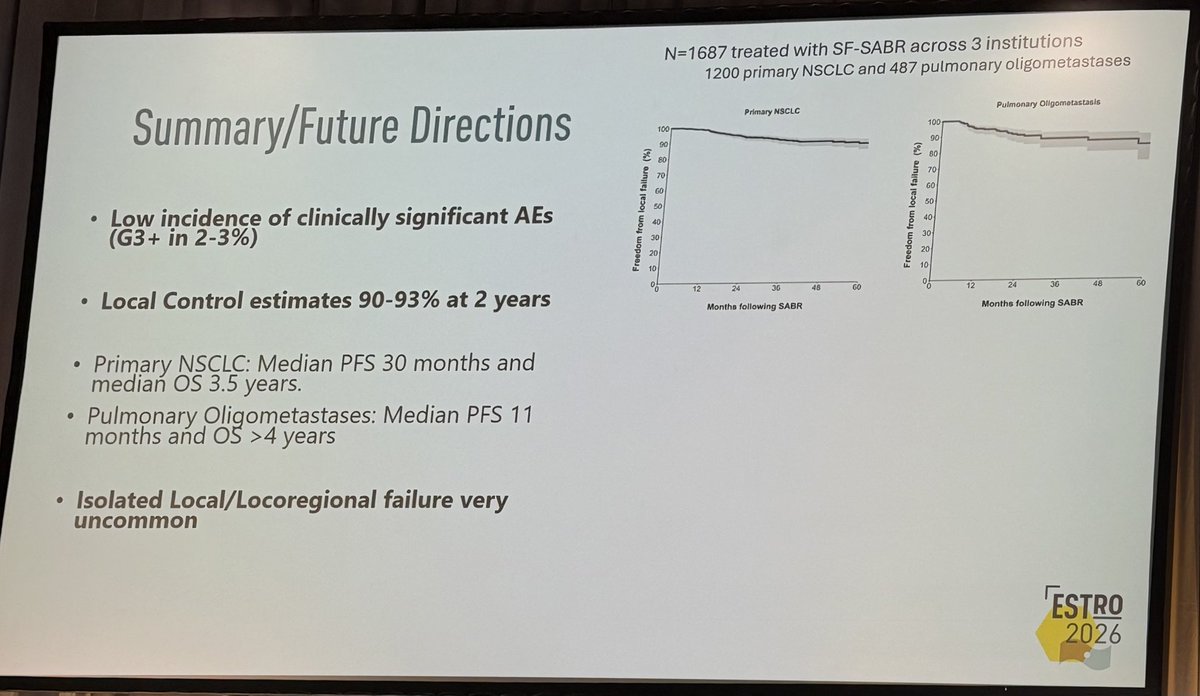
TL;DRLocal control 90-93% at 2yr and G3+ AEs 2.9% across 1687 single-fraction SABR pts at 3 centres.
The oligomet read is the gap between local control and PFS: 90-93% LC at 2yr against median PFS 11 mo, so distant failure, not the treated lesion, drives the course. For primary NSCLC the same LC sits with median PFS 30 mo, which is the split that should decide whether one-visit ablation is offered as definitive treatment or as a break from systemic therapy.
In early-stage primary NSCLC where visit burden drives the fractionation choice, this supports single fraction as a durable local option (LC 90-93% at 2yr, G3+ 2.9%); tumour location and operability are not reported, so who it represents stays open.
Local control holds at 90-93% at 2yr for a primary and for a metastasis alike, so the single fraction is not the variable separating outcomes; median PFS is (30 vs 11 mo). Tumour size and location go unreported, so the target selection behind that number is unmeasured.
For a pt with pulmonary oligometastases, one-visit ablation gave 90-93% local control at 2yr but median PFS of 11 mo, so it clears the treated lesion without changing the systemic course. That frames referral as a local step between systemic lines, not a substitute for one.
| Cohort | n | Median PFS | Median OS |
|---|---|---|---|
| Primary NSCLC | 1200 | 30 mo | 3.5 yrs |
| Pulmonary oligometastases | 487 | 11 mo | >4 yrs |
+2 more figures
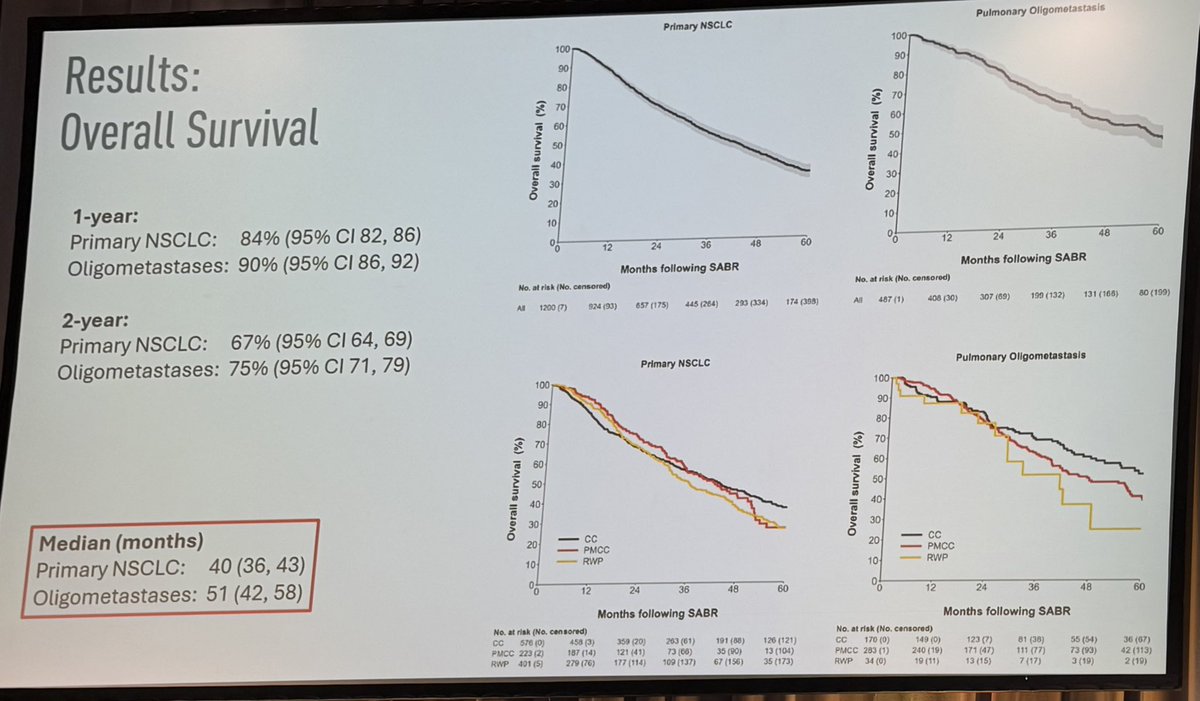
| Endpoint | Primary NSCLC | Oligometastases |
|---|---|---|
| 1yr OS | 84% (95% CI 82, 86) | 90% (95% CI 86, 92) |
| 2yr OS | 67% (95% CI 64, 69) | 75% (95% CI 71, 79) |
| Median OS | 40 mo (36, 43) | 51 mo (42, 58) |
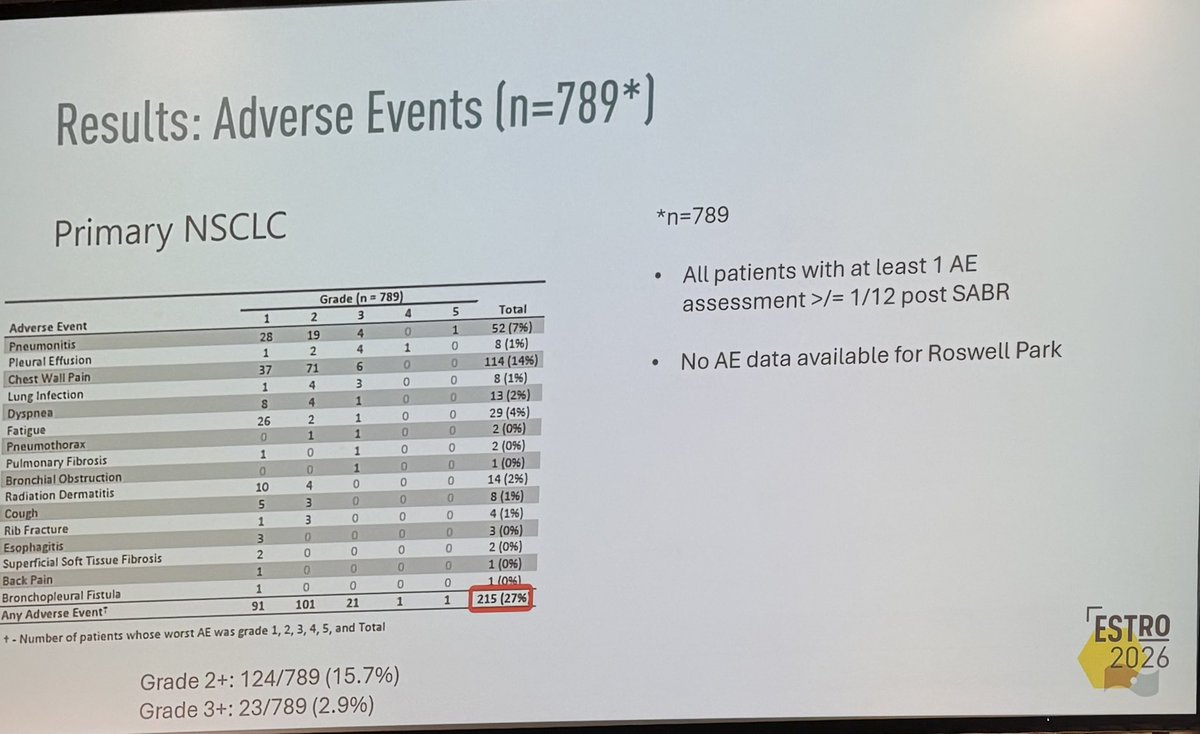
| Adverse event (n=789) | n (%) |
|---|---|
| Any AE | 215 (27%) |
| Grade 2+ | 124 (15.7%) |
| Grade 3+ | 23 (2.9%) |
| Chest wall pain | 114 (14%) |
| Pneumonitis | 52 (7%) |
| Fatigue | 29 (4%) |
| Dyspnea | 13 (2%) |
6 details
Pooled analysis of 1687 pts treated with single-fraction SABR at three centres (Peter MacCallum, Cleveland Clinic, Roswell Park): 1200 primary NSCLC and 487 pulmonary oligometastases. Whether the contributing cohorts were prospective or retrospective is not stated in source.
Eligibility, operability, tumour size and central vs peripheral location are not reported in source. Cohort mix differs sharply by centre: Roswell Park supplied 401 of the NSCLC pts but only 34 oligomet pts, while Peter Mac supplied 283 of 487 oligomet pts.
Single fraction throughout, but the prescribed dose is not reported in source. Without it the outcome cannot be mapped onto a schedule a reader could write, which is the one parameter that would carry this into planning.
No primary endpoint is stated in the source. Reported outcomes are local control, freedom from local failure, PFS, OS and adverse events, each descriptive rather than tested against a comparator.
Local control 90-93% at 2 years across both cohorts, with isolated local or locoregional failure described as very uncommon. Survival separates by cohort while local outcome does not.
| Centre | Primary NSCLC | Pulmonary oligomets |
|---|---|---|
| Cleveland Clinic | 576 | 170 |
| Peter MacCallum | 223 | 283 |
| Roswell Park | 401 | 34 |
AE reporting covers 789 primary NSCLC pts only, with no Roswell Park data and no oligometastasis toxicity in source. Within that subset chest wall pain and pneumonitis dominate and G3+ events stay at 2.9%.
Single-fraction SABR already carries randomised support: RTOG 0915 in peripheral early-stage NSCLC and SAFRON II in pulmonary oligometastases, both randomised single against multi-fraction schedules. This series adds scale and follow-up at three high-volume centres, which is what a non-randomised dataset can contribute, and no comparator.
Toxicity rests on 789 of 1687 pts, with one centre absent from the AE table and the oligometastatic cohort not represented in it at all. Centre mix is uneven, so pooled rates carry each centre's own selection rather than a common one.
The question the thread raises, whether one-stop SABR should be used more often, is not the question this dataset answers. What it does show is that local control near 90-93% and G3+ toxicity near 3% hold at scale outside a protocol, which is the usual worry about a schedule with no second chance. The unreported dose sits between that reassurance and a prescription.
Pooled uncontrolled series across three centres, no multi-fraction comparator and no stated design; dose unreported, so outcomes cannot be tied to a prescription.
- Whether single-fraction outcomes hold for central tumours
- Durability of single-fraction ablation for pulmonary oligometastases beyond first progression
- Toxicity of single-fraction SABR in the oligometastatic cohort
📚 Sources · 🐦 1 tweet
👏🏽👏🏽👏🏽@neildwallaceie at #ESTRO26 - 1687 patients receiving single fraction SABR for #lungcancer and pulmonary oligomets, @PeterMacRadOnc / @ClevelandClinic / @RoswellPark. Fantastic local control, and low adverse rates. Should we be using “one stop” SABR more often #radonc ? pic.twitter.com/w2IlGKRU5o
— Shankar Siva (@_ShankarSiva) May 18, 2026
OPERA
ForRectal cancer on watch-and-wait pathway after neoadjuvant therapy
TL;DRW14 clinical response (DRE+rectoscopy) identified 76% good responders; 5yr organ preservation 75% A vs 83% B, p=0.24.
The transferable read is timing: response can be called at W14, one month after NAT ends, on DRE plus rectoscopy, with MRI TRG1-2 concordance of 98% (80/82). nCR at W14 preserved organs as well as cCR (77% vs 81%), so a near-complete response reflecting radiation effect does not by itself send a patient to TME.
In rectal pts on a watch-and-wait pathway, this supports assessing response at W14 rather than deferring to W24 and reassessing nCR rather than treating it as failure; it does not address pts never eligible for organ preservation.
Response can be called at W14, one month after NAT ends, on DRE plus rectoscopy, with MRI TRG1-2 concordance of 98% (80/82). nCR at that point preserved organs as well as cCR (77% vs 81%), so a near-complete response reflecting radiation effect does not itself justify TME.
The surgical decision this moves is when to abandon watch-and-wait. A W14 nCR reached 5yr organ preservation of 77% versus 81% for cCR, so early near-complete response is not evidence for proceeding to TME. Regrowth and salvage counts are not reported in source.
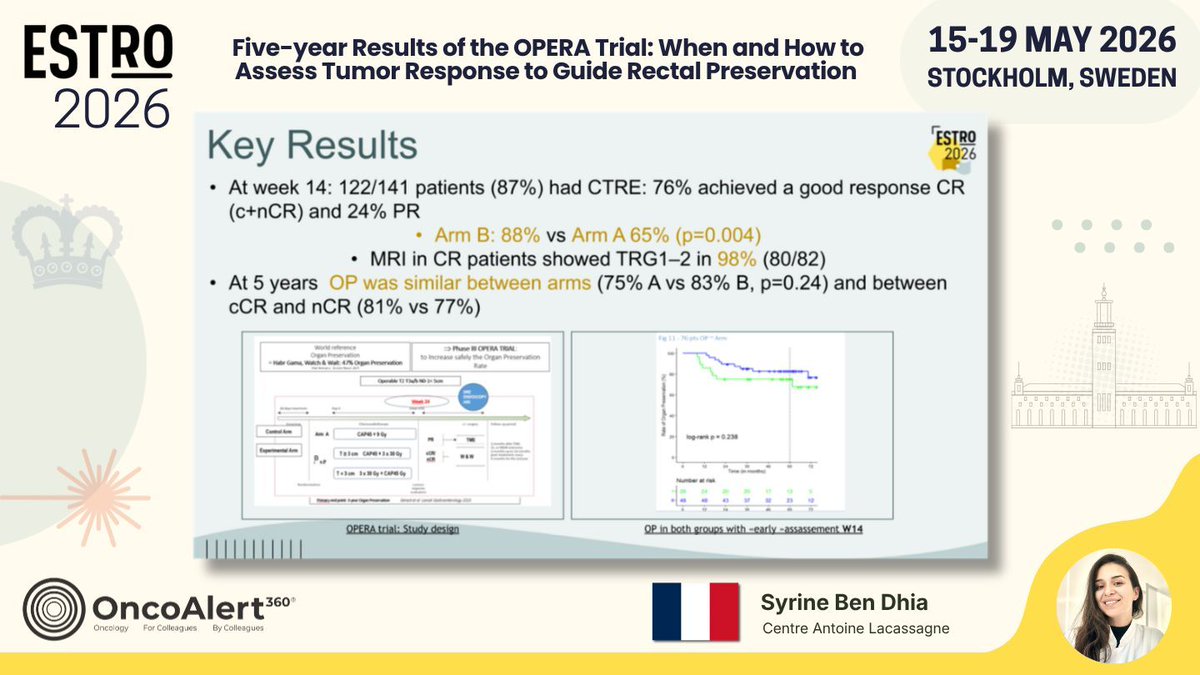
| Endpoint | Arm A | Arm B | Overall |
|---|---|---|---|
| W14 good response (cCR+nCR) | 65% | 88% | 76% |
| W14 partial response | n/a | n/a | 24% |
| 5yr organ preservation | 75% | 83% | p=0.24 |
| CTRE performed at W14 | n/a | n/a | 122/141 (87%) |
+2 more figures


10 details
Post-hoc analysis of the randomised OPERA trial (two arms, A and B), reporting 5-year organ-preservation outcomes. The parent trial assessed response at week 24 with a three-modality triad (DRE, rectoscopy, MRI); this analysis asks whether the week 14 read is good enough.
Week-14 clinical tumor response evaluation (CTRE) by DRE and rectoscopy, categorised CR / nCR / PR, with cCR + nCR counted as a "good" clinical response. MRI graded by TRG. CTRE was correlated with relapse and 5-year organ-preservation rates.
Both arms received neoadjuvant therapy with organ preservation as the goal, and good responders at W14 either proceeded to organ preservation or were reassessed at W24. Dose, fractionation, and the content distinguishing Arm A from Arm B are not reported in source, which limits how far the arm difference transfers.
CTRE was obtainable in 122/141 (87%) at W14. MRI confirmed TRG1-2 in 98% (80/82) of clinical CR pts, and 5-year organ preservation did not differ by arm (p=0.24) or by response depth (cCR 81% vs nCR 77%).
Watch-and-wait practice has largely settled on later response assessment, with the OPRA framing of consolidation timing and the registry experience both anchoring the decision point well beyond three months. This analysis argues the clinical exam carries most of that information a month after NAT ends, which is earlier than the field currently commits.
The 19 pts without CTRE at W14 (141 minus 122) are unaccounted for in source, and selective assessability would bias the 76% good-response figure upward. The arm difference (88% vs 65%, p=0.004) is uninterpretable here because the randomised contrast is not described.
The clinically useful claim is that nCR is a radiation effect, not residual tumor, and the 5-year organ-preservation parity between cCR and nCR (81% vs 77%) is the evidence for it. What the source does not settle is regrowth: organ preservation at 5 years is a net figure that can absorb salvage, so equal preservation does not establish equal local control.
Post-hoc timepoint analysis of 141 pts; W14 vs W24 assessment was never randomised, and no relapse or regrowth data reported in source.
- Regrowth and salvage rates behind the 5yr organ preservation figures
- What distinguished Arm A from Arm B
- Outcomes of the 19 pts without W14 CTRE
📚 Sources · 🐦 1 tweet
Day FOUR of #ESTRO26 Coverage by OncoAlert 🚨
— OncoAlert (@OncoAlert) May 18, 2026
Five-year Results of the OPERA Trial: When and How to Assess Tumor Response to Guide Rectal Preservation Presented by Syrine Ben Dhia 🇫🇷 #RadOnc ☢️
This post-hoc analysis of the OPERA trial evaluated early tumor response… pic.twitter.com/KUanFTxeFh
HEAT NCT01794403
ForLocalized low- to intermediate-risk prostate, IPSS <12, gland <80 cc
7% vs 7.4%
p-non-inferiority = 0.007 at 4.25y, margin 12%
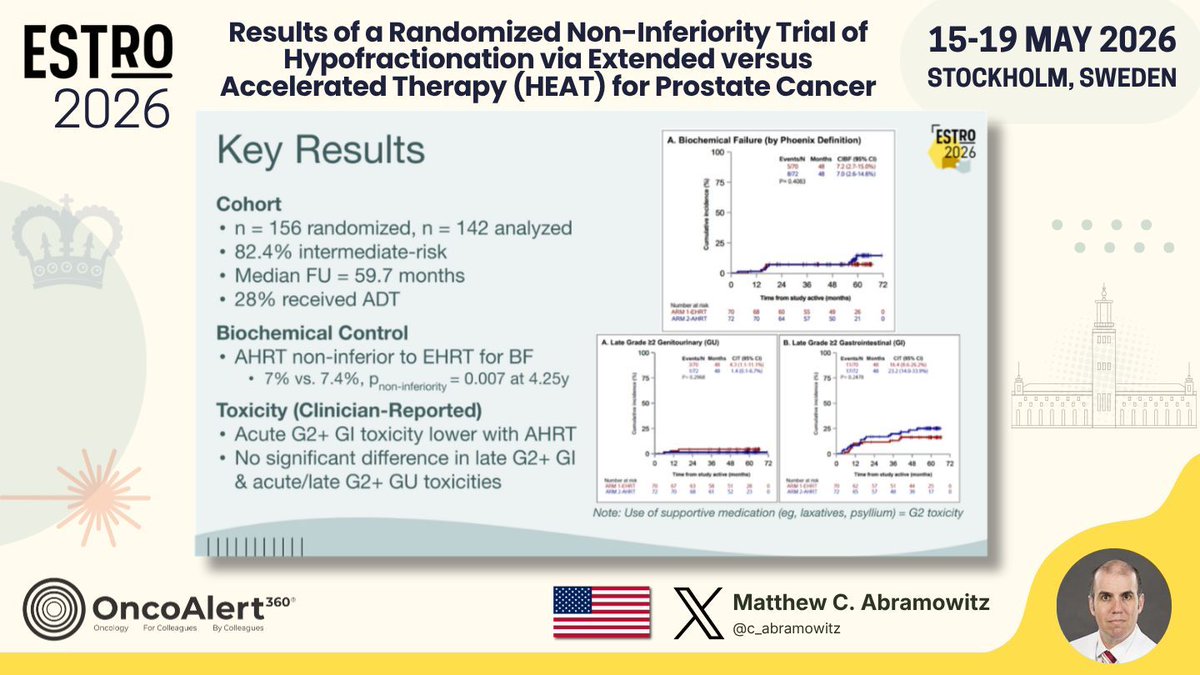
TL;DRInterim: BF 7% vs 7.4% at 4.25y, p-non-inferiority 0.007, 5-fx SBRT non-inferior to 26-fx IMRT with ADT allowed.
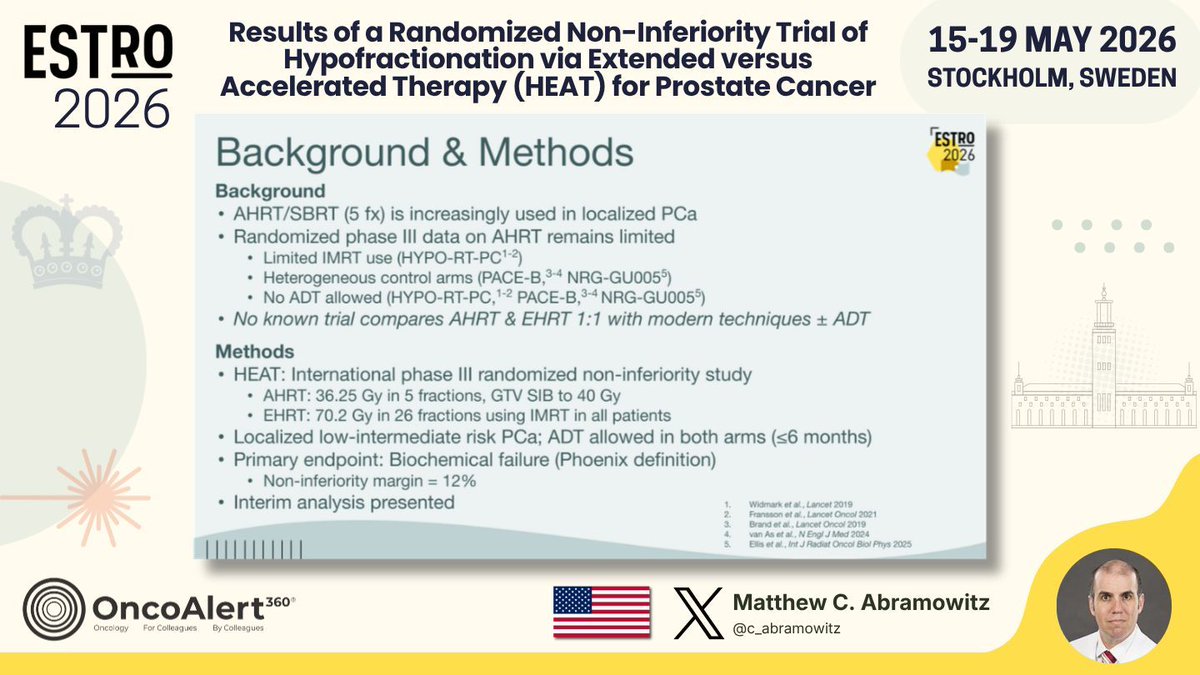
The design detail that transfers is the SIB: 36.25 Gy/5 fx with GTV boost to 40 Gy, against a 70.2 Gy/26 fx IMRT comparator rather than conventional fractionation, with ≤6 months ADT permitted in both arms. That combination is closer to what most departments now offer than HYPO-RT-PC or PACE-B, so it addresses whether 5 fractions holds up when the control arm is already moderately hypofractionated.
In localized low- to intermediate-risk disease with IPSS <12 and gland under 80 cc, including men receiving short-course ADT, this supports 5-fraction SBRT as an option against moderate hypofractionation; it does not speak to high-risk disease or nodal coverage.
The transferable parameters are 36.25 Gy/5 fx with GTV SIB to 40 Gy against a 70.2 Gy/26 fx IMRT comparator, with ≤6 months ADT permitted in both arms. Acute G2+ GI favored 5 fractions and late G2+ GI and GU were comparable at median 59.7 months, so this moves the fractionation choice in low- to intermediate-risk disease.
+2 more figures
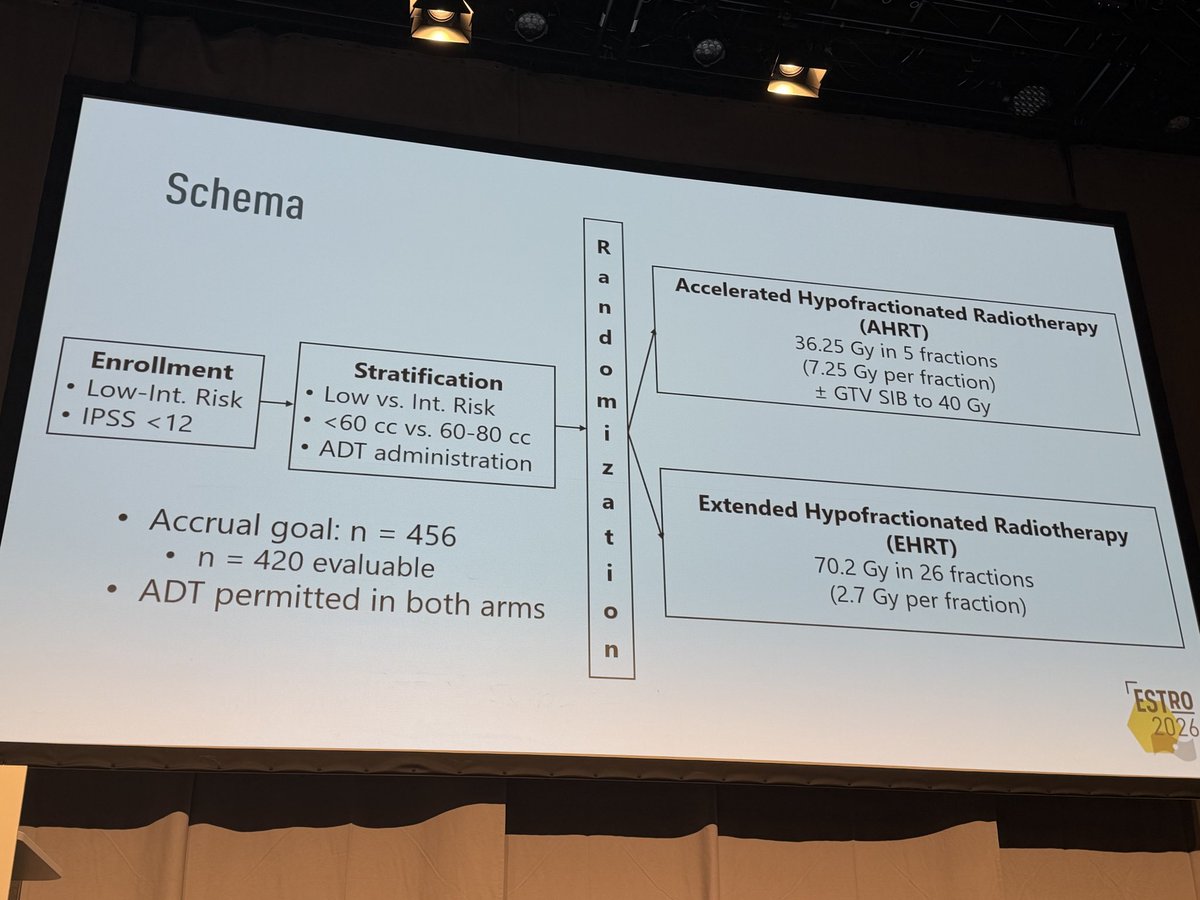
| Arm | Dose | Fractions | Dose per fraction |
|---|---|---|---|
| AHRT | 36.25 Gy (+ GTV SIB to 40 Gy) | 5 | 7.25 Gy |
| EHRT | 70.2 Gy | 26 | 2.7 Gy |
9 details 5 trials watching
International phase III randomized non-inferiority trial, 1:1, comparing accelerated (AHRT) vs extended (EHRT) hypofractionation. Interim analysis presented; accrual goal n = 456 with 420 evaluable, and 142 analyzed so far. Median follow-up 59.7 months.
Localized low- to intermediate-risk prostate cancer with IPSS <12. Stratified by risk group, prostate volume (<60 cc vs 60-80 cc) and ADT administration. 82.4% intermediate-risk; 28% received ADT.
AHRT: 36.25 Gy in 5 fractions (7.25 Gy per fraction) with GTV SIB to 40 Gy. EHRT: 70.2 Gy in 26 fractions (2.7 Gy per fraction), IMRT in all patients. ADT permitted in both arms, ≤6 months.
Primary: biochemical failure, Phoenix definition, with a non-inferiority margin of 12%. Clinician-reported acute and late GI and GU toxicity reported alongside.
BF 7% vs 7.4%, p-non-inferiority = 0.007 at 4.25y, meeting the non-inferiority criterion.
Acute G2+ GI toxicity lower with AHRT. No significant difference in late G2+ GI or in acute or late G2+ GU. Note that use of supportive medication (laxatives, psyllium) was scored as G2.
The presenters position HEAT against HYPO-RT-PC (limited IMRT use), PACE-B and NRG-GU005 (heterogeneous control arms), all of which allowed no ADT. HEAT is framed as the first trial comparing AHRT and EHRT 1:1 with modern technique plus ADT.
Event counts are low (7% vs 7.4%) against a 12% margin, so the interval around the difference is wide relative to the difference being excluded. The comparator is itself hypofractionated, so this does not test 5 fractions against conventional fractionation.
The question HEAT answers is narrower than 'does SBRT work': it asks whether 5 fractions holds when the control arm is already 26 fractions of IMRT and short ADT is on the table. A positive interim read supports 5 fractions as a default offer in this risk band, but the final prespecified analysis is what settles it.
Interim analysis at 142 of a planned 420 evaluable; prespecified final primary analysis is the gate. Wide 12% margin relative to observed event rates.
- Does non-inferiority hold at the final prespecified analysis
- Effect of concurrent ADT on the fractionation comparison n=60 · primary completion 2028-02 · randomises SBRT +/- relugolix in cFIR/cgUIRn=130 · primary completion 2028-11 · adds ultra-short ADT to single-fraction SBRT
- Late GU outcomes beyond 5 years with 7.25 Gy fractions n=100 · primary completion 2027-10 · 36.25 Gy/5 fx, 1-2mm PTV, late urethra toxicityn=175 · primary completion 2028-12 · 3 fx vs 5 fx benchmark, late GU grade 2+ 1° EPrecruiting Erectile Dysfunction in Good Prognosis Prostate Cancer : Comparison Between Brachytherapy and Stereotactic Body Radiotherapy Phase NAn=240 · primary completion 2030-04 · 7.25 Gy x5 vs I-125 brachy, f/u to 2030
📚 Sources · 🐦 2 tweets
Day FOUR of #ESTRO26 Coverage by OncoAlert 🚨
— OncoAlert (@OncoAlert) May 18, 2026
Results of a Randomized Non-Inferiority Trial of Hypofractionation via Extended versus Accelerated Therapy (HEAT) for Prostate Cancer Presented by Matthew C. Abramowitz🇺🇸 #RadOnc ☢️ #ProstateCancer
HEAT is an international phase… pic.twitter.com/IkSTgQHwXK
The HEAT trial is another randomized demonstration of the safety & efficacy of SBRT compared to hypofractionted RT in #prostatecancer at #ESTRO26 pic.twitter.com/c9sNb3KOqo
— Pierre Blanchard, MD (@PBlanchardMD) May 18, 2026
TORPEdO
ForOropharyngeal SCC requiring concurrent chemo-RT with bilateral neck treatment
No difference vs IMRT
Mean scores similar at 3/12/24 mo post RT; no effect size reported in source
TL;DRNo mean UW-QoL physical composite difference IMPT vs IMRT at 3/12/24 mo post RT, 205 pts.
Both arms were prescribed the same 70 Gy / 56 Gy in 33 fractions under identical constraints, so this tests IMPT under photon-derived objectives, not its dosimetric ceiling. The physical composite (saliva, taste, chewing, swallowing) separates at no timepoint from week 6, weakening the QoL case for referring unselected bilateral-neck OPSCC pts to protons.
In oropharyngeal SCC needing bilateral-neck chemoradiotherapy, patient-reported QoL alone does not support a proton referral; it does not speak to unilateral-neck, RT-alone, or reirradiation pts, where the sparing case differs.
The referral decision is what moves: with identical prescriptions (70 Gy / 56 Gy in 33 fractions) and matched constraints, IMPT showed no mean UW-QoL physical composite advantage at any timepoint from week 6. That argues for model-based selection of individual patients over categorical proton referral in bilateral-neck OPSCC.

+1 more figure

9 details
Multicentre phase 3 RCT, 2:1 randomisation to IMPT vs IMRT, 205 pts recruited. Stratified by T-stage, N-stage, p16 status and smoking history. This ESTRO 2026 presentation reports the longitudinal HR-QoL analysis only.
Oropharyngeal SCC requiring concurrent chemo-radiotherapy including bilateral neck treatment. p16 status was a stratification factor, not an exclusion, so both HPV-driven and HPV-negative disease are represented.
70 Gy / 56 Gy in 33 fractions over 6.5 weeks in both arms, IMPT vs IMRT. Same dose, same schedule, same constraints, so delivery technique is the only variable.
Concurrent cisplatin 100mg/m2 on D1 and D22, identical in both arms. The systemic backbone is fixed, so nothing here reads on regimen choice.
Co-primary (clinician): CTCAE grade 3 weight loss (≥20% decrease from baseline) or gastrostomy dependence at 12 months post RT. Co-primary (patient): UW-QoL physical composite of saliva, taste, chewing, swallowing, appearance and speech at 12 months post CRT.
No difference in mean UW-QoL physical composite between arms at 3, 12 and 24 months post RT, with similar trajectories from week 6 post CRT and similar results across multiple PRO instruments. Scores fell at end of treatment then recovered, most stabilising from 12 months. No effect sizes given in source.
Non-randomised proton series in oropharynx have reported lower gastrostomy dependence and xerostomia than photon comparators, and that expectation is what this trial was built to test. The randomised patient-reported comparison does not reproduce a separation. No cross-trial numbers are in the source.
A composite of six domains dilutes a benefit confined to one, xerostomia being the obvious candidate. 90% CIs and no stated non-inferiority margin mean this is an absence of difference, not demonstrated equivalence. The commentary point that UK proton centres are early on the learning curve is untestable from the source.
The clean part of this design, matched dose and matched constraints, is also what bounds the answer: IMPT was planned to objectives written for photons, so the trial measures what protons deliver under photon rules rather than what they can achieve when pushed. It supports selecting patients by individual sparing benefit rather than referring bilateral-neck OPSCC to protons as a class.
Randomised phase 3 PRO co-primary shows no arm difference, supporting IMRT as standard. Clinician-reported co-primary and effect sizes absent from source.
- Clinician co-primary (weight loss / gastrostomy) result not yet reported
- Whether proton-experienced centres would show a QoL difference
- HR-QoL beyond 2 years; follow-up ongoing to 5 years
📚 Sources · 🐦 2 tweets · 📄 1 paper
Day FOUR of #ESTRO26 Coverage by OncoAlert 🚨
— OncoAlert (@OncoAlert) May 18, 2026
Health-related quality of life in the phase III trial of Toxicity Reduction using Proton Beam Therapy for Oropharyngeal Cancer (TORPEdO;CRUK/18/010) Presented by Matthew Tyler🇬🇧 #RadOnc ☢️
TORPEdO, a multicentre phase 3… pic.twitter.com/ZP6yK7RThL
TORPEdO. Misma planificación + constraints idénticas y centros UK noveles probablemente limitaron el potencial de #IMPT.
— Amadeo Wals (@AmadeoWals) May 18, 2026
Centros con alta experiencia se siguen viendo ventajas clínicas . La QA rigurosa del UK es una fortaleza, pero no maximiza la diferencia.#ESTRO26 #HNCSM https://t.co/rASp3QDIk1
INRT-AIR & DARTBOARD pooled analysis
ForHNSCC oropharynx/larynx/hypopharynx, stage I-IVB, excluding T1-2N0 larynx
TL;DR5yr solitary elective nodal recurrence 0% with ENI omission in HNSCC; 5yr OS 87%, PFS 74%, n=117.
The number that matters is 0% solitary elective nodal recurrence at 5 yrs: elective volumes are where the parotid, constrictor and pharyngeal dose lives, and this is the first pooled long-term read that omitting them does not trade nodal control. MDADI 84.9 at 12 mo with no significant decline is the swallowing correlate. No dose or CTV detail in source, so the contouring approach cannot be replicated from this abstract.
In stage I-IVB oropharynx, larynx or hypopharynx SCC being planned for definitive chemoRT, this supports enrolling on an INRT protocol rather than adopting nodal omission off-trial; it does not extend to T1-2N0 larynx, which was excluded.
This is the elective-volume decision, the one de-escalation lever definitive chemoRT has never randomised. 0% solitary elective nodal recurrence at 5 yrs with MDADI 84.9 at 12 mo says the trade is not nodal control, but the nodal selection ran through an AI model on staging PET/CT, so the transferable piece may be the selection step, not the omission.

+1 more figure

11 details 2 trials watching
Patient-level pooled analysis of 2 prospective trials, INRT-AIR and DARTBOARD, both testing involved nodal radiotherapy. N=117, median follow-up 3.4 years. No randomised comparator arm receiving standard elective nodal irradiation.
HNSCC of oropharynx, larynx, and hypopharynx, stage I-IVB, explicitly excluding T1-2N0 larynx. Completed PET/CT and neck CT were required for eligibility, which is also the imaging substrate the nodal-selection step depends on.
Definitive chemoradiotherapy with omission of elective nodal irradiation (ENI), treating involved nodes only (INRT). Suspicious node identification was assisted by an artificial-intelligence model reading the staging PET/CT and neck CT. Dose, fractionation and margin expansions are not reported in the source.
5-yr solitary elective nodal recurrence 0%. 3-yr cumulative incidence: local 9.5%, regional 4.3%, distant 11%. 5-yr OS 87%, PFS 74%. Mean composite MDADI 84.9 at 12 months with no significant decline after treatment.
Pooling two protocols with different designs into one patient-level cohort assumes their INRT definitions were interchangeable, which the source does not establish. Median follow-up of 3.4 years supports a 5-year estimate on a shrinking risk set, and HPV status, which drives OS in an oropharynx-weighted cohort, is not reported.
The zero solitary elective nodal failures make the mechanistic case that undissected, PET-negative elective levels rarely harbour disease that only ENI would sterilise. What the pooled cohort cannot settle is whether the result survives outside two experienced centres using an AI-assisted nodal-selection step, which is precisely the component a general department would have to reproduce.
Pooled single-arm prospective cohorts, n=117, no randomised comparator against standard elective nodal RT. Presenters state randomised evidence needed before non-trial use.
- Randomised INRT vs elective nodal irradiation in definitive chemoRT recruiting Dose De-escalation and Sentinel LN Mapping Driven Radiotherapy of Contralateral Neck in Ipsilateral Node Positive HNSCC Phase NAn=147 · primary completion 2027-01 · sentinel node mapping tailors contralateral neck volumerecruiting Invert-Prospective Phase II Randomized Trial of Involved Nodal Versus Elective Neck RadioTherapy Phase 2n=80 · primary completion 2028-07 · randomised INRT vs ENI, solitary elective recurrence
- Does AI-assisted nodal selection outperform physician contouring
- Whether INRT toxicity benefit is measurable against standard elective volumes
📚 Sources · 🐦 1 tweet
Day FOUR of #ESTRO26 Coverage by OncoAlert 🚨
— OncoAlert (@OncoAlert) May 18, 2026
Omission of elective nodal irradiation in HNSCC: long-term results and patient-level pooled analysis from 2 prospective trials (INRT-AIR & DARTBOARD)
Presenter Sympascho Young 🇺🇸
A patient-level pooled analysis of 117 patients… pic.twitter.com/KaaT70nSNH
NRG/RTOG 1005 NCT01349322
ForHigh-risk early breast cancer post-lumpectomy + axillary surgery, boost indicated
HR 1.31
90% CI 0.84-2.04, P=.037 (noninferiority met)
TL;DR7yr IBR 2.6% concurrent vs 2.2% sequential, HR 1.31 (90% CI 0.84-2.04), noninferior, one shorter course.
The concurrent arm is 15 fractions total, 40 Gy/15F whole breast with an 8 Gy SIB at 0.53 Gy/day, versus 21-32 fractions sequentially. Cosmesis was noninferior on patient BCTOS, physician rating, and blinded photo review, so the usual objection to a simultaneous integrated boost in a high-risk, 16.7% close-margin population does not hold at 3 years.
In a post-lumpectomy patient with grade 3, ER-negative, close-margin, or node-positive disease where you would add a boost, this supports a 15-fraction SIB course instead of sequential; it does not address partial-breast, regional nodal irradiation, or ultrahypofractionated 5-fraction boost.
The concurrent arm is 15 fractions total, 40 Gy/15F whole breast with an 8 Gy SIB at 0.53 Gy/day, against 21-32 fractions sequentially. Cosmesis was noninferior on patient BCTOS, physician rating, and blinded photo review, so the usual SIB objection does not hold at 3 years in a cohort with 16.7% close margins.
10 details 5 trials watching
Randomized, unblinded phase 3 noninferiority trial run by NRG Oncology, 278 sites across North America and 6 other countries, accrual May 2011 to June 2014. 2,354 randomly assigned, 2,255 eligible (sequential 1,118, concurrent 1,137). Median follow-up 7.3 years.
Post-lumpectomy and axillary surgery, selected for higher risk of ipsilateral breast recurrence. Median age 55 (IQR 47-64), 35.6% under 50; 96.8% invasive, 52.7% grade 3, 29.6% ER-negative, 16.7% LVI, 16.7% close (<2 mm) or focally positive margins, 16.3% node-positive, 61.8% received chemotherapy.
Sequential arm: WBI 50 Gy/25F or 42.7 Gy/16F, then boost 12 Gy/6F (84.9%) or 14 Gy/7F. Concurrent arm: WBI 40 Gy/15F with an 8 Gy/15F integrated boost at 0.53 Gy per day. 3DCRT in 1,290 (59%), photons in 1,614 (73.8%). QART scored contours and plans per protocol or acceptable variation in 92.8% and 91.9%.
Primary: IBR as first recurrence, noninferiority margin an HR upper 90% CI limit of 2.12, powered at 80% off an assumed 1.59% 5-year sequential-arm IBR. Secondary: DFS, OS, adverse events, and cosmesis (patient BCTOS, physician global cosmetic score, blinded central digital photo review).
56 IBR events, 24 sequential and 32 concurrent. Cause-specific hazards and Fine-Gray gave the same HR 1.31, and noninferiority held against each sequential WBI fractionation separately. The protocol-specified superiority test was not significant, and post-hoc analyses by stratification variable showed no treatment interactions.
| Arm | WBI | Boost |
|---|---|---|
| Sequential | 50 Gy/25F (575, 52.4%) or 42.7 Gy/16F (523, 47.6%) | 12 Gy/6F (932, 84.9%) or 14 Gy/7F, after WBI |
| Concurrent | 40 Gy/15F | 8 Gy/15F at 0.53 Gy/day, during WBI |
Grade >2 treatment-related toxicity was uncommon with no difference in grade 3-4 events (p=0.81); radiation dermatitis, fatigue, and breast pain were the most prevalent events. Physician-rated excellent/good cosmesis at 3 years was 85.9% sequential vs 82.4% concurrent (p=0.34), photo review 64.2% vs 72.0% (p=0.11).
The boost itself was established by EORTC 22881-10882, where 16 Gy sequential cut IBR but added treatment time and worsened fibrosis. IMPORT HIGH tested integrated boosts on a 40 Gy/15F backbone and found 48 Gy acceptable while its 53 Gy arm carried more induration. NRG 1005 answers the delivery question at scale rather than the dose question.
Cosmetic assessment thinned badly over time: blinded photo review response fell from 79.7% at baseline to 47.1% at 3 years, and physician rating from 90.3% to 50.5%, so the cosmesis conclusions rest on roughly half the cohort with unblinded delivery. The QoL substudy also had imbalances, more stage II sequentially (39.7% vs 32.5%) and more IMRT concurrently (27.1% vs 18.5%).
The point estimate favors sequential (HR 1.31) even as the confidence bound clears the margin, so this is a noninferiority conclusion in the honest sense, not equivalence. With 7-year IBR at 2.2% and 2.6%, the absolute difference is under a percentage point in a deliberately high-risk cohort, which is the frame in which trading 6 to 7 fractions is reasonable.
CONSORT flow
Adequately powered phase III, prespecified noninferiority margin met at 7.3yr median f/u, with cosmesis and toxicity co-endpoints also noninferior. Removes 6-7 fractions.
- Late cosmesis and fibrosis beyond 3 years with an integrated boost n=132 · primary completion 2026-03 · 1° EP RT fibrosis at 4y with hypofx tumor bed boostn=50 · primary completion 2028-09 · cosmesis + PROMs to 60mo after ultra-short WBI/SIB
- Does noninferiority hold at 10-year IBR follow-up
- Integrated boost on ultrahypofractionated 5-fraction whole-breast RT recruiting Ultra Hypo-fractionated Adjuvant Whole Breast Radiation Therapy With Simultaneous Integrated Boost for Early-Stage Breast Cancer (H-ASSIST) Phase 2n=90 · primary completion 2028-02 · 5fx WBI + SIB, toxicity and QoL endpointsrecruiting 5 fr Ultrahypofractionated WBI and SIB for Breast Cancer With Unfavorable Characteristics Phase NAn=458 · primary completion 2029-06 · randomised 26Gy/5fx + SIB 30Gy vs 40.05Gy/15fx + SIBn=400 · primary completion 2030-12 · phase 3 FAST-Forward 1wk vs 2wk concomitant boost
📚 Sources · 📄 1 paper
Abstract
Multinational HCC EBRT IPD Cohort
ForVery early / early-stage HCC (BCLC-0 or A), incl. treatment-naive
TL;DRMedian OS 6.8y BCLC-0 and 4.6y BCLC-A across 4,913 EBRT-treated HCC pts, comparable to resection and ablation.
The modifiable RT variable in the Cox model is ablative dose, which was associated with reduced mortality, so the transferable read is that dose, not simply delivering EBRT, tracks with the outcome. Fractionation and dose thresholds are not given in the abstract. This is the citation for putting EBRT on the BCLC-0/A allocation discussion.
In BCLC-0 or A HCC where resection, transplant, or ablation is not feasible or is declined, this supports discussing ablative-dose EBRT as a locoregional option; it does not establish EBRT over resection or ablation in a pt eligible for either.
Ablative dose was the modifiable variable associated with reduced mortality, so the transferable read is dose, not simply offering EBRT. Dose thresholds, fractionation, and modality mix are not given in the source abstract. This is the citation for putting EBRT into the BCLC-0/A allocation discussion at tumor board.
Child-Pugh B or C, performance status, and tumor burden drove mortality in the multivariable model, which is the gating frame for who gets locoregional therapy at all. For the med onc coordinating a BCLC-0/A pt, EBRT enters the locoregional menu alongside ablation rather than as a last resort.
Median OS of 6.8 y (BCLC-0) and 4.6 y (BCLC-A) in EBRT-treated pts is a cross-literature benchmark against resection and ablation, not a head-to-head. It bears on referral for the medically inoperable or anatomically difficult pt, and does not establish EBRT over resection in a fully resectable candidate.
9 details 2 trials watching
Systematic review of EBRT publications meeting prespecified HCC technical standards (search date December 15, 2022), with corresponding authors invited to contribute individual patient data. Kaplan-Meier OS and RMST stratified by BCLC stage and treatment status; random-effects Cox for covariates. No comparator arm.
4,913 pts treated with EBRT, median follow-up 5.0 years, multinational. Analyses split by BCLC stage and by treatment-naive vs treatment-experienced; the headline read sits in BCLC-0 and BCLC-A.
EBRT delivered per each contributing series, gated by the prespecified technical standards rather than one protocol. Ablative dose was associated with a reduced risk of death; specific dose levels, fractionation, and modality mix are not given in the source abstract.
Overall survival by Kaplan-Meier and restricted mean survival time, stratified by BCLC stage and treatment status. Covariate associations from multivariable random-effects Cox modeling.
Median OS 6.8 y (95% CI 5.7-8.7) for BCLC-0 and 4.6 y (95% CI 4.1-5.1) for BCLC-A. Treatment-naive: not reached (95% CI 8.6-NR) for BCLC-0, 5.4 y (95% CI 4.5-6.7) for BCLC-A.
| Cohort | BCLC-0 | BCLC-A |
|---|---|---|
| All pts | 6.8 y (95% CI 5.7-8.7) | 4.6 y (95% CI 4.1-5.1) |
| Treatment-naive | NR (95% CI 8.6-NR) | 5.4 y (95% CI 4.5-6.7) |
The authors frame these medians as comparable with resection, thermal ablation, and other ablative locoregional therapies, a cross-study benchmark rather than a randomised comparison. EBRT's exclusion from BCLC has rested on the absence of OS evidence, which is the gap this cohort is built to fill.
IPD came only from authors who published and agreed to share, so contributing centers are self-selected and unmeasured selection at the patient level (who was routed to EBRT rather than resection) is unrecoverable. More recent year of treatment predicting survival mixes technique gains with stage migration and modern systemic salvage over a multi-decade accrual window.
The claim is an allocation claim, not an efficacy claim: EBRT belongs in the BCLC decision tree as an option to be weighed. It does not settle sequencing against ablation in a pt eligible for both, and the ablative-dose signal makes the quality of the RT, not its mere availability, the operative variable.
Largest EBRT IPD cohort argues for a BCLC allocation change, but it is pooled non-randomised data with no head-to-head comparator against resection or ablation.
- Ablative dose threshold and fractionation driving the survival association
- EBRT vs thermal ablation head-to-head in early HCC recruiting Stereotactic Radiosurgery Versus Radiofrequency Ablation for Primary Liver Cancer Phase 2n=130 · primary completion 2025-01 · phase 2 SBRT vs RFA, inoperable primary liver caactive Stereotactic Body Radiotherapy Versus Radiofrequency Ablation for Unresectable, Small (≤ 3 cm) HCC Phase NAn=178 · primary completion 2026-12 · randomised SBRT vs RFA, unresectable HCC <=3cm
- Selection differences between EBRT-treated and resected early-stage pts
📚 Sources · 📄 1 paper
Abstract
EXTEND
ForOligometastatic solid tumors, 1-5 metastases, on standard systemic therapy
HR 0.54
95% CI 0.41-0.72, p<0.001
TL;DRPFS HR 0.54 (0.41-0.72), p<0.001 for MDT added to SOC across 6 oligometastatic baskets; RT delivered 98% of MDT.
The prostate-excluded HR 0.60 (0.40-0.89) is the number that matters for an RT reader: the benefit survives removal of the two prostate baskets, where MDT is already routine. RT delivered 98% of MDT (370/379), so this is a radiotherapy result, though dose and fractionation are not reported in source.
In a patient with 1-5 metastases from pancreas or a non-breast, non-kidney histology already on standard systemic therapy, this supports discussing MDT as an addition rather than a deferral; it does not resolve the breast or kidney question, where the baskets were inconclusive.
RT delivered 98% of MDT (370/379 metastases), so the all-basket HR 0.54 and the prostate-excluded HR 0.60 (0.40-0.89) are radiotherapy effect sizes. The prostate-excluded analysis is the one that moves practice beyond the population where MDT is already routine, though dose, fractionation and target volume are not reported in source.
MDT was added on top of standard systemic therapy rather than substituted for it, so nothing here supports deferring or de-escalating systemic treatment. The ctDNA findings (detectable at enrollment with shorter PFS, clearance at 3 months with better survival) are the medonc-relevant signal, pointing toward a molecular rather than lesion-count definition of who to refer.
13 details 5 trials watching
Multicenter randomized phase II basket trial, 6 histology baskets with basket-specific stratification and powering. Accrual 2018 to 2023, median follow-up 53 months.
Patients with 1-5 metastases on standard-of-care systemic therapy, allocated to breast, pancreas, kidney, two prostate baskets, or an "Other" basket. 521 screened, 350 randomized, 334 analyzed per protocol (MDT+SOC n=166; SOC n=168).
Radiotherapy delivered 98% of MDT (370/379 metastases), so this is effectively a radiotherapy trial. Dose, fractionation, technique and target-volume definition are not reported in source.
Primary: PFS, pre-specified in the per-protocol set at three levels (within each basket, across all baskets, and across all baskets excluding the prostate baskets). Exploratory: ctDNA and immune profiling.
All-basket PFS HR 0.54 (95% CI 0.41-0.72), p<0.001; excluding prostate, HR 0.60 (95% CI 0.40-0.89). Superiority in pancreas, prostate and "Other"; breast and kidney inconclusive. No per-basket effect sizes reported in source.
SABR-COMET randomized 99 patients across mixed histologies; STOMP and ORIOLE were prostate-only and smaller. EXTEND's contribution is scale plus histology resolution: it keeps a benefit when the prostate baskets are removed, which the prostate-only trials could not address.
The primary analysis is per-protocol rather than ITT, and an unblinded PFS endpoint in a trial that ablates the very lesions being measured favors the intervention arm. The "Other" basket is a mixed-histology pool, so its superiority signal is the hardest of the three to carry into a single phase III.
The prostate-excluded HR 0.60 is the trial's most load-bearing number, since it shows the pooled result is not simply the prostate literature reasserting itself. The ctDNA correlations (detectable at enrollment with worse PFS and survival; clearance at 3 months with better survival) point at a biological rather than anatomic definition of oligometastasis, which is the more interesting question EXTEND raises without settling.
CONSORT flow
Randomized phase II, per-protocol primary, histology-specific signals explicitly framed as hypothesis-generating for phase III. Consistent with SABR-COMET / STOMP / ORIOLE direction.
- Does MDT-driven PFS benefit translate to overall survival n=340 · primary completion 2026-11 · OLIGAMI: randomised MDT after 12wk systemic, breastactive Stereotactic Ablative Radiotherapy for Comprehensive Treatment of Oligometastatic (1-3 Metastases) Cancer Phase NAn=330 · primary completion 2030-11 · SABR-COMET-style RCT with OS as primary, 1-3 mets
- Can ctDNA select oligometastatic patients for MDT n=60 · primary completion 2027-12 · SABR cohort tracking ctDNA dynamics as biomarker
- Confirmatory phase III in pancreas oligometastatic disease recruiting Stereotactic Body Radiotherapy in Patients With Rare Oligometastatic Cancers (OligoRARE) Phase NAn=200 · primary completion 2028-08 · phase III SBRT+SOC, OS endpoint, pancreas among sitesactive SENECA: First Line metaStatic pancrEatic caNcer Primary and Distant (if Oligometastatic) lEsion direCted rAdiotherapy Phase 3n=108 · primary completion 2030-01 · randomised phase 3 SBRT vs chemo alone, 1L met pancreas
📚 Sources · 📄 1 paper
Abstract
FASTRACK II NCT02613819
ForPrimary RCC ≤10cm, T1b-dominant, medically inoperable or declined surgery
100% at 36, 60, 84 mo
ITT population, RECIST-assessed, median f/u 62 mo
TL;DR100% freedom from local progression at 36, 60, and 84mo after single-fraction 26Gy or 42Gy/3fx SABR in inoperable primary RCC.
The transferable detail is the size-adapted prescription: 26Gy in one fraction under 4cm, 42Gy/3fx above it, with median tumour 46mm and 65% T1b or higher. That is a larger-tumour cohort than most ablation series, and zero local failures out to 84mo supports offering SABR when a 77-year-old is turned down for nephrectomy.
In a medically inoperable or surgery-declining patient with a primary RCC up to 10cm, including T1b and larger where thermal ablation is a poor fit, this supports SABR as a durable local option; it does not speak to the operable patient, where nephrectomy remains untested against it.
The transferable detail is the size-adapted prescription: 26Gy single fraction under 4cm, 42Gy/3fx above it, in a cohort with median tumour 46mm and 65% at least T1b. Zero local failures to 84mo supports offering SABR when the patient is turned down for nephrectomy; bowel toxicity (two colonic obstructions) sets the technical ceiling.
This is the non-surgical arm of the small-renal-mass conversation getting real prospective follow-up, at a median tumour of 46mm where thermal ablation performs worst. It changes what you can tell a high-risk or surgery-declining patient at referral; it does not test SABR against partial nephrectomy in an operable patient, which remains unstudied.
10 details
Non-randomised phase 2, eight hospitals in Australia and the Netherlands, run by TROG and ANZUP. Enrolment July 28 2016 to Feb 27 2020; 71 enrolled, one withdrew consent before treatment. This report is the pre-planned final follow-up at a median of 62 months (IQR 60-72).
Histologically confirmed primary RCC, medically inoperable, high risk, or declined surgery, ECOG ≤2, tumours ≤10 cm, N0-N1. Median age 77 years (70-82), 49 (70%) male. Median tumour size 46 mm (37-55), with 39 (56%) T1b, six (9%) T2a and one (1%) T3a.
Size-adapted prescription: 26 Gy in a single fraction for tumours ≤4 cm, 42 Gy in three fractions 48 h apart for tumours >4 cm. Histological confirmation was required before treatment, so this is a biopsy-proven cohort rather than a radiographic-diagnosis one.
Primary: freedom from local progression by RECIST, assessed in the intention-to-treat population, as was safety.
100% local control at 36, 60 and 84 months, with no local recurrences and no cancer-related deaths reported in the cohort.
Seven (10%) patients had at least one treatment-related grade 3 event within 9 months: pain in four (6%), nausea and vomiting in three (4%), colonic obstruction in two (3%), diarrhoea in one (1%). No grade 4 events and no treatment-related deaths; no new long-term safety signals emerged with extended follow-up.
A 100% point estimate in 70 pts carries a wide confidence bound that the headline hides, and RECIST is an imperfect local-control instrument after ablative RT, where a treated mass commonly persists without viable tumour. Renal function trajectory, the endpoint that actually competes with nephrectomy, is not reported in this source.
Prior SABR evidence in primary RCC was retrospective and pooled, so a prospective multicentre dataset at 84 months is the new contribution rather than the effect size itself. Comparison to partial nephrectomy and thermal ablation remains indirect: no randomised trial has run, and this cohort was selected against surgery by definition.
The finding that transfers is durability at a tumour size where thermal ablation performs worst, with a median of 46 mm and 65% at least T1b. What it does not settle is whether SABR is a choice rather than a fallback, which needs a randomised or matched comparison in operable pts, with renal function as a co-primary.
Single-arm phase 2, N=70, inoperable or surgery-declining pts only. No randomised comparator vs partial nephrectomy or thermal ablation. Maturity gate holds despite 62mo f/u.
- SABR vs partial nephrectomy in operable pts
- Renal function trajectory after SABR vs nephrectomy
- SABR vs thermal ablation in T1b tumours
📚 Sources · 📄 1 paper
Abstract
POP-RT vs PEACE-2
TL;DRWPRT bFFS HR 0.50 (POP-RT) vs bPFS HR 0.97 (PEACE-2); pelvic RT benefit vanishes with 3yr ADT, PSMA staging.
POP-RTPEACE-2
The reversal tracks four coupled changes, and the one an RT reader controls is target volume: with 36 months ADT, 78 Gy EQD2 and PSMA staging, WPRT bought nothing biochemically (HR 0.97, p=0.73) where it halved biochemical failure at 24 months ADT and 74-76 Gy (HR 0.50). This moves elective nodal coverage toward optional in PSMA-staged very-high-risk N0M0 on 3 years of ADT, not in conventionally staged pts.
In very-high-risk N0M0 prostate staged by PSMA PET and planned for 36 months ADT with dose-escalated RT, this questions routine whole-pelvis coverage; it does not extend to conventionally staged pts or shorter ADT, where POP-RT still supports it.
Target volume is the variable you own here. WPRT halved biochemical failure at 24 months ADT and 74-76 Gy EQD2 (HR 0.50) but returned HR 0.97 (p=0.73) at 36 months ADT, 78 Gy and PSMA staging, with no toxicity penalty either way. Elective nodal coverage becomes conditional on staging and ADT length, not automatic.
ADT duration is the confounder doing the heavy lifting: 24 vs 36 months separates the two trials as much as the RT volume does. If 3 years of ADT is what erases the nodal-RT signal, then shortening ADT for tolerability reopens the case for pelvic coverage, so the systemic and RT decisions cannot be made independently in very-high-risk N0M0.

| Endpoint | POP-RT HR (95% CI), p | PEACE-2 HR (95% CI), p |
|---|---|---|
| bFFS / bPFS | 0.50 (0.42-0.61), p<0.001 | 0.97 (0.81-1.16), p=0.73 |
| cFFS / cPFS | 0.74 (0.61-0.90), p=0.002 | 0.81 (0.63-1.03), p=0.09 |
| MFS | 0.72 (0.58-0.89), p=0.002 | 0.93 (0.74-1.17), p=0.54 |
8 details 4 trials watching
Two independent phase III, open-label, randomized trials of whole-pelvis RT vs prostate-only RT, set side by side in a curator comparison graphic. POP-RT accrued 2011-2016 (median f/u 6.3-7.2 yr, updated); PEACE-2 accrued 2018-2023 and reads out at ~5.5 yr median f/u as an interim analysis (ESTRO 2026).
POP-RT enrolled high / very-high-risk localized N0M0 disease staged by conventional CT and bone scan. PEACE-2 restricted to very-high-risk N0M0 with PSMA PET/CT widely used, so its N0 is a cleaner, node-negative-by-molecular-imaging population.
Both delivered IMRT to whole pelvis plus prostate boost against prostate-only IMRT. Prostate dose was 74-76 Gy EQD2 in POP-RT and 78 Gy EQD2 in PEACE-2, so the control arm in the newer trial is the better-treated prostate.
ADT was a GnRH analog plus antiandrogen in both, but 24 months in POP-RT vs 36 months in PEACE-2. The extra year of systemic control is the single most plausible eraser of a nodal-RT effect.
Primary: bFFS in POP-RT, biochemical PFS in PEACE-2. Secondaries overlap (clinical failure/progression, MFS, OS, toxicity), with PEACE-2 adding CSS. The endpoints are close analogues but not identically defined, which limits how tightly the HRs can be compared.
Both trials reported comparable Grade ≥2 late GU toxicity between arms, with no significant increase in toxicity from WPRT in either. Toxicity is therefore not the lever in this decision; efficacy is.
POP-RT remains the only randomized trial to show a clear elective pelvic RT benefit (bFFS HR 0.50, MFS HR 0.72). PEACE-2's null biochemical result (HR 0.97) at interim is the first randomized read to contradict it, and it does so with a systemic and staging backbone POP-RT never had.
The two trials differ simultaneously in ADT duration, prostate dose, staging modality, risk band and accrual era, so no single factor can be assigned the loss of effect. PEACE-2's read is also interim with shorter follow-up than POP-RT's, and biochemical endpoints mature earliest, so the later endpoints are the least settled.
The graphic's own reading is that longer ADT, modern staging and intensified local therapy may reduce the incremental benefit of elective pelvic RT in very-high-risk disease. That is a hypothesis this comparison cannot test: it settles nothing about which of the four changes did the work, and a reader who shortens ADT while omitting pelvic RT is borrowing from both trials at once.
| Endpoint | POP-RT | PEACE-2 |
|---|---|---|
| Biochemical (bFFS / bPFS) | HR 0.50 (0.42-0.61), p<0.001 | HR 0.97 (0.81-1.16), p=0.73 |
| Clinical (cFFS / cPFS) | HR 0.74 (0.61-0.90), p=0.002 | HR 0.81 (0.63-1.03), p=0.09 |
| MFS | HR 0.72 (0.58-0.89), p=0.002 | HR 0.93 (0.74-1.17), p=0.54 |
- Does PEACE-2's cPFS signal mature into benefit at final analysis?
- Is longer ADT or PSMA staging the reason pelvic RT stopped working? n=250 · primary completion 2031-05 · PSMA-N0M0 randomised to PORT vs prostate+WPRTrecruiting Abi/Pred + ADT vs ADT in PSMA-Positive, Conventionally Node-Negative Prostate Cancer Phase 2n=140 · primary completion 2033-04 · PSMA+ cN0 nodes: ADT vs abi/pred intensification
- Does elective pelvic RT still help pts on shorter ADT? recruiting Phase II Trial of PSA Response-based Androgen Deprivation Therapy and Nodal Coverage for Prostate Cancer Early Salvage Radiotherapy (RANGER) Phase 2n=68 · primary completion 2030-11 · adds pelvic nodal RT + 4mo ADT in PSA nonrespondersn=250 · primary completion 2031-05 · prostate-only vs whole-pelvis RT, high-risk N0
📚 Sources · 🐦 1 tweet
POP RT Vs PEACE II
— Rohit Malde (@roxboxfix) May 18, 2026
2 years ADT + WPRT
Vs 3 years ADT + Prostate Only RT
Tough to choose or you already have a choice ?? pic.twitter.com/42kdSKQYKW
PRIME NCT03561961
ForHigh-risk, very high-risk or node-positive non-metastatic prostate; ECOG 0-2
TL;DRInterim: acute grade ≥2 GU ~5.4% vs ~4.0% (p=0.59) for 5-fx SBRT vs 25-fx, both with whole-pelvis RT; BFFS immature.
The transferable parameter is the nodal dose: 25 Gy in 5 fractions to elective pelvis in both arms, with SIB to involved nodes permitted only in the SBRT arm. Late grade ≥2 GU ran ~10-12% vs ~9-11% at 1-2 yr, so the 5-fraction schedule carried no toxicity penalty over 25 fractions in a node-covered field.
In high-risk or node-positive non-metastatic prostate cancer where whole-pelvis RT and ~2 years of ADT are already planned, this supports 5-fraction delivery on toxicity grounds; it does not yet inform biochemical control, and does not extend to pts treated to prostate alone.
The gate is the elective nodal dose: 25 Gy in 5 fractions to whole pelvis in both arms, SIB to involved nodes only in the SBRT arm. Grade 3+ GU/GI stayed <1% either way, so the decision this moves is whether pelvic coverage can be compressed to 5 fractions, not whether it controls nodes.

+1 more figure

| Feature | HYPO-RT-PC | PRIME |
|---|---|---|
| Fractionation | 42.7 Gy/7 fx vs 78 Gy/39 fx | 36.25 Gy/5 fx vs 68 Gy/25 fx |
| Pelvic RT | None (prostate + SV) | Whole pelvis, 25 Gy/5 fx, both arms |
| ADT | Not permitted | Long course (~2 years), both arms |
| Nodal status | Node-negative only | Includes node-positive |
| Primary result | 10-yr FFS 72% vs 65%, adj HR 0.84 (95% CI 0.69-1.03) | BFFS not yet mature |
9 details 3 trials watching
Phase III, open-label, randomized non-inferiority trial from Tata Memorial Centre and collaborating Indian centres. Accrual 2018 to 2023, completed at ~434 pts, 1:1, stratified by risk group and nodal status. Interim analysis with follow-up of 1 to 2 years.
High-risk, very high-risk and/or node-positive non-metastatic prostate cancer, ECOG 0-2, life expectancy 10 years. PSMA PET/CT staging was permitted, so nodal staging is not uniform across the cohort.
Arm A 36.25 Gy in 5 fractions (7.25 Gy/fx), every other day. Arm B ~68 Gy in 25 fractions (2.7 Gy/fx) over ~5 weeks. Both arms received whole-pelvis elective nodal RT at 25 Gy in 5 fractions or equivalent, with SIB to positive nodes allowed in the SBRT arm; delivery was modern IMRT/VMAT with daily IGRT.
Long-course ADT (~2 years) in both arms, so the randomised variable is fractionation alone, not systemic intensity.
Primary: biochemical failure-free survival (Phoenix, nadir + 2 ng/mL). Secondary: acute and late toxicity (RTOG/CTCAE v4.0/5.0), OS, MFS, cFFS, QoL (EORTC QLQ-C30, QLQ-PR25, IPSS) and cost-effectiveness.
No BFFS, MFS or OS estimate is reported in the source. The interim efficacy statement is only no signal of inferiority for the SBRT arm, with mature 4 to 5 year data awaited.
| Toxicity | SBRT 5 fx | Mod hypo 25 fx | p |
|---|---|---|---|
| Acute GU (≤90 days) | ~5.4% | ~4.0% | 0.59 |
| Acute GI (≤90 days) | ~2.2% | ~3.7% | 0.20 |
| Late GU (1-2 yr) | ~10-12% | ~9-11% | NS |
| Late GI (1-2 yr) | ~5-7% | ~4-6% | NS |
| Grade 3+ GU/GI | <1% | <1% | not reported |
QoL by EORTC QLQ-C30, QLQ-PR25 and IPSS showed urinary and bowel domains stable and comparable between arms, with transient declines during and soon after treatment then recovery. ADT-related sexual and hormonal effects were similar, as expected with a fixed 2-year backbone in both arms.
HYPO-RT-PC gave level-1 support for ultra-hypofractionation (10-yr FFS 72% vs 65%, adjusted HR 0.84, 95% CI 0.69-1.03), but in node-negative pts with no pelvic RT and no ADT, mostly on 3D-CRT. PRIME asks the fractionation question where the target includes the pelvis and the backbone is 2 years of ADT, so its toxicity read is not inherited from that trial.
Toxicity reaches the reader as approximate values on a third-party summary graphic rather than a published table, and late follow-up of 1 to 2 years is short for the GU and GI events that separate fractionation schedules. Open-label design also leaves the QoL and IPSS readouts unblinded.
If BFFS holds at 4 to 5 years, the practical claim is that elective pelvic coverage can be delivered in 5 fractions instead of 25, compressing a 5-week course to 1 to 2 weeks where linac time rations access. Toxicity is the necessary first gate and it clears; non-inferiority is an efficacy claim and nothing here tests it yet.
Interim toxicity and QoL readout at 1-2 yr; primary BFFS not reported and 4-5 yr efficacy pending. Safety comparability cannot establish non-inferiority of 5-fraction SBRT.
- Adequacy of 25 Gy/5 fx elective nodal dose for microscopic disease recruiting A Trial of 5 Fraction Prostate SBRT Versus 5 Fraction Prostate and Pelvic Nodal SBRT Phase 3n=1128 · primary completion 2028-06 · phase 3, 5-fx prostate vs prostate+pelvic nodal SBRTrecruiting PRO-BOOST-N: Prostate-First Versus Combined Prostate and Nodal Dose Escalation in PSMA PET-Staged Node-Positive Prostate Cancer Phase 2/3n=600 · primary completion 2033-12 · randomises nodal dose escalation over UHF whole-pelvis
- Late GU/GI toxicity beyond 2 years with 5-fraction whole-pelvis RT
- Mature BFFS non-inferiority at 4-5 years recruiting Comparing Moderately Ultra Hypofractionated Radiation Treatments for Prostate Cancer Phase 2n=204 · primary completion 2030-11 · non-inferiority: 25 Gy/5 fx vs 44 Gy/20 fx pelvic nodes
📚 Sources · 🐦 1 tweet
PRIME trial
— Rohit Malde (@roxboxfix) May 18, 2026
Can we safely deliver ultra-short SBRT including pelvic nodal irradiation in biologically aggressive disease treated with ADT?
With Pelvic RT
Moderate hypofractionation:
~68 Gy/25#/5w
Vs
Extreme hypofractionation/SBRT:
36.25 Gy / 5 # /1-2w
Compare HYPO RT PC pic.twitter.com/7NABknLsD5
PIVOTALboost
ForHigh-risk localised prostate, 20-fraction IMRT candidates
TL;DRAdding pelvic nodal IMRT to a focal prostate boost in 20fx raised early bowel toxicity only; 2yr G2+ rates similar across arms.
The 2-year cumulative G2+ rates run in the wrong direction for a toxicity argument against nodal RT: bowel 6.5% (4.5-9.5) and bladder 16.5% (13.1-20.6) in the nodes+boost arm, below both prostate-only arms. Whatever excess bowel toxicity nodal RT causes lives inside 18 weeks. That removes late toxicity as the reason to omit pelvic nodes in 20fx, and leaves the decision resting entirely on the unreported efficacy endpoint.
In high-risk localised prostate planned for 20-fraction IMRT, this supports that adding a focal boost with or without pelvic nodal coverage does not raise 2-year G2+ bowel or bladder toxicity; it says nothing about whether either improves biochemical control.
At 2 years, the nodes-plus-boost arm sat at 6.5% G2+ bowel (4.5-9.5) and 16.5% bladder (13.1-20.6), below both prostate-only arms, so the excess bowel toxicity from pelvic coverage is confined to the first 18 weeks. In a 20-fraction schedule, late morbidity is no longer the argument for omitting elective nodal RT or a focal boost.

| Arm | Bowel G2+ (95% CI) | Bladder G2+ (95% CI) |
|---|---|---|
| Prostate (n=281) | 8.2% (5.7-11.7) | 19.5% (15.5-24.4) |
| Prostate+Boost (n=345) | 8.7% (6.3-12.1) | 24.1% (20.2-28.7) |
| Prostate+Nodes+Boost (n=347) | 6.5% (4.5-9.5) | 16.5% (13.1-20.6) |
+1 more figure
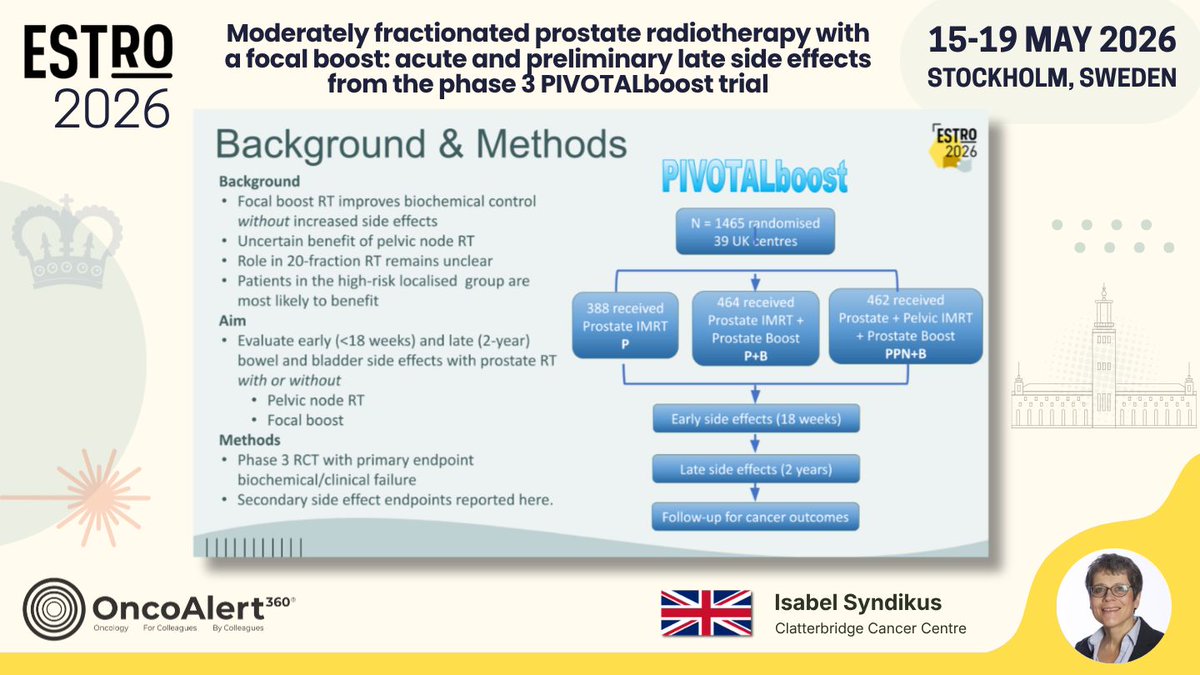
8 details 5 trials watching
Phase 3 RCT, N=1465 randomised at 39 UK centres. Primary endpoint is biochemical/clinical failure; the side-effect endpoints presented here are secondary. Early toxicity assessed to 18 weeks, late toxicity at 2 years.
Localised prostate cancer, with the slides naming the high-risk localised group as most likely to benefit from the interventions under test. Full eligibility criteria not stated in the source.
20-fraction moderately hypofractionated IMRT in all arms. Randomisation is to prostate alone (388), prostate + focal boost (464), or prostate + pelvic nodes + focal boost (462), so the trial separates the boost question from the nodal question. Prescription dose and boost dose level not stated in the source slides.
Primary: biochemical/clinical failure, not reported at this presentation. Secondary (reported here): early bowel and bladder side effects to 18 weeks and late G2+ events at 2 years.
Nodal RT increased early bowel side effects, resolving by 18 weeks. Late cumulative rates were reported for the 973 (74%) patients with at least 2 years' follow-up.
The nodal question in prostate RT is currently split: POP-RT favoured whole-pelvis RT on biochemical failure-free survival while PEACE-2 was null on its nodal comparison, and both used conventional or near-conventional fractionation. PIVOTALboost is the first randomised test of pelvic nodal coverage in a 20-fraction schedule, so its eventual efficacy readout is the one that transfers to how most UK and increasingly non-UK practice actually delivers prostate RT.
The late analysis rests on the 74% with 2 years of follow-up, so a differential drop-out by arm would bias the comparison, and cumulative-incidence estimates at 2 years cannot address the fibrotic and stricture toxicity that appears at 5 to 10 years. The source does not state the grading instrument, and a clinician-graded versus patient-reported difference materially changes the size of a G2+ bowel signal.
A safety readout without its efficacy partner cannot move the nodal decision on its own, but it does close off one of the two arguments against nodal coverage in the hypofractionated era. The remaining argument is whether pelvic nodal RT does anything for disease control, which this trial is powered to answer and has not yet reported.
CONSORT flow
Randomised phase 3, but this is the secondary toxicity readout only; the biochemical/clinical failure primary endpoint is unreported, so it settles safety, not benefit.
- Does pelvic nodal RT improve biochemical/clinical failure at 20 fractions? n=18 · primary completion 2026-08 · 20fx pelvic nodal RT with prostate SIBrecruiting Phase III Adaptive Adaptive Stereostactic Body Radiotherapy (SBRT) With Dose Escalation for High-Risk Prostate Cancer Phase NAn=390 · primary completion 2033-04 · WPRT + DIL boost vs standard RT, high risk
- Does the focal intraprostatic boost add control over prostate IMRT alone? recruiting Image-guided Focal Dose Escalation- Primary pc Treated With Primary External Beam Hypofract.Stereotactic rt Phase NAn=374 · primary completion 2025-08 · arm A focal dose escalation vs arm B IMRTactive Standard Moderately Hypofractionated RT vs. Ultra-hypofractionated Focal Lesion Ablative Microboost in Prostate Cancer Phase NAn=484 · primary completion 2032-01 · Hypo-FLAME microboost vs standard 20fx RTrecruiting Addition of Focal Boost to Primary Radiotherapy for Prostate Cancer in 12 or 20 Fractions Phase NAn=1016 · primary completion 2040-10 · randomises focal boost vs none at 20fx
- Do G2+ rates diverge beyond 2 years as late fibrotic toxicity matures?
📚 Sources · 🐦 1 tweet
Day THREE of #ESTRO26 Coverage by OncoAlert 🚨
— OncoAlert (@OncoAlert) May 17, 2026
Moderately fractionated prostate radiotherapy with a focal boost: acute and preliminary late side effects from the phase 3 PIVOTALboost trial Presented by Isabel Syndikus 🇬🇧 #RadOnc ☢️
In the PIVOTALboost trial, we treated 1314… pic.twitter.com/cGuR1j2Qos
PACE-NODES
ForHigh-risk localised prostate (T3a-T4, Gleason 8-10, or PSA>20), on 12-36mo ADT
28% vs 21%
PPN-SBRT vs P-SBRT; no effect size or p-value reported in source
TL;DRCTCAE G2+ GI toxicity 28% vs 21% with added pelvic nodal SBRT; no GU difference, symptoms resolved by 12wk.
Nodal SBRT at 25Gy/5f costs 7 points of acute G2+ GI (28% vs 21%) and nothing in GU, with the EPIC-26 bowel signal at 4 weeks resolving by 12. That makes acute tolerability a weak argument against 5f elective nodal coverage; the decision now waits on late effects and the immature failure endpoint.
In high-risk localised prostate already planned for 5f prostate SBRT plus 12-36mo ADT, this supports the feasibility of extending to pelvic nodes without a GU penalty; it says nothing yet about whether nodal coverage improves control.
The cost of adding 25Gy/5f to the pelvis is 7 points of acute G2+ GI (28% vs 21%), transient by 12 weeks, with no GU penalty. The gating practical fact is deliverability: 11% of PPN-SBRT patients never received allocation on unmet constraints.

| Endpoint | PPN-SBRT | P-SBRT |
|---|---|---|
| CTCAE G2+ GI, 12wk | 28% | 21% |
| Did not receive allocation | 11% | 4% |
+1 more figure
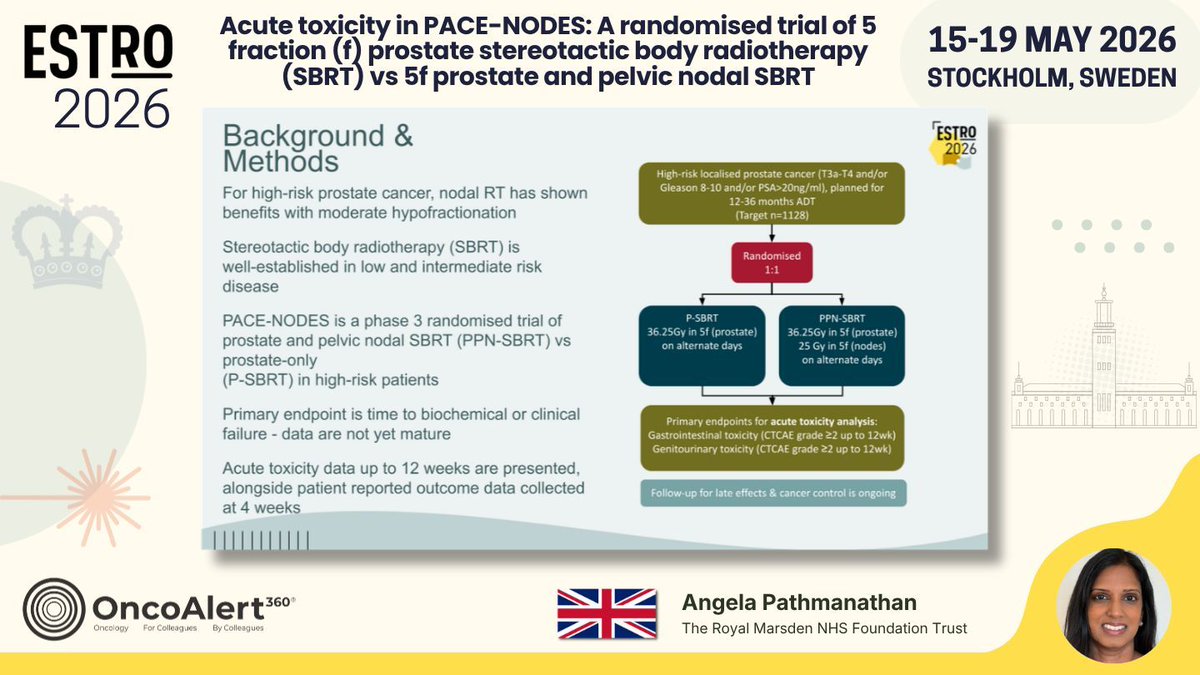
10 details 3 trials watching
Phase 3 randomised 1:1 multicentre trial, target n=1128, 1166 randomised. This presentation reports the acute toxicity analysis only; the efficacy primary is time to biochemical or clinical failure and is not yet mature.
High-risk localised prostate cancer: T3a-T4 and/or Gleason 8-10 and/or PSA>20ng/ml, all planned for 12-36 months ADT.
Both arms 36.25Gy in 5 fractions to the prostate on alternate days. PPN-SBRT adds 25Gy in 5 fractions to the pelvic nodes; P-SBRT is prostate-only.
Primary for this analysis: CTCAE grade ≥2 GI and grade ≥2 GU toxicity up to 12 weeks. Patient-reported EPIC-26 domain scores collected at 4 weeks.
GI was the only separating domain; GU did not differ by clinician or patient report, and the GI gap had closed by 12 weeks.
11% of PPN-SBRT and 4% of P-SBRT patients did not receive their allocated treatment, mostly because planning constraints were not met, which is itself a deliverability signal for 5f nodal treatment.
Patient-reported outcomes were captured at 4 weeks only, so the 12-week convergence rests on clinician CTCAE grading. No effect size, confidence interval or p-value for the GI difference appears in the source, and late GI toxicity is the endpoint that historically decides elective nodal coverage.
The trial's answer so far is about deliverability rather than benefit: 5f nodal SBRT can be given across multiple centres at an acute cost confined to transient bowel symptoms. Whether that cost is worth paying depends entirely on the failure endpoint still to read out.
Acute-toxicity readout only; the efficacy primary (time to biochemical or clinical failure) is immature, so the nodal-coverage question stays open.
- Late GI toxicity beyond the 12-week acute window n=100 · primary completion 2027-10 · 1-2mm PTV margins to cut late rectal toxicityn=500 · primary completion 2027-12 · late GI toxicity as primary endpoint after prostate SBRT
- Whether 5f nodal SBRT improves biochemical or clinical failure recruiting PRO-BOOST-N: Prostate-First Versus Combined Prostate and Nodal Dose Escalation in PSMA PET-Staged Node-Positive Prostate Cancer Phase 2/3n=600 · primary completion 2033-12 · randomises nodal dose in cN1 ultrahypofx pelvic RT
- Which anatomy or constraints drove the 11% non-delivery rate
📚 Sources · 🐦 1 tweet
Day THREE of #ESTRO26 Coverage by OncoAlert 🚨
— OncoAlert (@OncoAlert) May 17, 2026
Acute toxicity in PACE-NODES: A randomised trial of 5 fraction (f) prostate stereotactic body radiotherapy (SBRT) vs 5f prostate and pelvic nodal SBRT
Presented by Angela Pathmanathan 🇬🇧 #RadOnc ☢️ #ProstateCancer
PACE-NODES is a… pic.twitter.com/z9bAOiKSIy
PEACE-2
ForVery-high-risk localized prostate, N0M0, ≥2 of Gleason ≥8 / T3-T4 / PSA ≥20
HR 0.81
95% CI 0.63-1.03, p=0.088, primary endpoint not met
TL;DRcPFS HR 0.81 (0.63-1.03), p=0.088: pelvic RT over prostate-only missed its primary endpoint in very-high-risk N0M0.
The target-volume decision is the whole trial: ADT × 3 years and the systemic backbone were fixed, so the 4.2-point 7yr cPFS gap (67.1% vs 62.9%, p=0.088) is what elective pelvic coverage buys in conventionally-staged N0M0 disease. No dose or fractionation appears in the source slides, and staging used conventional imaging or choline PET, not PSMA.
In very-high-risk localized prostate cancer staged N0M0 on conventional imaging or choline PET, this questions routine elective pelvic nodal coverage added to 3 years of ADT; it does not address PSMA-staged or node-positive disease.
Target volume is the randomized variable with the systemic backbone fixed, so the 7yr cPFS gap of 67.1% vs 62.9% (HR 0.81, p=0.088) is the entire return on elective pelvic coverage in conventionally-staged N0M0. Dose and fractionation are absent from source, blocking a technique-level transfer.
ADT × 3 years ran in every arm and cabazitaxel × 4 cycles was the second randomization, so nothing here moves systemic choice. The relevant read is prognostic: fewer than 1 in 10 men died of prostate cancer in a decade, which questions intensification in this clinicopathologically-defined very-high-risk group.

| Arm | 7yr cPFS | HR (95% CI) | p |
|---|---|---|---|
| Pelvic RT | 67.1% [61.6; 72.2] | 0.81 [0.63; 1.03] | 0.088 |
| Prostate only RT | 62.9% [57.4; 68.1] | n/a | n/a |
+2 more figures


9 details 5 trials watching
International multicenter randomized trial with four arms crossing two questions: RT target volume (prostate only vs pelvis) and cabazitaxel × 4 cycles vs none. Primary: cPFS. The target-volume comparison reads out at 7 years.
Very-high-risk localized prostate cancer defined as ≥2 risk factors among Gleason ≥8, T3-T4, and PSA ≥20 ng/mL. N0M0 by conventional imaging or choline PET/CT.
Androgen deprivation therapy × 3 years in every arm, with cabazitaxel × 4 cycles as the second randomization. The systemic backbone is held constant across the target-volume comparison.
The randomized variable is target volume alone: prostate-only RT versus pelvic RT. Dose, fractionation, and nodal CTV definition are not reported in the source slides.
Primary: cPFS. Secondary: PSA response at 3 months, bPFS, metastasis-free survival, prostate-cancer-specific survival, OS, acute and long-term tolerance, QoL, and biopsy biomarkers.
cPFS HR 0.81 (0.63-1.03), p=0.088 on multivariable analysis, so the primary endpoint was not met. 7yr cPFS 67.1% pelvic versus 62.9% prostate-only. Toxicity and secondary endpoints are not reported in these slides.
POP-RT, a single-center randomized trial of roughly 224 men, reported a whole-pelvis benefit that made elective nodal coverage common practice in high-risk disease. PEACE-2 is larger and multicenter and does not reproduce a comparable signal on its own primary endpoint.
Staging predates routine PSMA PET, so occult nodal disease sits in both arms and dilutes a target-volume comparison. The RT dose, fractionation, and pelvic CTV definition are absent from the source, which blocks a transfer judgment to any specific technique.
The plenary's own conclusion turned on prognosis rather than the RT question: with fewer than 1 in 10 men dying of prostate cancer in the first decade, the "very high-risk" definition itself is what the investigators challenged. A cohort with that little cancer-specific mortality has little room for a target-volume difference to show up in cPFS.
CONSORT flow
Randomized, prespecified cPFS primary, adequate accrual (380 vs 381) and 7yr readout. Negative result contests routine elective pelvic coverage in N0M0 very-high-risk disease.
- Does PSMA PET staging identify a subgroup where pelvic RT helps n=250 · primary completion 2031-05 · PSMA-N0M0 high-risk randomised to PORT vs whole-pelvis RTrecruiting PRO-BOOST-N: Prostate-First Versus Combined Prostate and Nodal Dose Escalation in PSMA PET-Staged Node-Positive Prostate Cancer Phase 2/3n=600 · primary completion 2033-12 · PSMA PET-staged cN1M0: nodal dose escalation vs…
- Biomarkers to guide intensification vs de-intensification in very-high-risk disease
- Pelvic RT toxicity and QoL tradeoff not reported in source n=700 · primary completion 2021-12 · longitudinal GI/heme/GU toxicity + HRQoL after WPRTactive Hypofractionated Whole-Pelvis Radiotherapy (WPRT) vs Conventionally-Fractionated WPRT in Prostate Cancer Phase 2n=58 · primary completion 2026-09 · QoL of 5-fraction vs 25-fraction WPRTn=400 · primary completion 2027-03 · late GI toxicity, protons vs photons, whole-pelvis RT
📚 Sources · 🐦 1 tweet
📣@PBlanchardMD shows #ESTRO26 that pelvic #radiotherapy in high risk #prostatecancer does not have a large improve in outcomes.
— Shankar Siva (@_ShankarSiva) May 17, 2026
- With only 1 in 10 dying of prostate cancer in 10 years, are these patients truly “high risk”? #pcsm #radonc pic.twitter.com/D0XrGD6iNX
OLIGOMA NCT04495309
ForMetastatic breast cancer, ≤5 lesions, any treatment line; mostly ER+/HER2- first-line
35.8 vs 20.4 mo
HR 0.48 (95%-CI 0.25-0.91), p=0.021
TL;DRmPFS 35.8 vs 20.4mo, HR 0.48 (0.25-0.91) p=0.021 with ablative RT to all lesions in oligometastatic breast.
The RT question here is whether ALL lesions must be treated: eligibility required ablative RT to every metastasis, and pts needing palliative RT to all sites were excluded, so this is comprehensive ablation, not selective consolidation. With 2/3 bone lesions and >80% carrying 1-3 mets, the transferable case is the low-burden bone-dominant pt. No dose or fractionation reported in source.
In ER+/HER2- metastatic breast with 1-3 mostly bone lesions starting first-line systemic therapy, this supports discussing ablative RT to all sites; it does not extend to pts with >5 lesions or those needing palliative RT to every site.
The transferable detail is the eligibility rule, not the HR: RT went to ALL metastatic lesions, and pts needing palliative RT to every site were excluded. With >80% carrying 1-3 mets and 2/3 bone, this is comprehensive ablation of low-burden disease. Dose and fractionation not reported in source.
The systemic regimen was fixed by tumor board BEFORE randomisation, so the PFS separation is attributable to RT rather than to differential drug management. Nearly three-quarters were on first-line endocrine or chemotherapy, so the question this moves is whether to pause and refer for ablation at diagnosis of oligometastatic disease, not which regimen to pick.

+3 more figures

| Arm | QLQ-C30 summary, mean (95%-CI) | Between-group change (ANCOVA) |
|---|---|---|
| Experimental | 72.2 (67.2-77.2) | -2.1 (-9.2-5.1) |
| Control | 74.3 (69.3-79.3) | n/a |


9 details 5 trials watching
Randomised trial (ARO-2021-09), systemic therapy alone vs systemic therapy plus local ablative radiotherapy to all metastatic lesions. Stratified by type of systemic therapy and treatment line. Systemic regimen was set by multidisciplinary tumor board before randomisation, so the only variable is RT.
Metastatic breast cancer, any treatment line, maximum 5 lesions. Median age 58 (experimental) vs 59 (control); ER positive 76.7% vs 81.8%, HER2 positive 7.5% vs 15.0%. Nearly three-quarters were on first-line endocrine or chemotherapy. >80% had 1-3 metastases and 2/3 of lesions were bone.
Local ablative RT was delivered to all metastatic lesions, not a selected subset. Palliative RT to symptomatic metastases was permitted, but pts requiring palliative RT to all metastases were not eligible. Dose, fractionation and technique not reported in source.
Co-primary: PFS and quality of life (EORTC QLQ-C30) at 12 weeks post-randomisation. Secondary: overall survival, toxicity, compliance, QLQ-C30 and QLQ-BR23, and patient satisfaction with cancer care (EORTC PATSAT C33).
Both co-primary endpoints read out in the trial's favour: PFS separated, and the 12-week QoL difference stayed inside the prespecified non-inferiority margin of -10 points with baseline adjustment. OS not reported in source.
Beyond the accrual shortfall, the QoL co-primary rested on n=64 of 87 randomised, and 12 weeks is too early to capture late RT toxicity in a population with a 35.8-month median PFS. Toxicity and compliance were secondary and are not reported in source.
This is the first RCT to show a PFS benefit from MDT in oligometastatic breast cancer specifically, a histology under-represented in the earlier mixed-tumour MDT randomised experience. Eight trials in the same question (TAORMINA, STEREO-SEIN, LARA, CLEAR, COSMO, ARCHER, ISTMET, OLIGAMI) are still recruiting, so the field will not settle on 87 pts.
The result establishes direction, not magnitude: an HR of 0.48 from an early-terminated trial is the estimate most likely to regress. What it does settle is the tolerability question, since short-term QoL was not degraded by treating every lesion. Which pts benefit most, by lesion count, site and systemic line, remains open.
CONSORT flow
Recruitment stopped at <20% of initial target; 87 pts, PFS CI 0.25-0.91. Positive and randomised, but underpowered against eight ongoing confirmatory trials.
- Which oligometastatic breast subgroups benefit most from MDT n=340 · primary completion 2026-11 · phase 3 MDT with subtype-specific systemic therapynot yet Adding Surgery and Radiation to the Usual Treatment for HER2-Positive Breast Cancer That Had Already Spread at Diagnosis Phase 3n=562 · primary completion 2032-05 · HER2+ de novo, 1-5 mets, SBRT added to SOC
- Does the PFS benefit translate to overall survival n=150 · primary completion 2025-08 · randomised SABR vs SOC in de novo oligomet BCn=345 · primary completion 2025-12 · TAORMINA: randomised SABR + systemic, 1-5 mets
- Optimal dose and fractionation for bone-dominant ablation recruiting OligoCare TwiCs (Trials Within Cohorts) Trial Comparing Acute Toxicity in Single-fraction vs Multiple-fraction SBRT for Metastasis-directed Treatment (SPRINT) Phase NAn=302 · primary completion 2029-02 · SPRINT: single- vs multi-fraction SBRT randomised
📚 Sources · 🐦 3 tweets
📌 Metastases-directed treatment in Patients with Oligometastatic Breast Cancer: Results from the OLIGOMA-trial (ARO-2021-09, NCT04495309) @DavidKrugMD 👏🏻 #ESTRO26 @ESTRO_RT @OncoAlert #OncoAlertAF pic.twitter.com/YDMef0fXRm
— Elisabetta Bonzano MD, PhD (@to_be_elizabeth) May 17, 2026
❗️ The OLIGOMA trial results just dropped at #ESTRO26 and they are massive. A 15-month improvement in median PFS for OMD breast cancer (HR = 0.48). This adds to the growing mountain of evidence that MDT (Metastasis-Directed Therapy) works. Lets’s go 🧵 1/n pic.twitter.com/5uiEVSYtdH
— NonsparseOncologist (@5_utr) May 17, 2026
Here are some details!
— Jeff Ryckman (@jryckman3) May 17, 2026
On OLIGOMA, nearly 3/4 were first line endocrine or chemotherapy. #ESTRO26 #OncTwitter@CJTsaiMDPhD pic.twitter.com/r3kJzNNsyK
APBI-IMRT Florence NCT02104895
ForEarly breast cancer post-BCS, pT <25 mm, margins ≥5 mm, age >40
7.7% vs 4.2%
HR 1.57 (95% CI 0.82-3.04), p=0.17
TL;DR15-yr IBTR 7.7% APBI vs 4.2% WBI, HR 1.57 (0.82-3.04) p=0.17; excess driven by new ipsilateral primaries, not true local relapse.
The 5-fraction 30Gy IMRT schedule is what transfers: this is the longest follow-up for that specific PBI regimen, and the 15-yr excess sits in new ipsilateral primaries (5.9% vs 2.7%, p=0.09) rather than local relapse (2.1% vs 1.6%, p=0.75). That distinction is the whole case for keeping PBI in Florence-eligible pts, and it rests on adjudication, not on a powered endpoint.
In a woman over 40 after breast-conserving surgery with a tumour under 25 mm and margins of at least 5 mm, this supports offering 5-fraction PBI as a durable option; it does not extend to node-positive disease, close margins, or younger patients.
The transferable parameter is 30Gy in 5 fractions by IMRT, now with 15-yr follow-up. The excess ipsilateral events are new primaries (5.9% vs 2.7%, p=0.09), not local relapse (2.1% vs 1.6%, p=0.75), which is the distinction that justifies continuing PBI in Florence-eligible pts.
Nothing here moves systemic therapy: distant metastasis 2.7% vs 4.6% and breast-cancer deaths 2.3% vs 3.1% are indistinguishable at 15 years. What matters downstream is the new-primary rate of 5.9% with PBI, which shapes how much ipsilateral surveillance a de-escalated local approach earns.

+2 more figures


10 details
Phase III equivalence trial, 1:1 randomisation, n=520, accrued 2005-2013, median follow-up 15 years. Powered at 80% against a 5-year estimated IBTR of 3% with a 5% equivalence margin. Survival outcomes analysed ITT; toxicity and cosmesis per protocol after 14 withdrawals.
Post-breast-conserving-surgery early breast cancer: pT <25 mm, final surgical margins ≥5 mm, age >40 years. A selected, low-risk population by design.
PBI arm: 30Gy in 5 fractions delivered by IMRT (n=260). WBI arm: 50Gy in 25 fractions plus a 10Gy in 5-fraction tumour-bed boost (n=260).
No endpoint separated the arms at 15 years. The IBTR point estimate favours WBI (HR 1.57, 95% CI 0.82-3.04, p=0.17) but the confidence interval spans unity.
Florence remains the only randomised test of a 5-fraction IMRT PBI schedule with follow-up this long; other external-beam PBI randomisations used different dose and fractionation, so their recurrence rates are not directly interchangeable with this one. The direction here, a numerically higher IBTR concentrated in new primaries, is the pattern PBI trials have consistently reported when they separate the two.
The trial was sized for 5-year equivalence, so the 15-year IBTR comparison is a long-term description rather than a powered test, and the upper CI bound of 3.04 leaves room for a real excess. The relapse-versus-new-primary split is an adjudicated distinction, not a molecularly confirmed one, and it carries the entire reassurance.
The result supports continuing PBI in Florence-eligible pts rather than expanding the indication. It does not settle whether the new-primary excess is a genuine consequence of leaving untreated breast tissue unirradiated, which is biologically the expected cost of the approach and would not be captured by any local-control endpoint.
CONSORT flow
Randomised phase III with mature 15-yr follow-up; no significant difference on any oncological endpoint. Supports an already guideline-listed de-escalation rather than establishing a new one.
- Whether the new-primary excess reflects untreated ipsilateral breast tissue
- Ipsilateral surveillance intensity after partial-breast irradiation
- Applicability of 5-fraction PBI below age 40
📚 Sources · 🐦 1 tweet
📌 Fifteen-year outcomes of the randomised APBI-IMRT Florence phase Ill trial of partial versus whole-breast irradiation in early breast cancer ✨
— Elisabetta Bonzano MD, PhD (@to_be_elizabeth) May 17, 2026
Excellent presentation led by @CarlottaB 👏🏻#ESTRO26 @Icro_Meattini @ESTRO_RT @OncoAlert #OncoAlertAF pic.twitter.com/1j4bIA2nyC
EORTC IM-MS (22922/10925)
ForStage I-III breast cancer considering internal mammary / medial supraclavicular nodal RT
61.0% vs 61.8%
HR=1.00, 95% CI 0.90-1.10, P=0.967 (1° EP not met)
TL;DR20yr OS 61.0% vs 61.8%, HR 1.00 (0.90-1.10), P=0.967: the 15yr breast-cancer mortality benefit is erased by non-BCM.
The 20yr null OS is a competing-risk cancellation, not absent efficacy: BCM 18.6% vs 22.4% (HR 0.82) offset by non-BCM 20.4% vs 15.8% (HR 1.26), with cardiac disease 15.2% vs 11.7% and lung fibrosis 6.3% vs 3.2%. Whether IM coverage survives depends entirely on your heart dose, and DBCG IMN2 ran 4-9x lower.
In stage I-III breast cancer where IM-MS coverage is on the table, this supports the anti-cancer effect of IM irradiation while showing the 20yr survival gain is forfeited at 1990s-era heart doses; it does not describe outcomes at modern DIBH/IMRT cardiac exposures.
This is a planning-constraint result, not a target-volume result. IM coverage delivered BCM 18.6% vs 22.4% (HR 0.82) and gave it all back as non-BCM (HR 1.26), with cardiac disease 15.2% vs 11.7%. The benefit survives only if your mean heart dose looks like DBCG IMN2's 1.2-2.3 Gy, not this trial's.
The 20yr OS null (61.0% vs 61.8%) should not be read as breast-cancer control being unimproved: BCM fell to 18.6% from 22.4%. The excess deaths are cardiopulmonary, which is a comorbidity and cardiac-surveillance consideration in long survivors treated in older RT eras rather than a systemic-therapy signal.

| Endpoint | IM-MS RT | No IM-MS RT | HR | P |
|---|---|---|---|---|
| BCM rate | 18.6% | 22.4% | 0.82 (0.72-0.95) | 0.006 |
| non-BCM rate | 20.4% | 15.8% | 1.26 (1.09-1.46) | 0.002 |
+3 more figures

| Endpoint | IM-MS RT | No IM-MS RT | HR (95% CI) | P |
|---|---|---|---|---|
| Overall survival (ITT), 20yr | 61.0% | 61.8% | 1.00 (0.90-1.10) | 0.967 |

| RT-related side effect | IM-MS RT | No IM-MS RT |
|---|---|---|
| Lung fibrosis | 6.3% | 3.2% |
| Cardiac fibrosis | 2.7% | 1.7% |
| Cardiac diseases | 15.2% | 11.7% |

| Endpoint (pN0) | IM-MS RT | No IM-MS RT | HR | P |
|---|---|---|---|---|
| DFS rate | 53.9% | 53.6% | 0.93 (0.81-1.07) | 0.318 |
| DMFS rate | 67.2% | 67.4% | 0.93 (0.78-1.10) | 0.397 |
9 details
Randomised EORTC trial 22922/10925, stage I-III breast cancer, internal mammary + medial supraclavicular irradiation versus no IM-MS irradiation. This is the 20-year readout, presented as a plenary at ESTRO 2026, including a dedicated pN0 analysis.
The intervention is the IM-MS target volume itself, added to otherwise standard locoregional treatment. Per-arm dose and fractionation are not reported in source; what the presenters did quantify is the dosimetric era gap, with DBCG IMN2 mean heart doses 4-9 times lower (MHD 1.2 Gy right-sided, 2.3 Gy left-sided, treated 2007-2014).
Primary: overall survival (ITT). Secondary readouts presented at 20 years include DFS and DMFS under DATECAN definitions (DFS counts all deaths and all breast events including DCIS and contralateral; DMFS counts all deaths and distant metastases), breast-cancer mortality, non-breast-cancer mortality, second cancers, and RT-related late effects.
OS 61.0% vs 61.8%, HR=1.00 (0.90-1.10), P=0.967. DFS and DMFS are likewise flat (HR 0.97 each), and the pN0 subgroup shows no separation. The signal lives entirely in the cause-specific split.
No statistical difference in secondary cancers or second breast cancers between arms. Absolute RT-related late effects favour the control arm: cardiac disease 15.2% vs 11.7%, lung fibrosis 6.3% vs 3.2%, cardiac fibrosis 2.7% vs 1.7%.
The Danish DBCG IMN2 cohort (Nielsen, Lancet Reg Health Eur 2024) reported that IM-MS irradiation reduced distant metastasis and BCM and improved OS in node-positive pts at 15 years. The presenters attribute the divergence to technique, since IMN2 heart doses were 4-9x lower.
The pN0 result is a subgroup read on endpoints that were flat overall, so it cannot exclude a small benefit in that group. The competing-risk interpretation also rests on comparing this trial's toxicity against a non-randomised cohort treated a decade later, which is a dosimetric argument, not a trial result.
This is the cleanest available demonstration that an oncologically real nodal-RT benefit can be spent entirely on late cardiopulmonary mortality. It settles that IM-MS irradiation reduces breast cancer death; it does not settle whether the survival benefit is recoverable, which is now a planning question rather than a target-volume question.
Randomised, prespecified 1° OS, 20yr follow-up, null. Divergence from DBCG IMN2 is confounded by an old-technique heart dose (4-9x higher), not by design flaw.
- Does IM-MS survival benefit re-emerge at modern cardiac-sparing doses?
- Which nodal subgroups justify IM coverage given competing cardiac mortality?
📚 Sources · 🐦 2 tweets
📌 Internal Mammary and Medial Supraclavicular irradiation in stage I-III breast cancer: 20 years results of the randomised EORTC trial 22922/10925, including in pNo patients
— Elisabetta Bonzano MD, PhD (@to_be_elizabeth) May 17, 2026
Special Joint Presentation Led by Prof. Philip Poortmans and Orit Kaidar-Person ✨ at #ESTRO26 @ESTRO_RT… pic.twitter.com/KIoJtdhEzp
20-year outcomes of @EORTC internal mammary #radiotherapy trial.
— Shankar Siva (@_ShankarSiva) May 17, 2026
➡️internal mammary improved control
➡️ survival counterbalanced by late adverse events #radiotherapy #bcsm
Great to see the long term data at #ESTRO26, and discussing Charlotte Cole suggests with modern RT, long… pic.twitter.com/yPtlfrLcri
DBCG RT Natural
For≥60y, pT1N0, grade 1-2, ER≥10%, HER2 normal, margin ≥2mm, post-BCS
1.5% vs 9.8%
+RT 2/236, 1.5% (0.3-5.1); -RT 19/272, 9.8% (5.9-14.9)
TL;DR5yr invasive LR 1.5% with PBI vs 9.8% randomised no-PBI vs 8.2% self-selected no-PBI at 4yr median f/u.
The 2x2 by treatment received is the actionable read, not the arm comparison: -RT +ET reached 3.7% (7/213) while -RT -ET hit 12.2% (32/352), so ET adherence is what holds the omission strategy together, and it was suboptimal. PBI was 40Gy/15fr, not a 5-fraction schedule.
In a woman ≥60 with pT1N0 grade 1-2 ER-positive HER2-normal disease post-lumpectomy, this argues against dropping both PBI and endocrine therapy, and it does not address node-positive, lobular, grade 3, or ER-low disease, which were excluded.
PBI 40Gy/15fr drove LR to 1.5% (2/236) vs 9.8% randomised omission, and the -RT arm crossed the prespecified 4% ceiling. The +RT -ET cell at 3.0% (2/132) means RT alone holds local control without endocrine therapy, which moves the omission conversation for a patient who will not take or tolerate ET.
The -RT +ET cell reached 3.7% (7/213) versus 12.2% (32/352) with neither, so endocrine therapy alone is close to RT alone for local control here. But the ET grouping is by treatment received (≥4.5y vs <4.5y or low-risk), so that 3.7% describes completers and adherence is the load-bearing assumption in an ET-only strategy.

+3 more figures

| Study arm | Events/Total | CIF % (95% CI) |
|---|---|---|
| +RT | 2/236 | 1.5 (0.3-5.1%) |
| -RT | 19/272 | 9.8 (5.9-14.9%) |
| S-RT | 18/278 | 8.2 (4.5-13.3%) |

9 details 3 trials watching
Phase III randomized trial, PBI 40Gy/15fr vs no PBI, stratified by institution and endocrine therapy yes/no, with a third non-randomised self-selecting no-PBI cohort. Planned accrual 926 randomised with an interim analysis at 200 patients with 2 year follow-up. Median follow-up 4 years at this reading.
≥60 years, breast cancer treated with breast conservation, pT1N0, unilateral, unifocal, non-lobular, ER ≥10%, HER2 normal, grade 1-2, limited DCIS, margin ≥2mm. Endocrine therapy given per DBCG guideline, which recommends ET for pT1c and/or grade 2.
Partial breast irradiation, 40Gy in 15 fractions. This is a moderately hypofractionated PBI schedule, not the 5-fraction regimens now in wide use, which matters for how the toxicity and convenience side of the omission trade transfers.
Primary: 5 year invasive local recurrence, with a design assumption of 2% and a prespecified maximum acceptable 4%. Secondary: loco-regional side effects and quality of life. Follow-up yearly mammography plus loco-regional side effect assessment to 10 years.
All 41 recurrences were invasive and 39 of 41 arose in patients who received no PBI. Distant failure was rare across the whole trial at 4 events, 2 in each of the +RT and no-PBI groups.
Loco-regional side effects and QoL were prespecified secondary endpoints but no toxicity or QoL figures were reported in the source. The omission-versus-PBI toxicity trade that drives this decision is therefore unquantified here.
PRIME II and CALGB 9343 established that RT omission in older low-risk women is tolerable because absolute local recurrence stays low. Here the randomised no-RT arm reached 9.8% and crossed the trial's own 4% ceiling, which is the opposite result, and the discussant framed surgery alone as carrying high local recurrence even in low risk.
Median follow-up is 4 years against a 5 year primary endpoint, so the reported cumulative incidences are read before the timepoint the trial was designed around. The third arm is self-selected, not randomised, so its 8.2% carries confounding by whatever drove refusal, and the endocrine therapy split is by treatment received rather than assignment.
The trial's contribution is that it isolates the floor: a group with no adjuvant treatment at all, which the modern omission trials do not have because endocrine therapy is universal in their omission arms. 12.2% at that floor reframes the published omission literature as measuring RT omission on an endocrine backbone, not omission of local therapy. It does not settle whether PBI or ET is the better single agent, since 3.0% and 3.7% overlap widely.
CONSORT flow
Randomised, prespecified LR endpoint, stopped early by independent monitoring for exceeding the 4% threshold. Cuts against the de-escalation direction PRIME II and CALGB 9343 set.
- Does 5-fraction PBI match 40Gy/15fr local control in this population n=910 · primary completion 2029-11 · phase 3 PBI vs WBI, 1 week each, LR endpoint
- Toxicity and QoL trade between PBI and endocrine monotherapy n=30 · primary completion 2023-11 · SBRT added to endocrine tx, unoperated pts 75+n=168 · primary completion 2030-07 · randomised 30Gy vs 26Gy/5fr PBI, PRO endpoint
- Whether 4yr separation holds at the 5yr primary timepoint
📚 Sources · 🐦 2 tweets
Another trial showing even for lR optimal local control with RT and ET and suboptimal adherence to ET. In era of 5 fraction decision making is easier # Estro2026 pic.twitter.com/nkvYl3iuTn
— Sushil (@Sushilberiwal) May 17, 2026
Danish #breastcancer partial breast #radiotherapy “natural” trial.
— Shankar Siva (@_ShankarSiva) May 17, 2026
➡️ No postoperative treatment had highest risk of recurrence
➡️either tamoxifen or #radonc reduced recurrence
➡️combined tamoxifen + RT had no recurrences
In context of EUROPA trial, RT has best QoL vs endocrine… pic.twitter.com/bDVmbDKRNb
IMPORT HIGH
ForInvasive early breast, pT1-3 pN0-pN3a M0, post-BCS, requiring tumour bed boost
3.7% vs 3.5% 10yr IBTR (48Gy SIB vs 40+16Gy)
95% CI 2.6-5.3 vs 2.4-5.0; 53Gy/15F 5.5% (4.1, 7.3)
TL;DR10yr IBTR 3.7% with 48Gy/15F SIB vs 3.5% with 40Gy/15F + 16Gy/8F sequential; 53Gy/15F higher at 5.5%.
The decision this hardens is delivery, not dose: 48Gy/15F SIB holds at 3.7% (2.6, 5.3) IBTR at 10 years against 3.5% (2.4, 5.0) for a sequential 16Gy/8F phase, in a higher risk group. 53Gy/15F sits at 5.5% (4.1, 7.3), so escalation buys nothing.
For a woman after breast conserving surgery for pT1-3 pN0-pN3a invasive disease who needs a tumour bed boost, the 10-year data support the integrated 48Gy/15F arm over a separate sequential boost; they do not speak to boost omission or to 5-fraction whole-breast schedules.
Three weeks, one plan: the boost is integrated into 15 fractions with a modest dose reduction to whole breast distant from tumour, and IBTR at 10 years matches the sequential 16Gy/8F phase. Escalating the integrated boost to 53Gy/15F does not improve local control.

| Dose group | 10yr IBTR (95% CI) | 10yr OS abs. diff vs 40Gy/15F |
|---|---|---|
| 40Gy/15F + 16Gy/8F | 3.5% (2.4, 5.0) | reference |
| 48Gy/15F (3.2Gy/F) | 3.7% (2.6, 5.3) | -0.5 (-3.0, 2.8) |
| 53Gy/15F (3.5Gy/F) | 5.5% (4.1, 7.3) | 1.5 (-1.4, 5.1) |
+1 more figure

8 details 4 trials watching
Three-arm randomised multicentre trial, 1:1:1, N=2617 across 76 UK hospitals, recruited 2009-2015. Annual clinical follow-up to 10 years; PRO and photographic assessment collected only to 5 years.
Women ≥18 after breast conserving surgery for invasive early breast cancer, pT1-3, pN0-pN3a, M0, all requiring a tumour bed boost. Described as a higher-than-average risk group.
40Gy/15F + 16Gy/8F sequential boost (N=871), 48Gy/15F SIB at 3.2Gy/F (N=874), 53Gy/15F SIB at 3.5Gy/F (N=872). The SIB arms escalate to the regions at highest risk with a modest dose reduction to whole breast distant from tumour, all delivered in 3 weeks.
Endpoint reported here: ipsilateral breast tumour relapse at 10 years. The original sample size calculation assumed a 5% control rate at 5 years. Absolute OS difference and clinician-assessed normal tissue effects also reported.
The 5-year ordering holds at 10 years: the two lower-dose groups sit close together and 53Gy/15F stays highest. Both absolute OS differences vs 40Gy/15F have intervals containing zero.
Moderate/marked effects at 10 years were given as bounds across all randomised groups: <18% breast distortion or shrinkage, <10% induration, <2% telangiectasia, <2% breast oedema. No per-arm split reported in source.
EORTC 22881-10882 established the tumour bed boost itself; IMPORT HIGH asks how to deliver it and whether more dose helps. At 10 years, integration works and escalation does not, the same ranking the 5-year publication (Coles et al. Lancet 2023;401:2124-37) reported.
PRO and photographic assessment stopped at 5 years, so the 10-year toxicity comparison rests on clinician scoring reported as all-group bounds, not per-arm rates. Observed IBTR also ran below the 5% control rate the sample size calculation assumed.
The practical read is fraction count, not dose: a boost folded into 15 fractions removes the separate 16Gy/8F phase with no 10-year IBTR cost, while 53Gy/15F returns nothing. What the trial does not settle is whether the same integration transfers to 5-fraction whole-breast schedules.
CONSORT flow
Mature 10yr follow-up of a 2617-pt randomised trial; extends the 5-year Lancet 2023 read rather than changing it. No formal 10yr non-inferiority margin stated in source.
- Simultaneous integrated boost within 5-fraction whole-breast schedules recruiting Ultra-hypofractioNated Adjuvant Radiotherapy ± sImultaneous Integrated Boost for Low-risk Breast Cancer Patients Phase 2n=65 · primary completion 2025-10 · ultra-hypofx WBI +/- SIB, low-risk, phase 2recruiting Ultra Hypo-fractionated Adjuvant Whole Breast Radiation Therapy With Simultaneous Integrated Boost for Early-Stage Breast Cancer (H-ASSIST) Phase 2n=90 · primary completion 2028-02 · 5-fraction WBI with SIB tumor bed boost, phase 2
- Patient-reported cosmesis beyond 5 years, unmeasured after photographic follow-up ended n=139 · primary completion 2025-12 · 10y registry with cosmesis + QoL assessmentsn=50 · primary completion 2028-09 · cosmesis + PROMs to 60mo after ultra-short WBI/SIB
📚 Sources · 🐦 1 tweet
Day THREE of #ESTRO26 Coverage by OncoAlert 🚨
— OncoAlert (@OncoAlert) May 17, 2026
Ten-year results of the IMPORT HIGH trial (ISRCTN47437448): Dose escalated simultaneous integrated boost radiotherapy in early breast cancer Presented by Charlotte Coles 🇬🇧 #RadOnc ☢️
Ten-year IMPORT HIGH trial data show that a… pic.twitter.com/7RqVy2SrQm
DBCG HYPO
ForNode-negative early breast cancer or DCIS, post-BCS whole-breast RT
24.7% vs 19.5% at 10 yr
HR 0.76 (95% CI 0.62-0.92), p=0.005, favouring 40 Gy/15 fr
TL;DR10yr grade 2-3 breast induration 24.7% (50Gy) vs 19.5% (40Gy), HR 0.76 (0.62-0.92), p=0.005, no recurrence penalty.
The fibrosis separation persists at a decade, 24.7% vs 19.5%, HR 0.76 (0.62-0.92): 40 Gy/15 fr is not merely non-inferior on late morbidity, it is better, with OS numerically higher (93.0% vs 92.1%, p=0.10). For a node-negative or DCIS patient, the residual argument for 25 fractions is gone.
For node-negative invasive breast cancer or DCIS after breast conservation, this supports 40 Gy/15 fr over 50 Gy/25 fr on late induration with no recurrence cost; node-positive and regional nodal irradiation populations were not enrolled and are not addressed.
The fibrosis separation persists at a decade, 24.7% vs 19.5%, HR 0.76 (0.62-0.92), so 40 Gy/15 fr is superior on late induration rather than merely non-inferior. In node-negative disease or DCIS, whole-breast only, the late-tissue argument for 25 fractions has no support here.

| Endpoint (10-yr) | 50 Gy/25 fr | 40 Gy/15 fr | HR (95% CI), p |
|---|---|---|---|
| Grade 2-3 breast induration | 24.7% | 19.5% | 0.76 (0.62-0.92), p=0.005 |
| Overall survival | 92.1% | 93.0% | 0.81 (0.63-1.04), p=0.10 |
+1 more figure

8 details 5 trials watching
Phase III randomised non-inferiority trial, 1:1, run across Denmark, Norway and Germany from 2009-2014. These are the prespecified 10-year analyses of toxicity, recurrence and survival, at a median follow-up of 12.8 years.
1,882 women with node-negative breast cancer or DCIS. After exclusions (13 and 16), 933 and 936 women were analysed in the two arms, with 917 carried into the morbidity analysis of one arm.
Whole-breast irradiation only: 50 Gy in 25 fractions versus 40 Gy in 15 fractions. No regional nodal irradiation question is posed, and boost details are not reported in the source slides.
Primary: grade ≥2 breast induration at 3 years, requiring two consecutive visits or the final follow-up. Morbidity was scored at years 0, 1, 2, 3, 4, 5 and 10; recurrence and survival are the co-reported 10-year outcomes.
The toxicity endpoint is the positive result here: 10-year grade 2-3 induration 24.7% with 50 Gy vs 19.5% with 40 Gy, HR 0.76 (0.62-0.92), p=0.005. The fibrosis advantage of hypofractionation is durable, not an early-follow-up artefact.
START-B and the UK 10-year hypofractionation data established 40 Gy/15 fr as at least equivalent for control with less normal-tissue effect; DBCG HYPO reproduces that direction in a contemporary node-negative and DCIS population treated 2009-2014, in an era of CT planning and modern systemic therapy rather than the 1990s cohorts.
Breast induration is a clinician-scored endpoint and the source does not state whether assessment was blinded, which matters when the two arms are trivially distinguishable by treatment duration. Locoregional recurrence, distant failure and breast cancer mortality are reported only as 'no significant difference' with no event counts or confidence intervals in the source, so the precision of the non-inferiority claim cannot be judged from these slides.
A 5.2-percentage-point absolute reduction in decade-level grade 2-3 induration is a real cosmetic and symptomatic difference in a population most of whom will never recur. The OS HR of 0.81 (0.63-1.04) is directionally in favour of the shorter schedule but is not significant and should not be read as a survival benefit of hypofractionation.
Randomised phase III, prespecified 10-yr analysis, 12.8-yr median follow-up, primary toxicity endpoint favours 40 Gy/15 fr. Reinforces already-standard moderate hypofractionation rather than changing it.
- How does 40 Gy/15 fr compare with five-fraction schedules on 10-yr fibrosis? n=2100 · primary completion 2029-03 · randomised 1 wk vs 3 wk adjuvant WBI, non-inferiorityrecruiting 5 fr Ultrahypofractionated WBI and SIB for Breast Cancer With Unfavorable Characteristics Phase NAn=458 · primary completion 2029-06 · 26 Gy/5 fr + SIB vs 40.05 Gy/15 fr + SIB, randomisedrecruiting Ultra-Hypofractionated vs Moderate Hypofractionated Radiotherapy for Regional Lymph Nodes in High Risk Breast Cancer Phase NAn=1950 · primary completion 2034-03 · 26 Gy/5 fr vs 40-42.5 Gy/15-16 fr nodal RT
- Does the induration benefit hold with regional nodal irradiation? recruiting Hypofractionated Irradiation At Regional Nodal Area for Breast Cancer Vs Existed Standard Treatment Phase 3n=801 · primary completion 2022-12 · phase 3 hypofx vs conventional RNI, safety endpointactive Hypofractionated vs. Conventional Regional Nodal Radiation Therapy for Patients With Invasive Breast Cancer Phase 2n=805 · primary completion 2030-02 · 3 wk vs 5 wk nodal RT, arm edema and recurrence
- Locoregional recurrence event counts and confidence intervals
📚 Sources · 🐦 1 tweet
Day TWO of #ESTRO26 Coverage by OncoAlert 🚨
— OncoAlert (@OncoAlert) May 17, 2026
10-year Follow-Up of the DBCG HYPO Trial: Breast Induration, Recurrence and Survival After Hypofractionated Whole Breast Irradiation Presented by Hanna Forsberg 🇩🇰 @BOffersen #RadOnc ☢️ #BreastCancer
The DBCG HYPO trial reports… pic.twitter.com/4qf9R3HZwT
HypoG-01
ForBreast cancer receiving adjuvant RT incl. nodal volumes, ESTRO-contoured
118 events / 1260 pts
Median f/u 4.8 yrs; LRR 20/118, iLRR sites in-volume 20/30 (67%)
TL;DR118 first events over 4.8yr median f/u; 67% of LRR sites in-volume, patterns comparable across 40Gy/15fx and 50Gy/25fx.
The actionable number is 20/30 iLRR sites in-volume, with 19/30 nodal and concentrated in levels 1 and 2: failures are happening inside correctly contoured CTVs, not at their edges, so this argues against widening nodal volumes and supports ESTRO contouring as drawn. Per-arm event counts not reported in source.
In node-involved breast cancer planned for adjuvant regional nodal RT, this supports keeping ESTRO-guideline CTVs rather than expanding level 1 to 2 coverage for geographic-miss concern; it does not address volume choice in pts contoured outside those guidelines.
20/30 iLRR sites were in-volume and 19/30 nodal, mainly levels 1 and 2. Recurrences are inside correctly drawn CTVs, so the fix is not a wider nodal volume, and ESTRO contouring holds under 40 Gy/15 fx. Per-arm counts not reported in source.
19/30 recurrence sites were nodal, concentrated in levels 1 and 2, the levels most affected when axillary dissection is replaced by sentinel-node-only management. Relevant to how much residual nodal risk surgical de-escalation leaves for RT to absorb; the analysis does not stratify by axillary surgery type.

| Event / site | n |
|---|---|
| Isolated distant recurrence | 61 |
| Second malignancy | 37 |
| Isolated locoregional recurrence | 19 |
| Concomitant locoregional recurrence | 1 |
| LRR as first event | 20 / 118 |
| iLRR sites in-volume | 20 / 30 (67%) |
| iLRR sites nodal | 19 / 30 |
+1 more figure

9 details 5 trials watching
Pre-planned secondary analysis of the HypoG-01 phase III trial, analysed ITT. N=1,260, median follow-up 4.8 years. Reported as a patterns-of-failure and dosimetric mapping study, not a re-test of the parent efficacy endpoint.
Randomisation was 40 Gy/15 fractions over 3 weeks vs 50 Gy/25 fractions over 5 weeks, each with a tumour-bed boost. Contouring followed ESTRO guidelines, which is what makes the in-volume/marginal classification interpretable rather than institution-specific.
Primary event was the first oncological event: locoregional recurrence, distant recurrence, or second malignancy. LRR was classified against the CTV as in-volume (within CTV), marginal (outside CTV but ≥50% prescribed dose), or out-of-volume (<50%). Planned dose at each recurrence site was re-estimated on the original planning CT.
118 first events. Distant recurrence and second malignancy dominated (61 and 37); LRR was the least common first event at 20/118. Among 30 iLRR sites, 20 (67%) were in-volume and 19/30 were nodal, mainly levels 1 and 2.
The dosimetric read is retrospective by construction: dose at the recurrence site is estimated on the initial plan CT, so anatomic change and registration error over a median 4.8 years both push sites toward an in-volume label. The event count also caps what can be concluded, since 30 sites split across two arms leaves the "not obviously different" claim underpowered rather than negative.
START-B and FAST-Forward established that moderate and ultra-hypofractionation do not cost local control, but neither mapped recurrence sites against the CTV. The contribution here is geographic rather than actuarial: it tests whether the *volume*, not the *dose per fraction*, is where hypofractionated regional treatment could fail.
A 67% in-volume rate reframes residual LRR as a biology problem, not a coverage problem: pts recurred where dose was delivered. The nodal concentration in levels 1 and 2 is the one signal worth watching, since those are the levels most variably treated when surgical axillary management is de-escalated.
Pre-planned secondary analysis, descriptive only. No per-arm effect size or statistical comparison in source; 30 iLRR sites cannot exclude an arm difference.
- Per-arm LRR site distribution, 40 Gy/15 fx vs 50 Gy/25 fx recruiting Hypofractionated Irradiation At Regional Nodal Area for Breast Cancer Vs Existed Standard Treatment Phase 3n=801 · primary completion 2022-12 · phase 3 hypofx vs conventional RNI, node-positiverecruiting Conventionally Fractionated vs. Hypofractionated Comprehensive Nodal Irradiation for Breast Cancer Using Pencil Beam Scanning Proton Therapy Phase 3n=276 · primary completion 2038-02 · phase 3 3wk vs 5wk comprehensive nodal RT, protons
- Does ultra-hypofractionation shift nodal failure geography? n=768 · primary completion 2029-01 · randomised ultrahypo vs moderate hypo RNI, 4 cohortsrecruiting Ultra-Hypofractionated vs Moderate Hypofractionated Radiotherapy for Regional Lymph Nodes in High Risk Breast Cancer Phase NAn=1950 · primary completion 2034-03 · 26Gy/5fx vs 40Gy/15fx RNI, n=1950, recurrence f/u
- Level 1-2 coverage after sentinel-node-only axillary management n=205 · primary completion 2027-12 · RNI volume tailored to SLND-alone vs SLND+ALND
📚 Sources · 🐦 1 tweet
Day TWO of #ESTRO26 Coverage by OncoAlert 🚨
— OncoAlert (@OncoAlert) May 16, 2026
Patterns of locoregional and distant recurrence and dosimetric analysis in the HypoG-01 phase III trial Presented by Louis Munschi 🇫🇷 #RadOnc ☢️
In the HypoG-01 phase III trial (1260 patients, median follow-up 4.8 years), 118… pic.twitter.com/ogARInu0fB
Tumour bed boost after BCS+WBRT (Dutch cohort)
ForPost-BCS invasive breast cancer receiving WBRT, boost decision pending
TL;DR10yr IBTR 1.2% with 0-2 risk factors regardless of boost, supporting boost omission in the modern systemic era.
The decision this moves is boost omission, and the number that moves it is 10yr IBTR 1.2% in the 0-2 risk-factor group whether or not a boost was given, on 15,085 vs 13,845 pts. Note the ≥3 group ran higher WITH boost (3.3% vs 2.7%), which is allocation bias, not boost harm. Boost dose and fractionation are not in the source.
In a post-BCS patient over 40 with grade 1-2, hormone-receptor-positive disease receiving guideline-concordant systemic therapy, this supports omitting the tumour bed boost; it does not resolve the boost question for pts carrying three or more risk factors.
The omission decision rests on 10yr IBTR of 1.2% in the 0-2 risk-factor group with and without boost (15,085 vs 13,845 pts). The ≥3 stratum ran higher WITH boost (3.3% vs 2.7%), a signature of risk-based allocation rather than boost harm. Boost dose and fractionation are absent from the source.

| Risk factors | N no boost | N boost | 5yr no boost | 5yr boost | 10yr no boost | 10yr boost |
|---|---|---|---|---|---|---|
| 0-2 | 15,085 | 13,845 | 0.6% | 0.7% | 1.2% | 1.2% |
| ≥ 3 | 149 | 733 | 1.3% | 2.9% | 2.7% | 3.3% |
| Uncertain | 592 | 944 | 0.8% | 3.3% | 1.4% | 3.6% |
+2 more figures


9 details
Population-based Dutch cohort from the Netherlands Cancer Registry linked to pathology, on behalf of the DBRT group. Treatment years 2012-2016, follow-up to 10 years. Observational, no randomisation and no adjusted comparison reported in source.
Breast-conserving treatment with or without an RT boost, N=31,348 across the three risk strata. Stratification is by a count of five risk factors: age ≤40, grade 3, triple-negative, guideline-indicated systemic therapy not adequately given, and no pCR after neoadjuvant chemo in TNBC or HER2+.
Whole-breast RT with or without a tumour bed boost. Boost dose, fractionation, technique (photon vs electron vs SIB) and the WBRT schedule are not reported in the source slides, which limits transfer to a specific departmental protocol.
Primary: ipsilateral breast tumour recurrence (IBTR), histologically confirmed, identified by an algorithm over pathology report codes and free text. Reported as cumulative incidence at 5 and 10 years by risk-factor count. Benchmarked against the Assisi thresholds: omission acceptable at <3% 10yr IBTR with boost, <6% without.
IBTR was low in every stratum. The only cell crossing an Assisi threshold was ≥3 risk factors treated with a boost at 10 years, and even there the no-boost value in the same stratum was lower.
EORTC 22881-10882 established that a boost roughly halves IBTR, and that trial's control-arm event rates were an order of magnitude above these. IMPORT HIGH and the 2024 Assisi think tank both moved the field toward de-escalating or restricting the boost; this cohort supplies the contemporary absolute rates those recommendations assumed but could not show.
Boost was allocated by guideline-based risk, so the boost groups are adversely selected and the raw contrast understates any boost effect; the higher rate in the ≥3 boost group is the visible signature of that confounding. The ≥3 no-boost cell holds only 149 pts, and the 'uncertain' stratum (592 / 944) shows a boost-no-boost gap wide enough to suggest unmeasured risk is driving allocation there too.
The finding is about absolute rather than relative benefit: a preserved 50% relative reduction applied to a 1.2% 10-year event rate is not worth five extra fractions and a fibrosis penalty. What the cohort cannot say is whether the boost is the reason those low-risk rates are low, since roughly half the low-risk group received one.
Registry cohort, no randomisation and no adjusted effect estimate; boost allocation confounded by risk. Supports the direction already set by IMPORT HIGH and Assisi thresholds.
- Which ≥3 risk-factor subgroups actually benefit from a boost
- Whether boost omission holds under randomised testing in low-risk pts
- Boost dose and technique used across this cohort
📚 Sources · 🐦 1 tweet
Day TWO of #ESTRO26 Coverage by OncoAlert 🚨
— OncoAlert (@OncoAlert) May 16, 2026
Is a boost to the tumour bed still indicated after breast-conserving surgery and whole-breast radiotherapy in the era of modern systemic therapy? Presented by Femke Froklage 🇳🇱 #RadOnc ☢️
We aimed to identify a subgroup of breast… pic.twitter.com/RqK5r9XPqW
OligoCare
ForOligometastatic solid tumors treated with SABR, mixed primaries and lesion sites
TL;DRReal-world SABR local failure 5.0% at 1yr, 11.4% at 3yr across 2447 pts / 3533 lesions; CRC worst at 19.6%.
The actionable RT signal is minimum PTV dose, called the single most critical technical factor, and the de novo vs repeat OMD gap the authors attribute to higher delivered dose. CRC failed most (19.6% at 3yr) despite the highest median dose per fraction, which argues for escalation or combination rather than coverage alone. No dose thresholds are reported in source.
For a prostate or NSCLC oligomet being planned for SABR, this real-world cohort supports expecting durable in-field control (8.1% and 9.8% failure at 3yr); it does not support the same expectation for a colorectal met, where 3yr failure reached 19.6%.
Minimum PTV dose is named the most critical technical factor, so coverage of the low-dose region, not the prescription isodose, is where the planning attention goes. CRC failed worst (19.6% at 3yr) despite the highest median dose per fraction, so escalation alone may not close that gap. No dose thresholds reported in source.
SABR delivers 88.6% in-field control at 3yr in routine practice, so local failure is not the dominant driver of progression in most oligometastatic primaries. The exception is colorectal, at 19.6% failure by 3yr, where the authors suggest combination systemic approaches alongside local therapy rather than dose escalation alone.

| Primary | Total | 1 year | 3 years |
|---|---|---|---|
| Colorectal | 518 | 9.3% | 19.6% |
| Breast | 378 | 4.1% | 11.3% |
| NSCLC | 530 | 6.0% | 9.8% |
| Prostate | 1021 | 2.7% | 8.1% |
+2 more figures


10 details 4 trials watching
Prospective EORTC OligoCare registry cohort, interim analysis. 57 institutions, enrolment July 2019 to July 2025. No randomisation and no comparator arm; technique and dose were chosen by the treating institution.
2447 eligible pts with 3533 lesions. Median age 69 (range 28-94), 69% male. Primaries reported for the local-control breakdown were prostate (1021), NSCLC (530), colorectal (518) and breast (378).
SABR to oligometastatic lesions across bone (869 non-vertebral, 515 spine), lung (807), non-regional nodes (558), liver (306), brain (231) and other (247) sites. Minimum PTV dose was the technical factor most associated with outcome; specific dose and fractionation schedules are not reported in source.
Local in-field progression, reported as cumulative incidence with 99% CI, at 1 and 3 years. Median follow-up 31 months, minimum 6 months.
Overall local in-field progression 5.0% at 1yr and 11.4% at 3yr, ie 88.6% local control at 3yr. By primary, colorectal was the outlier and prostate the best.
Randomised oligometastatic SABR trials (SABR-COMET, STOMP, ORIOLE) were built on much smaller, more selected cohorts and reported survival or progression endpoints rather than lesion-level in-field control at this scale. This registry does not test the SABR question those trials asked; it reports what in-field control looks like once SABR is delivered in routine multi-institutional practice.
Dose and fractionation were institution-chosen, so the minimum-PTV-dose association is confounded by target site, prior irradiation and case selection. No PTV dose threshold, no per-primary dose data and no toxicity are reported in source, so the technical conclusion cannot be translated into a planning constraint.
The CRC finding is the one that changes a plan: worst local control despite the highest median dose per fraction points at intrinsic radioresistance rather than underdosing, and the authors call for escalation or combination strategies. The de novo versus repeat OMD gap is reported as a dose effect, which is plausible but is exactly the kind of comparison a registry cannot separate from the reasons a lesion is being re-treated.
Prospective multi-site registry, no randomised comparator, institution-chosen technique. Large real-world cohort supports existing SABR practice in OMD rather than testing it.
- Minimum PTV dose threshold that predicts local control
- Combination or dose-escalation strategies for colorectal oligomets recruiting Fruquintinib Combined With Sintilimab ± Radiotherapy for Third-line Treatment of Colorectal Cancer With Liver Metastases Phase 2n=62 · primary completion 2026-10 · SBRT+LDRT with sintilimab/fruquintinib, MSS CRC liverrecruiting Low and Intermediate Risk OliGometastatic ColoREctal CancEr PatieNts Treated with Stereotactic ABlative Radiotherapy Phase NAn=204 · primary completion 2031-04 · randomised SABR + chemo in 1-3 CRC oligomets
- Whether repeat OMD failure reflects dose or disease biology active Bony M - Stereotactic Ablative Radiotherapy (SABR) of Bony Metastases in Patients With Oligometastatic Disease Phase NAn=67 · primary completion 2023-01 · SABR in de novo vs recurrent OMD bone lesionsn=397 · primary completion 2028-06 · MR-guided adaptive SBRT, tumor control by site
📚 Sources · 🐦 1 tweet
📣 #ESTRO26 - @UmbertoRicardo e2irradiate @EORTC prospective OLIGOCARE registry of SABR for oligomets. ~2500 patients, ~3500 mets.
— Shankar Siva (@_ShankarSiva) May 17, 2026
➡️ local failure 5% at 1 year and 11% at 3 years
➡️ Colorectal cancer has higher risk of progression
➡️ minimum PTV dose correlated with outcome… pic.twitter.com/cx4zERqHhK
RCC SBRT (5-year local control)
ForPrimary RCC treated with SBRT; stage and operability not stated in source
TL;DR100% local control at 5 years for RCC treated with SBRT, per a conference slide; no N, dose, or CI in source.
7 details
Not reported in source. The tweet gives a 5-year local control figure with no study type, N, institution, or registry identifier, so design cannot be inferred.
SBRT to primary RCC; dose, fractionation, number of fractions, and target definition are not reported in source. These are the parameters that gate transfer to practice, and none are available here.
100% local control at 5 years as stated in the source tweet. No confidence interval, no n-at-risk, and no statement of whether this is a Kaplan-Meier estimate or a crude proportion.
Beyond the missing design, the specific risk is effective follow-up: a medically inoperable RCC cohort loses pts to non-cancer death well before 5y, so a 100% figure can rest on very few pts at risk. Local control definition (RECIST-style size change vs absence of growth vs biopsy) is also unstated and swings the estimate.
Single tweet with one number, no N, design, dose, or LC definition. Cannot judge whether the 100% figure reflects efficacy or short effective follow-up.
- Dose and fractionation behind the reported 5-year local control
- Local control definition and n-at-risk at 5 years
- SBRT vs partial nephrectomy in operable primary RCC
📚 Sources · 🐦 1 tweet
These results are so impressive!! 💯 local control at 5 years for RCC treated with SBRT@DrRanaMcKay @AdityaBagrodia @DrTylerStewart @DrYukselUrun @OncoAlert https://t.co/fUB3airM5g
— Tyler Seibert MD PhD (@TylerSbrt) May 17, 2026
DIREKHT
ForResected HNSCC referred for post-operative RT
TL;DRDe-escalated post-op HNSCC RT: contralateral neck sparing and primary CTV to 56 Gy in selected pts; no outcome numbers in source tweet.
The two levers named are the ones that gate post-op HNSCC RT morbidity: contralateral neck omission and a 56 Gy primary CTV rather than standard higher-dose coverage. Which pts qualified is the whole question, and the source text does not give the selection criteria or any control or toxicity numbers.
Both levers are RT-side decisions: whether to cover the contralateral neck electively, and whether 56 Gy suffices for the primary CTV in selected post-op pts. The source names the approach but gives no selection rule and no control or toxicity numbers, so it flags a trial to read rather than a volume or dose change to adopt.
6 details
Two de-escalation levers reported in source: contralateral neck sparing in a specified subgroup, and reduction of the primary CTV dose to 56 Gy. Fractionation, technique, and the dose to involved or high-risk volumes are not stated in the source text.
Described as a trial, but phase, randomisation, N, sites, and follow-up are not stated in the source tweet.
No primary endpoint, effect size, or toxicity result reported in source. The tweet is commentary on the trial's approach, not its results.
Everything that would let a reader act on this is missing from the source: the selection rule for contralateral neck omission, the comparator, and any locoregional control or late-toxicity figures. A de-escalation result is only interpretable against its non-inferiority margin, which is not given.
Source is a single commentary tweet with no design, N, endpoint, or effect size. Nothing to classify beyond the de-escalation concept.
- Which pts qualify for contralateral neck sparing post-operatively
- Whether 56 Gy primary CTV holds locoregional control vs standard dose
📚 Sources · 🐦 1 tweet
There are tremendous opportunities to improve post-operative radiotherapy in HNSCC. The DIREKHT trial is an excellent example of such work, in which they spared the contralateral neck in a specified group of patients and/or reduced the primary CTV dose to 56 Gy.
— David Sher (@DavidSherMD) May 16, 2026
The details… https://t.co/7W84LYIofR