Prostate
All-prostate ASTRO day: who needs ADT with definitive or salvage RT (Decipher, PAM50, MMAI), whether brachy boost adds to 80 Gy EBRT, and how to predict and manage GU toxicity.
NRG/RTOG 0815
ForNon-metastatic intermediate-risk prostate cancer, dose-escalated RT, median age 68
HR 0.87
95% CI 0.72-1.04, p=0.13; did not meet OS
TL;DROS HR 0.87 (95% CI 0.72-1.04, p=0.13), not met; 6 mo STAD + dose-escalated RT cut PSA failure (HR 0.60) and DM (HR 0.35) in IR PCa.
Dose escalation did not erase the ADT benefit: with 79.2 Gy or a brachy boost, STAD still cut distant mets (40 vs 14 events, HR 0.35) and PCSM (HR 0.26). OS stayed flat because 422 of 446 deaths were non-prostate cancer, so the STAD call is a disease-control vs QoL/cardiac trade-off, not a survival one.
In non-metastatic intermediate-risk prostate cancer planned for dose-escalated EBRT or brachy boost, this supports discussing 6 mo STAD for fewer relapses and PC deaths without an OS promise; it does not identify which IR subgroup can safely omit it. The longer read
Dose escalation to 79.2 Gy or brachy boost did not replace STAD for disease control: distant mets HR 0.35, PSA failure HR 0.60. OS stayed flat because 422 of 446 deaths were non-prostate cancer, so the ADT decision with dose-escalated RT is a disease-control vs QoL trade-off.
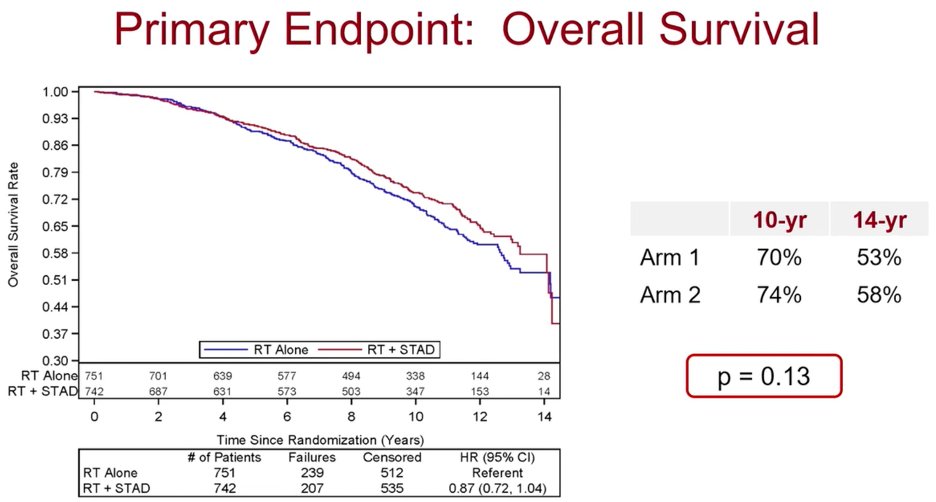
| Arm | N | 10-yr OS | 14-yr OS | HR (95% CI) | p |
|---|---|---|---|---|---|
| RT alone | 751 | 70% | 53% | Referent | n/a |
| RT + STAD | 742 | 74% | 58% | 0.87 (0.72, 1.04) | 0.13 |
+3 more figures
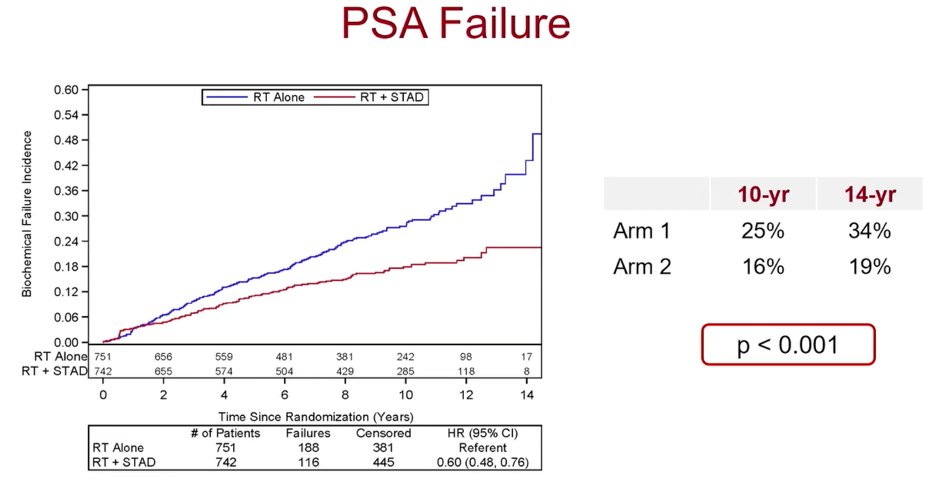
| Arm | N | 10-yr PSA failure | 14-yr PSA failure | HR (95% CI) |
|---|---|---|---|---|
| RT alone | 751 | 25% | 34% | Referent |
| RT + STAD | 742 | 16% | 19% | 0.60 (0.48, 0.76), p < 0.001 |
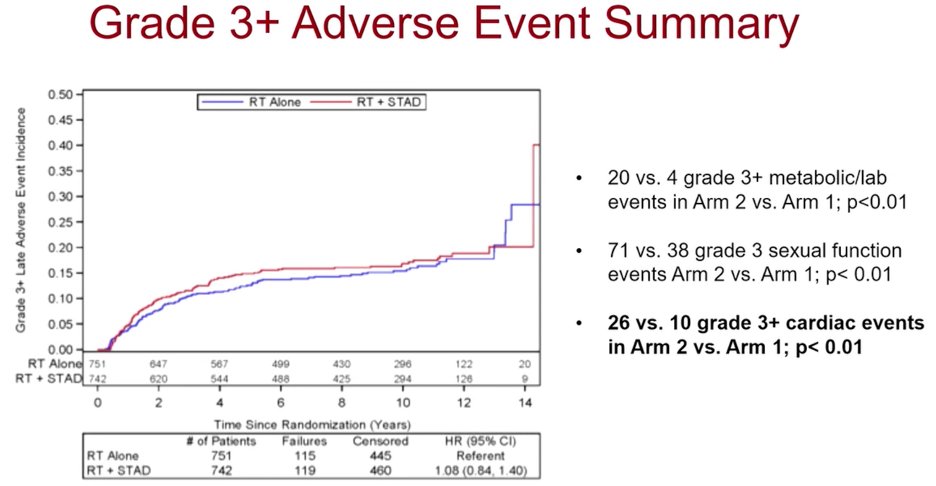
| Late AE | RT + STAD | RT alone | p / HR |
|---|---|---|---|
| Any grade 3+ late AE | 1.08 (0.84, 1.40) | Referent | HR (95% CI) |
| Grade 3+ metabolic/lab | 20 | 4 | p<0.01 |
| Grade 3 sexual function | 71 | 38 | p<0.01 |
| Grade 3+ cardiac | 26 | 10 | p<0.01 |

9 details
Phase III prospective randomized trial, N=1493 (751 vs 742). Median follow-up 9.4 y overall, 10.3 y in survivors. Stratified by number of IR factors, ACE-27 comorbidity, and RT modality.
Non-metastatic intermediate-risk prostate cancer with ≥1 of Gleason 7, PSA >10 but ≤20 ng/mL, or cT2b-T2c; all 3 factors plus ≥50% positive cores excluded. Median age 68, median PSA 8.1 ng/mL, 92% Gleason 7, 67% single IR factor.
Dose-escalated EBRT to 79.2 Gy, or EBRT with an LDR or HDR brachytherapy boost; 89% received EBRT alone. More than 90% of contours and dose analyses scored per protocol or acceptable variation.
6 months STAD: LHRH agonist plus antiandrogen. LHRH compliance 91%, antiandrogen 87%.
Primary: OS, powered for 5-y OS 90% to 93% (HR 0.66). Secondary: biochemical failure, local failure, distant metastasis, PC death, salvage therapy, non-PC death.
OS not improved (HR 0.87, p=0.13); PSA failure, MFS, distant mets, salvage ADT and PC deaths all favored STAD, with non-PC mortality similar (HR 0.93).
Overall grade 3+ late AEs similar (HR 1.08), but metabolic, sexual and cardiac grade 3+ events higher with STAD. EPIC hormone and sexual domains dropped early with STAD and largely converged by 60 months; urinary and bowel domains similar.
RTOG 9408 established STAD with RT at conventional doses; 0815 asks whether dose-escalated RT removes that need, and the disease-control answer is no. The OS answer differs because the population is IR with high competing mortality.
OS power assumption ignored the competing non-PC mortality that dominated deaths. Brachy-boost and multi-factor subsets are small, so subgroup omission cannot be defended from this trial.
STAD buys durable disease control and fewer PC deaths without excess non-PC mortality, at a transient QoL cost. The open question is selection: which IR pts can skip it, which the authors defer to imaging, genomics, and MMAI.
CONSORT flow
Adequately powered phase 3 with long follow-up; OS primary not met, but consistent disease-control benefit supports selective STAD as a toxicity trade-off rather than an OS gain.
- Which intermediate-risk subgroups can safely omit STAD?
- Does PSMA PET or genomic selection amplify STAD benefit?
📚 Sources · 🐦 1 tweet · 📄 1 paper
NRG/RTOG 0815: Ph 3 RCT of dose-escalated RT ± 6 mo STAD in IR PCa (n=1493; median f/u 10.3 y)
— Rashid K. Sayyid (@RKSayyid) September 28, 2026
🚨OS: 10-y 70% (RT alone) vs 74% (RT+STAD); 14-y 53% vs 58% (HR 0.87; p=0.13)
🔹PSA failure: 25% vs 16% at 10 y; 34% vs 19% at 14 y (HR 0.60; p<0.001)
🔹MFS: 67% vs 72% at 10 y; 50%… pic.twitter.com/G5qfgfc9CI
Abstract
RTOG 0815 Genomic Classifier (Decipher) Analysis
ForIntermediate-risk prostate cancer receiving definitive RT
TL;DRAdding STAD to RT gave an 8% absolute 10-yr DM benefit with Int/High Decipher vs 1% with Low GC, in intermediate-risk prostate cancer.
Low GC was the largest stratum (44% of 395) and gained only 1% absolute 10-yr DM from STAD, versus 8% with Int/High GC. This points to Decipher as the gate for ADT omission alongside RT in intermediate-risk disease, pending the interaction statistics the source does not report.
For intermediate-risk pts with low Decipher (<0.45) planned for RT, this questions whether adding STAD meaningfully lowers 10-yr DM risk; it does not address high-risk disease or long-course ADT.
Low GC was the largest stratum (44% of 395) and gained only 1% absolute 10-yr DM from STAD, versus 8% with Int/High GC. This points to Decipher as the gate for ADT omission alongside RT in intermediate-risk disease, pending the interaction statistics the source does not report.
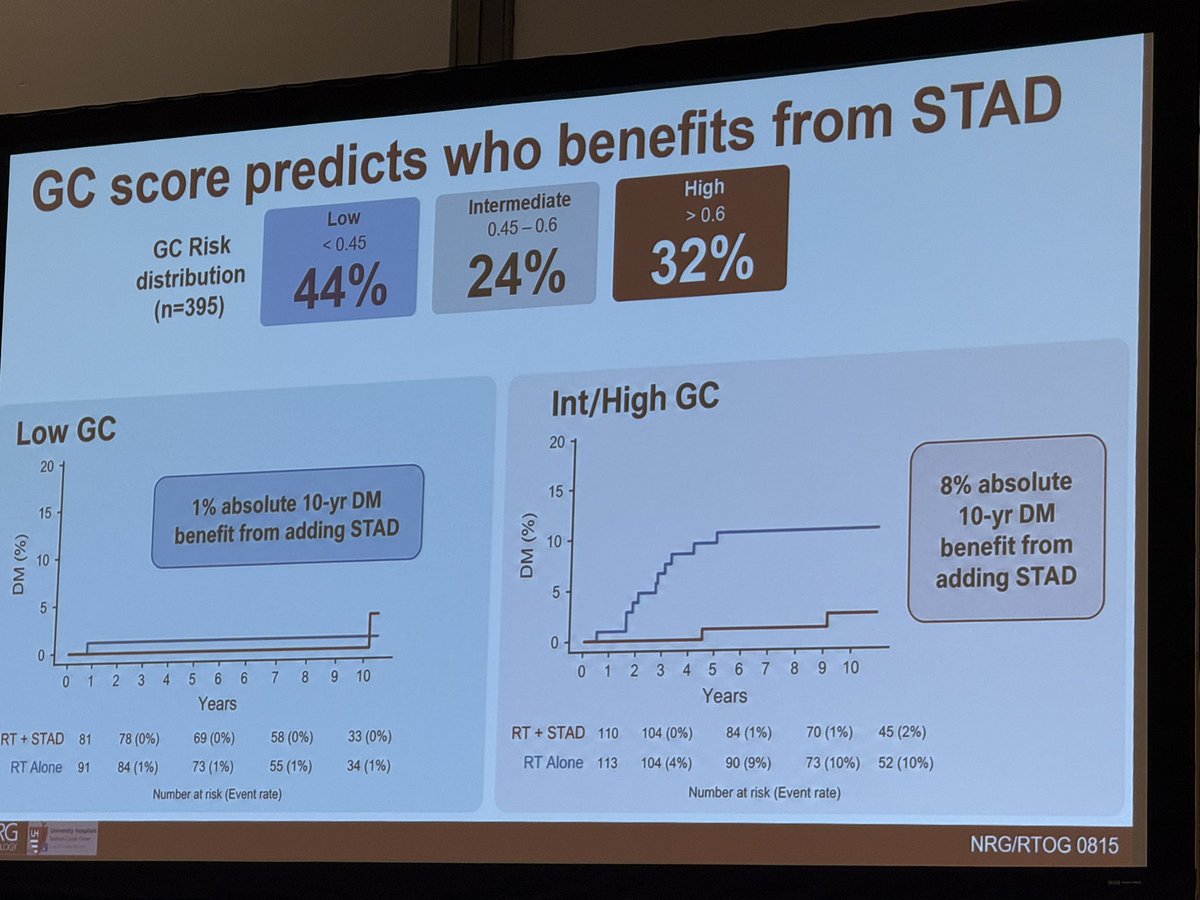
| GC group | Share of cohort (n=395) | Absolute 10-yr DM benefit from adding STAD |
|---|---|---|
| Low (<0.45) | 44% | 1% |
| Int/High (≥0.45) | 24% + 32% | 8% |
+1 more figure
8 details 2 trials watching
Secondary analysis of NRG/RTOG 0815, randomizing RT alone vs RT + STAD. Whether the GC analysis was prespecified is not stated in source.
Intermediate-risk prostate cancer with Decipher GC scores, n=395. GC distribution: Low (<0.45) 44%, intermediate (0.45-0.6) 24%, high (>0.6) 32%.
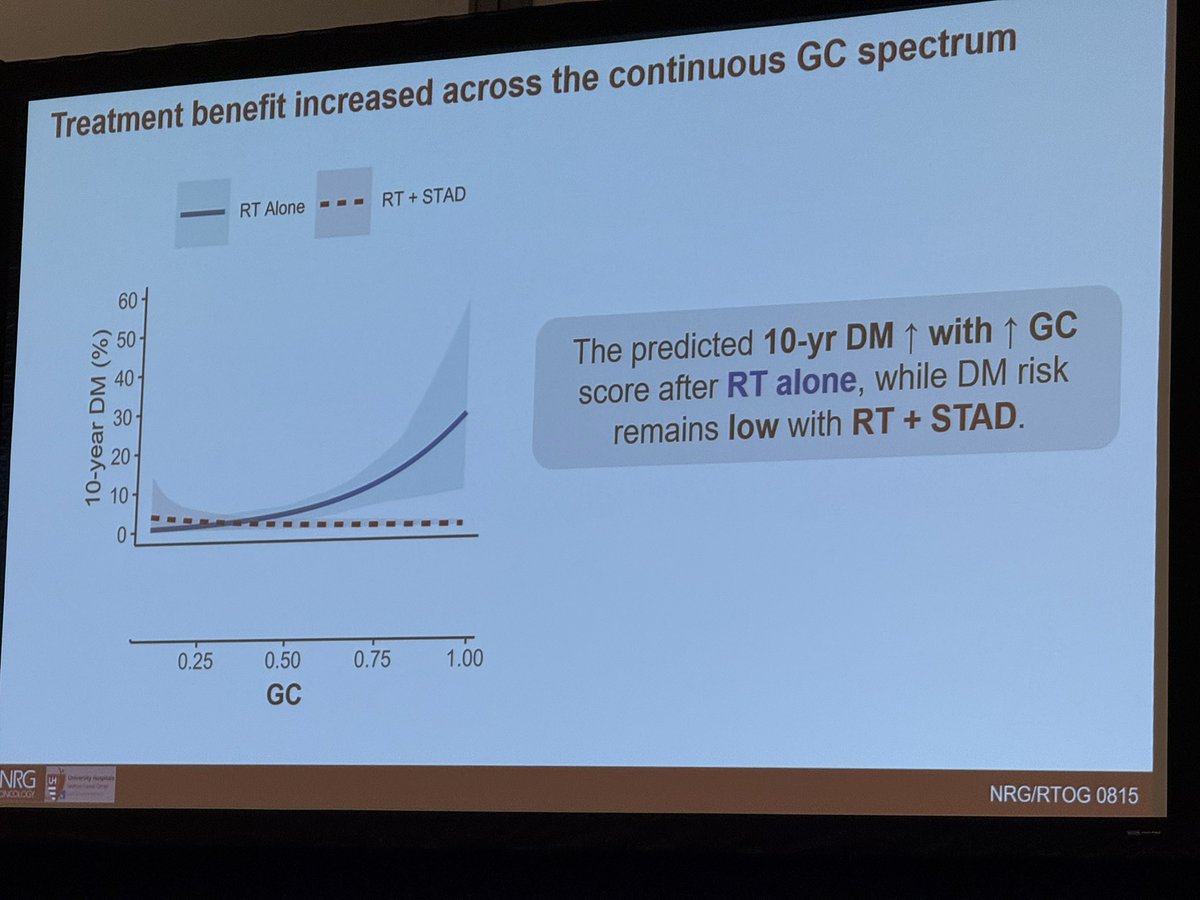
Distant metastasis (DM) at 10 years by GC stratum, plus predicted 10-yr DM across the continuous GC score.
Adding STAD: 1% absolute 10-yr DM benefit in Low GC vs 8% in Int/High GC. Benefit increased with continuous GC score; predicted DM rose with GC after RT alone but stayed low with RT + STAD.
Parallels prior Decipher analyses of RT ± ADT trials such as RTOG 9601 in the salvage setting. Here the predictive question moves to definitive RT for intermediate-risk disease.
Tweet-level source: RT dose, STAD duration, and the effect of the 0.45 cutpoint on the interaction are not reported. The Int/High group pools two strata (24% and 32%).
If the interaction holds, low-GC pts lose little from omitting STAD, which spares ADT toxicity in nearly half the cohort. Prospective de-escalation data are still needed before that becomes standard.
Secondary biomarker analysis of an RCT; prespecification not stated, and no interaction p, HR, or CI reported in the source.
- Formal GC-by-treatment interaction statistics and HRs
- Prospective validation of GC-guided STAD omission n=2050 · primary completion 2026-11 · phase 3 UIR, Decipher-guided ADT de-intensificationn=222 · primary completion 2027-12 · phase 2 UIR SBRT without ADT, Decipher-based selection
- Does GC benefit hold in unfavorable vs favorable intermediate-risk?
📚 Sources · 🐦 1 tweet
🚨Decipher score predictive of ADT benefit for preventing metastasis in patients with intermediate-risk #ProstateCancer in secondary analysis of @NRGonc RTOG 0815 RCT@angela_jia_ @ASTRO_org #ASTRO26 pic.twitter.com/YokjDQVxKa
— Tyler Seibert MD PhD (@TylerSbrt) September 29, 2026
LUNAR vs SATURN
ForM1 oligorecurrent PCa post-RP, candidates for SBRT
TL;DRIPTW-adjusted euPFS HR 1.39 (95% CI 0.56-3.45), p=0.47, SBRT+RLT vs SBRT+6mo AAT in M1 oligorecurrent PCa post-RP; n=63.
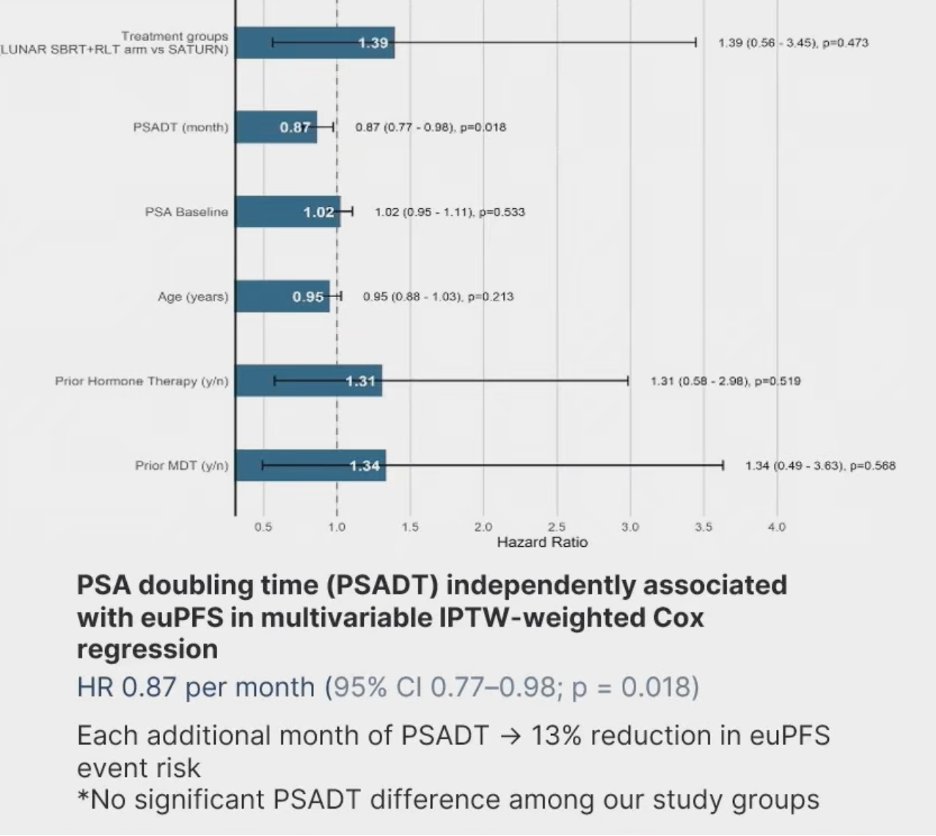
The SBRT-alone group progressed in 100% (18/18) at median 6.0 mo, versus 19.4 mo with RLT and 21.7 mo with AAT, so the RT read is that SBRT alone looks insufficient here and the open choice is the systemic partner. PSADT (HR 0.87 per month) is the selection variable to weigh when deciding whether SBRT alone is reasonable.
In M1 oligorecurrent PCa post-RP planned for SBRT, this leaves open whether 177Lu-PNT2002 can stand in for 6 mo AAT as the SBRT partner; it does not support dropping a systemic partner on the basis of RLT-vs-AAT parity. The longer read
SBRT alone progressed in 100% (18/18) at median 6.0 mo, versus 19.4 and 21.7 mo with a systemic partner, so the RT question here is which adjunct goes with SBRT. PSADT (HR 0.87 per month) is the variable for choosing who might get SBRT alone.
177Lu-PNT2002 vs 6 mo AAT as the SBRT partner: adjusted euPFS HR 1.39 (0.56-3.45) cannot separate them, so RLT is not yet established as a testosterone-sparing substitute. Grade ≥3 AEs 10% vs 20% (p=0.357) is the only tolerability hint.
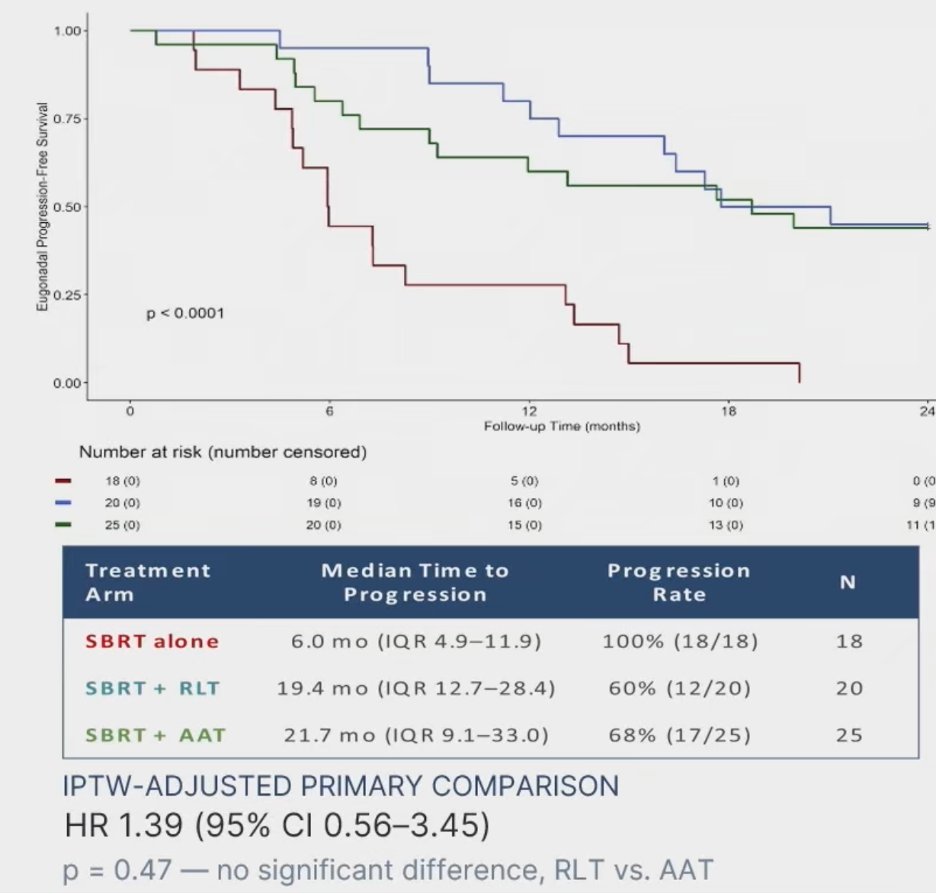
| Arm | N | Median time to progression | Progression rate |
|---|---|---|---|
| SBRT alone | 18 | 6.0 mo (IQR 4.9-11.9) | 100% (18/18) |
| SBRT + RLT | 20 | 19.4 mo (IQR 12.7-28.4) | 60% (12/20) |
| SBRT + AAT | 25 | 21.7 mo (IQR 9.1-33.0) | 68% (17/25) |
| IPTW-adjusted RLT vs AAT | HR 1.39 (95% CI 0.56-3.45), p = 0.47 |
+2 more figures
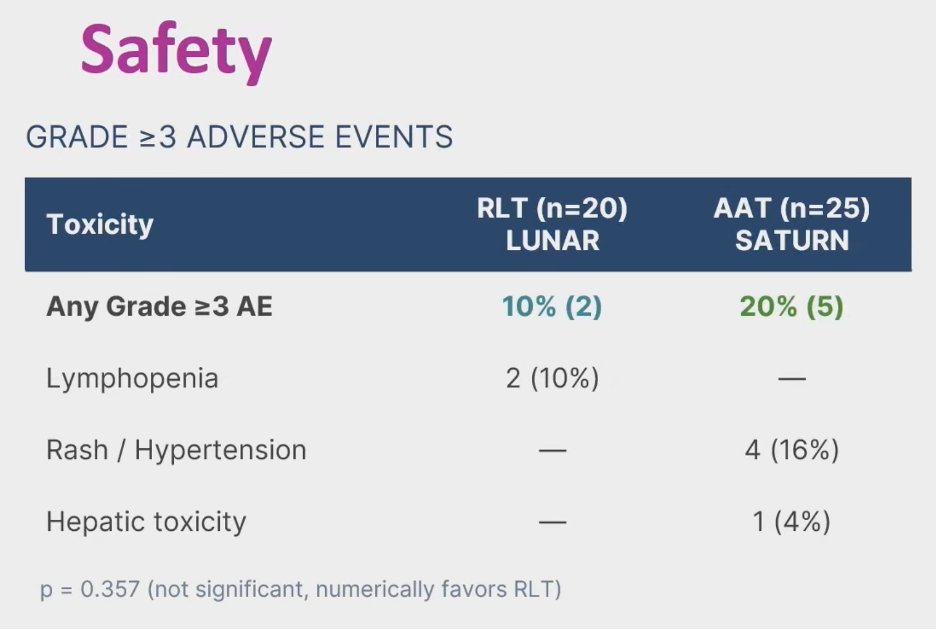
| Toxicity | RLT (n=20) | AAT (n=25) | p |
|---|---|---|---|
| Any Grade ≥3 AE | 10% (2) | 20% (5) | 0.357 |
9 details
Cross-trial IPD comparison pooling the LUNAR SBRT+RLT arm and the SATURN SBRT+AAT cohort, plus an SBRT-alone group; n=63. Primary contrast is an IPTW-adjusted Cox model, RLT vs AAT.
M1 oligorecurrent PCa post-RP. Groups: SBRT alone n=18, SBRT+RLT n=20, SBRT+AAT n=25; no PSADT difference across groups per source.
Systemic partner was either 177Lu-PNT2002 RLT or 6 mo androgen annihilation therapy (AAT); AAT components not specified in source.
SBRT to oligorecurrent sites in all three groups. Dose, fractionation, and target definition not reported in source.
Primary: eugonadal PFS (euPFS), RLT vs AAT, IPTW-adjusted.
Adjusted euPFS HR 1.39 (95% CI 0.56-3.45), p=0.47, RLT vs AAT. PSADT independently associated with euPFS, HR 0.87 per month (0.77-0.98), p=0.018.
Any grade ≥3 AE 10% (2) RLT vs 20% (5) AAT, p=0.357; numerically fewer with RLT, not significant.
STOMP and ORIOLE established MDT for oligorecurrent PCa and raised the question of what to add to it. This analysis compares two candidate partners rather than testing either against SBRT alone in a randomized frame.
The SBRT-alone contrast is unadjusted and its source is not stated, so the 6.0 mo median cannot be read as a controlled comparator. Progression definitions and imaging schedules across the two trials are not described in source.
A null adjusted HR with a CI spanning 0.56 to 3.45 is absence of evidence, not equivalence. RLT is a plausible testosterone-preserving partner to SBRT, but a randomized RLT vs AAT trial is needed before substituting one for the other.
Non-randomized cross-trial IPD comparison, IPTW on measured covariates only, n=45 in the adjusted contrast; wide CI cannot establish equivalence of RLT and AAT.
- Randomized RLT vs AAT as SBRT partner in oligorecurrent PCa
- PSADT threshold for SBRT alone without systemic partner
- Testosterone recovery and QoL with RLT vs AAT
📚 Sources · 🐦 1 tweet
LUNAR vs SATURN: cross-trial IPD comparison of SBRT + 177Lu-PNT2002 RLT vs SBRT + 6 mo androgen annhilation therapy (AAT) the in M1 oligorecurrent PCa post-RP (n=63)
— Rashid K. Sayyid (@RKSayyid) September 30, 2026
🔹Median time to progression: 19.4 mo RLT vs 21.7 mo AAT vs 6.0 mo SBRT alone
🔹Adjusted euPFS similar w/ RLT vs… pic.twitter.com/bn7sstnbvy
NRG/RTOG 0534 SPPORT PAM50 Analysis
ForPost-RP PSA 0.1-2.0 ng/mL, pT2/pT3 N0M0, Gleason ≤9, salvage RT
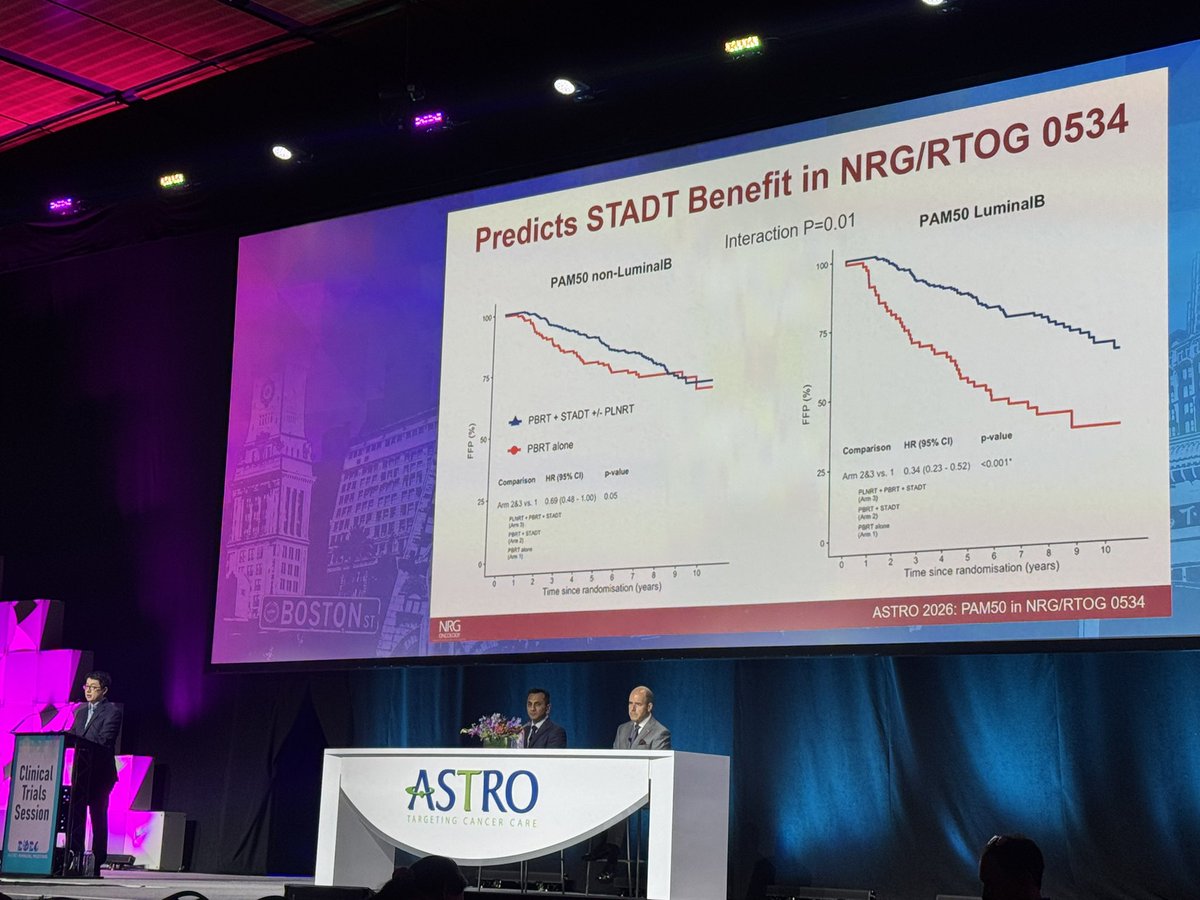
TL;DRPAM50 Luminal B predicts STADT benefit with salvage RT: 5-y FFP benefit 31% vs 10% non-Luminal B (p-int=.01).
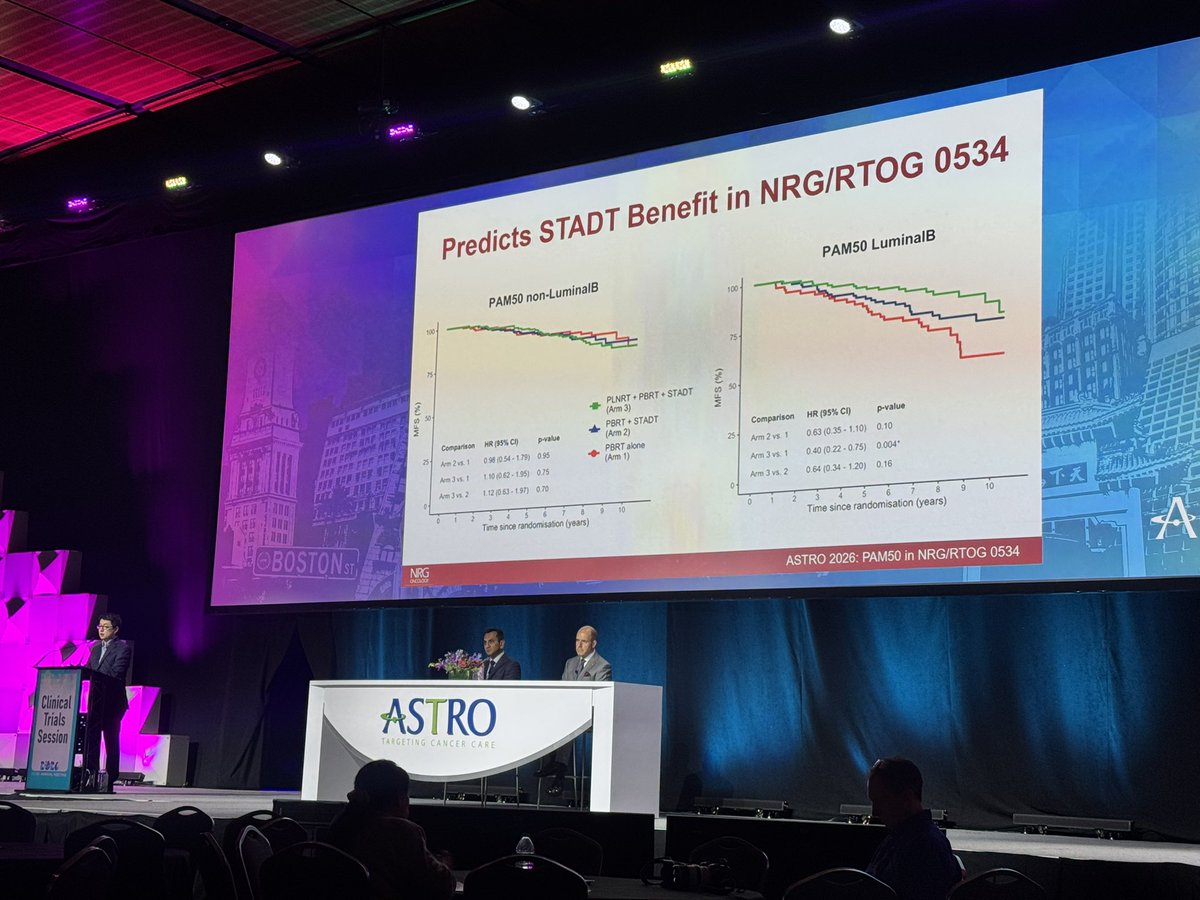
The ADT-with-salvage-RT decision may split by subtype: Luminal B gained 31% absolute 5-y FFP and 20% 10-y MFS from STADT, while non-Luminal B gained 10% FFP and no MFS (-3%). If validated, this flags a non-Luminal B group where STADT could be omitted from PBRT.
In post-RP pts with PSA 0.1-2.0 ng/mL heading to salvage RT, a Luminal B PAM50 call supports pairing STADT with RT; it does not yet justify dropping ADT in non-Luminal B pts.
For salvage PBRT, the subtype split frames when STADT earns its toxicity: 31% vs 10% absolute 5-y FFP benefit, Luminal B vs non-Luminal B. The PLNRT increment over STADT (Arm 3 vs 2 HR 0.64, p=0.16) stays unresolved by subtype.
Luminal B behaves as an ADT-responsive phenotype: 10-y MFS benefit 20% vs -3% in non-Luminal B (p-int=.05). Points toward biomarker-gated short-term ADT rather than uniform use with salvage RT, pending validation.
+2 more figures
12 details
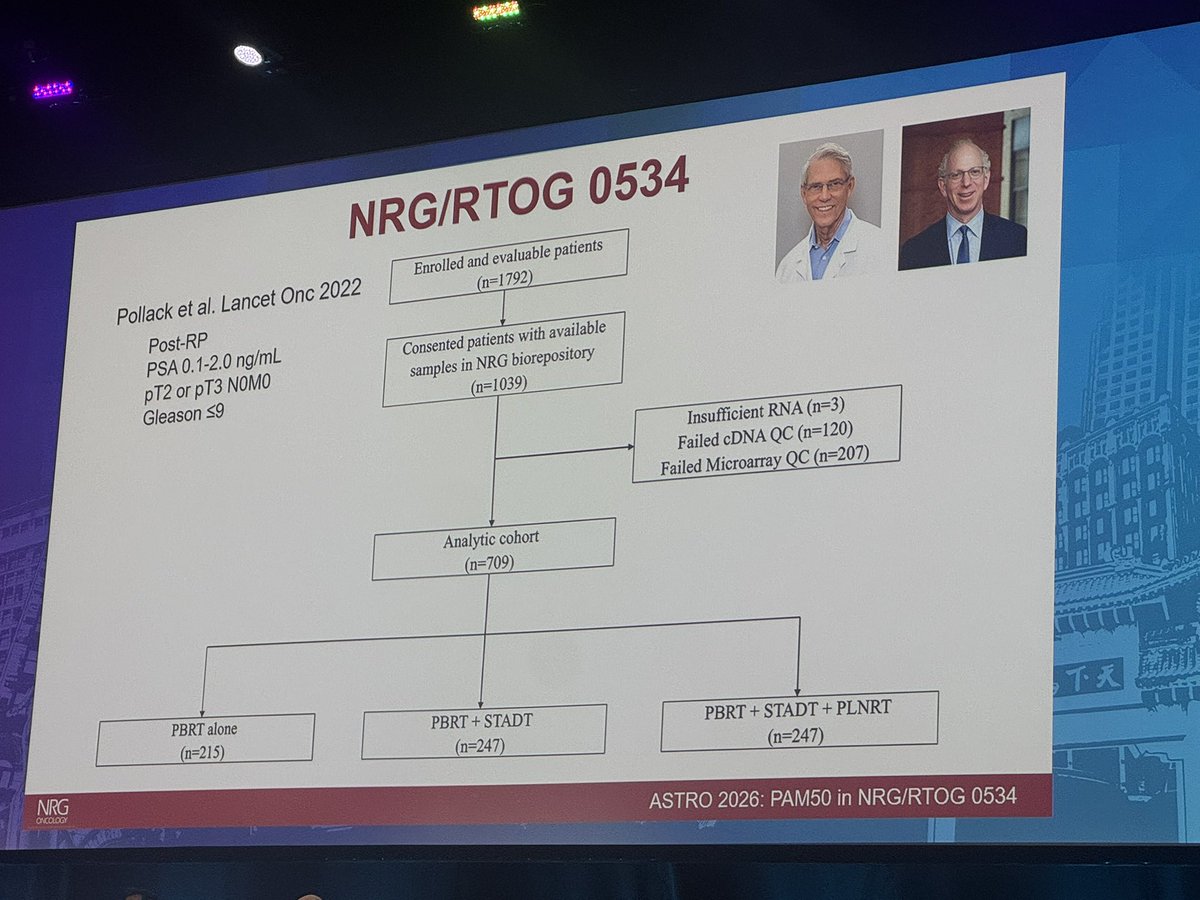
Biomarker analysis of NRG/RTOG 0534 SPPORT (Pollack et al. Lancet Onc 2022). PAM50 subtyping on archived tissue; analytic cohort n=709 of 1792 enrolled.
Post-RP, PSA 0.1-2.0 ng/mL, pT2 or pT3 N0M0, Gleason ≤9. 330 of 1039 sampled pts excluded for insufficient RNA or QC failure.
Arm 1 PBRT alone (n=215), Arm 2 PBRT + STADT (n=247), Arm 3 PBRT + STADT + PLNRT (n=247). Dose and fractionation not reported in source.
Luminal B was prognostic and predictive of STADT benefit: interaction p=.01 for 5-y FFP and p=.05 for 10-y MFS.
| Endpoint | Luminal B | non-Luminal B | Interaction |
|---|---|---|---|
| 5-y FFP benefit | 31% | 10% | p-int=.01 |
| 10-y MFS benefit | 20% | -3% | p-int=.05 |
Sits beside the parent SPPORT result, which established STADT and PLNRT as additions to PBRT. Extends earlier PAM50 work linking luminal B to ADT response into a salvage RT randomized cohort.
Only 40% of enrolled pts contributed; sample availability may skew the cohort. Subtype-level PLNRT contrast (Arm 3 vs 2 HR 0.64, p=0.16) is underpowered.
Supports a biomarker-selected STADT decision in salvage RT. Does not settle whether PLNRT benefit tracks subtype, or how PAM50 combines with other classifiers.
Secondary biomarker analysis of a randomized trial; 709/1792 evaluable, prespecification not stated, slide panel attribution partly illegible. Hypothesis-generating until externally validated.
- Can non-Luminal B pts safely omit STADT with salvage RT?
- Does PLNRT benefit differ by PAM50 subtype?
- How does PAM50 combine with other genomic classifiers for ADT selection?
📚 Sources · 🐦 1 tweet
New #ASTRO2026 data from @NRGOnc /RTOG 0534 SPPORT 🔬🧬 presented by Shuang (George) Zhao @UTMDAnderson. PAM50 Luminal B = both prognostic & predictive of benefit from postop ADT.
— Lauren Henke, MD, MSCI (@lauren_henke) September 27, 2026
📈 5-y FFP benefit: 31% vs 10% (p-int=.01)
🎯 10-y MFS: 20% vs -3% (p-int=.05)#Pcsm @Astro_org pic.twitter.com/BRJsYDWiQS
GETUG P05
ForIntermediate-risk localised prostate, N0M0, no ADT, IPSS ≤15, age ≤80
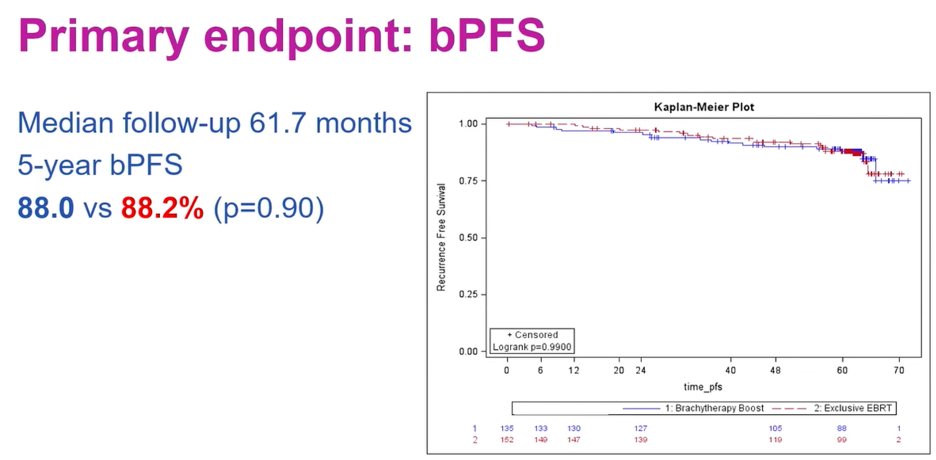
88.0% vs 88.2%
p=0.90, no difference
TL;DR5-yr bPFS 88.0 vs 88.2% (p=0.90): 46 Gy EBRT + LDR/HDR boost no better than 80 Gy EBRT in IR prostate without ADT.
The toxicity ledger cuts against the boost: late GU G2 34.1% vs 17.9% (all-grade p=0.0006), against acute GI sparing only. With 5-yr bPFS flat in both GG2 and GG3, this questions offering a brachy boost over 80 Gy EBRT in IR disease treated without ADT.
In intermediate-risk prostate cancer treated without ADT, this questions adding an LDR/HDR boost over dose-escalated EBRT for bPFS; it does not address boost with ADT, higher-risk disease, or hypofractionated or SBRT comparators. The longer read
The toxicity ledger cuts against the boost: late GU G2 34.1% vs 17.9% (all-grade p=0.0006), against acute GI sparing only. With 5-yr bPFS flat in both GG2 and GG3, this questions offering a brachy boost over 80 Gy EBRT in IR disease treated without ADT.
+3 more figures
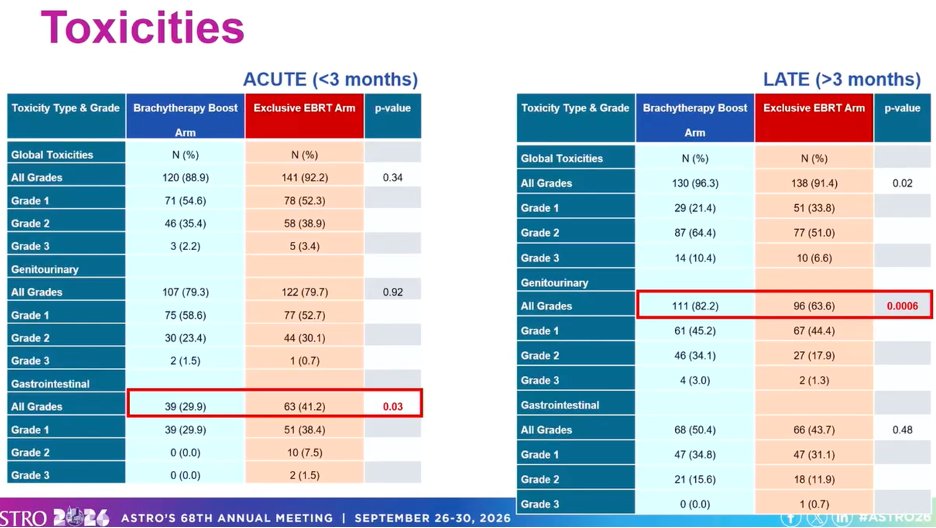
| Toxicity (all grades) | Brachytherapy boost | Exclusive EBRT | p |
|---|---|---|---|
| Acute GU | 107 (79.3) | 122 (79.7) | 0.92 |
| Acute GI | 39 (29.9) | 63 (41.2) | 0.03 |
| Late GU | 111 (82.2) | 96 (63.6) | 0.0006 |
| Late GI | 68 (50.4) | 66 (43.7) | 0.48 |

11 details 1 trial watching
Phase 3 RCT, 1:1, n=288, presented at ASTRO 2026. Median follow-up 61.7 mo.
Histologically proven intermediate-risk prostate adenocarcinoma, age 18-80, expected survival ≥10y, ECOG ≤2. Excluded T3a or greater, ADT, nodal or distant mets, IPSS >15, active IBD.
Both arms: EBRT 46Gy in 2Gy fx to prostate + 1cm SV. Boost arm: LDR 110Gy or HDR 14Gy 1-4 wks after EBRT. Control: 34Gy EBRT boost to prostate, 80 Gy total over 8 wks.
Primary: 5-yr bPFS. Secondary: toxicity, OS, PCSS, IPSS, IIEF-5, QLQ-C30.
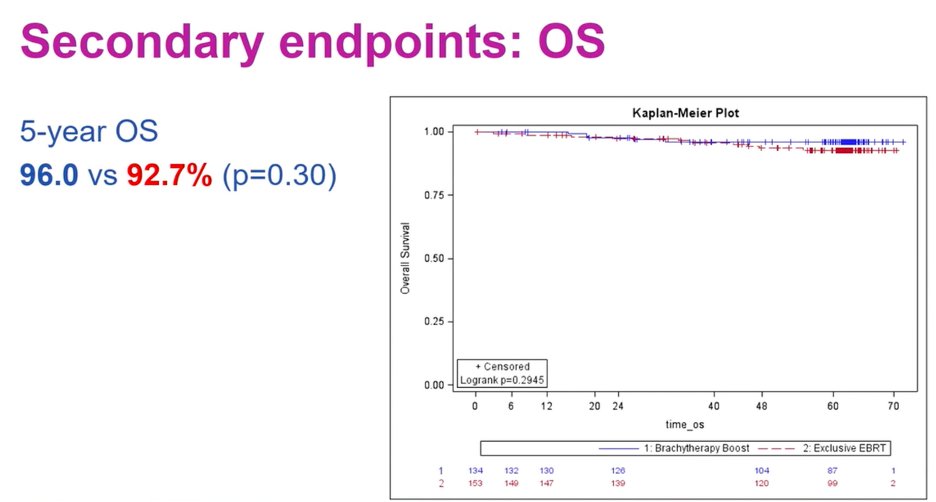
5-yr bPFS 88.0 vs 88.2% (p=0.90), with no benefit in GG2 or GG3. 5-yr OS 96.0 vs 92.7% (p=0.30).
Boost lowered acute GI all-grade toxicity (29.9 vs 41.2%, p=0.03) but raised late GU (82.2 vs 63.6%, p=0.0006). Late GI similar (p=0.48).
ASCENDE-RT, the main randomised support for an LDR boost over dose-escalated EBRT, gave ADT and enrolled a higher-risk mix. GETUG P05 tests the boost without ADT in IR disease and finds no bPFS gain.
LDR and HDR boosts are pooled. Power, margin, and bPFS definition not in source. The 2Gy-fraction 80 Gy control predates hypofractionated standards.
In IR disease without ADT, 80 Gy EBRT already reaches about 88% 5-yr bPFS, which leaves little room for a boost to add anything. The extra late GU morbidity makes routine boosting hard to justify here. Whether a gap opens with longer follow-up is unsettled.
Randomised phase 3 with prespecified bPFS primary, null at 5 yr; diverges from ASCENDE-RT boost benefit. Power not in source, and IR bPFS separation may need longer f/u.
- Does a bPFS benefit emerge with longer follow-up?
- LDR vs HDR boost outcomes not reported separately active Improving Quality of Life After Prostate Brachytherapy: a Comparison of HDR and LDR Brachytherapy Phase NAn=195 · primary completion 2019-12 · randomised HDR vs LDR boost, PSA recurrence-free survival
- Boost vs hypofractionated or SBRT EBRT in IR disease
📚 Sources · 🐦 1 tweet
GETUG P05: Ph 3 RCT of 46 Gy EBRT + LDR/HDR brachy boost vs dose-escalated 80 Gy EBRT in IR PCa, no ADT (n=288)
— Rashid K. Sayyid (@RKSayyid) September 28, 2026
🔹5-yr bPFS: 88% vs 88.2% (p=0.90)
🔹No bPFS benefit in iether GG2 or 3 pts
🔹5-yr OS: 96% vs 92.7% (p=0.30)
🔹Acute GI toxicity lower w/ brachy: 30% vs 41% (p=0.03)… pic.twitter.com/qoxDCnJV4b
PROSTOX Ultra (SCIMITAR/EXCALIBUR)
ForPost-RP pts receiving 5-fx prostate bed SBRT ± pelvic nodes
TL;DRContinuous AUC 0.814 (SCIMITAR) and 0.824 (EXCALIBUR) for late G2+ GU toxicity after post-RP prostate bed SBRT; recalibrated 0.25 threshold gives pooled AUC 0.748.
Reported via UroToday →
The intact-prostate 0.50 cutoff failed post-op: in EXCALIBUR every pt with toxicity scored below it, while continuous ranking held (AUC 0.814 and 0.824). Clinical factors (pad use, IPSS, time from RP) predicted nothing, so a germline score at 0.25 is the only stratifier here for counseling or planning before prostate bed SBRT.
In a post-prostatectomy pt being considered for 5-fraction prostate bed SBRT, this supports reading a PROSTOX Ultra score against a 0.25 post-op threshold rather than the intact 0.50; it does not inform conventionally fractionated postop RT, which was not studied. The longer read
The intact-prostate 0.50 cutoff failed post-op: in EXCALIBUR every pt with toxicity scored below it, while continuous ranking held (AUC 0.814 and 0.824). With clinical factors predicting nothing, a germline score at 0.25 is the only stratifier here for counseling or fractionation choice before prostate bed SBRT.
10 details 1 trial watching
Biomarker evaluation in two prospective post-op SBRT cohorts, SCIMITAR (NCT03541850) and EXCALIBUR (NCT04915508). Continuous and dichotomized discrimination compared; exploratory threshold recalibration targeting sensitivity >=0.65 and specificity >=0.70; AUCs bootstrapped and pooled by fixed-effects meta-analysis.
SCIMITAR enrolled 100 post-prostatectomy pts, 89 evaluable; EXCALIBUR 74 evaluable. Germline DNA from saliva.
SCIMITAR: 30-34 Gy in 5 fractions ± pelvic nodes. EXCALIBUR: 5-fraction SBRT to the prostate bed ± nodes.
Late grade 2+ GU adverse events, with discrimination by continuous AUC and binary AUC at the 0.50 intact threshold and a recalibrated post-op threshold.
Risk ordering preserved: scores higher with toxicity in both cohorts. At 0.50, EXCALIBUR binary AUC <0.50 (threshold misalignment); at 0.25, pooled AUC 0.748. Candidate thresholds spanned ~0.10-0.31.
| Metric | SCIMITAR | EXCALIBUR |
|---|---|---|
| Continuous AUC | 0.814 | 0.824 |
| Binary AUC at 0.50 (intact) | 0.755 | <0.50 |
| Specificity at 0.50 | 0.985 | 0.926 |
| Sensitivity at 0.50 | 0.546 | not reported |
| Binary AUC at 0.25 (post-op) | 0.750 | 0.727 |
| Median score, tox vs no tox | 0.547 vs 0.049, p<0.0001 | 0.338 vs 0.043, p=0.009 |
The intact-prostate PROSTOX Ultra model used a prespecified 0.50 threshold after intact SBRT; post-RP performance was previously unknown. Here the genetic signal transfers but the clinical trigger shifts downward post-op.
The 0.25 cutoff was selected on the same two cohorts it is reported in, so the 0.748 pooled AUC is optimistic until tested externally. EXCALIBUR toxicity rate and nodal-field proportions are not reported in source, limiting judgment of whether field size confounds the signal.
Supports mirSNP germline risk as a continuous predictor that generalizes post-RP, needing context-specific calibration rather than a new model. Whether a high score should change dose, field, or modality is not tested.
Biomarker validation in two small cohorts (89 and 74 evaluable); post-op threshold derived in-sample by exploratory recalibration, untested in an independent cohort or for risk-adapted planning.
- Does the 0.25 post-op threshold hold in an independent cohort?
- Does risk-adapted fractionation lower GU toxicity in high-score pts? active Germline DNA-Based Radiosensitivity Biomarker Influence on Toxicity Following Prostate Radiotherapy, GARUDA Trial Phase NAn=208 · primary completion 2027-12 · germline score guides SBRT vs hypofx; GU tox, intact gland
- Is the signal confounded by pelvic nodal field inclusion?
📚 Sources · 📄 1 paper
Abstract
Biomarkers in the Post-operative Setting for Prostate Cancer (review)
TL;DRSpratt ASTRO 2026 review: PAM50 luminal B predicts apalutamide benefit with salvage RT in NRG GU006 (5y MFS 95% vs 82%, HR 0.27); non-luminal B no benefit.
Reported via UroToday →
POSEIDONMARCAPRTOG 9601RTOG 0534NRG GU002NRG GU006BALANCESYMPHONY
The ADT decision with salvage RT now has three selectors: pre-RT PSA (OS benefit only above 0.50 ng/mL in POSEIDON), PAM50 luminal B (GU006 5y MFS 95% vs 82%), and MMAI-high. Adverse pathology count does not select (interaction p=0.40). SYMPHONY will test 5-fraction prostate-bed SBRT, dose de-escalation, and elective nodal RT.
In a post-RP pt with PSA ≤0.50 ng/mL and non-luminal B PAM50, these data question adding ADT to salvage RT; the GU006 benefit applies to luminal B tumors only. The longer read
Pre-RT PSA gates ADT benefit with salvage RT: POSEIDON OS benefit appears only above 0.50 ng/mL, so early salvage is where ADT omission is most defensible. SYMPHONY will test 5-fraction prostate-bed SBRT, dose de-escalation and elective nodal RT.
PAM50 luminal B identified apalutamide benefit with salvage RT in GU006 (5y MFS HR 0.27); non-luminal B showed none (HR 1.06). Longer ADT duration did not improve OS (HR 0.96), and adverse pathology count did not predict HT benefit.
10 details 3 trials watching
Conference review talk by Dr. Spratt at ASTRO 2026, summarized by UroToday. It pulls together IPD meta-analyses, the prospective biomarker-stratified NRG GU006, and post-hoc biomarker analyses of RTOG 9601/0534.
POSEIDON: adding HT to post-op RT gives OS HR 0.87 (0.76-1.01), p=0.06 overall, with benefit confined to PSA >0.50 ng/mL (HR 0.72 and 0.69). In GU006, apalutamide benefit is restricted to luminal B (MFS HR 0.27). Non-luminal B shows no benefit (MFS HR 1.06).
| Pre-RT PSA (ng/mL) | OS HR (95% CI) | p |
|---|---|---|
| Overall | 0.87 (0.76-1.01) | 0.06 |
| ≤0.20 | 1.14 (0.83-1.57) | 0.42 |
| 0.21-0.50 | 0.94 (0.74-1.19) | 0.70 |
| 0.51-1.0 | 0.72 (0.54-0.96) | 0.02 |
| >1.0 | 0.69 (0.48-0.98) | 0.03 |
| Endpoint | Luminal B: apa vs pbo | Luminal B HR | Non-luminal B: apa vs pbo | Non-luminal B HR |
|---|---|---|---|---|
| 5y bPFS | 72% vs 54% | 0.45 (95% CI 0.24-0.86), p=0.0062 | 70% vs 71% | 0.95 (80% CI 0.65-1.41), p=0.44 |
| 5y MFS | 95% vs 82% | 0.27 (95% CI 0.07-0.95), p=0.029 | 90% vs 89% | 1.06 (95% CI 0.41-2.78), p=0.90 |
Upcoming SYMPHONY trials: PRESTO (prostate bed 20-33 fx vs 5 fx SBRT, N=948), ADAGIO (normal vs reduced dose, N=948), CRESCENDO (± elective nodal RT, N=870), and FULL-SCORE (MDT ± prostate-bed/nodal RT in N+/M+, N=480).
PAM50 prediction is prospective in NRG GU006 and post-hoc in RTOG 0534, so the two lines of evidence agree. Decipher has been validated prospective-retrospectively across RTOG 9601, RTOG 0534, NRG GU002 and NRG GU006.
Clinicopathologic adverse features predict risk but not differential HT benefit. Benefit comes from PSA level and molecular or pathology biomarkers. The speaker frames PAM50 as a level 1A predictive biomarker for systemic intensification with salvage RT.
GU006 luminal B estimates rest on a subgroup with a wide MFS CI. MMAI benefit separation is reported only as approximate curve readings, and RTOG 0534 PAM50 data are retrospective.
- Does PAM50 luminal B predict ADT benefit at PSA ≤0.20 ng/mL?
- Can 5-fraction prostate-bed SBRT replace conventional salvage fractionation? recruiting Post-prostatectomy Radiation Therapy--Moderate Versus Ultra-hypofractionated (Also Known as Stereotactic Body Radiation Therapy [SBRT]) Phase 2n=136 · primary completion 2026-11 · randomised ph 2, ultra vs moderate hypofx, 2y QOLrecruiting Salvage Stereotactic Body Radiotherapy of the Prostate Bed for Biochemical Recurrence After Radical Prostatectomy. Phase NAn=284 · primary completion 2029-02 · randomised ph II/III salvage SBRT vs SOC RT post-RPn=206 · primary completion 2031-09 · phase 3, 5-fx SBRT vs mild hypofx RT, adjuvant/salvage
- Does elective nodal RT add benefit in salvage setting?
📚 Sources · 📄 1 paper
Abstract
GUAM International Consensus Guideline on GU Adverse Events
ForProstate cancer pts receiving RT, intact gland or post-prostatectomy
TL;DRFirst RT-specific GU AE guideline: 48-expert Delphi, 31 key questions; 76% favor moderate hypofractionation over SBRT at baseline IPSS 15-19.
Reported via UroToday →
Baseline IPSS, not a bladder or urethral constraint, becomes the gating variable for fractionation: 76% favored moderate hypofractionation over SBRT at IPSS 15-19, while no dose-volume constraint reached consensus. The technique lever the panel flagged is margin, citing MIRAGE late G≥2 GU 51% to 27% with 2-mm MRI-guided vs 4-mm CT-guided margins.
In an intact-prostate pt with severe obstructive LUTS before RT, this supports urology referral for an outlet procedure with an 8-12 week recovery interval before RT; it does not extend to irritative-predominant symptoms, where 95% of the panel advised against a prophylactic procedure. The longer read
Baseline IPSS is the gating variable for fractionation: 76% favored moderate hypofractionation over SBRT at IPSS 15-19, and 85% endorse full bladder at sim and treatment. No dose-volume constraint reached consensus, so margin reduction (MIRAGE 2-mm vs 4-mm) is the cited technique lever.
The surgical decision is timing and selection of an outlet procedure: 74% would refer at IPSS ≥20, 94% would wait ≥8 wk and 66% ≥12 wk before RT. 95% advise against a prophylactic procedure when irritative symptoms predominate, and only 52% consider SBRT safe afterward.
15 details
Systematic review (183 articles) plus a 3-round modified Delphi, May 2025 to Feb 2026, consensus defined as ≥75% agreement. Panel of 48 experts from 15 countries (34 radonc, 7 medonc, 7 urologic onc); 31 key questions reached consensus. Independently peer reviewed, endorsed by ASTRO and ESTRO.
76% favor moderate hypofractionation over SBRT at baseline IPSS 15-19; 85% recommend a full bladder at simulation and treatment. No dose-volume constraint reached consensus. After a BOO procedure, only 52% considered SBRT safe once obstruction resolved.
Intact gland: alpha blocker 1st-line for obstructive, anti-spasmodic 1st-line for irritative symptoms; anti-spasmodic 1st-line post-prostatectomy. 80% against prophylaxis before symptom onset; 80% add a 2nd agent rather than switch.
Cites MIRAGE: 2-mm MRI-guided margins cut late G≥2 GU AEs from 51% to 27% vs 4-mm CT-guided. CHHiP, PROFIT, RTOG 0415 and the HYDRA meta-analysis did not show a consistent late GU increase with moderate hypofractionation; RICH-ART supports HBOT for refractory radiation cystitis.
Several reported splits (74% for post-op alpha blocker futility and IPSS ≥20 referral, 52% for post-procedure SBRT) sit under the ≥75% bar and the write-up does not say how they were adopted. Radonc-heavy panel (34 of 48). Trade-press summary, not the manuscript.
Formalizes practice previously extrapolated from BPH and OAB data and moves fractionation choice onto baseline IPSS. Open gaps: dose-volume constraints, urethral contouring reliability, and RT-specific drug evidence; BEFORE, RadTARGET, RELIEF and DESTINATION-2 are ongoing, and the guideline is meant to be living.
| Setting | Preferred 1st-line | Subsequent options, in order |
|---|---|---|
| Intact, obstructive | Alpha blocker | PDE5-I → NSAID → steroid → anti-spasmodic |
| Intact, irritative | Anti-spasmodic | Alpha blocker → NSAID → phenazopyridine → cranberry |
| Post-prostatectomy | Anti-spasmodic | Not stated in source |
| Baseline IPSS | % panel selecting |
|---|---|
| 10-14 | 16% |
| 15-19 | 61% |
| 20-24 | 21% |
| ≥25 | 2% |
| Baseline IPSS | % panel selecting |
|---|---|
| 15-19 | 34% |
| 20-24 | 47% |
| 25-29 | 15% |
| ≥30 | 4% |
Modified Delphi guideline on a systematic review; recommendations are panel agreement, not outcomes, and several reported thresholds fall at or below the stated ≥75% consensus bar.
- Which dose-volume constraints predict late GU toxicity?
- Reliability of urethral contouring for prostate RT
- RT-specific evidence for alpha blockers and anti-spasmodics