PACE-A
ForLocalised low/intermediate-risk PCa (GG1-2), surgical candidates, no ADT
TL;DR≥1 urinary pad 14/29 (48%) RP vs 3/36 (8%) SBRT; BCF HR 0.48 (95% CI 0.16-1.46), mFU 8 yrs, GG1-2 localised PCa.
The continence gap is the RT read: ≥1 pad in 14/29 (48%) after RP vs 3/36 (8%) after 36.25 Gy/5fx, with bowel toxicity 0 (0%) on SBRT. With mFU 8 yrs and 7 deaths none from PCa, this supports SBRT as the lower-urinary-morbidity option when counselling surgical candidates, though efficacy parity rests on 13 events.
In an MRI-staged GG1-2, PSA ≤20 surgical candidate choosing between RP and SBRT, this supports framing continence as the main differentiator; it does not extend to GG3+ disease or pts needing ADT.
36.25 Gy/5fx with no ADT delivered pad use in 3/36 (8%) and no moderate/big bowel problems, so five-fraction SBRT holds its functional advantage against a surgical, not just a conventional RT, comparator in GG1-2 disease.
Pad use after RP was 14/29 (48%) against 3/36 (8%) after SBRT, with BCF HR 0.48 (0.16-1.46) at mFU 8 yrs. For GG1-2 surgical candidates, the continence trade-off is now randomised evidence, while efficacy parity remains unproven on 13 events.

| Arm | ≥1 urinary pad |
|---|---|
| Prostatectomy | 14/29 (48%) |
| SBRT | 3/36 (8%) |
+3 more figures
| Arm | Moderate/big bowel problem |
|---|---|
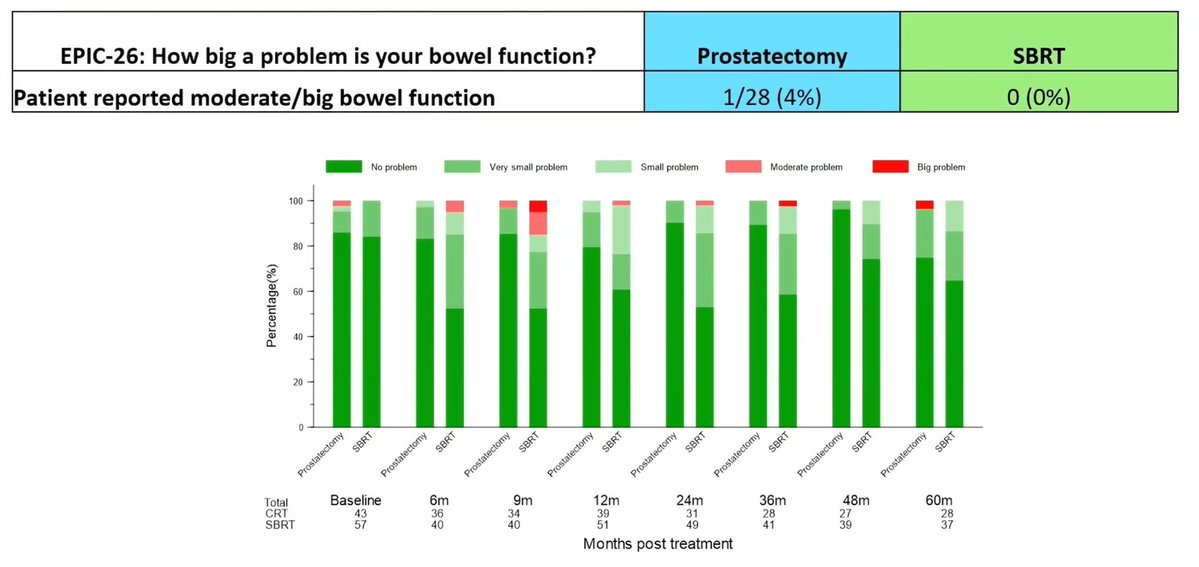
| Prostatectomy | 1/28 (4%) |
| SBRT | 0 (0%) |
12 details
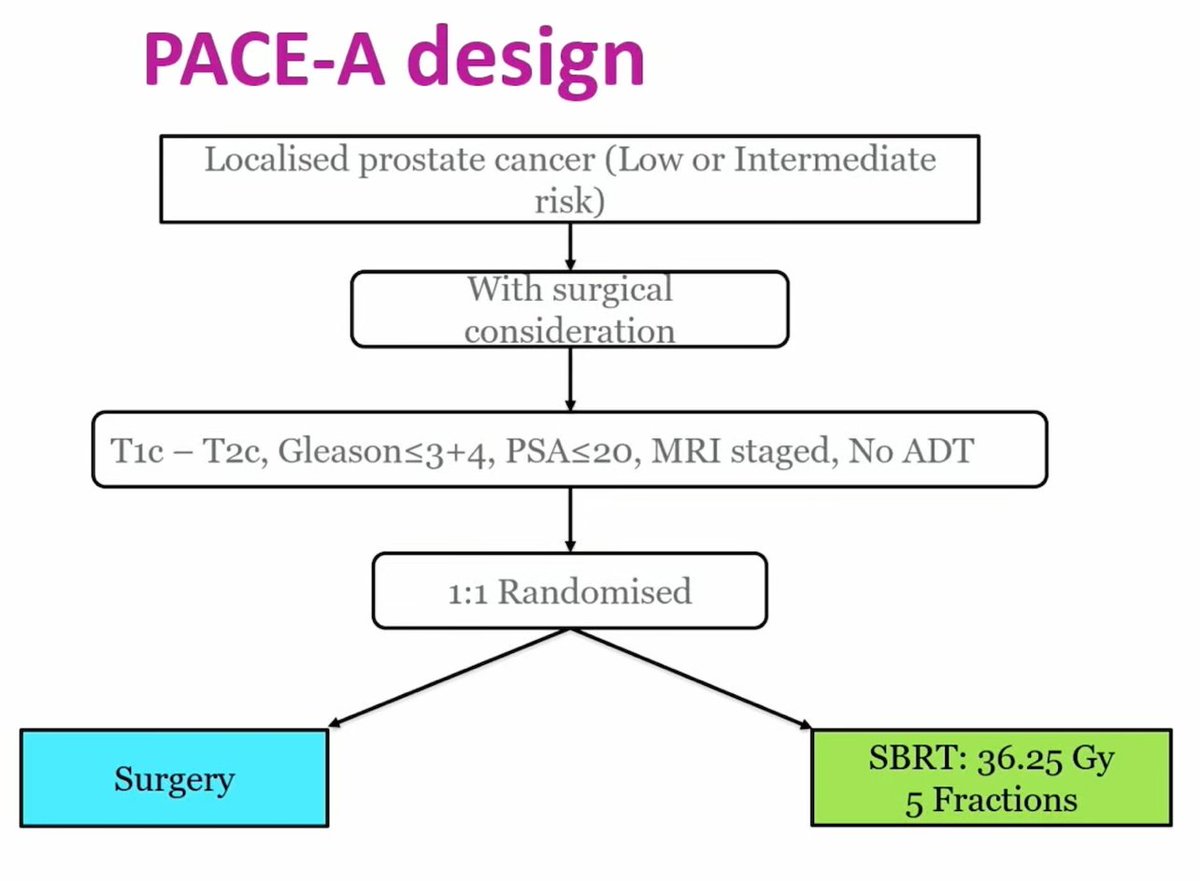
1:1 randomised RP vs SBRT, n=123 (60 RP, 63 SBRT), 10 UK centres. Median follow-up 8 yrs. Phase not stated in source.
Localised low or intermediate risk PCa with surgical consideration: T1c-T2c, Gleason ≤3+4, PSA ≤20, MRI staged, no ADT.
SBRT 36.25 Gy in 5 fractions. Target volume and margins not reported in source.
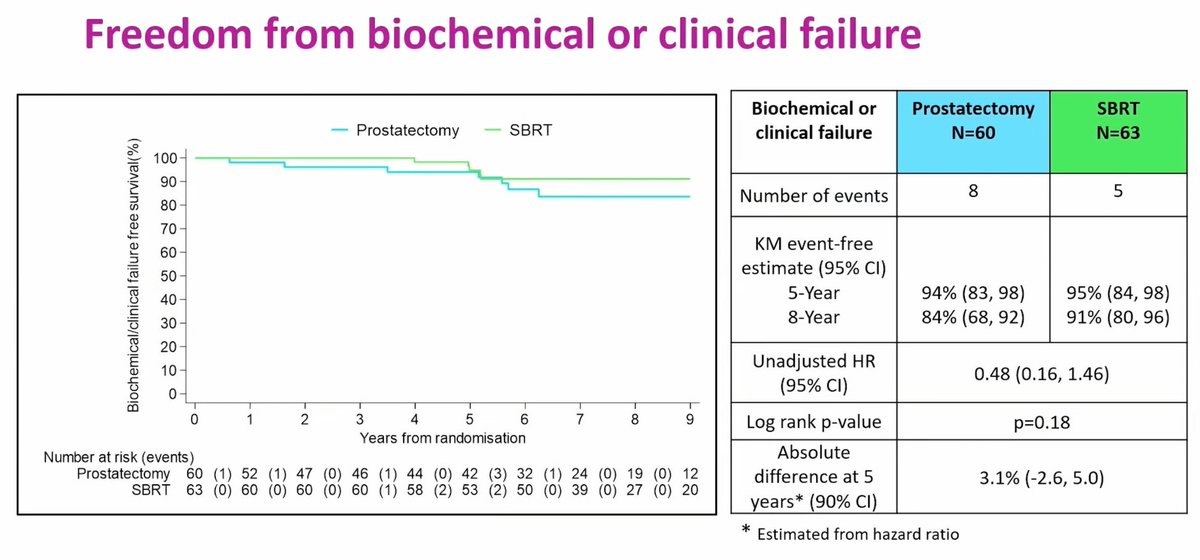
Biochemical or clinical failure: 13 events, HR 0.48 (95% CI 0.16-1.46), log rank p=0.18. Absolute 5-yr difference 3.1% (90% CI -2.6, 5.0), estimated from HR. 7 deaths, none from PCa, HR 0.55 (0.12-2.46).
Patient-reported ≥1 urinary pad 14/29 (48%) RP vs 3/36 (8%) SBRT. Moderate/big bowel problem 1/28 (4%) RP vs 0 (0%) SBRT.
PACE-B tested SBRT against conventional RT; PACE-A supplies the surgical comparison in the same programme. ProtecT remains the reference randomised comparison of RP vs RT in localised disease, with a different RT technique and population.
PRO denominators (29 and 36) sit well below the 60 and 63 randomised, so responder bias could inflate or shrink the pad gap. Timepoint for the pad comparison not stated in source.
The trial answers the toxicity question more convincingly than the efficacy one: the urinary continence difference is large, while the BCF CI spans a threefold range either way. Oncologic equivalence of SBRT vs RP in GG1-2 is not settled by these data.
CONSORT flow
Randomised but small: 13 BCF events cannot establish oncologic equivalence. Primary endpoint not stated in source; PRO denominators show heavy attrition.
- Oncologic noninferiority of SBRT vs RP in GG1-2 disease
- Durability of the continence gap with complete PRO capture
📚 Sources · 🐦 1 tweet
#ASTRO26 Plenary -- PACE-A: 5-yr Outcomes of RP vs SBRT for GG1-2 PCa @nickva1 @urotoday
— Zach Klaassen (@zklaassen_md) September 28, 2026
📍n=123 (60 RP, 63 SBRT), mFU 8 yrs, 10 🇬🇧 centers
📍13 BCF events: HR 0.48, 95% CI 0:16-1.46
📍7 deaths (no PCa): HR 0.55, 95% CI 0.12, 2.46
📍EPIC-26 >=1 urinary pad: 14/29 (48%) RP vs… pic.twitter.com/tSYdMxDayT
The longer read
The value of PACE-A lies in where it sits within the PACE programme. PACE-B asked whether five-fraction SBRT could replace conventionally fractionated RT; PACE-A asks the harder counselling question, whether it can stand beside radical prostatectomy for a man who is a surgical candidate. That comparison has historically been hard to randomise, and ProtecT remains the main randomised reference for surgery versus radiotherapy in localised disease, using a different radiation technique and an older, PSA-screened population. PACE-A modernises the radiation arm (36.25 Gy in 5 fractions, MRI staging, no ADT) and restricts entry to Gleason ≤3+4 disease, which is exactly the population where treatment choice is driven by functional trade-offs rather than cancer control.
Read as a toxicity trial, the signal is large and directionally unsurprising. Pad use of 14/29 (48%) after prostatectomy against 3/36 (8%) after SBRT is a gap that would survive considerable noise, and the bowel data, 1/28 (4%) versus 0 (0%), argue that the historical GI penalty of radiotherapy does not reappear with this technique. The caution is in the denominators. Only 29 of 60 surgical and 36 of 63 SBRT pts contribute to the pad comparison, and the timepoint of that comparison is not given in the source. Differential questionnaire return is a real threat: if men with worse continence were less likely to respond after surgery, the gap is understated; if the reverse, overstated. Neither direction is knowable from what was presented.
Read as an efficacy trial, PACE-A cannot carry much weight. Thirteen biochemical or clinical failure events yield an HR of 0.48 with a CI from 0.16 to 1.46, compatible with a substantial advantage for either arm. The absolute five-year difference of 3.1% is itself model-derived from the HR, not an observed difference. Seven deaths, none from prostate cancer, confirm that this is a population in which cancer-specific survival will not discriminate between modalities within any realistic follow-up. A reader should therefore resist framing this as evidence of oncologic equivalence; it is evidence that, at 8 years, no large efficacy difference has emerged in a small trial of favourable disease.
The decision it moves is the functional one. For a GG1-2 man weighing RP against SBRT, PACE-A offers randomised patient-reported evidence that SBRT spares continence without a visible bowel cost, while cancer control appears similar within wide uncertainty. It leaves untouched the GG3 and high-risk populations, where ADT and nodal questions dominate, and it does not resolve whether biochemical failure definitions after surgery and after SBRT are truly comparable, a known asymmetry in any RP versus RT comparison.