ASTRO Annual Meeting 2026
SWOG S1827/MAVERICK
ForLS- or ES-SCLC, no brain mets on MRI after 1st-line therapy
HR 0.60
90% CI 0.46-0.78, one-sided p=0.0005, favoring MRI alone
TL;DRMRI surveillance alone beat MRI + PCI for cognitive failure-free survival, HR 0.60 (90% CI 0.46-0.78), in LS- and ES-SCLC without brain mets after first-line therapy.
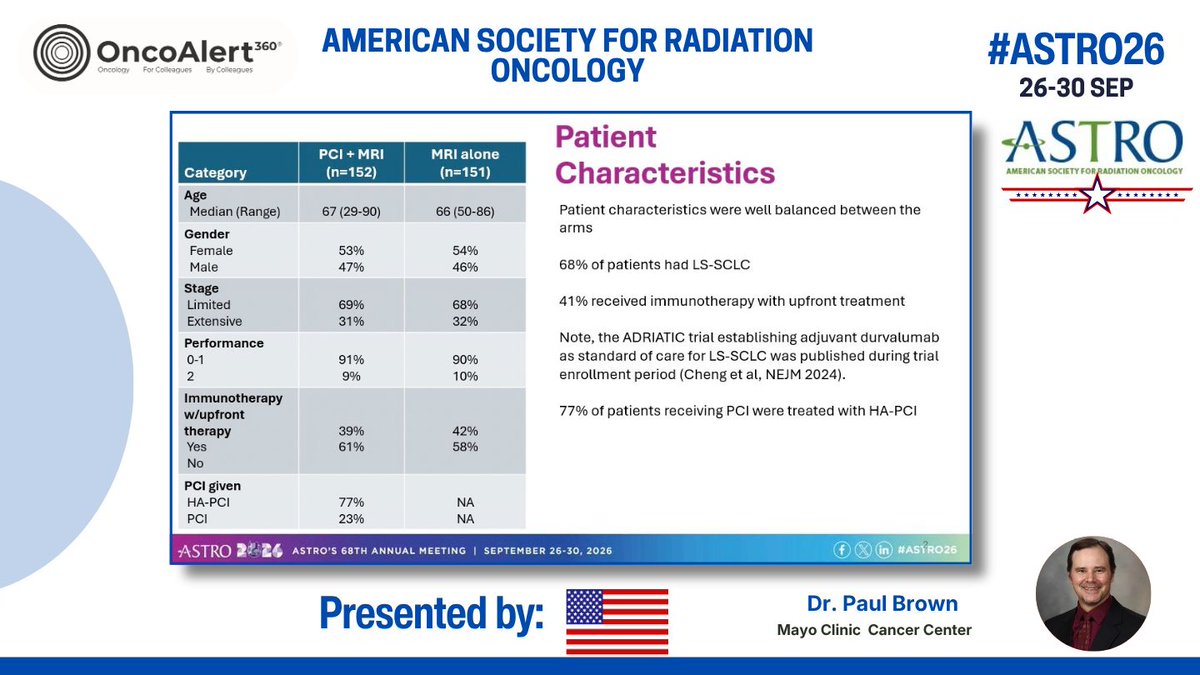
The benefit held with HA-PCI in 77% of the PCI arm and in the HA-PCI-only subgroup, so hippocampal sparing does not rescue PCI. Stage did not modify the effect (LS HR 0.59, ES HR 0.65, interaction p=0.79), which moves the LS-SCLC PCI default toward omission with MRI surveillance, pending final OS.
In LS- or ES-SCLC with a clean brain MRI after first-line therapy, this supports MRI surveillance over PCI, including HA-PCI. It does not address pts who cannot reliably get serial MRI, and it does not settle OS until the 190-event analysis. The longer read
HA-PCI made up 77% of the PCI arm and the HA-PCI-only subgroup still favored MRI alone, so the technique fix does not rescue PCI. The benefit was similar in LS (HR 0.59) and ES (HR 0.65), which moves the LS-SCLC PCI referral toward omission, with WBRT or SRS held for detected mets.
Immunotherapy was a stratification factor, and 41% of pts received it upfront. For the post-induction SCLC visit, this supports serial brain MRI (3, 6, 9, 12, 18, 24 mo) over a PCI referral. Final OS at 190 events is still the gate, especially in the post-ADRIATIC durvalumab era.
Also covered Sep 14
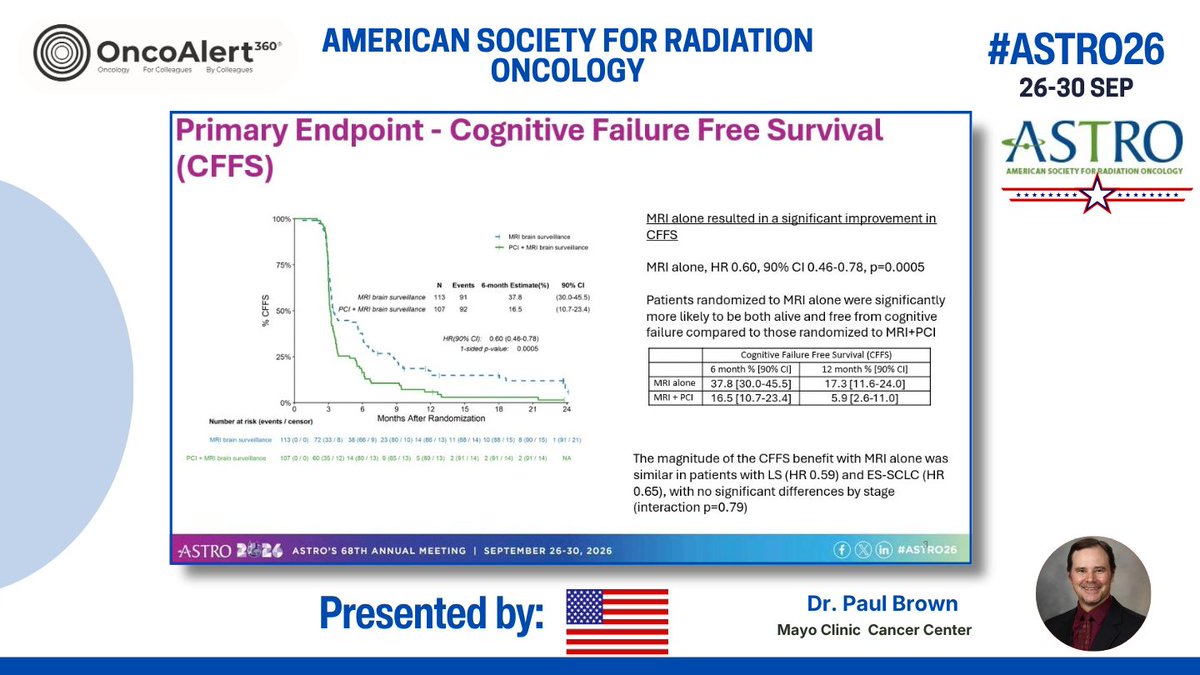
| Arm | 6-mo CFFS % (90% CI) | 12-mo CFFS % |
|---|---|---|
| MRI alone | 37.8 (30.0-45.5) | 17.3 |
| MRI + PCI | 16.5 (10.7-23.4) | 5.9 |
+2 more figures

13 details 3 trials watching
Randomized phase III (SWOG S1827), total accrual 304. Stratified by LS vs ES stage, immunotherapy (y/n), and PS 0-1 vs 2.
SCLC, limited or extensive stage, no prior brain mets and no brain mets on MRI after first-line therapy. 68% LS-SCLC; 41% received immunotherapy with upfront treatment.
PCI 25 Gy / 10 fx, with HA-PCI allowed at physician discretion; 77% of PCI pts received HA-PCI. At brain mets, RT was recommended in both arms (WBRT or SRS allowed).
Primary: cognitive failure-free survival (CFFS), with MRI and cognitive testing at 3, 6, 9, 12, 18 and 24 mo. Key secondary: OS.
CFFS favored MRI alone, HR 0.60 (90% CI 0.46-0.78), one-sided p=0.0005. The effect was similar by stage (LS HR 0.59, ES HR 0.65, interaction p=0.79) and in the HA-PCI-only subgroup. Preliminary OS after 128 events showed no significant difference. PCI decreased brain mets with no PFS difference.
| Subgroup | CFFS HR |
|---|---|
| LS-SCLC | HR 0.59 |
| ES-SCLC | HR 0.65 |
| Interaction | p=0.79 |
The Takahashi Japanese phase III had already moved ES-SCLC toward MRI surveillance, while LS-SCLC PCI still rests on pre-MRI-era randomized data and meta-analysis. MAVERICK is the first randomized test of surveillance vs PCI to include LS-SCLC with modern MRI staging.
The endpoint uses a 90% CI and a one-sided test. The brain mets reduction with PCI is unquantified in source, as is symptomatic morbidity from salvage RT. ADRIATIC changed the LS-SCLC backbone mid-enrollment.
When OS does not differ, a composite of death + cognitive failure mainly measures cognitive toxicity, and on that axis PCI loses even with hippocampal sparing. The open question is whether final OS confirms the preliminary read.
Randomized phase III, prespecified primary met, diverges from PCI as standard in LS-SCLC. Held below practice-changing: OS immature (128/190 events), composite cognitive endpoint, abstract-only.
- Does OS remain equivalent at the final 190-event analysis? n=534 · primary completion 2026-04 · LS-SCLC phase 3 PCI vs MRI surveillance post-CRTrecruiting PRophylactic Cerebral Irradiation or Active MAgnetic Resonance Imaging Surveillance in Small-cell Lung Cancer Patients (PRIMALung Study) Phase NAn=600 · primary completion 2028-04 · phase 3 OS non-inferiority, MRI alone vs PCI+MRI
- Salvage RT burden and neurologic morbidity in the surveillance arm n=534 · primary completion 2026-04 · PCI vs MRI surveillance, efficacy + safety, LS-SCLC
- Does the result hold after consolidation durvalumab in LS-SCLC?
📚 Sources · 🐦 1 tweet
In Collaboration with our partners at ASTRO we continue our coverage of #ASTRO26 🚨
— OncoAlert (@OncoAlert) September 28, 2026
LBA 03 - SWOG S1827/MAVERICK: A RANDOMIZED PHASE III TRIAL OF BRAIN MRI SURVEILLANCE WITH AND WITHOUT PROPHYLACTIC CRANIAL IRRADIATION (PCI) FOR SMALL-CELL LUNG CANCER (SCLC)
Presented by Dr.… pic.twitter.com/XwdqCUV9fN
PACE-A
ForLocalised low/intermediate-risk PCa (GG1-2), surgical candidates, no ADT
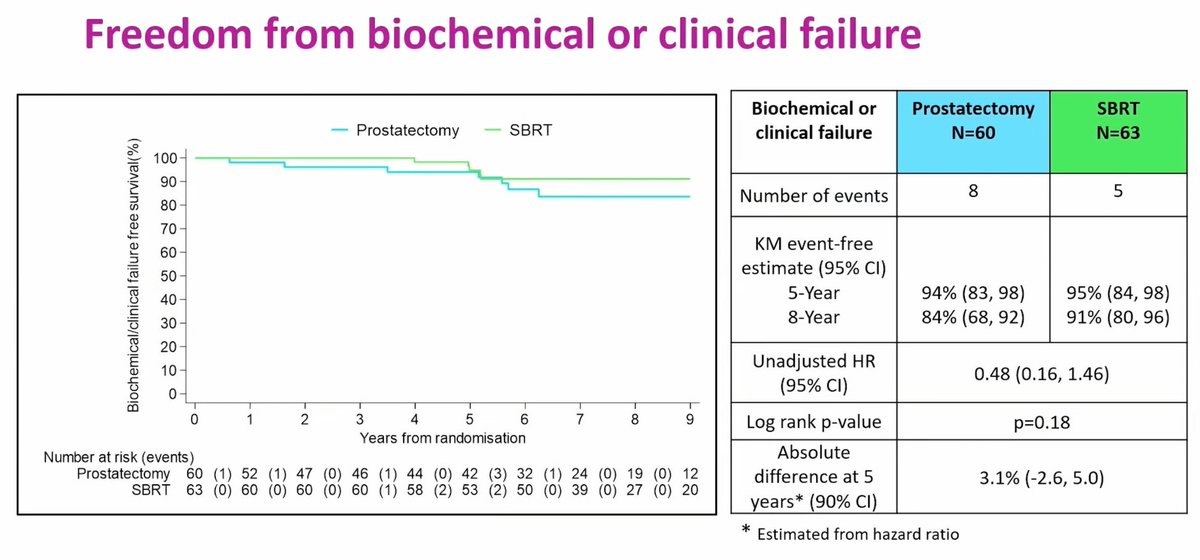
TL;DR≥1 urinary pad 14/29 (48%) RP vs 3/36 (8%) SBRT; BCF HR 0.48 (95% CI 0.16-1.46), mFU 8 yrs, GG1-2 localised PCa.
The continence gap is the RT read: ≥1 pad in 14/29 (48%) after RP vs 3/36 (8%) after 36.25 Gy/5fx, with bowel toxicity 0 (0%) on SBRT. With mFU 8 yrs and 7 deaths none from PCa, this supports SBRT as the lower-urinary-morbidity option when counselling surgical candidates, though efficacy parity rests on 13 events.
In an MRI-staged GG1-2, PSA ≤20 surgical candidate choosing between RP and SBRT, this supports framing continence as the main differentiator; it does not extend to GG3+ disease or pts needing ADT. The longer read
36.25 Gy/5fx with no ADT delivered pad use in 3/36 (8%) and no moderate/big bowel problems, so five-fraction SBRT holds its functional advantage against a surgical, not just a conventional RT, comparator in GG1-2 disease.
Pad use after RP was 14/29 (48%) against 3/36 (8%) after SBRT, with BCF HR 0.48 (0.16-1.46) at mFU 8 yrs. For GG1-2 surgical candidates, the continence trade-off is now randomised evidence, while efficacy parity remains unproven on 13 events.

| Arm | ≥1 urinary pad |
|---|---|
| Prostatectomy | 14/29 (48%) |
| SBRT | 3/36 (8%) |
+3 more figures
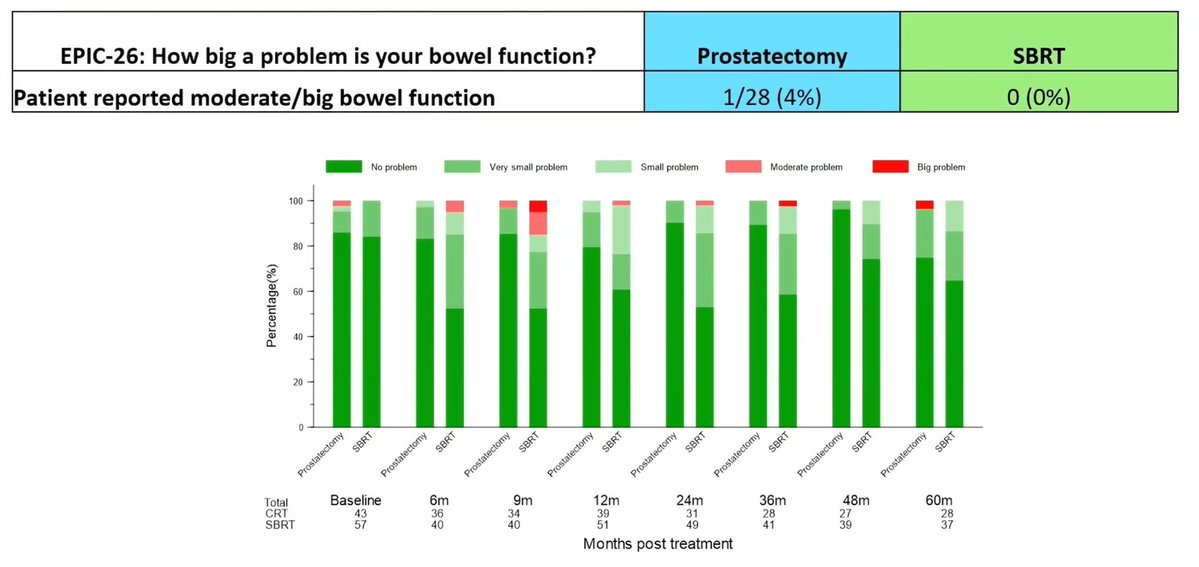
| Arm | Moderate/big bowel problem |
|---|---|
| Prostatectomy | 1/28 (4%) |
| SBRT | 0 (0%) |
12 details
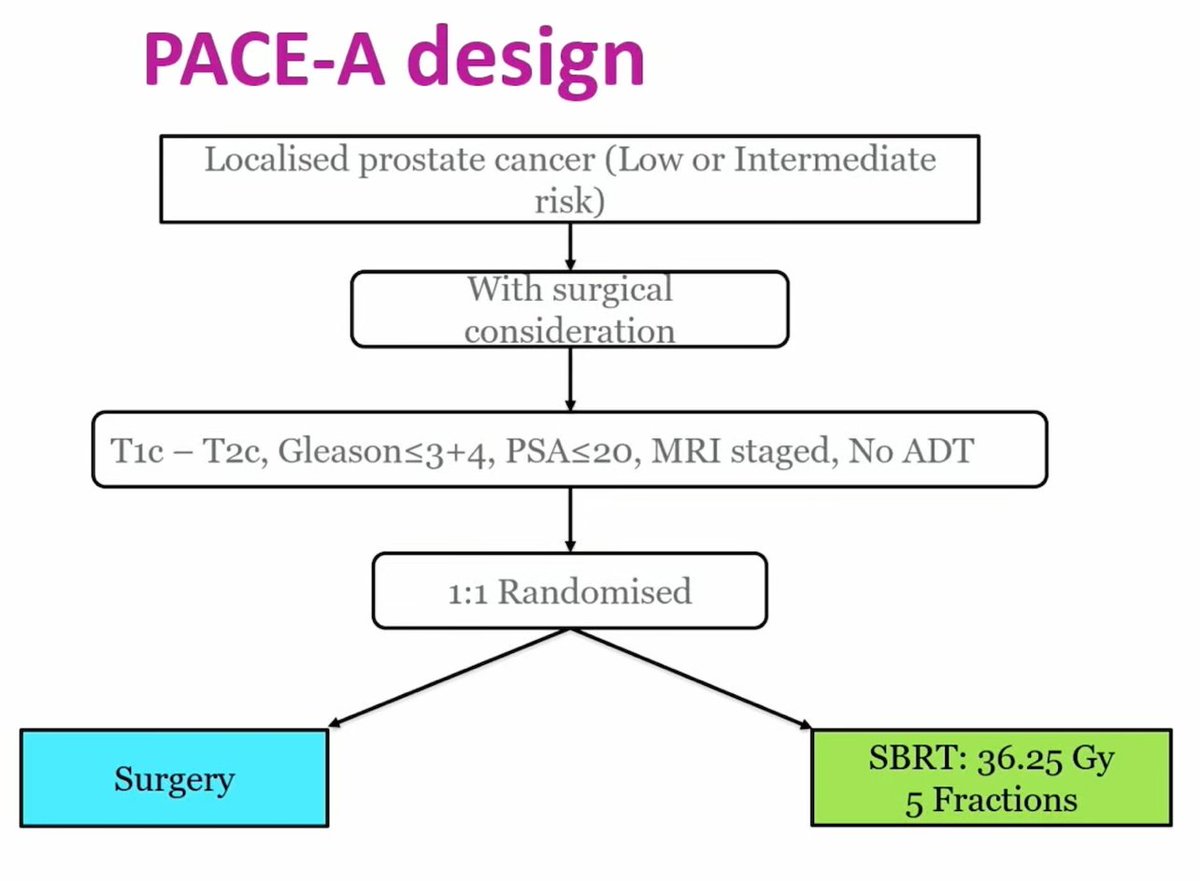
1:1 randomised RP vs SBRT, n=123 (60 RP, 63 SBRT), 10 UK centres. Median follow-up 8 yrs. Phase not stated in source.
Localised low or intermediate risk PCa with surgical consideration: T1c-T2c, Gleason ≤3+4, PSA ≤20, MRI staged, no ADT.
SBRT 36.25 Gy in 5 fractions. Target volume and margins not reported in source.
Biochemical or clinical failure: 13 events, HR 0.48 (95% CI 0.16-1.46), log rank p=0.18. Absolute 5-yr difference 3.1% (90% CI -2.6, 5.0), estimated from HR. 7 deaths, none from PCa, HR 0.55 (0.12-2.46).
Patient-reported ≥1 urinary pad 14/29 (48%) RP vs 3/36 (8%) SBRT. Moderate/big bowel problem 1/28 (4%) RP vs 0 (0%) SBRT.
PACE-B tested SBRT against conventional RT; PACE-A supplies the surgical comparison in the same programme. ProtecT remains the reference randomised comparison of RP vs RT in localised disease, with a different RT technique and population.
PRO denominators (29 and 36) sit well below the 60 and 63 randomised, so responder bias could inflate or shrink the pad gap. Timepoint for the pad comparison not stated in source.
The trial answers the toxicity question more convincingly than the efficacy one: the urinary continence difference is large, while the BCF CI spans a threefold range either way. Oncologic equivalence of SBRT vs RP in GG1-2 is not settled by these data.
CONSORT flow
Randomised but small: 13 BCF events cannot establish oncologic equivalence. Primary endpoint not stated in source; PRO denominators show heavy attrition.
- Oncologic noninferiority of SBRT vs RP in GG1-2 disease
- Durability of the continence gap with complete PRO capture
📚 Sources · 🐦 1 tweet
#ASTRO26 Plenary -- PACE-A: 5-yr Outcomes of RP vs SBRT for GG1-2 PCa @nickva1 @urotoday
— Zach Klaassen (@zklaassen_md) September 28, 2026
📍n=123 (60 RP, 63 SBRT), mFU 8 yrs, 10 🇬🇧 centers
📍13 BCF events: HR 0.48, 95% CI 0:16-1.46
📍7 deaths (no PCa): HR 0.55, 95% CI 0.12, 2.46
📍EPIC-26 >=1 urinary pad: 14/29 (48%) RP vs… pic.twitter.com/tSYdMxDayT
STOP
ForPSMA PET ≤3 mets, CI-negative BCR or de novo oligometastatic HSPC
TL;DR3-yr biochemical progression 21% vs 60% (p=0.004) adding SBRT to intermittent ADT in PSMA PET-detected, conventional-imaging-negative oligometastatic HSPC/BCR.
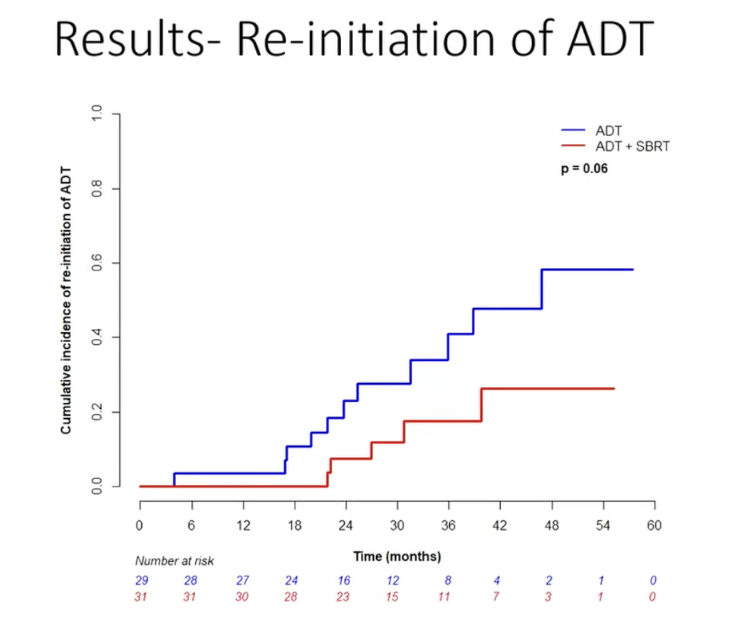
The RT read is durability of the ADT-free interval: consolidating all PSMA-avid sites during a fixed 8-9 month ADT course left median time to biochemical progression not reached vs 27 mo. ADT re-initiation trended the same way (p=0.06), so SBRT's value here is extending time off ADT, not replacing it.
In CI-negative, PSMA PET-positive recurrent or de novo HSPC with ≤3 deposits already planned for a finite ADT course, this supports adding SBRT to prolong biochemical control; it does not address MDT without ADT or disease visible on conventional imaging.
Consolidating all PSMA-avid sites (≤3) within 4 months of ADT start cut 3-yr biochemical progression from 60% to 21%. SBRT technique was institutional by anatomic region, so no dose/fractionation standard emerges; the decision it informs is adding MDT to a short ADT course, not using MDT alone.
Both arms stopped ADT after 8-9 months, so the SBRT benefit plays out as a longer ADT-free interval. ADT re-initiation trended lower (p=0.06) but was not significant, so evidence that SBRT spares cumulative ADT exposure is still missing.

+2 more figures
9 details 4 trials watching
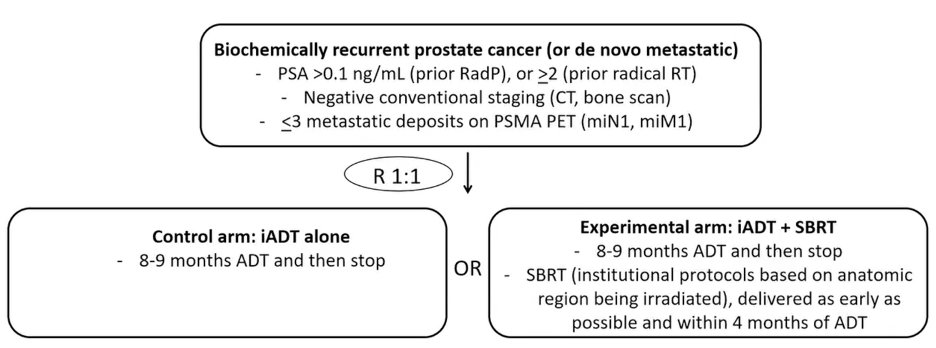
Randomised 1:1, n=60. Primary endpoint was feasibility, met with 91% of eligible pts enrolled. Phase not stated in source.
Biochemically recurrent prostate cancer (or de novo metastatic) with negative conventional staging (CT, bone scan) and ≤3 deposits on PSMA PET (miN1, miM1). PSA >0.1 ng/mL after RadP or ≥2 after radical RT.
Both arms received 8-9 months ADT, then stopped. Intermittent ADT is the backbone and the ADT-free interval is the tested space.
SBRT to all PSMA-avid sites per institutional protocol by anatomic region, delivered within 4 months of ADT. No uniform dose/fractionation reported in source.
Biochemical progression favored SBRT (p=0.004); ADT re-initiation trended lower but was not significant (p=0.06). QoL (EORTC QLQ-C30 global health) was collected; values not legible in source.
| Endpoint | iADT + SBRT | iADT alone | p |
|---|---|---|---|
| 3-yr biochemical progression | 21% | 60% | 0.004 |
| Median time to biochemical progression | NR | 27 mo | not reported in source |
| Cumulative incidence of ADT re-initiation | not reported in source | not reported in source | 0.06 |
STOMP and ORIOLE tested MDT without continuous ADT in conventionally or PSMA-staged oligorecurrence. STOP instead layers SBRT onto a finite ADT course in CI-occult, PSMA-only disease, a population neither directly addressed.
Feasibility-powered, so the efficacy effect size is imprecise and vulnerable to imbalance. Heterogeneous SBRT protocols prevent a dose recommendation, and hard endpoints (MFS, OS) are not reported in source.
The signal is that PSMA-guided consolidation makes a short ADT course more durable. What it does not settle is whether that delays metastatic progression or reduces lifetime ADT exposure, the endpoint that trended but missed.
Randomised but n=60 with a feasibility primary; efficacy is secondary, SBRT unstandardized, and ADT re-initiation not significant. Needs a powered trial.
- Does SBRT delay metastatic progression or improve OS beyond biochemical control? recruiting Veterans Affairs Seamless Phase II/III Randomized Trial of STAndard Systemic theRapy With or Without PET-directed Local Therapy for Oligometastatic pRosTate Cancer Phase 2/3n=464 · primary completion 2026-09 · phase 2/3 SST ± PET-directed local tx, CRPC-free survivalrecruiting Metastasis Directed Stereotactic Body Radiotherapy for Oligo Metastatic Hormone Sensitive Prostate Cancer Phase NAn=118 · primary completion 2031-12 · randomised MD-SBRT vs SOC, PSMA-PET oligomet HSPC
- Optimal SBRT dose/fractionation for PSMA-only oligorecurrence
- Does SBRT reduce cumulative ADT exposure in a powered trial? active Comparison of Intermittent Androgen Deprivation Therapy With or Without Irradiation Recovery in Prostate Cancer Patients Phase NAn=256 · primary completion 2026-06 · randomised IADT ± RT, PET-detected ≤5 nodal metsnot yet Best Salvage Treatment for High-risk Relapsing Prostate Cancer (PEACE-9 - ESCALATE-RT) Phase 3n=140 · primary completion 2030-07 · phase 3 MDT added to intermittent ADT, time to restart
📚 Sources · 🐦 1 tweet
STOP: RCT of iADT +/- SBRT in PSMA PET+/ CI-oligometastatic HSPC/BCR (n=60)
— Rashid K. Sayyid (@RKSayyid) September 28, 2026
🔹91% of eligible pts enrolled → feasibility endpoint met
🔹3-yr biochemical progression: 21% vs 60% favoring iADT+SBRT (p=0.004)
🔹Median time to biochemical progression: NR vs 27 mo
🔹3-yr ADT… pic.twitter.com/IkvZS1UiBu
ROADS NCT04365374
ForNewly diagnosed brain met 2-7 cm indicated for resection
HR 0.06
95% CI 0.01-0.46, p=0.0070; co-primary SB-RFS HR 0.48 (0.30-0.76)
TL;DRCs-131 tile brachytherapy at resection cut surgical bed recurrence vs post-op SRT: time-to-SBR HR 0.06 (0.01-0.46), SB-RFS HR 0.48, in newly diagnosed resected brain mets.
The surgical bed effect held in the per-protocol population (time-to-SBR HR 0.06), so it is not just an artifact of the 17.8% of SRT pts who never got cavity RT. Control was modern, mostly fractionated 27-30 Gy SRT. This moves the cavity-RT decision from a delayed post-op SRT course toward intra-op Cs-131 implant.
In a pt with a newly diagnosed 2-7 cm brain met going to resection, this supports discussing intra-op Cs-131 tiles over planned post-op SRT; it does not settle the OS question, or whether TBRT should be chosen over pre-operative SRT. The longer read
The PP analysis kept time-to-SBR HR 0.06 against a control arm treated with 92.2% multi-fraction SRT, so TBRT beat modern cavity SRT, not only missed SRT. RN at 12 mo was similar (5.3% vs 5.7%). Cavity RT shifts to a brachytherapy workflow at surgery; your role moves to dosimetry and SRT for non-index mets.
RT is decided at the craniotomy: tiles went in only after intra-op pathology confirmed metastasis, and several pts turned out to have GBM or other non-metastatic pathology. Hospital stay was 3.0 vs 4.0 days and surgical AEs were balanced, so the implant did not add operative morbidity in this series.
Also covered May 30
12 details 1 trial watching
Randomized, open-label, non-inferiority phase 3, 32 US centers, pre-operative 1:1 randomization. NI null HR 1.26 with hierarchical testing (NI then superiority for both co-primaries, then OS). Median f/u 12.9 mo.
One surgical brain metastasis 2.0-7.0 cm, newly diagnosed. mITT required surgery, pathologic confirmation of metastasis and any follow-up: 204 of 230 randomized. Lung primary was most common index histology.
TBRT: collagen tile with four Cs-131 seeds placed in the cavity at resection, after intra-op path. SRT: cavity 17-20 Gy/1, 27 Gy/3 or 30 Gy/5, planned 21±7 days post-op; 92.2% fractionated. Non-index mets got SRT in both arms.
Co-primary: time-to-SBR (death censored) and SB-RFS (SBR or death). Secondary: OS, QoL, KPS, neurocognition, LMD, RN. SBR centrally reviewed by two neuroradiologists.
Any AE 79.0% vs 80.7%, ≥G3 TRAEs 20.0% vs 21.7%. 12-mo RN 5.3% vs 5.7%. No QoL or neurocognitive cost detected.
Post-op SRT became SOC from Mahajan et al. (12-mo freedom-from-SBR 72% vs 43% with observation) and the SRT vs WBRT trial. The R+SRT arm's 15.4% 12-mo SBR sits within the 84-87% freedom-from-SBR of cited fractionated series, so the control was not a weak comparator.
Co-primary endpoints were redefined mid-trial (May 2025) after a death-censoring error in SB-RFS. Seed MRI artifacts may have unblinded central review. OS benefit (HR 0.59) disappeared in PP (HR 0.73, 0.44-1.20) and systemic therapy was not captured in detail.
The local-control gain is large and consistent across mITT, ITT and PP, and plausibly reflects both higher cavity BED and removing the post-op gap in which 18 SRT pts dropped out. The OS signal is hypothesis-generating: confined to single-met pts, sensitive to population, with no clear mechanism.
CONSORT flow
Randomized phase 3, co-primaries met on non-inferiority and superiority vs contemporary SRT. Held back from practice-changing by 12.9-mo f/u, mid-trial endpoint amendment, open-label design.
- Does the OS benefit replicate in an independent trial?
- TBRT vs pre-operative SRT for resectable brain metastases active Neoadjuvant vs. Intraoperative vs. Adjuvant Resection Cavity Radiotherapy of Brain Metastases Phase NAn=90 · primary completion 2027-05 · 3-arm preop vs intraop vs postop cavity RT
- Late radiation necrosis after Cs-131 tiles with longer follow-up