LUNAR vs SATURN
ForM1 oligorecurrent PCa post-RP, candidates for SBRT
TL;DRIPTW-adjusted euPFS HR 1.39 (95% CI 0.56-3.45), p=0.47, SBRT+RLT vs SBRT+6mo AAT in M1 oligorecurrent PCa post-RP; n=63.
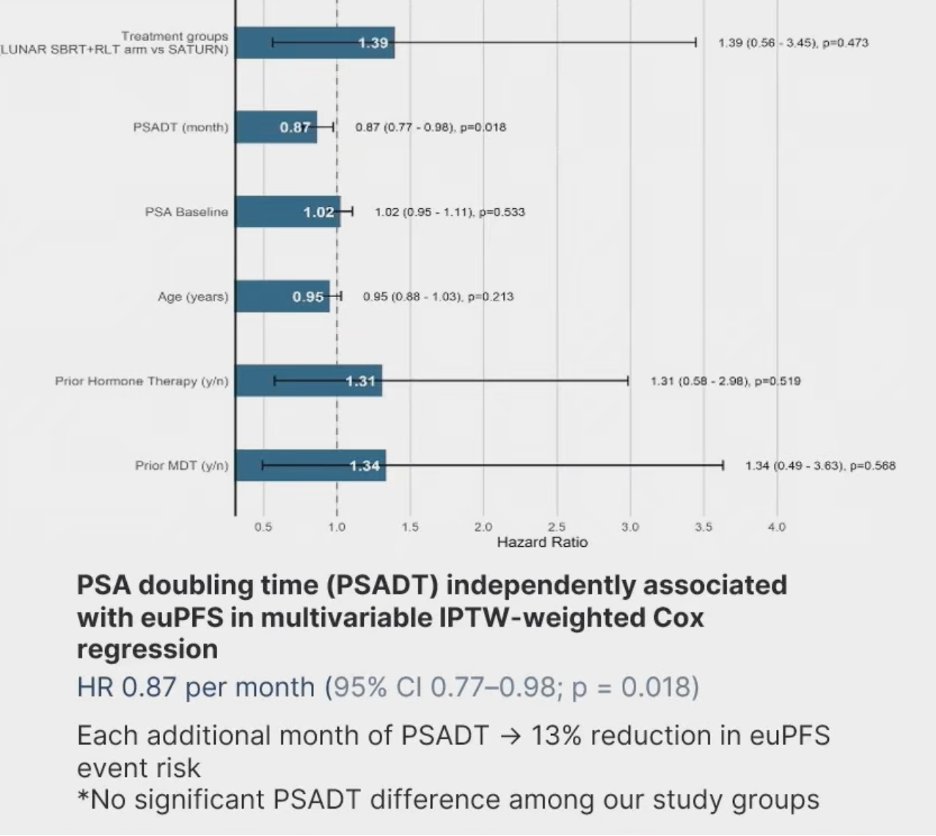
The SBRT-alone group progressed in 100% (18/18) at median 6.0 mo, versus 19.4 mo with RLT and 21.7 mo with AAT, so the RT read is that SBRT alone looks insufficient here and the open choice is the systemic partner. PSADT (HR 0.87 per month) is the selection variable to weigh when deciding whether SBRT alone is reasonable.
In M1 oligorecurrent PCa post-RP planned for SBRT, this leaves open whether 177Lu-PNT2002 can stand in for 6 mo AAT as the SBRT partner; it does not support dropping a systemic partner on the basis of RLT-vs-AAT parity.
SBRT alone progressed in 100% (18/18) at median 6.0 mo, versus 19.4 and 21.7 mo with a systemic partner, so the RT question here is which adjunct goes with SBRT. PSADT (HR 0.87 per month) is the variable for choosing who might get SBRT alone.
177Lu-PNT2002 vs 6 mo AAT as the SBRT partner: adjusted euPFS HR 1.39 (0.56-3.45) cannot separate them, so RLT is not yet established as a testosterone-sparing substitute. Grade ≥3 AEs 10% vs 20% (p=0.357) is the only tolerability hint.
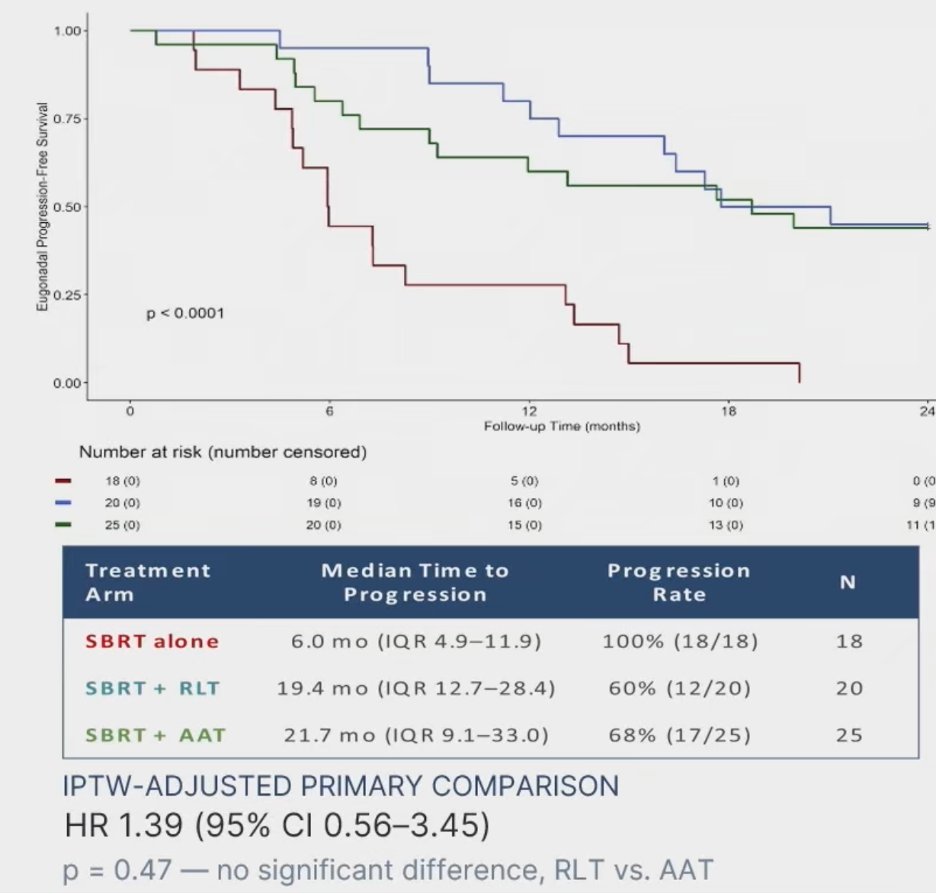
| Arm | N | Median time to progression | Progression rate |
|---|---|---|---|
| SBRT alone | 18 | 6.0 mo (IQR 4.9-11.9) | 100% (18/18) |
| SBRT + RLT | 20 | 19.4 mo (IQR 12.7-28.4) | 60% (12/20) |
| SBRT + AAT | 25 | 21.7 mo (IQR 9.1-33.0) | 68% (17/25) |
| IPTW-adjusted RLT vs AAT | HR 1.39 (95% CI 0.56-3.45), p = 0.47 |
+2 more figures
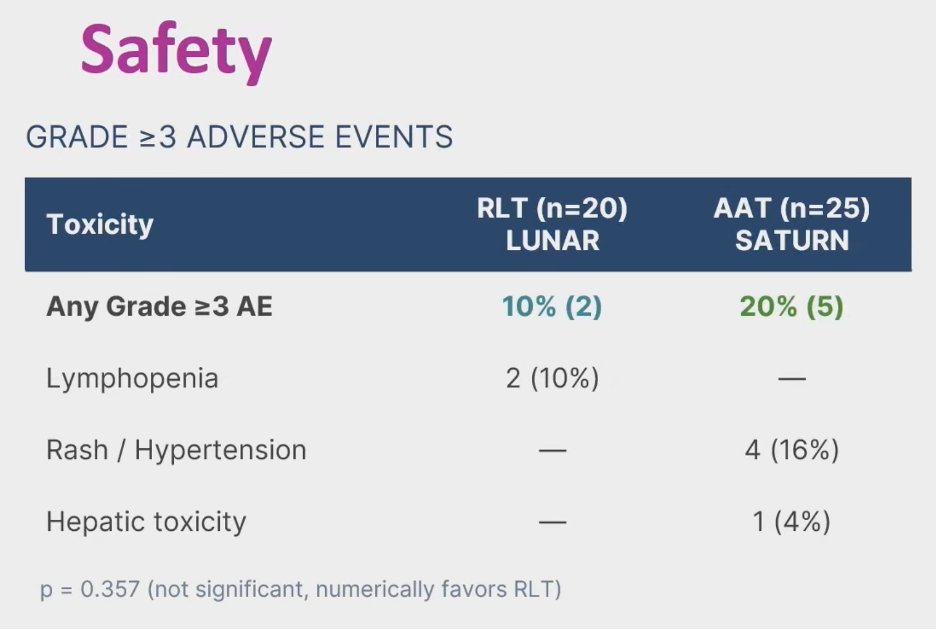
| Toxicity | RLT (n=20) | AAT (n=25) | p |
|---|---|---|---|
| Any Grade ≥3 AE | 10% (2) | 20% (5) | 0.357 |
9 details
Cross-trial IPD comparison pooling the LUNAR SBRT+RLT arm and the SATURN SBRT+AAT cohort, plus an SBRT-alone group; n=63. Primary contrast is an IPTW-adjusted Cox model, RLT vs AAT.
M1 oligorecurrent PCa post-RP. Groups: SBRT alone n=18, SBRT+RLT n=20, SBRT+AAT n=25; no PSADT difference across groups per source.
Systemic partner was either 177Lu-PNT2002 RLT or 6 mo androgen annihilation therapy (AAT); AAT components not specified in source.
SBRT to oligorecurrent sites in all three groups. Dose, fractionation, and target definition not reported in source.
Primary: eugonadal PFS (euPFS), RLT vs AAT, IPTW-adjusted.
Adjusted euPFS HR 1.39 (95% CI 0.56-3.45), p=0.47, RLT vs AAT. PSADT independently associated with euPFS, HR 0.87 per month (0.77-0.98), p=0.018.
Any grade ≥3 AE 10% (2) RLT vs 20% (5) AAT, p=0.357; numerically fewer with RLT, not significant.
STOMP and ORIOLE established MDT for oligorecurrent PCa and raised the question of what to add to it. This analysis compares two candidate partners rather than testing either against SBRT alone in a randomized frame.
The SBRT-alone contrast is unadjusted and its source is not stated, so the 6.0 mo median cannot be read as a controlled comparator. Progression definitions and imaging schedules across the two trials are not described in source.
A null adjusted HR with a CI spanning 0.56 to 3.45 is absence of evidence, not equivalence. RLT is a plausible testosterone-preserving partner to SBRT, but a randomized RLT vs AAT trial is needed before substituting one for the other.
Non-randomized cross-trial IPD comparison, IPTW on measured covariates only, n=45 in the adjusted contrast; wide CI cannot establish equivalence of RLT and AAT.
- Randomized RLT vs AAT as SBRT partner in oligorecurrent PCa
- PSADT threshold for SBRT alone without systemic partner
- Testosterone recovery and QoL with RLT vs AAT
📚 Sources · 🐦 1 tweet
LUNAR vs SATURN: cross-trial IPD comparison of SBRT + 177Lu-PNT2002 RLT vs SBRT + 6 mo androgen annhilation therapy (AAT) the in M1 oligorecurrent PCa post-RP (n=63)
— Rashid K. Sayyid (@RKSayyid) September 30, 2026
🔹Median time to progression: 19.4 mo RLT vs 21.7 mo AAT vs 6.0 mo SBRT alone
🔹Adjusted euPFS similar w/ RLT vs… pic.twitter.com/bn7sstnbvy
The longer read
The question this analysis asks is the right one for the field. Metastasis-directed therapy in oligorecurrent prostate cancer is no longer the experimental arm; STOMP and ORIOLE moved SBRT into routine practice for this population, and the live debate is what, if anything, should be given alongside it. Short-course androgen suppression is one obvious partner. Radioligand therapy is a newer one, attractive because it treats PSMA-avid micrometastatic disease without suppressing testosterone. Comparing the two is a reasonable thing to want, and pooling individual patient data from LUNAR and SATURN is a resourceful way to get an early look.
The result, though, should be read as uninformative rather than reassuring. An IPTW-adjusted HR of 1.39 with a 95% CI of 0.56 to 3.45 in 45 patients does not show that RLT matches AAT; it shows that this sample cannot distinguish them. The point estimate leans toward AAT, and the upper bound allows a substantially worse outcome with RLT. Anyone tempted to frame this as RLT being an androgen-sparing equivalent is reading parity into a confidence interval that does not support it.
The methodological concern is the usual one for cross-trial comparisons, sharpened by the small sample. Propensity weighting balances what was measured (PSADT, baseline PSA, age, prior hormone therapy, prior MDT), but trials differ in ways a covariate table does not capture: PSMA staging intensity, imaging cadence after treatment, and how progression was adjudicated. Those differences directly affect a time-to-progression endpoint. The source does not describe how they were harmonized.
The SBRT-alone group is the most striking number on the slide, with 18 of 18 progressing at a median of 6.0 months, and also the least interpretable. The adjusted primary comparison is RLT versus AAT only, and the source does not say where the SBRT-alone patients came from. A reader should not treat that arm as a controlled estimate of what a systemic partner adds, although its direction matches the rationale for adding one.
The PSADT finding is the more portable signal. An HR of 0.87 per month of doubling time fits the long-standing view that PSA kinetics separate patients for whom SBRT alone may be durable from those carrying occult disease. For a radiation oncologist weighing SBRT alone against SBRT with a systemic partner, PSADT remains the variable to weigh. What would settle the partner question is a randomized RLT versus AAT comparison with matched imaging, ideally with testosterone-recovery and quality-of-life endpoints, since sparing androgen suppression is the whole case for RLT. The lower grade ≥3 AE rate with RLT (10% vs 20%, p=0.357) points the same way but is not conclusive.