NRG/RTOG 0534 SPPORT PAM50 subtypes
ForPost-RP PSA 0.1-2.0 ng/mL, pT2/pT3 N0M0, Gleason ≤9, salvage RT
TL;DRPAM50 Luminal B predicted STADT benefit with salvage RT: 5-y FFP gain 31% vs 10% non-Luminal B (p-int=.01); 10-y MFS 20% vs -3%.
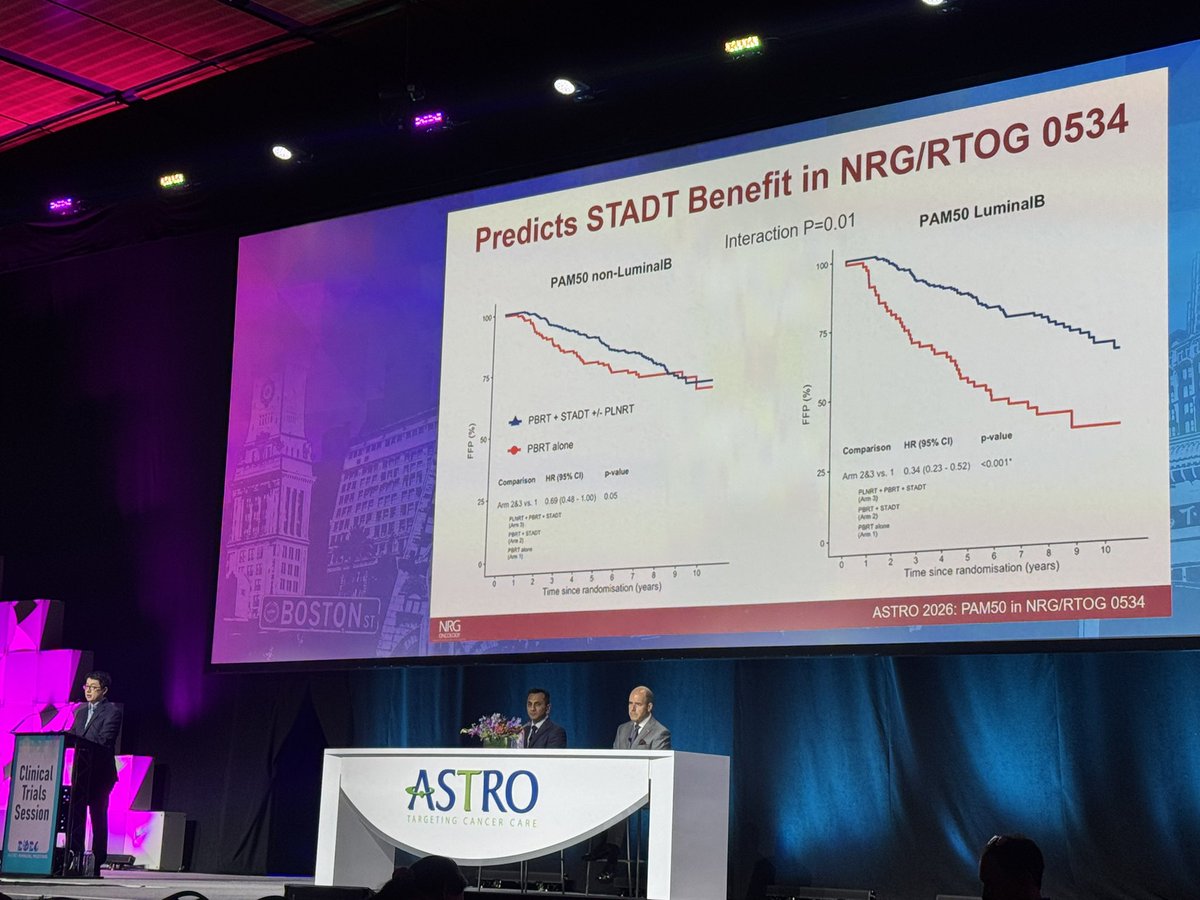
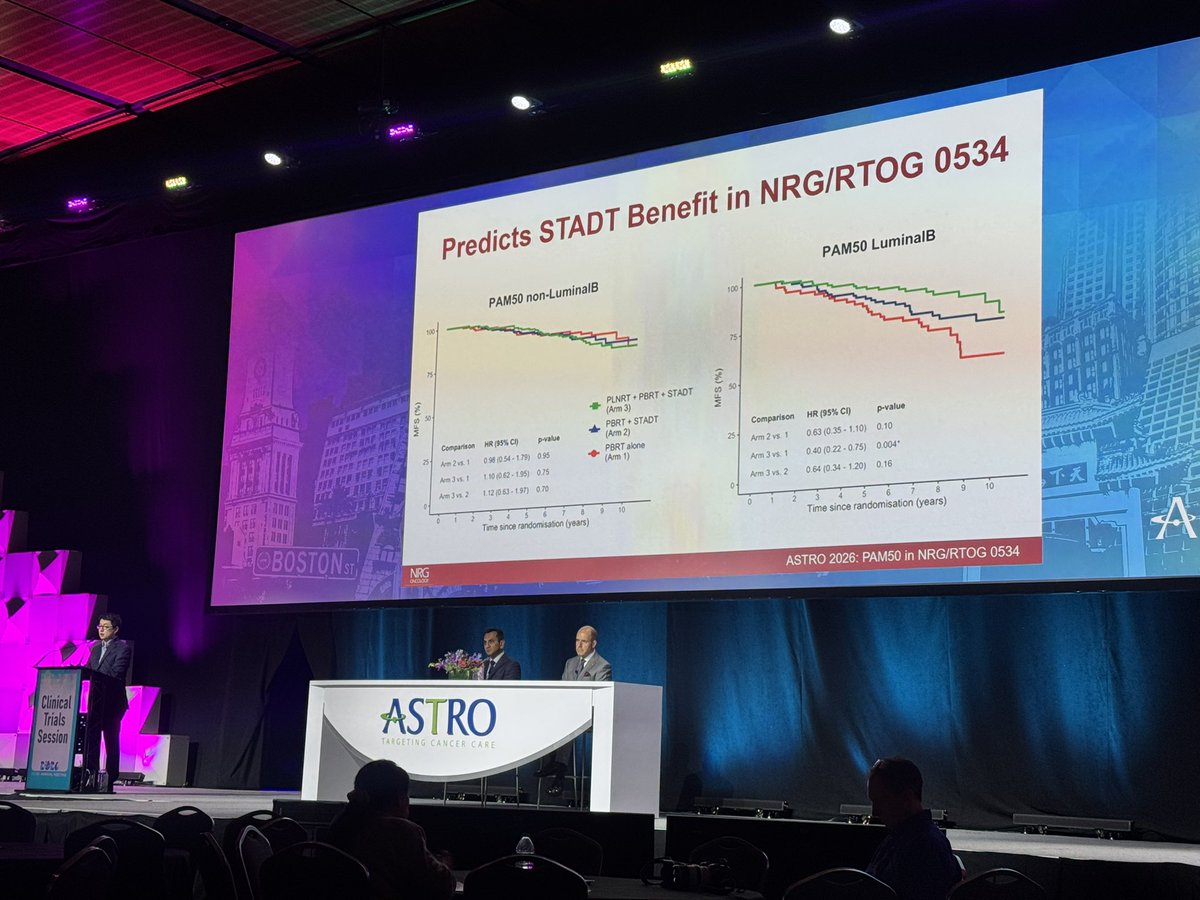
The RT decision here is adding STADT to salvage prostate bed RT: Luminal B tumors gained 31% absolute 5-y FFP from ADT vs 10% in non-Luminal B (p-int=.01). The legible arm-level panel does not cleanly isolate a PLNRT increment (HR 0.64, p=0.16), so subtype informs the ADT add-on more than nodal coverage.
In a post-RP pt with PSA 0.1-2.0 ng/mL, N0M0, heading to salvage prostate bed RT, a PAM50 Luminal B call supports the case for STADT; it does not settle ADT omission for non-Luminal B pts or the pelvic nodal question.
The salvage RT decision it informs is the STADT add-on: Luminal B tumors gained 31% absolute 5-y FFP from ADT vs 10% in non-Luminal B (p-int=.01). PLNRT's increment over STADT is not resolved by subtype (HR 0.64, p=0.16), so the nodal-field decision stays where SPPORT left it.
+2 more figures
9 details
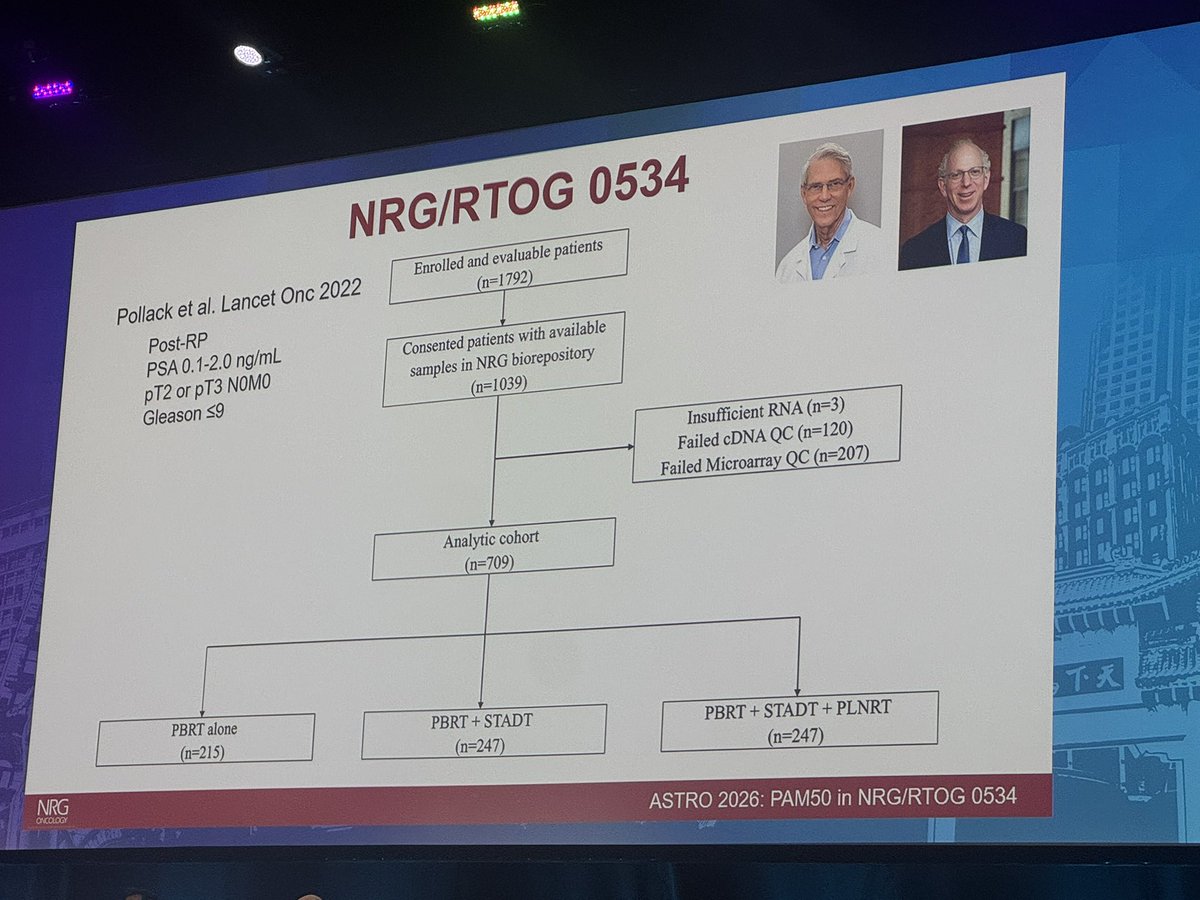
Transcriptomic PAM50 subtyping of archived tissue from NRG/RTOG 0534 SPPORT, a three-arm salvage RT trial (Pollack, Lancet Onc 2022). Whether the biomarker analysis was prespecified is not stated in source.
Post-RP, PSA 0.1-2.0 ng/mL, pT2 or pT3 N0M0, Gleason ≤9. Analytic cohort n=709 of 1792 enrolled; 1039 had biorepository samples, with 330 lost to RNA or QC failure.
Arms: PBRT alone (n=215), PBRT + STADT (n=247), PBRT + STADT + PLNRT (n=247). Dose and fractionation not reported in source.
Luminal B carried the larger ADT benefit on FFP (p-int=.01) and MFS (p-int=.05). One FFP panel shows ADT arms vs PBRT alone HR 0.34 (0.23-0.52), p<0.001; panel attribution not legible in OCR.
| Endpoint | Luminal B | non-Luminal B | p-interaction |
|---|---|---|---|
| 5-y FFP benefit | 31% | 10% | .01 |
| 10-y MFS benefit | 20% | -3% | .05 |
RTOG 9601 and SPPORT established ADT with salvage RT in unselected post-RP pts. This analysis asks which of those pts carry the benefit, using subtype rather than PSA or pathology alone.
Tissue was available for under half the trial, so the subset may differ from the randomized population. Arm-level slides do not resolve PLNRT's contribution by subtype in legible form.
Subtype appears to concentrate ADT benefit in Luminal B, raising de-escalation potential for non-Luminal B. It does not establish safe ADT omission, which needs a prospective selected design.
Secondary biomarker analysis in tissue-available subset; prespecification not stated. MFS interaction borderline. Needs prospective PAM50-selected validation before guiding ADT use.
- Can non-Luminal B pts omit STADT with salvage RT?
- Does PAM50 subtype select for pelvic nodal RT?
- Validation of PAM50 in a second salvage RT trial
📚 Sources · 🐦 1 tweet
New #ASTRO2026 data from @NRGOnc /RTOG 0534 SPPORT 🔬🧬 presented by Shuang (George) Zhao @UTMDAnderson. PAM50 Luminal B = both prognostic & predictive of benefit from postop ADT.
— Lauren Henke, MD, MSCI (@lauren_henke) September 27, 2026
📈 5-y FFP benefit: 31% vs 10% (p-int=.01)
🎯 10-y MFS: 20% vs -3% (p-int=.05)#Pcsm @Astro_org pic.twitter.com/BRJsYDWiQS
The longer read
The clinical question this analysis addresses is not whether ADT helps salvage radiotherapy after prostatectomy; RTOG 9601 and the parent SPPORT trial already argued that it does in aggregate. The question is who carries that benefit, because short-term ADT is not free for a post-RP man who often has decades ahead of him, and the trials that justified it enrolled broadly. A predictive biomarker that concentrates the benefit would let a radiation oncologist offer ADT where it moves outcomes and spare it where it does not.
On that question the result is directionally clean. PAM50 Luminal B tumors gained 31% absolute 5-year FFP from ADT against 10% in non-Luminal B, with an interaction p of .01, and the 10-year MFS difference (20% vs -3%) points the same way. Biologically this is coherent: luminal tumors are the androgen-receptor-driven phenotype, so a larger hormonal effect is what one would expect, and earlier retrospective post-RP work had linked luminal subtyping to ADT response. Randomized-trial tissue is the right setting to test it, since only a randomized comparison can separate prognostic from predictive.
Confidence should still be tempered. The cohort is the 709 of 1792 men with usable tissue, and tissue availability in a cooperative-group biorepository is rarely random; if it tracks institution, era, or tumor volume, the subset may differ from the trial that generated the parent result. The source does not state whether the PAM50 interaction was a prespecified hypothesis, and a three-arm trial offers several comparisons from which a subtype interaction could emerge. The MFS interaction sits at .05, which a skeptic would call a single borderline test rather than confirmation. A negative absolute benefit in non-Luminal B is almost certainly noise around zero, not evidence of harm.
For the RT reader the nodal question remains open. The arm-level slides suggest that in one subtype panel the three-modality arm separated from PBRT alone more clearly than STADT alone did, but the panel labels are not legible in the captured OCR, and the direct PLNRT plus STADT vs STADT comparison (HR 0.64, p=0.16) does not support a subtype-selected nodal decision. The cleaner read is about ADT, not field size.
What would make this wrong is a prospective test in which non-Luminal B men treated with prostate bed RT alone fare no better than the unselected control arm historically did, or a validation in a second salvage RT trial in which the interaction disappears. Until then this belongs alongside other genomic classifiers as a reason to weigh ADT more or less heavily in discussion, not as grounds to withhold it.