PEACE-1
ForMetastatic prostate cancer on ADT+docetaxel, high or low volume
TL;DRmOS 6.2 vs 4.4y (HR 0.68) adding abiraterone to ADT+docetaxel at 8y FU, n=710; no treatment-by-volume interaction (P=0.5552).
Low volume is where prostate RT sits, and abiraterone still more than doubled 7-yr rPFS there (43.4% vs 20.9%, HR 0.54) with no volume interaction (p=0.5552). Models adjusted for prostate RT, but an abiraterone-by-RT interaction is not reported in source, so this does not settle whether triplet and prostate RT add independently.
In metastatic prostate cancer starting ADT+docetaxel, this supports abiraterone intensification in both high- and low-volume disease; it does not address pts not receiving docetaxel.
Low volume is the prostate RT population, and abiraterone still lifted 7-yr rPFS 43.4% vs 20.9% there. Models adjusted for prostate RT, but abiraterone effect by RT stratum is not reported in source, so additivity with local RT remains untested here.
The volume-agnostic read is the decision point: no interaction (p=0.5552), and low-volume rPFS HR 0.54 matches high-volume 0.50. Low-volume OS HR 0.74 (0.51-1.05) reflects few events, not absent effect, so volume alone is a weak reason to withhold abiraterone from a docetaxel doublet.
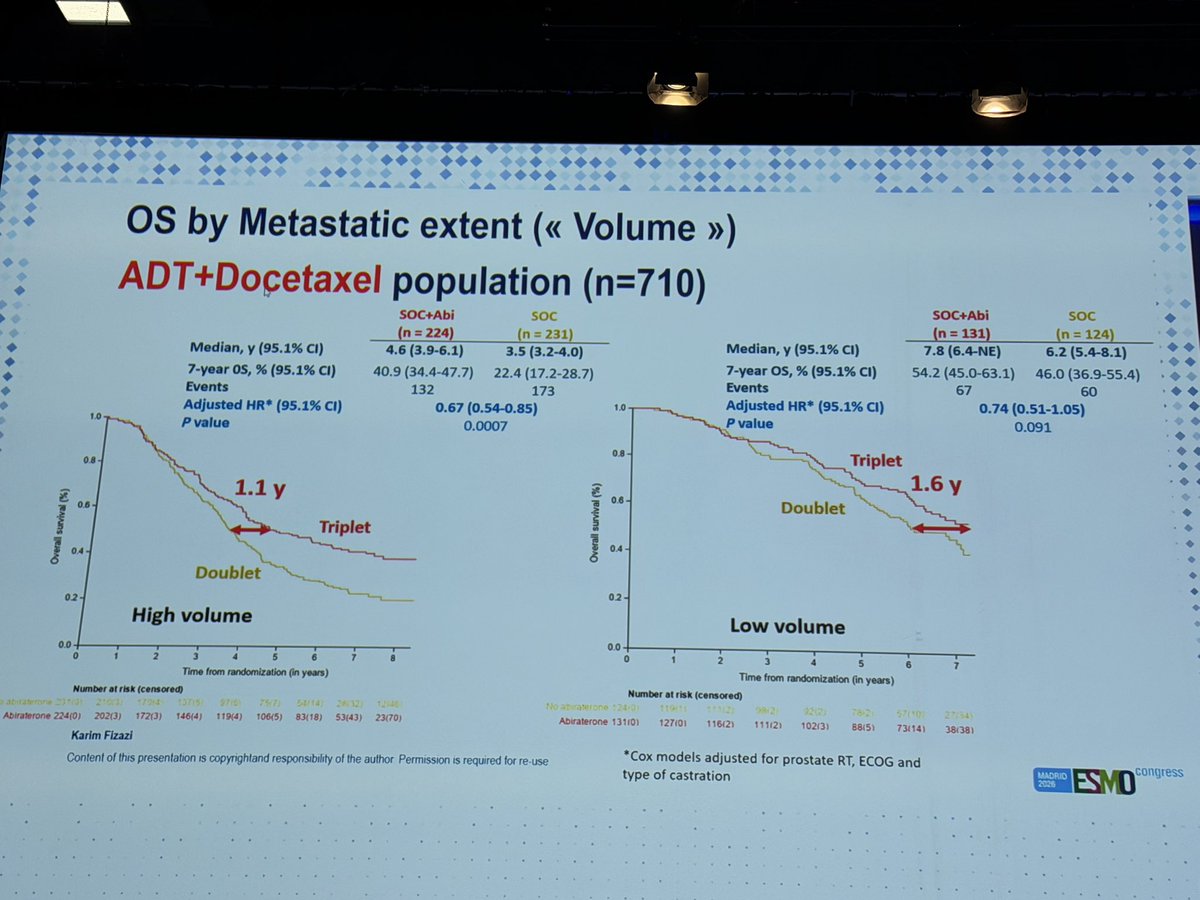
| Volume | Median OS, y (Abi vs SOC) | 7-yr OS % (Abi vs SOC) | Adj HR (95.1% CI) | p |
|---|---|---|---|---|
| High | 4.6 vs 3.5 | 40.9 vs 22.4 | 0.67 (0.54-0.85) | 0.0007 |
| Low | 7.8 vs 6.2 | 54.2 vs 46.0 | 0.74 (0.51-1.05) | 0.091 |
+1 more figure
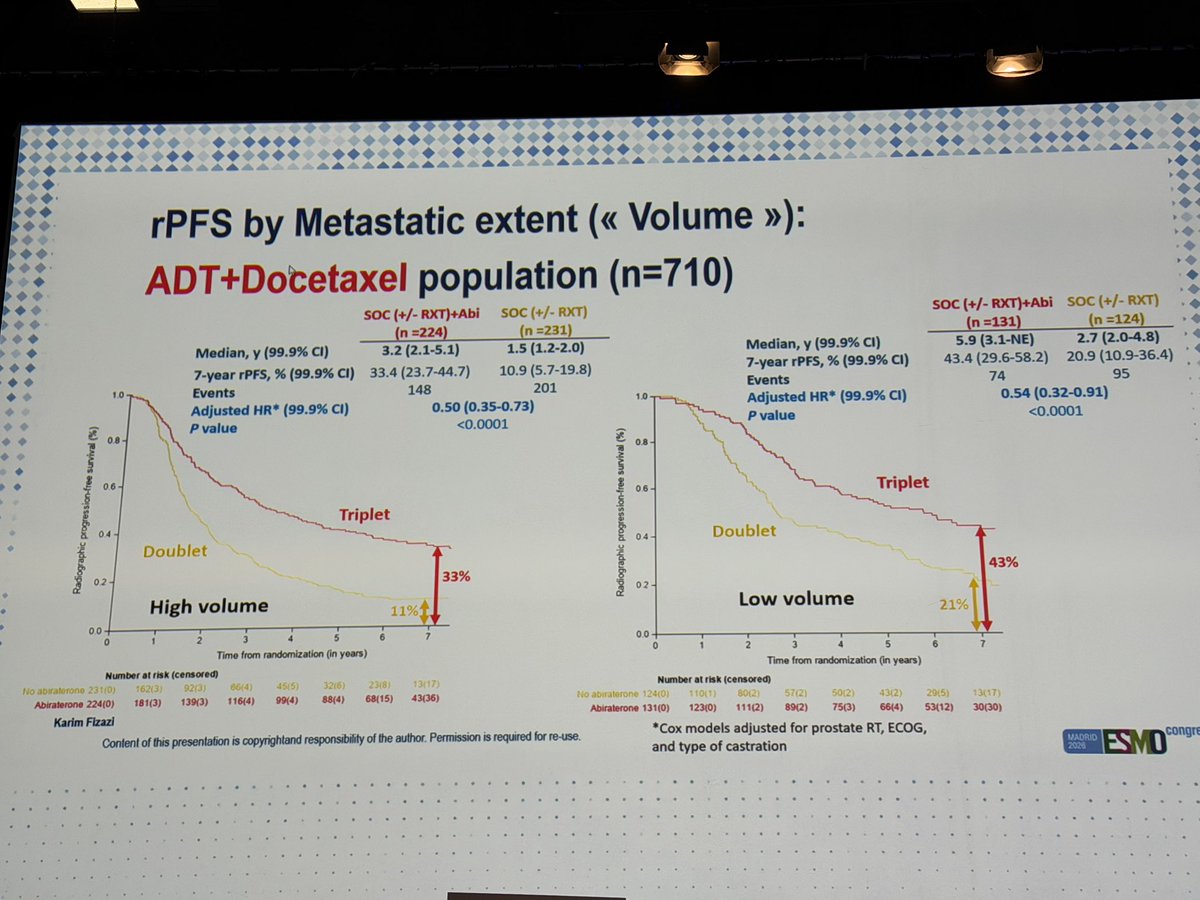
| Volume | Median rPFS, y (Abi vs SOC) | 7-yr rPFS % (Abi vs SOC) | Adj HR (99.9% CI) | p |
|---|---|---|---|---|
| High | 3.2 vs 1.5 | 33.4 vs 10.9 | 0.50 (0.35-0.73) | <0.0001 |
| Low | 5.9 vs 2.7 | 43.4 vs 20.9 | 0.54 (0.32-0.91) | <0.0001 |
10 details
Randomized trial, 8y FU long-term analysis presented at ESMO (Madrid). This report is restricted to the ADT+docetaxel population (n=710), split by metastatic extent.
High volume: n=224 Abi vs n=231 SOC. Low volume: n=131 Abi vs n=124 SOC.
SOC (ADT+docetaxel, ± prostate RT) with vs without abiraterone. Dose and schedule not reported in source.
Prostate RT was a factor within SOC ("+/- RXT"); Cox models adjusted for prostate RT. RT dose, fractionation and the abiraterone effect within each RT stratum are not reported in source.
Pooled OS benefit holds at 8y; volume-specific OS and rPFS are in the figure tables. No treatment-by-volume interaction (p=0.5552).
| Endpoint | Triplet (+Abi) | Doublet | Effect |
|---|---|---|---|
| Median OS | 6.2 y | 4.4 y | HR 0.68 |
| 8-yr OS | 40.3% | 27.1% | n/r |
Extends the earlier PEACE-1 triplet result with longer follow-up and sits alongside ARASENS as the second ARPI + docetaxel triplet dataset. No cross-trial figures in source.
Low-volume OS rests on 67 vs 60 events with CI 0.51-1.05. Post-progression therapy, abiraterone exposure and safety at 8y are not reported in source.
The absence of interaction argues against restricting the triplet to high-volume disease, even though low-volume OS has not cleared significance on its own. The rPFS signal in low volume is as large as in high volume, so the OS gap more likely reflects event count and the longer natural history of low-volume disease.
Randomized long-term update in the docetaxel population, direction unchanged. Volume subgroups underpowered for OS (low-volume CI crosses 1), but no interaction supports a uniform effect.
- Is abiraterone benefit independent of concurrent prostate RT?
- Will low-volume OS benefit reach significance with more events?
- Abiraterone vs darolutamide as the triplet partner
📚 Sources · 🐦 1 tweet
🚨 PEACE-1: 8y FU long-term analysis
— MJosé Juan (@mjuanfi81) October 24, 2026
In patients receiving ADT+docetaxel (n=710), adding abiraterone delivers:
🔹mOS: 6.2 vs 4.4 years (HR 0.68)
🔹 8-yOS: 40.3% vs 27.1%
🔹 High-vol OS: HR 0.67
🔹 Low-vol OS: HR 0.74
🔹 No treatment-by-volume interaction (P=0.5552).@OncoAlert pic.twitter.com/ME1u6GQKGQ
The longer read
The value of this update is durability. With eight years of follow-up in the docetaxel population, abiraterone keeps an OS advantage (median 6.2 vs 4.4 years, HR 0.68) and the 8-year survival gap (40.3% vs 27.1%) has not closed. Benefit from adding a second agent to docetaxel could plausibly have faded as control-arm pts received abiraterone or another ARPI at progression. It hasn't, which supports giving the agent upfront rather than holding it for later. The source does not report post-progression therapy, though, so how much crossover dilutes the estimate is unknown.
The volume analysis is what changes the practical argument. Doublet docetaxel has long been associated with high-volume disease, so a natural guess was that triplet intensification would earn its toxicity only there. These data don't support that guess. The interaction test is clearly null (p=0.5552). The low-volume rPFS hazard ratio (0.54) is essentially the same as the high-volume one (0.50), and 7-year rPFS in low volume roughly doubles (43.4% vs 20.9%). The low-volume OS hazard ratio of 0.74 with an interval reaching 1.05 is a power problem, not evidence of no effect. With only 67 and 60 deaths, and a control arm already at a 6.2-year median, the subgroup could not resolve a modest OS difference. Reading p=0.091 as "no benefit in low volume" would be the classic error of treating a subgroup's non-significance as heterogeneity, and the formal test says there is none.
For a radiation oncologist the more interesting question is the one the slides leave unanswered. PEACE-1 crossed abiraterone with prostate RT, and these Cox models adjust for RT, but the source does not show the abiraterone effect within the RT and no-RT strata. Low-volume disease is exactly where prostate RT is used. So the question of whether abiraterone and local RT act independently, or whether part of the systemic benefit in low volume overlaps with what local therapy provides, is still open. Until that breakdown is shown, the data support using both together without telling us how much each adds.
The statistics need one caveat. rPFS intervals are given at 99.9% and OS at 95.1%, consistent with a multiplicity-adjusted design, and the slides report 7-year landmarks by volume while the headline tweet gives 8-year pooled figures. Neither undermines the read, but readers should not line up the 7-year subgroup and 8-year pooled percentages as if they came from the same time point.
Set against ARASENS, the field now has two trials pointing the same way: in pts fit for docetaxel, adding an ARPI improves survival. This update does not choose between agents, and it says nothing about pts for whom docetaxel is not planned. What would make it wrong is a later finding that the low-volume OS estimate was driven by imbalance in post-progression therapy or RT use, and the source gives no way to check either.