Systemic
Testosterone recovery post-ADT discontinuation (podcast review)
TL;DRReview of two datasets: 25% of real-world pts recovered T within 12mo; 54% relugolix vs 3% leuprolide at 90d in HERO.
HERO
For short-course ADT with RT, the recovery question is now quantified: only 25% of real-world pts on injectable ADT had documented T >280 ng/dl within 12mo of stopping, and testing happened in only about 40% at all. The authors position relugolix for short-term or intermittent regimens, not continuous long-term ADT.
In men finishing a defined course of ADT, especially short-term ADT with RT or an intermittent strategy, these data support checking testosterone after discontinuation rather than assuming recovery; they do not inform men on continuous long-term ADT.
Short-course ADT with definitive or salvage RT is exactly the setting the authors name as where recovery matters, and the real-world number is sobering: 25% recovery to >280 ng/dl within 12mo, in a cohort where only about 40% were tested at all. That argues for scheduling a post-ADT testosterone check rather than assuming recovery.
The choice between an oral GnRH antagonist and a depot agonist carries a recovery consequence in this post hoc read: 54% vs 3% at 90 days, median 86 vs 112 days. Relevant when planning intermittent or defined-duration ADT, not continuous therapy.
10 details 4 trials watching
Sponsored podcast article (Pfizer with Sumitomo Pharma), reviewing two published papers: a retrospective real-world Optum EHR/oncology cohort (2020-2021 data) and a post hoc subgroup of the phase 3 HERO trial. No new analysis is presented here.
Real-world cohort: 3875 men who initiated and discontinued injectable ADT, of whom 1553 (about 40%) had at least one testosterone test within 12 months of stopping. HERO subgroup: 184 men who completed 48 weeks of ADT, 137 relugolix and 47 leuprolide.
Relugolix 360 mg loading dose then 120 mg orally once daily; leuprolide IM every 12 weeks. The real-world cohort predates relugolix availability, so it covers injectable formulations only.
Recovery thresholds differ between the two sources. Real-world: testosterone >280 ng/dl on any test within 12 months. HERO subgroup: >280 ng/dl or >80% of baseline, assessed to 90 days post discontinuation.
Real-world recovery was 25% (390/1553) at 12 months, with lower adjusted risk of new-onset diabetes (HR 0.47, 0.27-0.79). HERO 90-day cumulative incidence was 54% relugolix vs 3% leuprolide (nominal p=.002), median time to recovery 86 vs 112 days.
| Outcome | HR | 95% CI |
|---|---|---|
| New-onset diabetes | 0.47 | 0.27-0.79 |
| New-onset depression | 0.58 | 0.33-1.02 |
| Treatment for sexual dysfunction | 1.33 | 0.99-1.78 |
| Subgroup | Relugolix | Leuprolide |
|---|---|---|
| Overall cumulative incidence | 54% | 3% |
| Baseline T at/above pretreatment median | 71% | 6% |
| Age ≤65 | 78% | 13% |
| Age >65 | 47% | 0% |
| Biochemical recurrence | 57% | 0% |
In the HERO post-discontinuation window, any AE and grade 3+ AE were 96% and 15% in both groups over 30 days; serious AEs 12% relugolix vs 11% leuprolide. Day-90 PSA rose slightly more with relugolix (0.39 vs 0.06 ng/ml), with no correlation between rising testosterone and rising PSA.
The two sources are not comparable on their own terms: different recovery definitions, different windows (12 months vs 90 days), and no relugolix in the real-world arm, so the cross-source read is descriptive only. The 86 vs 112 day medians come from a window that ends at 90 days, so the leuprolide median sits beyond the observation period.
The clinically usable claim is the testing-behaviour one: recovery is rarely documented because testosterone is rarely measured after ADT stops. Whether faster biochemical recovery translates into the bone, metabolic and mood outcomes cited as the motivation is untested here.
- Does faster testosterone recovery improve bone, metabolic or cardiovascular outcomes n=110 · primary completion 2027-07 · relugolix vs leuprolide: cholesterol, glucose, QoLrecruiting REVELUTION-2: Relugolix+Abiraterone Acetate (AA) Versus Leuprolide+AA Cardiac Trial Phase 3n=72 · primary completion 2029-07 · phase 3 cardiac endpoints, relugolix vs leuprolide + AA
- Recovery rates beyond 90 days with relugolix not yet Relugolix in Combination With Radiation Therapy for Treating Patients With High Risk Prostate Cancer Phase 2n=90 · primary completion 2025-10 · relugolix duration comparison with DXA + RT
- Recovery after longer ADT durations than 48 weeks active Comeback From Long coursE Androgen Deprivation Therapy (ADT) With RElugolix and Darolutamide (CLEARED) Phase 2n=33 · primary completion 2028-11 · T recovery rate after 2y relugolix + darolutamide
📚 Sources · 📄 1 paper
HERO
ForAdvanced prostate cancer, completing 48wk ADT, no ongoing ADT planned
TL;DR90-day testosterone recovery to ≥280 ng/dL 53.9% with relugolix vs 3.2% with leuprolide after 48wk ADT.
Reported via UroToday →
For intermediate-risk prostate cancer treated with RT plus short-course ADT, the recovery kinetic is the deliverable: median 86.0 days to normal T on relugolix vs 2 of 47 recovering on leuprolide by day 90. That gates the choice of agent when ADT is a fixed 4 to 6 month adjunct to RT and the goal is off-treatment hypogonadism time, not depth of suppression.
In men finishing a defined short-course ADT with RT and no plan for ongoing suppression, this informs agent choice on recovery speed; it does not apply to men continuing ADT indefinitely or to those where prolonged suppression is the therapeutic aim.
When ADT is a defined 4 to 6 month adjunct to definitive RT, agent choice can be made on recovery speed rather than suppression depth. Median 86.0 days to normal testosterone (95% CI 65.0, 92.0) on relugolix is a concrete planning figure for counselling on off-treatment hypogonadism.
Relevant only where ADT is time-limited by design. The parent trial's depth advantage (96.7% vs 88.8% sustained castration) and this recovery signal point the same way, but neither is tied to an oncologic endpoint, so sequencing and continuous-suppression decisions are untouched.
8 details
Subset analysis of the phase 3 HERO trial, which randomized 934 men with advanced prostate cancer 2:1 to relugolix or leuprolide for 48 weeks. This report covers a 90-day recovery period after treatment discontinuation.
184 men who completed 48 weeks of assigned therapy and had no plan to start alternative ADT within the next 12 weeks (24 weeks after a last leuprolide 3-month depot). 137 had received relugolix, 47 leuprolide.
Relugolix 120 mg orally once daily after a single 360 mg loading dose on Day 1, versus leuprolide injections every 12 weeks, each for 48 weeks.
Time to testosterone recovery to ≥280 ng/dL by Kaplan-Meier, PSA during the recovery phase, and adverse events during recovery. No oncologic efficacy endpoint in this analysis.
During recovery, 96% of men had at least one adverse event and 15% had a grade ≥3 event, similar in both groups.
The 90-day window sits inside the pharmacologic tail of a 3-month leuprolide depot, so part of the 53.9% vs 3.2% gap is measurement timing rather than a durable biologic difference. The leuprolide median of 112.0 days derives from 2 recovery events.
Consistent in direction with the parent HERO result, where relugolix gave deeper sustained castration (96.7% vs 88.8%, difference 7.9%, 95% CI 4.1 to 11.8, P<0.001). The trade the two readings define is depth of suppression on-treatment against speed of recovery off-treatment, both favoring the oral antagonist.
This settles a kinetic question, not a clinical one: no recurrence, quality-of-life, or cardiometabolic endpoint is tied to the faster recovery here. Whether restoring normal testosterone months earlier translates into measurable benefit, or into a PSA that reflects recovering physiology rather than disease, remains untested.
| Metric | Relugolix | Leuprolide |
|---|---|---|
| n in recovery subset | 137 | 47 |
| Baseline T entering recovery (mean±SD) | 427±142 ng/dL | 404±127 ng/dL |
| Recovered T | 74 | 2 |
| Median time to recovery | 86.0 d (95% CI 65.0, 92.0) | 112.0 d (95% CI 112.0, NE) |
| Median PSA at day 90 | 0.39 ng/mL (0 to 233.1) | 0.06 ng/mL (0 to 14.0) |
Post-hoc subset of a phase 3 trial, non-randomised entry criterion, 137 vs 47 arms; recovery kinetics are a pharmacologic expectation, not a new clinical outcome.
- Does faster testosterone recovery change QoL or cardiometabolic outcomes
- Is higher day-90 PSA on relugolix physiologic or disease-driven
- Recovery kinetics after short-course ADT with definitive radiotherapy
📚 Sources · 📄 1 paper
Abstract
STAMPEDE (abiraterone ± enzalutamide, high-risk non-metastatic) NCT00268476
ForHigh-risk non-metastatic prostate ca (N+ or 2 of T3/T4, Gleason 8–10, PSA ≥40)
HR 0·53
95% CI 0·44–0·64, p<0·0001; 6yr MFS 82% vs 69%
TL;DR6yr MFS 82% vs 69%, HR 0·53 (0·44–0·64), adding 2yr abiraterone to ADT+RT; enzalutamide adds nothing.
The RT-relevant read is that benefit is unchanged by radiotherapy: MFS HR 0·54 (0·44–0·67) with planned RT vs 0·51 (0·34–0·76) without, p interaction 0·67, in a cohort where 85% were planned for 74 Gy/37 fx to prostate and seminal vesicles. Abiraterone is therefore additive to definitive RT plus 3yr ADT, not a substitute for either.
In a man starting 3yr ADT plus 74 Gy prostate RT for node-positive or high-risk node-negative disease, this supports 2yr abiraterone intensification; it does not extend to men relapsing after prior local therapy, who were under-represented, nor to post-prostatectomy combination therapy, which was not tested.
Benefit is unchanged by radiotherapy: MFS HR 0·54 (0·44–0·67) with planned RT vs 0·51 (0·34–0·76) without, p interaction 0·67, in a cohort where 85% were planned for 74 Gy/37 fx to prostate and seminal vesicles. Abiraterone is additive to definitive RT plus 3yr ADT, not a reason to omit either.
The regimen question is duration and partner, not whether to intensify: 2yr abiraterone 1000 mg plus prednisolone on a 3yr ADT backbone gives MFS HR 0·53, and adding enzalutamide 160 mg buys nothing (interaction HR 1·02) while raising G3+ AEs from 37% to 58%. Node-positive pts derived HR 0·49 (0·38–0·64).
14 details 5 trials watching
Two open-label phase 3 randomised comparisons within the STAMPEDE MAMS platform, run at 113 UK and Swiss sites, with no overlapping controls, pooled by individual patient data meta-analysis. Recruitment Nov 15, 2011 to March 31, 2016; N=1974; median follow-up 72 months (85 months in the abiraterone trial, 60 months in the abiraterone and enzalutamide trial). The switch of the non-metastatic primary outcome from overall survival to metastasis-free survival was made before any efficacy inspection by randomised group and published as a prespecified declaration.
High-risk non-metastatic prostate adenocarcinoma: node positive, or if node negative, at least two of T3/T4, Gleason 8–10, PSA ≥40 ng/mL; or relapsing with high-risk features (PSA ≥4 with doubling time <6 months, PSA ≥20, or nodal relapse). WHO PS 0–2, no age limit, clinically significant cardiovascular disease excluded. Median age 68 (IQR 63–73), median PSA 34 ng/mL, 774 (39%) node positive, 1563 (79%) of 1968 Gleason 8–10.
ADT for 3 years in all arms, started no more than 12 weeks before randomisation. Combination arms added abiraterone acetate 1000 mg + prednisolone 5 mg daily for 2 years, with enzalutamide 160 mg daily in the second trial only. Median time from randomisation to starting combination therapy 1·4 weeks; when RT was omitted, treatment could continue to progression.
Local RT was mandated for node-negative disease unless contraindicated and encouraged for node-positive disease, per local guidelines at 74 Gy in 37 fractions to prostate and seminal vesicles or a hypofractionated equivalent. Planned RT covered 1684 (85%) of 1974 pts: 99% of newly diagnosed node-negative, 71% of node-positive, and only 7% of previously treated pts.
Primary: metastasis-free survival in the pooled intention-to-treat population, powered for a target HR of 0·75 at 90% power with a one-sided type 1 error of 1·25%, requiring roughly 315 control-group events. Secondary: overall survival, prostate cancer-specific survival, biochemical failure-free survival, progression-free survival, and toxicity.
G3+ AEs in the first 24 months were 169 (37%) of 451 vs 130 (29%) of 455 in the abiraterone trial, but 298 (58%) of 513 vs 172 (32%) of 533 once enzalutamide was added. Hypertension (14% vs 5%), fatigue (10% vs 2%) and raised aminotransferases (13% vs 5%) account for most of the gap between the two combination arms. Seven grade 5 events occurred, none in a control group.
Trials of abiraterone combined with enzalutamide or apalutamide in metastatic castration-resistant disease had already shown modest radiographic PFS gains with no overall survival gain, and the interaction HR of 1·02 (0·70–1·50) here reproduces that in the hormone-sensitive non-metastatic setting. The two trials also confirm each other independently, MFS HR 0·54 (0·43–0·68) and 0·53 (0·39–0·71), which is the strongest internal replication available for a result of this size.
Toxicity was captured only during the first 2 years of treatment, so late cardiovascular and metabolic effects of a 2-year ARSI on top of 3 years of ADT are not measured here. Data on subsequent therapy at castration resistance are described as unreliable, and the 2-year combination duration was pragmatic (matched to the ADT-with-RT requirement), not compared against shorter or longer schedules.
The result establishes fixed-duration hormone intensification as additive to definitive local therapy, with the effect size holding across nodal status and across planned RT use. What it does not settle is whether MFS at 72 months translates into a durable cure fraction, or which of the enzalutamide-driven toxicities would be acceptable if a future combination did show separation.
| Endpoint | HR | 95% CI | p |
|---|---|---|---|
| Overall survival | 0·60 | 0·48–0·73 | <0·0001 |
| Prostate cancer-specific survival | 0·49 | 0·37–0·65 | <0·0001 |
| Biochemical failure-free survival | 0·39 | 0·33–0·47 | <0·0001 |
| Progression-free survival | 0·44 | 0·36–0·54 | <0·0001 |
| Subgroup | SOC events/n | Combination events/n | HR (95% CI) | p interaction |
|---|---|---|---|---|
| RT planned | 238/843 | 139/841 | 0·54 (0·44–0·67) | 0·67 |
| No RT planned | 68/145 | 41/145 | 0·51 (0·34–0·76) | 0·67 |
| N0 | 140/598 | 89/599 | 0·60 (0·46–0·78) | 0·22 |
| N+ | 165/389 | 91/385 | 0·49 (0·38–0·64) | 0·22 |
| Event | Abiraterone trial | Abi + enzalutamide trial |
|---|---|---|
| Hypertension | 23 (5%) of 451 | 73 (14%) of 513 |
| Fatigue | 10 (2%) | 49 (10%) |
| Raised aminotransferases | 25 (5%) | 69 (13%) |
CONSORT flow
Two prospectively randomised phase 3 trials, prespecified pooled primary endpoint hit, 72mo follow-up, and the RT-treated majority carries the same effect as the whole.
- Optimal duration of abiraterone: shorter or longer than 2 years recruiting Reduced Length of ADT and ARTA With XRT in High-Risk Prostate Cancer (RELAX): A Randomised Trial Phase 2n=206 · primary completion 2035-01 · randomised 9mo ADT/6mo ARTA vs 2y ADT with XRT
- Benefit in men relapsing after prior local therapy n=532 · primary completion 2031-02 · ARPI timing with SBRT/salvage XRT in recurrent HSPCrecruiting Treating Prostate Cancer That Has Come Back After Surgery With Apalutamide and Targeted Radiation Based on PET Imaging Phase 3n=804 · primary completion 2032-12 · phase 3 abi+apa added to salvage RT for post-RP BCR
- Combination therapy in men undergoing prostatectomy n=90 · primary completion 2026-09 · randomised apalutamide ± abiraterone before RPrecruiting Neoadjuvant Intense Endocrine Therapy for High Risk and Locally Advanced Prostate Cancer Phase 2n=900 · primary completion 2026-12 · neoadjuvant ADT + abiraterone arms before RARP
📚 Sources · 📄 1 paper
REVELUTION
ForNon-metastatic intermediate/high-risk prostate cancer receiving definitive RT + ADT
68.9 mm³ adjusted mean difference
Leuprolide vs relugolix; crude 56 vs 25 mm³. CI/p not reported in source
TL;DRAdjusted 12-mo total plaque volume rose 68.9 mm³ more with leuprolide vs relugolix in men getting prostate RT.
Reported via UroToday →
Every man here got prostate ± pelvic nodal RT, so this is an RT-clinic decision, not a med-onc one: for the 6-month ADT course you prescribe alongside definitive RT, the agonist added 68.9 mm³ of adjusted total plaque volume at 12 months, driven by non-calcified plaque. A radiation-alone control cohort was enrolled in parallel, though its comparison was not reported in source.
For the intermediate/high-risk man starting definitive prostate RT with 6+ months of concurrent ADT, particularly with elevated ASCVD 10-year risk, this supports weighing agent choice on cardiovascular grounds; it says nothing about ADT duration or about men on ADT without RT.
The entire cohort received prostate ± pelvic nodal RT, so this is your ADT prescription, not someone else's: the agonist added 68.9 mm³ of adjusted total plaque volume at 12 months, driven by non-calcified plaque. It moves agent selection for the 6-month course accompanying definitive RT, particularly in men with elevated baseline ASCVD risk.
This supplies the missing mechanism under HERO's MACE difference: comparable testosterone suppression, divergent coronary plaque trajectory, with the signal in non-calcified rather than calcified plaque. It argues the agonist-antagonist cardiovascular gap is pharmacologic rather than an artifact, though the population here is non-metastatic and radiotherapy-treated.
11 details 4 trials watching
Single-institution, parallel-cohort, open-label randomized trial across four Emory-affiliated centers, enrolling June 2020 to 2024. ADT-eligible pts randomized 1:1 relugolix vs leuprolide, stratified by ASCVD 10-year risk score; a parallel prospective RT-alone cohort was enrolled as control.
94 men with non-metastatic prostate cancer, intermediate and high risk, all treated with pelvic radiotherapy to the prostate with or without pelvic nodes. Lower-risk men eligible for definitive RT alone without planned ADT formed the parallel arm.
Relugolix 360 mg day 1, then 120 mg daily; leuprolide in 3-month depots. ADT given for at least six months, longer by cancer risk tier.
All pts received pelvic radiotherapy to the prostate with or without the pelvic lymph nodes. Dose, fractionation and technique are not reported in source.
Primary: change in total plaque volume. Secondary: changes in plaque subtypes (non-calcified, calcified, low-attenuation). Serial CCTA at baseline (within 7 days of treatment start) and 12 months, blinded to arm, quantified by the automated HeartFlow tool; 12-month mean difference by ANCOVA adjusted for age, statin use and baseline plaque volume.
The adjusted total-plaque-volume difference of 68.9 mm³ favouring relugolix was driven mainly by non-calcified plaque; calcified and low-attenuation plaque showed no significant difference with low absolute change. Per-arm CIs and p-values are not reported in source.
| Measure | Leuprolide | Relugolix |
|---|---|---|
| Total plaque volume, crude difference | 56 mm³ | 25 mm³ |
HERO (2020) showed a lower MACE rate with relugolix vs leuprolide and drove the FDA approval, but offered no mechanism, since both agents suppress testosterone comparably and share the hypogonadal metabolic profile. REVELUTION supplies the candidate mechanism, accelerated coronary atherosclerosis under GnRH agonism, consistent with the 2010s observational signal that agonists carry higher cardiovascular risk than orchiectomy.
The imaging endpoint is validated as a predictor of MACE, not a substitute for it, and 12 months is short for plaque trajectories. The parallel RT-alone cohort was not randomized against either ADT arm, so the no-hormone comparison is observational and cannot isolate radiotherapy's own contribution to plaque change.
If the agonist-antagonist difference is real and mechanistic, the decision it moves is which ADT agent accompanies definitive RT in a man with baseline cardiovascular risk, not whether to give ADT at all. It does not establish that changing agent prevents events; that inference still rests on HERO.
Small single-institution randomized trial with an imaging surrogate (plaque volume), not clinical MACE. Supplies a mechanism for HERO rather than independent outcome evidence.
- Does the plaque difference translate to fewer clinical cardiovascular events recruiting Effects of Relugolix vs Leuprolide on Cardiac Function in Patients With Prostate Cancer Phase 2n=70 · primary completion 2027-12 · relugolix vs leuprolide, cardiac MRI + performancerecruiting REVELUTION-2: Relugolix+Abiraterone Acetate (AA) Versus Leuprolide+AA Cardiac Trial Phase 3n=72 · primary completion 2029-07 · relugolix vs leuprolide + AA, cardiac CTA, pelvic RT
- Plaque trajectory beyond 12 months and after ADT completion n=100 · primary completion 2026-12 · randomised CCTA vs usual care, ADT >12mo planned
- Does pelvic radiotherapy itself contribute to coronary plaque change n=200 · primary completion 2029-11 · ADT cardiotox cohort enrolls with and without RT
📚 Sources · 📄 1 paper
Abstract
DeLLphi-304
For2L SCLC after platinum, with or without baseline brain metastases
TL;DRPost hoc CNS analysis: median CNS PFS NE vs 7.2mo, HR 0.54 (0.39-0.75) favoring 2L tarlatamab in SCLC.
For an RT reader the actionable number is the brain-met subset: CNS PFS 6.5 vs 4.2mo, HR 0.40 (0.24, 0.66) by mRANO-BM BICR, with CNS CR 14.9% vs 5.4%. But >70% had prior CNS-directed treatment and no RT exposure or intracranial-failure pattern is reported, so this informs surveillance interval rather than deferring SRS.
In relapsed SCLC with treated, asymptomatic brain metastases entering 2L, this supports tarlatamab as systemic therapy with meaningful intracranial activity; it does not address untreated or symptomatic CNS disease, where local therapy remains the studied path.
The brain-met subset read by mRANO-BM BICR gives CNS PFS 6.5 vs 4.2mo, HR 0.40 (0.24, 0.66), which is the number to hold against a systemic-only strategy. But >70% had prior CNS-directed therapy and neither RT exposure nor in-field versus out-of-field failure is reported, so it moves the surveillance interval, not the decision to offer SRS.
Intracranial activity is now a differentiator for tarlatamab in 2L SCLC rather than an unknown: CNS CR 14.9% vs 5.4% and CNS disease control 77.6% vs 71.4%, with median duration of CNS disease control 8.2 vs 5.2mo. That supports keeping a pt with treated, stable brain metastases on the bispecific rather than defaulting to chemotherapy for CNS coverage.

| Arm | n | Median CNS PFS (95% CI) | HR (95% CI) |
|---|---|---|---|
| Tarlatamab | 67 | 6.5 (4.3, 13.7) | 0.40 (0.24, 0.66) |
| Chemotherapy | 56 | 4.2 (2.9, 5.5) | n/a |
+2 more figures

| Arm | n | Median CNS PFS (95% CI) | HR (95% CI) |
|---|---|---|---|
| Tarlatamab | 254 | NE (13.7, NE) | 0.54 (0.39, 0.75) |
| Chemotherapy | 255 | 7.2 (5.6, NE) | n/a |
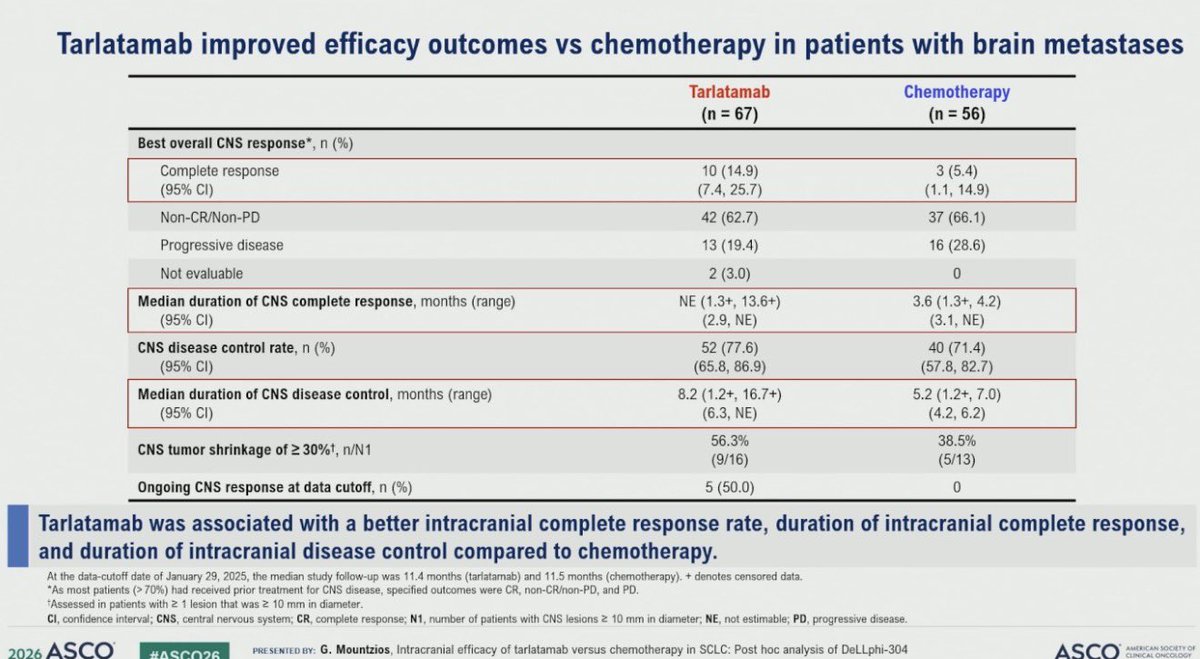
| CNS outcome | Tarlatamab (n=67) | Chemotherapy (n=56) |
|---|---|---|
| Complete response, n (%) | 10 (14.9) | 3 (5.4) |
| Non-CR/non-PD, n (%) | 42 (62.7) | 37 (66.1) |
| Progressive disease, n (%) | 13 (19.4) | 16 (28.6) |
| CNS disease control rate, n (%) | 52 (77.6) | 40 (71.4) |
| Median duration of CNS disease control, mo | 8.2 (1.2+, 16.7+) | 5.2 (1.2+, 7.0) |
10 details 1 trial watching
Post hoc intracranial analysis of the randomised DeLLphi-304 trial of second-line tarlatamab versus chemotherapy in SCLC. Two assessment frameworks: investigator RECIST in the ITT population and mRANO-BM by BICR in pts with baseline brain metastases. Data cutoff January 29, 2025; median follow-up 11.4 mo (tarlatamab) and 11.5 mo (chemotherapy).
ITT n=254 tarlatamab versus n=255 chemotherapy. The brain-metastasis cohort was n=67 versus n=56, defined as ≥1 brain metastasis at baseline per mRANO-BM by BICR plus ≥1 post-baseline scan. More than 70% had already received CNS-directed treatment, which is why the response categories were CR, non-CR/non-PD and PD rather than a conventional ORR.
This analysis reports time to CNS progression or death (CNS PFS) in the ITT population and in the brain-metastasis subset, plus best overall CNS response, CNS disease control rate, duration of CNS complete response and duration of CNS disease control. None of these was the trial's registered primary endpoint.
Both CNS PFS comparisons favor tarlatamab, and the effect is larger in the brain-metastasis subset (HR 0.40) than in the ITT population (HR 0.54). Intracranial complete response was 14.9% versus 5.4%, and CNS tumor shrinkage ≥30% occurred in 9/16 versus 5/13 pts with measurable lesions ≥10mm.
Brain metastases develop in the majority of SCLC pts, and second-line systemic options have historically been judged on extracranial disease with CNS control assumed to be the province of SRS, WBRT or prophylactic cranial irradiation. A bispecific T-cell engager showing an intracranial complete response rate of 14.9% is the notable part, because the working assumption for large-molecule agents has been limited intracranial penetration.
The ITT median CNS PFS was not estimable at 11.4 months of follow-up, so the ITT curve rests on the early portion of the data and the point estimate can still move. The two populations were also read with different tools and different models (stratified Cox for ITT, unstratified for the subset), so the ITT and subset HRs are not strictly comparable to each other.
The result establishes that intracranial disease does not progress faster under tarlatamab than under chemotherapy, and probably progresses more slowly. What it does not establish is whether that activity is sufficient to defer local therapy in a patient who would otherwise be referred for SRS, since the source reports no radiotherapy exposure data and no in-field versus out-of-field failure pattern.
Post hoc intracranial analysis of a randomised trial; CNS endpoints were not the registered primary, and the brain-met subset HR comes from an unstratified model.
- Does intracranial activity permit deferral of SRS in untreated brain mets
- Activity in CNS-treatment-naive or symptomatic brain metastases n=35 · primary completion 2029-02 · phase 2 tarlatamab, active asymptomatic brain mets
- Durability of CNS control beyond 12 months follow-up
📚 Sources · 🐦 1 tweet
Dr. @g_mountzios #ASCO26 presents CNS outcomes with 2L tarlatamab in DeLLphi-304. Improved time to CNS progression overall (HR 0.54). In pts with brain nets, tarlatamab vs chemo CNS CR rate 15% vs 5% with DCR 78% vs 71% and time to CBS progression 6.5m vs 4.2m, HR 0.40 pic.twitter.com/5i8jL1zlKW
— Stephen V Liu, MD (@StephenVLiu) June 1, 2026
PROTEUS
TL;DRMost distant metastases were PSMA PET-detected (53.0% apalutamide, 60.7% comparator); no EFS or MFS effect size in source.
53.0% of distant mets in the apalutamide group were PSMA PET-detected vs 60.7% in the comparator, so the arms differ in how events were found, not only how often. MFS surrogacy was built in the conventional-imaging era, which is the read this complicates. No effect size in source.
Whether apalutamide added to ADT earns its place turns on an MFS signal in which 53.0% (apalutamide) and 60.7% (comparator) of distant mets were PSMA PET-detected. Weigh the intensification decision against how much of any separation is detection rather than biology. No effect size in source.
Also covered Aug 29
8 details
MFS event ascertainment was PSMA PET-dominant: 53.0% of distant metastases in the apalutamide group and 60.7% in the comparator were identified by PET rather than conventional imaging. EFS is named in the thread, but no effect size for either endpoint appears in the source.
The contested question is whether a PET-detected metastasis is the same event MFS was built to count. A commentator's hypothetical, explicitly not trial data, models 100 pts per arm with 60 BCRs on ADT alone and 50 on apalutamide plus ADT to show how differential detection alone can widen an apparent gap.
The NEJM sentence quoted in the thread is truncated, so the 60.7% figure's arm label is inferred from a two-arm comparison rather than read directly. The full presentation has not occurred, and the source gives no phase, N, follow-up, or eligibility.
Results online but the source thread carries no EFS or MFS effect size, so no strength bucket is defensible; ascertainment concern noted, not adjudicated.
- Whether the MFS separation holds under conventional-imaging-only ascertainment
- Does the EFS signal translate to overall survival
- How PSMA PET stage migration should be handled in MFS endpoints
📚 Sources · 🐦 3 tweets
#ASCO26
— Daniel E Spratt (@DrSpratticus) May 31, 2026
The PROTEUS trial results are now online...buckle up as we wait to see the full presentation. This is going to be a trial that is likely highly controversial until the full results are published.
Some may call this a homerun, others may call this the largest negative…
Thought experiment:
— Sean McBride (@seanmmcbride) May 31, 2026
Let's take a very simple hypothetical trial involving 100 patients in the APA arm and 100 patients in the ADT alone arm. Pulling from PROTEUS EFS data, assume that, by 5 years, 60 patients in the ADT arm have had a BCR compared to 50 in the ADT+APA arm.… pic.twitter.com/WJaiDlJnQs
#ASCO26
— Daniel E Spratt (@DrSpratticus) May 31, 2026
Talk about real-time updates. NEJM paper now online and my predictions and inferences appear true.
Majority of MFS events were by PET not conventional imaging. "Most distant metastases were identified by PSMA PET (53.0% of those in the apalutamide group and 60.7% in the… https://t.co/Yz4myY0flq
RASolute 302
ForPreviously treated metastatic pancreatic adenocarcinoma, RAS G12-mutant
13.2 vs 6.6 mo
HR 0.40 (95% CI 0.30-0.54), P<0.001
TL;DRmOS 13.2 vs 6.6mo, HR 0.40 (0.30-0.54), P<0.001 for daraxonrasib vs chemo in RAS G12 2L metastatic pancreatic.
In previously treated metastatic pancreatic cancer with a RAS G12 mutation, this supports RAS(ON) multi-selective inhibition over investigator's choice chemotherapy in the second line; it does not speak to untreated disease, to RAS wild-type tumors, or to any role alongside radiotherapy.

| Population / arm | N | Events (%) | Median OS (95% CI), mo | 12-mo OS | HR (95% CI) | P |
|---|---|---|---|---|---|---|
| RAS G12 · daraxonrasib | 228 | 72 (32) | 13.2 (10.0-NR) | 53.3 | 0.40 (0.30-0.54) | <0.001 |
| RAS G12 · chemotherapy | 231 | 127 (55) | 6.6 (5.4-8.2) | 8.7 | n/a | n/a |
| Overall · daraxonrasib | 248 | 79 (32) | 13.2 (10.0-NR) | 53.2 | 0.40 (0.30-0.53) | <0.001 |
| Overall · chemotherapy | 252 | 141 (56) | 6.7 (5.8-8.0) | 17.3 | n/a | n/a |
9 details 4 trials watching
Randomised comparison of daraxonrasib against investigator's choice chemotherapy in previously treated metastatic pancreatic cancer, reported as ASCO 2026 Abstract LBA5. Two co-reported populations: RAS G12 (n=459) and an overall population (n=500) that adds G13, Q61 and tumors with no RAS mutation identified. Hazard ratios from a stratified Cox model, P values from stratified log-rank.
Previously treated metastatic pancreatic cancer. The G12 population carried RAS G12 mutations; the overall population also admitted G13, Q61, and patients in whom no RAS mutation was identified. Line of prior therapy, performance status and prior regimen are not given in the source.
Primary read here is overall survival, reported separately for the RAS G12 and overall populations. No PFS, response or safety endpoint appears in the source figure.
OS 13.2 vs 6.6 mo in RAS G12, HR 0.40 (0.30-0.54), P<0.001; the overall population is nearly identical at 13.2 vs 6.7 mo, HR 0.40 (0.30-0.53). Only 32% of daraxonrasib patients had died versus 55-56% of chemotherapy patients, and the experimental median's upper CI bound is not reached, so the estimate can still move.
Second-line metastatic pancreatic cancer has sat near six months' median OS since NAPOLI-1, and the 6.6 mo control arm here reproduces that benchmark rather than undercutting it. The experimental arm roughly doubles it, which is a larger step than any second-line systemic result in this disease to date.
The whole read rests on one OS figure from a conference thread: crossover, chemotherapy-arm composition and the safety profile are absent, and any of the three could change how the survival curve should be read. The 12-mo OS gap between the two control populations (8.7% vs 17.3%) is wide enough to deserve explanation when the full report lands.
The result's strength is its concordance: an identical HR 0.40 in the mutation-selected and all-comers populations means the benefit is not an artefact of subgroup selection. What it does not settle is durability, since the experimental median is immature, nor whether the effect holds in patients without an identified RAS mutation, who were pooled into the overall population rather than reported on their own.
Randomised, OS primary, HR 0.40 with concordant effect in G12 and all-comers. Source is a conference OS figure only; safety and PFS unverified here.
- Durability beyond the immature 13.2mo median active Phase 3 Study of Daraxonrasib (RMC-6236) in Patients With Previously Treated Metastatic Pancreatic Ductal Adenocarcinoma (PDAC) Phase 3n=500 · primary completion 2026-06 · the same phase 3, primary completion 2026-06recruiting Study of Daraxonrasib and Daraxonrasib + GnP as First-line Treatment in Patients With Metastatic Pancreatic Adenocarcinoma Phase 3n=900 · primary completion 2028-06 · daraxonrasib +/- GnP moved to 1L metastaticrecruiting Study of Daraxonrasib (RMC-6236) in Patients With Resected Pancreatic Ductal Adenocarcinoma (PDAC) Phase 3n=500 · primary completion 2029-05 · daraxonrasib vs observation after R0/R1 resection
- Activity in tumors with no identified RAS mutation not yet A Pan-RAS Inhibitor in Combination With Anti-Tumor Therapy in Participants With Advanced Pancreatic Cancer Phase 1/2n=80 · primary completion 2028-08 · pan-RAS HRS-2329, RAS mutation OR amplification
- Safety and tolerability profile, absent from source
📚 Sources · 🐦 1 tweet
#ASCO26
— Nicholas Hornstein (@GIMedOnc) May 31, 2026
This one is special.
This is the hottest paper of 2026 and potentially in the history of pancreatic cancer.
Let’s dive in.
RASolute 302: Daraxonrasib vs investigator’s choice chemotherapy in previously treated metastatic pancreatic cancer
Abstract LBA5 (soon!)… pic.twitter.com/Lq7PEjOWAo
Management After pCR in MIBC (Panel)
TL;DRPanel review: sandwich immunotherapy regimens continue planned adjuvant therapy regardless of pCR, with de-escalation still unanswered.
SWOG 8710ABACUSCHECKMATE-274KEYNOTE-905VOLGANIAGARAVESPERKEYNOTE-B15
In MIBC pts who reach pT0N0 at cystectomy on a sandwich regimen, this supports completing planned adjuvant therapy rather than stopping on pathologic response; after cisplatin-based chemo alone, surveillance remains the presented standard.

+2 more figures

| Setting | Trial | Reported outcome |
|---|---|---|
| Cisplatin-ineligible | KEYNOTE-905 | Periop EVP now standard |
| Cisplatin-ineligible | VOLGA | EV + durva/treme improved EFS (press release) |
| Cisplatin-eligible | NIAGARA | 24-mo OS 82.2% vs 75.2% |
| Cisplatin-eligible | VESPER | 5-yr OS 66% vs 57%, ddMVAC > gem/cis |
| Cisplatin-eligible | KEYNOTE-B15 | OS improved vs gem/cis, under FDA review |

11 details
ASCO 2026 GU education session, not a trial. Synthesizes SWOG 8710, NIAGARA, VESPER, KEYNOTE-905, KEYNOTE-B15 and VOLGA into a position on what to do after pCR.
The practice answer presented is continue: resume durvalumab for 8 months post-cystectomy on the NIAGARA regimen, resume EVP post-cystectomy on perioperative EVP. Surveillance after pCR is standard only for cisplatin-based chemo alone.
The continue-vs-stop question has never been randomized. Not all pts in the source trials completed adjuvant therapy, often for toxicity, so the observed benefit reflects a mixed delivered dose rather than the full planned course.
The session names the two open questions itself: the relative contribution of the pre- versus postoperative components, and whether adjuvant therapy can be de-escalated on pCR or another biomarker. Neither is answerable from an intention-to-treat perioperative design.
- Relative contribution of pre- vs postoperative components
- Can adjuvant therapy be de-escalated based on pCR or biomarkers
📚 Sources · 🐦 1 tweet
#ASCO26 GU Oncology Spotlight 🚨
— Dra. María Natalia Gandur Quiroga (@nataliagandur) May 30, 2026
🔬 Management in Bladder Cancer After Pathologic Complete Disease Response
Presented by Brendan J. Guercio, MD@OncoAlert@ASCO
In muscle-invasive bladder cancer, pCR after neoadjuvant therapy is one of the most powerful prognostic signals we… pic.twitter.com/sMd2In7X3p
A-DREAM
FormHSPC, PSA <0.2 after 18-24mo ADT + ≥12mo ARPI
41.0% (32/78)
80% CI 33.1-48.9%, one-sided p 0.0249
TL;DR41% treatment-free with eugonadal T at 18mo after stopping ADT+ARPI in responding mHSPC (80% CI 33.1-48.9%, one-sided p 0.0249).
The RT-relevant detail is baseline burden: 51.3% had prostate RT and 29.5% had RT to metastatic sites, so the cohort that tolerated interruption was heavily locally treated, and 4 pts (5.1%) took RT as their non-protocol next step off ADT. Metastasis-directed RT is not tested here, but this is the population where a de-intensification question meets it.
In mHSPC with PSA under 0.2 after 18-24 months of ADT plus at least 12 months of ARPI, this supports discussing a protocolized interruption with PSA and testosterone monitoring; it does not extend to pts with persistent PSA or to unselected metastatic disease.
The cohort was RT-heavy before interruption: 51.3% had prostate radiation and 29.5% had radiation to metastatic sites, and 4 (5.1%) took radiation as their non-protocol next step off ADT. Metastasis-directed RT to extend time off systemic therapy is the randomizable question this describes but does not test.
The composite splits usefully: 57.7% stayed treatment-free for 18 months but only 66.7% recovered testosterone (median 9.0 months), so gonadal recovery, not disease control, is the rate limiter in a median-age-70 cohort. Counsel the two risks separately before interrupting.

+3 more figures


| Characteristic | Value |
|---|---|
| Median age | 70 (49-90) |
| High volume (CHAARTED) | 27 (35.1%) |
| Low volume (CHAARTED) | 50 (64.9%) |
| Prostate RT as local therapy | 40 (51.3%) |
| RT to metastatic sites | 23 (29.5%) |
11 details 5 trials watching
Alliance single-arm phase 2, N=75 planned, 78 eligible enrolled 07/2022-03/2024. Median follow-up 26.9 months. Monitoring PSA and testosterone q3mo, scans at least q6mo (q3mo with rising PSA), QOL q6mo.
mHSPC on ADT + ARPI with PSA <0.2 stable or falling after 18-24 months of ADT and at least 12 months of ARPI. Median age 70 (49-90), 84.6% White, 64.9% low volume by CHAARTED, 35.1% high volume. Median PSA prior to starting ADT+ARPI 18.99 ng/mL.
Not an intervention, but the cohort was RT-heavy at baseline: 40 (51.3%) had radiation as local therapy, 31 (39.7%) had no local therapy, 7 (9.0%) prostatectomy +/- RT. 23 (29.5%) had radiation to metastatic sites. Dose and fractionation not reported in source.
Primary: treatment-free with eugonadal testosterone (T ≥150 ng/dL) at 18 months. Secondary: time to eugonadal T, duration off treatment, QOL. Exploratory: rPFS, TTNT, OS (CSS/NCSS), cost. Re-initiation triggered by PSA ≥5 ng/mL, PCWG3 radiographic change, or prostate-cancer-related symptoms.
Primary endpoint met: 32/78 (41.0%), 80% CI 33.1-48.9%, one-sided p 0.0249. Testosterone recovered in 52 (66.7%) by 18 months with median time to eugonadal T 9.0 months (95% CI 8.4-12.4); 45 (57.7%) stayed treatment-free for 18 months. rPFS 15/78 events, median NE; OS 4/78 events, median NE.
The 18-month primary readout is short for a de-intensification question whose real risk is late: 4 of 29 pts who resumed per protocol later progressed and discontinued the original ARPI, so re-treatment did not uniformly restore control. Deaths (4) included non-prostate causes (myelodysplastic syndrome, influenza, myocardial infarction), and with no continuous-treatment arm the OS curve carries no comparative information.
Intermittent ADT has been tested before in metastatic disease (SWOG 9346 could not exclude an OS decrement with intermittent therapy in mHSPC), but A-DREAM asks the question in the modern ARPI-intensified era with a molecularly deeper response gate, which is why the cohort's off-treatment rate looks better than the older intermittent literature suggests. That comparison is a rationale, not a result: A-DREAM has no randomised arm.
The number that matters clinically is not 41% but its two components: testosterone recovery is the rate limiter (66.7% recovered, median 9.0 months), while disease control off treatment was more common (57.7% treatment-free at 18 months). A trial that de-intensifies successfully on disease grounds can still miss its endpoint on gonadal recovery in an older cohort, and that distinction determines who to counsel.
Single-arm phase 2, no continuous-treatment control, 18mo primary readout in a deeply selected responder cohort. Interruption safety needs a randomised comparator.
- Does interruption cost overall survival vs continuous ADT+ARPI active A Study of an Intermittent ADT Approach With Apalutamide Monotherapy in Participants With mCSPC Phase 3n=420 · primary completion 2026-10 · phase 3 intermittent vs continuous, rPFS non-inferiorityrecruiting Optimal PSA Triggered Individual Management of Androgen Sensitive Prostate Cancer Phase 2n=160 · primary completion 2030-10 · randomised intermittent relugolix+ARPI after PSA response
- Which responders recover testosterone and which do not active Comeback From Long coursE Androgen Deprivation Therapy (ADT) With RElugolix and Darolutamide (CLEARED) Phase 2n=33 · primary completion 2028-11 · 1° EP is T recovery rate after 2y relugolix+darolutamidenot yet Clinical Trial to Observe the Effects of Tamoxifen on Testosterone Recovery in Medically Castrated Prostate Cancer Patients Phase 2n=96 · primary completion 2030-10 · tamoxifen vs no tamoxifen for T recovery post-ADT
- Can metastasis-directed RT extend time off systemic therapy n=254 · primary completion 2031-08 · PSMA-guided SBRT added after 6mo darolutamide+ADT
📚 Sources · 🐦 1 tweet
Can treatment be safely stopped in selected patients with mHSPC?
— MJosé Juan (@mjuanfi81) May 30, 2026
Phase II A-DREAM trial, 41% of responders remained treatment-free with testosterone recovery 18m after stopping ADT/ARPI. At a median FU of 21 months, 35% of patients required treatment re-initiation.@OncoAlert pic.twitter.com/iW2VDBWWhN
ENZAMET + Decipher
FormHSPC on ADT + enzalutamide, Decipher score available
TL;DRDecipher >0.85 predicts docetaxel benefit in mHSPC on ADT+enza: HR(OS) 0.75 (0.43-1.33) vs 1.94 (0.95-3.96) if ≤0.85, interaction p=0.04.
In mHSPC starting ADT + enzalutamide with a Decipher score available, this offers hypothesis-level support for weighing docetaxel intensification above the 0.85 cut and for questioning it below; it does not extend to patients on other ARSIs or to those without genomic testing.
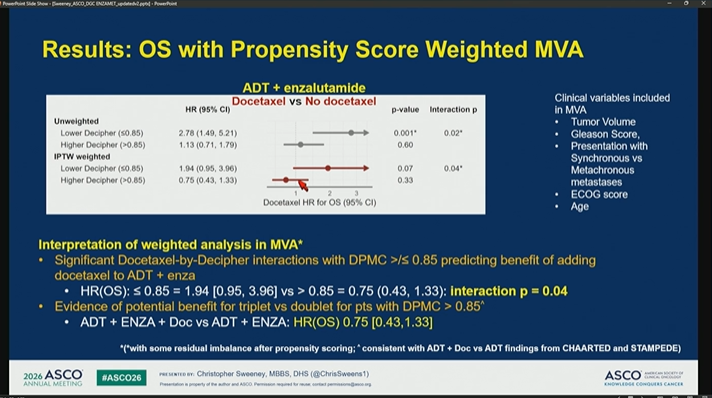
| Analysis | Lower Decipher (≤0.85) | Higher Decipher (>0.85) | Interaction p |
|---|---|---|---|
| Unweighted HR (95% CI) | 2.78 (1.49, 5.21) | 1.13 (0.71, 1.79) | 0.02 |
| Unweighted p-value | 0.001 | 0.60 | |
| IPTW weighted HR (95% CI) | 1.94 (0.95, 3.96) | 0.75 (0.43, 1.33) | 0.04 |
| IPTW weighted p-value | 0.07 | 0.33 |
+2 more figures


8 details
Post-hoc genomic-classifier analysis of the ENZAMET ADT + enzalutamide cohort, N=320, testing whether Decipher (DPMC) predicts docetaxel benefit. Docetaxel receipt was investigator-elected, not randomised, so a propensity-score IPTW model carries the comparison.
mHSPC on an ADT + enzalutamide backbone with an evaluable Decipher score, split at the prespecified 0.85 cut. A separate panel restricts to low-volume disease.
Overall survival, read two ways: prognostic (Decipher stratum on ADT + enza) and predictive (docetaxel-by-Decipher interaction).
Prognostic signal is the cleanest number on the slide deck: HR 3.02 (1.50-5.76) for DPMC >0.85 on ADT + enza. The predictive claim rests on the interaction, p=0.02 unweighted and p=0.04 after IPTW, not on either stratum reaching significance.
Docetaxel was not randomised within this cohort, so IPTW is doing the causal work and the authors concede residual imbalance after propensity scoring. Low-volume panel numbers are small (n at risk 14 and 13 in the reported strata) with a CI of 1.70 (0.32, 8.06), wide enough to be uninformative.
Presented as level 1B evidence consistent with CHAARTED and STAMPEDE, where docetaxel benefit concentrated in high-volume disease. This analysis proposes a genomic rather than volumetric selector for the same decision.
The strongest defensible claim is the prognostic one: DPMC >0.85 marks worse OS on ADT + enza. The predictive claim (add docetaxel above 0.85, omit it below) is directionally consistent across unweighted and weighted models but is not established by a single non-randomised interaction.
Post-hoc biomarker subgroup with non-randomised docetaxel use; both stratum HRs non-significant after weighting, residual imbalance conceded. Read rests on an interaction p=0.04.
- Prospective validation of Decipher-guided docetaxel selection in mHSPC
- Does the 0.85 cut hold on ARSI backbones other than enzalutamide
- Whether low Decipher predicts docetaxel harm or only absent benefit
📚 Sources · 🐦 1 tweet
#ASCO26 GU Oncology Spotlight 🚨
— Dra. María Natalia Gandur Quiroga (@nataliagandur) May 30, 2026
🔬 ENZAMET + Decipher | Part 2
Can genomics guide docetaxel intensification in mHSPC?
Outstanding presentation by @ChrisSweeney1.@OncoAlert@ASCO
After Part 1, the key question was:
➡️ Can a genomic classifier identify which patients with… pic.twitter.com/nJYMxuXelV
ARACOG (AFT-47)
ForAdvanced prostate cancer (mHSPC, nmCRPC, mCRPC) starting an ARSI
daro -15.8 vs enza -36.1
median % change in MCCD at 24 wks, P=0.009
TL;DREnzalutamide MCCD decline -36.1 vs -15.8 for darolutamide at 24wks (P=0.009) in randomized phase 2, N=111.
The comparison is between each pt's own worst-hit domain, and those differed by arm (PALFAM for daro, SWM for enza), so the read is how far the worst domain falls, not which one. Crossover before 24wks was scored at crossover inside the randomized arm, which attenuates rather than widens the gap. Moves ARSI selection when cognitive burden matters, not efficacy.
In a man starting an ARSI for mHSPC or nmCRPC where cognitive burden is a live concern, this supports darolutamide over enzalutamide on measured cognition; it does not speak to disease control, which was never compared head-to-head.
For ARSI selection where the two drugs are treated as equivalent on disease control, this puts a measured number on the cognitive difference (median MCCD -15.8 vs -36.1, P=0.009) instead of an AE-table impression. It moves drug choice, not sequencing or line of therapy.

| Metric | Darolutamide (N=48) | Enzalutamide (N=47) |
|---|---|---|
| Maximally changed module | PALFAM | SWM |
| Domain | Visual memory / executive function | Working memory / executive function |
| Median change, baseline to 24 wks | -15.8 | -36.1 |
| Between-arm P | P=0.009 | P=0.009 |
+2 more figures


8 details
Randomized open-label phase 2 from the Alliance for Clinical Trials in Oncology, N=111, stratified by age (<65, 65-80, >80). Enrolled 8/17/2021 to 3/11/2025, with CANTAB modules, PROMs and timed-up-and-go collected at 12 and 24 weeks.
Men with mCRPC, nmCRPC or mHSPC. Randomization was stratified by age across three bands (<65, 65-80, >80), so the design anticipated an older population. Baseline cognitive eligibility criteria not reported in source.
Darolutamide was provided by the study; enzalutamide was given through standard of care, so the two arms differed in drug supply as well as drug. Doses and concurrent ADT not reported in source.
Primary: % change from baseline to 24 weeks in the Maximally Changed Cognitive Domain (MCCD), drawn from 5 remotely delivered CANTAB modules (SWM, PALFAM, OTS, SSP, RVP) covering executive function, visual memory, attention and working memory. Blood for polygenic hazard score and AR testing, PROMs and timed-up-and-go were collected alongside.
Median MCCD change -15.8 with darolutamide (PALFAM) vs -36.1 with enzalutamide (SWM), P=0.009, across 48 and 47 pts in the primary analysis. No oncologic endpoint was reported in source.
The two drugs have never been compared head-to-head for efficacy, and cognition in ARAMIS and ARASENS (darolutamide) and PROSPER and ARCHES (enzalutamide) was captured as clinician-graded adverse events against placebo, not measured with a battery. Mild executive dysfunction is exactly the harm an AE table structurally misses.
Pts crossing over before 24 weeks carried their crossover score into the randomized arm, which should attenuate the gap rather than widen it. CANTAB is a research battery, not a clinical diagnostic, and no link to function, falls or discontinuation is reported in source. 24 weeks says little about years of therapy.
This shifts an argument that has run on mechanism and on AE tables onto measured performance. Where the two drugs are treated as interchangeable for disease control, cognition becomes a defensible tiebreaker. What it does not settle is whether an MCCD gap of this size is felt by the pt.
Randomized, prespecified primary endpoint met against a named comparator; open-label design and the composite MCCD construct temper it. Consistent with darolutamide's known limited CNS penetration.
- Whether the MCCD difference translates to function, falls, or discontinuation
- Durability of cognitive divergence beyond 24 weeks
- Whether apalutamide differs from enzalutamide on the same testing
📚 Sources · 🐦 2 tweets
#ASCO26 GU Oncology Spotlight 🚨
— Dra. María Natalia Gandur Quiroga (@nataliagandur) May 30, 2026
🔬 Abstract 5005 | ARACOG / AFT-47
Cognitive effects of darolutamide vs enzalutamide
Presented by Alicia K. Morgans, MD, MPH, FASCO@CaPsurvivorship @OncoAlert@ASCO
In prostate cancer, we often discuss AR pathway inhibitors through the lens… pic.twitter.com/vpZr1w6kc6
ARACOG (AFT-47) met its primary endpoint: enzalutamide caused significantly greater cognitive decline than darolutamide at 24 weeks in advanced prostate cancer.
— Katy Beckermann (@katy_beckermann) May 30, 2026
Randomized open-label phase 2, 111 pts (mHSPC, mCRPC, nmCRPC), DAR vs ENZ.
Cognition was measured with CANTAB, a… pic.twitter.com/kj4vfGRVyp
TALAPRO-3
ForHRR-deficient metastatic hormone-sensitive prostate cancer, enzalutamide/ADT candidates
HR 0.48
95% CI 0.36-0.65, P<0.001; 3yr rPFS 77% vs 56%
TL;DR3yr rPFS 77% vs 56%, stratified HR 0.48 (0.36-0.65), p<0.001, adding talazoparib to enzalutamide in HRR-deficient mCSPC.
In HRR-deficient metastatic prostate cancer starting enzalutamide plus ADT, this supports considering talazoparib upfront rather than reserving it, including for non-BRCA HRR alterations; it does not speak to HRR-proficient disease, which the trial excluded.

| Panel | Arm | Events/N | Median rPFS (95% CI), mo | HR (95% CI) |
|---|---|---|---|---|
| A ITT | Talazoparib+enzalutamide | 67/300 | NC (NC-NC) | 0.48 (0.36-0.65), P<0.001 |
| A ITT | Placebo+enzalutamide | 126/299 | 45.8 (37.7-NC) | |
| B BRCA | Talazoparib+enzalutamide | 22/104 | NC (NC-NC) | 0.37 (0.22-0.61) |
| B BRCA | Placebo+enzalutamide | 49/103 | 35.1 (18.6-NC) | |
| C Non-BRCA | Placebo+enzalutamide | 77/196 | NC (40.5-NC) | 0.57 (0.39-0.82) |
8 details 4 trials watching
Randomised, placebo-controlled phase 3 of talazoparib plus enzalutamide vs placebo plus enzalutamide, with ADT in both arms. ITT N=599 (300 vs 299), analysed as ITT with prespecified BRCA and non-BRCA subgroups.
HRR-deficient metastatic prostate cancer; the BRCA subgroup was 104 vs 103 and non-BRCA 196 vs 196, so BRCA carried roughly a third of the trial. Detailed eligibility and stratification factors are not reported in source.
Talazoparib added to an enzalutamide/ADT backbone that both arms received, so the comparison isolates the PARP inhibitor's contribution rather than the androgen-signaling backbone. Doses not reported in source.
Primary: imaging-based rPFS. Overall survival, safety and response endpoints are not reported in the source tweet or figure.
Landmark 3yr rPFS 77% vs 56%; median rPFS not reached in the talazoparib arm against 45.8 mo on placebo. Effect held in both molecular subgroups, numerically larger in BRCA (HR 0.37) than non-BRCA (HR 0.57).
| Population | Events/N talazoparib | Events/N placebo | Median placebo arm | HR (95% CI) |
|---|---|---|---|---|
| ITT | 67/300 | 126/299 | 45.8 (37.7-NC) | 0.48 (0.36-0.65) stratified |
| BRCA | 22/104 | 49/103 | 35.1 (18.6-NC) | 0.37 (0.22-0.61) unstratified |
| Non-BRCA | 45/196 | 77/196 | NC (40.5-NC) | 0.57 (0.39-0.82) unstratified |
TALAPRO-2 tested the same combination in first-line mCRPC across all comers; here the population is HRR-selected and the HR is numerically stronger. PROpel and MAGNITUDE established the PARP-plus-ARSI question in mCRPC, with MAGNITUDE's benefit confined to HRR-altered pts, which is the population this trial enrolled outright.
The talazoparib arm's median rPFS is NC (NC-NC) in both ITT and BRCA panels, so the absolute duration of benefit is unmeasured and the curves may still converge. No OS signal is available in source, and toxicity of the doublet (the practical cost of adding a PARP inhibitor to lifelong ARSI) is entirely absent from what was published in the thread.
The non-BRCA HR of 0.57 is the number that decides how wide this goes: if it holds, the case extends past BRCA to the broader HRR panel rather than collapsing to a BRCA-only result as earlier PARP trials did. What it does not settle is whether an rPFS gain of this size converts to survival, or whether the same result would follow sequential rather than upfront talazoparib.
CONSORT flow
Randomised double-blind phase 3, prespecified 1° rPFS hit with HR 0.48 in a biomarker-defined population, consistent across BRCA and non-BRCA. OS immature.
- Does the rPFS gain convert to overall survival n=1054 · primary completion 2022-10 · TALAPRO-2 mCRPC, mature OS readout of same combon=599 · primary completion 2026-02 · TALAPRO-3 itself; OS is a secondary endpoint
- Upfront combination vs sequential talazoparib after progression recruiting Talazoparib Plus Enzalutamide After Progression to Abiraterone in Metastatic Prostate Cancer: (TEAM PC) Phase 2n=78 · primary completion 2026-01 · talazoparib + enza 1L mCRPC after abiraterone PDrecruiting A Study of Talazoparib With or Without Enzalutamide in People With Prostate Cancer Who Have Previously Received Abiraterone Acetate Phase 2n=126 · primary completion 2029-03 · talazoparib +/- enza post-abiraterone, HRR-mutated
- Toxicity cost of indefinite PARP plus ARSI
📚 Sources · 🐦 1 tweet
JUST In: TALAPRO-3 published in @NEJM
— Toni Choueiri, MD (@DrChoueiri) May 30, 2026
Adding #talazoparib to enzalutamide/ADT
=>3-year rPFS: 77% vs 56% in HRR-deficient metastatic prostate cancer !
Looking forward to full presentation by @neerajaiims who keeps changing SOC, one trial at a time. @ASCO #ASCO26 @OncoAlert pic.twitter.com/nXiPk4DIXg
CHRYSALIS-2
ForTreatment-naive advanced NSCLC with atypical (uncommon) EGFR mutation
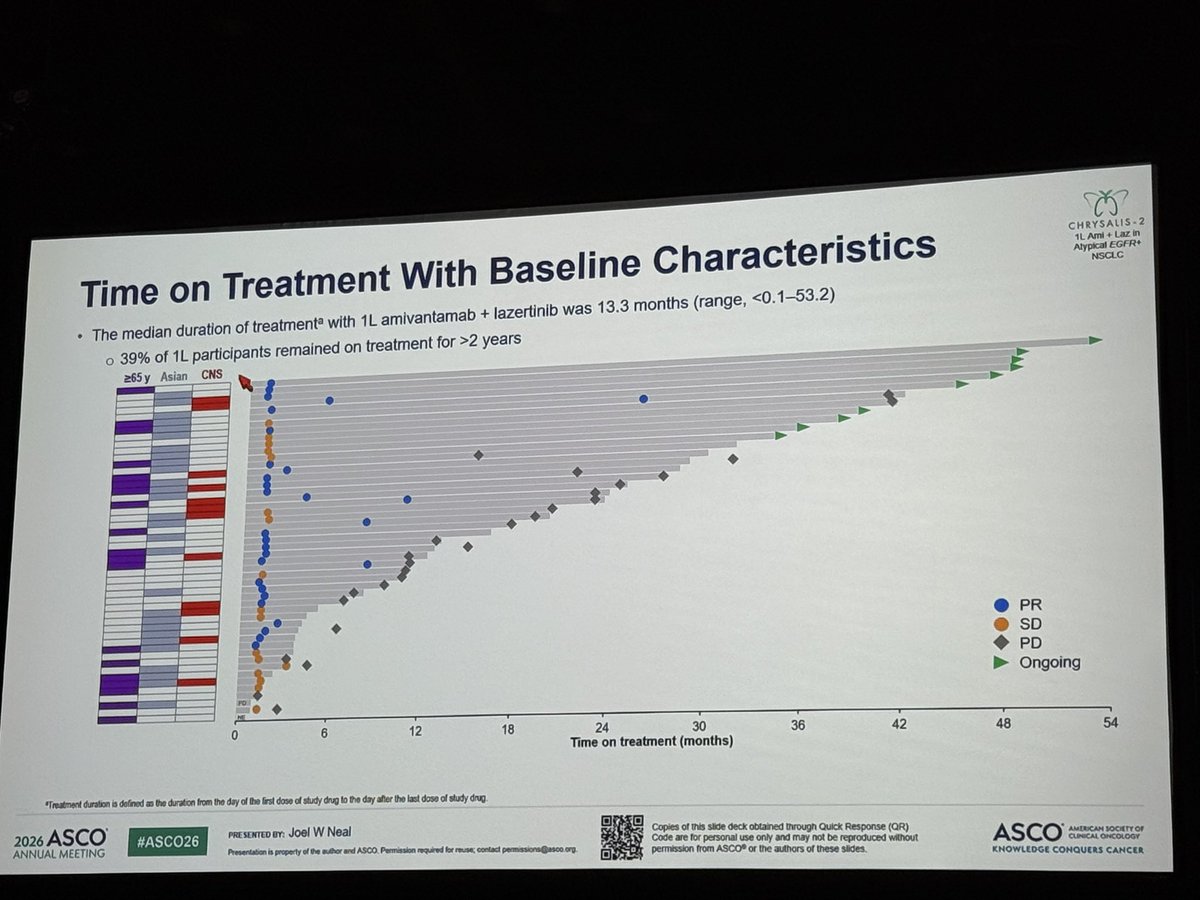
TL;DRMedian OS 41.0 mo (95% CI 27.7-NE) with 1L amivantamab + lazertinib in atypical EGFR-mutant NSCLC, single-arm n=49.
In treatment-naive advanced NSCLC with an atypical EGFR mutation, this supports amivantamab plus lazertinib as a prospectively benchmarked option where none is established; it does not extend to classical exon 19del/L858R disease or exon 20 insertions.

+1 more figure
8 details 3 trials watching
Single-arm expansion cohort of the CHRYSALIS-2 program, n=49, 1L atypical EGFR-mutated advanced NSCLC. Median follow-up 31.3 mo. No randomised comparator arm.
Treatment-naive advanced NSCLC harbouring an atypical (uncommon) EGFR mutation. Baseline strata shown on the swimmer plot include age ≥65y, Asian ancestry and CNS involvement; per-stratum counts are not reported in source.
IV amivantamab (EGFR/MET bispecific) plus lazertinib (third-generation EGFR TKI). No chemotherapy backbone. Median duration of treatment 13.3 months (range <0.1-53.2), with 39% of 1L participants still on treatment beyond 2 years.
Median OS 41.0 mo (95% CI 27.7-NE), described by the presenters as roughly 3.5 years. The upper CI bound is not estimable, so the point estimate is anchored on the lower bound of 27.7 mo.
Reported only as consistent with prior reports, no new safety signals with longer follow-up. No grade 3+ rates, infusion-reaction rates or dermatologic AE rates appear in the source.
The atypical EGFR label pools biologically distinct alterations (G719X, S768I, L861Q and compound variants) whose single-agent TKI sensitivity differs; n=49 cannot resolve per-variant benefit, and the curator's read of no variant-outcome association is an absence of signal in a small cohort, not evidence of uniformity. No comparator, so the 41.0 mo median cannot be positioned against afatinib or osimertinib series in the same population.
Atypical EGFR is the part of the EGFR-mutant space where no regimen is settled, so a 41.0 mo median in 49 pts is meaningful as a benchmark even without randomisation. The practical question this leaves open is whether the bispecific's added toxicity and IV schedule are justified over an oral TKI alone, which this design cannot answer.
Single-arm n=49 expansion cohort, no randomised comparator against afatinib or osimertinib in atypical EGFR. Maturity gate: single-arm never reaches confirmatory.
- Doublet vs single-agent osimertinib or afatinib in atypical EGFR n=480 · primary completion 2029-02 · phase 3 firmonertinib vs osimertinib/afatinib, PACC 1L
- Which atypical EGFR variants drive the durable-response tail
- Whether subcutaneous amivantamab preserves efficacy with less infusion burden n=418 · primary completion 2024-01 · phase 3 SC vs IV ami + lazertinib, randomisedrecruiting A Study of Amivantamab in Participants With Advanced or Metastatic Solid Tumors Including Epidermal Growth Factor Receptor (EGFR)-Mutated Non-Small Cell Lung Cancer Phase 2n=520 · primary completion 2027-08 · SC co-formulation activity + safety cohorts
📚 Sources · 🐦 1 tweet
Amivantamab + lazertinib achieved a median OS of 41.0 months in treatment-naïve atypical EGFR-mutant NSCLC, with no clear association between EGFR variant subtype and outcome. A compelling option. Meanwhile, amivantamab continues evaluation across multiple tumor types. #ASCO26 pic.twitter.com/aWn3Ja60Ji
— Chul Kim (@chulkimMD) May 29, 2026
ESAONA
For1L EGFR-mutant NSCLC with brain metastases
95.5% vs 79.6%
p = 0.0004
TL;DRiORR 95.5% vs 79.6% (p=0.0004) and intracranial PFS HR 0.46 favoring asandeutertinib in 1L EGFR-mutant NSCLC with brain mets.
The RT-relevant number is intracranial PFS: median not reached vs 17.5 mo, HR 0.46. If a first-line TKI holds CNS disease that long, the deferral-of-brain-RT window widens, but the source reports no prior-RT stratification, no CNS-RT use by arm, and no lesion size or symptom criteria, so this cannot yet gate an SRS-versus-defer decision.
In treatment-naive EGFR-mutant NSCLC with asymptomatic brain metastases, this supports the case for TKI-first CNS control as a hypothesis, not a change in practice; it says nothing about symptomatic or large lesions where local therapy is already indicated.
Intracranial PFS median not reached vs 17.5 mo, HR 0.46, is the number that touches the SRS-timing decision in asymptomatic brain mets. The source gives no prior-RT stratification and no salvage-RT rates by arm, so the deferral question stays open rather than answered.
The intracranial effect (HR 0.46) is roughly double the systemic one (HR 0.64), so the case for asandeutertinib rests on CNS penetration rather than broad potency. Serious TRAEs run 10.8% vs 7.1%, a real but modest trade against a phase II endpoint with no OS.

| Endpoint | Asandeutertinib (n=111) | Osimertinib (n=113) | Effect |
|---|---|---|---|
| Intracranial ORR (BICR) | 95.5% (89.8-98.5) | 79.6% (71.0-86.6) | p = 0.0004 |
| Intracranial PFS (BICR) | Median not reached | 17.5 mo (15.18-NA) | HR 0.46, p = 0.0020 |
| Overall PFS (BICR) | Median not reached | 17.2 mo (15.18-19.55) | HR 0.64, p = 0.0473 |
| Any TRAE | 99.1% | 95.6% | n/a |
| Serious TRAE | 10.8% | 7.1% | n/a |
7 details 4 trials watching
Randomised phase II, N=224, asandeutertinib (n=111) vs osimertinib (n=113). Endpoints read by BICR. Follow-up duration, stratification factors and alpha allocation are not reported in the source slide.
First-line EGFR-mutated NSCLC with brain metastases. The source does not state lesion number, size, symptom status, or whether prior CNS radiotherapy was permitted, which is the eligibility gate an RT reader needs.
Intracranial ORR by BICR is the headline, with intracranial PFS and overall PFS reported alongside. No overall survival data in source.
Any TRAE 99.1% vs 95.6%; serious TRAE 10.8% vs 7.1%. The excess serious-event rate is small in absolute terms but sits on a phase II denominator, and no organ-level breakdown is given in source.
The intracranial separation (HR 0.46) is larger than the systemic one (HR 0.64), which points at CNS penetration rather than a general potency gain as the mechanism. For radiation oncology the question is whether that CNS margin is durable enough to defer SRS in asymptomatic pts; a phase II with unreached medians and no OS cannot answer it.
CONSORT flow
Phase II, conference-slide source only; no OS, borderline overall-PFS p, and no reported CNS-RT or prior-RT stratification. Needs phase III before displacing osimertinib.
- Does intracranial PFS benefit translate to overall survival
- Salvage brain RT and SRS rates by arm recruiting Observation or Upfront Cranial RT in Oncogene Mutated NSCLC With Asymptomatic BM: A Phase III RCT Phase 3n=190 · primary completion 2025-12 · randomises upfront SRS/WBRT vs TKI alone, asx BMrecruiting A Study of Stereotactic Radiosurgery (SRS) and Standard Treatment in People With Lung Cancer That Has Spread to the Brain Phase 2n=56 · primary completion 2027-12 · SRS after 3mo osimertinib vs osimertinib alonerecruiting Early or Delayed Intervention of Brain Radiotherapy Combined With Almonertinib in EGFR Mutated NSCLC With Brain Metastases Phase 3n=232 · primary completion 2028-12 · early vs delayed SRS timing on 3G TKI, phase 3
- Activity in symptomatic or leptomeningeal CNS disease recruiting A Clinical Trial of Furmonertinib Combined With Anlotinib as First-line Treatment for Advanced NSCLC With EGFR-sensitive Mutations and Brain Metastasis Phase 2n=146 · primary completion 2027-09 · 1L 3G TKI + anlotinib, brain/LM mets at dx
📚 Sources · 🐦 1 tweet
#ASCO26 🧠🌍
— Dr Rishabh Jain (@DrRishabhOnco) May 30, 2026
Could a next-generation EGFR TKI outperform osimertinib in patients with brain metastases?
The phase II ESAONA trial suggests the answer may be yes.
🧪 LBA2007 | ESAONA
1L EGFR-mutated NSCLC with brain metastases
👥 n=224
⚔️ Asandeutertinib vs Osimertinib
Key… https://t.co/mEOKGNKgf7 pic.twitter.com/pUQuH6i2cV
OptiTROP-Lung05 NCT06448312
For1L stage IIIB-IV NSCLC, PD-L1 TPS ≥1%, EGFR/ALK wild-type, ECOG 0-1
HR 0.35
95% CI 0.26-0.47, p<0.0001; NR vs 5.7 mo
TL;DRmPFS NR vs 5.7mo, HR 0.35 (0.26-0.47) for sac-TMT + pembro in 1L PD-L1+ NSCLC.
In treatment-naive PD-L1 TPS ≥1% advanced NSCLC without EGFR/ALK alteration, this supports a TROP2 ADC plus pembro as a chemo-free option worth watching; it does not address pts already committed to pembro plus platinum chemo, nor PD-L1-negative disease.

| Arm | PFS events, n (%) | Median PFS, mo (95% CI) | HR (95% CI) |
|---|---|---|---|
| Sac-TMT + Pembro (n=208) | 66 (31.7) | NR (13.6, NE) | 0.35 (0.26, 0.47), p<0.0001 |
| Pembro (n=205) | 128 (62.4) | 5.7 (4.3, 7.0) | n/a |
+3 more figures

| PD-L1 stratum | Sac-TMT + Pembro median, mo | Pembro median, mo | HR (95% CI) |
|---|---|---|---|
| TPS ≥50% | NR (NE, NE) | 9.5 (6.9, 13.8) | 0.47 (0.29, 0.77) |
| TPS 1-49% | NR (11.1, NE) | 4.3 (2.9, 5.5) | 0.28 (0.19, 0.41) |

| Arm | OS events, n (%) | Median OS, mo (95% CI) | HR (95% CI) |
|---|---|---|---|
| Sac-TMT + Pembro (n=208) | 33 (15.9) | NR (NE, NE) | 0.55 (0.36, 0.85) |
| Pembro (n=205) | 54 (26.3) | NR (NE, NE) | n/a |

13 details 3 trials watching
Randomized, multicenter, open-label phase 3 (NCT06448312), 1:1, N=413. Stratified by histology (squamous vs non-squamous), PD-L1 TPS (1-49% vs ≥50%), and ECOG (0 vs 1). Median follow-up 10.5 months at this analysis.
Locally advanced stage IIIB/IIIC or metastatic stage IV NSCLC with no prior systemic antitumor therapy. Required PD-L1 TPS ≥1% by IHC 22C3 central lab, no sensitizing EGFR or ALK alteration, ECOG 0 or 1.
Sac-TMT 4 mg/kg Q2W plus pembrolizumab 400 mg versus pembrolizumab 400 mg Q6W alone, until progression or unacceptable toxicity. Pembro was capped at a maximum of 18 cycles in both arms. One pt in the pembro group never received assigned treatment.
Primary: PFS by BICR. Key secondary: OS. Other secondary: investigator-assessed PFS, ORR, DCR, DOR, safety. The updated efficacy boundary at the actual 194 PFS events was 0.0174 (2-sided).
PFS crossed its boundary at p<0.0001. OS was descriptive at the PFS interim, HR 0.55 (0.36, 0.85) with both medians not reached and only 33 vs 54 deaths.
The pembro-alone control performed as expected for an all-comers TPS ≥1% population, with the TPS ≥50% arm reaching 9.5 mo and the TPS 1-49% arm 4.3 mo, consistent with the KEYNOTE-042 signal that low-expressors gain least from single-agent IO. This is the setting where chemo-IO has historically been chosen, so the trial tests whether an ADC can occupy that slot instead of platinum doublet chemotherapy.
No toxicity data in the source, which is the decisive missing piece for a doublet whose entire premise is avoiding chemotherapy. The comparator is pembro monotherapy rather than the chemo-IO most oncologists actually give at TPS 1-49%, so the PFS gap partly measures a weak control rather than a strong experimental arm.
An HR of 0.35 with a median not reached is a large PFS effect, and the OS point estimate moves in the same direction, but neither settles whether sac-TMT plus pembro beats the regimen it would actually replace. The larger effect in TPS 1-49% (HR 0.28) than TPS ≥50% (HR 0.47) is the expected pattern when the control arm is weakest in the low-expressors, not evidence of a biomarker-selected ADC effect.
CONSORT flow
PFS interim of an open-label phase 3; OS descriptive at 10.5 mo f/u with both medians NR. No safety data in source, and no comparison vs pembro + chemo.
- Benefit vs pembrolizumab plus platinum chemotherapy, the real-world comparator n=614 · primary completion 2028-01 · phase 3 sac-TMT + pembro vs pembro alone, TPS >=50%, OSrecruiting Pembrolizumab With or Without Maintenance Sacituzumab Tirumotecan (Sac-TMT; MK-2870) in Metastatic Squamous Non-small Cell Lung Cancer (NSCLC) [MK-2870-023] Phase 3n=851 · primary completion 2029-01 · 1L sq NSCLC: pembro + platinum backbone, sac-TMT maint
- Safety and ILD rates of sac-TMT combined with pembrolizumab n=30 · primary completion 2026-12 · phase 1 safety/tolerability of sac-TMT + pembro
- Whether the OS signal holds at the final prespecified analysis
📚 Sources · 🐦 2 tweets
Right patient. Right treatment. Right timing.
— Yakup Ergün (@dr_yakupergun) May 30, 2026
The result: curves like these👇#ASCO26 https://t.co/72KByLKz90
🔁REVIEW #ASCO26 #LCSM Oral
— Hidehito HORINOUCHI (@HHorinouchi) May 30, 2026
🔥OptiTROP-Lung05: 1L Sac-TMT + Pembro vs Pembro in PD-L1+ NSCLC
✅mPFS NR vs 5.7m (HR 0.35)
✅ORR 70.2% vs 42.0%
✅OS HR 0.55 (95%CI 0.36-0.85, immature)
🎙️Dr. Caicun Zhou
🔗 https://t.co/DcbK1dGrhO@OncoAlert @Larvol @ASCO @IASLC https://t.co/512k6dZviW pic.twitter.com/Vdo86N50h9
NRG/RTOG 9804 + E5194 combined analysis
ForGood-risk DCIS post-lumpectomy, low/int grade, ≤2.5 cm, margins ≥3 mm, no RT
TL;DR15yr IBR 11.4% vs 19.0% with tamoxifen after lumpectomy alone in good-risk DCIS; MVA HR 0.54 for any IBR.
For the RT-omission conversation this is the other half of the ledger: in the same good-risk cohort 9804 randomized to RT, endocrine therapy alone carried 15-yr IBR 11.4% vs 19.0%, and the benefit sits entirely on invasive IBR (HR 0.43) rather than DCIS-IBR (P=.089). No RT-vs-tamoxifen comparison is reported in source, so this sizes the alternative, it does not substitute for it.
For the patient with low/intermediate-grade DCIS ≤2.5 cm and ≥3 mm margins who has already declined radiotherapy, this quantifies what endocrine therapy adds over surveillance alone at 15 years; it does not inform high-grade, larger, or close-margin DCIS, nor patients receiving RT.
This sizes the non-RT alternative in the very cohort 9804 randomized to RT or observation: 15-yr IBR 11.4% vs 19.0%, with the effect concentrated on invasive IBR (HR 0.43) and absent for DCIS-IBR (P=.089). No RT-versus-tamoxifen comparison exists in source, so it informs the omission discussion without answering it.
Endocrine therapy in good-risk DCIS buys a 46% relative reduction in any IBR (HR 0.54) and 57% in invasive IBR at a median 14.85 years, but the source gives no ER status, duration or adherence data, so the number cannot be gated to a receptor-defined subgroup. Uptake was only 43.1%, itself non-random.
Margin and excision quality track with the exposure rather than being controlled for it: tamoxifen users more often had a negative re-excision (27.2% vs 10.6%) and size ≤5 mm (57.0% vs 41.3%). For a surgeon this reinforces that the ≥3 mm margin plus small low/intermediate-grade lesion is the substrate on which these 15-year numbers rest.
9 details 3 trials watching
Ancillary exploratory combined analysis of two cooperative-group datasets, not a new randomization. Tamoxifen use was optional in both parent trials, so the tamoxifen comparison is observational; Fine-Gray univariate and multivariable models were used for the competing-risk endpoints.
N=878: the non-RT arm of NRG/RTOG 9804 (n=317) plus the good-risk cohort of E5194 (n=561). Good-risk was defined identically across both: low- or intermediate-grade DCIS, ≤2.5 cm, margins ≥3 mm. Median age 59 (28-88).
Lumpectomy alone without radiotherapy, with or without tamoxifen by patient/physician choice. Overall uptake 43.1%, but lopsided by trial: 65.6% in NRG/RTOG 9804 versus 30.3% in E5194.
No radiotherapy in any analyzed patient by design: the 9804 contribution is its observation arm and E5194 was a non-RT cohort. The result therefore describes the population in which a reader has already elected RT omission.
IBR, invasive IBR, DCIS-IBR, contralateral breast event and overall survival, compared between tamoxifen groups. Median follow-up 14.85 years overall (13.87 in 9804, 16.15 in E5194); 15.92 years among those still alive.
117 IBR events (65 invasive, 52 DCIS). 15-yr IBR 11.4% (7.9-15.5) with tamoxifen vs 19.0% (15.3-22.9) without, P=.001. On multivariable analysis HR 0.54 (0.35-0.83) for any IBR and HR 0.43 (0.24-0.77) for invasive IBR; DCIS-IBR was not significantly reduced (P=.089).
Beyond the non-randomized exposure, the tamoxifen groups differ on the axes that predict recurrence: trial of origin (55.0% vs 21.8% from 9804), negative re-excision (27.2% vs 10.6%) and size ≤5 mm (57.0% vs 41.3%). Duration of tamoxifen, adherence and receptor status are not given in the source, so a dose- or ER-defined read is unavailable.
The split between a significant invasive-IBR reduction and a null DCIS-IBR effect is the part worth carrying: it argues the drug is acting on the events that carry downstream consequence rather than uniformly suppressing recurrence. Whether that separation is biology or a power artifact of 52 DCIS events is not settled here.
NRG/RTOG 9804 itself established that RT reduces IBR in this same good-risk cohort, so the field now has magnitudes for both omission levers in one population. The source reports no direct RT-versus-tamoxifen comparison, and the pooled cohort cannot supply one.
Tamoxifen was optional and unrandomized in both parent trials; users differed on trial of origin, re-excision status and pathologic size, so confounding by indication is unadjustable away.
- Whether the invasive-only benefit reflects biology or DCIS-event power
- Optimal tamoxifen duration in RT-omitted good-risk DCIS active Trial of Low Dose Tamoxifen in Women With Breast Intraepithelial Neoplasia - Long Term Follow-up Phase 3n=500 · primary completion 2022-12 · tamoxifen 5mg/d vs placebo in ER+ DIN, long-term
- Whether ER status selects who benefits in DCIS recruiting DCIS: RECAST Trial Ductal Carcinoma In Situ: Re-Evaluating Conditions for Active Surveillance Suitability as Treatment Phase 2n=400 · primary completion 2028-11 · randomised endocrine agents in HR+ DCIS onlynot yet Avoiding Surgery in Estrogen Receptor Positive Atypical Ductal Hyperplasia and In-situ Carcinoma Treated With Endocrine Treatment Trial Phase NAn=340 · primary completion 2032-12 · ER+ DCIS/ADH, 5y invasive IBC on endocrine alone