Thoracic / Lung
Tarlatamab moves into 1L ES-SCLC maintenance; ultra-central SBRT pooled G5 toxicity sits at 4%, mostly hemoptysis.
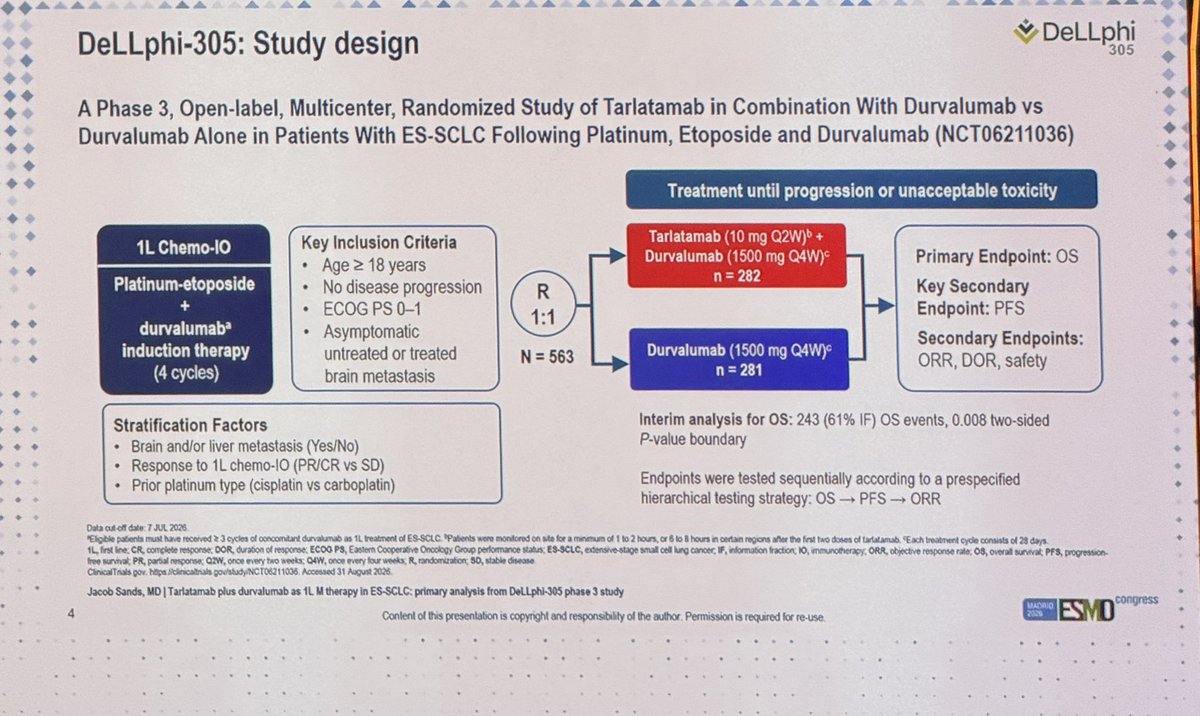
DeLLphi-305 NCT06211036
ForES-SCLC, no progression after 1L platinum-etoposide + durvalumab, ECOG 0-1
HR 0.42
95% CI 0.32-0.54, P<0.001; mOS 21.1 vs 12.7 mo
TL;DRmOS 21.1 vs 12.7 mo, HR 0.42 (0.32-0.54), adding tarlatamab to durvalumab 1L maintenance in ES-SCLC after chemo-IO induction.
Asymptomatic untreated brain mets were eligible and brain/liver mets were a stratification factor, so a cranial-disease subgroup read should exist; it is not in the source. The source also does not state whether consolidative thoracic RT or PCI was permitted, which gates how this maintenance backbone integrates with RT consolidation in ES-SCLC.
In ES-SCLC with no progression after 4 cycles of platinum-etoposide + durvalumab and ECOG 0-1, including asymptomatic brain mets, this supports adding tarlatamab to durvalumab maintenance; it does not inform pts who progressed on induction or ECOG ≥2. The longer read
Adds a BiTE to durvalumab maintenance with an OS HR of 0.42 and mOS 21.1 vs 12.7 mo, moving tarlatamab from later-line into 1L maintenance for induction nonprogressors. The post-dose monitoring requirement (1-2h, 6-8h in some regions) is an operational cost to plan for; AE rates are not in the source.

| Metric | Tarlatamab + Durvalumab (n = 282) | Durvalumab (n = 281) |
|---|---|---|
| Median OS, mo (95% CI) | 21.1 (20.8-NE) | 12.7 (11.2-14.8) |
| Median FU, mo | 15.9 | 16.1 |
| HR (95% CI); P | 0.42 (0.32-0.54); P < 0.001 | ref |
+2 more figures

10 details 1 trial watching
Phase 3, open-label, multicenter, randomized 1:1, N=563. OS interim analysis at 243 events (61% IF), two-sided boundary 0.008. Data cutoff 7 Jul 2026.
ES-SCLC after 4 cycles platinum-etoposide + durvalumab induction with no disease progression, ECOG PS 0-1, age ≥18. Asymptomatic untreated or treated brain mets allowed.
Tarlatamab 10 mg Q2W + durvalumab 1500 mg Q4W vs durvalumab 1500 mg Q4W alone, 28-day cycles, until progression or toxicity. On-site monitoring 1-2h (6-8h in some regions) after early tarlatamab doses.
Primary: OS. Key secondary: PFS. Secondary: ORR, DOR, safety. Tested hierarchically OS → PFS → ORR.
mOS 21.1 vs 12.7 mo, HR 0.42 (0.32-0.54), P<0.001; PFS 7.4 vs 1.9 mo, HR 0.34 (0.28-0.42); ORR 26% vs 4%.
| Endpoint | Tarlatamab + durvalumab | Durvalumab | Effect |
|---|---|---|---|
| Median PFS | 7.4 mo | 1.9 mo | HR 0.34 (0.28-0.42), P<0.001 |
| ORR | 26% | 4% | n/a |
Control arm is the current chemo-IO maintenance standard established by CASPIAN-era durvalumab, so the comparator is contemporary. Tarlatamab previously moved into later lines (DeLLphi-304); this trial tests it earlier, in the maintenance window.
Efficacy stop at 61% IF risks an inflated HR; median FU ~16 mo leaves the OS tail unknown. No safety data in source, and thoracic RT/PCI permissibility not stated.
A BiTE added at the point of maximal disease control nearly halves the death hazard over durvalumab alone. Unsettled: toxicity cost, durability beyond the interim, and integration with consolidative RT.
CONSORT flow
Randomized phase 3, OS primary met at prespecified interim boundary, labeled primary analysis; source calls it a game-changer. Safety data absent from source.
- Role of consolidative thoracic RT alongside tarlatamab maintenance
- OS durability with follow-up beyond the interim analysis
- Benefit and safety in pts with brain metastases n=35 · primary completion 2029-02 · ph2 tarlatamab intracranial efficacy, active SCLC brain mets
📚 Sources · 🐦 1 tweet
💥Game-changer in small cell #lungcancer! #ESMO26 LBA3 DeLLphi-305: Tarlatamab + durvalumab vs durvalumab 1L maintenance in ES-SCLC (n=563) after chemo-IO. Median OS ⬆️ 21.1 vs 12.7 mo (HR 0.42), PFS ⬆️7.4 vs 1.9 mo (HR 0.34), ORR 26% vs 4%. ☢️44% of pts still on T+D due to… pic.twitter.com/zwBot7Pt3N
— Shankar Siva (@_ShankarSiva) October 24, 2026
SBRT for Ultra-Central Lung Tumors Meta-Analysis
ForUltra-central lung tumors (primary NSCLC or mets), PTV abutting/overlapping PBT
TL;DRPooled 1-yr LC 92% and 2-yr LC 89% after ultra-central lung SBRT; G5 toxicity 4%, mostly hemoptysis, across 27 mostly retrospective studies.
The toxicity signal follows PBT hot spots, not the prescription: HILUS's 15% G5 came with a 67% IDL and median main bronchus Dmax 97 Gy. ISRS response: prescribe to 80-85% IDL, cap PBT Dmax at 133-150 Gy BED3 (EQD23 80-90 Gy), undercover PTV before overdosing airway.
In an ultra-central lung tumor without endobronchial extension or ILD, this supports 60 Gy/8 or 60 Gy/15 with a strict PBT hot-spot limit; it does not extend to endobronchial disease, where ISRS favors 60 Gy/15 with PBT Dmax <100 Gy BED3. The longer read
Airway hot spots drive fatal toxicity: HILUS's 15% G5 came with a 67% IDL and median main bronchus Dmax 97 Gy. ISRS asks for 80-85% IDL prescriptions, PBT Dmax <133-150 Gy BED3, and 60 Gy/15 with PBT Dmax <100 Gy BED3 for endobronchial disease.
Concurrent systemic agents are a modifiable risk: VEGF inhibitor within 30 days of SBRT carried fatal hemoptysis HR 16.9 in one 88-pt series. ISRS asks for 3-4 wk around VEGF inhibitors, 2-3 days for targeted agents, ≥2 days for IO, and holding antiplatelet/anticoagulation when safe.
14 details 4 trials watching
Systematic review and meta-analysis (PRISMA/MOOSE) of 27 studies, 1183 pts, published 2010-2022; random-effects pooling with meta-regression. All retrospective except HILUS (prospective phase II); none randomized. Median f/u ranged 7.6-44.5 mo.
Ultra-central lung tumors treated with SBRT (≥5 Gy/fx, photons), ≥5 eligible lesions per study. Excluded reirradiation and hilar/mediastinal nodal targets. Histology mixed; 9 studies (33%) were entirely primary NSCLC.
Dose 30-70 Gy in 3-10 fx, most often 50 Gy/5, 60 Gy/8, 60 Gy/12. Motion management in 96% of studies, mostly 4DCT. OAR dosimetry reporting was variable.
1-yr LC 92% (95% CI 86-96), 2-yr LC 89% (82-94); primary NSCLC subset 95% at both timepoints. Higher BED tracked with 1-yr LC (HR 2.14, p=0.03), not 2-yr (p=0.66).
| Endpoint | Pooled | 95% CI | Range | I² |
|---|---|---|---|---|
| 1-yr LC (21 studies) | 92% | 86-96 | 54-100% | 93.2% |
| 2-yr LC (19 studies) | 89% | 82-94 | 57-100% | 94.3% |
| Any G3-4 toxicity | 6% | 3-10 | 0-35% | 71% |
| Any G5 toxicity | 4% | 2-6 | 0-22% | 68% |
| G5 hemoptysis | 1% | 0-3 | 0-15% | 65% |
| G3-4 pneumonitis | 1% | 0-2 | 0-11% | 5% |
| Category | Recommendation |
|---|---|
| Delivery/dosing | 60 Gy/8 or 60 Gy/15; prescribe to 80-85% IDL; global Dmax far <150% |
| PBT constraint | Dmax <133-150 Gy BED3 (EQD23 <80-90 Gy); lower if risk factors or near trachea/main bronchi |
| Antiplatelet/anticoagulation | Hold when pausing is low-risk; else de-escalate PBT Dmax or use non-SBRT schedule |
| Targeted/IO | Gap 2-3 days targeted, 3-4 wk VEGF inhibitors, ≥2 days IO |
| Endobronchial tumor | Non-SBRT (60 Gy/15); PBT Dmax <100 Gy BED3 (EQD23 <60 Gy) |
| ILD | Lung V20 <10% strict cutoff; treat on trial |
Any G3-4 6% (3-10), any G5 4% (2-6), G5 hemoptysis 1% (0-3). G5 ≥10% in 7 studies; HILUS 15%. Risk factors: endobronchial tumor, antiplatelet/anticoagulant use, VEGF inhibitor within 30 days (HR 16.9), ILD.
Pooled 2-yr LC sits beside RTOG 0813 (89.4% in central/UC tumors). A prior 250-pt systematic review reported higher toxicity (treatment-related mortality 5%, G≥3 10%); the authors attribute the lower rates here to more contemporary, conformal series.
Fig 3 dose-event mapping drew on only 37 events from 9 studies, and PBT substructure dosimetry was rarely reported, so constraints beyond HILUS's could not be derived. Toxicity attribution in retrospective series is open to misclassification.
Efficacy is not the question; airway dose is. The ISRS constraint (PBT Dmax <133-150 Gy BED3) is built from cross-series convergence of fatal-hemoptysis doses, not a modeled threshold, and is pending SUNSET and LUNGTECH.
Pooled retrospective series (one prospective, none randomized) with I² >90% for LC, publication bias on every endpoint, and inconsistent ultra-central definitions. Guideline layer is expert opinion.
- Safe PBT dose limits by substructure (trachea, main vs lobar bronchi)
- Prospective toxicity of 60 Gy/8 vs 60 Gy/15 for ultra-central tumors n=30 · primary completion 2021-04 · phase 1 escalation from 60 Gy/8, G3 toxicity endpoint
- Role of MR-guided adaptive SBRT for ultra-central targets recruiting MR-informed Stereotactic Radiotherapy for Treatment of Ultracentral Lung Tumours Utilising a Dedicated MR-simulator for Daily Adaptation Followed by CBCT-guided Treatment Delivery Phase NAn=11 · primary completion 2028-12 · MR-sim daily adaptation, CBCT delivery, ultracentralactive Magnetic Resonance Guided Adaptive Stereotactic Body Radiotherapy for Lung Tumors in Ultracentral Location Phase 1n=38 · primary completion 2030-11 · phase 1 MTD of MR-linac SBRT, daily plan adaptationnot yet Multicentre Phase II Trial Evaluating Stereotactic Body Radiotherapy on Ultra-central Lung Tumors on MR-Linac Phase NAn=59 · primary completion 2031-11 · multicentre MR-linac SBRT safety, ultracentral tumors