Palliative
USPCC 2026 Point-Counterpoint: PSMA PET Response Assessment in APMR
ForAPMR / mCRPC starting ARSI or bipolar androgen therapy, serial PSMA PET considered
TL;DRHigh vs low δ-percent SUVmax carried HR 5.03 (1.17-21.65) for OS; δ-absolute SUVmax HR 9.31 (1.81-47.87).
Reported via UroToday →
The prognostic separation is real but the direction of uptake change is the confound: ADT and ARSI can raise PSMA expression independent of burden, so a flare on restaging PET after starting an ARSI is not evidence to abandon a planned metastasis-directed course. Timing of the post-treatment scan relative to systemic therapy start is the parameter that gates interpretation.
In APMR pts imaged shortly after starting abiraterone, enzalutamide, or bipolar androgen therapy, rising PSMA uptake does not reliably separate progression from AR-driven expression change; it does not speak to baseline staging PET, where the evidence base is separate.
Metastasis-directed therapy decisions increasingly rest on restaging PSMA PET. If that scan follows ARSI initiation, increased lesion avidity may reflect AR-driven PSMA upregulation rather than new disease, so scan timing relative to systemic therapy start gates whether the images should redirect a planned SBRT course.
Post-ARSI uptake change stratifies outcomes (DPSM HR 5.03, DASM HR 9.31 for OS) but was measured in 16 pts, and rising uptake at 2-4 months does not establish treatment failure. Time to therapy change should still be driven by PSA and conventional imaging.
9 details 5 trials watching
A point-counterpoint conference presentation, arguing the negative position. The evidence marshalled is three published studies: a prospective single-arm imaging trial (n=16 evaluable), a bipolar androgen therapy series (n=6), and the RECIP 1.0 framework paper.
The anchor trial enrolled pts with APMR starting abiraterone or enzalutamide, imaged with 18F-DCFPyL PET/CT immediately before therapy and again at 2-4 months. The BAT series imaged at baseline and 3 months.
Prognostic separation was consistent across both quantitative stratifiers, with DPSM HR 5.03 (95% CI 1.17-21.65) and DASM HR 9.31 (95% CI 1.81-47.87) for overall survival. A mixed but predominantly increased uptake pattern marked the shorter time to therapy change.
| Stratifier | Median time to therapy change | Median OS | p (TTC / OS) |
|---|---|---|---|
| Low DPSM | 12.2 mo (11.3-NA) | 37.2 mo (28.9-NA) | reference |
| High DPSM | 6.5 mo (4.6-NA) | 17.8 mo (13.9-NA) | 0.0001 / 0.02 |
| Low DASM | 12.2 mo (11.3-NA) | NA (37.2-NA) | reference |
| High DASM | 6.9 mo (6.1-NA) | 17.8 mo (13.9-NA) | 0.003 / 0.002 |
RECIP 1.0 is the field's standardization attempt, categorizing PD/PR/SD/CR by combining PSMA PET with CT, but it was derived in the radioligand therapy setting and its transfer to AR-directed therapy is exactly what Rowe argues is unestablished.
Beyond the small samples, the measurement layer itself is unvalidated: repeatability work using Bland-Altman, ICC, and within-subject coefficient of variation found lesion identification and segmentation variability material even above 1.5 cm³. A biomarker whose test-retest behaviour is uncertain cannot support a serial-change decision rule.
The talk separates two claims that often get merged: that post-therapy PSMA PET change is prognostic, which the data support, and that it is a valid response assessment, which requires reproducibility and a therapy-independent relationship between uptake and burden. Prognostic value in a 16-patient series does not license per-patient treatment decisions.
Conference position talk, not a result. Its supporting datasets are n=16 and n=6 prospective series; no comparative design establishes or refutes PET response assessment.
- Kinetics of AR-axis therapy effects on PSMA expression recruiting Assessing Efficacy of Neoadjuvant ADT in Localized High-Risk Prostate Cancer Patients Utilizing 18F-Flotufolastat PSMA PET/CT Phase 2n=50 · primary completion 2030-02 · PSMA PET before and after neoadjuvant ADT, pre-RPrecruiting PSMA PET for Treatment Response evaLuation of systemIC Therapies in prostAte caNcer (PELICAN)n=1300 · primary completion 2034-04 · SUVmax/SUVmean on PSMA PET pre-abiraterone, n=1300
- Repeatability thresholds for SUV and lesion segmentation
- RECIP validation outside radioligand therapy not yet Prognostic Value of 177Lutetium-PSMA Single Photon Emission Tomography and Timing of Responsen=280 · primary completion 2026-09 · RECIP 1.0 by SPECT at cycle 2, not PETn=27 · primary completion 2027-07 · PSMA PET response endpoint after RT plus ADT/ARPIrecruiting Phase II Non-Randomized Study Evaluating POSLUMA-PSMA PET Response After Oligo- Metastatic/Progressive-directed Treatment With Radiotherapy (PROMPT-R) Phase 2n=50 · primary completion 2028-05 · PSMA PET response 6/12mo after ablative RT
📚 Sources · 📄 1 paper
Abstract
Consolidative TRT + Atezolizumab Maintenance in ES-SCLC NCT04462276
ForES-SCLC with ≥SD after carbo-etoposide-atezolizumab induction, unselected
6.7 vs 13.4 mo
HR 1.55 (95% CI 0.90-2.69), P = .34; primary end point not met
TL;DRPrimary EP missed: mOS 6.7 vs 13.4mo (HR 1.55, P=.34) with consolidative 30Gy/10fx; trial halted for fatal SAEs.
The failure is toxicity, not tumor control: PFS was identical (2.4 vs 2.6 mo) while fatal AEs hit 19.4% vs 3.0%, and TRT carried an AE HR of 2.47 (1.15-5.32). Dose was modest (30 Gy/10 fx, postinduction volumes, below OAR thresholds), so de-escalating the plan is not the obvious fix; baseline DLCO SB and radiation-induced lymphopenia are the selection levers.
In unselected ES-SCLC responding to chemoimmunotherapy, this argues against offering consolidative thoracic RT during atezolizumab maintenance off-trial, particularly with low baseline DLCO; it says nothing about limited-stage disease or thoracic RT given without concurrent IO maintenance.
The dose was already conservative (30 Gy/10 fx, postinduction volumes, below OAR thresholds) and no dosimetric parameter tracked with serious events, so de-escalating the plan is not an obvious mitigation. Concurrent vs sequential timing did not change AE risk either. Selection (baseline DLCO SB 45.3 vs 56.7 in fatal-AE pts) and lymphocyte-sparing planning are the live levers.
Arm B's mOS of 13.4 mo and 56.6% 1-yr OS beat the IMpower133 atezolizumab benchmark, so maintenance alone was performing normally and the detriment is attributable to the added modality. TRT carried an AE HR of 2.47 (1.15-5.32) while longer atezolizumab exposure did not, which supports continuing maintenance unmodified rather than adding thoracic RT off-trial.
12 details 5 trials watching
Multicenter open-label phase 2 randomized trial (TREASURE, AIO-TRK-0320) at 20 sites in Germany and Austria, accrual September 2020 to August 2022, follow-up to September 2024, database lock April 2025, post hoc OS update April 2026. Planned 104 randomized for 80% power on a 20% absolute 12-month OS improvement; halted at 68 on SMC recommendation.
ES-SCLC with at least stable disease after induction carboplatin-etoposide-atezolizumab. 34 per arm, mean age 63.3 vs 65.6 y, 63.2% male, ECOG 0-1, thoracic PR in 82.4% overall. Randomization stratified by brain metastases, induction response, and prophylactic cranial irradiation.
30 Gy in 10 fractions to the postinduction thoracic primary and involved lymph node volume. Doses and volumes sat within or below typical clinical ranges and below established organ-at-risk thresholds, and concurrent versus sequential delivery relative to atezolizumab made no difference to AE occurrence.
Primary: overall survival from randomization, by stratified log-rank and multivariable Cox in the ITT population. Secondary: PFS and frequency plus severity of AEs and SAEs. Sensitivity analyses in per-protocol and an adjusted ITT excluding fatal AEs.
SAEs 61.3% vs 18.2% (P < .001) and fatal AEs 19.4% vs 3.0% (P = .04), dominated by infection and respiratory events. Grade 3 or greater trAE rate in arm A (26%) exceeded published benchmarks for atezolizumab monotherapy and for consolidative TRT without immunotherapy, which is the argument for an interaction between the two modalities rather than either alone.
Arm B tracked or beat the IMpower133 atezolizumab benchmark (13.4 mo and 56.6% 1-yr vs 12.3 mo and 51.7%), so the control arm was not underperforming; arm A fell well below it. Prior prospective single-arm series of TRT added to chemoimmunotherapy reported no toxicity increase, while randomized PACIFIC-2 and CheckMate-73L in NSCLC both showed more fatal infections in the concurrent thoracic RT plus IO arms.
Early termination at 68 of 104 makes every efficacy estimate exploratory, and the OS confidence interval (0.90-2.69) crosses 1. Causal attribution of the deaths was contested: investigators called 4 of the arm A fatalities unrelated, the SMC reclassified 3 of those as possibly or probably related. Risk-factor analyses (DLCO SB, GTV, dosimetry) are small-N and post hoc.
The PFS/OS dissociation is the load-bearing observation. Identical PFS argues the RT did nothing systemically, so the OS gap most plausibly reflects treatment-related deaths rather than faster progression, a reading the adjusted-ITT sensitivity analysis complicates by remaining consistent after excluding fatal AEs.
| Endpoint | Arm A (+TRT) | Arm B | P |
|---|---|---|---|
| Any toxic effects | 30 (96.8%) | 25 (75.8%) | .02 |
| SAEs | 19 (61.3%) | 6 (18.2%) | <.001 |
| trAEs | 71.0% | 30.3% | .001 |
| trSAEs | 29.0% | 6.1% | .01 |
| Fatal AEs | 6 (19.4%) | 1 (3.0%) | .04 |
CONSORT flow
Randomized, prespecified OS primary, halted early for fatal SAEs; result contests the single-arm safety data that encouraged consolidative TRT in the IO era.
- Can DLCO or lymphocyte kinetics select pts who tolerate consolidative TRT active Thymus Dosimetric and Morphologic Predictors of Radiation-Induced Lymphopenia in Stage III NSCLCn=450 · primary completion 2027-12 · thymus dose + morphology as RT lymphopenia predictors
- Does lymphocyte-sparing planning mitigate the infection signal n=55 · primary completion 2023-05 · SBRT planning optimized to cut lymphocyte depletionn=212 · primary completion 2026-11 · randomises lymphocyte-sparing vs conventional thoracic RT
- Is the late 2-year OS crossover real or small-numbers noise recruiting Phase II Trial of Consolidative Thoracic Radiotherapy for ES-SCLC After Standard Care of Chemo-immunotherapy Phase NAn=104 · primary completion 2025-09 · consolidative TRT after chemo-IO, PD-L1 maintenancerecruiting Association of Thoraco-mediastinal Radiotherapy With Maintenance Immunotherapy Treatment With Atezolizumab Phase 2n=37 · primary completion 2026-12 · consolidative TRT + atezolizumab maintenance in ES-SCLC
📚 Sources · 📄 1 paper
Abstract
ARTO NCT03449719
ForOligometastatic CRPC, ≤3 sites, no prior systemic therapy for CRPC
TL;DRAdding SBRT to all met sites improved OS: median NR vs 50 mo, HR 0.55 (0.33-0.92), p=0.021 in omCRPC.
The prescription is the transferable part: 1-5 fractions at BED ≥100 Gy to ALL sites, not an index lesion, so this is ablative comprehensive MDT rather than debulking. That, plus a control arm on a modern ARSI backbone, is what separates ARTO from the hormone-sensitive MDT trials and moves the question from omission to comprehensive ablation in CRPC.
In mCRPC with three or fewer sites and no prior CRPC-directed systemic therapy, this supports discussing comprehensive ablative SBRT alongside starting abiraterone; it does not extend to polymetastatic disease or to pts already progressing through an ARSI.
The transferable parameter is the prescription: 1-5 fractions at BED ≥100 Gy to ALL sites, not an index lesion. If a lesion cannot reach that dose, the pt has not had the tested intervention. This moves comprehensive ablative MDT from PSA-directed to survival-directed intent in CRPC.
The abiraterone plus ADT backbone was identical in both arms, so the OS difference is not a systemic-therapy effect and does not change drug choice or sequencing. What changes is the referral: a pt starting abiraterone for CRPC with ≤3 sites is now a radiotherapy conversation, not systemic therapy alone.
Also covered Jun 12
9 details 5 trials watching
Multicentre phase 2 randomised open-label trial, 16 academic and community centres in Italy, 1:1 by random permuted blocks, stratified by centre, ECOG PS and number of metastases. Enrolment Jan 2, 2019 to Sept 7, 2022; median follow-up 53 months (IQR 43-60). ITT analysis.
Age ≥18 with prostate adenocarcinoma and metastatic castrate-resistant disease, no more than three metastatic sites, and no previous systemic therapy for the mCRPC state. N=157 (control 82, experimental 75). No race or ethnicity data collected.
Both arms received ADT plus oral abiraterone acetate 1000 mg daily. The experimental arm added SBRT; the systemic backbone was identical, so the contrast isolates the radiotherapy.
SBRT delivered to all sites of metastatic disease in one to five fractions at a biologically effective dose ≥100 Gy. Comprehensive ablative intent, not treatment of an index lesion.
Primary: 6-month biochemical response (PSA decline ≥50% from baseline), reported previously. After the primary was met the power calculation was updated post-hoc for overall survival, finalised before unmasking; this report is an unplanned long-term OS analysis.
Most common grade 3-4 events were infectious complications (five control, zero experimental) and cardiovascular disorders (three each). One treatment-related death, in the control group, from myocardial failure. No excess grade 3-4 toxicity attributable to SBRT in the reported events.
STOMP and ORIOLE established MDT in hormone-sensitive oligometastatic disease without a systemic backbone, and SABR-COMET tested SABR across mixed histologies. ARTO is the randomised test in castrate-resistant disease with an ARSI given to both arms, which is the setting those trials leave open.
Open-label with no sham, and the OS power calculation was revised after the primary read, so the alpha spent on this comparison is not the trial's original design. The experimental median is not reached, meaning the reported HR rests on a control-arm curve that is itself only partly mature at 53 months.
A survival signal from comprehensive ablation on top of a modern ARSI backbone is the strongest randomised argument yet that MDT in CRPC is doing more than delaying PSA progression. What it does not settle is whether the benefit tracks the ablative dose, the completeness of coverage, or simply the favourable biology of pts whose disease stayed oligometastatic into castration resistance.
See the OS figures above; per-arm event counts beyond the medians and HR are not reported in source.
CONSORT flow
Randomised phase 2, but the OS analysis is unplanned with post-hoc power revision and the primary endpoint was 6-month PSA response. N=157.
- Does the OS benefit hold in a prespecified phase 3? active Prostate-cancer Treatment Using Stereotactic Radiotherapy for Oligometastases Ablation in Hormone-sensitive Patients Phase 3n=550 · primary completion 2026-06 · randomised phase 3, SBRT to all mets in mHSPCrecruiting Veterans Affairs Seamless Phase II/III Randomized Trial of STAndard Systemic theRapy With or Without PET-directed Local Therapy for Oligometastatic pRosTate Cancer Phase 2/3n=464 · primary completion 2026-09 · phase 2/3 SST +/- PET-directed local therapyrecruiting Metastasis-directed Therapy in Oligoprogressive Castration-refractory Prostate Cancer Phase 3n=246 · primary completion 2029-01 · phase 3 MDT in oligoprogressive CRPC, n=246
- Is benefit dose-dependent or driven by completeness of ablation? recruiting HIghly MetAstatic Life Prolonging Therapy-Resistant Prostate Cancer: Role of Stereotactic Radiotherapy for Bone and Lymph Node Metastases (HIMARS) Phase NAn=18 · primary completion 2028-05 · volume-escalated SBRT, defines max tolerated volume
- Does MDT benefit persist with newer ARSIs or PSMA radioligand therapy? n=107 · primary completion 2030-10 · 225Ac vs 177Lu-PSMA-617 with MDT SBRT
📚 Sources · 📄 1 paper
Abstract
RTOG 1112 NCT01730937
ForLocally advanced HCC unsuitable for local-regional therapy, 74% macrovascular invasion
15.8 vs 12.3 mo
HR 0.77, 90% CI 0.59-1.01, 1-sided P=.06 (did not meet)
TL;DRmOS 15.8 vs 12.3mo, HR 0.77 (90% CI 0.59-1.01), 1-sided P=.06; adjusted HR 0.72, P=.04; PFS HR 0.55.
The PFS signal is where SBRT earns its place: 9.2 vs 5.5 mo, HR 0.55 (95% CI 0.40-0.75), in a cohort 74% macrovascular-invasion positive, at 27.5 to 50 Gy in 5 fx with no excess G3+ toxicity (47% vs 42%, P=.52). That moves the add-SBRT-to-systemic decision in vascular-invasion HCC, even with sorafenib as the backbone.
In locally advanced HCC with macrovascular invasion who are unsuitable for or refractory to local-regional therapy, this supports adding 5-fraction SBRT to first-line systemic therapy; it does not address SBRT layered onto current IO-based regimens.
Personalized SBRT at 27.5 to 50 Gy in 5 fractions produced mPFS 9.2 vs 5.5 mo, HR 0.55 (95% CI 0.40-0.75), in a cohort 74% macrovascular-invasion positive, with G3+ toxicity indistinguishable from systemic therapy alone (47% vs 42%, P=.52). That is the case for offering liver SBRT alongside systemic therapy in vascular-invasion HCC.
The systemic backbone was fixed at sorafenib in both arms, so the OS and PFS deltas reflect the addition of RT, not drug choice. The open question for a med onc is sequencing: whether the HR 0.55 PFS gain persists on an IO-based first-line backbone, which is untested here.
10 details 5 trials watching
Multicenter phase 3 RCT, 1:1, stratified by performance status, liver function, degree of metastases and macrovascular invasion. 193 randomized, 177 eligible; accrual April 2013 to March 2021, stopped early once standard-of-care systemic therapy changed.
HCC unsuitable for or refractory to standard local-regional therapies and candidates for first-line systemic therapy. 150 of 177 (84.7%) male, median age 66 (IQR 60-72), macrovascular invasion in 131 (74.0%).
Personalized SBRT, 27.5 to 50 Gy in 5 fractions, delivered before sorafenib. The dose range is individualized rather than fixed, so the prescription reflects liver reserve and target geometry, not a single protocol dose.
Sorafenib in both arms; the experimental arm added SBRT first. The systemic backbone is identical, so the difference is attributable to radiation.
Primary: overall survival. Secondary: progression-free survival, adverse events, quality of life. The primary OS comparison was tested 1-sided with 90% CIs.
OS 15.8 vs 12.3 mo, HR 0.77 (90% CI 0.59-1.01), 1-sided P=.06; adjusted for stratification factors HR 0.72 (95% CI 0.52-0.99), 2-sided P=.04. PFS 9.2 vs 5.5 mo, HR 0.55 (95% CI 0.40-0.75), P<.001.
| Measure | Sorafenib | SBRT + sorafenib | P |
|---|---|---|---|
| Tx-related G3+ AE | 37 of 88 (42%) | 39 of 83 (47%) | P=.52 |
| Tx-related deaths | 2 | 1 | n/a |
| Improved QoL at 6 mo | 2 of 20 (10%) | 6 of 17 (35%) | n/a |
Treatment-related G3+ AEs 47% (39 of 83) with SBRT vs 42% (37 of 88) with sorafenib alone, P=.52. Treatment-related deaths: 2 sorafenib (unspecified, liver failure), 1 SBRT arm (lung infection).
The sorafenib comparator is the SHARP-era standard, and 1L HCC has since moved to IO-based combinations, which is why accrual closed. No randomised trial has yet tested SBRT against, or added to, those current regimens.
Early closure leaves the OS test underpowered, and the 2-sided P=.04 comes from the stratification-adjusted model rather than the primary unadjusted analysis. QoL was assessed in only 20 and 17 evaluable pts at 6 months, too few to weigh against the toxicity comparison.
The consistency between an OS HR of 0.77 and a PFS HR of 0.55 in a 74% macrovascular-invasion cohort argues the local effect is real and that OS dilution reflects competing liver and systemic events, not absence of benefit. What it does not settle is whether that local effect survives on top of a systemic backbone that already controls disease better than sorafenib did.
CONSORT flow
Randomised phase 3, prespecified OS primary, but 1-sided P=.06 misses and accrual closed early; comparator arm is sorafenib, now superseded.
- Does SBRT benefit persist on IO-based first-line systemic therapy recruiting Testing Immunotherapy With or Without Stereotactic Body Radiation Therapy in Patients With Advanced Liver Cancer, HELIO-RT Trial Phase 3n=226 · primary completion 2029-03 · phase 3 IO +/- SBRT in advanced HCC
- Optimal sequencing of SBRT relative to systemic therapy start not yet Second-line Systemic Therapy Combined with SBRT for HCC with Oligoprogression After Standard First-line Systemic Treatment Phase 2n=70 · primary completion 2026-10 · SBRT added at oligoprogression on 2nd-linerecruiting SBRT Plus Systemic Therapy vs Systemic Therapy Alone in BCLC C Hepatocellular Carcinoma Phase 2n=184 · primary completion 2027-11 · SBRT + systemic vs systemic alone, BCLC C, OS 1°
- Which macrovascular-invasion subgroups gain most from SBRT recruiting Atezolizumab Plus Bevacizumab Alone or Combined with External Beam Radiotherapy for HCC with Macrovascular Invasion Phase 2n=138 · primary completion 2026-03 · atezo/bev +/- EBRT to the invaded vesselrecruiting Using Radiotherapy and Immunotherapy to Treat Advanced Liver Cancer Before Transplant Phase 1/2n=48 · primary completion 2031-06 · Vp1-3 only, SBRT + atezo/bev to transplant
📚 Sources · 📄 1 paper
Abstract
ARTO NCT03449719
ForOligometastatic CRPC, ≤3 nonvisceral lesions, starting first-line abiraterone
92% v 68.3%
OR 5.34 (95% CI, 2.05 to 13.88; P = .001)
TL;DRAdding SBRT to abiraterone in oligometastatic CRPC: biochemical response 92% vs 68.3%, OR 5.34; PFS HR 0.35.
Surfaced from a review's discussed trials
The systemic backbone is fixed (AAP both arms), so the entire effect is RT-attributable: PFS HR 0.35 for ablating ≤3 nonvisceral lesions. That isolates the metastasis-directed question in castration-resistant disease, where prior randomized MDT data sit in the hormone-sensitive setting. Dose and fractionation are not in the source text, which limits direct transfer.
In castration-resistant pts with three or fewer nonvisceral metastases starting first-line abiraterone, this supports considering metastasis-directed SBRT concurrently; it does not extend to visceral, higher-volume, or hormone-sensitive metastatic disease.
The randomized contrast is SBRT alone, since AAP is fixed in both arms: PFS HR 0.35 (95% CI 0.21-0.57) for ablating ≤3 nonvisceral lesions. This moves the offer-MDT-at-castration-resistance decision, though dose, fractionation and target volume are absent from the source text, so technique transfer cannot be judged.
Systemic management is unchanged: both arms received first-line abiraterone and prednisone, so nothing here alters drug choice or sequencing. The read is whether to involve radiation oncology at the start of AAP in low-volume CRPC, with progression deferred (HR 0.35) but no survival endpoint reported.
Also covered Jul 7
8 details 5 trials watching
Multicenter randomized phase 2, 1:1 allocation, N=157 enrolled January 2019 to September 2022. Median follow-up not reported in source.
Oligometastatic castrate-resistant prostate cancer, defined as three or fewer nonvisceral metastatic lesions. Visceral disease excluded by definition.
Both arms received abiraterone acetate and prednisone (AAP). The experimental arm added concomitant SBRT, so AAP is a fixed backbone and the randomized contrast is radiotherapy alone.
SBRT to all sites of disease, delivered concomitantly with AAP. Dose, fractionation and target-volume detail are not reported in the source text, which gates how directly the result transfers to a given SBRT practice.
Primary: biochemical response, PSA decrease ≥50% from baseline at 6 months. Secondary: complete biochemical response (PSA <0.2 ng/mL at 6 months) and progression-free survival. No survival endpoint reported.
No toxicity reported in source, so the added burden of ablating up to three lesions is unquantified. PSA endpoints are mechanically sensitive to removing PSA-producing deposits, and the 6-month timepoint precedes any durability read.
STOMP and ORIOLE established the randomized signal for metastasis-directed therapy in hormone-sensitive oligometastatic disease. ARTO's addition is that the signal persists on an ARSI backbone in castration-resistant disease, a setting those trials did not test.
The PFS HR 0.35 is the more meaningful of the two results, since it is less mechanically coupled to ablating PSA-producing lesions than the primary endpoint. What remains unsettled is whether deferring progression on an ARSI translates into anything durable, which a phase 2 sized for a 6-month PSA readout cannot answer.
Randomized phase 2 with a 6-month PSA surrogate primary endpoint; no OS, no reported toxicity, and phase 3 confirmation in CRPC is absent.
- Does the PFS benefit translate to overall survival n=102 · primary completion 2027-04 · randomised SBRT in oligomet CRPC on ARSi backbonerecruiting Metastasis-directed Therapy in Oligoprogressive Castration-refractory Prostate Cancer Phase 3n=246 · primary completion 2029-01 · phase 3 MDT in castration-refractory, up to 5 lesions
- SBRT-attributable toxicity when ablating up to three sites recruiting SBRT Versus Hypofractionated Radiotherapy for Biochemically Recurrent or Oligometastatic Prostate Adenocarcinoma Phase 3n=118 · primary completion 2030-01 · phase 3 powered on SBRT toxicity vs hypofx RTrecruiting Fractionated Stereotactic Radiotherapy Plus Second-generation Antiandrogen for Oligometastatic Castration-resistant Prostate Cancer Patients. Phase 2n=51 · primary completion 2030-05 · SBRT + abiraterone/enza in mCRPC, safety endpoint
- Whether benefit holds beyond three lesions recruiting HIghly MetAstatic Life Prolonging Therapy-Resistant Prostate Cancer: Role of Stereotactic Radiotherapy for Bone and Lymph Node Metastases (HIMARS) Phase NAn=18 · primary completion 2028-05 · volume-escalated SRT in high-volume mets, MTV endpoint
📚 Sources · 📄 1 paper
Abstract
WOLVERINE
ForOligometastatic prostate cancer, up to 5 mets, mostly castration-sensitive
TL;DRIPD meta-analysis of 6 randomised phase 2 trials, 472 pts: MDT improved PFS (HR 0.44, 0.35-0.56), OS non-significant (HR 0.63, 0.39-1.00, p=0.051).
Surfaced from a review's discussed trials
The endpoint that survives every sensitivity cut is PFS (HR 0.44, and 0.46 excluding the observation-SOC trials), while OS stops at HR 0.63 (0.39-1.00, p=0.051). CRFS 0.58 in CSPC is the more decision-relevant signal, since delaying castration resistance is what MDT is being asked to buy. Nothing here resolves dose, target, or which oligo burden benefits.
In castration-sensitive oligometastatic prostate cancer with up to five lesions and a treated primary, this supports adding MDT for progression-free and castration resistance-free benefit; it does not establish an OS benefit, and the CRPC-only and untreated-primary populations are thinly represented.
The endpoint that survives every sensitivity cut is PFS (HR 0.44, and 0.46 excluding the observation-SOC trials), and CRFS 0.58 in CSPC is what MDT is being asked to buy. None of the constituent trials' dose, fractionation or target-selection choices are resolved by pooling, and rPFS carried I²=50% heterogeneity, so how to deliver MDT stays a local decision.
MDT deferred castration resistance (CRFS HR 0.58) in the castration-sensitive subset (n=257), which is the sequencing-relevant read: the question is whether local therapy buys time before ARPI escalation. Note the SOC arm actually got MORE second-generation ARPI (59.8% vs 50.4%), so the systemic backbone was not favouring MDT.
10 details 5 trials watching
Systematic review and individual patient data meta-analysis (X-MET collaboration), PROSPERO CRD42023479078. Searched Embase, PubMed, CENTRAL, MEDLINE and ClinicalTrials.gov to Nov 3 2023, updated May 4 2025; dual independent screening in Covidence, Cochrane RoB 2.0. Of 2975 studies screened, 7 phase 2 trials randomising 574 men were included.
Published randomised prospective trials in oligometastatic (up to five metastases) prostate cancer with data sufficient for PFS and OS. Most patients were castration-sensitive (n=375, 65%); ARTO enrolled entirely CRPC and the two EXTEND baskets a CRPC subset. The primary tumour had received prior definitive local therapy in 491 patients (85.5%), required in every trial except the EXTEND baskets and ARTO.
Co-primary: progression-free survival and overall survival. Secondary: radiographic PFS and castration resistance-free survival. Primary analysis restricted to the six trials randomising MDT plus SOC versus SOC, with both a random-effects trial-level analysis and a patient-level analysis stratified by trial.
Effect sizes are in the endpoint table. Trial- and patient-level estimates agreed closely on all four endpoints, and OS showed HR<1 in every individual trial without reaching significance in aggregate.
The constituent trials are the ones that currently drive MDT practice: STOMP and ORIOLE (small randomised phase 2, ADT-free intervals and progression), ARTO (MDT added to abiraterone in CRPC), the two EXTEND hormone baskets, and the prostate subgroup of SABR-COMET (16 men). Pooling them raises precision on PFS but cannot add the phase 3 evidence none of them supply, and the ongoing randomised phase 3 programmes remain the gate.
The SOC arm was not one thing: observation in all or part of STOMP, ORIOLE and COMET-SABR, and second-generation ARPI use differed between arms (59.8%, n=134 in SOC vs 50.4%, n=125 in MDT), which cuts against MDT rather than for it. Four abstract-only randomised primary analyses could not supply IPD and were excluded, and the prostate contribution from SABR-COMET is 16 men.
PFS is where the estimate is tight and consistent; OS is where the question stays open, and at p=0.051 the honest read is an underpowered signal, not a negative result. The endpoint most likely to matter to practice is CRFS (HR 0.58) in castration-sensitive disease, because deferring castration resistance is the outcome MDT is being asked to deliver.
Pools only phase 2 trials with non-blinded randomisation and mixed SOC; co-primary OS missed (p=0.051). Supports existing MDT practice rather than establishing level 1 evidence.
- Does MDT extend overall survival in a phase 3 population active Prostate-cancer Treatment Using Stereotactic Radiotherapy for Oligometastases Ablation in Hormone-sensitive Patients Phase 3n=550 · primary completion 2026-06 · phase 3 SBRT to all oligomets, 550 pts, mHSPCrecruiting Veterans Affairs Seamless Phase II/III Randomized Trial of STAndard Systemic theRapy With or Without PET-directed Local Therapy for Oligometastatic pRosTate Cancer Phase 2/3n=464 · primary completion 2026-09 · seamless ph2/3, CRPC-free survival, PET-directedrecruiting Metastasis Directed Stereotactic Body Radiotherapy for Oligo Metastatic Hormone Sensitive Prostate Cancer Phase NAn=118 · primary completion 2031-12 · randomised ph3 MD-SBRT vs standard tx, 1-3 mets
- Optimal dose, fractionation and target selection for prostate MDT recruiting OligoCare TwiCs (Trials Within Cohorts) Trial Comparing Acute Toxicity in Single-fraction vs Multiple-fraction SBRT for Metastasis-directed Treatment (SPRINT) Phase NAn=302 · primary completion 2029-02 · single- vs multi-fraction SBRT, acute toxicity 1° EPrecruiting SBRT Versus Hypofractionated Radiotherapy for Biochemically Recurrent or Oligometastatic Prostate Adenocarcinoma Phase 3n=118 · primary completion 2030-01 · ph3 SBRT vs hypofx RT in oligomet/BCR prostate
- Upper bound on metastasis number that still benefits
📚 Sources · 📄 1 paper
Abstract
ORIOLE NCT02680587
ForHormone-sensitive oligorecurrent prostate ca, 1-3 mets on conventional imaging, ADT-free
19% vs 61%
7/36 vs 11/18, P=.005
TL;DR6-mo composite progression 19% vs 61% with SABR (P=.005); mPFS not reached vs 5.8 mo, HR 0.30.
Surfaced from a review's discussed trials
The actionable RT parameter is target selection, not dose: 16 of 36 SABR pts had PSMA-avid lesions left untreated because planning was blinded to PET, and those men progressed at 38% vs 5% by 6mo (distant MFS 6.0 vs 29.0mo, HR 0.19). That argues total consolidation of PET-avid disease, so PSMA-PET-based planning is the decision this moves.
In hormone-sensitive oligorecurrent prostate cancer with 1-3 conventionally imaged mets and no recent ADT, this supports deferring ADT with SABR to all PET-avid sites; it does not speak to de novo synchronous oligometastatic or castration-resistant disease.
Target selection, not dose, is the transferable parameter: planning was blinded to PSMA-PET, so 16/36 SABR pts had avid lesions untreated, and they progressed 38% vs 5% at 6mo with distant MFS 6.0 vs 29.0mo (HR 0.19). That argues for PET-based planning and total consolidation of avid disease. Dose and fractionation are not reported in source text.
The comparator here is observation with ADT deferral, not a systemic regimen, so the read is about sequencing: SABR pushed median PFS from 5.8 months to not reached in men deliberately kept off ADT. Whether that delay costs anything downstream is untested at 18.8 months median follow-up.
11 details 5 trials watching
Phase 2, 2-arm randomized trial across 3 US radiation facilities affiliated with one university hospital. 80 men screened, 54 randomized 2:1 to SABR or observation, accrual May 2016 to March 2018, data cutoff May 20 2019. Median follow-up 18.8 months (range 5.8-35.0).
Recurrent hormone-sensitive prostate cancer with 1 to 3 metastases detected on conventional imaging (CT, MRI, or bone scan), asymptomatic, arisen within the prior 6 months, no larger than 5.0 cm. Prior definitive treatment of the primary required; salvage prostate-bed or pelvic RT allowed. No ADT within 6 months of enrollment or 3 or more years total. Median age 68 in both arms; Gleason grade ran higher in the observation arm (mean 8 vs 7).
SABR to metastatic sites, with treatment planning blinded to PSMA-PET, so PET-avid lesions outside the conventional-imaging map were left untreated in 16 of 36 SABR pts. Dose and fractionation are not reported in the source text. Local control 98.9% at 6 months.
Primary: progression at 6 months, a composite of PSA rise, radiographic progression on conventional imaging, symptomatic progression, ADT initiation for any reason, or death. Secondary: SABR toxicity, 6-month local control, PFS, Brief Pain Inventory QoL, and concordance between conventional imaging and PSMA-PET.
No grade 3 or higher adverse events in either arm. No differences in Brief Pain Inventory scores between arms or within either arm over time.
Sits alongside STOMP, the other randomized trial of metastasis-directed therapy versus surveillance in oligorecurrent hormone-sensitive disease, and reaches the same directional conclusion from an independent population. What ORIOLE adds is the PSMA-PET consolidation question, which STOMP's choline-PET-selected design could not isolate.
The composite primary is driven partly by ADT initiation for any reason, a clinician decision made without blinding in an open trial, so the treating team's knowledge of arm allocation can move the endpoint directly. The PET-untreated-lesion comparison is a within-arm post-randomization subgroup (19 vs 16 men), not a randomized contrast, and the men whose conventional imaging missed more disease plausibly had more disease to begin with.
The trial makes two distinct claims and they carry different weight. That SABR beats observation on a 6-month composite in a 54-man phase 2 is a signal, not a standard; that leaving PSMA-avid disease untreated tracks with earlier and more distant failure is the finding that changed how the field plans these treatments, even though it rests on an observational contrast inside one arm.
CONSORT flow
Phase 2, N=54, 6-month composite primary including ADT initiation, median f/u 18.8mo. Hypothesis-generating for MDT; no OS or definitive endpoint.
- Does deferring ADT via SABR change overall survival n=162 · primary completion 2031-04 · randomises RDT alone vs RDT + ADT, PFS primary
- Optimal SABR dose and fractionation for prostate oligometastases recruiting OligoCare TwiCs (Trials Within Cohorts) Trial Comparing Acute Toxicity in Single-fraction vs Multiple-fraction SBRT for Metastasis-directed Treatment (SPRINT) Phase NAn=302 · primary completion 2029-02 · single- vs multi-fraction SBRT, acute toxicity primary
- Does PSMA-PET-guided total consolidation improve outcomes prospectively recruiting Treatment With Darolutamide +/- Radiation Therapy for Patients With a Castration Resistant Cancer and Metastases Detected by Functional Imaging Phase 3n=336 · primary completion 2029-10 · phase 3 darolutamide +/- SBRT to functional-imaging metsn=1000 · primary completion 2030-12 · prospective registry, PSMA PET-guided directed RTrecruiting Metastasis Directed Stereotactic Body Radiotherapy for Oligo Metastatic Hormone Sensitive Prostate Cancer Phase NAn=118 · primary completion 2031-12 · randomised MD-SBRT vs SOC, PSMA-PET-defined 1-3 mets
📚 Sources · 📄 1 paper
Abstract
LBA8005: Concurrent Thoracic RT + Chemoimmunotherapy in ES-SCLC
ForTreatment-naive ES-SCLC on durvalumab/platinum/etoposide, ECOG 0-1, thoracic lesion
10.0 vs 11.8 mo
HR 1.14, 95% CI 0.84-1.56, p=0.40 (primary endpoint not met)
TL;DRmOS 10.0 vs 11.8 mo, HR 1.14 (0.84-1.56), p=0.40: adding 30Gy/10fx consolidative TRT to chemo-IO did not improve survival.
The consolidative-TRT habit carried over from CREST does not survive an IO backbone: OS HR 1.14, and both landmark subgroups (completers HR 1.02, no brain/liver mets HR 1.10) sit on or above 1.0, so there is no population here in which 30Gy/10fx earned its place. Source gives no local control or toxicity numbers, so the mechanism stays open.
In treatment-naive ES-SCLC starting durvalumab plus platinum/etoposide, this argues against routinely adding 30Gy/10fx thoracic RT during cycles 2-4; it does not address consolidative TRT after IO completion, nor PCI, which was permitted in both arms.
The 30Gy/10fx schedule that CREST validated does not hold up on an IO backbone (HR 1.14), and enriching for the fitter patient did not help: completers HR 1.02, no brain/liver mets HR 1.10. Note this tested CONCURRENT RT at day 21-28, not post-induction consolidation, so that decision is still open.
The systemic regimen was identical in both arms, so this is a clean read that thoracic RT adds nothing to durvalumab plus carboplatin/etoposide, not a comment on the backbone itself. PFS was flat (5.1 vs 5.0 mo), and referral for concurrent thoracic RT during cycles 2-4 is not supported.

| Arm | Median OS | 95% CI | HR (95% CI), p |
|---|---|---|---|
| Chemoimmunotherapy plus TRT | 10.0 months | 8.3 - 11.7 | 1.14 (0.84 - 1.56), p=0.40 |
| Chemoimmunotherapy | 11.8 months | 10.0 - 13.6 | reference |
+2 more figures

| Arm | Median PFS | 95% CI | HR (95% CI), p |
|---|---|---|---|
| Chemoimmunotherapy plus TRT | 5.1 months | 4.7 - 5.4 | 1.10 (0.84 - 1.45), p=0.49 |
| Chemoimmunotherapy | 5.0 months | 4.6 - 5.4 | reference |

9 details 5 trials watching
Randomized phase III, 1:1, N=228 (115 TRT vs 113 control). Stratified by liver metastases and brain metastases. Primary: overall survival; key secondary ORR, PFS, toxicity.
Treatment-naive confirmed SCLC, stage IV or stage III ineligible for curative chemoradiation, ECOG PS 0-1, at least one measurable thoracic lesion. Asymptomatic or stable brain metastases allowed.
Both arms: 4 cycles durvalumab 1500 mg + carboplatin AUC=5 + etoposide 100 mg/m2 IV d1 with d2-3 IV or 200 mg/m2 PO d2-4, Q3W, then durvalumab 1500 mg Q4W until progression, toxicity, or patient choice.
30 Gy in 10 fractions starting day 21-28, so delivered concurrently with the later chemoimmunotherapy cycles rather than as post-chemo consolidation. PCI 25-30 Gy to responders and WBRT 20-30 Gy for brain metastases were optional per local routine in both arms. Target volume, technique, and dose constraints not reported in source.
Primary endpoint not met. PFS was likewise flat (5.1 vs 5.0 mo, HR 1.10, p=0.49), and neither landmark subgroup shifted the estimate below 1.0.
| Population | TRT median OS | Control median OS | HR (95% CI), p |
|---|---|---|---|
| Completed all 4 chemo-IO courses | 11.9 mo (9.7-14.1) | 12.1 mo (9.4-14.8) | 1.02 (0.72-1.44), p=0.92 |
| No brain or liver mets | 11.9 mo (6.2-17.7) | 13.2 mo (10.4-16.1) | 1.10 (0.65-1.87), p=0.72 |
CREST (Slotman, Lancet 2015) established the same 30 Gy/10 fx schedule as consolidative TRT after chemotherapy alone and showed a 2-year OS gain. This trial asks the schedule against a durvalumab-containing backbone and finds nothing, which is the relevant question now that chemo-IO is standard first line.
Toxicity was a key secondary but no AE data appear in the source slides, so a harm-versus-local-benefit tradeoff cannot be assessed. No local control or pattern-of-failure endpoint is shown, and permitted PCI plus WBRT in both arms further blurs the RT contrast between arms.
The timing choice matters for how far the null generalizes: day 21-28 puts RT alongside active chemo-IO, not after it, so this tests concurrent thoracic RT rather than the CREST consolidation paradigm. What it does not settle is whether the null reflects absent local benefit or a benefit cancelled by added toxicity.
CONSORT flow
Randomised phase III, primary OS endpoint, prespecified stratification; result diverges from CREST-era practice of consolidative TRT. Design internally valid for the null claim.
- Does consolidative TRT after completing chemo-IO still help? n=150 · primary completion 2025-03 · RT to all residual lesions post chemo-IO in ES-SCLCrecruiting Phase II Trial of Consolidative Thoracic Radiotherapy for ES-SCLC After Standard Care of Chemo-immunotherapy Phase NAn=104 · primary completion 2025-09 · ph2 TRT after chemo-IO then PD-1/L1 maintenancenot yet Addition of Thoracic Consolidation Radiotherapy to the Maintenance Immunotherapy for ES-SCLC (STONE-001) Phase 3n=182 · primary completion 2028-12 · randomised TRT added to IO maintenance after inductionn=165 · primary completion 2028-12 · consolidative RT to residual disease during IO
- Did concurrent TRT add toxicity that offset local benefit? active Chemotherapy and Immunotherapy in Extensive-Stage Small-Cell Lung Cancer With Thoracic Radiotherapy Phase 2n=35 · primary completion 2027-09 · safety/feasibility of concurrent TRT with chemo-durva
- Local control and pattern-of-failure outcomes unreported
📚 Sources · 🐦 1 tweet
🚨 #ASCO26 | #️⃣LBA8005⁰☢️ Concurrent thoracic radiotherapy + chemoimmunotherapy in ES-SCLC
— Masahiro TORASAWA, MD. PhD. (@M_Torasawa) June 2, 2026
👥 ES-SCLC⁰Durvalumab + platinum/etoposide⁰± concurrent thoracic radiotherapy⁰TRT: 30 Gy / 10 fractions, starting day 21–28
📊 Randomized phase III⁰ChemoIO + TRT: n=115⁰ChemoIO… pic.twitter.com/TDA5amz59e
DeLLphi-304
For2L SCLC after platinum, with or without baseline brain metastases
TL;DRPost hoc CNS analysis: median CNS PFS NE vs 7.2mo, HR 0.54 (0.39-0.75) favoring 2L tarlatamab in SCLC.
For an RT reader the actionable number is the brain-met subset: CNS PFS 6.5 vs 4.2mo, HR 0.40 (0.24, 0.66) by mRANO-BM BICR, with CNS CR 14.9% vs 5.4%. But >70% had prior CNS-directed treatment and no RT exposure or intracranial-failure pattern is reported, so this informs surveillance interval rather than deferring SRS.
In relapsed SCLC with treated, asymptomatic brain metastases entering 2L, this supports tarlatamab as systemic therapy with meaningful intracranial activity; it does not address untreated or symptomatic CNS disease, where local therapy remains the studied path.
The brain-met subset read by mRANO-BM BICR gives CNS PFS 6.5 vs 4.2mo, HR 0.40 (0.24, 0.66), which is the number to hold against a systemic-only strategy. But >70% had prior CNS-directed therapy and neither RT exposure nor in-field versus out-of-field failure is reported, so it moves the surveillance interval, not the decision to offer SRS.
Intracranial activity is now a differentiator for tarlatamab in 2L SCLC rather than an unknown: CNS CR 14.9% vs 5.4% and CNS disease control 77.6% vs 71.4%, with median duration of CNS disease control 8.2 vs 5.2mo. That supports keeping a pt with treated, stable brain metastases on the bispecific rather than defaulting to chemotherapy for CNS coverage.

| Arm | n | Median CNS PFS (95% CI) | HR (95% CI) |
|---|---|---|---|
| Tarlatamab | 67 | 6.5 (4.3, 13.7) | 0.40 (0.24, 0.66) |
| Chemotherapy | 56 | 4.2 (2.9, 5.5) | n/a |
+2 more figures

| Arm | n | Median CNS PFS (95% CI) | HR (95% CI) |
|---|---|---|---|
| Tarlatamab | 254 | NE (13.7, NE) | 0.54 (0.39, 0.75) |
| Chemotherapy | 255 | 7.2 (5.6, NE) | n/a |
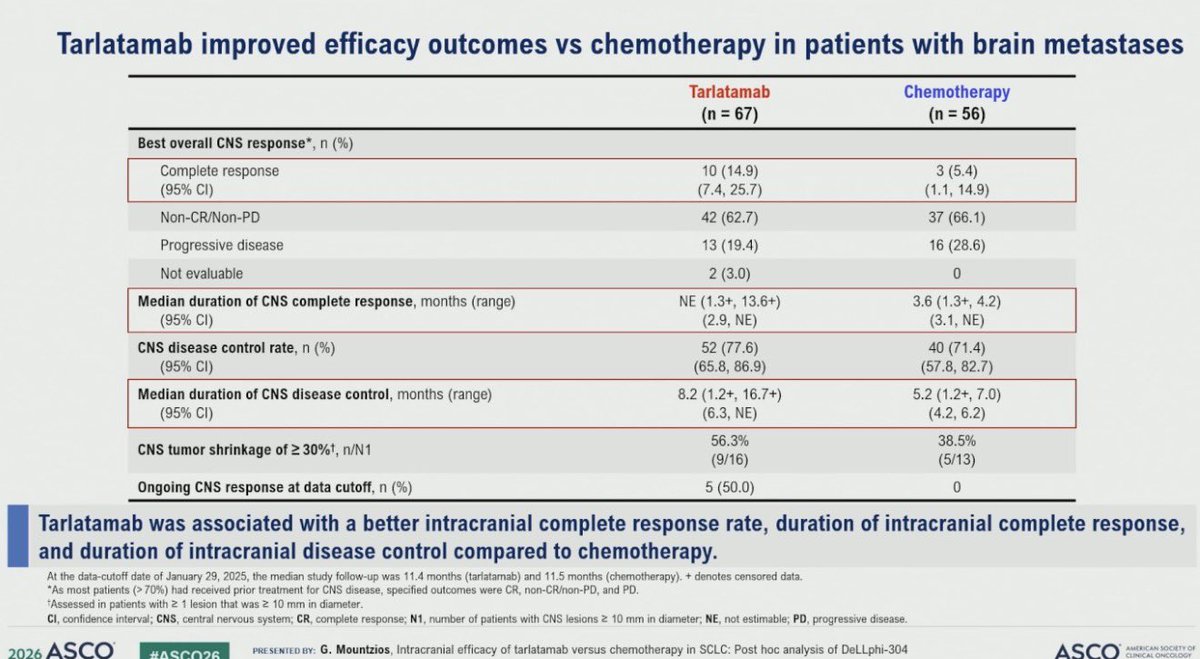
| CNS outcome | Tarlatamab (n=67) | Chemotherapy (n=56) |
|---|---|---|
| Complete response, n (%) | 10 (14.9) | 3 (5.4) |
| Non-CR/non-PD, n (%) | 42 (62.7) | 37 (66.1) |
| Progressive disease, n (%) | 13 (19.4) | 16 (28.6) |
| CNS disease control rate, n (%) | 52 (77.6) | 40 (71.4) |
| Median duration of CNS disease control, mo | 8.2 (1.2+, 16.7+) | 5.2 (1.2+, 7.0) |
10 details 1 trial watching
Post hoc intracranial analysis of the randomised DeLLphi-304 trial of second-line tarlatamab versus chemotherapy in SCLC. Two assessment frameworks: investigator RECIST in the ITT population and mRANO-BM by BICR in pts with baseline brain metastases. Data cutoff January 29, 2025; median follow-up 11.4 mo (tarlatamab) and 11.5 mo (chemotherapy).
ITT n=254 tarlatamab versus n=255 chemotherapy. The brain-metastasis cohort was n=67 versus n=56, defined as ≥1 brain metastasis at baseline per mRANO-BM by BICR plus ≥1 post-baseline scan. More than 70% had already received CNS-directed treatment, which is why the response categories were CR, non-CR/non-PD and PD rather than a conventional ORR.
This analysis reports time to CNS progression or death (CNS PFS) in the ITT population and in the brain-metastasis subset, plus best overall CNS response, CNS disease control rate, duration of CNS complete response and duration of CNS disease control. None of these was the trial's registered primary endpoint.
Both CNS PFS comparisons favor tarlatamab, and the effect is larger in the brain-metastasis subset (HR 0.40) than in the ITT population (HR 0.54). Intracranial complete response was 14.9% versus 5.4%, and CNS tumor shrinkage ≥30% occurred in 9/16 versus 5/13 pts with measurable lesions ≥10mm.
Brain metastases develop in the majority of SCLC pts, and second-line systemic options have historically been judged on extracranial disease with CNS control assumed to be the province of SRS, WBRT or prophylactic cranial irradiation. A bispecific T-cell engager showing an intracranial complete response rate of 14.9% is the notable part, because the working assumption for large-molecule agents has been limited intracranial penetration.
The ITT median CNS PFS was not estimable at 11.4 months of follow-up, so the ITT curve rests on the early portion of the data and the point estimate can still move. The two populations were also read with different tools and different models (stratified Cox for ITT, unstratified for the subset), so the ITT and subset HRs are not strictly comparable to each other.
The result establishes that intracranial disease does not progress faster under tarlatamab than under chemotherapy, and probably progresses more slowly. What it does not establish is whether that activity is sufficient to defer local therapy in a patient who would otherwise be referred for SRS, since the source reports no radiotherapy exposure data and no in-field versus out-of-field failure pattern.
Post hoc intracranial analysis of a randomised trial; CNS endpoints were not the registered primary, and the brain-met subset HR comes from an unstratified model.
- Does intracranial activity permit deferral of SRS in untreated brain mets
- Activity in CNS-treatment-naive or symptomatic brain metastases n=35 · primary completion 2029-02 · phase 2 tarlatamab, active asymptomatic brain mets
- Durability of CNS control beyond 12 months follow-up
📚 Sources · 🐦 1 tweet
Dr. @g_mountzios #ASCO26 presents CNS outcomes with 2L tarlatamab in DeLLphi-304. Improved time to CNS progression overall (HR 0.54). In pts with brain nets, tarlatamab vs chemo CNS CR rate 15% vs 5% with DCR 78% vs 71% and time to CBS progression 6.5m vs 4.2m, HR 0.40 pic.twitter.com/5i8jL1zlKW
— Stephen V Liu, MD (@StephenVLiu) June 1, 2026
MIRACLE-2
ForMSS rectal ca ≤10cm from anal verge, synchronous unresectable mets, 1L
ETS 76.0%
95% CI 62.4%-86.8%; single-arm, no comparator
TL;DRORR 68%, mOS 23.2mo with upfront HFRT/SBRT then chemo + tislelizumab in MSS unresectable metastatic rectal ca; 18% reached NED.
The RT-relevant claim rests on sequencing: HFRT to primary AND HFRT/SBRT to metastases delivered BEFORE any systemic therapy, with 18% (9/50) converting to NED. Dose and fractionation are not reported in source, which blocks transfer to practice. G3/4 lymphopenia 36.7% is the cost of irradiating primary plus mets ahead of cytotoxics.
In 1L MSS rectal cancer with synchronous unresectable liver or lung mets, this supports enrolling on a conversion-intent RT-first protocol rather than changing off-trial practice; it does not extend to resectable disease, MSI-high tumors, or non-rectal colon primaries.
The sequencing is the intervention: HFRT to a primary ≤10cm from the anal verge plus HFRT/SBRT to metastases delivered before any systemic therapy, with 9/50 converting to NED. Dose and fractionation are not reported in source, which blocks transfer. G3/4 lymphopenia 36.7% quantifies the cost of that combined pelvic and visceral burden.
Backbone was biomarker-gated (FOLFOX-bev for RAS/BRAF-mutant at 56.0%, FOLFIRI-cetuximab for WT) with tislelizumab 200mg Q2W added to both, so the PD-1 contribution is unmeasurable. DOR 8.0mo and 1-year DOR 20% show no durable-responder tail, arguing against real checkpoint activity in MSS disease.
Conversion is the surgical read: 18% (9/50) reached NED via primary resection plus metastasectomy or local ablation after RT-first induction, and watch-and-wait was considered for cCR where sphincter preservation failed. The 9/50 rate sets the yield to weigh when accepting these pts for staged resection planning.

| Outcome | n (%) | 95% CI |
|---|---|---|
| CR | 1 (2.0%) | n/a |
| PR | 33 (66.0%) | n/a |
| ORR | 34 (68.0%) | 53.6%-80.0% |
| DCR | 44 (88.0%) | 76.0%-95.2% |
| ETS | 38 (76.0%) | 62.4%-86.8% |
10 details 3 trials watching
Prospective single-arm phase I study at Fudan University Shanghai Cancer Center with a Fujian Cancer Hospital branch. Efficacy data available for N=50 as of Dec 31, 2025, median follow-up 19.9 months (95% CI 16.4-23.4). Reassessment every 8 weeks.
MSS rectal cancer with primary ≤10 cm from anal verge on MRI and synchronous unresectable metastases. 38 males (76.0%), median age 57 (range 30-73). Liver mets 52.0%, lung 8.0%, both 40.0%; RAS/BRAF mutant in 56.0%.
Hypofractionated RT to the primary and HFRT or SBRT to metastases, delivered first, before systemic therapy. Dose, fractionation and target volumes are not reported in source, so the RT prescription cannot be reproduced from this abstract.
After RT: FOLFOX-bevacizumab-tislelizumab for RAS/BRAF-mutant pts, FOLFIRI-cetuximab-tislelizumab for wild-type. Tislelizumab 200mg Q2W. Median eight treatment courses (range 3-12). Resectable disease went to primary resection plus metastasectomy or local ablation; watch-and-wait was considered for cCR where sphincter preservation was not possible.
Primary: ETS rate (≥20% target lesion reduction at 8 weeks post systemic initiation). Secondary: DCR, DOR, OS, PFS, safety. Note the headline ORR and OS circulating with this abstract are secondary, not the registered primary.
No grade 5 TRAEs. All-grade lymphopenia 95.9%, anemia 91.8%, leukopenia 69.4%. G3/4: lymphopenia 36.7%, neutropenia 26.5%, leukopenia 20.4%. The marrow and lymphoid toxicity dominates, which is the expected signature of irradiating a pelvic primary plus liver/lung mets ahead of FOLFOX or FOLFIRI.
The RT prescription is absent from the abstract, so the intervention cannot be replicated. DOR median 8.0 months with a 1-year DOR rate of 20% sits awkwardly under a 68% ORR, and PFS 9.3 months against OS 23.2 months means most of the survival curve is post-progression, where subsequent lines rather than the studied regimen are acting.
The trial's own conclusion claims only a high ETS rate and manageable safety, not an immune-resistance mechanism. Whether RT contributed anything beyond debulking is untestable in a single-arm design where every patient also received chemotherapy plus a PD-1 antibody.
| Endpoint | Median | 95% CI | 1-yr rate |
|---|---|---|---|
| OS | 23.2 mo | 15.1-31.3 | 93.3% |
| PFS | 9.3 mo | 7.1-11.5 | 33.4% |
| DOR (n=34 CR/PR) | 8.0 mo | 5.2-10.8 | 20% |
Single-arm phase I, N=50, no randomised comparator; median f/u 19.9mo with OS still immature. Hard maturity gate: single-arm never reaches confirmatory.
- Does RT add anything over chemo plus PD-1 alone in MSS mCRC? recruiting Regorafenib Alone or in Combination With Hypofractionated/Low-dose Radiotherapy Plus Toripalimab for Metastatic Colorectal Cancer Phase 2n=108 · primary completion 2025-04 · randomised: regorafenib +/- HFRT/LDRT + toripalimabnot yet A Combination Therapy Including Anti-PD-1 Immunotherapy in MSS Rectal Cancer With Resectable Distal Metastasis Phase 2n=52 · primary completion 2027-09 · SCRT then tislelizumab combo, MSS rectal w/ mets
- Durability beyond 1 year given 20% 1-yr DOR rate
- Optimal RT dose and fractionation for primary plus metastases recruiting Standard Systemic Therapy Combined With High/Low-dose Radiotherapy Plus Toripalimab for Metastatic Colorectal Cancer Phase 2n=96 · primary completion 2026-12 · TORCH-M: high vs low-dose RT + toripalimab, MSS mCRC
📚 Sources · 🐦 1 tweet
MIRACLE-2: RT to primary/mets -> chemo + tislelizumab in MSS unresectable met rectal ca (N=50): 68% ORR & median OS 23 mo.
— Dr. Nina Niu Sanford (@NiuSanford) May 31, 2026
Early, single-arm data, but ~1 in 5 pts reached NED.
Suggests RT + systemic + PD1 blockade could overcome immune resistance in MSS mCRC. #ASCO26 @OncoAlert pic.twitter.com/sjnUW8x7f3
RASolute 302
ForPreviously treated metastatic pancreatic adenocarcinoma, RAS G12-mutant
13.2 vs 6.6 mo
HR 0.40 (95% CI 0.30-0.54), P<0.001
TL;DRmOS 13.2 vs 6.6mo, HR 0.40 (0.30-0.54), P<0.001 for daraxonrasib vs chemo in RAS G12 2L metastatic pancreatic.
In previously treated metastatic pancreatic cancer with a RAS G12 mutation, this supports RAS(ON) multi-selective inhibition over investigator's choice chemotherapy in the second line; it does not speak to untreated disease, to RAS wild-type tumors, or to any role alongside radiotherapy.

| Population / arm | N | Events (%) | Median OS (95% CI), mo | 12-mo OS | HR (95% CI) | P |
|---|---|---|---|---|---|---|
| RAS G12 · daraxonrasib | 228 | 72 (32) | 13.2 (10.0-NR) | 53.3 | 0.40 (0.30-0.54) | <0.001 |
| RAS G12 · chemotherapy | 231 | 127 (55) | 6.6 (5.4-8.2) | 8.7 | n/a | n/a |
| Overall · daraxonrasib | 248 | 79 (32) | 13.2 (10.0-NR) | 53.2 | 0.40 (0.30-0.53) | <0.001 |
| Overall · chemotherapy | 252 | 141 (56) | 6.7 (5.8-8.0) | 17.3 | n/a | n/a |
9 details 4 trials watching
Randomised comparison of daraxonrasib against investigator's choice chemotherapy in previously treated metastatic pancreatic cancer, reported as ASCO 2026 Abstract LBA5. Two co-reported populations: RAS G12 (n=459) and an overall population (n=500) that adds G13, Q61 and tumors with no RAS mutation identified. Hazard ratios from a stratified Cox model, P values from stratified log-rank.
Previously treated metastatic pancreatic cancer. The G12 population carried RAS G12 mutations; the overall population also admitted G13, Q61, and patients in whom no RAS mutation was identified. Line of prior therapy, performance status and prior regimen are not given in the source.
Primary read here is overall survival, reported separately for the RAS G12 and overall populations. No PFS, response or safety endpoint appears in the source figure.
OS 13.2 vs 6.6 mo in RAS G12, HR 0.40 (0.30-0.54), P<0.001; the overall population is nearly identical at 13.2 vs 6.7 mo, HR 0.40 (0.30-0.53). Only 32% of daraxonrasib patients had died versus 55-56% of chemotherapy patients, and the experimental median's upper CI bound is not reached, so the estimate can still move.
Second-line metastatic pancreatic cancer has sat near six months' median OS since NAPOLI-1, and the 6.6 mo control arm here reproduces that benchmark rather than undercutting it. The experimental arm roughly doubles it, which is a larger step than any second-line systemic result in this disease to date.
The whole read rests on one OS figure from a conference thread: crossover, chemotherapy-arm composition and the safety profile are absent, and any of the three could change how the survival curve should be read. The 12-mo OS gap between the two control populations (8.7% vs 17.3%) is wide enough to deserve explanation when the full report lands.
The result's strength is its concordance: an identical HR 0.40 in the mutation-selected and all-comers populations means the benefit is not an artefact of subgroup selection. What it does not settle is durability, since the experimental median is immature, nor whether the effect holds in patients without an identified RAS mutation, who were pooled into the overall population rather than reported on their own.
Randomised, OS primary, HR 0.40 with concordant effect in G12 and all-comers. Source is a conference OS figure only; safety and PFS unverified here.
- Durability beyond the immature 13.2mo median active Phase 3 Study of Daraxonrasib (RMC-6236) in Patients With Previously Treated Metastatic Pancreatic Ductal Adenocarcinoma (PDAC) Phase 3n=500 · primary completion 2026-06 · the same phase 3, primary completion 2026-06recruiting Study of Daraxonrasib and Daraxonrasib + GnP as First-line Treatment in Patients With Metastatic Pancreatic Adenocarcinoma Phase 3n=900 · primary completion 2028-06 · daraxonrasib +/- GnP moved to 1L metastaticrecruiting Study of Daraxonrasib (RMC-6236) in Patients With Resected Pancreatic Ductal Adenocarcinoma (PDAC) Phase 3n=500 · primary completion 2029-05 · daraxonrasib vs observation after R0/R1 resection
- Activity in tumors with no identified RAS mutation not yet A Pan-RAS Inhibitor in Combination With Anti-Tumor Therapy in Participants With Advanced Pancreatic Cancer Phase 1/2n=80 · primary completion 2028-08 · pan-RAS HRS-2329, RAS mutation OR amplification
- Safety and tolerability profile, absent from source
📚 Sources · 🐦 1 tweet
#ASCO26
— Nicholas Hornstein (@GIMedOnc) May 31, 2026
This one is special.
This is the hottest paper of 2026 and potentially in the history of pancreatic cancer.
Let’s dive in.
RASolute 302: Daraxonrasib vs investigator’s choice chemotherapy in previously treated metastatic pancreatic cancer
Abstract LBA5 (soon!)… pic.twitter.com/Lq7PEjOWAo
OCEANUS
ForAdvanced or refractory NSCLC receiving both RT and an ICI
20.3 vs 16.0 mo
aHR 0.68, 95% CI 0.47-0.99, P=.045 (sequential vs concurrent)
TL;DRSequential iRT beat concurrent for OS in newly diagnosed advanced NSCLC (20.3 vs 16.0 mo, aHR 0.68, P=.045); territory-wide cohort.
For an RT reader the actionable variable is timing, and the only signal here favors giving RT sequentially rather than concurrently with ICI (20.3 vs 16.0 mo, aHR 0.68). But the source reports no dose, fractionation, target volume or pneumonitis rate, so the parameter that would let you transfer this to a plan is absent.
In newly diagnosed advanced NSCLC already going on an ICI who also need thoracic or palliative RT, this weakly supports separating RT from the ICI start rather than overlapping them; it says nothing about stage III unresectable chemoRT-plus-durvalumab, where the concurrent-then-consolidation standard is randomized.
The only actionable variable is timing: sequential rather than concurrent RT with ICI carried longer OS (20.3 vs 16.0 mo, aHR 0.68). Dose, fractionation, target volume and pneumonitis rates are absent from the source, so the parameters that would let you build a plan around this are missing.
Chemotherapy alongside iRT was associated with longer OS in newly diagnosed advanced disease but not in refractory disease, and ICI maintenance after RT in refractory pts was not significant (11.2 vs 6.7 mo, P=.20). This argues against dropping the chemo backbone in the newly diagnosed setting when RT is added.
13 details 3 trials watching
Territory-wide retrospective cohort (OCEANUS) using the Hong Kong Hospital Authority CDARS, covering more than 90% of the population. Propensity score overlap weighting was the primary method with IPTW for sensitivity; analysis ran December 2024 to April 2025. Landmark analysis was applied, and refractory pts had to survive at least 90 days.
NSCLC diagnosed January 1, 2010 to December 31, 2021 who subsequently received iRT for advanced or refractory disease. Of 3522 pts who received ICIs, 335 received RT: 155 newly diagnosed advanced and 180 refractory. 247 (73.7%) male, median age 64 (range 34-90).
The exposure is RT timing relative to ICI, sequential vs concurrent, in newly diagnosed disease, and RT with vs without ICI maintenance in refractory disease. Dose, fractionation, modality, target volume and irradiated site are not reported in the source, which is the gap that limits transfer to a specific plan.
Primary: real-world OS after landmark, estimated with weighted Kaplan-Meier and Cox models. Where proportional hazards were violated per Schoenfeld residuals, effects were summarized with restricted mean survival time.
Sequential iRT carried longer OS than concurrent in newly diagnosed advanced disease, aHR 0.68 (0.47-0.99), P=.045. In refractory disease the ICI-maintenance difference was not significant (P=.20), and added chemotherapy showed no significant OS association there.
PACIFIC established consolidation durvalumab after concurrent chemoRT in stage III unresectable disease, and PEMBRO-RT and MDACC randomized data tested RT added to pembrolizumab in metastatic disease, but none of these randomize sequential against concurrent iRT in advanced NSCLC. That question has no randomized answer, which is why a 155-pt weighted cohort is currently among the larger reads on it.
Timing was clinician-assigned, so pts pushed to concurrent RT plausibly had more urgent, symptomatic or bulky disease, an indication bias that overlap weighting on recorded covariates cannot remove. The 2010-2021 window also mixes ICI eras, agents and lines, and the source reports no toxicity, so the pneumonitis risk that motivates avoiding concurrency is unmeasured here.
The result argues that separating RT from ICI administration does not cost survival and may favor it, which is the opposite of the abscopal-synergy rationale often used to justify concurrency. It does not establish causality, define an interval, or identify which pts the timing matters for.
Retrospective propensity-weighted registry cohort, 155 pts in the primary comparison, P=.045 with CI touching 1.0. Authors themselves call it hypothesis generating.
- Optimal interval between RT and ICI administration active Concurrent or Sequential Immunotherapy and Radiation Therapy in Patients With Metastatic Lung Cancer Phase 1n=78 · primary completion 2026-12 · randomises seq vs concurrent SBRT + nivo/ipi in stage IV
- Whether concurrent iRT increases pneumonitis in advanced NSCLC n=150 · primary completion 2027-02 · biomarker cohort tracking pneumonitis after CRT then ICI
- Which pts, if any, benefit from concurrent rather than sequential timing active Concurrent or Sequential Immunotherapy and Radiation Therapy in Patients With Metastatic Lung Cancer Phase 1n=78 · primary completion 2026-12 · same SBRT dose levels in each timing arm, stage IV NSCLC
📚 Sources · 📄 1 paper
Abstract
A-DREAM
FormHSPC, PSA <0.2 after 18-24mo ADT + ≥12mo ARPI
41.0% (32/78)
80% CI 33.1-48.9%, one-sided p 0.0249
TL;DR41% treatment-free with eugonadal T at 18mo after stopping ADT+ARPI in responding mHSPC (80% CI 33.1-48.9%, one-sided p 0.0249).
The RT-relevant detail is baseline burden: 51.3% had prostate RT and 29.5% had RT to metastatic sites, so the cohort that tolerated interruption was heavily locally treated, and 4 pts (5.1%) took RT as their non-protocol next step off ADT. Metastasis-directed RT is not tested here, but this is the population where a de-intensification question meets it.
In mHSPC with PSA under 0.2 after 18-24 months of ADT plus at least 12 months of ARPI, this supports discussing a protocolized interruption with PSA and testosterone monitoring; it does not extend to pts with persistent PSA or to unselected metastatic disease.
The cohort was RT-heavy before interruption: 51.3% had prostate radiation and 29.5% had radiation to metastatic sites, and 4 (5.1%) took radiation as their non-protocol next step off ADT. Metastasis-directed RT to extend time off systemic therapy is the randomizable question this describes but does not test.
The composite splits usefully: 57.7% stayed treatment-free for 18 months but only 66.7% recovered testosterone (median 9.0 months), so gonadal recovery, not disease control, is the rate limiter in a median-age-70 cohort. Counsel the two risks separately before interrupting.

+3 more figures


| Characteristic | Value |
|---|---|
| Median age | 70 (49-90) |
| High volume (CHAARTED) | 27 (35.1%) |
| Low volume (CHAARTED) | 50 (64.9%) |
| Prostate RT as local therapy | 40 (51.3%) |
| RT to metastatic sites | 23 (29.5%) |
11 details 5 trials watching
Alliance single-arm phase 2, N=75 planned, 78 eligible enrolled 07/2022-03/2024. Median follow-up 26.9 months. Monitoring PSA and testosterone q3mo, scans at least q6mo (q3mo with rising PSA), QOL q6mo.
mHSPC on ADT + ARPI with PSA <0.2 stable or falling after 18-24 months of ADT and at least 12 months of ARPI. Median age 70 (49-90), 84.6% White, 64.9% low volume by CHAARTED, 35.1% high volume. Median PSA prior to starting ADT+ARPI 18.99 ng/mL.
Not an intervention, but the cohort was RT-heavy at baseline: 40 (51.3%) had radiation as local therapy, 31 (39.7%) had no local therapy, 7 (9.0%) prostatectomy +/- RT. 23 (29.5%) had radiation to metastatic sites. Dose and fractionation not reported in source.
Primary: treatment-free with eugonadal testosterone (T ≥150 ng/dL) at 18 months. Secondary: time to eugonadal T, duration off treatment, QOL. Exploratory: rPFS, TTNT, OS (CSS/NCSS), cost. Re-initiation triggered by PSA ≥5 ng/mL, PCWG3 radiographic change, or prostate-cancer-related symptoms.
Primary endpoint met: 32/78 (41.0%), 80% CI 33.1-48.9%, one-sided p 0.0249. Testosterone recovered in 52 (66.7%) by 18 months with median time to eugonadal T 9.0 months (95% CI 8.4-12.4); 45 (57.7%) stayed treatment-free for 18 months. rPFS 15/78 events, median NE; OS 4/78 events, median NE.
The 18-month primary readout is short for a de-intensification question whose real risk is late: 4 of 29 pts who resumed per protocol later progressed and discontinued the original ARPI, so re-treatment did not uniformly restore control. Deaths (4) included non-prostate causes (myelodysplastic syndrome, influenza, myocardial infarction), and with no continuous-treatment arm the OS curve carries no comparative information.
Intermittent ADT has been tested before in metastatic disease (SWOG 9346 could not exclude an OS decrement with intermittent therapy in mHSPC), but A-DREAM asks the question in the modern ARPI-intensified era with a molecularly deeper response gate, which is why the cohort's off-treatment rate looks better than the older intermittent literature suggests. That comparison is a rationale, not a result: A-DREAM has no randomised arm.
The number that matters clinically is not 41% but its two components: testosterone recovery is the rate limiter (66.7% recovered, median 9.0 months), while disease control off treatment was more common (57.7% treatment-free at 18 months). A trial that de-intensifies successfully on disease grounds can still miss its endpoint on gonadal recovery in an older cohort, and that distinction determines who to counsel.
Single-arm phase 2, no continuous-treatment control, 18mo primary readout in a deeply selected responder cohort. Interruption safety needs a randomised comparator.
- Does interruption cost overall survival vs continuous ADT+ARPI active A Study of an Intermittent ADT Approach With Apalutamide Monotherapy in Participants With mCSPC Phase 3n=420 · primary completion 2026-10 · phase 3 intermittent vs continuous, rPFS non-inferiorityrecruiting Optimal PSA Triggered Individual Management of Androgen Sensitive Prostate Cancer Phase 2n=160 · primary completion 2030-10 · randomised intermittent relugolix+ARPI after PSA response
- Which responders recover testosterone and which do not active Comeback From Long coursE Androgen Deprivation Therapy (ADT) With RElugolix and Darolutamide (CLEARED) Phase 2n=33 · primary completion 2028-11 · 1° EP is T recovery rate after 2y relugolix+darolutamidenot yet Clinical Trial to Observe the Effects of Tamoxifen on Testosterone Recovery in Medically Castrated Prostate Cancer Patients Phase 2n=96 · primary completion 2030-10 · tamoxifen vs no tamoxifen for T recovery post-ADT
- Can metastasis-directed RT extend time off systemic therapy n=254 · primary completion 2031-08 · PSMA-guided SBRT added after 6mo darolutamide+ADT
📚 Sources · 🐦 1 tweet
Can treatment be safely stopped in selected patients with mHSPC?
— MJosé Juan (@mjuanfi81) May 30, 2026
Phase II A-DREAM trial, 41% of responders remained treatment-free with testosterone recovery 18m after stopping ADT/ARPI. At a median FU of 21 months, 35% of patients required treatment re-initiation.@OncoAlert pic.twitter.com/iW2VDBWWhN
ENZAMET + Decipher
FormHSPC on ADT + enzalutamide, Decipher score available
TL;DRDecipher >0.85 predicts docetaxel benefit in mHSPC on ADT+enza: HR(OS) 0.75 (0.43-1.33) vs 1.94 (0.95-3.96) if ≤0.85, interaction p=0.04.
In mHSPC starting ADT + enzalutamide with a Decipher score available, this offers hypothesis-level support for weighing docetaxel intensification above the 0.85 cut and for questioning it below; it does not extend to patients on other ARSIs or to those without genomic testing.
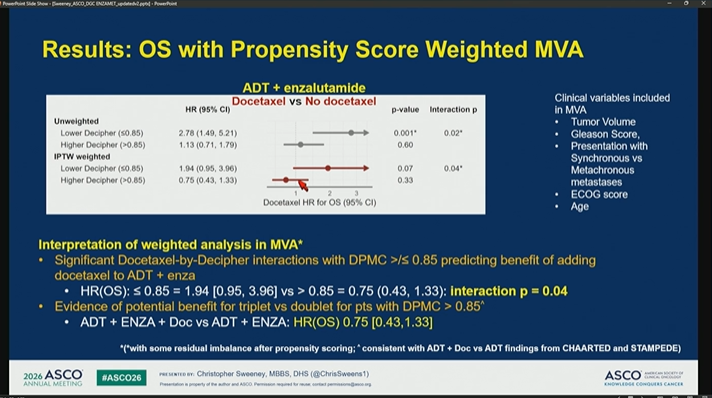
| Analysis | Lower Decipher (≤0.85) | Higher Decipher (>0.85) | Interaction p |
|---|---|---|---|
| Unweighted HR (95% CI) | 2.78 (1.49, 5.21) | 1.13 (0.71, 1.79) | 0.02 |
| Unweighted p-value | 0.001 | 0.60 | |
| IPTW weighted HR (95% CI) | 1.94 (0.95, 3.96) | 0.75 (0.43, 1.33) | 0.04 |
| IPTW weighted p-value | 0.07 | 0.33 |
+2 more figures


8 details
Post-hoc genomic-classifier analysis of the ENZAMET ADT + enzalutamide cohort, N=320, testing whether Decipher (DPMC) predicts docetaxel benefit. Docetaxel receipt was investigator-elected, not randomised, so a propensity-score IPTW model carries the comparison.
mHSPC on an ADT + enzalutamide backbone with an evaluable Decipher score, split at the prespecified 0.85 cut. A separate panel restricts to low-volume disease.
Overall survival, read two ways: prognostic (Decipher stratum on ADT + enza) and predictive (docetaxel-by-Decipher interaction).
Prognostic signal is the cleanest number on the slide deck: HR 3.02 (1.50-5.76) for DPMC >0.85 on ADT + enza. The predictive claim rests on the interaction, p=0.02 unweighted and p=0.04 after IPTW, not on either stratum reaching significance.
Docetaxel was not randomised within this cohort, so IPTW is doing the causal work and the authors concede residual imbalance after propensity scoring. Low-volume panel numbers are small (n at risk 14 and 13 in the reported strata) with a CI of 1.70 (0.32, 8.06), wide enough to be uninformative.
Presented as level 1B evidence consistent with CHAARTED and STAMPEDE, where docetaxel benefit concentrated in high-volume disease. This analysis proposes a genomic rather than volumetric selector for the same decision.
The strongest defensible claim is the prognostic one: DPMC >0.85 marks worse OS on ADT + enza. The predictive claim (add docetaxel above 0.85, omit it below) is directionally consistent across unweighted and weighted models but is not established by a single non-randomised interaction.
Post-hoc biomarker subgroup with non-randomised docetaxel use; both stratum HRs non-significant after weighting, residual imbalance conceded. Read rests on an interaction p=0.04.
- Prospective validation of Decipher-guided docetaxel selection in mHSPC
- Does the 0.85 cut hold on ARSI backbones other than enzalutamide
- Whether low Decipher predicts docetaxel harm or only absent benefit
📚 Sources · 🐦 1 tweet
#ASCO26 GU Oncology Spotlight 🚨
— Dra. María Natalia Gandur Quiroga (@nataliagandur) May 30, 2026
🔬 ENZAMET + Decipher | Part 2
Can genomics guide docetaxel intensification in mHSPC?
Outstanding presentation by @ChrisSweeney1.@OncoAlert@ASCO
After Part 1, the key question was:
➡️ Can a genomic classifier identify which patients with… pic.twitter.com/nJYMxuXelV
ARACOG (AFT-47)
ForAdvanced prostate cancer (mHSPC, nmCRPC, mCRPC) starting an ARSI
daro -15.8 vs enza -36.1
median % change in MCCD at 24 wks, P=0.009
TL;DREnzalutamide MCCD decline -36.1 vs -15.8 for darolutamide at 24wks (P=0.009) in randomized phase 2, N=111.
The comparison is between each pt's own worst-hit domain, and those differed by arm (PALFAM for daro, SWM for enza), so the read is how far the worst domain falls, not which one. Crossover before 24wks was scored at crossover inside the randomized arm, which attenuates rather than widens the gap. Moves ARSI selection when cognitive burden matters, not efficacy.
In a man starting an ARSI for mHSPC or nmCRPC where cognitive burden is a live concern, this supports darolutamide over enzalutamide on measured cognition; it does not speak to disease control, which was never compared head-to-head.
For ARSI selection where the two drugs are treated as equivalent on disease control, this puts a measured number on the cognitive difference (median MCCD -15.8 vs -36.1, P=0.009) instead of an AE-table impression. It moves drug choice, not sequencing or line of therapy.

| Metric | Darolutamide (N=48) | Enzalutamide (N=47) |
|---|---|---|
| Maximally changed module | PALFAM | SWM |
| Domain | Visual memory / executive function | Working memory / executive function |
| Median change, baseline to 24 wks | -15.8 | -36.1 |
| Between-arm P | P=0.009 | P=0.009 |
+2 more figures


8 details
Randomized open-label phase 2 from the Alliance for Clinical Trials in Oncology, N=111, stratified by age (<65, 65-80, >80). Enrolled 8/17/2021 to 3/11/2025, with CANTAB modules, PROMs and timed-up-and-go collected at 12 and 24 weeks.
Men with mCRPC, nmCRPC or mHSPC. Randomization was stratified by age across three bands (<65, 65-80, >80), so the design anticipated an older population. Baseline cognitive eligibility criteria not reported in source.
Darolutamide was provided by the study; enzalutamide was given through standard of care, so the two arms differed in drug supply as well as drug. Doses and concurrent ADT not reported in source.
Primary: % change from baseline to 24 weeks in the Maximally Changed Cognitive Domain (MCCD), drawn from 5 remotely delivered CANTAB modules (SWM, PALFAM, OTS, SSP, RVP) covering executive function, visual memory, attention and working memory. Blood for polygenic hazard score and AR testing, PROMs and timed-up-and-go were collected alongside.
Median MCCD change -15.8 with darolutamide (PALFAM) vs -36.1 with enzalutamide (SWM), P=0.009, across 48 and 47 pts in the primary analysis. No oncologic endpoint was reported in source.
The two drugs have never been compared head-to-head for efficacy, and cognition in ARAMIS and ARASENS (darolutamide) and PROSPER and ARCHES (enzalutamide) was captured as clinician-graded adverse events against placebo, not measured with a battery. Mild executive dysfunction is exactly the harm an AE table structurally misses.
Pts crossing over before 24 weeks carried their crossover score into the randomized arm, which should attenuate the gap rather than widen it. CANTAB is a research battery, not a clinical diagnostic, and no link to function, falls or discontinuation is reported in source. 24 weeks says little about years of therapy.
This shifts an argument that has run on mechanism and on AE tables onto measured performance. Where the two drugs are treated as interchangeable for disease control, cognition becomes a defensible tiebreaker. What it does not settle is whether an MCCD gap of this size is felt by the pt.
Randomized, prespecified primary endpoint met against a named comparator; open-label design and the composite MCCD construct temper it. Consistent with darolutamide's known limited CNS penetration.
- Whether the MCCD difference translates to function, falls, or discontinuation
- Durability of cognitive divergence beyond 24 weeks
- Whether apalutamide differs from enzalutamide on the same testing
📚 Sources · 🐦 2 tweets
#ASCO26 GU Oncology Spotlight 🚨
— Dra. María Natalia Gandur Quiroga (@nataliagandur) May 30, 2026
🔬 Abstract 5005 | ARACOG / AFT-47
Cognitive effects of darolutamide vs enzalutamide
Presented by Alicia K. Morgans, MD, MPH, FASCO@CaPsurvivorship @OncoAlert@ASCO
In prostate cancer, we often discuss AR pathway inhibitors through the lens… pic.twitter.com/vpZr1w6kc6
ARACOG (AFT-47) met its primary endpoint: enzalutamide caused significantly greater cognitive decline than darolutamide at 24 weeks in advanced prostate cancer.
— Katy Beckermann (@katy_beckermann) May 30, 2026
Randomized open-label phase 2, 111 pts (mHSPC, mCRPC, nmCRPC), DAR vs ENZ.
Cognition was measured with CANTAB, a… pic.twitter.com/kj4vfGRVyp
TALAPRO-3
ForHRR-deficient metastatic hormone-sensitive prostate cancer, enzalutamide/ADT candidates
HR 0.48
95% CI 0.36-0.65, P<0.001; 3yr rPFS 77% vs 56%
TL;DR3yr rPFS 77% vs 56%, stratified HR 0.48 (0.36-0.65), p<0.001, adding talazoparib to enzalutamide in HRR-deficient mCSPC.
In HRR-deficient metastatic prostate cancer starting enzalutamide plus ADT, this supports considering talazoparib upfront rather than reserving it, including for non-BRCA HRR alterations; it does not speak to HRR-proficient disease, which the trial excluded.

| Panel | Arm | Events/N | Median rPFS (95% CI), mo | HR (95% CI) |
|---|---|---|---|---|
| A ITT | Talazoparib+enzalutamide | 67/300 | NC (NC-NC) | 0.48 (0.36-0.65), P<0.001 |
| A ITT | Placebo+enzalutamide | 126/299 | 45.8 (37.7-NC) | |
| B BRCA | Talazoparib+enzalutamide | 22/104 | NC (NC-NC) | 0.37 (0.22-0.61) |
| B BRCA | Placebo+enzalutamide | 49/103 | 35.1 (18.6-NC) | |
| C Non-BRCA | Placebo+enzalutamide | 77/196 | NC (40.5-NC) | 0.57 (0.39-0.82) |
8 details 4 trials watching
Randomised, placebo-controlled phase 3 of talazoparib plus enzalutamide vs placebo plus enzalutamide, with ADT in both arms. ITT N=599 (300 vs 299), analysed as ITT with prespecified BRCA and non-BRCA subgroups.
HRR-deficient metastatic prostate cancer; the BRCA subgroup was 104 vs 103 and non-BRCA 196 vs 196, so BRCA carried roughly a third of the trial. Detailed eligibility and stratification factors are not reported in source.
Talazoparib added to an enzalutamide/ADT backbone that both arms received, so the comparison isolates the PARP inhibitor's contribution rather than the androgen-signaling backbone. Doses not reported in source.
Primary: imaging-based rPFS. Overall survival, safety and response endpoints are not reported in the source tweet or figure.
Landmark 3yr rPFS 77% vs 56%; median rPFS not reached in the talazoparib arm against 45.8 mo on placebo. Effect held in both molecular subgroups, numerically larger in BRCA (HR 0.37) than non-BRCA (HR 0.57).
| Population | Events/N talazoparib | Events/N placebo | Median placebo arm | HR (95% CI) |
|---|---|---|---|---|
| ITT | 67/300 | 126/299 | 45.8 (37.7-NC) | 0.48 (0.36-0.65) stratified |
| BRCA | 22/104 | 49/103 | 35.1 (18.6-NC) | 0.37 (0.22-0.61) unstratified |
| Non-BRCA | 45/196 | 77/196 | NC (40.5-NC) | 0.57 (0.39-0.82) unstratified |
TALAPRO-2 tested the same combination in first-line mCRPC across all comers; here the population is HRR-selected and the HR is numerically stronger. PROpel and MAGNITUDE established the PARP-plus-ARSI question in mCRPC, with MAGNITUDE's benefit confined to HRR-altered pts, which is the population this trial enrolled outright.
The talazoparib arm's median rPFS is NC (NC-NC) in both ITT and BRCA panels, so the absolute duration of benefit is unmeasured and the curves may still converge. No OS signal is available in source, and toxicity of the doublet (the practical cost of adding a PARP inhibitor to lifelong ARSI) is entirely absent from what was published in the thread.
The non-BRCA HR of 0.57 is the number that decides how wide this goes: if it holds, the case extends past BRCA to the broader HRR panel rather than collapsing to a BRCA-only result as earlier PARP trials did. What it does not settle is whether an rPFS gain of this size converts to survival, or whether the same result would follow sequential rather than upfront talazoparib.
CONSORT flow
Randomised double-blind phase 3, prespecified 1° rPFS hit with HR 0.48 in a biomarker-defined population, consistent across BRCA and non-BRCA. OS immature.
- Does the rPFS gain convert to overall survival n=1054 · primary completion 2022-10 · TALAPRO-2 mCRPC, mature OS readout of same combon=599 · primary completion 2026-02 · TALAPRO-3 itself; OS is a secondary endpoint
- Upfront combination vs sequential talazoparib after progression recruiting Talazoparib Plus Enzalutamide After Progression to Abiraterone in Metastatic Prostate Cancer: (TEAM PC) Phase 2n=78 · primary completion 2026-01 · talazoparib + enza 1L mCRPC after abiraterone PDrecruiting A Study of Talazoparib With or Without Enzalutamide in People With Prostate Cancer Who Have Previously Received Abiraterone Acetate Phase 2n=126 · primary completion 2029-03 · talazoparib +/- enza post-abiraterone, HRR-mutated
- Toxicity cost of indefinite PARP plus ARSI
📚 Sources · 🐦 1 tweet
JUST In: TALAPRO-3 published in @NEJM
— Toni Choueiri, MD (@DrChoueiri) May 30, 2026
Adding #talazoparib to enzalutamide/ADT
=>3-year rPFS: 77% vs 56% in HRR-deficient metastatic prostate cancer !
Looking forward to full presentation by @neerajaiims who keeps changing SOC, one trial at a time. @ASCO #ASCO26 @OncoAlert pic.twitter.com/nXiPk4DIXg
ROADS
ForResected brain metastasis >2 cm, post-op cavity radiation candidates
NR vs 17 mo
GammaTile vs SRS; no HR, CI, or p reported in source
TL;DRSurgical bed recurrence 1% with GammaTile brachytherapy vs 12% post-op SRS in resected brain mets >2cm, N=230.
The RT read is the bed-control mechanism: GammaTile puts dose in the cavity at resection, closing the gap where post-op SRS fails in cavities >2 cm, with median time to bed recurrence not reached vs 17 mo. LMD was 10% GT vs 3% SRS, so the trade is bed control against meningeal seeding when picking the cavity strategy.
In a resected brain metastasis larger than 2 cm being planned for cavity radiation, this questions post-op SRS as the default bed strategy; it does not extend to intact metastases, cavities under 2 cm, or pts already carrying leptomeningeal disease.
Bed control is the read: median time to bed recurrence not reached vs 17 mo with post-op SRS, in cavities >2 cm where SRS control is weakest, with radiation necrosis flat at 8% GT vs 7% SRS. LMD 10% GT vs 3% SRS is the counterweight when choosing the cavity strategy.
The cavity radiation decision moves into the operation itself: GammaTile is implanted at resection, so a met >2 cm being taken out becomes a pre-op discussion about tile placement rather than a post-op SRS referral. The 10% vs 3% LMD signal is the intraoperative trade to weigh.

| Endpoint | GammaTile | SRS |
|---|---|---|
| Time to surg bed recur | NR | 17 mo |
| Surg bed recur FS | NR | 11 mo |
| 2 yr OS | 62% | 36% |
10 details
Randomized trial of GammaTile brachytherapy vs post-op SRS after resection of a brain metastasis, N=230, reported as final results at ASCO 2026 (Weinberg). Randomization ratio, number of sites, and follow-up duration not reported in source.
Resected brain metastasis >2 cm, the size band where post-op cavity SRS control is weakest. Histology mix, number of brain metastases allowed, systemic disease status, and performance status not reported in source.
Experimental arm is GammaTile, a Cs-131 collagen tile implanted in the cavity at the time of resection, so dose starts without the post-op delay. SRS dose, fractionation, cavity margin, and time from surgery to SRS are not reported in source, and those are exactly the parameters that decide whether the control arm reflects the reader's own practice.
Primary I: time to surgical bed recurrence. Primary II: surgical bed recurrence-free survival. 2 yr OS is reported alongside them; the source does not state whether OS was a prespecified secondary.
Both primaries favor GammaTile with medians not reached vs 17 mo and 11 mo. No HR, confidence interval, or p-value appears in the source.
Radiation necrosis 7% SRS vs 8% GT, essentially flat. Leptomeningeal disease 3% SRS vs 10% GT is the signal that cuts against the arm winning on bed control; timing and denominators not reported in source.
Post-op cavity SRS became standard on N107C/CEC.3 and the MDACC randomized trial, both of which traded whole-brain neurocognitive toxicity for weaker bed control, with failure concentrated in larger cavities. ROADS attacks that residual failure directly rather than re-litigating whole-brain RT.
The 2 yr OS separation, 62% vs 36%, is far larger than bed recurrence alone (12% vs 1%) would mechanistically support, which points at arm imbalance, differential salvage, or systemic therapy that the source does not report. The trial is also inherently unblinded, and the LMD excess in the GammaTile arm has no reported timing to judge whether it is procedure-related seeding.
If the bed-control numbers hold in the full report, the cavity strategy for a large resected met becomes a surgical-planning decision made before the operation rather than a radiation-planning decision made after it. The OS claim should wait for the manuscript.
Randomized, both primaries reported, final analysis. Verdict held below practice-changing: conference-slide source with no HR, CI, or p-value, and unexplained LMD excess.
- Is the 2yr OS separation confirmed with hazard ratios and cause of death?
- Does the leptomeningeal excess with GammaTile reflect seeding or longer survival?
- Does the benefit hold against fractionated post-op SRS rather than single fraction?
📚 Sources · 🐦 1 tweet
🚨🚨 ASCO 2026 Final Results Randomized trial resected brain met Brachytherapy vs Post-Op SRS🚨
— PDBrown (@PDBrownOnc) May 30, 2026
- Incredible Surg Bed Control with Brachy (↑↑OS as well)
- Surg bed recurrence 12% SRS vs 1% GammaTile pic.twitter.com/PCTsCluyUd
CHRYSALIS-2
ForTreatment-naive advanced NSCLC with atypical (uncommon) EGFR mutation
TL;DRMedian OS 41.0 mo (95% CI 27.7-NE) with 1L amivantamab + lazertinib in atypical EGFR-mutant NSCLC, single-arm n=49.
In treatment-naive advanced NSCLC with an atypical EGFR mutation, this supports amivantamab plus lazertinib as a prospectively benchmarked option where none is established; it does not extend to classical exon 19del/L858R disease or exon 20 insertions.

+1 more figure
8 details 3 trials watching
Single-arm expansion cohort of the CHRYSALIS-2 program, n=49, 1L atypical EGFR-mutated advanced NSCLC. Median follow-up 31.3 mo. No randomised comparator arm.
Treatment-naive advanced NSCLC harbouring an atypical (uncommon) EGFR mutation. Baseline strata shown on the swimmer plot include age ≥65y, Asian ancestry and CNS involvement; per-stratum counts are not reported in source.
IV amivantamab (EGFR/MET bispecific) plus lazertinib (third-generation EGFR TKI). No chemotherapy backbone. Median duration of treatment 13.3 months (range <0.1-53.2), with 39% of 1L participants still on treatment beyond 2 years.
Median OS 41.0 mo (95% CI 27.7-NE), described by the presenters as roughly 3.5 years. The upper CI bound is not estimable, so the point estimate is anchored on the lower bound of 27.7 mo.
Reported only as consistent with prior reports, no new safety signals with longer follow-up. No grade 3+ rates, infusion-reaction rates or dermatologic AE rates appear in the source.
The atypical EGFR label pools biologically distinct alterations (G719X, S768I, L861Q and compound variants) whose single-agent TKI sensitivity differs; n=49 cannot resolve per-variant benefit, and the curator's read of no variant-outcome association is an absence of signal in a small cohort, not evidence of uniformity. No comparator, so the 41.0 mo median cannot be positioned against afatinib or osimertinib series in the same population.
Atypical EGFR is the part of the EGFR-mutant space where no regimen is settled, so a 41.0 mo median in 49 pts is meaningful as a benchmark even without randomisation. The practical question this leaves open is whether the bispecific's added toxicity and IV schedule are justified over an oral TKI alone, which this design cannot answer.
Single-arm n=49 expansion cohort, no randomised comparator against afatinib or osimertinib in atypical EGFR. Maturity gate: single-arm never reaches confirmatory.
- Doublet vs single-agent osimertinib or afatinib in atypical EGFR n=480 · primary completion 2029-02 · phase 3 firmonertinib vs osimertinib/afatinib, PACC 1L
- Which atypical EGFR variants drive the durable-response tail
- Whether subcutaneous amivantamab preserves efficacy with less infusion burden n=418 · primary completion 2024-01 · phase 3 SC vs IV ami + lazertinib, randomisedrecruiting A Study of Amivantamab in Participants With Advanced or Metastatic Solid Tumors Including Epidermal Growth Factor Receptor (EGFR)-Mutated Non-Small Cell Lung Cancer Phase 2n=520 · primary completion 2027-08 · SC co-formulation activity + safety cohorts
📚 Sources · 🐦 1 tweet
Amivantamab + lazertinib achieved a median OS of 41.0 months in treatment-naïve atypical EGFR-mutant NSCLC, with no clear association between EGFR variant subtype and outcome. A compelling option. Meanwhile, amivantamab continues evaluation across multiple tumor types. #ASCO26 pic.twitter.com/aWn3Ja60Ji
— Chul Kim (@chulkimMD) May 29, 2026
ESAONA
For1L EGFR-mutant NSCLC with brain metastases
95.5% vs 79.6%
p = 0.0004
TL;DRiORR 95.5% vs 79.6% (p=0.0004) and intracranial PFS HR 0.46 favoring asandeutertinib in 1L EGFR-mutant NSCLC with brain mets.
The RT-relevant number is intracranial PFS: median not reached vs 17.5 mo, HR 0.46. If a first-line TKI holds CNS disease that long, the deferral-of-brain-RT window widens, but the source reports no prior-RT stratification, no CNS-RT use by arm, and no lesion size or symptom criteria, so this cannot yet gate an SRS-versus-defer decision.
In treatment-naive EGFR-mutant NSCLC with asymptomatic brain metastases, this supports the case for TKI-first CNS control as a hypothesis, not a change in practice; it says nothing about symptomatic or large lesions where local therapy is already indicated.
Intracranial PFS median not reached vs 17.5 mo, HR 0.46, is the number that touches the SRS-timing decision in asymptomatic brain mets. The source gives no prior-RT stratification and no salvage-RT rates by arm, so the deferral question stays open rather than answered.
The intracranial effect (HR 0.46) is roughly double the systemic one (HR 0.64), so the case for asandeutertinib rests on CNS penetration rather than broad potency. Serious TRAEs run 10.8% vs 7.1%, a real but modest trade against a phase II endpoint with no OS.

| Endpoint | Asandeutertinib (n=111) | Osimertinib (n=113) | Effect |
|---|---|---|---|
| Intracranial ORR (BICR) | 95.5% (89.8-98.5) | 79.6% (71.0-86.6) | p = 0.0004 |
| Intracranial PFS (BICR) | Median not reached | 17.5 mo (15.18-NA) | HR 0.46, p = 0.0020 |
| Overall PFS (BICR) | Median not reached | 17.2 mo (15.18-19.55) | HR 0.64, p = 0.0473 |
| Any TRAE | 99.1% | 95.6% | n/a |
| Serious TRAE | 10.8% | 7.1% | n/a |
7 details 4 trials watching
Randomised phase II, N=224, asandeutertinib (n=111) vs osimertinib (n=113). Endpoints read by BICR. Follow-up duration, stratification factors and alpha allocation are not reported in the source slide.
First-line EGFR-mutated NSCLC with brain metastases. The source does not state lesion number, size, symptom status, or whether prior CNS radiotherapy was permitted, which is the eligibility gate an RT reader needs.
Intracranial ORR by BICR is the headline, with intracranial PFS and overall PFS reported alongside. No overall survival data in source.
Any TRAE 99.1% vs 95.6%; serious TRAE 10.8% vs 7.1%. The excess serious-event rate is small in absolute terms but sits on a phase II denominator, and no organ-level breakdown is given in source.
The intracranial separation (HR 0.46) is larger than the systemic one (HR 0.64), which points at CNS penetration rather than a general potency gain as the mechanism. For radiation oncology the question is whether that CNS margin is durable enough to defer SRS in asymptomatic pts; a phase II with unreached medians and no OS cannot answer it.
CONSORT flow
Phase II, conference-slide source only; no OS, borderline overall-PFS p, and no reported CNS-RT or prior-RT stratification. Needs phase III before displacing osimertinib.
- Does intracranial PFS benefit translate to overall survival
- Salvage brain RT and SRS rates by arm recruiting Observation or Upfront Cranial RT in Oncogene Mutated NSCLC With Asymptomatic BM: A Phase III RCT Phase 3n=190 · primary completion 2025-12 · randomises upfront SRS/WBRT vs TKI alone, asx BMrecruiting A Study of Stereotactic Radiosurgery (SRS) and Standard Treatment in People With Lung Cancer That Has Spread to the Brain Phase 2n=56 · primary completion 2027-12 · SRS after 3mo osimertinib vs osimertinib alonerecruiting Early or Delayed Intervention of Brain Radiotherapy Combined With Almonertinib in EGFR Mutated NSCLC With Brain Metastases Phase 3n=232 · primary completion 2028-12 · early vs delayed SRS timing on 3G TKI, phase 3
- Activity in symptomatic or leptomeningeal CNS disease recruiting A Clinical Trial of Furmonertinib Combined With Anlotinib as First-line Treatment for Advanced NSCLC With EGFR-sensitive Mutations and Brain Metastasis Phase 2n=146 · primary completion 2027-09 · 1L 3G TKI + anlotinib, brain/LM mets at dx
📚 Sources · 🐦 1 tweet
#ASCO26 🧠🌍
— Dr Rishabh Jain (@DrRishabhOnco) May 30, 2026
Could a next-generation EGFR TKI outperform osimertinib in patients with brain metastases?
The phase II ESAONA trial suggests the answer may be yes.
🧪 LBA2007 | ESAONA
1L EGFR-mutated NSCLC with brain metastases
👥 n=224
⚔️ Asandeutertinib vs Osimertinib
Key… https://t.co/mEOKGNKgf7 pic.twitter.com/pUQuH6i2cV
OptiTROP-Lung05 NCT06448312
For1L stage IIIB-IV NSCLC, PD-L1 TPS ≥1%, EGFR/ALK wild-type, ECOG 0-1
HR 0.35
95% CI 0.26-0.47, p<0.0001; NR vs 5.7 mo
TL;DRmPFS NR vs 5.7mo, HR 0.35 (0.26-0.47) for sac-TMT + pembro in 1L PD-L1+ NSCLC.
In treatment-naive PD-L1 TPS ≥1% advanced NSCLC without EGFR/ALK alteration, this supports a TROP2 ADC plus pembro as a chemo-free option worth watching; it does not address pts already committed to pembro plus platinum chemo, nor PD-L1-negative disease.

| Arm | PFS events, n (%) | Median PFS, mo (95% CI) | HR (95% CI) |
|---|---|---|---|
| Sac-TMT + Pembro (n=208) | 66 (31.7) | NR (13.6, NE) | 0.35 (0.26, 0.47), p<0.0001 |
| Pembro (n=205) | 128 (62.4) | 5.7 (4.3, 7.0) | n/a |
+3 more figures

| PD-L1 stratum | Sac-TMT + Pembro median, mo | Pembro median, mo | HR (95% CI) |
|---|---|---|---|
| TPS ≥50% | NR (NE, NE) | 9.5 (6.9, 13.8) | 0.47 (0.29, 0.77) |
| TPS 1-49% | NR (11.1, NE) | 4.3 (2.9, 5.5) | 0.28 (0.19, 0.41) |

| Arm | OS events, n (%) | Median OS, mo (95% CI) | HR (95% CI) |
|---|---|---|---|
| Sac-TMT + Pembro (n=208) | 33 (15.9) | NR (NE, NE) | 0.55 (0.36, 0.85) |
| Pembro (n=205) | 54 (26.3) | NR (NE, NE) | n/a |

13 details 3 trials watching
Randomized, multicenter, open-label phase 3 (NCT06448312), 1:1, N=413. Stratified by histology (squamous vs non-squamous), PD-L1 TPS (1-49% vs ≥50%), and ECOG (0 vs 1). Median follow-up 10.5 months at this analysis.
Locally advanced stage IIIB/IIIC or metastatic stage IV NSCLC with no prior systemic antitumor therapy. Required PD-L1 TPS ≥1% by IHC 22C3 central lab, no sensitizing EGFR or ALK alteration, ECOG 0 or 1.
Sac-TMT 4 mg/kg Q2W plus pembrolizumab 400 mg versus pembrolizumab 400 mg Q6W alone, until progression or unacceptable toxicity. Pembro was capped at a maximum of 18 cycles in both arms. One pt in the pembro group never received assigned treatment.
Primary: PFS by BICR. Key secondary: OS. Other secondary: investigator-assessed PFS, ORR, DCR, DOR, safety. The updated efficacy boundary at the actual 194 PFS events was 0.0174 (2-sided).
PFS crossed its boundary at p<0.0001. OS was descriptive at the PFS interim, HR 0.55 (0.36, 0.85) with both medians not reached and only 33 vs 54 deaths.
The pembro-alone control performed as expected for an all-comers TPS ≥1% population, with the TPS ≥50% arm reaching 9.5 mo and the TPS 1-49% arm 4.3 mo, consistent with the KEYNOTE-042 signal that low-expressors gain least from single-agent IO. This is the setting where chemo-IO has historically been chosen, so the trial tests whether an ADC can occupy that slot instead of platinum doublet chemotherapy.
No toxicity data in the source, which is the decisive missing piece for a doublet whose entire premise is avoiding chemotherapy. The comparator is pembro monotherapy rather than the chemo-IO most oncologists actually give at TPS 1-49%, so the PFS gap partly measures a weak control rather than a strong experimental arm.
An HR of 0.35 with a median not reached is a large PFS effect, and the OS point estimate moves in the same direction, but neither settles whether sac-TMT plus pembro beats the regimen it would actually replace. The larger effect in TPS 1-49% (HR 0.28) than TPS ≥50% (HR 0.47) is the expected pattern when the control arm is weakest in the low-expressors, not evidence of a biomarker-selected ADC effect.
CONSORT flow
PFS interim of an open-label phase 3; OS descriptive at 10.5 mo f/u with both medians NR. No safety data in source, and no comparison vs pembro + chemo.
- Benefit vs pembrolizumab plus platinum chemotherapy, the real-world comparator n=614 · primary completion 2028-01 · phase 3 sac-TMT + pembro vs pembro alone, TPS >=50%, OSrecruiting Pembrolizumab With or Without Maintenance Sacituzumab Tirumotecan (Sac-TMT; MK-2870) in Metastatic Squamous Non-small Cell Lung Cancer (NSCLC) [MK-2870-023] Phase 3n=851 · primary completion 2029-01 · 1L sq NSCLC: pembro + platinum backbone, sac-TMT maint
- Safety and ILD rates of sac-TMT combined with pembrolizumab n=30 · primary completion 2026-12 · phase 1 safety/tolerability of sac-TMT + pembro
- Whether the OS signal holds at the final prespecified analysis
📚 Sources · 🐦 2 tweets
Right patient. Right treatment. Right timing.
— Yakup Ergün (@dr_yakupergun) May 30, 2026
The result: curves like these👇#ASCO26 https://t.co/72KByLKz90
🔁REVIEW #ASCO26 #LCSM Oral
— Hidehito HORINOUCHI (@HHorinouchi) May 30, 2026
🔥OptiTROP-Lung05: 1L Sac-TMT + Pembro vs Pembro in PD-L1+ NSCLC
✅mPFS NR vs 5.7m (HR 0.35)
✅ORR 70.2% vs 42.0%
✅OS HR 0.55 (95%CI 0.36-0.85, immature)
🎙️Dr. Caicun Zhou
🔗 https://t.co/DcbK1dGrhO@OncoAlert @Larvol @ASCO @IASLC https://t.co/512k6dZviW pic.twitter.com/Vdo86N50h9
SPIN Score (Celiac Plexus Radiosurgery) NCT03323489
ForPancreatic cancer with retroperitoneal pain considered for celiac plexus SRS
TL;DRPost-hoc predictors of pain response after celiac SRS: response 32% / 53% / 89% by 0 / 1 / 2 SPIN points.
The actionable RT read is timing, not technique: neurotoxic chemo exposure carried OR 5.1 (p=0.009) against response, so the referral decision moves earlier in the disease course, before oxaliplatin or taxane neuropathy. Celiac SRS is NCCN-listed and single-fraction, so the gate is who you irradiate and when, not dose.
In pancreatic cancer pts with retroperitoneal pain scoring above 6 and no prior neurotoxic chemo, this supports considering celiac SRS earlier rather than after systemic lines; it does not tell you what to do for the chemo-exposed, low-pain pt, where response was 32%.
The gate on celiac SRS is patient selection and timing, not plan quality: neurotoxic chemo exposure carried OR 5.1 (p=0.009) against pain response, and 2-point pts responded 89% vs 32% at 0 points. Argues for taking the referral early rather than as last-line salvage.
The variable that mattered is one med onc controls: prior neurotoxic chemotherapy predicted failure of celiac SRS (OR 5.1, p=0.009). For a pt with severe retroperitoneal pain, this argues for a celiac SRS referral alongside, not after, an oxaliplatin or taxane backbone.

| SPIN score | n | Pain response |
|---|---|---|
| 0 | 31 | 32% |
| 1 | 40 | 53% |
| 2 | 19 | 89% |
10 details
Post-hoc analysis of the pivotal single-arm phase 2 celiac plexus radiosurgery trial (NCT03323489), n=90 evaluable. Candidate baseline predictors screened by univariate then multivariate logistic regression, with only multivariate-significant variables carried into the score. Internal validation by bootstrap resampling, 500 iterations, for an optimism-corrected AUC.
Pain response per parent protocol: a ≥2-point reduction in average pain on the Brief Pain Inventory-Short Form, baseline to three weeks. Parent-trial response was 53% (95% CI 42-64%).
Only neurotoxic chemotherapy exposure (OR 5.1, p=0.009) and baseline pain intensity (OR 1.8, p=0.003) survived multivariate analysis; age and therapy line dropped out to collinearity. The resulting 2-point score separated response into 32% / 53% / 89%, with AUC 0.716 apparent, 0.714 optimism-corrected.
| Predictor | Univariate | Multivariate |
|---|---|---|
| Neurotoxic chemo exposure | OR 5.33 (2.13-13.4), p<0.001 | OR 5.1, p=0.009 |
| Baseline pain intensity | OR 1.73, p=0.003 | OR 1.8, p=0.003 |
| Age | OR 1.06, p=0.014 | lost significance |
| Therapy line | OR 0.65, p=0.04 | lost significance |
The score was derived and internally validated in the same 90 pts, so the bootstrap corrects optimism from resampling but not from the variable-selection step that preceded it. The 2-point stratum is n=19, and the dichotomy at pain >6 was picked from the same data that shows steeper response above 7 and 8.
The neurotoxic-chemo term is the interesting one because it is a timing variable a clinician controls, not a fixed patient trait: it implies referral for celiac SRS competes with the systemic sequence rather than following it. Whether that reflects true nerve injury blunting an ablative pain response, or confounding by later-line disease biology, the post-hoc design cannot separate.
Post-hoc derivation on the parent trial's own 90 pts; internal bootstrap only, no external cohort. Design dominates the read regardless of effect size.
- External validation of the SPIN score in an independent cohort
- Is neurotoxic chemo effect causal or a proxy for later-line disease
- Durability of pain response beyond the 3-week endpoint
📚 Sources · 🐦 1 tweet
Celiac SRS = convenient, effective tx for intractable pain, but who benefits most?
— Dr. Nina Niu Sanford (@NiuSanford) May 30, 2026
Post-hoc Ph2 analysis identified 2 response predictors (SPIN score): severe baseline pain & no prior neurotoxic chemo.
Supports earlier use before potential chemo neuropathy. #ASCO26 @OncoAlert pic.twitter.com/3qFYU6N1iD
Wait or Treat (NCT05236946) NCT05236946
ForMetastatic EGFR/ALK+ NSCLC, asymptomatic measurable brain mets, ECOG 0-2
sub-HR 0.35
95% CI 0.21-0.59, p<0.001; 2y icPD 21.7% vs 50%
TL;DRUpfront cranial RT cut intracranial progression (sub-HR 0.35, 0.21-0.59, p<0.001) but 2y OS favored delayed RT, 48% vs 60%.
The intracranial win is real (2y progression 21.7% vs 50%, sub-HR 0.35) yet does not convert: 2y OS 48% upfront vs 60% delayed, HR 1.45. With necrosis reported ~6% upfront vs none delayed, and RT dose/technique unstated in source, this moves the timing decision toward deferral with MRI q3m surveillance.
In treatment-naive EGFR or ALK-driven metastatic NSCLC with asymptomatic measurable brain mets starting a TKI, this supports deferring cranial RT with q3m MRI rather than treating reflexively; it says nothing about symptomatic mets, large or dominant lesions, or oncogene-negative disease.
This is a timing question, not an omission question: both arms got cranial RT, and deferring cost 2y intracranial progression of 50% vs 21.7% while sparing necrosis (~6% upfront vs none delayed). Dose, fractionation, and WBRT-vs-SRS are absent from source, which is what gates transferring the toxicity read to your own technique.
The delayed arm's 1y intracranial progression of 25.7% on TKI plus chemotherapy is the number that makes upfront RT deferrable: most asymptomatic brain mets did not declare themselves in the first year. Deferral is contingent on q3m MRI surveillance, not on the TKI alone.
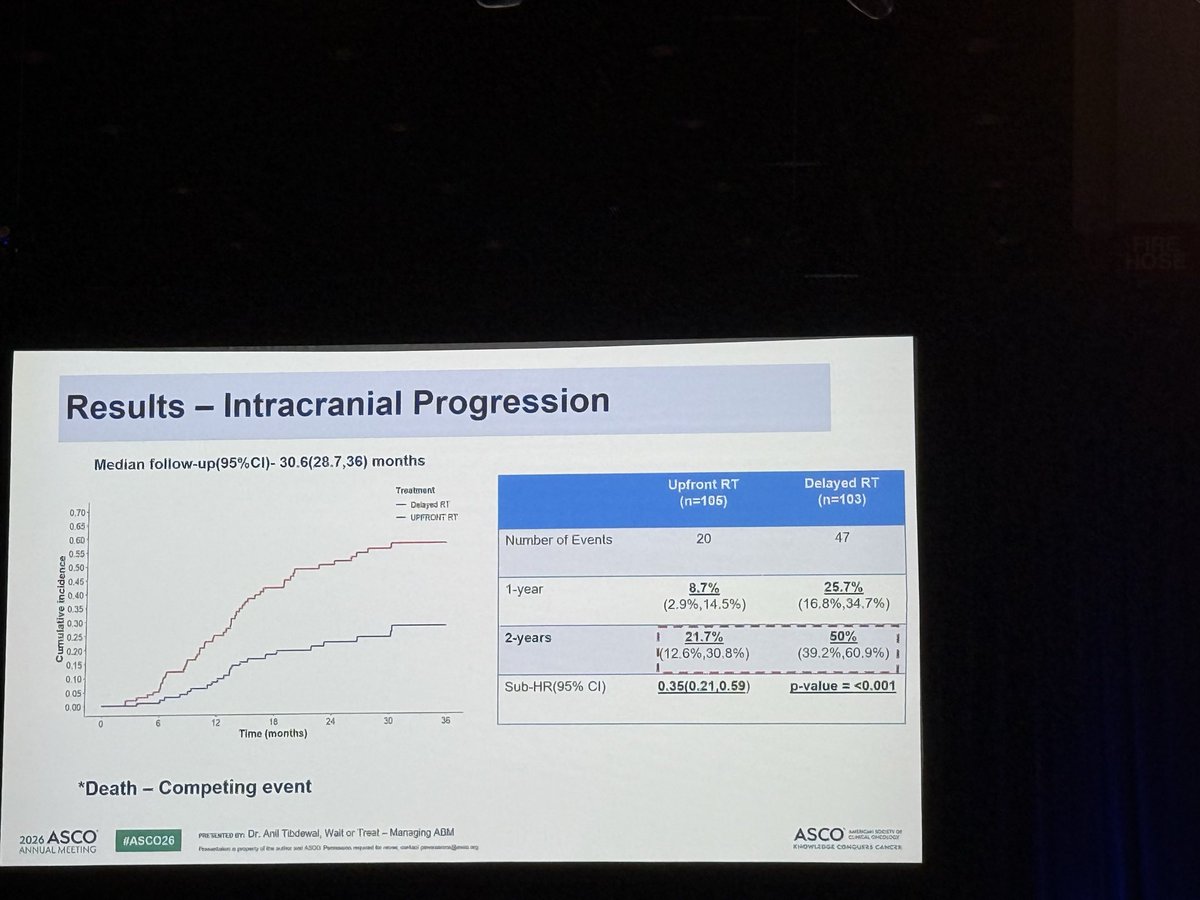
+2 more figures


10 details
Phase III open-label RCT, single-centre (Tata Memorial, Mumbai), N=208 randomised 1:1 to upfront (n=105) vs delayed cranial RT, both on TKI plus chemotherapy. Stratified by GPA (0-2 vs >2) and synchronous vs metachronous BM. Median follow-up 30.6 mo (28.7, 36).
Metastatic NSCLC with an EGFR or ALK alteration, ECOG PS 0-2, radiologically measurable brain metastases that were completely asymptomatic. Number, size, and location of lesions are not reported in source.
Upfront arm received cranial RT at diagnosis; the delayed arm received it at intracranial progression or patient's wish, so both arms are RT-exposed and the question is timing, not omission. Dose, fractionation, and technique (WBRT vs SRS) are not reported in source, which is the main barrier to transferring this result.
Primary: intracranial PFS. Secondary: OS, PFS, toxicity, ORR, neurocognition, PROM. Surveillance was MRI brain q3m for the first year, then q6m, which is what makes a delayed strategy safe to run.
Primary endpoint met. Survival ran the other way: 2y OS 48% upfront vs 60% delayed, OS HR 1.45, reported by attendees rather than captured in the slide OCR.
| Timepoint | Upfront RT (n=105) | Delayed RT (n=103) |
|---|---|---|
| 1-year | 8.7% (2.9%, 14.5%) | 25.7% (16.8%, 34.7%) |
| 2-years | 21.7% (12.6%, 30.8%) | 50% (39.2%, 60.9%) |
| Sub-HR (95% CI) | 0.35 (0.21, 0.59), p<0.001 | ref |
Radiation necrosis ~6% in the upfront arm and none in the delayed arm per attendee reports, and described as less severe when delayed. Full toxicity tables, neurocognition, and PROM were secondary endpoints not reported in the source.
The intracranial magnitude sits alongside the older WBRT-era data (QUARTZ, and the historic SRS-vs-WBRT trials) in showing that cranial RT controls the brain without buying survival. What is new is testing it where a CNS-penetrant TKI is the competing intracranial therapy, a setting those trials predate entirely.
Single-centre and open-label, and the RT prescription is absent from the source, so a reader cannot tell whether the necrosis signal reflects WBRT, SRS technique, or concurrent TKI exposure. Median follow-up of 30.6 mo is short relative to expected survival in this population, and the OS comparison was a secondary endpoint, not powered.
The result splits the two things RT is usually credited with: it clearly buys intracranial control, and it clearly does not buy time. Whether the OS direction is a real cost of upfront RT or noise in an underpowered secondary is the open question, and it decides whether deferral is merely non-inferior or actually preferred.
CONSORT flow
Randomised phase 3, prespecified intracranial PFS met, but the survival signal runs opposite the intracranial win. Directly contests reflex upfront cranial RT.
- Does the OS direction hold with longer follow-up?
- Was cranial RT whole-brain or stereotactic, at what dose?
- Neurocognition and PROM outcomes by RT timing
📚 Sources · 🐦 3 tweets
#ASCO26 | Wait or Treat? Brain RT in EGFR/ALK+ NSCLC
— OncLive.com (@OncLive) May 29, 2026
Presented by Dr Anil Ramakant Tibdewal.
A landmark Phase III randomized trial from @TataMemorial addressed a long-standing question: should asymptomatic brain metastases in oncogene-driven NSCLC receive upfront cranial RT or… pic.twitter.com/lRy9CfyQ8r
Should asymptomatic brain mets await systemic response in front line within EGFR/ALK context? I think yes. Despite reducing icPD, delayed brain RT OS looked better and radiation necrosis didn’t occur vs 6% #ASCO26 pic.twitter.com/O6d7GrvtU4
— Dr Riyaz Shah (@DrRiyazShah) May 29, 2026
No improvement in survival with up front radiation. OS favored delayed radiation with 2y OS 48% with early radiation vs 60% in late (OS HR 1.45). Also, radiation necrosis less common and less severe in delayed arm. Each case unique but delayed approach appealing #ASCO26 pic.twitter.com/wIhjqxhSaq
— Stephen V Liu, MD (@StephenVLiu) May 29, 2026
EXTEND
ForOligometastatic solid tumors, 1-5 metastases, on standard systemic therapy
HR 0.54
95% CI 0.41-0.72, p<0.001
TL;DRPFS HR 0.54 (0.41-0.72), p<0.001 for MDT added to SOC across 6 oligometastatic baskets; RT delivered 98% of MDT.
The prostate-excluded HR 0.60 (0.40-0.89) is the number that matters for an RT reader: the benefit survives removal of the two prostate baskets, where MDT is already routine. RT delivered 98% of MDT (370/379), so this is a radiotherapy result, though dose and fractionation are not reported in source.
In a patient with 1-5 metastases from pancreas or a non-breast, non-kidney histology already on standard systemic therapy, this supports discussing MDT as an addition rather than a deferral; it does not resolve the breast or kidney question, where the baskets were inconclusive.
RT delivered 98% of MDT (370/379 metastases), so the all-basket HR 0.54 and the prostate-excluded HR 0.60 (0.40-0.89) are radiotherapy effect sizes. The prostate-excluded analysis is the one that moves practice beyond the population where MDT is already routine, though dose, fractionation and target volume are not reported in source.
MDT was added on top of standard systemic therapy rather than substituted for it, so nothing here supports deferring or de-escalating systemic treatment. The ctDNA findings (detectable at enrollment with shorter PFS, clearance at 3 months with better survival) are the medonc-relevant signal, pointing toward a molecular rather than lesion-count definition of who to refer.
13 details 5 trials watching
Multicenter randomized phase II basket trial, 6 histology baskets with basket-specific stratification and powering. Accrual 2018 to 2023, median follow-up 53 months.
Patients with 1-5 metastases on standard-of-care systemic therapy, allocated to breast, pancreas, kidney, two prostate baskets, or an "Other" basket. 521 screened, 350 randomized, 334 analyzed per protocol (MDT+SOC n=166; SOC n=168).
Radiotherapy delivered 98% of MDT (370/379 metastases), so this is effectively a radiotherapy trial. Dose, fractionation, technique and target-volume definition are not reported in source.
Primary: PFS, pre-specified in the per-protocol set at three levels (within each basket, across all baskets, and across all baskets excluding the prostate baskets). Exploratory: ctDNA and immune profiling.
All-basket PFS HR 0.54 (95% CI 0.41-0.72), p<0.001; excluding prostate, HR 0.60 (95% CI 0.40-0.89). Superiority in pancreas, prostate and "Other"; breast and kidney inconclusive. No per-basket effect sizes reported in source.
SABR-COMET randomized 99 patients across mixed histologies; STOMP and ORIOLE were prostate-only and smaller. EXTEND's contribution is scale plus histology resolution: it keeps a benefit when the prostate baskets are removed, which the prostate-only trials could not address.
The primary analysis is per-protocol rather than ITT, and an unblinded PFS endpoint in a trial that ablates the very lesions being measured favors the intervention arm. The "Other" basket is a mixed-histology pool, so its superiority signal is the hardest of the three to carry into a single phase III.
The prostate-excluded HR 0.60 is the trial's most load-bearing number, since it shows the pooled result is not simply the prostate literature reasserting itself. The ctDNA correlations (detectable at enrollment with worse PFS and survival; clearance at 3 months with better survival) point at a biological rather than anatomic definition of oligometastasis, which is the more interesting question EXTEND raises without settling.
CONSORT flow
Randomized phase II, per-protocol primary, histology-specific signals explicitly framed as hypothesis-generating for phase III. Consistent with SABR-COMET / STOMP / ORIOLE direction.
- Does MDT-driven PFS benefit translate to overall survival n=340 · primary completion 2026-11 · OLIGAMI: randomised MDT after 12wk systemic, breastactive Stereotactic Ablative Radiotherapy for Comprehensive Treatment of Oligometastatic (1-3 Metastases) Cancer Phase NAn=330 · primary completion 2030-11 · SABR-COMET-style RCT with OS as primary, 1-3 mets
- Can ctDNA select oligometastatic patients for MDT n=60 · primary completion 2027-12 · SABR cohort tracking ctDNA dynamics as biomarker
- Confirmatory phase III in pancreas oligometastatic disease recruiting Stereotactic Body Radiotherapy in Patients With Rare Oligometastatic Cancers (OligoRARE) Phase NAn=200 · primary completion 2028-08 · phase III SBRT+SOC, OS endpoint, pancreas among sitesactive SENECA: First Line metaStatic pancrEatic caNcer Primary and Distant (if Oligometastatic) lEsion direCted rAdiotherapy Phase 3n=108 · primary completion 2030-01 · randomised phase 3 SBRT vs chemo alone, 1L met pancreas
📚 Sources · 📄 1 paper
Abstract
OLIGOMA NCT04495309
ForMetastatic breast cancer, ≤5 lesions, any treatment line; mostly ER+/HER2- first-line
35.8 vs 20.4 mo
HR 0.48 (95%-CI 0.25-0.91), p=0.021
TL;DRmPFS 35.8 vs 20.4mo, HR 0.48 (0.25-0.91) p=0.021 with ablative RT to all lesions in oligometastatic breast.
The RT question here is whether ALL lesions must be treated: eligibility required ablative RT to every metastasis, and pts needing palliative RT to all sites were excluded, so this is comprehensive ablation, not selective consolidation. With 2/3 bone lesions and >80% carrying 1-3 mets, the transferable case is the low-burden bone-dominant pt. No dose or fractionation reported in source.
In ER+/HER2- metastatic breast with 1-3 mostly bone lesions starting first-line systemic therapy, this supports discussing ablative RT to all sites; it does not extend to pts with >5 lesions or those needing palliative RT to every site.
The transferable detail is the eligibility rule, not the HR: RT went to ALL metastatic lesions, and pts needing palliative RT to every site were excluded. With >80% carrying 1-3 mets and 2/3 bone, this is comprehensive ablation of low-burden disease. Dose and fractionation not reported in source.
The systemic regimen was fixed by tumor board BEFORE randomisation, so the PFS separation is attributable to RT rather than to differential drug management. Nearly three-quarters were on first-line endocrine or chemotherapy, so the question this moves is whether to pause and refer for ablation at diagnosis of oligometastatic disease, not which regimen to pick.

+3 more figures

| Arm | QLQ-C30 summary, mean (95%-CI) | Between-group change (ANCOVA) |
|---|---|---|
| Experimental | 72.2 (67.2-77.2) | -2.1 (-9.2-5.1) |
| Control | 74.3 (69.3-79.3) | n/a |


9 details 5 trials watching
Randomised trial (ARO-2021-09), systemic therapy alone vs systemic therapy plus local ablative radiotherapy to all metastatic lesions. Stratified by type of systemic therapy and treatment line. Systemic regimen was set by multidisciplinary tumor board before randomisation, so the only variable is RT.
Metastatic breast cancer, any treatment line, maximum 5 lesions. Median age 58 (experimental) vs 59 (control); ER positive 76.7% vs 81.8%, HER2 positive 7.5% vs 15.0%. Nearly three-quarters were on first-line endocrine or chemotherapy. >80% had 1-3 metastases and 2/3 of lesions were bone.
Local ablative RT was delivered to all metastatic lesions, not a selected subset. Palliative RT to symptomatic metastases was permitted, but pts requiring palliative RT to all metastases were not eligible. Dose, fractionation and technique not reported in source.
Co-primary: PFS and quality of life (EORTC QLQ-C30) at 12 weeks post-randomisation. Secondary: overall survival, toxicity, compliance, QLQ-C30 and QLQ-BR23, and patient satisfaction with cancer care (EORTC PATSAT C33).
Both co-primary endpoints read out in the trial's favour: PFS separated, and the 12-week QoL difference stayed inside the prespecified non-inferiority margin of -10 points with baseline adjustment. OS not reported in source.
Beyond the accrual shortfall, the QoL co-primary rested on n=64 of 87 randomised, and 12 weeks is too early to capture late RT toxicity in a population with a 35.8-month median PFS. Toxicity and compliance were secondary and are not reported in source.
This is the first RCT to show a PFS benefit from MDT in oligometastatic breast cancer specifically, a histology under-represented in the earlier mixed-tumour MDT randomised experience. Eight trials in the same question (TAORMINA, STEREO-SEIN, LARA, CLEAR, COSMO, ARCHER, ISTMET, OLIGAMI) are still recruiting, so the field will not settle on 87 pts.
The result establishes direction, not magnitude: an HR of 0.48 from an early-terminated trial is the estimate most likely to regress. What it does settle is the tolerability question, since short-term QoL was not degraded by treating every lesion. Which pts benefit most, by lesion count, site and systemic line, remains open.
CONSORT flow
Recruitment stopped at <20% of initial target; 87 pts, PFS CI 0.25-0.91. Positive and randomised, but underpowered against eight ongoing confirmatory trials.
- Which oligometastatic breast subgroups benefit most from MDT n=340 · primary completion 2026-11 · phase 3 MDT with subtype-specific systemic therapynot yet Adding Surgery and Radiation to the Usual Treatment for HER2-Positive Breast Cancer That Had Already Spread at Diagnosis Phase 3n=562 · primary completion 2032-05 · HER2+ de novo, 1-5 mets, SBRT added to SOC
- Does the PFS benefit translate to overall survival n=150 · primary completion 2025-08 · randomised SABR vs SOC in de novo oligomet BCn=345 · primary completion 2025-12 · TAORMINA: randomised SABR + systemic, 1-5 mets
- Optimal dose and fractionation for bone-dominant ablation recruiting OligoCare TwiCs (Trials Within Cohorts) Trial Comparing Acute Toxicity in Single-fraction vs Multiple-fraction SBRT for Metastasis-directed Treatment (SPRINT) Phase NAn=302 · primary completion 2029-02 · SPRINT: single- vs multi-fraction SBRT randomised
📚 Sources · 🐦 3 tweets
📌 Metastases-directed treatment in Patients with Oligometastatic Breast Cancer: Results from the OLIGOMA-trial (ARO-2021-09, NCT04495309) @DavidKrugMD 👏🏻 #ESTRO26 @ESTRO_RT @OncoAlert #OncoAlertAF pic.twitter.com/YDMef0fXRm
— Elisabetta Bonzano MD, PhD (@to_be_elizabeth) May 17, 2026
❗️ The OLIGOMA trial results just dropped at #ESTRO26 and they are massive. A 15-month improvement in median PFS for OMD breast cancer (HR = 0.48). This adds to the growing mountain of evidence that MDT (Metastasis-Directed Therapy) works. Lets’s go 🧵 1/n pic.twitter.com/5uiEVSYtdH
— NonsparseOncologist (@5_utr) May 17, 2026
Here are some details!
— Jeff Ryckman (@jryckman3) May 17, 2026
On OLIGOMA, nearly 3/4 were first line endocrine or chemotherapy. #ESTRO26 #OncTwitter@CJTsaiMDPhD pic.twitter.com/r3kJzNNsyK
OligoCare
ForOligometastatic solid tumors treated with SABR, mixed primaries and lesion sites
TL;DRReal-world SABR local failure 5.0% at 1yr, 11.4% at 3yr across 2447 pts / 3533 lesions; CRC worst at 19.6%.
The actionable RT signal is minimum PTV dose, called the single most critical technical factor, and the de novo vs repeat OMD gap the authors attribute to higher delivered dose. CRC failed most (19.6% at 3yr) despite the highest median dose per fraction, which argues for escalation or combination rather than coverage alone. No dose thresholds are reported in source.
For a prostate or NSCLC oligomet being planned for SABR, this real-world cohort supports expecting durable in-field control (8.1% and 9.8% failure at 3yr); it does not support the same expectation for a colorectal met, where 3yr failure reached 19.6%.
Minimum PTV dose is named the most critical technical factor, so coverage of the low-dose region, not the prescription isodose, is where the planning attention goes. CRC failed worst (19.6% at 3yr) despite the highest median dose per fraction, so escalation alone may not close that gap. No dose thresholds reported in source.
SABR delivers 88.6% in-field control at 3yr in routine practice, so local failure is not the dominant driver of progression in most oligometastatic primaries. The exception is colorectal, at 19.6% failure by 3yr, where the authors suggest combination systemic approaches alongside local therapy rather than dose escalation alone.

| Primary | Total | 1 year | 3 years |
|---|---|---|---|
| Colorectal | 518 | 9.3% | 19.6% |
| Breast | 378 | 4.1% | 11.3% |
| NSCLC | 530 | 6.0% | 9.8% |
| Prostate | 1021 | 2.7% | 8.1% |
+2 more figures


10 details 4 trials watching
Prospective EORTC OligoCare registry cohort, interim analysis. 57 institutions, enrolment July 2019 to July 2025. No randomisation and no comparator arm; technique and dose were chosen by the treating institution.
2447 eligible pts with 3533 lesions. Median age 69 (range 28-94), 69% male. Primaries reported for the local-control breakdown were prostate (1021), NSCLC (530), colorectal (518) and breast (378).
SABR to oligometastatic lesions across bone (869 non-vertebral, 515 spine), lung (807), non-regional nodes (558), liver (306), brain (231) and other (247) sites. Minimum PTV dose was the technical factor most associated with outcome; specific dose and fractionation schedules are not reported in source.
Local in-field progression, reported as cumulative incidence with 99% CI, at 1 and 3 years. Median follow-up 31 months, minimum 6 months.
Overall local in-field progression 5.0% at 1yr and 11.4% at 3yr, ie 88.6% local control at 3yr. By primary, colorectal was the outlier and prostate the best.
Randomised oligometastatic SABR trials (SABR-COMET, STOMP, ORIOLE) were built on much smaller, more selected cohorts and reported survival or progression endpoints rather than lesion-level in-field control at this scale. This registry does not test the SABR question those trials asked; it reports what in-field control looks like once SABR is delivered in routine multi-institutional practice.
Dose and fractionation were institution-chosen, so the minimum-PTV-dose association is confounded by target site, prior irradiation and case selection. No PTV dose threshold, no per-primary dose data and no toxicity are reported in source, so the technical conclusion cannot be translated into a planning constraint.
The CRC finding is the one that changes a plan: worst local control despite the highest median dose per fraction points at intrinsic radioresistance rather than underdosing, and the authors call for escalation or combination strategies. The de novo versus repeat OMD gap is reported as a dose effect, which is plausible but is exactly the kind of comparison a registry cannot separate from the reasons a lesion is being re-treated.
Prospective multi-site registry, no randomised comparator, institution-chosen technique. Large real-world cohort supports existing SABR practice in OMD rather than testing it.
- Minimum PTV dose threshold that predicts local control
- Combination or dose-escalation strategies for colorectal oligomets recruiting Fruquintinib Combined With Sintilimab ± Radiotherapy for Third-line Treatment of Colorectal Cancer With Liver Metastases Phase 2n=62 · primary completion 2026-10 · SBRT+LDRT with sintilimab/fruquintinib, MSS CRC liverrecruiting Low and Intermediate Risk OliGometastatic ColoREctal CancEr PatieNts Treated with Stereotactic ABlative Radiotherapy Phase NAn=204 · primary completion 2031-04 · randomised SABR + chemo in 1-3 CRC oligomets
- Whether repeat OMD failure reflects dose or disease biology active Bony M - Stereotactic Ablative Radiotherapy (SABR) of Bony Metastases in Patients With Oligometastatic Disease Phase NAn=67 · primary completion 2023-01 · SABR in de novo vs recurrent OMD bone lesionsn=397 · primary completion 2028-06 · MR-guided adaptive SBRT, tumor control by site
📚 Sources · 🐦 1 tweet
📣 #ESTRO26 - @UmbertoRicardo e2irradiate @EORTC prospective OLIGOCARE registry of SABR for oligomets. ~2500 patients, ~3500 mets.
— Shankar Siva (@_ShankarSiva) May 17, 2026
➡️ local failure 5% at 1 year and 11% at 3 years
➡️ Colorectal cancer has higher risk of progression
➡️ minimum PTV dose correlated with outcome… pic.twitter.com/cx4zERqHhK