DBCG RT Natural
For≥60y, pT1N0, grade 1-2, ER≥10%, HER2 normal, margin ≥2mm, post-BCS
1.5% vs 9.8%
+RT 2/236, 1.5% (0.3-5.1); -RT 19/272, 9.8% (5.9-14.9)
TL;DR5yr invasive LR 1.5% with PBI vs 9.8% randomised no-PBI vs 8.2% self-selected no-PBI at 4yr median f/u.
The 2x2 by treatment received is the actionable read, not the arm comparison: -RT +ET reached 3.7% (7/213) while -RT -ET hit 12.2% (32/352), so ET adherence is what holds the omission strategy together, and it was suboptimal. PBI was 40Gy/15fr, not a 5-fraction schedule.
In a woman ≥60 with pT1N0 grade 1-2 ER-positive HER2-normal disease post-lumpectomy, this argues against dropping both PBI and endocrine therapy, and it does not address node-positive, lobular, grade 3, or ER-low disease, which were excluded.
PBI 40Gy/15fr drove LR to 1.5% (2/236) vs 9.8% randomised omission, and the -RT arm crossed the prespecified 4% ceiling. The +RT -ET cell at 3.0% (2/132) means RT alone holds local control without endocrine therapy, which moves the omission conversation for a patient who will not take or tolerate ET.
The -RT +ET cell reached 3.7% (7/213) versus 12.2% (32/352) with neither, so endocrine therapy alone is close to RT alone for local control here. But the ET grouping is by treatment received (≥4.5y vs <4.5y or low-risk), so that 3.7% describes completers and adherence is the load-bearing assumption in an ET-only strategy.

+3 more figures

| Study arm | Events/Total | CIF % (95% CI) |
|---|---|---|
| +RT | 2/236 | 1.5 (0.3-5.1%) |
| -RT | 19/272 | 9.8 (5.9-14.9%) |
| S-RT | 18/278 | 8.2 (4.5-13.3%) |

9 details 3 trials watching
Phase III randomized trial, PBI 40Gy/15fr vs no PBI, stratified by institution and endocrine therapy yes/no, with a third non-randomised self-selecting no-PBI cohort. Planned accrual 926 randomised with an interim analysis at 200 patients with 2 year follow-up. Median follow-up 4 years at this reading.
≥60 years, breast cancer treated with breast conservation, pT1N0, unilateral, unifocal, non-lobular, ER ≥10%, HER2 normal, grade 1-2, limited DCIS, margin ≥2mm. Endocrine therapy given per DBCG guideline, which recommends ET for pT1c and/or grade 2.
Partial breast irradiation, 40Gy in 15 fractions. This is a moderately hypofractionated PBI schedule, not the 5-fraction regimens now in wide use, which matters for how the toxicity and convenience side of the omission trade transfers.
Primary: 5 year invasive local recurrence, with a design assumption of 2% and a prespecified maximum acceptable 4%. Secondary: loco-regional side effects and quality of life. Follow-up yearly mammography plus loco-regional side effect assessment to 10 years.
All 41 recurrences were invasive and 39 of 41 arose in patients who received no PBI. Distant failure was rare across the whole trial at 4 events, 2 in each of the +RT and no-PBI groups.
Loco-regional side effects and QoL were prespecified secondary endpoints but no toxicity or QoL figures were reported in the source. The omission-versus-PBI toxicity trade that drives this decision is therefore unquantified here.
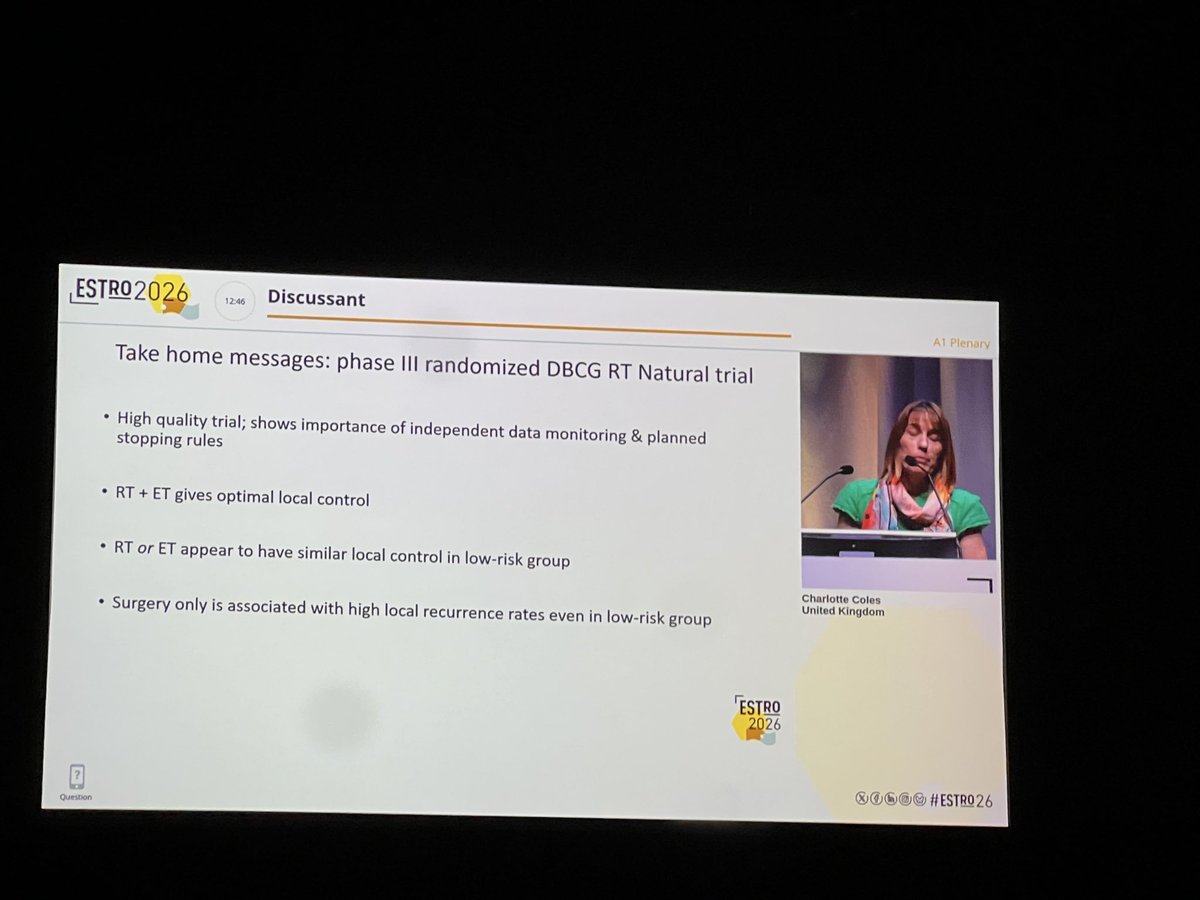
PRIME II and CALGB 9343 established that RT omission in older low-risk women is tolerable because absolute local recurrence stays low. Here the randomised no-RT arm reached 9.8% and crossed the trial's own 4% ceiling, which is the opposite result, and the discussant framed surgery alone as carrying high local recurrence even in low risk.
Median follow-up is 4 years against a 5 year primary endpoint, so the reported cumulative incidences are read before the timepoint the trial was designed around. The third arm is self-selected, not randomised, so its 8.2% carries confounding by whatever drove refusal, and the endocrine therapy split is by treatment received rather than assignment.
The trial's contribution is that it isolates the floor: a group with no adjuvant treatment at all, which the modern omission trials do not have because endocrine therapy is universal in their omission arms. 12.2% at that floor reframes the published omission literature as measuring RT omission on an endocrine backbone, not omission of local therapy. It does not settle whether PBI or ET is the better single agent, since 3.0% and 3.7% overlap widely.
CONSORT flow
Randomised, prespecified LR endpoint, stopped early by independent monitoring for exceeding the 4% threshold. Cuts against the de-escalation direction PRIME II and CALGB 9343 set.
- Does 5-fraction PBI match 40Gy/15fr local control in this population n=910 · primary completion 2029-11 · phase 3 PBI vs WBI, 1 week each, LR endpoint
- Toxicity and QoL trade between PBI and endocrine monotherapy n=30 · primary completion 2023-11 · SBRT added to endocrine tx, unoperated pts 75+n=168 · primary completion 2030-07 · randomised 30Gy vs 26Gy/5fr PBI, PRO endpoint
- Whether 4yr separation holds at the 5yr primary timepoint
📚 Sources · 🐦 2 tweets
Another trial showing even for lR optimal local control with RT and ET and suboptimal adherence to ET. In era of 5 fraction decision making is easier # Estro2026 pic.twitter.com/nkvYl3iuTn
— Sushil (@Sushilberiwal) May 17, 2026
Danish #breastcancer partial breast #radiotherapy “natural” trial.
— Shankar Siva (@_ShankarSiva) May 17, 2026
➡️ No postoperative treatment had highest risk of recurrence
➡️either tamoxifen or #radonc reduced recurrence
➡️combined tamoxifen + RT had no recurrences
In context of EUROPA trial, RT has best QoL vs endocrine… pic.twitter.com/bDVmbDKRNb
The longer read
The result that will get quoted is 1.5% versus 9.8%, but the number that should change how a radiation oncologist reads the omission literature is 12.2%. That is the cumulative incidence in women who received neither partial breast irradiation nor endocrine therapy, and it is a quantity the trials that built the omission consensus never measured. PRIME II and CALGB 9343 randomised radiotherapy on top of a universal endocrine backbone. Their low absolute recurrence rates in the omission arms were therefore always a statement about one local therapy being redundant when another systemic one is running, not a statement about how indolent the underlying biology is. DBCG RT Natural, by letting endocrine therapy vary and by capturing patients who took neither, puts a number on the untreated floor, and it is high enough that the framing of these tumors as ones that mostly do not come back looks like an artifact of the adjuvant treatment everyone was still receiving.
The design detail that carries the most weight for interpretation is also the one that most limits it. The endocrine comparison is by treatment received, defined as at least 4.5 years of therapy or censoring, with the low-adherence and short-duration patients falling into the minus-ET group. That is not a randomised contrast, and adherence is not random: women who stop endocrine therapy early differ from those who complete it in ways that plausibly correlate with recurrence risk, comorbidity, and surveillance intensity. So the 3.7% in the no-RT plus ET cell is a best case for endocrine monotherapy, drawn from the compliant, and the 12.2% is drawn from a group defined partly by having dropped out. The direction of that bias is not obviously conservative. The randomised comparison, which is clean, is only the radiotherapy question, and there the answer is unambiguous.
Against that, the follow-up is short. Median four years against a five year primary endpoint means these curves are being read before the point the trial was powered for, and the trial stopped at interim because a monitoring committee saw the no-radiotherapy arm cross a threshold the protocol set in advance. Early stopping for harm systematically overestimates the effect size at the moment of stopping, so the true separation at five years is likely to be narrower than 1.5 versus 9.8. That does not rescue omission, since the threshold that was crossed was the trial's own definition of acceptable, but it should temper the magnitude a reader carries forward.
The practical asymmetry is the one the discussant named: radiotherapy and endocrine therapy appear interchangeable for local control in this population, at 3.0% and 3.7%, with confidence intervals that overlap almost entirely. Two arms of a de-escalation decision that were previously ordered, drop the radiotherapy and keep the pill, now look like a choice between two roughly equivalent options with very different toxicity and adherence profiles. The radiotherapy delivered here was 40Gy in 15 fractions of partial breast irradiation, a schedule that predates the five-fraction regimens now displacing it. If a shorter course produces comparable control, the convenience argument that made endocrine monotherapy attractive weakens further, and the decision becomes a straightforward comparison of five days of treatment against five years of a drug that a meaningful fraction of this cohort did not complete.