Challenges SOC
NRG-GU005 NCT03367702
ForLocalized favorable intermediate-risk prostate, T1-T2b, GG1-2, PSA <20
88.6% vs 92.1%
SBRT not superior; adjusted HR 1.40 (0.91-2.13), P=.12
TL;DR3yr DFS 88.6% SBRT vs 92.1% MH-IMRT, superiority rejected (adjusted HR 1.40, 0.91-2.13); bowel and GU toxicity favored SBRT.
The number that should move practice is biochemical failure: 7.8% vs 4.2% at 3yr (adj HR 1.82, 1.01-3.27), while local failure was flat at 1.2% vs 1.0%. The SBRT prescription was deliberately modest, 36.25 Gy/5 fx with dose uniformity prioritized and urethral max held to 38.78 Gy, so this reads as a dose and margin question, not a verdict on 5 fractions.
In favorable intermediate-risk localized prostate cancer choosing between 5-fraction SBRT and moderate hypofractionation, this supports the toxicity and convenience case for SBRT while flagging a 3-year PSA-failure gap; it does not speak to unfavorable intermediate or high-risk disease, or to dose-escalated SBRT regimens.
Biochemical failure, not DFS, carries the read: 7.8% vs 4.2% at 3yr (adj HR 1.82, 1.01-3.27) with local failure flat at 1.2% vs 1.0%. The prescription was deliberately uniform, 36.25 Gy/5 fx with urethral max 38.78 Gy and no focal boost, so this argues about dose and margin rather than about 5 fractions.
Also covered Jul 8
13 details 5 trials watching
Phase 3, international, open-label, 1:1 randomized superiority trial across 136 centers, accruing November 2017 to June 2022 with last follow-up October 2024. N=698 randomized (353 SBRT, 345 MH-IMRT), median follow-up 3.2 years. Two coprimary end points, patient-reported QoL and DFS, each tested at 2-sided alpha .05 with no study-wise correction, so both had to be positive for a positive trial.
Localized cT1-T2b, either Gleason 3+4 (GG2) with PSA <20 ng/mL or Gleason 3+3 (GG1) with PSA 10-20 ng/mL. Median age 68 (range 42-84); 80% White, 13% Black, 3% Asian; 81.7% T1c and 88.1% Zubrod 0. Stratified by risk group and by rectal manipulation, of whom 55.6% used spacer alone and 40.3% no device.
SBRT 36.25 Gy in 5 fractions (7.25 Gy per fraction), delivered as prescribed in 96.6%; MH-IMRT 70 Gy/28 fx in 70.6% or 60 Gy/20 fx in 26.6%. Rectal constraints were max 38 Gy to 0.03 mL and 18 Gy to 50%; bladder 39 Gy and 15 Gy. Where PTV max exceeded 38.78 Gy the urethra had to be contoured and capped at 38.78 Gy, a deliberately uniform, non-escalated prescription. Protocol-compliant or acceptable variation in 97.7% and 97.2% of arms.
Coprimary: MCID frequency in EPIC-26 urinary irritative/obstructive and bowel domains at 24 months, and DFS at 3 years (powered for HR 0.62). Secondary: the other EPIC-26 domains at 12 and 24 months, overall survival, biochemical DFS, regional and distant failure. EPIC-26 adherence was 82% at 1yr and 84% at 2yr.
Urinary irritative/obstructive MCID was flat (35.4% vs 33.7%, P=.68); bowel MCID favored SBRT (34.9% vs 43.8%, P=.03). DFS superiority was rejected at a 91-event interim (HR 1.38, 0.91-2.09), with 3yr rates 88.6% vs 92.1% and no adjusted difference (HR 1.40, P=.12).
| Endpoint | SBRT | MH-IMRT | Effect |
|---|---|---|---|
| Biochemical failure | 7.8% | 4.2% | adj HR 1.82 (1.01-3.27), P=.046 |
| Local failure | 1.2% | 1.0% | P=.97 |
| Overall survival | n/a | n/a | P=.65; adj HR 1.15 (0.55-2.41), P=.70 |
Grade 3+4 GU adverse events were lower with SBRT (0.6% vs 2.5%, P=.04), as were any-grade rectal hemorrhage (10.5% vs 17.3%, P=.01) and fatigue (39.2% vs 50.8%, P=.002). Longitudinal bowel scores favored SBRT (LS mean 2.68 [1.02-4.34], P=.002) and urinary incontinence scores likewise (LS mean 2.91 [0.85-4.97], P=.006).
PACE-B and HYPO-RT-PC established that 5-fraction prostate SBRT is tolerable and non-inferior on biochemical control; this trial asked the harder superiority question and lost it, and adds a rectal-manipulation stratification neither predecessor used, which balanced spacer use across arms rather than leaving it a center-level confounder.
The biochemical failure signal, the one result that argues against SBRT, sits on 3-year rates with a CI whose lower bound touches unity (adj HR 1.82, 1.01-3.27) and cannot be separated from the higher benign PSA bounce rate after SBRT, which the trial was not designed to distinguish from true failure. Local, regional and distant failure events were too few to analyze (8 vs 7, 4 vs 2, 4 vs 4), so the mechanism behind the PSA gap is unobserved.
The authors attribute the PSA-control gap to a possible lower biologically effective dose and smaller SBRT margins, the same two choices that plausibly produced the bowel benefit. If that trade is real, it is tunable: focal boost to the dominant intraprostatic lesion was explicitly excluded here and is where the next version of this question belongs.
CONSORT flow
Randomised phase 3, prespecified coprimary endpoints, ITT: the DFS superiority hypothesis was rejected and biochemical failure ran higher with SBRT, contesting the assumption 5 fractions cost nothing.
- Whether benign PSA bounce explains the biochemical failure gap
- Does focal boost to the dominant intraprostatic lesion close it recruiting Image-guided Focal Dose Escalation- Primary pc Treated With Primary External Beam Hypofract.Stereotactic rt Phase NAn=374 · primary completion 2025-08 · randomised focal dose escalation, SBRT vs IMRT/IGRTn=186 · primary completion 2032-08 · randomised DIL boost vs whole-gland boost in SBRTrecruiting Phase III Adaptive Adaptive Stereostactic Body Radiotherapy (SBRT) With Dose Escalation for High-Risk Prostate Cancer Phase NAn=390 · primary completion 2033-04 · DIL dose-escalated SBRT vs mod hypofx, high risk
- Late GI/GU toxicity and QoL beyond 2 years n=68 · primary completion 2025-10 · 5y cumulative GI/GU/sexual toxicity, MR-linac SBRTactive Germline DNA-Based Radiosensitivity Biomarker Influence on Toxicity Following Prostate Radiotherapy, GARUDA Trial Phase NAn=208 · primary completion 2027-12 · long-term physician-scored GU toxicity after SBRT
📚 Sources · 📄 1 paper
Abstract
NSABP B-35 margin-width analysis
ForPostmenopausal HR+ DCIS after lumpectomy, WBI and 5yr endocrine therapy
5.6% vs 4.0%
1mm cutoff, absolute difference 1.6%; 2mm cutoff 5.3% vs 3.8%
TL;DR10yr IBTR 5.6% vs 4.0% at 1mm cutoff (abs diff 1.6%), 5.3% vs 3.8% at 2mm (abs diff 1.5%).
Reported via The ASCO Post →
The RT-relevant read is that every patient here got whole-breast irradiation plus 5 years of endocrine therapy, so the 1.5% to 1.6% margin penalty is the residual after full adjuvant treatment. That gates transfer: it says nothing about a close margin when RT is omitted or refused, which is where the margin question actually bites.
In a postmenopausal woman with HR+ DCIS whose lumpectomy margin is under 2mm and who will complete whole-breast RT plus 5yr endocrine therapy, this argues re-excision buys little; it does not extend to premenopausal, HR-negative, or RT-omitted pts.
Every patient here received whole-breast irradiation with an optional boost plus 5yr endocrine therapy, so 1.5% to 1.6% is the residual margin effect after full adjuvant treatment. Boost use by margin group is not reported in source, which matters: it determines whether a close margin was tolerated or quietly compensated.
A margin under 2mm carried a 10yr IBTR of 5.3% vs 3.8% for ≥2mm, an absolute 1.5% penalty, in the largest randomised-trial population yet examined. That directly gates the return-to-theatre decision, though margin width was not randomised and the narrow group is enriched for disease that could not be cleared.
9 details 1 trial watching
Secondary margin-width analysis of NRG Oncology/NSABP B-35, a double-blind randomised trial of tamoxifen vs anastrozole that enrolled 3,104 postmenopausal women 2003-2006. Because local recurrence did not differ between the two endocrine arms, the arms were pooled and margin width analysed across the whole population. Margin data were collected prospectively by participating pathologists.
Postmenopausal women with hormone receptor-positive DCIS treated with lumpectomy. Two overlapping analysis cohorts: n=2,707 with margins classifiable as <1mm (close/indefinite) vs ≥1mm, and n=2,546 with the closest margin measured, permitting a <2mm vs ≥2mm cutoff.
All patients received whole-breast irradiation with an optional boost. Dose, fractionation and boost uptake are not reported in the source, so the RT exposure behind these recurrence rates cannot be characterised beyond "whole breast, boost optional".
Primary endpoint of interest: cumulative incidence of ipsilateral breast tumor recurrence at 10 years, analysed at both the 1mm and 2mm cutoffs. A secondary analysis of all breast cancer events, including contralateral disease, was also performed.
The prevailing 2mm threshold rests largely on the SSO/ASTRO/ASCO DCIS consensus, whose meta-analytic base drew heavily on series with variable and often absent adjuvant therapy. This analysis puts the same question to a uniformly irradiated, uniformly endocrine-treated randomised trial population, which is why the residual margin effect looks so much smaller.
Margin width was not randomised, and patients re-excised on trial carry their final margin, so the narrow-margin group is enriched for disease that could not be cleared. Source reports no hazard ratios, confidence intervals or event counts, and no multivariable adjustment for grade, size, age or boost use.
The claim is that a 1.5% to 1.6% absolute 10-year difference does not justify routine reoperation, which is a value judgment about the trade against anxiety, cosmesis and cost rather than a statistical one. The difference was statistically significant at the 1mm cutoff, so the argument turns on clinical meaningfulness, and a patient who weighs local recurrence heavily could reasonably read the same number differently.
| Cutoff | Narrow margin | Wider margin | Absolute difference |
|---|---|---|---|
| 1 mm | 5.6% (n=502) | 4.0% (n=2,205) | 1.6% |
| 2 mm | 5.3% (n=879) | 3.8% (n=1,667) | 1.5% |
Prospectively collected margin data from a large RCT population directly contests the 2mm re-excision threshold, but the margin comparison itself is non-randomised and abstract-only.
- Does the finding hold when whole-breast RT is omitted? not yet Assessment of Biosignature Classification of DCIS for RadioTherapy Benefit Post Lumpectomy (ABCD RT) Phase 3n=5270 · primary completion 2039-07 · randomises RT omission in biosignature-low DCIS
- Boost use and dose by margin group
- Applicability to premenopausal or HR-negative DCIS
📚 Sources · 📄 1 paper
Abstract
POSEIDON
ForPost-prostatectomy biochemical recurrence, PET-negative, pre-PORT PSA the gating variable
HR 0·87
95% CI 0·76–1·01, p=0·06, not met
TL;DROS HR 0·87 (0·76–1·01), p=0·06 for adding hormone therapy to PORT; benefit only above pre-PORT PSA 0·5 ng/mL.
The gate is pre-PORT PSA, not risk features. Below 0·5 ng/mL point estimates favour PORT alone (HR 1·14 at ≤0·20); above it, HR 0·72 and 0·69 with NNT 22 and 12. Long-term HT only separates on spline at PSA ≥1·6 ng/mL, above what early salvage practice sees.
In PET-negative post-prostatectomy biochemical recurrence referred at PSA 0·2 to 0·5 ng/mL, this questions adding hormone therapy to prostate-bed radiotherapy; it does not address PSMA-PET-positive nodal recurrence or pts already above 0·5 ng/mL, where the survival signal sits.
For the pt referred at PSA 0·2 to 0·5 ng/mL, the point estimates favour PORT alone (HR 1·14 at ≤0·20, 0·94 at 0·21–0·50), so the routine 6-month ADT add-on has no survival footing in the range early salvage now targets. Above 0·5 ng/mL the HRs are 0·72 and 0·69 with NNT 22 and 12.
Duration is not the lever: prolonging 6 months to 24 within RADICALS gave OS HR 0·89 (0·68–1·16), and the long-term cohort's apparent advantage tracks its higher baseline PSA and worse pathology. RTOG 9601 used bicalutamide, not castration, so the one OS-positive trial does not validate GnRH intensification.
13 details
IPD meta-analysis of randomised phase 3 trials of PORT with or without hormone therapy, MARCAP consortium, PROSPERO CRD42019134376. One-stage framework, univariable Cox stratified by trial, intention-to-treat. Six randomised comparisons, 6057 pts, median follow-up 9·0 years.
Post-radical-prostatectomy pts receiving prostate-bed radiotherapy, adjuvant or salvage. Median pre-PORT PSA 0·3 ng/mL overall (0·5 in the long-term cohort). Positive margins in 57–60%, Gleason 7 in about two-thirds, seminal vesicle invasion 16–17%. Race and ethnicity data were not available.
Short-term arm was 4–6 months, predominantly GnRH agonist. Long-term was 24 months, GnRH agonist in 425 (86%) of 492 RADICALS three-way pts, with RTOG 9601 contributing bicalutamide monotherapy rather than castration.
PORT to the prostate bed with or without pelvic nodes, per each contributing trial. Dose, fractionation and nodal-volume detail are not reported in the source text, so the RT technique is not standardised across the six randomisations.
Primary: overall survival. Secondary MFS, event-free survival, biochemical recurrence (Fine–Gray). Prespecified interaction testing on pre-PORT PSA and hormone therapy duration, plus 10-year restricted mean survival time and NNT.
The primary endpoint was not met. The signal sits entirely in the PSA interaction and in MFS, both shown in the detail tables.
| Pre-PORT PSA (ng/mL) | HR (95% CI) | p |
|---|---|---|
| ≤0·20 | 1·14 (0·83–1·57) | 0·43 |
| 0·21–0·50 | 0·94 (0·74–1·19) | 0·70 |
| 0·51–1·00 | 0·72 (0·54–0·96) | 0·02 |
| >1·00 | 0·69 (0·48–0·98) | 0·03 |
| Comparison | OS HR (95% CI) | MFS HR (95% CI) |
|---|---|---|
| Short-term (4–6 mo) added to PORT | 0·93 (0·77–1·11) | 0·82 (0·71–0·95) |
| Long-term (24 mo) added to PORT | 0·79 (0·63–1·00) | 0·74 (0·60–0·91) |
| Prolong short to long | 0·89 (0·68–1·16) | 0·76 (0·61–0·95) |
RTOG 9601 remains the only contributing trial to show an OS benefit, and it enrolled late salvage at higher PSA with bicalutamide, exactly the high-PSA stratum where benefit persists here. The contrast with intact-prostate radiotherapy, where the same consortium's 2022 Lancet Oncology analysis found an OS benefit for added ADT, is the point: the postoperative setting does not inherit it.
The short-term and long-term comparisons draw on different trial populations, and the long-term cohort carried higher PSA and worse pathology, so the duration read is not a clean randomised contrast outside the 1523-pt RADICALS exploratory analysis. Spline thresholds of 1·6 and 2·0 ng/mL sit at the sparse tail of a cohort with median PSA 0·3.
MFS improved while OS did not, and the authors show the MFS effect never clears the ICECaP 0·81 threshold, so the divergence is not simply immature follow-up. What the analysis cannot settle is whether hormone therapy is inert at low PSA or whether its cancer-specific benefit is cancelled by other-cause mortality in pts with indolent disease.
IPD meta-analysis of six randomised trials, prespecified PSA interaction, 9-yr follow-up. Contradicts routine hormone therapy with PORT at low PSA. Duration contrast is exploratory.
- Biomarker to identify who benefits from hormone therapy with PORT
- Does hormone therapy benefit persist in PSMA-PET-staged salvage
- Why MFS gain does not translate to overall survival
📚 Sources · 📄 2 papers
Abstract
Consolidative TRT + Atezolizumab Maintenance in ES-SCLC NCT04462276
ForES-SCLC with ≥SD after carbo-etoposide-atezolizumab induction, unselected
6.7 vs 13.4 mo
HR 1.55 (95% CI 0.90-2.69), P = .34; primary end point not met
TL;DRPrimary EP missed: mOS 6.7 vs 13.4mo (HR 1.55, P=.34) with consolidative 30Gy/10fx; trial halted for fatal SAEs.
The failure is toxicity, not tumor control: PFS was identical (2.4 vs 2.6 mo) while fatal AEs hit 19.4% vs 3.0%, and TRT carried an AE HR of 2.47 (1.15-5.32). Dose was modest (30 Gy/10 fx, postinduction volumes, below OAR thresholds), so de-escalating the plan is not the obvious fix; baseline DLCO SB and radiation-induced lymphopenia are the selection levers.
In unselected ES-SCLC responding to chemoimmunotherapy, this argues against offering consolidative thoracic RT during atezolizumab maintenance off-trial, particularly with low baseline DLCO; it says nothing about limited-stage disease or thoracic RT given without concurrent IO maintenance.
The dose was already conservative (30 Gy/10 fx, postinduction volumes, below OAR thresholds) and no dosimetric parameter tracked with serious events, so de-escalating the plan is not an obvious mitigation. Concurrent vs sequential timing did not change AE risk either. Selection (baseline DLCO SB 45.3 vs 56.7 in fatal-AE pts) and lymphocyte-sparing planning are the live levers.
Arm B's mOS of 13.4 mo and 56.6% 1-yr OS beat the IMpower133 atezolizumab benchmark, so maintenance alone was performing normally and the detriment is attributable to the added modality. TRT carried an AE HR of 2.47 (1.15-5.32) while longer atezolizumab exposure did not, which supports continuing maintenance unmodified rather than adding thoracic RT off-trial.
12 details 5 trials watching
Multicenter open-label phase 2 randomized trial (TREASURE, AIO-TRK-0320) at 20 sites in Germany and Austria, accrual September 2020 to August 2022, follow-up to September 2024, database lock April 2025, post hoc OS update April 2026. Planned 104 randomized for 80% power on a 20% absolute 12-month OS improvement; halted at 68 on SMC recommendation.
ES-SCLC with at least stable disease after induction carboplatin-etoposide-atezolizumab. 34 per arm, mean age 63.3 vs 65.6 y, 63.2% male, ECOG 0-1, thoracic PR in 82.4% overall. Randomization stratified by brain metastases, induction response, and prophylactic cranial irradiation.
30 Gy in 10 fractions to the postinduction thoracic primary and involved lymph node volume. Doses and volumes sat within or below typical clinical ranges and below established organ-at-risk thresholds, and concurrent versus sequential delivery relative to atezolizumab made no difference to AE occurrence.
Primary: overall survival from randomization, by stratified log-rank and multivariable Cox in the ITT population. Secondary: PFS and frequency plus severity of AEs and SAEs. Sensitivity analyses in per-protocol and an adjusted ITT excluding fatal AEs.
SAEs 61.3% vs 18.2% (P < .001) and fatal AEs 19.4% vs 3.0% (P = .04), dominated by infection and respiratory events. Grade 3 or greater trAE rate in arm A (26%) exceeded published benchmarks for atezolizumab monotherapy and for consolidative TRT without immunotherapy, which is the argument for an interaction between the two modalities rather than either alone.
Arm B tracked or beat the IMpower133 atezolizumab benchmark (13.4 mo and 56.6% 1-yr vs 12.3 mo and 51.7%), so the control arm was not underperforming; arm A fell well below it. Prior prospective single-arm series of TRT added to chemoimmunotherapy reported no toxicity increase, while randomized PACIFIC-2 and CheckMate-73L in NSCLC both showed more fatal infections in the concurrent thoracic RT plus IO arms.
Early termination at 68 of 104 makes every efficacy estimate exploratory, and the OS confidence interval (0.90-2.69) crosses 1. Causal attribution of the deaths was contested: investigators called 4 of the arm A fatalities unrelated, the SMC reclassified 3 of those as possibly or probably related. Risk-factor analyses (DLCO SB, GTV, dosimetry) are small-N and post hoc.
The PFS/OS dissociation is the load-bearing observation. Identical PFS argues the RT did nothing systemically, so the OS gap most plausibly reflects treatment-related deaths rather than faster progression, a reading the adjusted-ITT sensitivity analysis complicates by remaining consistent after excluding fatal AEs.
| Endpoint | Arm A (+TRT) | Arm B | P |
|---|---|---|---|
| Any toxic effects | 30 (96.8%) | 25 (75.8%) | .02 |
| SAEs | 19 (61.3%) | 6 (18.2%) | <.001 |
| trAEs | 71.0% | 30.3% | .001 |
| trSAEs | 29.0% | 6.1% | .01 |
| Fatal AEs | 6 (19.4%) | 1 (3.0%) | .04 |
CONSORT flow
Randomized, prespecified OS primary, halted early for fatal SAEs; result contests the single-arm safety data that encouraged consolidative TRT in the IO era.
- Can DLCO or lymphocyte kinetics select pts who tolerate consolidative TRT active Thymus Dosimetric and Morphologic Predictors of Radiation-Induced Lymphopenia in Stage III NSCLCn=450 · primary completion 2027-12 · thymus dose + morphology as RT lymphopenia predictors
- Does lymphocyte-sparing planning mitigate the infection signal n=55 · primary completion 2023-05 · SBRT planning optimized to cut lymphocyte depletionn=212 · primary completion 2026-11 · randomises lymphocyte-sparing vs conventional thoracic RT
- Is the late 2-year OS crossover real or small-numbers noise recruiting Phase II Trial of Consolidative Thoracic Radiotherapy for ES-SCLC After Standard Care of Chemo-immunotherapy Phase NAn=104 · primary completion 2025-09 · consolidative TRT after chemo-IO, PD-L1 maintenancerecruiting Association of Thoraco-mediastinal Radiotherapy With Maintenance Immunotherapy Treatment With Atezolizumab Phase 2n=37 · primary completion 2026-12 · consolidative TRT + atezolizumab maintenance in ES-SCLC
📚 Sources · 📄 1 paper
Abstract
SUPREMO
ForPost-mastectomy breast, node-negative high-risk or 1-3 positive nodes
TL;DREditorial critique: chest-wall-only RT cut 10yr CW recurrence 1.1% vs 2.5% (HR 0.45) but RNI was prohibited.
The RT-relevant number is buried in SUPREMO's supplement: node-positive LRR 3.3% vs 4.8%, HR 0.51 (0.27-0.96), significant even with chest-wall-only fields and RNI prohibited. With supraclavicular coverage in 12% and IMN in under 2%, this trial never tested comprehensive PMRT, so it cannot settle the elective nodal decision.
In a post-mastectomy patient with 1-3 positive nodes staged by SLNB alone, this argues SUPREMO does not license PMRT omission; it says nothing about node-negative pts without adverse features, where EBCTCG also found no benefit.
The supplement carries the number the headline drops: node-positive LRR 3.3% vs 4.8%, HR 0.51 (0.27-0.96), achieved even with RNI prohibited, supraclavicular coverage in 12% and IMN in under 2%. SUPREMO therefore constrains chest-wall-only treatment, not the elective nodal volume decision.
Axillary staging gates how far SUPREMO travels: only 14% had SLNB alone, and roughly 30% of SLNB pts with 1-3 positive nodes harbour further nodes at completion ALND. Choosing ALND to justify skipping PMRT trades a 8% five-year lymphedema risk with SLNB alone for 25% with ALND alone.
Also covered Jul 7
9 details
ASO Perspectives editorial in Annals of Surgical Oncology, not new trial data. Two radiation oncologists re-read SUPREMO against the PMRT and RNI evidence base. PMRT after neoadjuvant therapy is explicitly out of scope.
The central claim is that SUPREMO tested chest wall alone, not PMRT: RNI was prohibited, supraclavicular nodes were covered in 12% of PMRT-arm pts (n=97), and internal mammary irradiation occurred in fewer than 2% across both arms. Non-UK centres could give RNI in the observation arm, and 12 control pts received supraclavicular RNI.
Only 25% were truly node-negative and would not be offered PMRT under current guidelines; the majority had N1 disease (1-3 nodes). 65% were hormone-receptor positive, TNBC was 10%, and only 14% had SLNB alone with the majority undergoing ALND.
SUPREMO's 10-year chest-wall recurrence fell from 2.5% to 1.1% (HR 0.45) with no gain in overall LRR, DFS or OS. The supplement carries the signal the headline drops: LRR 4.8% to 3.3%, HR 0.51 (95% CI 0.27-0.96) in node-positive pts, not in node-negative.
| Approach | 5yr lymphedema risk |
|---|---|
| SLNB alone | 8% |
| SLNB + RNI | 11% |
| ALND alone | 25% |
| ALND + RNI | 30% |
EBCTCG 2014 found PMRT cut 10-year LRR by 17.9% and 20-year breast cancer mortality by 8% in 1-3 node-positive women, persisting with a single positive node, with no node-negative benefit. MA-20 and EORTC 22922 both showed RNI benefit in 1-3 node-positive disease despite near-universal ALND, and a later EBCTCG RNI meta-analysis showed gains at 15 years including in contemporary systemic-therapy trials.
This is a single-perspective editorial from two radiation oncologists, so the framing selects evidence favouring comprehensive RNI, and the reader gets no independent re-analysis of SUPREMO's data. Its strongest number, the node-positive LRR HR 0.51, comes from a supplementary subgroup the trial did not power for.
The authors leave the genuinely open questions to trials in progress: MA.39 (Tailor-RT) for RNI omission at low recurrence score, T-Rex for RNI omission in hormone-sensitive disease with one to two macrometastatic SLNs. They also note the surgical corollary, that ALND should not be chosen to earn a PMRT omission, since ALND is the dominant lymphedema driver.
Editorial, no new data; contests the omission reading of SUPREMO on field design and population grounds, aligning with ASTRO 2025 and NCCN rather than the trial's public messaging.
- RNI omission in 1-3 node-positive pts staged by SLNB alone
- Whether low Oncotype score permits comprehensive RNI omission
- PMRT effect in triple-negative disease after mastectomy
📚 Sources · 📄 1 paper
RTOG 1112 NCT01730937
ForLocally advanced HCC unsuitable for local-regional therapy, 74% macrovascular invasion
15.8 vs 12.3 mo
HR 0.77, 90% CI 0.59-1.01, 1-sided P=.06 (did not meet)
TL;DRmOS 15.8 vs 12.3mo, HR 0.77 (90% CI 0.59-1.01), 1-sided P=.06; adjusted HR 0.72, P=.04; PFS HR 0.55.
The PFS signal is where SBRT earns its place: 9.2 vs 5.5 mo, HR 0.55 (95% CI 0.40-0.75), in a cohort 74% macrovascular-invasion positive, at 27.5 to 50 Gy in 5 fx with no excess G3+ toxicity (47% vs 42%, P=.52). That moves the add-SBRT-to-systemic decision in vascular-invasion HCC, even with sorafenib as the backbone.
In locally advanced HCC with macrovascular invasion who are unsuitable for or refractory to local-regional therapy, this supports adding 5-fraction SBRT to first-line systemic therapy; it does not address SBRT layered onto current IO-based regimens.
Personalized SBRT at 27.5 to 50 Gy in 5 fractions produced mPFS 9.2 vs 5.5 mo, HR 0.55 (95% CI 0.40-0.75), in a cohort 74% macrovascular-invasion positive, with G3+ toxicity indistinguishable from systemic therapy alone (47% vs 42%, P=.52). That is the case for offering liver SBRT alongside systemic therapy in vascular-invasion HCC.
The systemic backbone was fixed at sorafenib in both arms, so the OS and PFS deltas reflect the addition of RT, not drug choice. The open question for a med onc is sequencing: whether the HR 0.55 PFS gain persists on an IO-based first-line backbone, which is untested here.
10 details 5 trials watching
Multicenter phase 3 RCT, 1:1, stratified by performance status, liver function, degree of metastases and macrovascular invasion. 193 randomized, 177 eligible; accrual April 2013 to March 2021, stopped early once standard-of-care systemic therapy changed.
HCC unsuitable for or refractory to standard local-regional therapies and candidates for first-line systemic therapy. 150 of 177 (84.7%) male, median age 66 (IQR 60-72), macrovascular invasion in 131 (74.0%).
Personalized SBRT, 27.5 to 50 Gy in 5 fractions, delivered before sorafenib. The dose range is individualized rather than fixed, so the prescription reflects liver reserve and target geometry, not a single protocol dose.
Sorafenib in both arms; the experimental arm added SBRT first. The systemic backbone is identical, so the difference is attributable to radiation.
Primary: overall survival. Secondary: progression-free survival, adverse events, quality of life. The primary OS comparison was tested 1-sided with 90% CIs.
OS 15.8 vs 12.3 mo, HR 0.77 (90% CI 0.59-1.01), 1-sided P=.06; adjusted for stratification factors HR 0.72 (95% CI 0.52-0.99), 2-sided P=.04. PFS 9.2 vs 5.5 mo, HR 0.55 (95% CI 0.40-0.75), P<.001.
| Measure | Sorafenib | SBRT + sorafenib | P |
|---|---|---|---|
| Tx-related G3+ AE | 37 of 88 (42%) | 39 of 83 (47%) | P=.52 |
| Tx-related deaths | 2 | 1 | n/a |
| Improved QoL at 6 mo | 2 of 20 (10%) | 6 of 17 (35%) | n/a |
Treatment-related G3+ AEs 47% (39 of 83) with SBRT vs 42% (37 of 88) with sorafenib alone, P=.52. Treatment-related deaths: 2 sorafenib (unspecified, liver failure), 1 SBRT arm (lung infection).
The sorafenib comparator is the SHARP-era standard, and 1L HCC has since moved to IO-based combinations, which is why accrual closed. No randomised trial has yet tested SBRT against, or added to, those current regimens.
Early closure leaves the OS test underpowered, and the 2-sided P=.04 comes from the stratification-adjusted model rather than the primary unadjusted analysis. QoL was assessed in only 20 and 17 evaluable pts at 6 months, too few to weigh against the toxicity comparison.
The consistency between an OS HR of 0.77 and a PFS HR of 0.55 in a 74% macrovascular-invasion cohort argues the local effect is real and that OS dilution reflects competing liver and systemic events, not absence of benefit. What it does not settle is whether that local effect survives on top of a systemic backbone that already controls disease better than sorafenib did.
CONSORT flow
Randomised phase 3, prespecified OS primary, but 1-sided P=.06 misses and accrual closed early; comparator arm is sorafenib, now superseded.
- Does SBRT benefit persist on IO-based first-line systemic therapy recruiting Testing Immunotherapy With or Without Stereotactic Body Radiation Therapy in Patients With Advanced Liver Cancer, HELIO-RT Trial Phase 3n=226 · primary completion 2029-03 · phase 3 IO +/- SBRT in advanced HCC
- Optimal sequencing of SBRT relative to systemic therapy start not yet Second-line Systemic Therapy Combined with SBRT for HCC with Oligoprogression After Standard First-line Systemic Treatment Phase 2n=70 · primary completion 2026-10 · SBRT added at oligoprogression on 2nd-linerecruiting SBRT Plus Systemic Therapy vs Systemic Therapy Alone in BCLC C Hepatocellular Carcinoma Phase 2n=184 · primary completion 2027-11 · SBRT + systemic vs systemic alone, BCLC C, OS 1°
- Which macrovascular-invasion subgroups gain most from SBRT recruiting Atezolizumab Plus Bevacizumab Alone or Combined with External Beam Radiotherapy for HCC with Macrovascular Invasion Phase 2n=138 · primary completion 2026-03 · atezo/bev +/- EBRT to the invaded vesselrecruiting Using Radiotherapy and Immunotherapy to Treat Advanced Liver Cancer Before Transplant Phase 1/2n=48 · primary completion 2031-06 · Vp1-3 only, SBRT + atezo/bev to transplant
📚 Sources · 📄 1 paper
Abstract
BART
ForPost-cystectomy MIBC, pT3-4 / pN+ / R+, chemo-treated, no adjuvant IO
87.1% vs 76.0%
HR 0.43, 95% CI 0.20-0.96, p=0.04
TL;DR2yr LRFFS 87.1% vs 76.0% with adjuvant pelvic RT after cystectomy, HR 0.43 (0.20-0.96), p=0.04; OS unchanged.
Reported via UroToday →
The RT read is the per-protocol and subgroup magnitude: LRFFS HR 0.27 (0.10-0.71) among those actually irradiated, and HR 0.22 (0.06-0.75) in pN+. Target was cystectomy bed plus full pelvic nodes to 50.4Gy/28fx with stoma-sparing IMRT, a plan deliverable in standard practice, and late G3+ toxicity was 8.4% vs 10.5%. That moves the offer-RT decision for pN+ disease.
In pN+ or pT3-4 urothelial MIBC after cystectomy and cisplatin-based chemotherapy, this supports discussing adjuvant pelvic RT for locoregional control; it does not inform pts receiving adjuvant nivolumab, who were unrepresented here.
The deliverable read is technique plus magnitude: 50.4Gy/28fx to cystectomy bed and full pelvic nodes with stoma-sparing IMRT and daily IGRT, late G3+ 8.4% vs 10.5%, LRFFS HR 0.22 (0.06-0.75) in pN+. This moves the offer-adjuvant-RT decision for pN+ or margin-positive disease.
Chemotherapy was neoadjuvant in 71% and adjuvant in 20%, and no pt received immunotherapy, so this speaks to a failure mode the chemo backbone did not cover: 26% locoregional recurrence under observation. It does not change regimen choice, but it questions whether adjuvant nivolumab alone addresses pelvic failure.
With a median 20 nodes dissected and a 4.6% positive margin rate, locoregional recurrence still reached 26% without RT, so this is not attributable to inadequate surgery. For pT3-4, pN+, or R+ specimens, it argues for referral for adjuvant RT discussion rather than surveillance alone.
12 details 2 trials watching
Phase III multicenter RCT, 1:1 adjuvant radiotherapy versus observation, N=153 accrued 2016-2024 (RT 77, observation 76). Stratified by nodal stage (N0 vs N+) and chemotherapy timing. Median follow-up 47 months; per-protocol comparison by log rank, with Fine-Gray competing-risk subdistribution HRs for LRFFS (competing risks distant metastases, non-cancer death) and DFS.
High-risk non-metastatic urothelial MIBC post radical cystectomy: T3-4, N1-3, or R+. 62% pT3-T4, 41% pN+, variant histology component in 28%. Median age 57, median nodes dissected 20, positive margin rate 4.6%, neobladder in 2.6%.
Chemotherapy was neoadjuvant in 71% and adjuvant in 20%; 9.2% received none. No patient received immunotherapy in either arm.
50.4Gy in 28 fractions to the cystectomy bed and pelvic nodes. CTV covered common iliac, internal and external iliac, presacral and obturator nodes plus the cystectomy bed. Stoma and bowel sparing IMRT with daily onboard image guidance. 63 of 77 allocated received planned RT.
Primary: 2-year locoregional failure-free survival. Secondary: bladder cancer-specific survival, disease-free survival, overall survival.
Primary endpoint met. Overall 37% recurred, 18% locoregionally (8% RT vs 26% observation, p=0.006), and there were no isolated locoregional recurrences in the RT arm. Survival endpoints all favored RT numerically without reaching significance.
| Endpoint | Adjuvant RT | Observation | Effect size |
|---|---|---|---|
| LRFFS (primary) | 87.1% | 76.0% | HR 0.43 (0.20-0.96), p=0.04 |
| LRFFS per protocol | 93.2% | 75.0% | HR 0.27 (0.10-0.71), p=0.008 |
| DFS | 71.6% | 58.7% | HR 0.62 (0.36-1.05), p=0.07 |
| Bladder cancer-specific survival | 79.6% | 65.0% | HR 0.59 (0.33-1.10), p=0.09 |
| Overall survival | 70.4% | 57.4% | HR 0.78 (0.49-1.26), p=0.31 |
Grade 3 GI events were low and no higher with RT (1.6% vs 4.1%); the cost was grade 2 GI (17.5% vs 1.4%) with no toxicity-related discontinuation. Late grade 3+ toxicity was similar (8.4% vs 10.5%, p=0.60).
The comparator that defines current adjuvant practice is CheckMate 274 (adjuvant nivolumab), which no BART patient received, so this addresses a locoregional failure mode nivolumab was never shown to control. Prior adjuvant RT evidence in this space is the smaller Egyptian NCI randomised experience; BART is described as the largest RCT here.
Accrual over eight years fell short of target, so the survival endpoints are underpowered rather than negative: the OS CI (0.49-1.26) is compatible with both a substantial benefit and modest harm. 14 of 77 allocated to RT never received it and were analyzed with observation (n=90), which is the per-protocol comparison the headline HR 0.27 comes from.
This establishes that pelvic RT after cystectomy does what RT does elsewhere: it controls the field it treats, at an acceptable late-toxicity cost. What it does not establish is whether preventing a locoregional recurrence in a disease this systemically aggressive translates into survival, which the planned MERCY IPD meta-analysis is meant to answer.
CONSORT flow
Randomised, primary endpoint met, prespecified stratification. Adjuvant RT is not standard post-cystectomy; this is the first positive phase III. Underpowered for OS, no IO backbone.
- Does locoregional control translate into an overall survival benefit active Adjuvant Radiotherapy in Patients With Pathological High-risk Bladder Cancer (GETUG-AFU 30) Phase NAn=81 · primary completion 2027-12 · randomised adjuvant pelvic RT post-RC + PLND
- Adjuvant radiotherapy combined with adjuvant immunotherapy recruiting Adjuvant Concurrent Immunotherapy and Radiotherapy for the Treatment of Bladder Cancer Phase 1n=10 · primary completion 2027-04 · phase 1 concurrent adjuvant IO + RT safety
- Generalizability to older pts with limited lymphadenectomy
📚 Sources · 📄 1 paper
Abstract
PRIMARY2 NCT05154162
ForBiopsy-naive men, PI-RADS 2-3 MRI with a clinical red flag, PSA ≤20, ≤cT2
TL;DRcsPCa 12% vs 16% (difference -3.7%, 95% CI -8.9 to 1.5, p=0.0093 non-inferiority), and PSMA-PET avoided biopsy in 49%.
The RT-relevant read is downstream case-mix, not the PET itself: clinically insignificant cancer fell from 32% to 14% and no-cancer biopsies from 42% to 22%, so referrals arriving from this pathway are enriched for GS 3+4 with ≥10% pattern 4 or higher. GS 4+3 or higher was near-identical (4% vs 5%), so the high-risk pool a radiation oncologist actually treats does not shrink.
In a biopsy-naive man with PI-RADS 2 or 3 MRI and one clinical red flag (PSA density >0.1, family history, abnormal DRE), this supports PSMA-PET as a triage step before transperineal biopsy; it does not extend to PI-RADS 4-5, PSA above 20, or previously biopsied men.
The downstream referral mix shifts, not the treatment: clinically insignificant cancer fell from 32% to 14% and no-cancer biopsies from 42% to 22%, while GS 4+3 or higher was 4% vs 5%. Fewer men enter the treatment discussion with disease that never needed it, and the high-risk pool is unchanged.
This directly changes the biopsy decision: a PRIMARY score of 1-2 sent 159 of 331 men to PSA surveillance instead of transperineal biopsy, and among those still biopsied mean cores fell from 24.8 to 19.6. The trade is 35 (11%) missing control biopsies and a worst-case analysis that crosses the margin at four true positives among them.
11 details 5 trials watching
Investigator-initiated, multicentre, non-inferiority phase 3 RCT at seven Australian hospitals, randomised 1:1 (block sizes 2 or 4, stratified by site) via a central web system. No masking of participants or investigators. Enrolment March 2, 2022 to Aug 24, 2025; data cutoff Dec 5, 2025; median follow-up 6.0 months (IQR 5.1-7.0).
Biopsy-naive men with clinical suspicion of significant prostate cancer and PI-RADS 2 or 3 mpMRI plus at least one red flag (PSA density >0.1 ng/mL/mL, abnormal DRE, strong family history, BRCA mutation, PSA >10, PSA doubling time <36 months, or PSA velocity >0.75 ng/mL per year), PSA ≤20 ng/mL, clinical T2 or less. Median age 61 (IQR 56-66), median PSA 5.2 ng/mL, median PSA density 0.13; PI-RADS 2 in 335 (51%) and PI-RADS 3 in 325 (49%).
Experimental: pelvic-only [68Ga]Ga-PSMA-11 PET-CT within 28 days of randomisation, 1.8-2.2 MBq/kg, furosemide 20 mg recommended, acquisition 60-70 min post-injection, low-dose CT without contrast. PRIMARY score 3-5 → PSMA-targeted (plus MRI-targeted) transperineal biopsy; score 1-2 → no biopsy, PSA surveillance at 6, 12, 18 and 24 months. Control: systematic transperineal biopsy, minimum 12 cores.
Co-primary: proportion with clinically significant cancer (Gleason 3+4 with ≥10% pattern 4 or higher) on biopsy within 3 months, non-inferiority margin 10%; and proportion in the PET arm avoiding biopsy within 6 months, threshold 20%. Secondary: clinically insignificant cancer, alternate csPCa definitions, core number, interobserver variability, and patient-reported outcomes.
Both co-primaries met. Covariate-adjusted sensitivity analysis gave 8% vs 13%, difference -4.8% (95% CI -9.5 to -0.1); per-protocol gave 27 (11%) of 236 vs 47 (18%) of 255, difference -7.0% (-13.3 to -0.7). In the PET arm 166 (50%) of 329 scanned were PRIMARY-negative and 163 (50%) positive.
Post-biopsy symptoms were similar between arms: pain 33 (21%) experimental vs 62 (21%) control, haematuria 60 (38%) vs 126 (43%), haematospermia 77 (48%) vs 133 (45%). SHIM-assessed erectile dysfunction did not increase after biopsy (50 [31%] of 160 vs 91 [31%] of 294). The real safety argument is exposure avoided rather than toxicity reduced: 159 men had no biopsy at all.
The only prior evidence was the non-randomised PRIMARY cohort (2021), which reported improved NPV for csPCa in an MRI-triaged population going to systematic biopsy. A literature search to Dec 11, 2025 found no randomised trials of PSMA-PET in the diagnostic setting, so this is the first randomised test of the question rather than a confirmation of one.
Missing protocol biopsies were differential (35 [11%] control vs 7 [2%] experimental), and the prespecified worst-case scenario crosses the 10% margin once four of the 35 unbiopsied controls truly had csPCa, so the non-inferiority claim rests on how those men are counted. The 159 men who avoided biopsy carry no confirmatory histology at a median 6.0 months, and the trial reports 51 (8%) prostatectomies and 7 (1%) radiotherapy with definitive management deferred to the final analysis.
The trial answers a triage question, not a detection-accuracy question: it shows a PSMA-negative result can stand in for a negative biopsy over 6 months in a low-yield population, and that the biopsies still done return less indolent disease. What it does not settle is whether the avoided biopsies were truly negative, or whether the same result holds with an 18F-labelled tracer, at a non-accredited site, or in a health system where a PET costs more than the biopsy it replaces.
CONSORT flow
Randomised phase 3, prespecified co-primaries both met, so a triage step that halves biopsies is now tested evidence against a biopsy-everyone pathway. Short follow-up limits durability, not internal validity.
- Do the 159 men who avoided biopsy stay negative beyond 6 months
- Does the result hold with 18F-labelled PSMA tracers recruiting Fully Hybrid 18F-PSMA PET/MRI as One-stop Approach for the Diagnosis of Clinically Significant Prostate Cancer. Phase 2n=167 · primary completion 2026-03 · 18F-PSMA PET/MRI to cut unnecessary biopsiesn=250 · primary completion 2027-12 · RCT: MRI vs MRI+18F-PSMA biopsy in equivocal MRIrecruiting An Investigational Scan (18F-rhPSMA-7.3 PET-mpMRI) for Targeted Prostate Biopsy Using TRUS-MR Fusion Technique Phase 2n=90 · primary completion 2028-12 · 18F-rhPSMA-7.3 PET-mpMRI targeted biopsy
- Cost-effectiveness of PET triage vs systematic biopsy recruiting Dutch National Randomized Study: PSMA-PET/CT As a Triage Tool for Pelvic Lymph Node Dissection in Prostatectomy Patients Phase NAn=706 · primary completion 2025-07 · randomised PSMA-PET triage, endpoint incl. costsactive PSMA PET/CT Guided Intensification of Therapy in Patients at Risk of Advanced Prostate Cancer Phase 3n=800 · primary completion 2029-01 · phase 3 PSMA-PET guidance, cost-effectiveness EP
📚 Sources · 📄 1 paper
RTOG 0848 NCT01013649
ForResected pancreatic head adenocarcinoma, post 6 cycles adjuvant gemcitabine-based chemo
HR 0.96
90% CI 0.79-1.18, 1-sided P=.38; did not meet OS
TL;DRAdjuvant CXRT after 6 cycles gemcitabine-based chemo missed OS (HR 0.96), but node-negative pts gained: 5yr OS 48.1% vs 28.6%.
The whole RT read sits in 91 node-negative pts: 5yr OS 48.1% vs 28.6%, median OS 3.9 vs 3.0 yr, with interaction P=.022. Delivery was standard and QA'd (50.4 Gy/28 fx, tumor bed plus pancreatojejunostomy plus regional nodes, 81% IMRT), so the technique transfers directly. G4-5 toxicity was unchanged (6% v 5%).
In a resected pancreatic head adenocarcinoma pt who is node-negative and progression-free after adjuvant chemotherapy, this supports discussing CXRT; it does not extend to node-positive disease, where no treatment effect was seen, or to margin-positive pts (only 10 node-negative/margin-positive across both arms).
The RT signal is confined to 91 node-negative pts: 5yr OS 48.1% vs 28.6%, median OS 3.9 vs 3.0 yr, interaction P=.022. Technique transfers unchanged (50.4 Gy/28 fx, tumor bed plus pancreatojejunostomy plus regional nodes, 81% IMRT, real-time central review), and G4-5 toxicity was flat at 6% v 5%.
The systemic backbone dates the result: 67% got single-agent gemcitabine, 28% gemcitabine plus erlotinib, and no pt received FOLFIRINOX. Unselected CXRT after six cycles adds nothing (OS HR 0.96), so referral for adjuvant RT stays off the default path, though the grade 3 excess (38% v 19%) is GI and lymphopenic, not prohibitive.
10 details 2 trials watching
Prospective randomized phase IIR/III, two-step, multicenter (RTOG then NRG). Step 2 opened November 2009, closed October 2018, analyzed December 2023. Randomization 1:1, unmasked, stratified by nodal status, CA19-9, margins and adjuvant systemic treatment.
Curative-intent gross total resection of pancreatic head adenocarcinoma with documented microscopic margin status; body/tail excluded. Only pts without recurrence after five cycles of chemotherapy entered step 2: 546 entered step 1, 354 randomized (174 chemo, 180 chemo+CXRT). 74% node-positive, 17% margin-positive, 81% T3.
Step 1 was gemcitabine (67%), gemcitabine plus erlotinib (28%) or non-oxaliplatin gemcitabine combinations (5%); no pt received FOLFIRINOX. Both arms then took a sixth cycle; the experimental arm followed with CXRT within 21 days, sensitized by capecitabine (83%) or infusional 5-FU (15%).
50.4 Gy in 28 fractions to the postoperative tumor bed, pancreatojejunostomy and regional nodes; median delivered dose 50.4 Gy over 28 fractions and 38 days. 81% IMRT, 19% 3D conformal, 79% with no interruptions, 88% received ≥50 Gy. Centers were IROC-credentialed and every plan underwent real-time central review before start.
Primary: overall survival from second-step randomization. Secondary: DFS and adverse events (CTCAE v4.0). Final analysis triggered at the earlier of 316 OS events or 5 years of potential follow-up for all pts; it fired on the latter with 270 events, cutting power to 72%.
Grade 4 or 5 AEs were not increased (6% v 5%, P=.68), with one grade 5 in each arm (hepatic failure, sepsis). Grade 3 rose to 38% v 19% (P<.001), driven by GI events and decreased lymphocyte count; grade 3 nonhematologic 22% v 11% (P=.004).
ESPAC-1 reported adjuvant CXRT as detrimental, but accrued 1994-2000 with split-course lower-dose 2D planning, no postoperative imaging to exclude incomplete resection or early metastases, and no QA. RTOG 9704's post hoc analysis linked RT protocol deviations to worse survival, the specific failure mode 0848 designed its real-time review to prevent.
Accrual took almost 9 years and the OS event rate ran below projection, so the trial read out on a follow-up trigger at 270 of 316 planned events (power 72% for the hypothesized HR 0.76). The node-negative arms hold 42 and 49 pts, and the subgroup rests on an interaction P=.022 across nine tested subgroups.
The negative primary settles that unselected adjuvant CXRT adds nothing after gemcitabine-based chemotherapy, while the safety profile removes the ESPAC-1-era objection that RT here is harmful. What stays open is whether the node-negative signal reflects a real locoregional benefit in pts with lower competing distant risk, and whether it survives a modern FOLFIRINOX backbone.
| Endpoint | Chemo (n=42) | Chemo+CXRT (n=49) |
|---|---|---|
| 5yr OS (95% CI) | 28.6 (14.9-42.2) | 48.1 (33.3-62.9) |
| Median OS, yr (95% CI) | 3.0 (2.2-4.0) | 3.9 (2.5-NR) |
| Median DFS, yr (95% CI) | 1.5 (0.8-2.7) | 2.3 (1.4-NR) |
CONSORT flow
Prespecified stratified phase III, primary OS endpoint negative overall. Node-negative benefit rests on a subgroup interaction (P=.022) in 91 pts, hypothesis-generating not definitive.
- Does the node-negative CXRT benefit hold on a FOLFIRINOX backbone?
- Can SBRT substitute for conventional CXRT in this setting? active mFOLFIRINOX With or Without Stereotactic Body Radiotherapy in Locally Advanced Pancreatic Adenocarcinoma Phase 2n=92 · primary completion 2025-01 · candidate match
- How to select for RT benefit when nodal status follows neoadjuvant therapy? active Carboplatin, Nab-Paclitaxel, Durvalumab Before Surgery and Adjuvant Therapy in Head and Neck Squamous Cell Carcinoma Phase 2n=39 · primary completion 2022-02 · candidate match
📚 Sources · 📄 1 paper
FIRESTORM
ForHigh-risk meningioma (WHO gr 2 post-STR, recurrent gr 2, any gr 3), postop RT
HR 0.40
95% CI 0.24-0.69, P = .001 (MVA); IPTW HR 0.45 (0.24-0.83)
TL;DR5-yr PFS 65.8% vs 38.8% with dose-escalated postop RT (BED ≥79.2 Gy) in high-risk meningioma; MVA HR 0.40.
The benefit survives the obvious confounders: excluding the 35 single-fraction SRS cases from SD-RT, DE-RT still gave 5-yr PFS 65.8% vs 41.7% (HR 0.56, 0.36-0.86), and photon-alone escalation matched carbon on PFS (68.3% vs 61.1%) with 0% grade ≥3 radionecrosis. That makes 66-70 Gy conventionally fractionated photons the practical escalation route, not particle referral.
In a subtotally resected WHO grade 2 or any grade 3 meningioma being planned for postoperative RT, this supports considering escalation beyond 60 Gy/30 fx rather than defaulting to it; it does not speak to gross-totally resected grade 1 disease.
Photon-alone escalation to 70 Gy/35 fx or 66 Gy/33 fx matched carbon on 5-yr PFS (68.3% vs 61.1%) with zero grade ≥3 radionecrosis, versus 9.1% in the carbon subgroup. Boost PTV margins were 0.5 to 2 mm off cavity and residual tumor. That makes escalation a standard photon department decision, not a particle referral.
14 details
Individual patient-level meta-analysis pooling 248 patients from 7 international institutions, all retrospective except one prospective trial. Median follow-up 67.1 months (range 2.13-178). PFS was the primary outcome, analyzed by Kaplan-Meier, Cox MVA, and IPTW propensity weighting.
High-risk meningioma per RTOG 0539: newly diagnosed WHO grade 2 after STR/biopsy, any recurrent grade 2, or any grade 3. 188 (75.8%) were grade 2, 103 (41.5%) recurrent, and 182 (75.2%) had Simpson grade 4/STR. Median age 60; 55 (22.2%) had prior RT.
DE-RT was defined by biologically effective dose ≥79.2 Gy (equivalent to 66 Gy in 33 fractions) or receipt of a carbon-ion boost; anything below that threshold counted as SD-RT. Photon DE-RT used a sequential or simultaneous integrated boost with a 0.5 to 2 mm PTV margin, versus 1-2 cm CTV margins in the SD-RT arm. Carbon DE-RT boosted 16 Gy/8 fx after 50 Gy/25 fx photons with a 6 mm CTV margin.
Whole-cohort 3- and 5-yr PFS were 62.8% and 45.0%. DE-RT improved 3-yr (86.4% vs 55.6%) and 5-yr PFS (65.8% vs 38.8%), P = .0022, holding on stratified Cox by grade (HR 0.40, 0.22-0.73) and after IPTW (3-yr 84.7% vs 55.8%). OS was not improved on MVA or IPTW.
| Subgroup | 3-yr PFS DE-RT vs SD-RT | 5-yr PFS DE-RT vs SD-RT | MVA HR (95% CI) | P |
|---|---|---|---|---|
| Simpson 1-3 | 87.5% vs 55.9% | 70.0% vs 40.0% | 0.31 (0.08-1.14) | .08 |
| Simpson 4-5 | 86.3% vs 55.4% | 63.3% vs 38.4% | 0.55 (0.36-0.84) | .006 |
| Cohort | Any-grade RN | Grade ≥3 RN |
|---|---|---|
| DE-RT overall | 20 of 59 (33.9%) | 3 of 59 (5.1%) |
| DE-RT mixed carbon/photon | 15 of 33 (45%) | 3 of 33 (9.1%) |
| DE-RT photon-alone | 5 of 26 (19.2%) | 0% |
| SD-RT | 25 of 189 (13.2%) | 6 of 189 (3.2%) |
Any-grade radionecrosis was 33.9% with DE-RT vs 13.2% with SD-RT (P = .001), but grade ≥3 RN did not differ (5.1% vs 3.2%, P = .47). All 3 grade ≥3 events in the DE-RT arm occurred in the mixed carbon-photon cohort; the photon-alone DE-RT cohort had none, and its any-grade RN rate was not significantly higher than SD-RT (P = .41). One grade 5 event occurred in each arm.
Published series anchored on RTOG 0539 report 5-yr PFS of roughly 40% to 60% with 60 Gy/30 fx, which is what the SD-RT arm reproduces (45.0% overall). The escalation signal draws on MARCIE (carbon boost) and the Zeng et al. photon series, both contributors to this pool, so the comparison is partly internal rather than independent.
DE-RT was delivered at only 2 of 7 institutions, one carbon-only and one photon-only, so treatment arm is nearly collinear with center, and unmeasured practice differences (DOTATATE PET planning, response assessment, supportive care) travel with it. Molecular classification was unavailable, and P values were not adjusted for multiple testing across the subgroup analyses.
The Simpson 1-3 subgroup showed absolute separation as large as Simpson 4-5 (5-yr PFS 70.0% vs 40.0%) without reaching significance (P = .08 on MVA), which the authors attribute to a smaller GTR subset and fewer events rather than an absent effect. Whether escalation belongs in fully resected disease is the open question, and the PFS-only benefit means the case rests on avoiding local progression and its neurologic morbidity, not on survival.
Retrospective IPD pooling, DE-RT confined to 2 centers, no randomization; IPTW cannot remove selection. Direction consistent across every sensitivity analysis, but prospective randomization still needed.
- Benefit of dose escalation after gross total resection
- Whether molecular subgroups predict DE-RT benefit
- Prospective randomized confirmation of the PFS signal
📚 Sources · 📄 1 paper
Abstract
mRCAT-III NCT06507371
ForpMMR/MSS cT3-4N0/+M0 rectal adenoCa, ≤10cm from anal verge, no lateral node
61.0% vs 28.6%
P<0.0001, blinded independent central review
TL;DRpCR 61.0% vs 28.6% (P<0.0001) when elective nodal RT was omitted and tislelizumab added in pMMR/MSS LARC.
The RT variable here is target volume, not dose: both arms got 5Gy x 5d, and the experimental target was tumor bed alone with tumor-draining nodes deliberately spared. That inverts the usual de-escalation logic (smaller field proposed to IMPROVE efficacy by preserving nodal immunity), but tislelizumab moves with it, so the pCR gain cannot be assigned to the field change.
In pMMR/MSS cT3-4 rectal cancer ≤10cm from the verge with no positive lateral node, this raises the question of elective nodal omission with PD-1 blockade but does not yet support dropping nodal coverage outside a trial, and says nothing about dMMR/MSI-H disease.
The only RT variable is target volume: 5Gy x 5d in both arms, tumor bed alone versus conventional fields including the tumor-draining nodes. Elective nodal omission is being proposed to improve efficacy rather than reduce toxicity, but with no recurrence data reported, the coverage decision stays unchanged outside a trial.
Tislelizumab was added to an unchanged CAPOX backbone in a pMMR/MSS population, where checkpoint blockade has generally underperformed. The 61.0% vs 28.6% pCR is the sequencing signal, though the concurrent field reduction means the drug's independent contribution is not isolated.
All patients proceeded to TME, so the higher pCR (61.0% vs 28.6%) and MPR (77.9% vs 50.6%) bear on the depth of response at resection and, via the unreported organ-preservation secondary, on which patients might avoid it. Nodal yield and recurrence after unirradiated draining nodes are not reported.

| Endpoint (ITT) | Experimental (N=77) | Control (N=77) | P |
|---|---|---|---|
| pCR rate | 61.0 (47/77) | 28.6 (22/77) | <0.001 |
| MPR rate | 77.9 (60/77) | 50.6 (39/77) | <0.001 |
+1 more figure

10 details 5 trials watching
Multicenter, open-label, randomized phase 3 across 17 hospitals in China (NCT06507371). 1:1 allocation, n=77 per arm, stratified by clinical N stage (cN0 vs cN+). Pathologic response read by blinded independent central review.
Rectal adenocarcinoma with lower edge ≤10 cm from the anal verge, cT3-4 N0/+ M0, MSS/pMMR, age 18-75, ECOG PS 0-1. No positive lateral lymph node permitted, which excludes the population where lateral nodal management is itself contested.
Both arms received 5Gy x 5 days. The experimental arm's modification was target volume only: radiation to the tumor bed without tumor-draining lymph nodes, against conventional short-course fields in the control. Dose and fractionation were held constant, so the field is the only RT variable.
Experimental: tislelizumab 200 mg IV d1 plus oxaliplatin 130 mg/m² IV d1 and capecitabine 1000 mg/m² PO d1-14. Control: the same CAPOX backbone without tislelizumab. Both followed by TME, then adjuvant therapy and follow-up.
Primary: pCR rate in the ITT population. Secondary: MPR rate, TRG, organ preservation rate, EFS, OS and AEs. Only pCR and MPR are reported in the source; the time-to-event secondaries are not.
The presentation states the experimental approach reduced the incidence of severe gastrointestinal adverse events, consistent with a smaller irradiated volume, but no grade-specific rates are reported in source.
The control arm's 28.6% pCR sits above what short-course RT with consolidation chemotherapy has historically produced in pMMR disease, so the comparator is not obviously weak. The experimental result approaches the response depth usually reserved for dMMR/MSI-H disease, where checkpoint blockade already produces high complete-response rates; extending that to MSS is the claim being made.
Nodal recurrence is the outcome that decides whether sparing the tumor-draining nodes is safe, and no recurrence, EFS or OS data appear in the source. A pCR advantage at TME cannot answer it, and the cN+ stratum is where a nodal-omission failure would show first.
The trial's mechanistic premise, that irradiating draining nodes depletes the lymphocyte reservoir a PD-1 agent needs, is testable but not tested here: the field change and the checkpoint inhibitor were introduced together. A three-arm design (node-sparing RT + CAPOX, conventional RT + CAPOX + tislelizumab) would be needed to separate them.
CONSORT flow
Randomised phase 3, 1° EP met by central review, but confounds nodal-target omission with PD-1 addition and reports no recurrence or survival data.
- Nodal recurrence risk after sparing tumor-draining lymph nodes recruiting Nodal-Region Sparing Short-Course RT With Chemo-PD-1/Bevacizumab vs. Short-Course RT With Chemotherapy as TNT in pMMR/MSS Locally Advanced Rectal Cancer Phase 2n=76 · primary completion 2029-06 · nodal-sparing vs standard SCRT TNT in pMMR/MSSrecruiting Node-Sparing Short-Course Radiotherapy Sequential Chemotherapy and PD-1 Inhibitor for Mid/Low pMMR/MSS Rectal Cancer (MODIFI-RC-II) Phase 2/3n=430 · primary completion 2030-12 · randomised node-sparing vs conventional field, n=430
- Whether tislelizumab or field reduction drives the pCR gain recruiting Neoadjuvant Long-course Chemoradiation Plus PD-1 Blockade for Mid-low Locally Advanced Rectal Cancer Phase 2n=186 · primary completion 2024-03 · CRT ± tislelizumab, fixed field: isolates the PD-1 armnot yet Neoadjuvant Chemoradiotherapy Followed by Chemotherapy With or Without Tislelizumab for Resectable Ultra-low Rectal Cancer: The RELIEVE-02 Study Phase 3n=154 · primary completion 2027-12 · phase 3 CRT+chemo ± tislelizumab, ultra-low pMMR/MSS
- Organ preservation and EFS with node-sparing short-course RT recruiting Nodes-sparing Short-course Radiation Combined With CAPOX and Tislelizumab for MSS Middle and Low Rectal Cancer Phase 2n=32 · primary completion 2024-08 · node-sparing SCRT + CAPOX/tisle, organ preservation 2° EP
📚 Sources · 🐦 1 tweet
One of most interesting rectal ca studies at #ASCO26
— Dr. Nina Niu Sanford (@NiuSanford) June 2, 2026
P3 RCT in pMMR LARC: Node-sparing short-course RT + CAPOX + tislelizumab doubled pCR v conventional SCRT + CAPOX (61 v 29%)
Hypothesis = sparing elective node RT preserves antitumor immunity & improves PD1 response @OncoAlert pic.twitter.com/6xvA6ne0mg
LBA8005: Concurrent Thoracic RT + Chemoimmunotherapy in ES-SCLC
ForTreatment-naive ES-SCLC on durvalumab/platinum/etoposide, ECOG 0-1, thoracic lesion
10.0 vs 11.8 mo
HR 1.14, 95% CI 0.84-1.56, p=0.40 (primary endpoint not met)
TL;DRmOS 10.0 vs 11.8 mo, HR 1.14 (0.84-1.56), p=0.40: adding 30Gy/10fx consolidative TRT to chemo-IO did not improve survival.
The consolidative-TRT habit carried over from CREST does not survive an IO backbone: OS HR 1.14, and both landmark subgroups (completers HR 1.02, no brain/liver mets HR 1.10) sit on or above 1.0, so there is no population here in which 30Gy/10fx earned its place. Source gives no local control or toxicity numbers, so the mechanism stays open.
In treatment-naive ES-SCLC starting durvalumab plus platinum/etoposide, this argues against routinely adding 30Gy/10fx thoracic RT during cycles 2-4; it does not address consolidative TRT after IO completion, nor PCI, which was permitted in both arms.
The 30Gy/10fx schedule that CREST validated does not hold up on an IO backbone (HR 1.14), and enriching for the fitter patient did not help: completers HR 1.02, no brain/liver mets HR 1.10. Note this tested CONCURRENT RT at day 21-28, not post-induction consolidation, so that decision is still open.
The systemic regimen was identical in both arms, so this is a clean read that thoracic RT adds nothing to durvalumab plus carboplatin/etoposide, not a comment on the backbone itself. PFS was flat (5.1 vs 5.0 mo), and referral for concurrent thoracic RT during cycles 2-4 is not supported.

| Arm | Median OS | 95% CI | HR (95% CI), p |
|---|---|---|---|
| Chemoimmunotherapy plus TRT | 10.0 months | 8.3 - 11.7 | 1.14 (0.84 - 1.56), p=0.40 |
| Chemoimmunotherapy | 11.8 months | 10.0 - 13.6 | reference |
+2 more figures

| Arm | Median PFS | 95% CI | HR (95% CI), p |
|---|---|---|---|
| Chemoimmunotherapy plus TRT | 5.1 months | 4.7 - 5.4 | 1.10 (0.84 - 1.45), p=0.49 |
| Chemoimmunotherapy | 5.0 months | 4.6 - 5.4 | reference |

9 details 5 trials watching
Randomized phase III, 1:1, N=228 (115 TRT vs 113 control). Stratified by liver metastases and brain metastases. Primary: overall survival; key secondary ORR, PFS, toxicity.
Treatment-naive confirmed SCLC, stage IV or stage III ineligible for curative chemoradiation, ECOG PS 0-1, at least one measurable thoracic lesion. Asymptomatic or stable brain metastases allowed.
Both arms: 4 cycles durvalumab 1500 mg + carboplatin AUC=5 + etoposide 100 mg/m2 IV d1 with d2-3 IV or 200 mg/m2 PO d2-4, Q3W, then durvalumab 1500 mg Q4W until progression, toxicity, or patient choice.
30 Gy in 10 fractions starting day 21-28, so delivered concurrently with the later chemoimmunotherapy cycles rather than as post-chemo consolidation. PCI 25-30 Gy to responders and WBRT 20-30 Gy for brain metastases were optional per local routine in both arms. Target volume, technique, and dose constraints not reported in source.
Primary endpoint not met. PFS was likewise flat (5.1 vs 5.0 mo, HR 1.10, p=0.49), and neither landmark subgroup shifted the estimate below 1.0.
| Population | TRT median OS | Control median OS | HR (95% CI), p |
|---|---|---|---|
| Completed all 4 chemo-IO courses | 11.9 mo (9.7-14.1) | 12.1 mo (9.4-14.8) | 1.02 (0.72-1.44), p=0.92 |
| No brain or liver mets | 11.9 mo (6.2-17.7) | 13.2 mo (10.4-16.1) | 1.10 (0.65-1.87), p=0.72 |
CREST (Slotman, Lancet 2015) established the same 30 Gy/10 fx schedule as consolidative TRT after chemotherapy alone and showed a 2-year OS gain. This trial asks the schedule against a durvalumab-containing backbone and finds nothing, which is the relevant question now that chemo-IO is standard first line.
Toxicity was a key secondary but no AE data appear in the source slides, so a harm-versus-local-benefit tradeoff cannot be assessed. No local control or pattern-of-failure endpoint is shown, and permitted PCI plus WBRT in both arms further blurs the RT contrast between arms.
The timing choice matters for how far the null generalizes: day 21-28 puts RT alongside active chemo-IO, not after it, so this tests concurrent thoracic RT rather than the CREST consolidation paradigm. What it does not settle is whether the null reflects absent local benefit or a benefit cancelled by added toxicity.
CONSORT flow
Randomised phase III, primary OS endpoint, prespecified stratification; result diverges from CREST-era practice of consolidative TRT. Design internally valid for the null claim.
- Does consolidative TRT after completing chemo-IO still help? n=150 · primary completion 2025-03 · RT to all residual lesions post chemo-IO in ES-SCLCrecruiting Phase II Trial of Consolidative Thoracic Radiotherapy for ES-SCLC After Standard Care of Chemo-immunotherapy Phase NAn=104 · primary completion 2025-09 · ph2 TRT after chemo-IO then PD-1/L1 maintenancenot yet Addition of Thoracic Consolidation Radiotherapy to the Maintenance Immunotherapy for ES-SCLC (STONE-001) Phase 3n=182 · primary completion 2028-12 · randomised TRT added to IO maintenance after inductionn=165 · primary completion 2028-12 · consolidative RT to residual disease during IO
- Did concurrent TRT add toxicity that offset local benefit? active Chemotherapy and Immunotherapy in Extensive-Stage Small-Cell Lung Cancer With Thoracic Radiotherapy Phase 2n=35 · primary completion 2027-09 · safety/feasibility of concurrent TRT with chemo-durva
- Local control and pattern-of-failure outcomes unreported
📚 Sources · 🐦 1 tweet
🚨 #ASCO26 | #️⃣LBA8005⁰☢️ Concurrent thoracic radiotherapy + chemoimmunotherapy in ES-SCLC
— Masahiro TORASAWA, MD. PhD. (@M_Torasawa) June 2, 2026
👥 ES-SCLC⁰Durvalumab + platinum/etoposide⁰± concurrent thoracic radiotherapy⁰TRT: 30 Gy / 10 fractions, starting day 21–28
📊 Randomized phase III⁰ChemoIO + TRT: n=115⁰ChemoIO… pic.twitter.com/TDA5amz59e
PREPEC
ForSkin- or nipple-sparing mastectomy, therapeutic or risk-reducing, implant reconstruction
79.2 vs 74.3
Difference 4.8 (95% CI 1.0-8.7), p=0.01
TL;DRPre-pectoral implant improved 24-mo BREAST-Q physical well-being (chest) by 4.8 points, but implant loss 21.1% vs 14.5%.
The 4.8-point BREAST-Q gain (1.0 to 8.7) sits against a 5.7-point higher implant loss rate (-2.4 to 13.8), so this is a trade-off, not a win. Source reports no post-mastectomy RT stratification or irradiated subgroup, so whether pre-pectoral holds up under PMRT is untested here.
In women planned for skin- or nipple-sparing mastectomy with implant reconstruction, this supports pre-pectoral placement for patient-reported chest well-being while flagging higher device loss; it does not address women who will need post-mastectomy radiotherapy.
Nothing in the source stratifies by post-mastectomy RT or reports capsular contracture, so the irradiated implant patient is not addressed. A 21.1% unplanned device loss rate at 24 months without radiation is the baseline to hold in mind when timing chest wall RT around a pre-pectoral reconstruction.
The primary endpoint is met (4.8 points, 1.0 to 8.7, p=0.01) but the prespecified non-inferiority safety hypothesis is not: unplanned device loss or replacement was 21.1% versus 14.5%. This makes plane selection a documented consent conversation about reoperation risk, not a default technique choice.

| IBBR assignment | N | 24-mo LS mean (95% CI) |
|---|---|---|
| Pre-pectoral IBBR | 191 | 79.2 (75.5 - 82.8) |
| Sub-pectoral IBBR | 189 | 74.3 (70.7 - 78.0) |
| Difference | 4.8 (1.0 - 8.7), p=0.01 |
+2 more figures

| Actual IBBR positioning | Unplanned loss/replacement at 24 mo, crude % (n/N) |
|---|---|
| Pre-pectoral IBBR | 21.1% (41 / 194) |
| Sub-pectoral IBBR | 14.5% (27 / 186) |
| Adjusted difference (95% CI) | 5.7 (-2.4 to 13.8) |

9 details
International randomized trial (PREPEC / OPBC-02) of pre-pectoral versus sub-pectoral implant-based breast reconstruction after skin-sparing or nipple-sparing mastectomy. Follow-up to 24 months, with 6 post-randomization patient-reported timepoints.
Women undergoing nipple-sparing or skin-sparing mastectomy in either the therapeutic or risk-reduction setting. Primary analysis included 191 pre-pectoral and 189 sub-pectoral; safety was analysed by actual positioning (194 versus 186).
Primary: long-term patient-reported physical well-being (chest) on BREAST-Q, scored 0 to 100 with higher better. Main secondary safety endpoint: unplanned loss or replacement of expander or implant.
Primary endpoint met; the safety endpoint moved against pre-pectoral placement. See the endpoint tables above.
Unplanned implant or expander loss or replacement at 24 months was 21.1% (41/194) pre-pectoral versus 14.5% (27/186) sub-pectoral, adjusted difference 5.7% (-2.4 to 13.8), which the investigators call inconsistent with the non-inferiority hypothesis.
Longitudinal completion ranged 83-95% and the primary estimate rests on multiple imputation with imputed baseline values, so the 4.8-point difference carries missing-data assumptions on top of its confidence interval. Surgeon and patient blinding is not feasible for a positioning trial, which cuts directly at a patient-reported primary endpoint.
The trial answers the PRO question it asked and simultaneously undercuts the assumption that pre-pectoral placement is device-safe. Whether a 4.8-point BREAST-Q gain is worth a 5.7-point absolute rise in unplanned reoperation is a preference-sensitive decision, not one the trial resolves.
Randomised, prespecified PRO primary endpoint met, but the safety co-read failed its non-inferiority hypothesis, so the trade-off, not the win, is the finding.
- Does pre-pectoral placement hold up under post-mastectomy radiotherapy
- Capsular contracture rates by implant plane
- Durability of the well-being advantage beyond 24 months
📚 Sources · 🐦 1 tweet
📌 Surgical de-escalation of implant-based breast reconstruction after mastectomy for breast cancer treatment or prevention: The international randomized phase I|I
— Elisabetta Bonzano MD, PhD (@to_be_elizabeth) May 30, 2026
PREPEC trial (ОРBC-02).
Presented by Walter Weber ✨#ASCO26 @OncoAlert #OncoAlertAF #BreastCancer pic.twitter.com/WE20JcBQG0
ROADS
ForResected brain metastasis >2 cm, post-op cavity radiation candidates
NR vs 17 mo
GammaTile vs SRS; no HR, CI, or p reported in source
TL;DRSurgical bed recurrence 1% with GammaTile brachytherapy vs 12% post-op SRS in resected brain mets >2cm, N=230.
The RT read is the bed-control mechanism: GammaTile puts dose in the cavity at resection, closing the gap where post-op SRS fails in cavities >2 cm, with median time to bed recurrence not reached vs 17 mo. LMD was 10% GT vs 3% SRS, so the trade is bed control against meningeal seeding when picking the cavity strategy.
In a resected brain metastasis larger than 2 cm being planned for cavity radiation, this questions post-op SRS as the default bed strategy; it does not extend to intact metastases, cavities under 2 cm, or pts already carrying leptomeningeal disease.
Bed control is the read: median time to bed recurrence not reached vs 17 mo with post-op SRS, in cavities >2 cm where SRS control is weakest, with radiation necrosis flat at 8% GT vs 7% SRS. LMD 10% GT vs 3% SRS is the counterweight when choosing the cavity strategy.
The cavity radiation decision moves into the operation itself: GammaTile is implanted at resection, so a met >2 cm being taken out becomes a pre-op discussion about tile placement rather than a post-op SRS referral. The 10% vs 3% LMD signal is the intraoperative trade to weigh.

| Endpoint | GammaTile | SRS |
|---|---|---|
| Time to surg bed recur | NR | 17 mo |
| Surg bed recur FS | NR | 11 mo |
| 2 yr OS | 62% | 36% |
10 details
Randomized trial of GammaTile brachytherapy vs post-op SRS after resection of a brain metastasis, N=230, reported as final results at ASCO 2026 (Weinberg). Randomization ratio, number of sites, and follow-up duration not reported in source.
Resected brain metastasis >2 cm, the size band where post-op cavity SRS control is weakest. Histology mix, number of brain metastases allowed, systemic disease status, and performance status not reported in source.
Experimental arm is GammaTile, a Cs-131 collagen tile implanted in the cavity at the time of resection, so dose starts without the post-op delay. SRS dose, fractionation, cavity margin, and time from surgery to SRS are not reported in source, and those are exactly the parameters that decide whether the control arm reflects the reader's own practice.
Primary I: time to surgical bed recurrence. Primary II: surgical bed recurrence-free survival. 2 yr OS is reported alongside them; the source does not state whether OS was a prespecified secondary.
Both primaries favor GammaTile with medians not reached vs 17 mo and 11 mo. No HR, confidence interval, or p-value appears in the source.
Radiation necrosis 7% SRS vs 8% GT, essentially flat. Leptomeningeal disease 3% SRS vs 10% GT is the signal that cuts against the arm winning on bed control; timing and denominators not reported in source.
Post-op cavity SRS became standard on N107C/CEC.3 and the MDACC randomized trial, both of which traded whole-brain neurocognitive toxicity for weaker bed control, with failure concentrated in larger cavities. ROADS attacks that residual failure directly rather than re-litigating whole-brain RT.
The 2 yr OS separation, 62% vs 36%, is far larger than bed recurrence alone (12% vs 1%) would mechanistically support, which points at arm imbalance, differential salvage, or systemic therapy that the source does not report. The trial is also inherently unblinded, and the LMD excess in the GammaTile arm has no reported timing to judge whether it is procedure-related seeding.
If the bed-control numbers hold in the full report, the cavity strategy for a large resected met becomes a surgical-planning decision made before the operation rather than a radiation-planning decision made after it. The OS claim should wait for the manuscript.
Randomized, both primaries reported, final analysis. Verdict held below practice-changing: conference-slide source with no HR, CI, or p-value, and unexplained LMD excess.
- Is the 2yr OS separation confirmed with hazard ratios and cause of death?
- Does the leptomeningeal excess with GammaTile reflect seeding or longer survival?
- Does the benefit hold against fractionated post-op SRS rather than single fraction?
📚 Sources · 🐦 1 tweet
🚨🚨 ASCO 2026 Final Results Randomized trial resected brain met Brachytherapy vs Post-Op SRS🚨
— PDBrown (@PDBrownOnc) May 30, 2026
- Incredible Surg Bed Control with Brachy (↑↑OS as well)
- Surg bed recurrence 12% SRS vs 1% GammaTile pic.twitter.com/PCTsCluyUd
Neo-CRAG
ForcT3N2-3M0 / cT4 gastric or Siewert II-III EGJ adenocarcinoma, D2-resectable
HR 0.750
95% CI 0.607-0.928, P=0.008; 3yr DFS 55.6% vs 42.4%
TL;DRAdding preop 45Gy/25fx to periop XELOX raised 3yr DFS 55.6% vs 42.4%, HR 0.750; mOS 67.5 vs 37.6mo.
The RT case here rests on locoregional control: LRR after R0 fell to 9.4% from 18.3%, tracking the ypN0 (56.1% vs 36.4%) and pCR gains, which is the mechanistic chain CRITICS and TOPGEAR never produced. Dose was conventional 45Gy/25fx preoperatively, and G3+ postop complications stayed flat (9.0% vs 7.6%), so the deliverability objection to preop RT before D2 loses force.
In node-heavy cT3N2+ or cT4 gastric/Siewert II-III disease heading to D2 resection, this supports revisiting preoperative chemoRT rather than chemo alone; it does not speak to cT2N0-N1 disease or to pts already committed to a FLOT backbone.
Conventional 45Gy/25fx delivered preoperatively, after cycle 1 of chemo, halved locoregional recurrence after R0 resection (9.4% vs 18.3%) with no excess G3+ postoperative complications (9.0% vs 7.6%). That combination, a local-control gain without a surgical-morbidity cost, is what the omission decision in node-heavy cT3N2+ disease has been waiting for.
The systemic backbone was XELOX in both arms, so the DFS gain is attributable to radiotherapy rather than to the regimen, but the control arm's 37.6 mo median OS is the caveat: this does not tell you whether radiotherapy still adds on top of FLOT, whose own advantage is partly locoregional. Sequencing of RT after cycle 1 with attenuated dosing was deliverable.
Every pt was intended for standardized D2 resection, and preoperative chemoRT did not degrade it: G3+ postoperative complications were 9.0% vs 7.6%, and 448 of 620 randomised pts reached gastrectomy. ypN0 rose to 56.1% from 36.4%, which changes what the surgeon can expect to find in the nodal basin rather than the extent of dissection required.

| Endpoint | CRT | CT | Effect size |
|---|---|---|---|
| 3yr DFS | 55.6% (50.1-61.1) | 42.4% (36.9-47.9) | HR 0.750 (0.607-0.928), P=0.008 |
| Median DFS | 52.7 mo | 24.4 mo | n/a |
| 5yr OS | 50.1% | 44.2% | HR 0.781 (0.628-0.970), P=0.025 |
| Median OS | 67.5 mo | 37.6 mo | n/a |
9 details
Randomised, multicenter, phase 3 trial, N=620 (310 per group), 13 referral hospitals in China, accrual 2013-2022. Follow-up on the DFS curve extends past 120 months.
High-risk locally advanced gastric or EGJ adenocarcinoma: cT3N2-3M0, cT4aN+M0, or cT4bNanyM0, Siewert II/III permitted. 225 (36.3%) had an EGJ primary, and every pt was intended for standardized D2 resection.
Both arms: 3 cycles preoperative XELOX (oxaliplatin 130 mg/m² D1, capecitabine 1000 mg/m² BID D1-14, Q3W) then D2 gastrectomy then 3 adjuvant XELOX cycles.
CRT arm added concurrent 45 Gy / 25 fractions after cycle 1 of preoperative chemo, with attenuated concurrent dosing (oxaliplatin 100 mg/m², capecitabine 825 mg/m²). Target volume not specified in source.
Primary: disease-free survival, from randomization to progression, relapse, or death. Secondary: overall survival, pCR, R0 resection, safety.
Primary endpoint met. The locoregional read is the one an RT reader needs: LRR 9.4% vs 18.3% among R0-resected pts.
G3+ haematologic toxicity 14.6% vs 10.3%, the expected cost of concurrent chemoRT. G3+ postoperative complications were comparable, 9.0% vs 7.6%, so preoperative RT did not measurably worsen D2 surgical morbidity.
CRITICS (postoperative chemoRT after D1+ surgery) and TOPGEAR (preoperative chemoRT with ECF/FLOT) both failed to show a survival gain for radiotherapy in this disease. Neo-CRAG differs on three axes at once: RT given preoperatively, D2 resection mandated, and enrolment restricted to node-heavy cT3N2+ or cT4 disease.
The 2013-2022 accrual window means the control arm reflects a doublet era; a 37.6 mo median OS in the control group is short against contemporary FLOT-treated series. Single-country enrolment with uniformly high-quality D2 surgery also caps generalisability to centres with variable nodal dissection.
The pCR, downstaging, ypN0 and LRR gradient forms a coherent mechanistic chain from RT to the DFS separation, which is what earlier negative trials lacked. What it does not settle is whether that chain survives a stronger systemic backbone, since much of FLOT's advantage over a doublet is itself locoregional.
CONSORT flow
Randomised ph3, prespecified DFS met with OS support, but the chemo backbone is XELOX not FLOT, so it contests RT omission without settling it.
- Does preoperative chemoRT still add benefit on a FLOT backbone?
- Generalizability outside high-volume D2 centers
- Optimal target volume and elective nodal coverage not reported in source
📚 Sources · 🐦 1 tweet
Neo-CRAG: Ph3 RCT (n=620, gastric/GEJ) - adding neoadj chemoRT to peri-op XELOX improved OS (68 v 38 mo).
— Dr. Nina Niu Sanford (@NiuSanford) May 30, 2026
Limitation=non-FLOT, BUT still relevant IMO b/c:
1) DFS/OS benefit substantial.
2) Improvements in pCR, downstg, LRR supports plausible RT effect on OS. #ASCO26 @OncoAlert pic.twitter.com/eeM0Z8p20M
Wait or Treat (NCT05236946) NCT05236946
ForMetastatic EGFR/ALK+ NSCLC, asymptomatic measurable brain mets, ECOG 0-2
sub-HR 0.35
95% CI 0.21-0.59, p<0.001; 2y icPD 21.7% vs 50%
TL;DRUpfront cranial RT cut intracranial progression (sub-HR 0.35, 0.21-0.59, p<0.001) but 2y OS favored delayed RT, 48% vs 60%.
The intracranial win is real (2y progression 21.7% vs 50%, sub-HR 0.35) yet does not convert: 2y OS 48% upfront vs 60% delayed, HR 1.45. With necrosis reported ~6% upfront vs none delayed, and RT dose/technique unstated in source, this moves the timing decision toward deferral with MRI q3m surveillance.
In treatment-naive EGFR or ALK-driven metastatic NSCLC with asymptomatic measurable brain mets starting a TKI, this supports deferring cranial RT with q3m MRI rather than treating reflexively; it says nothing about symptomatic mets, large or dominant lesions, or oncogene-negative disease.
This is a timing question, not an omission question: both arms got cranial RT, and deferring cost 2y intracranial progression of 50% vs 21.7% while sparing necrosis (~6% upfront vs none delayed). Dose, fractionation, and WBRT-vs-SRS are absent from source, which is what gates transferring the toxicity read to your own technique.
The delayed arm's 1y intracranial progression of 25.7% on TKI plus chemotherapy is the number that makes upfront RT deferrable: most asymptomatic brain mets did not declare themselves in the first year. Deferral is contingent on q3m MRI surveillance, not on the TKI alone.
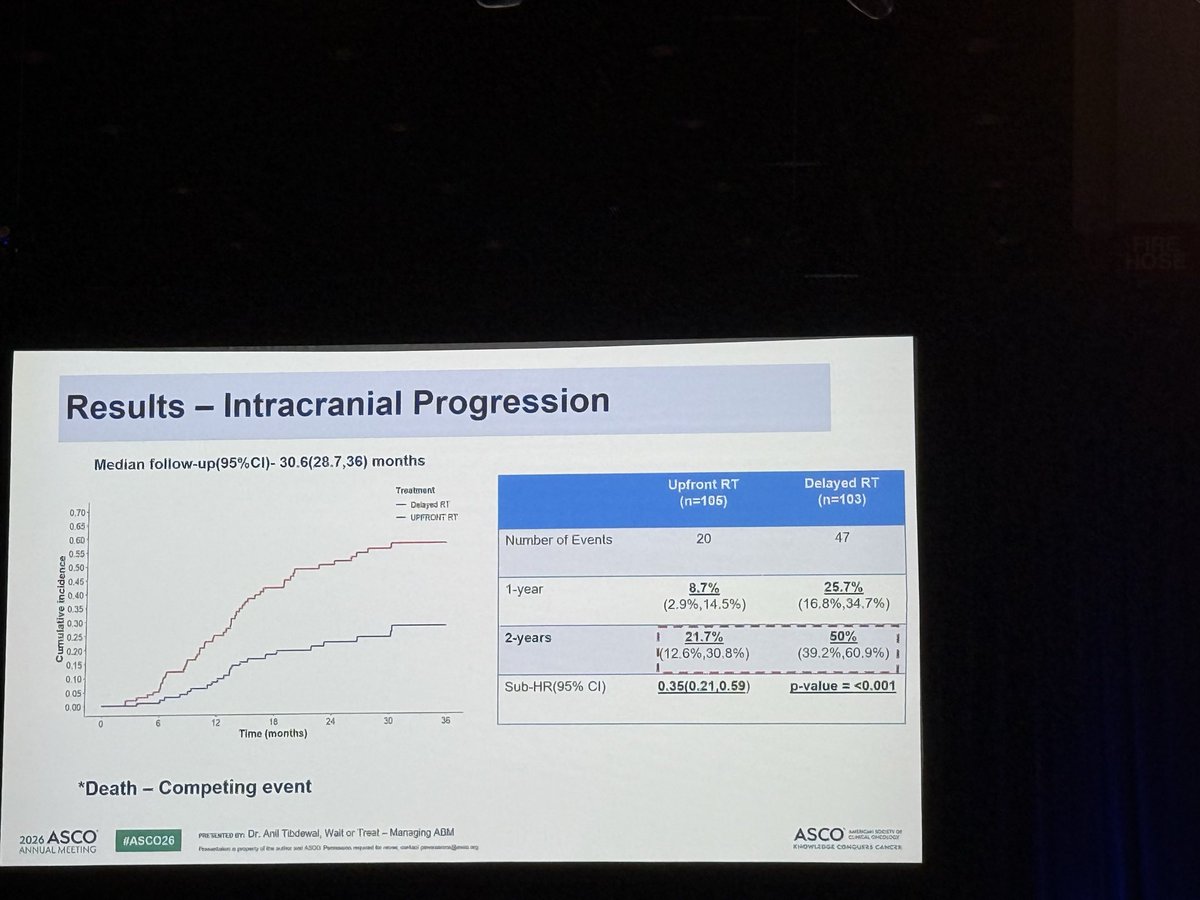
+2 more figures


10 details
Phase III open-label RCT, single-centre (Tata Memorial, Mumbai), N=208 randomised 1:1 to upfront (n=105) vs delayed cranial RT, both on TKI plus chemotherapy. Stratified by GPA (0-2 vs >2) and synchronous vs metachronous BM. Median follow-up 30.6 mo (28.7, 36).
Metastatic NSCLC with an EGFR or ALK alteration, ECOG PS 0-2, radiologically measurable brain metastases that were completely asymptomatic. Number, size, and location of lesions are not reported in source.
Upfront arm received cranial RT at diagnosis; the delayed arm received it at intracranial progression or patient's wish, so both arms are RT-exposed and the question is timing, not omission. Dose, fractionation, and technique (WBRT vs SRS) are not reported in source, which is the main barrier to transferring this result.
Primary: intracranial PFS. Secondary: OS, PFS, toxicity, ORR, neurocognition, PROM. Surveillance was MRI brain q3m for the first year, then q6m, which is what makes a delayed strategy safe to run.
Primary endpoint met. Survival ran the other way: 2y OS 48% upfront vs 60% delayed, OS HR 1.45, reported by attendees rather than captured in the slide OCR.
| Timepoint | Upfront RT (n=105) | Delayed RT (n=103) |
|---|---|---|
| 1-year | 8.7% (2.9%, 14.5%) | 25.7% (16.8%, 34.7%) |
| 2-years | 21.7% (12.6%, 30.8%) | 50% (39.2%, 60.9%) |
| Sub-HR (95% CI) | 0.35 (0.21, 0.59), p<0.001 | ref |
Radiation necrosis ~6% in the upfront arm and none in the delayed arm per attendee reports, and described as less severe when delayed. Full toxicity tables, neurocognition, and PROM were secondary endpoints not reported in the source.
The intracranial magnitude sits alongside the older WBRT-era data (QUARTZ, and the historic SRS-vs-WBRT trials) in showing that cranial RT controls the brain without buying survival. What is new is testing it where a CNS-penetrant TKI is the competing intracranial therapy, a setting those trials predate entirely.
Single-centre and open-label, and the RT prescription is absent from the source, so a reader cannot tell whether the necrosis signal reflects WBRT, SRS technique, or concurrent TKI exposure. Median follow-up of 30.6 mo is short relative to expected survival in this population, and the OS comparison was a secondary endpoint, not powered.
The result splits the two things RT is usually credited with: it clearly buys intracranial control, and it clearly does not buy time. Whether the OS direction is a real cost of upfront RT or noise in an underpowered secondary is the open question, and it decides whether deferral is merely non-inferior or actually preferred.
CONSORT flow
Randomised phase 3, prespecified intracranial PFS met, but the survival signal runs opposite the intracranial win. Directly contests reflex upfront cranial RT.
- Does the OS direction hold with longer follow-up?
- Was cranial RT whole-brain or stereotactic, at what dose?
- Neurocognition and PROM outcomes by RT timing
📚 Sources · 🐦 3 tweets
#ASCO26 | Wait or Treat? Brain RT in EGFR/ALK+ NSCLC
— OncLive.com (@OncLive) May 29, 2026
Presented by Dr Anil Ramakant Tibdewal.
A landmark Phase III randomized trial from @TataMemorial addressed a long-standing question: should asymptomatic brain metastases in oncogene-driven NSCLC receive upfront cranial RT or… pic.twitter.com/lRy9CfyQ8r
Should asymptomatic brain mets await systemic response in front line within EGFR/ALK context? I think yes. Despite reducing icPD, delayed brain RT OS looked better and radiation necrosis didn’t occur vs 6% #ASCO26 pic.twitter.com/O6d7GrvtU4
— Dr Riyaz Shah (@DrRiyazShah) May 29, 2026
No improvement in survival with up front radiation. OS favored delayed radiation with 2y OS 48% with early radiation vs 60% in late (OS HR 1.45). Also, radiation necrosis less common and less severe in delayed arm. Each case unique but delayed approach appealing #ASCO26 pic.twitter.com/wIhjqxhSaq
— Stephen V Liu, MD (@StephenVLiu) May 29, 2026
DBCG IMN2 NCT06549920
ForNode-positive breast cancer, macrometastatic, adjuvant taxane/trastuzumab/AI era
HR 0.85
95% CI 0.76-0.94, p=0.0016; 15y OS 65.0% vs 60.8%
TL;DRIMNI cut 15y mortality: OS 65.0% vs 60.8%, adjusted HR 0.85 (0.76-0.94), p=0.0016, in 4541 node-positive pts.
The 1-3 node group (n=3100, HR 0.85, 0.73-0.97) is the whole point: that is exactly where guidelines allow IMNI omission, and no measured factor identified a safe-omission subgroup. Right-sided IMN CTV V90% coverage was 94.6% with 25% under 64.8%, so a modern gated VMAT plan should exceed the dose separation that produced this 4.2% 15y OS gain.
In macrometastatic node-positive breast cancer with 1-3 involved axillary nodes going to locoregional RT, this supports including the internal mammary chain rather than omitting it; it does not speak to pts treated with neoadjuvant systemic therapy, who were excluded.
The 1-3 node subgroup (n=3100, HR 0.85, 0.73-0.97) removes the usual reason to skip the IMN chain, and no measured factor found a safe-omission group. Right-sided IMN CTV V90% was 94.6% with a quarter under 64.8%, so gated VMAT should beat the dose separation that produced this 4.2% 15y OS gain.
Benefit persisted on a modern backbone: 96.2% of chemo pts got a taxane, 13.5% trastuzumab, aromatase inhibitors postmenopausal, and the absolute 15y OS gain of 4.2% matched IMN1's 4.7% from the pre-taxane era. Effective systemic therapy did not absorb the regional RT effect, so this argues against dropping locoregional RT as drugs improve.
12 details
Nationwide population-based prospective cohort across six Danish RT centres, 2007-14, allocating IMNI by tumour laterality (right yes, left no) under national guideline. N=4541 of 5206 assessed. Median follow-up 13.7 years for OS, 13.2 for distant metastasis; analysis was intention-to-treat by side.
Macrometastatic node-positive breast cancer receiving locoregional RT; median age 59; 68.3% had 1-3 positive nodes. Excluded: prior malignancy, bilateral disease, neoadjuvant systemic therapy, recurrence before RT, non-standard RT. Axillary surgery was always axillary dissection.
Chemotherapy was three cycles EC (epirubicin 900 mg/m2, cyclophosphamide 600 mg/m2) then three cycles docetaxel 100 mg/m2; 96.2% of chemo pts received a taxane. Tamoxifen premenopausal, aromatase inhibitor postmenopausal; trastuzumab concurrent with chemo and RT in HER2+ (13.5% overall).
48 Gy/24 Fx before Jan 2009 (26.2%), 50 Gy/25 Fx after (73.2%), 3D conformal wide tangents in free-breathing. IMN target was intercostal space 1-4; all pts had axilla level II-III plus interpectoral and level IV, with level I added for ≥6 positive nodes or <10 nodes removed. QA showed IMN CTV V90% 94.6% right vs 20.4% left.
Primary: overall survival. Secondary: breast cancer mortality and distant metastasis, both with non-breast-cancer death as a competing event. Cox models adjusted for age, menopausal status, histology, tumour size, and nodal count, stratified by IHC subtype and grade.
The OS point estimate sits on top of the EBCTCG regional-node meta-analysis rate ratio 0.90 (0.84-0.96) and of KROG 08-06's HR 0.87 (0.57-1.31), the only other 3D-based IMNI study, which was underpowered at n=735 and read as negative. It also reproduces DBCG IMN1's absolute OS gain of 4.7%, arguing the taxane/trastuzumab/AI era did not absorb the benefit.
Contamination runs both ways: 10.1% of left-sided pts (n=238) got IMNI and a quarter of right-sided pts had under 64.8% IMN coverage, so the observed gain likely understates a fully delivered one. Cardiac and lung toxicity were captured only as death, with no smoking, comorbidity, or cardiac-event data, and the era predates PET-CT staging and respiratory gating.
The ER-/HER2+ signal (HR 1.49, 0.98-2.25, interaction p=0.021) echoes Kyndi's DBCG 82b&c finding but conflicts with NSABP B-51, and the analysis was explorative without multiplicity correction, so it should not gate treatment. The medial/central plus ≥4 node cell (HR 0.98, 0.79-1.21) is the one group where benefit looks absent, matching IMN1's 0.91 (0.73-1.15).
| Endpoint | IMNI | No IMNI | Adjusted HR (95% CI), p |
|---|---|---|---|
| OS at 15y | 65.0% | 60.8% | 0.85 (0.76-0.94), p=0.0016 |
| BC mortality at 15y | 21.4% | 23.6% | 0.84 (0.74-0.95), p=0.0077 |
| Distant mets at 15y | 25.1% | 26.9% | 0.87 (0.78-0.98), p=0.026 |
CONSORT flow
Prospective nationwide cohort, prespecified primary endpoint, 13.7y follow-up; contradicts guidelines withholding IMNI at 1-3 nodes. Non-randomised laterality allocation keeps it below practice-changing.
- Effect of IMNI alongside immunotherapy and antibody-drug conjugates
- Is ER-/HER2+ a genuine predictive subtype for IMNI harm
- Safe RT omission in cN+ pts with pCR after neoadjuvant therapy
📚 Sources · 📄 1 paper
SWOG S1007
ForHR+/ERBB2- breast, 1-3 positive nodes, Oncotype RS ≤25
TL;DR5yr LRR 0.85% with RNI vs 0.55% without after BCS+RT in RS≤25 N1 disease; IDFS unchanged by RNI.
The number that moves the RNI decision is 0.55% 5yr LRR after BCS+RT without RNI, and equally low LRR in the endocrine-alone arm. Chemotherapy omission on a low RS does not by itself justify adding supraclavicular coverage. Target-volume detail beyond supraclavicular is not reported in source.
In HR+/ERBB2- N1 disease with RS ≤25 treated with BCS and whole-breast RT, this argues low RS alone does not compel nodal irradiation; it does not speak to RS >25, higher nodal burden, or ERBB2+ disease.
The actionable number is 0.55% 5yr LRR after BCS+RT without RNI in RS ≤25 N1 disease, against 0.85% with RNI. That floor leaves little absolute room for regional coverage, and IDFS did not move (premenopausal HR 1.03, postmenopausal HR 0.85). This informs the elective supraclavicular decision.
LRR stayed similarly low in the endocrine-therapy-alone group, so omitting chemotherapy on a low Recurrence Score did not raise locoregional risk. The conclusion is explicit: chemo omission is not an independent indication for RNI, which removes a reason to hedge a de-escalation decision.
9 details
Secondary analysis of the randomized SWOG S1007 trial (endocrine therapy alone vs chemotherapy then endocrine therapy). Radiotherapy data were prospectively collected across diverse practice settings, but RNI receipt itself was not randomized. Data analyzed June 2022 to April 2023.
Hormone receptor-positive, ERBB2-negative breast cancer with 1 to 3 involved nodes and Oncotype DX 21-gene Recurrence Score ≤25. 4871 female patients had radiotherapy forms; median age 57 (range 18-87).
RNI defined as targeting at least the supraclavicular region. 3947 (81.0%) reported radiotherapy receipt; of 3852 with complete target information, 2274 (59.0%) received RNI. Dose, fractionation, and internal mammary coverage are not reported in source.
Cumulative incidence of locoregional recurrence by locoregional treatment received, plus association between invasive disease-free survival and locoregional therapy, adjusted for menopausal status, treatment group, recurrence score, tumor size, nodes involved, and axillary surgery.
Median follow-up 6.1 years. See the LRR and IDFS tables above; IDFS did not differ by RNI receipt in either menopausal stratum.
| Locoregional treatment | 5yr LRR |
|---|---|
| BCS + RT with RNI | 0.85% |
| BCS + RT without RNI | 0.55% |
| Mastectomy + PMRT | 0.11% |
| Mastectomy, no RT | 1.7% |
| Group | HR (95% CI) | P |
|---|---|---|
| Premenopausal | 1.03 (0.74-1.43) | .87 |
| Postmenopausal | 0.85 (0.68-1.07) | .16 |
MA.20 and EORTC 22922 established the regional irradiation question in node-positive disease, both without an overall survival gain, in cohorts assembled before genomic risk stratification. This analysis reads that question in the population those trials could not define, biologically favorable N1, and finds an LRR floor low enough that a relative benefit has little absolute room to operate.
Radiotherapy information was recorded only in the first year after randomization, forcing a 1-year landmark that excludes the earliest events. Target detail stops at supraclavicular coverage, so internal mammary treatment cannot be separated, and the low absolute event count leaves the IDFS confidence intervals wide enough to accommodate a small effect in either direction.
The finding that matters is the floor, not the comparison: with 5yr LRR at or below 1.7% in every locoregional strategy examined, the population has too few events for regional irradiation to demonstrate meaningful absolute benefit. The explicit conclusion is that omission of chemotherapy is not an independent indication for RNI, which addresses a specific compensatory reflex rather than the general RNI question.
Prospectively collected RT data in a large trial cohort, but RNI receipt was not randomized; observational comparison, so an unmeasured-confounding read is unavoidable.
- Does any favorable N1 subgroup (3 nodes, RS near 25) still warrant RNI?
- Internal mammary coverage contribution, unseparable in this dataset
- Longer follow-up for late locoregional events in HR+ disease
📚 Sources · 📄 1 paper
Abstract
EORTC 22922/10925
ForStage I-III breast, central/medial tumor or involved axilla, post-ALND
61.0% vs 61.8% at 20yr
HR 1.00, p=.967; primary endpoint not met
TL;DR20yr OS 61.0% vs 61.8% (HR 1.00, p=.967): IM-MS nodal RT cut breast cancer mortality but added non-cancer deaths.
The breast cancer mortality gain (22.4% vs 18.6%, HR 0.82) is real and was fully offset by non-breast-cancer deaths (15.8% vs 20.4%, HR 1.26) that only emerged after 15 years. Cardiac disease ran 15.2% vs 11.7%. In a 1996-2004 planning era, that trade gates IM-MS coverage on achievable heart dose, not on nodal risk alone.
In a woman with a medial or central stage I-III tumor being considered for IM chain coverage, this supports treating the cardiac dose constraint as co-equal with nodal risk; it does not speak to modern DIBH or proton delivery, where the competing-mortality arm may not hold.
Breast cancer mortality fell (HR 0.82) and non-cancer death rose (HR 1.26), netting OS HR 1.00, with cardiac disease 15.2% vs 11.7% and lung fibrosis 6.3% vs 3.2%. Planning ran in the 2D era, so the decision this moves is achievable heart dose, not whether to cover the IM chain.
Systemic therapy was per institutional preference across 1996-2004 accrual, so the disease-specific gain (HR 0.82) sits on a backbone that predates current regimens. For a med onc the read is competing mortality: the excess non-cancer deaths after 15 years reframes how long-term cardiac surveillance should run in irradiated survivors.
9 details
Prospective multicenter randomized phase 3 trial, accrual 1996-2004, 4004 pts, with an RT quality-assurance program built in. The last analysis was planned at 20 years on the assumption that any survival effect of IM-MS-RT would be delayed. Median follow-up 22.2 years.
Women ≤75 yrs, unilateral histologically confirmed breast adenocarcinoma, stage I-III. Gate was tumor location or nodal status: centrally or medially located primary irrespective of axillary involvement, or any quadrant with axillary involvement. Median age 54.
Randomization was to internal mammary and medial supraclavicular (levels 3-4) nodal irradiation or not, layered on standard breast or chest wall treatment. Dose and fractionation are not given in the source excerpt. Planning ran in the two-dimensional and early-conformal era, when IM coverage at least doubled heart dose.
Primary: overall survival. Secondary: disease-free survival, distant metastases-free survival, breast cancer mortality, any breast recurrence.
Lung fibrosis 6.3% vs 3.2%, cardiac fibrosis 2.7% vs 1.7%, cardiac disease 15.2% vs 11.7% with IM-MS-RT. Severe (grade 3-4) events were uncommon and near-equal: cardiac 1.9% vs 1.7%, lung 0.3% vs 0.0%, so the excess sits in lower-grade, chronic morbidity rather than catastrophic events.
MA.20 and DBCG-IMN both read regional nodal RT positively at roughly ten-year horizons, and DBCG-IMN reported an OS gain. This trial covers the same anatomic question at twice that follow-up and shows the disease-specific gain surviving while the survival gain does not, which is the read those trials were too short to produce.
Systemic therapy was left to physician and institutional preference across an eight-year accrual, so the systemic backbone is heterogeneous and predates current regimens. The competing-mortality signal is a cause-of-death attribution over two decades in a population whose baseline cardiovascular risk rises independently, and the source does not report a cardiac-specific mortality breakdown separating RT-attributable from age-attributable death.
The two effects are both real and point opposite ways: HR 0.82 on breast cancer mortality, HR 1.26 on other deaths, netting HR 1.00 on OS. That arithmetic is the finding, and it argues the relevant question is not whether IM-MS coverage works but whether its cost can be engineered down.
| Endpoint | Control | IM-MS-RT | Effect size |
|---|---|---|---|
| Overall survival | 61.8% | 61.0% | HR 1.00, p=.967 |
| Disease-free survival | 49.0% | 48.2% | HR 0.97 (0.89-1.06), p=.5148 |
| Distant metastasis-free survival | 59.8% | 58.9% | HR 0.97 (0.88-1.08), p=.578 |
| Breast cancer mortality | 22.4% | 18.6% | HR 0.82 (0.72-0.95), p=.006 |
| Death not from breast cancer/unknown | 15.8% | 20.4% | HR 1.26, p=.002 |
Randomised, prespecified 20yr primary analysis, adequate power, endpoint reported honestly. Divergence from the 10yr-era read of nodal RT is internally valid, not a design artifact.
- Does modern heart-sparing delivery erase the excess non-cancer mortality?
- Which subgroups have enough breast cancer risk to justify the trade?
- Cardiac surveillance interval for irradiated long-term survivors
📚 Sources · 📄 1 paper
Abstract
Bladder Adjuvant Radiotherapy
ForPost-cystectomy MIBC, pT3-4 / pN+ / margin+ / ≤10 nodes dissected
87.1% v 76.0%
HR 0.43 (95% CI, 0.20 to 0.96), P = .04
TL;DR2yr LRFS 87.1% vs 76.0% with adjuvant pelvic IMRT after RC, HR 0.43 (0.20-0.96), P=.04; DFS/BCSS/OS not significant.
The RT read is the target volume and the technique: stoma-sparing IG-IMRT, 50.4Gy/28fx to cystectomy bed plus pelvic nodes, with no additional severe toxicity reported. That combination is deliverable in a standard department today, so this moves the offer-vs-observe decision for a pT3-4 or pN+ postcystectomy patient rather than leaving adjuvant pelvic RT as a historical toxicity concern.
In a postcystectomy MIBC patient with pT3-4, pN+, positive margin, or ≤10 nodes dissected who has completed perioperative chemotherapy, this supports discussing adjuvant pelvic RT for locoregional control; it does not address patients who received adjuvant immunotherapy.
The transferable detail is the technique: stoma-sparing IG-IMRT, 50.4Gy/28fx to cystectomy bed plus pelvic nodes, with no additional severe toxicity reported. Elective nodal coverage was standard in the treated volume. This moves the offer-versus-observe decision for pT3-4 or pN+ postcystectomy patients.
Over 90% of patients received perioperative chemotherapy (71% neoadjuvant), so the RT benefit sits on top of a modern systemic backbone rather than substituting for it. No patient received immunotherapy, so how adjuvant RT interacts with adjuvant checkpoint blockade in this same high-risk group is untested here.
Surgical adequacy is embedded in eligibility: ≤10 nodes dissected and positive margin were qualifying high-risk features alongside T3-4 and N1-3. That reframes a limited lymphadenectomy or a close margin as a trigger for adjuvant RT referral rather than observation.
10 details
Multicenter phase III RCT, 1:1 adjuvant RT versus observation after radical cystectomy. 153 patients randomly assigned June 2016 to May 2024 (Obs 76, RT 77), stratified by nodal involvement and chemotherapy timing. Median follow-up 47 months.
Nonmetastatic urothelial MIBC, high risk after RC by any one of T3-4, N1-3, positive margin, or ≤10 nodes dissected. Baseline load was heavy: 62% pT3-T4 and 41% pN+.
Over 90% received systemic chemotherapy (71% neoadjuvant, 20% adjuvant). None received immunotherapy in either arm.
Stoma-sparing IG-IMRT, 50.4Gy in 28 fractions, prescribed to the cystectomy bed and pelvic nodes. Elective nodal coverage was part of the treated volume, not an optional add-on.
Primary: 2-year locoregional recurrence-free survival. Secondary: disease-free survival, bladder cancer-specific survival, overall survival.
The primary endpoint was met; secondary endpoints all favored RT numerically without reaching significance. See the endpoint table for arm-level rates and hazard ratios.
| Endpoint | RT | Obs | HR (95% CI) |
|---|---|---|---|
| LRFS (1°) | 87.1% | 76.0% | 0.43 (0.20-0.96), P=.04 |
| DFS | 71.6% | 58.7% | 0.62 (0.36-1.05) |
| BCSS | 79.6% | 65.0% | 0.59 (0.33-1.10) |
| OS | 70.4% | 57.4% | 0.78 (0.49-1.26) |
The authors report no additional severe toxicity with adjuvant pelvic IMRT. Grade-level AE breakdown is not reported in the source abstract.
The primary endpoint is a 2-year locoregional readout under a 47-month median follow-up, so the headline reports early control rather than durability. Accrual spanned eight years, during which adjuvant immunotherapy entered practice in this exact population, and the control arm reflects none of it.
Adjuvant pelvic RT after cystectomy has been an open question since the older Egyptian NCI randomized experience, which used larger fields and conventional technique. This is the modern IMRT-era answer, and it lands positive on local control only, not survival.
A HR of 0.43 on locoregional control with an upper CI bound of 0.96 is a real but fragile signal in 153 patients. The consistent numeric direction across DFS (HR 0.62), BCSS (HR 0.59), and OS (HR 0.78) is reassuring but underpowered, and none of it settles whether locoregional control converts to survival.
CONSORT flow
Randomised, prespecified 2yr LRFS primary endpoint met in a setting where adjuvant RT is not standard. Small N and borderline CI limit confidence, not internal validity.
- Does locoregional benefit persist alongside adjuvant immunotherapy
- Does 2yr LRFS gain translate to survival with longer follow-up
- Which high-risk feature drives the benefit: pN+, margin, or nodal yield
📚 Sources · 📄 1 paper
Abstract
High-dose hyperfractionated SIB RT vs standard-dose RT (limited-stage SCLC) NCT03214003
ForLS-SCLC, age 18-70, ECOG 0-1, PET-CT staged, ≤2 prior chemo courses
TL;DRmOS 60.7 vs 39.5mo, HR 0.55 (0.37-0.72), p=0.003 for 54Gy SIB vs 45Gy BID, no added toxicity.
The dose went to GTV only: PTV stayed 45Gy in both arms, so this is an SIB boost, not a uniform 54Gy plan, and that is why grade 3-4 oesophagitis stayed at 13%. Local PFS HR 0.51 against a null MFS (HR 0.81) locates the benefit in the chest. Deliverable on VMAT with PET-defined involved fields.
In a fit LS-SCLC patient under 70 with PET-defined disease starting concurrent chemoRT, this supports an SIB boost to 54Gy/30 BID over uniform 45Gy; it does not speak to patients over 70, ECOG 2, or once-daily schedules.
The escalation is an SIB to GTV only, with PTV held at 45Gy in both arms, which is why grade 3-4 oesophagitis stayed at 13% vs 12%. Local PFS HR 0.51 against a null MFS (HR 0.81) confirms a chest-confined benefit. PET-defined involved fields, no elective nodal irradiation.
The chemotherapy backbone was fixed and identical (4 cycles platinum-etoposide, 99% completion in both arms), so the OS gain is attributable to the RT dose, not the regimen. Grade 3-4 neutropenia was unchanged at 44% vs 41%, so referring a fit under-70 patient for the boost schedule carries no extra haematologic cost.
10 details 1 trial watching
Open-label randomised phase 3, 16 public hospitals in China, 1:1, enrolled June 30 2017 to April 6 2021. Stratified by ECOG, stage, prior chemotherapy course, and platinum choice. Median follow-up 46 months (IQR 33-56); terminated early by the DSMB in April 2021 on interim benefit.
Aged 18-70, ECOG 0-1, VALSG limited-stage confirmed on whole-body FDG PET-CT and brain MRI, previously untreated or after one to two courses of platinum-etoposide. Median age 64, 46% female, 86% stage III, 79% current or former smokers. Age over 70 and ECOG 2 were excluded.
Four cycles of cisplatin 75 mg/m² (or carboplatin AUC 5) with etoposide 100 mg/m² days 1-3 every 3 weeks; 99% completed all four cycles in both arms. PCI 25 Gy in 10 fractions for responsive disease, given to 82% vs 81%.
VMAT, 6-MV, 30 twice-daily fractions over 3 weeks, minimum 6 h apart, starting 0-42 days after cycle 1. Experimental arm delivered a simultaneous integrated boost of 54 Gy to GTV/IGTV with the PTV at 45 Gy; the control arm had 45 Gy to both GTV and PTV. Target volumes were PET-positive lesions only, with elective nodal irradiation omitted and a 5 mm CTV margin.
Primary: overall survival in the ITT population, from the start of chemotherapy. Secondary: PFS, local PFS, metastatic-free survival, disease control rate, acute and late toxicity, and HRQOL (reported elsewhere).
No toxicity penalty for the boost: grade 3-4 oesophagitis 13% vs 12% (p=0.84) and pneumonitis 5% vs 6% (p=0.663). Grade 3-4 neutropenia 44% vs 41%. Late grade 3 pneumonitis in 2 vs 3 pts, no late grade 3 oesophagitis or pulmonary fibrosis in either arm. One treatment-related death (myocardial infarction, 54 Gy arm).
CONVERT (66 Gy in 33 once-daily fractions) and CALGB 30610/RTOG 0538 (70 Gy once daily) both failed to beat 45 Gy twice daily, with median OS 25 vs 30 mo and 28.5 vs 30.1 mo respectively. Neither escalated arm was hyperfractionated or accelerated. The Nordic phase 2 (60 Gy in 40 twice-daily fractions) did show a gain, 2-year OS 74.2% vs 48.1%, and this trial is the phase 3 counterpart of that signal.
Stopping at the interim analysis with 224 of a planned 326 pts inflates the observed effect, and the appendix-level subgroup analysis has not been done. There was no centralised QA of contouring or planning across the 16 centres, and prognostic variables that plausibly drive a dose effect (tumour volume, PTV size) were not balanced by design.
The 21.2-month OS gain is larger than the trial powered for (assumed HR 0.65, 37 vs 24 mo), and the control arm's 39.5 mo sits well above the 20.8-30 mo reported elsewhere for 45 Gy. That points to cohort selection (PET staging, VALSG limited stage, age and ECOG caps) rather than an underperforming control, which is reassuring for internal validity but limits transfer. Local PFS separating (HR 0.51) while MFS does not (HR 0.81) is the mechanistically coherent read for a dose escalation confined to the chest.
CONSORT flow
Randomised phase 3, prespecified OS primary hit at interim. Diverges from CONVERT/CALGB 30610 dose-escalation failures. Early stopping and single-country cohort temper it.
- Tolerability of 54Gy BID SIB in pts over 70
- Replication outside China with centralised RT quality assurance
- Optimal boost dose between 54Gy and 60Gy twice daily recruiting Dose-Escalation Radiotherapy in Limited-Stage Small Cell Lung Cancer: A Phase III Randomized Trial Phase 3n=300 · primary completion 2028-09 · randomises 45 vs 60 vs SIB 45-54Gy BID
📚 Sources · 📄 1 paper
Multinational HCC EBRT IPD Cohort
ForVery early / early-stage HCC (BCLC-0 or A), incl. treatment-naive
TL;DRMedian OS 6.8y BCLC-0 and 4.6y BCLC-A across 4,913 EBRT-treated HCC pts, comparable to resection and ablation.
The modifiable RT variable in the Cox model is ablative dose, which was associated with reduced mortality, so the transferable read is that dose, not simply delivering EBRT, tracks with the outcome. Fractionation and dose thresholds are not given in the abstract. This is the citation for putting EBRT on the BCLC-0/A allocation discussion.
In BCLC-0 or A HCC where resection, transplant, or ablation is not feasible or is declined, this supports discussing ablative-dose EBRT as a locoregional option; it does not establish EBRT over resection or ablation in a pt eligible for either.
Ablative dose was the modifiable variable associated with reduced mortality, so the transferable read is dose, not simply offering EBRT. Dose thresholds, fractionation, and modality mix are not given in the source abstract. This is the citation for putting EBRT into the BCLC-0/A allocation discussion at tumor board.
Child-Pugh B or C, performance status, and tumor burden drove mortality in the multivariable model, which is the gating frame for who gets locoregional therapy at all. For the med onc coordinating a BCLC-0/A pt, EBRT enters the locoregional menu alongside ablation rather than as a last resort.
Median OS of 6.8 y (BCLC-0) and 4.6 y (BCLC-A) in EBRT-treated pts is a cross-literature benchmark against resection and ablation, not a head-to-head. It bears on referral for the medically inoperable or anatomically difficult pt, and does not establish EBRT over resection in a fully resectable candidate.
9 details 2 trials watching
Systematic review of EBRT publications meeting prespecified HCC technical standards (search date December 15, 2022), with corresponding authors invited to contribute individual patient data. Kaplan-Meier OS and RMST stratified by BCLC stage and treatment status; random-effects Cox for covariates. No comparator arm.
4,913 pts treated with EBRT, median follow-up 5.0 years, multinational. Analyses split by BCLC stage and by treatment-naive vs treatment-experienced; the headline read sits in BCLC-0 and BCLC-A.
EBRT delivered per each contributing series, gated by the prespecified technical standards rather than one protocol. Ablative dose was associated with a reduced risk of death; specific dose levels, fractionation, and modality mix are not given in the source abstract.
Overall survival by Kaplan-Meier and restricted mean survival time, stratified by BCLC stage and treatment status. Covariate associations from multivariable random-effects Cox modeling.
Median OS 6.8 y (95% CI 5.7-8.7) for BCLC-0 and 4.6 y (95% CI 4.1-5.1) for BCLC-A. Treatment-naive: not reached (95% CI 8.6-NR) for BCLC-0, 5.4 y (95% CI 4.5-6.7) for BCLC-A.
| Cohort | BCLC-0 | BCLC-A |
|---|---|---|
| All pts | 6.8 y (95% CI 5.7-8.7) | 4.6 y (95% CI 4.1-5.1) |
| Treatment-naive | NR (95% CI 8.6-NR) | 5.4 y (95% CI 4.5-6.7) |
The authors frame these medians as comparable with resection, thermal ablation, and other ablative locoregional therapies, a cross-study benchmark rather than a randomised comparison. EBRT's exclusion from BCLC has rested on the absence of OS evidence, which is the gap this cohort is built to fill.
IPD came only from authors who published and agreed to share, so contributing centers are self-selected and unmeasured selection at the patient level (who was routed to EBRT rather than resection) is unrecoverable. More recent year of treatment predicting survival mixes technique gains with stage migration and modern systemic salvage over a multi-decade accrual window.
The claim is an allocation claim, not an efficacy claim: EBRT belongs in the BCLC decision tree as an option to be weighed. It does not settle sequencing against ablation in a pt eligible for both, and the ablative-dose signal makes the quality of the RT, not its mere availability, the operative variable.
Largest EBRT IPD cohort argues for a BCLC allocation change, but it is pooled non-randomised data with no head-to-head comparator against resection or ablation.
- Ablative dose threshold and fractionation driving the survival association
- EBRT vs thermal ablation head-to-head in early HCC recruiting Stereotactic Radiosurgery Versus Radiofrequency Ablation for Primary Liver Cancer Phase 2n=130 · primary completion 2025-01 · phase 2 SBRT vs RFA, inoperable primary liver caactive Stereotactic Body Radiotherapy Versus Radiofrequency Ablation for Unresectable, Small (≤ 3 cm) HCC Phase NAn=178 · primary completion 2026-12 · randomised SBRT vs RFA, unresectable HCC <=3cm
- Selection differences between EBRT-treated and resected early-stage pts
📚 Sources · 📄 1 paper
Abstract
PEACE-2
ForVery-high-risk localized prostate, N0M0, ≥2 of Gleason ≥8 / T3-T4 / PSA ≥20
HR 0.81
95% CI 0.63-1.03, p=0.088, primary endpoint not met
TL;DRcPFS HR 0.81 (0.63-1.03), p=0.088: pelvic RT over prostate-only missed its primary endpoint in very-high-risk N0M0.
The target-volume decision is the whole trial: ADT × 3 years and the systemic backbone were fixed, so the 4.2-point 7yr cPFS gap (67.1% vs 62.9%, p=0.088) is what elective pelvic coverage buys in conventionally-staged N0M0 disease. No dose or fractionation appears in the source slides, and staging used conventional imaging or choline PET, not PSMA.
In very-high-risk localized prostate cancer staged N0M0 on conventional imaging or choline PET, this questions routine elective pelvic nodal coverage added to 3 years of ADT; it does not address PSMA-staged or node-positive disease.
Target volume is the randomized variable with the systemic backbone fixed, so the 7yr cPFS gap of 67.1% vs 62.9% (HR 0.81, p=0.088) is the entire return on elective pelvic coverage in conventionally-staged N0M0. Dose and fractionation are absent from source, blocking a technique-level transfer.
ADT × 3 years ran in every arm and cabazitaxel × 4 cycles was the second randomization, so nothing here moves systemic choice. The relevant read is prognostic: fewer than 1 in 10 men died of prostate cancer in a decade, which questions intensification in this clinicopathologically-defined very-high-risk group.

| Arm | 7yr cPFS | HR (95% CI) | p |
|---|---|---|---|
| Pelvic RT | 67.1% [61.6; 72.2] | 0.81 [0.63; 1.03] | 0.088 |
| Prostate only RT | 62.9% [57.4; 68.1] | n/a | n/a |
+2 more figures


9 details 5 trials watching
International multicenter randomized trial with four arms crossing two questions: RT target volume (prostate only vs pelvis) and cabazitaxel × 4 cycles vs none. Primary: cPFS. The target-volume comparison reads out at 7 years.
Very-high-risk localized prostate cancer defined as ≥2 risk factors among Gleason ≥8, T3-T4, and PSA ≥20 ng/mL. N0M0 by conventional imaging or choline PET/CT.
Androgen deprivation therapy × 3 years in every arm, with cabazitaxel × 4 cycles as the second randomization. The systemic backbone is held constant across the target-volume comparison.
The randomized variable is target volume alone: prostate-only RT versus pelvic RT. Dose, fractionation, and nodal CTV definition are not reported in the source slides.
Primary: cPFS. Secondary: PSA response at 3 months, bPFS, metastasis-free survival, prostate-cancer-specific survival, OS, acute and long-term tolerance, QoL, and biopsy biomarkers.
cPFS HR 0.81 (0.63-1.03), p=0.088 on multivariable analysis, so the primary endpoint was not met. 7yr cPFS 67.1% pelvic versus 62.9% prostate-only. Toxicity and secondary endpoints are not reported in these slides.
POP-RT, a single-center randomized trial of roughly 224 men, reported a whole-pelvis benefit that made elective nodal coverage common practice in high-risk disease. PEACE-2 is larger and multicenter and does not reproduce a comparable signal on its own primary endpoint.
Staging predates routine PSMA PET, so occult nodal disease sits in both arms and dilutes a target-volume comparison. The RT dose, fractionation, and pelvic CTV definition are absent from the source, which blocks a transfer judgment to any specific technique.
The plenary's own conclusion turned on prognosis rather than the RT question: with fewer than 1 in 10 men dying of prostate cancer in the first decade, the "very high-risk" definition itself is what the investigators challenged. A cohort with that little cancer-specific mortality has little room for a target-volume difference to show up in cPFS.
CONSORT flow
Randomized, prespecified cPFS primary, adequate accrual (380 vs 381) and 7yr readout. Negative result contests routine elective pelvic coverage in N0M0 very-high-risk disease.
- Does PSMA PET staging identify a subgroup where pelvic RT helps n=250 · primary completion 2031-05 · PSMA-N0M0 high-risk randomised to PORT vs whole-pelvis RTrecruiting PRO-BOOST-N: Prostate-First Versus Combined Prostate and Nodal Dose Escalation in PSMA PET-Staged Node-Positive Prostate Cancer Phase 2/3n=600 · primary completion 2033-12 · PSMA PET-staged cN1M0: nodal dose escalation vs…
- Biomarkers to guide intensification vs de-intensification in very-high-risk disease
- Pelvic RT toxicity and QoL tradeoff not reported in source n=700 · primary completion 2021-12 · longitudinal GI/heme/GU toxicity + HRQoL after WPRTactive Hypofractionated Whole-Pelvis Radiotherapy (WPRT) vs Conventionally-Fractionated WPRT in Prostate Cancer Phase 2n=58 · primary completion 2026-09 · QoL of 5-fraction vs 25-fraction WPRTn=400 · primary completion 2027-03 · late GI toxicity, protons vs photons, whole-pelvis RT
📚 Sources · 🐦 1 tweet
📣@PBlanchardMD shows #ESTRO26 that pelvic #radiotherapy in high risk #prostatecancer does not have a large improve in outcomes.
— Shankar Siva (@_ShankarSiva) May 17, 2026
- With only 1 in 10 dying of prostate cancer in 10 years, are these patients truly “high risk”? #pcsm #radonc pic.twitter.com/D0XrGD6iNX
EORTC IM-MS (22922/10925)
ForStage I-III breast cancer considering internal mammary / medial supraclavicular nodal RT
61.0% vs 61.8%
HR=1.00, 95% CI 0.90-1.10, P=0.967 (1° EP not met)
TL;DR20yr OS 61.0% vs 61.8%, HR 1.00 (0.90-1.10), P=0.967: the 15yr breast-cancer mortality benefit is erased by non-BCM.
The 20yr null OS is a competing-risk cancellation, not absent efficacy: BCM 18.6% vs 22.4% (HR 0.82) offset by non-BCM 20.4% vs 15.8% (HR 1.26), with cardiac disease 15.2% vs 11.7% and lung fibrosis 6.3% vs 3.2%. Whether IM coverage survives depends entirely on your heart dose, and DBCG IMN2 ran 4-9x lower.
In stage I-III breast cancer where IM-MS coverage is on the table, this supports the anti-cancer effect of IM irradiation while showing the 20yr survival gain is forfeited at 1990s-era heart doses; it does not describe outcomes at modern DIBH/IMRT cardiac exposures.
This is a planning-constraint result, not a target-volume result. IM coverage delivered BCM 18.6% vs 22.4% (HR 0.82) and gave it all back as non-BCM (HR 1.26), with cardiac disease 15.2% vs 11.7%. The benefit survives only if your mean heart dose looks like DBCG IMN2's 1.2-2.3 Gy, not this trial's.
The 20yr OS null (61.0% vs 61.8%) should not be read as breast-cancer control being unimproved: BCM fell to 18.6% from 22.4%. The excess deaths are cardiopulmonary, which is a comorbidity and cardiac-surveillance consideration in long survivors treated in older RT eras rather than a systemic-therapy signal.

| Endpoint | IM-MS RT | No IM-MS RT | HR | P |
|---|---|---|---|---|
| BCM rate | 18.6% | 22.4% | 0.82 (0.72-0.95) | 0.006 |
| non-BCM rate | 20.4% | 15.8% | 1.26 (1.09-1.46) | 0.002 |
+3 more figures

| Endpoint | IM-MS RT | No IM-MS RT | HR (95% CI) | P |
|---|---|---|---|---|
| Overall survival (ITT), 20yr | 61.0% | 61.8% | 1.00 (0.90-1.10) | 0.967 |

| RT-related side effect | IM-MS RT | No IM-MS RT |
|---|---|---|
| Lung fibrosis | 6.3% | 3.2% |
| Cardiac fibrosis | 2.7% | 1.7% |
| Cardiac diseases | 15.2% | 11.7% |

| Endpoint (pN0) | IM-MS RT | No IM-MS RT | HR | P |
|---|---|---|---|---|
| DFS rate | 53.9% | 53.6% | 0.93 (0.81-1.07) | 0.318 |
| DMFS rate | 67.2% | 67.4% | 0.93 (0.78-1.10) | 0.397 |
9 details
Randomised EORTC trial 22922/10925, stage I-III breast cancer, internal mammary + medial supraclavicular irradiation versus no IM-MS irradiation. This is the 20-year readout, presented as a plenary at ESTRO 2026, including a dedicated pN0 analysis.
The intervention is the IM-MS target volume itself, added to otherwise standard locoregional treatment. Per-arm dose and fractionation are not reported in source; what the presenters did quantify is the dosimetric era gap, with DBCG IMN2 mean heart doses 4-9 times lower (MHD 1.2 Gy right-sided, 2.3 Gy left-sided, treated 2007-2014).
Primary: overall survival (ITT). Secondary readouts presented at 20 years include DFS and DMFS under DATECAN definitions (DFS counts all deaths and all breast events including DCIS and contralateral; DMFS counts all deaths and distant metastases), breast-cancer mortality, non-breast-cancer mortality, second cancers, and RT-related late effects.
OS 61.0% vs 61.8%, HR=1.00 (0.90-1.10), P=0.967. DFS and DMFS are likewise flat (HR 0.97 each), and the pN0 subgroup shows no separation. The signal lives entirely in the cause-specific split.
No statistical difference in secondary cancers or second breast cancers between arms. Absolute RT-related late effects favour the control arm: cardiac disease 15.2% vs 11.7%, lung fibrosis 6.3% vs 3.2%, cardiac fibrosis 2.7% vs 1.7%.
The Danish DBCG IMN2 cohort (Nielsen, Lancet Reg Health Eur 2024) reported that IM-MS irradiation reduced distant metastasis and BCM and improved OS in node-positive pts at 15 years. The presenters attribute the divergence to technique, since IMN2 heart doses were 4-9x lower.
The pN0 result is a subgroup read on endpoints that were flat overall, so it cannot exclude a small benefit in that group. The competing-risk interpretation also rests on comparing this trial's toxicity against a non-randomised cohort treated a decade later, which is a dosimetric argument, not a trial result.
This is the cleanest available demonstration that an oncologically real nodal-RT benefit can be spent entirely on late cardiopulmonary mortality. It settles that IM-MS irradiation reduces breast cancer death; it does not settle whether the survival benefit is recoverable, which is now a planning question rather than a target-volume question.
Randomised, prespecified 1° OS, 20yr follow-up, null. Divergence from DBCG IMN2 is confounded by an old-technique heart dose (4-9x higher), not by design flaw.
- Does IM-MS survival benefit re-emerge at modern cardiac-sparing doses?
- Which nodal subgroups justify IM coverage given competing cardiac mortality?
📚 Sources · 🐦 2 tweets
📌 Internal Mammary and Medial Supraclavicular irradiation in stage I-III breast cancer: 20 years results of the randomised EORTC trial 22922/10925, including in pNo patients
— Elisabetta Bonzano MD, PhD (@to_be_elizabeth) May 17, 2026
Special Joint Presentation Led by Prof. Philip Poortmans and Orit Kaidar-Person ✨ at #ESTRO26 @ESTRO_RT… pic.twitter.com/KIoJtdhEzp
20-year outcomes of @EORTC internal mammary #radiotherapy trial.
— Shankar Siva (@_ShankarSiva) May 17, 2026
➡️internal mammary improved control
➡️ survival counterbalanced by late adverse events #radiotherapy #bcsm
Great to see the long term data at #ESTRO26, and discussing Charlotte Cole suggests with modern RT, long… pic.twitter.com/yPtlfrLcri
DBCG RT Natural
For≥60y, pT1N0, grade 1-2, ER≥10%, HER2 normal, margin ≥2mm, post-BCS
1.5% vs 9.8%
+RT 2/236, 1.5% (0.3-5.1); -RT 19/272, 9.8% (5.9-14.9)
TL;DR5yr invasive LR 1.5% with PBI vs 9.8% randomised no-PBI vs 8.2% self-selected no-PBI at 4yr median f/u.
The 2x2 by treatment received is the actionable read, not the arm comparison: -RT +ET reached 3.7% (7/213) while -RT -ET hit 12.2% (32/352), so ET adherence is what holds the omission strategy together, and it was suboptimal. PBI was 40Gy/15fr, not a 5-fraction schedule.
In a woman ≥60 with pT1N0 grade 1-2 ER-positive HER2-normal disease post-lumpectomy, this argues against dropping both PBI and endocrine therapy, and it does not address node-positive, lobular, grade 3, or ER-low disease, which were excluded.
PBI 40Gy/15fr drove LR to 1.5% (2/236) vs 9.8% randomised omission, and the -RT arm crossed the prespecified 4% ceiling. The +RT -ET cell at 3.0% (2/132) means RT alone holds local control without endocrine therapy, which moves the omission conversation for a patient who will not take or tolerate ET.
The -RT +ET cell reached 3.7% (7/213) versus 12.2% (32/352) with neither, so endocrine therapy alone is close to RT alone for local control here. But the ET grouping is by treatment received (≥4.5y vs <4.5y or low-risk), so that 3.7% describes completers and adherence is the load-bearing assumption in an ET-only strategy.

+3 more figures

| Study arm | Events/Total | CIF % (95% CI) |
|---|---|---|
| +RT | 2/236 | 1.5 (0.3-5.1%) |
| -RT | 19/272 | 9.8 (5.9-14.9%) |
| S-RT | 18/278 | 8.2 (4.5-13.3%) |

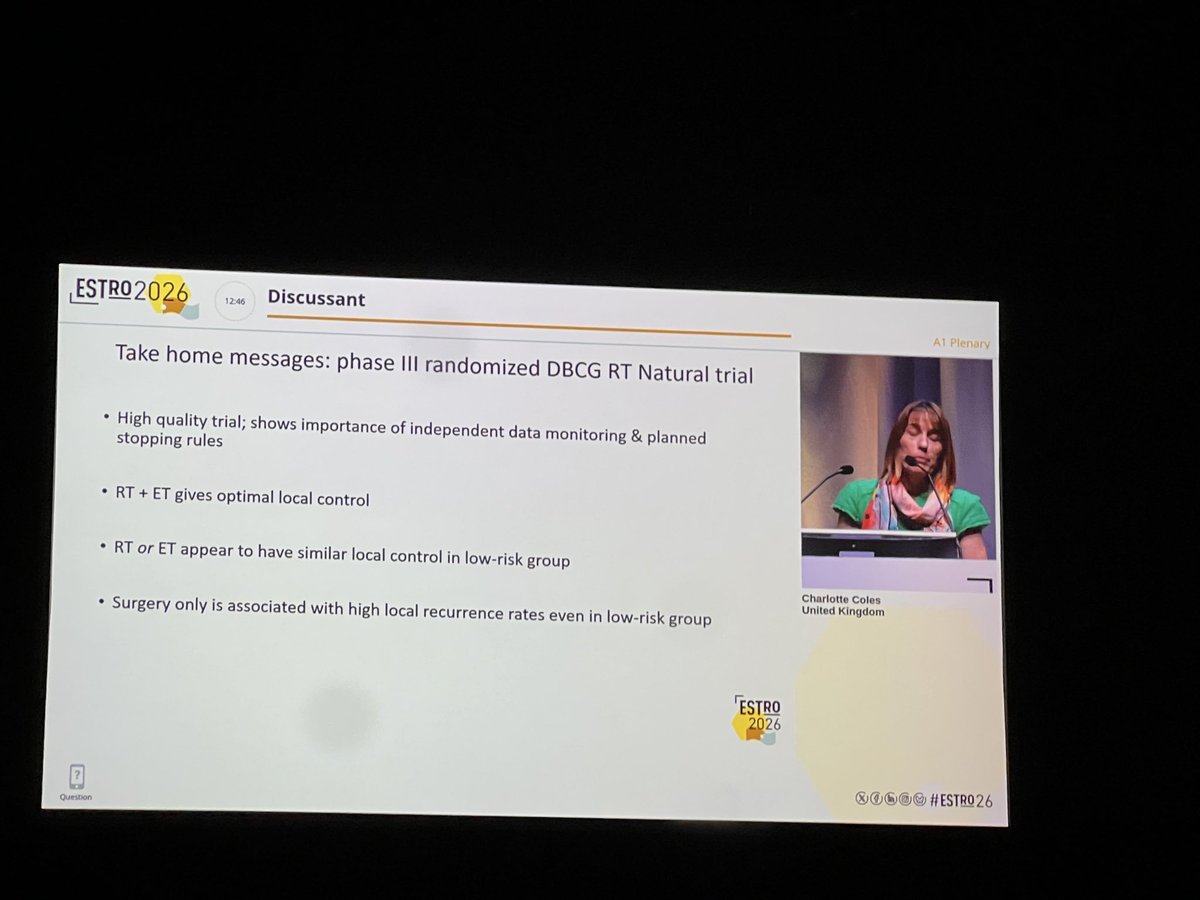
9 details 3 trials watching
Phase III randomized trial, PBI 40Gy/15fr vs no PBI, stratified by institution and endocrine therapy yes/no, with a third non-randomised self-selecting no-PBI cohort. Planned accrual 926 randomised with an interim analysis at 200 patients with 2 year follow-up. Median follow-up 4 years at this reading.
≥60 years, breast cancer treated with breast conservation, pT1N0, unilateral, unifocal, non-lobular, ER ≥10%, HER2 normal, grade 1-2, limited DCIS, margin ≥2mm. Endocrine therapy given per DBCG guideline, which recommends ET for pT1c and/or grade 2.
Partial breast irradiation, 40Gy in 15 fractions. This is a moderately hypofractionated PBI schedule, not the 5-fraction regimens now in wide use, which matters for how the toxicity and convenience side of the omission trade transfers.
Primary: 5 year invasive local recurrence, with a design assumption of 2% and a prespecified maximum acceptable 4%. Secondary: loco-regional side effects and quality of life. Follow-up yearly mammography plus loco-regional side effect assessment to 10 years.
All 41 recurrences were invasive and 39 of 41 arose in patients who received no PBI. Distant failure was rare across the whole trial at 4 events, 2 in each of the +RT and no-PBI groups.
Loco-regional side effects and QoL were prespecified secondary endpoints but no toxicity or QoL figures were reported in the source. The omission-versus-PBI toxicity trade that drives this decision is therefore unquantified here.
PRIME II and CALGB 9343 established that RT omission in older low-risk women is tolerable because absolute local recurrence stays low. Here the randomised no-RT arm reached 9.8% and crossed the trial's own 4% ceiling, which is the opposite result, and the discussant framed surgery alone as carrying high local recurrence even in low risk.
Median follow-up is 4 years against a 5 year primary endpoint, so the reported cumulative incidences are read before the timepoint the trial was designed around. The third arm is self-selected, not randomised, so its 8.2% carries confounding by whatever drove refusal, and the endocrine therapy split is by treatment received rather than assignment.
The trial's contribution is that it isolates the floor: a group with no adjuvant treatment at all, which the modern omission trials do not have because endocrine therapy is universal in their omission arms. 12.2% at that floor reframes the published omission literature as measuring RT omission on an endocrine backbone, not omission of local therapy. It does not settle whether PBI or ET is the better single agent, since 3.0% and 3.7% overlap widely.
CONSORT flow
Randomised, prespecified LR endpoint, stopped early by independent monitoring for exceeding the 4% threshold. Cuts against the de-escalation direction PRIME II and CALGB 9343 set.
- Does 5-fraction PBI match 40Gy/15fr local control in this population n=910 · primary completion 2029-11 · phase 3 PBI vs WBI, 1 week each, LR endpoint
- Toxicity and QoL trade between PBI and endocrine monotherapy n=30 · primary completion 2023-11 · SBRT added to endocrine tx, unoperated pts 75+n=168 · primary completion 2030-07 · randomised 30Gy vs 26Gy/5fr PBI, PRO endpoint
- Whether 4yr separation holds at the 5yr primary timepoint
📚 Sources · 🐦 2 tweets
Another trial showing even for lR optimal local control with RT and ET and suboptimal adherence to ET. In era of 5 fraction decision making is easier # Estro2026 pic.twitter.com/nkvYl3iuTn
— Sushil (@Sushilberiwal) May 17, 2026
Danish #breastcancer partial breast #radiotherapy “natural” trial.
— Shankar Siva (@_ShankarSiva) May 17, 2026
➡️ No postoperative treatment had highest risk of recurrence
➡️either tamoxifen or #radonc reduced recurrence
➡️combined tamoxifen + RT had no recurrences
In context of EUROPA trial, RT has best QoL vs endocrine… pic.twitter.com/bDVmbDKRNb