PIVOTALboost
ForHigh-risk localised prostate, 20-fraction IMRT candidates
TL;DRAdding pelvic nodal IMRT to a focal prostate boost in 20fx raised early bowel toxicity only; 2yr G2+ rates similar across arms.
The 2-year cumulative G2+ rates run in the wrong direction for a toxicity argument against nodal RT: bowel 6.5% (4.5-9.5) and bladder 16.5% (13.1-20.6) in the nodes+boost arm, below both prostate-only arms. Whatever excess bowel toxicity nodal RT causes lives inside 18 weeks. That removes late toxicity as the reason to omit pelvic nodes in 20fx, and leaves the decision resting entirely on the unreported efficacy endpoint.
In high-risk localised prostate planned for 20-fraction IMRT, this supports that adding a focal boost with or without pelvic nodal coverage does not raise 2-year G2+ bowel or bladder toxicity; it says nothing about whether either improves biochemical control.
At 2 years, the nodes-plus-boost arm sat at 6.5% G2+ bowel (4.5-9.5) and 16.5% bladder (13.1-20.6), below both prostate-only arms, so the excess bowel toxicity from pelvic coverage is confined to the first 18 weeks. In a 20-fraction schedule, late morbidity is no longer the argument for omitting elective nodal RT or a focal boost.

| Arm | Bowel G2+ (95% CI) | Bladder G2+ (95% CI) |
|---|---|---|
| Prostate (n=281) | 8.2% (5.7-11.7) | 19.5% (15.5-24.4) |
| Prostate+Boost (n=345) | 8.7% (6.3-12.1) | 24.1% (20.2-28.7) |
| Prostate+Nodes+Boost (n=347) | 6.5% (4.5-9.5) | 16.5% (13.1-20.6) |
+1 more figure
8 details 5 trials watching
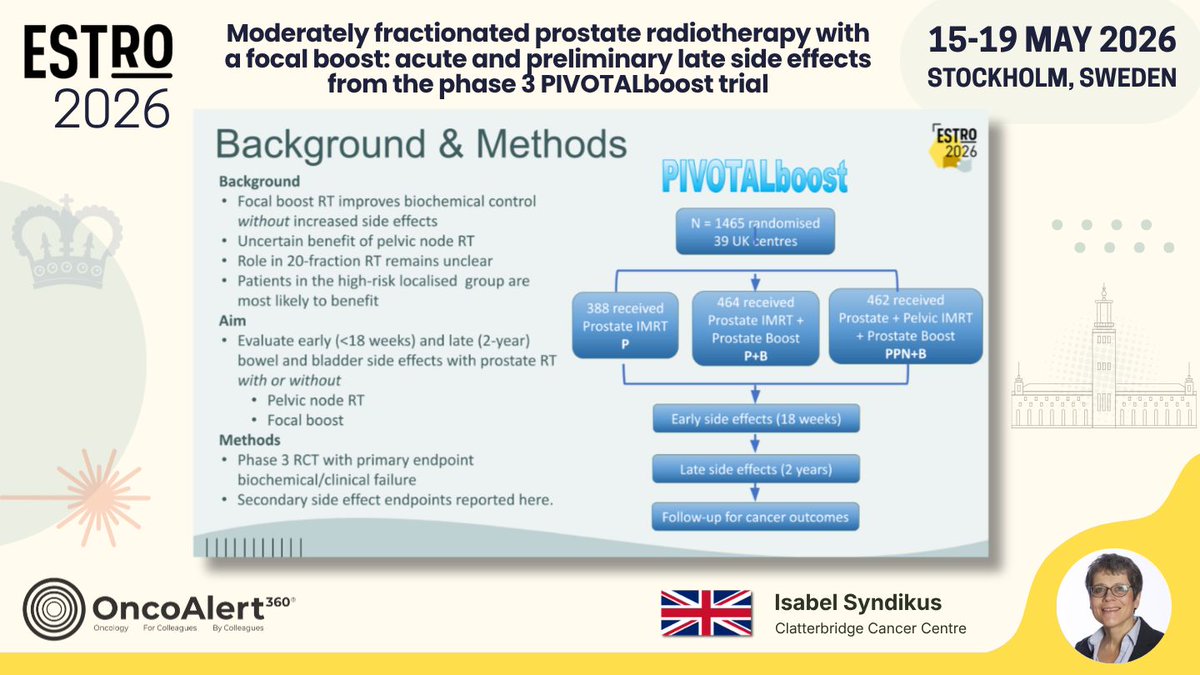
Phase 3 RCT, N=1465 randomised at 39 UK centres. Primary endpoint is biochemical/clinical failure; the side-effect endpoints presented here are secondary. Early toxicity assessed to 18 weeks, late toxicity at 2 years.
Localised prostate cancer, with the slides naming the high-risk localised group as most likely to benefit from the interventions under test. Full eligibility criteria not stated in the source.
20-fraction moderately hypofractionated IMRT in all arms. Randomisation is to prostate alone (388), prostate + focal boost (464), or prostate + pelvic nodes + focal boost (462), so the trial separates the boost question from the nodal question. Prescription dose and boost dose level not stated in the source slides.
Primary: biochemical/clinical failure, not reported at this presentation. Secondary (reported here): early bowel and bladder side effects to 18 weeks and late G2+ events at 2 years.
Nodal RT increased early bowel side effects, resolving by 18 weeks. Late cumulative rates were reported for the 973 (74%) patients with at least 2 years' follow-up.
The nodal question in prostate RT is currently split: POP-RT favoured whole-pelvis RT on biochemical failure-free survival while PEACE-2 was null on its nodal comparison, and both used conventional or near-conventional fractionation. PIVOTALboost is the first randomised test of pelvic nodal coverage in a 20-fraction schedule, so its eventual efficacy readout is the one that transfers to how most UK and increasingly non-UK practice actually delivers prostate RT.
The late analysis rests on the 74% with 2 years of follow-up, so a differential drop-out by arm would bias the comparison, and cumulative-incidence estimates at 2 years cannot address the fibrotic and stricture toxicity that appears at 5 to 10 years. The source does not state the grading instrument, and a clinician-graded versus patient-reported difference materially changes the size of a G2+ bowel signal.
A safety readout without its efficacy partner cannot move the nodal decision on its own, but it does close off one of the two arguments against nodal coverage in the hypofractionated era. The remaining argument is whether pelvic nodal RT does anything for disease control, which this trial is powered to answer and has not yet reported.
CONSORT flow
Randomised phase 3, but this is the secondary toxicity readout only; the biochemical/clinical failure primary endpoint is unreported, so it settles safety, not benefit.
- Does pelvic nodal RT improve biochemical/clinical failure at 20 fractions? n=18 · primary completion 2026-08 · 20fx pelvic nodal RT with prostate SIBrecruiting Phase III Adaptive Adaptive Stereostactic Body Radiotherapy (SBRT) With Dose Escalation for High-Risk Prostate Cancer Phase NAn=390 · primary completion 2033-04 · WPRT + DIL boost vs standard RT, high risk
- Does the focal intraprostatic boost add control over prostate IMRT alone? recruiting Image-guided Focal Dose Escalation- Primary pc Treated With Primary External Beam Hypofract.Stereotactic rt Phase NAn=374 · primary completion 2025-08 · arm A focal dose escalation vs arm B IMRTactive Standard Moderately Hypofractionated RT vs. Ultra-hypofractionated Focal Lesion Ablative Microboost in Prostate Cancer Phase NAn=484 · primary completion 2032-01 · Hypo-FLAME microboost vs standard 20fx RTrecruiting Addition of Focal Boost to Primary Radiotherapy for Prostate Cancer in 12 or 20 Fractions Phase NAn=1016 · primary completion 2040-10 · randomises focal boost vs none at 20fx
- Do G2+ rates diverge beyond 2 years as late fibrotic toxicity matures?
📚 Sources · 🐦 1 tweet
Day THREE of #ESTRO26 Coverage by OncoAlert 🚨
— OncoAlert (@OncoAlert) May 17, 2026
Moderately fractionated prostate radiotherapy with a focal boost: acute and preliminary late side effects from the phase 3 PIVOTALboost trial Presented by Isabel Syndikus 🇬🇧 #RadOnc ☢️
In the PIVOTALboost trial, we treated 1314… pic.twitter.com/cGuR1j2Qos
The longer read
The value of this readout is what it removes from the argument rather than what it adds. Elective pelvic nodal irradiation in prostate cancer has been contested on two separate grounds: whether it improves disease control, and whether the bowel and bladder cost of treating a large pelvic volume is worth paying. POP-RT reported a benefit on biochemical failure-free survival; PEACE-2 did not find one on its nodal comparison. Neither settled the toxicity question in the fractionation most departments now use, because both delivered prostate RT on conventional or near-conventional schedules, and toxicity does not scale linearly from a 37-fraction to a 20-fraction course. PIVOTALboost is testing the nodal question and the focal-boost question at 20 fractions, which is where the answer has to land to be usable.
The reported result is that nodal coverage costs something early and nothing durable. Early bowel side effects rose with pelvic nodal RT and the presenters state this resolves by 18 weeks. At two years the cumulative G2+ rates in the nodes-plus-boost arm were 6.5% for bowel and 16.5% for bladder, both numerically below the prostate-only and prostate-plus-boost arms rather than above them. The direction matters more than the significance testing here: a late toxicity penalty from treating pelvic nodes would have to show up as a higher rate in that arm, and it does not. A skeptic can reasonably say the confidence intervals overlap and that the trial was not powered on these endpoints, both true, but the burden was on nodal RT to demonstrate a late cost and no such cost is visible.
Two methodological features should temper confidence in the two-year figures specifically. The late analysis includes 973 of the randomised patients, described as 74% with at least two years of follow-up, so the estimate is not from the full cohort and would be biased by any differential attrition between arms. And two years is short for the toxicity that actually deters clinicians from pelvic fields: rectal bleeding requiring intervention, urinary stricture, and small-bowel effects have a longer natural history than the acute-to-subacute window this analysis covers. The framing of these data as preliminary late effects is honest, and reading them as a durable safety clearance would be overreading them.
The more consequential limitation is scope. This is the secondary endpoint of a trial whose primary endpoint is biochemical and clinical failure, and that endpoint is not reported here. A safety readout in isolation cannot change a management decision, because the decision is a trade and only one side of it has been priced. What it does do is narrow the terms of the eventual debate. If the efficacy readout is positive, the objection that nodal RT buys control at the cost of late bowel injury will have already been answered in the same trial and the same patients, which is a stronger position than importing a toxicity argument from a differently fractionated cohort. If it is null, the nodal question closes on efficacy grounds and this toxicity analysis becomes a footnote.
For a reader deciding today, the practical read is narrow but real: in a 20-fraction schedule, a focal intraprostatic boost and pelvic nodal coverage are not producing a visible late toxicity penalty at two years, so late morbidity is not a defensible reason to omit either. The reason to omit or include remains the efficacy question, and that answer has not arrived.