OPERA
ForRectal cancer on watch-and-wait pathway after neoadjuvant therapy
TL;DRW14 clinical response (DRE+rectoscopy) identified 76% good responders; 5yr organ preservation 75% A vs 83% B, p=0.24.
The transferable read is timing: response can be called at W14, one month after NAT ends, on DRE plus rectoscopy, with MRI TRG1-2 concordance of 98% (80/82). nCR at W14 preserved organs as well as cCR (77% vs 81%), so a near-complete response reflecting radiation effect does not by itself send a patient to TME.
In rectal pts on a watch-and-wait pathway, this supports assessing response at W14 rather than deferring to W24 and reassessing nCR rather than treating it as failure; it does not address pts never eligible for organ preservation.
Response can be called at W14, one month after NAT ends, on DRE plus rectoscopy, with MRI TRG1-2 concordance of 98% (80/82). nCR at that point preserved organs as well as cCR (77% vs 81%), so a near-complete response reflecting radiation effect does not itself justify TME.
The surgical decision this moves is when to abandon watch-and-wait. A W14 nCR reached 5yr organ preservation of 77% versus 81% for cCR, so early near-complete response is not evidence for proceeding to TME. Regrowth and salvage counts are not reported in source.
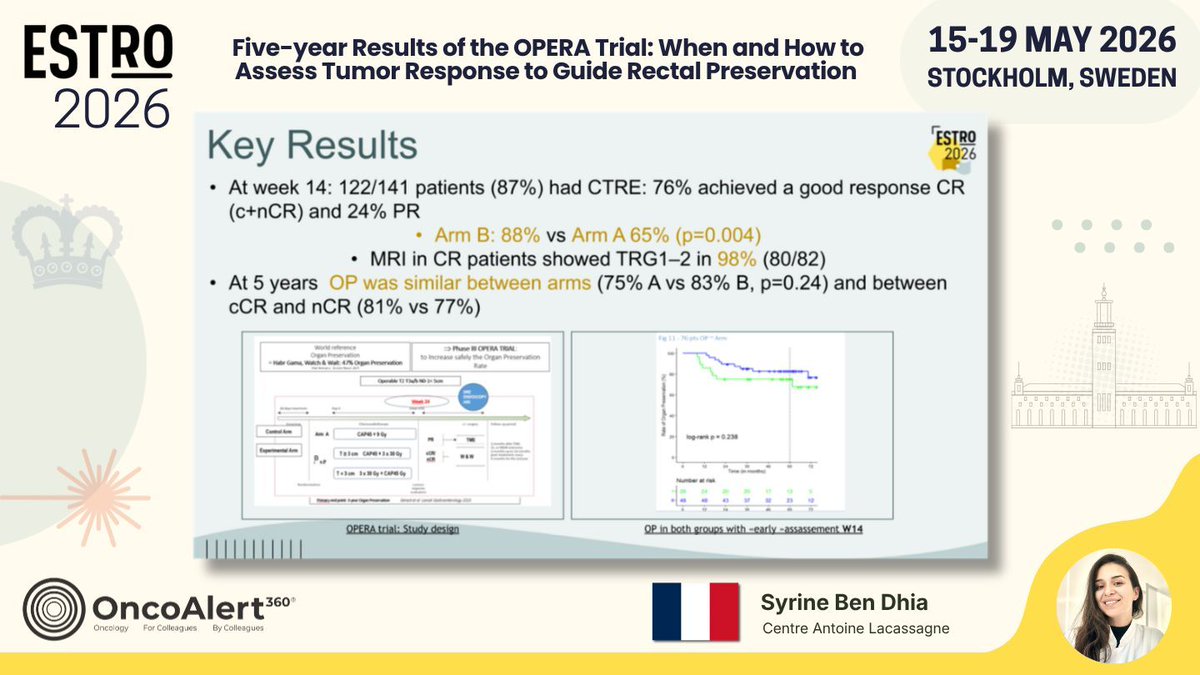
| Endpoint | Arm A | Arm B | Overall |
|---|---|---|---|
| W14 good response (cCR+nCR) | 65% | 88% | 76% |
| W14 partial response | n/a | n/a | 24% |
| 5yr organ preservation | 75% | 83% | p=0.24 |
| CTRE performed at W14 | n/a | n/a | 122/141 (87%) |
+2 more figures


10 details
Post-hoc analysis of the randomised OPERA trial (two arms, A and B), reporting 5-year organ-preservation outcomes. The parent trial assessed response at week 24 with a three-modality triad (DRE, rectoscopy, MRI); this analysis asks whether the week 14 read is good enough.
Week-14 clinical tumor response evaluation (CTRE) by DRE and rectoscopy, categorised CR / nCR / PR, with cCR + nCR counted as a "good" clinical response. MRI graded by TRG. CTRE was correlated with relapse and 5-year organ-preservation rates.
Both arms received neoadjuvant therapy with organ preservation as the goal, and good responders at W14 either proceeded to organ preservation or were reassessed at W24. Dose, fractionation, and the content distinguishing Arm A from Arm B are not reported in source, which limits how far the arm difference transfers.
CTRE was obtainable in 122/141 (87%) at W14. MRI confirmed TRG1-2 in 98% (80/82) of clinical CR pts, and 5-year organ preservation did not differ by arm (p=0.24) or by response depth (cCR 81% vs nCR 77%).
Watch-and-wait practice has largely settled on later response assessment, with the OPRA framing of consolidation timing and the registry experience both anchoring the decision point well beyond three months. This analysis argues the clinical exam carries most of that information a month after NAT ends, which is earlier than the field currently commits.
The 19 pts without CTRE at W14 (141 minus 122) are unaccounted for in source, and selective assessability would bias the 76% good-response figure upward. The arm difference (88% vs 65%, p=0.004) is uninterpretable here because the randomised contrast is not described.
The clinically useful claim is that nCR is a radiation effect, not residual tumor, and the 5-year organ-preservation parity between cCR and nCR (81% vs 77%) is the evidence for it. What the source does not settle is regrowth: organ preservation at 5 years is a net figure that can absorb salvage, so equal preservation does not establish equal local control.
Post-hoc timepoint analysis of 141 pts; W14 vs W24 assessment was never randomised, and no relapse or regrowth data reported in source.
- Regrowth and salvage rates behind the 5yr organ preservation figures
- What distinguished Arm A from Arm B
- Outcomes of the 19 pts without W14 CTRE
📚 Sources · 🐦 1 tweet
Day FOUR of #ESTRO26 Coverage by OncoAlert 🚨
— OncoAlert (@OncoAlert) May 18, 2026
Five-year Results of the OPERA Trial: When and How to Assess Tumor Response to Guide Rectal Preservation Presented by Syrine Ben Dhia 🇫🇷 #RadOnc ☢️
This post-hoc analysis of the OPERA trial evaluated early tumor response… pic.twitter.com/KUanFTxeFh
The longer read
The question this analysis answers is narrower than the OPERA trial's own, and more immediately useful. OPERA randomised a treatment question; this is a timing question laid over it. When is the earliest a clinician can look at a rectal cancer after neoadjuvant therapy and make a decision they will not regret? The protocol answer was week 24. The claim here is week 14, one month after treatment ends, and the argument rests on two numbers: MRI agreed with the clinical read in 98% of clinical CR pts (80/82), and pts called cCR versus nCR at that early point reached 5-year organ preservation at 81% and 77%.
The second of those is the one that should move a reader's practice, because it inverts a common instinct. A near-complete response at three months is easy to read as inadequate response, and the reflex is to book TME. The presenter's framing is that nCR at this timepoint reflects radiation effect rather than residual tumour burden, and the outcome data support that framing rather than merely asserting it: those pts kept their rectum at five years about as often as the complete responders did. If that holds, the early assessment is not a way to triage patients to surgery sooner, it is a way to avoid triaging them to surgery at all.
The methodology should temper confidence in specific directions rather than uniformly. This is post-hoc, and a post-hoc timepoint analysis is a weaker object than a post-hoc subgroup in one respect and stronger in another: nobody randomised W14 against W24, so the comparison is within-patient and observational, but the outcome ascertainment is the parent trial's, which is prospective and complete to five years. The population is 141 pts and the W14 evaluation was obtainable in 122 of them. The 19 who were not evaluated matter more than their number suggests, because assessability at three months is plausibly correlated with response, and a good-response rate of 76% computed over the evaluable subset would then read higher than the truth for an unselected clinic.
The arm comparison, 88% versus 65% with p=0.004, is the part of this material a reader should hold loosest. The source does not say what separates Arm A from Arm B, and without that the number describes an unlabelled contrast. It is also the only comparison here that is protected by randomisation, which is a frustrating combination: the trustworthy contrast is the uninterpretable one, and the interpretable claims are the observational ones.
What the analysis does not settle is regrowth. Organ preservation at five years is a survivorship figure that quietly incorporates salvage; two arms or two response strata can reach the same preservation rate through different amounts of local failure and successful rescue. No relapse or regrowth counts appear in the source material despite the stated correlation of CTRE with relapse, so the parity between cCR and nCR is established at the level of the rectum retained, not at the level of the tumour controlled. For a clinician deciding whether to reassess a near-complete responder at three months or send them to the operating room, that distinction is exactly the one they would want quantified, and it is the one still outstanding.