CHRYSALIS-2
ForTreatment-naive advanced NSCLC with atypical (uncommon) EGFR mutation
TL;DRMedian OS 41.0 mo (95% CI 27.7-NE) with 1L amivantamab + lazertinib in atypical EGFR-mutant NSCLC, single-arm n=49.
In treatment-naive advanced NSCLC with an atypical EGFR mutation, this supports amivantamab plus lazertinib as a prospectively benchmarked option where none is established; it does not extend to classical exon 19del/L858R disease or exon 20 insertions.

+1 more figure
8 details 3 trials watching
Single-arm expansion cohort of the CHRYSALIS-2 program, n=49, 1L atypical EGFR-mutated advanced NSCLC. Median follow-up 31.3 mo. No randomised comparator arm.
Treatment-naive advanced NSCLC harbouring an atypical (uncommon) EGFR mutation. Baseline strata shown on the swimmer plot include age ≥65y, Asian ancestry and CNS involvement; per-stratum counts are not reported in source.
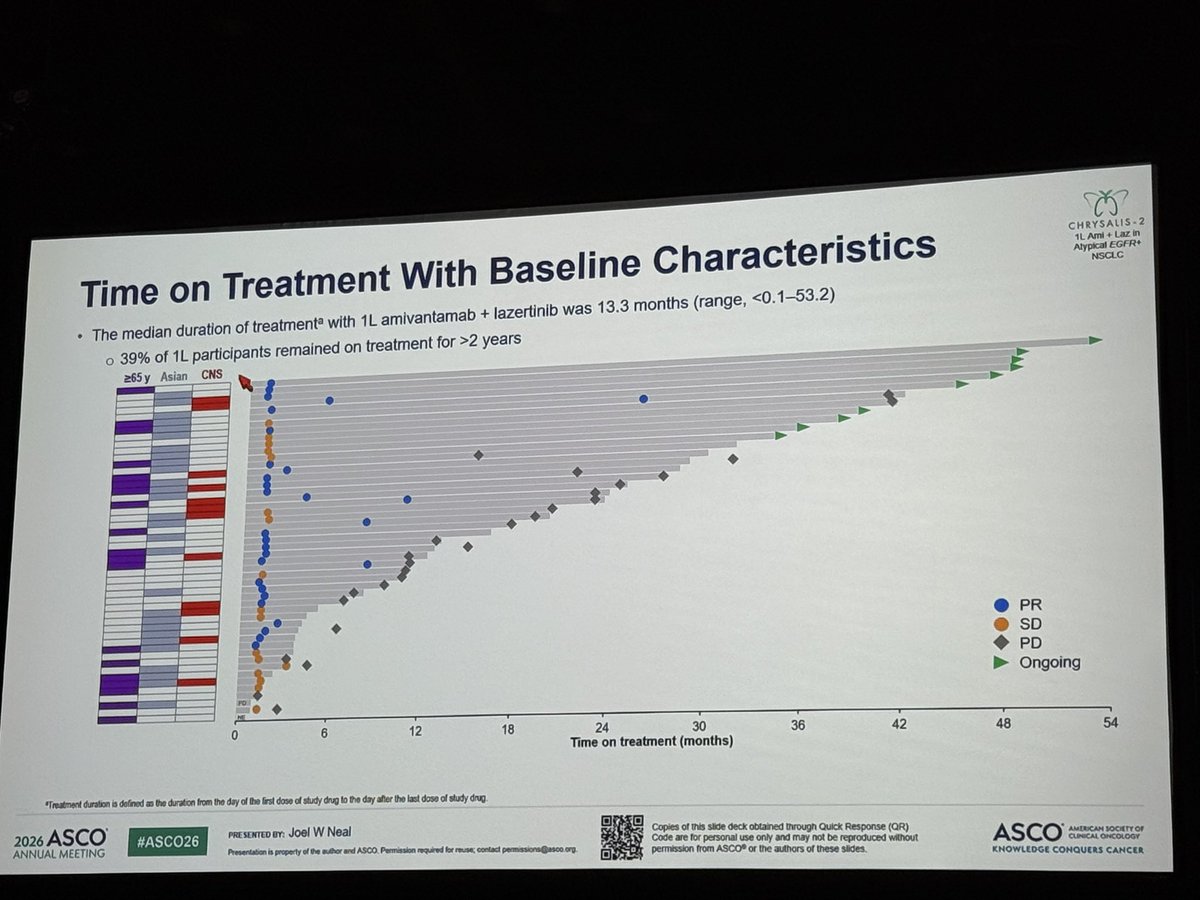
IV amivantamab (EGFR/MET bispecific) plus lazertinib (third-generation EGFR TKI). No chemotherapy backbone. Median duration of treatment 13.3 months (range <0.1-53.2), with 39% of 1L participants still on treatment beyond 2 years.
Median OS 41.0 mo (95% CI 27.7-NE), described by the presenters as roughly 3.5 years. The upper CI bound is not estimable, so the point estimate is anchored on the lower bound of 27.7 mo.
Reported only as consistent with prior reports, no new safety signals with longer follow-up. No grade 3+ rates, infusion-reaction rates or dermatologic AE rates appear in the source.
The atypical EGFR label pools biologically distinct alterations (G719X, S768I, L861Q and compound variants) whose single-agent TKI sensitivity differs; n=49 cannot resolve per-variant benefit, and the curator's read of no variant-outcome association is an absence of signal in a small cohort, not evidence of uniformity. No comparator, so the 41.0 mo median cannot be positioned against afatinib or osimertinib series in the same population.
Atypical EGFR is the part of the EGFR-mutant space where no regimen is settled, so a 41.0 mo median in 49 pts is meaningful as a benchmark even without randomisation. The practical question this leaves open is whether the bispecific's added toxicity and IV schedule are justified over an oral TKI alone, which this design cannot answer.
Single-arm n=49 expansion cohort, no randomised comparator against afatinib or osimertinib in atypical EGFR. Maturity gate: single-arm never reaches confirmatory.
- Doublet vs single-agent osimertinib or afatinib in atypical EGFR n=480 · primary completion 2029-02 · phase 3 firmonertinib vs osimertinib/afatinib, PACC 1L
- Which atypical EGFR variants drive the durable-response tail
- Whether subcutaneous amivantamab preserves efficacy with less infusion burden n=418 · primary completion 2024-01 · phase 3 SC vs IV ami + lazertinib, randomisedrecruiting A Study of Amivantamab in Participants With Advanced or Metastatic Solid Tumors Including Epidermal Growth Factor Receptor (EGFR)-Mutated Non-Small Cell Lung Cancer Phase 2n=520 · primary completion 2027-08 · SC co-formulation activity + safety cohorts
📚 Sources · 🐦 1 tweet
Amivantamab + lazertinib achieved a median OS of 41.0 months in treatment-naïve atypical EGFR-mutant NSCLC, with no clear association between EGFR variant subtype and outcome. A compelling option. Meanwhile, amivantamab continues evaluation across multiple tumor types. #ASCO26 pic.twitter.com/aWn3Ja60Ji
— Chul Kim (@chulkimMD) May 29, 2026
The longer read
Atypical EGFR mutations are the corner of EGFR-mutant lung cancer where the evidence base thins out fastest. Classical exon 19 deletions and L858R have a settled first-line answer and exon 20 insertions have been carved off into their own development track, but the residual group, G719X, S768I, L861Q and the compound variants, has largely been managed on the strength of afatinib's pooled post-hoc analyses and single-institution osimertinib experience. A median OS of 41.0 months in 49 prospectively treated patients is therefore worth attention less because it beats a comparator, which it does not have, and more because it establishes a prospective benchmark where the field has mostly been reasoning from retrospective series.
The number that should temper enthusiasm is the confidence interval, not the point estimate. The 95% CI runs 27.7 months to not estimable, meaning the survival curve had not delivered enough events to bound the upper end at a median follow-up of 31.3 months. With 49 patients, the median is being determined by a small number of events, and the honest read of the interval is that the true median is somewhere at or above roughly two and a half years. The presenters' framing of about 3.5 years is defensible as the point estimate, but a reader carrying it into a clinic conversation is carrying the least stable part of the result.
The treatment-duration data are arguably the more informative half of this presentation. Median time on treatment was 13.3 months against a median OS of 41.0 months, which means the average patient spent roughly a third of their survival on this regimen and the rest on something else. That gap matters for how the result should be interpreted: a substantial fraction of the observed survival is post-progression, attributable to subsequent lines, and the OS figure is not a clean readout of what the doublet delivers. At the same time 39% of patients remained on treatment beyond two years, so the distribution is bimodal rather than uniformly short. Identifying which patients sit in that durable tail is the question the cohort is too small to answer, and the stated absence of an association between variant subtype and outcome is an underpowered null rather than a demonstration that variant does not matter.
The methodological structure also deserves scepticism about generalisability. This is an expansion cohort within a larger development program, which selects for performance status, organ function and willingness to accept an intravenous regimen with a well-characterised infusion-reaction and dermatologic burden. Amivantamab's toxicity profile is the practical obstacle to its adoption, and the source reports safety only as consistent with prior reports without grade 3+ rates, so a reader cannot weigh the tolerability cost against the survival benefit from this presentation alone.
What would have to be true for this result to mislead? Chiefly that the atypical EGFR population enrolled here skewed toward the more TKI-sensitive variants, in which case a single-agent third-generation TKI might have produced a similar curve at a fraction of the toxicity and cost. Nothing in a single-arm design can exclude that, and until a randomised comparison against afatinib or osimertinib exists in this specific population, the doublet is a reasonable option supported by a real prospective benchmark rather than an established standard.