Clinico-transcriptomic Risk Stratification (Abstract 5000)
ForNCCN high-risk / very-high-risk localized prostate, definitive RT + ADT
TL;DR~¼ of NCCN ≥HR pts carry discordant clinical vs biomarker risk; 22-gene GC independently prognostic for MFS, DM, OS.
The de-escalation cell is where the risk sits: 9% of NCCN ≥HR pts read clinically high but biomarker low, and the framework withholds AAP from them. The 15% running the other way is the easier sell. What moves is whether GC gets ordered at consult, not any planning parameter.
In NCCN high-risk or very-high-risk localized prostate headed for definitive RT + ADT, this supports ordering a 22-gene GC before the abiraterone decision; it does not speak to post-prostatectomy salvage, node-positive, or metastatic disease.
RT + ADT is fixed in both branches, so nothing here touches dose, target volume, or fractionation; the framework is a consult-time test-order decision. Reclassification runs both ways, 15% clinically lower but biomarker higher and 9% the reverse, on GC bands of 0.6 and 0.85.
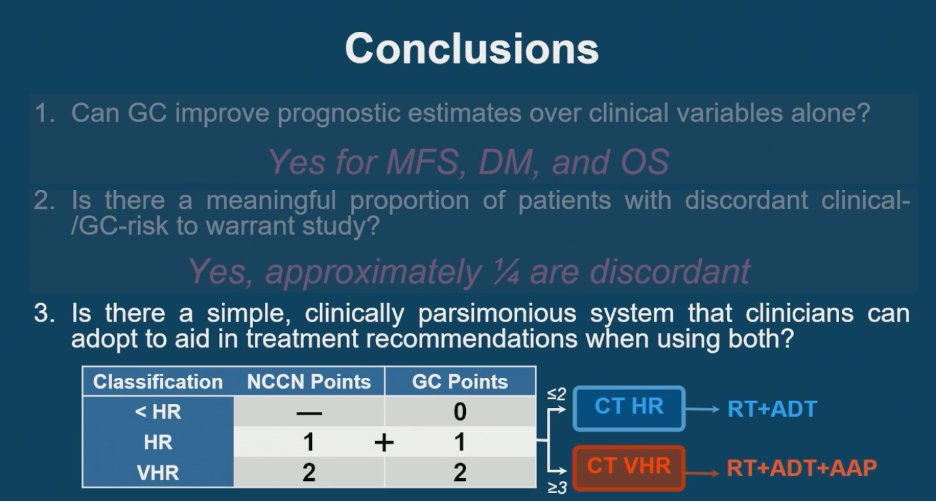
Intensification with AAP in localized disease gets a biomarker gate instead of an NCCN label: NCCN class and GC each contribute up to 2 points, and a sum ≥ 3 triggers AAP. GC was tested as prognostic across MFS, DM, and OS; no treatment-by-GC interaction is reported, so predictive value is unestablished.

+3 more figures

| Clinical risk | ↓ Biomarker | ↑ Biomarker |
|---|---|---|
| ↓ Clinical | 49% | 15% |
| ↑ Clinical | 9% | 27% |

8 details
Clinico-transcriptomic analysis of NRG cohorts modeling the 22-gene GC as a continuous variable (per 0.1 unit) alongside clinical covariates, with treatment carried as a covariate. Contributing trials, N, and follow-up duration are not reported in the source.
NCCN ≥ high-risk localized prostate, spanning NCCN HR and VHR. Baseline age, PSA, and grade distributions are not reported in the source.
Every branch of the framework keeps RT + ADT. No dose, fractionation, target volume, or ADT duration is reported, so RT enters as a fixed backbone rather than a variable under test.
Prognostic performance assessed on MFS, distant metastasis, and OS. No single primary endpoint is stated, and the framework itself is not compared against a randomized alternative.
GC was independently prognostic for all three endpoints (p<0.001); the row-level hazard ratios are not legible in the source slide. Approximately ¼ of the ≥HR population carries discordant clinical vs biomarker risk.
| Score (NCCN + GC) | CT risk | Recommendation |
|---|---|---|
| ≤ 2 points | CT HR | RT + ADT |
| ≥ 3 points | CT VHR | RT + ADT + AAP |
STAMPEDE M0 (Attard, Lancet 2022) is the external yardstick: the CT HR and CT VHR curves are overlaid on that trial's RT + ADT arm rather than on a randomized internal control. Eligibility, staging era, and ADT duration differ between cohorts, so the vertical gap carries trial effects alongside risk-group effects.
The GC term's hazard ratios and confidence intervals are not legible in the source, so the size of the increment over clinical variables cannot be checked. The 9% clinically-high / biomarker-low cell is where the framework withholds intensification, and its outcomes are the ones a reader most needs before acting.
The contribution is a parsimonious integer score computable at the consult desk, extending Spratt et al. (JCO 2018) to the modern VHR population. What it does not settle is whether the signal separating these curves also identifies who benefits from AAP: a prognostic split widens absolute benefit for a uniformly effective drug without any interaction, and none is reported here.
Retrospective pooled analysis; GC shown prognostic, not predictive. Intensification threshold benchmarked against STAMPEDE across trials, not randomized within cohort; no treatment-by-GC interaction in source.
- Does GC predict abiraterone benefit or only prognosis?
- Prospective validation of the ≥3-point intensification threshold
- Whether NCCN VHR pts with GC < 0.6 can omit AAP
📚 Sources · 🐦 2 tweets
#ASCO26 GU Oncology Spotlight 🚨
— Dra. María Natalia Gandur Quiroga (@nataliagandur) May 30, 2026
🔬 Abstract 5000 | High-risk prostate cancer
Clinico-transcriptomic risk stratification to guide abiraterone intensification
Presented by Krishnan R. Patel, MD, MHS@Krishnan_Patel@OncoAlert@ASCO
In high-risk localized prostate cancer,… pic.twitter.com/pZSCiTyGB8
#ASCO26 Dr. Patel presented a clinically practical framework integrating NCCN clinical risk + a 22-gene genomic classifier to guide treatment intensification in high-risk localized prostate cancer.
— Julian Chavarriaga (@chavarriagaj) May 30, 2026
Key findings:
🔹 The genomic classifier independently improved prognostic… pic.twitter.com/fRcdTmfBec
The longer read
The allocation problem this takes on is real and unsolved. STAMPEDE M0 established that adding abiraterone to RT plus ADT improves MFS and OS in high-risk non-metastatic disease, and that result carried AAP into NCCN, but the population defined by clinical criteria is wide and nobody has a defensible rule for which of those men need the third agent. The proposal is a two-input integer score: NCCN clinical class contributes points, the 22-gene GC contributes points, and a sum of at least 3 triggers intensification on top of RT and ADT. Its appeal is that it is computable at the consult desk without a nomogram or a calculator.
The most persuasive result is the discordance figure, not the prognostic modeling. If the GC were largely re-encoding grade, stage, and PSA, the cross-tabulation would sit almost entirely on its diagonal. It does not: 15% of the ≥HR population reads clinically lower risk but biomarker higher risk, and 9% runs the other way. That is the whole case for ordering the assay, because a marker agreeing with the clinical model everywhere buys cost and no decisions. Whether the reclassification points in the right direction is a separate question, and the source does not answer it.
The methodological hinge is prognostic versus predictive, and the abstract as presented does not clear it. Everything shown supports the GC as an independent prognostic factor for metastasis-free survival, distant metastasis, and overall survival. Nothing shown demonstrates that it identifies who benefits from abiraterone, which is what a score allocating abiraterone requires. There is a coherent defense of allocating a uniformly effective drug by absolute risk: if relative benefit is constant, the highest-risk men gain most in absolute terms, and clinical risk grouping already does this implicitly. But that defense rests on the constancy assumption and should be argued rather than implied by overlaying curves.
The overlay deserves its own scrutiny. The CT HR and CT VHR curves are read against the RT plus ADT arm of a different trial, run under different eligibility, different staging technology, and different ADT duration. Cross-trial curve comparison of this kind tends to flatter the newer cohort, and the separation a reader sees carries trial effects as well as risk effects. A within-cohort contrast would answer the same question without that confound.
What would make this wrong in practice is a small independent GC increment. The row-level hazard ratios were not legible in the source, so the gain over clinical variables cannot be checked here. If it is modest, a score in which NCCN VHR alone contributes 2 points will be driven mostly by clinical class, and the men actually reclassified will be few enough that the assay changes little. The consequential direction is the 9% cell, clinically high and biomarker low, where the framework withholds intensification on prognostic grounds. Withholding a drug with a demonstrated survival benefit is a heavier decision than adding one, and it is the direction that most needs a prospective test before the score gets used as an allocator rather than a tiebreaker.