SWOG S1827/MAVERICK
ForLS- or ES-SCLC, no brain mets on MRI after 1st-line therapy
HR 0.60
90% CI 0.46-0.78, one-sided p=0.0005, favoring MRI alone
TL;DRMRI surveillance alone beat MRI + PCI for cognitive failure-free survival, HR 0.60 (90% CI 0.46-0.78), in LS- and ES-SCLC without brain mets after first-line therapy.
The benefit held with HA-PCI in 77% of the PCI arm and in the HA-PCI-only subgroup, so hippocampal sparing does not rescue PCI. Stage did not modify the effect (LS HR 0.59, ES HR 0.65, interaction p=0.79), which moves the LS-SCLC PCI default toward omission with MRI surveillance, pending final OS.
In LS- or ES-SCLC with a clean brain MRI after first-line therapy, this supports MRI surveillance over PCI, including HA-PCI. It does not address pts who cannot reliably get serial MRI, and it does not settle OS until the 190-event analysis.
HA-PCI made up 77% of the PCI arm and the HA-PCI-only subgroup still favored MRI alone, so the technique fix does not rescue PCI. The benefit was similar in LS (HR 0.59) and ES (HR 0.65), which moves the LS-SCLC PCI referral toward omission, with WBRT or SRS held for detected mets.
Immunotherapy was a stratification factor, and 41% of pts received it upfront. For the post-induction SCLC visit, this supports serial brain MRI (3, 6, 9, 12, 18, 24 mo) over a PCI referral. Final OS at 190 events is still the gate, especially in the post-ADRIATIC durvalumab era.
Also covered Sep 14
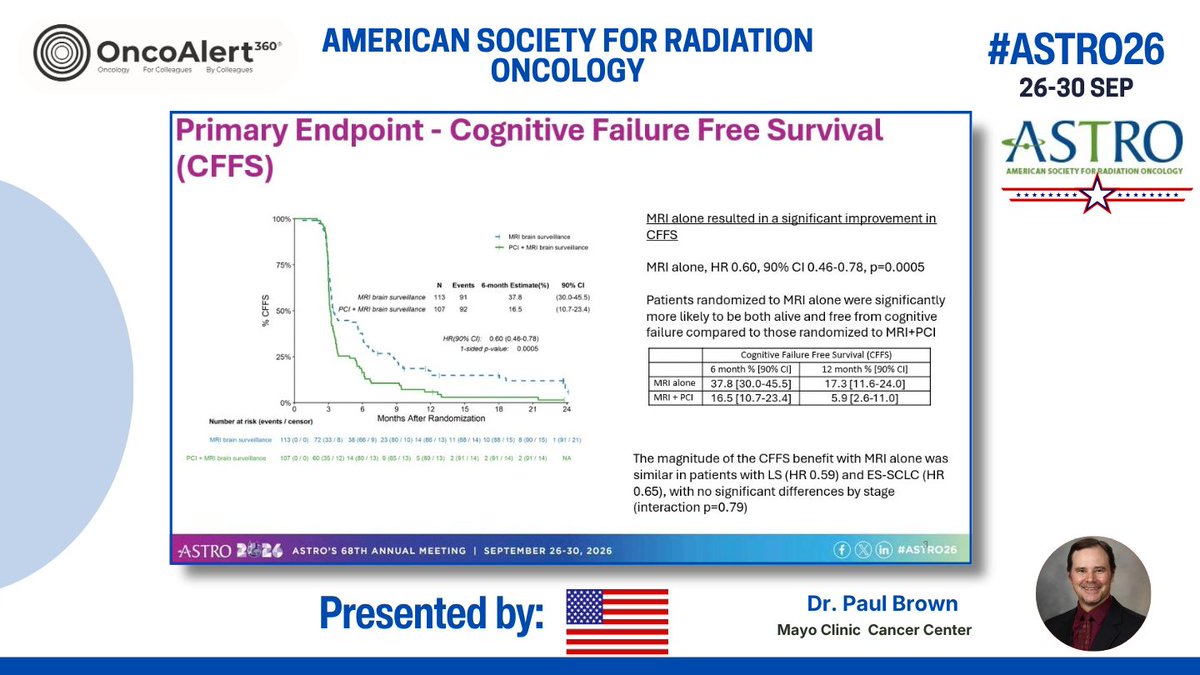
| Arm | 6-mo CFFS % (90% CI) | 12-mo CFFS % |
|---|---|---|
| MRI alone | 37.8 (30.0-45.5) | 17.3 |
| MRI + PCI | 16.5 (10.7-23.4) | 5.9 |
+2 more figures

13 details 3 trials watching
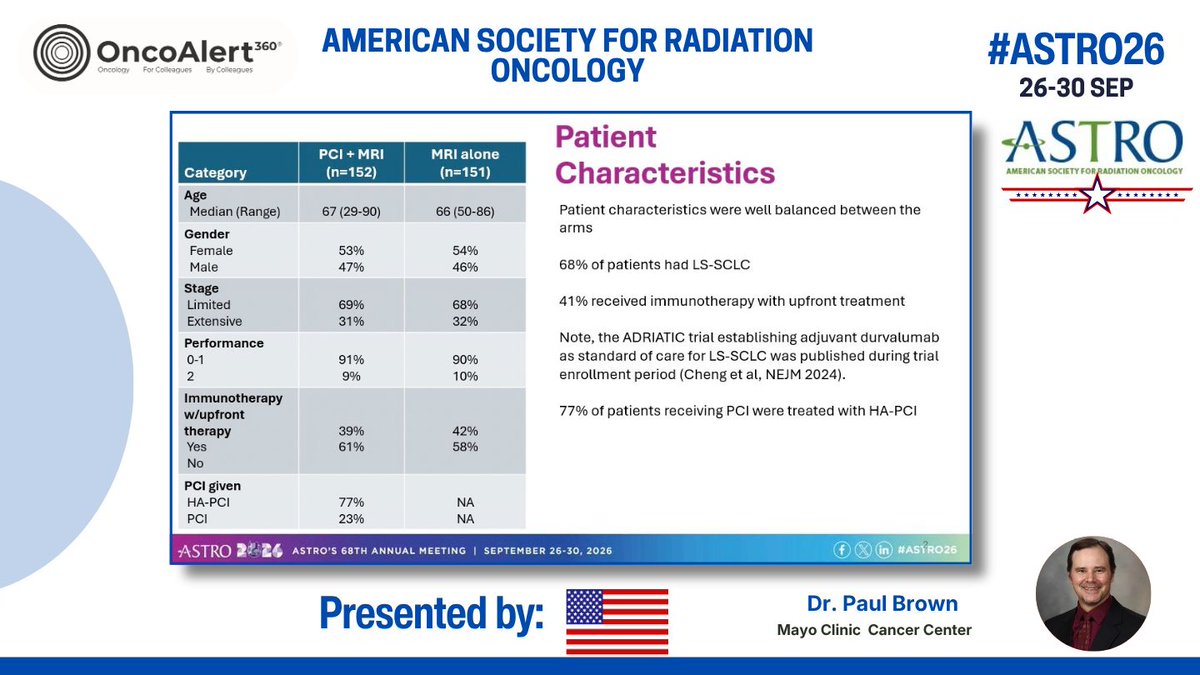
Randomized phase III (SWOG S1827), total accrual 304. Stratified by LS vs ES stage, immunotherapy (y/n), and PS 0-1 vs 2.
SCLC, limited or extensive stage, no prior brain mets and no brain mets on MRI after first-line therapy. 68% LS-SCLC; 41% received immunotherapy with upfront treatment.
PCI 25 Gy / 10 fx, with HA-PCI allowed at physician discretion; 77% of PCI pts received HA-PCI. At brain mets, RT was recommended in both arms (WBRT or SRS allowed).
Primary: cognitive failure-free survival (CFFS), with MRI and cognitive testing at 3, 6, 9, 12, 18 and 24 mo. Key secondary: OS.
CFFS favored MRI alone, HR 0.60 (90% CI 0.46-0.78), one-sided p=0.0005. The effect was similar by stage (LS HR 0.59, ES HR 0.65, interaction p=0.79) and in the HA-PCI-only subgroup. Preliminary OS after 128 events showed no significant difference. PCI decreased brain mets with no PFS difference.
| Subgroup | CFFS HR |
|---|---|
| LS-SCLC | HR 0.59 |
| ES-SCLC | HR 0.65 |
| Interaction | p=0.79 |
The Takahashi Japanese phase III had already moved ES-SCLC toward MRI surveillance, while LS-SCLC PCI still rests on pre-MRI-era randomized data and meta-analysis. MAVERICK is the first randomized test of surveillance vs PCI to include LS-SCLC with modern MRI staging.
The endpoint uses a 90% CI and a one-sided test. The brain mets reduction with PCI is unquantified in source, as is symptomatic morbidity from salvage RT. ADRIATIC changed the LS-SCLC backbone mid-enrollment.
When OS does not differ, a composite of death + cognitive failure mainly measures cognitive toxicity, and on that axis PCI loses even with hippocampal sparing. The open question is whether final OS confirms the preliminary read.
Randomized phase III, prespecified primary met, diverges from PCI as standard in LS-SCLC. Held below practice-changing: OS immature (128/190 events), composite cognitive endpoint, abstract-only.
- Does OS remain equivalent at the final 190-event analysis? n=534 · primary completion 2026-04 · LS-SCLC phase 3 PCI vs MRI surveillance post-CRTrecruiting PRophylactic Cerebral Irradiation or Active MAgnetic Resonance Imaging Surveillance in Small-cell Lung Cancer Patients (PRIMALung Study) Phase NAn=600 · primary completion 2028-04 · phase 3 OS non-inferiority, MRI alone vs PCI+MRI
- Salvage RT burden and neurologic morbidity in the surveillance arm n=534 · primary completion 2026-04 · PCI vs MRI surveillance, efficacy + safety, LS-SCLC
- Does the result hold after consolidation durvalumab in LS-SCLC?
📚 Sources · 🐦 1 tweet
In Collaboration with our partners at ASTRO we continue our coverage of #ASTRO26 🚨
— OncoAlert (@OncoAlert) September 28, 2026
LBA 03 - SWOG S1827/MAVERICK: A RANDOMIZED PHASE III TRIAL OF BRAIN MRI SURVEILLANCE WITH AND WITHOUT PROPHYLACTIC CRANIAL IRRADIATION (PCI) FOR SMALL-CELL LUNG CANCER (SCLC)
Presented by Dr.… pic.twitter.com/XwdqCUV9fN
The longer read
The question MAVERICK answers is narrower and more useful than 'does PCI work.' PCI reduces brain metastases, and the conclusions slide confirms that again here. What was never settled is whether that reduction is worth its cognitive cost once staging MRI and serial MRI surveillance can find brain metastases early enough for effective salvage. In ES-SCLC, the Takahashi Japanese trial had already shifted many practices toward surveillance. In LS-SCLC, the PCI standard still rests on randomized data and meta-analysis from an era of CT staging without routine brain MRI. MAVERICK is the first randomized trial to put LS-SCLC with MRI staging into that comparison, and LS-SCLC made up 68% of the enrolled population.
The primary endpoint needs to be read carefully, because it largely determines the result. Cognitive failure-free survival counts death and cognitive failure as events. If survival does not differ between arms, and the preliminary OS analysis after 128 events suggests it does not, then the CFFS difference is almost entirely a cognitive-toxicity difference. That is a legitimate endpoint for a de-escalation question. But the trial is a demonstration that PCI costs cognition without a detectable survival return, not a demonstration that surveillance is oncologically superior. The statistics follow the same logic: a 90% CI and a one-sided p=0.0005 are appropriate for a directional hypothesis, and with an HR of 0.60 the result is not fragile.
For radiation oncologists, the most consequential detail is that hippocampal avoidance did not rescue PCI. 77% of the PCI arm received HA-PCI, and the HA-PCI-only subgroup still favored MRI alone. That removes the most common counterargument, that modern technique would close the gap. Stage also did not modify the effect (LS HR 0.59, ES HR 0.65, interaction p=0.79), which argues against keeping PCI for LS-SCLC on the grounds that curative intent raises the value of preventing intracranial relapse.
Several features should temper confidence. OS is immature, and the final analysis is planned at 190 events. A late OS divergence favoring PCI in the LS subgroup, where long-term survivors live long enough for intracranial control to matter, would reopen the question. The source does not quantify the brain metastasis reduction, and it does not describe the symptomatic burden, SRS versus WBRT use, or neurologic morbidity of salvage in the surveillance arm. Those numbers determine whether surveillance trades toxicity now for toxicity later. ADRIATIC established consolidation durvalumab for LS-SCLC during enrollment, and only 41% of pts received immunotherapy upfront. How the result carries over to a durvalumab-consolidated LS population, whose intracranial relapse pattern may differ, is inferred rather than tested.
The practical upshot: for a pt with a clean post-induction brain MRI, the burden of proof now sits with PCI rather than with surveillance, in both stages. That assumes a surveillance program the trial actually delivered, with MRI at 3, 6, 9, 12, 18 and 24 months. A practice that cannot reliably deliver that schedule is not running the tested strategy. The final OS analysis, with PFS and salvage-RT patterns reported in full, is what would turn this from a strong challenge to the PCI standard into a settled replacement.