NRG/RTOG 0815
ForNon-metastatic intermediate-risk prostate cancer, dose-escalated RT, median age 68
HR 0.87
95% CI 0.72-1.04, p=0.13; did not meet OS
TL;DROS HR 0.87 (95% CI 0.72-1.04, p=0.13), not met; 6 mo STAD + dose-escalated RT cut PSA failure (HR 0.60) and DM (HR 0.35) in IR PCa.
Dose escalation did not erase the ADT benefit: with 79.2 Gy or a brachy boost, STAD still cut distant mets (40 vs 14 events, HR 0.35) and PCSM (HR 0.26). OS stayed flat because 422 of 446 deaths were non-prostate cancer, so the STAD call is a disease-control vs QoL/cardiac trade-off, not a survival one.
In non-metastatic intermediate-risk prostate cancer planned for dose-escalated EBRT or brachy boost, this supports discussing 6 mo STAD for fewer relapses and PC deaths without an OS promise; it does not identify which IR subgroup can safely omit it.
Dose escalation to 79.2 Gy or brachy boost did not replace STAD for disease control: distant mets HR 0.35, PSA failure HR 0.60. OS stayed flat because 422 of 446 deaths were non-prostate cancer, so the ADT decision with dose-escalated RT is a disease-control vs QoL trade-off.
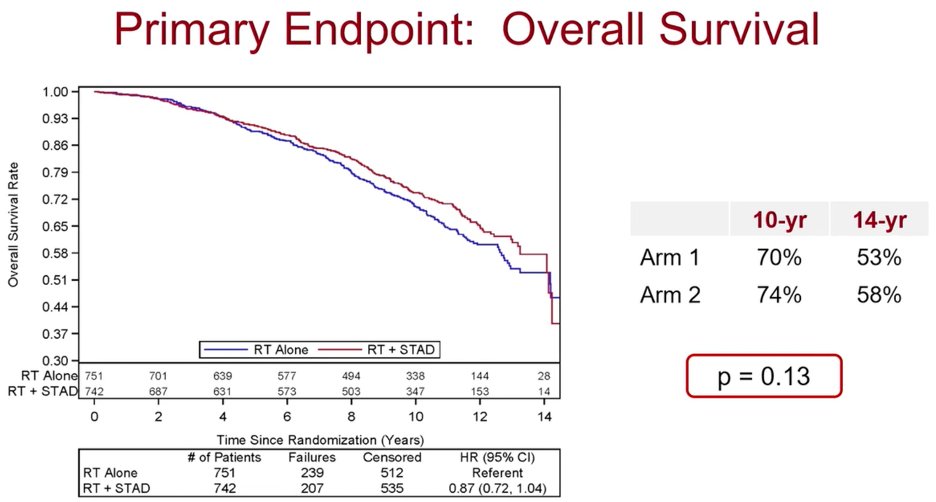
| Arm | N | 10-yr OS | 14-yr OS | HR (95% CI) | p |
|---|---|---|---|---|---|
| RT alone | 751 | 70% | 53% | Referent | n/a |
| RT + STAD | 742 | 74% | 58% | 0.87 (0.72, 1.04) | 0.13 |
+3 more figures
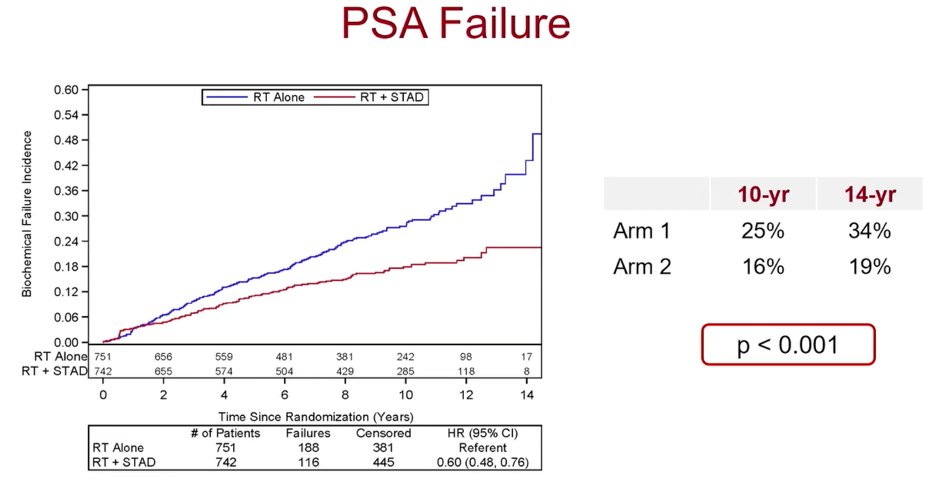
| Arm | N | 10-yr PSA failure | 14-yr PSA failure | HR (95% CI) |
|---|---|---|---|---|
| RT alone | 751 | 25% | 34% | Referent |
| RT + STAD | 742 | 16% | 19% | 0.60 (0.48, 0.76), p < 0.001 |
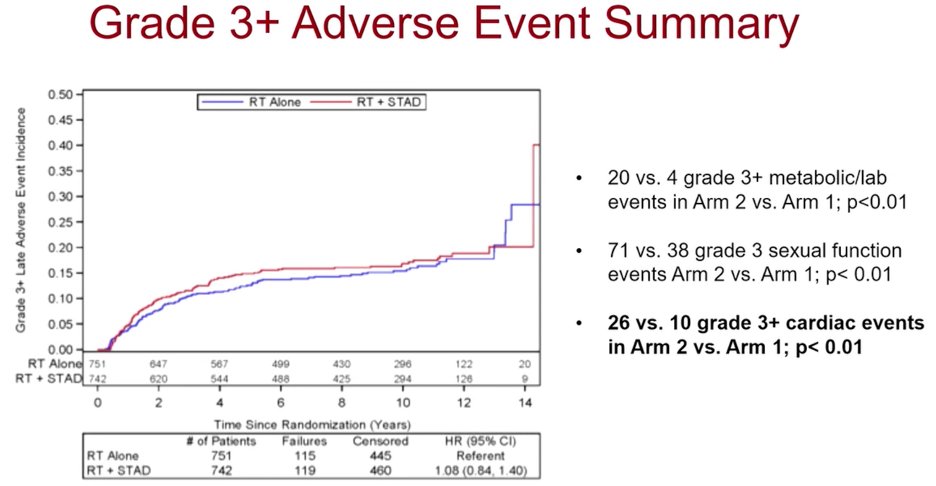
| Late AE | RT + STAD | RT alone | p / HR |
|---|---|---|---|
| Any grade 3+ late AE | 1.08 (0.84, 1.40) | Referent | HR (95% CI) |
| Grade 3+ metabolic/lab | 20 | 4 | p<0.01 |
| Grade 3 sexual function | 71 | 38 | p<0.01 |
| Grade 3+ cardiac | 26 | 10 | p<0.01 |

9 details
Phase III prospective randomized trial, N=1493 (751 vs 742). Median follow-up 9.4 y overall, 10.3 y in survivors. Stratified by number of IR factors, ACE-27 comorbidity, and RT modality.
Non-metastatic intermediate-risk prostate cancer with ≥1 of Gleason 7, PSA >10 but ≤20 ng/mL, or cT2b-T2c; all 3 factors plus ≥50% positive cores excluded. Median age 68, median PSA 8.1 ng/mL, 92% Gleason 7, 67% single IR factor.
Dose-escalated EBRT to 79.2 Gy, or EBRT with an LDR or HDR brachytherapy boost; 89% received EBRT alone. More than 90% of contours and dose analyses scored per protocol or acceptable variation.
6 months STAD: LHRH agonist plus antiandrogen. LHRH compliance 91%, antiandrogen 87%.
Primary: OS, powered for 5-y OS 90% to 93% (HR 0.66). Secondary: biochemical failure, local failure, distant metastasis, PC death, salvage therapy, non-PC death.
OS not improved (HR 0.87, p=0.13); PSA failure, MFS, distant mets, salvage ADT and PC deaths all favored STAD, with non-PC mortality similar (HR 0.93).
Overall grade 3+ late AEs similar (HR 1.08), but metabolic, sexual and cardiac grade 3+ events higher with STAD. EPIC hormone and sexual domains dropped early with STAD and largely converged by 60 months; urinary and bowel domains similar.
RTOG 9408 established STAD with RT at conventional doses; 0815 asks whether dose-escalated RT removes that need, and the disease-control answer is no. The OS answer differs because the population is IR with high competing mortality.
OS power assumption ignored the competing non-PC mortality that dominated deaths. Brachy-boost and multi-factor subsets are small, so subgroup omission cannot be defended from this trial.
STAD buys durable disease control and fewer PC deaths without excess non-PC mortality, at a transient QoL cost. The open question is selection: which IR pts can skip it, which the authors defer to imaging, genomics, and MMAI.
CONSORT flow
Adequately powered phase 3 with long follow-up; OS primary not met, but consistent disease-control benefit supports selective STAD as a toxicity trade-off rather than an OS gain.
- Which intermediate-risk subgroups can safely omit STAD?
- Does PSMA PET or genomic selection amplify STAD benefit?
📚 Sources · 🐦 1 tweet · 📄 1 paper
NRG/RTOG 0815: Ph 3 RCT of dose-escalated RT ± 6 mo STAD in IR PCa (n=1493; median f/u 10.3 y)
— Rashid K. Sayyid (@RKSayyid) September 28, 2026
🚨OS: 10-y 70% (RT alone) vs 74% (RT+STAD); 14-y 53% vs 58% (HR 0.87; p=0.13)
🔹PSA failure: 25% vs 16% at 10 y; 34% vs 19% at 14 y (HR 0.60; p<0.001)
🔹MFS: 67% vs 72% at 10 y; 50%… pic.twitter.com/G5qfgfc9CI
Abstract
The longer read
The cleanest way to read 0815 is as two separate answers to two questions the trial was not designed to separate. The question it was powered for, whether 6 months of ADT improves survival when the radiation dose is already escalated, gets a negative answer. The question most radiation oncologists actually care about, whether dose escalation makes ADT redundant for disease control, gets an equally clear answer in the other direction: PSA failure, distant metastasis, salvage ADT and prostate cancer death all moved in favor of STAD, with an HR of 0.35 for distant metastasis and 0.26 for prostate cancer death.
The OS miss is largely structural. The trial was designed around a 5-year OS improvement from 90% to 93%, an assumption that implicitly treated prostate cancer as a meaningful driver of death in an intermediate-risk, median-age-68 population. It was not: 422 of 446 deaths were from other causes. With prostate cancer deaths of 19 versus 5, no plausible effect on cancer mortality could have surfaced as a significant all-cause signal. The reassuring companion finding is that non-prostate cancer mortality was not higher with STAD (HR 0.93), which matters because the historical worry about ADT in older men with comorbidity is cardiovascular harm. The grade 3+ cardiac excess (26 vs 10 events) is real but did not translate into excess non-cancer death at this follow-up.
Against RTOG 9408, which supported adding STAD at conventional doses, 0815 is better read as continuity than reversal. The argument that higher local dose would close the gap is weakened by the distant metastasis result: ADT appears to act on occult systemic disease that local dose cannot address. That said, distant metastasis events were few in absolute terms, 40 versus 14 across nearly 1,500 men, so the relative effect is large while the absolute stakes for a typical patient are modest.
The selection question is where the trial leaves the reader short. Two thirds had a single intermediate-risk factor, 89% received EBRT alone, and staging predates PSMA PET and routine genomic classifiers. Subgroup HRs for PSA failure all favored STAD, but the authors state they could not identify a group that does not benefit, which is not the same as showing all groups benefit; the brachy-boost and multi-factor strata are too small to support either claim. Practices that already individualize by unfavorable versus favorable intermediate-risk features will find nothing here that forbids it, and nothing that validates it.
The practical upshot is that STAD in this setting should be framed as a trade: fewer relapses, less salvage therapy and fewer prostate cancer deaths, against early sexual and hormonal QoL deterioration that largely recovered by 60 months and an excess of cardiac and metabolic events. For a patient whose competing mortality is high, that trade looks thin; for a fit patient with a long horizon, the reduction in distant metastasis and salvage ADT carries more weight. The trial would be wrong in its disease-control conclusions only if antiandrogen non-compliance or modality imbalance biased the secondary endpoints, and neither appears large enough to do so.