NRG/RTOG 0815 Decipher GC
ForIntermediate-risk prostate cancer, dose-escalated RT, biopsy Decipher GC available
p-interaction <0.001
10-yr DM absolute benefit 11% high GC vs 1% low GC
TL;DR10-yr DM absolute benefit from adding STAD to dose-escalated RT: 11% in high GC vs 1% in low GC, p-interaction <0.001.
The omission read is the low-GC group: 44% of the cohort had GC <0.45 and a 10-yr DM absolute difference of 1% with STAD. The slide pools int/high GC at 8% while the abstract gives 11% for high GC alone, so where GC 0.45-0.6 falls is not resolved in source. RT dose and fractionation are not stated.
In intermediate-risk prostate cancer planned for dose-escalated RT, a low Decipher GC (<0.45) supports discussing STAD omission and a GC >0.6 argues against it; it does not settle the GC 0.45-0.6 group or pts outside intermediate-risk disease.
The omission read is the low-GC group: 44% of the cohort had GC <0.45 and a 10-yr DM absolute difference of 1% with STAD added to dose-escalated RT. Slide pools int/high GC at 8% vs 11% for high GC alone in the abstract, so GC 0.45-0.6 stays unresolved. RT dose and fractionation not stated in source.
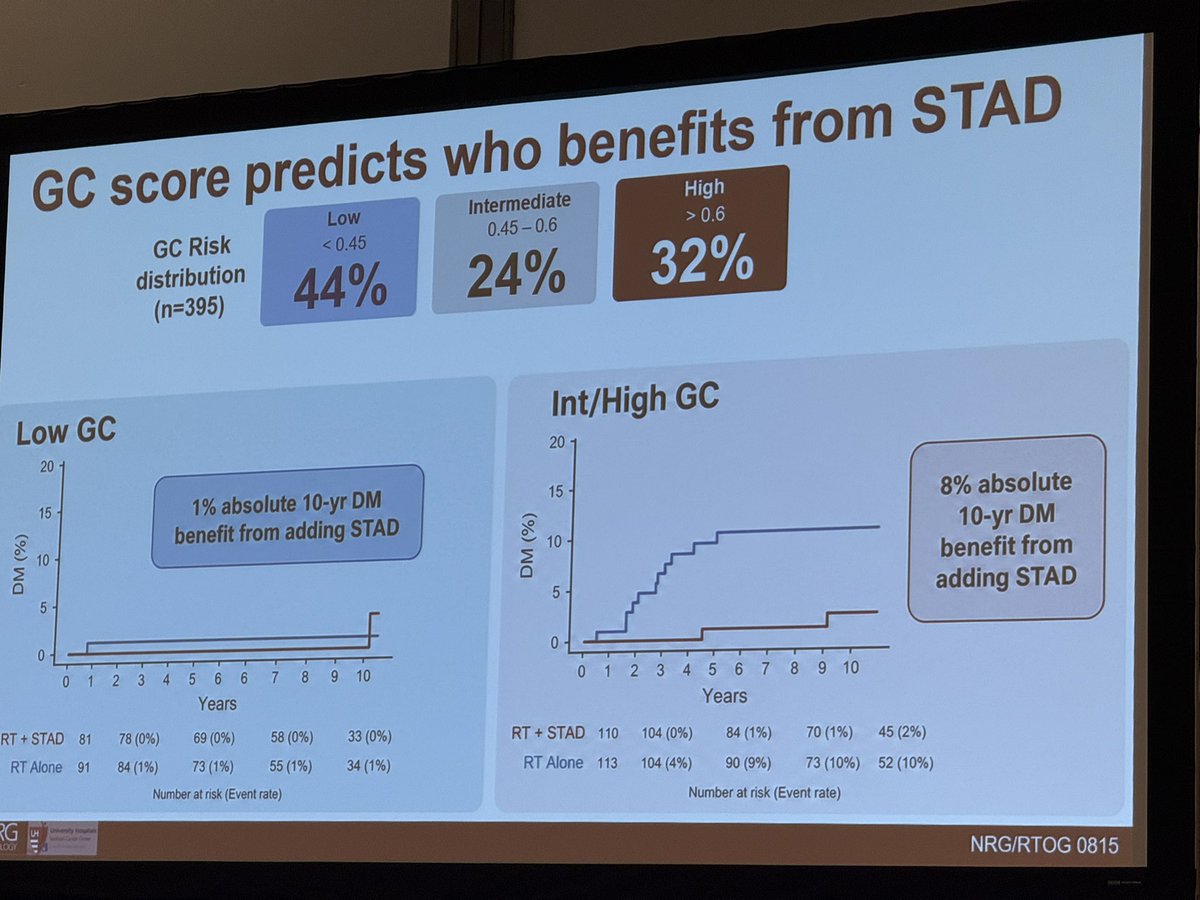
| GC group | Absolute 10-yr DM benefit from adding STAD |
|---|---|
| Int/High GC | 8% |
| Low GC | 1% |
+1 more figure
12 details 2 trials watching
Ancillary study of NRG/RTOG 0815, a phase 3 randomized trial of dose-escalated RT with or without 6 months of STAD. Prespecified analysis plan with NCI approval, GC data linked to updated outcomes at 10.2 years median follow-up (IQR 8.4-11.4).
Intermediate-risk prostate cancer. GC scores were obtained for 395 pts of 856 with available tissue, with baseline characteristics balanced between arms. GC distribution: low (<0.45) 44%, intermediate (0.45-0.6) 24%, high (>0.6) 32%.
6 months of STAD added to dose-escalated RT vs RT alone. Agents not stated in source.
Dose-escalated RT in both arms. Dose, fractionation, modality mix and target volume are not stated in source, though RT modality was a covariate in the multivariable models.
Primary: distant metastasis. Secondary: biochemical failure, MFS, PCSM, OS. Cox and Fine-Gray competing risk MVA adjusted for age, race, clinical risk factors, comorbidity score and RT modality.
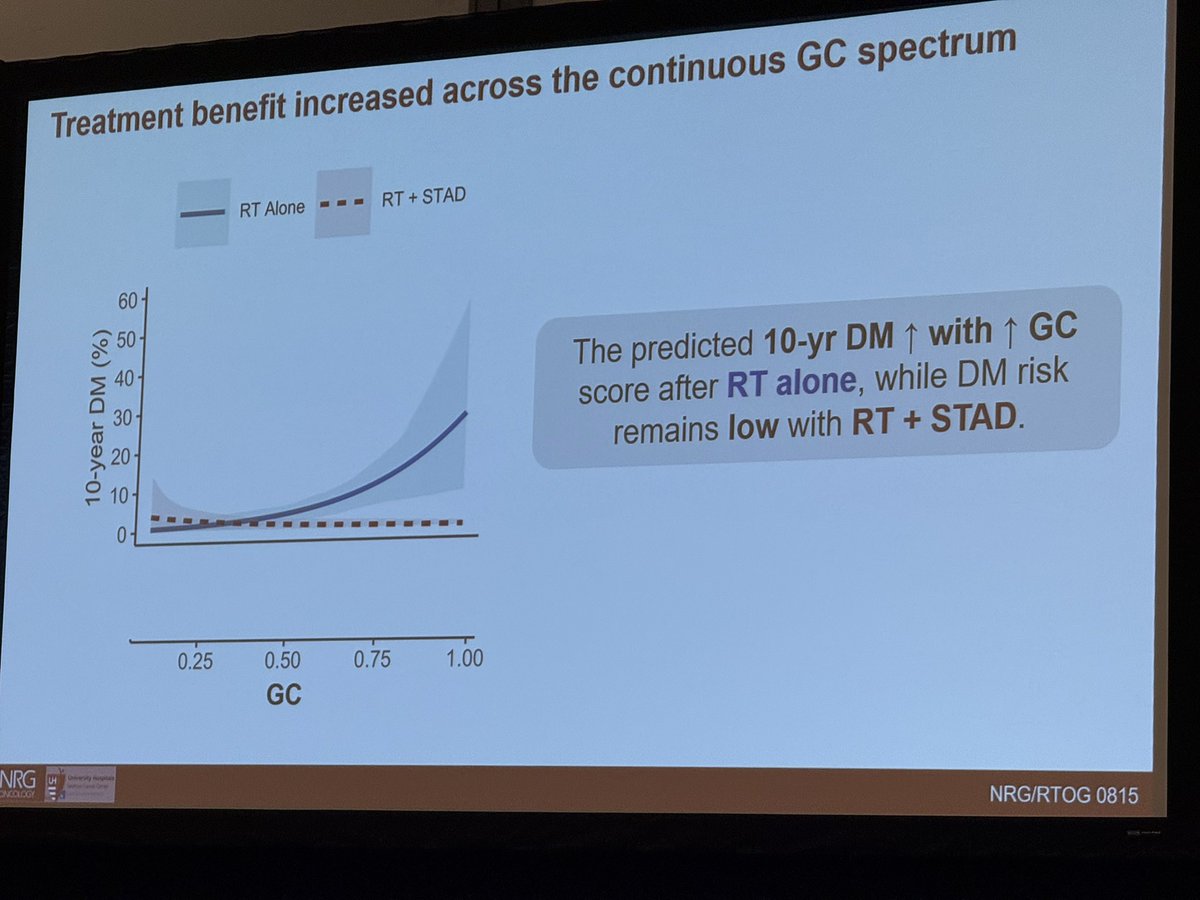
GC-STAD interaction for DM p<0.001 and for PCSM p-interaction <0.001. 10-yr DM absolute difference 1% in low GC vs absolute benefit 11% in high GC. Slide 2 shows predicted 10-yr DM rising with GC score after RT alone and staying low with RT + STAD.
| Endpoint | sHR (95% CI) | p |
|---|---|---|
| Biochemical failure | 2.19 (1.36-3.53) | <0.001 |
| Distant metastasis | 4.89 (0.98-24.3) | 0.05 |
The parent NRG/RTOG 0815 trial set the question of STAD with dose-escalated RT for intermediate-risk disease as a whole. Decipher has prior ancillary validation in NRG/RTOG 0126 and 9601. This analysis adds a treatment interaction inside a trial that randomized the therapy in question.
The slide and the abstract cut the cohort differently (int/high GC pooled at 8% vs high GC at 11%), leaving the GC 0.45-0.6 group unresolved. The prognostic DM estimate has a CI of 0.98-24.3. No favorable vs unfavorable intermediate-risk breakdown in source.
The predictive claim is for DM and PCSM, not OS or MFS, for which no interaction is reported in source. The low-GC finding is the clinically usable half, since it identifies a large group with no clear benefit from intensification. The authors themselves defer to NRG GU010 for prospective validation.
Ancillary biomarker analysis in the 395 pts with GC scores; interaction rests on 16 DM and 7 PCSM events. Prespecified plan, but prospective validation (NRG GU010) pending.
- Does GC-guided STAD omission hold prospectively in NRG GU010? n=2050 · primary completion 2026-11 · phase 3 Decipher-guided de-intensification in UIRn=222 · primary completion 2027-12 · phase 2 SBRT without ADT in UIR, Decipher-guided
- STAD benefit in intermediate GC (0.45-0.6) reported on its own?
- Does the interaction hold within favorable vs unfavorable intermediate-risk disease?
📚 Sources · 🐦 1 tweet · 📄 1 paper
🚨Decipher score predictive of ADT benefit for preventing metastasis in patients with intermediate-risk #ProstateCancer in secondary analysis of @NRGonc RTOG 0815 RCT@angela_jia_ @ASTRO_org #ASTRO26 pic.twitter.com/YokjDQVxKa
— Tyler Seibert MD PhD (@TylerSbrt) September 29, 2026
Abstract
The longer read
A biomarker earns the word predictive only when it is tested inside a trial that randomized the treatment it claims to select for, and that is what distinguishes this analysis from most of the Decipher literature. The classifier has been shown repeatedly to sort pts by prognosis, including in earlier NRG ancillary projects such as RTOG 0126 and RTOG 9601. Prognosis alone does not tell a radiation oncologist whether ADT helps a given man. Here the therapy in question, 6 months of STAD on top of dose-escalated RT, was assigned by randomization, the analysis plan was prespecified and approved by the NCI before the assay was run, and the assay was locked. Those three features are the reason to take the interaction seriously rather than file it with exploratory subgroup work.
The reasons for restraint are equally specific. The interaction for distant metastasis rests on 16 events, and the one for prostate cancer-specific mortality on 7. A p-interaction below 0.001 on that base says the pattern is unlikely to be noise within this dataset, but it does not make the size of the benefit in each stratum precise, and the source gives no confidence intervals around the 11% and 1% figures. The prognostic estimate for DM shows the same fragility, with an interval running from 0.98 to 24.3. GC scores came from 395 pts of 856 with available tissue, so the analyzed group is a subset defined by tissue availability and assay success. Arms were balanced within it, which protects the randomized comparison, but whether the subset resembles the full trial population is not something the abstract lets a reader check.
There is also an unresolved seam between the two sources. The abstract contrasts low GC with high GC, 1% against 11%. The slide contrasts low GC with intermediate and high pooled, 1% against 8%. Both can be true, and together they imply the intermediate GC group dilutes the benefit, yet neither source reports that group by itself. For a clinician the threshold matters: the decision at GC 0.5 is exactly the one the data leave open.
The asymmetry of the two findings should shape how they are used. The low-GC result is the more actionable, because it describes a large fraction of the cohort (44%) whose long-term metastasis risk was low with RT alone, and where the cost of being wrong is small in absolute terms. The high-GC result argues against omission more than it defines a new intensified standard, since 6 months of STAD was already an accepted option in this risk group. What the analysis does not show is an interaction for OS or MFS, and with 134 deaths against 16 metastases, most mortality in this population is clearly not driven by prostate cancer.
Transfer to current practice carries one more caveat. The source specifies only that RT was dose-escalated, without dose, fractionation or target volume, and does not separate favorable from unfavorable intermediate-risk disease, where baseline STAD practice already differs. NRG GU010, which the authors name as the prospective validation, is the place those questions get a randomized answer.