DeLLphi-305 NCT06211036
ForES-SCLC, no progression after 1L platinum-etoposide + durvalumab, ECOG 0-1
HR 0.42
95% CI 0.32-0.54, P<0.001; mOS 21.1 vs 12.7 mo
TL;DRmOS 21.1 vs 12.7 mo, HR 0.42 (0.32-0.54), adding tarlatamab to durvalumab 1L maintenance in ES-SCLC after chemo-IO induction.
Asymptomatic untreated brain mets were eligible and brain/liver mets were a stratification factor, so a cranial-disease subgroup read should exist; it is not in the source. The source also does not state whether consolidative thoracic RT or PCI was permitted, which gates how this maintenance backbone integrates with RT consolidation in ES-SCLC.
In ES-SCLC with no progression after 4 cycles of platinum-etoposide + durvalumab and ECOG 0-1, including asymptomatic brain mets, this supports adding tarlatamab to durvalumab maintenance; it does not inform pts who progressed on induction or ECOG ≥2.
Adds a BiTE to durvalumab maintenance with an OS HR of 0.42 and mOS 21.1 vs 12.7 mo, moving tarlatamab from later-line into 1L maintenance for induction nonprogressors. The post-dose monitoring requirement (1-2h, 6-8h in some regions) is an operational cost to plan for; AE rates are not in the source.

| Metric | Tarlatamab + Durvalumab (n = 282) | Durvalumab (n = 281) |
|---|---|---|
| Median OS, mo (95% CI) | 21.1 (20.8-NE) | 12.7 (11.2-14.8) |
| Median FU, mo | 15.9 | 16.1 |
| HR (95% CI); P | 0.42 (0.32-0.54); P < 0.001 | ref |
+2 more figures

10 details 1 trial watching
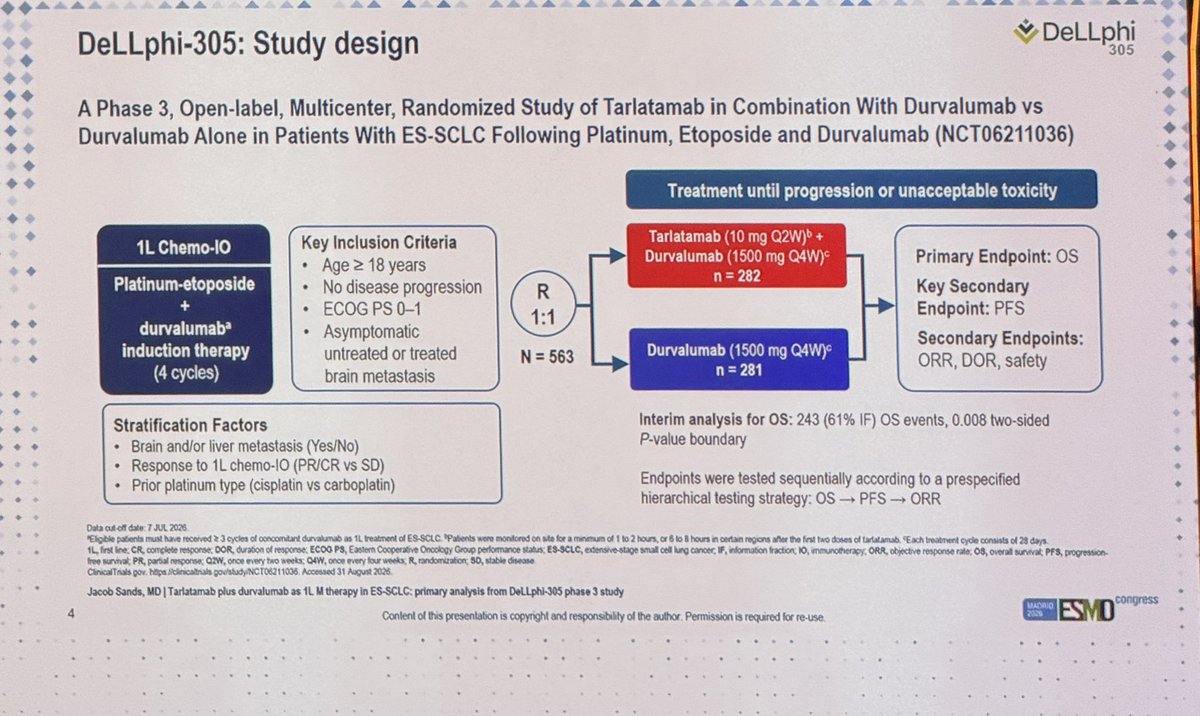
Phase 3, open-label, multicenter, randomized 1:1, N=563. OS interim analysis at 243 events (61% IF), two-sided boundary 0.008. Data cutoff 7 Jul 2026.
ES-SCLC after 4 cycles platinum-etoposide + durvalumab induction with no disease progression, ECOG PS 0-1, age ≥18. Asymptomatic untreated or treated brain mets allowed.
Tarlatamab 10 mg Q2W + durvalumab 1500 mg Q4W vs durvalumab 1500 mg Q4W alone, 28-day cycles, until progression or toxicity. On-site monitoring 1-2h (6-8h in some regions) after early tarlatamab doses.
Primary: OS. Key secondary: PFS. Secondary: ORR, DOR, safety. Tested hierarchically OS → PFS → ORR.
mOS 21.1 vs 12.7 mo, HR 0.42 (0.32-0.54), P<0.001; PFS 7.4 vs 1.9 mo, HR 0.34 (0.28-0.42); ORR 26% vs 4%.
| Endpoint | Tarlatamab + durvalumab | Durvalumab | Effect |
|---|---|---|---|
| Median PFS | 7.4 mo | 1.9 mo | HR 0.34 (0.28-0.42), P<0.001 |
| ORR | 26% | 4% | n/a |
Control arm is the current chemo-IO maintenance standard established by CASPIAN-era durvalumab, so the comparator is contemporary. Tarlatamab previously moved into later lines (DeLLphi-304); this trial tests it earlier, in the maintenance window.
Efficacy stop at 61% IF risks an inflated HR; median FU ~16 mo leaves the OS tail unknown. No safety data in source, and thoracic RT/PCI permissibility not stated.
A BiTE added at the point of maximal disease control nearly halves the death hazard over durvalumab alone. Unsettled: toxicity cost, durability beyond the interim, and integration with consolidative RT.
CONSORT flow
Randomized phase 3, OS primary met at prespecified interim boundary, labeled primary analysis; source calls it a game-changer. Safety data absent from source.
- Role of consolidative thoracic RT alongside tarlatamab maintenance
- OS durability with follow-up beyond the interim analysis
- Benefit and safety in pts with brain metastases n=35 · primary completion 2029-02 · ph2 tarlatamab intracranial efficacy, active SCLC brain mets
📚 Sources · 🐦 1 tweet
💥Game-changer in small cell #lungcancer! #ESMO26 LBA3 DeLLphi-305: Tarlatamab + durvalumab vs durvalumab 1L maintenance in ES-SCLC (n=563) after chemo-IO. Median OS ⬆️ 21.1 vs 12.7 mo (HR 0.42), PFS ⬆️7.4 vs 1.9 mo (HR 0.34), ORR 26% vs 4%. ☢️44% of pts still on T+D due to… pic.twitter.com/zwBot7Pt3N
— Shankar Siva (@_ShankarSiva) October 24, 2026
The longer read
The comparator here matters most. Durvalumab maintenance after platinum-etoposide plus durvalumab is the backbone that CASPIAN made standard, so this is not a win over an outdated control. Adding tarlatamab at the point of best disease control, rather than holding it for relapse as DeLLphi-304 did, gives an OS HR of 0.42 and a median OS of 21.1 vs 12.7 mo. In ES-SCLC, where first-line chemo-IO gains have been measured in a few months, an effect this size is unusual. The PFS HR of 0.34 points the same way, and because the hierarchy was OS → PFS → ORR, the secondary endpoints are confirmatory and were not picked after the fact.
Three features of the design should temper confidence in the exact size of the effect, though probably not in its direction. First, the OS analysis was an interim look at 243 events, 61% of the planned information, against a two-sided boundary of 0.008. Trials that stop early for efficacy tend to overestimate the true effect, so a fully mature HR could land closer to 1 than 0.42 and still be clinically decisive. Second, median follow-up of about 16 months is short next to the experimental arm's median. Its median OS has a non-estimable upper bound (20.8-NE), so whether the curves stay apart or a durable tail forms, the way IO tails formed in this disease, is not yet known. Third, the trial was open-label. OS resists that bias, but PFS and response assessment do not. Still, the PFS result fits the OS result well enough that bias is unlikely to explain it.
Generalizability is the larger question. Only patients who reached maintenance without progression and kept ECOG 0-1 were eligible. That is a selected subset of the ES-SCLC population at diagnosis, enriched for chemosensitive disease. The result says nothing about patients who progress during induction or decline in performance status. Allowing asymptomatic untreated brain metastases, with brain/liver metastases as a stratification factor, widens the population compared with many SCLC trials. But the source does not give the subgroup estimate, so it cannot show whether intracranial disease shares the benefit.
The source also leaves out what a treating physician most needs to weigh against the survival gain: rates of cytokine release syndrome, neurotoxicity and grade 3+ events. The protocol's required post-dose monitoring (1-2 hours, or 6-8 hours in some regions, after early doses) shows the operational cost but not the clinical one. The tweet notes that 44% of patients were still on the combination at cutoff, which suggests tolerability was not prohibitive. That is indirect evidence, not a safety profile.
For a radiation oncologist, the open issue is how this fits with consolidative thoracic RT and cranial management. The source does not say whether thoracic RT or PCI was allowed. A maintenance regimen this active changes the context in which consolidation decisions are made. It does not settle whether RT still adds to it, or how a T-cell engager combines with thoracic or cranial irradiation. This result moves the systemic maintenance decision for induction nonprogressors. The RT consolidation question remains open until data on that interaction exist.