PROTEUS Substudy
ForHR LPC/LAPC, conventionally staged M0, planned RP + PLND
HR 0.38
95% CI 0.26-0.55, p<0.0001
TL;DREFS HR 0.38 (95% CI 0.26-0.55) with perioperative apalutamide + ADT around RP + PLND in HR LPC/LAPC; MFS HR 0.49, nominal p only.
The testosterone curve is the hidden read: T recovery to ≥200 ng/dL took a median 20.7 mo (~9 mo from EOT), so much of the EFS window is BCF assessed under residual castration. TTST medians of 46.0 vs 12.3 mo carry ~20 mo of lead-time, which leaves the durable-benefit question with MFS and its nominal p=0.0193.
In conventionally staged HR LPC/LAPC headed for RP + PLND, this supports perioperative APA + ADT as an EFS-delaying option under discussion; it does not extend to PSMA PET-staged pts or to men treated with definitive RT.
Testosterone recovery took a median 20.7 mo (~9 mo from EOT), so the EFS gain is partly measured during residual castration. MFS HR 0.49 with nominal p=0.0193 is the endpoint that will decide whether perioperative APA + ADT changes disease course or only delays PSA events.
The surgical backbone was unchanged (RP + PLND in both arms), and the control arm's adjuvant management was left to physician discretion. Without baseline PSMA PET, some conventionally staged M0 candidates may have had occult disease, which matters when selecting HR LPC/LAPC pts for RP.

| Arm | Median | Rate (95% CI) |
|---|---|---|
| APA + ADT | Not reached | 63.0% (52.2-71.9) |
| RP + PLND alone | 19.1 months | 41.4% (35.6-47.1) |
| HR 0.38 (95% CI 0.26-0.55) | p<0.0001 | n/a |
+3 more figures

| Metastasis detection method, n (%) | APA + ADT | RP + PLND |
|---|---|---|
| PSMA PET | 9 (8.8) | 50 (16.3) |
| Conventional imaging | 1 (1.0) | 6 (2.0) |
| MFS HR 0.49 (95% CI 0.26-0.90) | nominal p=0.0193 | n/a |

| Arm | Median time to first subsequent therapy |
|---|---|
| APA + ADT | 46.0 months |
| RP + PLND alone | 12.3 months |
| HR 0.29 (95% CI 0.20-0.43), nominal p<0.0001 | n/a |
11 details 1 trial watching
Randomized 1:3, open-label, N=408, accrual July 2022 to October 2023. Stratified by cN0 vs cN1, Gleason 7 vs 8-10, and region. Phase not stated in source.
HR LPC/LAPC, conventionally staged M0 (CT + bone scan). No baseline PSMA PET.
APA 240 mg QD + ADT for 6 cycles neoadjuvant, RP + PLND, then 6 cycles adjuvant. Control: RP + PLND with local or systemic adjuvant tx at physician discretion.
Primary: EFS, time to first BCF (PSA progression), LRR, DM or death. Secondary/exploratory: MFS, time to first subsequent therapy.
EFS HR 0.38 (0.26-0.55), p<0.0001; MFS HR 0.49 (0.26-0.90), nominal p=0.0193; TTST HR 0.29 (0.20-0.43), nominal. Per-arm values in the figure captions.
proPSMA showed PSMA PET staging accuracy of 92% vs 65% for CT + bone scan, and EAU/ESMO advise PSMA PET/CT for high-risk disease where available. PROTEUS staged without it, so its M0 population differs from a modern PSMA-staged cohort.
1:3 allocation leaves 102 pts in the experimental arm. The control adjuvant strategy was at physician discretion, so the comparator is heterogeneous. Safety magnitudes were truncated in the source.
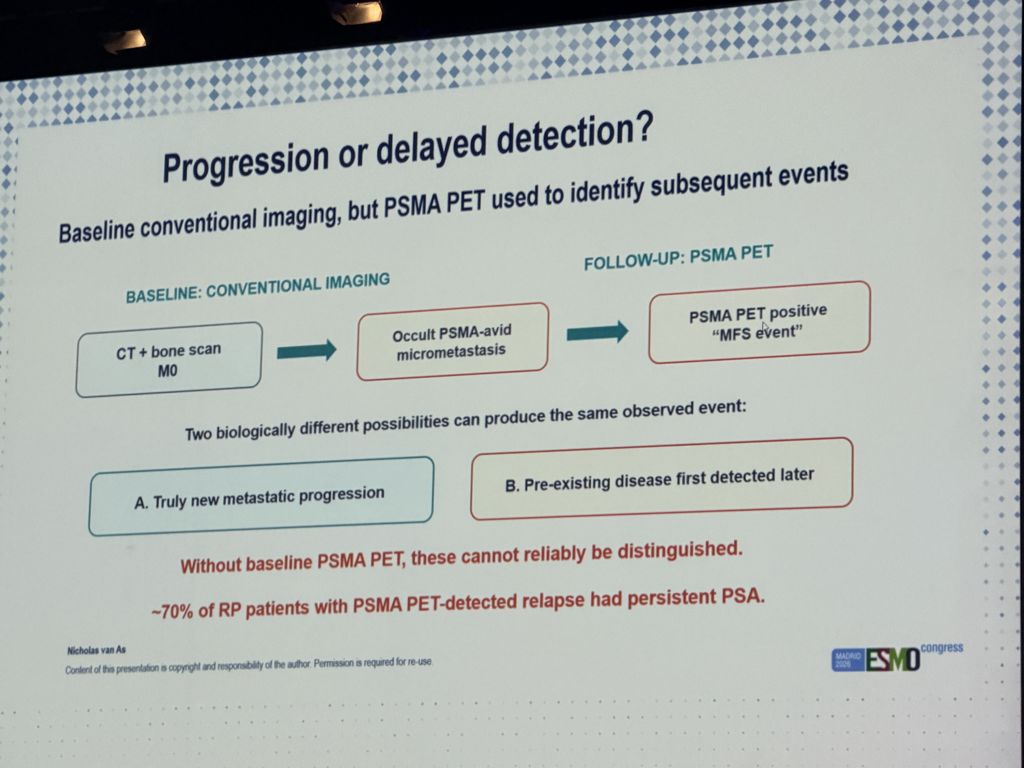
Lead-time from treatment exposure and slow testosterone recovery inflate the early-window endpoints. Whether metastatic progression is truly delayed, rather than PSMA-avid disease being detected later, is not settled without baseline PSMA PET.
CONSORT flow
Randomized, EFS met, but EFS leans on PSA failure during slow testosterone recovery; MFS nominal and PSMA-detection driven; TTST lead-time biased; no baseline PSMA PET.
- Does the EFS benefit hold in PSMA PET-staged M0 pts?
- Will MFS reach non-nominal significance with longer follow-up? n=2517 · primary completion 2026-12 · phase 3 parent RCT, MFS 1° EP vs placebo + ADT
- Does any benefit persist after testosterone recovery?
📚 Sources · 🐦 2 tweets
PROTEUS Substudy: Periop Apa + ADT with RP+PLND vs RP+PLND in HR PCa @urotoday #ESMO26
— Zach Klaassen (@zklaassen_md) October 24, 2026
Periop APA + ADT (+ RP+PLND; n= 102) vs RP+PLND alone (n=306)
🚨EFS: HR 0.38, 95% CI 0.26–0.55
🚨MFS: HR 0.49, 95% CI 0.26–0.90
🚨TT 1st Sub Rx: HR 0.29, 95% CI 0.20–0.43
🚨All Gr Hot Flush:… pic.twitter.com/v7zhSfLzrR
#ESMO26 PROTEUS discussion by Nicholas van As
— Alan Tan (@alantanmd) October 24, 2026
• No baseline PSMA PET; enrolled conventionally staged M0
• MFS events: true progression or delayed detection? Most were PSMA PET-detected (8.8% vs 16.3%)
• TTST HR 0.29, but ~20-mo lead-time bias#ProstateCancer pic.twitter.com/FfugtpcYwU
The longer read
The headline EFS hazard ratio of 0.38 is large, but the endpoint's components decide how far it can carry. EFS here is the first of biochemical failure, locoregional recurrence, distant metastasis or death. In a post-prostatectomy population, biochemical failure will dominate that composite, and the trial's own testosterone data show why that matters: recovery to 200 ng/dL took a median of 20.7 months, roughly nine months after treatment ended. A meaningful part of the follow-up therefore measured PSA in men who were still functionally castrate. A PSA endpoint read under residual androgen suppression measures exposure to therapy as much as disease biology, and an EFS separation of this size is what one would expect from that mechanism alone, whether or not the underlying disease course changed.
The secondary endpoints were meant to answer that, and they only partly do. Time to first subsequent therapy (medians 46.0 vs 12.3 months) is vulnerable to the same problem, and the discussant estimated about 20 months of lead-time bias. MFS is the endpoint that could show durable benefit, and its hazard ratio of 0.49 has a wide interval (0.26-0.90) and a nominal p-value. The detection table also matters: most metastatic events were found on PSMA PET (9 vs 50 events), in a trial that staged its population with CT and bone scan alone. Van As's point is that an event called new metastasis may be disease that was present at baseline and only found later. Detection timing could differ between arms if hormonal therapy temporarily suppressed PSMA-avid disease, so the MFS difference may reflect when disease was found rather than whether it developed.
The population is also behind current staging. EAU and ESMO now advise PSMA PET for high-risk disease where available, and proPSMA's accuracy figures (92% vs 65%) suggest some enrolled men had occult nodal or distant disease. In a PSMA-staged population the absolute benefit could plausibly be smaller, because the men most likely to have early events would be identified and treated differently from the start.
Two design features limit the comparison further. The 1:3 allocation leaves 102 men in the experimental arm, which makes the secondary endpoints fragile. The control arm received adjuvant local or systemic treatment at the physician's discretion, so the comparator is not one defined strategy, and the source does not say how much adjuvant or salvage RT the control arm received.
What would change the read is maturation of MFS to a non-nominal result, ideally with OS, and some evidence that the effect holds once testosterone has fully recovered. Until then, this trial shows that perioperative apalutamide plus ADT delays PSA-defined events after prostatectomy. It does not yet show that it changes the metastatic course of the disease.