CNS
Wait or Treat (NCT05236946) NCT05236946
ForMetastatic EGFR/ALK+ NSCLC, asymptomatic measurable brain mets, ECOG 0-2
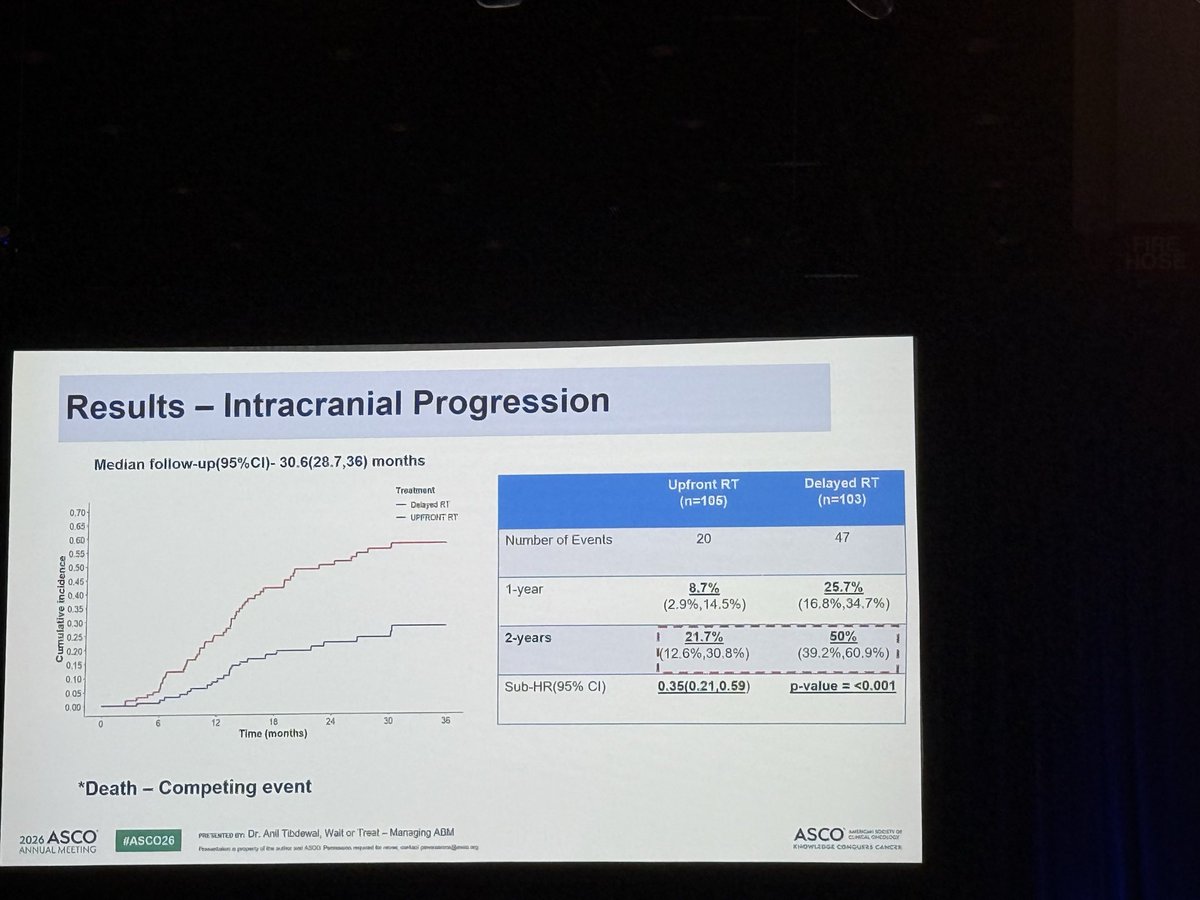
sub-HR 0.35
95% CI 0.21-0.59, p<0.001; 2y icPD 21.7% vs 50%
TL;DRUpfront cranial RT cut intracranial progression (sub-HR 0.35, 0.21-0.59, p<0.001) but 2y OS favored delayed RT, 48% vs 60%.
The intracranial win is real (2y progression 21.7% vs 50%, sub-HR 0.35) yet does not convert: 2y OS 48% upfront vs 60% delayed, HR 1.45. With necrosis reported ~6% upfront vs none delayed, and RT dose/technique unstated in source, this moves the timing decision toward deferral with MRI q3m surveillance.
In treatment-naive EGFR or ALK-driven metastatic NSCLC with asymptomatic measurable brain mets starting a TKI, this supports deferring cranial RT with q3m MRI rather than treating reflexively; it says nothing about symptomatic mets, large or dominant lesions, or oncogene-negative disease.
This is a timing question, not an omission question: both arms got cranial RT, and deferring cost 2y intracranial progression of 50% vs 21.7% while sparing necrosis (~6% upfront vs none delayed). Dose, fractionation, and WBRT-vs-SRS are absent from source, which is what gates transferring the toxicity read to your own technique.
The delayed arm's 1y intracranial progression of 25.7% on TKI plus chemotherapy is the number that makes upfront RT deferrable: most asymptomatic brain mets did not declare themselves in the first year. Deferral is contingent on q3m MRI surveillance, not on the TKI alone.
+2 more figures


10 details
Phase III open-label RCT, single-centre (Tata Memorial, Mumbai), N=208 randomised 1:1 to upfront (n=105) vs delayed cranial RT, both on TKI plus chemotherapy. Stratified by GPA (0-2 vs >2) and synchronous vs metachronous BM. Median follow-up 30.6 mo (28.7, 36).
Metastatic NSCLC with an EGFR or ALK alteration, ECOG PS 0-2, radiologically measurable brain metastases that were completely asymptomatic. Number, size, and location of lesions are not reported in source.
Upfront arm received cranial RT at diagnosis; the delayed arm received it at intracranial progression or patient's wish, so both arms are RT-exposed and the question is timing, not omission. Dose, fractionation, and technique (WBRT vs SRS) are not reported in source, which is the main barrier to transferring this result.
Primary: intracranial PFS. Secondary: OS, PFS, toxicity, ORR, neurocognition, PROM. Surveillance was MRI brain q3m for the first year, then q6m, which is what makes a delayed strategy safe to run.
Primary endpoint met. Survival ran the other way: 2y OS 48% upfront vs 60% delayed, OS HR 1.45, reported by attendees rather than captured in the slide OCR.
| Timepoint | Upfront RT (n=105) | Delayed RT (n=103) |
|---|---|---|
| 1-year | 8.7% (2.9%, 14.5%) | 25.7% (16.8%, 34.7%) |
| 2-years | 21.7% (12.6%, 30.8%) | 50% (39.2%, 60.9%) |
| Sub-HR (95% CI) | 0.35 (0.21, 0.59), p<0.001 | ref |
Radiation necrosis ~6% in the upfront arm and none in the delayed arm per attendee reports, and described as less severe when delayed. Full toxicity tables, neurocognition, and PROM were secondary endpoints not reported in the source.
The intracranial magnitude sits alongside the older WBRT-era data (QUARTZ, and the historic SRS-vs-WBRT trials) in showing that cranial RT controls the brain without buying survival. What is new is testing it where a CNS-penetrant TKI is the competing intracranial therapy, a setting those trials predate entirely.
Single-centre and open-label, and the RT prescription is absent from the source, so a reader cannot tell whether the necrosis signal reflects WBRT, SRS technique, or concurrent TKI exposure. Median follow-up of 30.6 mo is short relative to expected survival in this population, and the OS comparison was a secondary endpoint, not powered.
The result splits the two things RT is usually credited with: it clearly buys intracranial control, and it clearly does not buy time. Whether the OS direction is a real cost of upfront RT or noise in an underpowered secondary is the open question, and it decides whether deferral is merely non-inferior or actually preferred.
CONSORT flow
Randomised phase 3, prespecified intracranial PFS met, but the survival signal runs opposite the intracranial win. Directly contests reflex upfront cranial RT.
- Does the OS direction hold with longer follow-up?
- Was cranial RT whole-brain or stereotactic, at what dose?
- Neurocognition and PROM outcomes by RT timing
📚 Sources · 🐦 3 tweets
#ASCO26 | Wait or Treat? Brain RT in EGFR/ALK+ NSCLC
— OncLive.com (@OncLive) May 29, 2026
Presented by Dr Anil Ramakant Tibdewal.
A landmark Phase III randomized trial from @TataMemorial addressed a long-standing question: should asymptomatic brain metastases in oncogene-driven NSCLC receive upfront cranial RT or… pic.twitter.com/lRy9CfyQ8r
Should asymptomatic brain mets await systemic response in front line within EGFR/ALK context? I think yes. Despite reducing icPD, delayed brain RT OS looked better and radiation necrosis didn’t occur vs 6% #ASCO26 pic.twitter.com/O6d7GrvtU4
— Dr Riyaz Shah (@DrRiyazShah) May 29, 2026
No improvement in survival with up front radiation. OS favored delayed radiation with 2y OS 48% with early radiation vs 60% in late (OS HR 1.45). Also, radiation necrosis less common and less severe in delayed arm. Each case unique but delayed approach appealing #ASCO26 pic.twitter.com/wIhjqxhSaq
— Stephen V Liu, MD (@StephenVLiu) May 29, 2026