Prostate
ADT agent choice alongside RT for localized PCa: the QoL signal is post hoc and not tied to RT technique.
REVELUTION
ForLocalized intermediate- or high-risk prostate, RT + ADT, no prior ADT
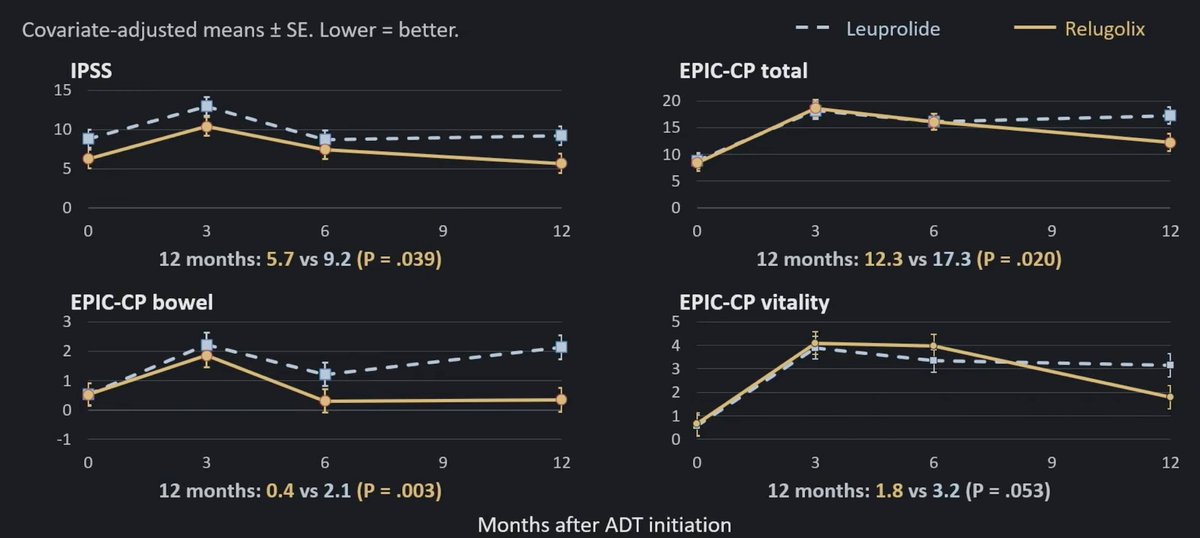
TL;DRPost hoc QoL: relugolix vs leuprolide with RT gave lower 12-mo IPSS (5.66 vs 9.22, p=0.039) and EPIC-CP total (12.25 vs 17.25, p=0.02).
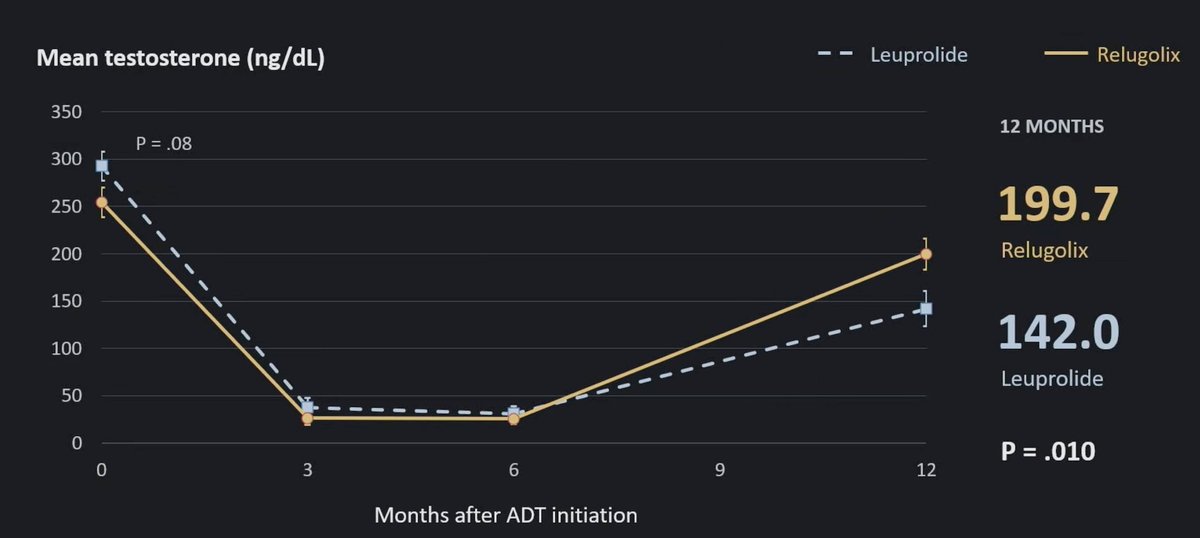
The GU signal is the RT-relevant read: IPSS 5.66 vs 9.22 at 12 mo, a period in which RT urinary toxicity is still resolving. Relugolix arm mean testosterone was higher at 12 mo (199.7 vs 142.0 ng/dL), so the QoL edge may track faster hormonal recovery rather than the agent itself. That matters when picking the ADT partner for short-course RT.
In localized intermediate- or high-risk prostate cancer receiving RT with ADT, this offers hypothesis-level support for oral relugolix on urinary and overall EPIC-CP burden at 12 mo; it does not inform sexual function or erectile outcomes, where no difference was seen. The longer read
Urinary burden is the RT-relevant signal: IPSS 5.66 vs 9.22 at 12 mo with relugolix, during the window when RT GU toxicity is still resolving. RT technique was not reported, so whether target volume or fractionation was balanced across arms is unknown.
The agent comparison is confounded by hormonal kinetics: 12-mo mean testosterone was 199.7 vs 142.0 ng/dL, favoring faster recovery with relugolix. The QoL edge may reflect recovery rather than the drug on treatment, which matters when choosing between an antagonist and an agonist for finite ADT.
Also covered Jun 16
+2 more figures
9 details 1 trial watching
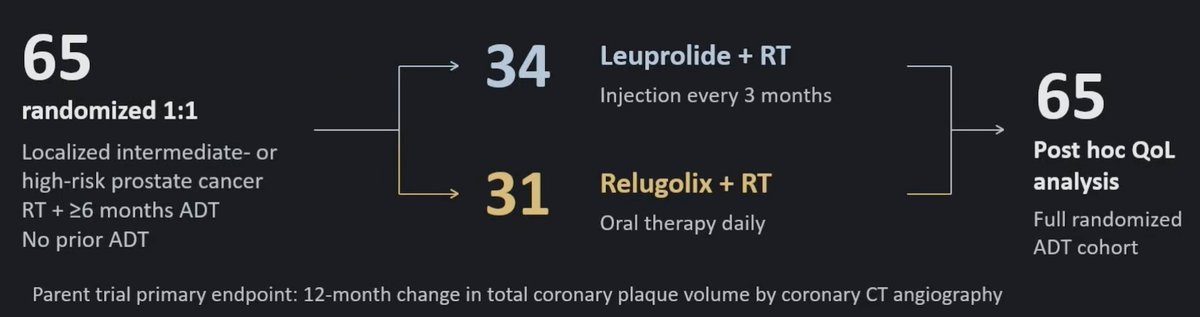
Post hoc QoL analysis of a 1:1 randomized trial, N=65 (arm split 34/31 per schema). Parent trial primary: 12-mo change in total coronary plaque volume by coronary CTA.
Localized intermediate- or high-risk prostate cancer, no prior ADT, planned for RT + ADT.
Relugolix oral daily vs leuprolide injection every 3 months, both with RT. ADT duration printed as "26 months" in schema OCR, possibly an OCR artifact.
RT given in both arms; dose, fractionation, and target volume not reported in source.
No 12-mo difference in EPIC-CP incontinence (P=.32), irritation (P=.15), sexual (P=.56), or SHIM (P=.92).
HERO established relugolix vs leuprolide in advanced disease; this extends the comparison to RT-treated localized disease, but on post hoc PROs rather than a prespecified endpoint.
Higher 12-mo testosterone with relugolix (199.7 vs 142.0 ng/dL) means QoL gains may reflect hormonal recovery, not the agent. Oral vs injection arms were open, so patient-reported endpoints carry expectation bias.
A urinary and global EPIC-CP edge for relugolix is plausible, but a cardiac-endpoint trial was not built to test it. The result frames a prespecified PRO question for RT + ADT trials rather than settling agent choice.
| Endpoint (12 mo) | Relugolix + RT | Leuprolide + RT | p |
|---|---|---|---|
| Mean testosterone (ng/dL) | 199.7 | 142.0 | 0.01 |
| IPSS | 5.66 | 9.22 | 0.039 |
| EPIC-CP total | 12.25 | 17.25 | 0.02 |
Post hoc QoL analysis of a trial powered for coronary plaque volume; N=65, unblinded oral vs injectable, testosterone divergence confounds attribution.
- Does the QoL benefit persist after adjusting for testosterone recovery?
- Prospective PRO comparison of relugolix vs leuprolide with RT n=110 · primary completion 2027-07 · relugolix vs leuprolide QoL comparison, 6-mo ADT
📚 Sources · 🐦 1 tweet
Relugolix vs Leuprolide + RT for Localized PCa: PROs in the REVELUTION RCT @urotoday #ASTRO26
— Zach Klaassen (@zklaassen_md) September 30, 2026
Relugolix vs Leuprolide:
📌T @ 12 mos: 199.7 vs 142.0 ng/dL; p=0.01
📌@ 12 mos:
- ⬇️ IPSS (5.66 vs 9.22; p=0.039)
- ⬇️ EPIC-CP total (12.25 vs 17.25; p=0.02)
- ⬇️ EPIC-CP bowel… pic.twitter.com/Ek2xLZsl3u