REVELUTION
ForLocalized intermediate- or high-risk prostate, RT + ADT, no prior ADT
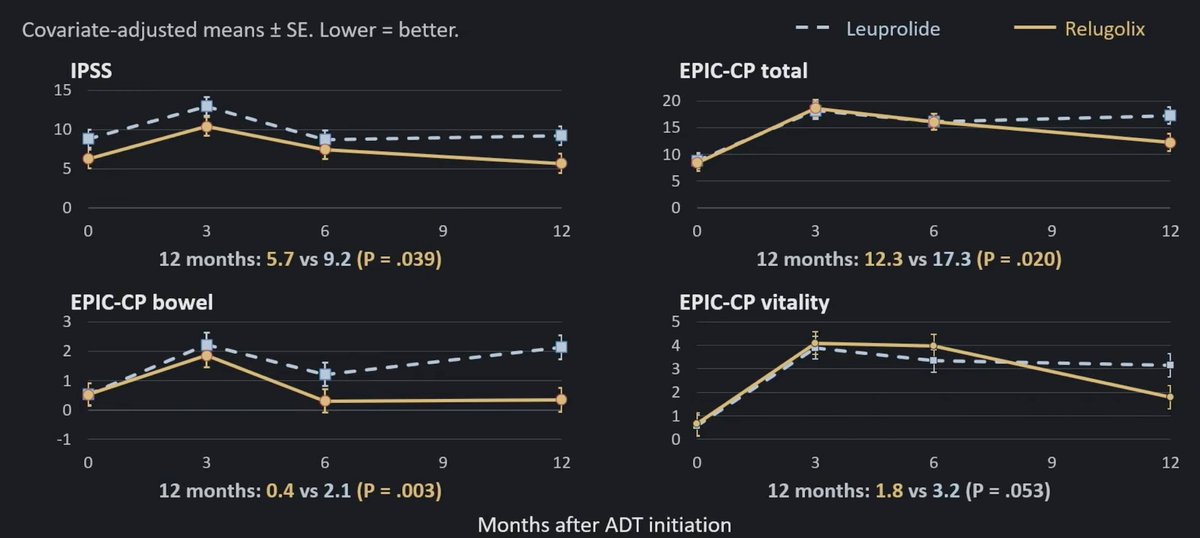
TL;DRPost hoc QoL: relugolix vs leuprolide with RT gave lower 12-mo IPSS (5.66 vs 9.22, p=0.039) and EPIC-CP total (12.25 vs 17.25, p=0.02).
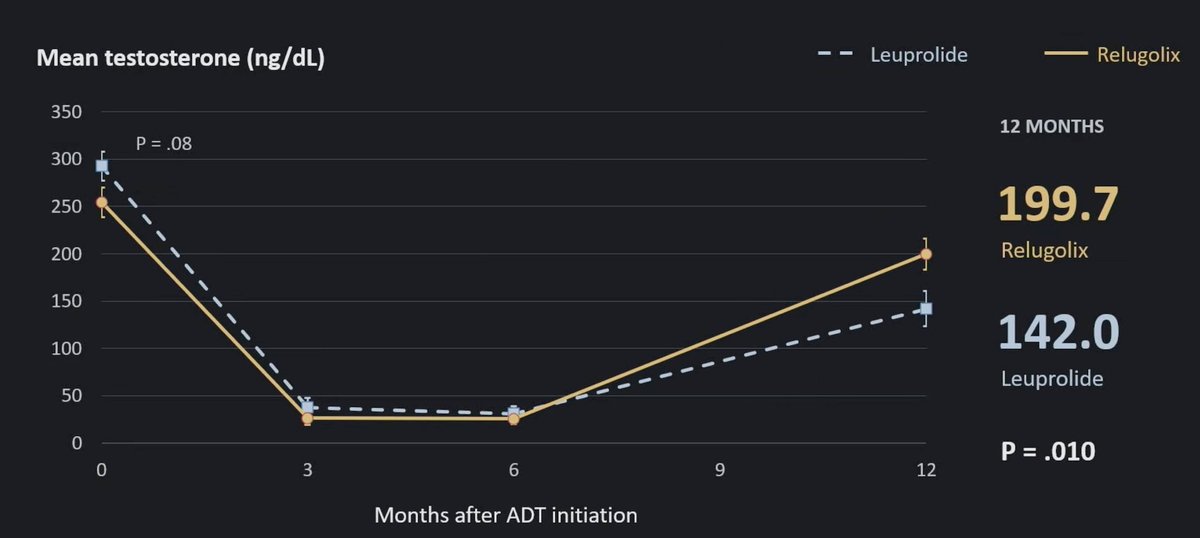
The GU signal is the RT-relevant read: IPSS 5.66 vs 9.22 at 12 mo, a period in which RT urinary toxicity is still resolving. Relugolix arm mean testosterone was higher at 12 mo (199.7 vs 142.0 ng/dL), so the QoL edge may track faster hormonal recovery rather than the agent itself. That matters when picking the ADT partner for short-course RT.
In localized intermediate- or high-risk prostate cancer receiving RT with ADT, this offers hypothesis-level support for oral relugolix on urinary and overall EPIC-CP burden at 12 mo; it does not inform sexual function or erectile outcomes, where no difference was seen.
Urinary burden is the RT-relevant signal: IPSS 5.66 vs 9.22 at 12 mo with relugolix, during the window when RT GU toxicity is still resolving. RT technique was not reported, so whether target volume or fractionation was balanced across arms is unknown.
The agent comparison is confounded by hormonal kinetics: 12-mo mean testosterone was 199.7 vs 142.0 ng/dL, favoring faster recovery with relugolix. The QoL edge may reflect recovery rather than the drug on treatment, which matters when choosing between an antagonist and an agonist for finite ADT.
Also covered Jun 16
+2 more figures
9 details 1 trial watching
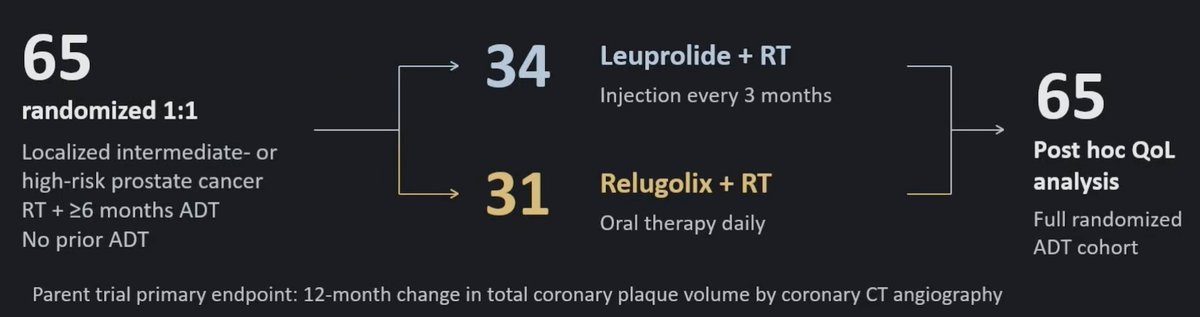
Post hoc QoL analysis of a 1:1 randomized trial, N=65 (arm split 34/31 per schema). Parent trial primary: 12-mo change in total coronary plaque volume by coronary CTA.
Localized intermediate- or high-risk prostate cancer, no prior ADT, planned for RT + ADT.
Relugolix oral daily vs leuprolide injection every 3 months, both with RT. ADT duration printed as "26 months" in schema OCR, possibly an OCR artifact.
RT given in both arms; dose, fractionation, and target volume not reported in source.
No 12-mo difference in EPIC-CP incontinence (P=.32), irritation (P=.15), sexual (P=.56), or SHIM (P=.92).
HERO established relugolix vs leuprolide in advanced disease; this extends the comparison to RT-treated localized disease, but on post hoc PROs rather than a prespecified endpoint.
Higher 12-mo testosterone with relugolix (199.7 vs 142.0 ng/dL) means QoL gains may reflect hormonal recovery, not the agent. Oral vs injection arms were open, so patient-reported endpoints carry expectation bias.
A urinary and global EPIC-CP edge for relugolix is plausible, but a cardiac-endpoint trial was not built to test it. The result frames a prespecified PRO question for RT + ADT trials rather than settling agent choice.
| Endpoint (12 mo) | Relugolix + RT | Leuprolide + RT | p |
|---|---|---|---|
| Mean testosterone (ng/dL) | 199.7 | 142.0 | 0.01 |
| IPSS | 5.66 | 9.22 | 0.039 |
| EPIC-CP total | 12.25 | 17.25 | 0.02 |
Post hoc QoL analysis of a trial powered for coronary plaque volume; N=65, unblinded oral vs injectable, testosterone divergence confounds attribution.
- Does the QoL benefit persist after adjusting for testosterone recovery?
- Prospective PRO comparison of relugolix vs leuprolide with RT n=110 · primary completion 2027-07 · relugolix vs leuprolide QoL comparison, 6-mo ADT
📚 Sources · 🐦 1 tweet
Relugolix vs Leuprolide + RT for Localized PCa: PROs in the REVELUTION RCT @urotoday #ASTRO26
— Zach Klaassen (@zklaassen_md) September 30, 2026
Relugolix vs Leuprolide:
📌T @ 12 mos: 199.7 vs 142.0 ng/dL; p=0.01
📌@ 12 mos:
- ⬇️ IPSS (5.66 vs 9.22; p=0.039)
- ⬇️ EPIC-CP total (12.25 vs 17.25; p=0.02)
- ⬇️ EPIC-CP bowel… pic.twitter.com/Ek2xLZsl3u
The longer read
The question this analysis raises is real and practical. When ADT accompanies RT for localized disease, the choice between an oral GnRH antagonist and a depot agonist is often made on logistics, cardiovascular history, or payer coverage rather than on patient-reported outcomes. REVELUTION's parent trial was built to look at coronary plaque, and this post hoc look at QoL suggests that relugolix pts reported less urinary symptom burden and lower overall EPIC-CP scores at 12 months (IPSS 5.66 vs 9.22, EPIC-CP total 12.25 vs 17.25). Sexual function and SHIM did not separate.
The most important thing to read alongside those PRO numbers is the testosterone curve. At 12 months mean testosterone was 199.7 ng/dL with relugolix vs 142.0 ng/dL with leuprolide. Both values are high for pts still on continuous suppression, and the schema's printed ADT duration may be an OCR artifact, so it is not clear from the source whether some pts had already stopped ADT by month 12. If they had, the relugolix arm's higher testosterone fits what HERO suggested about faster recovery after an antagonist is stopped. That changes how the QoL signal should be read: lower IPSS and EPIC-CP scores in the relugolix arm may reflect earlier hormonal recovery rather than any intrinsic property of the drug during treatment. Those are different claims with different clinical consequences, and this dataset cannot separate them.
The design limits confidence further. Sixty-five pts split across two arms is small for multiple PRO domains, the analysis was not prespecified, and no multiplicity handling is described. The arms differed in route as well as agent, a daily pill vs an injection every three months, and nothing in the source suggests blinding, so expectation bias on subjective endpoints is plausible. The vitality and bowel domains are plotted, but the source text does not let them be attributed cleanly, and the P=.053 value sits right at the threshold.
For an RT reader the urinary finding is the one worth tracking. GU symptom burden at 12 months mixes resolving RT toxicity with hormonal effects, and an ADT partner that lowers that burden would matter for pts with baseline LUTS. RT technique was not reported, though, and that is the variable most likely to drive urinary scores. Without it, the arms cannot be checked for comparable target volumes or fractionation.
The result would be wrong, or at least overstated, if the PRO gap closed once analyses adjusted for testosterone at the time of assessment, or if a blinded or larger cohort showed no IPSS difference. Until a prospective PRO endpoint in an RT + ADT population tests it, this is a reason to ask the question, not a basis for choosing the agent.