PACE-NODES
ForHigh-risk localised prostate (T3a-T4, Gleason 8-10, or PSA>20), on 12-36mo ADT
28% vs 21%
PPN-SBRT vs P-SBRT; no effect size or p-value reported in source
TL;DRCTCAE G2+ GI toxicity 28% vs 21% with added pelvic nodal SBRT; no GU difference, symptoms resolved by 12wk.
Nodal SBRT at 25Gy/5f costs 7 points of acute G2+ GI (28% vs 21%) and nothing in GU, with the EPIC-26 bowel signal at 4 weeks resolving by 12. That makes acute tolerability a weak argument against 5f elective nodal coverage; the decision now waits on late effects and the immature failure endpoint.
In high-risk localised prostate already planned for 5f prostate SBRT plus 12-36mo ADT, this supports the feasibility of extending to pelvic nodes without a GU penalty; it says nothing yet about whether nodal coverage improves control.
The cost of adding 25Gy/5f to the pelvis is 7 points of acute G2+ GI (28% vs 21%), transient by 12 weeks, with no GU penalty. The gating practical fact is deliverability: 11% of PPN-SBRT patients never received allocation on unmet constraints.

| Endpoint | PPN-SBRT | P-SBRT |
|---|---|---|
| CTCAE G2+ GI, 12wk | 28% | 21% |
| Did not receive allocation | 11% | 4% |
+1 more figure
10 details 3 trials watching
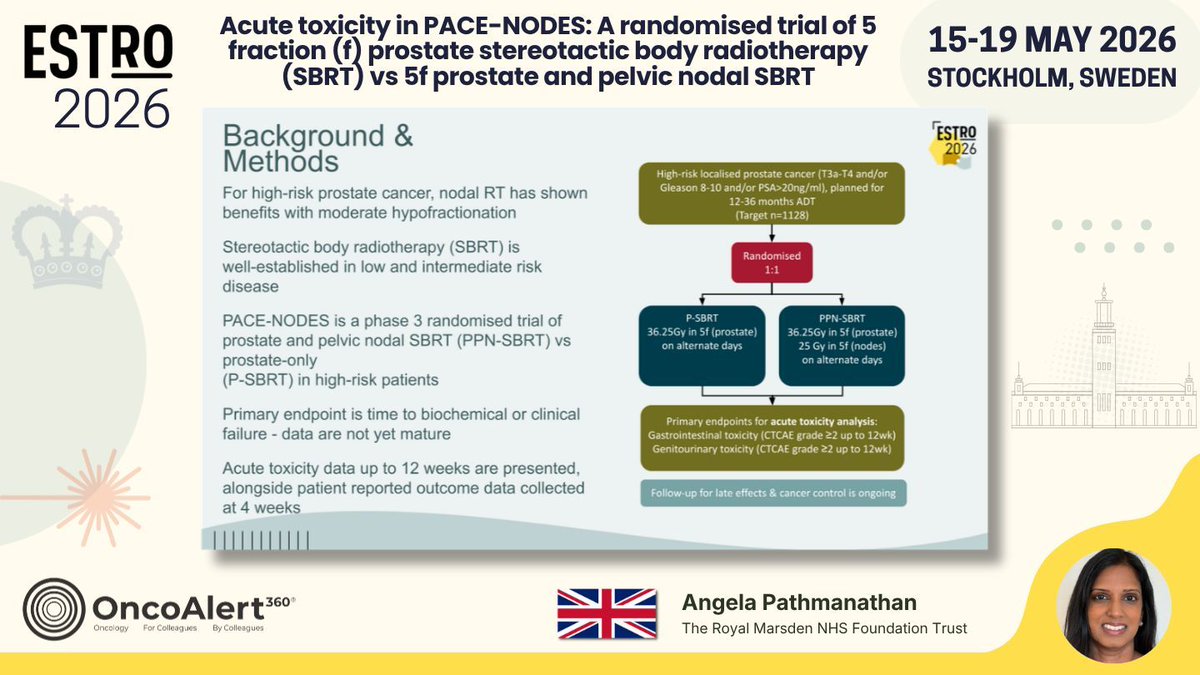
Phase 3 randomised 1:1 multicentre trial, target n=1128, 1166 randomised. This presentation reports the acute toxicity analysis only; the efficacy primary is time to biochemical or clinical failure and is not yet mature.
High-risk localised prostate cancer: T3a-T4 and/or Gleason 8-10 and/or PSA>20ng/ml, all planned for 12-36 months ADT.
Both arms 36.25Gy in 5 fractions to the prostate on alternate days. PPN-SBRT adds 25Gy in 5 fractions to the pelvic nodes; P-SBRT is prostate-only.
Primary for this analysis: CTCAE grade ≥2 GI and grade ≥2 GU toxicity up to 12 weeks. Patient-reported EPIC-26 domain scores collected at 4 weeks.
GI was the only separating domain; GU did not differ by clinician or patient report, and the GI gap had closed by 12 weeks.
11% of PPN-SBRT and 4% of P-SBRT patients did not receive their allocated treatment, mostly because planning constraints were not met, which is itself a deliverability signal for 5f nodal treatment.
Patient-reported outcomes were captured at 4 weeks only, so the 12-week convergence rests on clinician CTCAE grading. No effect size, confidence interval or p-value for the GI difference appears in the source, and late GI toxicity is the endpoint that historically decides elective nodal coverage.
The trial's answer so far is about deliverability rather than benefit: 5f nodal SBRT can be given across multiple centres at an acute cost confined to transient bowel symptoms. Whether that cost is worth paying depends entirely on the failure endpoint still to read out.
Acute-toxicity readout only; the efficacy primary (time to biochemical or clinical failure) is immature, so the nodal-coverage question stays open.
- Late GI toxicity beyond the 12-week acute window n=100 · primary completion 2027-10 · 1-2mm PTV margins to cut late rectal toxicityn=500 · primary completion 2027-12 · late GI toxicity as primary endpoint after prostate SBRT
- Whether 5f nodal SBRT improves biochemical or clinical failure recruiting PRO-BOOST-N: Prostate-First Versus Combined Prostate and Nodal Dose Escalation in PSMA PET-Staged Node-Positive Prostate Cancer Phase 2/3n=600 · primary completion 2033-12 · randomises nodal dose in cN1 ultrahypofx pelvic RT
- Which anatomy or constraints drove the 11% non-delivery rate
📚 Sources · 🐦 1 tweet
Day THREE of #ESTRO26 Coverage by OncoAlert 🚨
— OncoAlert (@OncoAlert) May 17, 2026
Acute toxicity in PACE-NODES: A randomised trial of 5 fraction (f) prostate stereotactic body radiotherapy (SBRT) vs 5f prostate and pelvic nodal SBRT
Presented by Angela Pathmanathan 🇬🇧 #RadOnc ☢️ #ProstateCancer
PACE-NODES is a… pic.twitter.com/z9bAOiKSIy
The longer read
The question PACE-NODES is built to answer is not the one this presentation answers. Elective pelvic nodal irradiation in high-risk prostate cancer has a benefit signal from moderately hypofractionated and conventionally fractionated work, and the open problem has been whether that benefit survives compression into five fractions, where the small-bowel and rectal dose per fraction rises sharply and the planning geometry is far less forgiving. What is reported here is the acute toxicity half of that question, and on its own terms the answer is reassuring in a specific and limited way: adding 25Gy in 5 fractions to the pelvis raised clinician-graded grade 2 or worse GI events from 21% to 28% over twelve weeks, the patient-reported EPIC-26 bowel domain moved in the same direction at four weeks, and by twelve weeks the difference had resolved. Genitourinary toxicity, which is the dominant acute complaint after prostate SBRT and the one most likely to be aggravated by a larger volume, did not separate at all by either clinician or patient report.
The more informative number may be the one that is not a toxicity endpoint. Eleven percent of patients allocated to nodal treatment did not receive it, against four percent in the prostate-only arm, mostly because dose constraints could not be met. That is a deliverability rate, and it belongs in any read of feasibility: in roughly one in nine patients, a multicentre planning team could not produce an acceptable five-fraction nodal plan. Whether that reflects the constraint set, the planning platform, or the anatomy will determine how much of this transfers to a department outside the trial's network, and it sets a floor on how a future intention-to-treat efficacy result should be read.
Acute toxicity is also the weaker of the two safety questions here. Elective nodal coverage has historically been argued about on late bowel effects, not acute ones, and the 12-week window closes long before those declare themselves. A trial can look clean at three months and still accumulate late grade 2 bowel events, and the per-fraction dose in a five-fraction schedule is exactly the variable that makes late reactions harder to predict from acute ones. The presentation says follow-up for late effects is ongoing, which is the honest framing.
So the practical read for a radiation oncologist is narrow but real. Acute tolerability is no longer a persuasive reason to decline nodal coverage in a patient already committed to five-fraction prostate SBRT and long-course ADT, provided a plan meeting constraints can actually be produced. It remains no reason to offer it either, because nothing here speaks to biochemical or clinical control. Anyone treating nodes in five fractions today is doing so on an extrapolation from moderately hypofractionated data, and this trial has now shown that the extrapolation is at least physically deliverable at acceptable short-term cost. The decision itself is still waiting on the primary endpoint, and no source number here should be used to anticipate it.