HEAT NCT01794403
ForLocalized low- to intermediate-risk prostate, IPSS <12, gland <80 cc
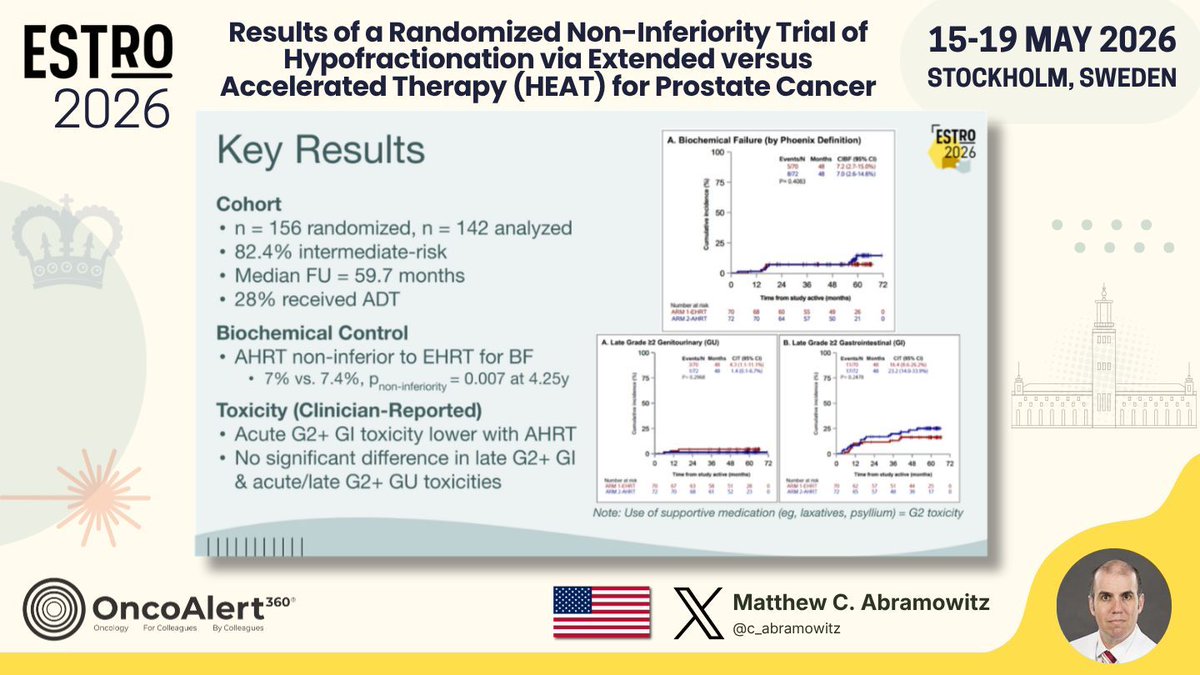
7% vs 7.4%
p-non-inferiority = 0.007 at 4.25y, margin 12%
TL;DRInterim: BF 7% vs 7.4% at 4.25y, p-non-inferiority 0.007, 5-fx SBRT non-inferior to 26-fx IMRT with ADT allowed.
The design detail that transfers is the SIB: 36.25 Gy/5 fx with GTV boost to 40 Gy, against a 70.2 Gy/26 fx IMRT comparator rather than conventional fractionation, with ≤6 months ADT permitted in both arms. That combination is closer to what most departments now offer than HYPO-RT-PC or PACE-B, so it addresses whether 5 fractions holds up when the control arm is already moderately hypofractionated.
In localized low- to intermediate-risk disease with IPSS <12 and gland under 80 cc, including men receiving short-course ADT, this supports 5-fraction SBRT as an option against moderate hypofractionation; it does not speak to high-risk disease or nodal coverage.
The transferable parameters are 36.25 Gy/5 fx with GTV SIB to 40 Gy against a 70.2 Gy/26 fx IMRT comparator, with ≤6 months ADT permitted in both arms. Acute G2+ GI favored 5 fractions and late G2+ GI and GU were comparable at median 59.7 months, so this moves the fractionation choice in low- to intermediate-risk disease.
+2 more figures
| Arm | Dose | Fractions | Dose per fraction |
|---|---|---|---|
| AHRT | 36.25 Gy (+ GTV SIB to 40 Gy) | 5 | 7.25 Gy |
| EHRT | 70.2 Gy | 26 | 2.7 Gy |
9 details 5 trials watching
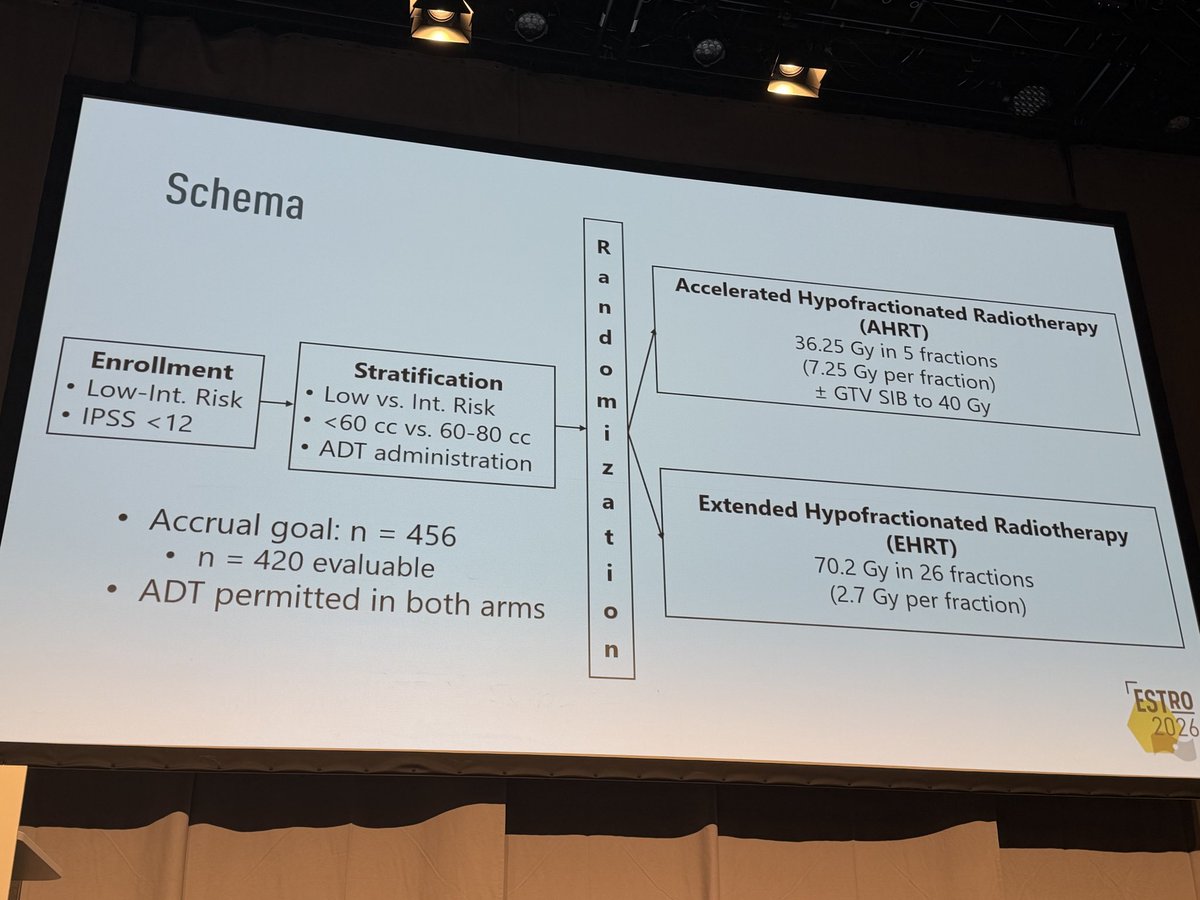
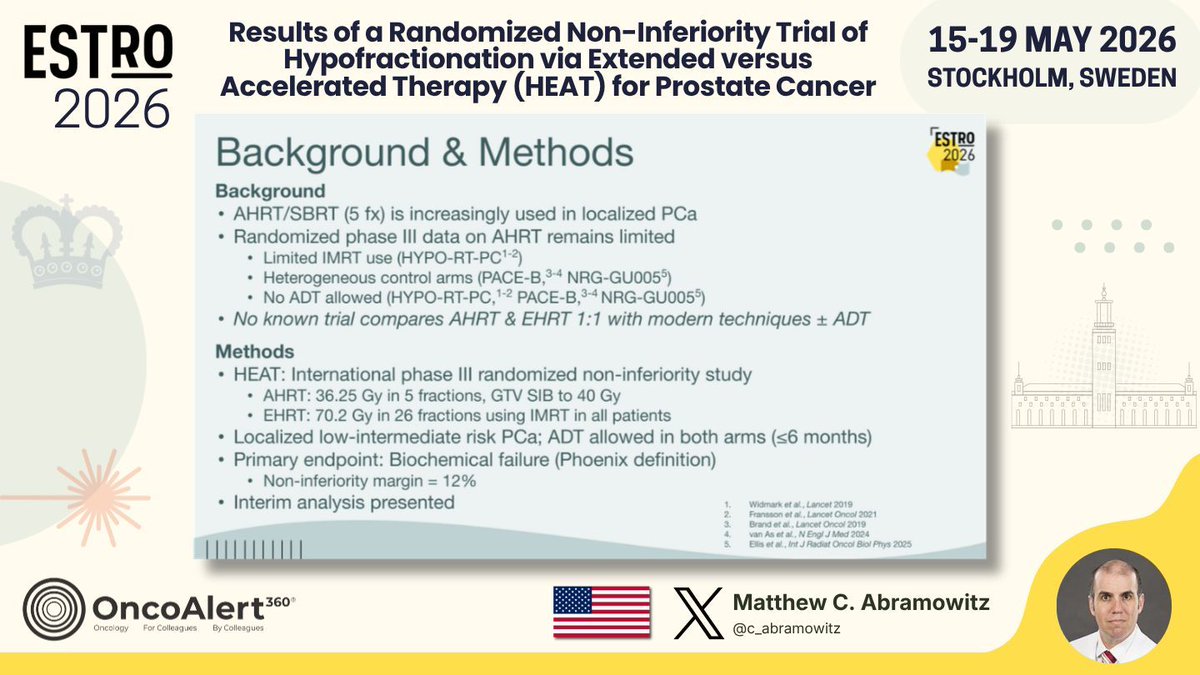
International phase III randomized non-inferiority trial, 1:1, comparing accelerated (AHRT) vs extended (EHRT) hypofractionation. Interim analysis presented; accrual goal n = 456 with 420 evaluable, and 142 analyzed so far. Median follow-up 59.7 months.
Localized low- to intermediate-risk prostate cancer with IPSS <12. Stratified by risk group, prostate volume (<60 cc vs 60-80 cc) and ADT administration. 82.4% intermediate-risk; 28% received ADT.
AHRT: 36.25 Gy in 5 fractions (7.25 Gy per fraction) with GTV SIB to 40 Gy. EHRT: 70.2 Gy in 26 fractions (2.7 Gy per fraction), IMRT in all patients. ADT permitted in both arms, ≤6 months.
Primary: biochemical failure, Phoenix definition, with a non-inferiority margin of 12%. Clinician-reported acute and late GI and GU toxicity reported alongside.
BF 7% vs 7.4%, p-non-inferiority = 0.007 at 4.25y, meeting the non-inferiority criterion.
Acute G2+ GI toxicity lower with AHRT. No significant difference in late G2+ GI or in acute or late G2+ GU. Note that use of supportive medication (laxatives, psyllium) was scored as G2.
The presenters position HEAT against HYPO-RT-PC (limited IMRT use), PACE-B and NRG-GU005 (heterogeneous control arms), all of which allowed no ADT. HEAT is framed as the first trial comparing AHRT and EHRT 1:1 with modern technique plus ADT.
Event counts are low (7% vs 7.4%) against a 12% margin, so the interval around the difference is wide relative to the difference being excluded. The comparator is itself hypofractionated, so this does not test 5 fractions against conventional fractionation.
The question HEAT answers is narrower than 'does SBRT work': it asks whether 5 fractions holds when the control arm is already 26 fractions of IMRT and short ADT is on the table. A positive interim read supports 5 fractions as a default offer in this risk band, but the final prespecified analysis is what settles it.
Interim analysis at 142 of a planned 420 evaluable; prespecified final primary analysis is the gate. Wide 12% margin relative to observed event rates.
- Does non-inferiority hold at the final prespecified analysis
- Effect of concurrent ADT on the fractionation comparison n=60 · primary completion 2028-02 · randomises SBRT +/- relugolix in cFIR/cgUIRn=130 · primary completion 2028-11 · adds ultra-short ADT to single-fraction SBRT
- Late GU outcomes beyond 5 years with 7.25 Gy fractions n=100 · primary completion 2027-10 · 36.25 Gy/5 fx, 1-2mm PTV, late urethra toxicityn=175 · primary completion 2028-12 · 3 fx vs 5 fx benchmark, late GU grade 2+ 1° EPrecruiting Erectile Dysfunction in Good Prognosis Prostate Cancer : Comparison Between Brachytherapy and Stereotactic Body Radiotherapy Phase NAn=240 · primary completion 2030-04 · 7.25 Gy x5 vs I-125 brachy, f/u to 2030
📚 Sources · 🐦 2 tweets
Day FOUR of #ESTRO26 Coverage by OncoAlert 🚨
— OncoAlert (@OncoAlert) May 18, 2026
Results of a Randomized Non-Inferiority Trial of Hypofractionation via Extended versus Accelerated Therapy (HEAT) for Prostate Cancer Presented by Matthew C. Abramowitz🇺🇸 #RadOnc ☢️ #ProstateCancer
HEAT is an international phase… pic.twitter.com/IkSTgQHwXK
The HEAT trial is another randomized demonstration of the safety & efficacy of SBRT compared to hypofractionted RT in #prostatecancer at #ESTRO26 pic.twitter.com/c9sNb3KOqo
— Pierre Blanchard, MD (@PBlanchardMD) May 18, 2026
The longer read
The value of HEAT is not that it shows five-fraction prostate SBRT works. That case was made by HYPO-RT-PC and PACE-B, and five-fraction treatment is already routine in many departments. What HEAT does is remove two objections that survived those trials, and both of them are objections a radiation oncologist actually hits in clinic.
The first is the comparator. HYPO-RT-PC's control arm used limited IMRT, and PACE-B and NRG-GU005 carried heterogeneous control arms, which is the presenters' own framing of the gap. If your alternative to five fractions is 70.2 Gy in 26 fractions delivered with IMRT to every patient, as it is here, the relevant question is whether SBRT matches a modern moderately hypofractionated schedule rather than whether it matches something closer to historical practice. HEAT is designed around that comparison specifically, which makes its answer more directly transferable than a trial whose control arm no one still uses.
The second is ADT. The prior randomized trials in this space did not permit androgen deprivation, which left a real population unrepresented: the intermediate-risk man for whom short-course ADT is on the table. HEAT permitted up to six months in both arms, and 28% of the cohort received it. That is not a large enough subgroup to answer whether SBRT and ADT interact, but it does mean the trial is not silent on the population where the question comes up.
What should temper confidence is the arithmetic of the interim read. With 142 patients analyzed against a planned 420 evaluable, and failure rates of 7% and 7.4%, the trial is excluding a 12% absolute difference using very few events. A non-inferiority margin that wide is defensible for a surrogate endpoint where the absolute event rate is low and the two arms are both expected to perform well, but it means the result rules out a fairly coarse degree of inferiority rather than establishing equivalence. The formal p-value of 0.007 reflects the design working as specified, not a tight estimate of the true difference. The prespecified final analysis is what should move practice, and this interim should be read as consistent with expectation rather than as settling anything.
The toxicity read carries a caveat that is easy to miss and worth carrying into patient conversation. Acute G2+ GI toxicity was lower with the five-fraction arm, which is the opposite of the intuition that a larger fraction size should cost more acutely, and is plausible given the shorter overall treatment time and smaller integrated dose to rectum. But the trial scored use of supportive medication such as laxatives or psyllium as grade 2, which raises event counts in both arms and makes the comparison sensitive to how liberally supportive medication was offered. Late GI and both acute and late GU were comparable, which is the more consequential finding: the concern with 7.25 Gy fractions has always been late effects, and at a median follow-up of 59.7 months there is no signal of a late penalty.